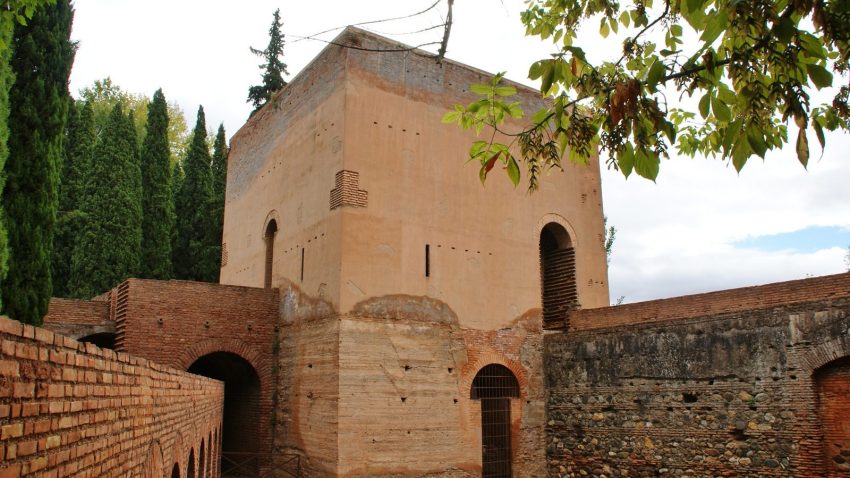
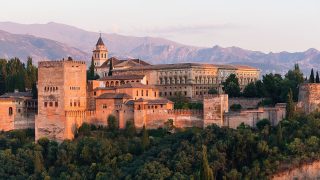
21 Things to See in the Alhambra for Free 2026
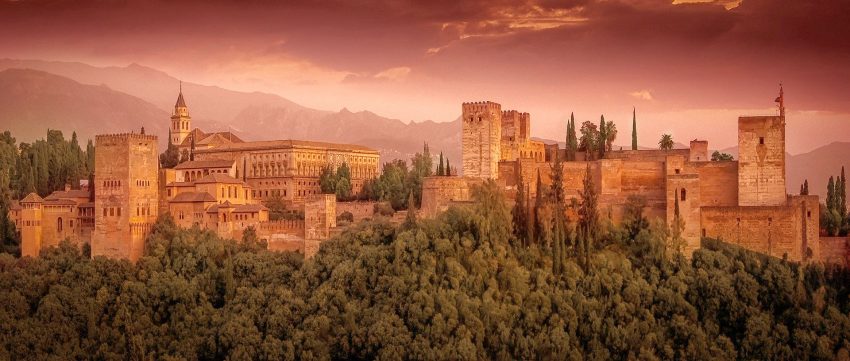
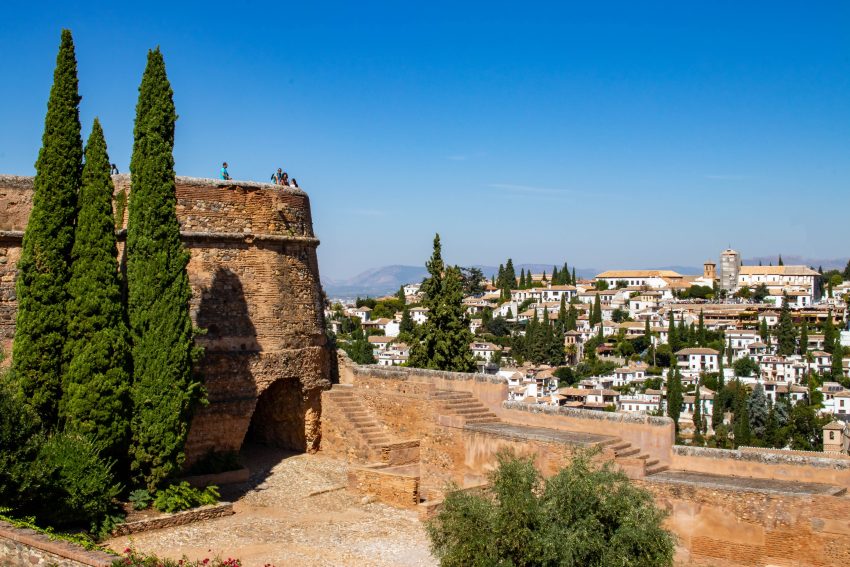
View of Alhambra
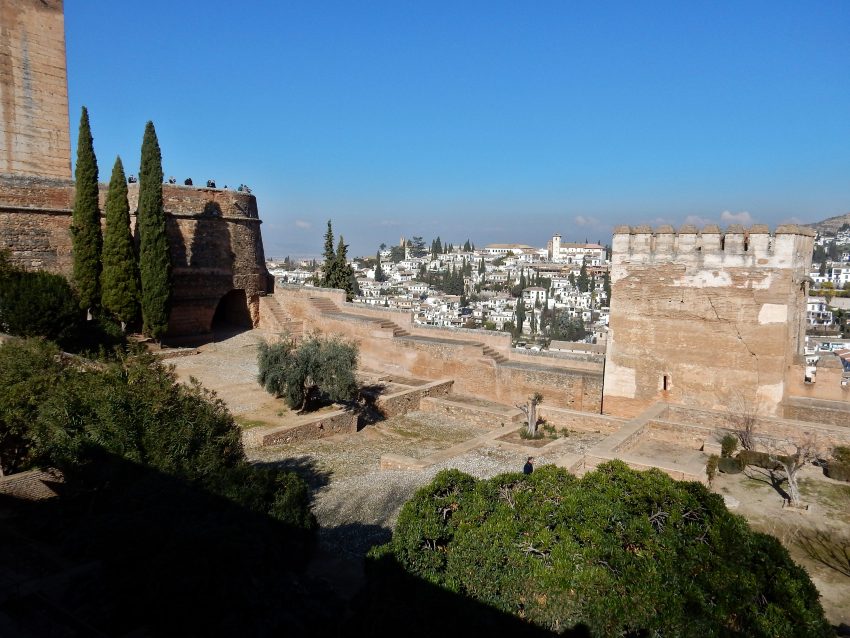
View of Alhambra

This website uses affiliate links which earn a small commission at no additional cost to you.

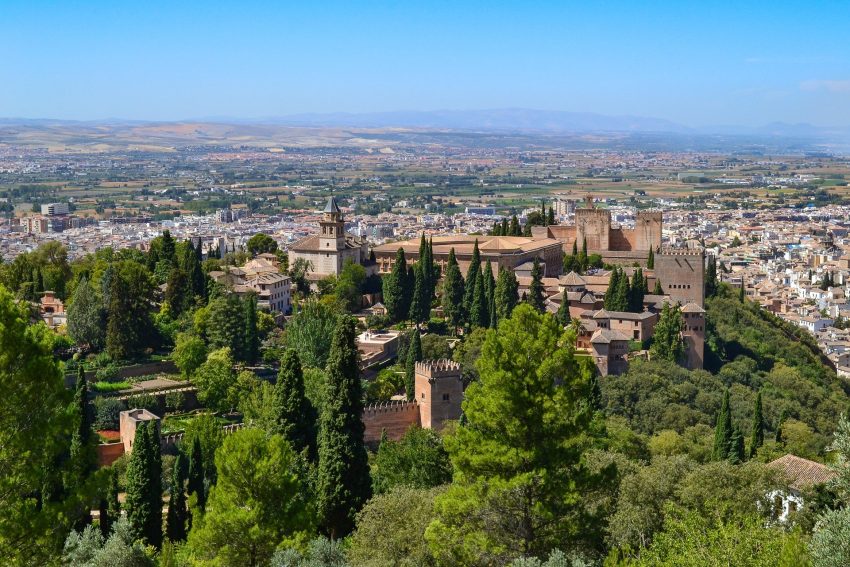
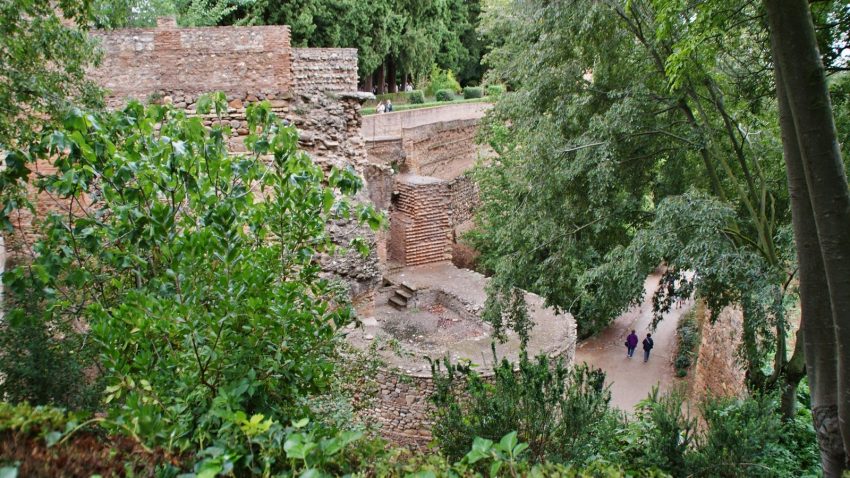
The Alhambra was a fortified city, a complex of palaces, towers, gardens and access gates. This is the reason why a large part of the Alhambra can be seen for free.

1. The Pomegranates Gate
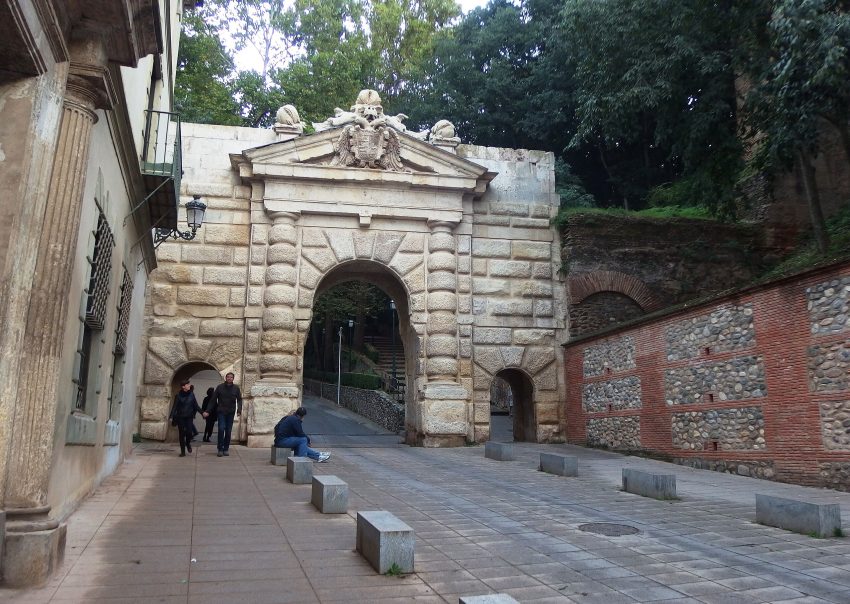
Puerta de Las Granadas Granada 4
CC BY-SA 4.0 / Palickap

If you walk from Plaza Nueva up Cuesta de Gomérez you will find the impressive Puerta de las Granadas or Gate of the Pomegranates.


This is a beautifully preserved medieval gate and is the main access to the forest of the Alhambra. It was built in 1536 and replaced the previous gate which was called Bib-Albuxar or Gate of the good news. Remains of this older gate are still visible on the right side of the gate.

The new gate was constructed in the style of Roman triumphal arches tympanum is shown the Imperial shield, with allegorical figures of Peace and Abundance,  and crowned by three pomegranates, which is where it gets its name.


Location: Puerta de las Granadas, Cuesta de Gomérez, Granada, Spain | Website

We recommend to rent a car in Spain through Discover Cars, they compare prices and review multiple car rental agencies. Book your rental car here.

2. The Forest of Alhambra

Bosque de Alhambra 1
© la-alhambra.org.es

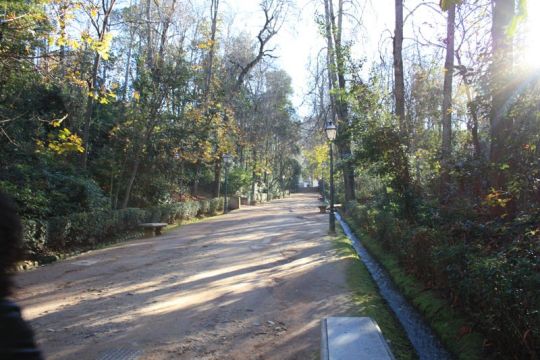
When you pass the Pomegranates Gate you find yourself in the Alhambra forest.


The Bosque de Alhambra or Forest of Alhambra grows around the base of Sabika hill on which the Alhambra Complex is built. There are three paths will lead you into the complex; the side paths are for pedestrians. The right will lead you up to the Crimson Towers, with great views over the forest to the Alcazaba.

The forest was planted in 1729, although its current configuration only dates back to the 19th century. Prior to this the complex was still regarded as a military building and no vegetation was allowed to be grown here.

If you are eager to get to the main part of the Alhambra take the left path, the right if you would like a slight detour to see the Vermilion Towers, or straight ahead along the Cuesta de Gomérez  to explore the park further.

If you walk along the Cuesta de Gomérez you will come across a peculiar Arch hidden in the forest, the Puerta de Birrambla. This was 12th century Arch was moved here in the 19th century, originally it was in the Medina de Granada. 

When the road splits to the left you will see the Fuente del Tomate or Fountain of the Tomato and a Monument to the writer Ángel Ganivet. After admiring the monument, head up the hill towards the Alhambra.


| Website

Here is a complete selection of hotel options in Granada. Feel free to review each one and choose the stay that best suits your needs.

3. The Vermilion Towers

Torres Bermejas Alhambra Granada 3
Flickr / Junta Granada Informa

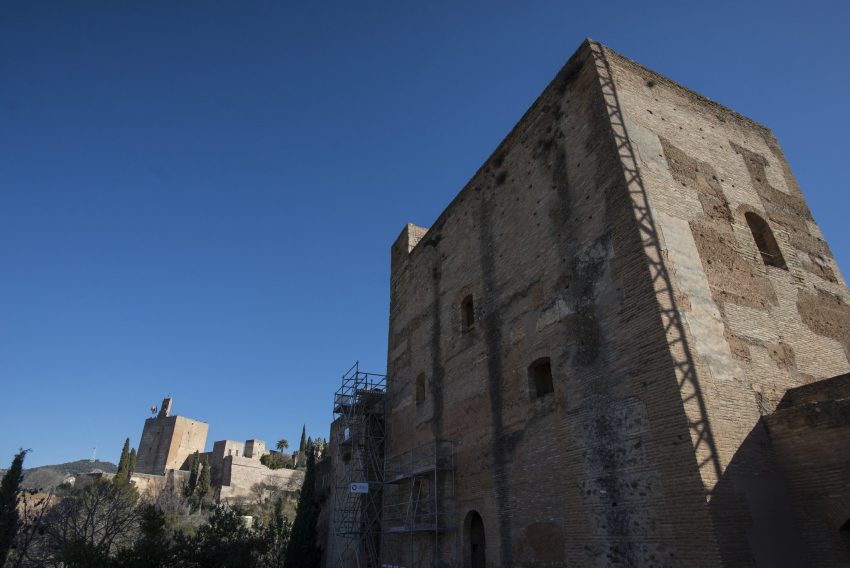
Take a short detour and head up the right path, you will be coming back this way, so you can skip this if you wish. Bear right up the path and climb up the Mauror hill and you will come to the The Vermilion Towers.


The Las Torres Bermejas or Vermilion / Crimson Towers, which are named for the reddish color of their walls, stand on top of the Mauror hill, opposite the Alcazaba of the Alhambra. There are three towers, although the center is considerable taller than the others. They originally stood apart from the Alhambra Palace but were joined by a wall from Alcazaba which goes through the Puerta de las Granadas.

This is a great place to get your first photos of the Alhambra on the opposite hill.

Head back to the Gate of the Pomegranates, and walk up the Cuesta de Gomérez.


Location: Torres Bermejas Callejón Niño del Royo, s/n 18009 Granada Spain

Traveling to a country with a different currency? Avoid ATM transaction fees and pay in local currency with a Wise Card. Having used it for over 5 years, we've saved loads on fees!

4. The Fountain of Charles V

The Pilar de Carlos V or The Fountain of Charles V is a masterpiece of the Spanish Renaissance. In this monumental fountain we can see three big spouts representing the three rivers of Granada: Beyro, Darro and Genil.

Click here to read our blog about 15 Best Things to See and Do in Granada, Spain (2026)

5. The Gate of Justice

Puerta De La Justicia Alhambra Grenada 7
CC BY-SA 3.0 / Martin Furtschegger

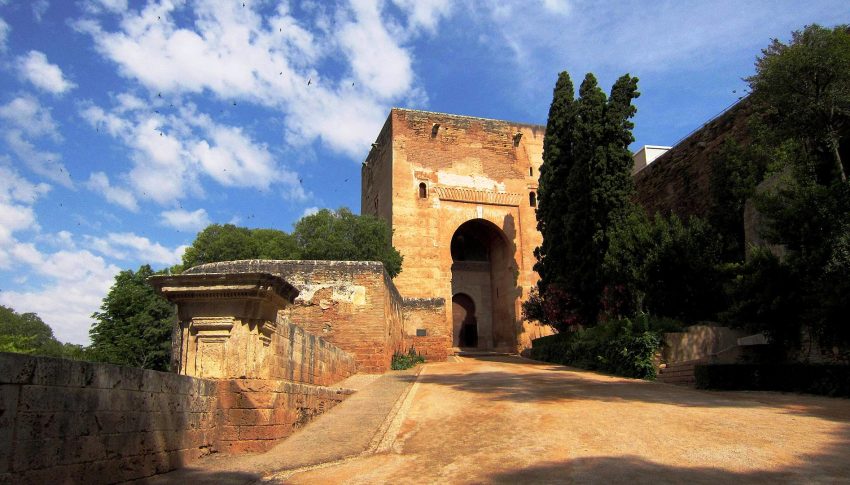
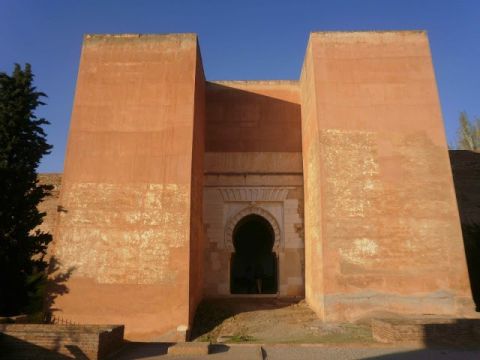
If you pass the fountain and walk up the stairs, turning to the left, you will find the marvelous Gate of Justice.


This is one of the four outer gates that grant access to the walled complex of the Alhambra, and certainly the most impressive and renowned one. It was built in 1348, during the reign of Yusuf I.

The Gate of the Justice is also known as Gate of the Esplanade by the wide space that extended in front of it. The Gate of Justice is adorned with a couple of symbolic icons in the keystone of its arches. The hand carved in the keystone of the outer arch and a key in the center of the inner arch. The Moorish legend say that no Christian would enter Alhambra until the hand touches the key!

We cross this wonderful gate that grants access to the medieval city of the Alhambra. Note as you walk though its formidable defecates, with corners to turn around and then the ramp you neet to advance up.


Location: Justice Gate Calle Real de la Alhambra, 18 18009 Granada Spain | Hours: 24 Hours | Price: Free | Website

Click here to read our blog about The Nasrid Palaces 2026: The Heart of the Alhambra

6. The Plaza de Los Aljibes

Plaza de Los Aljibes, Alhambra, Grenada
CC BY-SA 1.0 / Jebulon

The ramp after the Gate of Justice leads you to the Plaza de Los Aljibes. Don’t look at the Gate of Wine when you walk past, we are coming back to that!


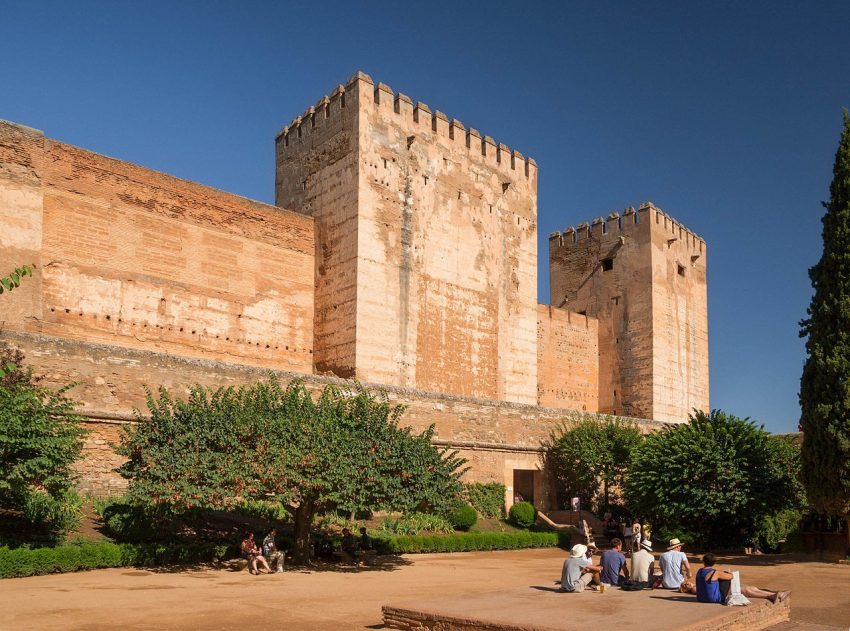
The Plaza de Los Aljibes or Square of the Cisterns is now large central square. It was the dividing line between the Alcazaba fortress  and the Palacio Nazaríes of the Alhambra. Currently, this square is the point of entry to the Alcazaba.

Before the Christian Conquest of Granada in 1492 this used to be a ditch or gully. In 1494 the Count of Tendilla built a water tank or cisterns in the gully and created the square on top, which is where it got its name.

If you look towards the Alcazaba from left to rights are the Torre del Adarguero, which may be hard to see, but it is on the corner, Torre Quebrada , and the Torre del Homenaje.

This is a great place to relax and enjoy the views of the districts of Albaicin and Sacromonte.


Location: Placeta de los Aljibes Plaza Algibes Alhambra, 1T 18009 Granada Spain | Hours: 24 Hours | Price: Free

Click here to read our blog about Generalife, Alhambra 2026: The Architect’s Garden

7. Puerta de la Tahona

Puerta De La Tahona Alcazaba Alhambra 4
CC BY-SA 4.0 / Rumomo

If you go to the far end of the The Plaza de Los Aljibes you will be able to view two more important parts of the Alhambra.


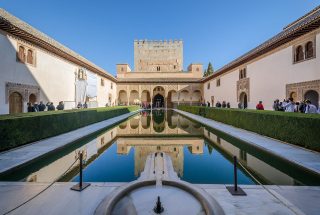
To the left you can see the walls of the Alcazaba and its three towers. Below the Torre del Homenaje lies the Bastion of the Torre del Cubo, with lots of people snapping away wwith their cameras at the view. Below that lies the hole in the wall which is the Puerta de la Tahona or Gate of the Bakery.  This gate was not discovered until 1954, its horseshoe arches bricked up and hidden within the Torre del Cubo which was built around it!

Originally people from Granada would have walked up the Sabika hill to the Puerta de las Armas,  though that gate, walk along the Camino de Ronda or Calle del Foso, beneath the northern walls and towers of the Alcazaba, and through this gate to reach the Palacio Nazaríes.


| Hours: For opening times of the Puerta de la Tahona see Alhambra Opening Times. Access is normally restricted unless to building forms part of the Space of the Month program. | Price: The Puerta de la Tahona is part of the Alhambra Complex and access it you need to purchase Alhambra Tickets or a Alhambra Guided Tour.

Click here to read our blog about Alcazaba, Alhambra 2026: The Fortress of the Alhambra

8. Torre de Mohamed

Torre de Mohamed Alhambra Grenada 5
CC BY-SA 2.0 / Brett Hodnett

Also viewed from the far end of the The Plaza de Los Aljibes is the Torre de Mohamed or Tower of Mohamed. This defensive Tower was built in the time of Mohammed II (1235 – 1302) and would have been the last checkpoint before reaching the Palaces.


| Hours: Entrance to this building is usually restricted and cannot be visited during the ordinary visit of the Alhambra Complex. Access is sometimes permitted with advance registration, through activities arranged by the Board of the Alhambra and the Generalife. It may also be included in the "Space of the Month" programme, which allows the visit of certain spaces normally closed to preserve their conservation and that do not admit a high number of visitors. | Price: The Torre de Mohamed is part of the Alhambra Complex and access it you need to purchase Alhambra Tickets or a Alhambra Guided Tour.

Click here to read our blog about The Nasrid Palaces 2026 | Palace of the Lions

9. Puerta del Vino

Puerta del Vino AlhambraGranada 2
CC BY-SA 32.0 / AdriPozuelo

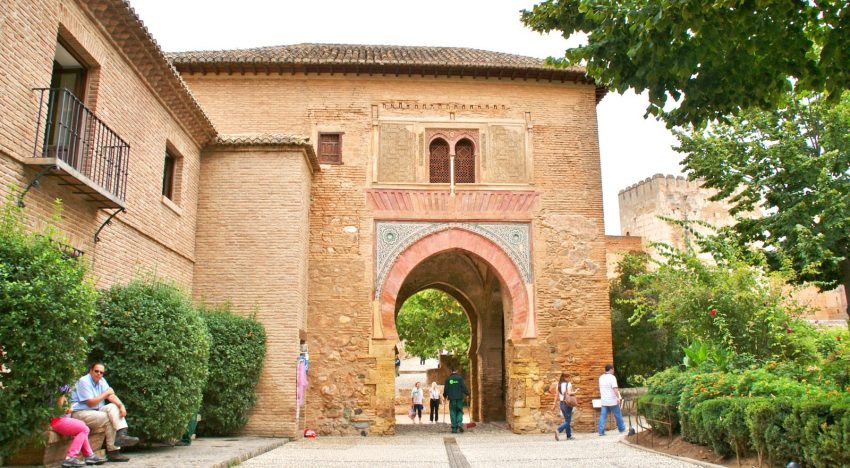
Head back to the south east corner of the Plaza de Los Aljibes, to the Gate of Wine.


The Puerta del Vino or The Gate of Wine is one of the oldest in the Complex and sits in the corner of the Plaza de Los Aljibes.

There are two theories regarding the name. It could have beenthe result of a mistake, in Moorish times it was called Bib al-Hamra, which means Red Gate, this may have been confused with  Bib al-Jamra, which means Wine Gate. Alternatively during the years of Christian occupation, the residents of the Alhambra could purchase wine tax-free and the wine would hae been picked up from here.

The Gate of Wine is quite simple compared the the L shaped Gate of Justice you came through. It was the main entrance to the medina or city of the Alhambra.  Within it you can see a alcove for benches where guards would have sat and controlled the entrance.


Location: Puerta del Vino Plaza Algibes Alhambra, 2T 18009 Granada Spain | Hours: 24 Hours | Price: Free | Website

Click here to read our blog about The Nasrid Palaces 2026 | The Comres Palace

10. Palace of Charles V

Patio Palacio Carlos V In Alhambra
CC BY-SA 4.0 / Ra-smit

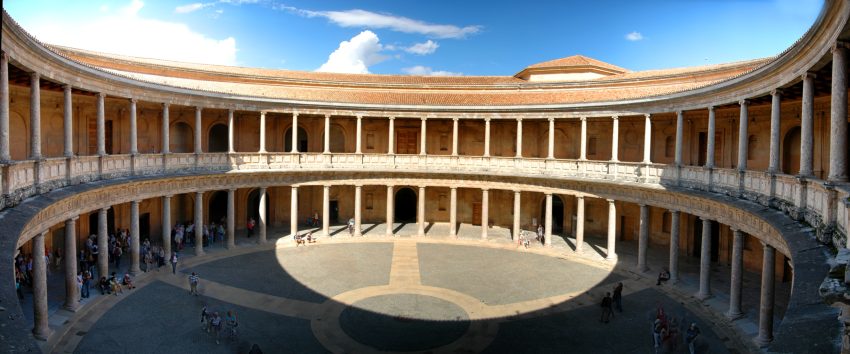
Head through the Puerta del Vino, walk 10m and turn left to get to the entrance of the Palace of Charles V.


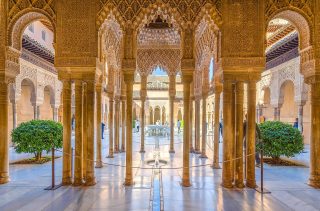
The Palacio de Carlos V or Palace of Charles V is a 16th-century Renaissance palace, built to be used for  King Charles V of Spain’s  future royal residence. The Palace clashes spectacularly with the style of the surrounding Moorish Alhambra. It was one of the first Renaissance buildings created outside of Italy, and was modeled on Florence’s Palazzo Pitti. The building is square but contains a stunning two-tiered circular courtyard with 32 columns which is well worth having a look at.

You can enter the building free of charge. You can also visit the Alhambra Museum and the Museo de Bellas Artes de Granada which is free if you are an EU citizen.


Location: Palacio de Carlos V, Calle Real de la Alhambra, Granada, Spain | Hours: 8.30am-8pm Apr–mid-Oct, to 6pm mid-Oct–Mar, night visits 10-11.30pm Tue-Sat Apr–mid-Oct, 8-9.30pm Fri & Sat mid-Oct–Mar | Price: Access to the Palacio de Carlos V is free via the Puerta de la Justicia on the southern side of the Alhambra. | Website

Click here to read our blog about The Nasrid Palaces 2026 | The Mexuar

11. Church of Santa María de La Encarnación
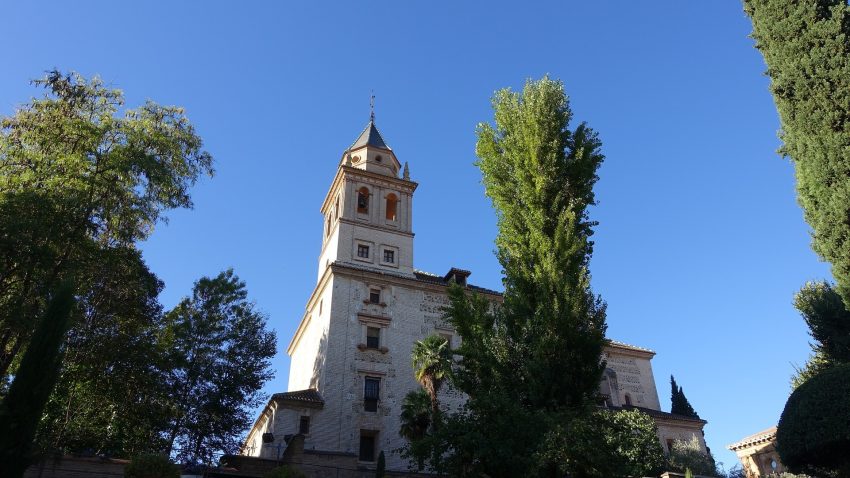
Church of Santa Maria de La Encarnacion Alhambra 3

Walk up the Calle Real or Royal Street and you will see the Church of Santa María de La Encarnación. It is to the south east of the


Church of Santa María de La Encarnación or Church of Santa Maria of the Incarnation is a plain church was built in 17th century on the site of the Great Alhambra Mosque and was built here to represent the triumph of Christianity over Islam.

Look inside to see the The Virgin of Anguish, which is a work of art by Torcuato Ruiz del Peral.

Look outside for the marble pillar which stands in front of the church, and which bears a plaque telling the story of two monks who entered the Moorish kingdom to preach their faith to the heretics. They were beheaded in this place by the Sultan Mohammed V, the ruler who created the lovely Courtyard of Lions.

You do not need a ticket to visit this church.


Location: Church of Santa Maria de la Alhambra Calle Real de la Alhambra, 1-22 18009 Granada Spain | Website

Click here to read our blog about Boabdil, the Kast King of Granada

12. Baño de la Mezquita

Bano de la Mezquita Alambra Granada 6
CC BY-SA 4.0 / Kolforn

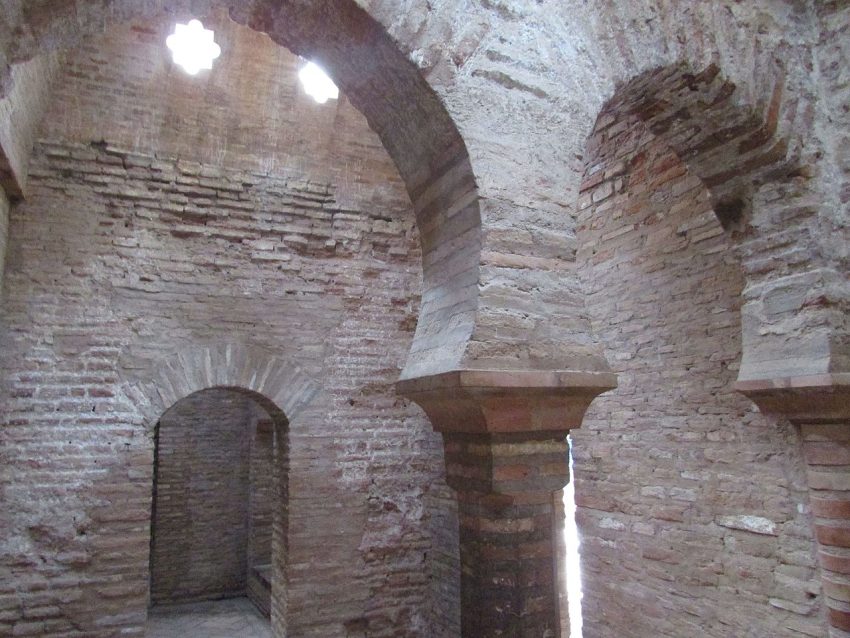
Leaving the Church of Santa María de La Encarnación you head up the Calle Real de la Alhambra a short way before getting to the Baths of the Great Mosque on your left.


The Baño de la Mezquita or the Baths of the Great Mosque were built in the time of Muhammad III (1302-1309) and would have been linked to the Mosque next door. Pop in to have a look at the baths.

The entrance is combined with the Ángel Barrios Museum a famous musician and composer from Granada.  In the 19th century Ángel Barrios’ family lived next door, and managed a tavern which was located in the room where the Baths are. Many popular artists, such as Sorolla, Zuloaga, Ravel and García Lorca would come to the bar.


| Hours: Monday to Sunday from 8:30 a.m. to 8 p.m. (from March 15 to October 14) and from 8:30 a.m. to 6 p.m. (from October 15 to March 14) | Price: Free | Website

Click here to read our blog about The Nasrid Dynasty: Rulers of Granada, the Alhambra, and Their Lasting Legacy

13. Convento de San Francisco

Parador de Granada
Parador de Granada
CC BY-SA 4.0 / Paradores

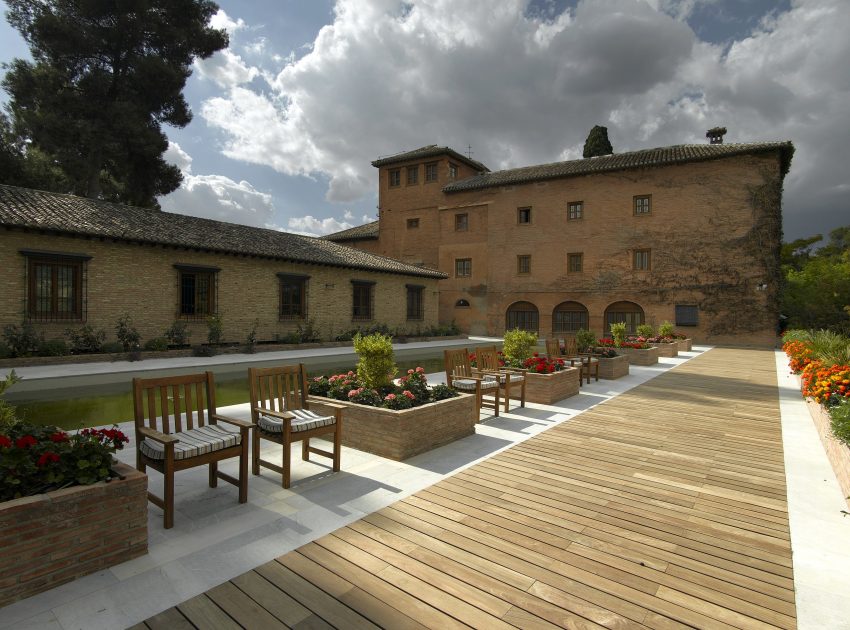
If you continue walking this road you will reach the Convento de San Francisco or Saint Francis Convent.


The Convento de San Francisco or Convent of St Francis has been turned into a luxury Parador hotel. The Parador de San Francisco, is located in the former convent which was constructed by the Catholic Monarchs in 1493 on a former Nasrid palace, the Palacio de los Infantes, which was erected during the reign of Muhammad II between 1303 and 1309. In this convent, Queen Isabella was buried before being moved to the Royal Chapel.

Enter the hotel for a relaxing drink or just pop in to see the chapel.


Click here to read our blog about History of the Alhambra

14. Puerta de los Carros

puerta de los carros 2
© Board of the Alhambra and Generalife

Head back towards the Palace of Charles V and turn left when you can. Head down the road the taxis are probably going and you will come to the Puerta de los Carros.


The Puerta de los Carros or Gate of the Carriages was created between 1526 and 1536 with the sole purpose of facilitating the passage for the construction works in the Palace of Charles V. It is the only current vehicle access to the Alhambra.


| Website

Click here to read our blog about The Land of Al-Andalus

15. Torre de las Cabezas

Torre de las Cabezas Alhambra
Flickr / Elliott Brown

Carry on walking down the Calle Real de la Alhambra with the The Forest of Alhambra on your right and the walls of the Alhambra on your left. You will probably unknowingly walk past the Torre de las Abencerrajes, which would be on your left. You will come to a junction at the base of the Torre de las Cabezas.


The Torre de las Cabezas or Tower of the Heads is a defensive tower which also served as a prison.


| Hours: For opening times of the Torre de las Cabezas see Alhambra Opening Times. Access is normally restricted unless to building forms part of the Space of the Month program. | Price: The Torre de las Cabezas is part of the Alhambra Complex and access it you need to purchase Alhambra Tickets or a Alhambra Guided Tour.

Click here to read our blog about Guided Tours of the Alhambra 2026: Which One to Choose?

16. Torre de los Siete Suelos

Torre de los siete suelos Alhambra Grenada
CC BY-SA 4.0 / Angvm11

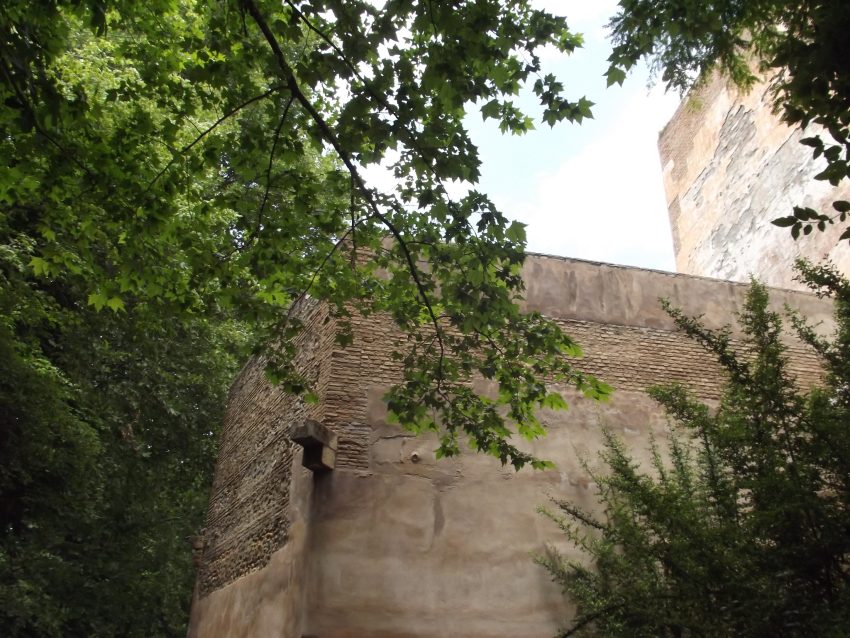
Continue along the base of the walls. You will pass the Torre de la Bruja or Witch’s Tower and the Torres del Capitán, before reaching the Torre de los Siete Suelos.


The Torre de los Siete Suelos or Tower of the Seven Floors was once an important entrance to the Medina or City of the Alhambra. Legend say that the last Nasrid king, Boabdil, came out through this gate to give the keys of the Alhambra to the Catholic Monarchs, and he asked them not to allow anyone to use it again and therefore to close it down for ever. There is also  a legend of the poor and honest water carrier who receives in gratitude for his hospitality, to a dying Moor, who takes him to that door. Once there, he sees the ground open and an immense quantity of gold and jewels appear before him.

Just behind you in the park is the Fuente del Pimiento or Pepper Fountain.


Location: Puerta de Siete Suelos 18009 Granada Spain | Hours: Entrance to this building is usually restricted and cannot be visited during the ordinary visit of the Alhambra Complex. Access is sometimes permitted with advance registration, through activities arranged by the Board of the Alhambra and the Generalife. It may also be included in the "Space of the Month" program, which allows the visit of certain spaces normally closed to preserve their conservation and that do not admit a high number of visitors. | Price: The Puerta de Siete Suelos is part of the Alhambra Complex and access it you need to purchase Alhambra Tickets or a Alhambra Guided Tour. | Website

Click here to read our blog about Your Complete Guide to Alhambra Tickets (2026)

17. Torre del Agua

Torre del Agua Alhambra Grenada 43
CC BY-SA 3.0 / AdriPozuelo

Continue walking along the walls. You will pass the Torre de Baltasar de La Cruz and the
Torre de Juan de Arce. Turn left at the la Mimbre Restuarant and you will see the Torre del agua on your left.


The Torre del Agua or Water Tower is a large three floor defensive tower. It was built here to protect the aqueduct that takes water from the Generalife to the Alhambra. It was completely destroyed by Napoleons troops 1812 and what you see is a reconstruction.


| Hours: For opening times of the Torre del Agua see Alhambra Opening Times. | Price: The Torre del Agua is part of the Alhambra Complex and access it you need to purchase Alhambra Tickets or a Alhambra Guided Tour. | Website

Click here to read our blog about Walk the Paseo de las Torres in Granada 2026: Views, Towers & History

18. Torre de las Infantas de la Alhambra
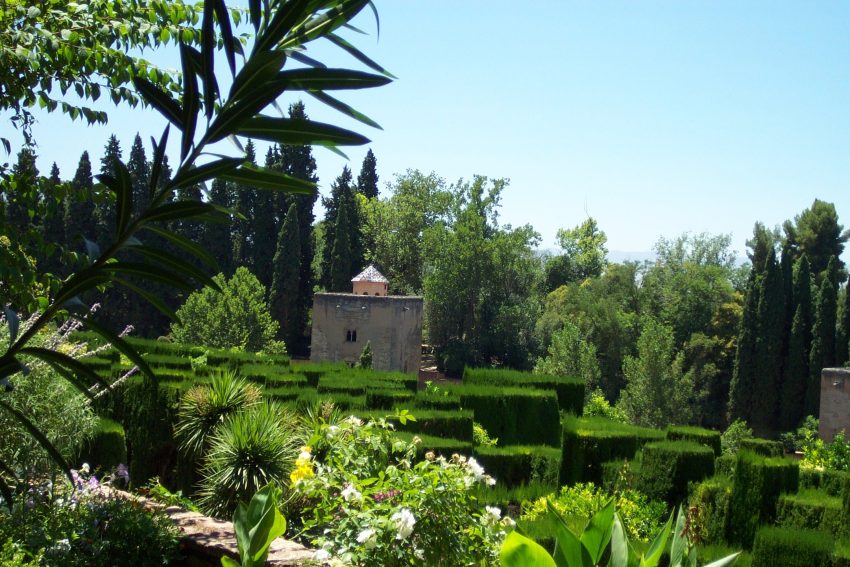
Torre de las Infantas de la Alhambra Grenada 2
CC BY-SA 3.0 / Juandev

You pass underneath the bridge the Torre del agua protected and come to the Torre del Cabo de la Carrera. The Torre del Cabo de la Carrera or Tower of the End of the Street, again was mostly destroyed by Napoleon’s troops in 1812. You now will be walking down Cuesta del Rey Chico or Street of the Biy King or Cuesta de los Chinos or street of the Chinese. The Generalife will be on you right and the Alhambra Complex on your left.


You come across the Torre de las Infantas or Tower of the Princesses on your left. Since the 17th century it has been called the Tower of the Princesses  from the legend by Washington Irving about the princesses Zaida, Zoraida and Zorahaida. Zayda, Zorayda and Zorahayda were daughters of King Muhammad VII, who lived in the Tower of the Infantas. The older two fled with their lovers, but the younger did not dare and was locked in the watchtower until her death.


Location: Torre de las Infantas de la Alhambra Calle Real de la Alhambra 18009 Granada Spain | Hours: For opening times of the Torre de las Infantas see Alhambra Opening Times. Entrance to this building is usually restricted and cannot be visited during the ordinary visit of the Alhambra Complex. Access is sometimes permitted with advance registration, through activities arranged by the Board of the Alhambra and the Generalife. It may also be included in the "Space of the Month" program, which allows the visit of certain spaces normally closed to preserve their conservation and that do not admit a high number of visitors. | Price: The Torre de las Infantas is part of the Alhambra Complex and access it you need to purchase Alhambra Tickets or a Alhambra Guided Tour. | Website

19. Puerta de Hierro
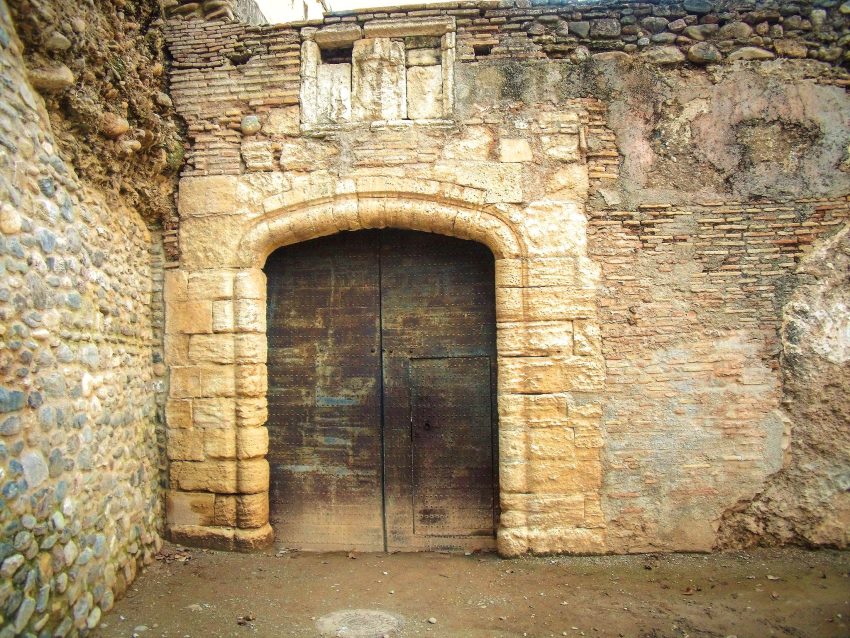
Puerta de Hierro Alhambra
© Andrew Ashton

Continue walking past the Torre de la Cautiva or Tower of the Captive and the Torre del Cadí or Tower of the Judge, untill you see the Torre de los Picos on your left.


The Puerta de Hierro or Iron Gate was built just after the conquest of Alhambra. The gate is a fortified bastion that juts out beneath the walls of the Alhambra to protect a door that sits below the Torre de los Picos. The bastion contains a stables and a small courtyard.

The Puerta de Hierro is overlooked by the  Torre de los Picos or Tower of the Points which received this name because its merlons end in brick pyramids. It was built in the late 13th century or beginning of the 14th and it is therefore surprising for it to appear in the Gothic style.


| Hours: For opening times of the Puerta de Hierro see Alhambra Opening Times. Access to the Puerta de Hierro is normally restricted, unless it is open as part of the Space of the Month program. | Price: The Puerta de Hierro is part of the Alhambra Complex and access it you need to purchase Alhambra Tickets or a Alhambra Guided Tour.

20. Paseo de los Tristes and Casa de las Chirimías
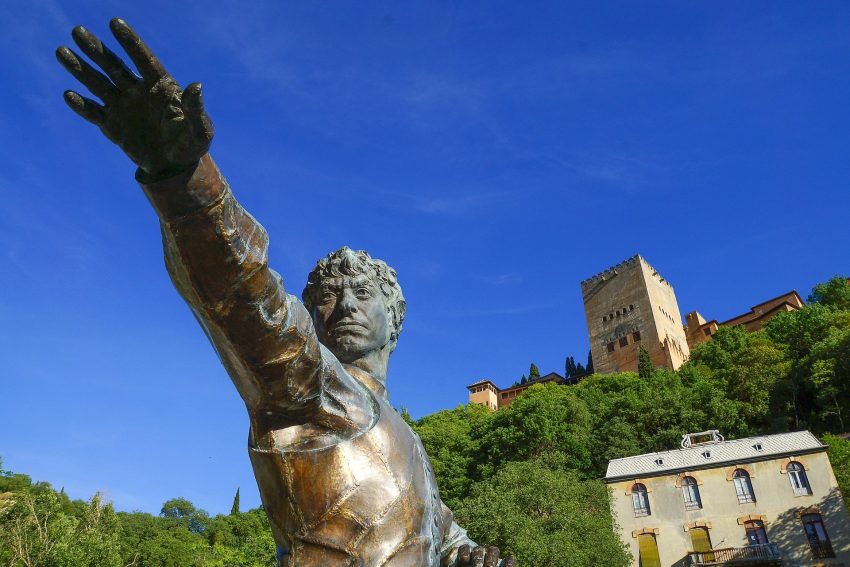
Paseo de los Tristes Granada

Continue down the Cuesta del Rey Chico, past the Puerta de Hierro, you will come across an open area, across which you will see the Puerta del Bosque, a small entrance in the outer walls of Alhambra. Continue down and just after passing a small college you will cross the River Darro over the 11 Century Puente del Aljibillo or Bridge Aljibillo. Turn left onto and walk along the Paseo de los tristes, which has great views of the Alhambra above you.


The Paseo de los tristes or Promenade of the Sad is a lively square with amazing views of the Alhambra. There are plenty of restaurants where you can sit out side and enjoy a pleasant rest. Towards the end of the paseo there is an tower Casa de las Chirimías where dignitaries would watch the fiestas below from the balcony, with musicians playing above them.


Location: Paseo de los tristes, granada Calle Reyes Católicos, 32 18001 Granada Spain | Hours: 24 Hour | Price: Free

21. Puente del Cadi

Puerta de los Tablero Granada 5
CC BY-SA 3.0 / Balbo

Walk down the Carrera del Darro, you will pass the 16th century Parroquia de San Pedro y San Pablo or Church of San Pedro and San Pablo on your left and the Convento de Santa Catalina de Zafra on your right. The left side opens up again and you are walking alongside the Darro. You will see the remains of a Bridge tower on your left.


The Puente del Cadi or Bridge of the Cadi was once an important defense of the Alhambra, it was a combined water gate and bridge. The one remaining of the two towers can be seen across the river. There would have been a city wall from that up the the Puerta de las Armas. The gate was called Puerta de los Tablero or Door of the Boards, which refereed the the system of damning water using wooded boards.


Location: Puente del Cadi, Carrera del Darro, 33, 35 18010 Granada Spain

Continue down the Carrera del Darro and you will come to the Plaza Nueva de Granada, where you started.

Powered by GetYourGuide
Moira & Andy
Moira & Andy

Hey! We're Moira & Andy. From hiking the Camino to trips around Europe in Bert our campervan — we've been traveling together since retirement in 2020!

Read our full story here

This website uses affiliate links which earn a small commission at no additional cost to you.

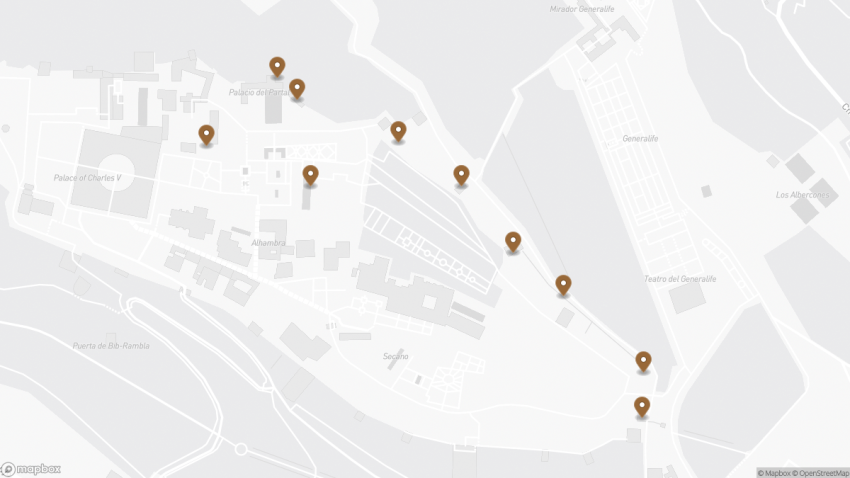
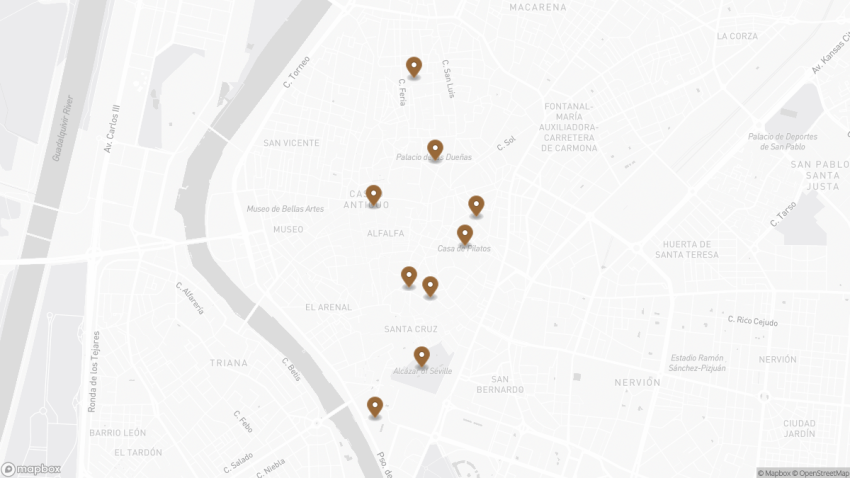
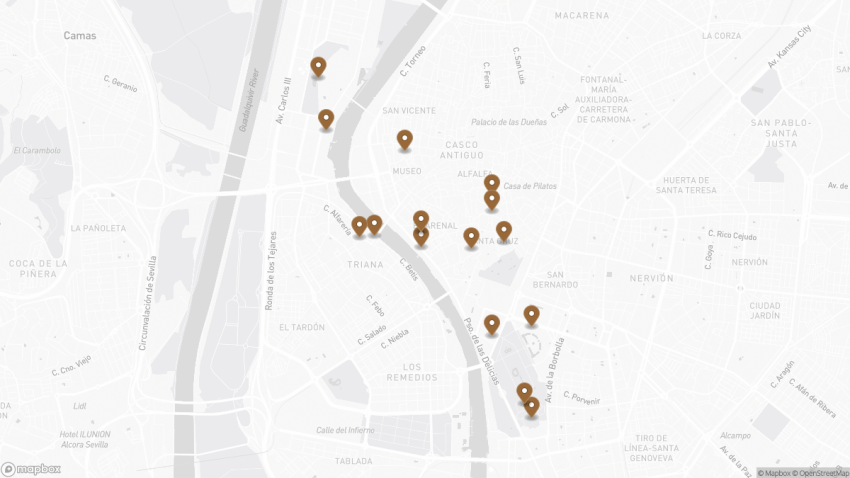
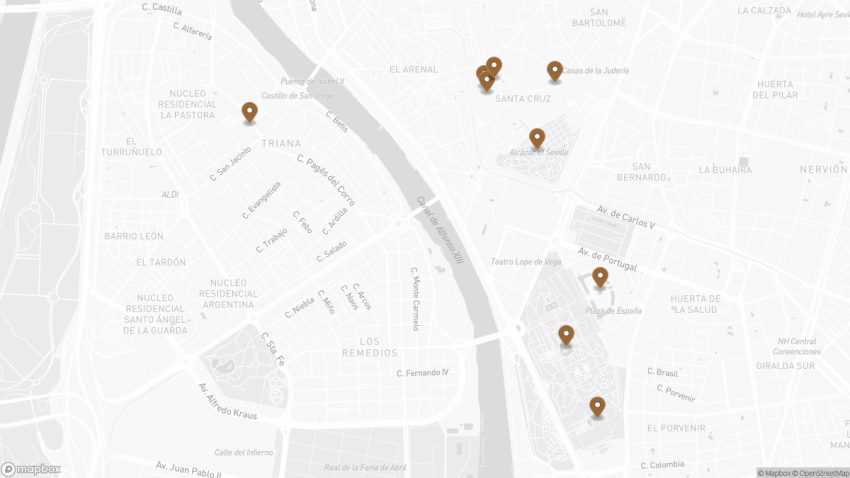
Walking Tour Map
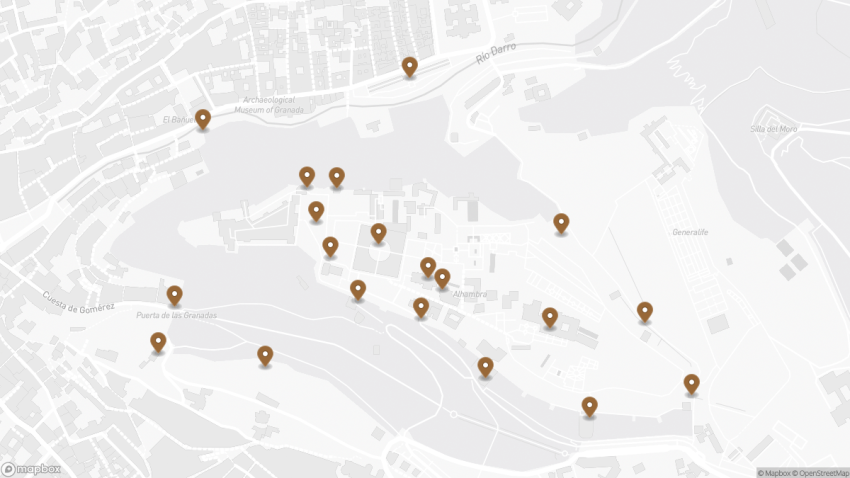
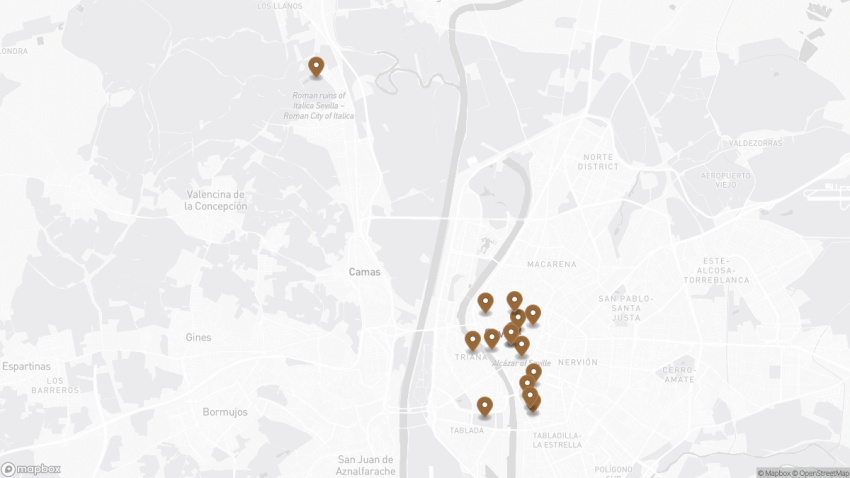
Map of the 21 Things to See in the Alhambra for Free walking route with 20 stops in Granada.
Preview map of the 21 Things to See in the Alhambra for Free route in Granada, showing 20 stops. Use the interactive map to zoom and tap markers.

Similar Blogs

Walk the Paseo de las Torres in Granada 2026: Views, Towers & History

Paseo de las Torres Alhambra

This website uses affiliate links which earn a small commission at no additional cost to you.

The Paseo de las Torres or Promenade of the Towers, is a landscaped promenade dotted by various towers, gardens, and Nasrid ruins. It connects the Jardines del Partal with the Alhambra Alta and the Generalife.

1. Torre de la Rauda

Torre de Ruada, Alhambra

We will start just to the north of the Church of Santa Maria de la Alhambra at the Torre de la Rauda. The tower used to be a entrance to Palacio de los Leones.

The Tower takes its name from the Royal Cemetery that is locate just to its south, which was thought to be the burial place of the kings of Granada. Rauda means garden, cemetery or paradise in Arabic. It is thought that King Boabdil took the remains of his ancestors with him when Granada fell to the Christians.


| Hours: For opening times of the Torre de la Rauda see Alhambra Opening Times. Access is normally restricted unless to building forms part of the Space of the Month program. | Price: The Torre de la Rauda is part of the Alhambra Complex and access it you need to purchase Alhambra Tickets or a Alhambra Guided Tour. | Website

We recommend to rent a car in Spain through Discover Cars, they compare prices and review multiple car rental agencies. Book your rental car here.

2. Torre de las Damas

Torre de las Damas Alhambra

Walk through the Gardens of the Partal to the Torre de las Damas or Tower of the Ladies. The tower has also been called “Partal“, which means portico, because of the portico formed by the five arches that often reflect on the rectangular pond. The gardens and the palace get its name from this. The Partal or Portico palace was built by Sultan Muhammad III (1302-1309) and is the oldest preserved in the Alhambra.

The Torre de las Damas is a spectacular viewpoint from which you can see both the Albaicín and the Generalife.

To the left of this tower are three small Arab houses, built after the tower and attached to it. In one of them some paintings were discovered which, although deteriorated and incomplete, are the only paintings of this type in Muslim Spain. Made in the first half of the s. XIV, represent hunting scenes, fantastic animals, men and women.


Location: Torre de las Damas Callejon Guindo, 2T 18009 Granada Spain | Hours: For opening times of the Torre de las Damas see Alhambra Opening Times. | Price: The Torre de las Damas is part of the Alhambra Complex and access it you need to purchase Alhambra Tickets or a Alhambra Guided Tour. | Website

Here is a complete selection of hotel options in Granada. Feel free to review each one and choose the stay that best suits your needs.

3. Mezquita del Partal

Mezquita del Partal Alhambra
CC BY-SA 3.0 / Sylvain Gimenez

This small tower rises to the right of the portico of the Partal and on the adarve of the wall. The Nasrid Sultan Yusuf I (1333-1354) had it built. The interior of the oratory, for private use, is decorated with plasterwork based on Kufic inscriptions and plant or vegetal motifs.

The façade, which has a horseshoe arch in its center, still preserves remains of the decorative plasterwork. The interior room is divided into two unequal parts by a semicircular arch. The mihrab, with a roof made of assembled wood, is very similar to that of North African mosques. The following inscription can be read on its horseshoe-covered arch of muqarnas: “Come and pray and do not be negligent.


Location: Oratorio del partal 18009 Granada Spain | Hours: For opening times of the Mezquita del Partal see Alhambra Opening Times | Price: The Mezquita del Partal is part of the Alhambra Complex and access it you need to purchase Alhambra Tickets or a Alhambra Guided Tour.

Traveling to a country with a different currency? Avoid ATM transaction fees and pay in local currency with a Wise Card. Having used it for over 5 years, we've saved loads on fees!

4. Palacio de Yusuf III

Palacio de Yusuf III Alhambra 5

Leaving the Partal Gradens, you come to the Palace of Yusuf III (1408-1417).  Standing out from the gardens is the long pool which would have sat in the central courtyard. It is surrounded by lush gardens which are scattered with the ruins of the palace. It would have resembled the Palacio de Comares. During the days of the Catholic monarchs the palace was the domain of the the Lords of Mondéjar, or Tendilla, who ruled the palace on behalf of the Royals.

Towards the front of the courtyard are the remains of a tower overlooking the open patio. The remains of the tower form a terrace that provides one of loveliest views to be had in the Alhambra.


| Hours: For opening times of the Palacio de Yusuf III see Alhambra Opening Times. | Price: The Palacio de Yusuf III is part of the Alhambra Complex and access it you need to purchase Alhambra Tickets or a Alhambra Guided Tour.

Click here to read our blog about 15 Best Things to See and Do in Granada, Spain (2026)

5. Torre de Los Picos

Torre de los Picos Alhambra Grenada 6
Flickr / Elena

This distinctive three-story tower is known by this name for its battlements which are finished with brick pyramids. The tower served to defend an entrance to the fortress. A stairway descends from the tower to the to its base which ends at the Puerta del Arrabal. In the days of the Catholic monarchs barracks and protective bastion was built around the bastion below Puerta del Arrabal to give it more protection. This bastion has another exit called the Puerta de Hierro, or Gate of Iron.

This tower forms a mysterious and fantastic set that inspired Washington Irving to describe the powerful and wealthy Jew Almamen, who was hiding in this place to seek revenge against the seducer of his daughter.


Location: Torre de los Picos C. Real de la Alhambra Centro 18009 Granada Spain | Hours: For opening times of the Torre de los Picos see Alhambra Opening Times. Access is normally restricted unless to building forms part of the Space of the Month program. | Price: The Torre de los Picos is part of the Alhambra Complex and access it you need to purchase Alhambra Tickets or a Alhambra Guided Tour.

Click here to read our blog about The Nasrid Palaces 2026: The Heart of the Alhambra

6. Torre del Cadi

Torre del Cadi Alhambra Granada 4
CC BY-SA 1.0 / Jebulon

The next tower along the battlements is a small watch tower the Torre del Cadi or Tower of the Judge. In the 16th century it was also called the Torre del Preso or Prisoner’s Tower. Although its most interested name is from the 17th and 18th centuries when it was called the Torre del paso de la zorra or The passing of the Vixen.

This tower was restored in 1924 and faces the alley that leads to the original entrance of the Generalife.


Location: Torre del Cadí Generalife Centro 18009 Granada Spain | Hours: For opening times of the Torre del Cadí see Alhambra Opening Times. | Price: The Torre del Cadí is part of the Alhambra Complex and access it you need to purchase Alhambra Tickets or a Alhambra Guided Tour.

Click here to read our blog about Generalife, Alhambra 2026: The Architect’s Garden

7. Torre de la Cautiva

Torre de la Cautiva Alhambra Granada 2
CC BY-SA 3.0 / Holycharly

The Torre de la Cautiva or the Tower of the Captive because according to romantic legend Isabel de Solís was held prisoner here before becoming the Sultan’s wife and changing her name to Soraya.

On the outside the Tower of the Captive is virtually indistinguishable from the other towers. Its interior has however one of the most richly decorated room spaces in all the Alhambra. It has also been called the Tower of the Thief, Tower of the of the Ladies and Tower of the of the Sultana.


Location: Torre de la Cautiva, Generalife, Granada, Spain | Hours: For opening times of the Torre de la Cautiva see Alhambra Opening Times. | Price: The Torre de la Cautiva is part of the Alhambra Complex and access it you need to purchase Alhambra Tickets or a Alhambra Guided Tour. | Website

Click here to read our blog about Alcazaba, Alhambra 2026: The Fortress of the Alhambra

8. Torre de las Infantas

Torre de las Infantas de la Alhambra Grenada 2
CC BY-SA 3.0 / Juandev

The Torre de las Infantas or Tower of the Princesses is a small tower / palace from the mid 15th century.

Legend has it that the Kingdom of Granada, was ruled by a Sultan named Mohamed “The Left-Handed”, who married a Christian captive and they had three beautiful daughters. The Sultan consulted an astrologer to read his daughters futures. He was told that he would not have to worry until his daughters were of marriageable age, but he should carefully guard them. The fearful Sultan decided to watch over them from a young age, and locked them in a tower of the Alhambra, that is, with all the luxuries at his fingertips. Thus his three daughters Zaida, Zoraida and Zorahaida,  grew up locked in the tower until they were already of marriageable age.  From the tower, they could see a group of Christian knights who had been taken prisoners, and fell in love with them. They wanted to become Christians, escape and marry the prisoners. They planned this with the help of their nursemaid. On the night of their escape the youngest, Zorahaida changed her mind as she did not want to go against her fathers wishes. Her two older sisters lived happily with their knights in Córdoba, while Princess Zorahaida was kept in the tower, her spirit still lives there waiting for her Christian knight to rescue her.


Location: Torre de las Infantas de la Alhambra Calle Real de la Alhambra 18009 Granada Spain | Hours: For opening times of the Torre de las Infantas see Alhambra Opening Times. Entrance to this building is usually restricted and cannot be visited during the ordinary visit of the Alhambra Complex. Access is sometimes permitted with advance registration, through activities arranged by the Board of the Alhambra and the Generalife. It may also be included in the "Space of the Month" program, which allows the visit of certain spaces normally closed to preserve their conservation and that do not admit a high number of visitors. | Price: The Torre de las Infantas is part of the Alhambra Complex and access it you need to purchase Alhambra Tickets or a Alhambra Guided Tour. | Website

Click here to read our blog about The Nasrid Palaces 2026 | Palace of the Lions

9. Torre del Cabo de la Carrera

Torre del Cabo de la Carrera Alhambra Grenada 2
CC BY-SA 3.0 / AdriPozuelo

The Torre del Cabo de la Carrera or Tower at the end of the Street get its name as it is positioned at the end of the Calle Mayor of the Alhambra. All that s left of the building is its lower walls, since it was destroyed by Napoleon’s troops in 1812 when they left Granada.

There was an inscription which said it was restored in 1502 by the Catholic Monarchs.


Location: Torre del Cabo de la Carrera Generalife Centro 18009 Granada Spain | Hours: For opening times of the Torre del Cabo de la Carrera see Alhambra Opening Times. | Price: The Torre del Cabo de la Carrera is part of the Alhambra Complex and access it you need to purchase Alhambra Tickets or a Alhambra Guided Tour.

Click here to read our blog about The Nasrid Palaces 2026 | The Comres Palace

10. Torre del Agua

Torre del Agua Alhambra Grenada 43
CC BY-SA 3.0 / AdriPozuelo

The Torre del Agua or Water Tower is the most eastern tower. It was called the Water Tower as it guarded the aqueduct that carries the water from the Generalife to the Alhambra. These waters came from the Darro river through a mix of pools, cisterns and wells and supplied all the water to the inhabitants of Alhambra.

Similar to the Torre del Cabo de la Carrera it was blown up in 1812, with only its foundations left. Its walls have been reconstructed although it is hollow inside.


| Hours: For opening times of the Torre del Agua see Alhambra Opening Times. | Price: The Torre del Agua is part of the Alhambra Complex and access it you need to purchase Alhambra Tickets or a Alhambra Guided Tour. | Website

Click here to read our blog about The Nasrid Palaces 2026 | The Mexuar

Powered by GetYourGuide
Moira & Andy
Moira & Andy

Hey! We're Moira & Andy. From hiking the Camino to trips around Europe in Bert our campervan — we've been traveling together since retirement in 2020!

Read our full story here

This website uses affiliate links which earn a small commission at no additional cost to you.

Walking Tour Map
Map of the Walk the Paseo de las Torres in Granada: Views, Towers & History walking route with 10 stops in Granada.
Preview map of the Walk the Paseo de las Torres in Granada: Views, Towers & History route in Granada, showing 10 stops. Use the interactive map to zoom and tap markers.

Similar Blogs

48 Hours in Ronda 2026: The Perfect Two-Day Itinerary

Mirador de Aldehuela

This website uses affiliate links which earn a small commission at no additional cost to you.

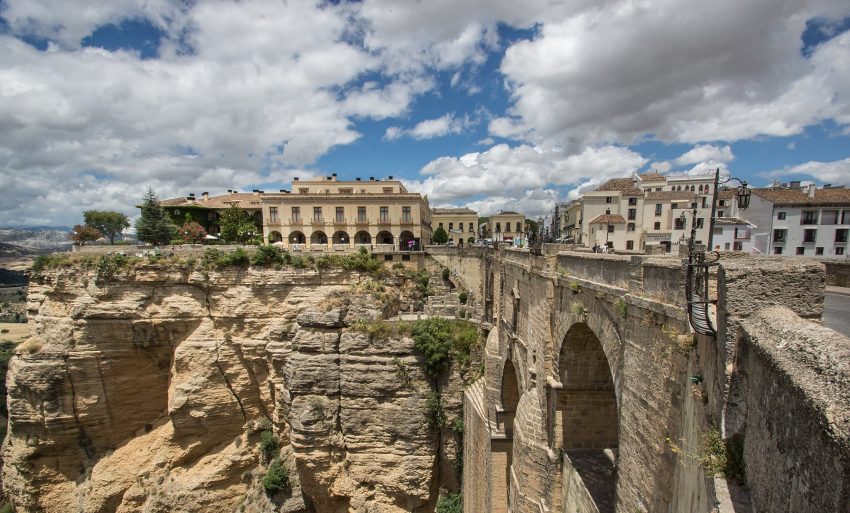
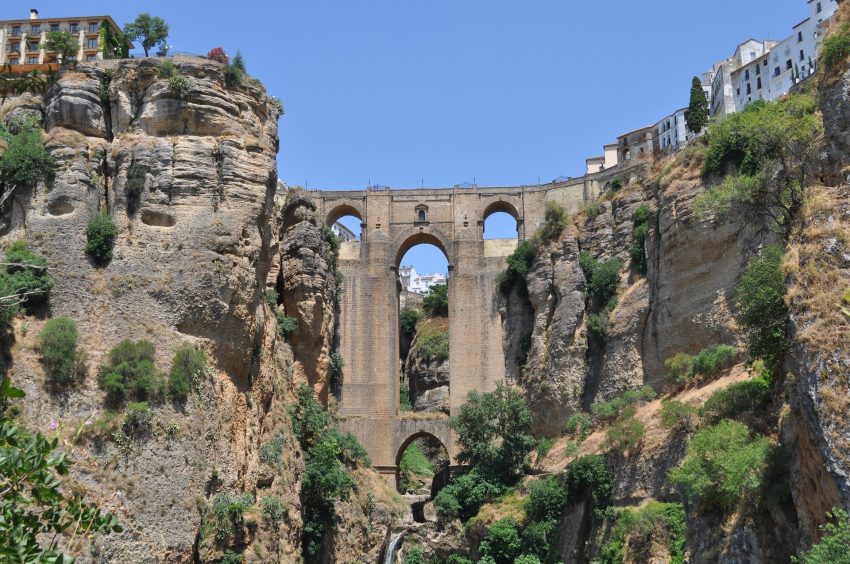
Ronda is without a doubt, one of the most amazing hidden gems in Andalucia. It is a small yet charming historic hilltop city, home to the spectacular Puente Nuevo, an iconic stone bridge, and an old and new part of town covered in cobblestone streets.

48 hours in Ronda will enable you to take in all it has to offer, from the dramatic El Tajo gorge to one of Spain's most historic and beautiful bullrings.

Bridges!

El Tajo de Ronda 3
El Tajo de Ronda 3
CC BY-SA 3.0 / Pedro J Pacheco

Start at the Alameda del Tajo by the Bullring and walk along the Paseos.

When you get to the square with the statue of a bull – Monumento al Toro. You should pop in the Tourist office and pick up a map.

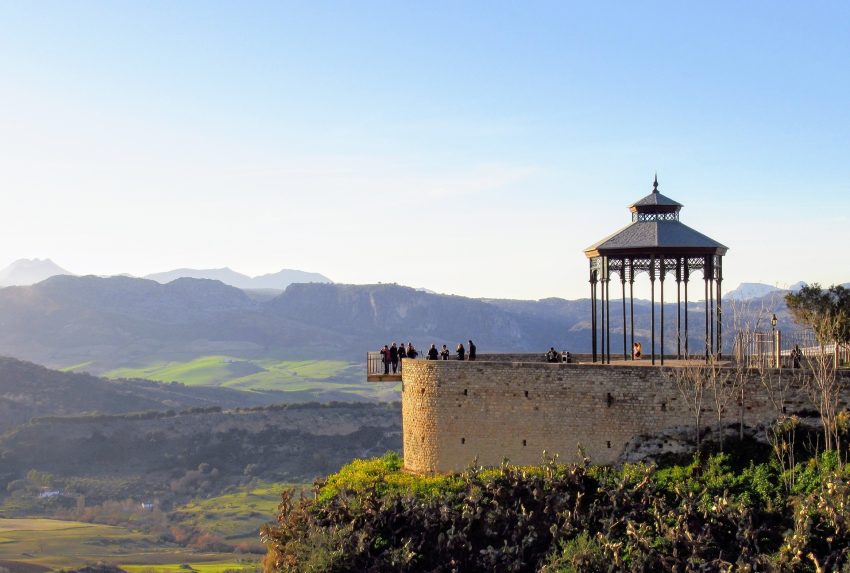
There are are plenty of places to stop and admire the view over the valley, one of the most spectacular is the Mirador de Ronda. Walk under the parador hotel on the Paseo de Ernest Hemingway and get ready for your first view of the Puente Nuevo!

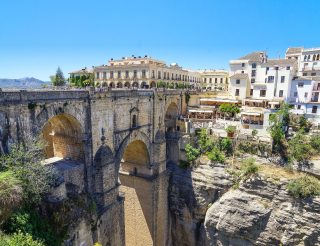
The dizzying, 120-metre-high Puente Nuevo or New Bridge was finished in 1793 and spans the El Tajo gorge that divides Ronda in two. If you are not scared of heights look straight down through the iron grilles set into the stone. There is a small museum underneath the bridge, in what used to be a prison cell.

Walk across the bridge and check out the view from the observation terrace on your left. You can see opposite your next destination the hanging gardens of Cuenca.

We recommend to rent a car in Spain through Discover Cars, they compare prices and review multiple car rental agencies. Book your rental car here.

Jardines de Cuenca

Jardines De Cuenca Ronda 3

Cross the bridge back into the New Town, and turn right onto Calle Rosario. Turn right again onto Calle Los Remedios, then take the next right again into a narrow alley which you will be glad takes you to the Jardines de Cuenca. These gardens afford views of both all the three bridges, from different angles and heights as well as the House of the Moorish King opposite which you will be seeing later!  Walk down the 23 terraces of rose gardens.

Hopefully you are here around mid-day, when the walls of the gorge are more evenly illuminated, allowing better photos.

Here is a complete selection of hotel options in Ronda. Feel free to review each one and choose the stay that best suits your needs.

Puente Viejo

Arab Baths Ronda 3
Arab Baths Ronda 3
CC BY-SA 4.0 / Daniel VILLAFRUELA.

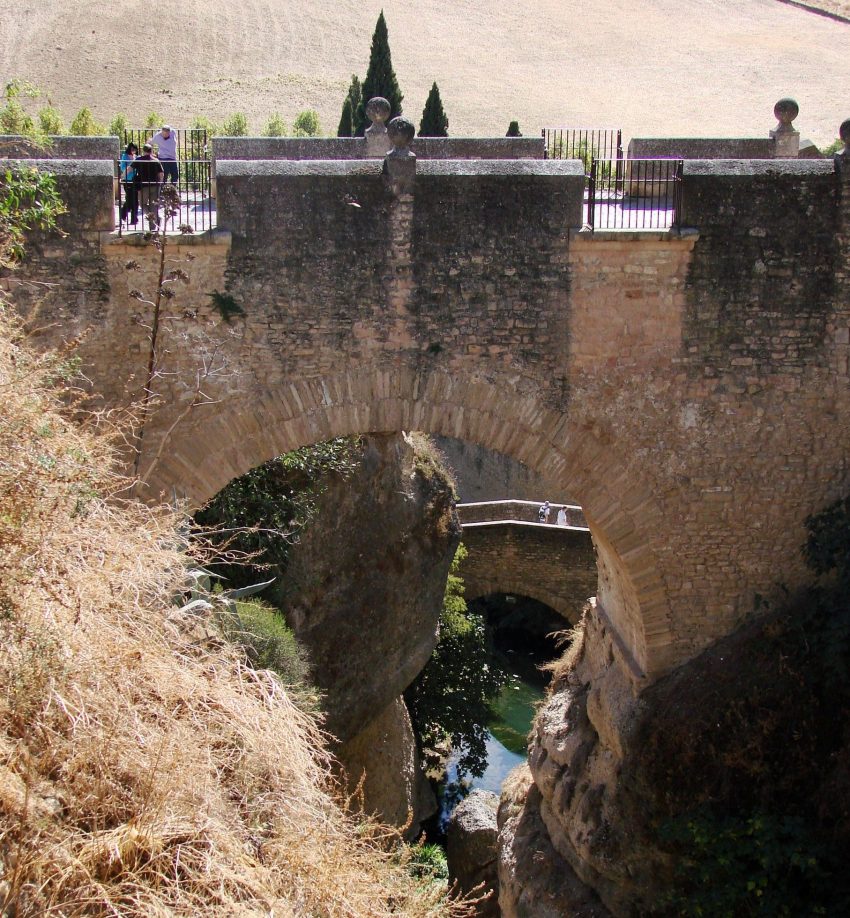
You should reach the Puente Viejo or  Old Bridge (16th century) and cross it into the Old Town. As you cross the bridge you will have geed views of the Puente Árabe or Arab Bridge and and beyond that the Baños Árabes or Arab Baths.

Aas you cross the bridge you will will be heading down the steps on your left. Before you do  look up to the iconic Arco de Felipe V.

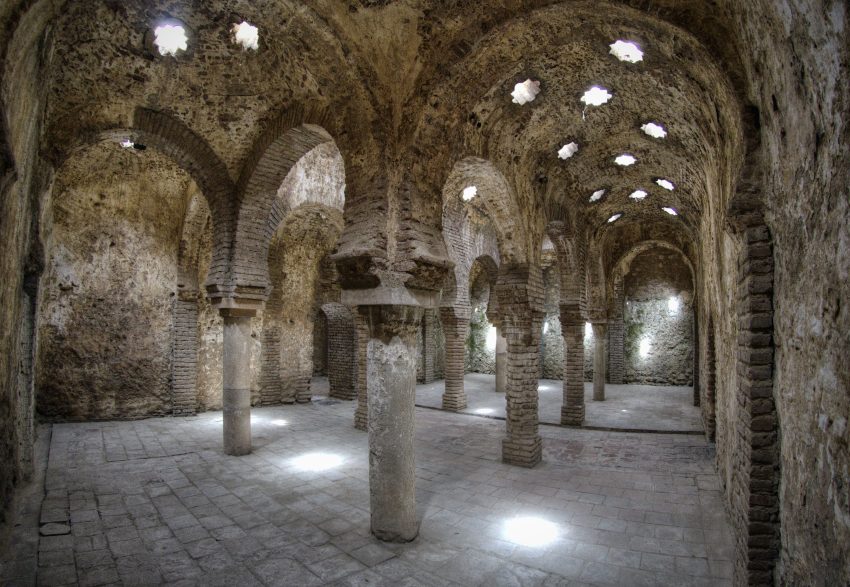
Head on down the Arab Bridge and the 13th and 14th Baños Árabes which are well worth visiting.

Traveling to a country with a different currency? Avoid ATM transaction fees and pay in local currency with a Wise Card. Having used it for over 5 years, we've saved loads on fees!

Explore the old city of Ronda

Casa del Rey Moro Water Gate
© Casa del Rey Moro

Depending on how tired you are you you can either head back up to the House of the Moorish King or as you are heading to the old bridge turn left up the steps to see more of the Murallas de Levante.

The steps will lead you to the Puerte de la Cijara. Head through the gates and bear right through the old city, you will end up on Calle Armiñán, turn right and should come to a square with the San Sebastian Minaret, which is the remains of a mosque in Ronda, walk past it onto Calle Marqués de Salvatierra. You will also pass the Palacio de Salvatierra, with its incredible facade.

Follow signs for the Palacio Del Rey or House of the Moorish King. It was not actually the Home of a Moorish king but the water mine it houses is from that period, and is worth investigating. This was the original water source for the Moorish town, and it was powered by Christian slaves! The grounds also have great views of the gorge.

Click here to read our blog about Exploring Ronda’s Moorish Defences 2026: Walls, Gates & Towers

Visit a Palace!

Courtyard Palacio de Mondragon Ronda
Flickr / Elliott Brown

The  Mondragón Palace perches on top of the El Tajo Gorge and has great views to the north towards the Sierra de las Nieves. Although little remains of the original Moorish palace, it may once have been the home of the 14th-century Moorish King Abomelic, who built the underground Water Mine at the Casa del Rey Moro.

The small Museum of Ronda on the second floor showcases local history and archaeology – going right back to prehistory – alongside a display dedicated to Megalithic and Moorish tombstones and burial traditions.

Click here to read our blog about 6 Hours in Ronda 2026: What to See on a Short Visit

Walk to the Bottom of El Trajo at sunset.

View of Ronda, Spain
Flickr / Jose Ramirez

Head towards Plaza de María Auxiliadora and you will find some steps in the corner to head down the gorge.

The first stop down the El Tajo gorge is Mirador Puente Nuevo de Ronda. This provides great views, although you are standing on the edge of a cliff with a distinct lack of a barrier!

You can head further down, at Mirador el Viento, near the Puerta Del Viento, or even lower, at Arco del Cristo. The lowest view point is called Ronda Bridge View Point and it’s directly next to a  field of olive trees.

You can also drive down to the Ronda Bridge View Point if you feel your legs are not up to it!

Explore Ronda at your own pace with our self-guided walking tour! Follow our curated route to discover must-see sights and local secrets that makes Ronda one of the best places to visit in Spain.

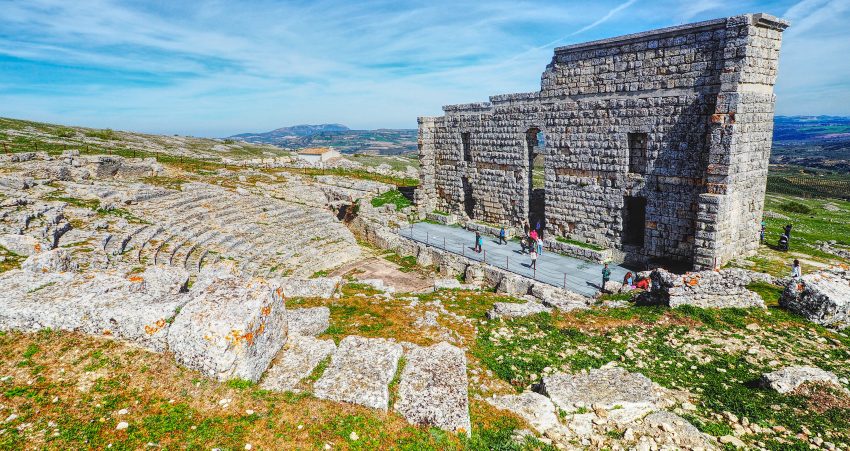
Explore the Roman Ruins of Acinipo

Theater of the Roman Ruins, Acinipo, Ronda
CC BY-SA 4.0 / Jose Rodríguez Cordón

Sometimes Ronda can get a little crowded with tourists so travel up into the mountains 20km north-west of Ronda, and if you’re early enough, you can have an entire Roman town to yourself. The drive up is also stunning with vineyard and fields of sunflowers.

Great amphitheater, and Roman baths, there are also the most stunning view in andalucia.

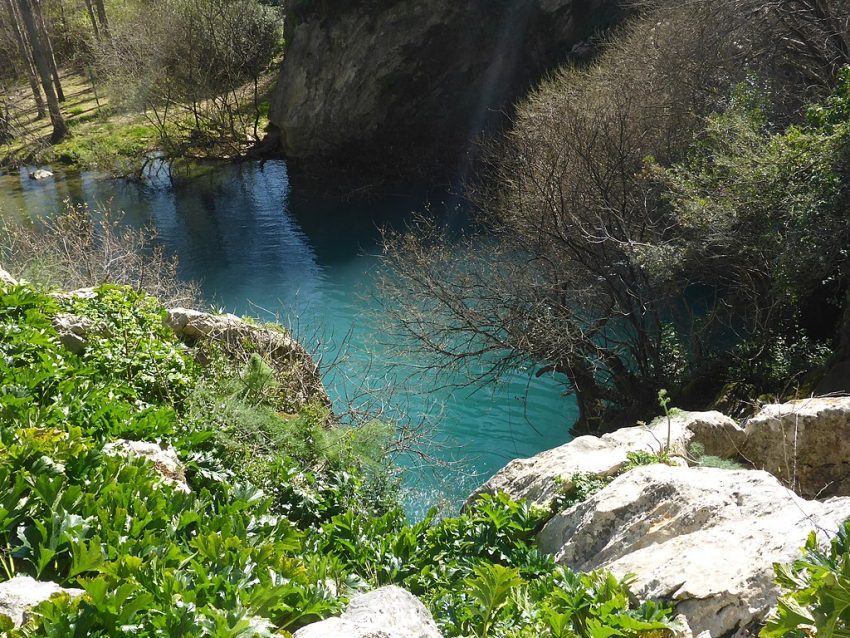
Cool off and have a swim at the Cueva del Gato!

Cueva del Gato, Ronda
CC BY-SA 4.0 / El Pantera

You have earned a little dip to cool off from the Andalusian summer heat.  An emerald blue freshwater pool is located at the opening of the Cave of the Cat.

Cueva del Gato is a naturally formed limestone cavern and a freshwater pool, located in the Sierra de Grazalema Natural Park.

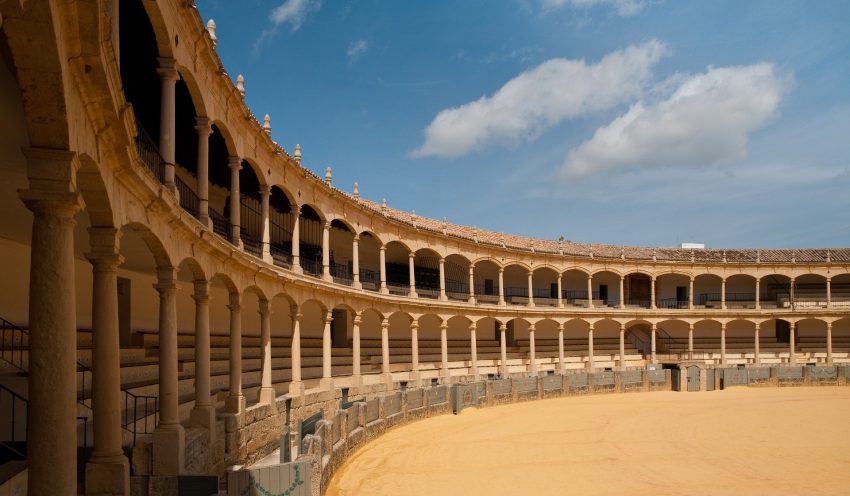
Ronda Spain Bullfighting Traditions

Ronda Bullring
Ronda Bullring

Ronda has one of the oldest bullrings in all of Spain. Bullfighting was founded in 1765, and of course, it plays a huge part in the history of Andalusia.  So, I would advise giving it a visit on your last afternoon.

Although bullfighting is very controversial nowadays, its interesting to learn and understand the history and custom of the sport. The bullring itself is beautiful and feels grand and important, and there is only one bull fight a year, so you probably wont have to avoid watching a fight!

Powered by GetYourGuide
Moira & Andy
Moira & Andy

Hey! We're Moira & Andy. From hiking the Camino to trips around Europe in Bert our campervan — we've been traveling together since retirement in 2020!

Read our full story here

This website uses affiliate links which earn a small commission at no additional cost to you.

Walking Tour Map
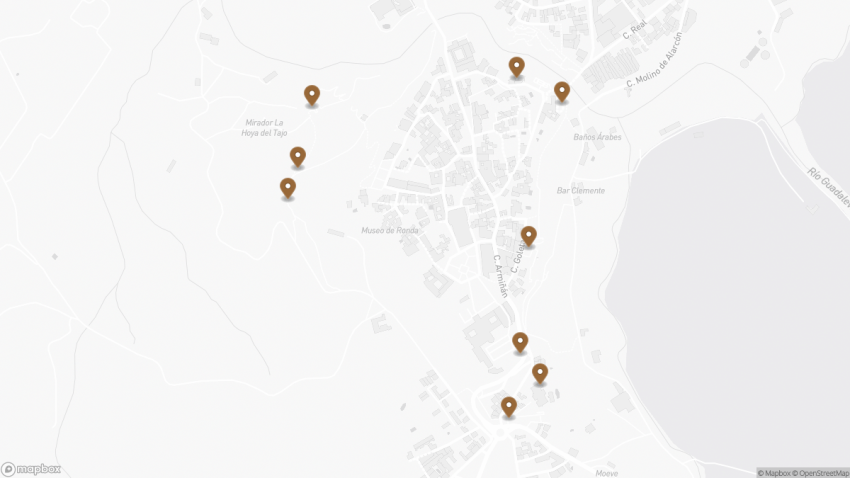
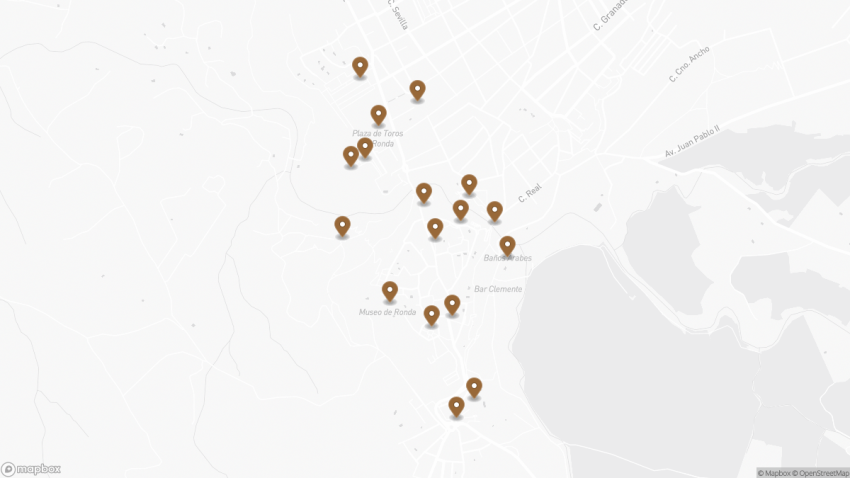
Map of the 48 Hours in Ronda: The Perfect Two-Day Itinerary walking route with 9 stops in Ronda.
Preview map of the 48 Hours in Ronda: The Perfect Two-Day Itinerary route in Ronda, showing 9 stops. Use the interactive map to zoom and tap markers.

Exploring Ronda’s Moorish Defences 2026: Walls, Gates & Towers

Puertas de Carlos V Ronda
CC BY-SA 3.0 / Panarria

This website uses affiliate links which earn a small commission at no additional cost to you.

Ronda importance to the history of Andalucia is related how secure it was from attack. This allowed Ronda to develop and become independent.

The City walls and castle of Ronda as built by the Moors and its combination the the steep shear cliffs of the gorge on 2 sides and steep hillside on the other 2 were so strong that they were unbeatable by warfare methods of the Moorish age.

Christian armies would pass by Ronda knowing that the defences were too strong.

1. Albacara Walls

Albacara Walls Ronda 2 1
© Andrew Ashton

The Albacara Walls are located in the mouth of Ronda Gorge roughly half way up the gorge. The wall ends with a shear drop to the gorge bottom and protects a slop that leads right up to the gorge top lip.

They spanned the space between the Puerta Del Viento or the Wind Gate and the Puerta de los Molinos or Gate of the Mills where the hill side was not as steep.

The walls would provide an area into which cattle could be driven if the town suspected an attack. There were also several very important flour & oil mills were located in the mouth of the gorge behind the wall.  It also restricted entry into the gorge the location of the towns water supply.


Location: 29400 Ronda Málaga Spain | Hours: 24 Hours | Price: Free

We recommend to rent a car in Spain through Discover Cars, they compare prices and review multiple car rental agencies. Book your rental car here.

2. Mill Gate (Puerta de los Molinos)

Arco del Cristo Ronda 4
© Diputación de Málaga

The Mill gate was near the end of the Albacara Wall next to the gorge edge. It was used for access to the mills further into the gorge mouth.

After the reconquest by the Christians the gate was renamed the Arch of Christ (Arco Cristo) because the Christians built a small shrine into the stonework


Location: Arco del Cristo. Murallas de Albacara y Molinos del Tajo, Ronda (Rincón Singular) 6 Plaza de María Auxiliadora 29400 Ronda Málaga, Spain | Hours: 24 Hour | Price: Free

Here is a complete selection of hotel options in Ronda. Feel free to review each one and choose the stay that best suits your needs.

3. Wind Gate (Puerta del Viento)

Puerta Del Viento Ronda
CC BY-SA 2.0 / IMBiblio

Located at the other end of the Albacara Wall built onto a very tall vertical gherkin shaped rock that forms a natural wall.


Location: 29400 Ronda, Málaga, Spain | Hours: 24 Hour | Price: Free.

Traveling to a country with a different currency? Avoid ATM transaction fees and pay in local currency with a Wise Card. Having used it for over 5 years, we've saved loads on fees!

4. Laurel Castle

laurel Castle Ronda
laurel Castle Ronda
© Andrew Ashton

The Impressive Alcazaba Walls

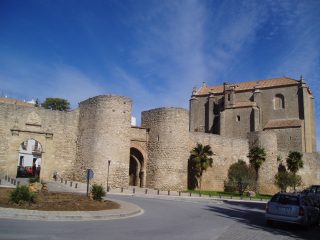
Ronda’s Castle, the ‘Castillo del Laurel‘ was built by the Moors on the highest point of Ronda and overlooks, and controls the entrance to the city via the Almocabar Gate and Imágenes Gate no longer in existence.

Although partly destroyed by the French in the Peninsular War of 1812 and more so by the Spanish in there road improvement scheme  to widen the street ‘Calle Imágenes’ and the erection of new buildings.


Location: Castillo del Laurel Calle Cuesta de las Imágenes 29400 Ronda Málaga Spain | Hours: 24 Hours | Price: Free to view the exterior.

Click here to read our blog about 48 Hours in Ronda 2026: The Perfect Two-Day Itinerary

5. Almocabar Gate

City Walls, Ronda
City Walls, Ronda
CC BY-SA 3.0 / Tajchman

The Almocabar Walls are located on the southern side of Ronda and are well preserved and you can walk along the walls.

The Almocabar gate and Almocabar walls take there name from the Moorish word ‘Al maqabir’ meaning cemetery. By tradition Moorish cemeteries were built outside the city walls and the one at Ronda was located opposite the gate in what is now the Plaza Ruedo Alameda.


Location: Puerta de Almocábar Plazuela Arquitecto Francisco Pons Sorolla, s/n 29400 Ronda Málaga Spain | Hours: 24 Hours | Price: Free | Website

Click here to read our blog about 6 Hours in Ronda 2026: What to See on a Short Visit

6. Iglesia del Espiritu Santo

Iglesia del Espiritu Santo, Ronda

Church of the Holy Spirt in the location of a previous Moorish defensive tower

The Holy Spirt church was built as a celebration of the Christian victory over the Moors in 1485. The church is built in the location of an octagonal defensive tower built by the moors and it had commanding views of the Almocabar Gate, Almocabar Walls and the approaches to Ronda from the Costa del Sol.

The tower was  totally destroyed by the cannon fire of the besieging Christian Army.


Location: Calle Espíritu Santo, 15, 29400 Ronda, Málaga, Spain | Hours: Monday - Saturday: 10:00-14:00 & 16:00 - 19:00 | Price: Adults: €1.00

Explore Ronda at your own pace with our self-guided walking tour! Follow our curated route to discover must-see sights and local secrets that makes Ronda one of the best places to visit in Spain.

7. Levante Walls

Levante walls Ronda
Levante walls Ronda
© Andrew Ashton

The Levante Walls are located to the East of the Old Town of Ronda or La Ciudad. The Eastern side was a more vulnerable side of the city because the natural defenses of high steep cliffs were not present, instead there was a slope in places right up to the walls on the summit, in others up to a small cliff face. Therefore there was a double line of walls & in places a triple line.


Location: Calle Armiñán, 14 29400 Ronda Málaga Spain | Hours: 24 Hours | Price: Free to view externally

8. Cijara Gate

The Cijara Gate was located in the Levante Walls and a main entrance into the city. The current short outer wall just before the gate probably extended to other gate(s) no longer visible by the Puente Romano. This gate led into the Jewish Quarter. In the valley bottom below the Cijara Gate is the Baños Árabes where visitors to Ronda would refresh themselves before entering the city.

9. Philipe V Arch

City Gate Ronda 4
City Gate Ronda 4
CC BY-SA 3.0 / Marlene VD

The Arch of Philipe V was actually erected in 1742 but did replace a narrow defensive gate built by the Moors. On the arch you will find an inscription and the coats of arms of both the Anjou & Borbons. There is a nice view of the Padre Jesus Church through the arch.


Location: Calle Marqués de Salvatierra, 30, 29400 Ronda, Málaga, Spain | Hours: 24 Hours | Price: Free

10. The Water Mine

Casa del Rey Moro Water Gate
© Casa del Rey Moro

A key to the defense of Ronda was an adequate water supply. The water mine is a shaft that descends to the river and gave access to the River. The water wheel was powered by Christian slaves!


Location: La Casa del Rey Moro, Calle Cuesta de Santo Domingo, 9 29400 Ronda Málaga Spain | Hours: Daily; Winter (October-April): 10:00 - 20:00; Summer (May-September): 10:00 - 21:30 | Price: Adults: €10.00 | Website

The introduction of the use of cannon changed in siege warfare dramatically changed the impregnability of Ronda. The first confirmed use of cannon in Europe was actually by the Moors in the Seige of Cordoba in 1280.

By miss information the Christian Army had drawn the many of the Moorish troops, led by Hamet el Zegri, out to the defence of Málaga and an inexperienced interim governor, Abraham al Haquim, was left in charge of Ronda.

Besides heavy bombing of the southern walls including the complete destruction of the octagonal defensive tower, which the Iglesia del Espiritu Santo was built on top of.

The Christians had also found out about the ‘secret’ Mine water entrance in the gorge . Friday 13th of May, despite fierce resistance by its Moorish defenders, the mine was taken and thus cut off the Moors from there water supply. Within a few days the Moors had to surrender…

1. Albacara Walls

Albacara Walls Ronda 2 1
© Andrew Ashton

The Albacara Walls are located in the mouth of Ronda Gorge roughly half way up the gorge. The wall ends with a shear drop to the gorge bottom and protects a slop that leads right up to the gorge top lip.

They spanned the space between the Puerta Del Viento or the Wind Gate and the Puerta de los Molinos or Gate of the Mills where the hill side was not as steep.

The walls would provide an area into which cattle could be driven if the town suspected an attack. There were also several very important flour & oil mills were located in the mouth of the gorge behind the wall.  It also restricted entry into the gorge the location of the towns water supply.


Location: 29400 Ronda Málaga Spain | Hours: 24 Hours | Price: Free

We recommend to rent a car in Spain through Discover Cars, they compare prices and review multiple car rental agencies. Book your rental car here.

2. Mill Gate (Puerta de los Molinos)

Arco del Cristo Ronda 4
© Diputación de Málaga

The Mill gate was near the end of the Albacara Wall next to the gorge edge. It was used for access to the mills further into the gorge mouth.

After the reconquest by the Christians the gate was renamed the Arch of Christ (Arco Cristo) because the Christians built a small shrine into the stonework


Location: Arco del Cristo. Murallas de Albacara y Molinos del Tajo, Ronda (Rincón Singular) 6 Plaza de María Auxiliadora 29400 Ronda Málaga, Spain | Hours: 24 Hour | Price: Free

Here is a complete selection of hotel options in Ronda. Feel free to review each one and choose the stay that best suits your needs.

3. Wind Gate (Puerta del Viento)

Puerta Del Viento Ronda
CC BY-SA 2.0 / IMBiblio

Located at the other end of the Albacara Wall built onto a very tall vertical gherkin shaped rock that forms a natural wall.


Location: 29400 Ronda, Málaga, Spain | Hours: 24 Hour | Price: Free.

Traveling to a country with a different currency? Avoid ATM transaction fees and pay in local currency with a Wise Card. Having used it for over 5 years, we've saved loads on fees!

4. Laurel Castle

laurel Castle Ronda
laurel Castle Ronda
© Andrew Ashton

The Impressive Alcazaba Walls

Ronda’s Castle, the ‘Castillo del Laurel‘ was built by the Moors on the highest point of Ronda and overlooks, and controls the entrance to the city via the Almocabar Gate and Imágenes Gate no longer in existence.

Although partly destroyed by the French in the Peninsular War of 1812 and more so by the Spanish in there road improvement scheme  to widen the street ‘Calle Imágenes’ and the erection of new buildings.


Location: Castillo del Laurel Calle Cuesta de las Imágenes 29400 Ronda Málaga Spain | Hours: 24 Hours | Price: Free to view the exterior.

Click here to read our blog about 48 Hours in Ronda 2026: The Perfect Two-Day Itinerary

5. Almocabar Gate

City Walls, Ronda
City Walls, Ronda
CC BY-SA 3.0 / Tajchman

The Almocabar Walls are located on the southern side of Ronda and are well preserved and you can walk along the walls.

The Almocabar gate and Almocabar walls take there name from the Moorish word ‘Al maqabir’ meaning cemetery. By tradition Moorish cemeteries were built outside the city walls and the one at Ronda was located opposite the gate in what is now the Plaza Ruedo Alameda.


Location: Puerta de Almocábar Plazuela Arquitecto Francisco Pons Sorolla, s/n 29400 Ronda Málaga Spain | Hours: 24 Hours | Price: Free | Website

Click here to read our blog about 6 Hours in Ronda 2026: What to See on a Short Visit

6. Iglesia del Espiritu Santo

Iglesia del Espiritu Santo, Ronda

Church of the Holy Spirt in the location of a previous Moorish defensive tower

The Holy Spirt church was built as a celebration of the Christian victory over the Moors in 1485. The church is built in the location of an octagonal defensive tower built by the moors and it had commanding views of the Almocabar Gate, Almocabar Walls and the approaches to Ronda from the Costa del Sol.

The tower was  totally destroyed by the cannon fire of the besieging Christian Army.


Location: Calle Espíritu Santo, 15, 29400 Ronda, Málaga, Spain | Hours: Monday - Saturday: 10:00-14:00 & 16:00 - 19:00 | Price: Adults: €1.00

Explore Ronda at your own pace with our self-guided walking tour! Follow our curated route to discover must-see sights and local secrets that makes Ronda one of the best places to visit in Spain.

7. Levante Walls

Levante walls Ronda
Levante walls Ronda
© Andrew Ashton

The Levante Walls are located to the East of the Old Town of Ronda or La Ciudad. The Eastern side was a more vulnerable side of the city because the natural defenses of high steep cliffs were not present, instead there was a slope in places right up to the walls on the summit, in others up to a small cliff face. Therefore there was a double line of walls & in places a triple line.


Location: Calle Armiñán, 14 29400 Ronda Málaga Spain | Hours: 24 Hours | Price: Free to view externally

8. Cijara Gate

The Cijara Gate was located in the Levante Walls and a main entrance into the city. The current short outer wall just before the gate probably extended to other gate(s) no longer visible by the Puente Romano. This gate led into the Jewish Quarter. In the valley bottom below the Cijara Gate is the Baños Árabes where visitors to Ronda would refresh themselves before entering the city.

9. Philipe V Arch

City Gate Ronda 4
City Gate Ronda 4
CC BY-SA 3.0 / Marlene VD

The Arch of Philipe V was actually erected in 1742 but did replace a narrow defensive gate built by the Moors. On the arch you will find an inscription and the coats of arms of both the Anjou & Borbons. There is a nice view of the Padre Jesus Church through the arch.


Location: Calle Marqués de Salvatierra, 30, 29400 Ronda, Málaga, Spain | Hours: 24 Hours | Price: Free

10. The Water Mine

Casa del Rey Moro Water Gate
© Casa del Rey Moro

A key to the defense of Ronda was an adequate water supply. The water mine is a shaft that descends to the river and gave access to the River. The water wheel was powered by Christian slaves!


Location: La Casa del Rey Moro, Calle Cuesta de Santo Domingo, 9 29400 Ronda Málaga Spain | Hours: Daily; Winter (October-April): 10:00 - 20:00; Summer (May-September): 10:00 - 21:30 | Price: Adults: €10.00 | Website

The introduction of the use of cannon changed in siege warfare dramatically changed the impregnability of Ronda. The first confirmed use of cannon in Europe was actually by the Moors in the Seige of Cordoba in 1280.

By miss information the Christian Army had drawn the many of the Moorish troops, led by Hamet el Zegri, out to the defence of Málaga and an inexperienced interim governor, Abraham al Haquim, was left in charge of Ronda.

Besides heavy bombing of the southern walls including the complete destruction of the octagonal defensive tower, which the Iglesia del Espiritu Santo was built on top of.

The Christians had also found out about the ‘secret’ Mine water entrance in the gorge . Friday 13th of May, despite fierce resistance by its Moorish defenders, the mine was taken and thus cut off the Moors from there water supply. Within a few days the Moors had to surrender…

Powered by GetYourGuide
Moira & Andy
Moira & Andy

Hey! We're Moira & Andy. From hiking the Camino to trips around Europe in Bert our campervan — we've been traveling together since retirement in 2020!

Read our full story here

This website uses affiliate links which earn a small commission at no additional cost to you.

Walking Tour Map
Map of the Exploring Ronda’s Moorish Defences: Walls, Gates & Towers walking route with 9 stops in Ronda.
Preview map of the Exploring Ronda’s Moorish Defences: Walls, Gates & Towers route in Ronda, showing 9 stops. Use the interactive map to zoom and tap markers.

Self-Guided Walking Tour of Ronda, Spain (2026)

View of Ronda, Spain
Flickr / Jose Ramirez

This website uses affiliate links which earn a small commission at no additional cost to you.

Ronda, perched dramatically atop a gorge in Spain's Andalusia region, is a city steeped in history and natural beauty. From its ancient origins to its role in modern Spanish culture, Ronda offers visitors a unique glimpse into the past. With a layout made for walking and dramatic vistas at every turn, it's the perfect destination for a half-day on foot.

From the Puente Nuevo spanning the El Tajo gorge to Moorish palaces and one of Spain's oldest bullrings, Ronda is full of unforgettable landmarks. A walking tour brings these sites to life while weaving together the city's Roman, Islamic, and Spanish legacies.

How to Get to Ronda

By Plane: The nearest major airports to Ronda are Málaga-Costa del Sol Airport (around 100 km away) and Seville Airport (about 130 km away), both of which are well connected to European cities with frequent flights. From either airport, you can continue your journey to Ronda by rental car, bus, or train, with Málaga generally offering the most convenient onward connections due to its closer distance and transport options For the best deals and a seamless booking experience, check out these flights to Ronda on Booking.com..

By Train: Ronda is well connected by rail to cities like Malaga and Seville. The Ronda train station is located about a 10-minute walk from the historic centre. Train schedules and bookings can be found on Omio.

By Car: You can reach Ronda via the scenic A-397 or A-374 roads. There's parking near the historic core at Parking El Castillo and Parking Plaza del Socorro. If you are looking to rent a car in Spain I recommend having a look at Discover Cars, first, as they compare prices and review multiple car rental agencies for you.

Where to Stay in Ronda

To enjoy the best of Ronda on foot, stay near the old town or close to the Puente Nuevo. For a luxurious stay, try Parador de Ronda, set right next to the gorge. A mid-range gem is Hotel Montelirio, offering views and character. Budget travellers will appreciate Hotel Arunda II, which is central and comfortable.

A Brief History of Ronda

Ronda's history dates back to prehistoric times, with evidence of Neolithic settlements found in nearby caves. The city was originally established by the Celts in the 6th century BCE and later became a significant Roman town known as Arunda. During the Islamic period, Ronda flourished as a cultural and economic centre, serving as the capital of the Taifa of Ronda in the 11th century.

Ronda’s strategic location made it a focal point during the Christian Reconquista, and it was captured by Christian forces in 1485. In later centuries, it became renowned for its bandolero legends and bullfighting tradition, inspiring writers such as Ernest Hemingway and Orson Welles. Today, the city is one of Andalusia’s most atmospheric destinations.

Guided or Self-Guided Tour of Ronda?

To make the most of your time in Ronda, consider joining the Ronda: 2-Hour Private Walking Tour. This private tour is ideal for those who want personalised attention and a deeper understanding of Ronda’s history, architecture, and culture. Your expert guide will walk you through key landmarks, including the Puente Nuevo, the bullring, and the old Arab quarter, offering stories that span centuries.

Your Walking Tour of Ronda

This blog highlights Ronda’s key attractions, but depending on your pace and interest, you might choose to linger longer in certain sites or enjoy tapas at one of the town’s scenic terraces.

1. Historic Bullring

Ronda Bullring
Ronda Bullring

Start the walk in the new part of town.


Ronda is well known as the birthplace of bullfighting and the bullring itself was built in the 18th century and is one of the oldest bullrings in Spain. Even though times have changes and few tourists are fans of the sport the Plaze de Toros is an amazing building with a great history and well worth a visit.

You can choose to have a look inside for around 6 EUR or simply admire the beautiful entrance gate and the bullfighter statue of Pedro Romero outside. The tourist office next door may provide you with a paper map to help with orientation.


Location: Plaza de Toros de Ronda, 15 Calle Virgen de la Paz, Ronda, Spain, | Hours: Monday-Sunday: 10:00 – 20:00. | Price: €8 (€9.50 with audioguide) | Website

We recommend to rent a car in Spain through Discover Cars, they compare prices and review multiple car rental agencies. Book your rental car here.

2. Stroll the Alameda del Tajo

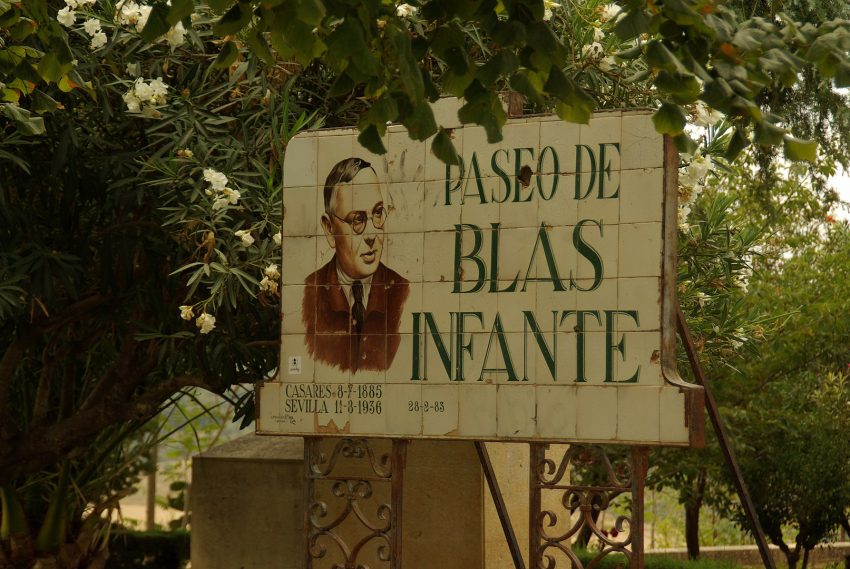
Walking Paseo de Blas Infante
Flickr / Dulce Wang

Coming out the front of the bullring, turn left onto Calle Virgen de la Paz, towards the Almeda del Tajo.


Alameda del Tajo is a popular public park, opened in the beginning of the 19th century. Its tree-lined promenades & panoramic balconies which are suspended over a cliff offer the most beautiful views of the awesome “Serranía de Ronda” Ronda’s mountain range.

The walk is beautiful all year round, in the spring, when pink and white blossoms cover the trees along the walkways, you will be glad of its shade in the summer and its golden colours in the fall, when leaves change color.


Location: Alameda del Tajo, Paseo Blas Infante, 1, 29400 Ronda, Málaga, Spain | Hours: 24 Hours | Price: Free.

Here is a complete selection of hotel options in Ronda. Feel free to review each one and choose the stay that best suits your needs.

3. Walking the Paseos

Paseo de Blas Infante 2
CC BY-SA 3.0 / Concepcion AMAT ORTA

From the Alameda, you can turn left onto Paseo De Los Ingleses before returning here and turn right onto Paseo Blas Infante. Walk along the paseo with the bullring on your left and the cliff tops on your right.


This is a great paseo often with street musicians, such as flamenco and guitarists, performing along the path which lead you to various viewing spots. Its not just one paseo but a series of them starting in the north with Paseo De Los Ingleses, through the Alameda del Tajo, onto Paseo de Orson Welles, Paseo de Ernest Hemingway and finally overlooking the Puente Nuevo the Paseo de Kazunori Yamauchi.


Location: Paseo Blas Infante, 1, 29400 Ronda, Málaga, Spain | Hours: June - September 8.00am - 00.00 September - May: 9.00am - 22.00 | Price: Free | Website

Traveling to a country with a different currency? Avoid ATM transaction fees and pay in local currency with a Wise Card. Having used it for over 5 years, we've saved loads on fees!

4. Mirador de Ronda

Mirador de Ronda
Mirador de Ronda

When you get to the Monument to the Bull, you turn right. You will pass between monuments to Orson Wells and Earnest Hemingway and head towards the Mirador de Ronda.


The Mirador de Ronda is a beautiful lookout point from which you can see the lower lying parts of the countryside, the forests, farms and mountains. It’s a breathtaking sight and surely one you will not easily forget.


Location: Mirador de Ronda Ctra. de los Molinos, 1955 29400 Ronda Málaga Spain | Hours: 24 Hours | Price: Free

Click here to read our blog about 48 Hours in Ronda 2026: The Perfect Two-Day Itinerary

5. Walk over the Puente Nuevo

View of Ronda, Spain
Flickr / Jose Ramirez

After leaving Mirador de Ronda head left, following the edge of the cliff. When you reach the Parador hotel, you will walk along Paseo de Ernest Hemingway. Turn the corner and continue around. All along you will enjoy the spectacular views of the beautiful Puente Nuevo and the steep El Tajo Canyon. The final section of the walk is named Paseo de Kazunori Yamauchi.


The Puente Nuevo is Ronda’s New Bridge (even though it is already 200 years ago). It is an impressive feat of engineering, crossing the steep gorge at a height of almost 100 metres. No wonder it is is Ronda’s most famous landmark.

On this walking tour we will cross the bridge to get to the older part of the town, however if you are keen you can also have a quick look inside. The entrance to the Puente Nuevo is cheap and will give you access to the room underneath the bridge where you can see a small balcony.

is a not very interesting exhibition in Spanish about the construction of the bridge and the use of the room for locking up political prisoners during the Spanish Civil War. The booklet you receive with your ticket will be in English.


Location: Puente Nuevo Calle Armiñán, s/n 29400 Ronda Málaga Spain | Hours: Monday to Friday: 10:00-18:00 Saturday: 10:00-14:00 & 16:00-18:00 Sunday: 10:00-15:00 | Price: Adults: €2.5 | Website

Click here to read our blog about Exploring Ronda’s Moorish Defences 2026: Walls, Gates & Towers

6. Admire the view from the Puerta de los Molinos

Mirador del Viento
Mirador del Viento

Cross the bridge to the other side and turn the first right down the Calle Tenorio. Walk down this winding cobbled road until you get to the Plaza de María Auxiliadora. This is a great little square and viewing point to get more views of the valley. From here the more energetic will wan to descend the steps in the corner to the Los Molinos. The path is steep and strenuous in summer but you will get the best views of the bridge from the bottom.


You will pass various viewing points:

  • Mirador puente nuevo de Ronda or viewing point of the new bridge
  • Mirador del viento or viewing point of the wind – named after the nearby Gate in the city Wall – Puerta Del Viento – or Gate of the Wind
  • Puerta de los Molinos or Gate of the Mills

When you have (run out of film in your cameras?) head back the way you have come.


Location: Arco del Cristo. Murallas de Albacara y Molinos del Tajo, Ronda (Rincón Singular) 6 Plaza de María Auxiliadora 29400 Ronda Málaga, Spain | Hours: 24 Hour | Price: Free

Click here to read our blog about 6 Hours in Ronda 2026: What to See on a Short Visit

7. Explore the Palacio de Mondragón

Palacio de Mondragon, Ronda, Spain
© JUAN LUIS MARTINEZ

When you are back at the Plaza de María Auxiliadora head south and you will come to the Palacio de Mondragón de Mondragón


The Palacio de Mondragón  or is an an old Moorish palace from the 14th century you will also find Ronda’s Municipal Museum.  The beautiful building started out as the home of home of King Abbel Malik.  For a modest fee you get to see a great palace which is a fine example of Andalusian building design. It’s not large but has nice courtyards, balconies, tiled walls, and terraces. The gardens in particular are gorgeous and offer great views of the countryside and a nice cool breeze.


Location: Plaza Mondragón, s/n, 29400 Ronda, Málaga, Spain | Hours: Mon: 10:00-14:00 & 15:00-18:00; Tue-Fri: 09:30-19:00; Sat: 10:00-14:00 & 15:00-18:00; Sun: 10:00-15:00. | Price: Adults: €4.00 | Website

8. Take a break at the Plaza Duquesa de Parcent

Iglesia de Santa María la Mayor Ronda
CC BY-SA 4.0 / José Rojas

From the Palacio de Mondragón head further south and you will come to the Plaza Duquesa de Parcent.


This is the main square in the Old Town and it is stunning. It’s surrounded by beautiful buildings including the City Hall but the most remarkable is undoubtedly Church of Santa María la Mayor, with its beautiful bell tower.

Also around the square are the convents of Caridad or Charity and the Claristas or the ‘Poor Clares’.


Location: Plaza Duquesa de Parcent, 11, 29400 Ronda, Málaga, Spain | Hours: 24 Hours | Price: Free

9. See the Old Walls and City Gate

City Walls, Ronda
City Walls, Ronda
CC BY-SA 3.0 / Tajchman

The old City Entrance is worth seeing but you are doubling back on yourself. head down by the right of the City Hall and head south on the Calle Cuesta de las Imágenes. You will have the fortifications of the old city wall on your right – which look magnificent. you should come to Plaza Ruedo Alameda – which is another great square to have a quick caña!


In Moorish times, Ronda was protected its position and high walls that ran around it making it impregnable! Well nearly as it was conquered in 1485 by the Marquis of Cádiz after a brief siege!

The Puerta de Almocábar was the main gate into the old Moorish town. Around the gate you can see part of the old walls that protected Ronda from invaders which are possible to climb up and walk along the top of!


Location: Puerta de Almocábar Plazuela Arquitecto Francisco Pons Sorolla, s/n 29400 Ronda Málaga Spain | Hours: 24 Hours | Price: Free | Website

10. Marvel at the Iglesia del Espíritu Santo

Iglesia del Espiritu Santo, Ronda

If you did make it down to the City Gates – walk through them on up through Calle Espíritu Santo.


You will see the impressive Iglesia del Espíritu Santo on your right. This impressive church was the first built after the town was taken from the Moors in the 16 Century.


Location: Calle Espíritu Santo, 15, 29400 Ronda, Málaga, Spain | Hours: Monday - Saturday: 10:00-14:00 & 16:00 - 19:00 | Price: Adults: €1.00

11. Museum of the Bandits

Museo del bandolero in Ronda
CC BY-SA 2.0 / SweetnessParadise

Continue up the hill on the Calle Armiñán and you will come to the Museo del Bandolero. You could bear to the right as you go up the hill and get some views of the city walls.


This is  a museum dedicated to the bandits who operated in this area in the 18th and 19 century. A relatively cheap price to pay to enter – if you have young boys – of all ages they will probably enjoy it.


Location: Museo del Bandolero Calle Armiñán, 65 29400 Ronda Málaga Spain | Hours: Daily: 11:00 - 19:30 | Price: Adults: €3.75 | Website

12. Museo Lara

Museum Lara Ronda
Museum Lara Ronda
CC BY-SA 3.0 / Andras Vadas

Continue up the Calle Armiñán to get to the Museo Lara.


This is a bizarre museum – one mans collection of curious things from beautiful things from the past and torture instruments from the Inquisition. Also some unusual typewriters, six-barrelled pistols, delicate prayer books, and fine measuring instruments from the early days of science…

The torture objects and witchcraft collection in the basement are clearly there for effect, and probably not recommendable for families with young children.


Location: Museo Lara Calle Armiñán, 29 29400 Ronda Málaga Spain | Hours: June to October: 11:00 - 20:00; November to May:11:00 -18:30 | Price: Adults: €4.00 | Website

13. The House of the Moorish King

Casa del Rey Moro Water Gate
© Casa del Rey Moro

Carry on up the Calle Armiñán and turn right when you see the large murial of the Viajes Romanticos. head down there and you will come across the The House of the Moorish King.


The main house is in some disrepair, you are paying the entrance fee to see the hanging gardens and the water mine. While the gardens are also looking a bit neglected there are still some great views of the narrow gorge here.

It is the 230 steps of the water mine that you are here to see. you can go all the way down to the bottom of the gorge and see where the Christian forces breached the Moorish defenses and entered the town.


Location: La Casa del Rey Moro, Calle Cuesta de Santo Domingo, 9 29400 Ronda Málaga Spain | Hours: Daily; Winter (October-April): 10:00 - 20:00; Summer (May-September): 10:00 - 21:30 | Price: Adults: €10.00 | Website

14. Puente Viejo

Old Bridge Ronda Spain
CC BY-SA 23.0 / Marshall Henrie

Head past La Casa del Rey Moro down Calle Cuesta de Santo Domingo. When you approach the Palacio de Salvatierra you should see some steps to the left. Follow the steps down, and walk down Calle Cuesta de Santo Domingo. The road should wind downwards and yo will pass underneath the Puerta de Felipe V and see the Puente Viejo in front of you.


Ironically, the Puente Viejo is not the oldest bridge in Ronda, as you approach the bridge to your right is the the oldest bridge, which is the Roman Bridge. It may not be the most pretty bridge but it is free of traffic and much more relaxing to walk than the Puente Nuevo.

The bridge is from the 16th or 17th century and offers some great views to both sides. On the one side you will see the Arab Baths and the Roman Bridge, on the other side you can look deep into the gorge, almost all the way to the New Bridge. You will see the water of the river below your feet.


Location: Puente Viejo Calle Real, 2 29400 Ronda Málaga Spain | Hours: 24 Hours | Price: Free

15. Arab Baths

Arab Baths, Ronda Spain
CC BY-SA 2.0 / Ángel M. Felicísimo

The Moorish Baths are again optional, depending on how fit you are feeling and time constraints, you will need to return to this point.
If you wish to see them you need to descend the steps you saw as you approached the Puente Viejo, these will take you in the direction of the Puente Árabe, take those which will lead you to the Moorish Baths.


The Moorish  Public Baths  are a fine example of Moorish design that they borrowed from the Romans. it was constructed in the 13th and 14th centuries and are the best preserved Arab Baths in Spain. Look at the beautiful star-shaped openings in the ceiling of the three rooms that let in the light in. The water was brought into the building straight from the river with a water wheel.


Location: Baños Arabes, Yacimiento Arqueológico, Calle Molino de Alarcón, s/n 29400 Ronda Málaga Spain | Hours: Monday: 10:00 - 14:00, 15:00 - 18:00; Tuesday - Friday 09:30 - 20:00; Saturday 10:00 - 14:00, 15:00 - 18:00; Sunday & Bank Holiday10:00 - 15:00. | Price: Adults: €4.50; Free Tuesday After 15:00 | Website

16. Stroll through the Cuenca Gardens

Jardines De Cuenca Ronda 3

Cross the Puente Viejo and on your left are the Jardines De Cuenca.


Walk up these 23 rose-covered terraces, to get away from the crowds and for great views of Puente Nuevo, Puente Viejo and the Roman Bridge from these paths. Also look out for the House of the Moorish king opposite.


Location: Jardines De Cuenca, Calle Escolleras, 1 29400 Ronda Málaga Spain | Hours: Daily: 8am-7pm | Price: Free

17. Relax in the Plaza del Socorro

Hercules Plaza del Socorro Ronda 2

When you leave the park on Calle Escolleras bear left. This will take you up a narrow cobbled street which leads you to Calle Virgen de los Remedios. Turn left and walk about 300m until you get to Plaza del Socorro.


This is a great little square to relax. The square is surrounded by beautiful buildings especially the Iglesia de Socorro. The Plaza is historically significant because it was here that Blas Infante unfurled the flag of Andalusia in 1918. The square also features a statue of Hercules which is a symbol of Andalucia designed by Blas Infante.


Location: Plaza del Socorro, 7, 29400 Ronda, Málaga, Spain | Hours: 24 Hours | Price: Free

Return to Plaza de Toros

There is a short walk from here down Calle Pedro Romero to get back to the bullring.

Powered by GetYourGuide
Moira & Andy
Moira & Andy

Hey! We're Moira & Andy. From hiking the Camino to trips around Europe in Bert our campervan — we've been traveling together since retirement in 2020!

Read our full story here

This website uses affiliate links which earn a small commission at no additional cost to you.

Walking Tour Map
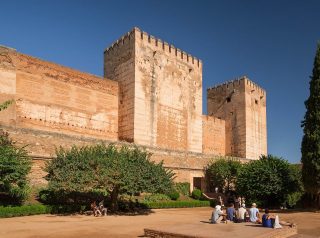
Map of the Self-Guided Walking Tour of Ronda, Spain walking route with 17 stops in Ronda.
Preview map of the Self-Guided Walking Tour of Ronda, Spain route in Ronda, showing 17 stops. Use the interactive map to zoom and tap markers.

Best Palaces to Explore in Seville, Spain (2026)

Real Alcazar of Seville

This website uses affiliate links which earn a small commission at no additional cost to you.

Few cities in Europe rival Seville for its fusion of royal grandeur, Moorish artistry, and Andalusian charm. Across its sunlit streets lie centuries-old palaces - each a living monument to the city's layered history. From royal courts and Renaissance mansions to hidden noble residences, Seville's palatial architecture tells the story of a city that has always been both European and exotic, regal and romantic.

Many of these palaces still feel alive: courtyards filled with orange blossom, fountains murmuring beneath horseshoe arches, and tiled walls glowing in the Andalusian light. The Real Alcázar may be Seville’s crown jewel, but beyond its walls lie other treasures - aristocratic houses, merchant mansions, and Renaissance gems that reveal the private side of the city’s nobility.

Whether you’re a lover of architecture, a history enthusiast, or simply drawn to beauty and storytelling, Seville’s palaces promise a journey through art, power, and passion. Here are the most spectacular ones to explore.

The Story of Seville through its Palaces

The history of Seville can be read in the walls of its palaces. Each one tells part of a larger story that stretches back over a thousand years, from the days of the caliphs to the modern age. Together they show how the city evolved from a Moorish fortress into a royal capital, a center of trade, and a cradle of art and culture.

The Real Alcázar of Seville

The Real Alcázar of Seville marks the beginning of this story. It was first built in 913, when the Umayyad caliph Abd al-Rahman III established a fortified palace beside the Roman walls. The rulers of Al-Andalus expanded it into a luxurious residence, and when the Christians took Seville in the thirteenth century they kept and adapted what they found. King Alfonso X added a Gothic palace, and a century later King Peter I built the Mudejar Palace, a masterpiece of carved plaster, cedar wood, and colored tiles. The Alcázar remains the city's most important palace, still used by the Spanish royal family and still surrounded by gardens that have grown and changed for a thousand years.

The rise of Renaissance Seville

As Seville became a Christian city, a new generation of noble houses rose within its walls. Families enriched by trade with the Mediterranean and the Americas built homes that blended Renaissance order with Andalusian warmth. The Casa de los Pinelo, near the Cathedral, shows this harmony in its balanced arches, marble columns, and tiled courtyards. The Palacio de los Marqueses de la Algaba, on the edge of the old Moorish quarter, kept alive the fading Mudejar tradition with its brick façade and horseshoe arches. The Casa de Pilatos, begun at the end of the fifteenth century by the Enríquez de Ribera family, joined Italian influence to Seville's native style, creating a palace of marble courtyards, Roman statues, and patterned azulejos that has come to define the city's Renaissance spirit.

Seville’s golden age of learning and art

The wealth that flowed through Seville in the sixteenth and seventeenth centuries filled the city with art and learning. The Casa Palacio de la Condesa de Lebrija, though restored in modern times, reflects the curiosity of that age. Its rooms are lined with Roman mosaics brought from the ruins of Italica and decorated with antiques collected by the Countess of Lebrija, a woman of taste and scholarship. Her house captures Seville's love of history and its role as a meeting place between ancient culture and the discoveries of a new world.

The grace of noble life

The Casa de las Dueñas represents the enduring power of Seville’s nobility. Built between the fifteenth and sixteenth centuries and owned by the Dukes of Alba, it combines Gothic and Renaissance forms with Mudejar courtyards shaded by orange trees. In later years it became a home of art and poetry, remembered as the birthplace of the poet Antonio Machado. Its quiet patios and tiled galleries express the domestic grace that lies behind Seville’s grandeur.

Baroque and Bourbon splendor

By the seventeenth century, Seville’s fortunes had changed, but its taste for splendor had not. The Palacio de San Telmo, built as a school for navigators in 1682, shows the exuberant Baroque style of a city that had once ruled the seas. Its red and ochre façade, filled with columns and cherubs, remains one of Seville’s most striking sights. Not far away, the Casa Salinas preserves a smaller, more intimate side of the same tradition: a sixteenth-century family house where Renaissance geometry meets the Moorish love of light and water.

Enlightenment refinement

The eighteenth century brought a new refinement. The Palacio de Villapanés, built for Admiral Manuel López Pintado, reflects the elegance of the Enlightenment. Behind its plain exterior lies a world of marble staircases, frescoed ceilings, and peaceful courtyards. Today it serves as a hotel, proof that Seville’s palaces continue to live and adapt rather than stand as empty monuments.

The living memory of Seville

Seen together, these buildings form a continuous thread through Seville’s history. The Alcázar recalls its Islamic beginnings; the Renaissance houses speak of wealth and discovery; the Baroque and Neoclassical palaces show the confidence of later centuries. Each has changed with the city, absorbing new ideas while keeping the harmony of Andalusian design. To walk among them is to follow the whole course of Seville’s past, from fortress to royal residence, from trading port to modern capital, in a city where history is still written in stone, tile, and garden shade.

1. Real Alcázar

Banos de Maria Padilla Seville

The Real Alcázar of Seville is the crown jewel of the city — a living masterpiece that has witnessed more than a millennium of Spanish history. Originally built in the 10th century as a Moorish fortress, it was later transformed by Christian kings into a breathtaking fusion of Islamic, Gothic, Renaissance, and Baroque architecture. The result is a dazzling labyrinth of courtyards, fountains, and intricately carved archways that feel almost dreamlike.

The palace’s Mudéjar Palace, built under King Peter I in the 14th century, remains its most iconic feature. Highlights include the Patio de las Doncellas, with its delicate arches and reflecting pool, and the Hall of Ambassadors, crowned by a golden dome symbolizing the universe. Every inch is a testament to the coexistence and blending of cultures that defined Andalusia.

Outside, the Alcázar Gardens offer a tranquil world of palm trees, tiled fountains, and orange blossoms. Their beauty has captivated artists, filmmakers, and travelers alike — so much so that the palace served as a filming location for Game of Thrones’ Water Gardens of Dorne. It’s not only Seville’s most famous attraction but also a timeless emblem of Spain’s royal legacy.


Location: Patio de Banderas, s/n 41004 Sevilla Spain | Hours: (Summer) Monday – Sunday: 09:30–19:00. (Winter) Monday – Sunday: 09:30–17:00. Closed on 1 January, 6 January, Good Friday, 25 December. | Price: €15.50 (general); €8.00 (reduced); optional Upper Royal Quarters add-on €5.50. | Website

We recommend to rent a car in Spain through Discover Cars, they compare prices and review multiple car rental agencies. Book your rental car here.

Powered by GetYourGuide

2. Casa Pilatos

Casa de Pilatos Seville 8
CC BY-SA 4.0 / Mario Fernández

A lesser-known but equally captivating palace, the Casa de Pilatos is a stunning example of Andalusian nobility and Renaissance elegance. Built in the late 15th century by the Enríquez de Ribera family, it’s still privately owned and perfectly preserved. The house combines Italian Renaissance symmetry with Sevillian Mudéjar artistry, giving visitors a harmonious mix of cultures in one exquisite setting.

The mansion’s central courtyard, adorned with marble columns and blue-and-white azulejos, is one of Seville’s most photographed spots. Around it, visitors discover a museum-like collection of sculptures, Roman antiquities, and frescoes. Each room seems frozen in time, showcasing centuries of aristocratic life, from gilded ceilings to painted tiles that tell stories of ancient mythology and faith.

Stepping into the gardens, you’re transported into another era. Ornamental fountains trickle beside citrus trees, while balconies and stairways lead to private chambers decorated with 16th-century tapestries and paintings. Casa de Pilatos feels both intimate and grand — a palace where the Renaissance met the warmth of southern Spain.


Location: Plaza de Pilatos,1, 41003 Sevilla, Spain | Hours: Daily: 09:00–18:00. 25 December: 09:00–14:00; 1 January: 10:00–18:00; 6 January: 09:00–14:00. | Price: €12 (ground floor); €18 (ground floor + upper floor guided visit). | Website

Here is a complete selection of hotel options in Seville. Feel free to review each one and choose the stay that best suits your needs.

Powered by GetYourGuide

3. Casa Palacio de la Condesa de Lebrija

Palacio Lebrija Sevilla 11
CC BY-SA 3.0 / Michel wal

Hidden along Seville’s Calle Cuna, the Casa Palacio de la Condesa de Lebrija is a treasure trove of Roman mosaics and historic art. Once a noble residence, it was restored in the early 20th century by Regla Manjón Mergelina, the Countess of Lebrija, a passionate collector and scholar. Her vision transformed the house into a living museum — an elegant Sevillian home filled with the finest artifacts from across Spain and the Mediterranean.

The ground floor showcases the Countess’s unrivaled collection of Roman mosaics, many rescued from nearby Italica, the ancient Roman city. Walls and floors glitter with marble, ceramics, and archaeological fragments, giving each room an almost museum-like grandeur. Yet the house retains its warmth, with patios full of natural light and touches of traditional Andalusian style.

Upstairs, the private apartments reveal the Countess’s refined taste — antique furniture, Flemish paintings, porcelain, and libraries filled with rare manuscripts. Every room reflects a different era, blending comfort with scholarship. Visiting the Casa de Lebrija feels like stepping into the mind of a collector who turned her love of history into an art form.


Location: Palacio de Lebrija, Calle Cuna, 8, 41004 Sevilla, Spain | Hours: (Winter) September – June: Daily: 10:00–18:00. (Summer) July – August: Daily: 10:00–15:00. | Price: €15; Children (6–12): €6; Groups (15+): €10. | Website

Traveling to a country with a different currency? Avoid ATM transaction fees and pay in local currency with a Wise Card. Having used it for over 5 years, we've saved loads on fees!

4. Casa de las Dueñas

Courtyard Palacio de las Dueaas Sevilla
CC BY-SA 4.0 / Benjamín Núñez González

The Casa de las Dueñas is one of Seville’s most romantic palaces — and one that tells the story of Andalusian aristocracy through centuries of art and charm. Built between the 15th and 16th centuries, it served as the city residence of the Dukes of Alba, one of Spain’s most powerful families. Its blend of Gothic, Renaissance, and Mudéjar styles gives it an unmistakably Sevillian soul.

Visitors enter through a serene courtyard framed by orange trees and horseshoe arches. Inside, a series of patios, chapels, and galleries reveal a collection of art and furnishings accumulated over generations. Portraits of Spanish nobility line the walls, alongside ceramics from Triana and antique tiles that shimmer with Andalusian color.

Casa de las Dueñas is also famous as the birthplace of the poet Antonio Machado, whose verses were inspired by the house’s poetic atmosphere. Today, the palace is open to the public, offering a rare glimpse into noble life — intimate, elegant, and deeply tied to Seville’s artistic heritage.


Location: Palacio de las Dueñas en sevilla, Calle Dueñas, 5, Seville, Spain | Hours: (Summer) April – September: Daily: 10:00–19:00. (Winter) October – March: Daily: 10:00–18:00. Closed on 01 January, 06 January, 25 December, 30 December & 31 December. On 05 January & 24 December: 10:00–15:00. | Price: €14 (general); €10 (reduced); €0 (children under 6). | Website

Explore Seville at your own pace with our self-guided walking tour! Follow our curated route to discover must-see sights and local secrets that makes Seville one of the best places to visit in Spain.

Powered by GetYourGuide

5. Casa de los Pinelo

Casa de los PinelosSeville
CC BY-SA 3.0 / José Luis Filpo Cabana

The Casa de los Pinelo is one of Seville’s most refined Renaissance mansions, located just steps from the Cathedral. Built in the early 16th century by the Pinelo family — wealthy merchants of Genoese origin — the house is a perfect example of how trade and art flourished together in Seville’s Golden Age.

Architecturally, it stands out for its symmetry, marble columns, and intricate woodwork, reflecting Italian Renaissance ideals filtered through Sevillian craftsmanship. Inside, delicate Mudéjar ceilings, tiled courtyards, and decorative fountains reveal the elegance of a merchant family that embraced both wealth and culture.

Today, the Casa de los Pinelo serves as the headquarters of the Royal Academies of Fine Arts and Literature, keeping its artistic legacy alive. Visitors often come for exhibitions or guided tours that unveil its hidden patios and libraries. It remains a quiet oasis of scholarship and beauty in the heart of Seville.


Location: Casa de los Pinelo, Calle Abades, Seville, Spain | Hours: Tuesday & Thursday: 11:00–13:00. Closed on Saturday & Sunday. | Price: €7 (standard); €6 (seniors). | Website

Click here to read our blog about Must-Visit Museums In Seville, Spain 2026

6. Palacio de los Marqueses de la Algaba

Palacio de los Marqueses de la Algaba Sevilla. Patio
CC BY-SA 3.0 / José Luis Filpo Cabana

Just outside the walls of Seville’s historic center lies the Palacio de los Marqueses de la Algaba, an impressive 15th-century palace that beautifully preserves the late Mudéjar style. Once the residence of noble families during Seville’s golden trading years, it has since been restored and converted into the Center for Mudéjar Art, celebrating one of Andalusia’s defining artistic traditions.

The palace’s façade is striking — a blend of brick, horseshoe arches, and geometric ornamentation that showcases Islamic craftsmanship at its peak. Inside, arched galleries frame tranquil courtyards where temporary exhibitions and cultural events bring history to life. The main courtyard, with its carved capitals and azulejo panels, is a masterpiece in its own right.

Visiting the Palacio de los Marqueses de la Algaba offers more than architectural beauty; it’s an educational experience. The museum explores how Mudéjar art evolved under Christian rule, bridging two worlds through design. It’s one of Seville’s most underrated gems — perfect for travelers seeking history away from the crowds.


Location: Palacio Marqueses de la Algaba Plaza Calderón de la Barca, s/n 41003 Sevilla Spain View o | Hours: (Winter) 1 October – 30 April: Monday – Friday: 10:00–14:00 & 17:00–20:00; Saturday: 10:00–14:00. (Summer) 1 May – 30 September: Monday – Friday: 10:00–14:00 & 18:00–21:00; Saturday: 10:00–14:00. Closed on Sundays & public holidays. | Price: Free | Website

Click here to read our blog about Discover Roman Seville 2026: Ancient Ruins, History & Highlights

7. Casa Salinas

Casa Salinas Seville
© Casa de Salinas

The Casa Salinas is a private 16th-century mansion that has only recently opened to visitors, offering a glimpse into Seville’s noble domestic life. Hidden behind an unassuming façade on Calle Mateos Gago, it’s one of the city’s best-preserved examples of Renaissance-Mudéjar architecture. Its beauty lies in its balance: an elegant home where everyday life and art coexisted harmoniously.

The palace centers around a graceful marble-columned patio, surrounded by rooms adorned with colorful azulejos, carved ceilings, and antique furniture. Each corner seems carefully designed to catch the light and emphasize Seville’s indoor-outdoor lifestyle. Even the small family chapel and private study retain their period charm.

Still owned by the Salinas family, the house is maintained with extraordinary care, preserving its authenticity. Guided tours reveal stories of family heritage, craftsmanship, and tradition passed down for generations. Casa Salinas is a true hidden treasure — quieter than the Alcázar, but just as enchanting in its intimacy.


Location: Palacio de los marqueses de Salinas, Calle Mateos Gago, 39 41004 Sevilla Spain | Hours: (Winter) Daily: 10:00–19:00; 1 October – 14 June. (Summer) Daily: 10:00–14:00; 15 June – 30 September. Closed during private events. | Price: €12 general; €10 groups (10+); €10 Seville city residents; €6 children under 11; free under 6; €6 visitors with disabilities. | Website

Click here to read our blog about 16 Best Things to Do in Seville, Spain (2026)

Powered by GetYourGuide

8. San Telmo Palace

Palacio de San Telmo Seville 2
CC BY-SA 4.0 / CarlosVdeHabsburgo

The Palacio de San Telmo is one of Seville’s most monumental and historically significant buildings. Originally built in the late 17th century as a school for navigators, it trained officers for Spain’s colonial fleets during the height of its maritime empire. Later, it became the residence of the Dukes of Montpensier, relatives of the French royal family, who transformed it into a grand aristocratic palace.

The palace’s Baroque façade, designed by Leonardo de Figueroa, is among the most ornate in Spain. Its sculpted red and ochre exterior, rich with columns, cherubs, and royal coats of arms, dominates the Avenida de Roma. Inside, lavish halls and grand staircases reflect the wealth and power of its owners, as well as Seville’s status as Spain’s gateway to the Americas.

Today, San Telmo serves as the seat of the Andalusian presidency, but parts of it open occasionally for cultural visits and events. Even viewed from outside, it’s a breathtaking sight — a reminder of Seville’s golden age when ships, silver, and royal ambition shaped the world.


Location: San Telmo Palace, Calle Palos de la Frontera, 41004 Sevilla, Spain | Hours: Thursday: 10:00, 12:00, 16:00 & 18:00. Saturday: 11:00, 13:00, 16:00 & 18:00. Closed on Monday, Tuesday, Wednesday, Friday & Sunday. | Price: Free | Website

Click here to read our blog about 12 Hours in Seville: Top Sights and Things to Do (2026)

9. Palacio de Villapanés

Main patio Palacio de Villapanes 3
© Palacio de Villapanés Hotel

Now transformed into a luxury five-star hotel, the Palacio de Villapanés is a masterclass in Baroque elegance. Built in the 18th century for Admiral Manuel López Pintado, the first Marquis of Villapanés, it blends aristocratic grandeur with refined Sevillian artistry. Its graceful courtyards, wrought-iron balconies, and marble staircases capture the splendor of noble life in the Age of Enlightenment.

The interior showcases original coffered ceilings, frescoes, and furniture from the era, seamlessly paired with modern comforts. Guests can sip coffee beneath chandeliers that once illuminated aristocratic gatherings or stroll through the peaceful patios surrounded by orange trees. Every space preserves the balance between opulence and intimacy.

Even if you’re not staying there, the hotel’s restaurant and courtyard bar welcome visitors, allowing you to experience a taste of 18th-century Seville in contemporary luxury. The Palacio de Villapanés perfectly bridges past and present — living proof that Seville’s palaces are not relics, but enduring expressions of its soul.


Location: Hotel Palacio de Villapanes Calle Santiago, 31 41003 Sevilla Spain | Hours: Bar and restaurant open until midnight. | Price: Free to enter public areas (services such as dining, spa, and accommodation are paid). | Website

Best Places to Stay to Visit Seville’s Historic Palaces

If your goal is to be close to Seville's great palaces, you'll want to stay in or near neighborhoods like Santa Cruz, the Old Town / Cathedral area, Arenal / El Centro, or even Alameda de Hércules - each offers a different flavor of Seville life and easy access to the city's heritage treasures. In Santa Cruz, you'll be immersed in winding narrow alleys, fragrant citrus courts, and immediate walking access to the Real Alcázar, Casa de Pilatos, and Casa de los Pinelo. Staying there puts you within moments of the Puerta de León, the Alcázar gardens, and the Moorish-Christian heart of Seville. A hotel like Corral del Rey gives you boutique luxury steps from many palaces, while Hotel Casa 1800 Sevilla is tucked into a 17th-century mansion just off the Cathedral, making palace visits feel effortlessly close.

If you prefer to be centrally located in El Centro / Arenal, you’ll enjoy short strolls to the Alcázar, Casa de la Condesa de Lebrija, and Palacio de los Marqueses de la Algaba. This district also gives you better access to tapas, riverfront walks, and the Plaza de Toros. Hotel Amadeus & La Musica is well placed in this zone; its musical motif, courtyard, and proximity to Casa de los Pinelo make it a charming choice. On the same lines, Hotel Palacio de Villapanés is housed in one of Seville’s elegant palaces, blending heritage ambiance with the advantage of central access to both palaces and nightlife.

For travelers who like a bit more local authenticity, Alameda de Hércules offers a bohemian, relaxed base while still being within walking or short tram distance of the Alcázar, Casa de las Dueñas, and Casa Salinas. Here you might find smaller boutique guesthouses or apartments that let you mingle with locals each evening after your palace visits.

Wherever you stay, the key is to balance charm and walkability. If you’re lodged near Santa Cruz or the Cathedral, you’ll probably walk to at least half your palace list. El Centro / Arenal gives you a little more room to wander beyond just the palace route. And if you venture slightly farther - for example, into La Alameda - the tradeoff is tranquility at night with only a few extra minutes to the monuments by foot or public transit.

Powered by GetYourGuide
Moira & Andy
Moira & Andy

Hey! We're Moira & Andy. From hiking the Camino to trips around Europe in Bert our campervan — we've been traveling together since retirement in 2020!

Read our full story here

This website uses affiliate links which earn a small commission at no additional cost to you.

Walking Tour Map
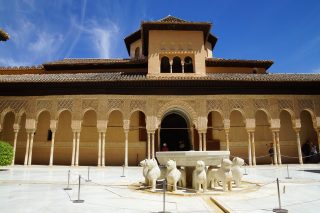
Map of the Best Palaces to Explore in Seville, Spain walking route with 9 stops in Seville.
Preview map of the Best Palaces to Explore in Seville, Spain route in Seville, showing 9 stops. Use the interactive map to zoom and tap markers.

Similar Blogs

Must-Visit Museums In Seville, Spain 2026

Interior of Museum of Fine Arts of Seville
CC BY-SA 3.0 / Anual

This website uses affiliate links which earn a small commission at no additional cost to you.

Seville is the undisputed heart of Andalusian culture, but let's be honest: it's a lot more than just orange trees and photo-ops. For art and history lovers, this city is a goldmine where the past doesn't just sit on a shelf-it dances, sails, and occasionally stares back at you from a 500-year-old canvas.

Whether you're here to trace the footsteps of Roman emperors, get lost in Baroque masterpieces, or finally figure out why every wall in town is covered in spectacular tilework, Seville's museums are the key to the city's soul. In this guide, we've rounded up the must-visit museums in Seville for 2026, ranging from the world-famous galleries to the hidden gems where you can actually hear yourself think.

Which Museums Are Right for You?

Seville’s cultural scene is vast, and trying to see everything in one trip is a recipe for museum fatigue. To help you prioritize, I’ve grouped the highlights into categories so you can choose the experiences that best fit your travel style.

The Big Three (The “Essential” List)

If you only have time for a few stops, these are the heavy hitters. They represent the core pillars of Sevillian identity: world-class art, the soul of the dance, and the city’s relationship with the river.

  • Fine Arts Museum: The “Prado of the South” and a must for masterpiece seekers.
  • Flamenco Museum: An immersive look at the heartbeat of Andalusia.
  • Naval Museum (Torre del Oro): The city’s most iconic landmark with a view to match.

Best for Families (Interactive & Engaging)

If you’re traveling with kids who might get bored of staring at silent oil paintings, these spots offer a more “hands-on” approach with interactive displays and room to breathe.

  • Science House: Perfect for whale skeletons and planetarium shows.
  • Navigation Pavilion: Great for “steering” ships and exploring life at sea.
  • Military Historical Museum: Full of big cannons and dioramas that usually keep younger travelers curious.

Off the Beaten Path (Escape the Crowds)

Seville is a popular place, and the main tourist hubs can get loud. If you want to see incredible architecture and history in relative peace, head to these underrated gems.

  • Casa de los Pinelo: Quiet Renaissance courtyards that most tourists walk right past.
  • Carriages Museum: A niche, high-luxury look at how the elite used to get around.
  • Andalucian Contemporary Art Centre (CAAC): A monastery-meets-factory vibe that feels like a hidden retreat.

Free & Budget-Friendly (Culture on a Dime)

You don’t need a huge budget to see world-class history here. These locations offer incredible insights into the Spanish Empire and local life for the price of… well, nothing.

  • General Archive of the Indies: UNESCO-level history and stunning marble floors for €0.
  • Spanish Inquisition Museum: An important, moving experience located right by the Triana market.
  • Military Historical Museum: Zero entry fee and-importantly-excellent air conditioning.

A Quick History of Seville

Seville wasn't built in a day, and it certainly wasn't built by just one people. It began as Hispalis, a thriving Roman port, before becoming Isbiliya under five centuries of Muslim rule, which gave the city its winding Almohad streets and iconic architecture. After the Christian Reconquest in 1248, Seville transformed again, eventually becoming the “Gateway to the New World.” During the 16th century, it was the richest city in Europe, where every ounce of gold and silver from the Americas had to pass through its docks.

Today, Seville is a beautiful, chaotic mix of these eras-Roman ruins sit under Gothic cathedrals, and Renaissance palaces are decorated with Moorish tiles. To truly “see” the history, you have to know which door to walk through.

How to Experience the Eras

If you want to walk through Seville’s timeline rather than just reading about it, here is how to match the history to the museum:

  • The Roman Roots: Head to the Archaeological Museum. Here, you can see the colossal statues and intricate mosaics salvaged from Italica (the birthplace of emperors). It’s the best way to visualize the city back when it was a marble-clad Roman powerhouse.
  • The Islamic Influence & Mudéjar Style: While the Alcázar is the obvious choice, the Museum of Arts and Traditions and Centro Cerámica Triana explain the soul of this era. They showcase the craft of tile-making and geometry that the Moorish artisans left behind, which still defines the city’s “look” today.
  • The Golden Age of Discovery: Visit the General Archive of the Indies and the Naval Museum (Torre del Oro). These spots put you in the room with the actual maps and journals of explorers like Columbus. You can feel the weight of the era when Seville was the center of the global economy.
  • The Religious & Artistic Boom: The Fine Arts Museum is the place to see how the wealth of the New World funded a massive “Golden Age” of Spanish art. The giant canvases were designed to show off the city’s piety and power during the 17th-century Baroque explosion.
  • The Darker Chapters: History isn’t all palaces and paintings. The Spanish Inquisition Museum (Castillo de San Jorge) offers a sobering look at the religious persecution that followed the Reconquest, built right into the ruins of the prison where it all happened.

Must-Visit Museums In Seville

1. Flamenco Museum

Flamenco Museum seville
© https://museodelbaileflamenco.com/

Founded by the legendary dancer Cristina Hoyos, this isn’t just a room full of old shoes; it’s a high-tech tribute to the soul of Andalusia. The museum is built over an 18th-century structure, which itself sits on the remains of a Roman temple, creating a literal layer cake of Seville’s history. The exhibits use dramatic lighting and large-scale projections to show the evolution of different palos (styles) of Flamenco, making the history of the dance feel like a living, breathing performance rather than a dusty archive.

The real magic happens in the central courtyard, where the acoustics are so sharp you’ll feel the vibration of the footwork in your chest. If you book the combo ticket, make sure to arrive at least an hour before the show starts; the museum actually closes its doors to visitors when the performances begin, so you can’t browse the exhibits afterward.

  • Don’t Miss: The courtyard performance. The acoustics in this small space are world-class—you’ll feel the vibration of the footwork in your chest.
  • Pro-Tip: If you book the “Combo Ticket,” get to the museum an hour before the show. The museum closes just as the shows begin, so you can’t browse afterward.
  • Your Take: You’re in Andalusia—skipping this is like going to Paris and ignoring the bread. Just go.

Location: Museo del Baile Flamenco, Calle Manuel Rojas Marcos, 3 41004 Sevilla, Spain | Hours: Daily: 11:00–18:45. First Monday of the month: 14:30–18:45. | Price: Museum Only: €6 Museum + Show: €29 (Combo ticket) Show Only: €25 | Website

We recommend to rent a car in Spain through Discover Cars, they compare prices and review multiple car rental agencies. Book your rental car here.

2. Fine Arts Museum

Sagrada Cena by Alonso Vazquez
Public Domain /

Often called the “Second Gallery of Spain” because it trails only the Prado in Madrid, this museum is a masterclass in the Seville School of painting. The building itself is a masterpiece of Mannerist architecture, and the soaring ceilings of the former church (now Room V) provide a heavenly backdrop for massive canvases by Murillo and Zurbarán. It’s the kind of place where the architecture is so grand you might find yourself staring at the ceilings as much as the artwork.

Keep an eye out for the sculptures by Martínez Montañés; his wood-carved figures are so lifelike that many are still used in Seville’s famous Holy Week processions today. Sunday mornings are lovely because the museum is free for many, but it gets crowded; if you want the “private palace” vibe, try a Tuesday afternoon. Even if you aren’t a hardcore art lover, the quiet, tile-heavy courtyards offer a peaceful escape from the city heat.

  • Don’t Miss: The sculptures by Martínez Montañés. His wood-carved figures are so lifelike they’re still used in Seville’s famous Holy Week processions.
  • Pro-Tip: Sunday mornings are lovely but crowded. If you want the “private palace” vibe, go around 2:00 PM on a Tuesday.
  • Your Take: Even if you aren’t an ‘art person,’ the courtyard gardens offer a quiet escape from the city noise that is worth the €1.50 alone.

Location: Seville Museum of Fine Arts, Pl. del Museo, 9 41001 Sevilla Spain | Hours: (Summer) 1 August – 31 August: Tuesday – Sunday & public holidays: 09:00–15:00. (Winter) 1 September – 31 July: Tuesday – Saturday: 09:00–21:00; Sunday & public holidays: 09:00–15:00. Closed on Monday (except Mondays before a public holiday). Closed on 01 January, 06 January, 01 May, 24 December, 25 December & 31 December. | Price: €1.50; free for EU citizens with valid ID and ICOM members. | Website

Here is a complete selection of hotel options in Seville. Feel free to review each one and choose the stay that best suits your needs.

Powered by GetYourGuide

3. Naval Museum of Seville

Torre del Oro, Seville

This iconic twelve-sided tower was once part of the city’s defensive walls and was allegedly once covered in golden tiles, which is how it earned its name. The museum inside is compact but effectively tells the story of how the Guadalquivir River was once the gateway to the New World. It’s a vertical experience, so be prepared for some narrow stairs as you move between navigational charts, models of famous ships, and historical documents that shaped global exploration.

The undisputed highlight is the panoramic terrace at the top. It offers one of the best angles in the city for photos of the Cathedral and the riverfront. The “voluntary contribution” requested at the door is usually around €3, which is a total bargain for the view alone. It’s small enough that you can’t get bored—if you spend more than 40 minutes here, you’re probably just waiting for the perfect lighting for your Instagram feed.

  • Don’t Miss: The panoramic view from the top. It offers the best angle of the Cathedral and the river for your Instagram feed.
  • Pro-Tip: The “voluntary contribution” is usually €3, which is a bargain for the view.
  • Your Take: It’s small enough that you can’t get bored. If you spend more than 40 minutes here, you’re probably just hiding from the sun.

Location: Paseo Cristobal Colón, s/n 41001 Sevilla. | Hours: Monday – Friday: 09:30–19:00. Saturday – Sunday & public holidays: 10:30–19:00. Closed on 1 January, 6 January, Good Friday, 1 May, 25 December. | Price: Free entry (voluntary contribution requested). | Website

Traveling to a country with a different currency? Avoid ATM transaction fees and pay in local currency with a Wise Card. Having used it for over 5 years, we've saved loads on fees!

4. Navigation Pavilion

Pabellon de la Navegacion
CC BY-SA 3.0 / 888pablo888

Originally built for the Expo ’92, this museum focuses on the grueling and often terrifying reality of life at sea during the age of discovery. It’s highly immersive, allowing you to try your hand at “steering” a ship and exploring the claustrophobic quarters where sailors ate and slept. Located on the Isla de la Cartuja, it offers a refreshing change of pace from the narrow streets of the old town and provides plenty of space for interactive learning.

Don’t miss the “Sea of Souls” installation, a hauntingly beautiful display of lights and sounds representing the thousands of people who crossed the Atlantic. If you have kids, the interactive touchscreens will keep them busy, but the real star for adults is the Schindler Tower. The elevator ride takes you up 50 meters for a 360-degree view of the modern side of Seville.

  • Don’t Miss: The “Sea of Souls” installation, which uses lights and sounds to represent the thousands of people who crossed the Atlantic.
  • Pro-Tip: The Schindler Tower elevator is the real star here. It’s one of the fastest ways to get a 360-degree view of the modern side of Seville.
  • Your Take: Perfect if you have kids. If you don’t have kids, it’s still a great way to justify playing with touchscreens for an hour.

Location: Pabellón de la Navegación, Camino de los Descubrimientos, 2 41092 Sevilla Spain | Hours: (Winter 2 January – 29 June; 2 September – 30 December): Tuesday – Saturday: 10:00–19:30. Sunday: 10:00–15:00. (Summer 1 July – 15 August): Tuesday – Sunday: 10:00–15:00. Torre Schindler times (Winter): Tuesday – Saturday: 10:30–13:00 & 16:30–18:30. Sunday: 10:30–14:00. Torre Schindler times (Summer): Tuesday – Sunday: 11:00 & 13:00. Closed on Monday. Also closed on 1 January, 6 January, 1 May, 24 December, 25 December, 31 December, and Maundy Thursday – Easter Sunday; closed 16 August – 31 August. | Price: €6.00 general; €4.00 reduced; free for children under 5 (with an accompanying adult); €2.00 promotional on selected days. The standard ticket includes the permanent exhibition and the Torre Mirador (Torre Schindler). | Website

Explore Seville at your own pace with our self-guided walking tour! Follow our curated route to discover must-see sights and local secrets that makes Seville one of the best places to visit in Spain.

5. Casa de los Pinelo

Upper Gallery Casa de los Pinelo
© Real Academia Bellas Artes Sevilla

This is a hidden Renaissance gem that most tourists walk right past on their way to the Cathedral. While the crowds lose their minds in the lines at the Alcázar, you can walk through these plateresque courtyards in near-silence. It represents the transition from Medieval to Renaissance styles and serves as the seat of the Academy of Fine Arts, meaning you’ll often see researchers and academics going about their business amidst the stunning tilework and carved ceilings.

The “Golden Room” (Salón de los Azulejos) is the standout feature here, boasting incredible 16th-century tiles and an intricate wooden ceiling. Because it’s an active academy, the hours are famously finicky—usually only opening for a couple of hours in the morning—so you’ll need to plan your day around it. It is the ultimate location to impress your travel partners with your deep knowledge of Seville’s underrated palaces.

  • Don’t Miss: The “Golden Room” (Salón de los Azulejos) with its incredible carved wooden ceiling and 16th-century tiles.
  • Pro-Tip: Because it’s an active academy, hours are strictly limited. Check their website the morning you plan to go.
  • Your Take: It’s the ultimate ‘I know a spot’ location to impress your travel partners.

Location: Casa de los Pinelo, Calle Abades, Seville, Spain | Hours: Tuesday & Thursday: 11:00–13:00. Closed on Saturday & Sunday. | Price: €7 (standard); €6 (seniors). | Website

Click here to read our blog about Best Palaces to Explore in Seville, Spain (2026)

6. The Bullfight Museum

Bull Fighting musem Sevilla 2
CC BY-SA 4.0 / CarlosVdeHabsburgo

Even if bullfighting makes you squeamish, the Real Maestranza is an architectural titan that demands a visit. This is one of the oldest bullrings in Spain, and its Baroque facade is the most photographed wall in the city for a reason. The museum takes you through the “Traje de Luces” (Suits of Lights) gallery, showing the incredible, heavy embroidery of famous matadors, and even includes the small chapel where fighters prayed before facing the bull.

The highlight of the tour is walking through the tunnel and out into the arena itself. Standing in the center of that yellow albero sand gives you a sense of scale and history that you simply can’t get from the street. Audio guides are included in the price, and you should definitely use them, otherwise, you’re just looking at a lot of very expensive capes and taxidermy without any context.

  • Don’t Miss: Walking out into the arena itself. Standing in the center of that yellow albero sand gives you a scale of the city’s history.
  • Pro-Tip: Audio guides are included in the price. Use them, or you’re just looking at a lot of very expensive capes with no context.
  • Your Take: It’s controversial, it’s bloody, and it’s undeniably Andalusian. At the very least, go for the architecture.

Location: Plaza de toros de la Real Maestranza de Caballería de Sevilla Paseo de Cristóbal Colón, 12 41001 Sevilla Spain | Hours: Daily: 09:30–19:30. Bullfighting days: 09:30–15:00. | Price: €10 (general); €6 (seniors 65+ and pensioners, students 17–25, youth 12–16); €3.50 (children 7–11); free (children 0–6 accompanied). | Website

Click here to read our blog about Discover Roman Seville 2026: Ancient Ruins, History & Highlights

Powered by GetYourGuide

7. General Archive of the Indies

archivo general de indias
©

This building was originally the “Lonja,” or the merchants’ exchange, designed to keep the traders from cluttering up the Cathedral steps. In 1785, King Charles III turned it into a centralized home for every document related to the Spanish Empire. Today, it holds roughly 15 million pages of history, including personal letters from Christopher Columbus and the maps that first outlined the Americas.

The interior is surprisingly serene, with wide stone hallways and massive mahogany shelving units that stretch on forever. While you can’t just pull a 500-year-old map off the shelf, the rotating temporary exhibitions usually showcase the “greatest hits” for the public. It’s free and located right next to the Cathedral, making it the perfect place to duck into for some air conditioning.

  • Don’t Miss: The rotating temporary exhibitions. They often pull out the “greatest hits” (like Columbus’s maps) that aren’t usually on display.
  • Pro-Tip: It’s free and right next to the Cathedral. If the line for the Cathedral is three hours long, pop in here for the AC.
  • Your Take: It’s basically a massive filing cabinet made of beautiful stone. Go in, look solemn, appreciate the quiet, and then head back to the tapas.

Location: Edificio de la Lonja Avenida de la Constitución, 3 41071 Seville | Hours: Tuesday – Saturday: 09:30–17:00; Sunday & Public Holidays: 10:00–14:00. Closed on Monday. | Price: Free | Website

Click here to read our blog about 16 Best Things to Do in Seville, Spain (2026)

Powered by GetYourGuide

8. Archaeological Museum of Seville

Museo Arqueologico de Sevilla 4 1
CC BY-SA 2.0 / Museo Arqueológico de Sevilla

Housed in a grand Neo-Renaissance palace built for the 1929 Exposition, this museum contains the “Tesoro del Carambolo,” a hoard of 24-carat gold jewelry so intricate it looks like it belongs in a movie. The collection covers everything from prehistoric tools to the height of the Roman Empire, with many of the best mosaics and statues being unearthed from the nearby ruins of Italica.

The Venus of Italica is the undisputed queen of the collection, a Roman masterpiece that remains incredibly well-preserved. However, because the museum has been undergoing a massive, multi-year renovation, you should always check the official status before you visit. Even if the doors are locked, the surrounding Plaza de América in María Luisa Park is worth the trip for the white pigeons and the stunning building facades.

  • Don’t Miss: The Venus of Italica. She’s a Roman masterpiece that puts most modern statues to shame.
  • Pro-Tip: Since the grand renovation has been a multi-year saga, always check their site before trekking out.
  • Your Take: If it’s open, it’s a world-class collection. If it’s closed, the building is still the best backdrop for a selfie.

Location: Archeological Museum of Seville Plaza América, 51 41013 Sevilla Spain | Hours: Daily: Closed (temporarily closed for renovation). | Price: Free for EU visitors with valid ID; €1.50 for other visitors (when open). | Website

Click here to read our blog about 12 Hours in Seville: Top Sights and Things to Do (2026)

9. Andalucian Contemporary Art Centre

The Centro Andaluz de Arte Contemporaneo Seville Spain
CC BY-SA 3.0 / Iantomferry

This museum offers the most striking contrast in Seville, as it’s housed in a 15th-century monastery that was later converted into a ceramics factory. You can still see the giant brick chimneys of the Pickman factory standing tall next to medieval monk cells. Today, it serves as the region’s premier spot for avant-garde art, hosting everything from radical video installations to abstract sculptures that look particularly strange against the backdrop of Gothic chapels.

Walking through the monk cells and seeing modern, sometimes jarring art is a surreal experience that gets you away from the typical tourist trail. The gardens are filled with orange and ombú trees, providing a lush, quiet vibe that feels miles away from the city center. Some of the art might leave you scratching your head, but the monastery-meets-factory setting is easily one of the coolest and most unique atmospheres in the entire city.

  • Don’t Miss: The contrast. Seeing a 21st-century abstract sculpture inside a 15th-century Gothic chapel is a trip.
  • Pro-Tip: The gardens are full of orange and ombú trees. It’s a great place to escape the “Disney-fied” parts of the city.
  • Your Take: Some of the art is ‘I could have made that’ territory, but the monastery-meets-factory setting is genuinely cool.

Location: Monastery of Santa Maria de las Cuevas, Calle Américo Vespucio, 2 41092 Sevilla Spain | Hours: Tuesday – Saturday: 11:00–21:00. Sunday & public holidays: 10:00–15:30. Closed on Monday. | Price: €3.01 (complete visit); €1.80 (monument or temporary exhibitions). Free entry: Tuesday – Friday 19:00–21:00; Saturday 11:00–21:00. | Website

10. Military Historical Museum

Military Historical Museum of Seville
CC BY-SA 3.0 / CarlosVdeHabsburgo

Tucked into the northern wing of the famous Plaza de España, this museum is often completely overlooked by tourists who are too busy taking photos of the tiled bridges outside. It covers Spanish military history from the Reconquista to the present day, featuring an impressive collection of old cannons, flags, and miniature dioramas of famous battles. It’s surprisingly large, with ten themed rooms spread across three floors of the historic building.

The industrial history section is a hidden gem, highlighting Seville’s past as a major hub for weapons manufacturing with displays of antique machinery that are strangely beautiful. Best of all, it is completely free and features excellent air conditioning. If you find yourself sweating at the Plaza de España and need a break from the sun, this is the perfect place to cool down.

  • Don’t Miss: The industrial history section. Seville used to be a hub for weapons manufacturing—the old machinery is surprisingly beautiful.
  • Pro-Tip: It’s one of the few places in the Plaza de España with a bathroom and air conditioning.
  • Your Take: Look, it’s free, it’s cool (temperature-wise), and it has big cannons. What more do you want?

Location: Military Historical Museum of Seville Plaza España, s/n 41013 Sevilla Spain | Hours: Tuesday – Friday: 09:30–14:00. Saturday: 10:00–14:00. Closed on Monday, Sunday, public holidays & August. | Price: Free | Website

11. Velázquez Center

Hospital de los Venerables Sacerdotes Seville 2
CC BY-SA 2.0 / Bobo Boom

This building was originally a 17th-century home for retired and infirm priests, but today it houses a potent art collection centered on Seville’s most famous painter, Diego Velázquez. The center was established to bring some of his masterpieces back to his home city, including the famous “Santa Rufina.” While the art gallery is the draw, the building itself—with its classic Sevillian courtyard—is a stunning example of Baroque design.

The real showstopper is the Church of the Venerables, which is covered from floor to ceiling in breathtaking frescoes. The price of admission includes a very high-quality audio guide that explains the history of the “Venerables” and the specific artistic techniques used in the chapel. It’s a bit pricier than other museums, but the sheer beauty of the church makes it worth every cent for art enthusiasts.

  • Don’t Miss: The sunken courtyard. It was designed to keep the priests cool in the summer and is one of the most peaceful spots in Santa Cruz.
  • Pro-Tip: The price is steep, but it includes a very high-quality audio guide. Don’t rush through it.
  • Your Take: It’s the ‘hidden boss’ of Seville’s art scene. The church alone will make your jaw drop.

Location: Hospital los Venerables, Plaza Venerables, 8 41004 Sevilla Spain | Hours: Monday – Saturday: 10:00–19:00. Sunday: 10:00–15:00. | Price: €12 general; €10 reduced; free for children under 12. | Website
Powered by GetYourGuide

12. Spanish Inquisition Museum

Castillo de San Jorge, Seville
Flickr / Sevilla Ciudad

This isn’t a museum of “things” as much as it is a museum of “feelings.” You walk through the excavated ruins of the castle where the Inquisition’s prisoners were held. The displays focus on the psychology of the era—how “fear of the neighbor” was used to control the population. It’s a somber, dark, and deeply moving experience located right under the Triana Market, where life today is much louder and happier.

The sensory walk is particularly effective, using lighting and soundscapes to make you feel the claustrophobia of the old prison. Because it is free and located right next to the Puente de Triana, it is an easy and essential stop before grabbing lunch in the market above. It’s a sobering reminder that Seville’s history isn’t all sunshine, tapas, and flamenco.

  • Don’t Miss: The sensory walk. The lighting and soundscapes are designed to make you feel the claustrophobia of the old prison ruins.
  • Pro-Tip: Entrance is free. It’s located right next to the Puente de Triana, so hit it before grabbing lunch in the market above.
  • Your Take: Nobody expects it, but everyone should visit it. A sobering reminder of the city’s darker side.

Location: Museo Del Castillo De San Jorge Plaza del Altozano, s/n 41001 Sevilla Spain | Hours: Tuesday – Sunday: 10:00–14:30. Closed on Monday. | Price: Free | Website

13. Museum of Arts and Traditions of Seville

Museum of Arts and Popular Customs of Seville 4
© Jose Luis Garcia Tenorio

Located directly across from the Archaeological Museum, this is like a time capsule of Andalusian life. It focuses on “Ethnography”—basically, how people actually lived throughout the centuries. You’ll see 19th-century kitchens, traditional Feria dresses from across the decades, and the tools used to make olive oil and wine. It’s a fascinating look at the daily grind that built the culture we admire today.

The collection of “Ex-votos”—small paintings left in churches as thanks for miracles—is a standout, offering a window into the hopes and fears of historic Sevillanos. The building itself is a Mudéjar-style pavilion from the 1929 Expo, so even if the agricultural tools don’t interest you, the tilework and woodwork will. It’s a bit niche, but charming for those who love social history.

  • Don’t Miss: The collection of “Ex-votos”—small paintings left in churches as thanks for miracles. A fascinating window into the past.
  • Pro-Tip: The building is a Mudéjar-style pavilion from the 1929 Expo. Even if you don’t like the exhibits, the tilework is insane.
  • Your Take: It’s a bit like your grandmother’s attic, if your grandmother was a 19th-century Spanish countess.

Location: Museum of Popular Arts and Traditions, Sevilla Plaza América, 3 41013 Sevilla Spain | Hours: (Summer) 16 June – 15 September: Tuesday – Sunday & public holidays: 09:00–15:00. (Winter) 16 September – 15 June: Tuesday – Saturday: 09:00–21:00. Sunday & public holidays: 09:00–15:00. Closed on Monday (except the day before a public holiday). | Price: €1.50 (free for EU citizens with valid ID; concessions may apply to eligible visitors). | Website

14. The Science House

Whale in entrance of Science Museum Seville
CC BY-SA 3.0 / Valoneti

Housed in the Peru Pavilion from 1929, this is a hub for the CSIC (Spain’s national research council). It’s very hands-on, focusing on the biodiversity of the Guadalquivir river and the geology of the region. They have a small but excellent planetarium that runs shows throughout the day, making it a great alternative to the history-heavy museums in the city center.

The massive whale skeletons hanging from the ceiling in the entrance hall are an immediate hit with visitors of all ages. While much of the signage is in Spanish, the interactive nature of the exhibits makes it easy enough for international travelers to enjoy. It’s one of the most recommended visits when traveling as a family, offering plenty of space for kids to run around and engage with science.

  • Don’t Miss: The massive whale skeletons hanging from the ceiling in the entrance hall.
  • Pro-Tip: Most of the signage is in Spanish, but the interactive exhibits are intuitive enough for kids of any language.
  • Your Take: Best for families who need a break from ‘old buildings.’ Also a great place to hide from the rain.

Location: Casa de la Ciencia Av. de María Luisa, s/n, 41013 Sevilla | Hours: Tuesday – Sunday: 10:00–20:00. Closed on Monday (except public holidays). On 24 December, 31 December & 5 January: 10:00–15:00. Closed on 25 December, 01 January & 06 January. | Price: €3 (museum); €3 (planetarium); €5 (combined ticket). | Website

15. The Ceramics Museum

Museo de la Ceramica de Triana 8
CC BY-SA 2.0 / Luca Nebuloni

Triana is the heart of Seville’s pottery tradition, and this museum is built into the old Santa Ana factory to preserve that legacy. You can see the original kilns (which look like giant brick beehives) and learn about the “Cuerda Seca” technique that gives Spanish tiles their raised, colorful patterns. It’s a great place to understand the craft that you see on almost every wall in Seville.The upper floor displays the evolution of tile designs from the medieval era to the modern day, showing how Triana’s artisans interpreted international trends through their own local craft. Your ticket often includes entry to other municipal museums, so be sure to ask at the desk. It’s a must-see for anyone who has found themselves mesmerized by the tilework in the Plaza de España.

  • Don’t Miss: The upper floor, which displays the evolution of tile designs from the medieval era to the modern day.
  • Pro-Tip: Your ticket often includes entry to other municipal museums. Ask at the desk so you can get more bang for your buck.
  • Your Take: More interesting than it looks—especially if you’ve been wondering why every wall in Seville is covered in tiles.

Location: Centro Cerámica Triana ,Calle Callao, 16, Sevilla | Hours: Tuesday – Sunday: 10:00–20:00. Reduced hours (24 & 31 December; 5 January; Holy Week & Feria): 10:00–15:00. Closed on Monday; 25 December; 1 & 6 January; Maundy Thursday & Good Friday. | Price: €2.10 general; €1.60 reduced; free for under 16 and Seville residents (with ID), plus a few other eligible categories. | Website
Powered by GetYourGuide
Moira & Andy
Moira & Andy

Hey! We're Moira & Andy. From hiking the Camino to trips around Europe in Bert our campervan — we've been traveling together since retirement in 2020!

Read our full story here

This website uses affiliate links which earn a small commission at no additional cost to you.

Walking Tour Map
Map of the Must-Visit Museums In Seville, Spain walking route with 15 stops in Seville.
Preview map of the Must-Visit Museums In Seville, Spain route in Seville, showing 15 stops. Use the interactive map to zoom and tap markers.

Similar Blogs

Discover Roman Seville 2026: Ancient Ruins, History & Highlights

Amphitheatre Itallica
CC BY-SA 2.0 / Anfiteatro de Itálica

This website uses affiliate links which earn a small commission at no additional cost to you.

The Romans governed the whole of Spain for more than six centuries. Seville was founded by the Phoenicians, who gave it the name of Hispalis: the Romans called it Julia.

The Romans used the city as a commercial capital, and they built on the outskirts of Seville, a colony called Italica, where two of the most important emperors of the Roman Empire were born: Trajan and Hadrian.

The Romans left a large impression in Seville. These are the five most important points of the Roman Seville:

1. Roman Ruins of Italica

Ancient Roman Amphitheatre in Italica 7
CC BY-SA 2.0 / Ángel M. Felicísimo

The Roman Ruins of Italica was founded in 206 BC by General Scipio after the victory against the Carthaginians in the Battle of Ilipa. Italica was the point of origin of most of the senators of the time, and birthplace of the emperors Trajan and Hadrian. Today, Italica preserves a wonderful Roman amphitheater, and offers the opportunity to walk along the ancient streets and see some houses and public buildings of that era.


Location: Conjunto Arqueológico de Itálica, Av. Extremadura, 2 41970 Santiponce Sevilla Spain | Hours: 1 April – 20 June: Tuesday – Thursday: 09:00–18:00. Friday – Saturday: 09:00–21:00. Sunday, public holidays & Monday (day before public holiday): 09:00–15:00. 21 June – 20 September: Tuesday – Saturday: 09:00–15:00. Sunday, public holidays & Monday (day before public holiday): 09:00–15:00. 21 September – 31 March: Tuesday – Saturday: 09:00–18:00. Sunday, public holidays & Monday (day before public holiday): 09:00–15:00. Closed on Mondays (except the day before a public holiday). Closed on 1 January, 6 January, 1 May, 24 December, 25 December, and 31 December. | Price: Free for EU citizens; €1.50 for non-EU visitors. | Website

We recommend to rent a car in Spain through Discover Cars, they compare prices and review multiple car rental agencies. Book your rental car here.

Powered by GetYourGuide

2. Archaeological Museum of Seville

Museo Arqueologico de Sevilla 4 1
CC BY-SA 2.0 / Museo Arqueológico de Sevilla

The fascinating Archaeological Museum of Seville is housed in a grandiose, neo-Renaissance palace at the southern end of the Parque de María Luisa.

The museum holds many Roman-era artworks such as Roman sculptures, mosaics and statues many unearthed at the nearby site of Itálica.


Location: Archeological Museum of Seville Plaza América, 51 41013 Sevilla Spain | Hours: Daily: Closed (temporarily closed for renovation). | Price: Free for EU visitors with valid ID; €1.50 for other visitors (when open). | Website

Here is a complete selection of hotel options in Seville. Feel free to review each one and choose the stay that best suits your needs.

3. Antiqvarium of Seville

Antiquarium Seville
Antiquarium Seville
CC BY-SA 3.0 / Takashi kurita

The Antiqvarium of Seville is a museum that encloses the visible remains of much of the Roman period, from Tiberius (AD 30) to the sixth century, and the Almohad Islamic house of the XII and XIII centuries. The Mosaic of the Bird House is spectacular.


Location: Antiquarium Pl. de la Encarnación, 37 41003 Sevilla, Spain | Hours: Tuesday – Saturday: 10:00–20:00. Sunday & Public Holidays: 10:00–14:00. Closed on Monday, 25 December, 1 January & 6 January. | Price: €2. Free for under-16s, Seville residents/born in Seville with ID, and people with disabilities (plus one companion). | Website

Traveling to a country with a different currency? Avoid ATM transaction fees and pay in local currency with a Wise Card. Having used it for over 5 years, we've saved loads on fees!

4. Palace of the Countess of Lebrija

Palacio de la Condesa de Lebrija 4
CC BY-SA 3.0 / José Luiz Bernardes Ribeiro

The Palace of the Countess of Lebrija is in the heart of the city, it has very well preserved Roman mosaics, as well as columns, amphorae, vessels, sculptures and vases. The Countess gathered an interesting collection of artifacts from the Roman period.

You can see a famous Roman mosaic, the Loves of Zeus which came from Italica, in the main courtyard. The rooms of the palace were designed by José Sayez y Lopez to take into account the size of the mosaics they were to contain.

You will also be able to see the bust of Dionysus; a small sarcophagus with a relief depicting a lion hunt and a putto or a cherub riding a dolphin.


Location: Palacio de Lebrija, Calle Cuna, 8, 41004 Sevilla, Spain | Hours: (Winter) September – June: Daily: 10:00–18:00. (Summer) July – August: Daily: 10:00–15:00. | Price: €15; Children (6–12): €6; Groups (15+): €10. | Website

Explore Seville at your own pace with our self-guided walking tour! Follow our curated route to discover must-see sights and local secrets that makes Seville one of the best places to visit in Spain.

5. The Alameda de Hercules

Alameda de Hercules Sevilla 3
CC BY-SA 3.0 / Gzzz

The Alameda de Hercules is a park area which was originally laid out in the late 16th century and became a fashionable promenade during the city’s 17th-century Golden Age.

The park is marked by 4 columns, the two Roman columns at its southern end were part of a Roman temple, and they are topped with statues of Hercules and Julius Caesar.


Location: Alameda de Hercules, Alameda de Hércules, Seville, Spain | Hours: 24 Hours | Price: Free

Click here to read our blog about Best Palaces to Explore in Seville, Spain (2026)

6. Roman Remains at El Giraldillo

Plaza Virgen de los Reyes Seville Spain
CC BY-SA 3.0 / Diliff

The Giralda or bell tower of the Cathedral was originally built at the end of the 12th century, as the minaret of a large mosque built by the Almohades, who dominated the region.

Construction of its minaret started in 1184 and to form a solid foundation for it, the Moors made a deep hole, into which they cast all the marble and stone monuments of the Romans that could be found.  At the foot of the Giralda one can still find inscriptions dating back to the era of emperor Augustus.


Location: La Giralda Av. de la Constitución, s/n 41004 Sevilla Spain | Hours: Monday – Saturday: 11:00–18:00. Sunday: 14:30–19:00. | Price: €13 online / €14 at the ticket office (Cathedral + La Giralda cultural visit). | Website

Click here to read our blog about Must-Visit Museums In Seville, Spain 2026

7. Cathedral's Ancient Columns

Columns Sevilla Cathedral And Giralda Tower
CC BY-SA 3.0 / Heinz Joerg Kretschmer

The Seville Cathedral is surrounded by hundred fifty-seven small granite or veined marbles columns linked by huge chains. These columns and chains were placed in 1565 to prevent the merchants from entering the temple with their horses when the weather was bad.

It is likely that many of the columns came from the nearby Roman ruins of  Italica.


Location: Av. de la Constitución, s/n 41004 Sevilla Spain | Hours: Monday – Saturday: 11:00–18:00. Sunday: 14:30–19:00. | Price: €13 online / €14 ticket office (general admission; includes the Cathedral, Giralda, and Church of El Salvador). | Website

Click here to read our blog about 16 Best Things to Do in Seville, Spain (2026)

Powered by GetYourGuide

8. Casa de Pilatos

Casa de Pilatos Seville
CC BY-SA 2.0 / Ajay Suresh

The Casa de Pilatos contains a number of artifacts of Roman origin. The main courtyard has statues of a dancer, Minerva and Ceres and a bust of Scipio Africanus.

Pedro Afan Enriquez de Ribera was Viceroy of Naples in 1559-1571 and in that period, similar to many Italian cardinals and noblemen, he gathered a collection of antique statues which he eventually sent home to Casa de Pilatos in Seville.

It is difficult to say whether the ancient statues and busts adorn Casa de Pilatos comes from Italy or Italica.


Location: Plaza de Pilatos,1, 41003 Sevilla, Spain | Hours: Daily: 09:00–18:00. 25 December: 09:00–14:00; 1 January: 10:00–18:00; 6 January: 09:00–14:00. | Price: €12 (ground floor); €18 (ground floor + upper floor guided visit). | Website

Click here to read our blog about 12 Hours in Seville: Top Sights and Things to Do (2026)

Powered by GetYourGuide
Moira & Andy
Moira & Andy

Hey! We're Moira & Andy. From hiking the Camino to trips around Europe in Bert our campervan — we've been traveling together since retirement in 2020!

Read our full story here

This website uses affiliate links which earn a small commission at no additional cost to you.

Walking Tour Map
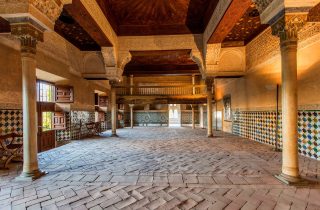
Map of the Discover Roman Seville: Ancient Ruins, History & Highlights walking route with 8 stops in Seville.
Preview map of the Discover Roman Seville: Ancient Ruins, History & Highlights route in Seville, showing 8 stops. Use the interactive map to zoom and tap markers.

Similar Blogs

16 Best Things to Do in Seville, Spain (2026)

Torre del Oro, Seville

This website uses affiliate links which earn a small commission at no additional cost to you.

Along with Córdoba and Granada, Seville is one of the three most famous cities in Andalucia.

Seville allows you to discover a City with a very rich Moorish architectural and historical legacy. As can be seen from the colorful painted tiles that adorn many buildings, to the stucco ceilings of the palaces and of course the iconic Giralda tower, which was once a minaret. It also allows you to dive into Spanish culture, with tapas, sangria and flamenco.

1. Seville Cathedral

Seville Cathedral Spain

This golden cathedral is the result of a fifteenth-century plan by Sevillanos to build a church so big that everyone would ‘think they were mad’. It is an enormous structure and you feel like you will loose yourself within it. You could spend hours staring at the beautiful architectural details, relics and historical curios. This World Heritage site has 80 different chapels inside and is one of the world’s largest cathedral. The tomb of Christopher Columbus is a big draw as well as experiencing the peace and tranquility of the Patio of the Orange Trees.


Location: Av. de la Constitución, s/n 41004 Sevilla Spain | Hours: Monday – Saturday: 11:00–18:00. Sunday: 14:30–19:00. | Price: €13 online / €14 ticket office (general admission; includes the Cathedral, Giralda, and Church of El Salvador). | Website

We recommend to rent a car in Spain through Discover Cars, they compare prices and review multiple car rental agencies. Book your rental car here.

Powered by GetYourGuide

2. El Giralda

sevilla catherdral
sevilla catherdral

Next door to the Cathedral is the Giralda bell tower. It has been the enduring emblem for Seville despite its Moorish origins, being the minaret for the former mosque. To get to the top you have to go up 34 ramps lead to the top instead of a stairway – this was allow Muezzin who led the call to prayer to ride almost all the way to the top. On the way up there are regular archaeological exhibits, which break up the climb. At the top you have amazing views of the city and the buttresses of the cathedral.


Location: La Giralda Av. de la Constitución, s/n 41004 Sevilla Spain | Hours: Monday – Saturday: 11:00–18:00. Sunday: 14:30–19:00. | Price: €13 online / €14 at the ticket office (Cathedral + La Giralda cultural visit). | Website

Here is a complete selection of hotel options in Seville. Feel free to review each one and choose the stay that best suits your needs.

3. Royal Alcázar Palace

Real Alcazar of Seville

The Palace is a beautiful medieval Islamic palace showcasing a unique fusion of Spanish Christian and Moorish architecture.  This is forms part of the  UNESCO-listed World Heritage site, together with the adjoining Seville Cathedral and the General Archive of the Indies. The palace complex is still in use by the Spanish royal family: their chambers, state rooms and halls are on the upper level and can be viewed if you pay a little extra.

The gardens of the Real Alcazar served as the setting for the Kingdom of Dorne on the Game of Thrones. If you enjoy Moorish architecture and decoration, this place will be a real treat for you.


Location: Patio de Banderas, s/n 41004 Sevilla Spain | Hours: (Summer) Monday – Sunday: 09:30–19:00. (Winter) Monday – Sunday: 09:30–17:00. Closed on 1 January, 6 January, Good Friday, 25 December. | Price: €15.50 (general); €8.00 (reduced); optional Upper Royal Quarters add-on €5.50. | Website

Traveling to a country with a different currency? Avoid ATM transaction fees and pay in local currency with a Wise Card. Having used it for over 5 years, we've saved loads on fees!

Powered by GetYourGuide

4. Plaza de España

Plaza Espana, Seville

The Plaza de España was built for the Ibero-American Exposition in 1929 and is situated within the Maria Luisa Park. Seville’s famous Plaza de España monument was built for the Ibero-American Exhibition of 1929, which was held in the Andalusian capital. Located in María Luisa Park, it was the centerpiece of the exhibition and featured many pavilions, which aspired to show off to the world Spain’s accomplishments in industry and architecture.It’s a semi-circular plaza edged by a canal and overlooked by a large, curved palace. It is a magnificent sight and a must see, with its colored ceramics and 48 tiled alcoves, each representing a different province of Spain.


Location: Plaza de España, s/n. 41013 Seville | Hours: 24 Hour | Price: Free | Website

Explore Seville at your own pace with our self-guided walking tour! Follow our curated route to discover must-see sights and local secrets that makes Seville one of the best places to visit in Spain.

5. Maria Luisa Park

Isleta de los patos Seville
CC BY-SA 3.0 / Annual

Maria Luisa is the largest green space in central Seville and is a delightful oasis of green, and is ideally located to escape the noise of the city, with ornamental duck ponds, tiled fountains, and shady paths snaking under the trees. The park’s has broad avenues flanked by palm trees.

In the late-19th century the grounds for this park were  donated to the city by Infanta Luisa Fernanda, originally it belonged to the nearby San Telmo Palace, which dates back to the 1500s. The park took its present shape after development in 1911.


Location: Paseo de las Delicias, s/n 41013 Sevilla Spain | Hours: (Summer) Daily: 08:00–00:00. (Winter) Daily: 08:00–22:00. | Price: Free | Website

Click here to read our blog about Best Palaces to Explore in Seville, Spain (2026)

6. Right Bank of the Guadalquivir

Torre del OroSeville

Starting from the Isabel Bridge you walk alongside the river towards the University of Seville.

Most sunny days Seville’s residents will be here out for walks, riding bikes, jogging or sitting on the stone walls looking across the water to Triana.

You pass by the Plaza de Toros, the 250-year-old bullfighting arena and its museum, which is an interesting visit.

If you continue further along the river you will find the Torre del Oro, an ornate watchtower erected during the days of the Almohad Caliphate in the 13th century, which  now also houses the maritime museum.

From the bank you have good views across the river at the Bario de Triana.


Location: Paseo Cristobal Colón, s/n 41001 Sevilla. | Hours: Monday – Friday: 09:30–19:00. Saturday – Sunday & public holidays: 10:30–19:00. Closed on 1 January, 6 January, Good Friday, 1 May, 25 December. | Price: Free entry (voluntary contribution requested). | Website

Click here to read our blog about Must-Visit Museums In Seville, Spain 2026

7. Tablaos and Flamenco Shows

Museo del Baile Flamenco
CC BY-SA 4.0 / Schnobby

Throughout the year there is flamenco happening each evening in Seville.

The Museo del Baile Flamenco provides the history of flamenco, with a live show and even lessons all set within an 18th-century building.

There are also plenty of tablaos to find in Seville. A tablao is the place where flamenco shows are performed, and is a great way to experience a show, with live musicians and either a bar or restaurant service.

If you are in Seville in the spring or autumn you can watch the Peñas de Guardia, which showcase local or up-and-coming flamenco talent.


Location: Museo del Baile Flamenco, Calle Manuel Rojas Marcos, 3 41004 Sevilla, Spain | Hours: Daily: 11:00–18:45. First Monday of the month: 14:30–18:45. | Price: Museum Only: €6 Museum + Show: €29 (Combo ticket) Show Only: €25 | Website

Click here to read our blog about Discover Roman Seville 2026: Ancient Ruins, History & Highlights

8. Archaeological Museum

Museo Arqueologico de Sevilla 4 1
CC BY-SA 2.0 / Museo Arqueológico de Sevilla

The Archaeological Museum of Seville is housed in the Fine Arts Pavilion that was built for the 1929 Ibero-American Exposition in the Plaza de España, collecting the most important artifacts from the archaeological sites around the Seville Province.

The most exciting finds are from the Bronze Age: For example, dating to the 8th century BC is Treasure of El Carombolo. The El Carambolo treasure, was discovered near Seville in 1958 and contains of golden bracelets, a golden chain with pendant, buckles, belt- and forehead plates.

The museum also houses many of the finds from the Roman town of Italica.


Location: Archeological Museum of Seville Plaza América, 51 41013 Sevilla Spain | Hours: Daily: Closed (temporarily closed for renovation). | Price: Free for EU visitors with valid ID; €1.50 for other visitors (when open). | Website

Click here to read our blog about 12 Hours in Seville: Top Sights and Things to Do (2026)

9. Museum of Arts and Traditions

Museum of Arts and Popular Customs of Seville 4
© Jose Luis Garcia Tenorio

The Museum of Arts and Traditions of Seville is housed in the Mudéjar Pavilion which was also built for the 1929 Ibero-American Exposition.

The museum is dedicated to the ethnological heritage of Andalusia, both material and human. The objects and utensils on display document the customs and ways of life of the traditional culture in the area. There is an emphases in ceramics, clothing and craft activities but everyday items are included such as  lace, ceramics, clothing, work tools, precious metalwork, musical instruments, etc. There is also a section on everyday clothing and costumes worn for the feria.


Location: Museum of Popular Arts and Traditions, Sevilla Plaza América, 3 41013 Sevilla Spain | Hours: (Summer) 16 June – 15 September: Tuesday – Sunday & public holidays: 09:00–15:00. (Winter) 16 September – 15 June: Tuesday – Saturday: 09:00–21:00. Sunday & public holidays: 09:00–15:00. Closed on Monday (except the day before a public holiday). | Price: €1.50 (free for EU citizens with valid ID; concessions may apply to eligible visitors). | Website

10. Museum of Fine Arts

Sagrada Cena by Alonso Vazquez
Public Domain /
The Museum of Fine Arts in Sevilla is one of the finest art museums in Spain. The museum is housed in a restored monastery and has a collection of artworks from the Middle Ages to the modern era with a focus on Spanish masters such as Murillo, Velázquez and Zurbarán.

Much of the work here has a religious theme and was acquired when monasteries and convents around the city that were closed down during la Desamortización from 1835 – 1837.


Location: Seville Museum of Fine Arts, Pl. del Museo, 9 41001 Sevilla Spain | Hours: (Summer) 1 August – 31 August: Tuesday – Sunday & public holidays: 09:00–15:00. (Winter) 1 September – 31 July: Tuesday – Saturday: 09:00–21:00; Sunday & public holidays: 09:00–15:00. Closed on Monday (except Mondays before a public holiday). Closed on 01 January, 06 January, 01 May, 24 December, 25 December & 31 December. | Price: €1.50; free for EU citizens with valid ID and ICOM members. | Website
Powered by GetYourGuide

11. Feria de Abril

Feria de Abril de Sevilla
CC BY-SA 4.0 / Anual

To the south west of the center of Seville, in Los Remedios, the Feria de Abril takes place. This week long event, beginning a lighting ceremony and wrapping up with a massive firework display.

There are a thousand tents or casetas are erected, and locals go around in traditional costumes – the women will wear the “traje de gitano”,  literally gypsy suit or flamenco dresses, while many men will wear the traje corto or short waistcoats and wide-brimmed hats. During the Fair people will eat, drink and dance traditional Sevillanas until dawn.

In the evening there is the fairground, with horseback rides and classic fair amusements.


Location: Real de la Feria Av. Flota de Indias, 1 41011 Sevilla Spain

12. Semana Santa

Seville Semana Santa

The Holy Week processions in Seville is very famous. From Palm Sunday to Easter Sunday somber penitents march through the streets wearing sandals, robes and those odd pointed hoods. The groups belong to brotherhoods of churches from across the city. They will carry the large, ornate floats portraying scenes from the Passion of Christ. This culminates of to Maundy Thursday, when the city’s central plazas have a seated area put up and attendee wear black. On this night the processions make their steady way around the city center until the morning.


| Hours: Mar/Apr | Website

13. Roman Ruins of Italica

Ancient Roman Amphitheatre in Italica 7
CC BY-SA 2.0 / Ángel M. Felicísimo

Only 8km out of Seville lie the ruins of Italica the birthplace of Roman Emperors Trajan and Hadrian. Italica is a large archaeological site, with highlights being the amphitheater and the Roman Theater. The amphitheater could have sat 25,000 spectators in the day, and you can explore the tunnels beneath the terraces of the arena. On top of that is the foundations of mansions and temples and exquisite mosaics.


Location: Conjunto Arqueológico de Itálica, Av. Extremadura, 2 41970 Santiponce Sevilla Spain | Hours: 1 April – 20 June: Tuesday – Thursday: 09:00–18:00. Friday – Saturday: 09:00–21:00. Sunday, public holidays & Monday (day before public holiday): 09:00–15:00. 21 June – 20 September: Tuesday – Saturday: 09:00–15:00. Sunday, public holidays & Monday (day before public holiday): 09:00–15:00. 21 September – 31 March: Tuesday – Saturday: 09:00–18:00. Sunday, public holidays & Monday (day before public holiday): 09:00–15:00. Closed on Mondays (except the day before a public holiday). Closed on 1 January, 6 January, 1 May, 24 December, 25 December, and 31 December. | Price: Free for EU citizens; €1.50 for non-EU visitors. | Website
Powered by GetYourGuide

14. Bario de Triana

Triana Neighborhood Guide, Seville
Flickr / José Luis Murillo

Opposite the old city, on the left bank of the Guadalquivir, is the Triana neighborhood. It was formerly known as Seville’s gypsy neighborhood, Triana has evolved into a lively vibrant area packed with charming paved streets, ceramic shops, pretty churches, atmospheric tapas bars and flamenco scene.

Calle Betis is an excellent viewpoint to contemplate some of the most famous landmarks of Seville, the Torre del Oro and the splendid El Giraldillo.

Visit  the recently modernized Triana Market, or explore the history of the area at the nestled in the ruins of San Jorge Castle, or the slightly more mundane Ceramics Museum.


| Hours: 24 Hours | Price: Free. | Website
Powered by GetYourGuide

15. Setas de Sevilla

Espacio Parasol, Sevilla
CC BY-SA 3.0 / Rubendene

The Setas de Sevilla popularly known as the Mushrooms of the Incarnation is a huge wooden structure with plenty of terraces, restaurants, cafeterias and bars to enjoy Seville evening and night.

On the top of the building, there is a viewing point and walkway, which allows you to walk among the Seville skyline.

The basement contains A museum showing Roman ruins, including some amazing mosaics that were uncovered when excavations were being done.


Location: Plaza de la Encarnación, 41003 Seville, Andalucía, Spain | Hours: Daily: 09:30–00:30 (last entry 23:45). | Price: €15 (general ticket for the rooftop viewing platform; concessions may be available). | Website
Powered by GetYourGuide

16. Casa de Pilatos

Casa de Pilatos Seville 8
CC BY-SA 4.0 / Mario Fernández

The magnificent Casa de Pilatos is a late 15th century Palace, officially known as the Royal Ducal House of Medinaceli, is one of the most intriguing buildings in Seville.

The building incorporates a wonderful mix of Mudéjar, Gothic and Renaissance decor, with some beautiful tilework and ceilings of interlaced beams with decorative insertions -its like a mini-Alcázar.

The palace features unique architecture supposedly based on Pontius Pilot’s estate, decor and even has a bust of Caligula.

The palace was a filming location for the 1960s film Lawrence of Arabia.


Location: Plaza de Pilatos,1, 41003 Sevilla, Spain | Hours: Daily: 09:00–18:00. 25 December: 09:00–14:00; 1 January: 10:00–18:00; 6 January: 09:00–14:00. | Price: €12 (ground floor); €18 (ground floor + upper floor guided visit). | Website
Powered by GetYourGuide
Moira & Andy
Moira & Andy

Hey! We're Moira & Andy. From hiking the Camino to trips around Europe in Bert our campervan — we've been traveling together since retirement in 2020!

Read our full story here

16 Best things to do in Seville

This website uses affiliate links which earn a small commission at no additional cost to you.

Walking Tour Map

Map of the 16 Best Things to Do in Seville, Spain walking route with 16 stops in Seville.
Preview map of the 16 Best Things to Do in Seville, Spain route in Seville, showing 16 stops. Use the interactive map to zoom and tap markers.

Similar Blogs

12 Hours in Seville: Top Sights and Things to Do (2026)

Plaza Espana, Seville

This website uses affiliate links which earn a small commission at no additional cost to you.

Seville is an exciting city, situated on the banks of the Guadalquivir River. We have visited it twice before, once in springtime when the jacaranda trees were in full bloom, massive trees with beautiful purple flowers. The other time we sailed a boat up the river, which was a brilliant way to arrive.

This time when we visited the Seville it was too early for the blossom but it is still an amazing place to spend a few days being famous for its cathedral, beautiful parks, palaces, the Triana area's flamenco dancing and tapas bars.

Now the capital of Andalusia, Seville was built during the Moorish Almohad dynasty and later became a 16th century metropolis. Seville usually has good weather with approximately 300 days of sunshine per year.

1. Alcazar of Seville

Real Alcazar of Seville

This was built for King Peter of Castillo on the site of an Albadid Muslim fortress 

The King of Spain still stays there in the upper part of the castle and for an extra fee you can visit this part of the castle. We didn’t because there was enough to see in this amazing palace with the limited time we had to spare. We bought a ticket on line at the official website to save queuing. If we had gone on Monday afternoon it would have been free entry.

We walked from courtyard to beautiful courtyard, spending a long time looking at the carved celings. The domed ceiling in the Ambassadors Hall is stunning. We walked through a maze of tile covered rooms, we even got  lost at one point in the warren of rooms!

We enjoyed the garden even more than the palatial castle, the orange blossom smelt amazing! There were typical Muslim style pools and fountains, pavilions, statues; in the English garden we sat and watched the peacocks and luckily they don’t peck at you as do the Seville pidgeons.

We were glad that we arrived early at 9.30am before the massive crowds who arrive for the tours that start at 11am.


Location: Patio de Banderas, s/n 41004 Sevilla Spain | Hours: (Summer) Monday – Sunday: 09:30–19:00. (Winter) Monday – Sunday: 09:30–17:00. Closed on 1 January, 6 January, Good Friday, 25 December. | Price: €15.50 (general); €8.00 (reduced); optional Upper Royal Quarters add-on €5.50. | Website

We recommend to rent a car in Spain through Discover Cars, they compare prices and review multiple car rental agencies. Book your rental car here.

Powered by GetYourGuide

2. The Seville Cathedral

Seville Cathedral Spain

Seville’s cathedral is the largest Gothic cathedral in the world and is recognised as UNESCO World Heritage. The building is 126 metres long and 83 metres wide with a ceiling height of 37 metres. The construction lasted over a century from 1401 to 1506. 

The basilica is over the ruins of the Aljama mosque which was destroyed by an earthquake in 1356. The mosque was built in the 12th century by the Almohads, the ruling Moorish dynasty, the only remaining parts are the Patio de los Naranjas, a large courtyard. A large portal (door of Pardon) leads to the patio. The stone fountain in the centre may even be from the Roman era. The other building remaining after the earthquake is the lower section of the Bell tower, the Giralda.

The most spectacular part of the interior is the main altar piece. Designed by Piere Dancart who worked for over 40 years, starting in 1482. It has the largest altarpiece in the world depicting scenes from the old testament and the lives of saints. In the centre is a statue of Santa Maria de la Sede.


Location: Av. de la Constitución, s/n 41004 Sevilla Spain | Hours: Monday – Saturday: 11:00–18:00. Sunday: 14:30–19:00. | Price: €13 online / €14 ticket office (general admission; includes the Cathedral, Giralda, and Church of El Salvador). | Website

Here is a complete selection of hotel options in Seville. Feel free to review each one and choose the stay that best suits your needs.

Powered by GetYourGuide

3. The Tomb of Christopher Columbus

Tomb of Christopher Columbus in Seville Spain 5
CC BY-SA 4.0 / Raffaele pagani

The Cathedral is also the burial place of Christopher Columbus and his son Diego. Just inside the Cathedral door stands a monument to him and his tomb which is held aloft by four allegorical figures representing the four kingdoms of Spain during his life, Castille, Aragon, Navara and Leon.


Location: Tumba de Cristobal Colon, 41004 Sevilla Spain | Hours: Monday – Saturday: 11:00–18:00. Sunday: 14:30–19:00. | Price: Included with Seville Cathedral ticket (general admission: €13 online / €14 at the ticket office). | Website

Traveling to a country with a different currency? Avoid ATM transaction fees and pay in local currency with a Wise Card. Having used it for over 5 years, we've saved loads on fees!

Powered by GetYourGuide

4. The Cathedral Bell Tower

giralda sevilla catherdral

We found the view from the Bell Tower stunning. Our guide was very knowledgeable and did a great job of entertaining us as well as guiding us. The climb up the tiny narrow staircase was quite difficult unless you are very fit. I will probably not do this again in the near future!

Between the Cathedral, Tomb and Bell Tower I was surprised we were in the cathedral complex for nearly three hours, there was so much to see.


Location: La Giralda Av. de la Constitución, s/n 41004 Sevilla Spain | Hours: Monday – Saturday: 11:00–18:00. Sunday: 14:30–19:00. | Price: €13 online / €14 at the ticket office (Cathedral + La Giralda cultural visit). | Website

Explore Seville at your own pace with our self-guided walking tour! Follow our curated route to discover must-see sights and local secrets that makes Seville one of the best places to visit in Spain.

5. Plaza de Espana

Plaza Espana, Seville

We headed to the Parque De Maria Luisa, but the Plaza Espana was so close we decided to pop over and have a look. 

The Plaza de España was built in the 1920’s on the edge of the Parque de María Luisa for the Ibero-American World’s Fair held in 1929. The main attraction here is, of course, the imposing half-circle structure made up of pavilions and galleries and towers, all surrounded by a moat with bridges connecting it to the giant square and fountain on the other side.

One of the highlights of the Plaza was discovering the alcoves that represent each of the provinces of Spain. Each one is colorfully decorated with painted tiles depicting scenes from that area’s history, alongside each bench is a bookcase where people can leave books about that area.


Location: Plaza de España, s/n. 41013 Seville | Hours: 24 Hour | Price: Free | Website

Click here to read our blog about Best Palaces to Explore in Seville, Spain (2026)

6. Parque De Maria Luisa

Parque de Maria Luisa Seville
CC BY-SA 4.0 / Gzzz

A 100 acre Park that stretches along the Guadalquivir River and was created in 1911 and redesigned for the 1929 Ibero American exposition. A large and well known park, it has everything, with flowers, fountains, statues and lots of shady trees for shelter from the summer heat.

We walked through the Parque De Maria Luisa and into the adjacent Plaza of Americans.


Location: Paseo de las Delicias, s/n 41013 Sevilla Spain | Hours: (Summer) Daily: 08:00–00:00. (Winter) Daily: 08:00–22:00. | Price: Free | Website

Click here to read our blog about Must-Visit Museums In Seville, Spain 2026

7. Plaza de America

Plaza de America Seville 2
CC BY-SA 4.0 / Barcex

We found a man selling bird seed and spent an enjoyable afternoon feeding the birds. I did end up with a few scratches from some rather aggressive pigeons and was a bit wary when they landed on my head, but on the whole it was great fun.

The Park teemed with wild birds. We spent a long time just wandering around watching the parakeets and the ducks. This was a great place to chill out after a few days looking at the famous museums and palaces.

After enjoying the wildlife we decided to stop at one of the bars in the park for some refreshing drinks.


Location: Plaza de América 41013 Seville Seville, Andalusia | Hours: (Winter) Daily: 08:00–22:00. (Summer) Daily: 08:00–24:00. | Price: Free | Website

Click here to read our blog about Discover Roman Seville 2026: Ancient Ruins, History & Highlights

8. Las Teresas

lasTeresas Seville
lasTeresas Seville
© Las Teresas

When we are in Spain we love visiting tapas bars. Las Teresas was opened in 1870. It is close to the Giralda Tower and the Santa Cruz Church in the Jewish quarter. We went there on a Friday night but should have known better because it is their busiest time and the service can be erratic. However, the atmosphere was good and the Iberian ham and spinach with chickpeas that we chose was well worth waiting for.

Click here to read our blog about 16 Best Things to Do in Seville, Spain (2026)

9. Baraka Sala Famenca

Baraka Sala Famenca
Baraka Sala Famenca
© Baraka Sala Famenca

A visit to Seville would not have been complete without a visit to a flamenco show. We chose the Baraka Sala Famenca to give us a taste of Triana. The fabulous show was definitely worth the money and we were glad that we had chosen their smaller, more intimate setting. Our last evening was magical; the show was amazing with superb dancing, singing, clapping and guitar playing.

Festivals

Two of the major festivals are Easter Week and the Feria de Abril. We have decided that when we visit the  city again it will be in April. The city is filled with music, food dancing and entertainment. The women all wear flamenco dresses, so it only leaves me to buy a new flamenco dress before next April and we will be there!

Powered by GetYourGuide
Moira & Andy
Moira & Andy

Hey! We're Moira & Andy. From hiking the Camino to trips around Europe in Bert our campervan — we've been traveling together since retirement in 2020!

Read our full story here

This website uses affiliate links which earn a small commission at no additional cost to you.

Walking Tour Map

Map of the 12 Hours in Seville: Top Sights and Things to Do walking route with 9 stops in Seville.
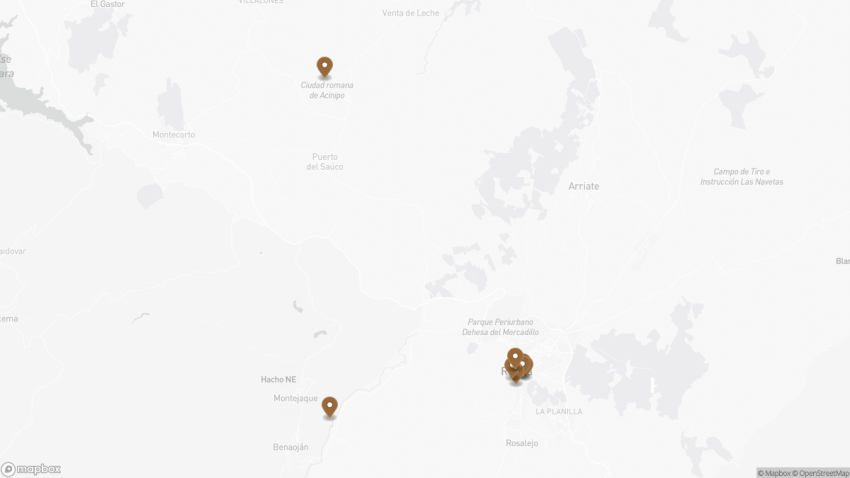
Preview map of the 12 Hours in Seville: Top Sights and Things to Do route in Seville, showing 9 stops. Use the interactive map to zoom and tap markers.
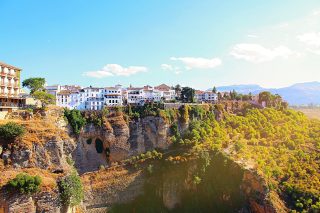
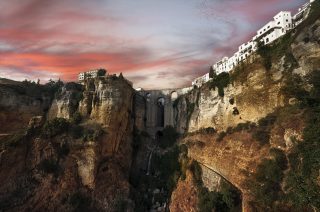
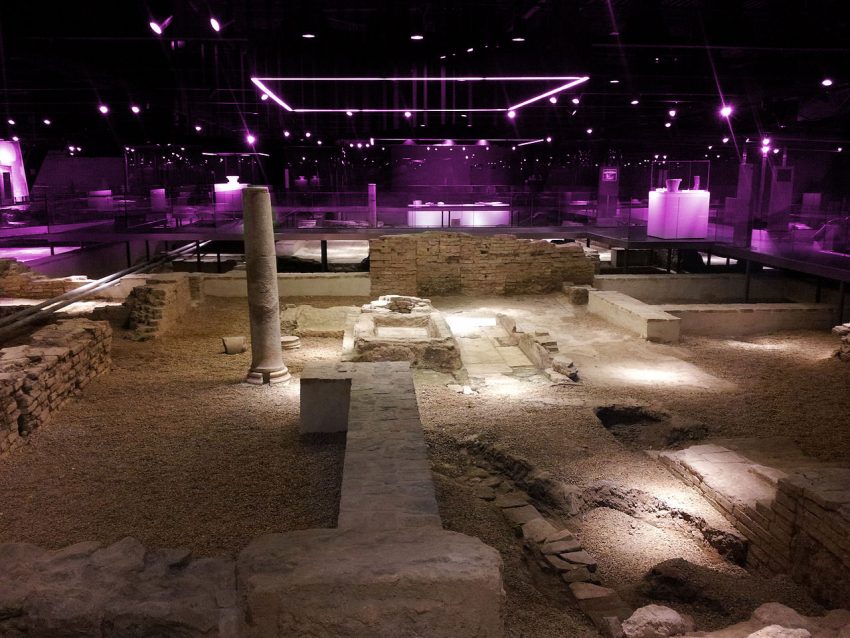
Similar Blogs