Córdoba, Spain: The Ultimate Travel Guide 2026
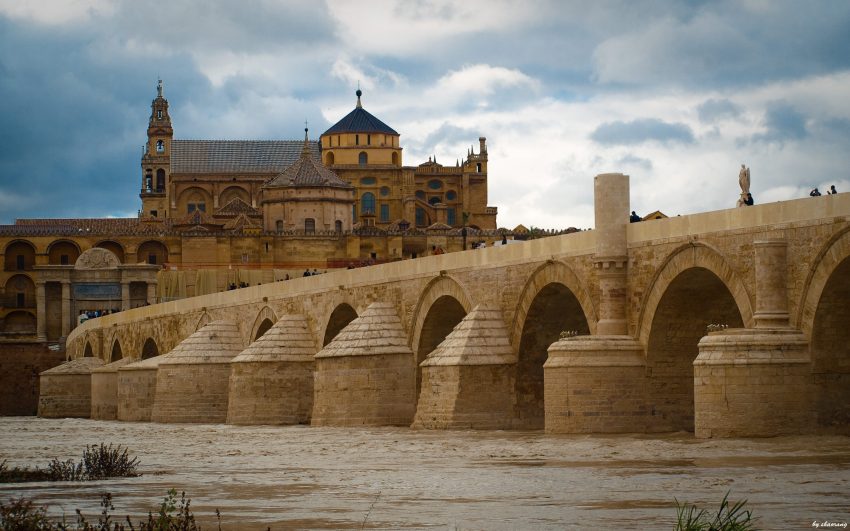
Roman Bridge and Mezquita, Cordoba
CC BY-SA 2.0 / shaorang

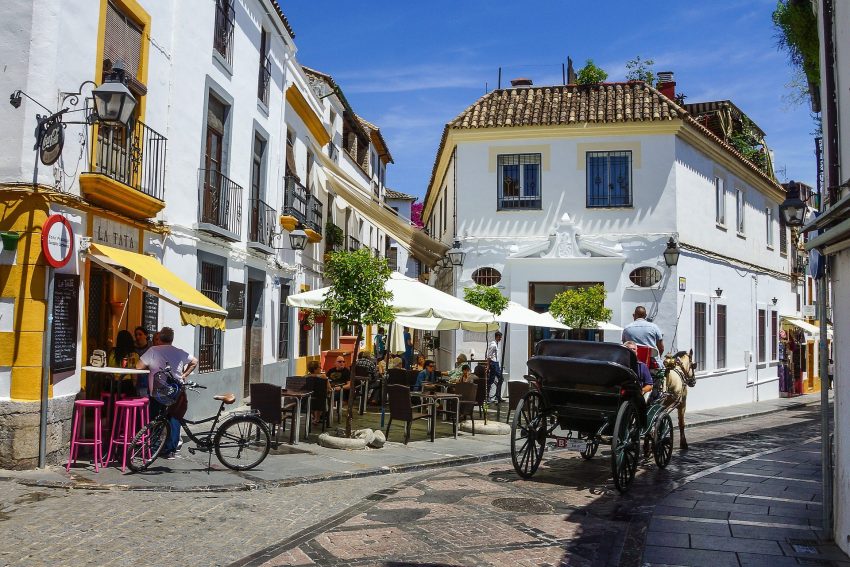
Córdoba, located in the Andalusia region of southern Spain, is a city that effortlessly blends rich culture, stunning architecture, and a vibrant atmosphere. As you walk through its charming streets, you’ll find yourself surrounded by picturesque courtyards adorned with colorful flowers, bustling markets, and an unmistakable Andalusian charm. The city is a wonderful place to explore on foot, allowing you to soak in the beauty of its winding alleyways, inviting cafes, and lively plazas where locals and visitors alike gather to enjoy the ambiance.

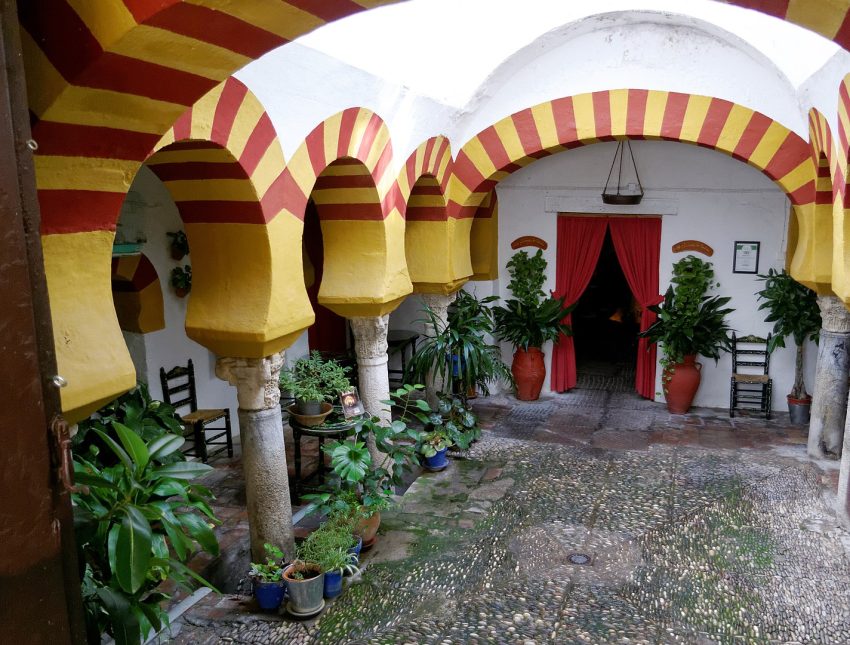
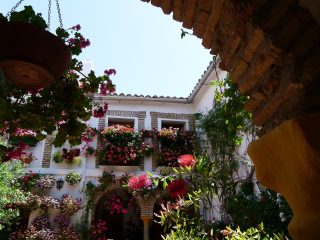
One of the highlights of visiting Córdoba is the mesmerizing Mezquita-Catedral, an architectural masterpiece that leaves visitors in awe. With its endless rows of striking arches and intricate details, the building offers an unforgettable experience. Beyond this iconic landmark, the city boasts peaceful patios that are open for public viewing during the annual courtyard festival, as well as serene gardens and traditional Andalusian houses that transport you to another era.

Beyond sightseeing, Córdoba is an excellent place to indulge in authentic Spanish cuisine. Local eateries serve delicious specialties such as salmorejo, a creamy tomato-based dish, and flamenquín, a breaded pork roll, both of which are favorites among locals. Whether you're sipping coffee by the river or enjoying tapas in a lively square, the city's relaxed pace and welcoming atmosphere make it an ideal destination for those seeking an immersive cultural experience.

Table of Contents

History of Córdoba

Early History

Córdoba, located in the southern region of Andalusia, Spain, has a rich history that dates back to ancient times. It was originally a Carthaginian settlement before being conquered by the Romans in 206 BC. Under Roman rule, Córdoba became a significant city, serving as the capital of the Roman province of Hispania Baetica.

Roman Era

During the Roman era, Córdoba flourished as a center of commerce and culture. The city was known for its impressive infrastructure, including bridges, aqueducts, and temples. The Great Roman Bridge, which still stands today, is a testament to the city’s importance during this period. Córdoba also produced notable philosophers such as Seneca and Lucan.

Visigothic Period

Following the fall of the Western Roman Empire, Córdoba came under the control of the Visigoths in the 6th century. The city experienced a period of decline as it lost much of its former significance. However, it remained an important religious center for Christianity.

Islamic Conquest and the Umayyad Caliphate

In 711 AD, the Moors conquered Córdoba, and it quickly became a prominent city under Islamic rule. In 756, Abd al-Rahman I declared Córdoba the capital of the independent Emirate of Córdoba. The city reached its peak under the Umayyad Caliphate in the 10th century, when it was transformed into one of the largest and most advanced cities in Europe. Córdoba became a center of learning, culture, and architecture, renowned for its libraries, universities, and medical schools.

The Great Mosque of Córdoba

One of the most iconic landmarks from this period is the Great Mosque of Córdoba (Mezquita), constructed in 785 AD. It was expanded multiple times over the centuries and is celebrated for its stunning architecture, including its vast prayer hall with hundreds of arches and columns. The mosque symbolized Córdoba’s status as a leading center of Islamic culture and religion.

Christian Reconquest

In 1236, Córdoba was captured by King Ferdinand III of Castile during the Christian Reconquest. The Great Mosque was converted into a Catholic cathedral, and many other Islamic structures were repurposed or destroyed. Despite this, much of the city’s Islamic heritage remains evident in its architecture and layout.

Renaissance and Baroque Periods

During the Renaissance and Baroque periods, Córdoba experienced a revival. The city saw the construction of many new buildings, including palaces, churches, and public squares. This period also saw the expansion of the city’s infrastructure and the improvement of its urban planning.

Modern Era

In the 19th and 20th centuries, Córdoba underwent significant changes as it modernized and industrialized. The city’s population grew, and it became an important agricultural and industrial center. Despite these changes, Córdoba has managed to preserve its rich historical and architectural heritage.

UNESCO World Heritage Site

In 1984, the historic center of Córdoba, including the Great Mosque-Cathedral, was designated a UNESCO World Heritage Site. This recognition highlights the city’s outstanding cultural significance and its well-preserved historical monuments.

Contemporary Córdoba

Today, Córdoba is a vibrant city that seamlessly blends its ancient heritage with modern life. It is a popular tourist destination known for its beautiful architecture, lively festivals, and rich cultural traditions. The annual Festival of the Patios, where residents open their flower-filled courtyards to the public, is just one example of the city’s enduring charm and cultural vitality.

Moira & Andy
Moira & Andy

Hey! We're Moira & Andy. From hiking the Camino to trips around Europe in Bert our campervan — we've been traveling together since retirement in 2020!

Read our full story here

Visiting Córdoba for the first time and wondering what are the top places to see in the city? In this complete guide, I share the best things to do in Córdoba on the first visit. To help you plan your trip, I have also included an interactive map and practical tips for visiting!

This website uses affiliate links which earn a small commission at no additional cost to you.
Powered by GetYourGuide

46 Best places to See in Córdoba

This complete guide to Córdoba not only tells you about the very best sights and tourist attractions for first-time visitors to the city but also provide insights into a few of our personal favorite things to do.

This is a practical guide to visiting the best places to see in Córdoba and is filled with tips and info that should answer all your questions!

1. Mezquita-Catedral
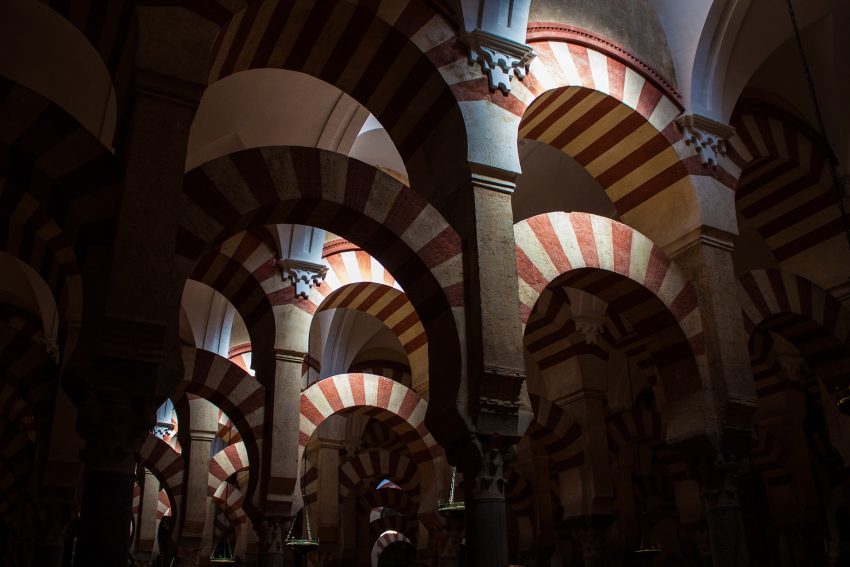
Mosque–Cathedral of Cordoba
The Mezquita-Catedral is a vast former mosque transformed into a Catholic cathedral, where Islamic geometry and Christian grandeur occupy the same space. Visitors first cross the Patio de los Naranjos, a calm orange-tree courtyard that once served for ablutions, then step into a dim hypostyle hall built from hundreds of reused Roman and Visigoth columns beneath red-and-white double arches. The mihrab glitters with gold mosaic said to have been brought from Byzantium, while a Renaissance nave and choir rise unexpectedly from the center like a stone ship in a sea of arches. Climb the bell tower—once a 10th-century minaret—for roofline views and traces of the earlier structure.
Location: CORDOBA Calle Cardenal Herrero, 1 14003 | Website | Distance: 0km

We recommend to rent a car in Spain through Discover Cars, they compare prices and review multiple car rental agencies. Book your rental car here.

Powered by GetYourGuide

2. Palacio de Congresos

Facade of Hospital de San Sebastian Cordoba
CC BY-SA 2.0 / Kennosuke Yamaguchi
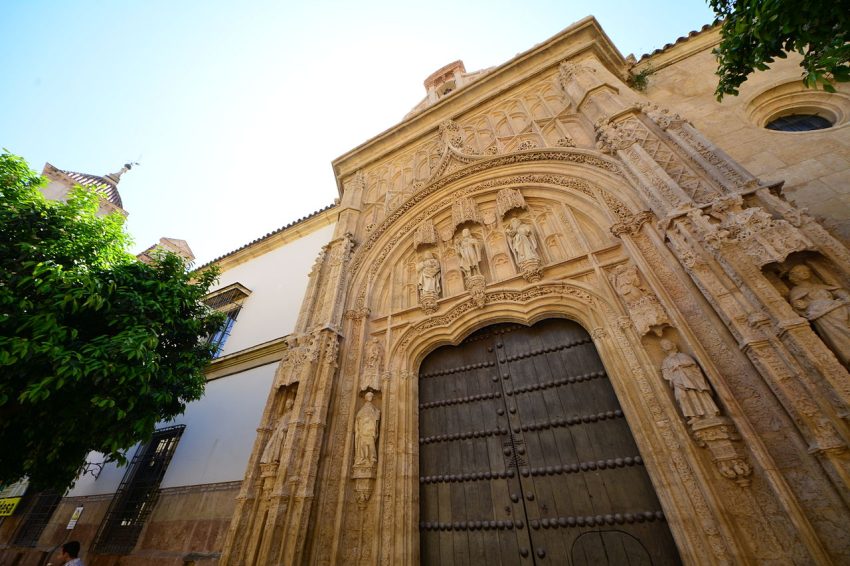
Palacio de Congresos in Córdoba occupies the former 16th-century Hospital de San Sebastián, a layered complex opposite the western façade of the Mosque–Cathedral that now functions as a conference venue and tourist information point. Inside, two calm courtyards set the tone with octagonal columns and brick arches where Gothic structure meets Mudejar patterning. Look for reused fragments tied to the site’s earlier life, including stretches associated with the old Umayyad Alcázar wall and the area once linked to the mosque’s ablutions. The Julio Romero de Torres Room—formerly a maternity ward—preserves 1500s frescoes of San Sebastián, and the old church still shows a flamboyant Plateresque-Gothic doorway and side tribunes where patients once watched services.
Location: Palacio De Congresos Y Exposiciones De Córdoba Calle Torrijos, 10 14003 Córdoba Spain | Website | Distance: 0.1km

Here is a complete selection of hotel options in Córdoba. Feel free to review each one and choose the stay that best suits your needs.

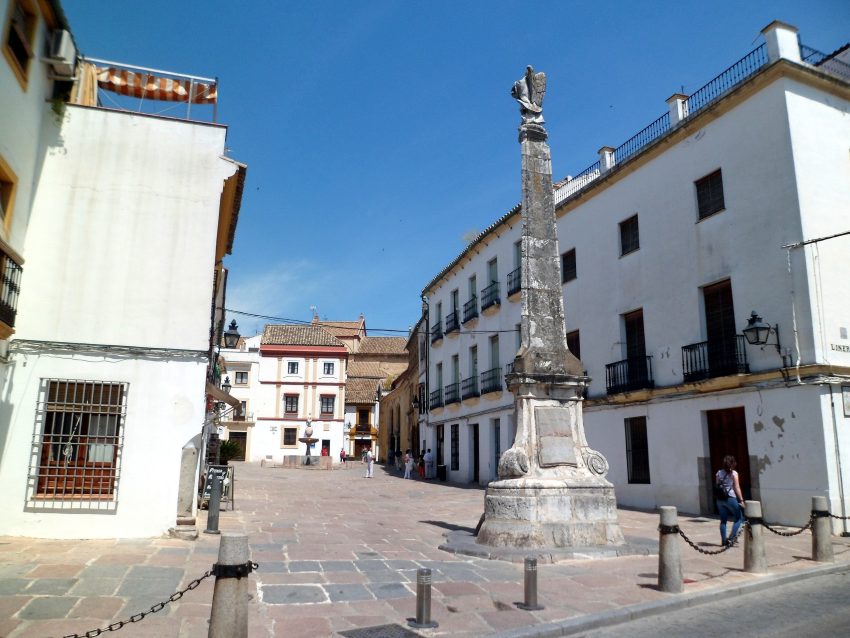
3. Triunfo de San Rafael de la Puerta del Puente
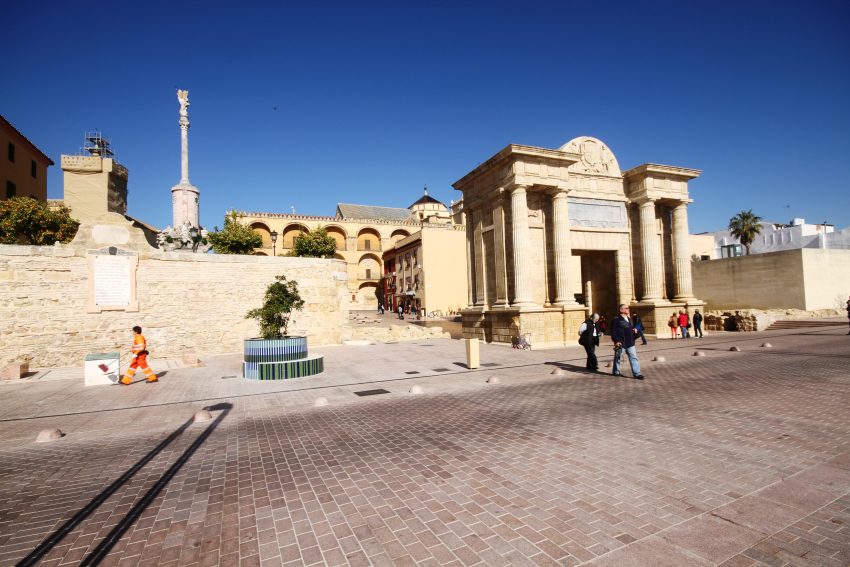
Triunfo de San Rafael Puerta del Puente  Cordoba
Triunfo de San Rafael Puerta del Puente Cordoba
CC BY-SA 3.0 / José Luiz
Rising beside the Roman Bridge at the Puerta del Puente, this towering “Triunfo” is a monumental column honoring San Rafael, long invoked as the city’s guardian since plague-era devotion in the 17th century. More than 27 metres tall, it stands on a dark marble base and lifts the archangel high above the riverfront, framed by the Mezquita behind and the bridge ahead. Look for the ornate sculptural program: a castle-like pedestal perched on a rocky mount, carved saints and animals, and motifs of agricultural abundance. Built from 1765 and completed in 1871, it’s especially striking after dusk when the stonework is lit and the square fills with passersby.
Location: Triunfo de San Rafael de la Puerta del Puente Calle Corregidor Luis de la Cerda, 85 14003 Córdoba Spain | Hours: 24 Hours | Price: Free | Distance: 0.1km

Traveling to a country with a different currency? Avoid ATM transaction fees and pay in local currency with a Wise Card. Having used it for over 5 years, we've saved loads on fees!

4. Puerta del Puente

Rear of Puerta Del Puente Cordoba
CC BY-SA 3.0 / Berthold Werner
Rising at the north end of the Roman Bridge, the Puerta del Puente is a Renaissance gateway built like a small triumphal arch, with a sandstone façade and Doric columns facing the river. It stands on the line of an older Roman entrance linked to the Via Augusta, later known in Islamic times as Bab al‑Qantara, keeping its role as the main southern threshold for centuries. Look for the inscription commemorating Philip II’s 1570 visit and the flanking warriors holding the Spanish crown, plus reliefs such as Judith and Holofernes. Inside, a compact exhibition explains the monument’s rebuilds, and the upper terrace frames sweeping views over the bridge, the Guadalquivir, and the old quarter—an especially photogenic spot at golden hour.
Location: Puerta del puente Plaza del Triunfo, s/n 14003 Córdoba Spain | Hours: Monday to Thursday from 10 am. to 3 pm. Friday from 10 am. to 2 pm. and from 6 pm. to 8:30 pm. Saturday from 10 am. to 2 pm. and from 6 pm. to 8:30 pm. Sunday and Bank Holidays from 10 am. to 3 pm. Summer, Monday to Sunday from 10 am. to 3 pm. | Price: Tickets: 1 € Free Entrance for children under 5 years | Distance: 0.1km

Explore Córdoba at your own pace with our self-guided walking tour! Follow our curated route to discover must-see sights and local secrets that makes Córdoba one of the best places to visit in Spain.

5. Mills of the Guadalquivir

Albolafia Water mill  Cordoba Spain
Albolafia Water mill Cordoba Spain
CC BY-SA 4.0 / Reyhaneh Behboudi
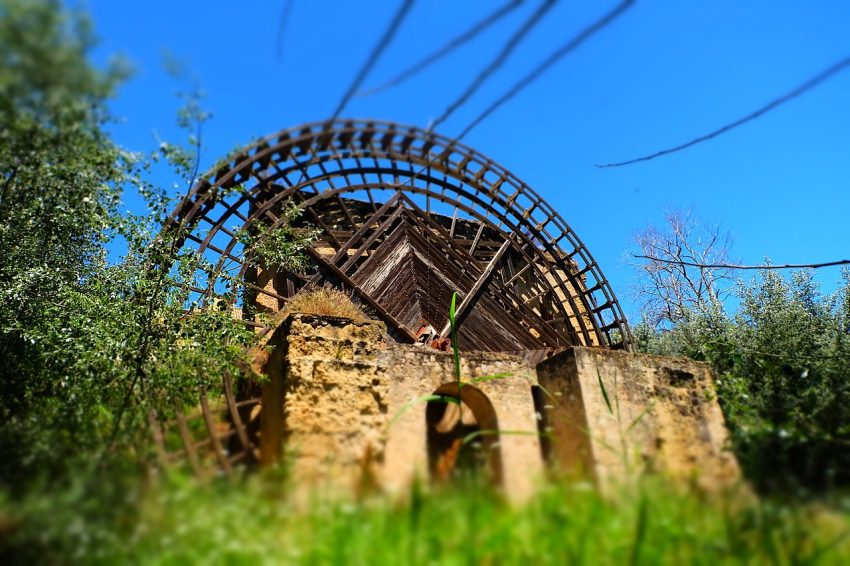
The Mills of the Guadalquivir are a chain of eleven medieval river watermills strung along the riverbank near the historic centre, built from the Islamic period through the late Middle Ages to grind grain and power trades like fulling cloth, tanning leather, and processing plant fibres. The best-known is Albolafia, a noria-style wheel created under Abd al-Rahman II, once lifting river water up to palace gardens beside the Roman Bridge. Other mills sit as quiet ruins with surviving walls, chambers, and millraces, while Martos has been adapted for cultural use with a small Museum of Water. In the evening, the riverfront can feel atmospheric—though lighting and upkeep vary, as visitors sometimes note.
Location: Molino de la Albolafia Av. del Alcázar, 512 14003 Córdoba Spain | Hours: 24 Hour | Price: Free | Distance: 0.2km

Click here to read our blog about Córdoba’s Spring Festivals 2026: Patios, Flowers & Local Traditions

6. Calleja de las Flores

Alminar Mezquita de Cordoba
CC BY-SA 2.0 / Ramón Jiménez
Calleja de las Flores is a narrow, stone-paved lane in the Jewish Quarter, a quick detour of whitewashed walls studded with bright blue pots spilling geraniums, carnations, and trailing vines. What makes it memorable is the forced perspective at the far end: the Mosque–Cathedral’s bell tower appears neatly framed between the tight walls, drawing photographers to pause and wait for a clear shot. Midway through, the view begins to reveal itself, then the passage opens into a small plaza with a simple fountain that feels like a shared courtyard. It’s tiny and often crowded, but the color-and-stone contrast sticks with you.
Location: Calleja de las Flores 1 14003 Córdoba Spain | Distance: 0.2km

Click here to read our blog about Visiting Córdoba’s Patios 2026: A Guide to the City’s Floral Courtyards

7. Baños Árabes de Santa María

Banos arabes de Santa Maria Cordoba
CC BY-SA 3.0 / Berthold Werner
Baños Árabes de Santa María is a compact set of medieval Arab baths hidden in Córdoba’s Jewish Quarter, preserving a rare slice of everyday bathing culture from the Caliphate and later Mudejar periods. You enter into vaulted chambers framed by horseshoe arches, where the sequence of rooms still reads clearly: a former changing area, a cold space now opened into a courtyard, and a rectangular hot room capped by a barrel vault. In the hot chamber, wall recesses for hot and cold water hint at the original bathing circuit. Ten metres below, an elliptical cistern reveals the ingenious water system that kept the complex running for centuries.
Location: Baños árabes de Santa María Calle Velázquez Bosco, 8 14003 Córdoba Spain | Distance: 0.2km

Click here to read our blog about 12 Best Museums in Córdoba, Spain (2026)

8. Puente Romano de Córdoba

Puente Romano at night
CC BY-SA 2.0 / Andreas Zieroth Follow
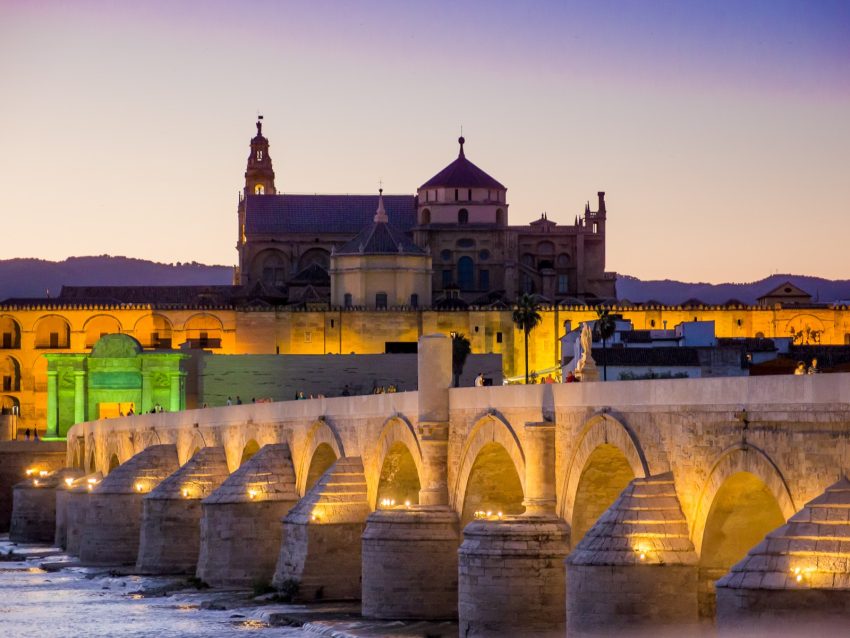
The Puente Romano is a 331‑metre stone bridge spanning the Guadalquivir, first built in the early 1st century BC and later reshaped under Moorish rule, which gives many arches their present character. Crossing its 16 arches (four pointed, the rest semicircular) feels like moving through layers of Roman, Islamic, and later Christian engineering. Midway, the statue of Archangel San Rafael is often ringed with red candles, adding a lived-in devotional touch to the river walk. From the deck, the view back toward the Mezquita-Catedral is especially striking at sunset, when warm light catches the arches and ripples below.

Click here to read our blog about Discovering Roman Córdoba 2026: Ruins, Monuments & Ancient Heritage

Powered by GetYourGuide

9. Statue of Maimónides

Moses ben Maimon Cordoba
CC BY-SA 2.0 / Jerzy Kociatkiewicz
Tucked into Plaza de Tiberíades in the Jewish Quarter, this 1964 bronze by Amadeo Ruiz Olmos portrays Moses ben Maimon (Maimónides) seated in scholarly robes with a book on his lap. The calm, inward-looking expression suits a thinker born here in the 12th century who later became a renowned physician and legal scholar in exile. The square’s whitewashed walls, old stone doorways, and potted plants create a hushed, enclosed setting that feels like a pause in the surrounding lanes. Many visitors notice the statue’s polished foot—rubbed for luck—before lingering by the plaques that explain the link between his birthplace and Tiberias, his traditional burial place.
Location: Estatua de Maimónides 14004 Córdoba Spain | Hours: 24 Hours | Price: Free | Distance: 0.3km

Click here to read our blog about 16 Best Things to Do in Córdoba, Spain (2026)

10. Baños del Alcázar Califal

Displays in Caliphal Baths Cordoba 3
CC BY-SA 3.0 / Tulum
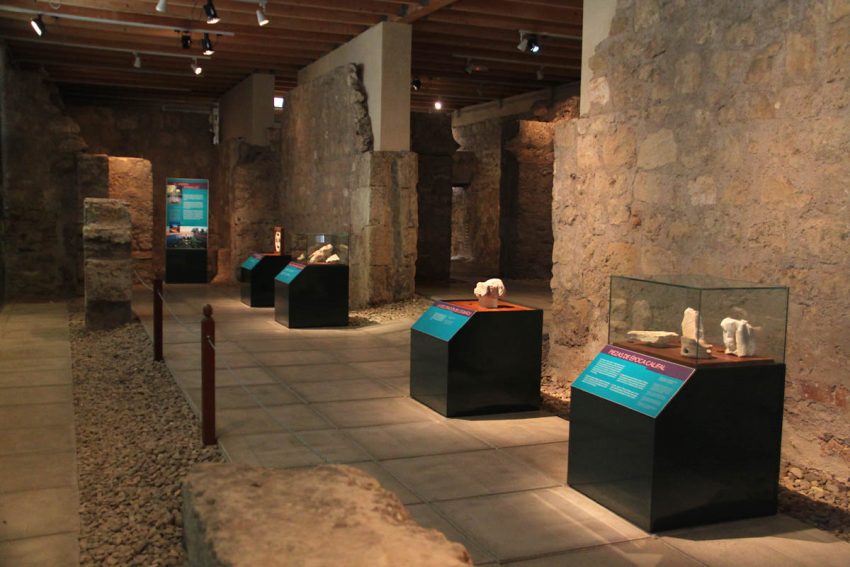
Hidden a few steps from the Alcázar de los Reyes Cristianos, the Baños del Alcázar Califal are 10th-century royal baths built for Caliph Al-Hakam II, revealing the private rituals and leisure of the palace court. Visitors move through a Roman-inspired sequence of cold, warm, and hot rooms, linked by narrow passages designed to hold the temperature changes. The dim vaulted chambers are punctured by star-shaped skylights that scatter light across stone floors, creating an almost hushed, steamy atmosphere even today. In the hottest room, you can still pick out traces of the hypocaust-style underfloor heating system. Later Almoravid and Almohad additions show how the complex evolved over centuries.
Location: Campo Santo de los Mártires, s/n, 14004 | Hours: From September 16 to June 15: From Tuesday to Friday from 8:30 am. to 8:45 pm. Saturday from 8:30 am. to 4:30 pm. Sunday and bank holidays from 8:30 am. to 2:30 pm. From June 16 to September 15: From Tuesday to Saturday from 8:30 am. to 3 pm. Sunday and bank holidays from 8:30 am. to 2:30 pm. | Price: Adult: € 2.50 Student up to 26 years: € 1.25 Tuesday through Friday from 8:30 to 9:30 am., except for bank holidays, is free. | Website | Distance: 0.3km

11. Hospital del Cardenal Salazar
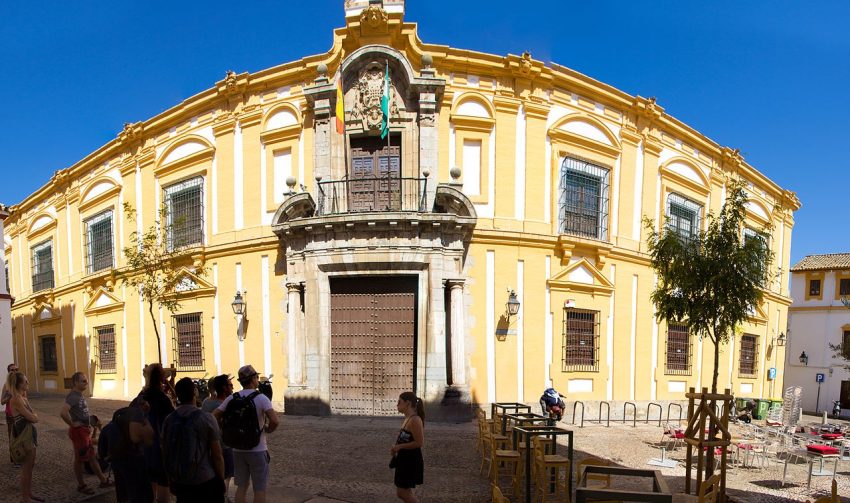
Hospital del Cardenal Salazar
CC BY-SA 2.0 / Tibor Kovacs
Hospital del Cardenal Salazar is an early-18th-century Baroque complex founded in 1704 by Cardinal Pedro de Salazar, later shifting from a choirboys’ school to a hospital that cared for the terminally ill before joining the university. From the narrow street, the stone façade stands out with Doric-style pilasters and a grand arched entrance. Inside, the mood turns quiet around two courtyards, including a larger patio with arcades and a marble fountain. Look closely at old windowpanes along the corridors—some still carry names and dates scratched by former patients, a small detail that makes the building’s past feel immediate. Visitors also mention a pleasant café and occasional free concerts.
Location: Hospital del Cardenal Salazar Plaza Cardenal Salazar, 6 14003 Córdoba Spain | Distance: 0.3km

12. El Zoco
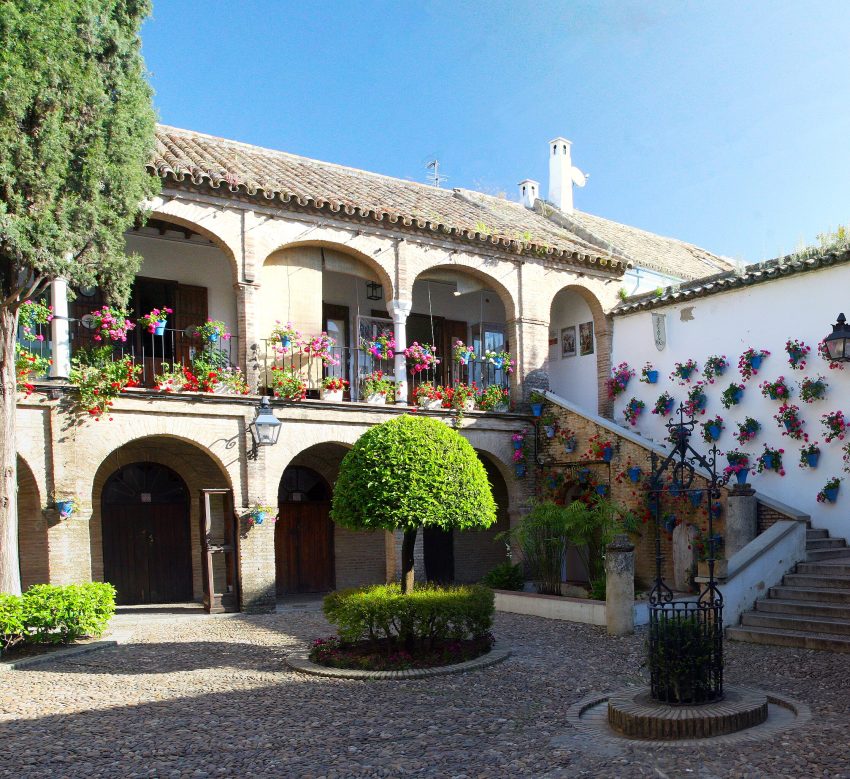
El Zoco Cordoba Spain 5
CC BY-SA 2.0 / Wolfgang Manousek
El Zoco (Mercado de la Artesanía) is Córdoba’s municipal craft market, tucked into the narrow lanes of La Judería inside the 16th-century Casa de las Bulas. Built around a rectangular patio with arcaded galleries and simple brickwork, it feels more like a quiet workshop courtyard than a bazaar. Visitors drift between small studios selling silver filigree, leatherwork, ceramics, and handmade jewellery, with contemporary pieces mixed in among traditional techniques. Look for details like the wall of blue hanging pots and archaeological fragments set into the architecture, and you may catch a guitarist playing in the courtyard. Because individual stalls keep their own hours, it can be lively—or nearly closed.
Location: Zoco Municipal de la Artesanía Calle Judíos, s/n 14004 Córdoba Spain | Hours: Everyday 10.00 - 20.00 | Distance: 0.3km

13. Museo Taurino
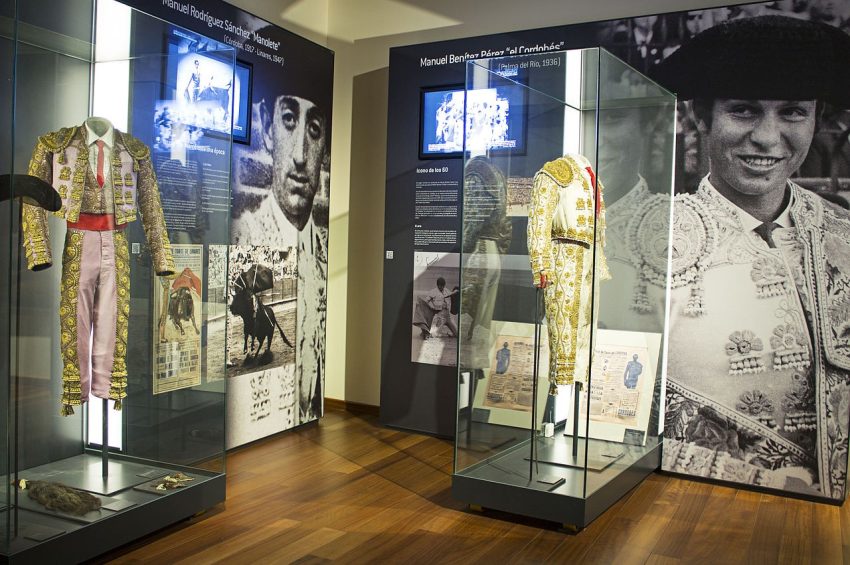
Interior of the Museo Taurino
CC BY-SA 2.0 / Delegación de Cultura Ayuntamiento de Córdoba
Museo Taurino explores Spain’s bullfighting tradition through the lives, craft, and mythology that surround the corrida, housed in a restored 16th-century Renaissance mansion (the Palacio de las Bulas) on Plaza Maimónides in La Judería. Six compact galleries move from historic posters and photographs to embroidered “suits of lights,” utensils, and mounted bull heads, with short films that many visitors find surprisingly informative. A central thread is the local pantheon known as the “Five Caliphs” (Lagartijo, Guerrita, Machaquito, Manolete, and Manuel Benítez “El Cordobés”), whose costumes and memorabilia anchor the story. The stone arches and patios give the displays an intimate, atmospheric backdrop, even for those uneasy about the subject.
Location: Bullfighting Museum of Cordoba Plaza Maimónides, 3 14004 Córdoba Spain | Hours: Open Winter, 9.30h-13.30h and 16.00h -19.00h. Summer, 9.30h-15.30h and 17.00h -20.00h. | Price: Regular: 4 EUR Kids, Students under 26 years: 2 EUR | Website | Distance: 0.3km

14. Capilla de San Bartolomé
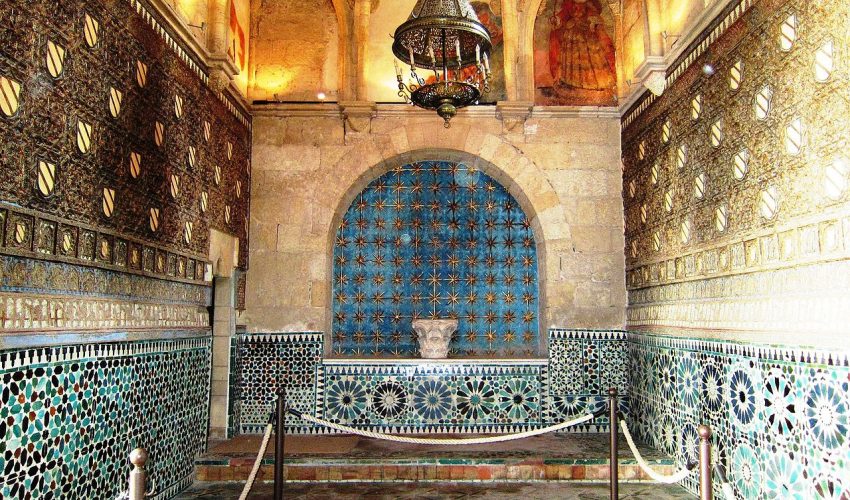
Capilla Mudejar de San Bartolome in der Calle Averroes Cordoba
CC BY-SA 3.0 / Martin Furtschegger
Capilla de San Bartolomé is a small 14th-century chapel tucked inside the Faculty of Humanities complex in La Judería, prized for its rare Mudéjar fusion of Christian worship and Islamic artistry. The compact interior is dense with yesería plasterwork—geometric lacería, vegetal ataurique, heraldic shields, and decorative Kufic and Naskh inscriptions—above original glazed-brick flooring. A short atrium and adjoining courtyard add pointed arches, slender columns, and a rib-vaulted ceiling that heightens the sense of passing into a quieter, enclosed world. Restored in the 20th and 21st centuries, it remains a brief visit but a memorable one, often described by travelers as a hidden pearl.
Location: San Bartolomé, Córdoba Faculty of philosophy and letters Calle Averroes, S / N 14004 Córdoba | Hours: From September 15th to June 14th: From 10:30 am. to 1:30 pm. and from 3:30 pm. to 6:30 pm. From June 15th to September 14th: From 10 am. to 2 pm. Closed on Mondays (mornings) and Sundays (afternoons) | Price: From Monday to Friday: 1,50 € Saturday and holidays: 2 € | Website | Distance: 0.3km

15. Plaza Maimónides

Moses ben Maimon Cordoba
CC BY-SA 2.0 / Jerzy Kociatkiewicz
Tucked into the Judería’s maze of narrow lanes and whitewashed façades, Plaza Maimónides is a small, calm square centered on a bronze statue of Moses ben Maimon (Maimonides), the 12th‑century philosopher, physician, and Torah scholar born here. The figure sits with a book, and many visitors pause to touch his foot for luck before taking photos. Once known as Plaza de Teberiades, the name nods to his burial in Tiberias and adds another layer to the place’s identity. One corner is taken up by the Museo Taurino, while the rest is a quiet mix of cafés, shopfronts, and shaded corners that feel especially peaceful in the early hours.
Location: Plaza Maimónides, Córdoba, Spain | Hours: 24 Hours | Price: Free | Distance: 0.3km

16. Alcázar de los Reyes Cristianos
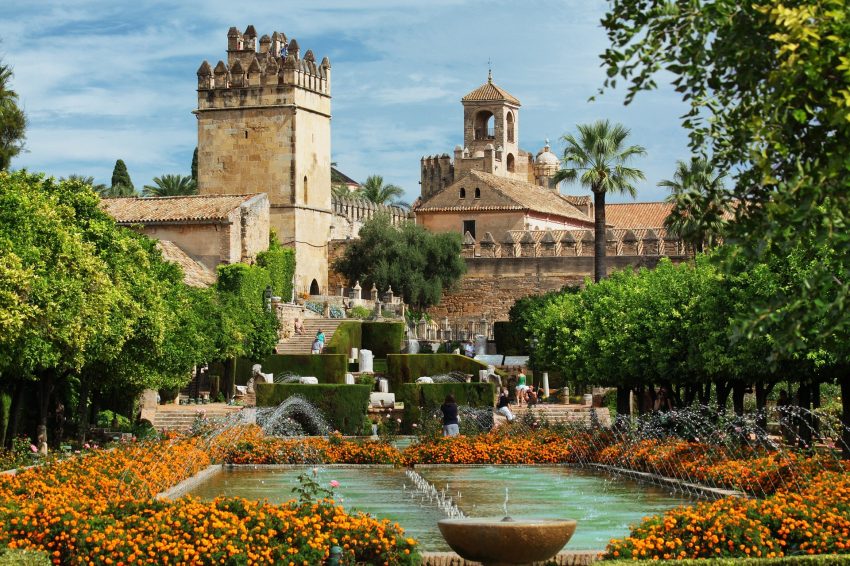
Alcazar de los Reyes Cristianos
The Alcázar de los Reyes Cristianos is a fortified palace above the Guadalquivir that concentrates Córdoba’s shifting rulers, from Roman and Visigoth foundations to Umayyad court life and a 14th‑century rebuilding under Alfonso XI. Inside, visitors move between cool patios and excavated layers, then climb the Lions Tower—its lion-headed spouts a memorable detail—for wide views over the river and rooftops. The Salón de los Mosaicos displays large Roman floor mosaics and a 3rd‑century sarcophagus, while traces of earlier baths lie beneath. Most people linger longest in the vast gardens, where cypress avenues, citrus trees, and long reflecting pools create shaded, quiet walks.
Location: Calle de las Caballerizas Reales s/n | Hours: Tuesday to Sunday from 8.45 a.m. to 3.15 p.m. Last admission 30 minutes before closing time. | Price: Adult: € 5 Students up to 26 years : € 2.50 | Website | Distance: 0.3km

17. Torre de Belén de Córdoba
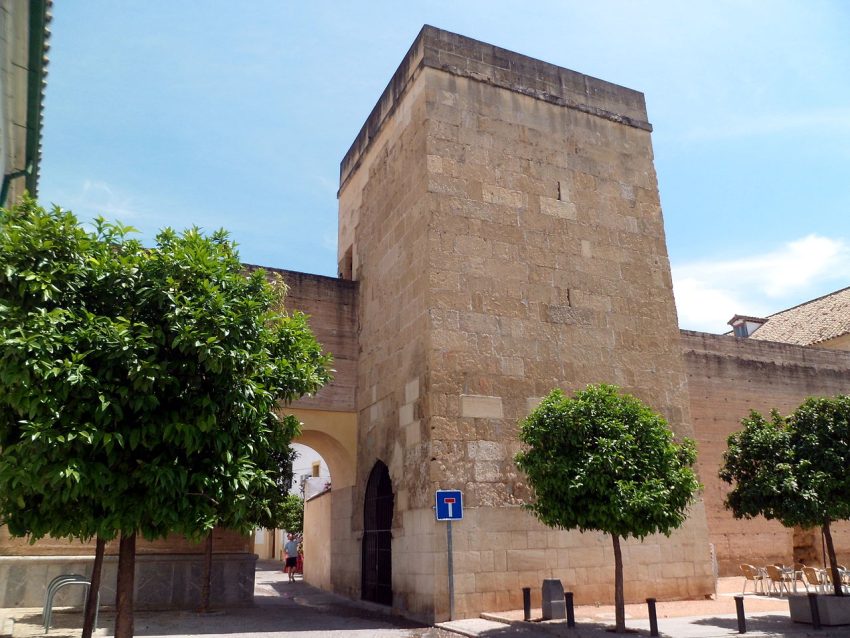
Torre de Belen   Cordoba Espana
Torre de Belen Cordoba Espana
CC BY-SA 3.0 / Américo Toledano
Torre de Belén is a compact 12th-century Almohad watchtower that once anchored the medieval walls, tucked into the quiet lanes of San Basilio. Built from sturdy ashlar limestone, it’s best appreciated from the outside: look for the pointed horseshoe-arch entrance and the right-angled doorway layout designed to slow intruders. After the 13th-century Christian conquest, the ground level was adapted into a small chapel—one reason it’s also known as Torre de las Imágenes or Torre de San Benito—and three arched openings on the east side once held bells. Restored in 2000, it stands out for its narrow, defensive proportions against the surrounding whitewashed houses.
Location: Belem Tower Calle Martín de Roa, 2 14004 Córdoba Spain | Hours: 24 Hours | Price: Free | Distance: 0.4km

18. Casa Andalusí
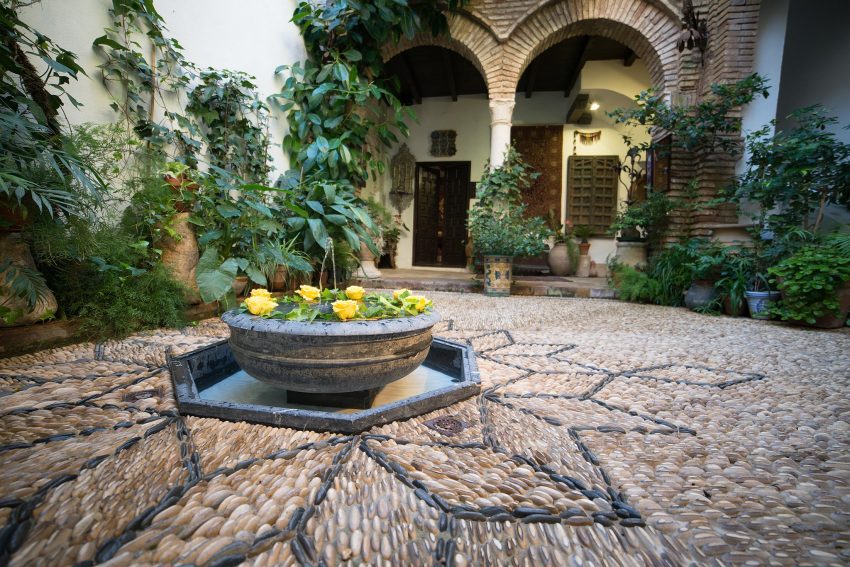
Patio Casa Andalusi
Patio Casa Andalusi
CC BY-SA 42.0 / Miguel Luke
Casa Andalusí is a small house-museum in Córdoba’s Jewish Quarter that recreates the feel of a 12th-century Andalusian home shaped by Al-Andalus. Visitors step into a cool, quiet courtyard where patterned tiles, greenery, and a softly running fountain set the tone before a sequence of intimate rooms with ceramics, manuscripts, and other domestic objects. Downstairs, a Roman mosaic in the cellar adds an unexpected layer of the city’s older past. Another memorable stop is the paper-making display, a nod to Córdoba’s role in early European paper production. Reviews often describe it as cozy and atmospheric, with a calm pace that rewards close looking.
Location: Calle Judíos, 12, 14004 Córdoba, Spain | Hours: 10.30am-7.30pm Apr-Oct, 10am-7pm Nov-Mar | Price: €4 | Website | Distance: 0.4km
Powered by GetYourGuide

19. Caballerizas Reales de Córdoba

Passion and Spirit of the Andalusian Horse at the Caballerizas Reales
CC BY-SA 2.0 / xavier.estruch
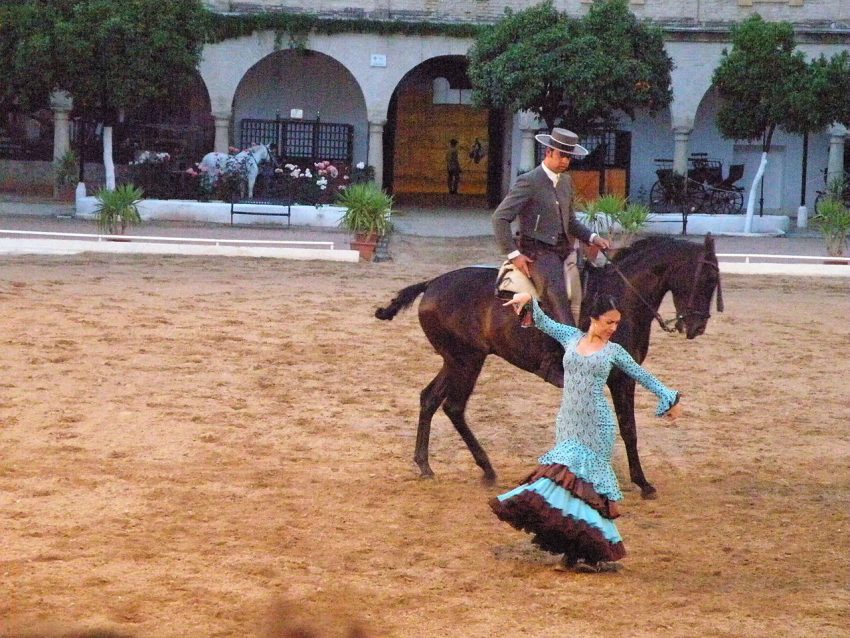
Caballerizas Reales are Philip II’s 16th-century royal stables, created in 1567 to breed and refine the purebred Spanish (Andalusian) horse, and still marked by the old “Real” brand—an R inside a C topped with a crown. Inside, three long vaulted naves on sandstone columns feel almost cathedral-like, with light slipping through small high windows onto the atmospheric stalls. The complex opens onto a broad central courtyard, and a later iron-framed dressage arena shows how the site kept adapting after the 1757 fire and later military use. Many visitors come for the evening equestrian show, praised for its skilled riders and close-up time with the horses beforehand; photography is typically restricted during the performance.
Location: Caballerizas Reales Calle Caballerizas Reales, 1 14004 Córdoba Spain | Hours: Tue-Sat 10am-1.30pm, 4pm-8pm, Sun 10am-11am; closed Mon, early Jul, 1 and 7 Jan, 25 Dec | Price: Free | Website | Distance: 0.4km
Powered by GetYourGuide

20. Córdoba Archaeological Museum

Patio of Museo Arqueologico y Etnologico de Cordoba Spain
CC BY-SA 2.0 / Amelia Wells
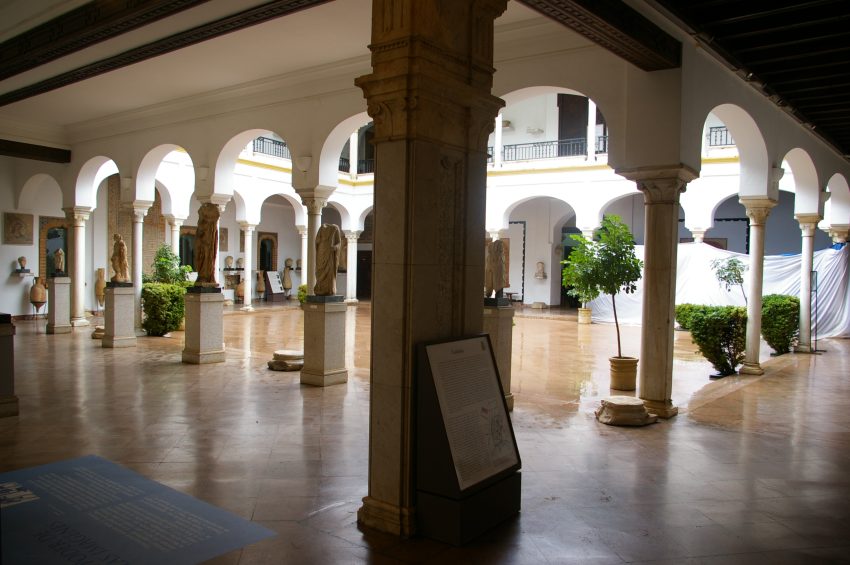
Córdoba Archaeological Museum is housed in the 16th-century Palace of Páez de Castillejo, where Renaissance courtyards and stone stairways frame a collection of more than 33,000 objects charting the area from the Bronze Age to the Late Middle Ages. The visit moves through eight halls arranged by eras—prehistory, Roman Colonia Patricia, the Visigothic transition, and Islamic Qurtuba—so you can track how the city’s identity shifted over time. Its most memorable feature is below ground: you descend to see part of Córdoba’s Roman theatre, one of the largest built in Hispania, preserved under the palace. Reviews often mention the clear timelines and that it’s easy to cover in about an hour.
Location: Córdoba Archaeological Museum Pl. de Jerónimo Páez, 7 Centro 14003 Córdoba Spain | Hours: 9am-8pm Tue-Sat & 9am-3pm Sun mid-Sep–mid-Jun, 9am-3pm Tue-Sun mid-Jun–mid-Sep | Price: E.U. citizens free, all others 1.50 EUR | Website | Distance: 0.4km

21. Torre de la Calahorra
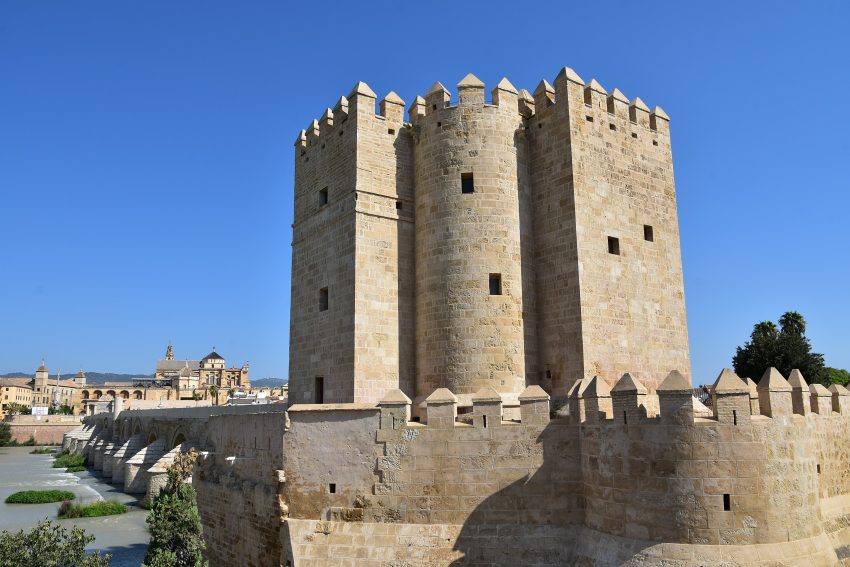
Torre de la Callahora Cordoba
CC BY-SA 2.0 / Richard Mortel
Guarding the southern end of the Roman Bridge, the Torre de la Calahorra is a stout medieval gate-fortress built for control and defense, with thick masonry, narrow arrow slits, and battlements that still read as military architecture. Begun in the Islamic period and later reshaped in 1369 when Enrique II added a third cylindrical tower, it became a tougher stronghold with features like a moat and artillery positions. Inside, the Museo Vivo de Al-Andalus uses audiovisual rooms, models, and soundscapes to evoke 10th-century daily life and the era’s shared Muslim, Christian, and Jewish culture. Climb to the rooftop terrace for a broad river-and-skyline view that many visitors single out as the payoff.
Location: Torre De Calahorra s/n Puente Romano 14009 Córdoba Spain | Hours: Summer (May to September) 10.00 to 14.00 and 16.30 to 20.30 Winter (October to March) 10.00 to 18.00 | Price: 4.50 euro, reduced 3.00 euro | Website | Distance: 0.4km

22. Casa de Sefarad

Casa De Sefarad
Casa De Sefarad
CC BY-SA 2.0 / Turol Jones, un artista de cojones
Casa de Sefarad (also known as Casa de la Memoria) is a privately run museum set inside a restored 14th-century Judería house, created to preserve the memory of the Sephardic Jewish community after the expulsion of 1492. The visit unfolds through nine small rooms around a quiet central courtyard, giving the place an intimate, lived-in feel rather than a grand museum scale. Exhibits range from Ladino language and domestic life to Sephardic music, with period instruments on display, and a room on the Inquisition featuring documents and a replica 1510 sambenito. Another memorable space focuses on women of Al‑Andalus across faiths, alongside a room dedicated to Maimonides.
Location: Judería de Cordoba Calle Averroes, 2 14004 Córdoba Spain | Hours: From September 16 to June 15. Monday to Sunday: 10:00 a.m. to 6:00 p.m. From June 16 to September 15. Monday to Sunday: 10:00 a.m. to 6:00 p.m. | Price: Adults: € 4. Reduced: € 3. | Website | Distance: 0.4km
Powered by GetYourGuide

23. Sinagoga

West wall of the Synagogue of Cordoba
GFDL / Américo Toledano
The Sinagoga de Córdoba is a small medieval synagogue (built 1314–1315) tucked into the narrow lanes of the Judería, and one of only three surviving in Spain—the only one in Andalusia. Inside, visitors linger over intricate Mudejar plasterwork, Hebrew inscriptions, and the intimate square prayer room that still feels hushed and enclosed. A women’s gallery sits above, supported by three arches carved with vegetal motifs and psalm texts, while a semi-circular arch marks where the Torah scrolls were once kept. Its layered afterlife is tangible too: after 1492 it was converted into the Hospital Santo Quiteria, later becoming a shoemakers’ chapel.
Location: Córdoba Synagogue Calle Judíos, 20 14004 Córdoba Spain | Hours: Tuesday to Sunday: 9:00h - 15:30h / Monday closed. Closing days: 1st and 6th January and 25th December. | Price: Free admission for EU Citizens. 0,30 € for the rest | Website | Distance: 0.4km
Powered by GetYourGuide

24. Judería de Córdoba

Juderia de Cordoba
Juderia de Cordoba
Córdoba’s Judería is the old Jewish quarter, a tight weave of medieval lanes where whitewashed walls, flower pots, and tucked-away patios make wandering feel intimate and slow. It matters as the heart of the city’s Sephardic past, home to scholars during the Caliphate and later marked by the 1492 expulsion. The small 14th-century Sinagoga de Córdoba—one of only three surviving medieval synagogues in Spain—preserves delicate plasterwork around a courtyard, prayer hall, and women’s gallery. Calleja de las Flores compresses the scene into a postcard: bright blooms framing a view toward the Mezquita’s tower. Around Plaza Maimónides, artisan jewellery and silver shops mix with everyday cafés, keeping the quarter lived-in rather than museum-like.
Location: Judería de Cordoba, Calle Averroes, Córdoba, Spain | Hours: 24 Hours | Price: Free | Distance: 0.4km

25. Posada del Potro
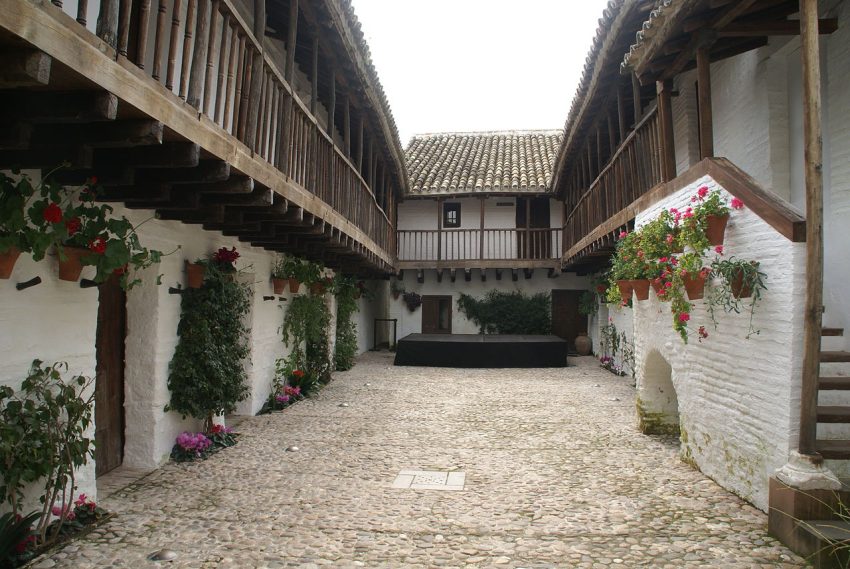
Posada del Potro   Cordoba
Posada del Potro Cordoba
CC BY-SA 2.0 / David Baron
Posada del Potro is a 15th-century courtyard inn on Plaza del Potro, where creaking wooden galleries and heavy beams still frame a quiet, shaded patio. Once a rough travellers’ lodging with stables, it later entered literature through Cervantes, who nods to the “Potro” in Don Quixote. The building stayed in use as an inn until 1972 and now houses the Centro Flamenco Fosforito, a municipal museum devoted to flamenco and the singer Antonio Fernández Díaz “Fosforito.” Inside, you’ll find recordings, historical displays, and hands-on stations, while the courtyard sometimes hosts intimate performances. Visitors often remember the contrast between the tranquil patio and its rowdy past.
Location: Plaza del Potro s/n 14003 Córdoba Spain | Hours: Posada del Potro - Centro Flamenco Fosforito Plaza del Potro, 7 14002 Córdoba Spain | Distance: 0.5km

26. Centro Flamenco Fosforito
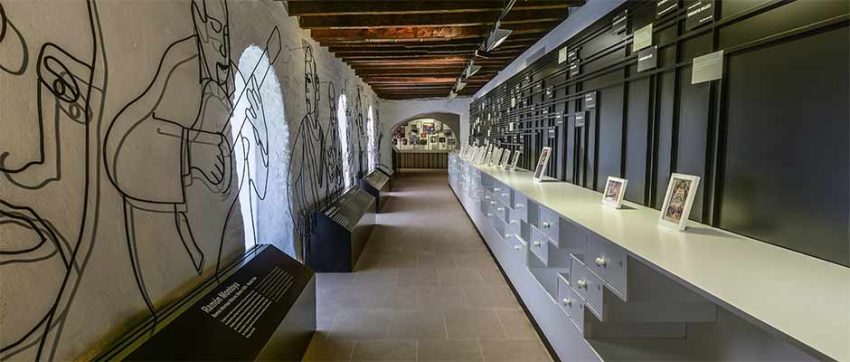
Centro Flamenco Fosforito
© https://centroflamencofosforito.cordoba.es/
Set inside the Posada del Potro, a 15th-century inn on Plaza del Potro mentioned in Don Quixote, Centro Flamenco Fosforito is a municipal interpretation centre devoted to flamenco as lived culture, not stage spectacle. Opened in 2013 and named for cantaor Antonio Fernández Díaz “Fosforito,” it traces the art’s roots and the communities that shaped it through touchscreens on palos, listening stations, and video panels. Visitors can try marking compás at rhythm stations, then linger over guitars, percussion, costumes, and personal items linked to Fosforito’s career. The quiet courtyard setting makes the experience feel grounded in place, even when the tech is front and centre.
Location: Posada del Potro - Centro Flamenco Fosforito Plaza del Potro, 7 14002 Córdoba Spain | Hours: 8.30am-2.30pm Tue-Sat, from 9.30am Sun mid-Jun–mid-Sep, 8.30am-7.30pm Tue-Fri, to 2.30pm Sat & Sun mid-Sep–mid-Jun | Website | Distance: 0.5km
Powered by GetYourGuide

27. Plaza del Potro

Plaza del Potro
Plaza del Potro
CC BY-SA 3.0 / Américo Toledano
Plaza del Potro is a small, courtyard-like medieval square dating to the 14th century, tucked into one of the oldest riverside districts. At its center stands the Renaissance Fountain of the Potro (installed in 1577), later crowned with a rearing colt holding the city’s coat of arms—an unusual emblem that gives the plaza its name and best photo angle. Opposite, the 1924 Triumph of the Archangel Raphael adds a note of local devotion, balancing the colt’s lively symbolism with a calmer, vertical monument. Quiet corners with stone benches and shade invite a pause, and the surrounding façades house the Fine Arts Museum and the Julio Romero de Torres Museum.
Location: Plaza del Potro s/n 14003 Córdoba Spain | Hours: 24 Hours | Price: Free | Distance: 0.5km

28. Museo de Bellas Artes de Córdoba
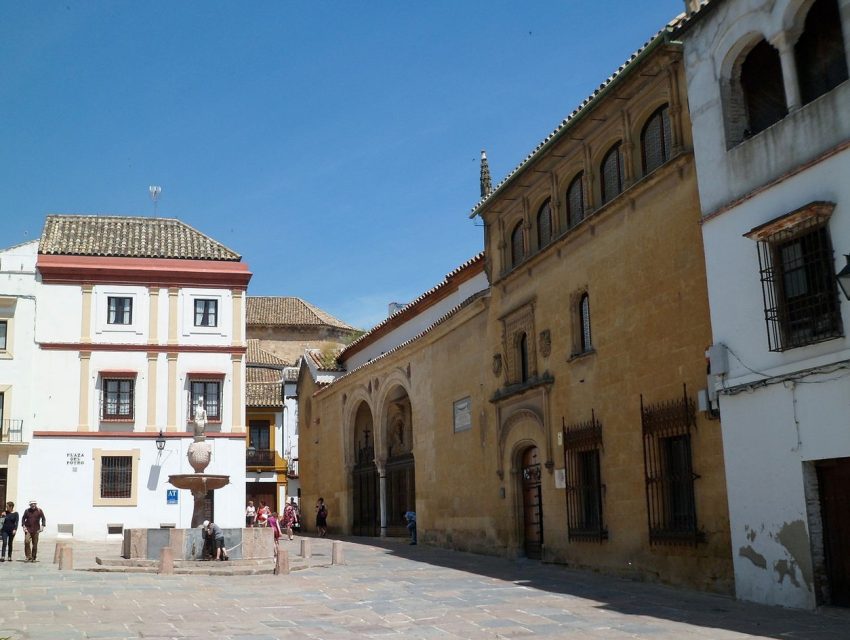
Plaza del Potro, Cordoba
CC BY-SA 3.0 / Américo Toledano
Museo de Bellas Artes de Córdoba is the city’s fine-arts museum, set in the former Hospital de la Caridad (late 15th century) on Plaza del Potro, and it anchors Córdoba’s story of painting and sculpture beyond its better-known monuments. Visitors move through calm, intimate rooms arranged across two floors, from medieval and Mannerist works to strong Andalusian Baroque holdings and later modern pieces. The setting is part of the experience: Renaissance courtyards planted with orange trees and a Baroque staircase topped by a carved wooden ceiling. In the galleries, you’ll encounter names such as Goya, Murillo, Zurbarán, Valdés Leal, and local figures including Antonio del Castillo and the Romero de Torres brothers. Many travelers remark on the thoughtful curation and manageable size.
Location: Plaza del Potro, 1, 14002 Córdoba, Spain | Hours: 9am-3pm Tue-Sun mid-Jun–mid-Sep, 9am-8pm Tue-Sat & 9am-3pm Sun mid-Sep–mid-Jun | Price: EU Citizen/other free/€1.50 | Distance: 0.5km

29. Museo Julio Romero de Torres
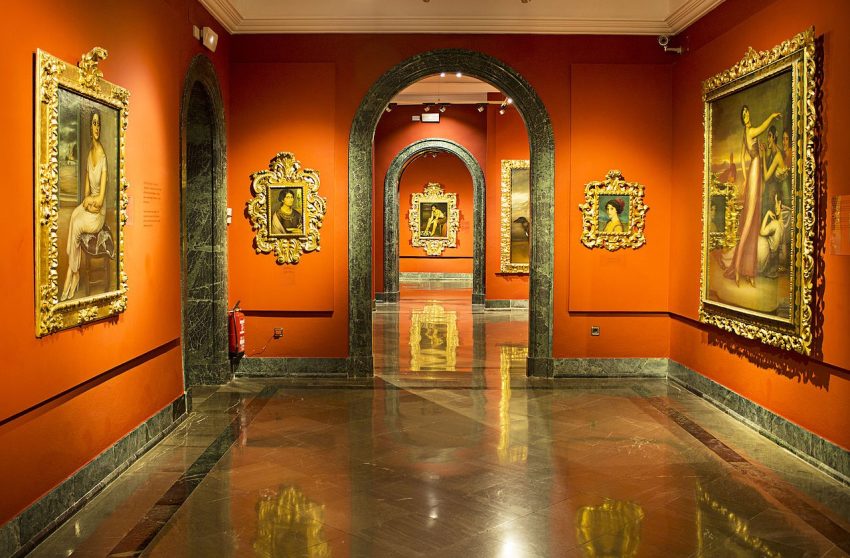
Interior Museo Julio Romero de Torres
CC BY-SA 2.0 / Delegación de Cultura Ayuntamiento de Córdoba
Set in the former Hospital of la Caridad on Plaza del Potro, the Museo Julio Romero de Torres is devoted entirely to the painter born in this very building, with the city’s largest group of his works. Six thematic rooms trace his evolution from early studies and family pieces to canvases steeped in folklore, symbolism, and the mystic edge of Andalusian identity. Personal objects—letters, brushes, even guitars—make the galleries feel intimate rather than grand. Upstairs, rooms such as the Chapel and The Origin of Deepness lean into his allegorical streak and his connection to flamenco’s cante jondo. The museum shares the complex with the Fine Arts Museum, and visitors often note how well curated the small space feels.
Location: Julio Romero de Torres Museum Plaza del Potro, 1 14002 Córdoba Spain | Hours: 8.30am-3pm Tue-Sat & 8.30am-2.30pm Sun mid-Jun–mid-Sep, 8.30am-8.45pm Tue-Fri, 8.30am-4.30pm Sat & 8.30am-2.30pm Sun mid-Sep–mid-Jun | Price: Adults: €4.50. | Website | Distance: 0.5km

30. Alminar de San Juan

Alminar de San Juan de los Caballeros Cordoba 4
CC BY-SA 2.0 / Turol Jones
Alminar de San Juan in Córdoba, Spain is a compact 9th-century Islamic minaret that later became a church bell tower after the 1236 Christian conquest, leaving an unusually intact core from the Emiral–Caliphal period. It stands in the quiet Plaza de San Juan, a square limestone tower about 3.7 metres per side and roughly 10.9 metres tall, with a restrained, early-medieval austerity. Look closely for the paired caliphal horseshoe arches, set as twin openings and carried on reused Visigothic marble columns—an arresting mix of materials and eras. You can’t usually go inside, so the experience is about circling the exterior, catching the light on the stonework, and soaking up the stillness that visitors often describe as “majestic.”
Location: Alminar de San Juan Plaza de San Juan, 4 14003 Córdoba Spain | Hours: 24 Hours | Price: Free to view from outside. | Distance: 0.5km

31. Almodóvar Gate
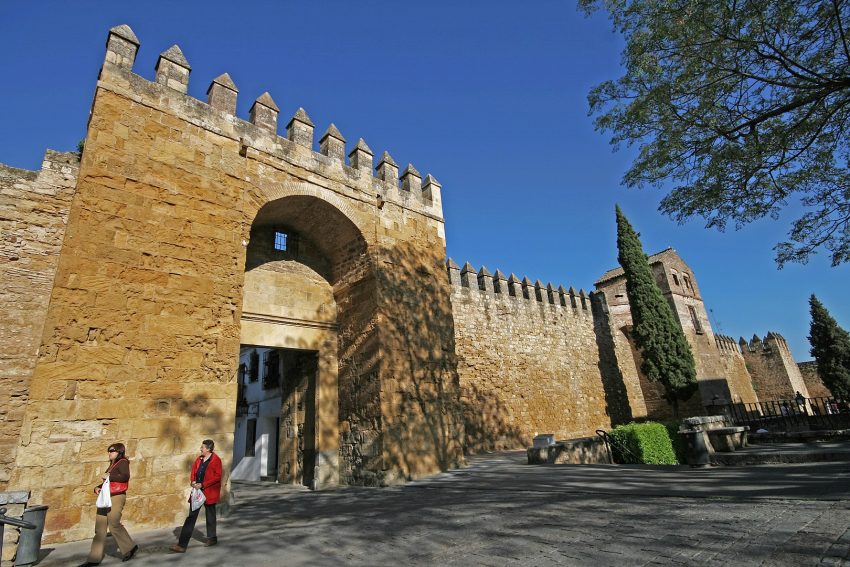
Almodovar Cordoba Espana
CC BY-SA 2.0 / Michael Bryan
Almodóvar Gate (Puerta de Almodóvar) is a surviving medieval entrance in Córdoba’s western city wall, where the old town gives way to the narrow lanes of the Judería. The structure you see today is largely a 14th-century Christian rebuild: a slightly pointed central arch held between two stout defensive towers, topped with battlements and an upper walkway once used by sentries. Just outside, late-20th-century gardens add a calm stretch of paths with running water, making the approach feel unexpectedly park-like. A bronze statue of the philosopher Seneca stands nearby, and the gate remains a memorable threshold between quiet greenery and the bustle of the Jewish Quarter.
Location: Puerta de Almodóvar Calle Judíos, n2 14003 Córdoba Spain | Hours: 24 Hours | Price: Free | Distance: 0.5km

32. Plaza de las Tendillas
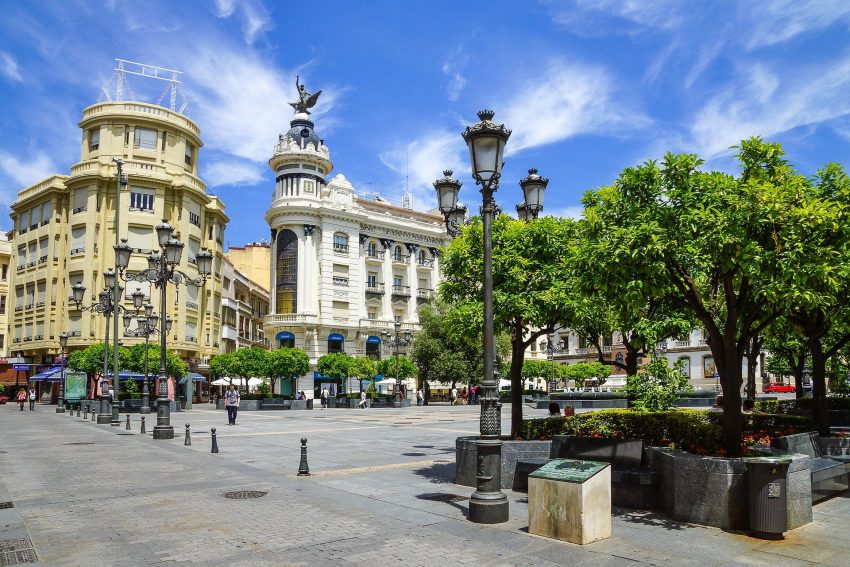
Plaza de las Tendillas
Plaza de las Tendillas is a broad pedestrian square that bridges the old-town lanes with the modern shopping streets, functioning as an everyday meeting point with cafés, fountains, and plenty of places to sit. Its centerpiece is the 1927 equestrian statue of Gonzalo Fernández de Córdoba (“the Great Captain”), notable for its white-marble head set against bronze. Many visitors time their pause for the Tendillas Clock (installed 1961), which marks quarters and hours with recorded classical-guitar notes—locals describe it as pure Andalusia. The plaza’s name recalls the small market stalls (“tendillas”) that once crowded this spot, later reshaped into today’s open civic space in the early 1900s.
Location: Plaza de las Tendillas, 6, 14003 Córdoba, Spain | Hours: 24 Hours | Price: Free | Distance: 0.6km

33. Plaza de la Corredera
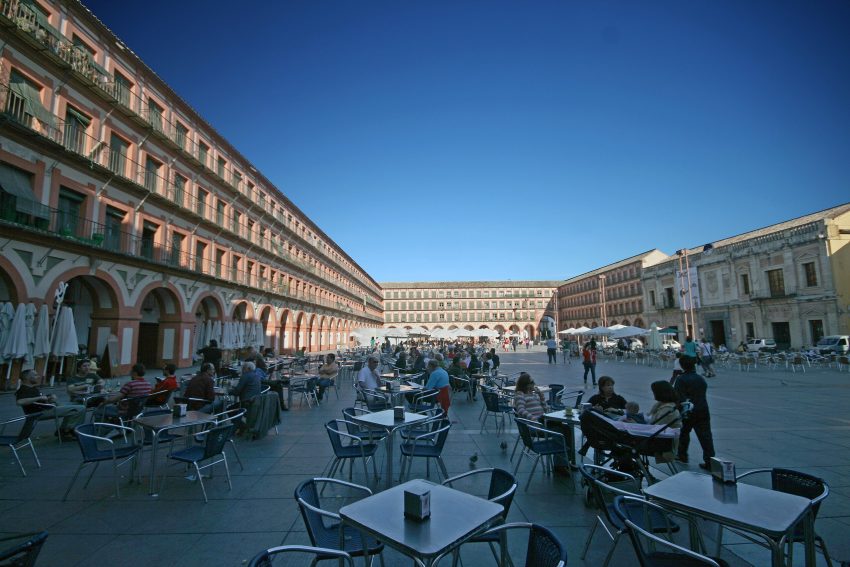
Plaza de la Corredera, Cordoba
CC BY-SA 2.0 / Michael Bryan
Plaza de la Corredera is a monumental, perfectly rectangular public square framed by long arcades and stacked wrought-iron balconies, with colourful façades that feel more Castilian than Andalusian. At roughly 113 metres by 55, its broad, open geometry makes the narrow surrounding streets feel suddenly theatrical when you enter through passages like the Arco Alto or Arco Bajo. Rebuilt into its uniform look in the 1680s, it also carries darker layers: it once hosted executions (until 1838) and bullfights (until 1846), with bulls brought in via the Toril alley. Beneath the paving, Roman mosaics were found and later moved for preservation.
Location: Plaza de la Corredera s/n 14002 Córdoba Spain | Hours: 24 Hours | Price: Free | Distance: 0.7km

34. Puerta de Sevilla
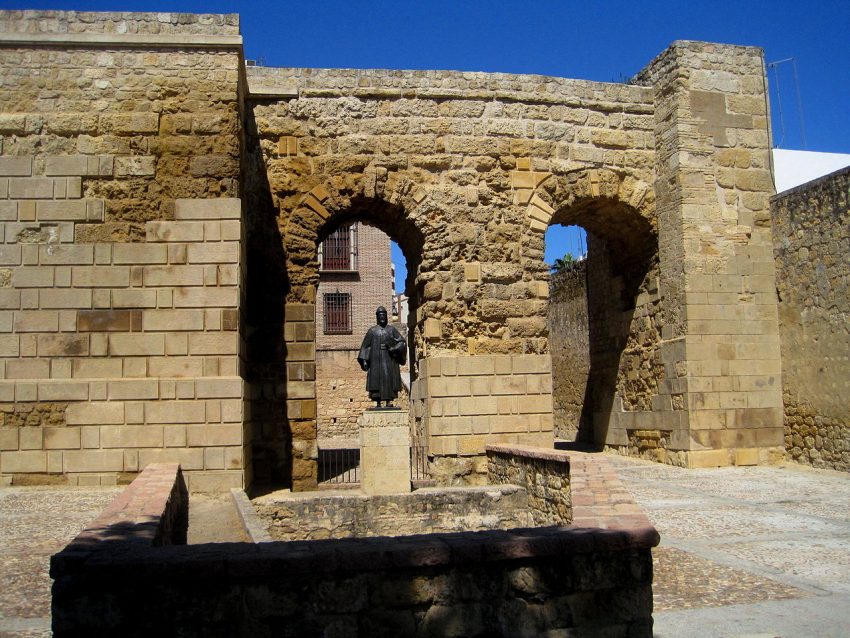
Puerta de Sevilla Cordoba
CC BY-SA 3.0 / Roberto Chamoso G
Puerta de Sevilla is a small reconstructed gateway in Córdoba’s western city walls, marking the historic exit toward Seville and the entrance into the flower-filled San Basilio quarter. Its roots reach back to the Islamic-era enceinte, later serving as a key passage after the Christian conquest, before being demolished in 1865 to ease traffic and rebuilt in the 1950s. Visitors notice the single sandstone opening with a granite surround and a civic coat of arms above the lintel, plus a right-angled stretch of restored wall ending in a squat square watchtower. Two curious twin arches beside the gate—argued to be defensive remnants or an old aqueduct—add an archaeological riddle, and a nearby statue of Ibn Hazam gives the spot a reflective pause.
Location: Puerta de Sevilla Calle Puerta Sevilla 14004 Córdoba Spain | Distance: 0.7km

35. Templo Romano de Córdoba
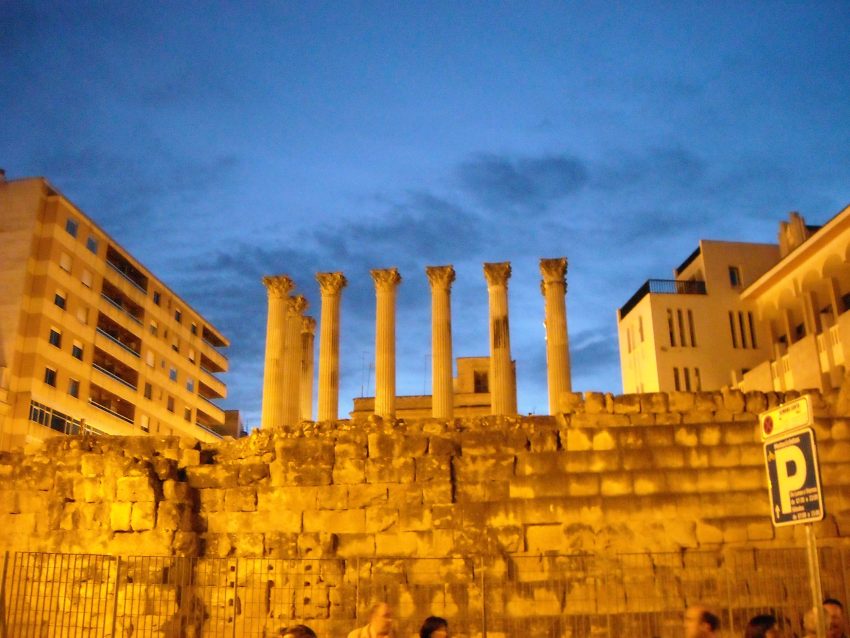
Templo romano Córdoba
CC BY-SA 2.0 / Marco Chiesa
The Templo Romano de Córdoba is a partially reconstructed Roman imperial-cult temple beside the Ayuntamiento, its surviving marble columns hinting at the scale of ancient Corduba’s Provincial Forum. Begun under Claudius and finished decades later under Domitian, it originally rose on a high podium with a broad stair and a façade of six Corinthian columns facing an altar for public ceremonies. Today you mainly experience it from the street: bright white shafts soaring above red-brick supports, especially striking when illuminated after dark. Many visitors simply pause in the square to take it in, as access can be limited, and a Carrara-marble statue of the city’s Roman founder, Claudio Marcelo, stands nearby.
Location: Templo Romano Calle Capitulares, 1 14002 Córdoba Spain | Hours: 24 Hours | Price: Free | Distance: 0.7km

36. Real Colegiata de San Hipólito
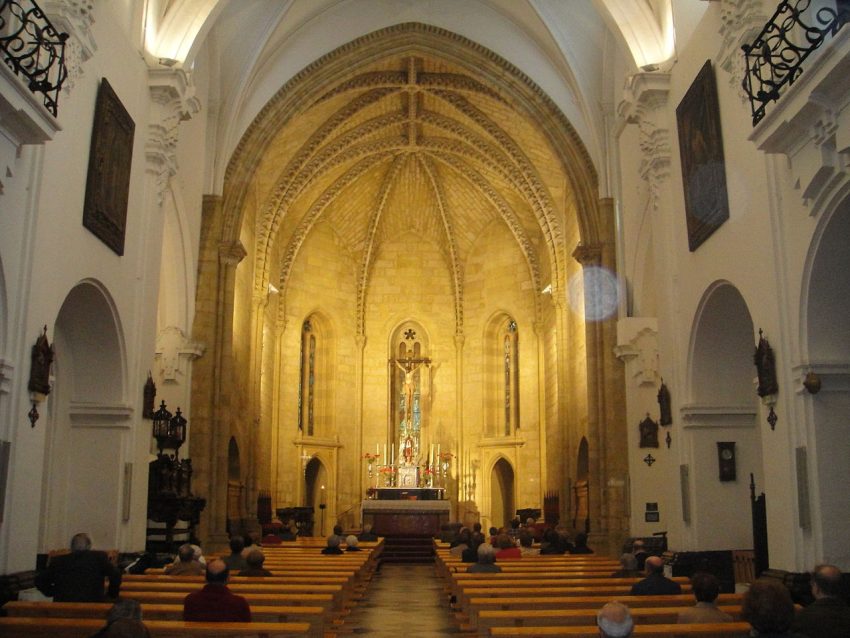
Interior de la iglesia de San Hipolito de Cordoba
CC BY-SA 3.0 / Lancastermerrin88
The Real Colegiata de San Hipólito is a 14th-century collegiate church in Córdoba founded by King Alfonso XI after the Battle of Salado, and it remains one of the city’s most direct links to Castilian royal power. Inside, visitors come for the prominent tombs of Alfonso XI and his father Ferdinand IV, which give the calm nave a distinctly dynastic feel. The architecture is restrained Gothic—pointed arches and clean lines—later layered with touches from its long religious stewardship, including a Jesuit chapter. Step outside to notice the imposing tower and the rear entrance toward the cloister. Depending on the day, you may find it quietly open or hosting a local ceremony.
Location: Parroquia San Hipolito Plaza San Ignacio de Loyola, 0 14008 Córdoba Spain | Distance: 0.8km

37. Roman Mausoleum
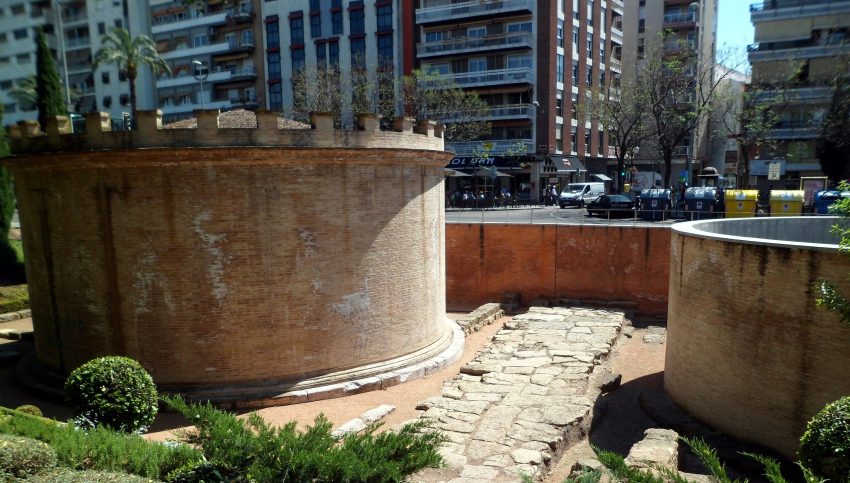
Roman mausoleum Corduba Spain 2
CC BY-SA 3.0 / Américo Toledano
The Roman Mausoleum is a pair of mid–1st-century AD cylindrical funerary monuments that once flanked a main approach road, advertising the status of Corduba’s elite to everyone arriving from Hispalis (today’s Seville). One mausoleum has been carefully reconstructed, so you can circle its drum-like form and read the architecture at full scale, while the second survives only in part, folded into the modern streetscape. Between them, a visible strip of the ancient Roman road adds a rare, tactile sense of movement through the landscape. Expect a quick, open-air stop—some visitors note limited access and sparse on-site interpretation, but the surviving stonework and roadbed linger in the memory.
Location: Roman Mausoleum Paseo de la Victoria, 17 14008 Córdoba Spain | Hours: 24 Hours | Price: Free | Distance: 0.8km

38. Palacio de Orive
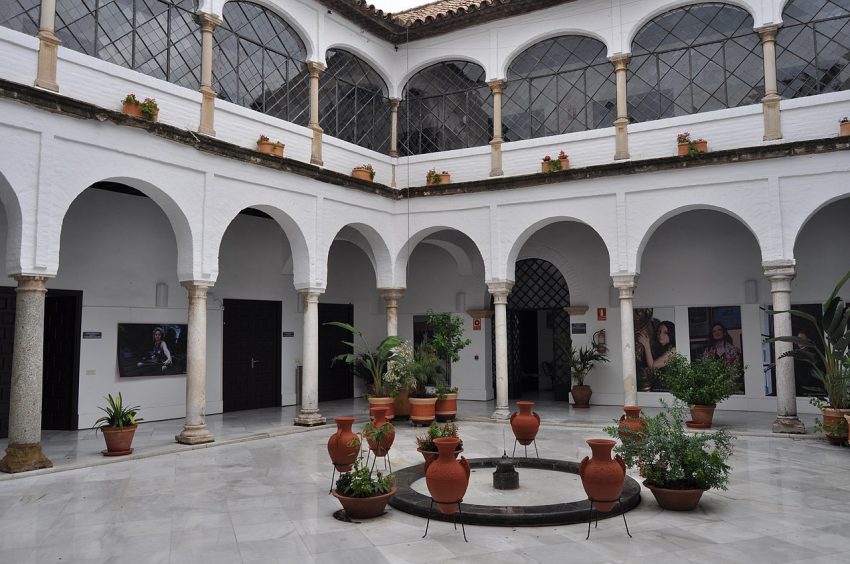
Palacio de OriveCordoba
CC BY-SA 2.0 / Luis Rogelio HM
Palacio de Orive is a 1560 Renaissance palace by Hernán Ruiz II, now used for municipal cultural offices but still best experienced for its calm patios and garden setting. Step into two contrasting courtyards: an intimate former carriage patio with brick arcades, and a perfectly square central court where semicircular arches and balconies frame a small fountain. Look closely at the lower arcade—several arches stand on reused Roman and Islamic columns, a quiet reminder of the city’s layered past. The façade’s sculpted female bust holds a ribbon praising loyalty, and the rear orchard-like gardens flow into the Orive Gardens, where locals linger in the shade.
Location: Palacio de Orive Plaza de Orive, 2 14002 Córdoba Spain | Hours: From Monday to Saturday: 10:00 to 14:00 and from 17:00 to 21:00 Sundays: 10:00 to 14:00 | Price: Free | Distance: 0.9km

39. Real Jardín Botánico de Córdoba
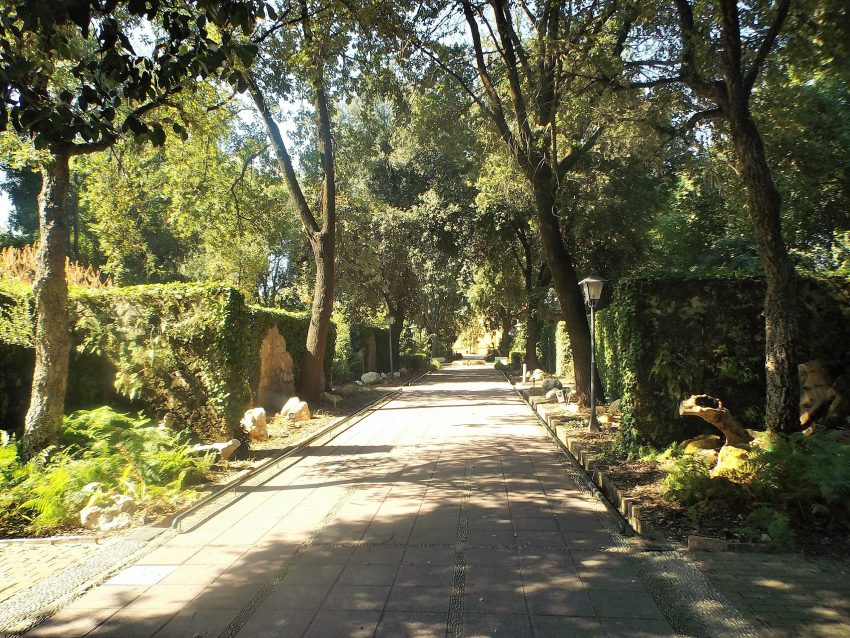
Camino del Real Jardin Botanico de Cordoba
CC BY-SA 4.0 / Eunostos
Real Jardín Botánico de Córdoba is a modern botanical garden on the Guadalquivir’s edge, created in 1987 as a working centre for education, conservation, and plant science. Its layout feels like a sequence of outdoor “rooms,” moving from an arboretum with a woodland mood into greenhouses and themed collections that explain Mediterranean survival strategies, useful plants, and fruit trees. The visit culminates at the Molino de la Alegría, a historic mill that houses a paleobotany museum, shifting your focus from living specimens to fossils and landscape deep time. Travelers often remember the calm, shady pace after Córdoba’s hotter streets, though some note the grounds can look dry in peak summer.
| Hours: Park: Tuesday – Sunday: 10:00–17:00. Closed on Monday. Museums (Etnobotany & Paleobotany) Tuesday – Sunday: 10:00–14:00. Closed on 1 January; 6 January; 24 December; 25 December; 31 December. | Price: €3 (adults); €1.50 (children from 5, students, pensioners); €2 (youth card & pre-booked groups). | Website | Distance: 1.1km

40. Plaza del Conde de Priego
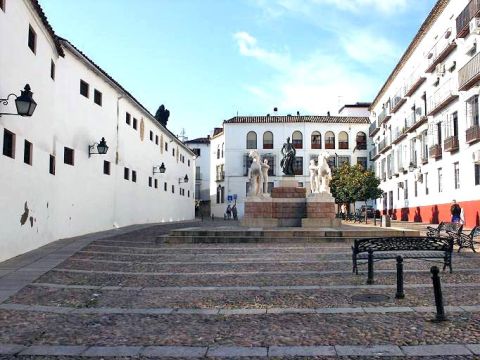
Plaza del Conde de Priego Cordoba
GNU / Justojosemm
Plaza del Conde de Priego is a small, atmospheric square in the Santa Marina district, valued for its quiet, lived-in feel and the powerful monument at its center. The statue honors Manolete (Manuel Rodríguez Sánchez, born 1917), the legendary bullfighter whose brief career ended tragically at 30, and it remains a vivid marker of local bullfighting heritage. Historic façades frame the space, including the Convento de Clarisas de Santa Isabel de los Ángeles, a 15th-century convent that still lends a monastic calm. Benches and mature trees create pockets of shade, and visitors often linger to circle the sculpture and take in the calm away from busier streets.
Location: Plaza del Conde de Priego, 1, 14001 Córdoba, Spain | Hours: 24 Hours | Price: Free | Distance: 1.2km

41. Palacio de los Marqueses de Viana

Patio De Las Columnas Palacio De Viana Cordoba
CC BY-SA 2.0 / Luis Rogelio HM
Palacio de los Marqueses de Viana is a former aristocratic residence turned palace-museum, best known as a “museum of patios” for its twelve distinct courtyards and a large garden. Enter from Plaza de Don Gome and you move through a patchwork complex shaped by many noble owners, where late Gothic and Renaissance lines pick up Baroque flourishes. Visitors linger over details like the mannerist façade with mythological figures and a family crest, then drift between patios cooled by water features and dense planting. Inside, period rooms display tapestries, paintings, Talavera ceramics, and richly furnished salons, giving a tactile sense of how elite domestic life changed over centuries. The atmosphere is notably calm and quiet, especially off-peak.
Location: Plaza de Don Gómes, 2, 14001 Cordova, Spain | Hours: Tue - Sat: 10 am - 7 pm Sun: 10 am - 3 pm | Price: €8 | Website | Viana Palace Gardens and Patios Entry Ticket | Distance: 1.2km
Powered by GetYourGuide

42. Palacio de la Merced

Palace of La Merced Cordoba
CC BY-SA 2.0 / Turol Jones, un artista de cojones
Palacio de la Merced is a former 13th-century Mercedarian convent rebuilt in the 18th century into a commanding Baroque complex, now used as the provincial government offices. Visitors come for the sculpted façade near Plaza de Colón and the calm main cloister, where porticoed galleries, marble columns, and a dark marble fountain soften the building’s official feel. Inside, an imperial marble staircase provides the most dramatic photo angle, especially when shot from below. Because it’s a working administrative building, entry can be limited and you’ll pass through security, but staff are often welcoming and the visit is free. Temporary exhibitions and civic events add a contemporary layer to the historic shell.
Location: Plaza de Colón, 15, 14001 Córdoba, Spain | Hours: Monday to Friday from 7 am. to 3 pm. | Price: Free | Website | Distance: 1.3km

43. Santa Marina

Plaza del Conde de Priego Cordoba
GNU / Justojosemm
Santa Marina is a quiet, residential quarter just north of the centre, prized for its cobbled lanes, small leafy plazas, and well-kept historic houses within the UNESCO-listed old town. Its anchor is the Iglesia de Santa Marina, a sturdy 13th-century Fernandine church built after the 1236 conquest, with thick exterior buttresses and a mix of Romanesque and Gothic lines that feels unexpectedly monumental when you turn a corner and see it. Nearby, Plaza del Conde de Priego centres on the statue of Manolete, tying the neighbourhood to local bullfighting memory. Many visitors linger for the calm, the patios tucked behind doors, and the cool, hushed interior that invites a slow look at its statues and icons.
| Hours: 24 Hours | Price: Free | Distance: 1.3km

44. Malmuerta Tower
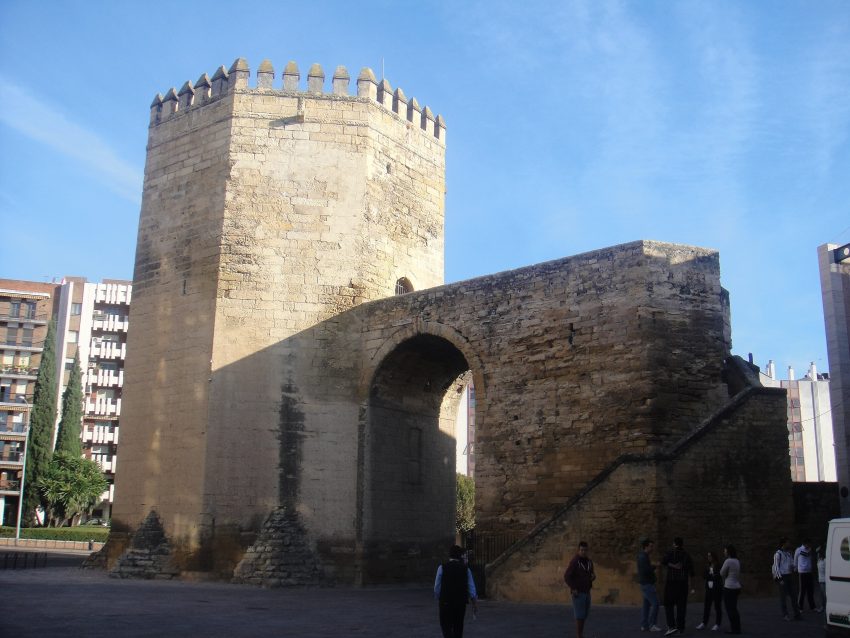
Torre de la Malmuerta1
CC BY-SA 3.0 / Lancastermerrin88
The Torre de la Malmuerta is a 15th-century albarrana watchtower built in 1406–1408 on top of earlier Almohad remains, once linked by an arch to the city wall to strengthen the defenses near the Rincón and Colodro gates. Its octagonal plan, narrow slit windows, and crenellated crown give it a stark, military silhouette that stands out even amid modern traffic. Look for the inscription beneath the connecting arch that records its construction. When interior access is open, stairways lead to a vaulted chamber and upper levels with wide views across rooftops; some visitors note it’s often closed, so the exterior is the main draw. The tower’s lingering appeal is sharpened by the local “wrongly dead woman” legend behind its name.
Location: Torre de la Malmuerta 14001 Córdoba Spain | Hours: 24 Hours | Price: Free | Distance: 1.4km

45. Centro de Interpretación de la Fiesta de los Patios Trueque Cuatro

Cordoba Patios Festival Visitors Centre
© www.turismodecordoba.org
Centro de Interpretación de la Fiesta de los Patios Trueque Cuatro is a small interpretive museum set inside a real house-patio, designed to explain the living tradition behind the Fiesta de los Patios. The central courtyard is the main draw: walls lined with potted geraniums and trailing ivy, glazed tiles, and the soft presence of water that makes the space feel cool and intimate. Inside, panels and objects trace how shared neighbour courtyards functioned as domestic and social hubs, and how the festival’s patio types are judged today. It also underlines why the patio tradition was recognised by UNESCO as Intangible Cultural Heritage in 2012. Visitors often describe it as a lovely, shady place to linger—though opening hours can be unpredictable.
Location: Interpretation Center of the Fiesta de los Patios Calle Trueque, 4 14002 Córdoba Spain | Hours: From September 1 to March 31 From 10:00 a.m. to 2:00 p.m. Monday, Friday and Saturday: 10:00 a.m. - 2:00 p.m. and 5:00 p.m. - 7:00 p.m. Sundays and holidays: 10:00 a.m. - 2:00 p.m. | Price: Free | Distance: 1.5km

46. Palacio de Maximiano Hercúleo
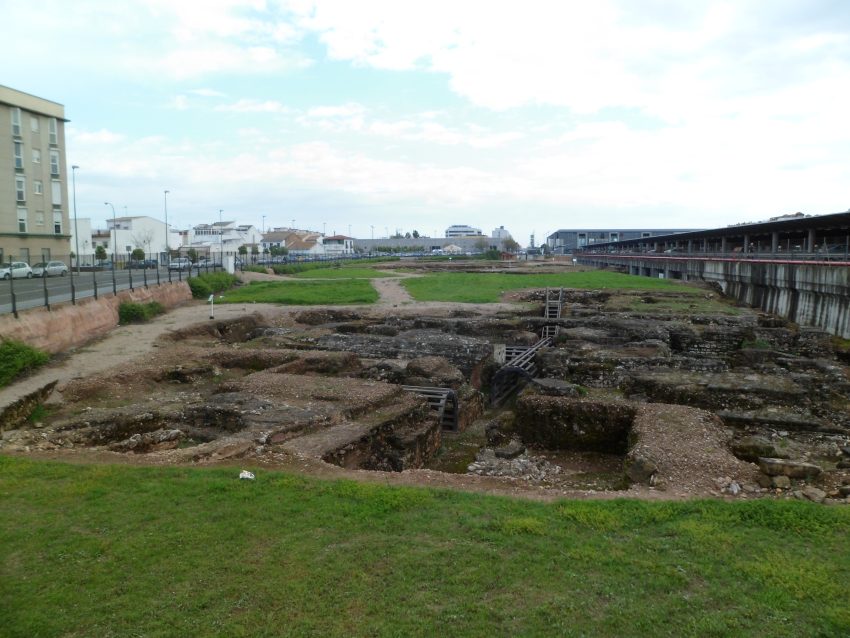
Palacio de Maximiano Herculeo, Cordoba
CC BY-SA 3.0 / Américo Toledano
Palacio de Maximiano Hercúleo is a recently excavated Roman imperial palace site in northwest Córdoba, near the city’s main railway station, tied to Emperor Maximian’s visit to Hispania around 296–297 A.D. Seen from surrounding streets and a signposted perimeter path, the exposed foundations hint at a vast complex—about 400 by 200 metres—that once covered more than eight hectares. Look for the curve of a semicircular portico thought to mark a grand entrance and the outline of a basilica-style central hall with an apse where ceremonies and audiences took place. Interpretation panels help you read the street-level stonework, though several visitors note the remains feel neglected or partly closed.

Best Day Trips from Córdoba

A day trip from Córdoba offers the perfect opportunity to escape the urban rhythm and discover the surrounding region's charm. Whether you're drawn to scenic countryside, historic villages, or cultural landmarks, the area around Córdoba provides a variety of easy-to-reach destinations ideal for a one-day itinerary. If you are looking to rent a car in Spain I recommend having a look at Discover Cars, first, as they compare prices and review multiple car rental agencies for you.

1. Medina Azahara
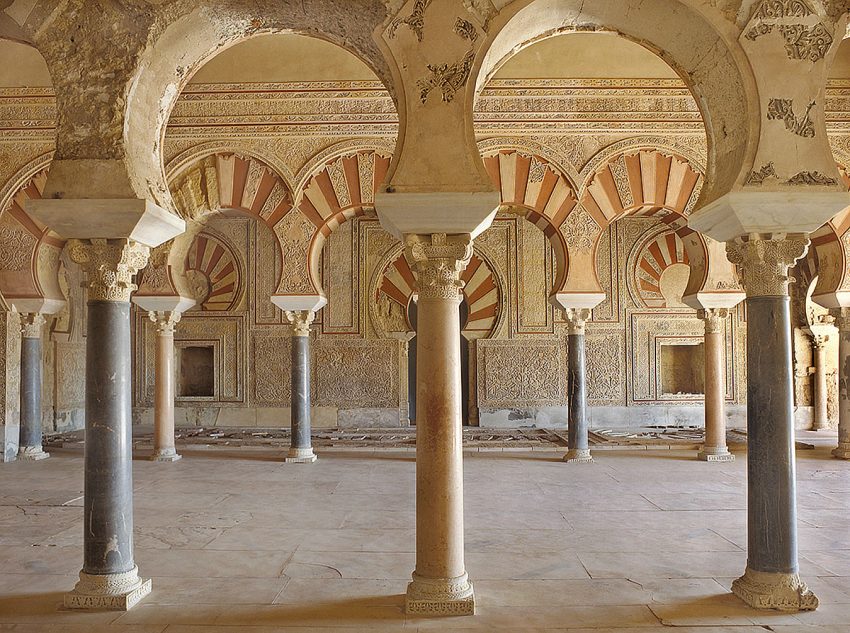
interior Salon Rico of Medina Azahara
Public Domain / Sombradeparra
Medina Azahara in Córdoba, Spain, is an archaeological site on the western edge of the city, at the foot of the Sierra Morena. Built in the 10th century by Abd al-Rahman III, it was planned as a palace-city for the Umayyad court and laid out across terraces above the Guadalquivir valley. Today, visitors come to walk through excavated walls, courtyards,…
Location: Medina Azahara - Conjunto Arqueológico Madinat al-Zahra Ctra. Palma del Río, km 5.5 14005 Córdoba Spain | Hours: Sunday — 9:00 to 15:00 (year round) Tuesday to Saturday — 9:00 closing at 15:00 (July to mid-September), at 18:00 (mid-September to end March), and at 21:00 (April to June). | Price: Entrance is free if you are a resident of the EU, otherwise there is a EUR 1.50 charge. | Website | Distance: 7.8km
Visiting Medina Azahara
Powered by GetYourGuide

2. Monasterio de San Jerónimo de Valparaíso

Real Monasterio De San Jeronimo De Valparaiso – Cordoba 4
©
Monasterio de San Jerónimo de Valparaíso is a former monastery in Córdoba, Spain, set in the hills above Medina Azahara. It began as a small religious community in the late 14th century and later grew into a larger monastic complex with Gothic, Renaissance, and Baroque elements.Today it is best known for its secluded setting, its cloistered courtyard, and the survival…
Location: Real Monasterio de San Jerónimo de Valparaíso Ctra. Palma del Río, Km 5,5 14005 Córdoba Spain | Hours: Only certain days a year through Medina Azahara. | Distance: 7.9km
Visiting Monasterio de San Jerónimo de Valparaíso

3. Castillo de Almodóvar del Río
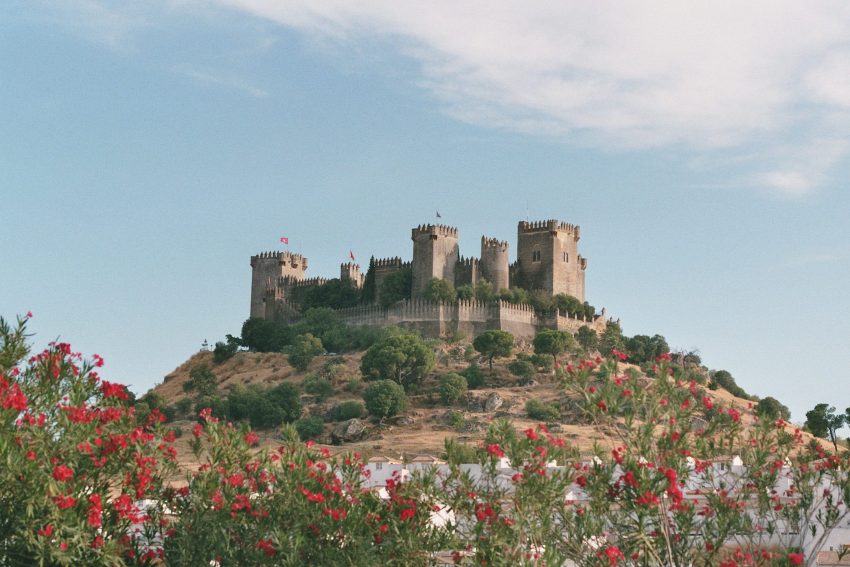
Castillo de Almodovar del Rio
CC BY-SA 3.0 / Rabe!
Castillo de Almodóvar del Río in Córdoba, Spain, is a hilltop castle and one of the clearest medieval landmarks in the province. Rising above the town of Almodóvar del Río and the Guadalquivir valley, it stands about 22 kilometres from Córdoba and is easy to spot long before you reach the entrance.The castle combines fortified walls, nine towers, battlements, restored…
Location: Castillo Almodovar del Rio Calle Castillo 14720 Almodóvar del Río Córdoba Spain | Hours: Monday to Friday 11am-2.30pm, Saturday and Sunday 11am-7pm. | Price: 7 euros; children aged 4-12: 4 euros: children aged under 4: free | Website | Distance: 22.9km
Visiting Castillo de Almodóvar del Río

4. Jaén
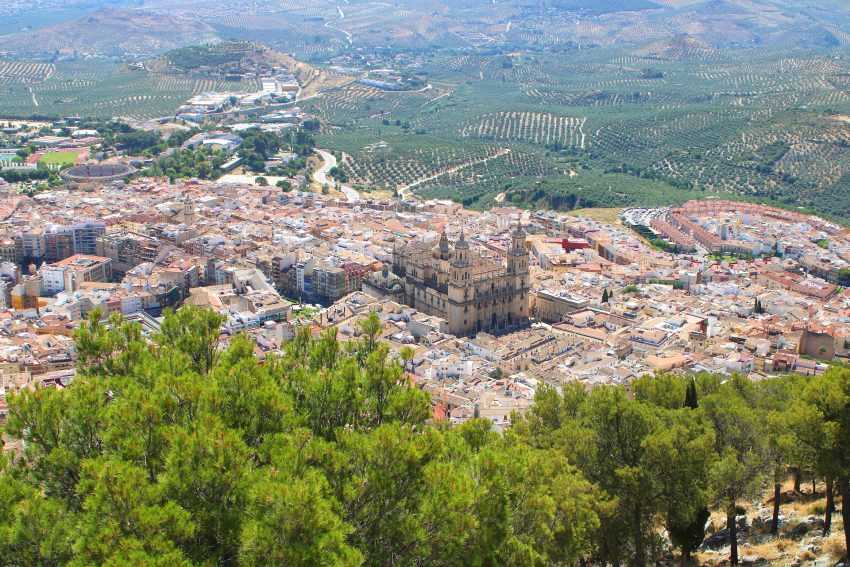
Jaen Andalucia Spain
Jaén, located in the heart of Andalusia, is an underrated gem surrounded by vast olive groves, earning its reputation as the world's olive oil capital. Set against the backdrop of the Santa Catalina mountains, the city's steep, narrow streets create a distinctive layout that invites exploration. Wandering through its historic center, visitors can discover quiet plazas, whitewashed buildings, and hidden…
Visiting Jaén
Powered by GetYourGuide

5. Linares

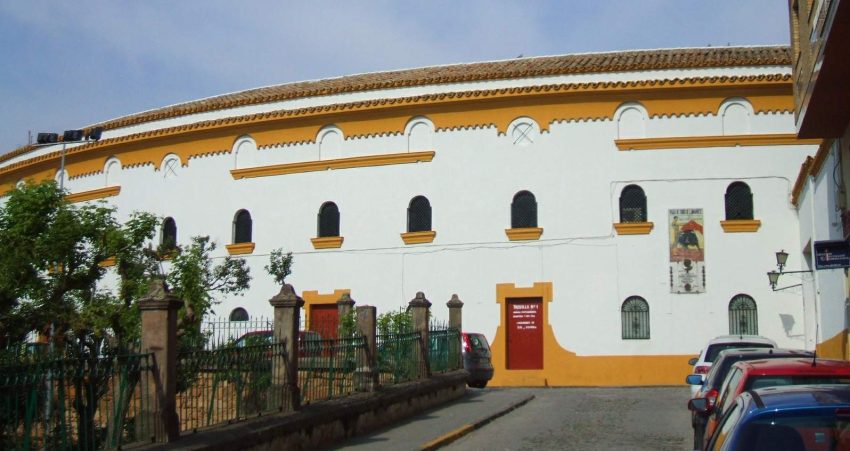
Linares   Plaza de Toros
Linares Plaza de Toros
CC BY-SA 1.0 / Zarateman
Visiting Linares in northern Andalusia offers travelers a more authentic and grounded experience of the region, away from the well-trodden paths of the bigger tourist cities. Located in the province of Jaén, Linares is a mid-sized town known for its Andalusian character, traditional squares, and proud local culture. It’s an excellent place to slow down, enjoy the rhythm of daily…
Visiting Linares
Powered by GetYourGuide

6. Seville

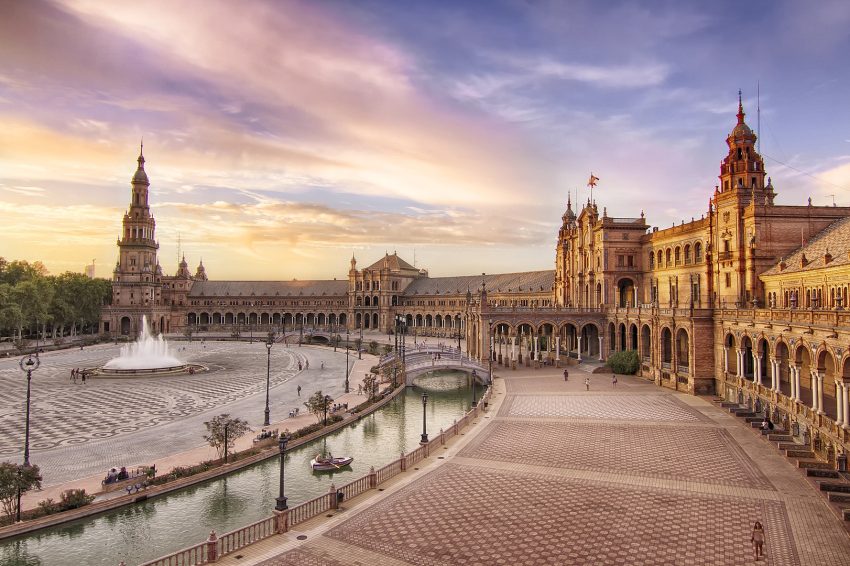
Monumental Plaza de Espana de Sevilla
CC BY-SA 3.0 / Francisco Colinet
Seville is a city that captivates visitors with its vibrant atmosphere, stunning architecture, and rich cultural experiences. Whether you're wandering through the narrow streets of Barrio Santa Cruz, admiring the colorful tiles of Plaza de España, or indulging in authentic tapas, every corner of Seville offers something special. The city’s warm climate and lively energy make it an ideal destination…
Visiting Seville
Powered by GetYourGuide

7. Ronda

View of Ronda, Spain
Flickr / Jose Ramirez
Ronda sits high in the hills of Spain’s Andalusia region, in the province of Málaga, and feels a world away from the busy Costa del Sol. Perched dramatically above the El Tajo gorge, it offers sweeping views of rugged countryside, distant mountains, and the whitewashed villages scattered across the Serranía de Ronda. It’s an easy city to navigate on foot,…
Visiting Ronda
Powered by GetYourGuide

8. Granada

View of Alhambra
View of Alhambra
CC BY-SA 1.0 / Jebulon
Visiting Granada is an unforgettable experience that combines breathtaking scenery, rich cultural traditions, and an atmosphere that’s both vibrant and relaxed. The city is compact and walkable, making it easy to explore its distinct neighborhoods—from the winding alleys of the Albaicín to the elegant boulevards near the city center. Granada's setting at the foot of the Sierra Nevada mountains adds…
Visiting Granada
Powered by GetYourGuide

9. Málaga

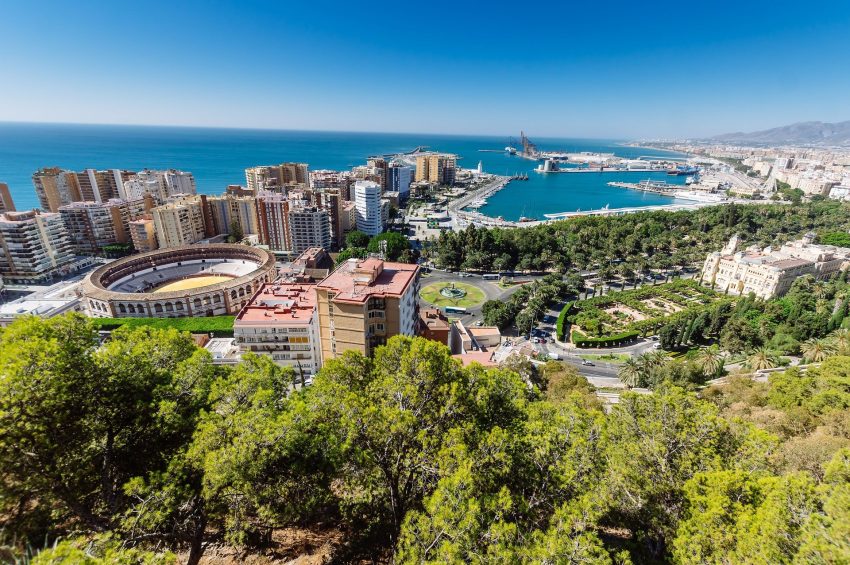
malaga
malaga
Málaga, set on the sun-drenched Costa del Sol in Andalusia, is a vibrant city that effortlessly blends coastal relaxation with cultural richness. With its golden beaches and scenic promenades, Málaga is an ideal destination for those looking to enjoy the Mediterranean lifestyle. The city’s energetic atmosphere is evident in its bustling plazas, stylish boutiques, and thriving nightlife, making it a…
Visiting Málaga
Powered by GetYourGuide

10. Marbella

Marbella
Marbella
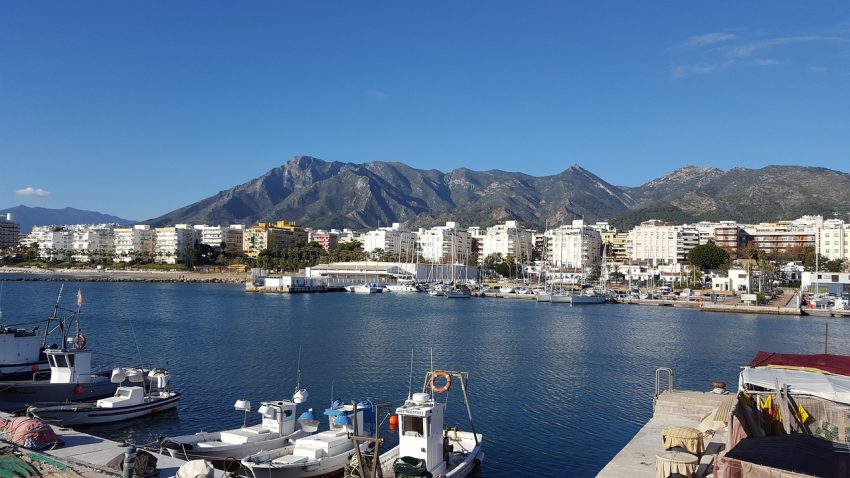
Marbella is a city and municipality in southern Spain, located in the province of Málaga within the autonomous community of Andalusia. Situated on the Costa del Sol, Marbella serves as the headquarters of the Association of Municipalities of the region and is the head of its judicial district. Visiting Marbella offers a mix of laid-back beach life, upscale glamour, and…
Visiting Marbella
Powered by GetYourGuide

11. Arcos de la Frontera

Arcos de la Frontera
CC BY-SA 2.0 / Luis Rogelio HM
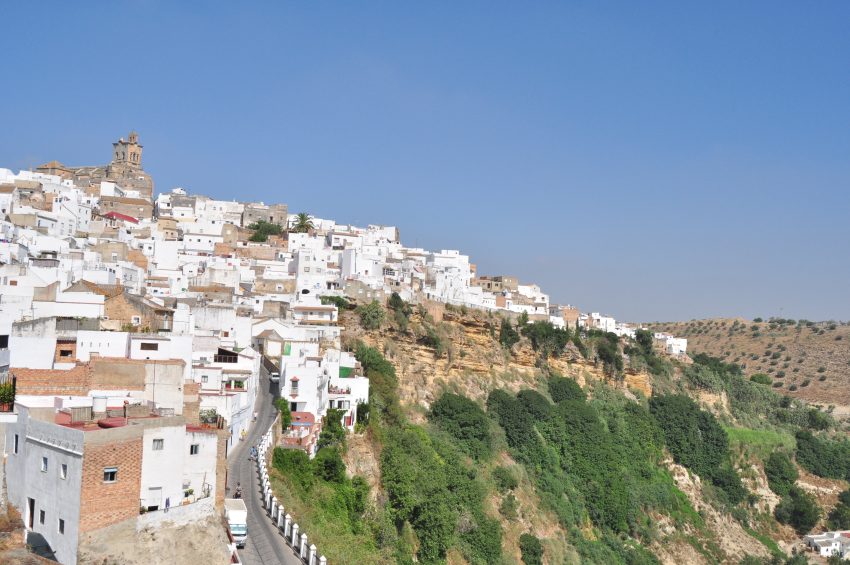
Nestled between countryside and mountains, this town showcases a blend of both landscapes and is intersected by two rivers, the Guadalete and the Majaceite. The Guadalete River feeds into the Bornos and Arcos Reservoirs, both declared Natural Beauty Spots due to their exemplary wetland environments. A portion of the town lies within the boundaries of Los Alcornocales Natural Park. Perched…
Visiting Arcos de la Frontera
Powered by GetYourGuide

Where to Stay in Córdoba

For first-time visitors, the Judería (Jewish Quarter) is an excellent choice. This historic area is characterized by narrow, winding streets, whitewashed buildings, and a rich cultural heritage. Staying here places you within walking distance of major attractions like the Mezquita-Catedral and the Alcázar de los Reyes Cristianos. A recommended hotel in this area is Las Casas de la Judería de Córdoba, offering a unique experience with its interconnected houses and beautiful patios.

If you’re interested in experiencing Córdoba’s vibrant nightlife and shopping scene, consider staying in the Centro district. This area is bustling with modern shops, cafes, and restaurants, providing a lively atmosphere day and night. A notable hotel here is H10 Palacio Colomera, which combines contemporary comfort with historical elegance.

For a more tranquil and picturesque setting, the San Basilio neighborhood offers a peaceful retreat. Known for its beautiful courtyards and traditional Andalusian houses, it’s a great place to relax and enjoy the local culture. A suitable accommodation option in this area is Hotel Boutique Patio del Posadero, providing a cozy atmosphere with personalized service.

Using the our Hotel and Accomodation map, you can compare hotels and short-term rental accommodations in Córdoba. Simply insert your travel dates and group size, and you’ll see the best deals for your stay.

Córdoba Accommodation Map

Best Time to Visit Córdoba

Spring in Córdoba

Spring in Córdoba, from March to May, is arguably the best time to visit. The weather is mild and pleasant, with temperatures ranging from 15°C to 25°C (59°F to 77°F). This season also brings the famous Córdoba Patios Festival in May, where locals open their beautifully decorated courtyards to the public. The city is filled with blooming flowers and vibrant colors, making it an ideal time for sightseeing and outdoor activities.

Summer in Córdoba

Summer in Córdoba, from June to August, can be quite hot, with temperatures often exceeding 35°C (95°F). While this might be too intense for some, the city does offer numerous shaded areas and air-conditioned attractions. If you don’t mind the heat, you can enjoy fewer crowds and longer daylight hours. Evening events and festivals, such as the Noche Blanca del Flamenco in June, provide cultural entertainment after the sun sets.

Autumn in Córdoba

Autumn in Córdoba, from September to November, is another great time to visit. The weather cools down to a more comfortable range, with temperatures between 20°C and 30°C (68°F to 86°F). The city’s cultural calendar is still active, and the changing colors of the foliage add a beautiful backdrop to your explorations. This season is perfect for strolling through the historic streets and visiting attractions without the peak summer crowds.

Winter in Córdoba

Winter in Córdoba, from December to February, is mild, with temperatures averaging between 10°C and 15°C (50°F to 59°F). This is the off-peak tourist season, so you can enjoy a quieter, more relaxed experience. It’s an excellent time to visit indoor attractions like museums and the Great Mosque-Cathedral. Additionally, the city’s holiday decorations and festivities provide a festive atmosphere, especially around Christmas and New Year’s.

Annual Weather Overview

  • January 15°C
  • February 18°C
  • March 21°C
  • April 28°C
  • May 30°C
  • June 31°C
  • July 37°C
  • August 35°C
  • September 31°C
  • October 28°C
  • November 19°C
  • December 17°C

Festivals held in Córdoba

How to get to Córdoba

By Air to Córdoba

The nearest major airport to Córdoba is Seville Airport (SVQ), located about 130 kilometers (81 miles) away. From Seville Airport, you can take a train, bus, or rent a car to reach Córdoba. Another option is to fly into Málaga Airport (AGP), which is about 160 kilometers (99 miles) from Córdoba. Both airports offer various domestic and international flights.

By Train to Córdoba

Córdoba is well-connected by train, with the Córdoba Central Railway Station serving as the main hub. High-speed AVE trains from Madrid take approximately 1 hour and 45 minutes to reach Córdoba. From Seville, the train journey is about 45 minutes, and from Málaga, it takes around 1 hour. The train station is conveniently located close to the city center.

By Bus to Córdoba

Several bus companies operate routes to Córdoba from various cities in Spain. From Madrid, buses take around 4 to 5 hours to reach Córdoba. From Seville, the bus journey is about 2 hours, and from Málaga, it takes approximately 2.5 hours. The main bus station is also centrally located, making it easy to access the city's attractions.

By Car to Córdoba

Driving to Córdoba is a convenient option, especially for exploring the surrounding regions. From Madrid, the drive takes about 4 hours via the A-4 highway. From Seville, it takes around 1.5 hours, and from Málaga, it takes about 2 hours. Renting a car gives you the flexibility to explore at your own pace and visit nearby attractions. If you are looking to rent a car in Spain I recommend having a look at Discover Cars, first, as they compare prices and review multiple car rental agencies for you.

Local Transportation in Córdoba

Once in Córdoba, you can explore the city by walking or biking, as many attractions are within a short distance from each other. The local bus network operated by AUCORSA provides convenient transportation within the city. Taxis are also readily available for getting around Córdoba and offer a convenient option for short trips.

More from this area