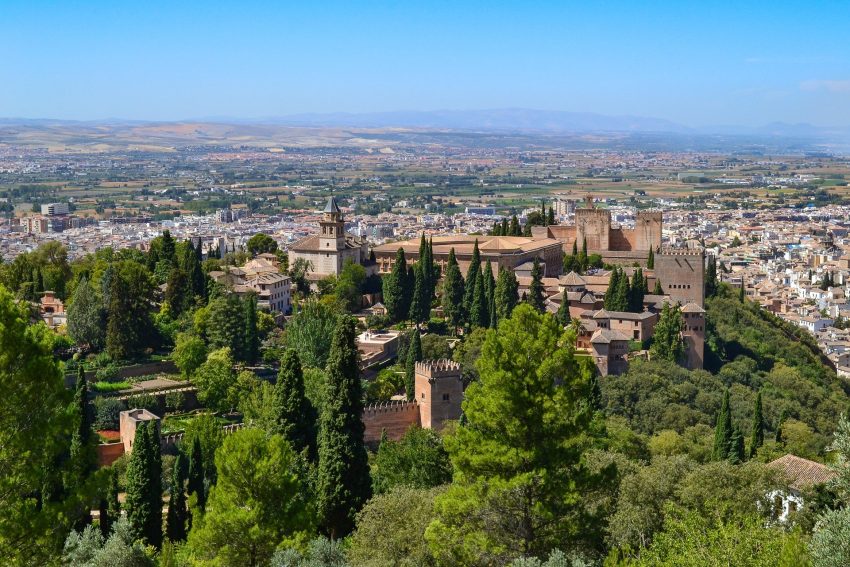
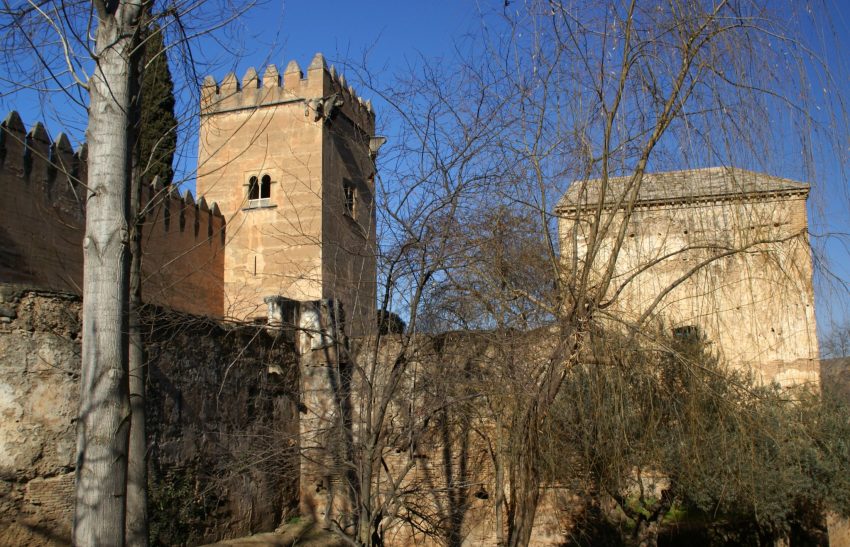
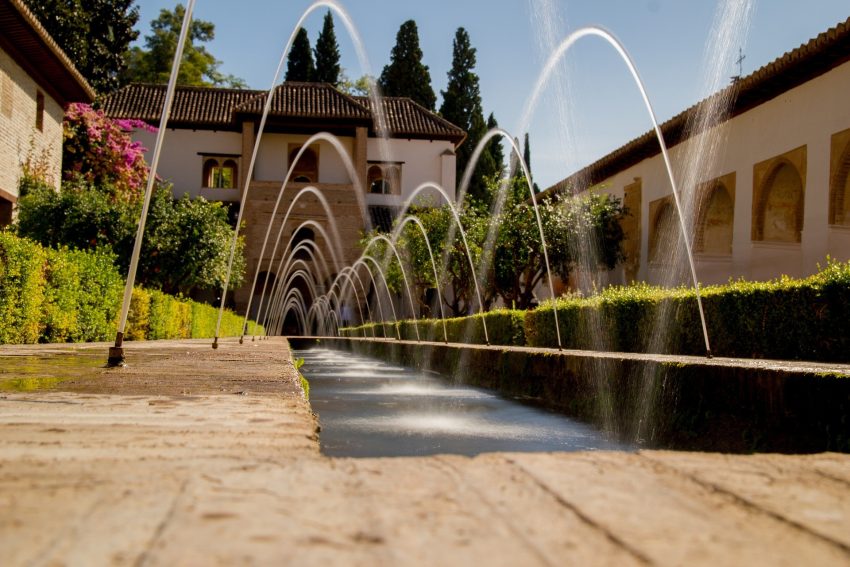
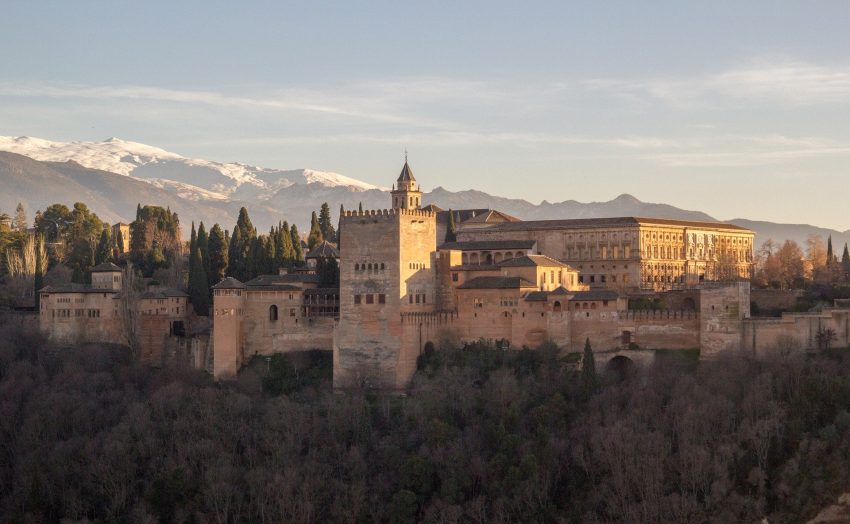
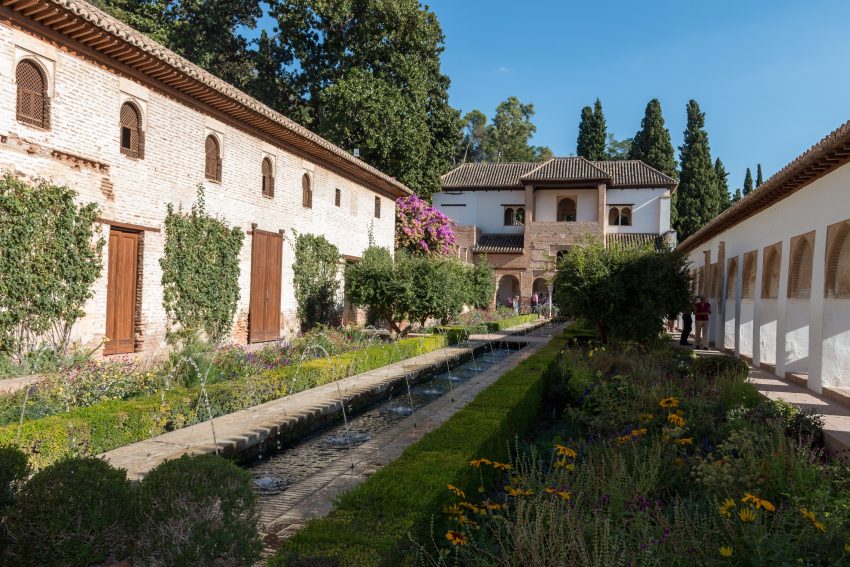
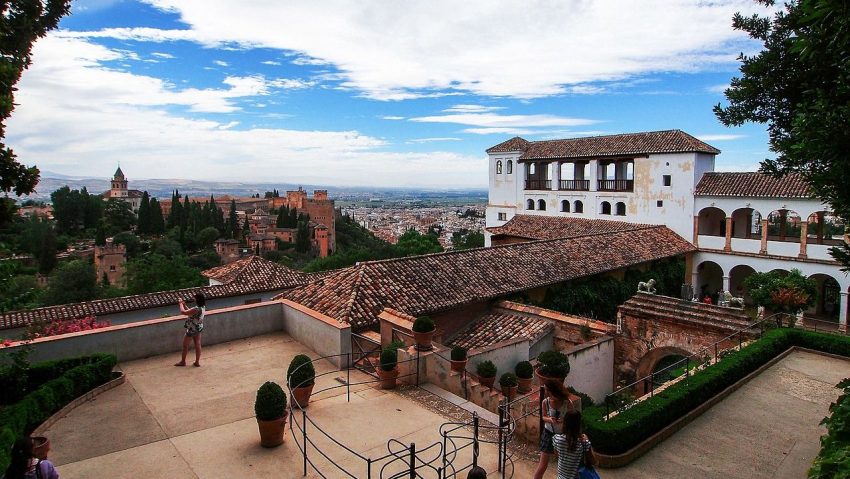
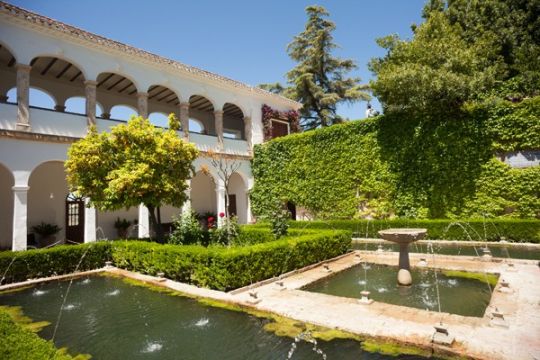
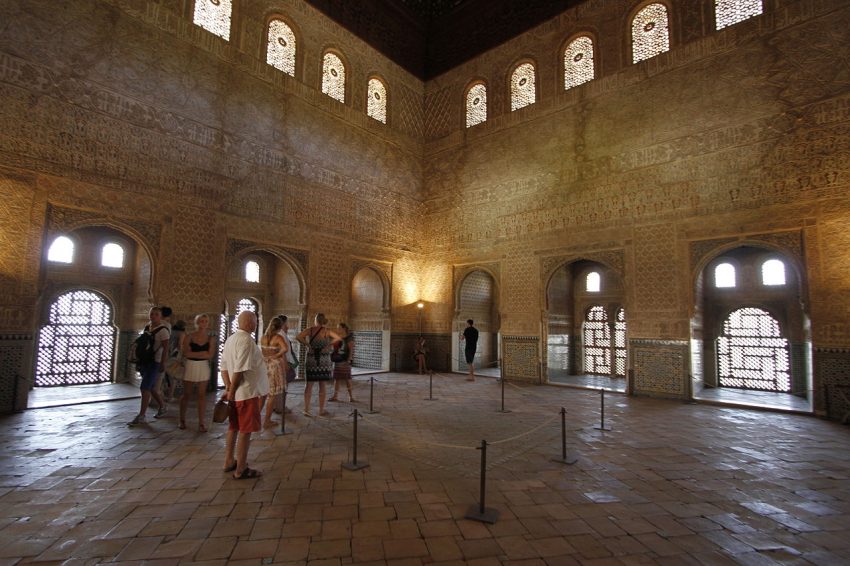
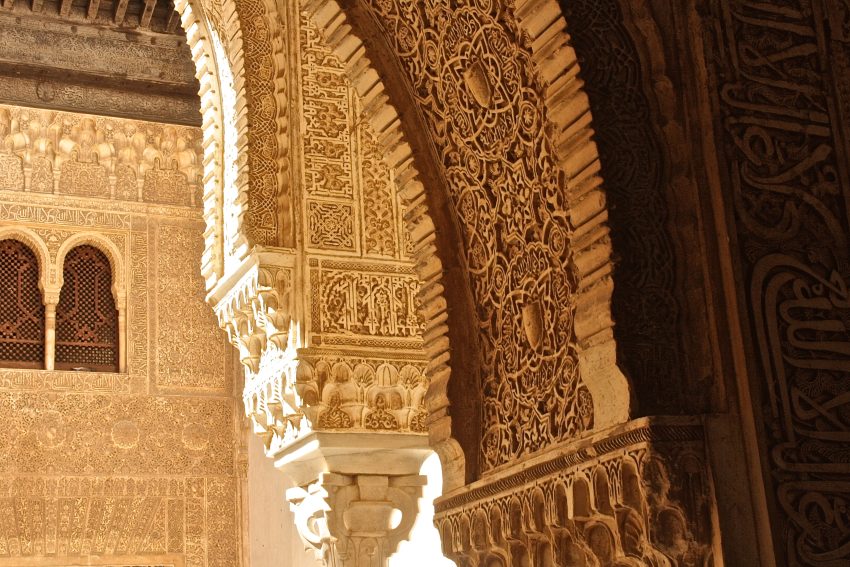
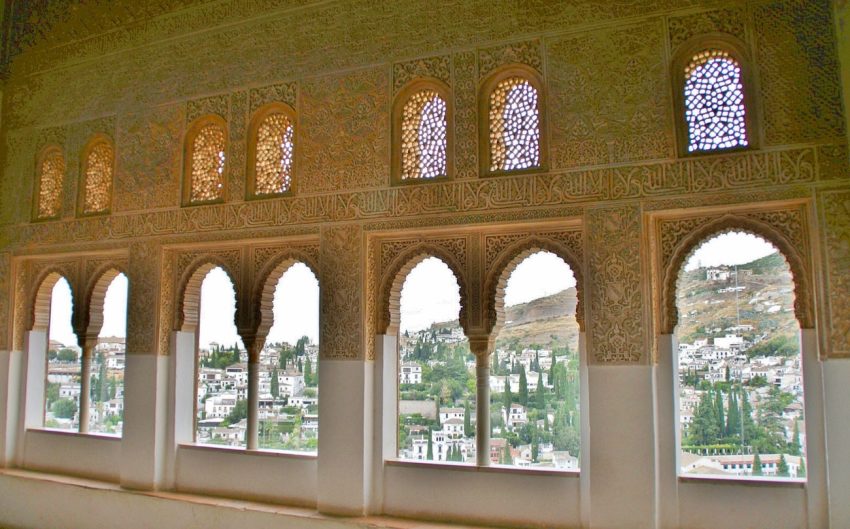
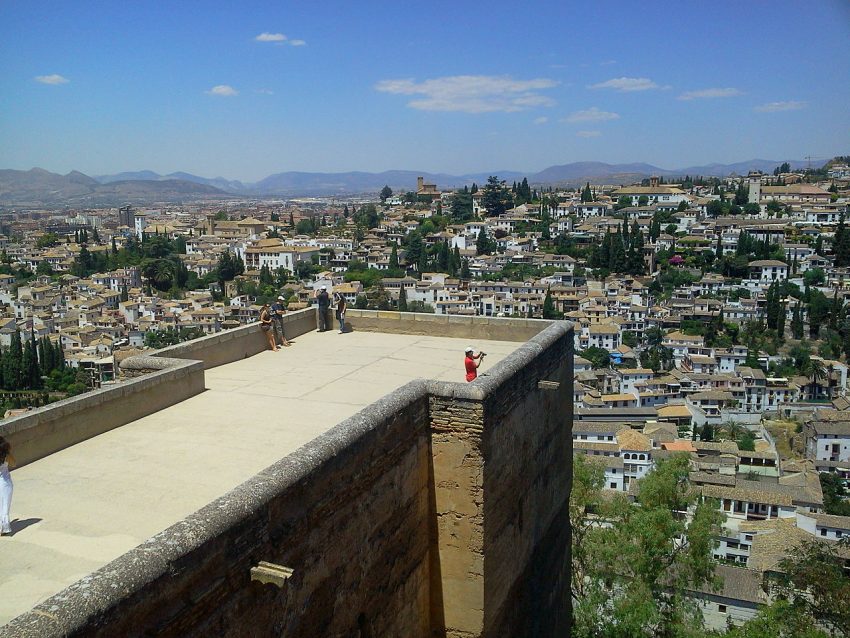
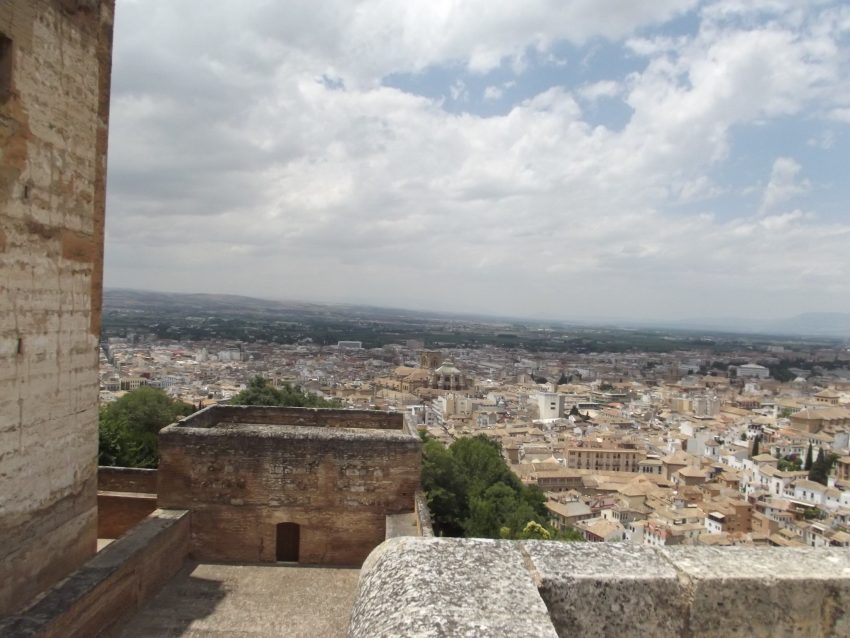
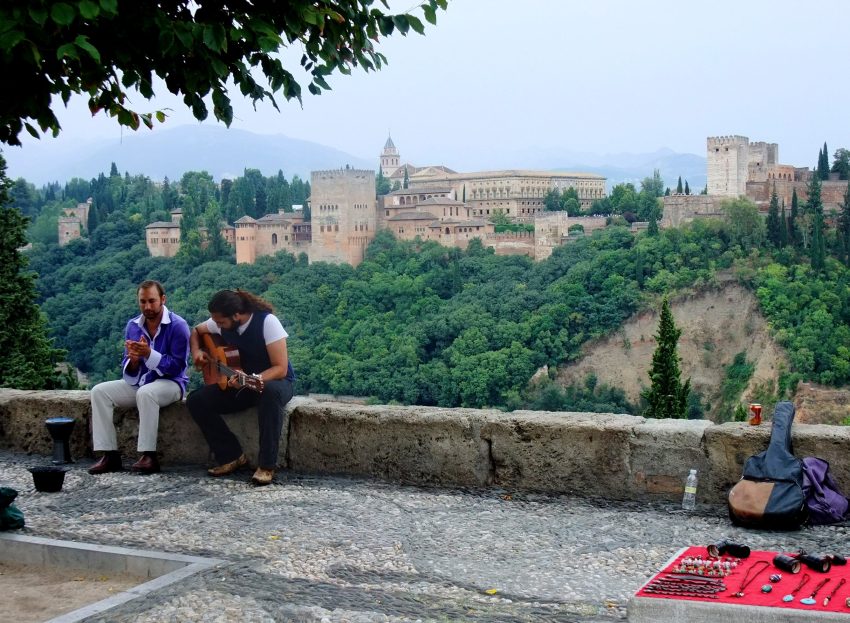
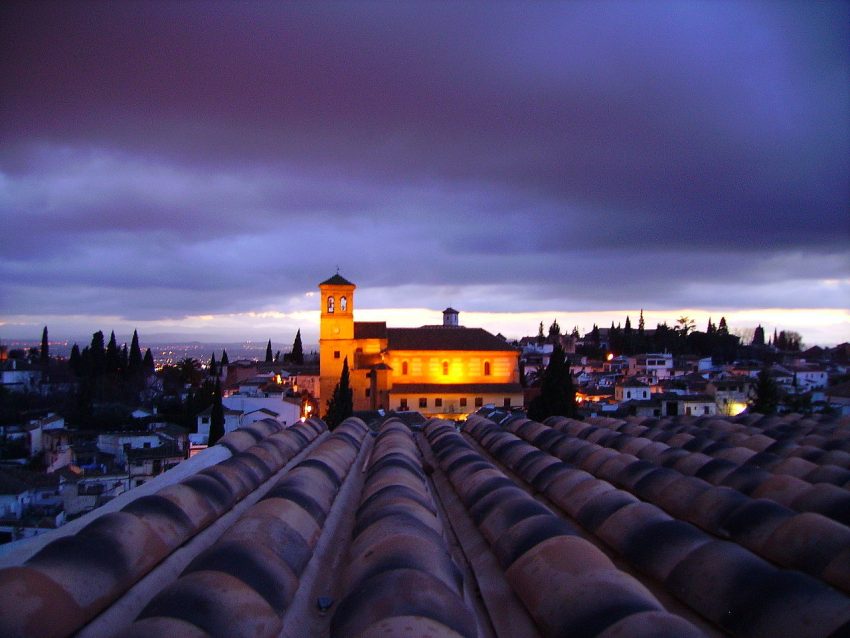
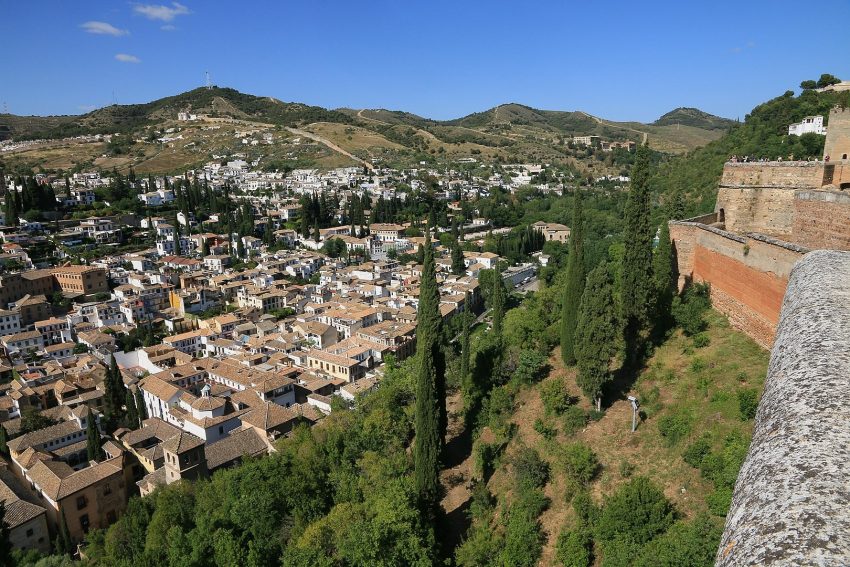
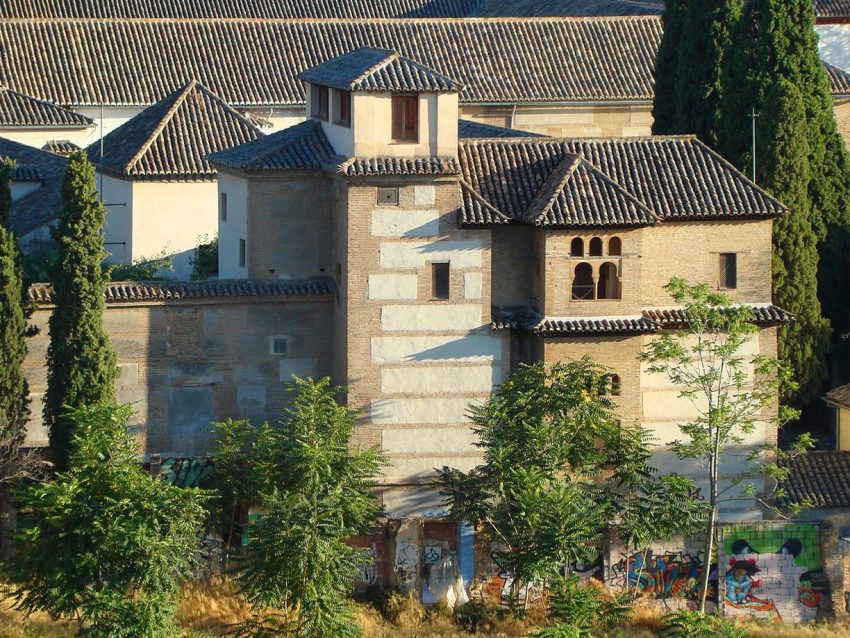
Visiting Granada is an unforgettable experience that combines breathtaking scenery, rich cultural traditions, and an atmosphere that's both vibrant and relaxed. The city is compact and walkable, making it easy to explore its distinct neighborhoods-from the winding alleys of the Albaicín to the elegant boulevards near the city center. Granada's setting at the foot of the Sierra Nevada mountains adds a dramatic natural backdrop to its Moorish architecture and leafy plazas.
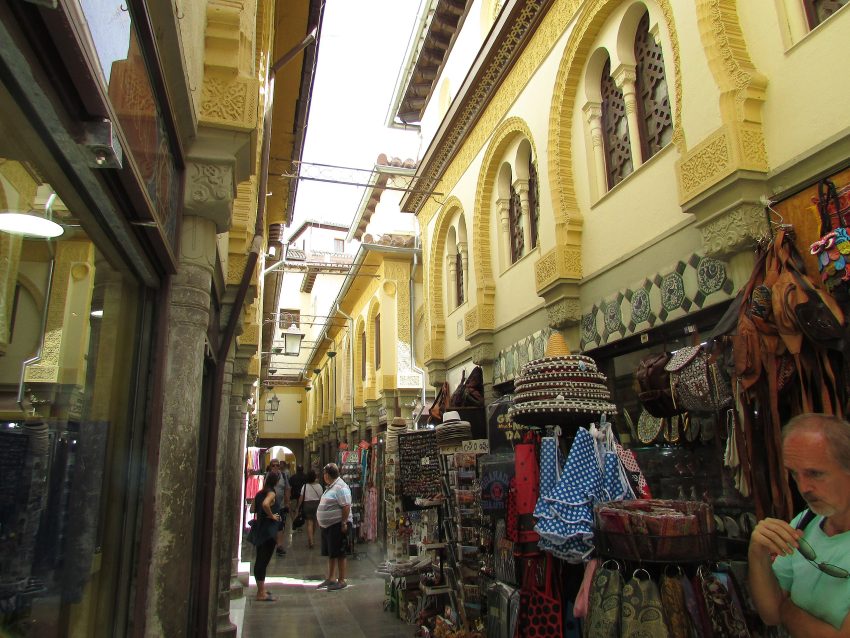
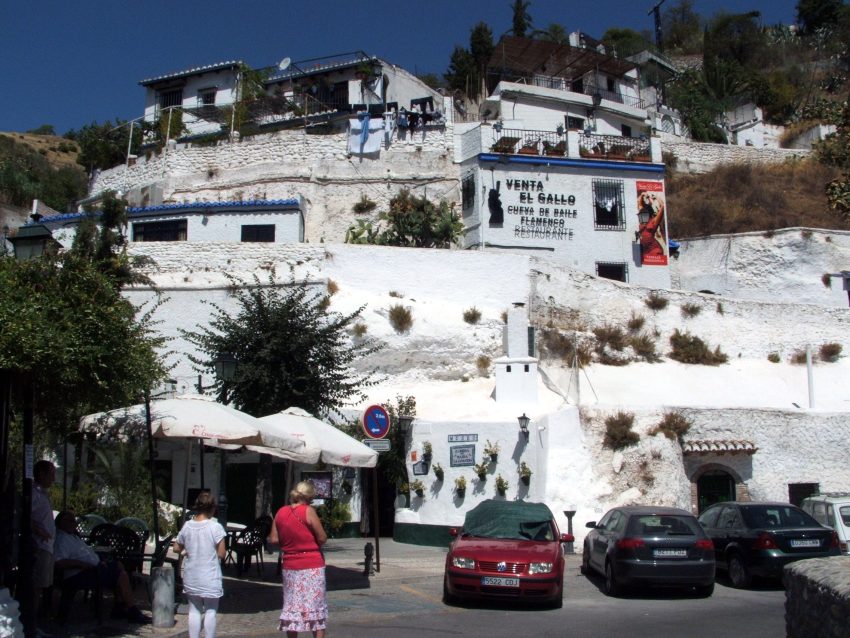
One of the highlights of visiting Granada is the variety of sensory experiences on offer. You can enjoy traditional flamenco in the Sacromonte caves, sip sweet local wines in sun-drenched patios, or wander through spice-scented markets that echo the city's North African influences. Tapas culture is deeply ingrained here, and many bars still offer small plates free with your drink, making casual dining both delicious and affordable.
Granada also balances the energy of a student town with the grace of a cultural capital. It's lively without being overwhelming, with plenty of quiet corners and scenic viewpoints where you can pause and take in the view. Whether you're here for a few days or just passing through on a longer journey across Andalusia, Granada rewards visitors with beauty, depth, and a strong sense of place.
Granada’s earliest roots lie with the Iberian tribes who settled the region long before recorded history. During the Roman era, a settlement existed nearby, though the city we know today had not yet taken shape. It wasn’t until the decline of Roman authority and the arrival of the Visigoths that the area began to develop into a more structured urban center. While little remains from this time, these early foundations set the stage for what would become one of the most important cities in medieval Spain.
Granada in the Islamic Era: The Rise of Al-Andalus
Granada truly began to flourish under Islamic rule, especially after the arrival of the Zirid dynasty in the 11th century. The city became the capital of a powerful taifa kingdom and was renamed “Granada.” Over time, it grew in influence, particularly with the founding of the Nasrid dynasty in the 13th century. The Nasrids established Granada as the capital of the Emirate of Granada, making it the last Muslim stronghold on the Iberian Peninsula. It was during this period that the Alhambra was constructed—an architectural marvel that remains one of Spain’s most iconic landmarks.
Granada in the Christian Reconquest: The Fall of the Emirate
In 1492, Granada became the final Muslim kingdom to fall during the Christian Reconquista. The Catholic Monarchs, Ferdinand and Isabella, entered the city in a peaceful surrender agreement that initially promised religious and cultural tolerance. The handover of Granada marked the unification of Spain under Christian rule and signaled the end of Islamic political presence in the Iberian Peninsula. The Alhambra and other Islamic monuments were preserved but gradually adapted to Christian purposes, while many of the city’s mosques were converted into churches.
Granada in the Modern Era: Transformation and Legacy
Following the Reconquest, Granada underwent significant changes. The expulsion of Muslims and Jews altered the city’s demographic and cultural makeup, and the Counter-Reformation brought new religious institutions and architecture. Over the centuries, Granada evolved from a royal capital into a regional hub of education and tourism. The founding of the University of Granada in the 16th century helped cement its role as a cultural and academic center. Today, Granada’s unique history—shaped by its Islamic, Christian, and Jewish past—continues to define its identity, making it one of the most compelling cities in Europe for visitors and scholars alike.
Moira & Andy
Hey! We're Moira & Andy. From hiking the Camino to trips around Europe in Bert our campervan — we've been traveling together since retirement in 2020!
Visiting Granada for the first time and wondering what are the top places to see in the city?
In this complete guide, I share the best things to do in Granada on the first visit.
To help you plan your trip, I have also included an interactive map and practical tips for visiting!
This website uses affiliate links which earn a small commission at no additional cost to you.
This complete guide to Granada not only tells you about the very best
sights and tourist attractions for first-time visitors to the city but also provide insights
into a few of our personal favorite things to do.
This is a practical guide to visiting the best places to see in Granada and is filled with tips and info that
should answer all your questions!
1. Carmen de los Mártires
Pool Carmen de los Martires
CC BY-SA 4.0 / Palickap
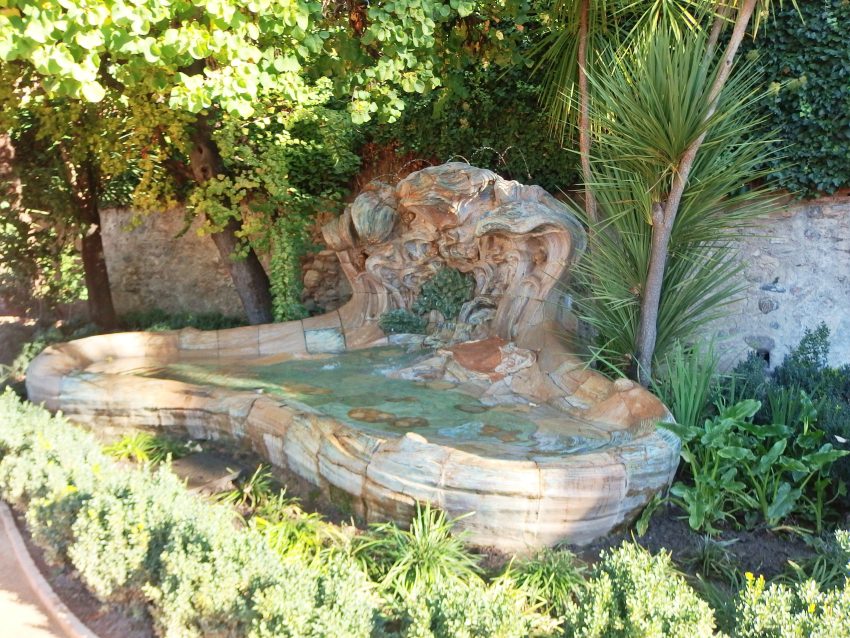
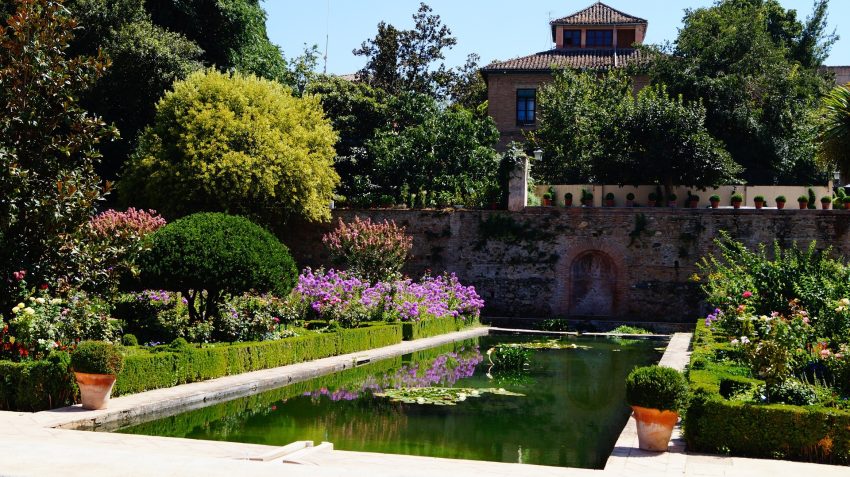
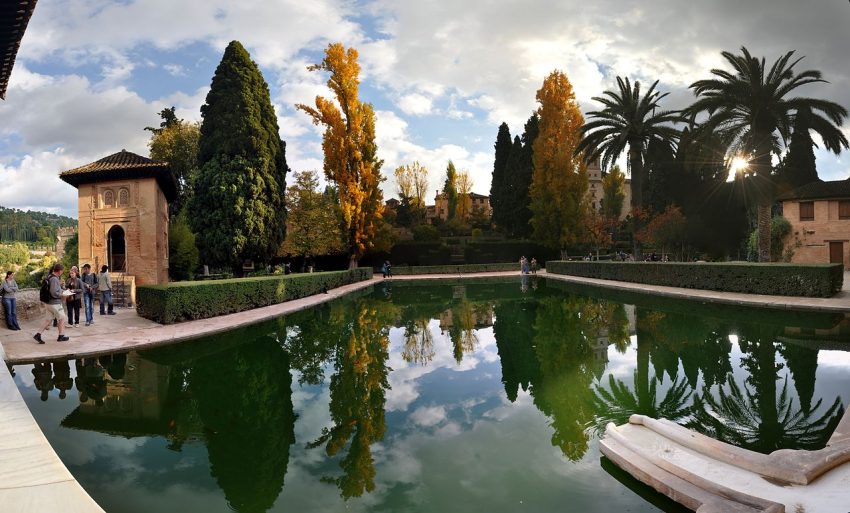
Carmen de los Mártires is a seven-hectare hillside garden on Mauror Hill, a quiet counterpoint to the stone and crowds nearby. Winding paths move between contrasting styles: a formal French parterre with a Neptune fountain, a palm-filled English grove, and a 1940s Neo-Nasrid courtyard built around a long reflective pool. Ponds and shaded corners feel almost theatrical, and it’s common to spot peacocks roaming the lawns. For a storybook moment, cross to the lake’s small island and climb the spiral stairs of the ruined tower for wide views, especially near sunset. The grounds also preserve traces of earlier lives, including an old aqueduct linked to the Carmelite monastery.
Location: Calle de Antequeruela Alta, Granada, España | Hours: From April 1 to October 14: From Monday to Friday from 10:00 am. to 14:00 pm. and 18:00 pm. to 20:00 pm. Saturdays, Sundays and holidays from 10:00 am. to 20:00 pm. From October 15 to March 31: From Monday to Friday from 10:00 am. to 14:00 pm. and 16:00 pm. to 18:00 pm. Saturdays, Sundays and holidays from 10:00 am. to 18:00 pm.
| Price: Free | Website | Distance: 0.9km
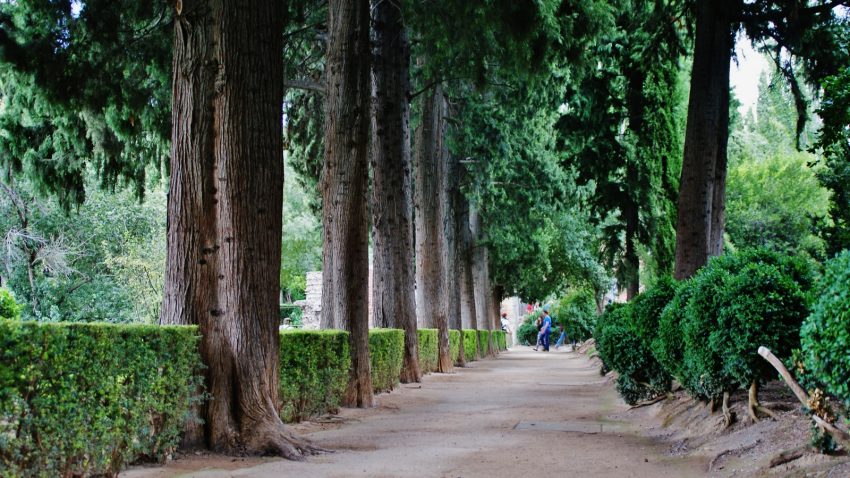
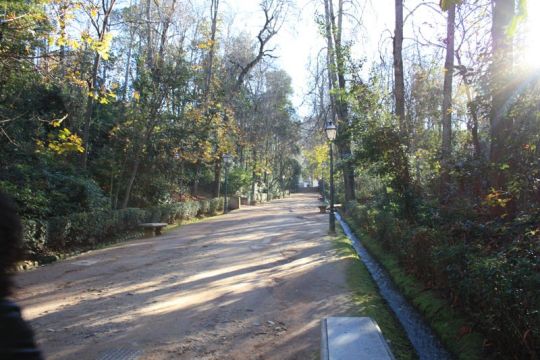
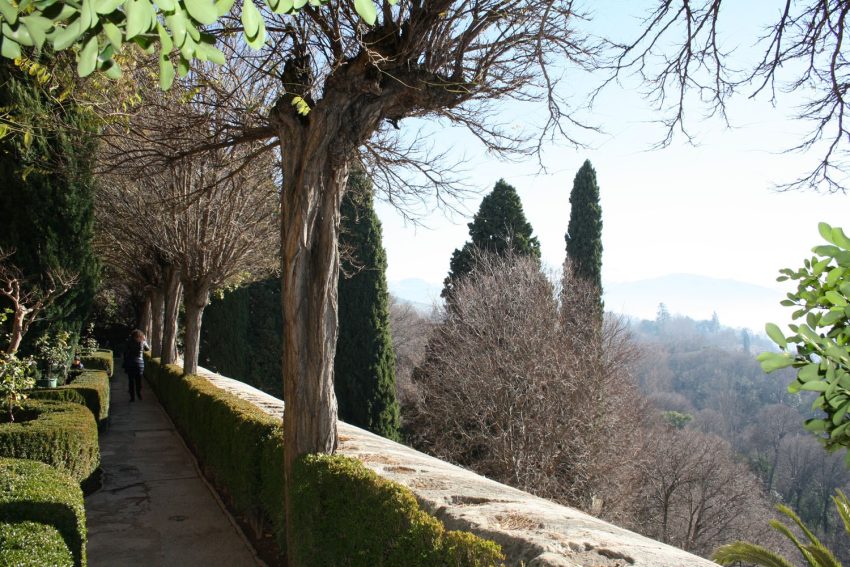
The Paseo de los Cipreses is a shaded avenue in the Generalife that functions as the gardens’ official entrance and exit, easing you into the palace grounds at a calm, unhurried pace. Laid out in 1862 for Queen Isabella II’s visit, it later gained its present character after the estate was donated to the Spanish state in 1921 and reworked by restorer Leopoldo Torres Balbás. Tall, mature cypresses form a cool green corridor, while rose beds and the 20th-century Jardines Nuevos add bursts of color at the edges. It connects naturally from the oleander-arched Paseo de las Adelfas, making the transition between garden rooms feel deliberate and theatrical.
Location: Promenade of the Cypress Trees Unnamed Road,18009 18009 Granada Spain | Hours: For opening times of the Paseo de los Cipreses in the Generalife see Alhambra Opening Times.
| Price: The Paseo de los Cipreses is part of the Generalife of the Alhambra Complex and access it you need to purchase Alhambra Tickets or a Alhambra Guided Tour. | Website | Distance: 1.1km
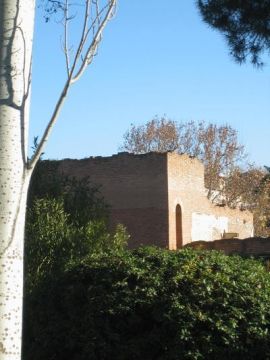
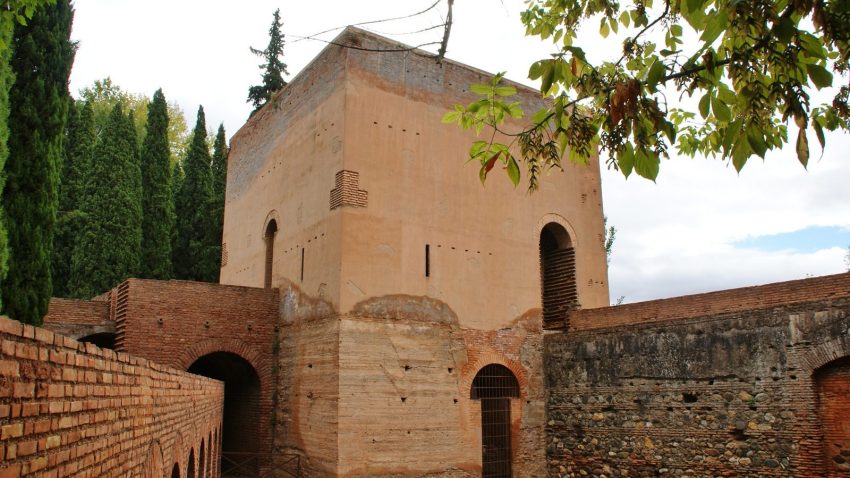
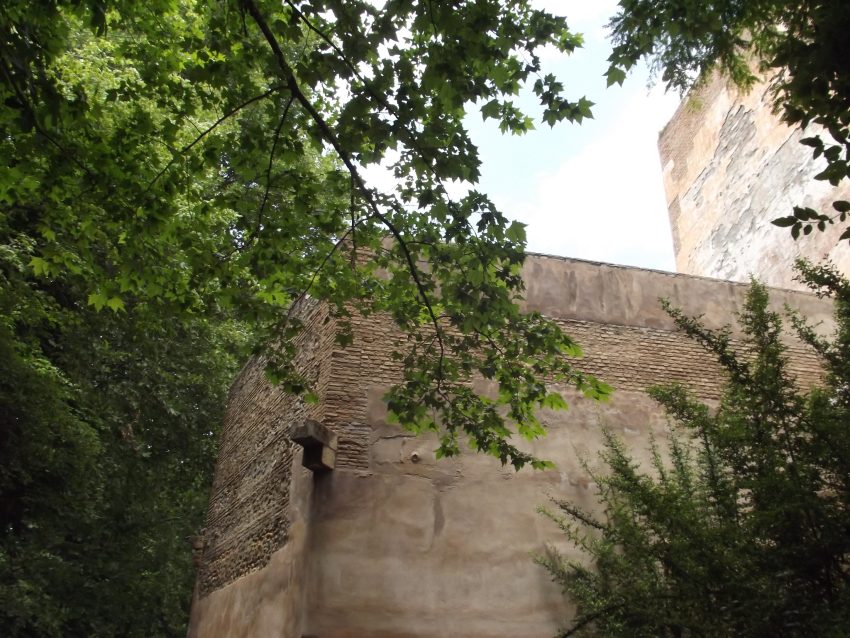
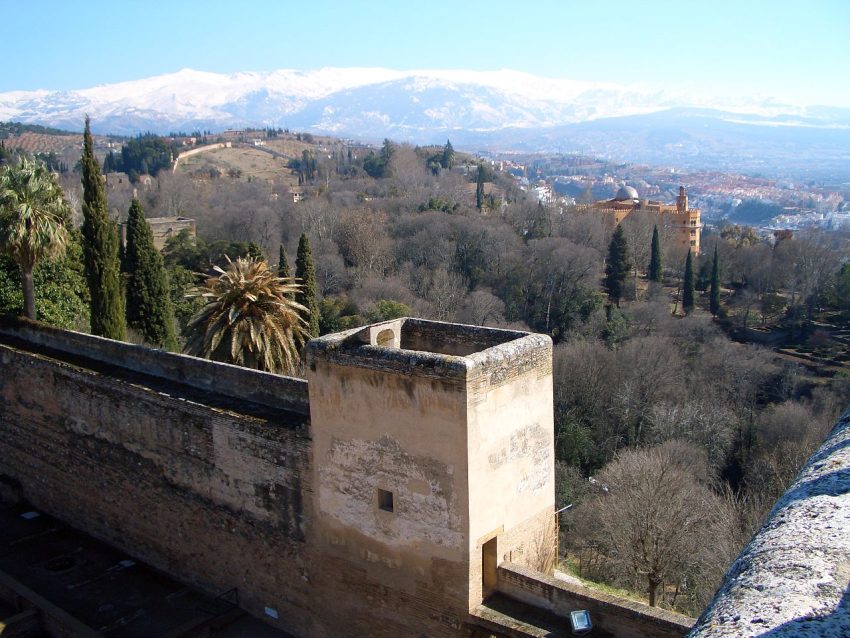
Torre de Juan de Arce is a small defensive tower set into the Alhambra’s southeast wall, where the parapet walkway passes straight through its elongated rectangular projection. Step through the narrow doorways to see the simple interior chamber where guards once paused to watch the steep approaches below and control movement along the rampart. Part of the Nasrid fortification line, it was damaged in the 1812 French demolitions and later rebuilt, yet its footprint still explains how the wall was patrolled. The name recalls jurist Juan de Arce de Otálora, who lived here briefly in the 1550s and wrote De nobilitatis—an unexpected link to the world of Lazarillo de Tormes.
| Hours: For opening times of the Torre de Juan de Arce see Alhambra Opening Times.
Access is normally restricted unless to building forms part of the Space of the Month program.
| Price: The Torre de Juan de Arce is part of the Alhambra Complex and access it you need to purchase Alhambra Tickets or a Alhambra Guided Tour. | Distance: 1.1km
Traveling to a country with a different currency? Avoid ATM transaction fees and pay in local currency with a Wise Card. Having used it for over 5 years, we've saved loads on fees!
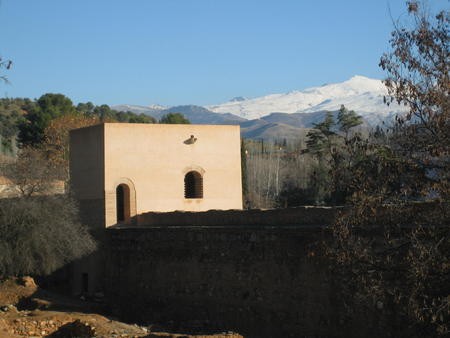
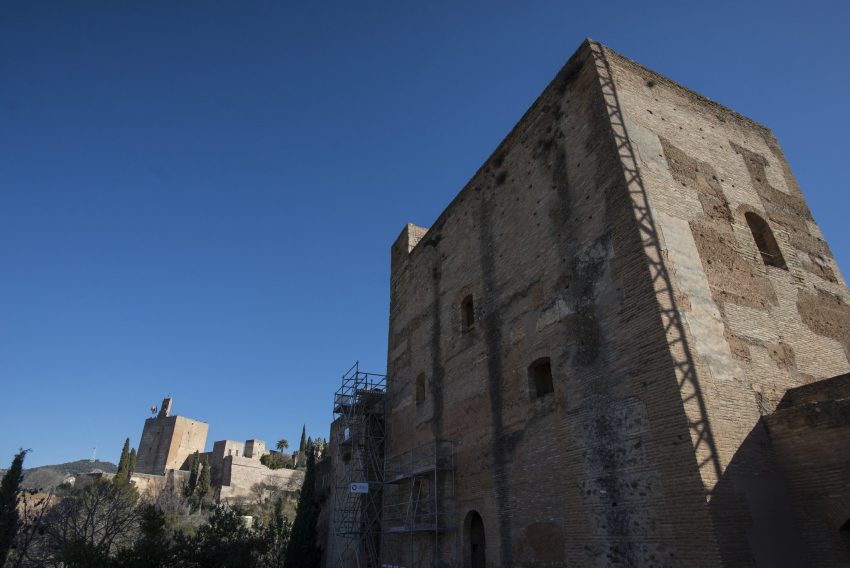
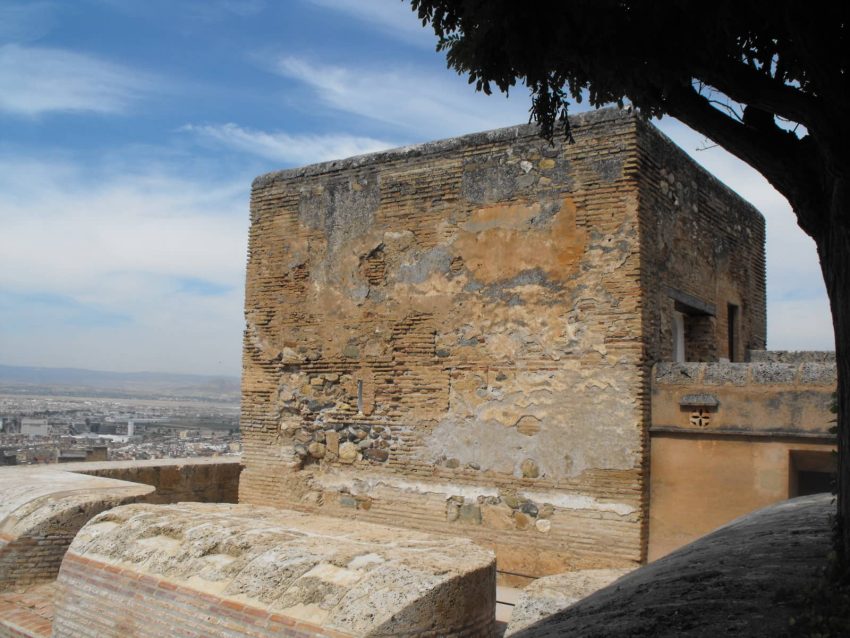
Torre de Baltasar de la Cruz is a small defensive tower set into the Alhambra’s southern wall in Granada, built in the 14th century under the Nasrid ruler Yusuf I as part of the fortress’s watch system. It has a compact square plan, and the parapet walkway feeds straight into the interior, making it easy to picture guards circulating along the ramparts. From the wall you look down over the steep southern slope, a reminder of how closely this stretch was monitored. The tower was blown apart during the Napoleonic withdrawal and later rebuilt, so what you see today is a restored silhouette that still reads clearly in the wall line. Its name preserves a rare personal link: it once served as the residence of Baltasar de la Cruz.
Location: Torre de Baltasar de La Cruz 18009 Granada Spain | Hours: For opening times of the Torre de Baltasar see Alhambra Opening Times.
Access is normally restricted unless to building forms part of the Space of the Month program. | Price: The Torre de Baltasar is part of the Alhambra Complex and access it you need to purchase Alhambra Tickets or a Alhambra Guided Tour. | Distance: 1.1km
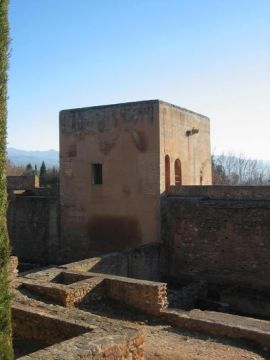
Torre del Capitán in Granada, Spain, is a compact Nasrid-era defensive tower on the Alhambra’s southern wall, built to watch the steep slope below and control movement along the ramparts. Its elongated, square projection juts beyond the masonry, making the lookout function easy to read even from a distance. Inside, a small surveillance room connects directly to the wall-walk where guards once checked passage. Below, the Camino de Ronda marks the area where 1932–33 excavations uncovered traces of two Nasrid houses and a street leading toward the Medina, hinting at daily life pressed against the fortress edge. Visitors remember rugged stonework, dramatic hillside views, and the quiet, almost hidden feel—praised in reviews as a “maravilla mundial.”
Location: Torre del Capitán 18009 Granada Spain | Hours: For opening times of the Torre del Capitán see Alhambra Opening Times.
Access is normally restricted unless to building forms part of the Space of the Month program. | Price: The Torre del Capitán is part of the Alhambra Complex and access it you need to purchase Alhambra Tickets or a Alhambra Guided Tour. | Distance: 1.1km
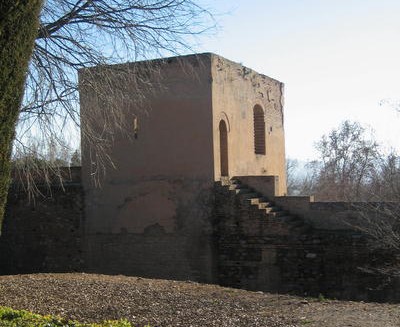
Torre de la Bruja (the “Witch’s Tower”) is a small defensive tower on the Alhambra’s steep southern wall in Granada, Spain, rebuilt to match the original after Napoleonic troops wrecked this section during the Peninsular War. Its long, rectangular form and the hollow upper level—once part of the rampart walkway—make it easy to picture guards moving along the defenses. Set on a rocky spur between the Torres del Capitán and the Torre de las Cabezas, it feels tucked away from the palace crowds. Step inside the lower chamber and the mood turns quiet and watchful, with the hillside dropping sharply below and the fortress’s practical geometry close at hand.
| Hours: For opening times of the Torre de la Bruja see Alhambra Opening Times.
Access is normally restricted unless to building forms part of the Space of the Month program. | Price: The Torre de la Bruja is part of the Alhambra Complex and access it you need to purchase Alhambra Tickets or a Alhambra Guided Tour. | Distance: 1.1km
Torre del Cabo de la Carrera is a small, quiet ruin on the Paseo de las Torres along the Alhambra’s northeastern wall in Granada. Once marking the end of the Calle Mayor, it stood at a key hinge between the palace-city’s upper fortifications and the steep Darro ravine by the Cuesta de los Chinos. Reworked under the Catholic Monarchs in 1502, it later met a violent end when retreating Napoleonic troops blew it up on the night of 15–16 September 1812, leaving only fragments and a low footprint of masonry. What visitors remember are the broken stones, the sudden drop of the ravine, and the calmer, less crowded feel compared with the main palace areas.
Location: Torre del Cabo de la Carrera Generalife Centro 18009 Granada Spain | Hours: For opening times of the Torre del Cabo de la Carrera see Alhambra Opening Times.
| Price: The Torre del Cabo de la Carrera is part of the Alhambra Complex and access it you need to purchase Alhambra Tickets or a Alhambra Guided Tour. | Distance: 1.1km
Torre del Agua is a sturdy, utilitarian watchtower on the far southeastern edge of Granada’s Alhambra, set beside the Royal Ditch (Acequia del Sultán) that carried water from the Darro River into the palace-city. Its whole purpose was protection: from this steep hillside position it guarded the aqueduct link between the Generalife and the main complex, where a bridge meets the path along the ravine. Built across three levels and notably larger than some nearby towers, it was designed for surveillance rather than decoration, and today what you see is largely reconstructed outer masonry. Standing next to the channel, you can trace the water’s entry route and understand why visitors still describe it as a defensive tower watching the Acequia Real.
| Hours: For opening times of the Torre del Agua see Alhambra Opening Times.
| Price: The Torre del Agua is part of the Alhambra Complex and access it you need to purchase Alhambra Tickets or a Alhambra Guided Tour. | Website | Distance: 1.1km
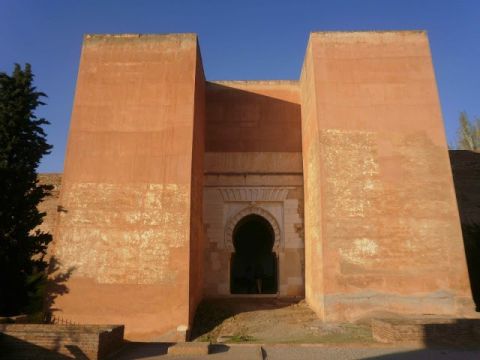
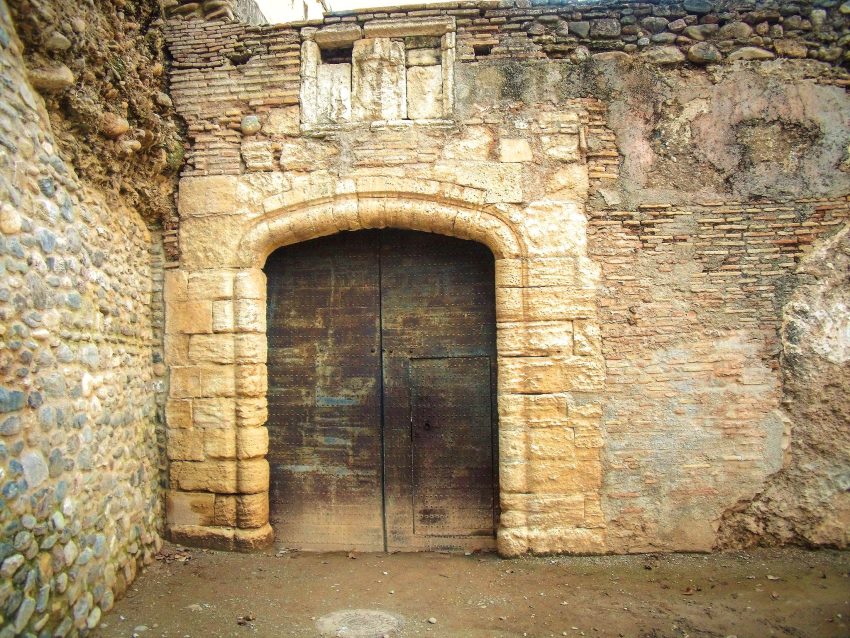
Torre de los Siete Suelos (Tower of the Seven Floors) is a reconstructed 14th-century gate-tower on the Alhambra’s southern wall in Granada, once a principal entrance leading into the upper Medina. Its gateway bears the Nasrid motto “Only God is Victor,” echoing the complex’s grander portals, and the name clings to a legend of seven underground levels. In reality, visitors can only trace the idea through two confirmed subterranean chambers—cylindrical vaults with skylights and narrow openings that feel more like hidden infrastructure than romance. The tower was blown up in 1812 during the French retreat and rebuilt in the 1970s from old images, so what you see is a careful resurrection layered with myth.
Location: Puerta de Siete Suelos 18009 Granada Spain | Hours: Entrance to this building is usually restricted and cannot be visited during the ordinary visit of the Alhambra Complex.
Access is sometimes permitted with advance registration, through activities arranged by the Board of the Alhambra and the Generalife.
It may also be included in the "Space of the Month" program, which allows the visit of certain spaces normally closed to preserve their conservation and that do not admit a high number of visitors.
| Price: The Puerta de Siete Suelos is part of the Alhambra Complex and access it you need to purchase Alhambra Tickets or a Alhambra Guided Tour. | Website | Distance: 1.1km
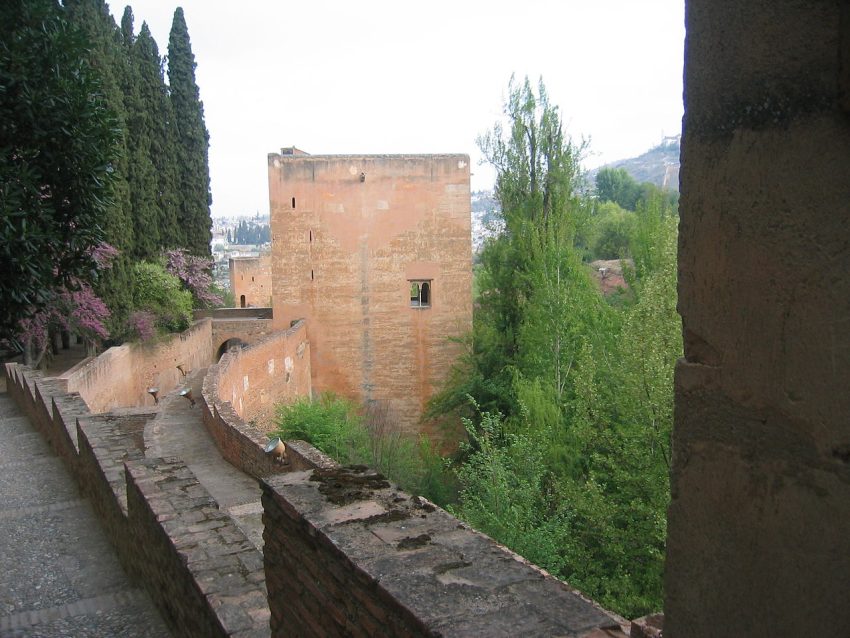
A quiet, leafy walkway on the Alhambra hillside, the Paseo de los Nogales runs between the main entrance area and the Generalife, with benches and shifting views over orchards and forested slopes. As you walk, the fortress walls rise to your left and a sequence of towers comes into view—among them the damaged Torre del Cabo de la Carrera and the crenelated Torre de los Picos. The route also traces older infrastructure: repaving in 2009 revealed remains of the Acequia Real, the royal water channel that once fed the palaces and gardens. Cypress, vines, and dense vegetation line the path, giving it a calmer, more rural feel than the palace courts.
| Website | Distance: 1.2km
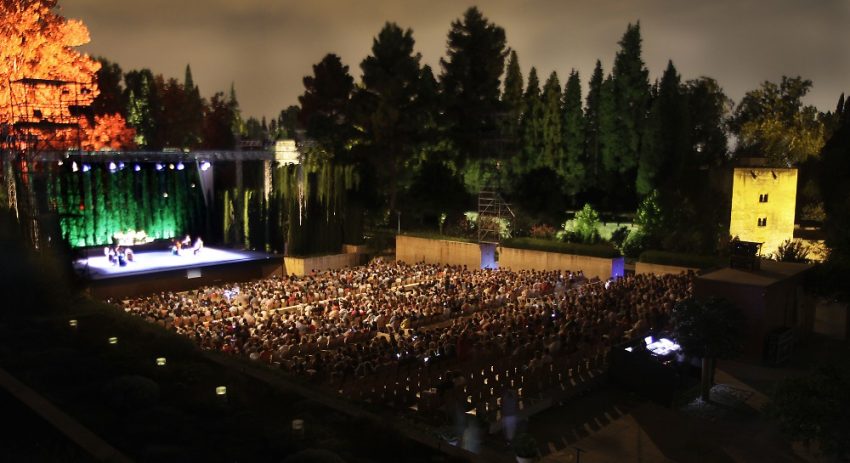
The Teatro del Generalife is an open-air theatre set at the southern end of the Generalife gardens, created in the 1950s as the main stage for the International Festival of Music and Dance. Its broad stage is framed by tall cypress “screens” that act like living scenery, with parterres, paths, and orchard terraces flowing around the seating. Designed by Francisco Prieto Moreno to echo the proportions of a Nasrid riad, it creates a rare conversation between modern performance and the Alhambra’s centuries-old landscape. Even without a show, visitors remember the calm, plant-filled setting—orange trees, benches, and wide open space—and the dusk atmosphere when the greenery takes on theatre lighting.
Location: Generalife Theatre Paseo del Generalife, 1B 18009 Granada Spain | Hours: For opening times of the Teatro del Generalife see Alhambra Opening Times.
| Price: The Teatro del Generalife is part of the Generalife of the Alhambra Complex and access it you need to purchase Alhambra Tickets or a Alhambra Guided Tour. | Website | Distance: 1.2km
Torre de las Cabezas is a stark Nasrid-era defensive tower on the Alhambra’s ramparts in Granada, an elongated rectangle that projects outward to widen the guards’ view over the terrain. Set between the Torre de la Bruja and the Torre de las Abencerrajes, it feels more severe than the nearby palaces, with bare stone and tight, vaulted interior chambers. Visitors can step into spaces once used as prison cells and sense the claustrophobia of the narrow corridors. Its name recalls a grim tradition: the heads of executed prisoners were said to be displayed on the exterior as a warning. From the rampart walk, the tower’s geometry and sightlines make its military logic easy to read.
| Hours: For opening times of the Torre de las Cabezas see Alhambra Opening Times.
Access is normally restricted unless to building forms part of the Space of the Month program.
| Price: The Torre de las Cabezas is part of the Alhambra Complex and access it you need to purchase Alhambra Tickets or a Alhambra Guided Tour. | Distance: 1.2km
Torre de las Abencerrajes is a half-vanished defensive tower on the Alhambra’s south wall, so discreet that many people pass without noticing it. Unlike towers that jut outward, it once ran almost flush and parallel to the rampart, and today it’s largely reduced to faint wall traces and a barely readable footprint. It stood beside the Palacio de los Abencerrajes, and both were badly shattered in 1812 when retreating Napoleonic troops blew up parts of the complex. The name echoes the Nasrid Abencerrajes lineage later wrapped in legend, while an “Accounting Tower” label also appears in post-conquest records. What lingers is the sense of a fortified city’s missing piece, hidden among trees and ruins.
| Hours: For opening times of the Torre de las Abencerrajes see Alhambra Opening Times.
Access is restricted.
| Price: The Torre de las Abencerrajes is part of the Alhambra Complex and access it you need to purchase Alhambra Tickets or a Alhambra Guided Tour. | Distance: 1.2km
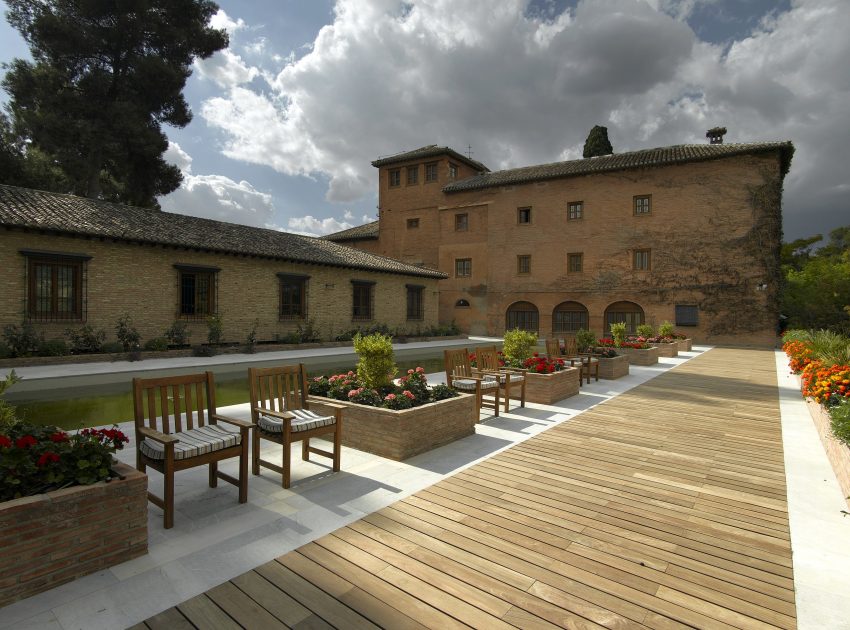
Convento de San Francisco, now the Parador de Granada, sits inside the Alhambra on ground layered with change: it was built over a Nasrid palace and became Granada’s first Christian convent after 1492. Visitors notice the quiet courtyard where an original Nasrid water channel still runs to a small rectangular pond, a miniature echo of palace garden design. Inside, monastic restraint meets older details—vaulted spaces, heavy wooden beams, and lingering Arabic motifs—showing how the building was adapted rather than erased. The former chapel is remembered for sheltering the temporary tombs of Ferdinand and Isabella before their move to Granada’s Royal Chapel. Even from the outside, the aged stone, gardens, and cloister-like calm feel distinct from the surrounding palaces.
Puerta de Birrambla is a surviving medieval city gate of Granada’s former medina, now standing as a solitary arch in the wooded lower grounds of the Alhambra along the Paseo de las Alamedas. Built in the 11th–12th century as the main entrance to Plaza de Bib-Rambla, its horseshoe arch and hefty stone blocks hint at the city life that once streamed through it. Dismantled during 19th-century reforms, the stones were stored in Granada’s Archaeological Museum before being reassembled in 1933 by conservation architect Leopoldo Torres Balbás. Its proportions and decorative language helped shape later Nasrid gatehouses, and today the ruin feels quietly romantic, especially when late light catches the textured masonry.
Location: Puerta de Birrambla, Cuesta de Gomérez, 39 18009 Granada Spain | Distance: 1.2km
Torre de las Infantas is a late-Nasrid palace-tower on the Alhambra’s eastern ramparts, part of a trio of qalahurras that pair fortification with intimate domestic rooms. From the outside it reads as almost blank stone, punctuated by just two small windows, but inside it opens into finely worked stucco, ceramic plinths, carved wood, and shimmering mocárabe details. Entry is especially memorable: a passage with three sharp bends leads to a central hall once topped by a muqarnas dome, later replaced by a wooden dome after earthquake damage. Upper rooms frame the courtyard through horseshoe-arched windows, while the quiet wall-walk nearby feels like a calmer escape from the palace crowds.
Location: Torre de las Infantas de la Alhambra Calle Real de la Alhambra 18009 Granada Spain | Hours: For opening times of the Torre de las Infantas see Alhambra Opening Times.
Entrance to this building is usually restricted and cannot be visited during the ordinary visit of the Alhambra Complex.
Access is sometimes permitted with advance registration, through activities arranged by the Board of the Alhambra and the Generalife.
It may also be included in the "Space of the Month" program, which allows the visit of certain spaces normally closed to preserve their conservation and that do not admit a high number of visitors.
| Price: The Torre de las Infantas is part of the Alhambra Complex and access it you need to purchase Alhambra Tickets or a Alhambra Guided Tour. | Website | Distance: 1.2km
Torre de la Cautiva is a tower-palace set into the northern wall of Granada’s Alhambra, outwardly reading as a plain defensive turret on the Paseo de las Torres. Inside, it opens into a small patio with three-sided galleries where festooned arches sit on intricate mocárabes, leading through a double honeycomb arch into a square hall. Look for the dense stucco inscriptions, tilework, and a poetic text that describes the room as both palace and bastion, a rare window into how Nasrid spaces were meant to be read. Built in the late 1200s and refined under Yusuf I in the 1300s, it later housed Christian occupants, and its “Captive” name clings to legends of Isabel de Solís.
Location: Torre de la Cautiva, Generalife, Granada, Spain | Hours: For opening times of the Torre de la Cautiva see Alhambra Opening Times.
| Price: The Torre de la Cautiva is part of the Alhambra Complex and access it you need to purchase Alhambra Tickets or a Alhambra Guided Tour. | Website | Distance: 1.2km
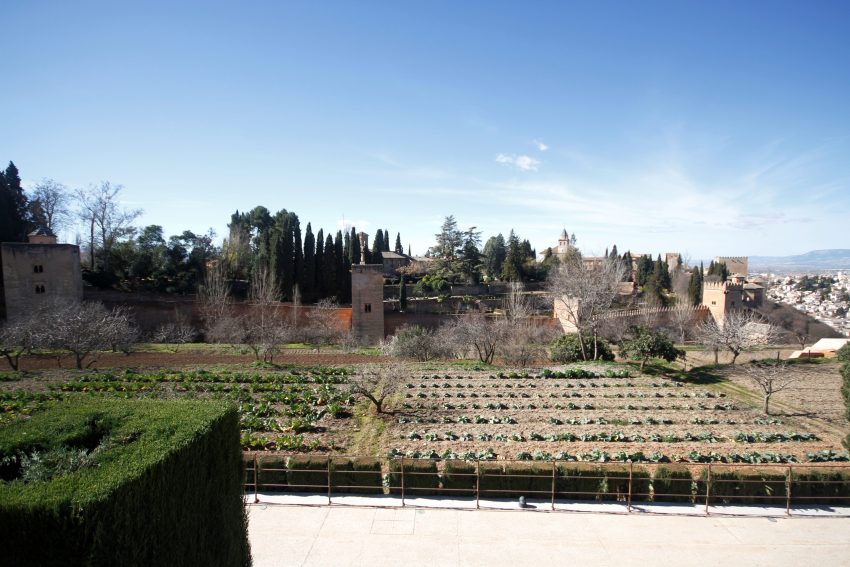
The Gardens of Generalife include the Huertas del Generalife, terraced working orchards on the sunlit slopes of the Sol hill that once fed the Nasrid court as much as they delighted it. Fed by the Acequia Real canal bringing water from the Darro River, the stepped plots show how irrigation, architecture, and agriculture were engineered into a single landscape. Look for the four historic orchards—Colorada, Grande, de la Ropería, and Fuente Peña—still laid out as productive platforms held by sturdy retaining walls. Between fruit trees and open beds, the views back toward the Alhambra make the contrast between palace grandeur and everyday cultivation unforgettable, especially in the quiet of early morning.
| Hours: For opening times of the Huertas del Generalife in Generalife see Alhambra Opening Times.
| Price: The Huertas del Generalife is part of the Generalife of the Alhambra Complex and access it you need to purchase Alhambra Tickets or a Alhambra Guided Tour. | Alhambra Gardens and Generalife Fast-Track Entry Available! | Distance: 1.3km
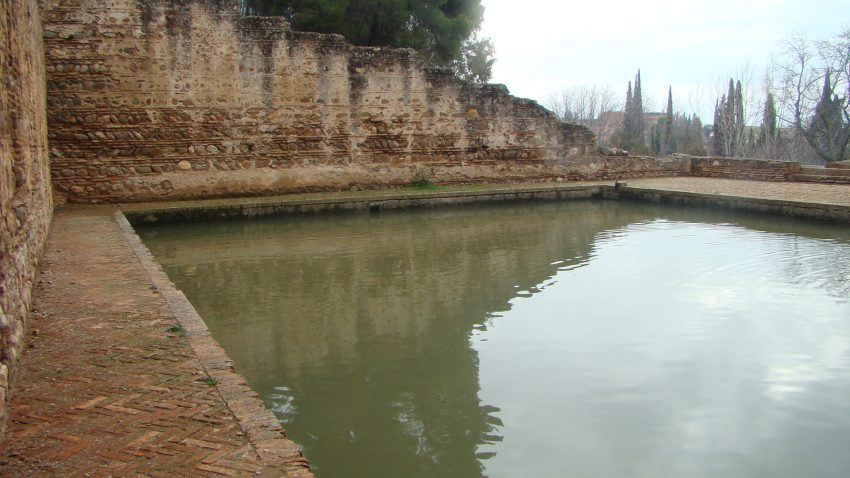
Bano de las Damas Los Albercones Generalife Granada Spain
Public Domain / Pepepitos
The Albercones are high, reservoir-like pools in the upper Generalife that reveal how the Alhambra’s water system once worked. Fed by the Acequia Real, they helped regulate flow to orchards and fountains, where steady pressure mattered as much as beauty. Visitors notice the quiet, slightly remote setting, brick-edged platforms, and the remains of the Las Damas tower, where water was lifted from a well by a wheel mechanism. Later basins added in 1926 and again in the 1960s show how the network was expanded for restoration and heavier use. Today the area feels peaceful, with rocky paths, gated sections, and wide views over the terraces.
| Hours: For opening times of the Albercones in the Generalife see Alhambra Opening Times. | Price: The Albercones is part of the Generalife of the Alhambra Complex and access it you need to purchase Alhambra Tickets or a Alhambra Guided Tour. | Website | Distance: 1.3km
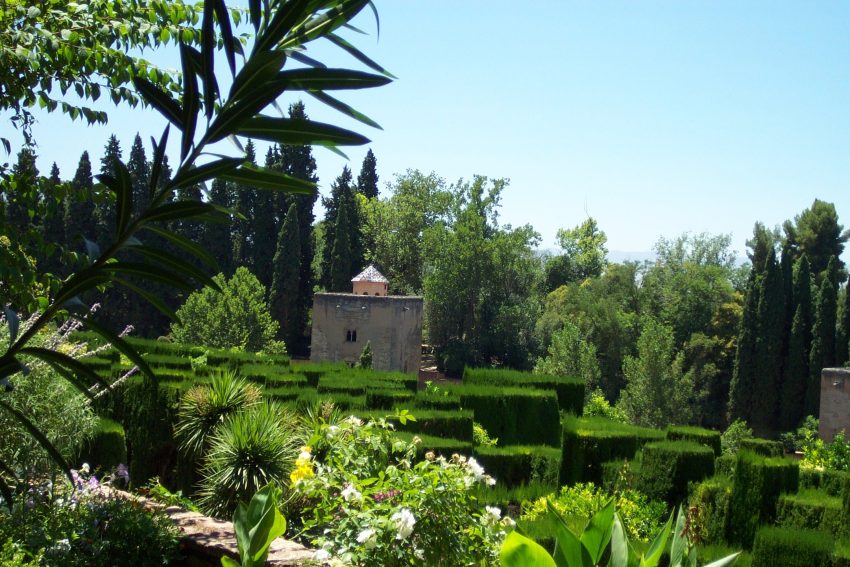
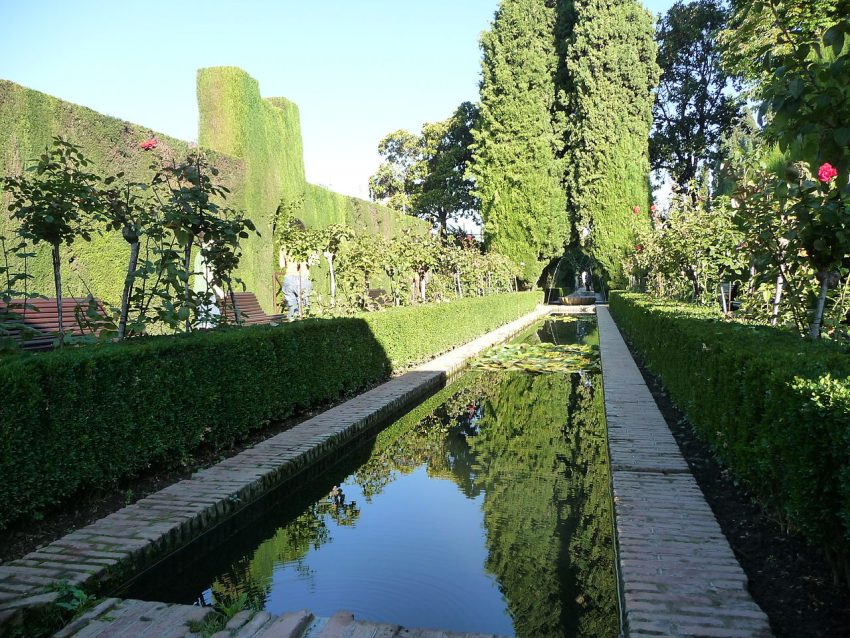
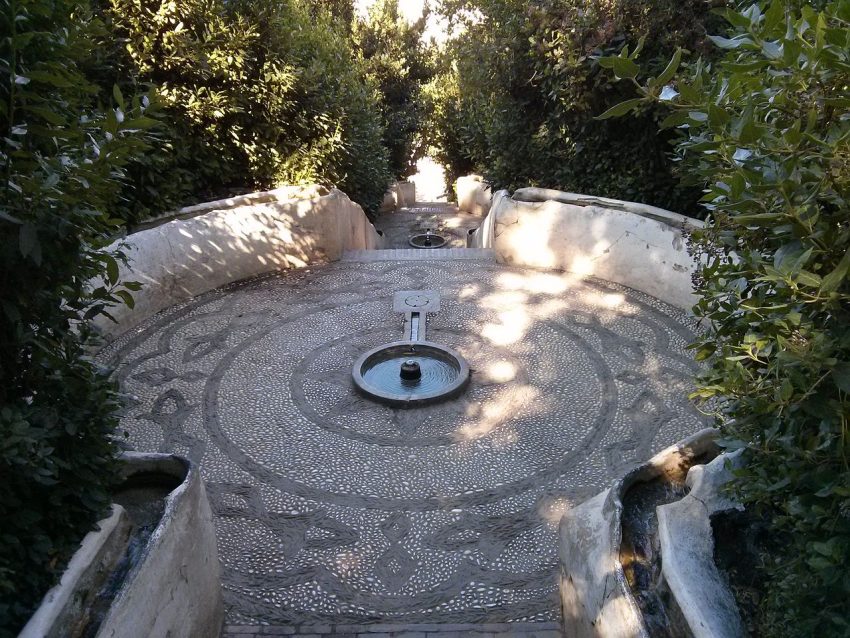
Jardines Bajos (the Lower or “New” Gardens) are the early‑20th‑century landscaped terraces that knit the Generalife to the Alhambra, turning a once in-between zone into a calm sequence of garden rooms. Paths pass the open-air Teatro del Generalife, where summer performances play against fortress walls, then slip into a Prieto Moreno design of four ponds around a central fountain shaded by tall cypresses. Rose-lined walks and cypress “walls” frame long sightlines to the Alhambra’s towers and the Albaicín. The finale is a 1931 labyrinth: high hedges form green boxes and winding corridors, with pebble mosaics underfoot and pockets that feel surprisingly secluded even on busy mornings.
Location: Jardines Bajos del Generalife Paseo del Generalife, 1A 18009 Granada Spain | Hours: For opening times of the Jardines Bajos Generalife see Alhambra Opening Times.
| Price: The Jardines Bajos is part of the Generalife of the Alhambra Complex and access it you need to purchase Alhambra Tickets or a Alhambra Guided Tour. | Website | Distance: 1.3km
Jardines del Partal are a tranquil band of terraced gardens on the northern slope of Granada’s Alhambra, laid out in the early 20th century over the excavated remains of Nasrid-era houses. Paths wind past stabilized fragments—old courtyard foundations, water channels, and cistern traces—where planting beds and cypresses soften the stone. The experience is defined by space and sightlines: ponds and walkways open to views across the Albaicín and toward the Generalife orchards. Along the walls, towers such as the Torre de las Infantas and Torre de la Rauda punctuate the route like markers of the lost palatial neighborhood. It’s a quiet place to slow down between bigger monuments.
Location: Partal Garden Alhambra 18009 Granada Spain | Hours: For opening times of the Jardines del Partal see Alhambra Opening Times.
| Price: The Jardines del Partal is part of the Alhambra Complex and access it you need to purchase Alhambra Tickets or a Alhambra Guided Tour. | Website | Distance: 1.3km
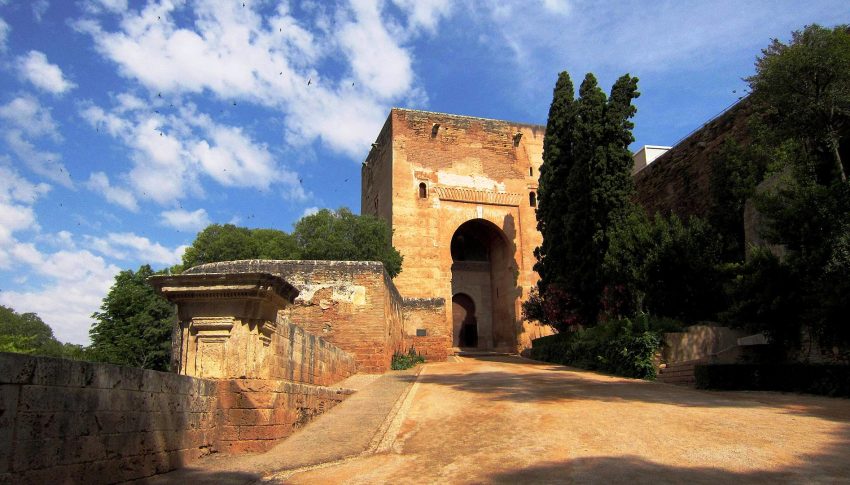
Perched above the Puerta de la Justicia, this inhabited gate tower formed the Alhambra’s main controlled entrance, built under Sultan Yusuf I in 1348 (the date still appears on the founding inscription). After 1492 it became the gate warden’s residence, a practical checkpoint where everyone entering the palatial city was watched. Today you can step inside restored rooms arranged as a small exhibition, with drawings, plans, postcards, archival documents, and books from the historic Jorge Loring collection. Outside, the pointed horseshoe arch framed by an alfiz and the deep, defensive passageway are what visitors remember most. The approach is steep on foot, but the gate feels like a dramatic threshold.
| Hours: Tuesday, Wednesday, Thursday and Sunday. From 8:30 a.m. to 6:00 p.m.
CAPACITY: Maximum 30 people.
READING POINT AND "MUSIC BOX"
Every Saturday. From 10:00 a.m. to 2:00 p.m.
| Price: Free | Website | Distance: 1.3km
Puerta de Hierro (“Iron Gate”) is a post-conquest artillery bastion built into the Alhambra’s outer defenses, commissioned by the Count of Tendilla to protect the nearby Torre de los Picos and control movement along the northern approach. Passing through, you notice the stout walls and a vaulted entrance corridor designed for tight, defensible access—evidence of how gunpowder warfare reshaped 16th-century fortifications. The structure absorbed an older gateway (the Puerta del Arrabal) and once connected to practical military spaces like barracks, stables, and gun platforms. From this point, the route historically continued toward the Generalife, with orchards on one side and the towers of Las Infantas and La Cautiva on the other.
| Hours: For opening times of the Puerta de Hierro see Alhambra Opening Times.
Access to the Puerta de Hierro is normally restricted, unless it is open as part of the Space of the Month program. | Price: The Puerta de Hierro is part of the Alhambra Complex and access it you need to purchase Alhambra Tickets or a Alhambra Guided Tour. | Distance: 1.3km
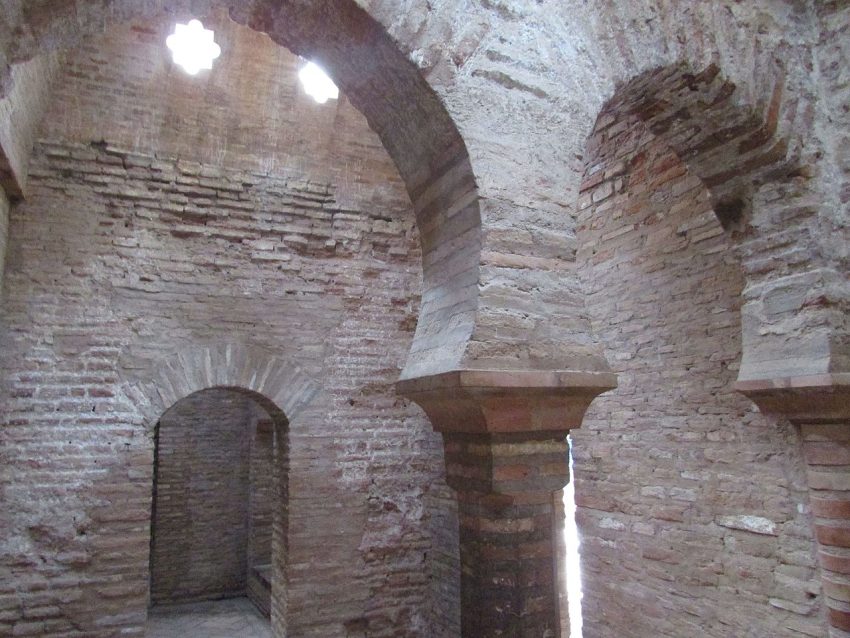
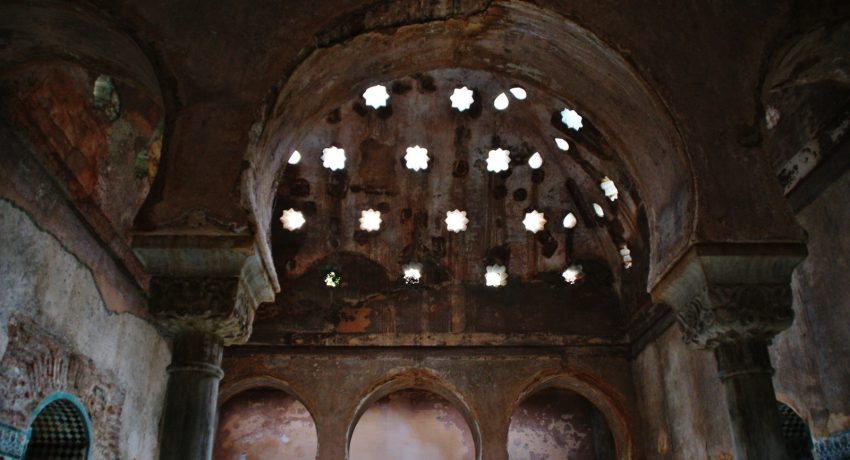
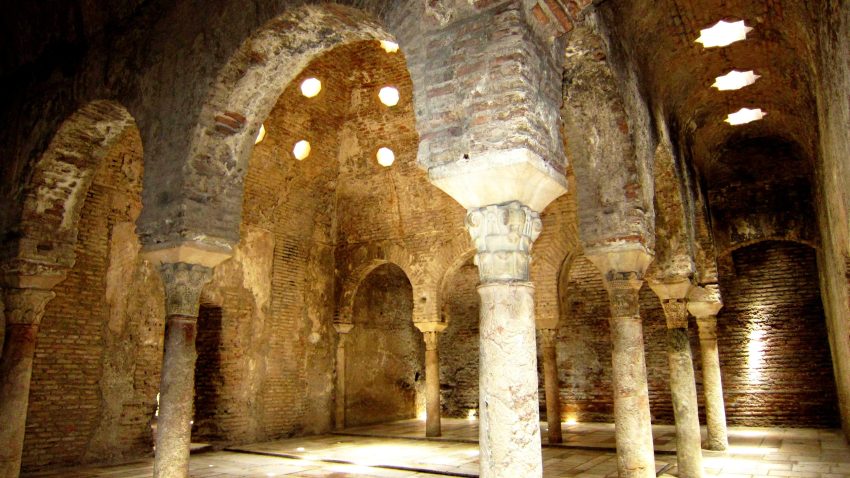
Tucked along the Alhambra’s Calle Real, the Baño de la Mezquita is the partially preserved hammam that once served worshippers of the palatine city’s main mosque, dating to the early 14th century under Muhammad III. Even in its ruined state, you can read the classic bath sequence—cool, warm, and hot chambers—once heated by a hypocaust furnace beneath the floors. Look for the vaulted spaces punctured by small star- and polygon-shaped skylights that controlled light and steam. After the Christian conquest it drifted from ritual cleansing to social life, later nicknamed Baño del Polinario when guitarist and tavern-keeper Antonio Barrios used the abandoned bath as a gathering spot. Parts were stabilized and reconstructed in 1934 by Leopoldo Torres Balbás.
| Hours: Monday to Sunday from 8:30 a.m. to 8 p.m. (from March 15 to October 14) and from 8:30 a.m. to 6 p.m. (from October 15 to March 14) | Price: Free | Website | Distance: 1.3km
Tucked along the Calle Real inside the Alhambra complex, the Angel Barrios Museum is a small, intimate tribute to composer Ángel Barrios (1882–1964) and the artistic circle that gathered in his family home. The rooms are staged with original furnishings, paintings, instruments, photographs, and handwritten scores, giving a vivid sense of early-20th-century domestic life. What makes it especially memorable is the building itself: restored structures that include the former bathhouse of the Alhambra’s Great Mosque and a 14th-century Nasrid house, where medieval patterns sit beside turn-of-the-century décor. Some visitors come as much for the old bath spaces as for the music, so check opening days—Mondays can be closed.
Location: Ángel Barrios Museum-legacy,Patronato de la Alhambra y Generalife Servicio de Investigación y Difusión, Calle Real de la Alhambra, s/n 18009 Granada Spain | Website | Distance: 1.3km
Church of Santa Maria de La Encarnacion Alhambra 3
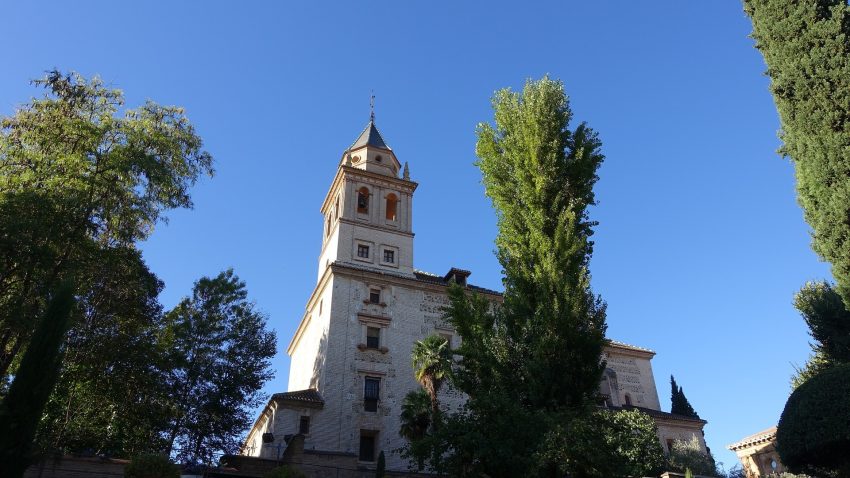
Inside Granada’s Alhambra complex, the Church of Santa María de La Encarnación is a restrained Renaissance church built over the foundations of the former Great Mosque, a tangible marker of the city’s shift from Islamic to Christian rule. Completed between 1581 and 1618 in a sober Herrerian style, its plain stone exterior feels almost austere beside the surrounding palaces. Step inside and the mood changes: a towering 1671 Baroque altarpiece with twisting Solomonic columns dominates the space, with sculptures by Alonso de Mena and a later Virgin of Anguish by Torcuato Ruiz del Peral. Outside, a marble pillar recalls two monks said to have been executed here. Travelers note it’s small, often free, and sometimes closed early.
Location: Church of Santa Maria de la Alhambra Calle Real de la Alhambra, 1-22 18009 Granada Spain | Website | Distance: 1.3km
Bosque de Alhambra is the wooded green belt that wraps the Alhambra’s outer walls on Sabika Hill, planted largely in the 17th century to soften and protect the fortress slopes. Winding routes—from the central Cuesta de Gomérez to side paths toward Torres Bermejas and the Cuesta Empedrada—thread through tall trees, shady arches, and constant running water. Along the way you’ll notice trickling fountains, mossy stone channels, and occasional fragments of old masonry, with sudden peeks of towers and gates above. The climb is gentle in places and steep in others, but the prevailing feeling is cool and quiet—many visitors linger here after the palaces to decompress in the shade.
| Website | Distance: 1.3km
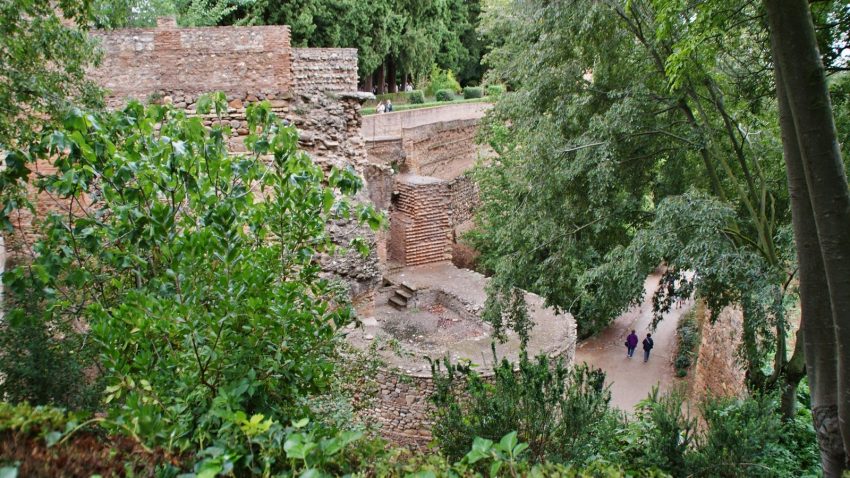
Camino de Ronda is the Alhambra’s former inner moat and patrol road, running as a long corridor behind the defensive walls. When filled with water it acted as a ditch; when dry it became the fortress’s main internal route, letting guards move quickly between towers, gates, and ramparts to relay messages and watch access points. Today the most legible stretch lies on the northeastern walls along the Paseo de las Torres, near the Torre del Cabo de la Carrera, where the depth, width, and stonework of the trench-like roadway are still clear. Walking beside it, you notice sharp turns, tight passages between towers, and how the path hugs the battlements like a protected service street.
| Website | Distance: 1.3km
Puerta de los Carros (Gate of the Cars) is a plain, early-16th-century entrance cut into the Alhambra’s defenses to let carts and heavy building stone pass during Charles V’s Renaissance works. You’ll notice its two-part design: a broad, square vehicle opening beside a smaller wooden pedestrian door. Above the main passage sits a marble coat of arms of the Catholic Monarchs, a clear signal that this gate postdates the Nasrid era. Inside the arch, carved stones with round holes mark where the original gate fittings once anchored. It remains the only authorized vehicular access into the Monumental Area, so you may see taxis or service vehicles passing through.
| Website | Distance: 1.3km
Palacio de Yusuf III is an archaeological ruin in the Partal area of the Alhambra in Granada, Spain, once the complex’s second-largest palace after the royal residences. Though only foundations, a few walls, and traces of gardens survive, the footprint still reads clearly: a broad central courtyard with a long, sunken reflecting pool on the scale of the Patio de los Arrayanes, plus fragments of baths that hint at ceremonial use. From the terrace where the reception hall stood, you get a medieval-era viewpoint over the Darro valley and the Albaicín. With greenery growing through the masonry, it feels quieter than the busiest palaces, and many visitors linger here to breathe and take photos.
| Hours: For opening times of the Palacio de Yusuf III see Alhambra Opening Times.
| Price: The Palacio de Yusuf III is part of the Alhambra Complex and access it you need to purchase Alhambra Tickets or a Alhambra Guided Tour. | Distance: 1.3km
Torre del Cadí (the “Tower of the Judge”) is a modest Nasrid-era watchtower on the Alhambra’s northern wall in Granada, set along the Paseo de las Torres between the Torre de los Picos and the Torre de la Cautiva. Its importance came from policing movement on the road below, opposite the old Generalife entrance, where it functioned as a checkpoint between the palace precincts and the gardens. Restored in 1924, it also carries a trail of older nicknames—Torre del Candil and, in the 16th century, Torre del Preso—hinting at administrative and custodial uses. Inside are two small rooms at parapet level, linked to a terrace reached by stairs wrapped around a central buttress.
Location: Torre del Cadí Generalife Centro 18009 Granada Spain | Hours: For opening times of the Torre del Cadí see Alhambra Opening Times.
| Price: The Torre del Cadí is part of the Alhambra Complex and access it you need to purchase Alhambra Tickets or a Alhambra Guided Tour. | Distance: 1.3km
Torre de los Picos is one of the Alhambra’s largest defensive towers, set on the wall-walk along the Paseo de las Torres between the fortress and the Generalife. Its jagged crenellations—“peaks”—and the projecting corbels and machicolations make its military purpose obvious, guarding a key approach toward the Puerta del Arrabal. Built in the later 1300s over a 13th-century footprint, it has the unusual quirk of the wall-walk running beneath it rather than through it. Inside, the severity gives way to decorated rooms: three stacked chambers, pointed horseshoe-arch windows with carved capitals, and an upper room with a rib-vault carried on thick cylindrical ribs.
Location: Torre de los Picos C. Real de la Alhambra Centro 18009 Granada Spain | Hours: For opening times of the Torre de los Picos see Alhambra Opening Times.
Access is normally restricted unless to building forms part of the Space of the Month program.
| Price: The Torre de los Picos is part of the Alhambra Complex and access it you need to purchase Alhambra Tickets or a Alhambra Guided Tour. | Distance: 1.3km
Puerta de la Justicia is the monumental 14th-century gateway into the Alhambra, built in 1348 under Yusuf I as a controlled, symbolic threshold to the Nasrid citadel. Visitors first notice the huge horseshoe arch and the white Macael-marble hand carved above it, paired with the key motif inside—details tied to enduring legends about the fortress’s fate. The passage bends twice, leading into a defensive space where guards once had the advantage, and Qur’anic inscriptions still frame the inner arch. Later Christian layers remain visible, including a Gothic Virgin and Child and an artillery bulwark. Reaching it involves a steep uphill approach through the Alhambra forest, then easier walking beyond the gate.
Location: Justice Gate Calle Real de la Alhambra, 18 18009 Granada Spain | Hours: 24 Hours | Price: Free | Website | Distance: 1.3km
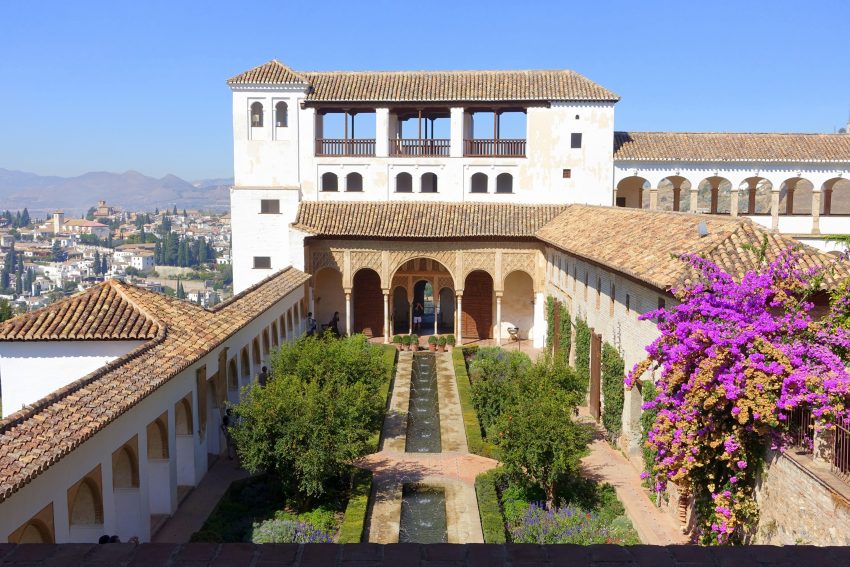
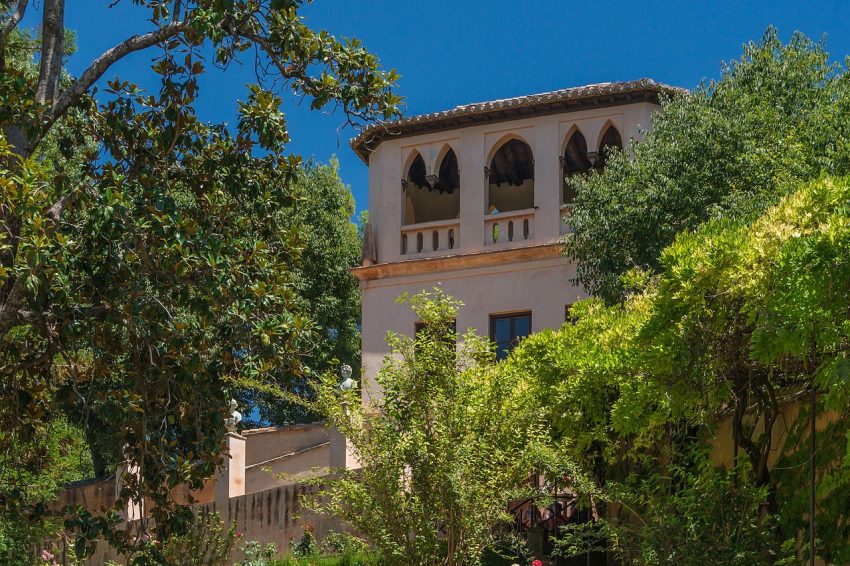
The Generalife is the Nasrid rulers’ 14th-century summer retreat, a quiet counterpoint to the palace complex across the valley. Visitors move through cypress-lined avenues and rectangular beds before reaching the Patio de la Acequia, where a long water channel runs between myrtle and flowers beneath light arcades and small fountain jets. Deeper inside, the Jardín de la Sultana centers on a still pond and the remnants of a storied cypress, while the shaded Escalera del Agua lets water slip along the handrails under a canopy of laurel. Upper terraces culminate at the neo-Gothic Mirador Romántico (1836) with wide views over the river valleys and rooftops.
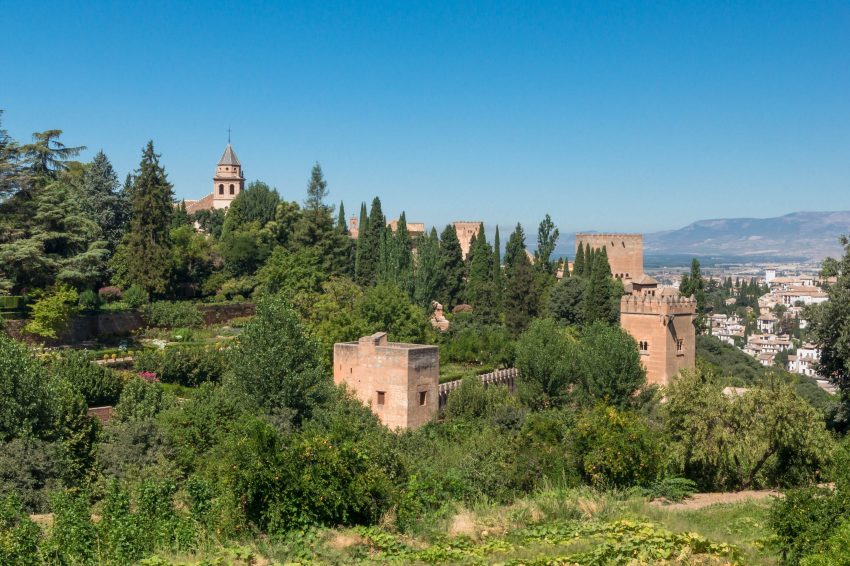
The Alhambra Complex is a vast hilltop royal citadel in Granada, Spain, built by the Nasrid rulers and later altered after the Christian conquest of 1492. Behind its reddish walls on La Sabika hill, visitors move through cool courtyards where water channels, reflective pools, and carved stucco and tilework create a carefully staged play of light and symmetry. The Alcazaba’s 13th-century fortress towers still command the skyline, and climbing the Torre de la Vela opens wide views over Granada and the Vega plains. In the Nasrid Palaces, muqarnas vaulting and calligraphy frame intimate spaces like the Court of the Lions. Across the valley, the Generalife gardens feel like a shaded summer retreat of cypress, flowers, and running water.
Location: Alhambra Calle Real de la Alhambra, s/n 18009 Granada Spain | Hours: 8.30am-8pm Apr–mid-Oct,
to 6pm mid-Oct–Mar,
night visits 10-11.30pm Tue & Sat Apr–mid-Oct,
8-9.30pm Fri & Sat mid-Oct–Mar | Price: Adult €14,12-15yr €8, under 12yr free, Generalife & Alcazaba only adult/under 12yr €7/free NB Advance ticket reservations are almost essential for admission to the best parts of the Alhambra. | Website | Full Alhambra Guided Tour with Skip-the-line Tickets Available! | Distance: 1.3km
The Pabellón Sur de Generalife anchors the short southern end of the Patio de la Acequia, framing the long water channel with a cool, shaded portico once used as the Nasrid family’s private quarters. Visitors linger beneath its seven-arch sequence: sturdy brick pillars on the outer bays and a lighter central trio carried by two columns with cubic capitals. From its layered levels, the pavilion reads like a domestic threshold between lower courtyards and upper rooms, designed for breezes, garden scents, and the sound of running water. Later alterations are visible too, including rebuilt elements and an upper three-centred arch from the Christian period. The mirador above gives a memorable, elevated view along the canal.
| Hours: For opening times of the Pabellón Sur de Generalife in Generalife see Alhambra Opening Times. | Price: The Pabellón Sur de Generalife is part of the Generalife of the Alhambra Complex and access it you need to purchase Alhambra Tickets or a Alhambra Guided Tour. | Website | Distance: 1.4km
Casa de los Amigos is a partly ruined Nasrid-era guest residence tucked just south of the Generalife, built for trusted companions and relatives of the sultan. You can still trace a domestic plan arranged around patios on different levels, with a square main courtyard that once organized daily life. Along the west side, the remains hint at practical spaces—warehouses, service rooms, even stables—rather than palace ceremony. Look for the southern entrance, where a rising cobbled lane linked the house to the hamman alley and the Generalife orchards, a discreet route between court life and cultivated seclusion. Its layout echoes ideals described in the medieval Kitab al-Filaha about a separate “house for friends” set beneath sheltering trees.
Patio de la Guardia is a small, shaded courtyard on the Generalife route, positioned between fortified entry points before the grander palace gardens. Its modest scale is the point: bitter orange trees cast dappled shade over a simple white marble, cup-shaped fountain whose soft trickle cools the space. Look for the built-in benches by the entrance arch, a reminder that guards once paused here to control access. Ahead, the doorway toward the next courtyard is picked out with tiles and the Nasrid key emblem, adding a quiet note of authority to an otherwise practical space. Many visitors remember it as a peaceful pause, though some note wear in places.
| Hours: For opening times of the Patio de la Guardia see Alhambra Opening Times.
| Price: The Patio de la Guardia is part of the Generalife of the Alhambra Complex and access it you need to purchase Alhambra Tickets or a Alhambra Guided Tour. | Distance: 1.4km
Tucked just inside the Generalife entrance, the Patio del Descabalgamiento is a plain, workaday courtyard where riders once dismounted and horses were watered before anyone continued on foot. Its restored footprint still shows the practical hardware of arrival: stone drinking troughs and low footrests used for getting down from the saddle. The brick archway ahead is the moment to pause—its keystone bears the Nasrid hand-and-key emblem, and inside the passageway two benches remain where guards waited and watched access. The contrast between this utilitarian threshold and the gardens beyond makes the space easy to remember, even in a quick 5–10 minute stop.
| Hours: For opening times of the Patio del Descabalgamiento in the Generalife see Alhambra Opening Times.
| Price: The Patio del Descabalgamiento is part of the Generalife of the Alhambra Complex and access it you need to purchase Alhambra Tickets or a Alhambra Guided Tour. | Distance: 1.4km
Paseo de las Adelfas is a mid-19th-century promenade in Granada’s Generalife Gardens, created as a romantic access route and now a quiet connector between the Jardines Altos and the Paseo de los Cipreses. The path runs above the orchards behind a long dividing wall, and in season it becomes a shaded tunnel where oleander branches arch overhead and scent the air. As you walk, the canopy filters the Andalusian light and frames long, straight perspectives that feel almost theatrical. Openings along the way reveal elevated views down to the Jardines Bajos—ponds, clipped hedges, and winding layouts—and, at times, the Alhambra beyond.
Location: Paseo de las Adelfas del Generalife, Granada, Spain | Hours: For opening times of the Paseo de las Adelfas in the Generalife see Alhambra Opening Times. | Price: The Paseo de las Adelfas is part of the Generalife of the Alhambra Complex and access it you need to purchase Alhambra Tickets or a Alhambra Guided Tour. | Website | Distance: 1.4km
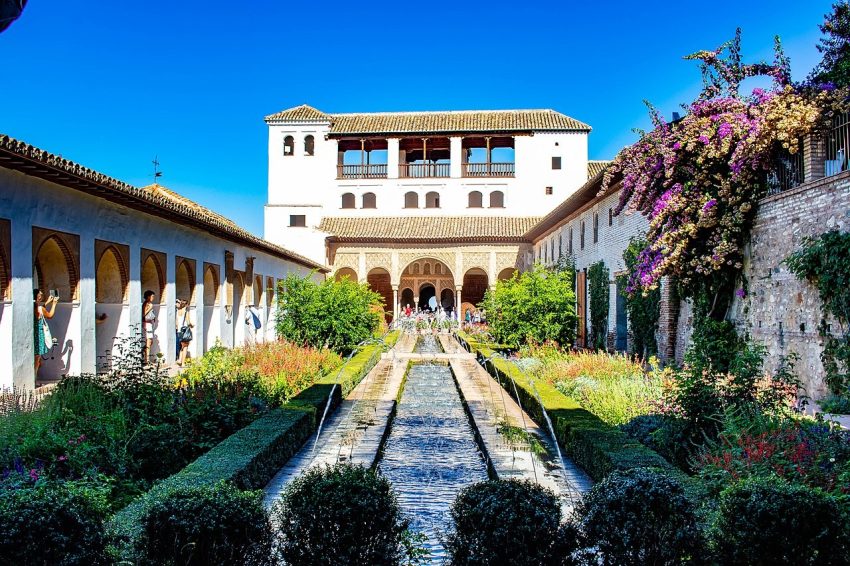
Palacio del Generalife is the Alhambra’s summer retreat in Granada, a palace-and-garden estate where Nasrid court life was designed around shade, long views, and the constant presence of water. Its almunia character still comes through: clipped greenery and terraces feel almost rural in places, then turn ceremonial as you pass through layered courtyards into the palace core. The Court of the Main Canal sets the pace with a long central watercourse and jets that change the soundscape as you move under arcades. Quieter spaces like the Soultana’s Court and the Water Stairway turn hydraulic engineering into a sensory experience. Visitors remember the flower scents, careful upkeep, and an unexpected calm despite the crowds.
| Hours: For opening times of the Palacio del Generalife see Alhambra Opening Times.
| Price: The Palacio del Generalife is part of the Generalife of the Alhambra Complex and access it you need to purchase Alhambra Tickets or a Alhambra Guided Tour. | Website | Distance: 1.4km
Jardines del Palacio del Generalife are a small, enclosed Nasrid-era garden tucked beneath the North Pavilion, prized for the sense of privacy and hush it preserves inside the Generalife estate. As early as 1526, Venetian ambassador Andrea Navagero admired its ivy-softened walls and a central fountain said to have once blasted water ten fathoms high. In 1928, architect Torres Balbás reshaped the area by removing an attached building and adding a higher, westward terrace garden, creating new sightlines between levels. Visitors notice the tight geometry, the cooling sound of water, and the contrast between shaded corners and brighter upper terraces, even when the wider complex feels busy.
| Hours: For opening times of theJardines del Palacio del Generalife see Alhambra Opening Times. | Price: TheJardines del Palacio del Generalife is part of the Generalife of the Alhambra Complex and access it you need to purchase Alhambra Tickets or a Alhambra Guided Tour. | Distance: 1.4km
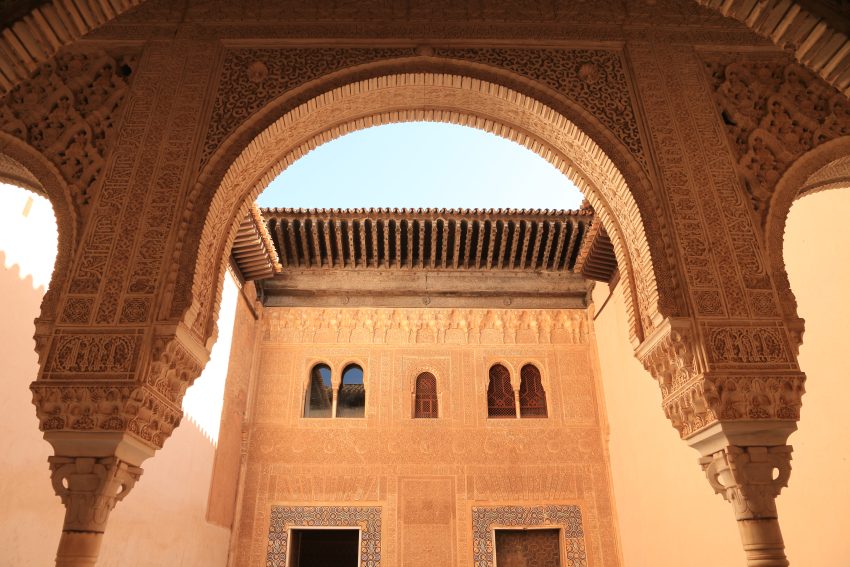
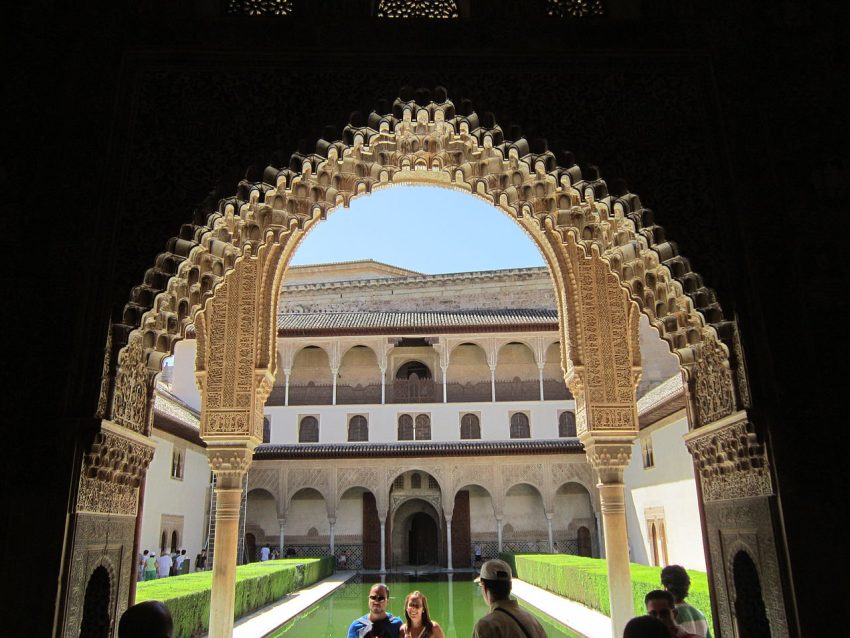
The Facade of the Palace of Comares is the ceremonial front of the sultan’s official residence within Granada’s Alhambra, facing the Patio del Cuarto Dorado. Built under Yusuf I and finished by Mohammed V, it was designed to overawe arrivals with carved stucco, tiled lower panels, and two matching wooden-doored entrances set on a three-stepped platform. Look up to the trio of upper openings—two canted-arch windows flanking a smaller central one—where inscriptions run beneath the eaves. Above the central window sits the Throne Verse (Quran 2:255), and the Nasrid motto “Only God is Victor” repeats through the decoration, turning architecture into a statement of authority.
Mezquita del Partal (the Oratory of the Partal) is a small Nasrid-era mosque tucked into the Partal area of Granada’s Alhambra, built under Yusuf I in the mid-14th century. It matters as the only surviving free-standing mosque in Granada, preserving a rare slice of everyday devotional life beyond the palace halls. Inside, the intimate prayer space fits only a handful of worshippers, drawing your eye to a horseshoe-arched mihrab decorated with golden shell motifs and panelled ornament. Nasrid plasterwork mixes calligraphy and vegetal patterns, while a finely carved timber ceiling rewards a slow look upward. Unusual side windows open to garden and landscape views, adding calm light and air.
Location: Oratorio del partal 18009 Granada Spain | Hours: For opening times of the Mezquita del Partal see Alhambra Opening Times | Price: The Mezquita del Partal is part of the Alhambra Complex and access it you need to purchase Alhambra Tickets or a Alhambra Guided Tour. | Distance: 1.4km
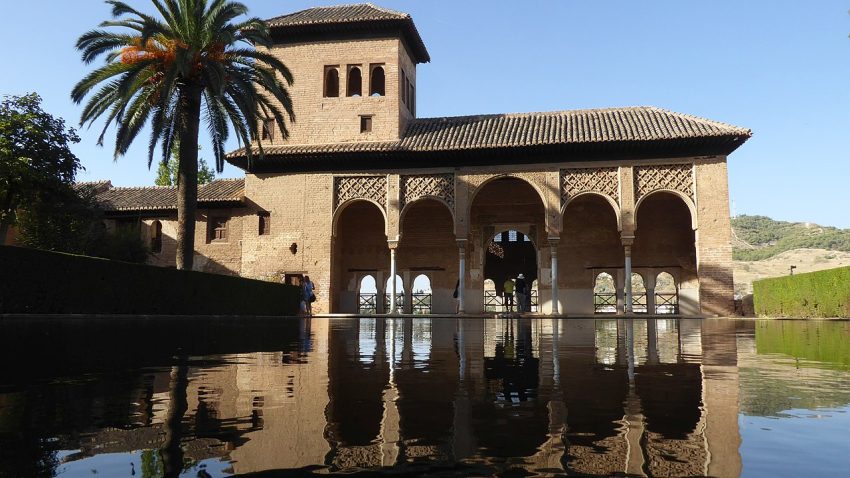
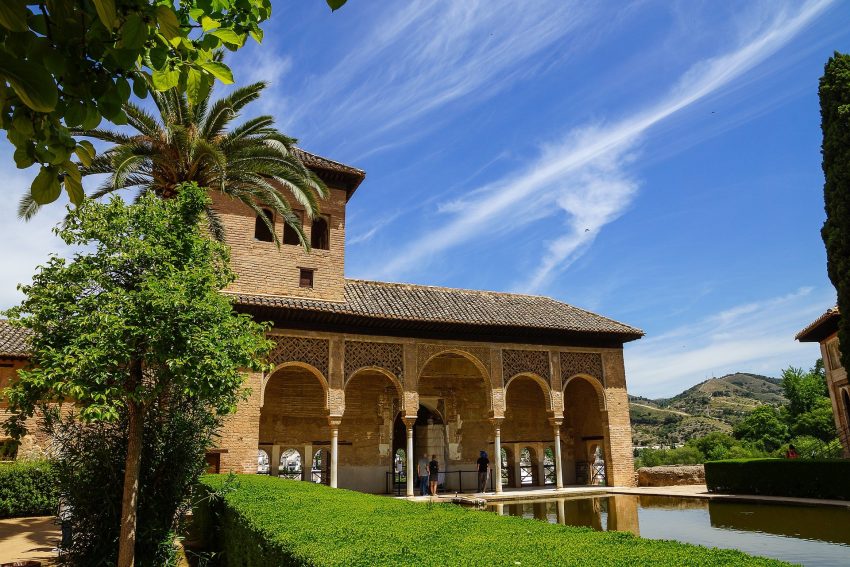
Palacio del Partal is a serene corner of Granada’s Alhambra, preserving some of the complex’s earliest Nasrid palace fabric from the reign of Muhammad III (1302–1309). Its defining feature is a five-arched portico facing a long reflecting pool, where the arcade and sky often appear doubled in the water. The adjacent Torre de las Damas anchors the scene, while terraces and 20th-century gardens soften the excavated outlines of former houses and courtyards. Nearby, the tiny Mezquita del Partal—small enough for only a few worshippers—perches on the ramparts, adding an intimate note to the broader palace landscape.
Location: El Partal Callejon Guindo, 2T 18009 Granada Spain | Hours: For opening times of the Palacio del Partal see Alhambra Opening Times
| Price: The Palacio del Partal is part of the Alhambra Complex and access it you need to purchase Alhambra Tickets or a Alhambra Guided Tour. | Website | Distance: 1.4km
Mirador de Daraxa is a small Nasrid viewpoint chamber tucked inside the Alhambra’s Nasrid Palaces in Granada, created under Muhammad V and later turned inward when Renaissance additions enclosed its former open panorama. The room is intimate—about 15 by 10 feet—lit softly through low windows designed for seated viewing, now looking onto the cloister-like Jardín de Daraxa. Visitors notice the finely carved arches, including a double entrance arch, and the delicate honeycomb-like mocárabes above the openings. Tilework in black, white, and yellow lines the lower walls, while Arabic inscriptions weave prayers and courtly praise around the windows, giving the space a hushed, private feel.
Location: Mirador de Daraxa Alhambra 18009 Granada Spain | Hours: For opening times of the Mirador de Daraxa see Alhambra Opening Times.
| Price: The Mirador de Daraxa is part of the Alhambra Complex and access it you need to purchase Alhambra Tickets or a Alhambra Guided Tour. | Website | Distance: 1.4km
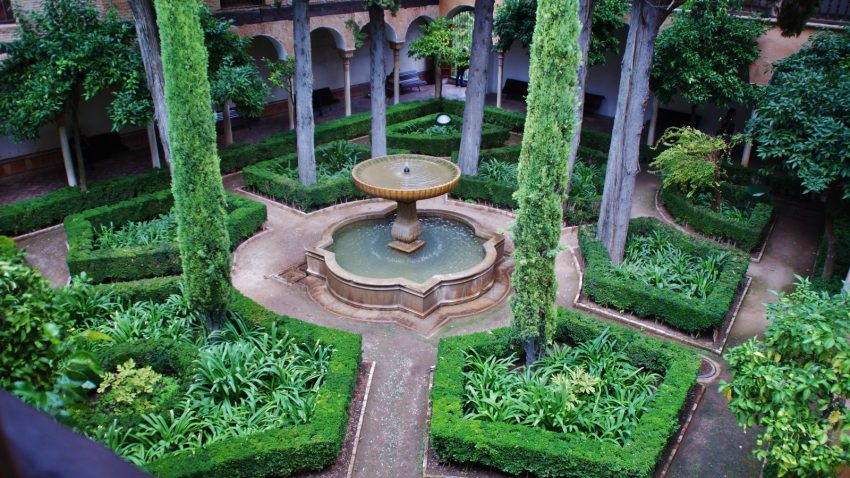
Jardín de Daraxa is a secluded courtyard garden within Granada’s Alhambra, tucked beside the Emperor’s Chambers and the Mirador de Daraxa, where greenery and stone create a pause between ornate rooms. Enclosed on all four sides by arcaded Renaissance galleries and upper chambers, it feels like a cloister despite its open-air planting. Visitors notice the central marble fountain set amid box hedges, with cypresses, orange trees, and acacias softening the surrounding masonry. The space was reshaped after the Christian conquest (1526–1538), and its layered look—Nasrid fragments alongside later additions—makes the transitions visible at a glance. Beneath nearby rooms lies the Sala de los Secretos, known for its whisper-carrying acoustics.
| Hours: For opening times of the Jardín de Daraxa see Alhambra Opening Times. | Price: The Jardín de Daraxa is part of the Alhambra Complex and access it you need to purchase Alhambra Tickets or a Alhambra Guided Tour. | Website | Distance: 1.4km
Fountain and viewing platform, Patio de la Reja, Alhambra
CC BY-SA 3.0 / Shesmax
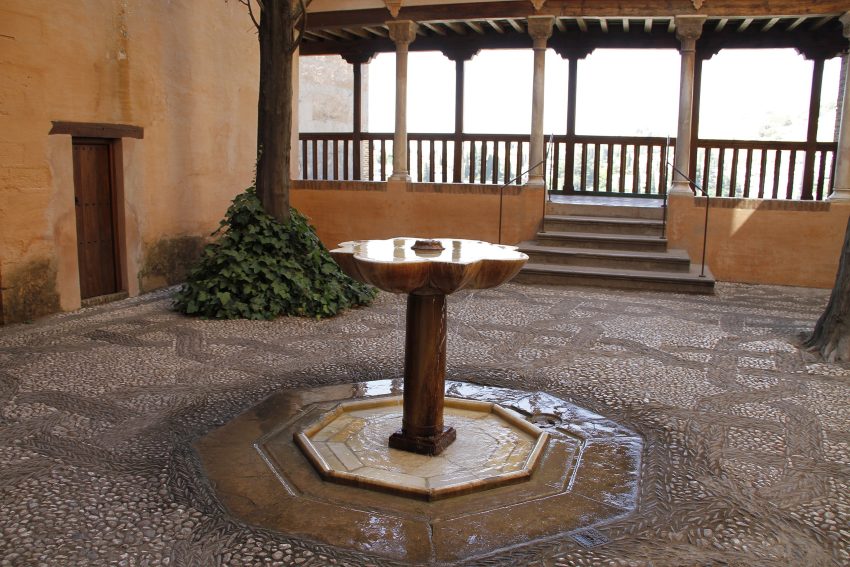
Patio de la Reja is a hushed 17th-century courtyard tucked north of the Palacio de los Leones within the Alhambra’s Palacio Nazaríes, created when Christian rulers reshaped parts of the Nasrid palaces into Habsburg apartments. Its name comes from the wrought-iron grille set into the south wall in 1655, a barred gallery that once served as a secure passage and lookout. In the center, a stone fountain reuses a white marble basin, its gentle spill into an octagonal base softening the courtyard’s austere stonework. Tall cypress trees rise from the corners, and the overall feel is closer to a monastic cloister than the ornate patios nearby.
| Hours: For opening times of the Patio de la Reja see Alhambra Opening Times.
| Price: The Patio de la Reja is part of the Alhambra Complex and access it you need to purchase Alhambra Tickets or a Alhambra Guided Tour. | Website | Distance: 1.4km
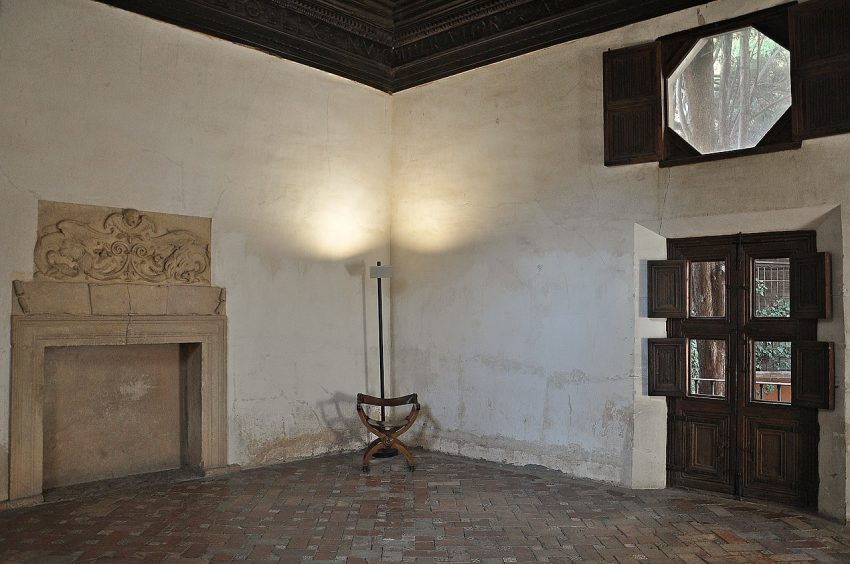
The Habitaciones de Carlos V are a small Renaissance suite inserted into the Alhambra’s Nasrid palaces, created in the 16th century when Charles V planned an imperial residence here. Look for the square coffered ceilings, crisp friezes, and the Latin proclamation of the emperor’s titles paired with the motto “Plus oultre,” alongside a fireplace edged with winged monsters. Four chambers are known as the Washington Irving Rooms, marked by a 1914 marble plaque recalling his 1829 stay while writing Tales of the Alhambra. The smallest “Fruit Rooms” stand out for wooden ceilings carved and painted with fruit motifs—an unexpectedly intimate detail amid the palace grandeur.
| Hours: For opening times of the Habitaciones de Carlos V see Alhambra Opening Times.
Entrance to this part of the Alhambra is usually restricted and cannot be visited during the ordinary visit of the Alhambra Complex. It may also be included in the "Space of the Month" program, where it will be open one month of the year. | Price: The Habitaciones de Carlos V is part of the Alhambra Complex and access it you need to purchase Alhambra Tickets or a Alhambra Guided Tour. | Website | Distance: 1.4km
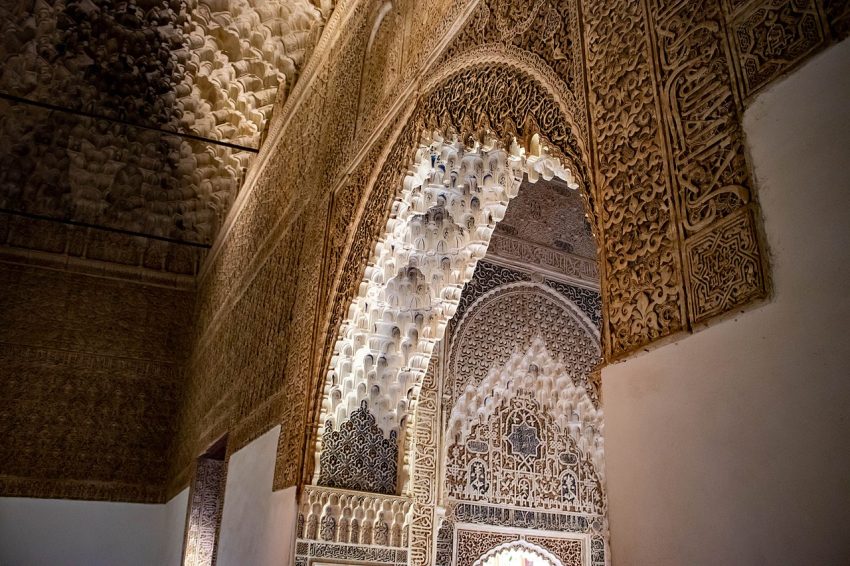
Tucked within the Palacio de los Leones, the Sala de los Ajimeces is a calm rectangular chamber that bridges the royal rooms and the Jardín de Daraxa. Its name comes from the twin arched balconies, once screened with delicate wooden latticework, where soft light falls across carved plaster walls. Look up for the mocárabes dome—recreated in the 16th century yet still shimmering with stalactite-like geometry—and trace the frieze below it, inscribed with a dedication to Abu Abd’ Allah, the last emir. The north opening leads to the Mirador de Daraxa, where the garden view feels hushed and intimate, inviting a slow pause.
| Hours: For opening times of the Sala de los Ajimeces see Alhambra Opening Times.
| Price: The Sala de los Ajimeces is part of the Alhambra Complex and access it you need to purchase Alhambra Tickets or a Alhambra Guided Tour. | Website | Distance: 1.4km
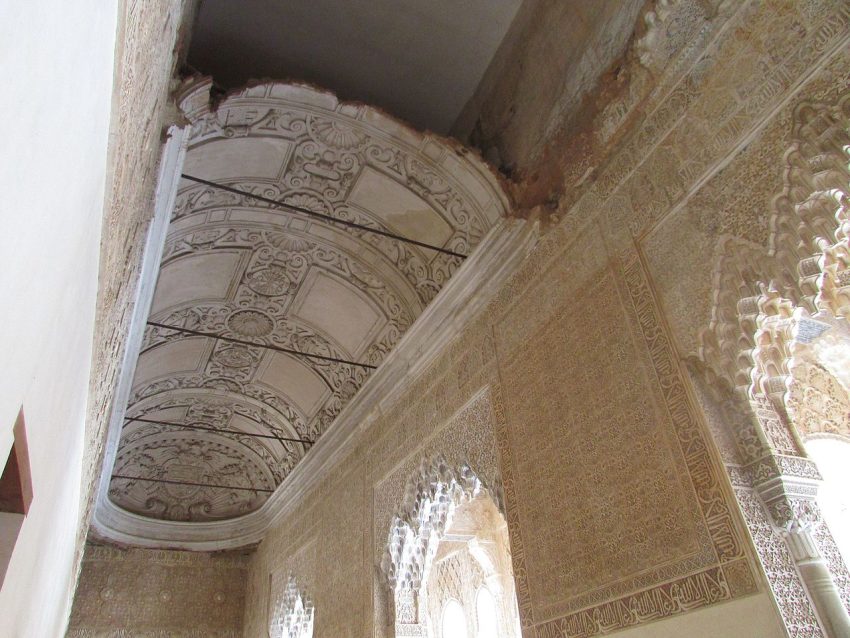
Sala de los Mocárabes is the threshold hall you step into when moving from the Patio de los Arrayanes toward the Palacio de los Leones, with three eastern arches looking out onto the lion courtyard. It was once capped by a full mocárabes (honeycomb) vault, but a 1590 gunpowder explosion and later alterations left only a surviving northern section. Look up to see the Christian-era ceiling designed to honor the Catholic Monarchs, marked with their initials and emblems like the yoke and arrows, plus Felipe II’s coat of arms at the ends. Below, Nasrid stucco bands and inscriptions remain, including the motto “Only God is an Overcomer!” that ties the room to its original design.
| Hours: For opening times of the Sala de los Mocárabes see Alhambra Opening Times.
| Price: The Sala de los Mocárabes is part of the Alhambra Complex and access it you need to purchase Alhambra Tickets or a Alhambra Guided Tour. | Website | Distance: 1.4km
Paintings of the 10 Kings, Sala de los Reyes, Alhambra
CC BY-SA 2.0 / Junta Granada Informa
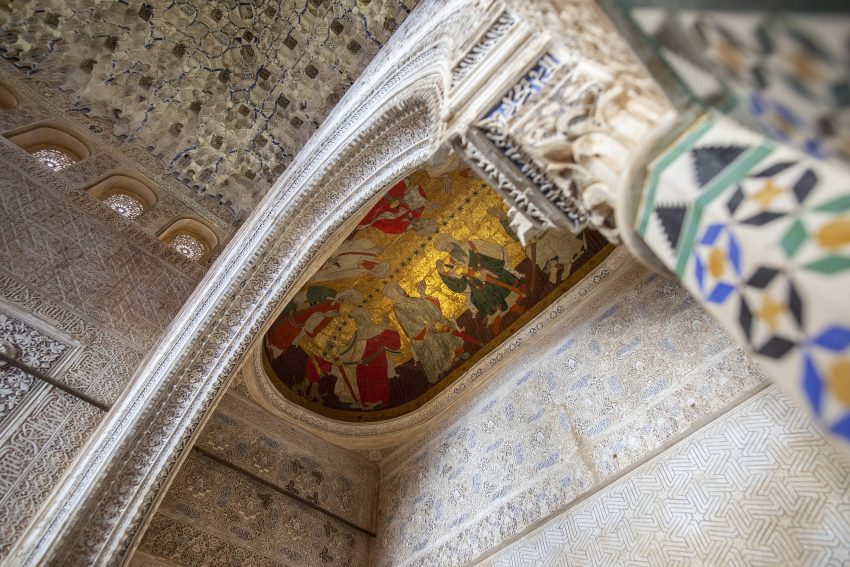
Sala de los Reyes is a long ceremonial chamber within the Palacio de los Leones in the Nasrid Palaces, thought to have hosted the sultan’s councils and judicial meetings. You enter through three porticoes of triple arches dripping with muqarnas, then move through seven linked spaces where carved stucco, inscriptions, and softly lit domes reward slow looking. The central painted dome shows ten Nasrid rulers on lambskin fixed with bamboo nails—an exceptionally rare survival of figural painting here—while the side domes depict courtly hunts, tournaments, and romantic scenes that mingle Christian and Muslim imagery. From the central bay, the view back toward the Patio de los Leones feels precisely framed, like architecture turned into choreography.
Location: s/n, Calle Real de la Alhambra, 18009 Granada, Spain | Hours: For opening times of the Sala de los Reyes see Alhambra Opening Times.
| Price: The Sala de los Reyes is part of the Alhambra Complex and access it you need to purchase Alhambra Tickets or a Alhambra Guided Tour. | Website | Distance: 1.4km
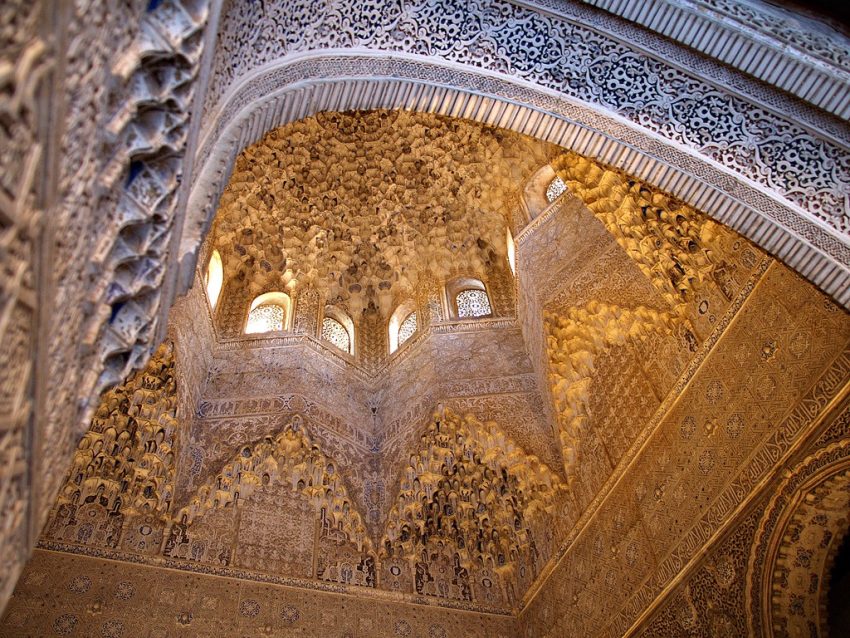
Tucked off the Patio de los Leones in the Nasrid Palaces, the Sala de Dos Hermanas is a refined court chamber from the reign of Mohammed V, long associated with the sultana’s quarters. What lingers is the ceiling: a luminous muqarnas dome that blooms overhead like a stone honeycomb, its facets catching light from small side windows. Underfoot, two perfectly matched slabs of pale Macael marble—among the largest in the Alhambra—give the room its name. Look for the band of poetic inscriptions along the lower walls and the small central fountain, whose thin water channel once linked the space to the courtyard’s hydraulics.
Location: Sala de las Dos Hermanas, Calle Real de la Alhambra, Granada, Spain | Hours: For opening times of the Sala de Dos Hermanas see Alhambra Opening Times.
| Price: The Sala de Dos Hermanas is part of the Alhambra Complex and access it you need to purchase Alhambra Tickets or a Alhambra Guided Tour. | Website | Distance: 1.4km
Ceiling in Hall of the Abencerrajes alhambra Granada
CC BY-SA 2.0 / jvwpc
Tucked just off the Patio de los Leones, the Sala de los Abencerrajes is an intimate royal chamber in the Nasrid Palaces, remembered for its mix of refined design and dark legend. Look up to the sixteen-sided muqarnas dome: stalactite-like vaulting catches light from tiny openings, so the ceiling seems to glow and subtly shift as you move. Beneath it sits a twelve-sided marble fountain, perfectly centered; many visitors linger over the dome’s reflection in the still water and notice the rusty stains tied to the Abencerrajes story. Blue capitals, delicate plasterwork, and quiet alcoves that once served as private sitting areas make the room feel both secluded and ceremonial.
Location: Sala de los Abencerrajes, Calle Real de la Alhambra, Granada, Spain | Hours: For opening times of the Sala de los Abencerrajes see Alhambra Opening Times.
| Price: The Sala de los Abencerrajes is part of the Alhambra Complex and access it you need to purchase Alhambra Tickets or a Alhambra Guided Tour. | Website | Distance: 1.4km
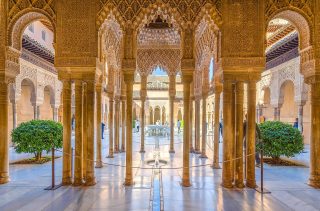
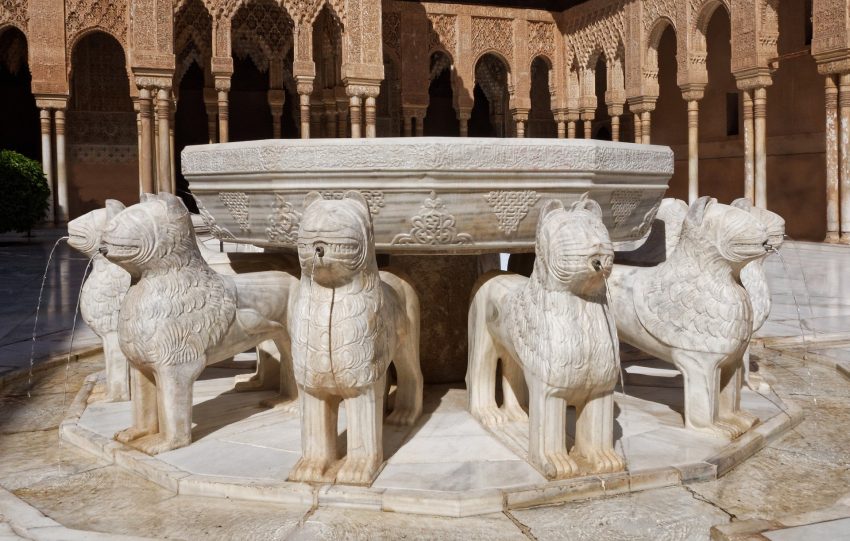
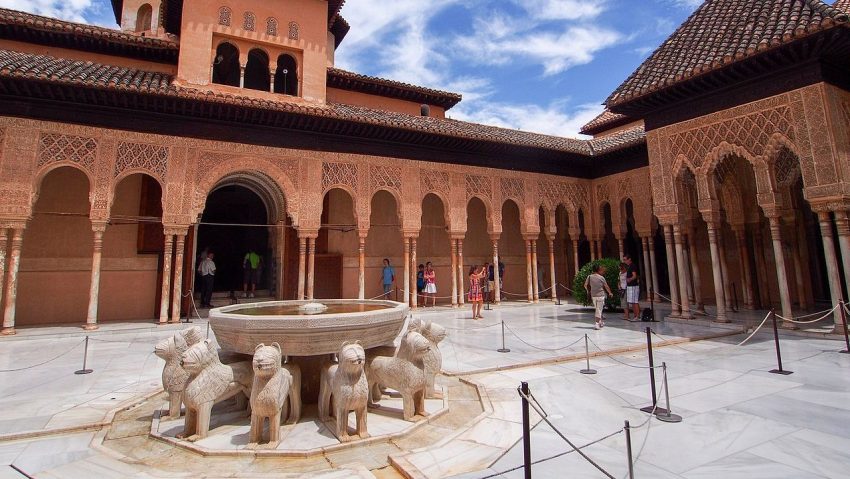
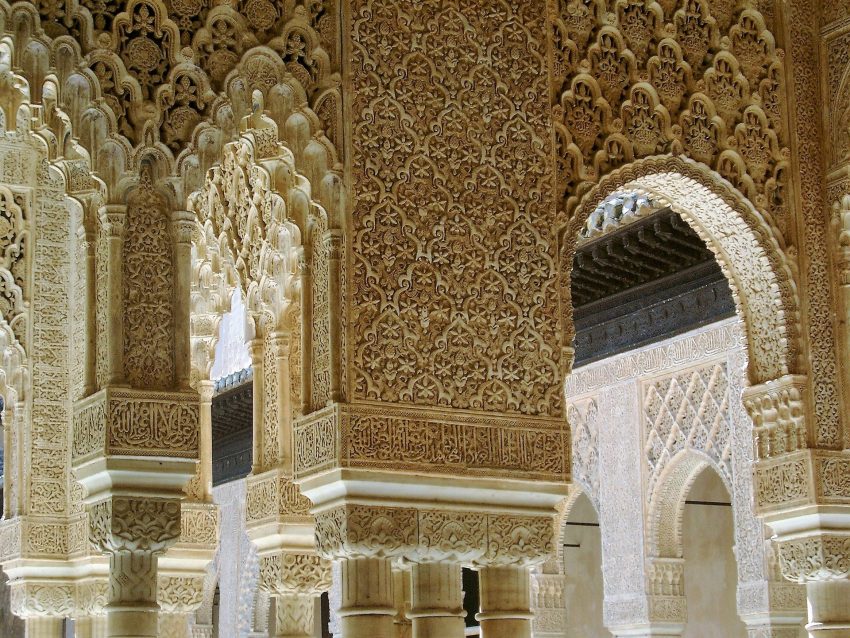
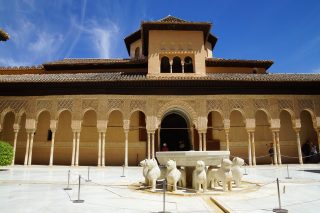
The Patio de los Leones (Court of the Lions) is the luminous courtyard at the heart of the Nasrid Palaces’ Palacio de los Leones, commissioned under Mohammed V and designed as a private royal precinct. At its centre sits a dodecagonal marble basin carried by twelve individually carved lions, ringed by an inscription by Ibn Zamrak that reads like poetry in stone. A “forest” of 124 slender marble columns holds up delicate galleries of scalloped arches and muqarnas-like detailing, where light shifts across stucco patterns and carved screens. Four narrow water channels radiate from the fountain in a cross, a deliberate reference to paradise rivers, making the space feel both mathematical and serene.
Location: Patio de Los Leones Calle Real de la Alhambra, s/n 18009 Granada Spain | Hours: For opening times of the Patio de los Leones see Alhambra Opening Times.
| Price: The Patio de los Leones is part of the Alhambra Complex and access it you need to purchase Alhambra Tickets or a Alhambra Guided Tour. | Website | Distance: 1.4km
El Baño de Comares is the preserved medieval hammam tucked within the Palacio de Comares, an unusually complete example of Islamic palace bathing culture in the western world. From the viewing gallery you can still read the classic sequence of rooms—cold, warm, then hot—leading back to a two-storey changing hall with a central fountain and columned bays once used for reclining. Look for the warm and hot chambers’ ceilings, punctured with star-shaped skylights that filtered light and steam, and for traces of the underfloor heating system that once carried warmth from a boiler. Even without entry, the intact layout makes royal privacy and ritual cleanliness feel tangible.
| Hours: For opening times of the El Baño de Comares see Alhambra Opening Times.
Entrance to this part of the Alhambra is usually restricted and cannot be visited during the ordinary visit of the Alhambra Complex. It may also be included in the "Space of the Month" program, where it will be open one month of the year.
| Price: The El Baño de Comares is part of the Alhambra Complex and access it you need to purchase Alhambra Tickets or a Alhambra Guided Tour. | Website | Distance: 1.4km
Entrance to the Sala de la Barca Palacio de Comares
CC BY-SA 3.0 / Ismael zniber
Sala de la Barca is a long, narrow antechamber inside the Palacio de Comares, linking the Patio de los Arrayanes to the Hall of Ambassadors and setting the mood before the throne room. Its name comes from the Arabic baraka (“blessing”), a word repeated in inscriptions that later shifted into the Spanish “barca,” helped by the semi-cylindrical vault that resembles an upturned boat hull. Look up for the reconstructed 1964 ceiling, rebuilt after an 1890 fire, and then linger on the dense stucco ornament and Nasrid mottoes running along the walls. The room once contained bed alcoves at each end and a private prayer niche, hinting at how closely ceremony and intimacy overlapped at court.
Location: Boat Room Alhambra Calle Real de la Alhambra, s / n 18009 Granada Spain | Hours: For opening times of the Sala de la Barca see Alhambra Opening Times.
| Price: The Sala de la Barca is part of the Alhambra Complex and access it you need to purchase Alhambra Tickets or a Alhambra Guided Tour. | Distance: 1.4km
Patio de los Arrayanes with Palacio Carlos V behind Palcia de Comres
CC BY-SA 2.0 / Xavi
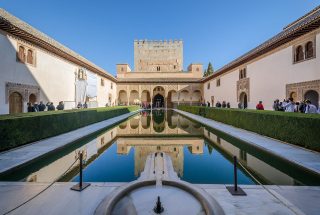
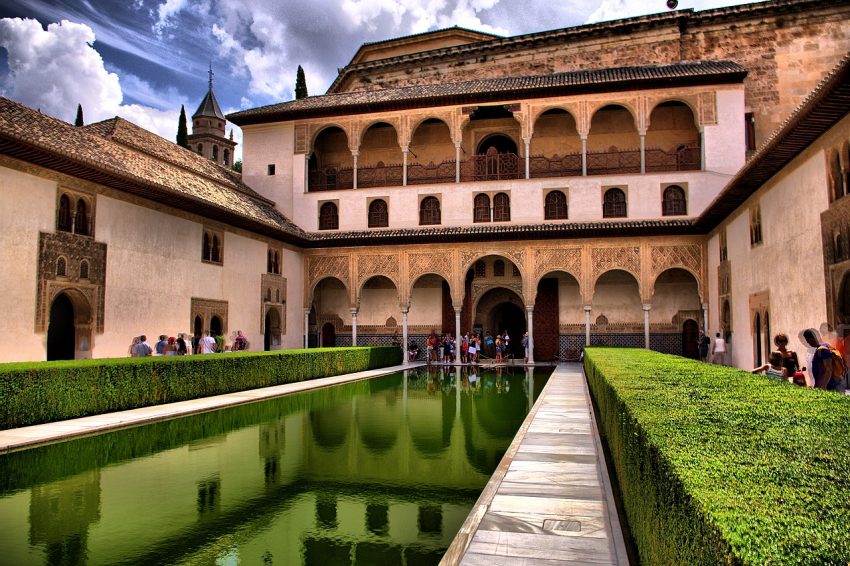
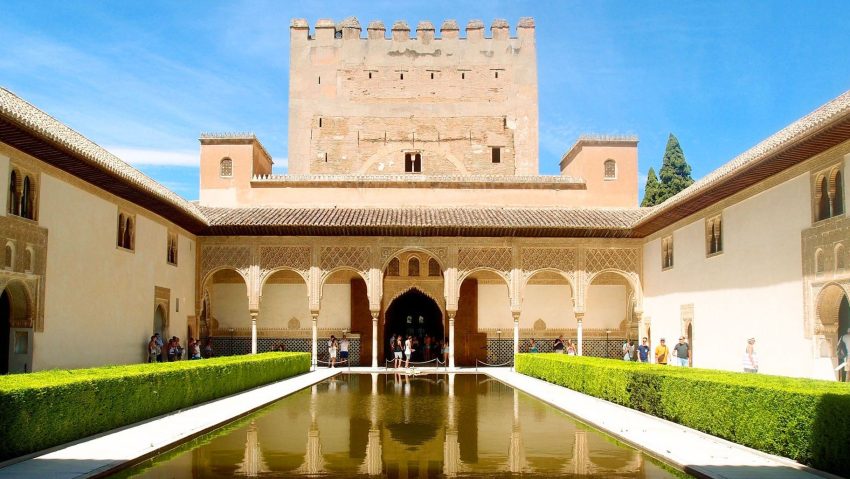
The Patio de los Arrayanes (Court of the Myrtles) is the calm, perfectly proportioned courtyard at the center of the Palacio de Comares, the Nasrid seat of power shaped under Ismail I and Yusuf I and completed by Muhammad V in 1370. A 34‑metre reflecting pool runs down the middle, edged by tightly clipped myrtle hedges that set off the pale marble paving. When the water is still, it doubles the seven-arched porticoes and frames the Comares Tower like a painted backdrop, which is why visitors linger for photographs. Look closer at the arches for muqarnas capitals, carved stucco, and Arabic inscriptions praising God and the ruler.
Location: Court of the Myrtles Calle Real de la Alhambra, 1T 18009 Granada Spain | Hours: For opening times of the Patio de los Arrayanes see Alhambra Opening Times.
| Price: The Patio de los Arrayanes is part of the Alhambra Complex and access it you need to purchase Alhambra Tickets or a Alhambra Guided Tour. | Website | Distance: 1.4km
Tucked between the Mexuar’s public halls and the private Comares Palace, the Patio del Cuarto Dorado is a compact reception courtyard where Nasrid sultans once heard petitions and staged court ritual. Visitors pass a tightly controlled, one-person horseshoe-arched entry before the space opens to a three-arched portico and the low-set fountain designed to murmur without drowning conversation. The south side is dominated by the Comares façade, built under Muhammad V to commemorate the 1369 capture of Algeciras, its twin doorways framed by carved stucco, tiled panels, scalloped windows, and poetic inscriptions proclaiming “Only God is Victor.” Light rakes across the relief, making the surface detail linger in memory.
| Hours: For opening times of the Patio del Cuarto Dorado see Alhambra Opening Times.
| Price: The Patio del Cuarto Dorado is part of the Alhambra Complex and access it you need to purchase Alhambra Tickets or a Alhambra Guided Tour. | Website | Distance: 1.4km
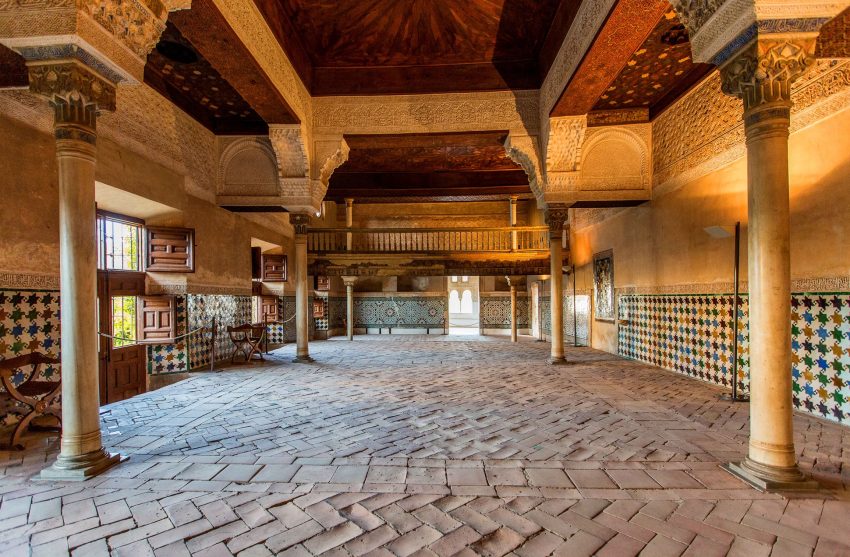
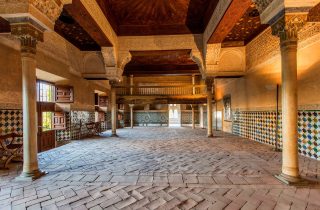
The Sala del Mexuar is the first hall on the Nasrid Palaces route, originally a council chamber where the sultan heard petitions and administered justice. Its layered past is visible at a glance: four marble columns with muqarnas corbels mark the Nasrid core, while a later Christian coffered wooden ceiling sits overhead. Along the lower walls, 16th‑century azulejos mix emblems and mottos—Nasrid inscriptions beside the Counts of Tendilla’s arms, Charles V’s double‑headed eagle, and the Pillars of Hercules. Pause to study the carved plasterwork and the way light picks out textures; the room quietly sets the tone for everything that follows.
Location: Mexuar room s/n Calle Real de la Alhambra 18009 Granada Spain | Website | Distance: 1.4km
Patio de los Leones, Palacio de los Leones, Alhambra
CC BY-SA 3.0 / rheins
Palacio de los Leones is the most intimate section of the Nasrid Palaces, created in the late 14th century under Muhammad V as a private royal residence. Its heart is the Patio de los Leones, a courtyard ringed by 124 slender marble columns and centred on a twelve-lion fountain whose channels once carried water outward like a miniature paradise garden. Around it, rooms such as the Sala de Dos Hermanas and Sala de Abencerrajes dazzle with muqarnas vaulting and finely carved stucco threaded with Arabic inscriptions and geometric motifs. The scale feels calm and precise, and visitors tend to linger on the symmetry, the soft sound of water, and the impossibly detailed surfaces.
| Hours: For opening times of the Palacio de los Leones see Alhambra Opening Times.
| Price: The Palacio de los Leones is part of the Alhambra Complex and access it you need to purchase Alhambra Tickets or a Alhambra Guided Tour. | Website | Distance: 1.4km
Patio de Machuca , Palace of Mexuar, Palacio Nazaries, Alhambra
CC BY-SA 4.0 / Rumomo
Palacio del Mexuar is the public-facing threshold to the Nasrid Palaces, where court business once unfolded before the more private royal suites. Built under Yusuf I and later restored by Muhammad V, its main hall functioned as a ministerial council chamber and a place where justice and petitions were heard. Visitors first step into the Sala del Mexuar, marked by four central columns and intricate muqarnas, then notice the later Christian-era painted ceiling that signals how heavily this area was repurposed after 1492. Tucked behind, the small oratory is angled toward Mecca, while the Cuarto Dorado and its patio frame a celebrated Nasrid façade of stucco symmetry and inscriptions. Look up—details reward slow viewing.
Location: Patio de Machuca Calle Real de la Alhambra, 1T 18009 Granada Spain | Hours: For opening times of the Palacio del Mexuar see Alhambra Opening Times.
| Price: The Palacio del Mexuar is part of the Alhambra Complex and access it you need to purchase Alhambra Tickets or a Alhambra Guided Tour. | Distance: 1.4km
Torres Bermejas (“Crimson Towers”) is a small defensive complex on Mauror hill, facing the Alhambra across the ravine. Three stone watchtowers—one noticeably taller—stand beside a later Christian artillery bastion, with reddish mortar that reads almost pink in certain light. Look closely and you’ll spot reused Muslim tombstones embedded in sections of the masonry, a reminder of how the site was rebuilt over centuries. The reward is in the viewpoints: south over the city’s rooftops and north toward the Alcazaba ridge. Recent visitor comments mention restoration work and occasional closures, so the experience can be more about the exterior and the panorama.
Location: Torres Bermejas Callejón Niño del Royo, s/n 18009 Granada Spain | Distance: 1.4km
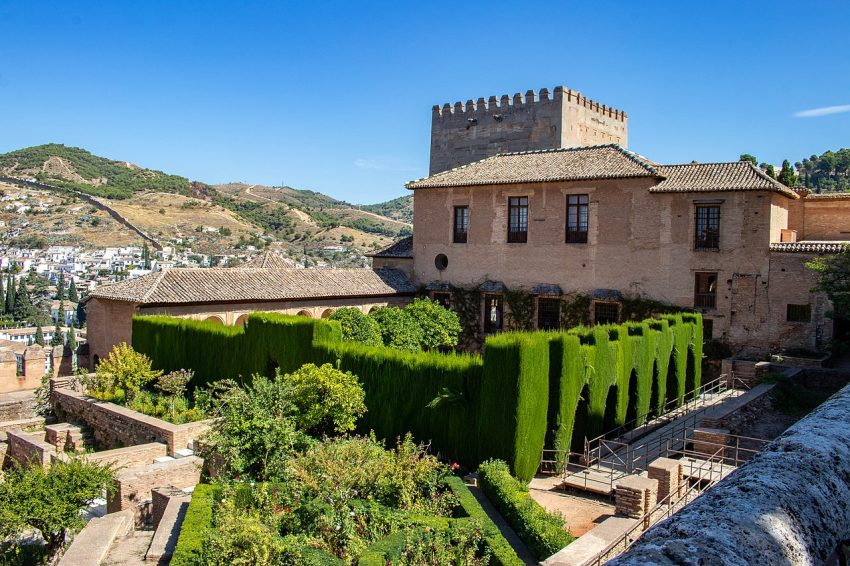
Jardín de Los Adarves is a calm, formal garden set atop the Alcazaba’s former artillery platforms within the Alhambra, where military space was reshaped into ornament in the early 1600s. Trimmed hedges and seasonal flowers sit beside tall magnolias, palms, jasmine, and orange trees that rise above the fortress walls. Look for two distinctive stone water troughs: the 1628 basin beneath the Torre del Adarguero with marine figures spouting water, and a western trough below the Torre de la Sultana with white-marble details. At the western end, a mirador opens to sweeping views over rooftops and the descending defensive wall toward the Puerta de las Granadas. Even when busy, it can feel surprisingly serene.
Palacio de Comares is the former official residence and seat of government of Granada’s Nasrid sultans within the Alhambra, where court ceremony and diplomacy unfolded. It is arranged around the Patio de los Arrayanes (Court of the Myrtles), a long reflective pool flanked by elegant arcades and porticoes that mirror the tower and sky when the water is still. At the north end, the Sala de la Barca leads into the Salón de los Embajadores inside the towering Torre de Comares, a throne room crowned by a lofty wooden dome conceived as the seven heavens. Visitors tend to remember the symmetry, the shifting light on stucco and inscriptions, and how quickly the courtyard fills with people.
| Hours: For opening times of the Palacio de Comares see Alhambra Opening Times.
| Price: The Palacio de Comares is part of the Alhambra Complex and access it you need to purchase Alhambra Tickets or a Alhambra Guided Tour. | Distance: 1.4km
Torre de las Damas is an early Nasrid palace-tower in the Partal area of the Alhambra, built under Muhammad III in the early 1300s and blending a defensive base with intimate living rooms. Visitors linger by the five-arched portico, where the arcade mirrors in the long pool for one of the complex’s most photogenic, quiet scenes. Inside are a small hall and a later mirador with open views toward the Darro valley and gardens. Just to the left, three attached Arab houses preserve rare, fading 16th‑century wall paintings—hunts, musicians, fantastical animals, and even a military expedition—an unusual survival in Spain. Many describe it as especially serene early in the day.
Location: Torre de las Damas Callejon Guindo, 2T 18009 Granada Spain | Hours: For opening times of the Torre de las Damas see Alhambra Opening Times.
| Price: The Torre de las Damas is part of the Alhambra Complex and access it you need to purchase Alhambra Tickets or a Alhambra Guided Tour. | Website | Distance: 1.4km
Torre de la Rauda is a small, understated Nasrid-era tower on the Alhambra’s Paseo de las Torres, remembered less for ornament than for what it signaled: the threshold to the royal cemetery once called the rawda. For years it was thought to contain the kings’ tombs, but later discoveries placed the burial ground south of the palace precinct, making the tower more likely an entrance gate—and perhaps linked to an earlier palace phase. Seen from the Jardines del Partal, you notice its square, single-story mass of plain brick and the four horseshoe-arched openings, one on each side. Uncovered in 1887 and studied in the 1920s, it reads like a quiet footnote beside the Palace of the Lions.
| Hours: For opening times of the Torre de la Rauda see Alhambra Opening Times.
Access is normally restricted unless to building forms part of the Space of the Month program.
| Price: The Torre de la Rauda is part of the Alhambra Complex and access it you need to purchase Alhambra Tickets or a Alhambra Guided Tour. | Website | Distance: 1.4km
Torre del Adarguero is the fragmentary “Hollow Tower” embedded in the eastern defensive wall of the Alcazaba within Granada’s Alhambra. Little more than its base survives, yet standing on its footprint along the inner rampart walkway makes the fortress’s hidden circulation easy to picture—soldiers moving behind battlements between watchpoints. The remains sit in the same exposed line as the Torre Quebrada and Torre del Homenaje, aimed toward the ravine and eastern approaches. Its name recalls an adarguero, a craftsman associated with the leather adarga shields used in medieval Iberian warfare, lending a rare human detail to the stonework. From here, the view east emphasizes why this flank demanded constant vigilance.
Location: Torre del Adarguero o Torre Hueca Centro 18009 Granada Spain | Hours: For opening times of the Torre del Adarguero see Alhambra Opening Times.
| Price: The Torre del Adarguero is part of the Alhambra Complex and access it you need to purchase Alhambra Tickets or a Alhambra Guided Tour. | Distance: 1.4km
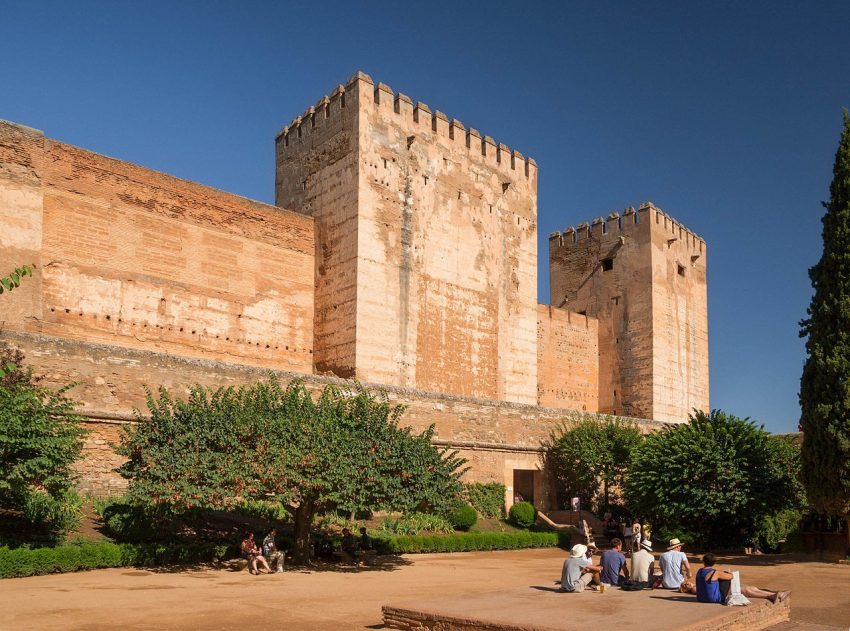
Plaza de los Aljibes is a broad, cypress-framed esplanade inside the Alhambra, created in 1494 when a ravine was filled and a huge water cistern was built beneath it (about 34 m long and 8 m high). Its open, wind-swept feel contrasts with the tight courtyards nearby, and the low walls make an easy perch for a breather with wide views toward the Albaicín and the city below. The surrounding crenelated towers and the Alcazaba’s watchtowers underline the fortress setting and make this a favorite photo stop. It has also hosted unexpected moments, from a temporary bullring to the 1922 Cante Jondo contest linked to Lorca and de Falla.
Location: Placeta de los Aljibes Plaza Algibes Alhambra, 1T 18009 Granada Spain | Hours: 24 Hours | Price: Free | Distance: 1.4km
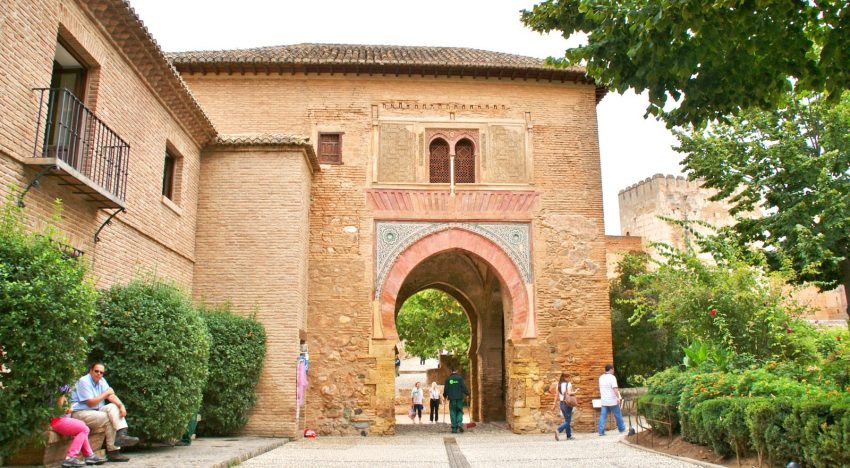
Puerta del Vino is a compact, atmospheric inner gate within the Alhambra that once regulated everyday access to the Medina, the citadel’s working residential quarter. Built in the early 14th century under Muhammad III, it rewards slow looking: one side is comparatively austere sandstone, while the other was later enriched under Muhammad V with vivid dry-rope tilework, polychrome stucco, and a framed twin balcony bearing the Nasrid shield and the motto “Only God is Victor.” Step beneath the arch and you can still picture guards seated in the passage as residents and craftsmen moved through. The quiet corner and fine workmanship stand out, even amid nearby crowds.
Location: Puerta del Vino Plaza Algibes Alhambra, 2T 18009 Granada Spain | Hours: 24 Hours | Price: Free | Website | Distance: 1.4km
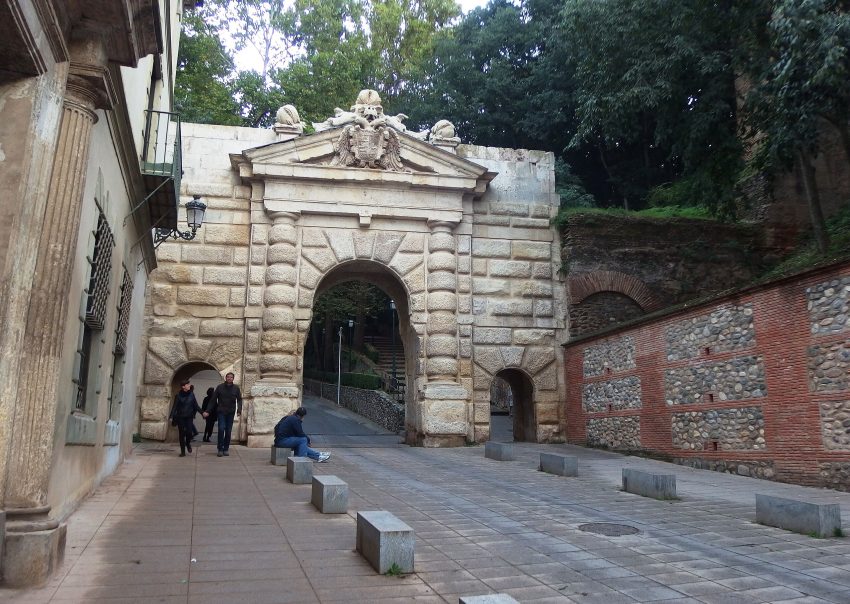
Puerta de las Granadas (Gate of the Pomegranates) is a monumental Renaissance gateway from 1536, designed by Pedro Machuca as a ceremonial entrance up from Plaza Nueva toward the Alhambra’s wooded slopes. Shaped like a Roman triumphal arch, it has three openings—a broad central arch once for riders and two smaller side arches for pedestrians—cut from smooth, tightly fitted stone. Look up for the imperial coat of arms with allegorical figures of Peace and Abundance, and the three carved pomegranates crowning the façade. On the right, traces of the earlier Moorish defensive gate still linger in the masonry. Passing beneath it, the city noise drops away and the shaded climb begins.
Location: Puerta de las Granadas, Cuesta de Gomérez, Granada, Spain | Website | Distance: 1.4km
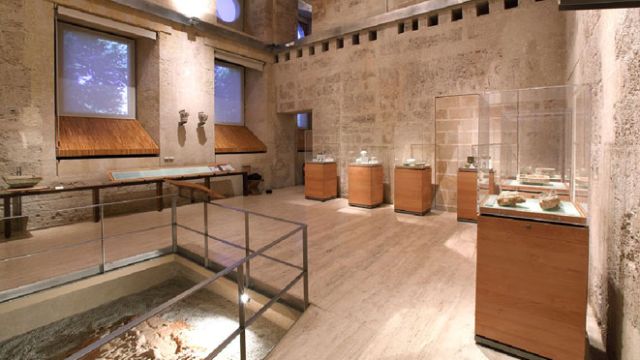
The Museum of the Alhambra in Granada, Spain, sits on the ground floor of the Palacio de Carlos V and gathers objects found during excavations across the Alhambra complex. Spread through seven rooms, it turns palace decoration into close-up evidence: glazed ceramics, carved marble, stucco fragments with inscriptions, woodwork, coins, and everyday domestic pieces from the Nasrid period. The celebrated Vase of the Gazelles, with its elegant animal motifs, is the kind of object visitors linger over, reading the Alhambra’s artistry in miniature. It’s a calm, air-conditioned pause from the courtyards outside, with benches and a quiet, gallery-like atmosphere where photography is typically allowed without flash.
Location: Museum of the Alhambra, Palacio de Carlos V, Plaza Algibes Alhambra, Granada, Spain | Hours: Closed Mondays.
Sundays and Tuesday: 08:30 - 14:30
Wednesday to Saturday: 08:30 - 18:00 | Price: Free | Website | Distance: 1.4km
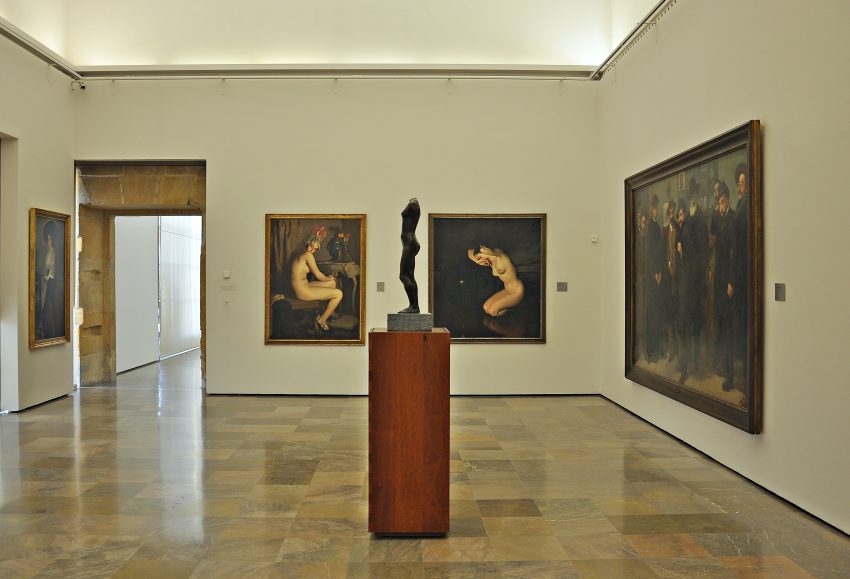
Set on the first floor of the Renaissance Palacio de Carlos V within the Alhambra, the Museo de Bellas Artes is a quiet, gallery-filled counterpoint to the crowds outside. Its collection spans more than 2,000 works—especially religious paintings, sculpture, and devotional pieces made locally from the 16th to the 20th centuries—tracing how Catholic patronage and lingering Islamic design sensibilities shaped artists over time. Look for names such as Alonso Cano and Mariano Fortuny, alongside works like the symbolic “Allegory of Death” and a 17th-century “St. Francis of Assisi.” High ceilings, stone details, and calm rooms make the art feel unhurried and intimate.
Location: Museo de Bellas Artes de Granada, Calle Real de la Alhambra, Granada, Spain | Hours: 9am-8pm Tue-Sat Apr–mid-Oct,
9am-6pm Tue-Sat mid-Oct–Mar,
9am-3pm Sun year-round
| Price: €1.50 free for EU members | Website | Distance: 1.4km
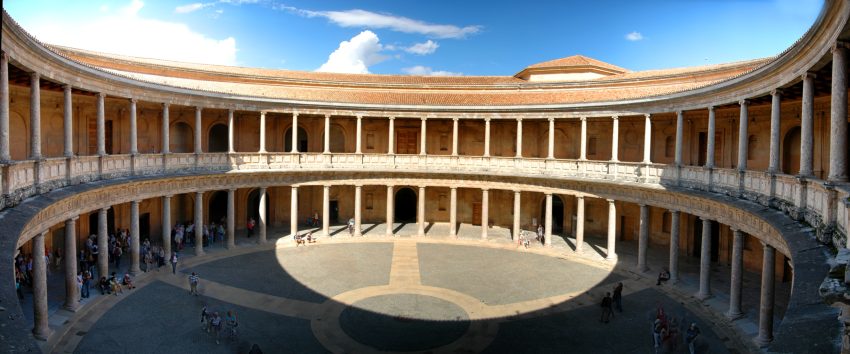
Commissioned by Emperor Charles V in the 16th century, this unfinished Renaissance palace rises as a stark, square mass beside the Nasrid palaces of the Alhambra—an intentional statement of imperial order against Moorish delicacy. Its unforgettable centerpiece is a monumental circular courtyard set within the square plan, ringed by a two-level colonnade: sturdy Tuscan columns below and slimmer Corinthian ones above. Outside, sculpted reliefs and medallions celebrate Charles V’s victories, including scenes linked to Pavia and Tunis and classical figures such as Hercules. Inside, two museums shift the mood from architecture to objects and art, including Nasrid-era pieces like the celebrated Vase of the Gazelles.
Location: Palacio de Carlos V, Calle Real de la Alhambra, Granada, Spain | Hours: 8.30am-8pm Apr–mid-Oct, to 6pm mid-Oct–Mar, night visits 10-11.30pm Tue-Sat Apr–mid-Oct, 8-9.30pm Fri & Sat mid-Oct–Mar | Price: Access to the Palacio de Carlos V is free via the Puerta de la Justicia on the southern side of the Alhambra. | Website | Distance: 1.4km
The Palacio Nazaríes are the Alhambra’s royal Nasrid apartments, a sequence of rooms and courtyards where light, geometry, and water are choreographed into calm. Visitors move from the older Mexuar audience hall into the Palace of Comares, where the Sala de la Barca leads to the Salón de los Embajadores, its surfaces dense with starry patterns and poetic inscriptions. The experience culminates in the Palace of the Lions: a forest of slender marble columns around a central fountain, with muqarnas-domed chambers like the Sala de las Dos Hermanas nearby. Painted wood ceilings, delicate stucco, and narrow channels of running water are the details people remember long after leaving.
Location: Nasrid Palaces, Calle Real de la Alhambra, Granada, Spain | Alhambra & Nasrid Palaces Fast-Track Ticket Available! | Distance: 1.4km
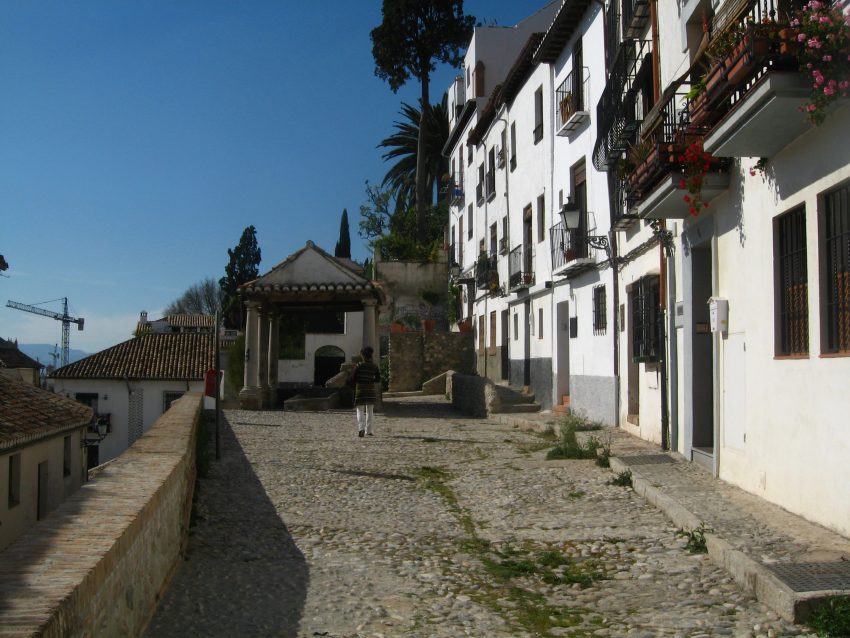
Realejo is Granada’s hillside district below the Alhambra, once the Jewish quarter of Muslim Granada known as Garnata al-Yahud and later reshaped after 1492 into a Christian neighborhood. Wandering its narrow, sloping streets, you’ll notice layers of the past: Moorish-era remnants such as the reddish Torres Bermejas, chapels and churches like Santo Domingo with its Baroque interior, and palaces tucked behind old walls. Life gathers in Campo del Príncipe, laid out in 1497 on a former Muslim cemetery, where the Cristo de los Favores statue anchors local devotion. Between quiet carmen gardens and cafés, El Niño de las Pinturas’ murals turn many corners into an open-air gallery.
| Hours: 24 Hour | Price: Free | Distance: 1.5km
The Pabellón Norte del Palacio del Generalife is a whitewashed, two-storey pavilion that frames the north side of the Patio de la Acequia, where a slender portico of five arches faces the long canal. Step closer and the craftsmanship becomes intimate: three central arches rest on mocárabe-carved capitals, and inside the Sala Regia is dense with plasterwork, niches, and a stalactite cornice that seems to drip into shadow. After a 1958 fire, restoration removed later layers and revealed original Nasrid archways and layout that had been hidden for centuries. From the connected Torre de Ismail, bay windows open to cool air and wide views over the Darro valley.
| Hours: For opening times of the Pabellón Norte del Palacio del Generalife see Alhambra Opening Times.
| Price: The Pabellón Norte del Palacio del Generalife is part of the Generalife of the Alhambra Complex and access it you need to purchase Alhambra Tickets or a Alhambra Guided Tour. | Distance: 1.5km
Mirador Romántico is a small neo-Gothic viewpoint pavilion tucked into the upper terraces of the Generalife in Granada, built in 1836 under administrator Don Jaime Traversa during the Romantic era’s rediscovery of Moorish Spain. Reached by climbing the Escalera del Agua, it sits high above the orchards and garden terraces, where the air feels noticeably quieter than the courtyards below. Its pointed arches and slender windows act like picture frames for the Alhambra’s walls and towers and, on clear days, the Albaicín beyond. Visitors remember the sense of seclusion—some note having it almost to themselves—though tall trees can partially block certain angles.
| Hours: For opening times of the Mirador Romántico in the Generalife see Alhambra Opening Times.
| Price: The Mirador Romántico is part of the Generalife of the Alhambra Complex and access it you need to purchase Alhambra Tickets or a Alhambra Guided Tour. | Website | Distance: 1.5km
The Patio de la Acequia is the long garden courtyard at the heart of the Generalife, built around a nearly 50-metre water channel that turns sound and reflection into architecture. A straight rill runs down the centre while 19th-century jets arc over it, and paths cross mid-way to divide four planted beds of myrtle, roses, orange trees, and cypresses. At the north end, a white pavilion of five arches leads into the former royal chambers, with an inscription dating it to 1319 under Sultan Ismail I. The space has been reshaped over centuries—filled in from its earlier sunken level and replanted with global species—yet it still feels like a calm, enclosed garden where people linger quietly.
Location: Court of the Water Channel Camino Fuente del Avellano, 4 18010 Granada Spain | Hours: For opening times of the Patio de la Acequia in Generalife see Alhambra Opening Times.
| Price: The Patio de la Acequia is part of the Generalife of the Alhambra Complex and access it you need to purchase Alhambra Tickets or a Alhambra Guided Tour. | Website | Distance: 1.5km
Escalera del Agua is a stone staircase in Granada’s Alhambra Generalife where water is built into the climb itself, running in narrow channels along the handrails. Shaded by a dense laurel canopy, the steps feel noticeably cooler, with the sound of moving water guiding you upward like a quiet metronome. Each landing pauses the ascent with a small circular patio and a pool or fountain that gathers and resets the flow before it continues. More than decoration, it’s Nasrid-era water engineering experienced through touch and temperature—many visitors trail their fingers through the stream as they go. Tucked away in the higher gardens, it rewards slow, details-first looking: worn stone, mossy edges, and flickering reflections.
Location: Escalera del agua 18009 Granada Spain | Hours: For opening times of the Escalera del Agua in the Generalife see Alhambra Opening Times.
| Price: The Escalera del Agua is part of the Generalife of the Alhambra Complex and access it you need to purchase Alhambra Tickets or a Alhambra Guided Tour. | Website | Distance: 1.5km
Jardines Altos are the uppermost terraces of the Generalife in Granada, Spain, a quiet set of elevated gardens where planting and water design take center stage. Visitors wander past magnolias, cypresses, and cedar, with aromatic myrtle, jasmine, and roses edging clipped beds and small fountains. The most memorable feature is the Escalera del Agua: a stairway shaded by a laurel canopy where water runs along the handrails, a detail that still makes travelers marvel at the estate’s hydraulic ingenuity. At the top, the Mirador Romántico opens to wide views across the Alhambra and surrounding hills, making the climb feel purposeful as well as serene.
| Hours: For opening times of the Jardines Altos in the Generalife see Alhambra Opening Times. | Price: The Jardines Altos is part of the Generalife of the Alhambra Complex and access it you need to purchase Alhambra Tickets or a Alhambra Guided Tour. | Website | Distance: 1.5km
Patio del Ciprés (Courtyard of the Cypress Trees) is a hushed Generalife garden court where arcades and Baroque planting frame a still, “U”-shaped pond edged with myrtle. A small stone fountain sends fine water arcs across the surface, doubling the cypresses and colonnades in reflection. The surrounding structure dates to 1584, adapted over earlier Generalife buildings once linked to a bath complex, with traces of the old water supply still evident. Climb the 19th-century stone staircase with its portico and ceramic lions to the hillside terraces and the Escalera del Agua, where water runs through the handrails beneath a vault of interlaced laurel.
Location: Patio de la Sultana Camino Fuente del Avellano, 4 18010 Granada Spain | Hours: For opening times of the Patio del Ciprés the Generalife see Alhambra Opening Times.
| Price: The Patio del Ciprés is part of the Generalife of the Alhambra Complex and access it you need to purchase Alhambra Tickets or a Alhambra Guided Tour. | Website | Distance: 1.5km
The Salón de Embajadores (Hall of the Ambassadors) is the grand ceremonial chamber inside the Comares Tower, where Nasrid sultans received envoys beneath a ceiling designed to mirror the Qur’anic cosmos. The room’s 11.3-metre square plan rises dramatically to about 18 metres, with thick walls carved into deep alcoves and triple-arched recesses that create pockets of shadow. Look up to the cedar-wood dome: thousands of tiny pieces form concentric stars for the seven heavens, with traces of lapis lazuli still catching the light. Around you, stucco and tilework are packed with calligraphy and poems (including verses by Ibn Zamrak), turning diplomacy into architecture.
Location: Salón de los Embajadores s/n Calle Real de la Alhambra 18009 Granada Spain | Hours: For opening times of the Salón de Embajadores see Alhambra Opening Times.
| Price: The Salón de Embajadores is part of the Alhambra Complex and access it you need to purchase Alhambra Tickets or a Alhambra Guided Tour. | Website | Distance: 1.5km
The Cuarto Dorado (Golden Room) is a ceremonial chamber in the Palacio del Mexuar, where court business and receptions once unfolded at the threshold between the Mexuar and the more formal Comares Palace. Its name comes from the gilded Mudejar coffered ceiling, still the feature most visitors remember, with geometric carpentry and traces of later repainting. Look closely and you’ll spot the layered mash-up of eras: Nasrid plasterwork and muqarnas sit alongside Christian-period changes, including a reshaped window turned into a viewpoint with facing seats and added capitals. The entrance portico, with three arches and old marble capitals, sets the tone before you step inside.
| Website | Distance: 1.5km
The Oratorio de Mexuar is a small Nasrid prayer chamber tucked at the northern end of the Alhambra’s Mexuar Palace, created for private worship alongside the sultan’s council spaces. Access is usually closed, so visitors pause at the doorway to take in the hush and the refined decoration. The focal point is the mihrab, a deeply worked niche oriented to Mecca, framed by a horseshoe arch and bands of stucco inscriptions, including an admonition to come to prayer. Four small balconies with twin arches and narrow windows once connected devotion to views outside. Restored after damage from a 1590 powder explosion, its delicate surfaces still reward close looking.
| Hours: For opening times of the Oratorio de Mexuar see Alhambra Opening Times.
| Price: The Oratorio de Mexuar is part of the Alhambra Complex and access it you need to purchase Alhambra Tickets or a Alhambra Guided Tour. | Website | Distance: 1.5km
The Madrasa de los Príncipes is the vanished royal Koranic school once embedded in the Mexuar, the oldest part of the Nasrid Palaces, and today it survives mainly as courtyard foundations. Those stone outlines still trace a classic Persian-style plan: a square court with four surrounding pavilions, with the main study hall to the south. Look for the subtle but telling skew where the small oratory and its minaret were aligned toward Mecca, shifting the geometry against the rest of the complex. Imagining princes moving from an ablutions basin to lessons in theology, law, astronomy, and philosophy gives this quiet footprint an unusually intimate feel, even when viewed only from nearby vantage points.
| Hours: For opening times of the Madrasa de los Príncipes see Alhambra Opening Times. | Price: The Madrasa de los Príncipes is part of the Alhambra Complex and access it you need to purchase Alhambra Tickets or a Alhambra Guided Tour. | Distance: 1.5km
Torre de Machuca is a small, outward-jutting defensive lookout in the Mexuar area of the Alhambra, barely four metres square but built for surveillance. Raised under Yusuf I (when it was known as Bahw al-Nasr, the “Tower of Victory”), it once stood beyond the palace route behind a moat, later absorbed into the expanded Mexuar under Muhammad V. You can’t usually go inside, but from nearby angles you can read its purpose in the way it projects from the wall and frames long views over rooftops and defensive lines. In the 16th century, Renaissance architect Pedro Machuca lived here, giving the tower its current name; visitors also note the quieter, shaded feel of this corner.
| Hours: For opening times of the Torre de Machuca see Alhambra Opening Times.
| Price: The Torre de Machuca is part of the Alhambra Complex and access it you need to purchase Alhambra Tickets or a Alhambra Guided Tour. | Website | Distance: 1.5km
Patio de Machuca , Palace of Mexuar, Palacio Nazaries, Alhambra
CC BY-SA 4.0 / Rumomo
Patio de Machuca is a small Renaissance courtyard within the Alhambra complex, marking the transition from 16th-century Christian additions to the older Nasrid Mexuar. It was once the entry court for visitors arriving from the Puerta de las Armas, and its calm geometry still reads as an antechamber before the palace halls. A Roman-inspired rectangular pool sits at the center, mirroring a simple north-side colonnade and the Torre de Machuca, where architect Pedro Machuca is said to have lived. Cypress trees planted during early 20th-century restoration suggest a lost gallery, creating shade and a hushed, reflective feel that many visitors pass by on the way to busier areas.
| Hours: Patio de Machucais normally restricted. However if you access the Nasrid Palaces in a group you pass close by it.
For opening times of the Patio de Machuca see Alhambra Opening Times.
| Price: The Patio de Machuca is part of the Alhambra Complex and access it you need to purchase Alhambra Tickets or a Alhambra Guided Tour. | Website | Distance: 1.5km
Puerta del Bosque is a small, easily missed gate in the Alhambra’s outer walls, set along the enclosure of the Bosque de San Pedro above the Darro River. Its quiet position high over the ruins of the Carmen del Granaillo and the Santa Ana Aqueduct makes it feel like a back entrance carved into forested stonework. Built after the Christian reconquest and later rebuilt in 20th-century restorations, the portal shows Sierra Elvira stone and blocky pilaster details associated with early modern repairs. Nearby, a hidden stair-tunnel once linked the woods to the walls below the Torre del Peinador de la Reina and the Torre de las Damas, hinting at the complex’s concealed circulation routes.
Puerta de la Tahona (Gate of the Bakery) is a little-noticed internal gate in the Alcazaba of Granada’s Alhambra, tucked under the terrace of the Torre del Cubo at the fortress’s northeast corner. It mattered as a controlled passage for movement from the Puerta de las Armas toward the Nasrid Palaces or the Puerta del Vino, shaping how people circulated inside the stronghold. Look for two pointed brick horseshoe arches and the iron portcullis, with a fixed upper section and a movable lower half. Above, a narrow walkway links nearby towers, while the gate’s hidden setting hints at how later artillery works under Felipe II and Luis Machuca’s 1586 bastion buried it from view.
| Hours: For opening times of the Puerta de la Tahona see Alhambra Opening Times.
Access is normally restricted unless to building forms part of the Space of the Month program.
| Price: The Puerta de la Tahona is part of the Alhambra Complex and access it you need to purchase Alhambra Tickets or a Alhambra Guided Tour. | Distance: 1.5km
Torre del Criado del Doctor Ortiz is a small, lesser-noticed defensive tower on the Alcazaba’s inner curtain wall in the Alhambra, set between the Torre del Homenaje and the Torre de Alquiza. Unlike the taller towers nearby, it’s a solid rectangular projection with no interior rooms, built purely for surveillance and defence. Its position let guards watch the Calle del Foso, the moat-street linking the Puerta de las Armas with the Puerta de la Tahona, controlling movement toward the Nasrid Palaces. Visitors remember its quiet corner of the fortress and the way its simple massing makes the wall’s defensive logic easy to read.
| Hours: For opening times of the Torre del Criado del Doctor Ortiz see Alhambra Opening Times.
| Price: The Torre del Criado del Doctor Ortiz is part of the Alhambra Complex and access it you need to purchase Alhambra Tickets or a Alhambra Guided Tour. | Distance: 1.5km
Torre de Alquiza is a compact, solid defensive tower on the Alcazaba’s first curtain wall in Granada’s Alhambra, built for surveillance rather than living space. Set just north of the Plaza de las Armas, it projects over the street–moat approach that once led from the Puerta de las Armas toward the Torre del Cubo, letting guards track movement along the ramp and passageways below. Reached by a steep, narrow stair, its battlements feel surprisingly quiet compared with busier parts of the fortress. From the top you can look across the Albaicín and Sacromonte and down into the Plaza de las Armas, with clear sightlines to nearby towers including the Torre del Homenaje and Torre de la Vela.
Location: Torre de Alquiza Centro 18009 Granada Spain | Hours: For opening times of the Torre de Alquiza see Alhambra Opening Times.
| Price: The Torre de Alquiza is part of the Alhambra Complex and access it you need to purchase Alhambra Tickets or a Alhambra Guided Tour. | Distance: 1.5km
Perched on the Alhambra’s ramparts above the Darro valley, the Torre del Peinador de la Reina is a small tower-palace where Nasrid structure meets Renaissance reinvention. Built over an earlier defensive tower and later adapted as a private chamber for Queen Isabel of Portugal, it carries traces of both sultans’ retreat and Christian court life. Inside, visitors notice carved woodwork, plaster details, and surviving fragments of Arabic praise inscriptions, then step into the upper room where frescoes steal attention. Painted in the mid-1500s, they narrate Charles V’s Tunis campaign with ships, landings, and allegorical scenes like Phaeton. The corridor openings frame memorable views, often praised in reviews.
Location: Peinador de la Reina Calle Chirimías, 5 18010 Granada Spain | Hours: For opening times of the Torre del Peinador de la Reina see Alhambra Opening Times.
| Price: The Torre del Peinador de la Reina is part of the Alhambra Complex and access it you need to purchase Alhambra Tickets or a Alhambra Guided Tour. | Website | Distance: 1.5km
Torre del Cubo—often identified with the elusive Torre de las Abencerrajes—is a half-lost defensive tower on the Alhambra’s south wall, more a ghost in the masonry than a standalone monument. Unlike the Alhambra’s projecting towers, it originally ran almost flush and parallel to the rampart, acting as a reinforced stretch beside the now-ruined Palacio de los Abencerrajes. Its fabric was shattered by the 1812 explosions during Napoleon’s retreat and later rebuilding left only fragmentary traces, partly swallowed by the Alhambra Forest. What visitors remember is the quiet hunt: reading the wall’s seams and trying to picture the fortified city that once filled this corner.
Location: Torre del Cubo de la Alhambra Calle Real de la Alhambra 18009 Granada Spain | Hours: For opening times of the Torre del Cubo see Alhambra Opening Times.
| Price: The Torre del Cubo is part of the Alhambra Complex and access it you need to purchase Alhambra Tickets or a Alhambra Guided Tour. | Distance: 1.5km
Torre de Mohamed is a late-13th-century defensive tower on the Alhambra’s north wall in Granada, built under the Nasrid ruler Mohammed II to monitor movement into the palatial quarters. It sits between the Torre del Cubo and the Tower of Machuca, guarding a sensitive approach near the Puerta de las Armas. The tower’s plain rectangular mass rises over two levels once used by guards, with three doorways—one opening toward the Plaza/Patio de la Madraza de los Príncipes and two leading up to the battlements. On the terrace, merlons and parapets frame wide views toward the Darro valley. Locals still call it Torre de las Gallinas, a nickname from its later use as a chicken coop.
| Hours: Entrance to this building is usually restricted and cannot be visited during the ordinary visit of the Alhambra Complex.
Access is sometimes permitted with advance registration, through activities arranged by the Board of the Alhambra and the Generalife.
It may also be included in the "Space of the Month" programme, which allows the visit of certain spaces normally closed to preserve their conservation and that do not admit a high number of visitors.
| Price: The Torre de Mohamed is part of the Alhambra Complex and access it you need to purchase Alhambra Tickets or a Alhambra Guided Tour. | Distance: 1.5km
Torre de las Armas (Tower of Arms) is a projecting defensive tower on the Alhambra’s north wall in Granada, set directly above the Puerta de las Armas, the main medieval gateway into the complex. Built in the Nasrid period, it functioned as a surveillance post and a checkpoint where entrants were expected to surrender weapons before passing inside. Its outward thrust over the lower wall of the Alcazaba makes its military purpose easy to read, even if you’re viewing it from the paths below rather than entering the interior. From its elevated position you can trace the approach from the old Almanzora side and take in wide views over Granada—something visitors often mention as the tower’s most memorable feature.
Location: Torre de las Armas 18009 Granada Spain | Hours: For opening times of the Torre de las Armas see Alhambra Opening Times.
| Price: The Torre de las Armas is part of the Alhambra Complex and access it you need to purchase Alhambra Tickets or a Alhambra Guided Tour. | Website | Distance: 1.5km
Torre de Comares is the 45-metre palace-tower that crowns the Palacio de Comares in Granada’s Alhambra, built under Yusuf I and finished by Muhammad V as the ceremonial seat of Nasrid rule. From outside it reads like a stern fortress—few openings, sharp lines, and projecting gargoyles—yet inside it turns lavish and intimate. The approach passes through the long Sala de la Barca before opening into the Salón de los Embajadores, where an immense cedar dome of more than 8,000 pieces forms a starry pattern evoking the seven heavens. Narrow passages lead to a small private oratory with a horseshoe arch and to upper rooms with balcony views over the complex.
Location: Torre de Comares C. Real de la Alhambra Centro 18009 Granada Spain | Hours: For opening times of the Torre de Comares see Alhambra Opening Times.
| Price: The Torre de Comares is part of the Alhambra Complex and access it you need to purchase Alhambra Tickets or a Alhambra Guided Tour. | Distance: 1.5km
Torre de los Hidalgos is a square 16th‑century defensive tower at the far western end of the Alhambra’s Alcazaba, built after the Christian conquest under the Catholic Monarchs. Set into the north curtain wall beside the Torre de la Vela, it was positioned to watch the approach to the Puerta de las Armas and reflects the shift toward early modern fortification and artillery-minded surveillance. You can’t enter the tower on a standard visit, but its roofline and stout masonry are easy to study from the Torre de la Vela terrace and from the eastern side of the Torre de las Armas. From these viewpoints, visitors often linger for wide panoramas over Granada’s rooftops and the Albaicín.
| Hours: For opening times of theTorre de los Hidalgos see Alhambra Opening Times.
Access is normally restricted unless to building forms part of the Space of the Month program.
| Price: The Torre de los Hidalgos is part of the Alhambra Complex and access it you need to purchase Alhambra Tickets or a Alhambra Guided Tour. | Distance: 1.5km
Torre de la Sultana is a small, understated defensive tower in Granada’s Alhambra, set between the Alcazaba’s military core and the greenery of the Jardín de los Adarves. Seen from the Plaza de las Armas or the rampart path linking Torre del Homenaje and Torre de las Armas, it reads as an elongated square block that juts toward the southern slope. Look closely at the patchwork of brick and masonry: the tower predates much of the Nasrid work and shows later repairs layered over an earlier Almohad structure. It’s usually closed inside, but its quiet setting and half-hidden garden-facing side make it memorable. Some visitors mention a local legend tied to its name, despite its practical purpose.
| Hours: For opening times of the Torre de la Sultana see Alhambra Opening Times.
Access is normally restricted unless to building forms part of the Space of the Month program.
| Price: The Torre de la Sultana is part of the Alhambra Complex and access it you need to purchase Alhambra Tickets or a Alhambra Guided Tour. | Distance: 1.5km
Torre de la Pólvora (the Powder Tower) is a compact, projecting square tower on the northeast stretch of the Alcazaba walls, built in the 13th century under the Nasrids to watch the steep approach that later became Cuesta Gomérez. Its outward jut from the curtain wall is easy to spot from the walkway, a design that widened sight lines over the ravine below. After 1492 it was reinforced and repurposed for early artillery, with gunpowder stored here—hence the name—and the terrace adapted as a firing platform. Tucked behind the Torre de la Vela, it feels quieter than the main battlements, but its position makes the fortress’s shift from lookout to gunpowder-era defense tangible.
| Hours: For opening times of the Torre de la Pólvora see Alhambra Opening Times.
The Torre de la Pólvora is part of the Alhambra Complex and access it you need to purchase Alhambra Tickets or a Alhambra Guided Tour.
| Price: The Torre de la Pólvora is part of the Alhambra Complex and access it you need to purchase Alhambra Tickets or a Alhambra Guided Tour. | Website | Distance: 1.5km
Torre Quebrada (the “Broken Tower”) is a Nasrid defensive tower on the eastern wall of the Alcazaba in Granada’s Alhambra, built under Yusuf I atop an older Zirí-period structure. What visitors remember is the long vertical fissure cleaving its façade, left by an 1838 landslide that sheared away part of the tower above the wall line and damaged the stair. Its U-shaped plan runs east–west, with two interior levels and a battlemented terrace that once served as a lookout. From the plazas on either side, you can see how the tower shifts from solid masonry at the base to a lighter, hollow upper section supported by inner arches.
| Hours: For opening times of the Torre Quebrada see Alhambra Opening Times.
| Price: The Torre Quebrada is part of the Alhambra Complex and access it you need to purchase Alhambra Tickets or a Alhambra Guided Tour. | Distance: 1.5km
Plaza de las Armas is the oldest open space inside the Alcazaba of Granada’s Alhambra, once the working square of a busy military quarter and an early entrance into the fortress. Walking through it today, you read the site in low stone outlines: barracks, storerooms, workshops, and small houses that supported the garrison and its civilian workforce. A large rainwater cistern sits to one side, later tied into the Alhambra’s canal system to secure water. Near the gate are traces of a bathhouse, and close to the Broken Tower you can spot the remains of a prison area. The rough, uneven ground makes the fortress feel more like a lived-in installation than a palace backdrop.
| Hours: For opening times of the Plaza de las Armas see Alhambra Opening Times.
| Price: The Plaza de las Armas is part of the Alhambra Complex and access it you need to purchase Alhambra Tickets or a Alhambra Guided Tour. | Website | Distance: 1.5km
The Torre del Homenaje is the Alcazaba’s hulking Tower of Homage within Granada’s Alhambra, a largely unadorned defensive mass that signals military authority more than courtly beauty. Rising about 26 metres and built on earlier fortifications—possibly as far back as the 9th century—it is linked to the first Nasrid ruler, al-Ahmar, who strengthened this corner of the citadel. The tower stacks six levels, beginning with a sealed, dungeon-like silo once used for both imprisonment and storing grain and salt. From its upper battlements, you feel why it mattered: the height and sightlines command the city and the surrounding hills, with views many visitors describe as spectacular.
| Hours: For opening times of the Torre del Homenaje see Alhambra Opening Times.
| Price: The Torre del Homenaje is part of the Alhambra Complex and access it you need to purchase Alhambra Tickets or a Alhambra Guided Tour. | Distance: 1.5km
Puerta de las Armas (Gate of Arms) is a medieval entrance built into the western face of the Torre de las Armas on Granada’s Alhambra, once the main way citizens reached the fortress from the city walls. Originally known as Bib al-Medina, it later took its current name from the rule that visitors surrendered weapons before entering. Passing through, you notice the defensive design: a sharply turning corridor, tucked-away guard alcoves, and horseshoe and pointed arches with traces of green, white, and blue tile around the frame. Step outside for wide views over the Darro valley and hillside neighborhoods—many visitors linger here just to admire Granada spread out below.
Location: Torre de las Armas 18009 Granada Spain | Hours: For opening times of the Puerta de las Armas see Alhambra Opening Times.
| Price: The Puerta de las Armas is part of the Alhambra Complex and access it you need to purchase Alhambra Tickets or a Alhambra Guided Tour. | Website | Distance: 1.5km
Rising above the Alcazaba, the Torre de la Vela is a massive Nasrid-era square watchtower whose terrace still feels like a military lookout over the city and valley. It later became a charged symbol of the 1492 conquest, when Ferdinand and Isabella’s banner was raised here. Inside, you climb through stark, defensive floors—brick pillars, vaulted spaces, and a lower level once used as a dungeon—before stepping out to wide views of the Albaicín, the Vega, and the Sierra Nevada. The 1773 bell crowns the tower and anchors local ritual: on 2 January, tradition says the first single woman to ring it will marry within the year. Expect steep stairs and crowds later in the day.
Location: Torre de la Vela, Alhambra Cuesta de Gomérez, 39 18009 Granada Spain | Hours: For opening times of the Torre de la Vela see Alhambra Opening Times.
| Price: The Torre de la Vela is part of the Alhambra Complex and access it you need to purchase Alhambra Tickets or a Alhambra Guided Tour. | Website | Distance: 1.5km
The Alcazaba is the Alhambra’s oldest surviving fortress, a hard-edged maze of massive stone walls, battlements, and watchtowers that once guarded the hilltop citadel for nearly a millennium. Much of what you see was rebuilt in the 13th century by Mohammed I, including the key towers—Torre del Homenaje, Torre Quebrada, and the banner-crowned Torre de la Vela, where the Christian standard was raised in 1492. Inside, the Plaza de las Armas reveals the bones of military life: traces of barracks alongside a cistern, bathhouse, and even a dungeon. Climb the towers for sweeping views over rooftops, valleys, and the surrounding hills.
Location: Alcazaba 18009 Granada Spain | Hours: For opening times of the Alcazaba see Alhambra Opening Times.
The Alcazaba is part of the Alhambra Complex and access it you need to purchase Alhambra Tickets or a Alhambra Guided Tour. | Website | Distance: 1.5km
Corral del Carbón is a 14th-century Nasrid caravanserai in central Granada, built in 1336 as a combined grain exchange and lodging for traveling merchants near the old silk market. You enter through a monumental double-arched gate with scalloped brickwork, delicate plaster arabesques, and a rare surviving Quranic inscription above the arch. A long, shadowy passage with blind arches and a wooden ceiling opens into a near-square courtyard once ringed by dozens of tiny rooms for traders, now calm and shaded. Under Christian rule it later functioned as a coal market and even a theatrical courtyard, and today it’s largely cultural offices with occasional events. Many visitors linger 15–30 minutes for the peaceful patio and photos.
Location: Calle Mariana Pineda, 8 Granada | Hours: Monday - Friday 9:00 - 19:00
Saturday and Sunday 10:00 - 14:00 | Price: Free | Distance: 1.6km
El Bañuelo is an 11th-century Moorish hammam tucked beneath a later house on Carrera del Darro, a quirk that helped it survive when many baths were destroyed after the Reconquest. Inside, you move through the classic sequence of chambers—cool, warm, and hot—framed by horseshoe arches and worn stone that still feels intimate and hushed. The warm room is the showstopper: octagonal, star-like skylights puncture the roof and cast soft beams across the space. Look for traces of the old heating and water system, including channels underfoot and the spot where the boiler once sat. Declared a National Monument in 1918, it remains among the best-preserved hammams in Andalusia.
Location: Arab Baths, 31 Carrera del Darro, Granada, Spain | Hours: September 15th - April 30th: Daily from 10:00 - 17:00
May 1st - September 14th: Daily from 9:30 - 14:30 and 17:00 - 20:30 | Price: € 2.50 | Distance: 1.6km
Paseo de los Tristes (officially Paseo del Padre Manjón) is a riverside promenade along the Darro where the Alhambra’s towers rise sharply above the Sabica hill. The walk runs between the Puente de las Chirimías and the Puente del Aljibillo, passing old stone façades, small terraces, and a 1609 fountain that hints at its early life as a civic paseo. Beside the first bridge stands the Casa de las Chirimías, a 1609 Baroque viewing tower once used by musicians and officials during public festivities. Its melancholy nickname dates to 19th-century funeral processions that paused here before climbing toward the San José cemetery, yet today you’re more likely to remember golden-hour light, café chatter, and occasional artisan stalls.
Location: Paseo de los tristes, granada Calle Reyes Católicos, 32 18001 Granada Spain | Hours: 24 Hour | Price: Free | Distance: 1.6km
Puerta de los Tableros is a surviving tower from an 11th-century river gate on the Darro, at the edge of Granada’s Alhambra Forest, once tied to the Puente del Cadí linking the Alhambra with Los Axares. Only one of the original pair of towers remains, a distinctive hexagonal block of sandstone that still shows slots and grooves where boards and a portcullis mechanism controlled the water. The gate’s purpose wasn’t just crossing: it could dam the Darro and release a sudden surge to hinder intruders and scour the channel. From the riverside paths you can spot a walled-up doorway where stairs once dropped to the water, and the walk up can feel steep and crowded at times.
Location: Puente del Cadi, Carrera del Darro, 33, 35 18010 Granada Spain | Distance: 1.6km
A tight lattice of alleyways and small shopfronts, the Alcaicería recreates the feel of an Andalusian souk on the footprint of a former walled silk market founded in the 15th century. The original bazaar burned in 1843 and was rebuilt in the 19th century in a neo-Moorish style, more decorative than Nasrid-authentic but still atmospheric. Browsing here is about texture and color: fajalauza ceramics, taracea inlaid-wood boxes, patterned textiles, and stained-glass “farolas” lamps that echo Islamic designs. It sits beside Plaza Bib-Rambla and just steps from the cathedral, and while many stalls lean touristy, the stroll itself is the point.
Location: Calle Alcaicería, 1 Granada | Hours: Open daily from 10:00 to 21:00.
During the months of June and July closed on Sunday from 15:00.
Closed on sunday from January 6th to March 19th. | Price: Free | Website | Distance: 1.7km
Tombs of the catholic monarchs at the Royal Chapel of Granada
CC BY-SA 4.0 / Javi Guerra Hernando
Commissioned by Queen Isabella I and King Ferdinand II after 1492, the Capilla Real is their intended mausoleum, built in late Gothic style beside the cathedral complex. Inside, visitors linger over Domenico Fancelli’s luminous marble tombs and the painted altarpiece that narrates the conquest of the city, with the monarchs shown kneeling in devotion. The sacristy-museum feels unusually intimate for a royal site, displaying Isabella’s crown and sceptre alongside personal objects such as a jewellery box and mirror, plus Ferdinand’s sword. A surviving well outside recalls the chapel’s construction on the former Great Mosque site. Many travellers note the hushed atmosphere and soft light over the stonework.
Location: Royal Chapel, Gran Via de Colon 5, 18001 Granada. | Hours: 10:15 - 18:30 (Monday - Saturday); 11:00 - 18:00 (Sunday & holidays) | Price: 5€ (adults), 3.50€ (students, disabled, children), 0€ (children under 12) | Website | Distance: 1.7km
Catedral de Granada (Santa Iglesia Catedral Metropolitana de la Encarnación) is a vast Renaissance cathedral built after 1492 on the site of the former Great Mosque, a stone-and-light statement of the city’s Christian turn. Step inside and the first thing you notice is the luminous white interior, where soaring pillars create a Roman-temple rhythm under unexpectedly airy vaults. Diego de Siloé’s redesign introduced a daring cupola placed over the apse rather than the crossing, drawing the eye upward. In the Main Chapel, stained glass by Teodoro de Holanda and Juan del Campo throws color onto seven monumental canvases by Alonso Cano. Visitors often remark on the sheer scale and height, and the good-value ticket commonly includes an audio guide.
| Hours: Monday - Saturday: 10:15 - 18:30
Sunday: 11:00 - 18:00 | Price: € 5, Up to 10 years: free / 65+ and students: € 3.50 | Website | Distance: 1.8km
Parque de las Ciencias is a sprawling, hands-on science museum complex on the southwest edge of town, built to make physics, biology, and astronomy feel tactile rather than abstract. Across seven permanent halls, visitors can move from a deep dive into the human body to perception experiments with light, mirrors, and sound, plus kid-focused activity zones. Outside, 27,000 square metres of gardens add a tropical butterfly house, a maze, and wildlife-focused areas, with the BioDomo recreating biodiversity in an immersive walkthrough. The 50-metre Astronomical Observation Tower doubles as a viewpoint, and the digital planetarium runs short films that many travellers pair with the space-themed displays.
Location: Avda. de la Ciencia, s/n Granada | Hours: Tuesday - Saturday 10:00 - 19:00
Sunday and public holidays 10:00 - 15:00
Closed on Mondays
1st of January, 1st of May and December 25th closed
Times of the planetarium are available daily at the ticket office. Approximately every hour a session. | Price: Regular tickets: € 7 / planetarium € 2.50 65+ and under 18: € 6 / planetarium € 2 | Website | Distance: 1.9km
Sacromonte climbs the Valparaíso hillside, where narrow paths lead past whitewashed cave homes and viewpoints that frame the Alhambra, the Albaicín, and the Darro valley. The district’s character comes from its troglodyte dwellings—some carved as early as the 16th century—shaped by displaced Jewish and Muslim families living alongside Romani communities beyond the old city’s control. A cluster of preserved caves forms the Cuevas del Sacromonte museum, while larger “zambra” caves nearer the road are set up for intimate flamenco nights with lantern light and guitar. Expect steep walks, low cave ceilings, and a lived-in, atmospheric edge that feels different after dark.
| Hours: 24 Hours | Price: Free | Flamenco Show at Cuevas Los Tarantos Tickets Available | Distance: 1.9km
Set on a stone terrace beside the Church of San Nicolás in the Albaicín, this mirador frames the Alhambra across the valley with the Sierra Nevada rising behind it. The view reads like a panorama: Generalife gardens to the left, the palace complex centred, and the Alcazaba anchoring the right, with the Torre del Peinador de la Reina standing out against the ridge. As afternoon light turns the walls warm and the sky shifts toward dusk, the square fills with photographers, families, musicians, and local artists, and the mood feels part street performance, part quiet vigil. The climb up steep cobbled lanes makes the first look over the wall feel earned.
Location: Mirador San Nicolás Plaza Mirador de San Nicolás, 2 18010 Granada Spain | Hours: 24 Hour | Price: Free | Distance: 1.9km
The Church of San Salvador is a Christian parish built directly over the former Great Mosque of the Albaicín, making it a rare place where Islamic and later styles share the same footprint. Visitors enter through a surviving courtyard—the Patio of Ablutions—where colonnades, a deep well and the old cistern still hint at pre‑Reconquest ritual life. Inside, you’ll notice Mudéjar craftsmanship in the ceilings alongside a hall-church plan shaped by 17th-century rebuilding and later 20th-century reconstruction after the 1936 fire. Look for the Renaissance portal associated with Diego de Siloé, then linger in side chapels with Baroque altarpieces and devotional sculpture. Many reviews still remark on the mosque-to-church transformation.
Location: Church of San Salvador, Placeta del Abad, 7, Granada, Spain | Hours: Monday-Saturday, 10am-1pm and 4.30-6.30pm
| Price: 1€ | Distance: 2km
The Albaicín is a hillside quarter of whitewashed Andalusian houses, jasmine-scented gardens, and narrow cobbled lanes that twist into small, hidden plazas. Its layered past is visible in Moorish cisterns, surviving minarets reused as church bell towers, and Renaissance churches built over former mosques, alongside fragments of the old defensive walls and gates such as the Arco de las Pesas. From the Mirador de San Nicolás, the Alhambra fills the view with the Sierra Nevada rising behind, while Mirador de San Cristóbal feels calmer and reveals stretches of the old citadel walls. Wandering here is about getting pleasantly lost in steep alleys, with cafés and small shops tucked into the maze.
Tucked into the upper Albaicín’s tight lanes, Palacio de Dar-Al-Horra is a small 15th-century Nasrid residence once associated with Sultana Aixa, mother of Boabdil, and it preserves a rare, domestic-scale glimpse of court life beyond the Alhambra. Rooms open onto a calm patio garden with a central pool, where carved plaster, geometric motifs, and poetic Arabic inscriptions linger despite later Christian changes. Look up for the warm-toned wooden alfarje ceilings, then head to the north portico: three horseshoe arches lead to a mirador-like room with long views across rooftops toward the Alhambra. A modest post-conquest chapel adds a contrasting note to the palace’s quiet, inward atmosphere.
Location: Callejón Ladrón del Agua, 8 in Granada | Price: €5, Sun free | Website | Distance: 2.1km
Plaza Larga is a cobblestoned square at the heart of the Albaicín, where everyday neighborhood life still revolves around the market. Mornings bring stalls piled with fruit, vegetables, herbs, and plenty of local chatter, while Saturdays shift into a flower market splashed with pinks, blues, and whites. On one edge stands the Arco de las Pesas, an 11th-century gate named for the confiscated weights of dishonest merchants—a small detail that makes the medieval past feel close. The plaza began as an open space outside the old citadel walls, and you can still spot remnants of the wall line nearby. Cafés and tapas tables spill out in warm weather, making it an easy place to linger and people-watch.
Location: Plaza Larga, Albaicin, Granada | Hours: 24 Hour | Price: Free | Distance: 2.1km
Granada Charterhouse view from the east. Granada Spain
CC BY-SA 3.0 / Ввласенко
The Monastery of Cartuja is a Carthusian complex on a quiet hill north of Granada, built from the early 1500s and expanded over three centuries as a retreat shaped by silence and solitude. From a plain patio you step into a calm cloister with a small fountain and four orange trees, then into interiors that turn unexpectedly theatrical. The church leads to the Sancta Sanctorum, screened by a Venetian glass gate and packed with swirling marble, gilded figures, and a tabernacle lifted on black columns, designed by Francisco Hurtado Izquierdo. Nearby, the sacristy’s darker, restrained mood and rooms like the refectory and chapter hall keep the monastic life in view.
Location: Monasterio de la Cartuja, Paseo de Cartuja, Granada | Hours: Summer: 10:00-13:00 and 16:00-20:00
Winter: 10:00-13:00 and 15:00-18:00 | Price: €5.00, Up to 12 years free / students up to 25 years € 3.50 | Website | Distance: 3.3km
A day trip from Granada offers the perfect opportunity to escape the urban rhythm and discover the surrounding region's charm. Whether you're drawn to scenic countryside, historic villages, or cultural landmarks, the area around Granada provides a variety of easy-to-reach destinations ideal for a one-day itinerary.
If you are looking to rent a car in Spain I recommend having a look at Discover Cars, first, as they compare prices and review multiple car rental agencies for you.
1. Jaén
Jaen Andalucia Spain
Jaén, located in the heart of Andalusia, is an underrated gem surrounded by vast olive groves, earning its reputation as the world's olive oil capital. Set against the backdrop of the Santa Catalina mountains, the city's steep, narrow streets create a distinctive layout that invites exploration. Wandering through its historic center, visitors can discover quiet plazas, whitewashed buildings, and hidden… Visiting Jaén
Málaga, set on the sun-drenched Costa del Sol in Andalusia, is a vibrant city that effortlessly blends coastal relaxation with cultural richness. With its golden beaches and scenic promenades, Málaga is an ideal destination for those looking to enjoy the Mediterranean lifestyle. The city’s energetic atmosphere is evident in its bustling plazas, stylish boutiques, and thriving nightlife, making it a… Visiting Málaga
Visiting Linares in northern Andalusia offers travelers a more authentic and grounded experience of the region, away from the well-trodden paths of the bigger tourist cities. Located in the province of Jaén, Linares is a mid-sized town known for its Andalusian character, traditional squares, and proud local culture. It’s an excellent place to slow down, enjoy the rhythm of daily… Visiting Linares
Visiting Almería offers a refreshing contrast to more tourist-saturated cities in Andalusia. With its sunny climate, relaxed pace, and dramatic coastal setting, it’s an ideal destination for travelers seeking a mix of urban life and natural beauty. The city’s palm-lined promenades, sandy beaches, and inviting plazas make it easy to unwind, while its manageable size allows you to explore without… Visiting Almería
Córdoba, located in the Andalusia region of southern Spain, is a city that effortlessly blends rich culture, stunning architecture, and a vibrant atmosphere. As you walk through its charming streets, you’ll find yourself surrounded by picturesque courtyards adorned with colorful flowers, bustling markets, and an unmistakable Andalusian charm. The city is a wonderful place to explore on foot, allowing you… Visiting Córdoba
Marbella is a city and municipality in southern Spain, located in the province of Málaga within the autonomous community of Andalusia. Situated on the Costa del Sol, Marbella serves as the headquarters of the Association of Municipalities of the region and is the head of its judicial district. Visiting Marbella offers a mix of laid-back beach life, upscale glamour, and… Visiting Marbella
Ronda sits high in the hills of Spain’s Andalusia region, in the province of Málaga, and feels a world away from the busy Costa del Sol. Perched dramatically above the El Tajo gorge, it offers sweeping views of rugged countryside, distant mountains, and the whitewashed villages scattered across the Serranía de Ronda. It’s an easy city to navigate on foot,… Visiting Ronda
For first-time visitors, the Albaicín is perhaps the most iconic area to stay. This former Moorish quarter, with its narrow, winding streets and whitewashed houses, provides incredible views of the Alhambra and easy access to the Mirador de San Nicolás. Staying in the Albaicín feels like stepping back in time, and Shine Albayzín is a beautifully restored boutique hotel that reflects the district’s traditional character.
For travelers wanting to stay within walking distance of major attractions like the Alhambra and the cathedral while enjoying modern comforts, the City Center (Centro) is a practical and vibrant choice. This area is filled with shops, tapas bars, and cultural sites, making it ideal for a well-rounded Granada experience. Eurostars Gran Vía offers elegant rooms and a rooftop terrace with views of the city and Sierra Nevada mountains, all from a central base.
Those looking for a more local and artsy atmosphere may enjoy Realejo, the old Jewish quarter that now houses street art, lively taverns, and a mix of traditional and modern eateries. It’s slightly quieter than the city center but still close to everything, and perfect for travelers who appreciate a lived-in, creative vibe. Hotel Palacio de los Navas blends historical architecture with contemporary comfort in the heart of this dynamic neighborhood.
For a luxury experience with direct access to the Alhambra grounds, consider staying in the Alhambra Hill area. Parador de Granada is uniquely located within the Alhambra complex itself, offering guests a rare opportunity to sleep amid centuries of royal history and lush gardens—ideal for a peaceful and immersive escape from the city buzz.
Using the our Hotel and Accomodation map, you can compare hotels and short-term rental accommodations in Granada. Simply insert your travel dates and group size, and you’ll see the best deals for your stay.
Granada Accommodation Map
Best Time to Visit Granada
The best time to visit Granada, Spain, largely depends on your preferences for weather, crowd levels, and activities. Here’s a breakdown of the seasons:
Spring (March to May): Spring is a wonderful time to visit Granada when the weather is mild and the city is blooming with flowers. Temperatures are comfortable for exploring outdoor attractions such as the Alhambra Palace, Generalife Gardens, and the historic Albaicín neighborhood. Additionally, spring sees fewer tourists compared to the peak summer months, allowing you to enjoy the city’s attractions without the crowds.
Summer (June to August): Summer is the peak tourist season in Granada, with hot temperatures and bustling streets. While it can be crowded and temperatures can soar, summer is the best time for experiencing the lively atmosphere of the city’s plazas, enjoying outdoor dining, and attending cultural events and festivals. If you visit during summer, be sure to book accommodations and tickets to popular attractions well in advance.
Autumn (September to November): Autumn is another excellent time to visit Granada, with mild temperatures and fewer crowds compared to the summer months. The weather remains pleasant, allowing you to continue exploring outdoor attractions and enjoying activities such as hiking in the nearby Sierra Nevada mountains. Additionally, autumn is harvest season, and you can sample seasonal delights at local markets and restaurants.
Winter (December to February): Winter is the quietest time to visit Granada, with cooler temperatures and occasional rainfall. While the weather may not be ideal for outdoor activities, it’s a great time to explore indoor attractions such as museums, galleries, and historic sites without the crowds. Plus, winter sees festive celebrations and holiday markets, adding to the city’s charm.
Ultimately, the best time to visit Granada depends on your preferences and what you hope to experience during your trip. Whether you prefer the vibrant atmosphere of summer, the mild temperatures of spring and autumn, or the quieter ambiance of winter, Granada offers something for every traveler throughout the year.
By Air: Granada's Federico García Lorca Airport, located about 15 kilometers west of the city, serves domestic flights from major Spanish cities and some international routes. An alternative is Malaga Airport, which offers a wider range of international connections. From Malaga, Granada can be reached by bus, train, or rental car.
By Train: Granada is connected to major Spanish cities like Madrid and Barcelona via Spain's rail network, including high-speed AVE trains. The train journey from Madrid to Granada takes approximately 3 to 4 hours, offering a comfortable and scenic route.
By Bus: Buses to Granada from major Spanish cities are frequent and affordable, making this a popular option for travelers. The main bus station in Granada has regular services to and from cities like Madrid, Seville, and Malaga.
By Car: Driving to Granada offers flexibility and the opportunity to explore the Andalusian landscape at your own pace. Granada is well-connected by highways and can be easily reached from any major city in Andalusia or from Madrid. If you are looking to rent a car in Spain I recommend having a look at Discover Cars, first, as they compare prices and review multiple car rental agencies for you.