Self-Guided Walking Tour of Picasso's Barcelona (2026)
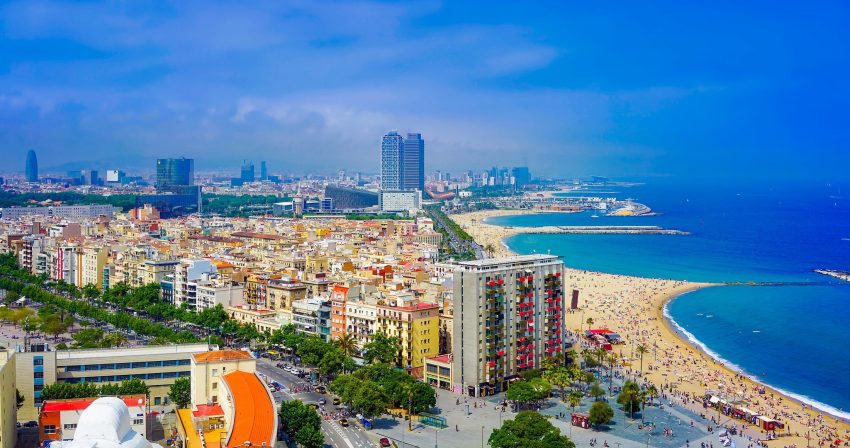
Picasso's Barcelona
Picasso’s Barcelona

This website uses affiliate links which earn a small commission at no additional cost to you.

Pablo Picasso, the great Spanish painter and sculptor, became an artist in Barcelona, spending key years here from his mid-teens into early adulthood (roughly 14 to 23). Born in Málaga, he later spoke of Barcelona with a particular kind of nostalgia, as if the city had become his emotional “home”: the streets, studios, cafés, and friendships that formed his earliest artistic instincts. In 1936 he wrote, “Barcelona the beautiful and wise, where I left so many things hanging on the altar of happiness…”

This self-guided walk follows that Barcelona on foot, linking the places that trained his eye and propelled his ambition. Along the way you'll visit the Museu Picasso and several public-facing settings-cafés and galleries-where his work first entered the city's creative conversation. It also places you inside the modernista atmosphere of the period, when Barcelona ran on late nights, argument, experimentation, and appetite for the new.

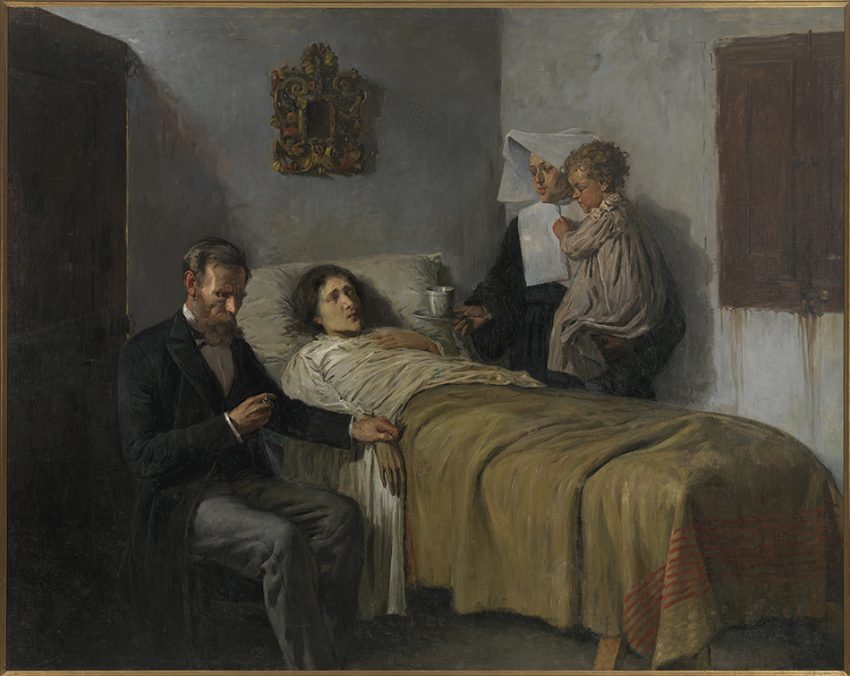
You'll start at Llotja de Barcelona, where discipline and draftsmanship were drilled into him, then move through streets and viewpoints that reveal the old city as both subject and stage. As his circle widened-art, nightlife, provocation-stops like Els Quatre Gats and Carrer d'Avinyó become part of the storyline, especially if you're thinking ahead to Les Demoiselles d'Avignon. The route then leads you into El Born to finish at the museum on Carrer de Montcada, set inside Gothic palaces and grounded by early works such as The First Communion (1896) and Science and Charity (1897), alongside pieces Picasso continued to support throughout his life.

How to Get to Picasso’s Barcelona

By Air: Barcelona-El Prat Airport (BCN) is the main gateway for most visitors and has frequent flights from across Europe and beyond. The simplest way into the city is the Aerobús to Plaça de Catalunya (a central hub for onward metro and walking routes), or the metro (L9S) to connect with other lines toward the centre; taxis are straightforward too if you're arriving late or carrying luggage. From the centre, Picasso sites cluster around the Gothic Quarter and El Born, which are easy to reach on foot or by a short metro ride. For the best deals and a seamless booking experience, check out these flights to Barcelona on Booking.com.

By Train: Barcelona Sants is the city's primary station for high-speed AVE services and long-distance routes, while França Station is historically linked to the old city and can be convenient depending on your arrival. From Sants, use the metro (typically Line 3 or Line 5 connections) or a quick taxi to reach the Gothic Quarter/El Born area where much of a Picasso-focused walk sits; from França, you're already close enough to walk into the historic streets around Carrer de Montcada. If you're arriving from elsewhere in Catalonia, Rodalies (commuter rail) can also drop you into well-connected central stations for an easy start. Train schedules and bookings can be found on Omio.

By Car: Driving into central Barcelona is rarely the most efficient option because of congestion, limited street parking, and traffic restrictions in parts of the inner city. If you do come by car, aim to park once in a paid garage near the edge of the old town (around Eixample, Port Vell, or the perimeter of El Born) and complete the route on foot, which suits the narrow medieval lanes and stop-and-start sightseeing pace. If you're staying outside the centre, consider leaving the car at your accommodation and using the metro or buses for the final leg to avoid parking stress. If you are looking to rent a car in Spain I recommend having a look at Discover Cars, first, as they compare prices and review multiple car rental agencies for you.

By Bus: Long-distance coaches typically arrive at Barcelona Nord station, which is well placed for a Picasso-themed route because it's a short hop from El Born and the Gothic Quarter. From Nord you can walk in around 20-30 minutes depending on your pace, or take a quick taxi/metro connection to begin near Llotja de Barcelona, Carrer Avinyó, or the Picasso Museum area. This option is often good value, especially if you're arriving from nearby cities in Spain or southern France.

Picasso and Barcelona

Barcelona 1895-1897: Training, discipline, and the first serious work

Picasso's Barcelona story is easiest to understand if you start with Llotja de Mar. In the late 1890s this was where formal instruction and ambition intersected: drawing from life, mastering proportion, learning how to build a figure so it could carry weight and emotion. The “young genius” narrative is real, but Barcelona is where that talent was hardened into a working method. The self-portraits and academic studies from this period matter because they explain how he later felt free to distort bodies and space without losing structure.

From there, the city itself became a kind of second classroom. Moving between the waterfront and the old streets around what is now a very walkable central core, he absorbed the theatre of everyday Barcelona: workers, priests, families, illness, poverty, and the public rituals of a Catholic city modernising quickly. That tension-civic pride beside social hardship-helps explain why works from these years aren't just technical exercises. Even when the compositions are academic, the impulse is observational, as if he's already testing how painting can describe the real world rather than idealise it.

This foundation is also why later “breakthroughs” weren't a sudden invention from nowhere. Barcelona gave him repetition and endurance: the habit of returning to the same subject, redrawing it, and pushing it until it becomes a personal language. In that sense, this first chapter of the walk isn't about a picturesque stop; it's about the engine room of his craft.

Barcelona 1898-1901: Cafés, bohemia, and the modernista network

If Llotja de Mar represents discipline, 4 Gats represents permission. This café-bar was a hub of the modernista scene where artists, writers, and provocateurs argued about what art should do next. For Picasso, it was a place to sharpen identity as much as technique: to show work, meet collaborators, and learn how reputation is built through conversation, rivalry, and visibility. The city’s café culture trained him to work fast, to respond, and to treat drawing as something immediate-almost journalistic-rather than precious.

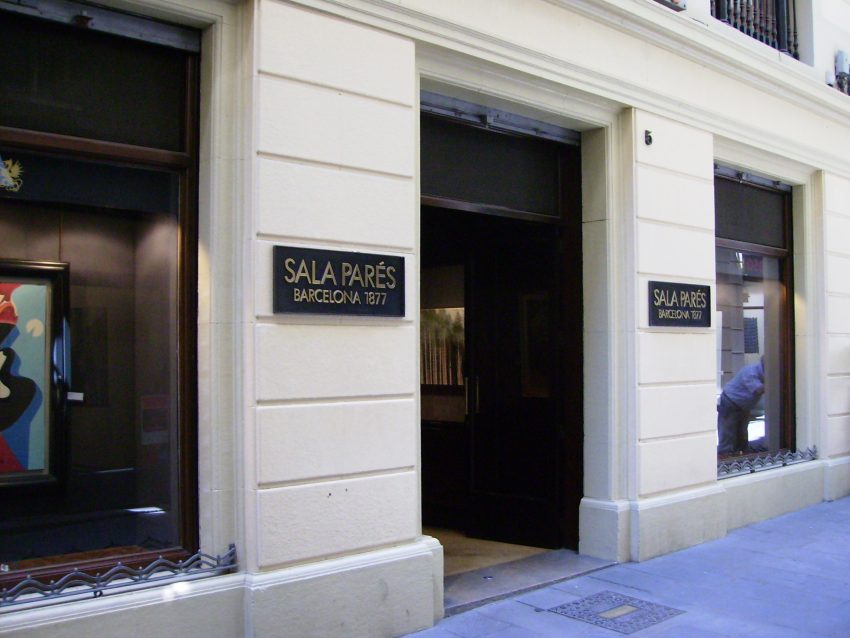
Sala Parés also matters in this phase, because it represents the public-facing side of an artist's life: exhibiting, being judged, and learning how tastes and markets shape what gets seen. Barcelona didn't only offer a bohemian myth; it offered institutions-galleries, critics, patrons-that forced Picasso to negotiate between private experimentation and public reception. That push-pull becomes a pattern across his career: he absorbs the world, then pivots against it.

When you place 4 Gats and Sala Parés on the same mental map, you get a clearer picture of Barcelona’s impact. One space fed the radical, social, restless Picasso; the other taught him how art circulates and how to position himself inside (and against) established culture.

Barcelona 1901-1907: Streets of memory, desire, and the darker edge of the city

As Picasso began spending more time in Paris, Barcelona remained the place he returned to in person and in imagination. Streets like Carrer d'Avinyó became part of his inner archive: the charged, nocturnal side of the city that mixed sex, danger, humour, and a kind of modern urban anonymity. Even if his most famous rupture paintings were executed elsewhere, Barcelona supplied emotional material and street-level realism-how bodies move, how people look at each other, how desire and commerce mingle in cramped lanes.

Other addresses on a Picasso walk-Carrer Nou de la Rambla, Carrer del Comerç, Carrer de la Plata-work less as “he did X here” trivia and more as a way to feel the texture that shaped him. This is the city of workshops and back streets, of quick encounters and long nights, of the old Gothic fabric pressing up against modern life. It helps explain why Picasso’s empathy can be so blunt and why his depictions of people can feel both intimate and unsparing: he learned early to look directly, without smoothing the edges.

Barcelona’s “modernity” wasn’t only architecture and optimism; it was also the visibility of outsiders and the precarious. That undertone sits behind the mood of his early blue-toned work and behind the way he could switch from tenderness to cruelty in a single line.

Barcelona after Picasso: Where the city keeps the story alive

The Museu Picasso is the clearest anchor for the Barcelona narrative because it doesn't just commemorate him; it shows formation. The early works make the point that Barcelona is not a footnote to a Parisian career-it is the formative laboratory. The museum's setting in connected medieval palaces also suits the story: Picasso's work is permanently in dialogue with tradition, and Barcelona is a city where the medieval and the modern coexist in the same walk.

Around the museum, the city has also built a public language of tribute and reinterpretation. Homenatge a Picasso is part of that: Barcelona marking its claim on the artist and reflecting him back through urban art rather than academic framing. And institutions like the Col·legi d'Arquitectes de Catalunya help contextualise the broader cultural environment Picasso grew up in-an ecosystem where design, architecture, and visual culture were taken seriously as expressions of a modern Catalan identity.

Seen this way, “Picasso's Barcelona” isn't just a list of stops. It's a story of training (Llotja de Mar), social ignition (4 Gats), public exposure (Sala Parés), street-level intensity (Carrer d'Avinyó and the old city lanes), and long-term memory (Museu Picasso and the city's tributes). The walk works because it mirrors how he developed: disciplined beginnings, then a rapid widening into the city's full complexity.

Where to Stay in Barcelona

To make the most of visiting Barcelona and this walking tour then you consider staying overnight at the centre. For the strongest “Picasso connection,” base yourself around Port Vell and the southern edge of the Gothic Quarter, where you're a short walk from Carrer de la Plata, Llotja de Mar, and the lanes that lead into the old city. The most on-theme option is Serras Barcelona, set in the building associated with Picasso’s early studio on Carrer de la Plata. Nearby, Hotel Neri and Wittmore Hotel keep you deep in the Gothic Quarter atmosphere for evenings after the walk, while Sonder DO Plaça Reial is a practical choice if you want quick access to La Rambla and easy taxi/metro connections without leaving the old town.

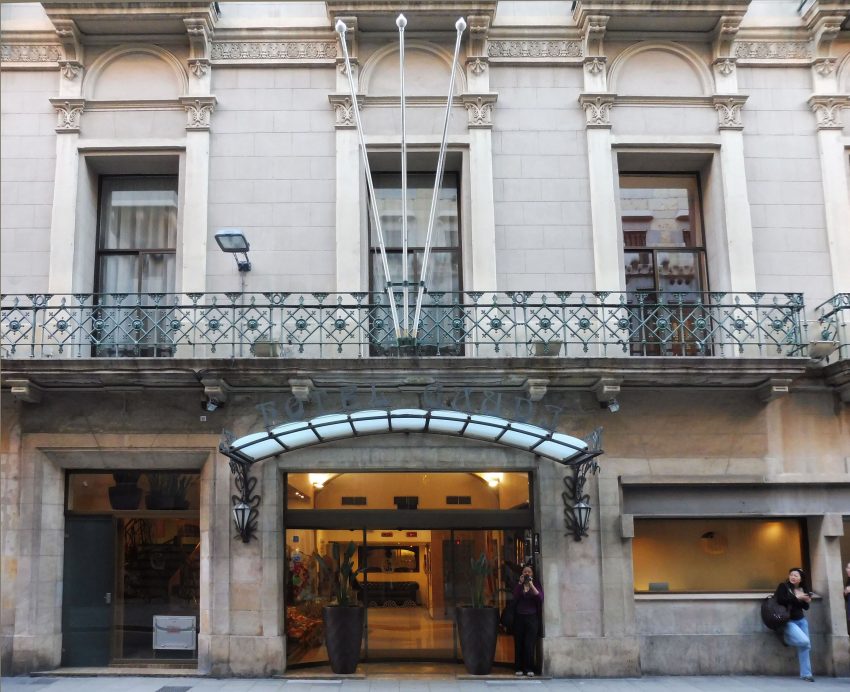
If you want to be closest to the Picasso Museum and the “workshops and bohemian streets” feel of El Born and Sant Pere, look around Via Laietana and the streets just behind it. Grand Hotel Central and H10 Montcada both put you within a very easy walk of Carrer de Montcada and the museum, and they’re well placed for reaching 4 Gats and Sala Parés on foot. For a more design-forward luxury base beside the market and steps from the same core area, The Barcelona EDITION works well, while Aparthotel Allada is ideal if you prefer extra space and a quieter street right in the same historic fabric.

For a slightly broader “city-centre” base that still keeps you walkable to Picasso's old Barcelona (and especially good if you'll mix the tour with nightlife, dining, and other sights), consider the Ramblas/Raval edge and the Avinyó side of the Gothic Quarter. Hotel 1898 is a reliable central hub for moving between the old town streets and the rest of the city, and Catalonia Avinyó puts you directly on Avinyó for that specific Picasso-linked ambience. If you like a boutique stay with a more local neighbourhood feel (and you’re happy to transit a short distance back into Ciutat Vella each morning), Hotel Brummell is well placed for the Nou de la Rambla/Paral·lel side of the story, and Casa Bonay is a stylish Eixample base that’s still a straightforward ride or brisk walk into the Born and Gothic Quarter.

Your Self-Guided Walking Tour of Picasso’s Barcelona

Discover Picasso's Barcelona on foot, with our walking tour map guiding you between each stop as you explore the streets, cafés, and corners that shaped his early years. Because it's a self-guided walking tour, you can set your own pace-skip any stops that don't interest you, linger longer where you want, and weave in coffee breaks whenever the mood strikes.

1. Llotja de Mar
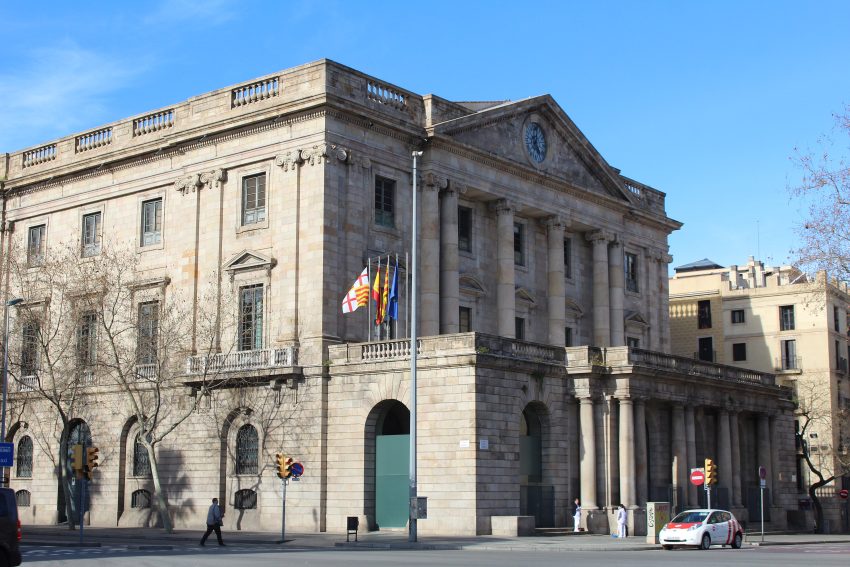
Casa Llotja de Mar
Casa Llotja de Mar
CC BY-SA 4.0 / Chabe01

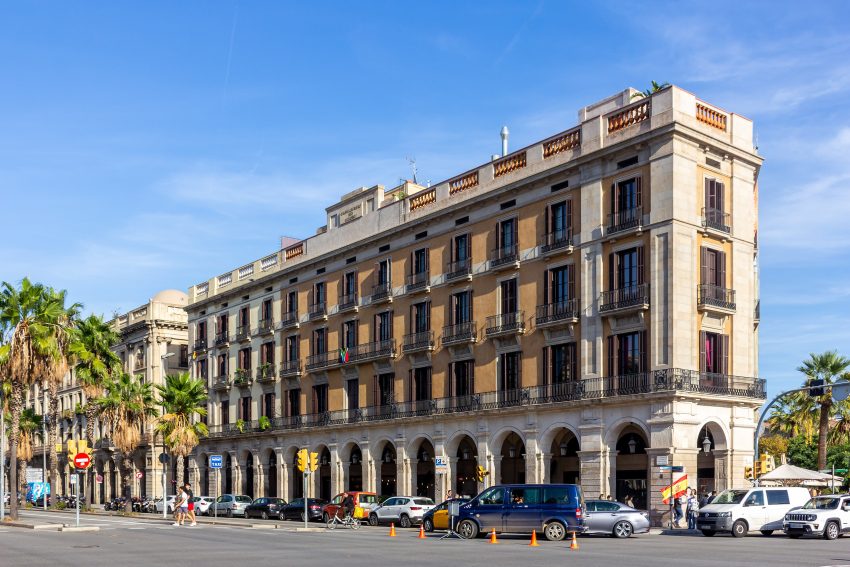
The Llotja de Mar is one of Barcelona’s great civic-commercial monuments: a medieval merchants’ exchange later refashioned with grand neoclassical ambitions. It sits in that seam between the old port economy and the city’s 19th-century cultural confidence, when Barcelona wanted its institutions to look as serious as its trade. Even if you only see it from outside, it reads as a statement building: ordered, formal, and designed to project stability.

What to see is the architecture itself and the atmosphere around it. Look for the restrained classical symmetry, the heavy stonework, and the way the building relates to the nearby waterfront routes that would have been busy with cargo, passengers, and gossip. It’s also a useful “mental anchor” for understanding how close art education and commerce were in Barcelona—patrons, newspapers, cafés, shipping money, and studios all fed the same streets.

The Picasso link is fundamental: the Llotja name is inseparable from the city’s art training because of the Escola de la Llotja, where Picasso studied as a teenager after arriving in Barcelona. This is where he sharpened academic drawing habits—precision, anatomy, disciplined line—that he could later bend, break, and reinvent. Seeing the Llotja in person helps you picture the young Picasso absorbing a rigorous, traditional foundation before he sprinted into modernity.


Location: Edifici Llotja, Pg. d'Isabel II, 1, Pis 2, Ciutat Vella, 08003 Barcelona, Spain | Hours: Monday – Friday: 08:00–18:00. Closed on Saturday, Sunday. | Price: Check official website. | Website


We recommend to rent a car in Spain through Discover Cars, they compare prices and review multiple car rental agencies. Book your rental car here.

2. Picasso First Home in Barcelona

Pg. d’Isabel II, 4
Pg. d’Isabel II, 4
CC BY-SA 4.0 / Mike Peel

This address sits on a prestigious edge of the old city, facing the port-facing promenades where Barcelona’s modern life arrived early: sailors, new cafés, imported ideas, and the bustle of a city looking outward. Buildings here tend to feel more “open” and worldly than the tighter medieval lanes, and that contrast matters when you’re tracing Picasso’s early Barcelona—he moved between cramped workshop streets and big-city boulevards.

What to see is the façade rhythm and the wider streetscape: arcades, ironwork, and the sense of a threshold between the Gothic Quarter’s density and the port’s airy openness. Take a moment to notice how quickly the mood changes as you pivot your view: behind you is the old city; ahead is a Barcelona tied to travel, trade, and a bigger horizon.

This spot is often connected with Picasso’s first Barcelona chapter because it’s associated with where he and his family lived soon after they arrived in the city. Whether you’re here for that specific biographical detail or simply the vibe, it’s a good place to think about Picasso as a newcomer—talented, ambitious, and suddenly in a metropolis that offered training, rivals, patrons, and constant visual stimulus.


Location: Pg. d'Isabel II, 4, Ciutat Vella, 08003 Barcelona, Spain | Hours: 24 Hours. | Price: Free.

Here is a complete selection of hotel options in Barcelona. Feel free to review each one and choose the stay that best suits your needs.

3. Picasso's First Workshop

Carrer de la Plata, 4
CC BY-SA 1.0 / Pablo Picasso

Carrer de la Plata is the kind of street where Barcelona’s old craft economy still feels close to the surface: narrow, practical, and historically linked to workshops and small-scale trade. Streets like this shaped daily life for artists—materials were bought nearby, frames were ordered locally, and studios were often just a short walk from suppliers and cafés. Even today, the lane’s proportions give you a sense of how compressed and intimate the city once felt.

What to see here is less a single monument and more the urban texture: the tight perspective, the older façades, and the way doorways and shopfronts sit close to the pedestrian flow. These are the lanes where you imagine a young artist moving quickly—sketchbook brain switched on—collecting faces, gestures, and street scenes.

In Picasso terms, this address is commonly included on Barcelona Picasso walks because it’s tied to his early studio geography in the old centre. The broader point is reliable even if you treat the exact doorway as symbolic: Picasso’s Barcelona wasn’t lived from afar. It was street-level, noisy, and made of small rooms and fast walks—conditions that suit an artist who worked like a sponge.


Location: Carrer de la Plata, 4, Ciutat Vella, 08002 Barcelona, Spain | Hours: 24 Hours. | Price: Free.

Traveling to a country with a different currency? Avoid ATM transaction fees and pay in local currency with a Wise Card. Having used it for over 5 years, we've saved loads on fees!

4. Carrer d'Avinyó, 44

Carrer d’Avinyó, 44
Carrer d’Avinyó, 44
CC BY-SA4.0 / Enric

Carrer d’Avinyó, 44 is a pinpoint stop in the Gothic Quarter that’s included on many Picasso-themed walks because it anchors one of the most persistent legends of his Barcelona years. The street itself is narrow and medieval in scale, with close façades, shifting light, and the kind of intimate atmosphere that makes the old city feel theatrical. You’re not here for a formal “attraction entrance” so much as for the setting—standing in a lane that still evokes the layered, sometimes shadowy social world artists moved through in the early 1900s.

This address is most often linked to the brothel said to have operated at number 44, frequently cited in popular accounts as a real-world reference point behind Les Demoiselles d’Avignon. Whether or not you treat the story as literal, it’s useful on a walking tour because it helps explain the kind of environments Picasso was willing to look at directly: private spaces, marginal lives, and subjects outside respectable society. That willingness feeds into the bigger shift the painting represents—an early step toward breaking bodies into sharper, more confrontational forms that would soon connect to cubism’s logic of analysis, deconstruction, and reassembly.

What to do here is simple but effective: pause, look up and down the street, and imagine how different this lane would have felt before modern shopfronts and restaurant signs. Notice how quickly the Gothic Quarter changes from busy corridors to quiet side streets within a block—exactly the kind of urban patchwork that made Barcelona such a charged place for a young artist. Then continue your Picasso walking tour toward El Born and the Museu Picasso, where you can reconnect the street-level myth and atmosphere with the actual works and early development the museum documents.


Location: Carrer d'Avinyó, 44, Ciutat Vella, 08002 Barcelona, Spain | Hours: Monday – Thursday: 09:00–14:00 & 15:00–18:00. Friday: 09:00–14:00. Closed on Saturday, Sunday. | Price: Free. | Website

Explore Barcelona at your own pace with our self-guided walking tour! Follow our curated route to discover must-see sights and local secrets that makes Barcelona one of the best places to visit in Spain.

5. Carrer Nou de la Rambla, 10

Nou de la Rambla 10
Nou de la Rambla 10
CC BY-SA 3.0 / Xavier Badia

Carrer Nou de la Rambla, 10 in El Raval, a low-key address that matters because it anchors Picasso’s Barcelona to a specific doorway and a specific moment. For Picasso fans, this isn’t about a museum interior or a photogenic facade—it’s about standing where his everyday working life unfolded, in a neighbourhood that still feels close to the city’s raw, lived-in rhythms. It sits roughly opposite Palau Güell, which makes it easy to pair art-history context with one of Gaudí’s most important early buildings.

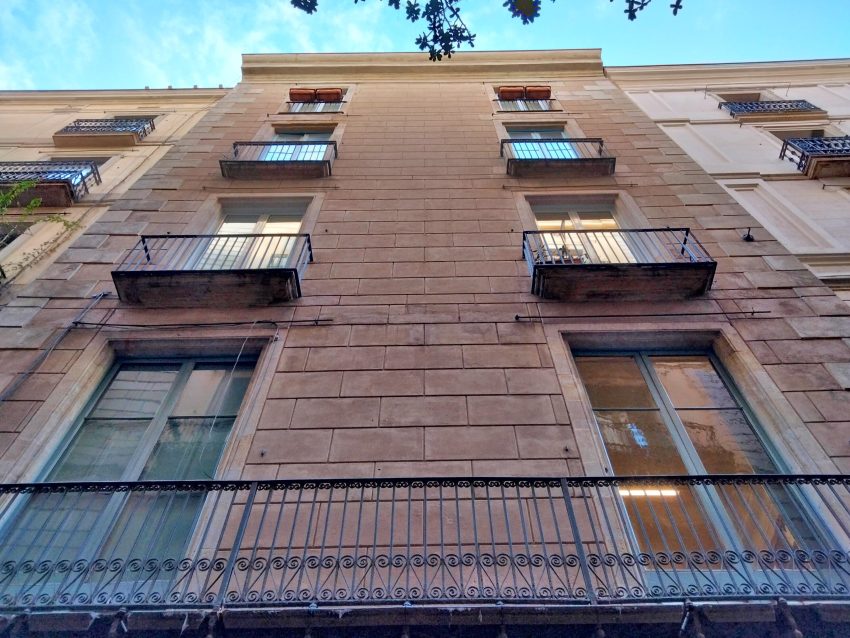
This address is linked to the studio Picasso rented in 1902 with painter Josep Rocarol and sculptor Àngel Fernández de Soto, during the unsettled years when he was constantly moving between Barcelona and Paris (1901–1904). His work wasn’t selling well, and he was living cheaply, shifting through modest rooms and hard-up apartments while his palette narrowed into the blue tones that define his Blue Period. The studio was on the top of the building, and from here he painted roof terraces and developed the moodier, more introspective themes that would soon make his early modern work unmistakable.

Just next door was the Eden Concert, a variety hall that Picasso and his friends frequented, and it fed directly into what he made—he drew quick sketches of performers, including cuplé singers from the era’s risqué theatre-song scene. Seen in the context of this walk, Carrer Nou de la Rambla, 10 is a “real-life coordinate” in Picasso’s story: a point where the city’s nightlife, rooftop views, and the harsher realities he was absorbing—poverty, addiction, and the human body—meet the creative pressure cooker of his early 20s.


Location: Carrer Nou de la Rambla, 10, Barcelona, Spain | Hours: 24 Hours, House viewed from street. | Price: Free | Website

Explore Barcelona at your own pace with our self-guided walking tour! Follow our curated route to discover must-see sights and local secrets that makes Barcelona one of the best places to visit in Spain.

6. Sala Parés

Sala Parés
Sala Parés
CC BY-SA 1.0 / Puigalder

Sala Parés is one of the classic names in Barcelona’s art scene, a gallery that helped formalise what it meant to “make it” locally. In the late 19th and early 20th century, galleries like this were gatekeepers and amplifiers: they shaped taste, connected buyers with painters, and anchored the idea of Barcelona as a serious cultural capital. It’s the kind of institution that reminds you modernism wasn’t only rebellion—it also needed rooms with good lighting and people willing to buy.

What to see is the gallery atmosphere and its continuity. Even if exhibitions change, spaces like this tend to preserve a certain tempo: quiet rooms, concentrated looking, and a sense of tradition. It’s worth noticing how a commercial gallery’s calm can contrast with the noisy café culture nearby—two different ecosystems that artists navigated constantly.

Picasso’s link to Sala Parés is the story of a young artist moving from student promise to public visibility, in a city where showing work mattered. Barcelona’s gallery circuit was part of his early professional formation: not just learning to draw, but learning how art entered society—through critics, collectors, and conversation. Visiting Sala Parés helps you picture Picasso not only as a genius-in-isolation, but as an ambitious young professional in a competitive scene.


Location: Carrer de Petritxol, 5, Ciutat Vella, 08002 Barcelona, Spain | Hours: Tuesday – Saturday: 11:00–14:00 & 16:00–20:00. Sunday – Monday: Closed. | Price: Free. | Website

Explore Barcelona at your own pace with our self-guided walking tour! Follow our curated route to discover must-see sights and local secrets that makes Barcelona one of the best places to visit in Spain.

7. Col·legi d'Arquitectes de Catalunya
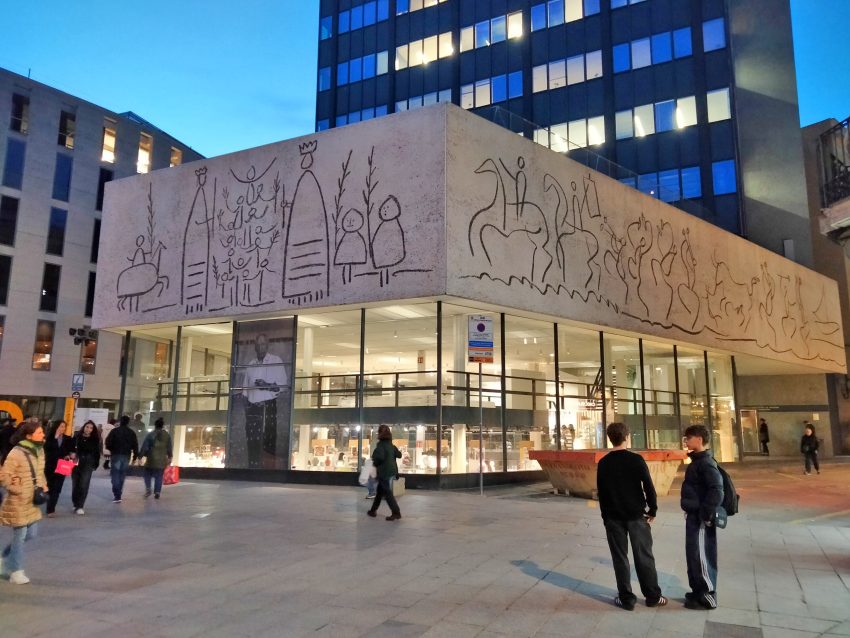
COAC (Col·legi d’Arquitectes de Catalunya)
CC BY-SA 4.0 / Enric

This building matters because it’s where Barcelona literally wears Picasso on its skin. The modern façade near the cathedral became a stage for a celebrated frieze design associated with Picasso—an emblem of how the city later claimed him as part of its cultural identity, even as his career and fame became global. It’s a great stop for understanding “Picasso in Barcelona” as a story that continues well beyond his youth.

What to see is the façade artwork and how it behaves in daylight. Step back far enough to read the sequence, then move closer to appreciate the line quality and the way the imagery plays against the building’s modern geometry. It’s also a good place to watch how passers-by react—some glance, some stop, some photograph—because public art always reveals a city’s habits.

The Picasso connection is explicit: it’s a public-facing homage that embeds his visual language into the everyday life of the Gothic Quarter. Conceptually, it’s also a reminder that Picasso’s Barcelona is not only preserved in museums and archives; it’s also curated in the streets as civic memory. This stop marks the point where biography becomes mythology—and where Barcelona presents Picasso as part of its own brand of modern creativity.


Location: Plaça Nova, 5, Ciutat Vella, 08002 Barcelona, Spain | Hours: Monday – Friday: 10:00–19:00. Saturday: 10:00–14:00. Closed on Sunday. | Price: Free. | Website

8. 4 Gats
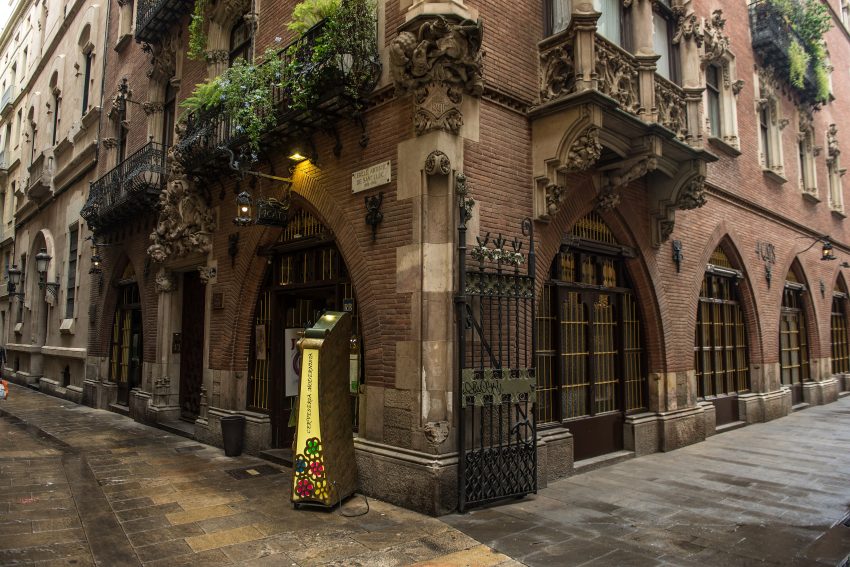
Els 4 Gats
Els 4 Gats
CC BY-SA 2.0 / Ralf Roletschek

4 Gats is the quintessential Barcelona modernist hangout: a café-cabaret where art, satire, music, and gossip mixed into something combustible. It was modeled on Parisian precedents but became distinctly local—an incubator for the city’s avant-garde, where young artists found peers, patrons, and the confidence to be loud about being new. In Picasso terms, it’s one of the most vivid portals into his formative social world.

What to see is the interior mood: the posters, the decorative details, and the sense of performance that still clings to the place. Even when it’s busy, look for the cues that this wasn’t just a café; it was a cultural engine. Imagine the tables as temporary studios—sketches made fast, ideas exchanged faster.

Picasso’s relationship to 4 Gats is unusually concrete: he wasn’t merely a visitor, he was part of the scene, and the venue is closely tied to his early exhibitions and social network in Barcelona. This is where the “young Picasso” feels most human—eager, sociable, and sharpening his identity through other artists’ reactions. If you want one stop that explains how Barcelona helped accelerate his development, 4 Gats is it.


Location: Carrer de Montsió, 3, Ciutat Vella, 08002 Barcelona, Spain | Hours: Tuesday – Saturday: 11:00–24:00. Sunday: 12:00–17:00. Closed on Monday. | Price: Free to enter; food and drinks are paid. | Website

9. Carrer del Comerç, 28
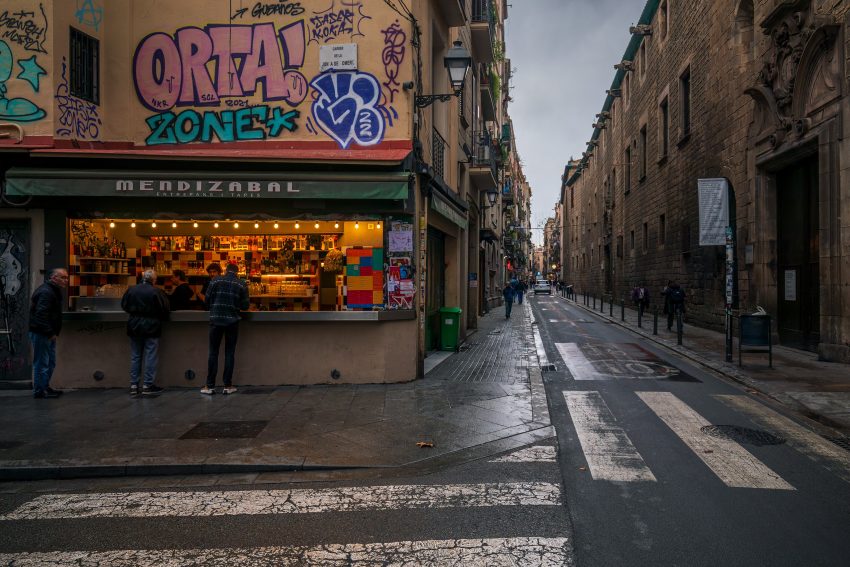
Carrer del Comerç, 28
CC BY-SA 3.0 / Ximonic

Carrer del Comerç sits in El Born, a district that historically blended trade, workshops, and a street-level intensity that’s ideal for art-watching. The street’s name is honest: commerce was the lifeblood here, and the built environment reflects that practical, mixed-use past. It’s also close to the cluster of medieval palaces and lanes that now hold some of the city’s key cultural institutions.

What to see is the neighbourhood character: stone façades, older doorways, and the way the street connects you into a walkable web of small squares and narrow passages. El Born is best appreciated at human pace—stop often, look upward, and notice how the district’s medieval scale creates a constant sense of discovery.

Its Picasso relevance is strongest in context: this is part of the compact zone where Picasso’s Barcelona story is easiest to trace on foot, because the museum and many “Picasso-era” streets sit close together. Even when a specific doorway isn’t famous, being here helps you feel how tight the geography is—how quickly Picasso could move from studio life to cafés to galleries to the urban theatre of the streets.


Location: Carrer del Comerç, 28, Ciutat Vella, 08003 Barcelona, Spain | Hours: 24 Hours to view from street. | Price: Free. | Website

10. Homenatge a Picasso

Monument Homenatge a Picasso, 1983
CC BY-SA 4.0 / Enric

This tribute is a later Barcelona speaking back to Picasso—a public artwork that acknowledges his importance while placing him within the city’s own post-war and post-dictatorship cultural narrative. It’s not about the young painter in cafés; it’s about the legacy figure and what his name means to Barcelona as a modern European city. In other words, it marks the shift from “Picasso lived here” to “Picasso belongs to our story.”

What to see is the work’s form, its material presence, and its setting in public space. Walk around it and pay attention to silhouette and texture; tributes like this often reward slow looking more than quick photos. Also notice how the surrounding park/city environment changes your perception—public art isn’t isolated, it’s constantly edited by weather, light, and people.

The Picasso tie is interpretive as much as biographical. This stop asks you to think about how artists become symbols, and how cities choose the version of an artist they want to celebrate. It’s a useful counterpoint to the intimate, early-life stops: here, Picasso is not the ambitious youth but the cultural monument—admired, contested, and permanently woven into Barcelona’s identity.


Location: Passeig de Picasso, 13, Ciutat Vella, 08003 Barcelona, Spain | Hours: 24 Hours. | Price: Free.

11. Museu Picasso
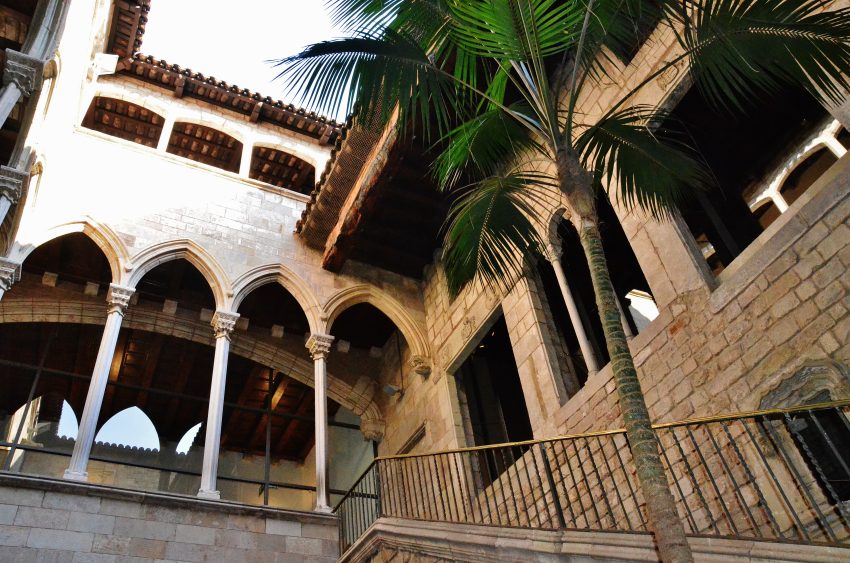
Picasso Museum Barcelona
CC BY-SA 2.0 / MARIA ROSA FERRE

The Museu Picasso is the key institution for understanding how Barcelona shaped Picasso before the world did. The collection is especially strong in early work, which matters because it lets you see the “before” with unusual clarity: academic training, youthful experiments, and the rapid evolution that happens when talent meets a city full of stimuli. The setting—historic palaces in the old city—adds another layer: the modern artist framed by medieval Barcelona.

What to see is the developmental story the galleries can tell. Focus on the shift in drawing confidence, the changing treatment of faces, and the way he moves from observation to invention. If you’re trying to connect street stops to the art, this is where you’ll find the visual proof: the teenager who mastered discipline, the young man who started to compress and distort, and the emerging modernist who refused to stay inside one style.

Its relationship to Picasso is obvious, but the deeper point is why the museum is in Barcelona at all. This city isn’t a footnote in his biography; it’s the furnace where he became Picasso. A good way to end your walk is to enter with the streets still fresh in your head—then you’ll recognise how the neighbourhood’s textures, the social energy of places like 4 Gats, and the training linked to Llotja echo through the work on the walls.


Location: Carrer de Montcada, 15-23, Ciutat Vella, 08003 Barcelona, Spain | Hours: (Winter) September 29 – March 29; Tuesday – Sunday: 10:00–19:00. Closed on Monday. (Summer) March 31 – September 27; Tuesday, Wednesday & Sunday: 09:00–20:00. Thursday – Saturday: 09:00–21:00. Closed on Monday. | Price: General admission: €13 (€12 online). Reduced: €7. Under 18: free. | Website
Powered by GetYourGuide
Moira & Andy
Moira & Andy

Hey! We're Moira & Andy. From hiking the Camino to trips around Europe in Bert our campervan — we've been traveling together since retirement in 2020!

Read our full story here

This website uses affiliate links which earn a small commission at no additional cost to you.

Walking Tour Summary

Distance: 5 km
Sites: 11

Walking Tour Map
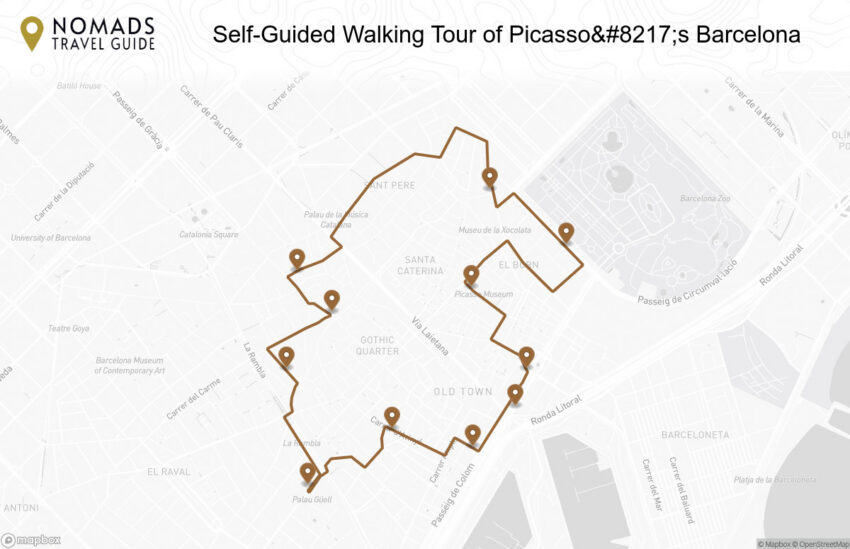
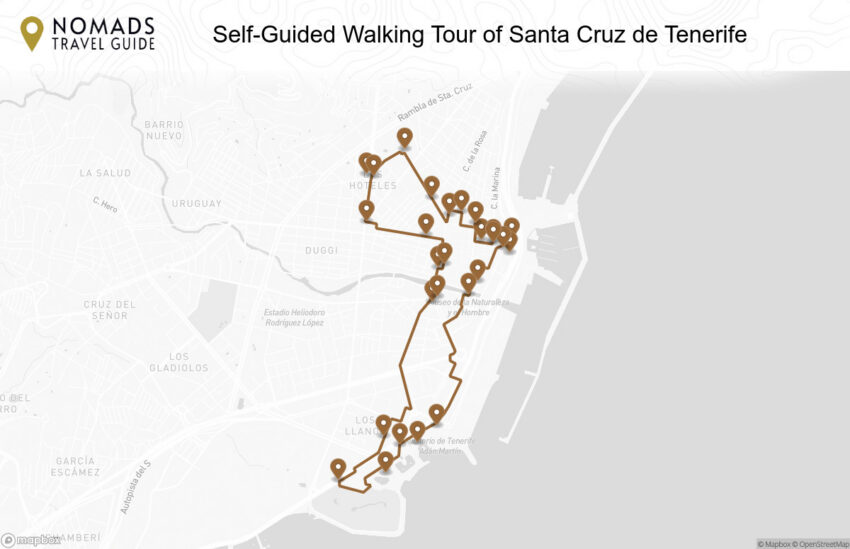
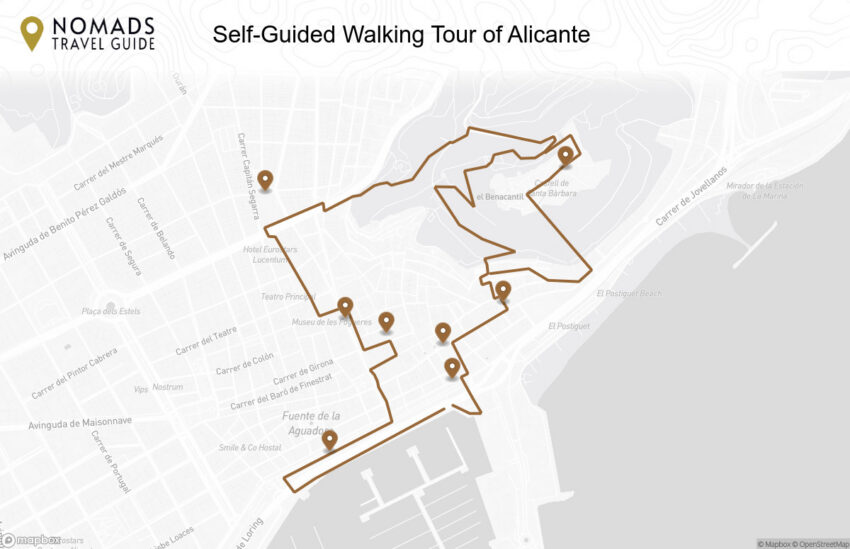
Map of the Self-Guided Walking Tour of Picasso’s Barcelona walking route with 11 stops in Barcelona.
Preview map of the Self-Guided Walking Tour of Picasso’s Barcelona route in Barcelona, showing 11 stops. Use the interactive map to zoom and tap markers.

More from this area

Self-Guided Walking Tour of Gaudi's Barcelona (2026)

Self-Guided Walking Tour of Gaudi's Barcelona
Self-Guided Walking Tour of Gaudi’s Barcelona

This website uses affiliate links which earn a small commission at no additional cost to you.

Barcelona can feel like an open-air gallery of Antoni Gaudí's imagination, where everyday streets suddenly turn into waves, mosaics, and stone that seems to breathe. A self-guided walking tour is the best way to take it in properly, because you can pause when something catches your eye, loop back for a better angle, and linger in the moments that feel uniquely Barcelona.

This route is built for curious walkers who want the story behind the city's most iconic Modernisme landmarks, not just a checklist. You'll connect major highlights with smaller details that are easy to miss when you're rushing, and you'll get a clearer sense of how Gaudí's work fits into Barcelona's broader creative energy. If you're wondering about the best things to see in Barcelona, this walk threads many of them into one satisfying day.

Expect a mix of grand “wow” moments and quieter architectural surprises, with plenty of chances to stop for coffee, a bakery break, or a shaded bench when you need it. You can do the tour straight through, or split it into two halves if you want time for interior visits and museums. Either way, you'll finish with a stronger feel for why Gaudí's Barcelona isn't just beautiful-it's a whole way of seeing the world.

How to Get to Barcelona

By Air: Barcelona-El Prat Airport (BCN) is the main international gateway and sits roughly 12-15 km from the centre. The easiest public options are the Aerobús to Plaça de Catalunya (a convenient jump-off point for the Passeig de Gràcia Gaudí sights) or the metro (L9 Sud) with a connection onward into the city; taxis and ride-hails are plentiful if you're arriving late or carrying luggage. If your first stop is Sagrada Família, plan on one connection from the airport unless you're taking a direct taxi. For the best deals and a seamless booking experience, check out these flights to Barcelona on Booking.com.

By Train: Barcelona Sants is the primary station for high-speed AVE and long-distance services, with additional regional arrivals at Passeig de Gràcia and França depending on your route. For Gaudí-focused sightseeing, arriving at (or transferring to) Passeig de Gràcia station can be particularly practical because it puts you near Casa Batlló and La Pedrera, while Sants is best if you want straightforward metro connections and lots of onward transport options. If you're coming from elsewhere in Catalonia, Rodalies trains are frequent, but allow extra buffer time during peak commuting hours. Train schedules and bookings can be found on Omio.

By Car: Driving into central Barcelona is doable, but it's rarely the most relaxing way to start a Gaudí day because traffic, limited parking, and one-way streets add friction. If you do arrive by car, consider parking in a secure garage outside the tightest central zones (or near a metro stop) and switching to public transport for the main sights; it's also worth checking whether your accommodation sits within the city's low-emission restrictions and what that means for your vehicle. For a self-guided walking tour, the car is most useful for getting to the city rather than moving between Gaudí sites once you're there. If you are looking to rent a car in Spain I recommend having a look at Discover Cars, first, as they compare prices and review multiple car rental agencies for you.

History of Gaudi’s Barcelona

Barcelona Before Gaudí: Medieval Roots, Markets, and a City of Craft (Until the mid-1800s)

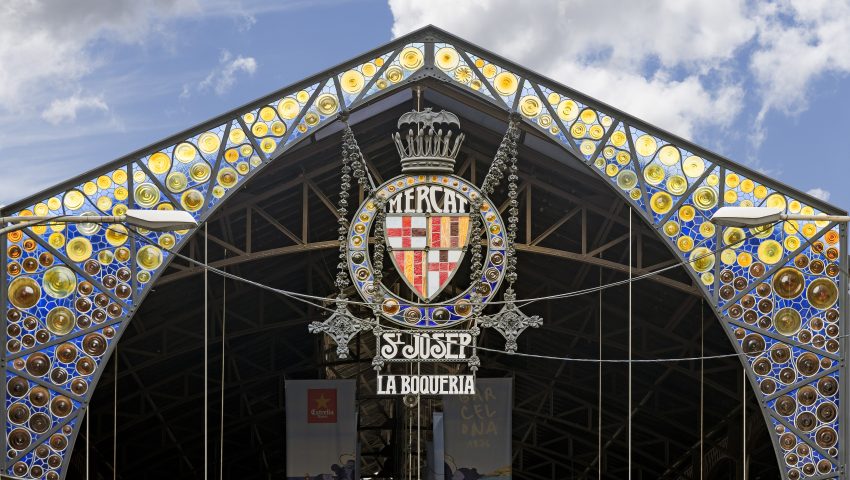
Before Gaudí reshaped the city's skyline and streetscape, Barcelona's character was already defined by layered history, skilled craftsmanship, and an intense street-level culture. The Gothic Quarter represents that older Barcelona: stone-heavy, devotional, and built through centuries of incremental change rather than single grand visions. Commerce and daily ritual mattered just as much as monuments, and Mercado de La Boqueria reflects a tradition of public markets as social infrastructure-places where the city's identity was reinforced every day through food, trade, and conversation. This pre-Gaudí Barcelona also carried a strong artisan backbone, which later became crucial when Modernisme demanded ceramicists, ironworkers, stained-glass makers, and sculptors capable of turning architecture into a total art form.

Barcelona Becomes Modern: Expansion, Confidence, and the Conditions for Modernisme (mid-1800s-1890s)

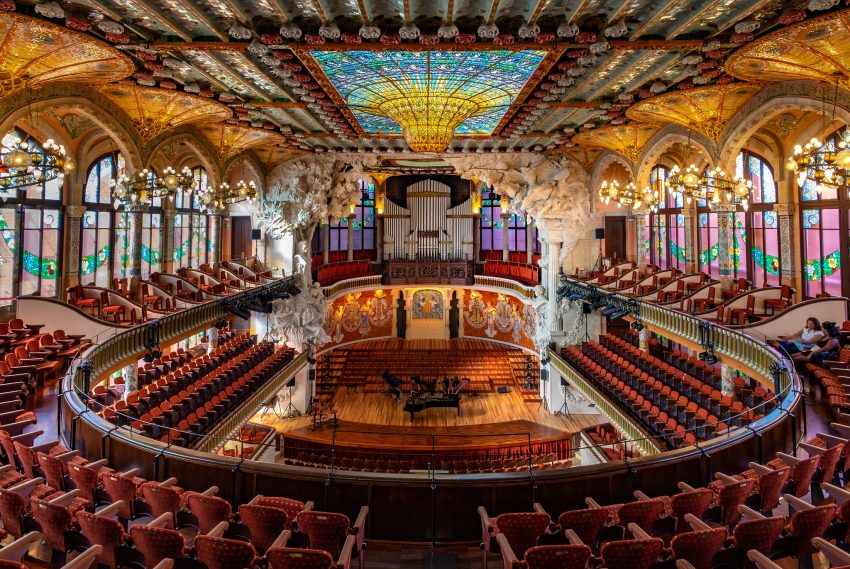
As Barcelona modernised and prosperity grew, architecture became a way to project ambition and cultural identity. Public life expanded into new civic spaces and new kinds of leisure, and places like Ciutadella Park signalled a Barcelona that wanted to look outward, host grand occasions, and present itself as progressive. At the same time, a rising urban elite began commissioning buildings that weren't merely functional-they were statements. This is where the city's creative energy starts to concentrate into what becomes Modernisme: a movement that treated buildings as immersive artworks, fusing structure with craft. The Palace of Catalan Music sits within that wider surge of confidence and artistry, showing how Barcelona's cultural institutions and architectural experimentation were becoming inseparable.

Barcelona and Gaudí’s Early Rise: A New Architectural Language Takes Hold (1890s-1905)

When Gaudí's work begins to dominate the conversation, it doesn't feel like a gentle evolution of style-it reads like a new language. He draws on craft traditions but pushes them into forms that seem grown rather than built, with façades that tell stories and surfaces that behave like living skin. In this period, the seeds of “Gaudí's Barcelona” become visible in the way domestic architecture is elevated into urban spectacle. CASA BATLLÓ begins to redefine what a city house can express, turning the street façade into a narrative object rather than a polite frontage. Around the same time, the city's appetite for innovation creates the ideal conditions for Gaudí's ideas to be taken seriously rather than dismissed as eccentric.

Barcelona’s Gaudí Peak: Domestic Masterworks and the City as Sculpture (1905-1915)

This decade is when Gaudí's work becomes inseparable from Barcelona's self-image. CASA BATLLÓ and Casa Milà push residential architecture beyond comfort and prestige into something closer to civic mythology-buildings that people read emotionally, even before they understand them intellectually. Casa Milà, in particular, signals a Barcelona willing to accept radical form in a prime urban setting: stone that undulates, ironwork that feels hand-drawn, rooftops that operate like a gallery. In Gràcia, the Gaudí story also becomes neighbourhood-scale, not just landmark-scale, because the area's creative identity and street life make it a natural home for architecture that rewards slow looking and repeated visits.

Barcelona and the Total Environment: Parc Güell and the Long Sacred Project (1900s-1926)

Parc Güell shows Gaudí thinking beyond single buildings and into complete environments-routes, terraces, textures, and viewpoints designed as one continuous experience. It's Barcelona rendered as a walkable artwork, where structure and landscape cooperate rather than compete. Over these same years, La Sagrada Familia grows from a major commission into a consuming life project, with the city effectively watching a new symbol being built in real time. The power of this period is that it captures two sides of Gaudí's Barcelona at once: the playful, public-facing imagination of Parc Güell and the intense spiritual ambition of La Sagrada Familia, both rooted in the same belief that architecture can shape how people feel, not just how they move.

Barcelona After Gaudí: Preservation, Reinterpretation, and a Living Legacy (1926-1980s)

After Gaudí, Barcelona's relationship with his work passes through phases of neglect, rediscovery, and argument. The city changes politically and culturally, and Modernisme shifts from “new style” to “heritage” with all the tension that implies: what to restore, what to alter, and how to explain it to a public that may no longer share the original context. La Sagrada Familia becomes the clearest symbol of this complexity because its incompletion invites permanent debate about continuity and intent. Meanwhile, the older Barcelona layers-like the Gothic Quarter's historical gravity and the everyday pull of Mercado de La Boqueria-continue to keep the city grounded, reminding visitors that “Gaudí's Barcelona” sits on top of a much longer story.

Barcelona Today: Global Icon Status, Tourism Pressure, and Ongoing Questions (1990s-Now)

In the contemporary city, Gaudí's sites have become both cultural treasures and logistical challenges. Restoration and interpretation have elevated experiences at CASA BATLLÓ and Casa Milà, while Parc Güell has shifted from local landmark to global pilgrimage point, changing how the space is managed and how it feels on the ground. La Sagrada Familia remains the centre of gravity because it is still evolving, forcing Barcelona to treat heritage as something active rather than finished-an identity that's continually being negotiated. What makes the history of Gaudí's Barcelona compelling now is that it isn't only about what was built; it's about how the city keeps absorbing, protecting, and redefining these places while trying to keep everyday neighbourhood life intact, especially in areas like Gràcia and around the most visited landmarks.

Where to Stay in Barcelona

To make the most of visiting Barcelona and this walking tour, you should consider staying overnight in the centre, ideally around the Eixample Dreta and Passeig de Gràcia where several key Gaudí stops cluster naturally into a walkable day. This base makes it easy to start with Casa Batlló and Casa Milà and still reach other highlights with a short metro hop when needed. Good picks here include Majestic Hotel & Spa Barcelona, Hotel Casa Fuster, and H10 Casa Mimosa, with Cotton House Hotel, Autograph Collection as a stylish alternative that still keeps you close to the Modernisme corridor.

If you want the same central convenience but a slightly calmer, better-value feel (while staying well connected to the main walking-tour start points), look around the Eixample edges near Provença/Diagonal or Plaça de Catalunya. From here, you can reach Passeig de Gràcia in minutes and also have fast train and metro links for day trips or airport transfers. Consider Olivia Balmes Hotel, Hotel Condes de Barcelona, and Hotel Granvia, with Hotel Jazz as a practical option if you want to be close to transport and still within easy reach of the Gaudí-heavy streets.

For a more local neighbourhood vibe that still suits a Gaudí-focused itinerary, Gràcia is a strong base, especially if you plan to spend time around Parc Güell and want cafés and small squares that feel lived-in after the day-trippers leave. You’ll likely use the metro to link to Passeig de Gràcia, but you’ll be sleeping in a calmer pocket of the city. Options worth considering are Casa Gracia (right on the boundary with Eixample), Aparthotel Silver, and Hotel Ronda Lesseps which can work well if you’re prioritising Parc Güell access and don’t mind short metro rides to the rest.

If you’d rather wake up close to La Sagrada Familia and build the day outward from there, staying in the Sagrada Família/Eixample north-east area can be efficient, particularly if you’ve booked an early entry time. It’s also a straightforward setup if you plan to use the metro to stitch the route together (and it’s easy to reach the main stations for train travel). Look at Radisson Blu 1882 Hotel, Barcelona Sagrada Familia, Hotel Sagrada Familia, and Eurostars Monumental for a mix of comfort levels while keeping you close to the basilica and well connected to the rest of the walking tour.

If you want atmospheric evenings and easy access to food markets, historic lanes, and concert venues (while still reaching Gaudí sites by metro), the Gothic Quarter and nearby old-town streets can be a rewarding base. You'll trade some pure “Gaudí-on-your-doorstep” convenience for character, late-night dining, and the feeling of stepping straight into the city's oldest layers after your daytime architecture loop. Consider Hotel Neri Relais & Châteaux, Kimpton Vividora Hotel, H10 Madison, or Catalonia Catedral for a central, walk-everywhere base that pairs well with the walking tour’s start-and-finish flexibility.

Your Self-Guided Walking Tour of Gaudi’s Barcelona

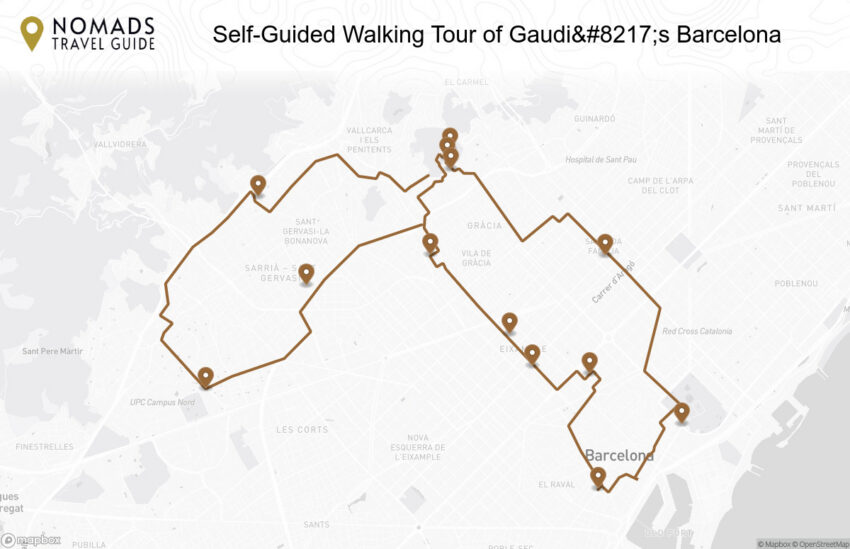
Discover Gaudí's Barcelona on foot with our walking tour map guiding you between each stop, from the soaring vision of La Sagrada Família to the sculpted stone curves of Casa Milà and the storybook façade of Casa Batlló. Because this is a self-guided walking tour, you can set your own pace-pause to admire the mosaic details, skip any stops that don't interest you, and fit in coffee breaks whenever you like, whether you're heading toward the playful forms of Parc Güell or simply following Gaudí's imagination street by street.

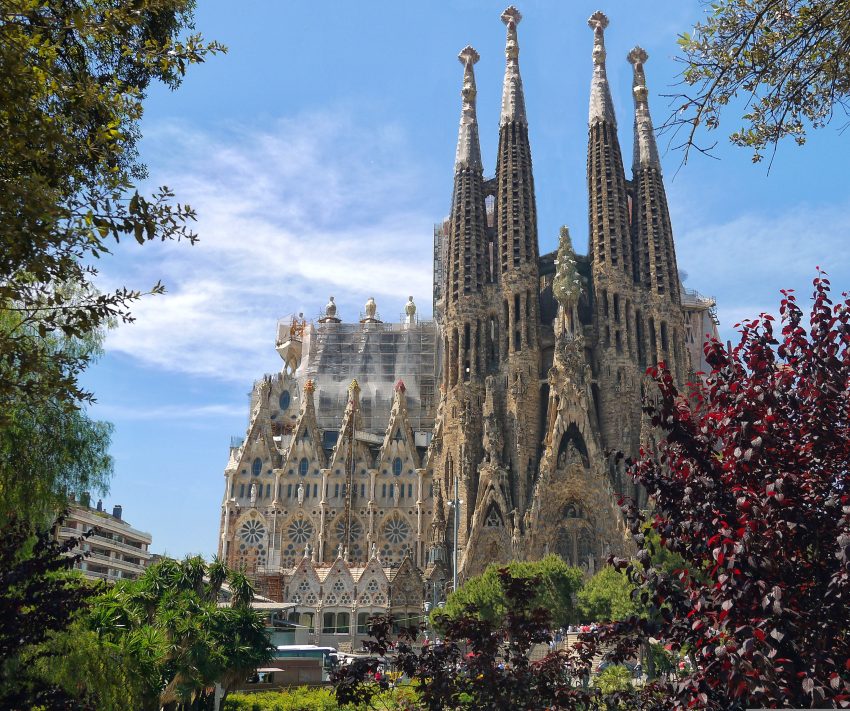
1. La Sagrada Familia

Basílica de la Sagrada Família

This is Gaudí’s central project and, in a way, his most direct statement about what architecture can be when it’s treated like a living system rather than a style. Work began in the 1880s, Gaudí took over early, and the building has continued long after his death—so you’re seeing both his thinking and the ongoing effort to realise it. The historical hook is that it’s not “finished history”: it’s a continuing construction narrative that still shapes how Barcelona presents itself.

What to see starts with the interior, because that’s where Gaudí’s engineering becomes emotional. The columns branch like trees, and the stained glass behaves like a climate—cool and warm zones shifting through the day. If you’re trying to understand Gaudí quickly, focus on how structure and decoration are the same thing here: the forms that hold the building up are also the forms that create the mood.

Outside, treat the façades as contrasting essays. One is dense and organic, the other stark and angular, and the tension between them shows how Gaudí could move from naturalism to near-abstraction without losing coherence. If you do a tower, the payoff isn’t just the view; it’s seeing how the geometry tightens as you get closer to the spires and apertures.


Location: Carrer de Mallorca, 401, Eixample, 08013 Barcelona, Spain | Hours: (Summer) April 1 – September 30; Daily: 09:00–20:00. (Winter) November 1 – February 28; Monday – Saturday: 09:00–18:00. Sunday: 10:30–18:00. | Price: Adults: €26 (includes audioguide app); With towers: €36; Guided tour: €30; Guided tour with towers: €40; Under 11: free. | Website

We recommend to rent a car in Spain through Discover Cars, they compare prices and review multiple car rental agencies. Book your rental car here.

2. Ciutadella Park

Barcelona- Parc de la Ciutadella
CC BY-SA 2.0 / Jorge Franganillo

Ciutadella Park isn’t a Gaudí “site” in the way Parc Güell is, but it’s useful as a pre-Gaudí baseline—and it contains a small, early Gaudí connection. The monumental cascade fountain was primarily Josep Fontserè’s work, with Gaudí contributing in a limited way when he was still young (often linked to the fountain’s hydraulic/engineering aspects).

What to see, through a Gaudí lens, is how 19th-century civic grandeur differs from Gaudí’s later organic Modernisme. The fountain aims for theatrical classicism—symmetry, allegory, a “Trevi” kind of drama—whereas Gaudí later pushes toward nature-derived structure and immersive surfaces. Walking from the cascade into the park’s calmer areas, you can feel how Barcelona’s public space evolves from monumentality toward the more experiential, path-based landscapes Gaudí would make famous.

Use the park as a breather between more intense architecture stops. It’s also a good place to reset your eye: after a couple of Gaudí interiors, the park’s open sightlines and simpler forms make it easier to notice what’s actually distinctive about Gaudí—curvature with intent, structure expressed as form, and ornament that’s doing a job.


Location: Passeig de Picasso, 21, Ciutat Vella, 08003 Barcelona, Spain | Hours: Daily: 7:00 AM – 10:30 PM | Price: Free to enter the park; you only pay for specific attractions inside (for example, the zoo or boat rental on the lake). | Website

Here is a complete selection of hotel options in Barcelona. Feel free to review each one and choose the stay that best suits your needs.

3. Palau Guell

Palau Güell
Palau Güell
CC BY-SA 2.0 / Fred Romero

Palau Güell is one of Gaudí’s earliest major Barcelona commissions and the first time he’s given a whole urban palace to choreograph from street to rooftop. Eusebi Güell hired him in the mid-1880s, and the building was constructed in the late 1880s as a city residence designed to host and impress high-society guests. It’s now part of UNESCO’s “Works of Antoni Gaudí,” which is a useful framing: you’re seeing Gaudí before the later, more organic exuberance, but already deploying his key ideas about structure, craft, and controlled spectacle.

What to see starts right at the entrance, where Gaudí turns practical access into theatre: the iron gates and parabolic arch forms signal the architect’s love of catenary geometry and forged metalwork as “living” texture. Inside, the visit is anchored by the central entertaining hall, conceived as the building’s social and spatial core—Gaudí designs it as a vertical volume, so light, sound, and presence all feel amplified. It’s a building you understand best by looking up and then looking closer: ceilings, openings, and structural transitions are where the invention sits.

Don’t skip the rooftop. Like his later houses, Palau Güell culminates in a sculptural roofscape, but here it reads as a controlled prototype: chimneys and ventilation elements treated as expressive forms rather than hidden services. The route through the house also reveals Gaudí’s “systems” thinking—how circulation, airflow, and daylight are engineered into the architecture without ever feeling purely utilitarian. It’s a compact visit compared with the Sagrada Família or Parc Güell, but it’s one of the best places to see Gaudí developing the vocabulary he later scales up across the city.


Location: Carrer Nou de la Rambla, 3-5, Ciutat Vella, 08001 Barcelona, Spain | Hours: (Summer) April 1 – October 31; Tuesday – Sunday: 10:00–20:00. (Winter) November 1 – March 31; Tuesday – Sunday: 10:00–17:30. Closed on Monday. | Price: Adults: €12; Students & 65+: €9; Ages 10–17: €5; Under 10: free. | Website

Traveling to a country with a different currency? Avoid ATM transaction fees and pay in local currency with a Wise Card. Having used it for over 5 years, we've saved loads on fees!

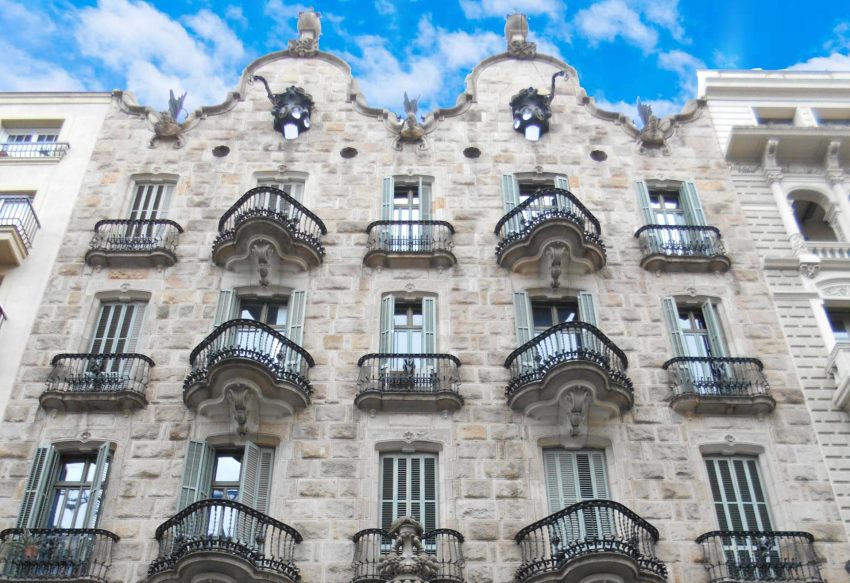
4. Casa Calvet

Casa Calvet
Casa Calvet
CC BY-SA 4.0 / Canaan

Casa Calvet is Gaudí in “city mode”: a commission for the textile manufacturer Pere Màrtir Calvet, built as a combined business-and-residential building on Carrer de Casp in the Eixample between 1898 and 1900. Because it had to fit a narrow urban plot and satisfy a conservative client, it ends up being one of his most restrained major works—yet it still won Barcelona City Council’s award for the best building of the year in 1900, which is telling.

What to see is how Gaudí hides mischief inside order. Start at street level: the entrance is framed by columns carved like stacked bobbins, a direct nod to the Calvet textile trade, and the central oriel window has a theatrical, almost baroque punch that breaks the façade’s “respectable” rhythm. Look up for the subtle asymmetries and for the balcony sequence—bulging ironwork alternating with shallower balconies—plus the witty details (including mushroom motifs) that feel like Gaudí signalling, quietly, that this is still his building.

Practically, most visitors experience Casa Calvet from the outside because it’s privately owned and not set up like Gaudí’s ticketed house-museums. The right approach is a slow façade read: step back to take in the overall symmetry, then move closer and track the details from doorway to balconies to roofline, paying attention to how stone carving and wrought iron turn “normal” architecture into something tactile and alive. If you do want an interior glimpse, your options are usually limited to any ground-floor hospitality businesses rather than a full architectural visit, so treat it as a short stop that sharpens your eye before the more famous, more flamboyant Gaudí sites.


Location: Carrer de Casp, 48, Eixample, 08010 Barcelona, Spain | Hours: Daily: 13:00–15:30 & 20:30–23:00. | Price: Free.

Explore Barcelona at your own pace with our self-guided walking tour! Follow our curated route to discover must-see sights and local secrets that makes Barcelona one of the best places to visit in Spain.

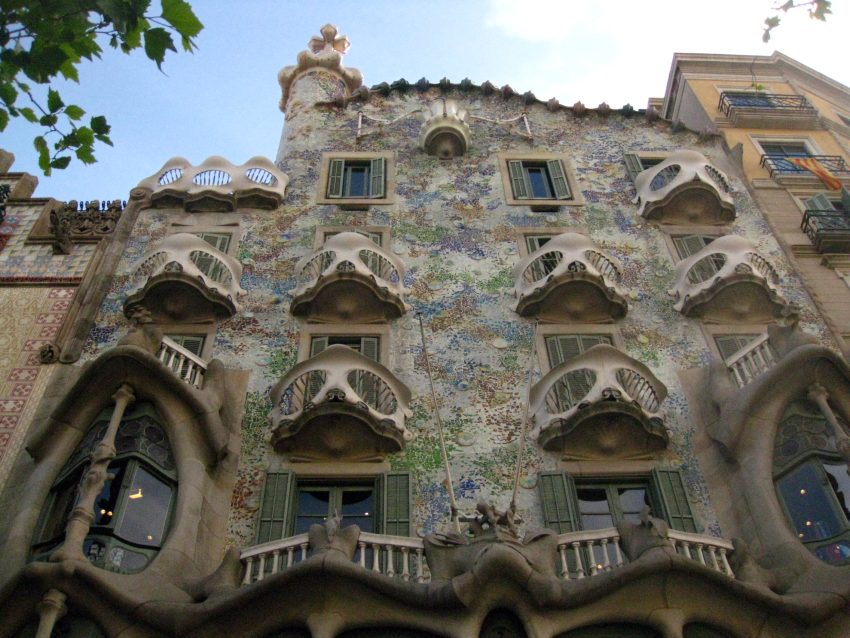
5. Casa Batlló

Casa Batlló
Casa Batlló
CC BY-SA 3.0 / Enfo

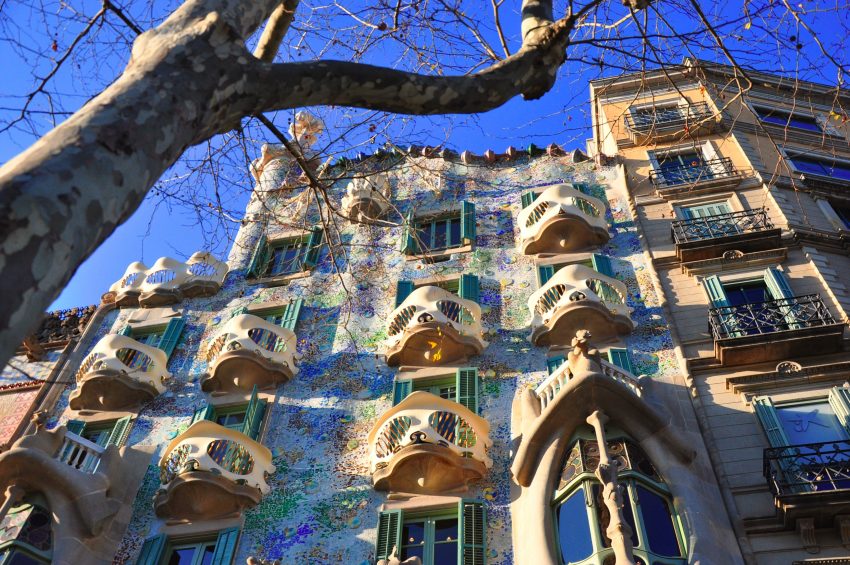
Casa Batlló is Gaudí in his most sensory, metamorphic mode: a renovation that turns a conventional urban building into something that looks animated. In the context of Barcelona’s Modernisme boom, it’s also a competitive street statement—Passeig de Gràcia as a showroom of architectural ambition—where Gaudí chooses a language of masks, bones, scales, and shifting colour instead of historical reference.

What to see is the sequence from façade to lightwell to roof. The street front is all surface intelligence: balconies that read like faces, columns that read like skeletal supports, and a façade skin that changes with daylight. Inside, the central lightwell is the real “machine”: tile colour gradients and proportions tuned to distribute light downward, making function feel like art.

The roof is the punctuation mark—sculptural and symbolic, but also technical (ventilation, chimneys, circulation). If you’re comparing Gaudí houses, Casa Batlló is the one that teaches you his obsession with atmosphere: he designs how rooms feel, not just how they look.


Location: Pg. de Gràcia, 43, Eixample, 08007 Barcelona, Spain | Hours: (Summer) April 1 – September 30; Daily: 09:00–21:00. (Winter) October 1 – March 31; Daily: 09:00–18:30. | Price: From €25 (General Visit); Night Visit from €39; Children (0–12) free. | Website

Explore Barcelona at your own pace with our self-guided walking tour! Follow our curated route to discover must-see sights and local secrets that makes Barcelona one of the best places to visit in Spain.

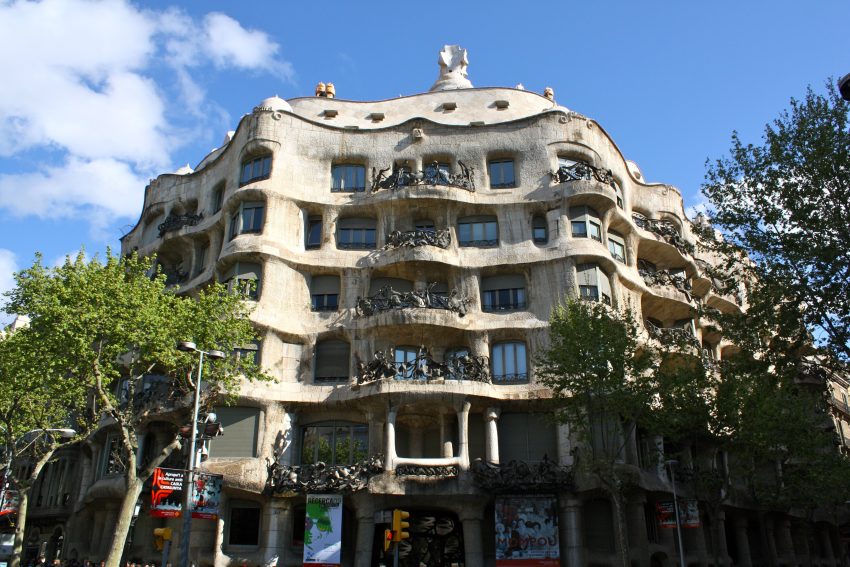
6. Casa Milà

La Pedrera – Casa Milà
CC BY-SA 2.0 / Kyle Taylor

Casa Milà (La Pedrera) is Gaudí’s more architectural, less illustrative counterpart to Casa Batlló: heavier massing, bigger moves, and a strong emphasis on structural freedom. It’s historically important because the building’s underlying system allows flexible interiors—an approach that feels surprisingly modern—while the exterior reads as a carved cliff face.

What to see begins with the courtyards and the attic. The courtyards show how Gaudí pulls light and air into a dense urban block, shaping voids as carefully as solids. The attic’s repeating arches are a masterclass in structural rhythm—beautiful, but also a clear demonstration of load paths and material logic.

The rooftop is the headline: chimneys and ventilation towers that feel like a sculpture garden, yet they’re doing real work. From up there you also get a useful comparison with the Sagrada Família: both are Gaudí, but one is domestic experimentation in stone and airflow, the other is a vertical, symbolic universe.


Location: Pg. de Gràcia, 92, Eixample, 08008 Barcelona, Spain | Hours: (Winter) November 10, 2025 – March 5, 2026; Monday – Sunday: 09:00–18:30. (Summer) March 6, 2026 – November 1, 2026; Monday – Sunday: 09:00–20:30. | Price: From €25 (standard daytime visit; other experiences cost more). | Website

Explore Barcelona at your own pace with our self-guided walking tour! Follow our curated route to discover must-see sights and local secrets that makes Barcelona one of the best places to visit in Spain.

7. Casa Vicens

Casa Vicens Gaudí
Casa Vicens Gaudí
CC BY-SA 4.0 / Pol Viladoms

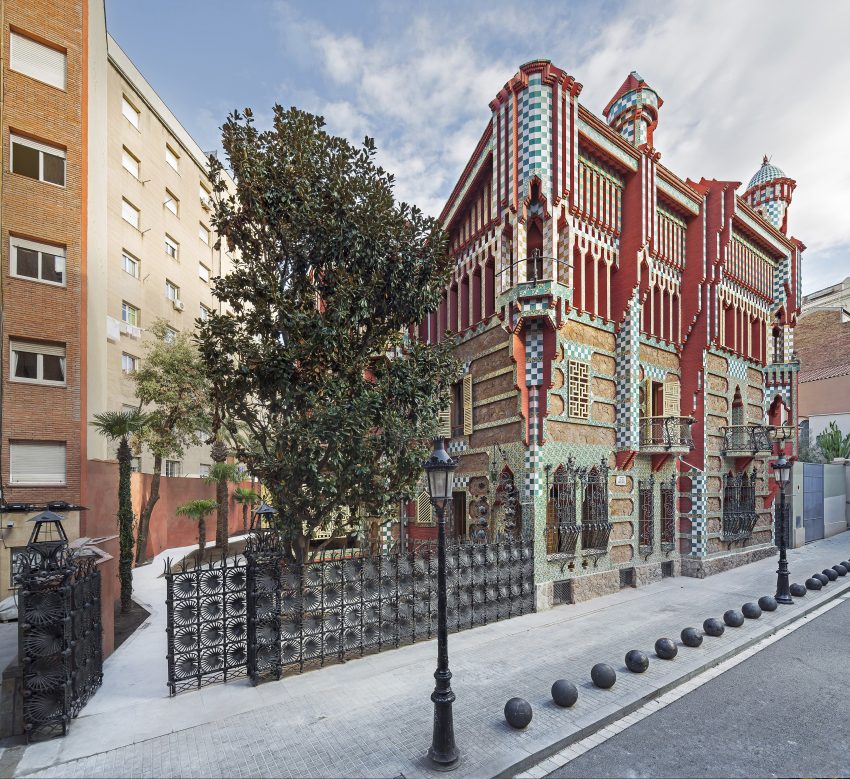
Casa Vicens is the clearest “origin point” for Gaudí in Barcelona: his first major commission, designed as a summer house for Manel Vicens and built in 1883–1885, when the area was still the Vila de Gràcia rather than the dense inner-city fabric it is now. You can already see the ideas he’ll keep refining for decades—nature as a design system, structure treated as art, and craft used as architecture rather than decoration. It’s also part of UNESCO’s “Works of Antoni Gaudí,” and after changing hands and undergoing restoration, it reopened as a house-museum in November 2017.

What to see starts outside: the building reads as a tiled, patterned composition rather than a single façade, with polychrome ceramics and brickwork creating a bold, almost graphic surface. This is early Gaudí and it leans into an orientalist/Neo-Mudéjar vocabulary, but in a personal way—geometry, colour, and surface texture doing the heavy lifting. If you’ve just come from Casa Batlló or Casa Milà, Casa Vicens is the useful contrast: less fluid “melted” stone, more crisp patterning and ornamental discipline, but still unmistakably Gaudí in how it turns materials into a kind of living skin.

Inside, slow down for the craft. The interiors are where Gaudí’s obsession with total design becomes obvious early: painted and tiled surfaces that pull in plant motifs, ceilings and joinery that make rooms feel curated rather than simply furnished, and transitions between spaces that feel designed as experiences. It’s a smaller, more intimate visit than his later headline works, which is exactly the point—Casa Vicens lets you see Gaudí before the city-scale ambition, when his signature is forming in colour, detail, and the idea that architecture should feel like nature translated into built form.


Location: Carrer de les Carolines, 20-26, Gràcia, 08012 Barcelona, Spain | Hours: Daily: 08:30–17:00. | Price: Check official website. | Website

8. Col·legi de les Teresianes

Col·legi de les Teresianes
CC BY-SA 1.0 / Canaan

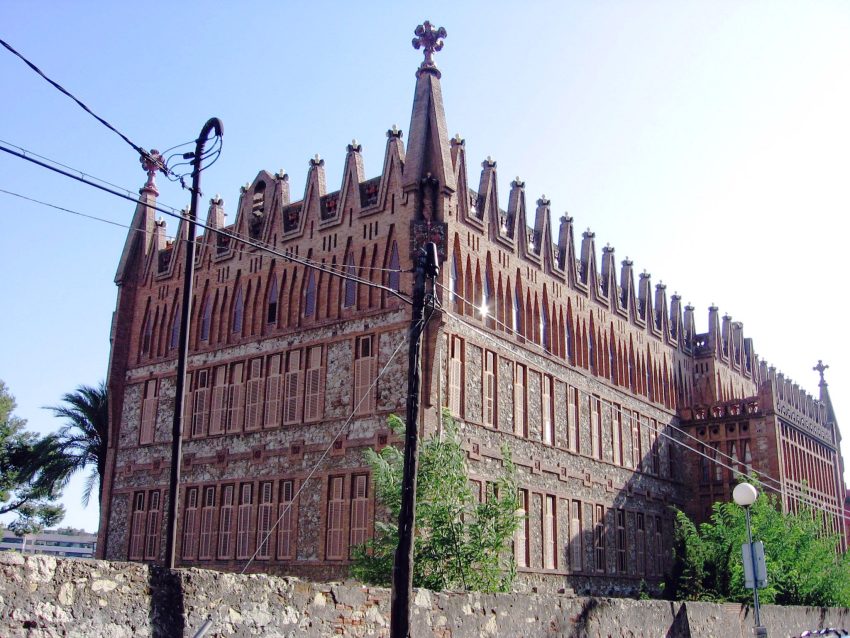
The Teresian School is an early Gaudí commission with a deliberately restrained brief: a religious order, an educational function, and a need for austerity rather than spectacle. Historically it’s revealing because Gaudí shows he can be disciplined—working largely in brick, leaning on structural ingenuity instead of decorative excess, and producing a building that feels fortress-like and purposeful. What to see is Gaudí’s use of parabolic/catenary logic in arches and openings, which gives the building its distinctive rhythm and sense of tension held in balance. The exterior is strong and severe, but the interest is in how repetition and proportion create beauty without relying on colour or mosaic. If you want to understand Gaudí as an engineer-architect—not just a maker of whimsical surfaces—this is a key stop. Because it’s a working school, treat it as an exterior-focused visit unless you have a specific arrangement. The best approach is to stand at a slight distance, watch how the façade reads as a continuous system, then move along it to see how arches, brick pilasters, and ironwork build a coherent language. It’s Gaudí proving he can do “sober” without doing “ordinary.”


Location: Carrer de Ganduxer, 85, 103, Sarrià-Sant Gervasi, 08022 Barcelona, Spain | Hours: Monday – Friday: 08:00–19:00. Closed on Saturday, Sunday. | Price: Check official website. | Website

9. Pavellons Güell

Güell Pavilions Barcelona
CC BY-SA 4.0 / Enric

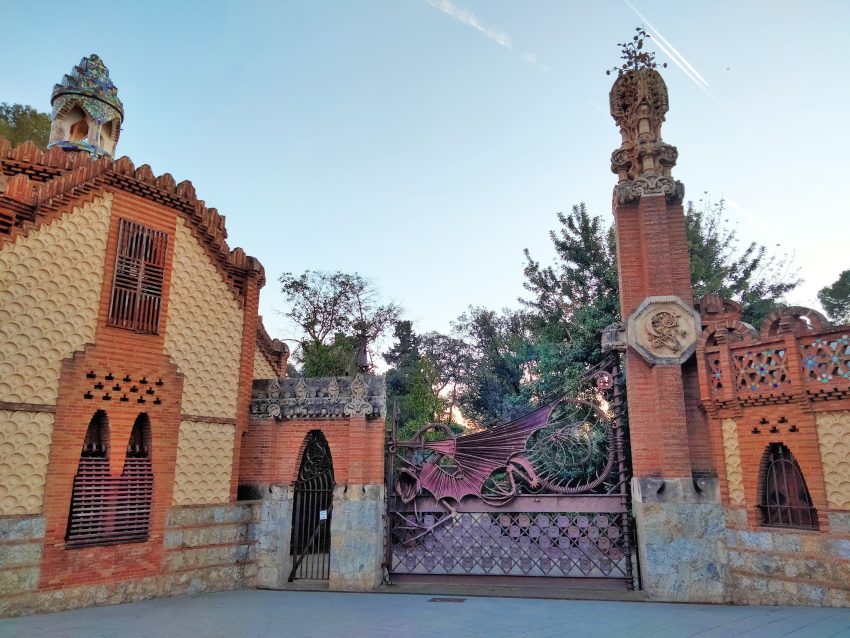
The Güell Pavilions are where the Gaudí–Güell partnership properly begins: built in the mid-1880s as entrance pavilions and service buildings for the Güell estate in Pedralbes. Historically, they’re valuable because you can see Gaudí developing ideas he’ll later scale up—parabolic forms, expressive brickwork, and a taste for turning functional elements into mythic theatre.

What to see is the famous Dragon Gate first: wrought iron that feels both ornamental and muscular, like a creature guarding the threshold. Then look at the pavilions themselves—compact buildings with bold forms and surfaces that preview Gaudí’s habit of making architecture feel “made” rather than merely assembled. This is also a good place to focus on craftsmanship at close range, because the details are legible without the sensory overload of his bigger landmarks.

The visit tends to be calmer than the headline Gaudí sites, which is part of the appeal. Go with the mindset that you’re seeing prototypes: early experiments in structure, symbolism, and the dramatization of arrival. It’s also one of the best places to notice how Gaudí designs gateways and transitions—he’s not just building objects, he’s scripting how you enter a world.


Location: Güell Pavilions, Avinguda de Pedralbes, Barcelona, Spain | Hours: Saturday – Sunday: 10:00–16:00. Closed: Monday – Friday. Closed: 1 January; 6 January; 25 December; 26 December. | Price: €6 (general); €3 (reduced); free for ages 0–6. | Website

10. Bellesguard

Bellesguard
Bellesguard
CC BY-SA 4.0 / Canaan

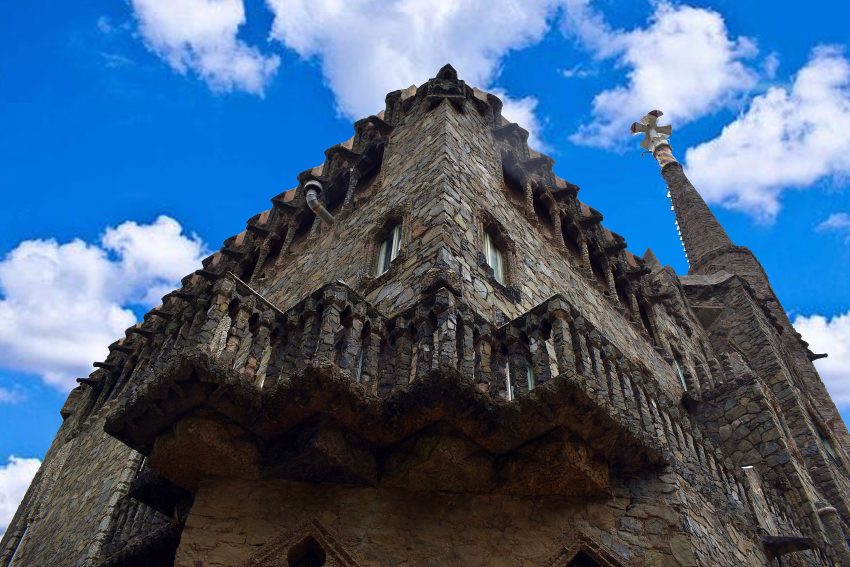
Torre Bellesguard (Casa Figueres) is Gaudí in a rarer register: part modernist house, part Gothic-inflected “castle,” built in the early 1900s on a site associated with medieval royal history. That layered past matters, because Gaudí isn’t simply doing medieval pastiche—he’s translating the memory of the place into a sharp, vertical composition that feels more angular and austere than his better-known, more organic works.

What to see is the overall silhouette and the way the building reads against the hillside: it’s one of Gaudí’s most straightforward, tower-like statements in Barcelona. Up close, pay attention to how he blends stonework severity with modernist detail—this is the house where his love of geometry and structural clarity comes forward. It’s a strong counterpoint to the saturated surfaces of Casa Vicens or the flowing façade of Casa Milà (even if you’re not visiting those, the contrast is useful to keep in mind).

Bellesguard is also about atmosphere and distance. The site’s name (“beautiful view”) isn’t accidental, and the visit tends to reward slower looking and contextual reading rather than rapid photo-stops. If you want a Gaudí experience that feels less central-and-crowded, this is one of the best choices—more contemplative, more site-driven.


Location: Carrer de Bellesguard, 20, Sarrià-Sant Gervasi, 08022 Barcelona, Spain | Hours: Tuesday – Sunday: 10:00–15:00. Closed on Monday. Closed on January 1, January 6, December 25, December 26. | Price: Audioguide tour: Adults €12; Under 18 & retired €9; Under 8 free. Guided tour: Adults €20; Under 18 & retired €15; Under 8 free. | Website

11. Gaudí House Museum

Casa Museu Gaudí in Parc Güell, Barcelona
CC BY-SA 4.0 / Sebastian Kasten

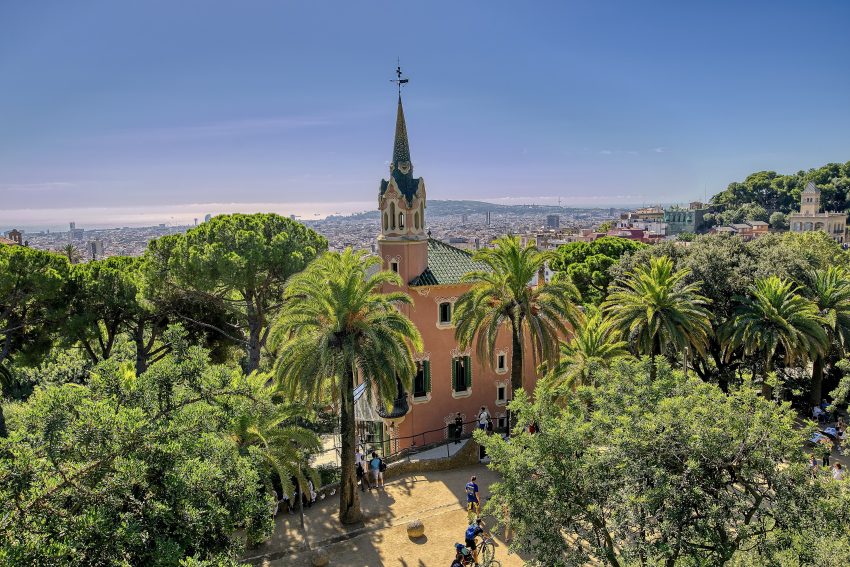
The Gaudí House Museum is in Parc Güell and matters primarily because Gaudí lived there from 1906 until late 1925, and the museum preserves a biographical lens on his daily life and design world. The important nuance is that the house itself was created as a model home for the Parc Güell development and was designed by Francesc Berenguer, a close collaborator—not by Gaudí. Its value is therefore contextual rather than architectural authorship.

What to see is the collection and the sense of scale: furniture, objects, and interior atmospheres that ground Gaudí’s work in lived reality. It’s a useful antidote to treating him as only a maker of monuments; here you’re seeing how design thinking extends into domestic items and personal space. If you’re interested in how an architect’s taste becomes an environment, this is one of the better “human” stops in his Barcelona.

Treat it as an add-on rather than a standalone destination: it’s best when it deepens what you’ve already seen elsewhere. If your goal is to understand Gaudí’s evolution, combine it mentally with the more experimental works (like the Colònia Güell crypt) and the urban commissions (like Casa Calvet) to connect biography, technique, and city context into a single narrative.


Location: Casa Museu Gaudí, Parc Güell, Barcelona, Spain | Hours: (Summer) April – September: Daily: 09:00-20:00. (Winter) October – March: Daily: 10:00-18:00. Special days: January 1 & January 6; December 25 & December 26: 10:00-14:00. | Price: From €24 (adult combined ticket: Park Güell visit with Gaudí House Museum). | Website

12. Park Güell

Park Güell
Park Güell

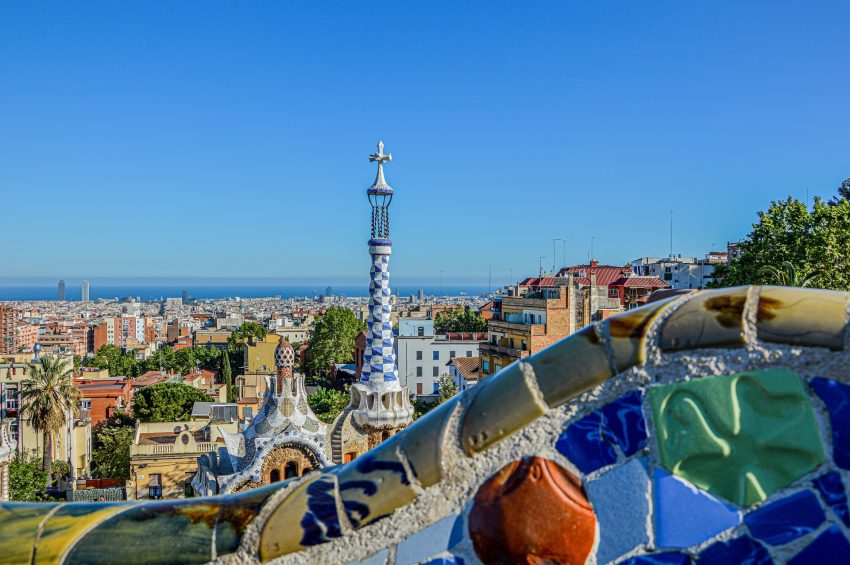
Parc Güell is where Gaudí turns a hillside into a total environment—architecture, infrastructure, and symbolism blended into one walkable piece of city. Historically it began as a planned garden-city development backed by Eusebi Güell; the housing concept failed, but the designed core survived and became a public park. It’s essential because it shows Gaudí thinking at the scale of landscape and movement, not just buildings.

What to see is concentrated but shouldn’t be rushed. The main terrace with the serpentine mosaic bench is Gaudí’s public room in the open air, designed for gathering and overlooking the city. The stairway and dragon fountain act like a ceremonial ascent, and the hypostyle hall’s columns give you that “stone forest” logic he later amplifies in the Sagrada Família.

To experience it as Gaudí intended, move from the icons to the connective tissue: the paths, viaducts, and retaining walls that make the site work as terrain. This is where his practicality shows—drainage, gradients, and load-bearing forms disguised as natural outcrops—so the park feels grown rather than imposed.


Location: Gràcia, 08024 Barcelona, Spain | Hours: Daily: 09:30–17:30. | Price: General ticket €18. Children (7–12) €13.50. Children (0–6) free. Over 65 €13.50. (Discount/free categories require documentation.) | Website

13. Gaudí Experiència

Gaudí Experiència
Gaudí Experiència
CC BY-SA 4.0 / Enric

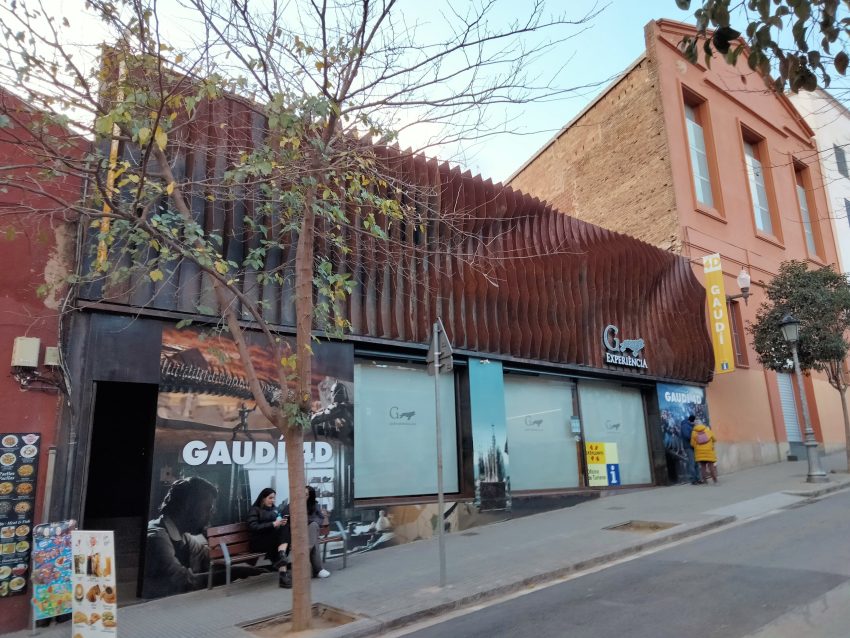
Gaudí Experiència (also branded as G Experiència) is a compact, modern visitor centre designed to help you “decode” Gaudí before you tackle his architecture in the real city. Instead of being a historic Gaudí building, it’s a multimedia interpretation space located a short walk from Parc Güell, built around the idea that Gaudí’s forms make more sense when you understand the structural logic, nature references, and spatial tricks behind them.

What to see is the 4D audiovisual first, because it frames everything else: it leans into Gaudí’s imaginative world using moving seats and sensory effects, then feeds you into interactive wall screens that run through his life and works in multiple languages. The centre also displays scale models, including a detailed model of Parc Güell and a model linked to the unbuilt “Hotel Attraction” concept, which is useful for understanding how far Gaudí’s ambitions stretched beyond what was ever constructed.

Practically, it’s an easy add-on before or after Parc Güell: the address is C/ Larrard 41, 08024 Barcelona. Opening hours are seasonal (November–March 10:00–17:00; April–June and September–October 10:00–18:30; July–August 10:00–20:00), with the last 4D show starting 30 minutes before closing. Standard admission is listed at €9.00 (with reduced tickets for under-14s and over-65s), and the venue flags that the 4D experience isn’t suitable for young children or some visitors (including pregnancy and certain health conditions).


Location: Gaudí Experiència, Carrer de Larrard, Barcelona, Spain | Hours: (Summer) July – August; Monday – Sunday: 10:00–20:00. April – June; September – October; Monday – Sunday: 10:00–18:30. (Winter) November – March; Monday – Sunday: 10:00–17:00. | Price: General: €9.00. Under-14s and over-65s: €7.50. | Website
Powered by GetYourGuide
Moira & Andy
Moira & Andy

Hey! We're Moira & Andy. From hiking the Camino to trips around Europe in Bert our campervan — we've been traveling together since retirement in 2020!

Read our full story here

This website uses affiliate links which earn a small commission at no additional cost to you.

Walking Tour Summary

Distance: 13 km
Sites: 13

Walking Tour Map
Map of the Self-Guided Walking Tour of Gaudi’s Barcelona walking route with 13 stops in Barcelona.
Preview map of the Self-Guided Walking Tour of Gaudi’s Barcelona route in Barcelona, showing 13 stops. Use the interactive map to zoom and tap markers.

More from this area

Self-Guided Walking Tour of Barcelona’s Gothic Quarter (2026)

Barcelona’s Gothic Quarter

This website uses affiliate links which earn a small commission at no additional cost to you.

Barcelona's Gothic Quarter is one of those places where the city's history feels close enough to touch: Roman stonework, medieval lanes, and grand civic buildings packed into a compact, walkable grid. A self-guided route works particularly well here because you can move at your own pace, detour into quieter alleys when crowds build, and linger where the atmosphere hits hardest. If you're looking for the best things to see in Barcelona's Gothic Quarter, this walk strings together the essentials without feeling like a checklist.

You'll start with the big landmarks that define the neighborhood's skyline and identity, including Catedral de Barcelona and Plaça Nova, then quickly slip into smaller, more characterful corners like Casa de l'Ardiaca and the Museu Frederic Mares. From there, the route naturally leads you into the heart of medieval power and ceremony at Palau del Lloctinent, Plaça del Rei, and the Capella Reial de Santa Àgata, where the setting does a lot of the storytelling even before you read a single plaque.

As you continue, you'll pass through the squares that locals still use as meeting points-Plaça Sant Just, Plaça de Sant Jaume, and the quietly affecting Plaça de Sant Felip Neri-before rounding out the walk with layers of older Barcelona at the Temple d'August (MUHBA) and the photogenic Pont del Bisbe near the Palau de la Generalitat. The final stretch softens into classic neighborhood life around the Basilica de Santa Maria del Pi and Plaça de Sant Josep Oriol, a satisfying finish that feels less like an “end point” and more like an invitation to keep wandering.

How to Get to Barcelona’s Gothic Quarter

By Air: If you're flying into Barcelona-El Prat Airport (BCN), the simplest approach is to get into the city centre first, then continue on foot or by metro to the Gothic Quarter. The Aerobús runs frequently to Plaça de Catalunya, which is an easy walking gateway into the neighbourhood; alternatively, the metro (L9 Sud connecting into other lines) can work well if you're staying near a convenient interchange. Taxis and rideshares are straightforward too, but expect slower progress at peak times. Once you're close, aim for Plaça de Catalunya, Jaume I (Metro L4), or Liceu (Metro L3) and walk the last stretch, since many streets inside the Quarter are pedestrianised or restricted. For the best deals and a seamless booking experience, check out these flights to Barcelona on Booking.com.

By Train: Barcelona Sants is the main long-distance rail hub, with most high-speed and intercity services arriving here, while Passeig de Gràcia also receives some regional services and can be handy depending on where you're coming from. From Sants, take the metro (L3) toward Liceu/Drassanes for an easy approach to the southern side, or connect toward Jaume I (L4) for the central lanes and plazas. From Passeig de Gràcia, you can either walk down through the city centre or hop on the metro to shorten the distance. If you're arriving by regional train into Estació de França, you're already very close-walking into the Gothic Quarter from there is quick and scenic. Train schedules and bookings can be found on Omio.

By Car: Driving into the Gothic Quarter itself is rarely practical because of narrow streets, restricted access, and limited parking, so treat your car as a way to reach the edge of the old city rather than the interior. Your best strategy is to park in a paid garage near the perimeter-around Plaça de Catalunya, Via Laietana, or the Port Vell area-then walk in. If you're using navigation, set your destination to a specific parking garage rather than a landmark inside the Quarter to avoid getting routed into restricted lanes. Also factor in congestion and the possibility of low-emission zone rules, which can affect some vehicles. If you are looking to rent a car in Spain I recommend having a look at Discover Cars, first, as they compare prices and review multiple car rental agencies for you.

By Bus: If you’re arriving by long-distance coach, most services terminate at Estació del Nord. From there, you can walk in around 20-30 minutes, or take the metro (Arc de Triomf on L1, then connect toward Jaume I/Liceu depending on where you want to start). City buses also skirt the edges of the old town, but the final approach is usually easiest on foot once you’re close, since the Gothic Quarter’s best streets aren’t designed for through-traffic.

Where to Stay in Barcelona for This Gothic Quarter Walking Tour

To make the most of visiting Barcelona's Gothic Quarter and this walking tour, you should consider staying overnight in the centre. The most “walk-out-the-door-and-you're-on-the-route” option is to stay inside the Gothic Quarter itself, where early mornings and evenings feel noticeably calmer than midday. Good picks here include Hotel Neri - Relais & Châteaux, Kimpton Vividora Hotel, Catalonia Catedral, and H10 Madison-all of which keep you close to the Cathedral/Plaça Nova end of the Quarter, so you can start before the lanes get busy.

If you want the same central access but with a slightly more open feel (and often easier taxi drop-offs), look at El Born / Sant Pere / Santa Caterina i la Ribera, directly bordering the Gothic Quarter. This is ideal if you like boutiques, tapas bars, and a neighbourhood vibe after the walk, while still being 5-15 minutes on foot from stops like Plaça del Rei, MUHBA, and Pont del Bisbe. Consider The Barcelona EDITION for a high-end base, Hotel REC Barcelona for a modern adults-only option, and Ohla Barcelona if you want a luxury stay right on the old-town edge with quick access into both the Quarter and the waterfront side.

For maximum transport convenience (airport bus, metro links, and straightforward arrivals/departures), staying around Plaça de Catalunya and the central Eixample edge is the most practical. You'll be able to walk into the Gothic Quarter in roughly 10-20 minutes depending on where you enter, and it's a strong choice if you're fitting the walk between day trips or train connections. Options that work well here include Olivia Plaza Hotel for a prime “doorstep of the centre” location, Hotel Jazz for a reliable, walkable base near the main hub, and Casa Bonay if you prefer a design-forward stay that’s still very well connected.

If you’d rather stay a little outside the tight old-town lanes (more space, often better value) but still be well-placed for this route, upper Eixample is a smart compromise-fast metro access into the centre, plus calmer streets at night. Two solid choices are Hotel Praktik Bakery (excellent for a casual, central base near Passeig de Gràcia) and Sir Victor Hotel (a higher-end option with a strong location for combining your Gothic Quarter walk with Modernista sights).

History of Barcelona’s Gothic Quarter

Barcelona’s Gothic Quarter in Roman Barcino (1st-4th centuries)

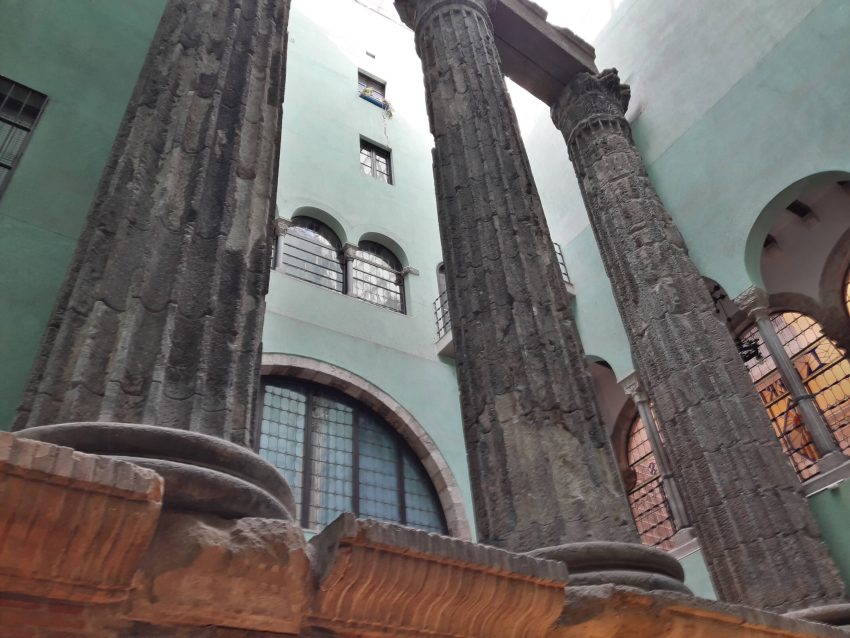
The oldest layer of Barcelona's Gothic Quarter is Roman, when the city was laid out with a tight street grid and monumental civic spaces. One of the clearest survivals is the Temple of Augustus, whose columns are a direct reminder that this quarter once revolved around a Roman forum and imperial cult architecture. Even today, the way streets pinch and open can feel like you're moving through a city built on earlier foundations rather than a clean-slate medieval plan.

This Roman inheritance also helps explain why later power centres clustered where they did. The area around Plaça de Sant Jaume (St. James’s Square) reflects the long continuity of civic life, with public authority repeatedly re-anchoring itself to the same core ground as the city transitioned from Roman rule into medieval governance.

Barcelona’s Gothic Quarter in the Early Medieval City (5th-11th centuries)

After Rome, the quarter evolved through centuries of adaptation: buildings reused older stonework, lanes shifted, and religious institutions began to shape the neighbourhood's identity. Over time, the cathedral precinct became a major organising force, setting the stage for the later grandeur of Catedral de Barcelona. Spaces like Plaça Nova make sense in this context as threshold places-edges between sacred precincts, daily commerce, and the flow of people into the heart of the old city.

Traces of this period are often more about pattern than single monuments: the clustering of church-related buildings and the persistence of certain pathways. Sites such as Plaça Sant Just reflect how parish life and small civic gathering points grew up alongside larger ecclesiastical authority.

Barcelona’s Gothic Quarter in the High Gothic Boom (12th-15th centuries)

The quarter's defining look is largely a product of the medieval expansion when Barcelona's wealth, institutions, and artistic ambitions intensified. Catedral de Barcelona became a statement project across generations, rising into the skyline as both a religious centre and a symbol of civic pride. Nearby, Casa de l'Ardiaca speaks to the administrative world wrapped around the cathedral-church power expressed not only through worship spaces but through offices, residences, and courtyards that managed the city's spiritual and social order.

This era also created the quarter's most atmospheric ensemble of power: Plaça del Rei, framed by institutions tied to governance and ceremony. Palau del Lloctinent and the Capella Reial de Santa Agata embody how authority was performed-through grand halls, formal architecture, and religious patronage-turning the square into a stage set for the city's public life.

Barcelona’s Gothic Quarter as a Political and Religious Centre (15th-17th centuries)

As Barcelona moved into a more complex early modern world, the Gothic Quarter remained the centre of administration, legal culture, and institutional continuity. The Palau de la Generalitat reinforced the area's role as a seat of government, and Plaça de Sant Jaume continued to function as a focal point for civic identity-less about medieval growth now, more about maintaining authority through established buildings and rituals.

Religious life also deepened in visible ways. The Basilica de Santa Maria del Pi is a powerful counterpoint to the cathedral precinct: another major church anchoring local life, devotion, and community status. Nearby squares such as Plaça de Sant Josep Oriol feel like the everyday face of that world-public space shaped by parish rhythms, artisans, and small-scale urban interactions.

Barcelona’s Gothic Quarter through Reform, Change, and Reinterpretation (18th-19th centuries)

The Gothic Quarter didn't freeze in time; it absorbed reforms, shifting social realities, and changing tastes. Many buildings were altered internally, repurposed, or adjusted to new urban needs, while the quarter's narrow fabric remained stubbornly intact. Over time, the area's medieval character began to be treated not just as old infrastructure but as heritage-something to be highlighted, curated, and sometimes reshaped to match a desired image of “historic Barcelona.”

This is also where museum culture becomes part of the story. The Museu Frederic Mares, connected to the cathedral complex, reflects a later impulse to collect, preserve, and interpret the city’s artistic and devotional past-turning the quarter into not just a living neighbourhood, but a place where history is actively displayed and explained.

Barcelona’s Gothic Quarter in the 20th Century (Restoration, Memory, and Loss)

The 20th century added a highly visible layer of “Gothic” identity through selective restoration and historicist design. Pont del Bisbe is the clearest example: a dramatic visual link that feels medieval in mood, even though it reflects a later vision of what the quarter should look like. That kind of intervention helped crystallise the Gothic Quarter as a coherent historic brand-picturesque, theatrical, and instantly recognisable.

At the same time, the quarter carries darker, more fragile memories. Plaça de Sant Felip Neri is often experienced as quiet and contemplative today, but it also holds the weight of 20th-century trauma and the way cities memorialise loss in everyday spaces. Together with long-standing civic nodes like Plaça de Sant Jaume and institutional anchors like the Palau de la Generalitat it shows how the quarter's history is not only medieval-it is continuously rewritten by politics, conflict, restoration, and remembrance.

Your Self-Guided Walking Tour of Barcelona’s Gothic Quarter

Discover Barcelona's Gothic Quarter on foot, with our walking tour map guiding you between each stop as you explore its medieval lanes, hidden squares, and landmark sights. Because this is a self-guided walking tour, you can set your own pace-skip any stops that don't interest you, linger where the atmosphere is best, and take coffee breaks whenever you feel like it.

1. Catedral de Barcelona

Cathedral of Barcelona
CC BY-SA 4.0 / FrDr

The cathedral’s roots reach back to early Christian Barcelona, but the building you see is mainly a Gothic project begun in the late 13th century and carried forward for centuries as the city’s religious and civic confidence grew. It sits on layers of earlier Roman and Visigothic history, and that “built-over-time” feeling is part of its character: the plan is high Gothic, while many details reflect later tastes and restorations.

Start outside by taking in the west façade and the way the cathedral anchors the surrounding lanes; the exterior reads like a stone ship rising from the Gothic Quarter. Inside, look up to appreciate the height and the ribbed vaulting, then slow down around the choir, where carving, stalls, and heraldic details reward close viewing.

Don’t miss the cloister, which is one of the most atmospheric spaces in the quarter: palm shade, fountains, and a quiet rhythm that contrasts with the streets outside. If access is open, climb up for rooftop views and a clearer sense of how the cathedral sits within the medieval street grid.


Location: Pcta. de la Seu, s/n, Ciutat Vella, 08002 Barcelona, Spain | Hours: Monday – Friday: 09:30–18:30. Saturday: 09:30–17:15. Sunday: 14:00–17:00. | Price: Adults: €16; Students (up to 25): €14; Groups: €8; Visitors with disability (from 33%): free. | Website

We recommend to rent a car in Spain through Discover Cars, they compare prices and review multiple car rental agencies. Book your rental car here.

2. Casa de l’Ardiaca

Casa de l’Ardiaca
Casa de l’Ardiaca
CC BY-SA 2.0 / MARIA ROSA FERRE

This house began as a prestigious residence tied to the cathedral’s clerical administration, and it evolved through medieval and later periods into a layered complex that mirrors Barcelona’s habit of building new identity onto old fabric. It’s not just “a house” in the domestic sense; it’s a small institutional world, shaped by church power and the practical needs of governance.

Step into the courtyard if it’s open, because that’s where the building’s calm reveals itself. Look for the mix of Gothic structure with later decorative touches, and pay attention to how the inner space feels intentionally protected from the surrounding bustle—an architectural expression of authority and privacy.

One of the most memorable details is the playful letterbox set into the façade, a small modern intervention that sits against the weight of history and somehow works. It’s a good stop for noticing how Barcelona’s Gothic Quarter is never purely medieval: it’s a living collage, and Casa de l’Ardiaca shows that layering particularly well.


Location: Carrer de Santa Llúcia, 1, Ciutat Vella, 08002 Barcelona, Spain | Hours: Monday – Friday: 09:00–19:30. Saturday: 10:00–19:30. Sunday: Closed. | Price: Free. | Website

Here is a complete selection of hotel options in Barcelona. Feel free to review each one and choose the stay that best suits your needs.

3. Plaça Nova

People enjoying sunshine in Plaça Nova, Barcelona
Plaça Nova, Barcelona
CC BY-SA 3.0 / Freepenguin

Plaça Nova marks a threshold: it’s where the Roman city once met the medieval city, and where modern Barcelona now funnels people into the Gothic Quarter. The square’s broadness is the clue—this is a place of passage, market life, and public announcements rather than a secluded medieval nook.

The most striking historic remnants are the Roman elements nearby, especially where pieces of the ancient wall and defensive structures appear almost casually beside later buildings. Use the openness of the square to orient yourself: from here, streets lead straight into the older maze, and you can feel the shift from wide civic space to tight medieval lanes in a few steps.

What to see is partly architectural, partly experiential: look for contrasts in stonework, the way the cathedral’s mass pulls the eye, and the changing light as the day moves. If there’s a market or book stall set-up, it’s a good place to pause and watch the quarter’s daily life, which has always been the real function of this gateway square.


Location: Plaça Nova, Ciutat Vella, 08002 Barcelona, Spain | Hours: 24 Hours | Price: Free. | Website

Traveling to a country with a different currency? Avoid ATM transaction fees and pay in local currency with a Wise Card. Having used it for over 5 years, we've saved loads on fees!

4. COAC

COAC (Col·legi d’Arquitectes de Catalunya)
CC BY-SA 4.0 / Enric

COAC occupies a prime position in Barcelona’s civic and cultural landscape and is closely associated with the city’s post-war architectural scene. The building is often discussed not just as an institutional headquarters for architects, but as a statement about modern identity in a historic urban setting—an effort to speak a contemporary architectural language while sitting among some of the city’s most symbolically charged streets and squares. Its history matters because it reflects the moment when modernism was reasserting itself in the public realm, with architecture positioned as a cultural force rather than mere construction.

The first thing to see is how the building presents itself to the street: pay attention to its façade composition, the rhythm of openings, and the way the structure frames views and movement around it. COAC is also known for prominent artistic interventions on its exterior—details that can be read as an attempt to fuse architecture, graphic expression, and public space into a single urban gesture. Whether you come for the architecture or the art, it’s a façade that benefits from stepping back, then moving in close to study textures, lines, and the relationship between solid and void.

Inside, the experience typically centers on its role as a professional and cultural venue rather than a single “must-see” object. If access aligns with your visit, look for exhibitions, lectures, or public programming that often make COAC feel like a working piece of the city rather than a static landmark. Even without going in, it’s worth using the stop as a lens on modern Barcelona: a place where you can compare how different eras—medieval, modernist, and modern—negotiate space, status, and visual presence in the same few blocks.


Location: Plaça Nova, 5, Ciutat Vella, 08002 Barcelona, Spain | Hours: Monday – Friday: 10:00–19:00. Saturday: 10:00–14:00. Closed on Sunday. | Price: Free. | Website

Explore Barcelona at your own pace with our self-guided walking tour! Follow our curated route to discover must-see sights and local secrets that makes Barcelona one of the best places to visit in Spain.

5. Plaça de Sant Josep Oriol

Plaça de Sant Josep Oriol, Barcelona, Spain
CC BY-SA 1.0 / Bernard Gagnon

This square sits beside Santa Maria del Pi and feels like an extension of the church’s social life—a medieval-adjacent public room where daily activity gathers. Historically, these small squares were the practical spaces of the city: trade, conversation, and the slow negotiation of neighborhood routines.

The history here is less about a single monument and more about continuity of use. The surrounding buildings and cafés, the nearby church presence, and the steady flow of locals make it easy to imagine how the square has long served as a meeting point, even as the city around it changed.

What to see is the lived texture: street musicians, small markets when they appear, and the way the square frames views of the basilica and adjacent lanes. It’s also a good place to look back at the church from a different angle and appreciate how medieval architecture shapes the everyday choreography of the quarter.


Location: Plaça de Sant Josep Oriol, Ciutat Vella, 08002 Barcelona, Spain | Hours: 24 Hours | Price: Free. | Website

Explore Barcelona at your own pace with our self-guided walking tour! Follow our curated route to discover must-see sights and local secrets that makes Barcelona one of the best places to visit in Spain.

6. Basilica de Santa Maria del Pi

Basílica de Santa Maria del Pi
CC BY-SA 3.0 / trolvag

This church is a classic example of Catalan Gothic: broad, strong, and grounded, with an emphasis on clear volumes rather than excessive ornament. It developed as a major parish church for a thriving neighborhood, reflecting the urban confidence of medieval Barcelona beyond the cathedral’s orbit.

Inside, the space feels wide and cohesive, designed to hold a congregation and focus attention forward. Look for the scale of the nave, the sense of structural clarity, and the way light plays across stone. If stained glass is visible, it’s often the highlight, bringing color into an otherwise sober palette.

Outside, notice the robust façade and the relationship between the church and the surrounding streets, which tighten and then open into small squares. It’s a rewarding stop because it shows a different side of Gothic Barcelona: parish life, community identity, and architecture built for everyday worship rather than episcopal display.


Location: Plaça del Pi, 7, Ciutat Vella, 08002 Barcelona, Spain | Hours: Monday – Saturday: 10:00–20:00. Sunday: 13:00–20:00. Closed on January 6, May 12, December 25, December 26. | Price: General admission: €8; Reduced: €6; Children under 6: free. | Website

Explore Barcelona at your own pace with our self-guided walking tour! Follow our curated route to discover must-see sights and local secrets that makes Barcelona one of the best places to visit in Spain.

7. Plaça de Sant Felip Neri

San Felip Neri Square, Barcelona, Spain
CC BY-SA 4.0 / Justraveling com

This square is small, quiet, and heavy with memory, shaped by religious life and the dense fabric of the old city. It’s the kind of place where the mood changes instantly when you step in—sound softens, movement slows, and the surrounding walls create a sheltered stillness.

The history most visitors feel here is tied to the traumas that marked the city in the 20th century, leaving traces that turn the square into a space of reflection rather than spectacle. It’s a reminder that “historic” doesn’t only mean medieval; it also means modern experiences that still sit close to the surface.

What to see is subtle: the church façade, the fountain, the worn stone, and the way the square holds silence even when the rest of the quarter is crowded. Treat it like a pause in your route—less about taking in information, more about letting the place communicate through atmosphere.


Location: Plaça de Sant Felip Neri, Ciutat Vella, 08002 Barcelona, Spain | Hours: 24 Hours | Price: Free | Website

8. Pont del Bisbe

Pont del Bisbe
Pont del Bisbe
CC BY-SA 2.0 / amaianos

This bridge is one of the quarter’s most photographed sights, but its story is more complex than the “medieval” look suggests. It was built in a historicizing style to create a dramatic connection over the street, shaping the Gothic Quarter’s visual identity in a way that blends past and modern imagination.

That doesn’t make it less interesting—if anything, it’s a perfect case study in how cities curate themselves. Barcelona’s old center has been restored, reassembled, and sometimes redesigned to heighten atmosphere, and Pont del Bisbe is a deliberate piece of that theatrical urban experience.

What to see is the craftsmanship of the stonework and the way the arch frames the narrow street below. Try viewing it from both directions, then look beyond it to notice how the bridge acts like a camera frame, pulling your eye down the corridor of buildings and compressing the space into a cinematic scene.


Location: Carrer del Bisbe, Ciutat Vella, 08002 Barcelona, Spain | Hours: 24 Hours. | Price: Free.

9. Temple d’August

Columns from Roman Temple
Columnes del temple romà
CC BY-SA 4.0 / Pere López Brosa

This is one of the most direct encounters with Roman Barcelona, a fragment that feels almost impossible because it survives in the middle of a medieval street pattern. The columns belong to a major temple from the Roman colony, hinting at a city that was once organized by classical order, monuments, and civic religion.

The history here is about survival through incorporation: Roman stone absorbed into later buildings, reappearing when excavations and preservation efforts made the ancient layers visible again. It’s a reminder that the Gothic Quarter isn’t only Gothic; it’s a palimpsest where older scripts keep showing through.

What to see is the scale and the material: stand close to the columns and look up, noticing how different Roman proportion feels from Gothic verticality. Then step back and note the setting—ancient architecture framed by later walls—because that contrast is the real spectacle.


Location: Carrer del Paradís, 10, Ciutat Vella, 08002 Barcelona, Spain | Hours: Monday: 10:00–14:00. Tuesday – Saturday: 10:00–19:00. Sunday: 10:00–20:00. Closed on 1 January; 1 May; 24 June; 25 December. | Price: Free. | Website

10. Palau de la Generalitat

Palau de la Generalitat de Catalunya
CC BY-SA 4.0 / FrDr

This palace represents the institutional history of Catalonia’s government, with roots that reach back to medieval administrative structures and a built form that has been expanded and refined over time. It’s not a single-era monument; it’s a statement of continuity, legitimacy, and regional identity expressed through architecture.

Look for the mixture of Gothic and Renaissance elements, which often show up in courtyards, windows, and decorative stonework. Even from the outside, the building reads as “official”: controlled massing, formal symmetry in key parts, and details designed to project authority.

What to see depends on access, but the façade and any visible inner spaces are worth lingering over because they embody governance as an aesthetic. This is one of those stops where the building’s function matters as much as its beauty—an architectural reminder that the Gothic Quarter was, and is, a seat of power.


Location: Pl. de Sant Jaume, 4, Ciutat Vella, 08002 Barcelona, Spain | Hours: Saturday: Check official website (free guided visits run on the second & fourth weekend of each month; except August). Sunday: Check official website (free guided visits run on the second & fourth weekend of each month; except August). Monday – Friday: Closed. Note: Additional open days may occur on Sant Jordi, the National Day of Catalonia, and during Christmas open days. | Price: Free (reservation required for guided visits when available). | Website

11. Plaça de Sant Jaume

Plaça de Sant Jaume, Barcelona
CC BY-SA 2.0 / Serge Melki

This is Barcelona’s political heart, layered on the footprint of the Roman forum and still serving as a civic center today. That continuity is the point: the square has long been a place where authority is performed in public, whether in imperial, medieval, or modern forms.

The square’s power comes from the face-off between major institutions, giving you an architectural conversation about governance. Even without stepping inside, you can read the space as a working civic room—formal, open, and designed for assemblies, ceremonies, and protests.

What to see is how the buildings address the square: symmetry, balconies, flags, and the subtle choreography of entrances. If you arrive when something is happening—an event, a public gathering, even a routine change of activity—you’ll understand why this square matters more than its size suggests.


Location: Pl. de Sant Jaume, Ciutat Vella, 08002 Barcelona, Spain | Hours: 24 Hours | Price: Daily

12. Plaça Sant Just

Plaça de Sant Just, Barcelona
CC BY-SA 4.0 / Enric

This square has the feel of a local pocket within the broader tourist flow—small enough to be intimate, old enough to feel settled, and still genuinely used by people who live and work nearby. It’s associated with one of the quarter’s older church sites, and the space around it reads like a medieval neighborhood center.

Historically, squares like this were where community life unfolded: meetings after services, informal trade, news exchange, and the steady social choreography of a dense city. The architecture around the edges tends to be varied, showing how centuries of rebuilding and adaptation can still preserve a coherent “old Barcelona” mood.

What to see is the atmosphere and the details: façades, doorways, and the way the square holds shade. It’s also a good place to listen—footsteps, voices, the softer soundscape that survives when streets narrow and buildings draw close.


Location: Plaça de Sant Just, Ciutat Vella, 08002 Barcelona, Spain | Hours: Open 24 hours. | Price: Free. | Website

13. Barcelona Roman Walls

Roman Barcelona
Roman Barcelona
CC BY-SA 4.0 / Canaan

Barcelona’s Roman walls are one of the clearest survivals of Barcino, the Roman city that sat beneath today’s Gothic Quarter. The first fortifications were laid out in the early imperial period, but the most substantial remains you see today largely relate to later strengthening, when the city reinforced its defenses with thicker masonry and more towers. Those upgrades weren’t just military paranoia; they reflect how strategically and economically important the settlement had become, and how Roman urban life was organized around a protected core with controlled entry points.

At Carrer dels Sots-Tinent Navarro, the wall reads as a powerful slice of the ancient perimeter: heavy stonework, a tall vertical face, and the rhythm of projecting towers that once gave defenders wider angles of view along the curtain. What’s especially compelling here is the layering—Roman fabric sitting shoulder-to-shoulder with later medieval structures, with the street acting like a narrow viewing corridor that emphasizes the wall’s height and mass. Look for changes in masonry texture and block size, and for the way later buildings “lean” into the Roman line, using it as a ready-made backbone.

To get the most from the stop, walk a short stretch rather than treating it as a single photo point. The walls make more sense when you follow their trajectory and imagine the city boundary they enforced, including where gates would have been and how the defensive towers punctuated movement. If you’re building a Roman-themed wander, this section pairs naturally with nearby remains like columns and fragments of Barcino’s civic core, but even on its own it delivers that rare Barcelona experience: a living street where you can stand within arm’s reach of two thousand years of city-making.


Location: Muralla Romana Carrer dels Sots-Tinent Navarro, Carrer del Sots - Tinent Navarro, Barcelona, Spain | Hours: 24 Hours | Price: Free | Website

14. Plaça del Rei

Plaça del Rei, Barcelona
CC BY-SA 3.0 / JosepBC

Plaça del Rei feels like a stage set for medieval Barcelona, and in many ways it was exactly that: a ceremonial space linked to royal and institutional power. The square’s enclosed, stone-heavy geometry creates an immediate sense of authority, as if the surrounding buildings are still listening for footsteps and proclamations.

Historically, this area is associated with the city’s governing elite, and the architecture reflects continuity rather than novelty—solid forms, controlled openings, and a preference for permanence. It’s the kind of place where politics and pageantry overlap: official receptions, civic rituals, and moments when the city presented itself to outsiders.

What to see is the ensemble itself: stand in the middle and take a slow turn, noticing how the walls shape sound and light. If you can enter adjacent historic buildings or exhibitions, do it, but even without that, the square is one of the best places to feel the medieval city as an atmosphere rather than a checklist.


Location: Pl. del Rei, Ciutat Vella, 08002 Barcelona, Spain | Hours: 24 Hours | Price: Free.

15. Capella Reial de Santa Agata

Capella de Santa Àgueda
CC BY-SA 2.0 / Josep Renalias

This chapel is closely linked to royal devotion and court life, a smaller sacred space that carries the idea of private worship within a political center. Its Gothic character is restrained and vertical, emphasizing solemnity over spectacle, which suits a place intended for focused ceremony rather than crowds.

Inside, the most compelling “what to see” is usually the way the space frames art and ritual: the altar area, the proportions, and any surviving decorative work that signals patronage. Chapels like this often communicate power subtly—through materials, craftsmanship, and the sense that only certain people historically belonged here.

Take a moment to look for the details that feel human: worn thresholds, softened edges of stone, and the way light settles in the apse. It’s a quieter stop than the cathedral, but it rewards attention because it connects spiritual practice to the political geography of the Gothic Quarter.


Location: Casa Padellàs (Barcelona History Museum MUHBA), Pl. del Rei, s/n, Ciutat Vella, 08002 Barcelona, Spain | Hours: Tuesday – Saturday: 10:00–19:00. Sunday: 10:00–20:00. Closed on Monday. | Price: Adults: €7.30; Reduced: €5.20; Under 16: free. | Website

16. Palau del Lloctinent

Palau del Lloctinent
CC BY-SA 1.0 / Bernard Gagnon

This palace is tied to the administrative machinery of the Crown of Aragon and the governing structures that radiated out from Barcelona when the city’s political reach expanded. Its architecture reflects power expressed through order: courtyards, staircases, and formal stonework meant to impress and control movement.

Look for the Renaissance sensibility in the building’s organization, especially if you catch views into the courtyard or interior elements. The stone staircases and galleries are the kinds of features that made official buildings feel theatrical—designed for processions, announcements, and the visibility of rank.

Even when you only see the exterior, it’s worth pausing to imagine the bureaucratic life once contained here: petitions, records, emissaries, and the constant negotiation between local privileges and royal authority. In a quarter full of churches, this is a reminder that Barcelona’s medieval core was also a working government district.


Location: Palau Reial Major, Carrer dels Comtes, Ciutat Vella, 08002 Barcelona, Spain | Hours: Monday – Sunday: 10:00–19:00. Closed: December 25–26, January 1 & 6. | Price: Free. | Website

17. Museu Frederic Mares

Museu Frederic Marès
CC BY-SA 3.0 / Kippelboy

This museum is shaped by a single collector’s vision: Frederic Marès assembled an eclectic, deeply personal collection that spans sculpture, religious art, and everyday objects. The setting—rooms tucked beside the cathedral complex—adds to the sense that you’re entering a cabinet of curiosities rather than a conventional chronological museum.

The headline pieces are medieval and Renaissance sculptures, especially Catalan works where faces and drapery still carry an intense physical presence. Move slowly through the sculpture galleries and let the lighting do its work; many pieces feel more intimate than monumental, and the museum’s layout encourages close viewing rather than grand “museum distance.”

Then there’s the delightfully strange side: fans, pipes, photographs, toys, and domestic objects that sketch a social history through things people once handled every day. It’s an excellent stop when you want to balance the big-ticket Gothic architecture with the texture of ordinary life that made that architecture meaningful.


Location: Plaça Sant Iu, 5, Ciutat Vella, 08002 Barcelona, Spain | Hours: Tuesday – Saturday: 10:00–19:00. Sunday: 11:00–20:00. Closed on Monday. | Price: Adults: €4.20; Reduced: €2.40; Under 16: free; Free entry: first Sunday of the month & Sunday afternoons (15:00–20:00). | Website
Powered by GetYourGuide
Moira & Andy
Moira & Andy

Hey! We're Moira & Andy. From hiking the Camino to trips around Europe in Bert our campervan — we've been traveling together since retirement in 2020!

Read our full story here

This website uses affiliate links which earn a small commission at no additional cost to you.

Walking Tour Summary

Distance: 1.5 km
Sites: 17

Walking Tour Map
Map of the Self-Guided Walking Tour of Barcelona’s Gothic Quarter walking route with 17 stops in Barcelona.
Preview map of the Self-Guided Walking Tour of Barcelona’s Gothic Quarter route in Barcelona, showing 17 stops. Use the interactive map to zoom and tap markers.

More from this area

Barcelona Self-Guided Walking Tour (2026): From Columbus Monument to Gaudí

Barcelona Self-Guided Walking Tour

This website uses affiliate links which earn a small commission at no additional cost to you.

Barcelona is a city that rewards slow travel: a few blocks can take you from medieval stonework to Modernisme façades that look like they've been sculpted rather than built. This self-guided route is designed to feel like a natural story of the city, starting at the waterfront landmark of Mirador de Colom, cutting through the buzz of La Rambla and La Boqueria, and then unfolding into the Gothic Quarter's quieter lanes around Plaça Nova and Barcelona Cathedral.

From there, the walk shifts from old Barcelona to its more polished, turn-of-the-century showpieces, with Palau de la Música Catalana as a highlight before you reach Plaça de Catalunya. Once you step onto Passeig de Gràcia, the tone changes again: this is where the “greatest hits” of Catalan Modernisme line up almost back-to-back, and you'll see why this stretch is often considered one of the best things to see in Barcelona for architecture lovers.

The final leg builds toward Gaudí’s most famous work, moving from Casa Lleó Morera, Casa Amatller, Casa Batlló and Casa Milà into the Eixample grid and on to La Sagrada Família. Do the tour at your own pace-treat it as a sightseeing walk with photo stops, or plan ahead to go inside key sites (especially Sagrada Família, which is far easier with timed tickets). Either way, you’ll end with a clear sense of how Barcelona’s streets evolved from Roman and Gothic foundations into a city defined by bold, modern design.

How to Get to Barcelona

By Air: Barcelona is served by Barcelona-El Prat Airport (BCN), the main international gateway around 12-15 km southwest of the city centre. The easiest public-transport option is the Aerobús (A1/A2) to Plaça de Catalunya, which is usually the most convenient drop-off for hotels and onward metro connections; alternatively, the metro (L9 Sud) links the airport to the wider network via interchanges, and local trains (R2 Nord) connect to major stations depending on the terminal. Taxis and rideshares are plentiful and can be good value for groups, late-night arrivals, or heavy luggage. For the best deals and a seamless booking experience, check out these flights to Barcelona on Booking.com.

By Train: Long-distance services arrive at Barcelona Sants (the main hub) and, on some routes, França Station or Passeig de Gràcia, with high-speed AVE and international connections (notably via France) making rail a strong option from many European cities. From Sants, you can reach most neighbourhoods quickly via the metro (L3/L5), local trains, or a short taxi ride, and it's generally the best arrival point if you want to start sightseeing without dealing with airport transfers. If you're continuing onward in Spain, Sants is also the most practical station for onward connections. Train schedules and bookings can be found on Omio.

By Car: Driving into Barcelona is straightforward via major motorways, but the centre is not car-friendly: expect congestion, limited parking, and restricted-traffic zones that can trigger fines if you enter incorrectly. For a smoother arrival, aim to park once-either at your accommodation (confirm parking in advance) or in a secure garage near the edge of the central districts-then rely on walking and public transport. If you're coming from the coast or nearby regions for a day trip, park-and-ride options and garages near metro stops can save time and stress. If you are looking to rent a car in Spain I recommend having a look at Discover Cars, first, as they compare prices and review multiple car rental agencies for you.

By Bus: Barcelona has extensive long-distance coach links from across Spain and nearby countries, with many services using Barcelona Nord (Estació del Nord) as the primary terminal. Coaches are often cheaper than rail, and they can be convenient on routes where train connections are limited; once you arrive, the metro and local buses make it easy to reach the Gothic Quarter, Eixample, or Plaça de Catalunya without needing a car. [bus]

Where to Stay in Barcelona

To make the most of visitng Barcelona and this walking tour then you consider stay overnight at the centre. If you want the easiest “walk-out-the-door” base with fast access to both the Old Town and the elegant boulevards, aim for Plaça de Catalunya and the streets just off it; you'll be able to join the route quickly and keep breaks (coffee, siesta, dinner) simple. Good picks here include Olivia Plaza Hotel and Hotel Jazz, with Yurbban Passage Hotel & Spa slightly east if you like a quieter feel while still staying very central.

For a more “Barcelona” feel with wide sidewalks, Modernista architecture, and easy strolling between major sights, base yourself in Eixample (especially around Passeig de Gràcia/Diagonal). It's comfortable for walking, well-lit at night, and typically calmer than the old lanes while still being close enough to dip into the Gothic Quarter on foot. Consider H10 Casa Mimosa, Hotel Praktik Bakery, or Hotel Granvia if you want classic-central positioning without being right on the busiest tourist corridors.

If your walking tour is heavy on medieval streets, plazas, and cathedral-era Barcelona, staying in the Gothic Quarter (or just by Port Vell) puts you in the middle of the atmosphere-great for early starts and late evenings when day-trippers clear out. It's also the most “doorstep convenient” for anything that begins in the old city, but rooms can be smaller and streets can be noisier in peak season. Strong options include Hotel Neri Relais & Châteaux, Serras Barcelona, and Hotel 1898 for a central base with a very direct line into the historic core.

If you prefer a slightly trendier, food-and-bar-forward base (and you like being close to the Picasso Museum / Santa Maria del Mar side of the old city), El Born is ideal: it’s still walkable to Gothic highlights, but feels more local in the evenings and is generally easier for finding casual dining. Look at Hotel Ciutadella Barcelona, Hotel REC Barcelona, or K+K Hotel Picasso El Born if you want quick access to the old town without being in the tightest lanes.

For better value while staying close enough to walk into the centre (and with excellent metro backup if your tour runs long), consider the Sant Antoni / Poble-sec edge near Paral·lel. It’s practical for getting around, usually less congested, and works well if you’re planning a mix of the walking tour plus evenings out. A reliable choice here is Hotel Barcelona Universal, which keeps you within a straightforward stroll of the old city while staying slightly removed from the densest tourist foot traffic.

Your Self-Guided Walking Tour of Barcelona

Discover Barcelona on foot with our walking tour map guiding you between each stop as you explore its waterfront promenades, medieval streets, grand plazas, and Modernista masterpieces. Because this is a self guided walking tour, you're free to skip any sights that don't interest you, linger longer where you love the vibe, and take coffee stops whenever you want.

1. Christopher Columbus monument

Christopher Columbus monument
CC BY-SA 3.0 / Margo Rita

The Christopher Columbus monument or Mirador de Colom rises at the foot of La Rambla where the city meets the port, built for the 1888 Universal Exposition as a statement of Barcelona’s maritime identity. The monument celebrates Christopher Columbus and, more broadly, Spain’s age of exploration, at a time when Barcelona was presenting itself as modern, outward-looking, and economically ambitious. Its mix of sculpture and ironwork is very much late-19th-century civic showmanship.

At ground level, take a slow lap around the base to read the narrative in stone: allegorical figures, reliefs, and decorative details that frame Columbus as a heroic symbol rather than a complicated historical figure. The column itself is the spectacle, designed to draw your eye upward from the bustle of the port. It’s also a useful landmark for orienting yourself between the waterfront, the lower Ramblas, and the start of the Gothic Quarter’s lanes.

If the lift is operating, the main “what to see” is the view: a compact panorama that connects the old city grid to the sea, with Montjuïc on one side and the Eixample’s sweep on the other. Even without going up, the area around it is lively—street performers, passing traffic, and the constant movement between the port and the city center. It’s best treated as a short, punchy stop that sets the scene for what Barcelona is about: streets, skyline, and sea.


Location: Plaça Portal de la Pau, s/n, Ciutat Vella, 08002 Barcelona, Spain | Hours: Daily: 08:30–14:00. | Price: Adults: €6; Reduced: €4 (children 4–12, seniors 65+, groups 10+); Under 4: free. | Website

We recommend to rent a car in Spain through Discover Cars, they compare prices and review multiple car rental agencies. Book your rental car here.

2. La Rambla

La Rambla
La Rambla
CC BY-SA 2.0 / xlibber

La Rambla began as a natural watercourse outside the medieval walls and gradually became the city’s most famous promenade—part artery, part stage. Over centuries it evolved into a place where locals and visitors mixed: markets, theatres, cafés, political gatherings, and daily strolling. Its history is less about a single monument and more about how Barcelona has always used public space as social life.

What to see is often in the details between the plane trees: kiosk-lined stretches, historic façades, and the rhythm of side streets that peel off toward the Gothic Quarter and El Raval. Keep an eye out for surviving old signage and ironwork balconies, and notice how quickly the mood changes from block to block. The promenade’s constant flow is the point—La Rambla is meant to be walked, not “done.”

For a better experience, dip in and out rather than marching straight down the center. Explore a side passageway for a quieter angle, then rejoin the crowd when you want the buzz again. Early morning shows a calmer Rambla with deliveries and locals; evenings bring energy, performances, and the sense that the street itself is an event.


Location: La Rambla, Barcelona, Spain | Hours: 24 Hours. | Price: Free. | Website

Here is a complete selection of hotel options in Barcelona. Feel free to review each one and choose the stay that best suits your needs.

3. Palau Guell

Palau Güell
Palau Güell
CC BY-SA 2.0 / Fred Romero

Palau Guell is one of Antoni Gaudí’s earliest major commissions in Barcelona, built in the late 19th century for industrialist Eusebi Güell. It sits near the edge of the old city where money, politics, and culture overlapped, and it reflects a moment when Catalan patrons were using architecture to project confidence and modernity. Unlike Gaudí’s later, more organic work, this palace feels controlled and urban—designed to impress guests arriving in carriages.

Inside, the building is a lesson in how Gaudí orchestrated space: tight, darker entry sequences that open into a dramatic central hall. Look for the interplay of stone, iron, and wood, the inventive structural solutions, and the way light is pulled down through the interior. The palace is also about craftsmanship—metalwork, ceilings, and subtle motifs that reward slow looking.

The rooftop is a highlight, where Gaudí’s chimneys become sculptural characters rather than pure utilities. From up there you’ll get a city view and, more importantly, a preview of Gaudí’s later obsession with skyline silhouettes and playful forms. It’s a compact visit that gives you Gaudí’s ideas in an early, more formal register—less fantasy, more controlled theatricality.


Location: Carrer Nou de la Rambla, 3-5, Ciutat Vella, 08001 Barcelona, Spain | Hours: (Summer) April 1 – October 31; Tuesday – Sunday: 10:00–20:00. (Winter) November 1 – March 31; Tuesday – Sunday: 10:00–17:30. Closed on Monday. | Price: Adults: €12; Students & 65+: €9; Ages 10–17: €5; Under 10: free. | Website

Traveling to a country with a different currency? Avoid ATM transaction fees and pay in local currency with a Wise Card. Having used it for over 5 years, we've saved loads on fees!

4. Mercat de la Boqueria

Mercat de la Boqueria
CC BY-SA 4.0 / Didier Descouens

Mercat de la Boqueria grew from informal street selling into a formal market structure, becoming one of Barcelona’s most iconic food halls. Its roots go back centuries, but the market as we recognize it today reflects the city’s expansion and the drive to organize commerce under civic oversight. It’s also part of the story of Catalan food culture: seasonal produce, seafood, cured meats, and a strong market-to-table tradition.

What to see is the sensory abundance: bright fruit, glistening fish displays, piles of peppers and mushrooms, and stalls that are mini-institutions in their own right. The best moments come from looking beyond the most obvious tourist clusters to find specialist vendors—charcuterie, cheeses, olives, or Catalan sweets. Pay attention to the architecture too: the iron-and-glass entry signals the classic European market ideal of light, order, and spectacle.

To make the visit feel authentic, go earlier and treat it as a working market rather than a single snack stop. Walk the full interior loop, note what locals are buying, and then choose one or two targeted tastings. Even if you don’t purchase much, Boqueria is a living museum of daily Barcelona: fast, loud, colorful, and intensely edible.


Location: La Rambla, 91, Ciutat Vella, 08001 Barcelona, Spain | Hours: Monday – Saturday: 08:00–20:30. Closed on Sunday. | Price: Free. | Website

Explore Barcelona at your own pace with our self-guided walking tour! Follow our curated route to discover must-see sights and local secrets that makes Barcelona one of the best places to visit in Spain.

5. Placa Nova

People enjoying sunshine in Plaça Nova, Barcelona
Plaça Nova, Barcelona
CC BY-SA 3.0 / Freepenguin

Placa Nova sits at the gateway to the Gothic Quarter beside the cathedral, a space that layers Roman Barcelona beneath medieval and modern city life. This is one of the best places to feel how the city keeps reusing the same strategic ground: entrances, meeting points, and civic circulation. The square also frames the tension between the ancient and the contemporary—ruins and museums alongside everyday pedestrian flow.

The headline “what to see” is the Roman wall and towers that mark the old city’s perimeter, a tangible reminder of Barcino’s defensive edge. Look closely at the stonework and the way later buildings were stitched onto earlier foundations. The square’s openness makes it easier to read the urban geometry of the Gothic Quarter before you get lost in its lanes.

Placa Nova is also a practical starting point: from here, streets radiate into narrow medieval corridors with quick access to key sites nearby. If you pause for a few minutes, you’ll notice the square’s changing use through the day—tour groups gathering, locals cutting through, occasional markets or cultural activity. It’s less a “destination” than a hinge between eras.


Location: Plaça Nova, Ciutat Vella, 08002 Barcelona, Spain | Hours: 24 Hours | Price: Free. | Website

Explore Barcelona at your own pace with our self-guided walking tour! Follow our curated route to discover must-see sights and local secrets that makes Barcelona one of the best places to visit in Spain.

6. Catedral de Barcelona

Cathedral of Barcelona
CC BY-SA 4.0 / FrDr

The Cathedral of Barcelona is a Gothic landmark that reflects the city’s medieval power and religious ambition, largely built from the 13th to 15th centuries on older sacred ground. Its soaring interior and fortress-like presence belong to an era when the church was central to civic identity and urban prestige. The later neo-Gothic façade, completed much more recently, adds another layer to the story: how Barcelona curated its medieval image for the modern age.

Inside, what to see includes the vertical drama of the nave, side chapels with distinct patrons, and the choir area, which is richly detailed and historically significant. Move slowly and let your eyes adjust—Gothic churches are designed for atmosphere: filtered light, shadow, and height. The cathedral also contains small details that connect to local traditions and saints important to Barcelona’s identity.

Don’t skip the cloister, a quieter counterpoint to the main church where you can appreciate the calm geometry of Gothic courtyard design. The cloister’s garden and fountain create a sense of enclosure that feels worlds away from the busy streets outside. If rooftop access is available, the terraces add perspective on the Gothic Quarter’s roofscape and the cathedral’s own architectural complexity.


Location: Pcta. de la Seu, s/n, Ciutat Vella, 08002 Barcelona, Spain | Hours: Monday – Friday: 09:30–18:30. Saturday: 09:30–17:15. Sunday: 14:00–17:00. | Price: Adults: €16; Students (up to 25): €14; Groups: €8; Visitors with disability (from 33%): free. | Website

Explore Barcelona at your own pace with our self-guided walking tour! Follow our curated route to discover must-see sights and local secrets that makes Barcelona one of the best places to visit in Spain.

7. Palau de la Musica Catalana

Palau de la Música Catalana
CC BY-SA 3.0 / Ralf Roletschek

Palau de la Musica Catalana is a masterpiece of Catalan Modernisme built in the early 20th century, closely tied to a cultural renaissance that emphasized the Catalan language, arts, and identity. Commissioned as a home for choral music, it isn’t just a concert hall—it’s an architectural manifesto about creativity, craftsmanship, and civic pride. The building’s exuberance makes sense when you see it as a public celebration, not private luxury.

What to see begins before you enter: the façade’s decorative program is dense, full of sculptural and mosaic details that feel almost musical in rhythm. Inside, the main hall is the knockout—especially the stained-glass skylight that floods the space with natural light, unusual for a performance venue. Every surface seems animated: columns, mosaics, sculptural groupings, and the way ornament flows into structure.

If you can attend a performance, the building makes the music feel embedded in the room itself. If not, a guided visit is still rewarding because it helps decode the symbolism and the craft techniques. Look for the contrast between delicacy and boldness—this is a place that wants to overwhelm you, but in a disciplined, highly designed way.


Location: C/ Palau de la Música, 4-6, Ciutat Vella, 08003 Barcelona, Spain | Hours: Monday – Saturday: 08:30–21:00. Sunday: 08:30–15:30. | Price: Guided tour: Adults €24; Seniors (65+) €20; Under 35 €20; Under 10: free; Residents of Catalonia €14 (box office prices may be higher). | Website

8. Placa de Catalunya

Plaça de Catalunya, Barcelona
GNU Free / Ralf Roletschek

Placa de Catalunya is the symbolic and practical center point where the old city meets the Eixample, shaped largely in the early 20th century as Barcelona modernized and expanded. Historically, it represents a boundary becoming a bridge: medieval density on one side, rational grid planning on the other. It’s also where commerce, transit, and civic life overlap at full volume.

What to see here is less about a single monument and more about the choreography of the city: fountains, statuary, and open space used as a meeting place and launchpad. Notice how many major routes funnel through it—shopping streets, avenues, metro entrances, and pedestrian streams. The square is a live diagram of Barcelona’s urban priorities.

Treat it as a navigation anchor and a people-watching stop rather than a long visit. From here you can step directly into the elegance of Passeig de Gracia, head down toward La Rambla, or peel off toward cultural venues and neighborhoods. It’s especially useful for resetting your mental map after wandering the Gothic Quarter’s maze.


Location: Plaça de Catalunya, Eixample, 08002 Barcelona, Spain | Hours: Open 24 hours. | Price: Free. | Website

9. Passeig de Gracia

Passeig de Gràcia
Passeig de Gràcia
CC BY-SA 4.0 / Celsoazevedo

Passeig de Gracia grew from a connecting road into Barcelona’s premier boulevard as the Eixample developed, becoming a showcase for wealth, modern design, and civic ambition. In the late 19th and early 20th centuries, the city’s elite competed here through architecture, commissioning bold façades that turned residential buildings into status symbols. The boulevard still reads as Barcelona’s open-air gallery of Modernisme and urban refinement.

What to see starts with the streetscape itself: broad sidewalks, high-end storefronts, and a steady sequence of striking buildings. Keep your eyes up—balconies, stone carvings, and ironwork tell you far more than the shop windows do. The street’s gentle slope and long sightlines make it ideal for appreciating how architecture shapes the feel of a city.

Plan to walk it slowly and in sections, pausing at key façades rather than trying to absorb everything at once. The best experience comes from contrasts: ornate Modernisme beside more restrained styles, residential detail beside commercial gloss. Even if you don’t enter any buildings, Passeig de Gracia communicates Barcelona’s design DNA in a single stroll.


Location: Pg. de Gràcia, Barcelona, Spain | Hours: 24 Hours. | Price: Free.

10. Casa Lleo Morera

Casa Lleó Morera
Casa Lleó Morera
CC BY-SA 4.0 / Canaan

Casa Lleo Morera is one of the standout Modernisme buildings on Passeig de Gracia, remodeled in the early 20th century during the period when Barcelona’s bourgeois families expressed identity and taste through architectural patronage. It’s part of a famous cluster of competing showpiece façades, illustrating how design became a public language of prestige. The building’s story is tied to that civic moment: confidence, creativity, and the belief that modern life deserved modern art.

What to see is the façade’s refined ornamentation—less flamboyant than some neighbors but exceptionally crafted. Look for sculptural details, floral motifs, and the integration of decorative arts into the building’s skin. Modernisme is about total design, so even exterior elements hint at the interiors’ original richness.

Access can be limited compared to other headline sites, so for many visitors the main “visit” is careful observation from the street. If you do get inside via a tour or special access, focus on how multiple crafts combine: stained glass, ceramics, carved wood, and metalwork acting as one cohesive aesthetic. Either way, it’s an essential piece of the boulevard’s architectural conversation.


Location: Pg. de Gràcia, 35, Eixample, 08007 Barcelona, Spain | Hours: Check official website. | Price: Check official website. | Website

11. Casa Amatller

Casa Amatller
Casa Amatller
CC BY-SA 4.0 / FrDr

Casa Amatller, also on Passeig de Gracia, is a Modernisme-era residence associated with a prominent family, shaped by the same wave of early 20th-century cultural ambition. Its design reflects a blending of local Catalan identity with broader European influences, typical of Barcelona’s outward-looking artistic climate at the time. The building’s presence contributes to the sense that this street was an arena where architecture was both art and social statement.

What to see begins with the distinctive silhouette and façade details that set it apart from its neighbors. Pay attention to the textures and the way ornament is organized—Modernisme can be exuberant, but it’s rarely random. The building is also celebrated for interior design elements that show how wealthy households treated everyday living as an aesthetic project.

If you can enter, look for the “total artwork” approach: furniture, lighting, decorative panels, and spatial planning all aligned to a single vision. The contrast between public-facing showiness and private domestic spaces is part of the fascination. Even from outside, it’s worth stopping long enough to see why this cluster of buildings became a shorthand for Barcelona’s design golden age.


Location: Pg. de Gràcia, 41, Eixample, 08007 Barcelona, Spain | Hours: Daily: 10:00–21:00. | Price: Adults (13–64): €15.50 (Monday – Friday, except Tuesday); €13.00 (Tuesday); €19.00 (weekends & holidays). Reduced: from €10.00; Junior (7–12): from €10.00; Under 7: free. | Website

12. Casa Batllo

Casa Batlló
Casa Batlló
CC BY-SA 3.0 / Enfo

Casa Batllo is one of Gaudí’s most imaginative works, a radical remodel that turned a conventional building into a signature piece of Barcelona’s Modernisme era. Created during the city’s early 20th-century cultural surge, it embodies a confidence in experimentation—architecture as art, not just construction. Its history is tied to that moment when patrons allowed architects to be boldly expressive in the heart of the city.

What to see is the façade’s sense of movement and its layered symbolism, often interpreted through natural and mythic references. Inside, the experience is about flow: curved lines, organic transitions, and light that shifts as you move. Look closely at how functional elements—windows, stairs, ventilation—are treated as design features rather than hidden necessities.

The roof is a major payoff, where sculptural forms turn the skyline into a kind of inhabited landscape. From up there, you understand how Gaudí designed not only for street impact but for the building’s own internal world. Casa Batllo is best approached as a sequence of surprises: the more slowly you move, the more the building reveals.


Location: Pg. de Gràcia, 43, Eixample, 08007 Barcelona, Spain | Hours: (Summer) April 1 – September 30; Daily: 09:00–21:00. (Winter) October 1 – March 31; Daily: 09:00–18:30. | Price: From €25 (General Visit); Night Visit from €39; Children (0–12) free. | Website

13. Casa Mila

La Pedrera – Casa Milà
CC BY-SA 2.0 / Kyle Taylor

Casa Mila, often called La Pedrera, was built in the early 20th century as a statement of modern urban living, pushing structural and aesthetic boundaries in a way that startled contemporaries. It belongs to Barcelona’s Modernisme peak, when the city’s growth and wealth created a market for daring architecture. Its history includes controversy: it challenged expectations of what a respectable residential building should look like.

What to see starts with the exterior’s wave-like stonework and the way the façade seems to breathe rather than sit still. Inside, pay attention to how light enters through courtyards, and how circulation is designed to feel fluid. The building is also a milestone in architectural thinking—form, structure, and function are interlocked, not layered separately.

The rooftop is legendary, with chimneys and ventilation towers that feel like a sculpture garden with a view. Beyond the photo appeal, it’s a lesson in how Gaudí turned building systems into expressive forms. If you explore the attic spaces, you’ll also get a clearer sense of the engineering logic behind the visual drama.


Location: Pg. de Gràcia, 92, Eixample, 08008 Barcelona, Spain | Hours: (Winter) November 10, 2025 – March 5, 2026; Monday – Sunday: 09:00–18:30. (Summer) March 6, 2026 – November 1, 2026; Monday – Sunday: 09:00–20:30. | Price: From €25 (standard daytime visit; other experiences cost more). | Website

14. La Sagrada Familia

Basílica de la Sagrada Família

La Sagrada Familia is Barcelona’s defining basilica and one of the most ambitious church projects in modern history, begun in the late 19th century and shaped decisively by Antoni Gaudí. Its long construction timeline is part of its identity: a living project that has moved through generations, technologies, and historical upheavals. The building reflects both religious purpose and a uniquely Catalan artistic vision, turning faith into an architectural language.

What to see is the contrast between the façades, each with distinct storytelling and emotional tone. Inside, the space is designed to feel like a forest of stone, with columns branching and light filtering through colored glass to create shifting atmospheres. Take time to stand still and look upward—the interior is less about individual details and more about the total, immersive effect.

If you go up a tower (when available), the city view is impressive, but the more interesting perspective is seeing the basilica’s geometry up close: textures, angles, and the interplay of old and new work. Even the exterior rewards repeated looking because so much is narrative-driven and symbol-heavy. It’s not a quick checklist site; it’s a place where time spent directly translates into what you notice.


Location: Carrer de Mallorca, 401, Eixample, 08013 Barcelona, Spain | Hours: (Summer) April 1 – September 30; Daily: 09:00–20:00. (Winter) November 1 – February 28; Monday – Saturday: 09:00–18:00. Sunday: 10:30–18:00. | Price: Adults: €26 (includes audioguide app); With towers: €36; Guided tour: €30; Guided tour with towers: €40; Under 11: free. | Website

15. La Monumental

The Monumental, Barcelona
CC BY-SA 3.0 / Tevfik Teker

La Monumental is Barcelona’s most famous bullring, opened in 1914 and expanded in 1916 with a striking Neo-Mudéjar and Byzantine-influenced look that echoes Moorish revival styles found in arenas across Spain. It became a major venue during the early 20th century when bullfighting was embedded in popular entertainment, but its modern story is defined by Catalonia’s shift away from the tradition. After years of protests and political debate, bullfighting in Catalonia was effectively ended in 2012, and La Monumental’s identity shifted from active arena to contested landmark and cultural relic.

Architecturally, what you’re really coming for is the exterior: the red-brick façade, horseshoe arches, patterned tilework, and domed corner details that make it instantly recognizable from the street. Walk the perimeter and look for the layered decorative bands and the way the building’s mass reads differently from each angle—part sports venue, part civic monument. Even if you don’t go inside, it’s one of the most visually distinctive early-1900s structures in the Eixample area and a good contrast to the nearby Modernisme highlights.

If the interior is accessible via tours or events, focus on the scale of the ring, the steep seating tiers, and the utilitarian spaces that reveal how these venues functioned behind the spectacle. The arena layout makes it easy to imagine the crowd dynamics and staging, and you’ll often find interpretive material that frames the building within Barcelona’s social history rather than romanticizing it. It’s a worthwhile stop if you’re interested in the city’s layered cultural identity—what Barcelona celebrated in one era, and what it chose to leave behind in another.


| Hours: Daily: 15:00–23:00. Hours vary by event; check the programme before you go. | Price: Varies by event (often from around €9–€15 for Monumental Club-style events). | Website

16. Arc de Triomf

the-arc-de-triomf-Barcelona

The Arc de Triomf was built as the ceremonial gateway for the 1888 Universal Exposition, and unlike many triumphal arches in Europe, it isn’t a monument to military victory. Instead, it’s an announcement of modern Barcelona: industrious, confident, and culturally ambitious. Its red-brick Neo-Mudéjar style stands out in a city more commonly associated with Gothic stone and Modernisme curves, making it immediately recognizable and easy to place in the late-19th-century civic project.

What to see is in the carved program: reliefs and decorative motifs that speak to progress, arts, and commerce rather than conquest. Stand back far enough to read the arch as an urban framing device—its proportions are designed to pull you forward along the long promenade that leads toward Parc de la Ciutadella. Up close, the details reward a slower look, especially the contrast between warm brick and pale stone ornamentation.

The surrounding boulevard, Passeig de Lluís Companys, is part of the experience. It’s a wide pedestrian corridor where the arch functions as a focal point, with a steady flow of walkers, cyclists, and street activity. Come in the late afternoon for softer light and a livelier atmosphere, then continue straight into Ciutadella Park to see how both sites were shaped by the same 1888 moment in Barcelona’s history.


Location: Passeig de Lluís Companys, Ciutat Vella, 08003 Barcelona, Spain | Hours: 24 Hours. | Price: Free.

17. Ciutadella Park

Barcelona- Parc de la Ciutadella
CC BY-SA 2.0 / Jorge Franganillo

Parc de la Ciutadella began as something far less welcoming: a military citadel built after Barcelona’s defeat in 1714, intended to control the city rather than serve it. Over time, the fortress was dismantled and the land was transformed into a public park, with the most important redesign tied to the 1888 Universal Exposition. That shift—from coercive military space to civic green space—makes the park one of Barcelona’s clearest examples of the city reshaping its own history.

What to see starts with the monumental fountain-cascade, a theatrical centerpiece designed in the late 19th century with a baroque sense of drama. Around it, the park mixes broad promenades, palms, and formal plantings with open lawns that locals use for picnics and lazy afternoons. The boating lake is a classic stop, not because it’s unique, but because it captures the park’s purpose: leisure in the middle of an otherwise dense, busy city.

Ciutadella is also where you can stitch together several “big Barcelona” sites in one walk. The Parliament of Catalonia sits within the grounds, giving the park political weight as well as recreational appeal, and nearby cultural institutions add depth if you want more than scenery. The best way to experience it is to slow down, take a full loop, and treat it as a breathing space between architectural highlights.


Location: Passeig de Picasso, 21, Ciutat Vella, 08003 Barcelona, Spain | Hours: Daily: 7:00 AM – 10:30 PM | Price: Free to enter the park; you only pay for specific attractions inside (for example, the zoo or boat rental on the lake). | Website

18. El Born Centre de Cultura i Memòria

El Born Centre de Cultura i Memòria
CC BY-SA 2.0 / Jorge Franganillo

El Born Centre de Cultura i Memòria occupies a former 19th-century market hall, the Mercat del Born, whose iron-and-glass structure reflects the era when Barcelona was modernising its infrastructure and public spaces. The building took on a very different role after archaeological excavations revealed extensive remains of the early-18th-century city underneath. That discovery anchored the site to one of Barcelona’s most defining historical ruptures: the 1714 siege and the aftermath of the War of the Spanish Succession, when parts of the neighbourhood were demolished and reshaped under the new Bourbon order.

What to see begins with the archaeological zone itself: streets, foundations, and household traces preserved in situ under the soaring market canopy. The power of the visit is the scale—this isn’t a single ruin behind glass, but an entire slice of urban fabric you can read like a map. As you walk the perimeter platforms, look for how the remains outline everyday life (homes, workshops, small lanes) and how interpretation panels connect individual structures to broader political change.

Beyond the ruins, the centre’s exhibitions and programming frame the site as a place of memory rather than a neutral museum. You’ll typically find displays on Barcelona’s civic identity, language, and social history, often linking 18th-century events to later struggles and cultural movements. Even if you keep it focused on “history and what to see,” this is a site where the story is inseparable from the idea of the city remembering itself—architecture above, city beneath, and narrative tying them together.


Location: El Born Centre de Cultura i Memòria, Plaça Comercial, Barcelona, Spain | Hours: Summer (March – October): Tuesday – Sunday: 10:00–20:00. Winter (November – February): Tuesday – Saturday: 10:00–19:00; Sunday: 10:00–20:00. Closed on Monday. Closed on 1 January, 1 May, 24 June, 25 December. | Price: Free entry to the centre and archaeological site; some exhibitions and guided visits are ticketed (often around €4.40–€7.80 depending on the activity). | Website

19. Basílica de Santa Maria del Mar

Basílica de Santa Maria del Mar
CC BY-SA 2.0 / Richard Mortel

Santa Maria del Mar is one of the purest expressions of Catalan Gothic, built largely in the 14th century during a period when Barcelona’s maritime trade helped fund ambitious civic and religious projects. Unlike many cathedrals shaped over centuries, this basilica is notable for the relative unity of its construction, which gives it an unusually coherent interior. Its identity is closely tied to the seafaring and mercantile community of medieval Barcelona, and it’s often described as a “people’s church” in contrast to more courtly or episcopal monuments.

What to see is the interior’s sense of space: tall, slender columns set wide apart, creating a feeling of openness and calm rather than heavy enclosure. Look at how light enters—especially when stained glass catches the sun—and how the proportions pull your gaze down the nave with minimal visual clutter. The building’s restraint is the point; decoration doesn’t dominate, so structure and geometry become the experience.

If rooftop or tower access is available, it’s worth doing for a different read of the church: you’ll see the buttresses, roofline, and the surrounding El Born streets from above, which makes the basilica’s relationship to the neighbourhood feel immediate. On the exterior, pause long enough to notice the Gothic detailing on portals and the overall massing—solid, maritime, and grounded. Santa Maria del Mar rewards slow attention because its drama is architectural, not ornamental: light, space, and a quietly confident medieval design.


Location: Plaça de Santa Maria, 1, Ciutat Vella, 08003 Barcelona, Spain | Hours: Monday – Sunday: 10:00–20:30. Monday – Saturday: 10:00–18:00. Sunday: 13:30–17:00. | Price: Interior temple + tribunes museum space + crypt: €5 per person. | Website
Powered by GetYourGuide
Moira & Andy
Moira & Andy

Hey! We're Moira & Andy. From hiking the Camino to trips around Europe in Bert our campervan — we've been traveling together since retirement in 2020!

Read our full story here

This website uses affiliate links which earn a small commission at no additional cost to you.

Walking Tour Summary

Distance: 9 km
Sites: 19

Walking Tour Map
Map of the Barcelona Self-Guided Walking Tour: From Columbus Monument to Gaudí walking route with 19 stops in Barcelona.
Preview map of the Barcelona Self-Guided Walking Tour: From Columbus Monument to Gaudí route in Barcelona, showing 19 stops. Use the interactive map to zoom and tap markers.

More from this area

Self-Guided Walking Tour of Santa Cruz de Tenerife (2026)

Self-Guided Walking Tour of Santa Cruz de Tenerife

This website uses affiliate links which earn a small commission at no additional cost to you.

Santa Cruz de Tenerife is a city that rewards slow exploring. It's compact enough to tackle on foot, but varied enough to feel like a proper journey: grand civic buildings and leafy plazas give way to local markets, Atlantic breezes, and pockets of modern design. A self-guided walking tour lets you move at your own pace, pausing for coffee, dipping into a museum, or detouring down a side street when something catches your eye.

This route is designed to stitch together the city’s highlights in a logical loop, mixing the everyday Santa Cruz with its headline sights. You’ll pass through the historic heart where the city’s institutions and older churches anchor the streetscape, then drift toward areas shaped by later growth-wider avenues, cultural venues, and open-air spaces that locals actually use. Along the way you’ll get a clear sense of how the capital of Tenerife balances tradition with a confident, contemporary feel.

If you're short on time, the walk works as a greatest-hits introduction; if you have longer, it's a framework you can stretch with stops for shopping, galleries, or a long lunch. Either way, it's one of the easiest ways to cover the best things to see in Santa Cruz de Tenerife without over-planning, and it helps you understand the city's layout quickly-what's clustered together, what's worth a detour, and where you'll want to linger.

How to Get to Santa Cruz de Tenerife

By Air: Most visitors arrive via Tenerife North Airport (TFN) or Tenerife South Airport (TFS). TFN is the closest to Santa Cruz and is usually the quickest option for reaching the city, with straightforward transfers by taxi, ride-hailing where available, or frequent intercity buses. TFS is larger and handles most international and low-cost flights, but it’s farther away, so allow extra time for the transfer north. If you’re connecting between airports, plan carefully around traffic and bus timetables, especially at peak hours. For the best deals and a seamless booking experience, check out these flights to Santa Cruz de Tenerife on Booking.com.

By Car: Driving into Santa Cruz is straightforward, with the TF-1 and TF-5 providing the main approaches from the south and north of Tenerife. A car is handy if you’re combining the city with coastal stops or mountain scenery, but parking in central areas can be tight, so it’s often best to aim for paid car parks rather than street spaces-especially on weekdays. If you’re coming in for a day visit, consider arriving earlier to avoid congestion and to secure parking closer to the centre. If you are looking to rent a car in Spain I recommend having a look at Discover Cars, first, as they compare prices and review multiple car rental agencies for you.

1. Oficina de Turismo del Palacio de Carta

Oficina de Turismo del Palacio de Carta
CC BY-SA 3.0 / CARLOS TEIXIDOR CADENAS

The tourist office in the Palacio de Carta has the advantage of being housed in a historic building, so even a practical stop can double as a quick architectural visit. Palacio de Carta itself represents the kind of elite urban residence that once signalled status and administrative importance in the city, and its presence near central public spaces makes it easy to include on foot.

What to see is the façade and any accessible interior features—stonework, balconies, and the overall proportioning that distinguishes an older civic-era building from the newer commercial frontages nearby. Even if you’re only stepping in for maps or advice, take a moment to look up and around; the building does some of the storytelling for you.

As a practical stop, it’s useful for confirming opening times, transport options, or what’s on that week. As a sightseeing stop, it’s a quick hit that anchors your sense of Santa Cruz’s historic centre before you continue toward plazas, museums, or the waterfront.


Location: Pl. de la Candelaria, 9, 38002 Santa Cruz de Tenerife, Spain | Hours: Monday – Friday: 09:00–17:00. Saturday: 09:00–14:00. Sunday: 09:00–14:00. | Price: Free. | Website

We recommend to rent a car in Spain through Discover Cars, they compare prices and review multiple car rental agencies. Book your rental car here.

2. Real Casino de Tenerife

Real Casino de Tenerife
CC BY-SA 3.0 / Koppchen

Real Casino de Tenerife is part of the same civic-club tradition as other European social institutions, historically associated with gatherings, cultural events, and a certain urban formality. In Santa Cruz, it signals a period when the city’s social life expressed itself through structured venues—places designed for conversation, music, and organised leisure rather than purely public street culture.

What to see is the building’s presence and detailing, which tends to communicate prestige and permanence. Even if you don’t enter, it’s worth noticing how it sits within the city’s central fabric, near other institutions that mark Santa Cruz as an administrative and cultural capital.

For visitors, the value is largely contextual: it helps you read the city as more than a port or a base for island excursions. Include it as a “look and understand” stop on a walking route, especially if you’re interested in how architecture reflects social structures.


Location: Pl. de la Candelaria, 12, 38002 Santa Cruz de Tenerife, Spain | Hours: Monday – Thursday: 07:00–23:00. Friday – Saturday: 07:00–00:00. Sunday: 07:00–23:00. | Price: Check official website. | Website

Here is a complete selection of hotel options in Santa Cruz de Tenerife. Feel free to review each one and choose the stay that best suits your needs.

3. Castillo de San Cristóbal

Castillo de San Cristobal
CC BY-SA 4.0 / Mike Peel

Castillo de San Cristóbal was one of Santa Cruz’s central coastal fortifications, built to defend the port and the urban core when sea-based threats were a constant reality. Although the original structure is no longer standing in full as an above-ground castle, its story remains crucial for understanding how Santa Cruz developed: as a defended harbour whose survival depended on artillery, logistics, and a network of coastal positions.

What to see today is the preserved remains and interpretive presentation that link the site to the modern Plaza de España area. The experience is partly archaeological and partly imaginative, inviting you to picture the old defensive line along a shoreline that has shifted with later urban projects. This is also where the city’s military history becomes more tangible, because you’re standing on the threshold between historic fortification and contemporary civic space.

Visit with the mindset of “layers under the city.” It’s a compact stop, but it deepens everything else you see nearby—the waterfront, the plazas, and the other defensive sites—by giving you the missing historical foundation that explains why Santa Cruz was built, contested, and fortified in the first place.


Location: s/n Plaza de España, 38003 Santa Cruz de Tenerife, Spain | Hours: Monday – Saturday: 10:00–18:00. Sunday: Closed. | Price: Free. | Website

Traveling to a country with a different currency? Avoid ATM transaction fees and pay in local currency with a Wise Card. Having used it for over 5 years, we've saved loads on fees!

4. Cabildo insular

Cabildo insular
Cabildo insular
CC BY-SA 3.0 / Koppchen

The Cabildo insular is a key institution in Tenerife’s governance, and in Santa Cruz it represents the island’s administrative identity in built form. Cabildo buildings tend to carry a civic gravity—designed to be recognisable, central, and symbolically “official,” reflecting the importance of the capital not just as a city, but as the seat of island-level decision-making.

What to see is the exterior architecture and the way the building relates to nearby streets and plazas. Even without going inside, you can read it as part of the civic landscape alongside courts, cultural institutions, and major public spaces. It’s also a useful waypoint because official buildings often sit in well-connected, walkable parts of the centre.

This is a stop for understanding rather than lingering. If you’re building a narrative walking tour, the Cabildo helps you explain Santa Cruz’s role within the island’s political and administrative structure, which in turn clarifies why the city feels different from resort towns elsewhere on Tenerife.


Location: Plaza de España, s/n, 38003 Santa Cruz de Tenerife, Spain | Hours: Monday – Friday: 08:30–18:00. Saturday: 09:00–13:00. Sunday: Closed. | Price: Free. | Website

5. Plaza de España

Plaza de España
Plaza de España
CC BY-SA 3.0 / Diego Delso

Plaza de España is one of Santa Cruz de Tenerife’s most emblematic civic spaces, laid out as a modern, open plaza to frame the city’s relationship with the sea and its role as the island’s capital. The square is relatively recent in feel compared with the older colonial-era streets nearby, and it functions as a ceremonial “front room” for official events, gatherings, and everyday promenades.

The first thing most visitors notice is the large reflecting pool and the bold sculptural centerpiece, which gives the plaza a clean, architectural identity and makes it feel expansive even on busy days. The surrounding government buildings help explain why this is a focal point for public life, and the broad sightlines make it a useful landmark for orienting yourself as you move between the waterfront and the historic center.

Come in the early morning for calmer photos and crisp light on the water, or around sunset when the plaza feels cooler and locals drift through on their way to cafés. It’s also a practical jumping-off point: from here you can walk easily toward the harbour views, the shopping streets inland, or connect to nearby squares and museums without doubling back.


Location: Zona Centro, 38003 Santa Cruz de Tenerife, Spain | Hours: 24 Hours. | Price: Free.

6. Plaza de la Candelaria

Plaza de la Candelaria
CC BY-SA 4.0 / Mike Peel

Plaza de la Candelaria sits in the historic heart of Santa Cruz and has long served as a meeting point where the city’s older street pattern opens into a social space. Its name ties it to the Canary Islands’ Marian devotion, and like many central plazas in Spanish cities, it’s less about grand size and more about the daily rhythm of people crossing, lingering, and meeting.

What you’ll want to look for is the monument at the center and the way the square links different eras of the city: older façades, modern storefronts, and the gentle slope of streets feeding into it. It’s a good place to pause and take in how Santa Cruz feels at street level—unhurried, social, and shaped by foot traffic rather than spectacle.

Use it as a connector between sights: stop for a quick coffee, watch the comings and goings, then continue on toward nearby shopping lanes or the larger civic spaces closer to the waterfront. In the evening the atmosphere shifts slightly—more locals, more conversation, and a sense that the square is part of the city’s living room.


Location: Pl. de la Candelaria, Santa Cruz de Tenerife, Spain | Hours: 24 Hours. | Price: Free.

7. Parroquia de la Concepción

Iglesia Matriz de Nuestra Señora de la Concepción
CC BY-SA 3.0 / Cabareste

Parroquia de la Concepción is one of Santa Cruz’s key historic churches and a cornerstone for understanding how the city grew from a port settlement into an urban center. The church’s long presence reflects centuries of religious, civic, and community life, with architectural layers that hint at repairs, expansions, and stylistic changes over time.

Inside, focus on the calm contrast between the bustle outside and the church’s quieter, devotional atmosphere. You’ll typically find traditional Canarian religious art, side chapels, and details that reward slow looking—woodwork, altarpieces, and the play of light across stone and plaster. Even if you’re not specifically visiting for religious reasons, it’s a useful cultural stop that explains local traditions and festivals.

If the tower is accessible during your visit, it’s often worth it for perspective: Santa Cruz’s historic grid, the line of the coast, and the city’s modern edge become much easier to read from above. Pair the church with a wander through the surrounding streets afterward—the transition from sacred interior to lively plazas is part of the experience.


Location: Pl. de la Iglesia, 2, 38003 Santa Cruz de Tenerife, Spain | Hours: Daily: 08:30–13:00 & 17:30–20:00. | Price: Free; donations appreciated. | Website

8. Museo de la Naturaleza y Arqueología

Museum of Nature and Archaeology
CC BY-SA 3.0 / Koppchen

Museo de la Naturaleza y Arqueología is the essential museum stop for anyone who wants context for Tenerife beyond beaches and viewpoints. It brings together the island’s natural history and archaeology, with a particular emphasis on the Guanche past and the wider story of the Canaries as a crossroads shaped by isolation, migration, and Atlantic trade routes.

The archaeology sections are the headline for most visitors: displays that explain pre-Hispanic life, belief systems, and material culture, often presented in a way that makes the island’s early history feel tangible rather than abstract. You’ll also see how later periods reframed that past, which is useful for understanding the layers of identity you’ll encounter across Tenerife today.

Don’t rush the natural-history galleries, which give you a clearer sense of why Tenerife’s landscapes look the way they do—volcanic forces, endemic species, and the environmental contrasts between coast, laurel forests, and high elevations. It’s an easy museum to combine with a walking route through central Santa Cruz, and it works well as a midday break when the sun is at its strongest.


Location: C. Fuente Morales, s/n, 38003 Santa Cruz de Tenerife, Spain | Hours: Monday – Saturday: 09:00–19:00. Sunday: 10:00–17:00. | Price: Adults: €5; Concessions: €3.50; Under 8: free; Free entry: Friday & Saturday from 16:00 until closing. | Website

9. Auditorio de Tenerife

Auditorio de Tenerife Adán Martín
CC BY-SA 3.0 / Thomas Wolf

Auditorio de Tenerife is the city’s modern architectural icon, built as a statement piece for Santa Cruz’s cultural life and international profile. Its dramatic, wave-like form signaled a shift toward waterfront regeneration and contemporary design, giving the capital a landmark that is instantly identifiable in photographs and skyline views. Even if you don’t attend a performance, the building matters because it frames how Santa Cruz presents itself today: outward-looking, design-conscious, and tied closely to the sea.

What to see starts with the exterior: walk around it rather than stopping at one angle, because the curves and overhangs change character as you move, and the scale becomes clearer against the open waterfront. The surrounding esplanade is part of the experience, with wide sightlines for photos and a sense of space that contrasts with the tighter streets of the historic center. If you can go inside, look for how the interior volumes echo the exterior drama, and check what’s on in the main hall or smaller spaces.

For visitors, this is an easy win on a Santa Cruz itinerary because it combines architecture, sea air, and a relaxed promenade in one stop. Time it for late afternoon into early evening if possible: the building photographs well as the light softens, and the area feels particularly pleasant for a pre-dinner walk. Pair it with nearby waterfront sights so it doesn’t feel isolated from the rest of your day.


Location: Av. la Constitución, 1, 38003 Santa Cruz de Tenerife, Spain | Hours: Monday – Friday: 10:00–17:00. Saturday: 10:00–14:00. Closed on Sunday. | Price: Guided tour: €5; children under 12: free (discounts available). | Website

10. Castle of San Juan Bautista

Castle of St John the Baptist
CC BY-SA 4.0 / Mike Peel

The Castle of San Juan Bautista is one of Santa Cruz de Tenerife’s most recognisable historic defenses, built to protect the port at a time when Atlantic trade made the Canaries strategically important and vulnerable to attack. Known locally as the Castillo Negro, it reflects the era when coastal fortifications were essential infrastructure, designed to control the harbour approaches and deter privateers and rival powers. Even if you’re not doing a deep dive into military history, it’s a useful stop for understanding Santa Cruz as a port city first, and a modern capital second.

On site, what you’re really seeing is compact, practical military architecture: thick dark stonework, rounded forms and low profiles intended to absorb fire and reduce blind spots, and a layout that prioritised function over grandeur. Walk the perimeter slowly to appreciate how the castle’s position relates to the sea and the old shoreline, then look for interpretive panels that explain its role in the wider network of island defenses. It’s also a good spot to mentally connect the historic port with the modern waterfront that has expanded and shifted over time.

The best way to visit is as part of a coastal walk, using the castle as a punctuation mark between the city and the ocean. Go in softer light if you can, when the stone colour reads best and the area feels calmer, and bring your attention to the setting as much as the structure itself: sea breeze, harbour views, and the contrast between a small fortification and the bold contemporary architecture nearby.


Location: 38003 Santa Cruz de Tenerife, Spain | Hours: 10:00 AM to 6:00 PM, Tuesday through Sunday. Closed on Mondays and major public holidays. | Price: Free. | Website

11. Casa de la Pólvora

Casa de la Pólvora
Casa de la Pólvora
CC BY-SA 4.0 / Mike Peel

Casa de la Pólvora is tied to Santa Cruz’s defensive and maritime past, when controlling supplies and safeguarding munitions were part of protecting a strategic Atlantic port. Sites like this tend to be modest in scale but historically meaningful, because they speak to the logistics behind fortifications and the everyday reality of a garrisoned coastline.

What to see is the character of a utilitarian military building: thick walls, restrained lines, and a location chosen for practical reasons rather than display. Even if you only view it externally, it’s worth pausing to imagine the wider defensive network it supported, alongside coastal batteries and castles that once defined the city’s seaward edge.

It pairs well with other military-history stops in Santa Cruz because it fills in the “supporting cast” behind the more photogenic forts. If you’re doing a themed walk, use it to connect the dots between the city’s architecture and the strategic pressures that shaped Santa Cruz for centuries.


Location: Av. la Constitución, 35, 38003 Santa Cruz de Tenerife, Spain | Hours: Check official website. | Price: Check official website.

12. Parque Marítimo César Manrique

Parque Marítimo César Manrique
CC BY-SA 3.0 / Koppchen

Parque Marítimo César Manrique is a deliberate blend of leisure space and landscape design, created to give Santa Cruz a seawater bathing complex that feels distinctly Canarian rather than generic. It sits within the late-20th-century story of waterfront rethinking in the capital, where public enjoyment of the coast was redesigned around promenades, pools, and architectural statements.

The main thing to see is the composition: saltwater pools, sun terraces, volcanic stone textures, palms, and sightlines that keep the ocean visually present even when you’re inside a controlled bathing area. The design encourages wandering between different levels and corners, so it’s worth doing a full circuit rather than claiming a spot immediately.

Go when you want a slower, restorative break from museums and streets. Even if you don’t swim, the complex is a pleasant place to walk, sit, and reset in sea air, and it works especially well on warm days when the city centre feels bright and reflective.


Location: Av. la Constitución, 5, 38005 Santa Cruz de Tenerife, Spain | Hours: (Summer) Saturday – Sunday: 10:00–19:00; Monday – Friday: 10:00–19:00. (From June 20, 2026.). (Winter) Saturday – Sunday: 10:00–18:00; Monday – Friday: 10:00–18:00. (September 8, 2025 – June 19, 2026.). | Price: Non-residents: Adults €7.50; Children under 12 €4.00; Under 3 free; Adults 65+ €5.00. Residents: Adults €5.00; Children under 12 €2.50; Under 3 free; 65+ or pensioners €2.50. | Website

13. Palmetum of Santa Cruz de Tenerife

Palmetum
Palmetum
CC BY-SA 3.0 / elduendesuarez

The Palmetum is one of Santa Cruz’s most distinctive attractions because it’s a botanical garden with a strong environmental backstory as well as a beautiful collection. Created on a restored site, it’s closely tied to the city’s efforts to reclaim and reimagine part of its waterfront landscape, turning an unlikely footprint into a living museum of palms and tropical flora. That transformation is part of the appeal: you’re not only visiting a garden, you’re seeing how urban land can be repaired and repurposed.

What to see is the variety and the structure of the place: palms from different world regions grouped to show how climate and geography shape plant forms, plus viewpoints and paths that create a feeling of gradual discovery. Take your time with the thematic sections, and look out for the way the planting design builds atmosphere as you move from one area to the next. The garden is also quietly educational, so if you like reading interpretive signs, you’ll come away with a clearer sense of biodiversity and island-friendly horticulture.

Plan for an unhurried visit, especially if you enjoy photography or simply want a slower pace after city streets and museums. The Palmetum works best earlier in the day or later in the afternoon when the light is gentler and the heat is less insistent, and it pairs well with the nearby waterfront for a full half-day theme of “Santa Cruz by the sea.” Bring water, take breaks at viewpoints, and treat it as a place to wander rather than tick off.


Location: Av. la Constitución, 38003 Santa Cruz de Tenerife, Spain | Hours: Daily: 10:00–18:00. | Price: Adults (non-resident): €6.00; Children (non-resident): €2.80; Adults (resident): €3.00; Residents 65+: €1.50; Residents under 12: €1.50; Under 3: free. | Website

14. Las Torres de Santa Cruz

Las Torres De Santa Cruz
CC BY-SA 3.0 / VolcánTeide

Las Torres de Santa Cruz are a marker of the city’s contemporary skyline, signalling a phase when Santa Cruz leaned into vertical, high-rise development as part of its modern identity. In a city known for plazas, promenades, and low-rise historic streets, the towers stand out as an intentional contrast: sleek, prominent, and urban in a way that feels more “metropolitan” than most of Tenerife.

What to see here is primarily exterior and contextual. The towers are most interesting when you view them from different parts of the city, noticing how they appear and disappear behind streets, parks, and the ravine. They also help you orient yourself geographically, acting as a visual anchor when you’re navigating between the waterfront, central plazas, and the greener avenues inland.

This is a quick stop rather than a deep visit, best integrated into a walking route as a viewpoint moment. If you like city photography, they work well as a modern counterpoint in a set of images that also includes historic churches and older civic buildings.


Location: Urbanizacion Poligono Cepsa, 1I, 38003 Santa Cruz de Tenerife, Spain | Hours: 24 Hours. | Price: Free.

15. Mercado Nuestra Señora de África

Mercado Ntra. Señora de África
CC BY-SA 4.0 / -wuppertaler

Mercado Nuestra Señora de África is more than a market—it’s a daily institution, built to serve Santa Cruz as a practical hub for food and local commerce. Its architecture and layout reflect the idea of the market as a civic service: orderly, walkable, and designed for regular use rather than one-off tourism.

What to see is, simply, the full spread of Tenerife’s everyday ingredients: fruit and vegetables, spices, cheeses, and seafood that points to the islands’ Atlantic pantry. Even if you don’t plan to buy much, walking the aisles is a quick lesson in local tastes and seasonality, and it’s a good place to pick up picnic supplies if you’re heading to a park or the waterfront.

Go in the morning when stalls are fullest and the atmosphere is busiest. If you like photographing places that feel real rather than staged, this is one of the best in Santa Cruz—hands weighing produce, vendors calling out prices, and the quiet choreography of locals shopping efficiently. If you do buy something, aim for small, easy wins: a piece of fruit, a local cheese, or something you can snack on as you continue your walk.


Location: Av. de San Sebastián, 51, 38003 Santa Cruz de Tenerife, Spain | Hours: Monday – Saturday: 06:00–14:00. Sunday: 07:00–14:00. | Price: Free. | Website

16. Tenerife Espacio de las Artes

TEA Tenerife Espacio de las Artes
CC BY-SA 1.0 / Mataparda

Tenerife Espacio de las Artes (TEA) is Santa Cruz’s flagship contemporary culture complex, opened in 2008 as a statement that the island’s capital is not just a gateway to beaches and volcano trails, but a serious place for art, photography, and public culture. The building itself is part of the draw: designed by Herzog & de Meuron in collaboration with local architect Virgilio Gutiérrez, it was conceived as a porous piece of the city, stitching together levels of the surrounding neighbourhood and drawing daylight deep into its galleries through a grid of varied window openings.

Inside, the “must” is whatever is on in the temporary exhibition halls, but TEA also has a strong permanent anchor in the Óscar Domínguez collection, giving you a direct link to one of Tenerife’s most internationally recognised 20th-century artists. Alongside the art program, TEA houses the island’s photography centre and the municipal library, which changes the feel of the place: it’s not only a museum visit, it’s a lived-in cultural building where locals come to study, read, and spend time.

For what to see beyond the artworks, treat the architecture and circulation as part of the experience: walk the public plaza and ramps, look for changing perspectives across the ravine-side setting, and notice how the galleries alternate between controlled museum calm and moments of bright Canarian light. It’s also an easy, efficient stop on a central Santa Cruz walking day because it sits close to other key sights (including the Museum of Nature and Archaeology), and the café/library element makes it a good mid-afternoon reset rather than a “quick in, quick out” gallery tick.


Location: Av. de San Sebastián, 10, 38003 Santa Cruz de Tenerife, Spain | Hours: Tuesday – Sunday: 10:00–20:00. Closed on Monday. | Price: Free. | Website

17. Puente Serrador

Puente Serrador
Puente Serrador
CC BY-SA 2.0 / Mataparda

Puente Serrador is one of Santa Cruz’s most distinctive pieces of early modern infrastructure, spanning the Barranco de Santos and linking parts of the city that would otherwise be divided by the ravine. Its importance is less about a single historic event and more about what it represents: the moment Santa Cruz began knitting together its expanding neighbourhoods with engineered confidence, rather than letting topography dictate daily life.

When you visit, look at the structure from more than one angle. From street level it reads as a practical urban bridge, but from the edges of the barranco you can appreciate its height, the geometry of its spans, and how it frames views down the ravine. It’s a good place to notice the city’s relationship with watercourses that are usually dry but still shape the urban form.

Treat it as a short, “in-motion” sight on a walking route rather than a destination you linger at for long. The best experience comes from approaching it, crossing it, then stepping to a viewpoint where you can see how the bridge sits within the barranco landscape and the surrounding streets.


Location: Puente Serrador, Santa Cruz de Tenerife, Spain | Hours: 24 Hours. | Price: Free.

18. Centro de Arte la Recova

Centro de Arte la Recova
CC BY-SA 3.0 / Koppchen

Centro de Arte La Recova is one of Santa Cruz de Tenerife’s most approachable contemporary art spaces, housed in a building whose past is tied to the city’s everyday commercial life. “La Recova” refers to the old market function, and that heritage matters because it sets up a satisfying contrast: a place once built for trade and daily transactions now repurposed for exhibitions, ideas, and cultural events. It’s a small but telling example of how Santa Cruz reuses historic urban fabric rather than sealing it behind glass.

What to see depends on the schedule, but the main appeal is the rotating program—often contemporary art, photography, and occasional thematic shows that connect local Canary Islands creatives with broader currents. Take a moment to notice the building itself as you move through: the proportions, the light, and the sense that this was designed to hold crowds and movement. Even when exhibitions are modest in scale, the space tends to reward a slower lap, because you can focus on individual works without the fatigue of a huge museum.

This is an ideal stop to slot into a walking day in the historic center because it’s quick to visit and close to plazas, shopping streets, and other cultural landmarks. Check opening times before you commit, then aim to pair it with a nearby market visit or a café break so the experience feels like part of the city’s daily rhythm. If you like discovering smaller venues that locals actually use, La Recova usually delivers more than its footprint suggests.


Location: Pl. Isla de la madera, s/n, 38003 Santa Cruz de Tenerife, Spain | Hours: Tuesday – Saturday: 11:00–13:00 & 17:00–21:00. Sunday: 11:00–14:00. Closed on Monday. | Price: Free. | Website

19. Calle del Castillo

Calle del Castillo
Calle del Castillo
CC BY-SA 3.0 / Koppchen

Calle del Castillo is Santa Cruz’s main commercial artery and one of the clearest expressions of the city’s modern identity layered onto older streets. While it’s primarily known today as a shopping street, its significance comes from how it channels movement through the center—linking plazas, side streets, and civic spaces in a way that keeps the city feeling compact and walkable.

As you walk, pay attention to the façades and the rhythm of cross-streets: you’ll catch glimpses of older architectural details, small balconies, and shopfronts that reveal how the street has adapted over decades. The experience isn’t just retail; it’s people-watching, street life, and the gentle shift from one neighborhood pocket to another.

It’s best enjoyed as a slow stroll rather than a direct march from one end to the other. Dip into side lanes for quieter corners, then return to the main flow. If you’re building a walking route, Calle del Castillo works as a reliable spine—easy to navigate, full of services, and close to several of the city’s headline sights.


Location: C. del Castillo, Santa Cruz de Tenerife, Spain | Hours: 24 Hours. | Price: Free.

20. Plaza Weyler

Plaza Weyler
Plaza Weyler
CC BY-SA 3.0 / Koppchen

Plaza Weyler is a central square with a distinct, formal feel, anchored by its fountain and framed by buildings that give it a slightly Parisian sense of order compared with the more irregular older plazas. The square’s name and civic presence connect to a period when Santa Cruz was consolidating its urban image, creating defined public spaces that felt modern and representative.

The fountain is the obvious focal point, and it’s worth circling the plaza to see how the sightlines work—how streets feed into it and how the planted edges soften the geometry. This is a good stop for a short pause because it’s visually complete: one central feature, balanced surroundings, and a steady flow of locals passing through.

Visit in the late afternoon when the light flatters the water and the square feels cooler. It’s also a practical waypoint between shopping streets and the greener promenades nearby, so it fits naturally into a walk that alternates between architecture, plazas, and park spaces.


Location: FP9V+3P, 38003 Santa Cruz de Tenerife, Spain | Hours: 24 Hours. | Price: Free. | Website

21. Plaza de los Patos

Plaza de los patos
Plaza de los patos
CC BY-SA 3.0 / Koppchen

Plaza de los Patos is a small, charming square that locals often remember with affection, known for its fountain and the duck motifs that give it its nickname. It represents a quieter side of Santa Cruz: an intimate urban garden space designed for short pauses, rather than big civic spectacle.

What to see is the central fountain and the tilework and decorative details that make the plaza feel personal and human-scaled. The planting and benches create an easy “take five minutes” atmosphere, and the surrounding residential and institutional architecture gives you a sense of how daily life wraps around these pocket public spaces.

Visit when you want a breather between bigger sights. It’s especially good as a stop on a route that includes Parque García Sanabria and the rambla, because it keeps you in the greener, more relaxed rhythm of central Santa Cruz.


Location: Av. de Veinticinco de Julio, 4, 38004, 38004 Santa Cruz de Tenerife, Spain | Hours: 24 Hours. | Price: Free.

22. Iglesia San Jorge

Iglesia San Jorge
Iglesia San Jorge
CC BY-SA 3.0 / Diego Delso

Iglesia San Jorge is one of those city churches that repays attention because it anchors a neighbourhood’s everyday spiritual and community life, even if it doesn’t always make the headline list for first-time visitors. Churches in Santa Cruz often carry layered local history through renovations, devotional traditions, and the steady cadence of festivals and parish events.

When you step inside, focus on the atmosphere and the craft details: altarpieces, images of saints, side chapels, and the way light falls through the nave. Even a brief visit can give you a feel for how religious art and interior design in the Canaries blends restraint with moments of colour and ornament.

It works best as a short, respectful stop while you’re already nearby, especially if you’re building a walking tour that mixes architecture, plazas, and local institutions. If it’s open, take ten minutes rather than rushing—these interiors are designed to slow you down.


Location: Av. de Veinticinco de Julio, 7, 38004 Santa Cruz de Tenerife, Spain | Hours: Monday – Friday: 10:00–13:00 & 17:00–19:00. Saturday: 10:00–13:00. Sunday: 17:00–19:00. | Price: Free; donations appreciated. | Website

23. Parque García Sanabria

Parque García Sanabria
CC BY-SA 3.0 / Koppchen

Parque García Sanabria is Santa Cruz’s most beloved central park and a showcase of the city’s relationship with gardens and public space. Developed as a major urban green lung, it represents the idea that a capital city should offer refuge from heat and traffic—shade, planting, and cultural features in walking distance of the historic core.

What to see is the layering: formal paths, dense plantings, and sculptures that appear as you wander rather than presenting themselves all at once. The park is especially rewarding if you slow down and look closely at the variety of flora and the way the landscaping creates small “rooms” of calm within a larger public space.

This is the ideal stop for a break mid-walk: sit for a while, cool down, and let the city’s pace soften. If you’re visiting with kids or anyone who needs regular pauses, it’s the most reliable place in central Santa Cruz to recharge before continuing on to the rambla, nearby squares, or back toward the waterfront.


Location: Unnamed Road, 38004 Santa Cruz de Tenerife, Spain | Hours: 24 Hours. | Price: Free. | Website

24. Parroquia de Nuestra Señora del Pilar

Parroquia de Nuestra Señora del Pilar
CC BY-SA 3.0 / rene boulay

Parroquia de Nuestra Señora del Pilar reflects the expansion of Santa Cruz beyond its oldest core, serving as a focal point for a more modern neighbourhood pattern while still keeping strong ties to traditional Catholic devotion. As with many parish churches, its story is closely connected to community life: baptisms, weddings, local celebrations, and the quieter everyday role of a place that people return to over years.

What to see is the blend of architecture and devotional focus. Look for the main altar and any notable side images that draw local attention, then notice how the church’s layout supports both private prayer and larger gatherings. The exterior setting also matters, because parish churches often sit within a small network of streets and squares that reveal the neighbourhood’s character.

This is a good stop if you want your Santa Cruz walk to feel less like a checklist and more like a cross-section of the city. Pair it with nearby cafés or a park pause so the visit sits naturally within the flow of a lived-in area rather than feeling isolated.


Location: C. el Pilar, 17, 38002 Santa Cruz de Tenerife, Spain | Hours: Check official website. | Price: Free; donations appreciated. | Website

25. Plaza del Príncipe de Asturias

Plaza del Príncipe de Asturias
CC BY-SA 4.0 / Mike Peel

Plaza del Príncipe de Asturias is one of Santa Cruz’s most pleasant central squares, with the feel of a shaded urban salon where the city pauses between errands, shopping, and civic life. It has long functioned as a social crossroads—more intimate than the waterfront plazas, but more “central” in daily rhythm than the purely residential pockets.

What to see is the planting, the seating areas, and the way the square frames surrounding streets. It’s also a reliable people-watching spot, where you’ll catch a mix of locals meeting up, families taking a break, and travellers orienting themselves before heading toward museums or shopping streets.

Use it as a mid-route reset: grab something nearby, sit for a while, then continue on with clearer bearings and a calmer pace. It’s especially good in warmer hours, when shade becomes part of the city’s practical comfort strategy.


Location: Zona Centro, 38002 Santa Cruz de Tenerife, Spain | Hours: 24 Hours. | Price: Free. | Website

26. Círculo de Amistad XII de Enero

Círculo de Amistad XII de Enero
CC BY-SA 3.0 / Michal Gorski

Círculo de Amistad XII de Enero is a long-standing social institution in Santa Cruz, part of the tradition of civic clubs that shaped urban culture through gatherings, events, and a sense of membership-based community. Places like this often sit slightly in the background for visitors, but they’re a key clue to how public and private social life has been organised in Spanish cities.

What to see is primarily architectural and atmospheric. Even if you only view it externally, notice the building’s formality and its position within the city’s social geography—close to streets and squares where people circulate. If you happen to catch it open for a public-facing event, it can offer a more “local” cultural texture than conventional tourist stops.

This is best treated as a contextual stop: something that deepens your sense of the city rather than demanding a long visit. It pairs well with a route through central Santa Cruz that includes plazas, theatres, and historic civic buildings.


Location: C. Ruíz de Padrón, 12, 38002 Santa Cruz de Tenerife, Spain | Hours: Monday – Friday: 09:00–13:00 & 16:00–20:00. | Price: Check official website. | Website

27. Parish of St. Francisco de Asís

Parish of St. Francisco de Asís
CC BY-SA 4.0 / Chuma23m

The Parish of St. Francisco de Asís connects Santa Cruz to the wider Franciscan tradition, which has deep roots across Spain and its Atlantic territories. Churches dedicated to St. Francis often carry an emphasis on community service and local devotion, and their interiors can hold artworks and imagery that reflect both broader Catholic iconography and specifically local religious culture.

When visiting, look for the main altar and any chapels or devotional images that appear especially cared for—these often indicate what matters most to the parish community. The church’s architectural language can also be revealing, showing how Santa Cruz adapted traditional church forms to local materials, climate, and urban setting.

It’s a worthwhile stop for travellers who enjoy reading a city through its religious architecture, even if you keep it brief. Combine it with nearby historic streets so the visit becomes part of a wider “old Santa Cruz” sequence rather than a standalone detour.


Location: Plaza San Francisco, 13, 38002 Santa Cruz de Tenerife, Spain | Hours: Monday: 10:00–13:00. Tuesday: 10:00–13:00 & 18:00–20:00. Wednesday: 10:00–13:00 & 18:00–20:00. Thursday: 10:00–13:00 & 18:00–20:00. Friday: 10:00–13:00 & 18:00–20:00. Saturday: 10:00–13:00 & 18:00–20:00. Sunday: 10:00–13:00 & 18:00–20:00. | Price: Free; donations appreciated. | Website
Powered by GetYourGuide
Moira & Andy
Moira & Andy

Hey! We're Moira & Andy. From hiking the Camino to trips around Europe in Bert our campervan — we've been traveling together since retirement in 2020!

Read our full story here

This website uses affiliate links which earn a small commission at no additional cost to you.

Walking Tour Summary

Distance: 6.5 km
Sites: 27

Walking Tour Map
Map of the Self-Guided Walking Tour of Santa Cruz de Tenerife walking route with 27 stops in Santa Cruz de Tenerife.
Preview map of the Self-Guided Walking Tour of Santa Cruz de Tenerife route in Santa Cruz de Tenerife, showing 27 stops. Use the interactive map to zoom and tap markers.

More from this area

Self-Guided Walking Tour of Salamanca (2026)

Self-Guided Walking Tour of Salamanca

This website uses affiliate links which earn a small commission at no additional cost to you.

Salamanca is one of Spain's most rewarding cities for exploring on foot: compact, atmospheric, and packed with show-stopping stonework that glows honey-gold at sunset. This self-guided route threads together the historic center's headline landmarks with the smaller details that make the city feel lived-in, from tucked-away courtyards to lively cafés spilling into the streets. It's an easy way to orient yourself quickly while still leaving room for detours when something catches your eye.

Along the way you'll tick off many of the best things to see in Salamanca, including grand squares, centuries-old university architecture, and panoramic viewpoints that reveal the city's layered skyline. The walk is designed to feel natural rather than rushed, with frequent places to pause for photos, a coffee, or a quick bite. Expect a mix of monumental highlights and quieter corners that help you understand how Salamanca's student energy and deep history sit side by side.

Plan this tour for your first full morning or late afternoon, when the streets are at their most photogenic and the city feels especially vibrant. Comfortable shoes are a must thanks to the cobbles, and it's worth timing a cathedral visit or viewpoint stop for golden hour if you can. By the end, you'll have a strong mental map of Salamanca and a clear sense of which places you want to return to for a deeper visit.

How to Get to Salamanca

By Air: Salamanca doesn't have a major commercial airport, so most visitors fly into Madrid-Barajas (MAD), which has the widest range of international and domestic connections. From Madrid you can continue onward by train, bus, or car, and the overall journey is straightforward enough to make Salamanca a practical add-on to a Spain itinerary even if you're arriving from overseas. If you find a flight into Valladolid (VLL) on your dates it can be closer, but options are usually limited compared with Madrid. For the best deals and a seamless booking experience, check out these flights to Salamanca on Booking.com.

By Train: Salamanca's main station (Estación de Salamanca) is a short ride from the historic center and is served by Renfe services connecting to Madrid and other regional hubs. Trains are generally the most comfortable option, with predictable journey times and no parking headaches once you arrive, making it ideal if you're planning to stay central and explore on foot. If you're coming from elsewhere in Spain, you may route via Madrid or another larger node depending on schedules. Train schedules and bookings can be found on Omio.

By Car: Driving is a good choice if you're combining Salamanca with nearby towns and countryside, or if you want maximum flexibility for day trips. The routes from Madrid and the northwest are typically simple motorway driving, and you'll find it easier to stay just outside the old town if your accommodation offers parking, then walk in for sightseeing. Avoid taking the car deep into the historic center where streets can be narrow and access may be restricted. If you are looking to rent a car in Spain I recommend having a look at Discover Cars, first, as they compare prices and review multiple car rental agencies for you.

By Bus: Long-distance buses are often the best-value option and can be very convenient from Madrid and other cities, with services usually arriving at Salamanca's bus station (Estación de Autobuses), within easy reach of the center. For many routes the bus can be as fast as the train (sometimes faster depending on connections), and it's a solid fallback if train times don't align with your plans.

Where to Stay in Salamanca

To make the most of visiting Salamanca and this walking tour then you consider stay overnight at the centre. The most convenient base is the Historic Centre (Casco Histórico) around Plaza Mayor and the cathedral quarter, where you can walk to almost every stop, dip back to your hotel between sights, and enjoy the evening atmosphere without needing taxis. Good options here range from classic heritage-style stays to modern boutiques, including Grand Hotel Don Gregorio, Hotel Rector, Catalonia Plaza Mayor Salamanca, and Soho Boutique Salamanca.

If you want a slightly quieter feel while staying walkable, look around the University and Cathedral edge and the riverside (near the Puente Romano and Paseo del Río), which is calmer at night but still close to viewpoints and the old town lanes. This area is ideal if you like morning strolls by the water, or you’re arriving by car and want an easier approach than the tightest central streets, with solid picks like Parador de Salamanca, Exe Salamanca, and Hotel Eurowings.

For better value and a more local, residential vibe, consider the area around Calle Toro and toward the modern centre, or across the river in quieter neighbourhoods where rooms can be larger and parking is often simpler, while still keeping the walk into Plaza Mayor manageable. These bases work well if you're doing Salamanca as part of a broader road trip or you prefer a calmer setting after a day of sightseeing, with options such as Ibis Salamanca, NH Collection Salamanca Palacio de Castellanos, and Eurostars Las Claras.

I’ll quickly verify key dates, architects, and patrons for Salamanca’s main monuments (cathedrals, university buildings, Plaza Mayor, major convents/palaces), then write a clean, period-based history section you can paste into your guide.

The History of Salamanca

Roman foundations and a strategic river crossing

Salamanca's story begins as a settlement shaped by the River Tormes and a key route through western Iberia. The Puente Romano de Salamanca anchored that role, turning the city into an important crossing point and giving it a physical link to its earliest urban footprint. Over time, the stone bridge became both practical infrastructure and a symbol of continuity, later framed by medieval walls and the dense fabric of the old town.

Medieval revival and the rise of a university city (12th-15th centuries)

After the Christian repopulation of the area in the Middle Ages, Salamanca grew into a major ecclesiastical and learning centre. The Catedral Vieja de Santa María began in the first third of the 12th century, founded by Bishop Jerome of Périgord, and evolved over centuries into a Romanesque-to-Gothic complex that remained central to the city's religious life. In parallel, Salamanca's intellectual identity crystallised with the foundation of the Universidad de Salamanca in 1218 under King Alfonso IX, with its position strengthened in the 13th century as it developed into a leading European seat of learning.

The “golden” Salamanca of stone, scholarship, & Plateresque (15th-16th centuries)

The city's late-medieval and early-Renaissance prosperity is written into its civic and academic architecture. The university's built campus took shape early: the Hospital del Estudio was erected in 1413 as part of the university's institutional expansion, and the Escuelas Mayores complex began in the early 15th century, later crowned by its celebrated façade made in the early 16th century. Within the university precinct, the Cielo de Salamanca-an astrological ceiling painting attributed to Fernando Gallego-was created in the 1480s, a vivid sign of Salamanca's fascination with cosmology and learning. Civil Salamanca also flourished: the Casa de las Conchas was built from 1493 to 1517 by Rodrigo Arias de Maldonado, its shell-studded façade becoming one of the city's most distinctive late-Gothic/Plateresque statements.

A second cathedral and an era of great monuments (16th-18th centuries)

Salamanca's ambitions outgrew its medieval cathedral, prompting the creation of the Catedral Nueva de Salamanca. Construction began in the early 16th century and continued for generations, blending late Gothic with Plateresque and later Baroque elements; major master builders included Juan Gil de Hontañón and his son Rodrigo Gil de Hontañón. Around the same time, powerful patrons reshaped the city with palaces and convents: the Convento de San Esteban was begun in 1524 on the initiative of Cardinal Juan Álvarez de Toledo, with design attributed to Juan de Álava and later work involving Rodrigo Gil de Hontañón; the Palacio de la Salina was built in 1538 for Rodrigo de Messía with Rodrigo Gil de Hontañón as architect; and the Palacio de Monterrey was commissioned by Don Alonso de Acevedo y Zúñiga, 3rd Count of Monterrey, with designs attributed to Rodrigo Gil de Hontañón and Fray Martín de Santiago. Salamanca's skyline also kept its medieval defensive accents, including the Torre del Clavero, a 15th-century tower tied to noble power and military orders.

Baroque confidence and Enlightenment order (17th-18th centuries)

The 17th and 18th centuries left Salamanca with some of its most theatrical urban spaces. The great Jesuit complex known as La Clerecía (the former Royal College of the Espíritu Santo) began in 1617 under the protection of Queen Margaret of Austria, with the general plan attributed to Juan Gómez de Mora, and was completed in 1754; today it is closely associated with the Pontifical University of Salamanca, established in 1940. In the civic heart of the city, the Plaza Mayor was constructed in phases between 1729 and 1755: first under Alberto Churriguera, then Manuel de Larra Churriguera, with the City Hall completed by Andrés García de Quiñones, giving Salamanca one of Spain's defining Baroque squares. The same era also brought neoclassical clarity: the Palacio de Anaya began in 1760 based on plans by José Hermosilla, reflecting Enlightenment ideals of symmetry and academic prestige.

Modern Salamanca: markets, museums, and preservation (19th-21st centuries)

In the modern period, Salamanca broadened its identity beyond ecclesiastical and university power, adding new civic infrastructure and cultural institutions. The Mercado Central de Salamanca introduced an iron-and-glass market tradition associated with early-20th-century design, linked to architect Joaquín de Vargas y Aguirre. That same architect built the Casa Lis-finished in 1905 for Miguel de Lis-now home to the Museo Art Nouveau and Art Deco, a striking contrast to the city's earlier sandstone austerity. In 1988, UNESCO inscribed the Old City of Salamanca as a World Heritage Site, reinforcing a long-standing commitment to preserving the historic centre while keeping it animated by student life and contemporary culture.

Should I take a Guided or Self-Guided Walking Tour of Salamanca?

If you're spending a day in Salamanca and want to make the most of your time in the historic centre, consider joining a guided walking tour with a local expert or following a self-guided route at your own pace. This two-hour Salamanca walking tour covers the essential landmarks and viewpoints while a guide adds context you’d otherwise miss, from the city’s university traditions and architectural details to the stories behind its grand plazas and cathedral quarter, helping you understand how Salamanca’s scholarly past still shapes its street life today.

Your Self-Guided Walking Tour of Salamanca

Discover Salamanca on foot with our walking tour map guiding you between each stop as you explore its golden sandstone streets, monumental university buildings, cathedral towers, and lively plazas. This walking tour follows the city's layered story, shaped by centuries of scholarship, religious patronage, and civic pride, taking you from Plaza Mayor's grand arcades and historic college courtyards to cathedral viewpoints and riverside walks by the Tormes, all within a compact, easily walkable historic centre.

1. Plaza Mayor

salamanca plaza mayor evening

Salamanca’s Plaza Mayor is an 18th-century masterwork of Spanish Baroque urban design, built as the city’s new civic heart after earlier medieval marketplaces became too cramped for Salamanca’s growing public life. Construction began in 1729 and continued through the mid-18th century, creating the harmonious arcades, sculpted medallions, and golden-stone façades that make the square feel both grand and intimate.

The square has always been more than a photogenic backdrop. It was designed for civic ceremony and daily commerce, with colonnaded walkways that sheltered vendors and passers-by from sun and rain, and façades that acted like an architectural stage set for festivals, proclamations, and public gatherings. Over time it became the city’s default meeting point, the place where Salamanca’s university character and local life naturally overlap.

What to see is simple but rewarding: walk the full perimeter under the arcades, then step into the centre and look back to appreciate the symmetry and scale. Come in the evening when the sandstone glows and the cafés fill, and return at a quieter hour to notice details in the carved medallions and ironwork balconies. If you are doing a walking tour, this is also an ideal reset point to re-orient before heading into the older lanes.


Location: Plaza Mayor de Salamanca Pl. Mayor, 4 37002 Salamanca Spain | Hours: 24 Hours | Price: Free | Website

We recommend to rent a car in Spain through Discover Cars, they compare prices and review multiple car rental agencies. Book your rental car here.

2. Mercado Central de Salamanca

Salamanca Central Market
CC BY-SA 4.0 / manelzaera

Salamanca’s Central Market reflects the late-19th and early-20th-century European push to modernise food selling: covered markets brought hygiene, structure, and reliable supply to what had often been open-air trading. Its architecture is practical rather than monumental, but it represents a real shift in how the city fed itself, moving commerce into an organised indoor setting while keeping the traditional rhythm of daily shopping.

The market has long served as a snapshot of local agriculture and the surrounding Castilian pantry. Generations of stallholders have made it a place where produce, cured meats, cheeses, and seafood sit side by side, and where locals still come for specific items rather than browsing in a supermarket. Even as tourism has grown, it remains grounded in everyday life, which is exactly what makes it interesting to visit.

Go inside for the atmosphere and the details: the calls between vendors, the seasonal produce, and the strong sense of place you only get where locals shop. Look for jamón and other cured specialities, local cheeses, olives, fruit, and small counters where you can grab something simple. It is an easy stop on a walking tour when you want a break from stone façades and a more lived-in view of the city.


Location: Pl. del Mercado, 0, 37001 Salamanca, Spain | Hours: Monday – Saturday: 08:00–15:00. Sunday: Closed. | Price: Free. | Website

Here is a complete selection of hotel options in Salamanca. Feel free to review each one and choose the stay that best suits your needs.

3. Palacio de la Salina

Salina Palace Salamanca
CC BY-SA 2.0 / Luis Rogelio HM

The Palacio de la Salina is one of Salamanca’s most elegant Renaissance palaces, a refined example of the city’s Plateresque tradition where decorative stonework is treated with the delicacy of metal engraving. Built in the 16th century for a prominent figure connected to royal administration, it speaks to a period when Salamanca’s wealth and prestige were closely tied to institutions, law, and the university ecosystem.

Architecturally, it is a lesson in contrast: a relatively sober exterior composition paired with intricate ornamental detail around doors, windows, and the courtyard. Like many Salamanca palaces, it was designed to project status while remaining defensible and private, with the interior patio acting as the true centre of domestic life and display.

When you visit, focus on the façade’s sculptural elements and then, if accessible, the courtyard where the building’s proportions and stonework feel most balanced. It is also a good place to notice how Salamanca’s famous golden stone changes character throughout the day. On a walking tour, it works well as a short, high-impact stop between larger monuments.


Location: Palacio de la Salina, Calle San Pablo, Salamanca, Spain | Hours: Daily 10:00–21:00 | Price: Free | Website

Traveling to a country with a different currency? Avoid ATM transaction fees and pay in local currency with a Wise Card. Having used it for over 5 years, we've saved loads on fees!

4. Casa de las Conchas

Casa de las Conchas
Casa de las Conchas
CC BY-SA 2.0 / Richard Mortel

The Casa de las Conchas dates from the late 15th to early 16th century and is one of Salamanca’s most distinctive noble houses, famous for the shell motifs that stud its façade. Those shells are usually linked to the Order of Santiago and to the status networks of the period, when powerful families used architecture to broadcast lineage, alliances, and institutional ties.

Its history sits at a hinge moment: the transition from Gothic forms to early Renaissance influences, when Salamanca was both a thriving university city and a place where elite households competed in taste and symbolism. The building has shifted roles over time, but it has retained the identity that makes it instantly recognisable, and today it is closely tied to Salamanca’s literary and scholarly culture.

What to see starts on the outside: stand back and take in the sheer number of shells, then move closer to spot the variation in carving and placement. If you go inside, look for the courtyard and details that reveal the blend of styles. It is a compact stop that delivers a strong visual payoff and sits naturally on routes between the university core and the cathedral quarter.


Location: Casa de las Conchas, Calle Compañía, 2 37002 Salamanca (Castilla y Leon) | Hours: 01 April – 31 May; Monday – Friday: 09:00-21:00. Saturday: 09:00-14:00 & 16:00-19:00. Sunday & public holidays: 10:00-14:00 & 16:00-19:00. 01 July – 30 September; Monday – Friday: 09:00-15:00 & 17:00-21:00. Saturday: 09:00-14:00 & 17:00-20:00. Sunday: 10:00-14:00 & 17:00-20:00. 08 September – 01 April; Monday – Friday: 09:00-21:00. Saturday, Sunday & public holidays: 10:00-14:00 & 16:00-19:00. 06 December – 08 December; Monday, Saturday & Sunday: 09:00-14:00 & 16:00-19:00. | Price: Free | Website

5. La Clerecía and the Stairway to Heaven

La Clerecía (Iglesia del Espíritu Santo)
CC BY-SA 2.0 / Marmontel

La Clerecía is one of Salamanca’s great Baroque complexes, built from the 17th into the 18th century as a major religious and educational institution. The scale is deliberate: it was conceived to rival the city’s established powers, and its façade and twin towers add a distinctly Baroque counterpoint to Salamanca’s older Gothic and Plateresque landmarks.

Historically, it represents Salamanca’s long entanglement of learning and faith. Institutions like this shaped the city’s identity as much as the university did, training clergy and scholars within a framework where theology, philosophy, and rhetoric were central intellectual disciplines. The building’s grandeur signals not only devotion but also institutional ambition.

For visitors, the highlight is the viewpoint experience often marketed as the Stairway to Heaven (the Scala Coeli terraces). Climb for the panoramic perspective over the old rooftops, cathedral towers, and the river corridor, which helps you understand the city’s layout in a single glance. Combine it with a closer look at the church interior and façade, then use the viewpoint as a navigation anchor for the rest of your walking tour.


Location: C. de la Compañía, 5, 37002 Salamanca, Spain | Hours: (Summer) March – November: 10:00–20:00. (Winter) December – February: 10:00–18:00. | Price: €3.75 (Scala Coeli); €6 (Scala Coeli + Vita Ignatii). | Website

6. Universidad de Salamanca

Salamanca University
CC BY-SA 2.0 / Luis Rogelio HM

Founded in 1218, the University of Salamanca is one of Europe’s oldest universities and the single institution most responsible for the city’s enduring intellectual reputation. It flourished in the medieval and early modern periods as a major centre for law, theology, philosophy, and the humanities, attracting students and scholars from across the Iberian world and beyond.

The university’s most iconic built symbol is the historic building’s Plateresque façade, a dense tapestry of carved stone that became a statement of power and prestige during Spain’s Renaissance era. Salamanca’s academic culture also helped shape wider historical currents, from legal thought to debates about empire, language, and ethics that echoed far beyond the city.

What to see includes the façade itself (take your time; it is meant to be read like a visual text), the courtyards, and the historic halls where possible. Look for the balance of ceremony and daily student life that still defines the area: robes, bookshops, and cafés clustered around old stone. Even if you do not enter every interior, walking the university quarter gives your tour its core narrative.


Location: Patio de Escuelas Menores, 37008 Salamanca | Hours: (Winter) Daily: 10:00–19:00; (Summer) Daily: 10:00–20:00 | Price: Adults: €10 | Website

7. Plaza de Anaya

Plaza de Anaya
Plaza de Anaya
CC BY-SA 3.0 / Björn S.

Plaza de Anaya is the connective tissue between Salamanca’s cathedral complex and the university world, a space that feels like an outdoor antechamber to some of the city’s biggest monuments. Its identity is largely shaped by the 18th-century neoclassical presence of the Anaya complex and the constant flow of students and visitors moving between academic and ecclesiastical landmarks.

Historically, this is where Salamanca’s two great power structures meet in stone: the university and the Church. The square’s openness is important; it creates breathing room between massive buildings and offers a clear sightline to façades that can otherwise feel overwhelming in Salamanca’s tight medieval street pattern.

What to see is the ensemble view. Stand at different corners to frame the cathedral towers against the neoclassical lines of the Anaya buildings, then cross the square slowly to appreciate how Salamanca’s “golden hour” light changes the stone. It is also an excellent place to pause, orient, and decide whether your next stop should be scholarly interiors or cathedral heights.


Location: Pl. de Anaya, 37008 Salamanca, Spain

8. Catedral Viejo y Nueva

salamanca Cathedral
salamanca Cathedral

Salamanca’s two cathedrals form a single, remarkable complex that shows the city expanding without wiping away what came before. The Catedral Vieja (Old Cathedral) was built mainly in the 12th and 13th centuries, rooted in Romanesque forms with an early Gothic lift, reflecting Salamanca’s medieval phase as it consolidated its religious identity. In the early 16th century, as Salamanca grew wealthier and more ambitious, work began on the Catedral Nueva (New Cathedral). Instead of demolishing the older building, the city built the new one alongside it so services could continue—an unusual decision that’s why you can experience both eras in one visit.

Because the New Cathedral took roughly two centuries to complete, it reads like a timeline in stone. Its underlying structure and vast spatial drama are late Gothic, designed for height and awe, while later Renaissance and Baroque elements appear as tastes shifted over generations. By contrast, the Old Cathedral feels more intimate and textural: heavier stone, tighter proportions, and a quieter, older atmosphere that makes you slow down and look closely. Together, they show two different ideas of sacred space—one medieval and inward, the other early modern and monumental—pressed side by side.

What to see is best approached as a sequence. Start in the Old Cathedral to absorb the medieval scale, then move into the New Cathedral to feel the sudden jump in volume and height; the contrast is the point. Spend time looking upward in the New Cathedral to appreciate the vaulting and the way light plays across Salamanca’s warm sandstone, then return your attention to the Old Cathedral’s chapels and details, which reward close viewing. If you can access any higher levels or viewpoints, take them: the relationship between the two structures becomes clearer from above, and you get one of the most memorable skyline perspectives in the city.


Location: Salamanca Cathedral C. Benedicto XVI 37008 Salamanca Spain | Hours: Daily: 10:00-18:00 | Price: Adult: €10.00 | Website

9. Museo Art Nouveau and Art Deco

Museo Art Nouveau y Art Déco – Casa Lis
CC BY-SA 3.0 / Tamorlan

Often known by the building that houses it, Casa Lis, Salamanca’s Art Nouveau and Art Deco museum is a striking contrast to the city’s medieval and Renaissance stonework. The mansion itself is early 20th century, built when modern styles, new materials, and urban refinement were reshaping European cities, and its stained glass and ironwork feel like a different world from the university façades.

The museum’s collection reflects the turn-of-the-century fascination with beauty, craftsmanship, and modern life, showing how design moved toward sinuous Art Nouveau lines and the sleek geometry of Art Deco. It is also a reminder that Salamanca is not frozen in a single “historic” period; the city continued evolving, absorbing new tastes and cultural currents.

Go for the building as much as the objects. Seek out the stained-glass features, the light-filled interior spaces, and the decorative arts displays that feel intimate compared with cathedral grandeur. It is a perfect mid-tour shift in mood: a place to reset your eye and enjoy detail at close range.


Location: Gibraltar, 14, 37008 Salamanca, Spain | Hours: Monday – Friday: 11:00–17:00. Saturday: 11:00–20:00. Sunday: 11:00–15:00. | Price: Adults: €7; Students: €3; Seniors: €3; Unemployed: €1; Under 14: free; Thursday (11:00–14:00): free for all. | Website

10. Puente Romano de Salamanca

salamanca romanbridge

The Roman Bridge is one of Salamanca’s oldest surviving structures, originally built in the Roman period as part of a route that connected key settlements across the Iberian Peninsula. While the bridge has been repaired and altered over centuries, its presence still signals Salamanca’s strategic location and the deep time layer beneath the city’s medieval and Renaissance fame.

Historically, this crossing mattered because bridges were economic infrastructure: they controlled movement of people, goods, and military forces. Salamanca’s later prosperity did not appear from nowhere; it grew in a place that had long been a node in regional networks, and the bridge is the simplest proof of that continuity.

What to see includes the upstream and downstream views, especially at sunrise or sunset when the stone and water soften. Walk across and then turn back for one of Salamanca’s classic skyline shots: cathedral towers rising above the city’s warm stone. It is also a good place to understand the relationship between the old city and the river corridor, which many visitors otherwise treat as background.


Location: Roman bridge of Salamanca Puente de Sánchez Fabrés 37008 Salamanca Spain | Hours: 24 Hour | Price: Free | Website

11. Palacio de Monterrey

Palacio de Monterrey
CC BY-SA 3.0 / Tamorlan

The Palacio de Monterrey is a 16th-century Renaissance palace celebrated for its refined Plateresque ornament and its association with one of Spain’s powerful noble houses. It represents Salamanca’s aristocratic layer, a world of lineage and courtly networks that coexisted with the city’s academic culture and sometimes competed with it in architectural display.

Its design is elegant rather than heavy, with decorative stonework that rewards careful viewing. Like other high-status buildings of the period, it is about controlled spectacle: the exterior communicates authority, while the interior organisation historically supported privacy, hierarchy, and the rituals of noble life.

For visitors, the main draw is the façade and the overall silhouette, especially the corner towers that give it a distinctive profile. Take a few minutes to study the carved details up close, then step back to see how the building sits in the street. It works well as a short, photogenic stop that broadens the story beyond university-and-cathedral Salamanca.


Location: Monterrey's palace Pl. de Monterrey, 2 37002 Salamanca Spain | Hours: (Summer: April to October) Tuesday–Sunday 10:30–14:30 and 16:00–20:00 (Winter: November to March) Tuesday–Thursday 10:30–14:30; Friday–Sunday 10:30–14:30 and 16:00–18:00 Closed Mondays (except public holidays). Free visit: Tuesday 10:30–11:00 (advance online booking required). | Price: Self-guided visit with audioguide €7. Guided tour €10 (Tue–Fri) / €12 (Sat–Sun). | Website

12. Pontifical University of Salamanca

Pontifical University of Salamanca
CC BY-SA 1.0 / Zarateman

The Pontifical University is a modern institution rooted in Salamanca’s older tradition of religious scholarship, and it is closely associated with the city’s grand Baroque educational architecture. It represents the continuation of a long intellectual lineage in which theology and related disciplines remained central, even as universities and societies modernised.

Its presence also reinforces Salamanca’s identity as a living university city rather than a museum set. The city’s educational ecosystem has always included multiple institutions and traditions, and the Pontifical University adds a contemporary chapter to a story that began in the medieval period but never truly stopped.

What to see depends on access, but the surrounding architecture is part of the appeal: the scale, stonework, and the way the complex fits into the historic core. Even if you do not enter academic spaces, walking past and connecting it to nearby Baroque and university landmarks helps you read Salamanca as a layered educational landscape rather than a single institution.


Location: C. de la Compañía, 5, 37002 Salamanca, Spain | Hours: Monday: 8:00 AM – 10:00 PM Tuesday: 8:00 AM – 10:00 PM Wednesday: 8:00 AM – 10:00 PM Thursday: 8:00 AM – 10:00 PM Friday: 8:00 AM – 10:00 PM Saturday: 9:00 AM – 2:00 PM Sunday: Closed | Website

13. Hospital del Estudio

Salamanca University Hospital
CC BY-SA 1.0 / August Dominus

The Hospital del Estudio was created to support the University of Salamanca, reflecting the medieval and early modern idea that a great university needed civic and charitable infrastructure around it. University-related hospitals served students and the broader community, linking learning, welfare, and public responsibility in a way that feels surprisingly modern.

Historically, it also speaks to Salamanca’s density of institutions: colleges, chapels, libraries, and support buildings formed an interconnected system. The hospital was part of that system, and its very existence indicates how central the university had become to the city’s functioning, not just its reputation.

When visiting, look for the institutional character in the architecture: sober lines, courtyards, and the sense of purpose-built space rather than aristocratic display. It is not as immediately dramatic as the cathedral or the Plaza Mayor, but it enriches your walking tour by showing the “working” city that enabled Salamanca’s scholarship to thrive.


Location: P.º de San Vicente, 182, 37007 Salamanca, Spain | Hours: 24 Hours. | Price: Free. | Website

14. Escuelas Menores

Escuelas Menores de la Universidad de Salamanca
CC BY-SA 1.0 / José Luis Filpo Cabana

The Escuelas Menores were part of Salamanca’s historic university complex, created to support teaching and academic life beyond the showpiece façades. They embody the day-to-day mechanics of a medieval and early modern university: classrooms, courtyards, and administrative spaces where education happened at a practical level.

Historically, the importance of these spaces is that they remind you Salamanca’s greatness was not only ceremony. The city’s university reputation was built on routine teaching, examinations, institutional rules, and a physical environment designed to manage large numbers of students over centuries.

When you visit, focus on the courtyard atmosphere and the details that survive from different periods. If your route includes the Cielo de Salamanca, pairing it with the Escuelas Menores deepens the experience: you move from architecture to a surviving piece of scholarly visual culture. It is also a calmer counterbalance to the cathedral crowds and the Plaza Mayor’s buzz.


Location: Pl. Fray Luis de León, 3, 37008 Salamanca, Spain | Hours: Monday – Saturday: 11:30–14:00 & 17:30–20:30. Sunday: 11:30–14:00. Closed on Monday. | Price: Check official website. | Website

15. Palacio de Anaya

San Bartolome College University of Salamanca
CC BY-SA 2.0 / Hugh Llewelyn

The Palacio de Anaya is a neoclassical landmark that signals Salamanca’s late-18th-century taste shift toward cleaner lines and classical restraint. It stands in deliberate contrast to the city’s earlier Plateresque exuberance, reflecting new academic and institutional ideals that valued order, clarity, and Enlightenment-era aesthetics.

Its history is tied to Salamanca’s educational institutions and the broader reshaping of scholarly life in the modern period. As the city evolved, buildings like this provided an architectural language that aligned Salamanca with contemporary European currents while still using local stone and fitting into the historic core.

What to see includes the façade and its proportions, best appreciated from the open space of Plaza de Anaya. Notice how the building frames your view toward the cathedrals, and how its calm geometry changes the mood of the area. It is a good “breathing space” stop on a walking tour: visually restorative after more ornament-heavy monuments.


Location: Anaya Palace C. Salamanca Zamora, 3 37008 Salamanca Spain | Hours: Monday–Friday 09:00–19:00 (During University term time.) | Price: Free (courtyard access). | Website

16. Torre del Clavero

Exterior Torre del Clavero Salamanca
CC BY-SA 2.0 / Luis Rogelio HM

The Torre del Clavero is a surviving fragment of Salamanca’s late medieval defensive and residential landscape, a reminder that elite power once needed literal fortification. The tower’s form and position hint at a time when authority was expressed through strong, vertical structures that combined prestige with security.

Historically, it is associated with a military-religious order environment and the networks of status that shaped Salamanca’s medieval society. Even as Salamanca became more stable and more oriented toward scholarship and civic life, remnants like this remained in the urban fabric, quietly anchoring the city to its earlier centuries.

What to see is the exterior profile and the way the tower rises above surrounding streets. It is not a long stop, but it is a valuable one: it breaks up a route dominated by grand plazas and churches and brings you back to the medieval city of strongholds, households, and fortified prestige.


Location: Torre del Clavero C. Consuelo, 34 37001 Salamanca Spain | Hours: Exterior view anytime; the tower interior is not generally open to visitors. | Price: Free (to see from outside). | Website

17. Convento de las Dueñas

Convento de las Dueñas
CC BY-SA 3.0 / Ben Bender

The Convento de las Dueñas is a historic convent complex that preserves a quieter, more enclosed side of Salamanca’s religious heritage. Founded in the late medieval period and developed in subsequent centuries, it offers a counterpoint to Salamanca’s more monumental churches by focusing on cloistered life, community, and internal architecture.

Its strongest historical signature is its blend of styles, with particular emphasis on decorative elements that echo Salamanca’s Plateresque tradition. Convents were not only spiritual spaces; they were also important social institutions, tied to patronage networks, family histories, and the city’s long religious continuity.

What to see is typically the cloister and the ornamental detail that survives in stone. Move slowly and pay attention to carving, arches, and the sense of enclosure, which contrasts sharply with Salamanca’s open squares. It is an excellent stop if you want a moment of calm and a more intimate architectural experience within the historic centre.


Location: Pl. del Concilio de Trento, s/n, 37001 Salamanca, Spain | Hours: Monday – Saturday: 10:30–12:45 & 16:30–19:30. Sunday: Closed. Closed on Sunday. | Price: Adults: €2.

18. Convento de San Esteban

Convent of San Esteban
CC BY-SA 3.0 / Björn S.

The Convento de San Esteban is one of Salamanca’s great Dominican monuments, built across the 16th and early 17th centuries with a façade that ranks among Spain’s most impressive Plateresque compositions. Its scale and decoration reflect the Dominicans’ influence and the deep interconnection between religious orders and Salamanca’s scholarly world.

Historically, it is linked to major intellectual and theological currents, and it also carries echoes of the Spanish age of exploration and debate, when Salamanca’s theologians and jurists were wrestling with new global realities. The convent stands as a physical expression of that era: confident, expansive, and rich in symbolic stonework.

What to see includes the façade’s sculptural storytelling, the church interior, and the cloistered spaces if accessible. Spend time looking upward and outward: this complex is designed to reward vertical attention, from carved portals to soaring interior elements. On a walking tour, it is a major anchor point that adds depth beyond the university narrative.


Location: Pl. del Concilio de Trento, s/n, 37001 Salamanca, Spain | Hours: (Summer) Monday – Sunday: 10:00–14:00 & 16:00–20:00. | Price: Check official website. | Website

19. Colegio de Calatrava

Colegio de Calatrava (Salamanca)
CC BY-SA 3.0 / Pipaina

The Colegio de Calatrava represents Salamanca’s tradition of collegiate institutions tied to specific communities and networks, in this case connected to the Order of Calatrava. Colleges like this were designed to support students and scholars through housing, governance, and a structured academic environment, reinforcing Salamanca’s status as a city built around learning.

Historically, such colleges were also about identity and patronage. They embedded social hierarchies into the university system and added architectural variety to the city’s academic quarter, creating a patchwork of institutions that shaped the everyday geography of student life.

What to see is often about reading the building in context rather than expecting a single iconic “must-see” interior. Look for the institutional character in the façade and plan, then connect it mentally to nearby university buildings and religious sites. As a walking-tour stop, it works best as a narrative layer: Salamanca as a city of many educational houses, each with its own purpose and lineage.


Location: 37008 Salamanca, Spain | Hours: Monday – Friday: 09:00–19:00. Saturday: 10:00–19:00. Sunday: 10:00–14:00. | Price: Check official website. | Website
Powered by GetYourGuide
Moira & Andy
Moira & Andy

Hey! We're Moira & Andy. From hiking the Camino to trips around Europe in Bert our campervan — we've been traveling together since retirement in 2020!

Read our full story here

This website uses affiliate links which earn a small commission at no additional cost to you.

Walking Tour Summary

Distance: 4 km
Sites: 19

Walking Tour Map
Map of the Self-Guided Walking Tour of Salamanca walking route with 19 stops in Salamanca.
Preview map of the Self-Guided Walking Tour of Salamanca route in Salamanca, showing 19 stops. Use the interactive map to zoom and tap markers.

More from this area

Self-Guided Walking Tour of Oviedo (2026)

Self-Guided Walking Tour of Oviedo

This website uses affiliate links which earn a small commission at no additional cost to you.

Oviedo is the kind of city that rewards walking: compact, elegant, and packed with layers of history that reveal themselves street by street. This self-guided route links together the old town's most atmospheric corners with a few standout modern landmarks, so you can set your own pace while still seeing the highlights in a logical order. It's ideal if you want a structured day out without committing to a guided group, with plenty of natural breaks for coffee, shopping, and a long lunch.

As you wander, you'll move between grand civic spaces, medieval traces of the city's origins, and the everyday rhythm of Asturias' capital. Expect a mix of handsome architecture, inviting plazas, and small details that make Oviedo feel lived-in rather than museum-like. Along the way you'll pass places that locals use daily-markets, pedestrian streets, and sidrerías-so the route feels as much like a cultural snapshot as a checklist of sights.

If you're trying to fit Oviedo into a short stay, this walking tour is one of the simplest ways to cover the best things to see in Oviedo without doubling back. You can complete it in a few hours if you're brisk, or stretch it into most of a day by adding museum time, cathedral interiors, and a proper cider stop. Either way, walking keeps the city's scale and character intact-you'll come away with a strong sense of how Oviedo fits together, not just a collection of photos.

How to Get to Oviedo

By Air: Oviedo does not have its own airport, so most visitors fly into Asturias Airport (OVD), located near the coast between Avilés and Gijón. From the airport, the simplest onward option is an airport coach to Oviedo (typically to the main bus station), or you can take a taxi or hire a car for a direct run into the city. If you are arriving via Madrid or Barcelona, you may also find it efficient to fly into those hubs and continue to Oviedo by train, depending on schedules and prices. For the best deals and a seamless booking experience, check out these flights to Oviedo on Booking.com.

By Train: Oviedo is well connected by rail within Asturias and to major Spanish cities, making train travel a practical choice if you are coming from Madrid, León, or other northern regions. Services typically arrive at Oviedo's main stations, putting you close to the centre and within easy reach of hotels and the start of a self-guided walking route. If you are already in Asturias, trains are also a straightforward way to hop between Oviedo, Gijón, and Avilés without dealing with parking. Train schedules and bookings can be found on Omio.

By Car: Driving to Oviedo is straightforward, with fast road links across Asturias and onward connections to the wider north of Spain. A car is useful if you are combining the city with coastal stops, mountain villages, or viewpoints where public transport is limited, but it is less convenient once you are in the centre due to traffic restrictions and paid parking. If you do drive in, consider using a hotel garage or a public car park and then exploring the historic core on foot. If you are looking to rent a car in Spain I recommend having a look at Discover Cars, first, as they compare prices and review multiple car rental agencies for you.

By Bus: Long-distance and regional buses can be a cost-effective way to reach Oviedo, particularly from other Asturian towns and nearby regions in northern Spain. Coaches usually arrive at the main bus station, which is well placed for continuing on foot or by a short taxi ride to your accommodation. Bus travel can also be handy if train times are limited for your route or if you prefer more frequent departures.

I'll quickly identify the most walkable base areas in Oviedo for your route (Old Town, Centro, Campo de San Francisco, etc.), then recommend well-located hotels in each area using your shortcode format, with multiple hotels per paragraph and no headings beyond the required H2.

Where to Stay in Oviedo

To make the most of visiting Oviedo and this walking tour, consider staying overnight in or very close to the centre, so you can start early, take breaks easily, and enjoy the city once the day-trippers thin out. The most convenient base for a walk-first itinerary is the Old Town around the Cathedral, Plaza de la Constitución, El Fontán, and Calle Gascona, where you are surrounded by the classic Oviedo streetscape and can slip out for cider and tapas without needing transport. Well-placed options here include Gran Hotel España, Soho Boutique Oviedo, and Exe Hotel El Magistral, all of which keep you within an easy stroll of the main sights and the liveliest evening streets. If you want to be especially close to the cider boulevard while still walking into the historic core in minutes, Sercotel Ciudad de Oviedo is also a strong, practical base.

If you prefer a slightly more open, elegant feel while staying central, look around Campo de San Francisco and the university area, where you get greenery, broad avenues, and an easy walk into both the Old Town and the main shopping streets. This is a good pick if you like starting the morning with a park stroll, or if you want a calmer feel at night while still being close enough to dip back into the historic centre for dinner. Good choices in this zone include NH Oviedo Principado, Eurostars Hotel de la Reconquista, and Hotel Campoamor, all of which keep the walking tour comfortably “doorstep easy” while offering quick access to parks, theatres, and the city’s more polished central streets.

For maximum transport convenience (especially if you are arriving late, leaving early, or planning day trips by rail or bus), the Calle Uría and station-side area works very well and is still walkable to the Cathedral and Old Town in roughly 10-20 minutes depending on your exact route. This is the best base if you want shops, cafés, and straightforward logistics, with the added bonus that you can finish the tour and be back near transport hubs quickly. Consider Barceló Oviedo Cervantes, Exe Oviedo Centro, and AC Hotel Oviedo Forum, which are particularly handy if you value fast check-ins, easy onward connections, and a simple start point for a self-guided route.

1. Cathedral of San Salvador

Cathedral of San Salvador
CC BY-SA 4.0 / D.Rovchak

Oviedo’s Cathedral of San Salvador is the city’s defining monument, rising over the old quarter as a largely Gothic complex built and expanded over several centuries from the late Middle Ages. It sits on ground that was already sacred in the early medieval period, and the cathedral grew alongside Oviedo’s importance as a religious and political centre in the Kingdom of Asturias and later León and Castile. Its long construction history is part of the appeal: you can read different phases in the structure, from austere medieval stonework to later additions.

The most famous historic space is the Cámara Santa, an early medieval chapel and reliquary chamber integrated into the cathedral complex and closely tied to Oviedo’s reputation as a city of relics. This tradition helped put Oviedo on pilgrimage routes, and it still shapes the visitor experience today. The cathedral treasury and chapels preserve that sense of Oviedo as a place where faith, power, and artistry were intertwined.

What to see on site starts with the exterior viewpoints around the plaza, where the cathedral’s tower and buttresses dominate the skyline, then continues inside with chapels, vaulting, carved choirwork, and the treasury spaces. If you have time, climb for elevated views across the rooftops of the Casco Antiguo, and slow down in the quieter corners where the building’s atmosphere feels most medieval. The cathedral also rewards repeat visits at different times of day, when the light changes the stone and the surrounding streets become calmer.


Location: Pl. Alfonso II el Casto, s/n, 33003 Oviedo, Asturias, Spain | Hours: (Winter) January 1 – February 28 & November 1 – December 31; Monday – Saturday: 10:00–13:00 & 16:00–17:00. Closed on Sunday. (Summer) March 1 – October 31; Monday – Saturday: 10:00–13:00 & 16:00–18:00. Closed on Sunday. | Price: Adults (18–65): €8; Seniors (65+): €7; Students (13–17) & university (under 25): €5; Pilgrims/families large/unemployed: €4; Under 12: free; Tower guided visit: €10. | Website

We recommend to rent a car in Spain through Discover Cars, they compare prices and review multiple car rental agencies. Book your rental car here.

2. Palacio de Valdecarzana-Heredia

Palacio de Valdecarzana-Heredia
CC BY-SA 3.0 / José Luis Filpo Cabana

Palacio de Valdecarzana-Heredia is a standout example of Oviedo’s aristocratic architecture, the kind of urban palace that signals wealth, lineage, and a taste for formal design. It belongs to the historic pattern of noble families establishing prominent residences in the centre, close to the city’s civic and religious landmarks. Even among Oviedo’s older buildings, palacios carry a distinctive presence—more monumental than a typical townhouse, but still integrated into the street fabric.

Historically, palaces like this are markers of Asturias’ social structure over the early modern period, when urban influence mattered alongside rural estates. Their façades often feature carefully carved stonework, symmetrical arrangements, and occasionally heraldic motifs that acted as visual statements of identity. Over centuries, many have been repurposed, which adds another layer to their story: permanence in form, flexibility in function.

What to see is the exterior detailing and overall massing—how the palace “sits” in the street and commands attention without needing height. Look for carved stone frames, balconies, and any coats of arms that hint at family histories. If you can access a courtyard or interior spaces (depending on current use), you will often find the most revealing architectural features there, where layout and proportions still reflect the original intent.


Location: C. de San Juan, 2, 33003 Oviedo, Asturias, Spain | Hours: 24 Hours. | Price: Free.

Here is a complete selection of hotel options in Oviedo. Feel free to review each one and choose the stay that best suits your needs.

3. Capilla de la Balesquida

Capilla de la Balesquida
CC BY-SA 2.5 / Sitomon

Capilla de la Balesquida is one of Oviedo’s most distinctive small religious monuments, closely tied to local tradition and civic-religious festivals. Unlike the cathedral’s scale and grandeur, this chapel feels intimate and rooted in neighbourhood identity, the kind of place that connects everyday Oviedo with older devotional customs. It is a good reminder that the city’s religious history is not only monumental—it is also local, communal, and sometimes surprisingly personal.

Historically, the chapel is associated with charitable foundations and the long-standing relationship between faith and community support in Oviedo. Its story is often told alongside local celebrations that reinforce a sense of continuity in the city, where medieval-era traditions still echo in modern public life. The chapel’s survival and care reflect how strongly Oviedo values these smaller heritage sites.

What to see includes the chapel’s exterior character and the atmosphere of its immediate surroundings. If it is open, step inside for a quick sense of scale and devotional detail. Even if it is closed, use it as a “story stop” on your walk: from here, it is easy to imagine older Oviedo—a smaller city where these chapels were woven into daily routine, not visited as attractions but lived as part of community life.


Location: Pl. Alfonso II el Casto, 16, 33003 Oviedo, Asturias, Spain | Hours: Monday – Sunday: 09:00–21:00. | Price: Free; donations appreciated. | Website

Traveling to a country with a different currency? Avoid ATM transaction fees and pay in local currency with a Wise Card. Having used it for over 5 years, we've saved loads on fees!

4. Museum of Fine Arts of Asturias

Museum of Fine Arts of Asturias
CC BY-SA 4.0 / Robot8A

The Museum of Fine Arts of Asturias is one of the region’s key cultural institutions, created to preserve and present Asturias’ artistic heritage while placing it in conversation with broader Spanish and European art. It occupies historic buildings in the old town, so the museum experience begins before you see a single canvas: the setting itself is a lesson in how Oviedo layers centuries of architecture into everyday city life.

Historically, its collection has grown through a mix of public acquisitions, deposits, and private donations, with a strong emphasis on Asturian artists alongside major names from Spain’s wider artistic tradition. That balance matters in Oviedo, where local identity is woven into civic life: the museum is not just a gallery, but a way of telling the region’s story through portraiture, religious art, landscapes, and modern works.

What to see depends on your tastes, but the highlights usually come from moving between periods, noting how styles shift from sacred medieval and early modern imagery to later portraiture and contemporary work. Look for rooms that foreground Asturias’ painters and themes, then compare them with better-known Spanish masters to see what feels distinctively northern in palette and subject. The museum is also a good “reset stop” during a walking tour: quiet, air-conditioned, and close to many of Oviedo’s landmark streets.


Location: C. Sta. Ana, 1-3, 33003 Oviedo, Asturias, Spain | Hours: (Summer) July 1 – August 31; Tuesday – Saturday: 10:30–14:00 & 16:00–20:00. Sunday: 10:30–14:30. Closed on Monday. (Winter) September 1 – June 30; Tuesday – Friday: 10:30–14:00 & 16:30–20:30. Saturday: 11:30–14:00 & 17:00–20:00. Sunday: 11:30–14:30. Closed on Monday. | Price: Free. | Website

5. La Lechera

La Lechera (Manuel García Linares, 1996)
CC BY-SA 3.0 / Nicola

La Lechera is a modern public sculpture by Manuel García Linares, installed in 1996, and it offers a sharp contrast to Oviedo’s medieval stonework and aristocratic façades. The work references the everyday economy and social history of Asturias, where dairy and rural production have long been central to identity and livelihood. Including it on a walking route adds a useful layer: Oviedo is not only about cathedrals and palaces, but also about the lives and labour that shaped the region.

Historically, late 20th-century public art in Spanish cities often aimed to humanise civic space and recognise local themes in a contemporary language. La Lechera fits that approach, using a familiar figure to anchor memory in the street rather than in a museum. It is the kind of piece locals use as a meeting point or shorthand landmark, which is often the clearest sign that public art has become part of a city’s daily life.

What to see is best approached by looking at how the sculpture interacts with its setting: sightlines, nearby façades, and the pace of pedestrian movement around it. Take a moment to read the work as both image and idea—why this figure, why here, and what it says about Asturias’ relationship with rural traditions. It is also an easy photo stop that adds variety to a route otherwise dominated by stone architecture and formal civic spaces.


Location: Calle Adolfo Álvarez Folguer, 11, 33003 Oviedo, Asturias, Spain | Hours: 24 Hours. | Price: Free.

6. Estatua “Pescadera”

Estatua “Pescadera”
Estatua “Pescadera”
CC BY-SA 3.0 / velomartinez

The Estatua “Pescadera” is one of Oviedo’s everyday heritage markers, celebrating the figure of the fish seller and the market life that has long kept the city running. Like other working-life sculptures in Spain, it shifts attention away from elites and institutions and toward the people who shaped the city through routine labour. It is a small stop, but it adds social texture to a walking route that might otherwise focus only on monumental architecture.

Historically, fish selling was not simply retail—it was part of the supply chain that connected coastal Asturias with inland towns like Oviedo, and it carried its own rhythms, calls, and traditions. Public sculptures of market workers often appear in modern urban programmes that aimed to honour local identity and make civic space feel more human. The Pescadera figure therefore functions both as commemoration and as a piece of street-level storytelling.

What to see is the sculpture’s detail—pose, expression, and the way it captures movement—then the immediate surroundings that give it context. It is worth pausing for a moment to imagine the older market sounds and routines that the figure represents. Practically, it also makes a good meeting point or “you are here” reference on a self-guided route through the centre.


Location: Pl. Trascorrales, 24, 33009 Oviedo, Asturias, Spain | Hours: 24 Hours. | Price: Free.

7. Oviedo Town Hall

Oviedo Town Hall
Oviedo Town Hall
CC BY-SA 2.0 / Javier.losa

Oviedo Town Hall anchors the city’s main civic square and represents the continuity of municipal government in the historic centre. Town halls in Spain are more than administrative offices: they are symbols of local identity, the place where decisions become visible and where ceremonies, announcements, and public celebrations take shape. In Oviedo, its presence reinforces how the old town functions not as a preserved museum district, but as a living civic core.

Historically, the building’s role matters as much as its architecture. This is the institutional “front door” of the city, positioned to face the public realm directly, with the square acting as a gathering space for everyday life and formal moments alike. Over centuries, as Oviedo expanded beyond its medieval footprint, the Town Hall’s location kept the centre of gravity in the old town, tying modern city life to older streets and traditions.

What to see starts with the façade and its relationship to the plaza: stand back to take in the symmetry, then move closer to notice decorative elements and how the building is designed to be read from the square. This is also a useful orientation point on foot—an easy place to pause, regroup, and choose your next streets. In the early evening, the square often feels at its most “local,” with cafés and conversation softening the official character of the setting.


Location: Pl. de la Constitución, 33009 Oviedo, Asturias, Spain | Hours: Check official website. | Price: Free. | Website

8. Plaza de la Constitución

Plaza de la Constitución
CC BY-SA 2.0 / Javier Losa

Plaza de la Constitución is Oviedo’s historic civic heart, a square shaped by the rhythms of local government, public ceremony, and everyday social life. For centuries, this is the kind of place where notices were posted, disputes were heard, celebrations unfolded, and the city’s identity was performed in public. Its name reflects modern constitutional Spain, but the square’s function as a focal point long predates the current title.

The defining building is the Ayuntamiento (Town Hall), whose formal façade anchors the plaza and expresses the power and permanence of the city’s institutions. Like many Spanish civic squares, it’s designed to be both practical and symbolic: a space for administration and a stage set for public life. Over time, as Oviedo modernised and expanded, this plaza remained a fixed reference point linking the medieval street pattern to newer neighbourhoods.

What to see here is partly architectural and partly experiential. Take a moment to study the Town Hall details, then look around the edges for the way cafés and street life soften the official tone of the square. It’s an ideal place to pause during a walk, especially in the evening when locals reclaim the centre and the lighting brings out the colour and texture of the façades. From here, you can slip easily into nearby streets that lead to the cathedral precinct and other old-town highlights.


Location: Pl. de la Constitución, Oviedo, 33009 Oviedo, Asturias, Spain | Hours: 24 Hours. | Price: Free. | Website

9. Iglesia de San Isidoro el Real

Iglesia de San Isidoro el Real
CC BY-SA 4.0 / Mongolo1984

Iglesia de San Isidoro el Real is one of Oviedo’s important churches beyond the cathedral, adding depth to the city’s religious landscape and highlighting how parish life shaped different neighbourhoods. Churches dedicated to major figures like Saint Isidore reflect a broader Iberian tradition of linking local worship to the intellectual and ecclesiastical heritage of Spain. In Oviedo, it provides a complementary experience to the cathedral: less about pilgrimage-scale grandeur, more about how worship and community operated day to day.

Historically, parish churches often evolved through phases—repairs, enlargements, stylistic updates—responding to population changes and shifting tastes. Even when a church has been modified over time, it tends to preserve a strong sense of continuity through its plan, devotional imagery, and the way it anchors a small cluster of streets around it. This is part of what makes Oviedo such a good walking city: major monuments and neighbourhood churches sit close enough to feel like chapters of the same story.

What to see includes the exterior presence first—how the church marks its corner of the city—then the interior if it is open, where altars, chapels, and religious art give a clearer sense of character. Take a moment for the quieter atmosphere, which can be a welcome contrast after the busier plazas. If you are planning a self-guided route, this church works well as a “breather stop,” offering a calm interior and a chance to reset before continuing through the old town streets.


Location: Pl. de la Constitución, s/n, 33009 Oviedo, Asturias, Spain | Hours: Monday – Saturday: 10:30–13:00 & 18:00–19:30. Sunday: 10:30–13:30. | Price: Free; donations appreciated. | Website

10. Plaza del Fontán

Plaza del Fontán
Plaza del Fontán
CC BY-SA 2.0 / Jose Luis Martinez Alvarez

Plaza del Fontán is one of Oviedo’s most atmospheric squares, known for its harmonious arcaded façades and its long connection to the city’s market culture. The square’s identity is closely linked to the 18th-century urban ideal of order and proportion, even though its daily life has always been informal and human-scale. It feels designed for strolling, conversation, and commerce, which is exactly how it still works.

Historically, El Fontán was a working space before it became a postcard: a place where produce, textiles, and everyday goods moved through the city, and where rural Asturias met urban Oviedo. The arcades offered shelter from rain and sun, making the square practical as well as beautiful. That market DNA is still present, even as the area has become more visitor-friendly and photogenic.

What to see is best approached slowly. Walk the perimeter under the arches, glance into the market building nearby, and then step back to appreciate the symmetry and colour of the façades. The square comes alive in the morning, when shopping and coffee overlap, and it becomes especially appealing later in the day when the light softens and the terraces fill. If you are following a walking route, El Fontán works well as a mid-tour stop for a snack and a reset before returning to the tighter medieval lanes.


Location: 33009 Oviedo, Asturias, Spain | Hours: 24 Hours. | Price: Free.

11. Vendedoras del Fontán

Vendedoras del Fontán
CC BY-SA 2.0 / Nacho

The Vendedoras del Fontán are a small but meaningful Oviedo landmark: a tribute to the women who sold goods in and around the Fontán market area and helped define the square’s everyday character. While many visitors treat the figures as a photo stop, the subject is rooted in real local history, reflecting the role of market sellers in sustaining urban life and connecting the city to surrounding towns and villages.

Their presence in the Fontán area points to how commerce in Oviedo was never just transactional. Markets were social infrastructure: places to exchange news, maintain relationships, and keep traditions alive through food and seasonal rhythms. Honouring the sellers makes the square feel less like a preserved backdrop and more like a living part of the city’s identity, where ordinary work is recognised as culturally significant.

What to see is simple but rewarding if you linger. Look closely at the figures’ posture and expression, then turn outward to take in the market setting they represent: the arcades, the stalls, and the flow of people. This is also a good moment to pay attention to details you might otherwise miss, like shop signs, small façades, and the way the square frames views into nearby streets. It’s a quick stop that adds texture and meaning to a walk through the historic centre.


Location: Pl. Daoiz y Velarde, 3, 33009 Oviedo, Asturias, Spain | Hours: 24 Hours. | Price: Free.

12. Junta General del Principado de Asturias

Parliament of the Principality of Asturias
CC BY-SA 2.0 / vicenmiranda

The Junta General del Principado de Asturias is the seat of Asturias’ regional parliament, and visiting its surroundings gives you a sense of Oviedo as an administrative capital as well as a historic city. The institution itself reflects Spain’s modern system of autonomous communities, where regional identity and governance have formal political expression. In Oviedo, that civic role sits comfortably alongside the older religious and medieval landmarks nearby.

The building associated with the parliament is part of the old town’s fabric, and that matters: Asturias’ contemporary institutions are housed in a cityscape shaped by earlier centuries of power, faith, and commerce. The contrast between modern democratic governance and the historic urban setting is part of the story you experience on foot. Even if you do not go inside, the location signals how Oviedo blends continuity with change.

What to see here is primarily architectural and contextual. Take in the exterior and the immediate streetscape, then consider how close you are to other symbols of authority in the city, from the cathedral complex to civic plazas. If access is available during your visit, the interior spaces can add depth to your understanding of Asturias today, but the area is worthwhile regardless for its proximity to key walking routes and for the “official” atmosphere that subtly changes the mood of the old town.


Location: C. Fruela, 13, 33007 Oviedo, Asturias, Spain | Hours: Monday: 09:00–14:00. Thursday: 09:00–14:00. Friday: 09:00–14:00. Closed on Tuesday, Wednesday, Saturday, Sunday. | Price: Free (guided visits; advance booking required). | Website

13. Campo de San Francisco

San Francisco Park
San Francisco Park
CC BY-SA 3.0 / Carlos Cunha

Campo de San Francisco is Oviedo’s central green refuge, a large urban park whose origins lie in earlier religious land use and later civic transformation. Like many European city parks, it reflects a 19th-century idea that public green space is part of a healthy, modern city—an antidote to density, noise, and hard stone streets. In Oviedo, it also functions as a meeting place that feels genuinely local, not designed only for visitors.

Historically, the park’s name preserves the memory of the Franciscan presence, even as the space became secular and civic in character. Over time it evolved into a landscaped public garden with paths, ponds, plantings, and small monuments that accumulate layers of meaning. It is the kind of place where daily routines—walking, chatting, reading—quietly shape the identity of the city as much as its headline landmarks do.

What to see is best enjoyed at a relaxed pace. Follow the paths to the pond areas, look out for small sculptures and playful details, and take note of how the park frames views back toward the city’s streets and façades. It is an excellent break point in a walking itinerary: sit for a while, watch the local rhythms, then continue refreshed. If you visit at different times of day, you will notice how the park shifts from morning calm to lively late-afternoon strolling.


Location: El Palomar, 33007 Oviedo, Asturias, Spain | Hours: 24 Hours. | Price: Free.

14. Plaza de España

Plaza de España
Plaza de España
CC BY-SA 3.0 / charles lecompte

Plaza de España is one of Oviedo’s key civic spaces, linking the historic centre with the more modern city around it and reinforcing Oviedo’s role as the administrative heart of Asturias. It functions as a visual pause in the urban fabric—more open than the medieval lanes, yet still connected to the city’s historic identity. As with many Spanish plazas, its importance comes from the way it gathers institutions and everyday life into the same setting.

Historically, plazas like this reflect the city’s growth beyond its older core, when Oviedo expanded and formalised its public spaces to match new civic needs. The square’s character is defined by the buildings that address it and the steady flow of people passing through for work, errands, and social meetings. It is less intimate than the old town squares, but it offers a clear sense of how Oviedo operates as a living, functional capital.

What to see here is partly the architecture and partly the perspective it gives you on the city’s layout. Use the plaza as a waypoint to orient yourself, then look for cafés and street corners that reveal how locals move between administrative districts and shopping streets. It’s a useful stop on foot because it transitions you smoothly between different “textures” of Oviedo: formal civic spaces on one side, and narrower, older streets leading back toward the historic core on the other.


Location: Pl. de España, Oviedo, 33007 Oviedo, Asturias, Spain | Hours: 24 Hours. | Price: Free.

15. Antiguo Hospicio Provincial de Oviedo

Antiguo Hospicio Provincial de Oviedo
CC BY-SA 2.0 / vicenmiranda

The Antiguo Hospicio Provincial de Oviedo is a reminder that Oviedo’s history is not only written in cathedrals and palaces, but also in the institutions that dealt with poverty, care, and social order. Provincial hospices in Spain were historically created to shelter and manage vulnerable groups—often orphans, the elderly, or those without means—reflecting a time when welfare was institutional, local, and closely connected to religious and civic authority. Even if you only see it from the outside, the building speaks to that era’s belief in large, durable public architecture designed to endure.

Over time, places like this tend to mirror broader shifts in social policy: from charity-driven models to more formalised public administration. Their footprints are often substantial, and their architecture typically prioritises solidity and function, sometimes softened by courtyards, chapels, or restrained decorative elements. In a city walk, the former hospice adds useful context to Oviedo’s “working civic history,” balancing the story told by the grander monuments.

What to see is primarily the building’s scale, façade rhythm, and any surviving institutional details that hint at its original purpose. If there is public access (depending on its current use), look for internal courtyards or corridors that reveal how such complexes were organised around supervision, routine, and separation of spaces. Even without entry, pausing here helps you imagine an older Oviedo where social care was visible in the cityscape, not hidden away.


Location: C. Gil de Jaz, 17, 13, 33004 Oviedo, Asturias, Spain | Hours: Check official website. | Price: Check official website.

16. Capilla de las Esclavas del Sagrado Corazón

Capilla de las Esclavas del Sagrado Corazón
CC BY-SA 1.0 / Zarateman

The Capilla de las Esclavas del Sagrado Corazón is one of Oviedo’s quieter sacred spaces, closely tied to the city’s tradition of religious education and charitable orders. While it does not dominate the skyline like the cathedral, it belongs to the same long story of faith shaping the city’s institutions, streets, and daily rhythms. Chapels like this often emerged alongside schools, residences, or community works, anchoring spiritual life to practical service in the neighbourhood.

Historically, these chapels reflect a period when religious congregations played a major role in education and social care in Spanish cities, leaving behind buildings that feel modest from the outside but carefully designed within. Even when you do not know every chapter of their institutional history, the architecture communicates a clear purpose: a focused, devotional space built for worship, ceremony, and community gatherings rather than display.

What to see is primarily the interior atmosphere if it is open: the altar, devotional imagery, and the details that reveal craftsmanship at a smaller scale than the cathedral—woodwork, metalwork, or stained glass depending on the chapel’s design. If it is closed, treat it as an architectural waypoint, noting how it sits within the street fabric and how easily Oviedo’s monumental and everyday religious spaces overlap in a short walk.


Location: C. Conde de Toreno, 2, 33004 Oviedo, Asturias, Spain | Hours: Monday – Friday: 13:00–18:00. Saturday: 13:00–18:00. Sunday: 13:00–18:00. | Price: Free; donations appreciated. | Website

17. Calle Uría

Calle Uría
Calle Uría
CC BY-SA 3.0 / AdelosRM

Calle Uría is Oviedo’s main boulevard-style shopping street, shaped by the city’s expansion and modernisation, and it tells a different chapter of Oviedo’s history than the medieval old town. Where the cathedral and plazas speak of ecclesiastical power and centuries-old civic ritual, Calle Uría speaks of a growing city: commerce, modern services, and the confidence of late 19th- and early 20th-century urban life. It is often the street visitors remember as the “everyday Oviedo” they walked through repeatedly.

Historically, streets like Uría became the backbone of the modern city, connecting transport hubs with civic and cultural institutions and creating a spine for retail and public life. The architecture along the street often reflects that era’s urban ambitions, with elegant façades and a more regular street plan than the old quarter. Walking here helps you understand how Oviedo evolved from a compact historic centre into a broader, more contemporary capital.

What to see is the street itself: shopfronts, façades, and the steady movement of locals going about their day. It is also an excellent route for linking your walking tour to practical needs—coffee breaks, quick shopping, or simply an easier, straighter walk between districts. Pay attention to the cross streets that lead back toward older areas, because that contrast is part of the experience: within a few minutes you can shift from modern boulevard to medieval lanes, which is one of Oviedo’s quiet strengths as a walkable city.


Location: C. Uría, Oviedo, Asturias, Spain | Hours: 24 Hours. | Price: Free.

18. Teatro Campoamor

Teatro Campoamor
Teatro Campoamor
CC BY-SA 2.5 / Sitomon

Teatro Campoamor is Oviedo’s most famous performance venue and a symbol of the city’s cultural life, known widely as the home of the annual Princess of Asturias Awards ceremonies. The theatre’s identity is closely linked to Oviedo’s 19th-century transformation into a modern provincial capital, when civic leaders invested in grand cultural buildings that projected confidence and sophistication. The result is a building that feels both local and national in its significance.

Historically, the Campoamor represents the era when theatre was a civic statement as much as an entertainment choice—an urban salon where social life, politics, and culture intersected. Its continued prominence reflects Oviedo’s enduring role as Asturias’ cultural centre, and even if you are not attending a performance, the building helps you understand how the city thinks about itself: serious about arts, ceremony, and public life.

What to see starts with the exterior façade and the sense of occasion in the surrounding streets, then continues inside if you can take a guided visit or attend a show. Look for the auditorium’s proportions, ornamentation, and the way the theatre stages “arrival” as part of the experience. If you do go for an evening performance, it pairs well with a pre-theatre stroll through the centre, when the city’s lighting and pace feel at their best.


Location: C. Pelayo, 33003 Oviedo, Asturias, Spain | Hours: Monday – Friday: 11:00–14:00 & 17:00–20:00. | Price: Prices vary by show. | Website

19. Casa de los Campomanes

Casa de los Campomanes
CC BY-SA 4.0 / Enric

Casa de los Campomanes is one of Oviedo’s historic residences associated with the city’s elite families and the administrative world that grew around them. Buildings like this are important not only for their façades but for what they represent: a period when status, education, and political influence were often expressed through urban homes positioned close to the city’s civic and ecclesiastical heart. Even if the details of ownership shift across centuries, the “casa” tradition anchors the old town’s sense of continuity.

Historically, these houses reflect Oviedo’s role as a regional centre where influential figures lived within walking distance of institutions, churches, and plazas. Their design often balances privacy with display—solid exterior walls and formal entrances, sometimes with stonework details, coats of arms, or refined window framing that signals lineage and position. Over time, many such buildings have been adapted for institutional or cultural uses, which is itself part of the city’s living history.

What to see is primarily architectural: the façade composition, any heraldic details, and how the building relates to the street around it. Treat it as a “pause point” that helps you read the old town as a place where power was domestic as well as official. If the building has public access or an interior courtyard, it is often worth a short look, as courtyards can preserve the original spatial character even when uses have changed.


Location: C. Jovellanos, 23, 33003 Oviedo, Asturias, Spain | Hours: 24 Hours. | Price: Free.
Powered by GetYourGuide
Moira & Andy
Moira & Andy

Hey! We're Moira & Andy. From hiking the Camino to trips around Europe in Bert our campervan — we've been traveling together since retirement in 2020!

Read our full story here

This website uses affiliate links which earn a small commission at no additional cost to you.

Walking Tour Summary

Distance: 3 km
Sites: 19

Walking Tour Map
Map of the Self-Guided Walking Tour of Oviedo walking route with 19 stops in Oviedo.
Preview map of the Self-Guided Walking Tour of Oviedo route in Oviedo, showing 19 stops. Use the interactive map to zoom and tap markers.

More from this area

Self-Guided Walking Tour of Las Palmas de Gran Canaria (2026)

Self-Guided Walking Tour of Las Palmas de Gran Canaria

This website uses affiliate links which earn a small commission at no additional cost to you.

Las Palmas de Gran Canaria is a city best experienced on foot, where Atlantic breezes, palm-lined promenades, and layers of history sit comfortably side by side. This self-guided walking tour is designed to help you navigate the city's most characterful neighbourhoods without rushing, linking major sights with the smaller details that make the capital of Gran Canaria feel lived-in and local. Along the way you will encounter elegant squares, colonial-era streetscapes, and viewpoints that reveal how the city opens out to the sea.

The route focuses on the best things to see in Las Palmas de Gran Canaria while keeping the walk logical and enjoyable, so you spend less time backtracking and more time exploring. Expect a mix of architectural highlights, cultural stops, and everyday scenes, from atmospheric old-town lanes to lively commercial streets and open-air gathering places. It is the kind of walk that works equally well as a first introduction or as a deeper dive if you want to understand how the city developed around its port, trade connections, and island identity.

Because it is self-guided, you can tailor the pace to your interests: linger in museums, pause for coffee in a shaded plaza, or time the seafront stretches for softer light. The tour also suits different schedules, whether you have a single afternoon or want to spread the walk across a full day with breaks for markets, beaches, and viewpoints. By the end, you will have a clear sense of the city's layout, its historical heart, and the coastal energy that shapes Las Palmas de Gran Canaria.

How to Get to Las Palmas de Gran Canaria

By Air: The main gateway is Gran Canaria Airport (LPA), roughly 20-30 minutes south of Las Palmas de Gran Canaria by road depending on traffic and your final neighbourhood. From the airport you can reach the city easily by taxi, airport transfer, or frequent public buses that connect directly to the main bus stations in Las Palmas, which is often the simplest option if you are travelling light. If you are arriving late, taxis and pre-booked transfers are the most straightforward choices, while daytime arrivals usually make public transport a reliable and good-value alternative. For the best deals and a seamless booking experience, check out these flights to Las Palmas de Gran Canaria on Booking.com.

By Bus: If you are already on Gran Canaria, intercity buses (guaguas) provide an efficient way to reach Las Palmas de Gran Canaria from resorts and towns across the island, including the south coast. Most long-distance routes terminate at the city's main stations, making it easy to connect onwards by local bus or taxi to Vegueta, Triana, Santa Catalina, or Las Canteras. Services are generally frequent on main corridors, and you can often avoid parking and traffic by using the bus for day trips into the capital.

By Car from another part of the island: Driving is straightforward thanks to the island’s main motorways, with the GC-1 linking the south and the airport to Las Palmas, and the GC-2 running along the north coast. Journey times vary significantly with commuting traffic, so it is worth planning arrivals outside peak hours if you want a smoother run into the centre. Once in the city, parking can be limited in older districts, so consider using paid garages and then continuing on foot, especially if your destination is Vegueta or Triana. If you are looking to rent a car in Spain I recommend having a look at Discover Cars, first, as they compare prices and review multiple car rental agencies for you.

Where to Stay in Las Palmas de Gran Canaria

To make the most of visiting Las Palmas de Gran Canaria and this walking tour then you consider staying overnight close to the centre, so you can begin in the historic quarters and finish by the waterfront without wasting time on transfers. For the most convenient access to Vegueta and Triana (the old town and main shopping streets), look at well-located city hotels that put you within easy walking distance of plazas, museums, and the cathedral area, such as Boutique Hotel Cordial La Peregrina, Hotel LIVVO Lumm, and Sercotel Hotel Parque. This area is ideal if your priority is architecture, culture, and short walking hops between tour stops, with plenty of cafés and restaurants for breaks during the day.

If you want a livelier base with quick access to the seafront stretch of the tour, Santa Catalina and the Parque Santa Catalina area works well, especially for evening dining and easy transport connections. You will be close to the marina and within a straightforward walk or short bus ride of Triana and Vegueta, while still having beach time on your doorstep if you extend the day. Practical options here include AC Hotel Gran Canaria by Marriott, Hotel Cristina by Tigotan Las Palmas, and Occidental Las Canteras, which are well placed for coastal views, restaurants, and an easy finish to a day’s walking.

For a more relaxed, beach-forward stay, base yourself around Las Canteras, where you can start or end the tour with a long promenade walk and an ocean swim, then connect into the city for the historic sections when you are ready. This is a strong choice if you prefer mornings by the water and sightseeing later, and it is also convenient for travellers who want plenty of dining options in a compact area. Consider Hotel Aloe Canteras, Veintiuno Emblematic Hotels - Adults Only, and Bull Reina Isabel & Spa depending on whether you want boutique character, a quieter adults-oriented experience, or a full-service beachfront base.

The History of Las Palmas de Gran Canaria

From Indigenous Gran Canaria to a Castilian foothold (before 1478-1483)

Before the Spanish conquest, Gran Canaria was home to an indigenous society with its own settlements and territorial organisation across the island. Las Palmas de Gran Canaria emerged as a colonial foundation when Castilian forces established a camp at the mouth of the Guiniguada ravine: on 24 June 1478, Captain Juan Rejón founded what was then called Real de Las Palmas, in the area that later became Vegueta. The conquest of the island concluded in 1483, after which the city's political and religious importance grew quickly, including the transfer of the bishopric to Las Palmas in the late 15th century.

The creation of Vegueta and the city’s ceremonial heart (late 15th-17th centuries)

Vegueta became the city’s oldest district and the base from which key institutions were established. Plaza Mayor de Santa Ana was laid out as the city’s principal civic-religious stage, framed by major buildings and still functioning as the symbolic centre of the historic quarter. Dominating the square, the Catedral de Santa Ana began construction in 1497, with a first long phase running into the 16th century and later major works resuming from the late 18th century, which helps explain its blended Gothic, Renaissance, and Neoclassical character.

Atlantic trade, defence, and the city’s fortifications (16th-19th centuries)

As Las Palmas developed into an Atlantic port city, defence infrastructure became essential. The Museo Castillo de Mata preserves this military layer: the fortress was designed by engineer Juan Alonso Rubián and its construction was completed in 1577 during the governorship of Diego de Melgarejo, with later rebuilding and adaptations following attacks such as the 1599 raid led by Pieter van der Does. Nearby, everyday religious life also expanded outside the oldest core; the Ermita de San Telmo traces its origins to a 16th-century hermitage (built in 1520) linked to sailors and maritime devotion in the Triana area.

Triana, markets, and a more modern city (19th-early 20th centuries)

In the 19th century the city broadened beyond Vegueta, and Triana developed into a commercial and bourgeois district, with Calle Mayor de Triana becoming its defining spine of shops, façades, and urban life. The Mercado de Vegueta anchored daily provisioning in the historic centre and is generally dated to the mid-19th century, with official sources noting its inauguration in 1858. This era of change accelerated as the port economy strengthened; the construction of the Port of La Luz began in 1883, helping drive the city’s growth from its old nucleus into new urban forms and neighbourhoods.

Cultural institutions and landmark civic architecture (20th century to today)

Las Palmas' identity as a cultural capital is visible in its civic buildings and museums. The Gabinete Literario, founded as an institution in the 19th century, is strongly associated with the city's cultural “boom”; its building's celebrated façade was designed in 1919 by architects Fernando Navarro and Rafael Massanet. In Triana, the Palacete Rodríguez Quegles reflects early-20th-century prosperity: commissioned by Domingo Rodríguez Quegles, designed by Madrid architect Mariano Belmás and completed locally by Fernando Navarro, it later shifted from private mansion to public cultural use. In Vegueta, Casa de Colón occupies an architectural complex linked to the former Governors' House; it was inaugurated as a museum in 1951 after restoration works commissioned to architect Secundino Zuazo, and it remains central to the city's narrative of Atlantic crossings and connections to the Americas.

The city’s plazas as living heritage

Some of Las Palmas’ most recognisable “heritage” is also distinctly public and everyday. In Plaza Mayor de Santa Ana, the famous bronze dogs (Los Perros de la Plaza de Santa Ana) were installed in 1895 on the initiative of Mayor Felipe Massieu; they are cast-iron works by French sculptor Alfred Jacquemar and have since become a civic emblem and a familiar photo stop. Behind the cathedral, Plaza del Pilar Nuevo preserves another strand of urban memory: it is historically associated with water collection around the square’s central pillar, and today it also serves as a gateway to major cultural venues in the old town.

Your Self-Guided Walking Tour of Las Palmas de Gran Canaria

Discover Las Palmas de Gran Canaria on foot with our walking tour map guiding you between each stop as you explore its historic quarters, Atlantic waterfront, elegant plazas, and lively local markets. This walking tour follows the city's layered story, shaped by island trade routes, centuries of coastal defence, and the distinctive character of Vegueta and Triana, taking you from cathedral viewpoints and landmark squares to seaside promenades and harbour-facing bastions.

1. Plaza de Santa Ana

Main Square of Santa Ana Las Palmas
CC BY-SA 2.0 / Bengt Nyman

Plaza de Santa Ana is the ceremonial heart of Vegueta, the historic district where Las Palmas de Gran Canaria first took shape. The square’s identity is inseparable from the late-15th- and 16th-century consolidation of Spanish rule on Gran Canaria, when civic and ecclesiastical power anchored the new city around a formal plaza. Over time, the space became the city’s stage for processions, public announcements, and everyday life in the old capital.

What you see today is a crisp composition of landmark façades: the Cathedral of Santa Ana facing the square, and key institutional buildings framing it, including the Casas Consistoriales (town hall) and the Episcopal Palace. It is a square designed for looking up and looking across, with a strong sense of symmetry and “frontality” that makes the cathedral feel even more monumental.

When you visit, take time to slow down and read the square as architecture. Walk the perimeter to appreciate how each building signals its role, then return to the center for the classic wide-angle view of cathedral and civic façades in one frame. The cast-iron dogs (a local icon) are part of the experience here too, and they help anchor the square’s atmosphere as both grand and approachable.


Location: Plaza Sta. Ana, 2, 35001 Las Palmas de Gran Canaria, Las Palmas, Spain | Hours: 24 hours | Price: Free

We recommend to rent a car in Spain through Discover Cars, they compare prices and review multiple car rental agencies. Book your rental car here.

2. Catedral Metropolitana de Santa Ana de Canarias

Catedral Metropolitana de Santa Ana de Canarias
CC BY-SA 2.0 / Bengt Nyman

The Cathedral of Santa Ana is one of the defining monuments of the Canary Islands, with a building story that spans centuries. Construction began in the late 15th century (often dated to 1497) and continued in major phases over subsequent generations, which is why the cathedral reads as a layered project rather than a single moment in time. Its long construction reflects the changing fortunes and priorities of the island’s capital and diocese.

Architecturally, the cathedral is best understood as a blend: a Gothic core and interior language paired with later interventions, including a more classical exterior treatment. Inside, look for the tall columns and the sense of height and rhythm through the naves, which gives the space its solemn, processional character. Many visitors also focus on the museum elements and sacred art associated with the cathedral complex.

A visit is most rewarding if you combine three perspectives: the façade from Plaza de Santa Ana, the interior’s structural grandeur, and the elevated views available from the cathedral’s towers/upper areas (when open), which help you understand how Vegueta sits above the ravine and how the historic city meets the port-side districts. If you have limited time, prioritize the interior plus a short circuit around the surrounding squares and lanes.


Location: Plaza Santa Ana, C. Obispo Codina, 13, 35001 Las Palmas de Gran Canaria, Las Palmas, Spain | Hours: Monday to Friday: from 10:00 to 18:00; Saturdays from 10:00 to 16:00 | Price: Adults: €6 | Website

Here is a complete selection of hotel options in Las Palmas de Gran Canaria. Feel free to review each one and choose the stay that best suits your needs.

3. Plaza del Pilar Nuevo

New Pillar Square Las Palmas
CC BY-SA 4.0 / Bengt Nyman

Plaza del Pilar Nuevo sits just behind the cathedral and is closely tied to the practical, lived history of the old town. Traditionally, it is described as a place connected to water collection, with the “pilar” (pillar/fountain) functioning as a local reference point in daily routines. In a district where monumental buildings dominate, this square reads as more intimate and domestic in scale.

The focal point is the fountain/pillar feature, and the setting is framed by historic façades, including the nearby presence of Casa de Colón and the rear aspects of the cathedral complex. This is the kind of place where the city’s Atlantic-world history feels close: a few steps connect you from religious authority to colonial-era governance and outward to the routes of trade and travel.

When you visit, use the square as a pause between larger sights. It is a good spot to look back at architectural details, listen for street musicians or small events (which sometimes animate the area), and then continue on a tight loop: cathedral precinct, Casa de Colón, and the surrounding Vegueta streets. It also works well as a calmer alternative to the more formal front-facing drama of Plaza de Santa Ana.


Location: Pl. del Pilar Nuevo, 35001 Las Palmas de Gran Canaria, Las Palmas, Spain | Hours: 24 Hours | Price: Free

Traveling to a country with a different currency? Avoid ATM transaction fees and pay in local currency with a Wise Card. Having used it for over 5 years, we've saved loads on fees!

4. Casa de Colon

Casa de Colón
Casa de Colón
CC BY-SA 2.0 / Cesar Gonzalez

Casa de Colón is one of the most important museums in Las Palmas for understanding how the Canary Islands sat at the crossroads of Atlantic exploration and exchange. The complex is linked to the former seat of the island’s governors and the long-standing tradition that Columbus stopped in the Canaries during the 1492 voyage period, which is why the museum’s narrative connects local history to the wider Americas story. As an institution, the museum was inaugurated in the mid-20th century (commonly noted as 1951 after renovations).

The building itself is part of the appeal: a historic architectural ensemble in Vegueta with courtyards, carved wood details, and a strong sense of “old town” texture. Inside, exhibits typically cover Columbus and navigation, the Canary Islands’ relationship with the Americas, and broader cultural history that helps explain why this port city mattered. Even if you are not a “museum person,” the atmosphere of the house draws you in.

When you go, plan to do two things: take in the exhibits at a steady pace, then spend time simply exploring the architectural spaces (patios, staircases, balconies) as if the building were a historic site in its own right. Afterward, step outside into the nearby squares (including Pilar Nuevo) to connect what you have just learned to the surrounding urban fabric of Vegueta.


Location: C. Colón, 1, 35001 Las Palmas de Gran Canaria, Las Palmas, Spain | Hours: Monday – Saturday: 10:00–18:00. Sunday: 10:00–15:00. | Price: Adults: €4; Reduced: €2; Under 18: free; Sundays: free. | Website

5. Gabinete Literario

Las Palmas de Gran Canaria Cabinete Literario
CC BY-SA 2.0 / Tamara k

The Gabinete Literario is a cornerstone of Las Palmas’ civic and cultural life, founded in the 19th century as a meeting point for intellectual, literary, and social activity. It is frequently dated to 1844 as an institution, and its continued role as a cultural hub gives it a rare continuity: it is not just a historic building, but an active part of the city’s cultural infrastructure.

Architecturally, it is celebrated for its richly decorated interiors and its blend of classical and modernist tastes, with rooms designed to impress. The setting around Plaza de Cairasco helps too: this is one of the city-center spaces where you can feel the shift from the medieval-rooted calm of Vegueta to the more “bourgeois” urbanity that expanded in later periods. It is often described as one of the city’s most beautiful and best-preserved historic buildings.

What to see depends on what is open, but in general you come for the interiors, the event programme, and the sense of stepping into a grand civic salon. If there is an exhibition on, treat it as a bonus; the main event is the building itself and the way it embodies Las Palmas’ cultural confidence. Pair it with a walk down Triana afterward to keep the narrative going from “culture” to “city life.”


Location: Pl. de Cairasco, 1, 35002 Las Palmas de Gran Canaria, Las Palmas, Spain | Hours: Dailt: 8:00 AM – 11:00 PM; Sunday: Closed | Price: Adults: €4 | Website

6. Palacete Rodriguez Quegles

Palacete Quegles
Palacete Quegles
CC BY-SA 2.0 / Beta15

Palacete Rodríguez Quegles is a refined example of the turn-of-the-20th-century domestic grandeur that accompanied Las Palmas’ commercial and civic growth. It was completed around 1900–1901 and is associated with architects Mariano Belmás Estrada and Fernando Navarro y Navarro, created as an elaborate private residence for a prominent local figure. Later, the building entered public hands and evolved into a civic cultural asset.

Its later life is part of the interest: the city acquired it in the 1970s and it was adapted for public uses, including educational and cultural functions, with restoration work revealing and recovering decorative richness. This “adaptive reuse” story is a recurring theme in Las Palmas, where heritage buildings have often been preserved by giving them a new institutional role.

When you visit, focus on exterior details first: proportions, ornament, and the overall “small palace” character that distinguishes it from surrounding streetscapes. Inside, the experience depends on exhibitions and access, but the building is worth a stop even as a façade-and-context sight. It also fits neatly into a broader Triana-area walk that includes Castillo de Mata and Parque de San Telmo.


Location: C. Escritor Benito Pérez Galdós, 4, 35002 Las Palmas de Gran Canaria, Las Palmas, Spain | Hours: Monday: 8:00 AM – 3:00 PM Tuesday: 8:00 AM – 3:00 PM Wednesday: 8:00 AM – 3:00 PM Thursday: 8:00 AM – 3:00 PM Friday: 8:00 AM – 3:00 PM Saturday: Closed Sunday: Closed | Price: Adults: €4

7. Museo Castillo de Mata

Castillo de Mata
Castillo de Mata
CC BY-SA 2.0 / Beta15

Castillo de Mata is a surviving piece of Las Palmas’ defensive system, rooted in the 16th-century need to protect an Atlantic port city exposed to privateers and rival powers. The fortress is specifically associated with the defensive walls and with episodes of attack and pressure, including references to figures such as Drake and the Dutch commander Pieter van der Does. In the 20th century it received formal heritage recognition, commonly noted as a historic-artistic monument designation in 1949.

As a museum, it is often framed around the relationship between the city and the sea, which is exactly the right lens for understanding Las Palmas. The fortification’s fabric, reconstructions, and modifications over centuries are part of the narrative: you are looking at military architecture that had to adapt as weapons, threats, and the city’s footprint changed.

On-site, look for the contrast between thick defensive masonry and the interpretive material that explains how the city grew around these lines of protection. It is a strong stop if you want something “historical” that is not a church or a grand civic façade, and it pairs well with a walk through Triana to see how the city transitioned from fortified edge to commercial centre.


Location: C. Domingo Guerra del Río, 147, 35002 Las Palmas de Gran Canaria, Las Palmas, Spain | Hours: Monday: 10:00 AM – 2:00 PM Tuesday: 10:00 AM – 2:00 PM Wednesday: 10:00 AM – 2:00 PM Thursday: 10:00 AM – 2:00 PM, 5:00 – 8:00 PM Friday: 10:00 AM – 2:00 PM Saturday: 11:00 AM – 2:00 PM Sunday: Closed | Price: Free. | Website

8. Parque de San Telmo

GC Las Palmas Parque de San Telmo
GC Las Palmas Parque de San Telmo R
CC BY-SA 2.0 /

Parque de San Telmo is one of the city’s most lived-in public spaces, positioned where Triana’s urban energy meets a more relaxed, park-like rhythm. Historically it has functioned as a gathering point and a gateway zone, and today it is closely associated with transit, strolling, and everyday social life in the centre. The park also represents a more modern chapter of the city’s development compared to Vegueta’s older ceremonial squares.

Two signature sights define the visit: the modernist kiosks (including a café kiosk often dated to the 1920s) and the small Ermita de San Telmo. These elements matter because they show how public leisure and civic aesthetics developed in Las Palmas in the early 20th century, using design to make everyday spaces feel elegant.

When you are there, treat it as a practical and atmospheric stop. Grab a coffee at the kiosk if you want a “local routine” moment, then step into the hermitage for a quick contrast in scale and mood. From here, it is easy to continue along Calle Mayor de Triana for architecture-spotting and shopping, keeping your route coherent and on foot.


Location: Av. Rafael Cabrera, 30, 35002 Las Palmas de Gran Canaria, Las Palmas, Spain | Hours: 24 hours | Price: Free

9. Ermita de San Telmo

Las Palmas de Gran Canaria Las Palmas Spain
CC BY-SA 3.0 / hh oldman

The Ermita de San Telmo, set within or alongside Parque de San Telmo, has roots that reach back to the early centuries of Las Palmas’ development. Sources commonly trace its origins to the 16th century, with an early hermitage associated with San Pedro González Telmo (San Telmo), a saint tied to sailors and seafaring communities. Its history also intersects with periods of attack and instability, including destruction during the 1599 raid led by Pieter van der Does, followed by rebuilding in later phases.

Inside, the appeal is the intimate devotional atmosphere and the craftsmanship of altarpieces and woodwork that feel distinctly Canarian in texture. It is the kind of small church where details matter more than scale: look carefully at the altar area, decorative panels, and any maritime references that speak to the saint’s patronage and the city’s relationship with the sea.

For visitors, the hermitage works best as a short, focused stop rather than a long museum-style visit. Step in for ten minutes, let your eyes adjust, and take in the contrast with the brightness and bustle of the park outside. Because it is so close to Triana and other central sights, it is easy to include without disrupting your day.


Location: Calle Triana, 22, 35002 Las Palmas de Gran Canaria, Las Palmas, Spain | Hours: Daily: 9:00 AM – 2:00 PM | Price: Free | Website

10. Calle Mayor de Triana

Calle Mayor de Triana
CC BY-SA 2.0 / Bengt Nyman

Calle Mayor de Triana is the city’s classic “main street” experience: a central artery that shifted over time from residential and commercial prestige to the modern open-air shopping corridor it is today. The street is especially associated with early-20th-century rebuilding and façade refinement, which is why so many buildings show modernist influences and carefully restored details. It is also one of the best places to feel Las Palmas as a living city rather than a preserved historic quarter.

What to look for is architectural variety at a human scale: balconies, ornament, shopfront rhythm, and the way the street opens into small squares and junctions. Even if you are not shopping, the street rewards slow walking because the design language changes block by block, reflecting different waves of prosperity and taste.

When you visit, walk it as a connector between “big” sights. It links naturally with Parque de San Telmo at one end and the approaches toward Vegueta at the other, so you can use it to stitch together a coherent walking route. Late afternoon is often a good time for people-watching and for seeing façades with softer light.


Location: Calle Triana, 36, 35002 Las Palmas de Gran Canaria, Las Palmas, Spain | Hours: 24 Hours | Price: Free

11. Mercado de Vegueta

Mercado de Vegueta
Mercado de Vegueta
CC BY-SA 2.0 / Odynny

Mercado de Vegueta is a key institution in the daily life of the old town, commonly dated to an opening in 1858. That 19th-century foundation matters because it marks the period when the city formalised and centralised food trade in a purpose-driven market building, moving beyond more informal arrangements. It is also one of the simplest ways to connect with local routines rather than just landmarks.

What you see is a market that celebrates produce, colour, and the specific tastes of Gran Canaria: fruit and vegetables, cheeses, meats, and fish, plus small stalls where locals shop quickly and regularly. The market’s atmosphere is as important as any single product; you are watching a working food ecosystem in a historic district rather than a curated “tourist hall.”

To get the most from a visit, go earlier in the day when counters are fullest and the pace is brisk. Even if you are not buying much, it is worth circling slowly and reading what is on offer, then stepping outside to continue through Vegueta’s streets and nearby cultural stops. If you enjoy food culture, this is one of the strongest “sense of place” sights in Las Palmas.


Location: mercado de vegueta, c/Mendizábal nº 1, 35001 Las Palmas de Gran Canaria, Las Palmas, Spain | Hours: Monday: 7:00 AM – 2:00 PM Tuesday: 7:00 AM – 2:00 PM Wednesday: 7:00 AM – 2:00 PM Thursday: 7:00 AM – 2:00 PM Friday: 7:00 AM – 2:30 PM Saturday: 7:00 AM – 2:30 PM Sunday: Closed | Price: Free | Website
Powered by GetYourGuide
Moira & Andy
Moira & Andy

Hey! We're Moira & Andy. From hiking the Camino to trips around Europe in Bert our campervan — we've been traveling together since retirement in 2020!

Read our full story here

This website uses affiliate links which earn a small commission at no additional cost to you.

Walking Tour Summary

Distance: 3 km
Sites: 11

Walking Tour Map
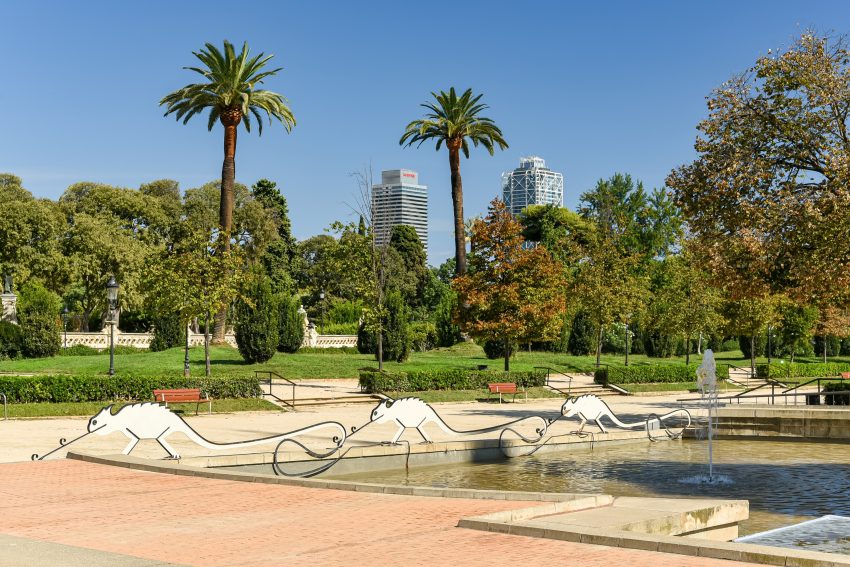
Map of the Self-Guided Walking Tour of Las Palmas de Gran Canaria walking route with 11 stops in Las Palmas de Gran Canaria.
Preview map of the Self-Guided Walking Tour of Las Palmas de Gran Canaria route in Las Palmas de Gran Canaria, showing 11 stops. Use the interactive map to zoom and tap markers.

More from this area

Self-Guided Walking Tour of Reykjavík (2026)

Self-Guided Walking Tour of Reykjavík

This website uses affiliate links which earn a small commission at no additional cost to you.

Reykjavík is compact, characterful, and made for exploring on foot. This self-guided walking tour stitches together the city’s most rewarding sights-architectural icons, harbour views, colourful streets, and small details you might miss from a bus window-into a route you can do at your own pace. Whether you have a few hours between excursions or want to dedicate a full day to the capital, walking is the simplest way to understand how Reykjavík’s history and creativity sit side by side.

Along the way you’ll move between the old town’s low-rise houses, lively shopping streets, and waterfront paths where the light changes by the minute. You’ll pass design shops, bakeries, and museums you can dip into if the weather turns, with plenty of opportunities to pause for a coffee or a bowl of lamb soup. The route is easy to tailor: shorten it for a quick orientation loop, or stretch it out with extra stops and detours into quieter neighbourhoods.

If you’re deciding what to prioritise, this walk is built around the best things to see in Reykjavík-classic landmarks alongside local favourites that give the city its personality. Expect big photo moments, but also the everyday scenes that make the capital feel lived-in: geothermal warmth in the air, public art in unexpected places, and a harbour that anchors the city’s past and present. Bring layers, keep your camera handy, and treat the tour as a flexible framework rather than a strict checklist.

Where to Stay in Reykjavík

To make the most of visiting Reykjavík and this walking tour then you consider staying overnight at the centre. The most convenient base is the 101 Reykjavík core around Laugavegur, Skólavörðustígur, and Hlemmur, where you can step straight into cafés, shops, museums, and many of the city’s headline sights without relying on buses or taxis. For a comfortable, walk-everywhere stay, consider Sand Hotel, Center Hotels Laugavegur, and Alda Hotel Reykjavík-all well-placed for an early start and easy returns between stops.

If you want a calmer feel while still remaining highly walkable, look at the Old Harbour and Grandi area. It’s ideal if your route includes the waterfront, Harpa, or a slower-paced morning by the sea, and it tends to feel less busy at night than the main shopping strip. Good options here include Reykjavík Marina - Berjaya Iceland Hotels and ION City Hotel, which place you close to the harbour atmosphere while keeping the city centre within an easy stroll.

For a quieter, more residential base that still connects well to a central walking route, consider the area around Tjörnin (the pond) and the University/Centre fringes, where streets are greener and evenings are more relaxed. This can be a strong choice if you prefer a slightly slower pace after sightseeing, while staying close enough to walk into the centre in 10-20 minutes. A reliable pick in this zone is Hotel Reykjavík Centrum, which keeps you close to the historic core and the start of many self-guided routes.

The History of Reykjavík

From Settlement to a Small Farmstead Town (9th-17th Centuries)

Reykjavík’s story begins with Iceland’s first permanent settlement era in the late 9th century, traditionally linked to Ingólfur Arnarson, who is often named in the sagas as the first Norse settler to establish himself in the area. For centuries, Reykjavík remained a modest cluster of farms rather than a true town, with activity centred on subsistence life and seasonal trade. If you want to connect that early period to something tangible today, The Settlement Exhibition is the most direct link: it interprets archaeological remains from the earliest habitation layers, grounding Reykjavík’s origin story in evidence rather than legend.

The Rise of an Administrative Centre (18th-19th Centuries)

Reykjavík began shifting from rural outpost to administrative and commercial centre in the 18th century, when Danish-led reforms encouraged more concentrated trade and governance. By the 19th century, the town’s civic identity strengthened as Iceland’s institutions gradually expanded in scope and confidence. A key symbol of that emergence is Alþingishús (Althingishus), built in the 1880s to house Iceland’s parliament. Its sober, dark-stone presence reflects Reykjavík’s growing political weight at a time when the island’s national movement was taking clearer shape. Nearby, Dómkirkjan (Reykjavík Cathedral), completed in the 19th century, reinforced the area around Austurvöllur as the heart of official and ceremonial life.

Nationhood and the Shaping of the Capital (1900s-Mid 20th Century)

In the early 20th century Reykjavík expanded rapidly as people moved from rural areas to the capital for work, education, and modern services. The city’s built environment began to reflect a more self-defined Icelandic identity, especially as the country moved toward full independence in 1944. Several core buildings in the central area speak to this state-forming era. Stjórnarráðshúsið (the Government House), long associated with national administration, anchors the governmental quarter, while cultural institutions consolidated Reykjavík’s role as the country’s intellectual centre; the Culture House is part of that lineage, representing the city’s commitment to safeguarding and presenting Iceland’s literary and historical heritage in a formal civic setting.

Postwar Growth, Modern Design, and Global Visibility (Late 20th Century-Today)

From the late 20th century onward, Reykjavík’s identity became increasingly tied to modern architecture, cultural production, and its dramatic coastal setting. Hallgrímskirkja is the most instantly recognisable example of that shift: the church was designed by Guðjón Samúelsson, and construction began in the mid-1940s, with completion in the 1980s. Its bold, basalt-inspired form turned the skyline into a statement about landscape, faith, and national design language, and it continues to function as both a working church and a defining landmark for visitors.

Along the waterfront, Reykjavík’s 21st-century transformation is encapsulated by Harpa, the concert hall and conference centre that opened in the early 2010s. Designed through a collaboration led by Henning Larsen Architects with Batteríið Architects, and featuring a distinctive façade concept associated with artist Olafur Eliasson, Harpa signalled Reykjavík’s ambition to present itself as a contemporary cultural city as well as a gateway to Iceland’s natural world. Nearby, the Sun Voyager (Sólfar) offers a more poetic public marker: an iconic steel sculpture by Jón Gunnar Árnason, it is often read as a dream-ship or an ode to exploration, fitting a city whose modern identity blends seafaring heritage with a forward-looking creative scene.

Sites That Hold Reykjavík’s Political and Diplomatic Memory

Reykjavík’s history is not only architectural; it is also political and diplomatic. Höfði, a house that has become synonymous with international diplomacy, is the most famous setting for that narrative, and it sits slightly apart from the tourist core, facing the sea in a way that feels deliberately contemplative. Within the centre, churches such as Fríkirkjan add another layer to the city’s civic geography, reflecting religious and community life as Reykjavík diversified and grew beyond its earlier institutional footprint around the cathedral and parliament.

If you trace these sites on foot-from the archaeological story at The Settlement Exhibition to the civic heart near Alþingishús and Dómkirkjan, then onward to Hallgrímskirkja and the modern waterfront at Harpa-you effectively walk through Reykjavík’s evolution: from settlement-era beginnings, to a national capital, to a compact city that uses architecture, culture, and public space to express who it is to the world.

Your Self-Guided Walking Tour of Reykjavík

Discover Reykjavík on foot with your walking tour map guiding you between each stop as you explore its colourful streets, harbourfront views, striking modern architecture, and cosy café culture. This walking tour follows the city’s layered story, shaped by settlement-era beginnings, maritime life, and a strong design-forward identity, taking you from landmark churches and historic civic squares to the waterfront, sculpture-lined promenades, and cultural spaces, all within a compact capital where the sea and changing light frame almost every view.

1. Sun Voyager (Sólfar)

Sun Voyager
Sun Voyager

Sun Voyager is one of Reykjavík’s most recognisable waterfront landmarks, unveiled in 1990 to mark the city’s 200th anniversary. Designed by sculptor Jón Gunnar Árnason, it is often described as a Viking ship, but the intent is more symbolic: a “dreamboat” pointing toward the horizon, suggesting hope, exploration, and the pull of the North Atlantic.

What you see is a sleek stainless-steel frame set directly on the Sæbraut seafront, with Mount Esja frequently forming a dramatic backdrop. The minimal lines catch the changing light, so the sculpture can look almost white in summer glare, then blue-grey under winter cloud, and it becomes especially striking when the sky turns pink at sunset.

It is less about spending time “inside” an attraction and more about setting the tone for a walk: linger for photos, then follow the shoreline path toward Harpa or the old harbour. On calm evenings you may get mirror-like reflections; on stormy days you feel Reykjavík’s elemental character immediately—wind, salt air, and sea spray.


Location: Sæbraut, 101 Reykjavík, Iceland | Hours: 24 Hours. | Price: Free.

Here is a complete selection of hotel options in Reykjavik. Feel free to review each one and choose the stay that best suits your needs.

2. Harpa Concert Hall and Conference Centre

Harpa Concert Hall and Conference Centre

Harpa opened in 2011 and quickly became a symbol of modern Iceland, rising from the post-2008 financial crisis era as a statement of cultural confidence. The building is closely associated with Icelandic-Danish artist Ólafur Elíasson and the architects Henning Larsen and Batteríið, whose collaboration produced a façade inspired by basalt columns and the shifting colours of the ocean and sky.

The main draw is the architecture itself: a geometric glass skin that refracts light in hundreds of directions, changing character minute by minute. Inside, the spaces are deliberately theatrical—broad staircases, warm timber finishes, and views across the harbour—while the main hall is designed for excellent acoustics and hosts everything from classical concerts to contemporary music.

Even if you do not attend a performance, it is worth going in to wander the public areas, see the light patterns, and enjoy the harbour-facing viewpoints. Check what is on, because a short concert can be an efficient way to experience the building as intended—sound, crowd, and atmosphere—rather than only as a photo stop.


Location: Austurbakki 2, 101 Reykjavík, Iceland | Hours: Monday – Tuesday: 10:00–18:00. Wednesday – Saturday: 10:00–20:00. Sunday: 10:00–18:00. | Price: Free (public areas); prices vary by show. | Website

Traveling to a country with a different currency? Avoid ATM transaction fees and pay in local currency with a Wise Card. Having used it for over 5 years, we've saved loads on fees!

3. Old Harbour

Old Harbour Souvenirs

Reykjavík’s Old Harbour is where the city’s modern story starts to feel tangible: a working waterfront that grew out of necessity rather than grandeur. For centuries, the coastline here was an exposed landing place where boats were hauled up on the shore, but Reykjavík’s growth as a trading and fishing centre made a proper harbour essential. Construction of the harbour in the early 20th century was a major national project, transforming the city’s economy and daily life by giving fishing boats and cargo vessels a safer, more reliable base in all but the worst weather.

As you approach along Geirsgata, you are effectively walking into that era of engineering and ambition. Near the harbour you will spot an old steam locomotive, once used to haul stone and building materials during the harbour works, a small but memorable reminder that this waterfront was built by hand, rail, and hard logistics rather than by slow, organic drift. From there, continue toward the sea: the shoreline path opens up views across the bay, and you can pause to take in the outdoor sculptures and the changing exhibition-style displays that often appear around the waterfront.

What to do here now is a mix of old and new. Fishing is still present in the working boats and the smell of the sea, but the Old Harbour Area has also become one of Reykjavík’s most enjoyable strolling zones, with galleries, small museums, cafés, and tour operators operating from restored or repurposed buildings. It is an easy place to fold into a walking tour: amble along the quays, watch the boats come and go, and use the open views as a reset before you continue into the city or further along the coast, where the atmosphere shifts from industrial harbour edges to wide water and sky.


Location: Geirsgata 5c, 101 Reykjavík, Iceland | Hours: 24 Hours | Price: Free. | Website

4. The Settlement Exhibition

The Settlement Exhibition
Public Domain / Szilas

The Settlement Exhibition is one of the most rewarding stops for understanding Reykjavík beyond its contemporary café culture and design scene. It centres on archaeological discoveries made during construction in the city, including remains that date to the early settlement period, giving you a rare, concrete link to Iceland’s beginnings.

The core experience is built around excavated structures and carefully presented artefacts, with interpretation that connects everyday objects to broader themes—migration, survival, resourcefulness, and the shaping of identity in a harsh environment. Rather than a broad sweep museum, it feels focused and narrative-driven, making it efficient even if you have limited time.

For what to do, plan to take it slowly: read the context panels, watch any short media elements, and treat it as a foundation for everything else you see in the city. After this visit, places like the old harbour or the institutional buildings around Austurvöllur tend to feel more meaningful, because you have a clearer sense of how quickly Icelandic society formed and evolved.


Location: Aðalstræti 16, 101 Reykjavík, Iceland | Hours: Daily: 10:00–17:00. | Price: Check official website. | Website

5. Cathedral of Christ the King

Cathedral of Christ the King
CC BY-SA 2.0 / Ben Kucinski

Reykjavík’s Cathedral of Christ the King, better known locally as Landakotskirkja, is the centre of Iceland’s Roman Catholic Diocese and the country’s only Catholic cathedral. The current neo-Gothic building was consecrated on 23 July 1929, but the story begins earlier on the Landakot site, where Catholic clergy re-established a foothold in Reykjavík in the 19th century and first built a small chapel in 1864 before a larger church became necessary as the community grew. The cathedral’s construction marked a turning point: a permanent, confident statement of Catholic life in a predominantly Lutheran country.

Architecturally, it is worth visiting even if you are not specifically seeking religious sites. It was designed by Guðjón Samúelsson, the same architect associated with some of Iceland’s best-known church architecture, and Landakotskirkja is instantly recognisable for its neo-Gothic massing and its unusual flat-topped tower rather than a needle spire. Seen from the surrounding streets in Vesturbær, it reads as a landmark that is both European in reference and distinctly adapted to Reykjavík’s scale and weather, with a solid, almost fortress-like presence that feels appropriate for the Atlantic edge.

Inside, the appeal is the calm atmosphere and the craftsmanship: many of the fittings and carved elements were produced by the Dutch atelier J.W. Ramakers & Sons, giving the interior a sense of artisanal detail that contrasts with the often minimal décor of local Lutheran churches. Plan to step in briefly for the stained glass and the quiet, then linger outside to appreciate how the cathedral sits above the neighbourhood streets, making it an easy stop to combine with a walk between the old harbour, Vesturbær cafés, and the central district. If your timing aligns, you can also experience the cathedral as a living place of worship, with services offered in multiple languages for Reykjavík’s international Catholic community.


Location: Túngata 13, 101 Reykjavík, Iceland | Hours: Monday: 09:00–17:00. Tuesday: 09:00–17:00. Wednesday: 09:00–17:00. Thursday: 09:00–17:00. Friday: 09:00–17:00. Saturday: Closed. Sunday: Closed. | Price: Free; donations appreciated. | Website

6. Fríkirkjan

Lutheran Free Church
CC BY-SA 1.0 / TommyBee

Fríkirkjan is a charming lakeside church with an important place in Reykjavík’s cultural landscape. It is associated with a movement that sought greater independence within Icelandic religious life, and that history gives the building a distinct identity compared with the cathedral’s formal national role.

What you see is a picturesque structure near Tjörnin (the city pond), where the setting is as much part of the experience as the church itself. In summer it feels bright and open, with birds and reflections on the water; in winter, the area can be starkly beautiful, and the church becomes a warm focal point in the subdued light.

It is an excellent stop during a walk around Tjörnin and nearby streets, particularly if you want quieter, more local-feeling moments between the larger headline sights. If you can time it with a concert or community event, even better—Fríkirkjan often feels like the kind of place where Reykjavík’s everyday cultural life is more visible than its tourist-facing image.


Location: Fríkirkjuvegur 5, 101 Reykjavík, Iceland | Hours: Monday – Thursday: 09:00–16:00. | Price: Free; donations appreciated. | Website

7. Alþingishús

Alþingishúsið
Alþingishúsið

Alþingishús is the home of Iceland’s parliament, a powerful symbol given that the Alþingi is often cited as one of the world’s oldest parliamentary institutions, founded in 930 at Þingvellir. The current parliament building in central Reykjavík dates to the late 19th century, built in hewn Icelandic stone, and its dignified, compact design reflects the young nation’s growing political self-definition.

What stands out is its solid, almost austere appearance, set beside Austurvöllur square—a gathering place that has long functioned as the city’s civic stage. The square is where locals meet, where seasonal events happen, and where political life becomes visible, from everyday conversations on benches to moments of public demonstration.

You typically engage with Alþingishús from the outside rather than as an interior museum experience, but it is an excellent stop for understanding Reykjavík’s centre as a living civic district. Pair it with a slow walk around Austurvöllur and the adjacent streets, noting how close the core institutions are to one another—parliament, cathedral, government offices—creating a compact “capital in miniature.”


Location: 43W5+MWW, Kirkjutorg, 101 Reykjavík, Iceland | Hours: Check official website. | Price: Free. | Website

8. Reykjavík Cathedral

Dómkirkjan í Reykjavík

Dómkirkjan is Reykjavík’s principal cathedral and one of the city centre’s key historical anchors. While the building has been altered over time, it remains closely tied to Iceland’s national story, including religious life, state occasions, and ceremonial moments that link the capital to the wider country.

Architecturally, it is notable for understatement: a pale façade, clean proportions, and a calm presence that contrasts with the more sculptural drama of Hallgrímskirkja. Its setting near Austurvöllur gives it additional resonance, because it sits alongside parliament and the heart of civic life, reinforcing how intertwined faith, society, and governance have historically been in Iceland.

What to do here is simple but worthwhile: step inside for a quiet pause, appreciate the light and the sense of continuity, and then use it as a pivot point to explore the immediate area. Even a brief visit adds texture to a walk through the centre because it frames the city not just as a creative hub, but as a place with deep institutional roots.


Location: Kirkjustræti, 101 Reykjavík, Iceland | Hours: Monday – Friday: 10:00–14:00. | Price: Free; donations appreciated. | Website

9. Stjórnarráðshúsið (Government House)

Prime Minister’s Office
CC BY-SA 4.0 / APK

Stjórnarráðshúsið is the Government House, a key building in Iceland’s political landscape and one of the city centre’s most historically resonant administrative sites. It is closely linked to the evolution of Icelandic governance, particularly the transition from external rule toward modern national administration, and it remains central to how the state presents itself in the capital.

The building itself is modest compared to grand government palaces elsewhere in Europe, which is part of its appeal: Reykjavík often signals authority through restraint rather than spectacle. Its presence helps you read the city’s core as a compact cluster of institutions, where political power is embedded in a walkable streetscape rather than separated behind vast ceremonial spaces.

As a visitor, you typically engage with Stjórnarráðshúsið as an exterior landmark—note its position, observe the rhythms of the area, and use it to connect the political story to nearby places like Alþingishús and the cathedral. It is a useful stop if you are building a mental map of Reykjavík as both a lived-in city and a functioning national capital.


Location: Lækjargata, 101 Reykjavík, Iceland | Hours: Monday – Friday: 08:30–16:00. Closed on Saturday, Sunday. | Price: Free. | Website

10. Culture House (Safnahúsið / The Culture House)

The House of Collections
CC BY-SA 3.0 / Vera de Kok

The Culture House is one of Reykjavík’s most valuable “context” stops, bringing together exhibitions that illuminate Iceland’s literary, artistic, and cultural heritage. Housed in a central building with an institutional feel, it functions as a gateway to the stories Iceland tells about itself—language, creativity, identity, and the preservation of memory.

What to see depends on the current exhibitions, but the emphasis is typically on well-curated, interpretive displays rather than blockbuster spectacle. You may encounter material connected to Icelandic manuscripts and cultural history, alongside rotating shows that broaden the frame to art and modern cultural expression, making it a strong complement to the archaeological focus of the Settlement Exhibition.

In practical terms, it works well mid-walk: it is centrally located, does not require a huge time commitment, and it gives you a more nuanced understanding of why Iceland’s cultural output—especially literature—punches above its weight globally. Even a short visit can deepen the meaning of what you see elsewhere, from public sculpture to contemporary architecture.


Location: Hverfisgata 15, Hverfisgata 15, 101 Reykjavík, Iceland | Hours: Daily: 10:00–17:00. | Price: Adults (18+): 1.500 kr.; Students: 1.000 kr.; Seniors (67+): 1.000 kr.; Children (17 and under): free; Visitors with disabilities and care partners: free. | Website

11. Hallgrímskirkja

Hallgrimskirkja
Hallgrimskirkja

Hallgrímskirkja is Reykjavík’s most iconic church, designed by state architect Guðjón Samúelsson and built over several decades in the 20th century, with completion in 1986. Its form is famously influenced by Icelandic nature—particularly basalt lava flows and columnar rock formations—translated into a dramatic stepped façade and a soaring tower that dominates the skyline.

The exterior is the headline: a monumental, sculptural front that feels both stark and uplifting, especially in low winter light. In the forecourt you will also see the statue of Leif Erikson, gifted by the United States in 1930 to commemorate the 1,000th anniversary of the Alþingi, linking the site to broader Icelandic identity and history.

Inside, the atmosphere is comparatively restrained, emphasising space, light, and clean lines rather than ornate decoration. The tower elevator is one of the best things to do in central Reykjavík: from the top you get a clear sense of the city’s layout—colourful roofs, the harbour edge, and the mountains beyond—making it a useful orientation point early in a visit.


Location: Hallgrímstorg 1, 101 Reykjavík, Iceland | Hours: Daily: 10:00–17:00. Tower & church shop: 10:00–16:45. | Price: Church entry: Free. Tower: Adults 1,400 ISK; Seniors/students/disabled 1,000 ISK; Children (7–16) 200 ISK; Under 7: free. | Website

12. The Einar Jónsson Museum

The Einar Jónsson Museum
CC BY-SA 2.0 / Ray Swi-hymn

The Einar Jónsson Museum (Listasafn Einars Jónssonar) is one of Reykjavík’s most distinctive small museums, built around the life and work of Einar Jónsson (1874–1954), often regarded as Iceland’s first major sculptor. Trained abroad and shaped by late-19th and early-20th century European art currents, Jónsson developed a symbolic, sometimes mystical visual language that resonated with Iceland’s emerging national identity. The museum itself is part of the story: it was purpose-built to house his work and stands close to Hallgrímskirkja, placing it in the same “cultural hilltop” zone that defines Reykjavík’s skyline.

Inside, the focus is almost entirely on sculpture, with a strong emphasis on plaster originals and bronze works that span Jónsson’s career. Expect expressive figures, allegorical scenes, and myth-tinged compositions that draw on Icelandic folklore, human psychology, and spiritual themes rather than straightforward portraiture alone. The galleries are compact and contemplative, so it suits visitors who prefer to slow down and look closely—this is less about variety and more about stepping into one artist’s world and understanding how he tried to give form to big ideas: fate, struggle, love, belief, and the forces of nature.

A major highlight is the sculpture garden outside, which is easy to combine with a walk around Hallgrímskirkja and the surrounding streets. The garden lets you see how the works sit in open air, with changing light and weather altering the mood—particularly effective in Reykjavík, where cloud and sun can shift quickly. If you are building a cultural route through the city centre, the museum works well as a short, high-impact stop: pair it with Hallgrímskirkja’s tower view for orientation, then use the museum to add depth and texture to Reykjavík’s artistic and national story.


Location: Hallgrímstorg 3, Njarðargata 51, 101 Reykjavík, Iceland | Hours: Tuesday – Sunday: 10:00–17:00. Closed on Monday. | Price: Adults: ISK 1500; Seniors (67+): ISK 1000; Students (with ID): ISK 1000; Under 18: free; People with disabilities: free. | Website

13. Höfði House (Hofdi)

Höfði House
Höfði House

Höfði is a small house with outsized historical significance, best known internationally as the site of the 1986 Reykjavík Summit between Ronald Reagan and Mikhail Gorbachev. While the meeting did not produce a final agreement, it is widely viewed as a pivotal moment in the thawing of Cold War tensions, giving Reykjavík a distinctive place in late 20th-century diplomatic history.

The building also carries local intrigue: it is one of the city’s older houses and has long been wrapped in stories and folklore, which adds an atmospheric layer even for visitors mainly interested in the summit narrative. Its location near the waterfront makes it feel slightly apart from the busiest central streets, lending it a quiet, reflective quality.

What to do is essentially to visit the exterior and absorb the setting—this is a “stand and think” stop rather than an activity-heavy attraction. It pairs well with a waterfront walk, especially if you started at Sun Voyager, because it reinforces a theme that runs through Reykjavík: a small city that repeatedly finds itself connected to big ideas, from exploration and settlement to culture and geopolitics.


Location: Félagstún 1, 105 Reykjavík, Iceland | Hours: 24 Hours. | Price: Free.
Powered by GetYourGuide
Moira & Andy
Moira & Andy

Hey! We're Moira & Andy. From hiking the Camino to trips around Europe in Bert our campervan — we've been traveling together since retirement in 2020!

Read our full story here

This website uses affiliate links which earn a small commission at no additional cost to you.

Walking Tour Summary

Distance: 5.5 km
Sites: 13

Walking Tour Map
Map of the Self-Guided Walking Tour of Reykjavík walking route with 13 stops in Reykjavik.
Preview map of the Self-Guided Walking Tour of Reykjavík route in Reykjavik, showing 13 stops. Use the interactive map to zoom and tap markers.

More from this area

Self-Guided Walking Tour of Alicante (2026)

View of Alicante from Castle
Self-Guided Walking Tour of Alicante

This website uses affiliate links which earn a small commission at no additional cost to you.

Alicante is a city that rewards walking. It is compact enough to explore at a relaxed pace, but layered enough to feel like you are moving through distinct neighbourhoods every few minutes: palm-lined seafront, elegant 19th-century streets, lively market lanes, and the steep, whitewashed climbs of the old quarter. A self-guided route is ideal here because you can linger where the city feels most alive, pause for a coffee in a shaded plaza, and detour for viewpoints without worrying about schedules.

This walking tour is designed to stitch Alicante's highlights into a practical loop, with plenty of chances to stop for food, photos, and short breaks in the shade. You will pass through the historic heart, where churches and civic buildings sit alongside everyday local life, then work your way toward the areas that define Alicante's sense of place: the waterfront promenades, the castle hill, and the streets where the city's contemporary energy is most visible. If your goal is to cover the best things to see in Alicante in a single day, this approach keeps the route efficient while still feeling unhurried.

Along the way, you will get a strong mix of history and atmosphere: the story of a Mediterranean port shaped by trade and fortification, the view-driven drama of the castle setting, and the simple pleasures that make Alicante easy to enjoy-markets, terraces, and the rhythm of the sea always nearby. Consider starting early to beat the heat and crowds, then finishing later in the day when the light softens and the city shifts into its evening pace.

How to get to Alicante

By Air: Alicante-Elche Airport (ALC) is the main gateway, with extensive domestic and European connections and generally the fastest option if you are coming from outside Spain. From the airport, the easiest transfer is by airport bus to central Alicante (terminating near key downtown stops), or by taxi/ride-hailing if you want a direct door-to-door trip; if you are heading straight to the Old Town or the seafront, public transport usually gets you close enough to walk the final stretch. In peak summer, allow extra time for security queues and for road congestion on the approach to the city. For the best deals and a seamless booking experience, check out these flights to Alicante on Booking.com.

By Train: Alicante is well connected by Spain's rail network, including high-speed services on the Madrid-Alicante corridor and frequent regional trains linking other Valencian and Murcia destinations. Alicante-Terminal station sits close to the centre, so arriving by rail is convenient for a walking-based itinerary: you can typically reach the waterfront, central shopping streets, and many hotels in a short taxi ride or a manageable walk, depending on luggage. For the best fares, booking earlier is usually advantageous, especially around weekends and holiday periods. Train schedules and bookings can be found on Omio.

By Car: Driving to Alicante can be practical if you are combining the city with coastal towns or inland day trips, with major routes such as the AP-7/A-70 connecting you along the Mediterranean corridor. The main drawback is parking: the city centre and Old Town have limited on-street spaces and regulated zones, so a paid underground car park is often the simplest solution, particularly in summer. If your accommodation offers parking, confirm access details in advance, as some central streets have restrictions or tight approaches. If you are looking to rent a car in Spain I recommend having a look at Discover Cars, first, as they compare prices and review multiple car rental agencies for you.

By Bus: Long-distance buses can be a cost-effective alternative, with services linking Alicante to many Spanish cities and regional hubs. The main bus station is generally straightforward for onward local transport, and for budget-focused travellers it can be a sensible option if train times or prices do not suit your schedule. [bus]

Where to Stay in Alicante

To make the most of visiting Alicante and this walking tour, then you should consider staying overnight in the centre. If you want to be able to start early, dip in and out of the Old Town, and finish by the waterfront without relying on taxis, the most practical base is the seafront/Old Town edge around El Postiguet and the Explanada. From here you can walk straight into the historic lanes, reach the main promenades in minutes, and keep the route flexible for heat or crowds. Strong options in this zone include Meliá Alicante for a classic seafront base and Hotel Spa Porta Maris by Meliá for immediate access to the marina and promenades.

If you prefer a more “city-break” feel with shopping streets, cafés, and fast access to transport links, stay in the central Ensanche/Centro area around Avenida Alfonso X El Sabio and the Mercado district. This puts you close to the walkable core while giving you a broader spread of dining and evening atmosphere beyond the Old Town. Consider Eurostars Lucentum for a very central, practical location, and Hospes Amérigo if you want a more boutique-style stay close to key historic streets and the cathedral area.

If your priority is a slightly quieter base with easy access to the castle approach and still within comfortable walking distance of the centre, the area around the Castle of Santa Bárbara foothills and the northern edge of the centre can work well. It is typically calmer at night, but you can still walk into the heart of Alicante quickly, especially if you are comfortable with gentle gradients. A good option here is Hotel Maya Alicante, which is well placed for viewpoints and onward walking routes. If you are arriving by rail or want an easy drive-in/drive-out plan with simpler parking logistics, the station-side/Benalúa edge is often more straightforward; NH Alicante is a practical choice for that style of stay.

The History of Alicante

Ancient origins and the rise of a port city

Alicante’s story begins with its strategic position on the Mediterranean, where successive cultures used the natural harbour and the defensible hill of Benacantil to control trade and movement along the coast. Archaeological evidence around the mountain points to very early occupation, but the city’s enduring “icon” is Santa Bárbara Castle, whose origins are commonly dated to the 9th century during Muslim rule, when the hilltop was fortified to command the bay and the surrounding approaches.

Medieval Alicante and the Christian reconquest

In the medieval period, Alicante developed as a walled settlement shaped by the frontier politics of eastern Iberia. Santa Bárbara Castle changed hands in the 13th century and was later rebuilt and strengthened under successive rulers, reflecting both its military value and the city's growing importance as a coastal stronghold. In the Old Town, the medieval street pattern still frames small squares and lanes around the Square of the Most Holy Face, which sits beside the civic heart of the city near the Town Hall-an area where religious processions, local ceremonies, and everyday city life have overlapped for centuries.

Early modern faith and civic power

From the 14th to 16th centuries, Alicante's oldest active church, the Basilica of Santa María, rose in Valencian Gothic style on the site of the former mosque, anchoring the medieval core with a building that later gained prominent Baroque elements. In the 17th century, the Co-cathedral of Saint Nicholas of Bari was built over an earlier mosque between 1613 and 1662, designed by Agustín Bernardino, and its sober exterior and domed crossing remain one of the clearest architectural statements of early modern Alicante. This same era gradually formalised Alicante's urban identity as a port city with stronger institutions and a more monumental public realm.

An 18th-century city and a 20th-century makeover

In the 18th century, Alicante's civic centre took on the confident Baroque face you see today at Alicante Town Hall, an 18th-century building credited to architect Lorenzo Chápuli, with its principal façade and ceremonial interiors marking the city's administrative consolidation. The early 20th century then added a second layer of landmark architecture: Alicante's Central Market was designed in 1915 by Francisco Fajardo Guardiola and completed in the early 1920s under Juan Vidal Ramos, while Casa Carbonell-also by Juan Vidal Ramos, built in the 1920s for textile entrepreneur Enrique Carbonell-became a defining presence along the seafront promenade. Together they capture a period when Alicante's commercial confidence and urban growth were being expressed in stone, iron, and modernist detail.

The seafront city you walk today

Alicante’s modern identity is inseparable from its waterfront. The Explanada de España, running beside the port, evolved into a signature promenade and later took its present name in the 20th century, with major remodelling plans in the mid-century as the seafront became a larger civic stage for locals and visitors. Rambla Méndez Núñez acts as a key urban spine linking the port area toward the Central Market and marking the transition between the older fabric and the newer city, which is why it often feels like the “hinge” street when you explore on foot. The result is a city where the walkable highlights are not confined to one period: medieval lanes, early modern churches, Baroque civic grandeur, and early-20th-century statement buildings all sit within an easy stroll of the sea.

Your Self-Guided Walking Tour of Alicante

Discover Alicante on foot with a walking tour map that guides you between each stop as you explore its palm-lined seafront, castle viewpoints, historic quarters, and everyday local life. This route follows the city's layered story as a Mediterranean port shaped by trade, fortification, and long centuries of cultural change, moving from Old Town lanes and landmark squares to waterfront promenades and panoramic lookouts. With most highlights concentrated within an easy walk, Alicante's mix of sea air, lively streets, and hilltop drama makes it simple to cover the city's essentials in one well-paced loop.

1. Casa Carbonell

Casa Carbonell
Casa Carbonell
CC BY-SA 4.0 / H.Helmlechner

Casa Carbonell, sitting prominently along Alicante’s seafront, is one of the city’s best-known early 20th-century buildings and a symbol of the period when Alicante projected modernity through elegant, European-influenced urban design. Commissioned by a wealthy owner and designed to be both prestigious and visible, it reflects the era’s taste for ornate façades and grand residential-commercial architecture along prime coastal promenades. Its enduring fame comes from exactly that intention: it was built to be noticed.

What to see now is primarily the exterior. The façade’s decorative detailing, balconies, and overall composition stand out against the openness of the waterfront setting, making it one of Alicante’s classic photo backdrops. It is also a useful marker for understanding how the city’s relationship with the sea evolved—from purely working port functions to leisure-oriented promenading and civic display.

For visitors, Casa Carbonell is best treated as a “pause point” on the Explanada. Stop for photos, then use it as a cue to slow down and enjoy the promenade properly: a long walk, a café stop, and a sense of Alicante’s everyday coastal rhythm. If you are interested in architecture, it pairs well with a broader look at the city’s modernist and early 20th-century building stock around the central avenues.


Location: Passeig Esplanada d'Espanya, 1, 03002 Alacant, Alicante, Spain | Hours: 24 Hours. | Price: Free.

We recommend to rent a car in Spain through Discover Cars, they compare prices and review multiple car rental agencies. Book your rental car here.

2. Alicante Town Hall

Alicante City Hall
Alicante City Hall
CC BY-SA 4.0 / Emilio J. Rodríguez Posada

Alicante Town Hall is a statement of civic identity, representing the era when Spanish cities expressed authority and pride through imposing municipal architecture. Its construction and later embellishments reflect Alicante’s growth as a port city and administrative centre, where power and commerce needed a public face. Even if you are not an architecture specialist, the building communicates what it was meant to communicate: stability, order, and an institutional presence at the heart of the old town.

Today, it is one of the most straightforward “walk-by and understand the city” stops in Alicante. The façade and the plaza setting make it easy to appreciate as part of the urban scene—an anchor point that helps you orient yourself as you move between church sites, small squares, and lanes leading toward the waterfront. If the building is open for visitors, stepping inside can add texture with ceremonial spaces and period details that show how civic life was staged.

As part of a route, pair it with the Basilica of Santa María and the nearby old-town squares for a compact cluster that blends civic and religious history. It is also a good spot for a short break, because the surrounding area tends to have nearby cafés and a comfortable “linger” atmosphere that suits slow travel.


Location: Plaça de l'Ajuntament, 1, 03002 Alacant, Alicante, Spain | Hours: (October – June) Monday – Friday: 09:00–14:00. Closed on Saturday, Sunday. (July – September) Monday – Friday: 09:00–13:00. Closed on Saturday, Sunday. | Price: Free. | Website

Here is a complete selection of hotel options in Alicante. Feel free to review each one and choose the stay that best suits your needs.

3. Basilica of Santa María

Basilica of St Mary of Alicante
CC BY-SA 1.0 / Diego Delso

The Basilica of Santa María is often described as Alicante’s oldest active church, rooted in the city’s medieval transformation after Christian conquest. Built on the site of a former mosque, it carries that layered Iberian story of religious continuity and urban redefinition. Over time, elements were added or modified, reflecting evolving tastes and liturgical priorities, which is why the building can feel like a composite of periods rather than a single “pure” style.

What stands out now is the sense of age and material presence. Look for stonework details and the way the façade and interior elements reflect different phases of construction. The church’s atmosphere tends to be more intimate than a cathedral, making it a good stop if you like spaces that feel rooted and slightly quieter, where you can appreciate small altars, devotional corners, and the softness of interior light.

To visit well, treat it as a short but intentional pause on an old-town circuit. Pair it with the Town Hall and nearby lanes, and consider stopping when you need a break from sun and noise. If you enjoy photography, the best shots often come from exterior angles that include surrounding streets, because they situate the basilica within the tight urban fabric that gives Alicante’s old town its character.


Location: Pl. Sta. María, 1, 03001 Alicante (Alacant), Alicante, Spain | Hours: Monday – Saturday: 10:00–19:00. Sunday: 13:00–19:00. | Price: Adults (18–64): €6; Seniors (65+): €5; Youth/Students: €4; Under 12: free (with an adult). | Website

Traveling to a country with a different currency? Avoid ATM transaction fees and pay in local currency with a Wise Card. Having used it for over 5 years, we've saved loads on fees!

4. Santa Bárbara Castle

Castell de Santa Bàrbera
CC BY-SA 3.0 / Diego Delso

Perched on Mount Benacantil, Santa Bárbara Castle is the defining silhouette of Alicante and one of the largest medieval fortifications in the region. The site’s strategic value goes back far earlier than the castle you see today: the hill was used in antiquity, and the fortifications were substantially developed under Islamic rule before later Christian expansion reshaped it after the Reconquista. Over the centuries it was repeatedly modified to match new military realities, leaving a layered complex where bastions, courtyards, and artillery platforms reflect different eras of siege warfare and coastal defence.

Walking the castle now is essentially a self-guided journey through Alicante’s military geography. Start with the upper levels for the broadest panoramas over the port, beaches, and the old town, then work your way down through the terraces and defensive lines to appreciate how the complex is organised. The viewpoints are the main event, but the real reward comes from noticing the small details—thick walls, angled ramparts, and the way the architecture is designed to control movement and sightlines.

To get the most out of a visit, time it to match the light: mornings are crisp and clear, while late afternoon is ideal for warmer tones over the harbour and city. If you want minimal effort, use the lift access where available, and if you prefer the “earned view,” take one of the climbing paths from the old town. Either way, budget enough time to linger at the viewpoints and walk multiple levels, because the castle reads differently from each terrace.


Location: Castillo de Santa Bárbara, 03002 Alicante (Alacant), Alicante, Spain | Hours: (November 15 – February 27) Monday – Sunday: 10:00–18:00. (February 28 – June 16) Monday – Sunday: 10:00–20:00. (June 17 – September 4) Monday – Sunday: 10:00–23:00. (September 5 – November 14) Monday – Sunday: 10:00–20:00. | Price: Free entry; lift: €2.70. | Website

5. Alicante’s Central Market

Mercat Central d’Alacant
CC BY-SA 1.0 / Zarateman

Alicante’s Central Market (Mercado Central) is both a daily-use food market and a snapshot of early 20th-century civic pride, built to formalise and modernise the city’s traditional trading culture. The building’s architecture reflects the era when European cities invested in grand public markets as symbols of hygiene, order, and prosperity—functional spaces designed to serve the whole city, but also to impress. Like many Spanish markets, it has remained a social institution as much as a retail one, linking local agriculture, fishing, and household routines to the rhythms of the city centre.

Visiting now is an easy way to understand Alicante beyond monuments. Inside, you’ll typically find stalls built around the essentials: seasonal produce, cured meats, cheeses, olives, spices, and seafood that reflects the city’s Mediterranean identity. It is the best place to see what is in season, pick up picnic supplies, and get a practical sense of local eating habits—what people cook, what they snack on, and what they buy daily versus occasionally.

The best approach is to go earlier in the day when the market is busiest and the selection is at its peak. If you are doing a walking itinerary, use the market as your “flavour stop” between churches and museums—quick enough to fit into a schedule, but memorable because it engages the senses. Even if you do not buy much, a short loop through the aisles gives you a grounded, lived-in counterpoint to Alicante’s more photogenic waterfront and castle views.


Location: Av. Alfonso El Sabio, nº 10, 03004 Alicante (Alacant), Alicante, Spain | Hours: Monday – Friday: 07:00–14:30. Saturday: 07:00–15:00. Closed on Sunday. | Price: Free. | Website

6. Rambla Méndez Núñez

Rambla de Méndez Núñez
CC BY-SA 1.0 / Zarateman

Rambla Méndez Núñez is one of Alicante’s key city-centre arteries, shaped by the Mediterranean tradition of broad promenades that channel movement, shade, and social life through an urban core. The “rambla” concept often traces older watercourses or drainage routes that were later urbanised, and over time these corridors became natural stages for parades, public gatherings, and everyday strolling. In Alicante, the Rambla’s role is to connect districts and attractions while maintaining that distinctly Spanish rhythm of walking, pausing, and watching the city move.

Today, the Rambla is less about a single landmark and more about how Alicante functions day to day. It is a practical route between the old town, shopping areas, and the waterfront zone, lined with cafés, kiosks, and the kind of city infrastructure that makes strolling comfortable—benches, shade patches, and frequent cross-streets that pull you toward side attractions. It is also a strong place to notice Alicante’s architectural mix, where civic buildings and apartment façades reflect different phases of growth.

For visitors, the Rambla works best as a “connector with benefits.” Use it to stitch together stops—Central Market, the old town streets, and the Explanada—without feeling like you are simply transiting. If you time it for early evening, it becomes part of the city’s social theatre, when locals head out and the street feels more like a living room than a road.


Location: Rbla. de Méndez Núñez, Alicante (Alacant), Alicante, Spain | Hours: 24 Hours. | Price: Free.

7. Co-cathedral of Saint Nicholas of Bari

Cocatedral de Sant Nicolau
CC BY-SA 4.0 / Emilio J. Rodríguez Posada

The Co-cathedral of Saint Nicholas of Bari is one of Alicante’s most important religious monuments, anchored in the city’s post-Reconquista development and later shaped by the architectural languages of the Counter-Reformation era. Built on the site of an earlier mosque, it reflects the common Iberian pattern of sacred continuity: new Christian structures rising where Islamic ones stood, both to serve the growing city and to formalise a new religious and civic identity. Its design, combining sober exterior lines with a more expressive interior, speaks to a period when churches were expected to be both doctrinally clear and visually persuasive.

Inside, the cathedral’s spatial drama becomes more apparent. Look for the proportions of the nave, the dome, and the way chapels and altarpieces punctuate the interior with bursts of ornament. Even if you are not deeply interested in church art, the building rewards attention because it is a calm, cool counterpoint to Alicante’s bright streets, and it offers a concentrated lesson in how Spanish religious architecture balances restraint with emphasis.

A strong way to include it now is as an old-town anchor stop: visit, step back out into the lanes, and then continue to nearby squares for a café break. If you can, time your visit for a quieter window so you can appreciate the acoustics and the “stillness” effect that these spaces were designed to create. It is not a long visit, but it adds cultural depth to a route that might otherwise focus on viewpoints and promenades.


Location: Plaza de, Pl. del Abad Penalva, 2, 03002 Alicante (Alacant), Alicante, Spain | Hours: Monday – Friday: 07:30–13:00 & 17:30–20:00. Saturday: 08:30–13:00 & 17:30–20:30. Sunday: 08:30–13:30 & 17:30–20:30. | Price: Church entry: Free. Cultural/audioguided visit (cloister + upper areas + bell tower): €8. | Website

8. Explanada de España

Passeig Esplanada d’Espanya
CC BY-SA 1.0 / Zarateman

The Explanada de España is Alicante’s signature promenade and the city’s most recognisable public space, designed for strolling by the marina with a distinctly Mediterranean sense of leisure. Its famous wave-pattern mosaic and palm-lined layout reflect an urban ideal: the waterfront as an everyday living room, where locals and visitors share the same slow rituals—walking, talking, people-watching, and pausing for coffee or ice cream. Historically, promenades like this formalised the city’s relationship with the sea, turning the port edge into civic space rather than purely functional infrastructure.

What to do now is intentionally simple, and that is the point. Walk the full length rather than treating it as a photo stop, because the Explanada works as an experience of pacing and atmosphere. You will often find market stalls, street performers, and small events that change the feel of the promenade depending on season and time of day. It is also one of the best places in Alicante to “do nothing well,” which is a legitimate travel skill.

For itinerary planning, use the Explanada as your connector between the old town cluster and the harbour zone. It works well as a morning start, a midday reset, or an evening wind-down, and it pairs naturally with nearby architecture like Casa Carbonell. If you time it for sunset, the light over the marina and palm silhouettes makes even a simple walk feel like a highlight.


Location: Passeig Esplanada d'Espanya, Alacant, Alicante, Spain | Hours: 24 Hours. | Price: Free.
Powered by GetYourGuide
Moira & Andy
Moira & Andy

Hey! We're Moira & Andy. From hiking the Camino to trips around Europe in Bert our campervan — we've been traveling together since retirement in 2020!

Read our full story here

This website uses affiliate links which earn a small commission at no additional cost to you.

Walking Tour Summary

Distance: 4 km
Sites: 8

Walking Tour Map
Map of the Self-Guided Walking Tour of Alicante walking route with 8 stops in Alicante.
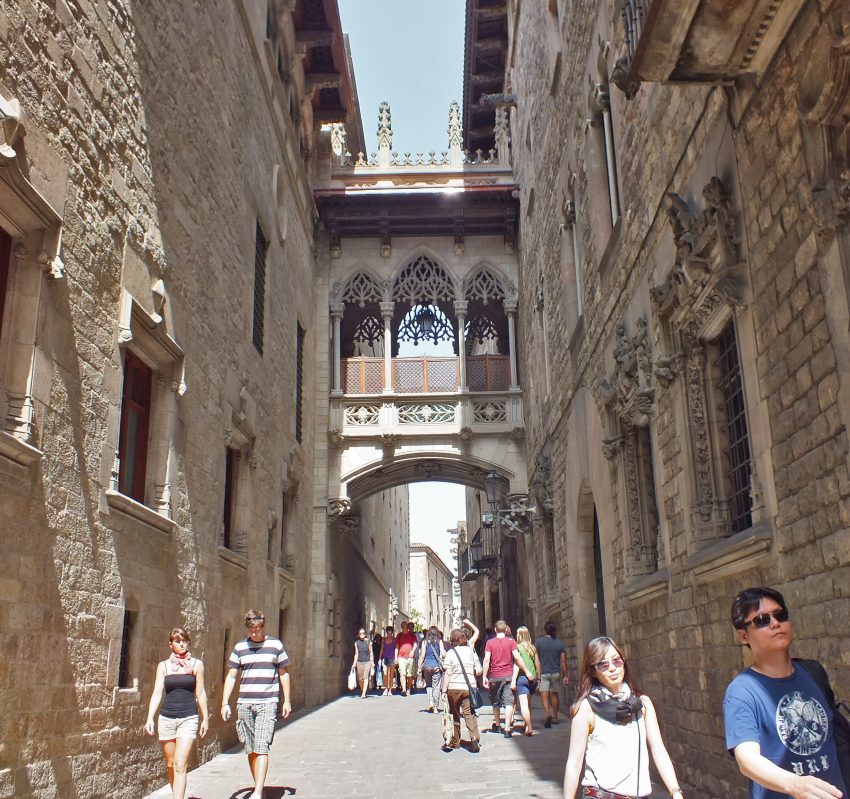
Preview map of the Self-Guided Walking Tour of Alicante route in Alicante, showing 8 stops. Use the interactive map to zoom and tap markers.
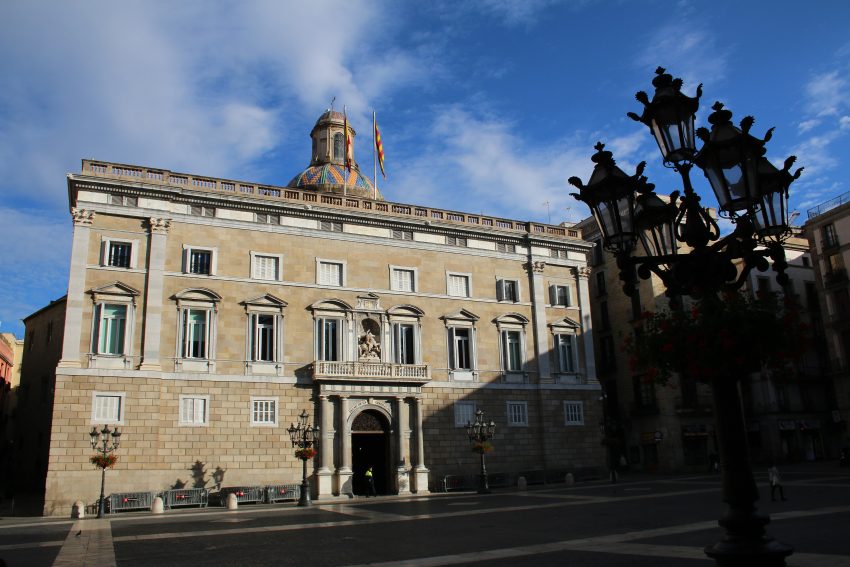
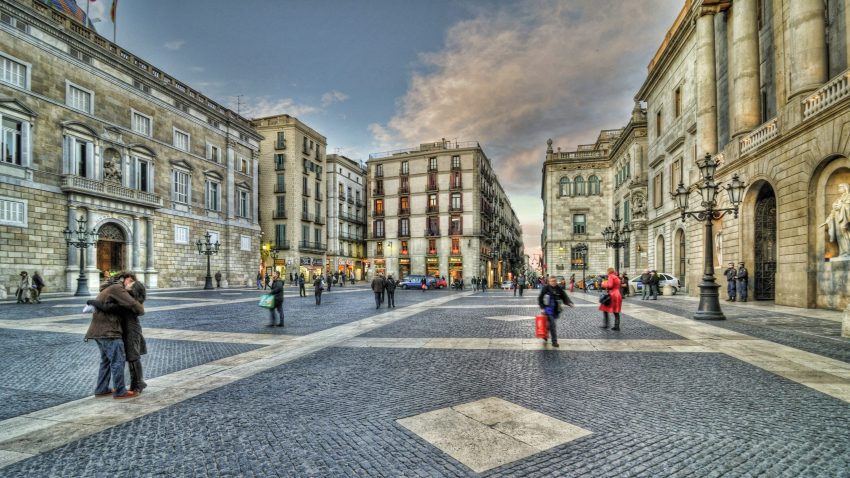
More from this area