Toledo, Spain: The Ultimate Travel Guide 2026

toledo
toledo

Toledo, set in the heart of Castile-La Mancha, is a city where centuries of cultural influences blend seamlessly into its striking urban landscape. Surrounded by the winding Tagus River, Toledo's elevated position offers breathtaking views of its skyline, dominated by the grand Alcázar and the towering Toledo Cathedral. The historic streets lead visitors through atmospheric alleys, where medieval buildings coexist with vibrant plazas, creating an immersive experience that transports travelers to another era. Whether admiring the intricate Mudéjar details or discovering hidden courtyards, every corner of Toledo carries a unique charm.

Beyond its impressive architecture, Toledo is a city of craftsmanship and tradition. Local artisans specialize in damascene metalwork, a centuries-old technique of inlaying gold into steel, making for exceptional souvenirs. The city also has a thriving gastronomic scene, with must-try dishes like carcamusas, a flavorful pork stew, and mazapán de Toledo, a sweet almond treat that has been a staple for generations. Exploring the local markets and family-run eateries provides an authentic taste of the region's culinary heritage.

For those seeking panoramic beauty, the Mirador del Valle offers one of the most striking viewpoints in Castile-La Mancha, where visitors can take in the full majesty of Toledo's historic layout. Walking along the riverside paths or crossing the Puente de San Martín provides another perspective of the city's timeless appeal. Whether wandering through historic monasteries, indulging in traditional Castilian cuisine, or simply taking in the awe-inspiring sights, Toledo is an unforgettable destination that showcases the richness of Spain's cultural legacy.

History of Toledo

Toledo in Antiquity

Toledo’s origins trace back to ancient times, with evidence of early Celtiberian settlements flourishing in the region. The city later came under Roman rule, transforming into an important administrative and military center. The Romans constructed vital infrastructure, including bridges, aqueducts, and roads, which contributed to Toledo’s growth and connectivity. The remnants of Roman engineering can still be seen in structures such as the Puente de Alcántara, a magnificent stone bridge that has endured through centuries of historical shifts.

Toledo in the Visigothic Period

Following the decline of the Roman Empire, Toledo became the capital of the Visigothic Kingdom, marking a significant era of political and religious influence. The Visigoths established Toledo as the center of governance, holding important ecclesiastical councils that shaped the religious framework of the Iberian Peninsula. This period solidified the city’s role as a hub for administration and culture, leaving behind architectural and artistic legacies that would influence later generations.

Toledo in the Islamic Era

In the early 8th century, Toledo was conquered by Moorish forces, integrating it into the flourishing Al-Andalus region. Under Islamic rule, Toledo became a center of knowledge, trade, and craftsmanship, renowned for its cultural and scientific advancements. The city’s Mudéjar architecture, a fusion of Islamic and Christian artistic styles, began to take shape during this time, adding a distinct character to Toledo’s urban landscape. The coexistence of diverse religious communities—Muslims, Christians, and Jews—contributed to Toledo’s reputation as a city of tolerance and intellectual exchange.

Toledo in the Christian Reconquest

Toledo was recaptured in 1085 by King Alfonso VI, marking a turning point in the city’s history. This event signified the gradual expansion of Christian rule throughout the Iberian Peninsula and established Toledo as a royal and religious center. The construction of the Toledo Cathedral, a masterpiece of Gothic architecture, reflected the city’s growing importance in Christian Spain. During this period, Toledo remained a crossroads of diverse traditions, retaining influences from its Islamic past while embracing new European styles and cultural developments.

Toledo in the Spanish Golden Age

During the Spanish Golden Age, Toledo thrived as an intellectual and artistic powerhouse. The city attracted renowned scholars, architects, and painters, including the famous El Greco, whose dramatic works captured Toledo’s spiritual and cultural essence. The period saw the expansion of Renaissance architecture, with palaces, monasteries, and civic buildings adding to Toledo’s grandeur. The city’s damascene metalwork, a tradition of crafting intricate gold-inlaid designs, flourished, cementing Toledo’s reputation as a center of craftsmanship.

Toledo in the Modern Era

The shift of Spain’s capital to Madrid in the 16th century led to Toledo’s gradual decline in political influence, though it retained its cultural significance. Over time, the city adapted to modern developments while preserving its architectural treasures. Today, Toledo is celebrated as a UNESCO World Heritage Site, drawing visitors who marvel at its medieval streets, imposing fortifications, and timeless artistic heritage. It remains an emblem of Spain’s historical evolution, where the past and present coexist in a city of remarkable depth and beauty.

Moira & Andy
Moira & Andy

Hey! We're Moira & Andy. From hiking the Camino to trips around Europe in Bert our campervan — we've been traveling together since retirement in 2020!

Read our full story here

Visiting Toledo for the first time and wondering what are the top places to see in the city? In this complete guide, I share the best things to do in Toledo on the first visit. To help you plan your trip, I have also included an interactive map and practical tips for visiting!

This website uses affiliate links which earn a small commission at no additional cost to you.
Powered by GetYourGuide

24 Best places to See in Toledo

This complete guide to Toledo not only tells you about the very best sights and tourist attractions for first-time visitors to the city but also provide insights into a few of our personal favorite things to do.

This is a practical guide to visiting the best places to see in Toledo and is filled with tips and info that should answer all your questions!

1. Puente de Alcántara (Toledo)

toledo roman bridge
toledo roman bridge
Puente de Alcántara is an ancient stone bridge over the Tagus that has long served as the eastern gateway into the walled city, with the Castillo de San Servando rising just above it. First built by the Romans for Toletum and repeatedly rebuilt under Moorish and Christian rule, it now spans the river with two arches and a mix of sturdy masonry and later additions. Look for the carved coats of arms of the Catholic Monarchs on the walls and the monumental Baroque-style arch that replaced the old eastern tower. Crossing it is as memorable for the shifting view of the skyline—especially the Alcázar—as for the sense of entering through a working piece of infrastructure.
Location: Puente de Alcántara, Toledo, Spain | Distance: 0.7km

We recommend to rent a car in Spain through Discover Cars, they compare prices and review multiple car rental agencies. Book your rental car here.

2. Museo De Santa Cruz

Museo De Santa Cruz
Museo De Santa Cruz
CC BY-SA 2.0 / Turol Jones
Housed in the former Hospital de Santa Cruz, this museum pairs a 16th-century Gothic–Plateresque shell with collections that trace local life from Roman Toletum through the Renaissance. The building is part of the experience: a serene arcaded courtyard with shifting light and shadow, plus a grand staircase and soaring vaults that reward slow looking. Galleries move from archaeology—mosaics, Visigothic pieces, and Islamic-era finds—to fine arts, including several El Greco paintings seen up close. Visitors often remark on how calm and uncrowded it feels, like a small treasure tucked just off the busy streets.
Location: Museo de Santa Cruz, Calle Miguel de Cervantes, Toledo, Spain | Distance: 0.9km

Here is a complete selection of hotel options in Toledo. Feel free to review each one and choose the stay that best suits your needs.

3. Puerta del Sol (Toledo)

Puerta del Sol Toledo, Spain
CC BY-SA 3.0 / Ursushoribilis
Puerta del Sol is a late-14th-century stone city gate that marks a dramatic entrance into the old quarter, built by the Knights Hospitaller as part of the fortifications. Its nickname, “Gate of the Sun,” is linked to its eastward orientation and to sun-and-moon motifs that once flanked the arch. Look closely for the carved medallion above the passage showing the ordination of Saint Ildephonsus, a detail many visitors miss while taking photos. The structure blends pointed Gothic forms with Mudéjar, Islamic-influenced stonework, a reminder of the city’s layered cultures. Walking through the arch, the narrow streets beyond feel suddenly medieval and enclosed.
Location: Puerta del Sol, Callejón San José, Toledo, Spain | Distance: 0.9km

Traveling to a country with a different currency? Avoid ATM transaction fees and pay in local currency with a Wise Card. Having used it for over 5 years, we've saved loads on fees!

4. Puerta de Bisagra

Puerta de Bisagra Toledo
CC BY-SA 2.0 / Luis Rogelio HM
Puerta de Bisagra is a monumental city gate that once controlled the main entrance through the walls, first built in the 10th century under Muslim rule as Bab al-Saqra. Its defensive character still reads clearly in the thick masonry, twin towers, and the Moorish horseshoe arch that frames the passage. Look closely and you’ll spot subtle layers—faint traces of earlier Arabic work alongside later Christian alterations after the 1085 reconquest, when it was associated with Alfonso VI. Nearby stands the larger 16th-century replacement, but the older gate feels more weathered and intimate. Arriving here, many travelers pause instinctively for photos, struck by how abruptly it drops you into a medieval streetscape.
Location: Puerta de Bisagra C. Real del Arrabal, 26 45003 Toledo Spain | Distance: 0.9km

Click here to read our blog about Best Places to See in Toledo, Spain (2026)

5. Plaza de Zocodover

Plaza de Zocodover
Plaza de Zocodover
CC BY-SA 2.0 / Luis Rogelio HM
Plaza de Zocodover is the city’s central square, long used as a meeting ground, market, and public stage at the edge of the old-town lanes. Its name comes from the Arabic Souq al-Dawab, recalling the days when horses and mules were traded here under Al-Andalus. The space was later reshaped under Philip II with input from Juan de Herrera, giving it a more formal, arcaded feel that still frames today’s café tables and street life. One memorable threshold is the Arco de la Sangre, a surviving gateway that once linked the Alcázar to the city. After dark the façades glow, and travelers often linger to people-watch or snap photos.

Click here to read our blog about Exploring the Jewish Quarter of Toledo (2026)

6. Mezquita del Cristo de la Luz

Brickwork mosque with columns
Mezquita Cristo de la Luz de Toledo
CC BY-SA 3.0 / Ignasilm
Mezquita del Cristo de la Luz is a tiny 10th-century mosque (c. 999 CE), later converted into a Christian chapel after 1085, and it shows both layers at once. Inside, a square prayer hall is divided into nine bays of horseshoe arches, each topped with a different vault, creating a surprising sense of rhythm in such a small space. Look closely at the brick-and-stone exterior: blind arches and Kufic-style details hint at Caliphal Córdoba influence. The Romanesque apse added after the reconquest forms a sharp, memorable transition from Islamic geometry to Christian forms. Many visitors describe it as subdued but atmospheric, with an especially peaceful garden just outside.
Location: Ermita "Mezquita" del Cristo de la Luz C. Cristo de la Luz, 22 45002 Toledo Spain | Hours: 10am-2pm & 3.30-5.45pm Mon-Fri, 10am-5.45pm Sat & Sun | Price: adult/child €2.80/free | Distance: 1km

Explore Toledo at your own pace with our self-guided walking tour! Follow our curated route to discover must-see sights and local secrets that makes Toledo one of the best places to visit in Spain.

7. Cave of Hercules

Small underground Roman-era vaulted structure
Cueva de Hercules, Toledo
CC BY-SA 4.0 / Carlos Delgado
The Cave of Hercules (Cueva de Hércules) is a small subterranean complex tucked off Callejón de San Ginés, where you descend into cool, arched chambers from a Roman-era water reservoir. Built in the late 1st century CE as part of the city’s aqueduct-fed system, it still shows thick concrete walls sealed with waterproof opus signinum and a barrel-vaulted ceiling of tightly set stone blocks. Soft lighting picks out the geometry and the seams between building phases, including later medieval alterations and reused Visigothic reliefs. The atmosphere is quiet and uncanny, made richer by local legends that once placed secret knowledge and Hercules’ school beneath these streets.
Location: Cuevas de Hércules, Callejón San Ginés, Toledo, Spain | Distance: 1.1km

8. Roman circus of Toledo

Ruinas del Circo Romano, Toledo
CC BY-SA 3.0 / Antonio.velez
The Roman Circus is an open-air archaeological site where fragments of a 1st-century CE racecourse still trace the outline of a vast arena once used for chariot races in Roman Toletum. Though much is reduced to low stonework, you can follow the long curve of the track and pick out foundations that hint at seating and the central spine where monuments once stood. Set within a public park, it feels more like a quiet place to wander than a curated ruin, with uneven ground and only a few interpretive panels. What visitors remember most is the surprising scale—over 400 meters long—and the rare chance to get close enough to touch the remains.
Location: Roman circus of Toledo, Av. de Carlos III, 9, 45004 Toledo, Spain | Distance: 1.1km

9. El Alcazar

Toledo Alcazar at night
CC BY-SA 3.0 / Adrian.lifa
Crowning a steep hill above the Tagus, the Alcázar is a vast stone fortress whose square mass is anchored by four symmetrical towers topped with spires. Built over earlier Roman and later medieval foundations, it was reshaped in the 16th century under Charles I and Philip II into a rigorously balanced Renaissance stronghold. Inside, broad courtyards and grand stairways lead into Spain’s Army Museum, where uniforms, weapons, maps, and archaeological pieces trace centuries of conflict and statecraft. Upper levels open to sweeping views over tiled rooftops and the river, a moment many visitors remember as much as the exhibits. Reviews often mention the scale—and the climb to the top—as part of the experience.
Location: Alcázar de Toledo C. de la Union, s/n 45001 Toledo Spain | Hours: 10am-5pm Tue-Sun | Price: adult/child €5/free, Sun free | Website | Distance: 1.1km

10. Termas Romanas

Termas Romanas de la Plaza de Amador de los Rios Toledo
CC BY-SA 2.0 / amaianos
Hidden beneath street level near Plaza Amador de los Ríos, Termas Romanas are the remains of a public bath complex from Toletum, dating to the late 1st–mid 2nd century CE. Descending into the cool, dim chambers, you’ll see vaulted rooms, brick arches, and worn stone floors that hint at the frigidarium–tepidarium–caldarium sequence once warmed by an underfloor hypocaust. The ruins also connect to the city’s wider Roman water system, with evidence of aqueduct-fed supply and subterranean storage. It’s a compact visit—often quiet—and the close-up masonry textures and engineering details are what linger most.
Location: Termas Romanas, Plaza Amador de los Ríos, Toledo, Spain | Hours: 10am-2pm & 5-9pm Tue-Sat Jun-Sep, 10am-2pm & 4-8pm Tue-Sat Oct-May, 10am-2pm Sun year-round | Distance: 1.2km

11. Catedral de Toledo

Cathedral of Toledo
Cathedral of Toledo
CC BY-SA 2.0 / Michal Osmenda
The Primatial Cathedral of Saint Mary is a vast Spanish Gothic church built from 1226 to 1493 on the foundations of a former mosque, with subtle Mudéjar echoes in details like the cloister’s multifoil arches. Inside, five soaring naves draw your eye toward the gilded Main Chapel, where dense carving and gold leaf create a radiant focal point. The choir stalls are a showpiece of late-medieval woodwork, and the sacristy feels like a small museum, displaying paintings by artists such as El Greco, Velázquez, Goya, and Titian. Many visitors remember the stained glass glow and the hushed, almost weightless atmosphere beneath the high vaults.
| Hours: 10am-6.30pm Mon-Sat, 2-6.30pm Sun | Price: €10, incl Torre de las Campanas €12.50 | Website | Distance: 1.2km

12. Convento de Santo Domingo El Antiguo

Convento de Santo Domingo El Antiguo Teledo
CC BY-SA 3.0 / Yildori
Convento de Santo Domingo El Antiguo is a secluded Cistercian convent whose roots reach back to the 6th century, later rebuilt after the 1085 reconquest and reshaped in the 16th century with a Renaissance church by Nicolás de Vergara, finished by Juan de Herrera. The atmosphere is hushed: a small cloister, arched windows, and a compact museum of devotional art. Visitors come for El Greco—several early paintings hang here, and his burial place is within the complex, though some travelers note the crypt is only glimpsed through a small opening in the floor. Another memorable detail is the convent’s marzipan, sold by the nuns at the door, sometimes with a minimum half‑kilo purchase.
Location: Convento de Santo Domingo El Antiguo, Plaza Santo Domingo Antiguo, Toledo, Spain | Hours: 11am-1.30pm & 4-7pm Mon-Sat, 4-7pm Sun | Price: adult/child €2.50/free | Distance: 1.3km

13. Iglesia de El Salvador, Toledo

Iglesia de El Salvador Toledo
CC BY-SA 2.0 / Luis Rogelio HM
Iglesia de El Salvador is a compact 12th-century church whose walls preserve earlier lives as a Visigothic sanctuary and an 11th-century mosque. Inside, the layering is tangible: reused Visigothic reliefs (including the sculpted “Pilaster of El Salvador” with scenes from Jesus’ life), a plan that still angles toward Mecca, and later Gothic additions such as the Santa Catalina chapel. The tower began as a minaret before receiving a Baroque crown. Many visitors linger in the basement/crypt, where museum-style displays and even a spring beneath the building make the site feel more like an archaeological cross-section than a simple parish church.
Location: Iglesia de El Salvador, Plaza el Salvador, Toledo, Spain | Distance: 1.4km

14. Iglesia de Santo Tomé

Iglesia de Santo Tome Toledo
©
Iglesia de Santo Tomé is a small medieval parish church whose quiet interior is dominated by El Greco’s The Burial of the Count of Orgaz (1586), displayed where it was made to be seen, above the tomb that inspired it. The building began in the 12th century on the site of a former mosque and was rebuilt in the 14th, leaving a striking Mudéjar bell tower adapted from the old minaret, with geometric brickwork and arched openings. Inside, the dim light and close quarters slow visitors to a near shuffle, heightening the painting’s split between earthly ceremony and radiant heaven. Expect a contemplative space with a few additional Gothic and Baroque altarpieces.
Location: Iglesia de Santo Tomé Pl. del Conde, 4 45002 Toledo Spain | Distance: 1.5km

15. Casa del Judío, Toledo

Casa del Judio Toledo
CC BY-SA 4.0 / Rafael Tello
Casa del Judío is a small medieval house in Toledo’s former Jewish Quarter that preserves rare traces of Sephardic domestic and ritual life from the 14th–15th centuries. Visitors step into a restored courtyard where Mudéjar yeserías (carved plasterwork) frame the space with delicate, Islamic-influenced patterns and occasional Hebrew inscriptions. The most memorable moment is descending below ground to see the well-preserved mikveh, its hydraulic plaster and cistern hinting at how purification rites were carried out. Look for the carved wooden lintel bearing a line from Psalm 118, a quiet statement of faith. Some visitors note the tight, enclosed feel, especially on the stairs.
Location: Casa del Judío, Travesía Judería, c, Spain | Website | Distance: 1.6km

16. Synagogue of Santa Maria la Blanca

Synagogue of Santa Maria la Blanca
CC BY-SA 3.0 / Roy Lindman
Santa María la Blanca is a former synagogue in the Jewish Quarter, later converted into a church in the early 15th century, and today preserved as a monument and museum. Step into a luminous white hall where 32 horseshoe arches rise from octagonal pillars, their carved plasterwork and Mudéjar geometry giving the space a calm, almost weightless symmetry. Built around 1205 under Christian rule by Muslim craftsmen for a Jewish congregation, its architecture quietly embodies a layered past of coexistence and rupture. At the rear, Renaissance chapels inserted later make the stylistic shift unmistakable. Visitors often remember the hush inside and how the light slides across the whitewashed arches.
Location: Sinagoga de Santa María La Blanca, Calle de los Reyes Católicos, Toledo, Spain | Hours: 1 March – 15 October 10:00 – 18:45 * 16 October – 28 February 10:00 – 17:45 * | Price: Adults €4,00, Children €3,00 | Website | Distance: 1.6km

17. Puerta Del Cambrón

Puerta del Cambron a City Gate of Toledo
CC BY-SA 3.0 / rheins
Puerta del Cambrón is a monumental stone gateway on the western stretch of the old walls, where travelers once entered from the Tagus valley and the road toward Madrid. The structure seen today was rebuilt in 1576 in a balanced Renaissance design, with twin towers and a deep arched passage that frames the city beyond. Look for the statue of Saint Leocadia set above the main arch, a reminder of the gate’s later association with the patron saint. Its current name recalls the cambrón, a thorny shrub said to have grown on an earlier tower, and older names linked it to the nearby Jewish Quarter. The outlook here is especially memorable at sunset, when the stone turns warm and the river views open up.
Location: Puerta Del Cambrón, Puerta del Cambrón, Toledo, Spain | Distance: 1.6km

18. Baños del Ángel
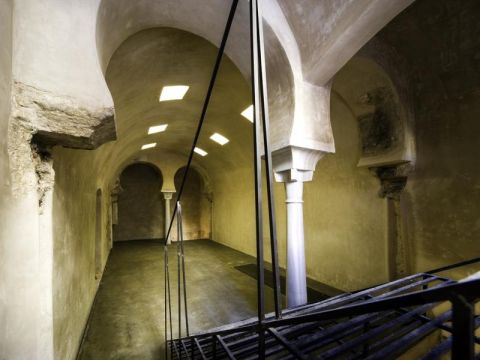
Banos del Angel
Banos del Angel
© Callejón del Ángel
Hidden under the old-town lanes on Calle del Ángel, the Baños del Ángel (Baños de Zeid) are a small but evocative set of medieval Islamic baths dating roughly from the 10th–13th centuries. Inside the restored chambers, you can still see the hypocaust system—brick supports for a raised floor that once funneled hot air to heat the caldarium. Vaulted ceilings punctured with tiny star-like openings let in shafts of light, hinting at the steamy, intimate atmosphere of a hammam used for cleansing and social ritual. Interpretive panels outline the hot–warm–cold sequence and water engineering. Some visitors note the site can feel poorly maintained or hard to spot.
Location: Baños Árabes del Ángel, Calle del Ángel, Toledo, Spain | Distance: 1.6km

19. Synagogue of El Transito

Synagogue of El Transito toledo
CC BY-SA 3.0 / Antonio.velez
Synagogue of El Tránsito is a 14th-century synagogue built in 1357 by Samuel ha-Levi Abulafia, whose interior still reads like a meeting point of cultures. Look up to the coffered cedar ceiling and then back to the walls, where dense stucco work mixes Hebrew inscriptions with Islamic-style geometric and floral patterns, edged with Gothic touches. After 1492 it was converted into a church, later even used as military quarters, before becoming the Sephardic Museum in 1910. Visitors linger in the lofty prayer hall, the women’s gallery above, and the museum displays of manuscripts and ceremonial objects; many reviews mention the calm garden as a welcome pause.
Location: Sephardic Museum C. Samuel Levi, 2 45002 Toledo Spain | Hours: 9.30am-7.30pm Tue-Sat Mar-Oct, to 6pm Tue-Sat Nov-Feb, 10am-3pm Sun year-round | Price: adult/child €3/1.50, after 2pm Sat & all day Sun free | Website | Distance: 1.6km

20. Museo del Greco

Museo del Greco
Museo del Greco
CC BY-SA 4.0 / Museo del Greco
Museo del Greco is a small, contemplative museum devoted to Domenikos Theotokopoulos (El Greco), whose visionary style became intertwined with this city’s spiritual atmosphere. Opened in 1911, it occupies a restored 16th-century house linked to a 20th-century annex, with a quiet garden in between that feels like a pause from the surrounding lanes of the old Jewish Quarter. Inside, you’ll see the painter’s elongated figures and charged color in works such as View and Plan of Toledo and parts of the Apostolado series, alongside other Spanish Golden Age paintings for context. Period furnishings and Talavera ceramics add a lived-in sense of the world he knew.
Location: El Greco Museum, Paseo Tránsito, s/n, 45002 Toledo, Castilla-La Mancha, Spain | Hours: 9.30am-7.30pm Tue-Sat Mar-Oct, to 6pm Nov-Feb, 10am-3pm Sun year-round | Price: adult/child €3/1.50, from 2pm Sat & all day Sun free | Website | Distance: 1.6km

21. Monasterio San Juan de Los Reyes

San Juan de los Reyes   Toledo
San Juan de los Reyes Toledo
CC BY-SA 3.0 / Choniron
Perched above the River Tagus, the Monasterio San Juan de los Reyes is a late-Gothic Franciscan foundation commissioned by Ferdinand and Isabella to memorialize the 1476 Battle of Toro and the birth of Prince John. The exterior bristles with royal emblems and the famous chains displayed on the walls, while inside, soaring ribbed vaults and a refined blend of Gothic and Mudéjar details draw the eye upward. The two-level cloister is the lasting impression: delicately carved arches, playful animals on column capitals, and a quiet garden that softens the stonework. Visitors often linger here for the shifting light and the calm, contemplative atmosphere.
Location: Monasterio de San Juan de los Reyes, Calle de los Reyes Católicos, Toledo, Spain | Hours: 10am-6.45pm Mar-Oct, to 5.45pm Nov-Feb | Price: €3 | Website | Distance: 1.6km

22. Baños de Tenerías

Espana   Toledo   Bano Arabe
Espana Toledo Bano Arabe
CC BY-SA 3.0 / Antonio.velez
Tucked into the old tanners’ quarter, the Baños de Tenerías are an early-11th-century Islamic hammam that reveals how daily hygiene and ritual purification shaped medieval urban life. Inside, stone vaults are punctured by small star-shaped skylights that cast sharp pools of light across the rooms. The preserved sequence of spaces—cold, warm, then hot—still reads clearly, alongside traces of the underfloor hypocaust heating and the water infrastructure that fed the baths. Interpretive panels help decode the layout, but the strongest impression is the quiet, enclosed atmosphere of a working bathhouse frozen in time. Visitors often note it’s small and easy to explore independently, and entry is commonly free.
Location: Restos Arqueológico Baños Árabes de Tenerías, Calle Carreras San Sebastián, Toledo, Spain | Distance: 1.7km

23. Mirador del Valle

toledo from Mirador del Valle
Perched on a hill across the Tagus River, Mirador del Valle is a panoramic lookout where the old town seems to rise from a loop of water and stone. From the railing, you take in a dense patchwork of terracotta roofs and city walls, with the Alcázar anchoring one end of the skyline and the Gothic spire of the cathedral pulling your eye to the center. The river’s curve and the bridges below—Puente de Alcántara and Puente de San Martín—make the view feel almost staged, especially as the light warms toward sunset. It’s free, open at all hours, and often dotted with photographers and travelers lingering for the full sweep.
Location: Mirador del Valle Ctra. Circunvalación, s/n 45004 Toledo Spain | Distance: 1.9km

24. Puente de San Martín (Toledo)

El Puente de San Martin Toledo  Espana
El Puente de San Martin Toledo Espana
CC BY-SA 3.0 / Dan Vaquerizo Molina
Puente de San Martín is a late-14th-century stone bridge that once controlled the western approach to the walled city, commissioned under Archbishop Pedro Tenorio. Five arches stride over the Tagus gorge, anchored by fortified towers at each end; the central span stretches about 40 meters, an audacious width for medieval engineering. Crossing it, you feel the river drop away beneath your feet while the skyline and ramparts rise ahead, with long sightlines that photographers linger over. A local legend adds intimacy to the masonry: the architect’s wife supposedly burned the scaffolding so the bridge could be rebuilt safely, saving his reputation. At sunset, the views turn especially dramatic and calm.
Location: San Martin's Bridge Bajada San Martín 45004 Toledo Spain | Distance: 1.9km

Best Day Trips from Toledo

A day trip from Toledo offers the perfect opportunity to escape the urban rhythm and discover the surrounding region's charm. Whether you're drawn to scenic countryside, historic villages, or cultural landmarks, the area around Toledo provides a variety of easy-to-reach destinations ideal for a one-day itinerary. If you are looking to rent a car in Spain I recommend having a look at Discover Cars, first, as they compare prices and review multiple car rental agencies for you.

1. Madrid

madrid palace
madrid palace
Madrid, the capital and largest city of Spain, showcases the nation's finest attributes through its vibrant population, diverse culinary offerings to suit every budget, and an array of top-tier museums and galleries found nowhere else in Europe. With a population of nearly 3.3 million residents and a metropolitan area exceeding 6.5 million, Madrid ranks as the third-largest city in the…
Visiting Madrid
Powered by GetYourGuide

2. Alcalá de Henares

Alcala de Henares
Alcala de Henares
CC BY-SA 2.0 / M.Peinado
Alcalá de Henares, situated 35 kilometers (22 miles) northeast of Madrid, is a fantastic day trip from the capital. From its rich literary heritage to its vibrant tapas scene, here are the top attractions and activities to enjoy when visiting this charming city.
Visiting Alcalá de Henares

3. Ávila

Avila City Walls
Avila City Walls
Ávila is a city of Spain located in the autonomous community of Castile and León. It is the capital and most populated municipality of the Province of Ávila. Ávila will always be associated with the image of its city walls. Visible from far away, they are among the best-preserved and most complete in Europe. They protect a medieval World Heritage City of…
Visiting Ávila
Powered by GetYourGuide

4. Guadalajara

Guadalajara Espana
Guadalajara Espana
CC BY-SA / Diego Delso, delso.photo
Located in central Spain, in the northeast of the Castile La Mancha region, this area offers a wealth of rural landscapes waiting to be explored, notably through its renowned Black Architecture villages. Additionally, Guadalajara boasts several protected natural areas, including the Tejeda Negra Nature Reserve, known for its stunning beech forest. For those with a penchant for culture, Guadalajara's historic…
Visiting Guadalajara

5. Segovia

alcazar de segovia
alcazar de segovia
Segovia, located in Castile and León, is a captivating city that effortlessly blends architectural grandeur with scenic landscapes and traditional Spanish charm. Its historic center, filled with cobbled streets, charming squares, and centuries-old buildings, is a delight to explore. The city's Roman aqueduct, one of Spain’s most iconic landmarks, stretches across the heart of Segovia, creating a striking contrast between…
Visiting Segovia
Powered by GetYourGuide

Where to Stay in Toledo

The Historic Center is the best choice for visitors who want to immerse themselves in Toledo’s medieval charm, with easy access to key sights such as the Toledo Cathedral, the Alcázar, and the Jewish Quarter. Staying in this area places you at the heart of the city, where picturesque alleyways lead to charming plazas and traditional restaurants. A great hotel in this area is Eugenia de Montijo, Autograph Collection, offering elegant accommodations in a beautifully restored palace.

For travelers looking for a tranquil escape, the Riverside District along the Tagus River provides a peaceful atmosphere with scenic walking routes and breathtaking vantage points of Toledo’s cityscape. This area offers a slower pace, perfect for those who enjoy nature alongside their cultural explorations. A recommended stay here is Parador de Toledo, a stunning hotel set on a hill overlooking the city, with unbeatable panoramic views and a serene environment.

If you’re seeking a more modern setting while still being close to Toledo’s highlights, Santa Teresa is a great option. This district offers excellent connections to the historic center while providing a quieter, residential feel with nearby local markets and authentic tapas bars. It’s ideal for visitors who want convenience without the crowds. A fantastic hotel in this area is Hotel Boutique Adolfo, offering stylish and contemporary accommodations with easy access to Toledo’s best attractions.

Using the our Hotel and Accomodation map, you can compare hotels and short-term rental accommodations in Toledo. Simply insert your travel dates and group size, and you’ll see the best deals for your stay.

Toledo Accommodation Map

Best Time to Visit Toledo

The best time to visit Toledo, Spain, largely depends on your preferences for weather, activities, and crowd levels. Here’s a breakdown of the seasons:

  1. Spring (March to May): Spring is a delightful time to visit Toledo, with mild temperatures and blooming flowers. The weather is comfortably warm, making it ideal for exploring the city’s historic streets, visiting its many churches and museums, and enjoying outdoor activities such as walking tours and picnics in the parks. Additionally, spring sees fewer tourists compared to the peak summer months, allowing for a more relaxed and authentic experience.
  2. Summer (June to August): Summer is the peak tourist season in Toledo, with hot temperatures and plenty of sunshine. This is the best time to visit if you enjoy outdoor activities such as sightseeing, visiting outdoor cafes and restaurants, and attending cultural events and festivals. However, be prepared for higher temperatures and larger crowds, especially in popular tourist areas. Consider visiting early in the morning or late in the afternoon to avoid the heat and crowds.
  3. Autumn (September to November): Autumn is another great time to visit Toledo, with mild temperatures and fewer tourists compared to the summer months. The weather remains pleasant, allowing you to continue enjoying outdoor activities such as exploring the city’s historic sites, hiking in the nearby countryside, and sampling local cuisine at outdoor cafes. Additionally, autumn offers opportunities to experience cultural events and festivals celebrating Spanish traditions and harvest season.
  4. Winter (December to February): Winter is the quietest time to visit Toledo, with cooler temperatures and occasional rainfall. While the weather may not be suitable for outdoor activities like picnics or hiking, it’s an excellent time to explore indoor attractions such as museums, art galleries, and historic sites. Additionally, winter offers a unique opportunity to experience the city’s festive atmosphere, with Christmas markets, holiday decorations, and traditional Spanish celebrations.

Ultimately, the best time to visit Toledo depends on your preferences and what you hope to experience during your trip. Whether you prefer the mild temperatures of spring and autumn, the vibrant energy of summer, or the peaceful ambiance of winter, Toledo offers something for every traveler throughout the year.

Annual Weather Overview

  • January 11°C
  • February 14°C
  • March 18°C
  • April 24°C
  • May 26°C
  • June 29°C
  • July 34°C
  • August 32°C
  • September 29°C
  • October 24°C
  • November 16°C
  • December 13°C

How to get to Toledo

Toledo, Spain, is a historic city that once served as the capital of the Spanish Empire. It is located in central Spain, just 70 kilometers south of Madrid, making it easily accessible for visitors. Here's how to get there:

By Train

One of the quickest and most convenient ways to reach Toledo is by train from Madrid. High-speed trains run frequently from Madrid's Atocha Station to Toledo. The journey takes about 30 minutes, making it an ideal day trip. Trains are comfortable, and tickets can be purchased online in advance or at the station.

By Bus

Buses from Madrid to Toledo are a budget-friendly option. Buses depart from the Plaza Elíptica bus station in Madrid and the journey takes about an hour. The frequency of buses makes it easy to find a time that suits your schedule.

By Car

Driving to Toledo from Madrid is straightforward. The journey takes about an hour via the A-42 highway. This option provides flexibility to explore at your own pace and perhaps visit other nearby sites. Parking can be found outside the old city walls, as the historic center is mostly pedestrianized.

Guided Tours

Many visitors choose to visit Toledo on a guided tour, especially if they are short on time or prefer not to organize transport themselves. Tours often include transport from Madrid and a guided walk around the city's major sights, providing a convenient and informative way to experience Toledo.

Arrival in Toledo

Once in Toledo, most of the historical attractions are within walking distance. The city is known for its medieval architecture, including the stunning Toledo Cathedral, the Alcázar, and numerous synagogues and mosques reflecting its diverse historical population. Walking through the narrow streets allows you to appreciate the blend of Gothic, Moorish, Renaissance, and Baroque styles.

Toledo's close proximity to Madrid and excellent transport links make it an easy and worthwhile addition to any travel itinerary in Spain.
Powered by GetYourGuide

More from this area