Renting a Car in Italy 2026: A Complete Guide for Travelers

renting a car in italy

This website uses affiliate links which earn a small commission at no additional cost to you.

From the majestic Alps in the north to the serene rolling hills of Tuscany and the picturesque coastal villages of the south, Italy's diverse landscapes are universally enchanting. It's no surprise that Italy ranks among Europe's most popular destinations. While many travelers choose the well-connected interrail system for convenience, renting a car offers the freedom to explore Italy's hidden gems at your own pace.

Whether it's cruising through the vineyard-clad Tuscan hills in a stylish convertible or navigating the winding streets of charming villages in a classic FIAT 500, driving in Italy can be a delightful experience. If you're considering renting a car to discover Italy's less-traveled roads and scenic routes, here is everything you need to know to make your road trip memorable and hassle-free.

How to Rent a Car in Italy

©

If you're looking to drive from Florence to Rome, or perhaps explore the renowned Tuscan wine country, renting a car in Italy offers unparalleled freedom to navigate the country at your own pace. This guide provides detailed information on how to rent a car in Italy, what to expect while driving, and includes essential tips to enhance your driving experience. Whether it's understanding local driving laws, finding the best rental deals, or navigating the idyllic but often challenging Italian roads, this guide will equip you with all the necessary knowledge to ensure a smooth and enjoyable journey.

When you rent a car in Italy, you’ll need to bring the following documents:

  • Your driver’s license from your home country
  • Your ID (passport)
  • Credit Card in your name
  • International Driver’s Permit

In Italy, while the legal driving age is 18, renting a car usually requires you to be at least 21 years old and have held your driver's license for a minimum of one year. Additionally, most car rental companies set an upper age limit, typically between 70 to 75 years. To rent a car, every driver must provide a valid driver's license, a form of identification to verify their identity, and a credit card to complete the payment process. These requirements ensure that all drivers meet the necessary legal and company-specific criteria for car rental in Italy.

[car_hire_italy]

If you're a non-EU citizen planning to rent a car in Italy, it's important to have an International Driver’s Permit (IDP) along with your valid national driver’s license. While rental agencies might not always ask to see the IDP, Italian law requires non-EU drivers to possess one, and it may be requested during a police check. An IDP costs about 15 USD and remains valid for one year. To ensure you comply with Italian driving regulations and avoid any legal issues, it’s advisable to secure your IDP before you travel. This can usually be arranged through your home country’s automobile association or similar organization.

Essential Information for Renting a Car in Italy

©

Driving in Italy can be both exhilarating and challenging, especially for those not accustomed to the local driving conditions. Here's what you need to know:

[car_hire_italy]

Insurance Requirements

In Italy, car insurance is mandatory. This includes the basic Car Damage Waiver (CDW) which should be arranged at the time of booking your rental car. While theft cover is recommended, it's not compulsory. To get the best rates on additional coverage, it's advisable to include them in your initial car rental booking. Additionally, check if your credit card offers coverage for car rentals in Italy, which can be a cost-effective way of meeting these requirements.

Driving Conditions

Italian roads vary greatly in quality. In the north, roads are generally well-maintained, while in the south and rural areas, they can be narrower and less maintained, making driving more challenging. Opting for a smaller car is beneficial due to these conditions, as it’s easier to navigate through tight spaces.

Zona Traffico Limitato (ZTL)

Italy has numerous Zona Traffico Limitato (ZTL) or pedestrian areas where access is restricted to vehicles without a permit. These zones are usually marked with signs showing a red circle or a light system that indicates when entry is restricted. A green light or a specific time noted on the sign indicates when the ZTL is open to vehicles.

It’s important to be vigilant for these signs because apps like Google Maps may inadvertently direct you through these restricted zones.

Many Italian city centers, which are often historic, have ZTLs. A practical tip is to park your vehicle outside these areas and walk or use public transport to avoid inadvertently driving into a restricted zone. If you’re staying at a hotel within a ZTL, notify the hotel staff so they can arrange necessary permissions with local parking authorities, allowing you to access the hotel without issues.

Keep Documents Handy

Since random police checks are common in Italy, always carry your driving license, IDP, and insurance documents while driving. Understanding these aspects can make driving in Italy a more enjoyable and stress-free experience, letting you explore the stunning landscapes and rich cultural heritage at your leisure.

The Autostrada and Superstrada

Italy offers a variety of road types, each with its own speed limits and rules. Here's a breakdown of what to expect on Italian roads:

  1. Autostrada (Highways): These are the main highways in Italy, easily recognizable by their green signs marked with an 'A'. The maximum speed limit on the Autostrada is 130 km/h, making it the fastest route for long-distance travel across the country.
  2. Superstrada (Dual Carriageways): These roads allow a maximum speed of 110 km/h. They are designed to handle higher traffic volumes than single carriageways and often connect major cities without the infrastructure of an Autostrada.
  3. Single Carriageways: The speed limit on these roads is 90 km/h. They typically connect smaller towns and rural areas, providing scenic routes with a slower pace.
  4. Urban Areas: Within towns and cities, the speed limit is generally set at 50 km/h. This limit is strictly enforced to ensure safety in densely populated areas.

Navigating these different types of roads requires awareness of the varying speed limits and conditions. Always ensure you adhere to the local driving regulations to maintain safety and avoid fines.

[car_hire_italy]

Top tips for Renting a Car in Italy

©

1. Do a walk around and check the car

When picking up your rental car in Italy, it's crucial to conduct a thorough inspection of the vehicle. Start with a walk-around to ensure that everything is in order, particularly if you're traveling in winter to mountainous regions. Check for snow tires or snow chains in the trunk if you expect snowy conditions.

You’ll be required to sign a document known as the check-out form. This form should list any pre-existing damages such as scratches or dents. If you notice any damage not recorded on the form, point it out to the rental agency staff and ensure it gets noted before you sign. The form will also record the car’s mileage and the fuel level at the time of pickup.

For additional security and to ensure all details are accurately logged, consider taking photos or videos of any noted damages, the fuel gauge, and the car’s odometer. This can provide you with proof and peace of mind should any disputes arise later regarding the condition of the car at the time of rental.

2. Check safety equipment

In Italy, it's mandatory for all vehicles to carry certain safety equipment. This includes a reflective safety vest and a warning triangle. The safety vest must be worn anytime you exit the vehicle on a roadway or shoulder, particularly in case of a breakdown or emergency. This is to ensure that other drivers can see you clearly, which is especially important in low visibility conditions or at night.

The warning triangle should be used to alert oncoming traffic in the event of a breakdown or accident. It should be placed at a safe distance behind your vehicle to give other drivers ample notice to slow down or change lanes.

Ensuring that these items are in your car not only complies with Italian road safety laws but also enhances safety for you and others on the road. Always check that these items are present and accessible when you pick up your rental car.

3. Careful where you park

Parking in Italy is designated by specific color codes that indicate whether parking is paid or free. Here's how to understand the different types of parking:

  1. Paid Parking: Marked with blue lines, these spaces require payment during designated hours. Payment methods and schedules can vary by location but typically involve a parking meter or an automated machine where you can purchase a ticket to display on your dashboard.
  2. Free Parking: Areas marked with white lines or unmarked spaces are generally free. However, even in free parking areas, it’s essential to check for any signs that might indicate restrictions such as time limits or the need for a parking disc.
  3. Parking Disc (Disco Orario): In some free parking zones, you may be required to use a parking disc (disco orario) to indicate your arrival time. This disc is placed inside your car’s windshield and helps regulate how long you can park in that spot. Parking discs are usually required in areas with a blue line if the sign indicates its necessity and in some white-lined parking areas to monitor time limitations.

Always be vigilant for signage that specifies the rules for each parking area, including the hours when payment is required or when the use of a parking disc is necessary. Observing these rules will help avoid fines and ensure that you're parking legally while in Italy.

Expect Toll Booths

Italy’s major highways, such as the Autostrada, operate with tolls that help maintain the quality and safety of these fast routes. Here’s how the toll system typically works and some additional tips for navigating it:

  1. Entering the Autostrada: When you enter the Autostrada, you’ll receive a ticket from a machine at the toll booth. Keep this ticket safe as you will need it to calculate and pay your toll upon exiting.
  2. Exiting and Paying: When exiting the Autostrada, you’ll stop at another toll booth where you must submit the ticket you received upon entry. The toll fee will be calculated based on the distance traveled. Payment can be made via cash, credit cards, or sometimes even debit cards. The cost generally ranges between 30 to 50 EUR depending on the length of your journey.
  3. Toll Booth Assistance: If you encounter any issues at the toll booths, such as the ticket machine not working, there is a ‘help’ button you can press. Assistance is available, although it’s helpful to know some basic Italian as not all operators may speak English fluently.
  4. Avoiding Toll Roads: If you prefer to avoid toll roads, it’s entirely possible. Non-toll roads often offer more scenic views and charming local stops but be prepared for a longer journey. Most map apps provide options to avoid tolls when setting your route, so you can choose according to your preferences and schedule.
  5. Map Apps and Navigation: Modern navigation apps usually indicate toll roads clearly and offer alternative routes if you choose to avoid them. Make sure your app is updated to ensure accurate guidance throughout your trip.

Understanding and preparing for these aspects of driving on Italian highways can make your road trip more enjoyable and free from unexpected interruptions.

Fill up with the Correct Fuel!

Fueling up your car in Italy is straightforward, with options to suit different preferences. Here's what you need to know about getting petrol or gas:

Types of Service: You can choose between self-serve (fai da te) and serviced (servito) pumps. Self-serve is usually cheaper and requires you to fill up the tank yourself, while the serviced option involves an attendant who will pump gas for you at a slightly higher cost.

Fuel Options: Make sure to use the correct type of fuel for your car. Options typically include Gasolio (diesel) and Benzina (gasoline). It's crucial to select the right one to avoid engine damage. Most rental cars in Italy have a sticker on the fuel door, car key, or dashboard indicating the appropriate fuel type.

Location of Gas Stations: You'll find gas stations throughout Italy, including in rural areas, small towns, big cities, and along the Autostrada. If you're planning a long drive or will be in less populated areas, plan your refueling stops ahead to ensure you don't run low on fuel.

24-Hour Service: Many gas stations offer automated self-service pumps that operate around the clock, allowing you to refuel even when the main station is closed. These pumps generally accept credit or debit cards.

Paying for Fuel: Payment methods vary by station. While many accept credit cards, it’s wise to carry some cash, especially in more remote areas or at smaller stations that might not accept cards.

Familiarizing yourself with these aspects of fueling up in Italy will help ensure that your driving experience is smooth and enjoyable.

How much does a Rental Car Cost?

The cost of renting a car in Italy can vary, especially during the peak summer months when demand increases and drives up prices. Generally, car rentals in Italy are reasonably priced, but it's wise to compare your options online through comparison sites to secure the best deal.

The location where you pick up your rental car also influences the cost. Renting a car in major cities such as Rome, Milan, or Florence tends to be cheaper than picking one up in smaller towns or airports. Additionally, arranging your car rental online before you arrive in Italy is usually more cost-effective than booking it directly at a rental office upon arrival.

When budgeting for a rental car in Italy, remember that your total expenses will also include costs for toll roads and fuel, which can be significant. Toll roads, especially the major highways, generally charge higher fees, and it's important to note that fuel prices in Italy, as in most of Europe, are higher than in countries like the US. Being prepared for these additional costs will help you manage your budget more effectively during your trip.

Who to Rent a Car From?

In Italy, there are many reputable car rental companies to choose from. To ensure the best selection and pricing, particularly during the busy summer months, it's advisable to book your rental car well in advance. Early reservation not only secures the car type you prefer but may also offer lower rates.

For those planning a multi-city tour, consider arranging a rental that allows you to pick up the car in one city and drop it off in another. While this option might be slightly more costly, it could be economically advantageous when you factor in the costs of tolls, fuel, and time saved.

When returning your rental car, be sure to understand the company’s policy on refueling, as many require you to return the car with a full tank of gas. Also, have the car inspected in your presence for any new damage to ensure there are no surprises or disputes later. This way, you can address any issues directly with the rental company before you leave.

Why we recomend Discover Cars

Discover Cars serves as a comprehensive platform for all car rental needs, providing options for both car hire and rentals. As a third-party rental car aggregator, Discover Cars aggregates pricing from multiple car rental agencies across nearly 150 countries. This enables customers to effortlessly find the most competitive prices for their car rental, saving them both time and effort that would otherwise be spent on searching for rentals independently.

Moira & Andy
Moira & Andy

Hey! We're Moira & Andy. From hiking the Camino to trips around Europe in Bert our campervan — we've been traveling together since retirement in 2020!

Read our full story here

This website uses affiliate links which earn a small commission at no additional cost to you.
More from this area

Renting a Car in Spain 2026: A Complete Guide for Travelers

Driving in Spain
Driving in Spain

This website uses affiliate links which earn a small commission at no additional cost to you.
Spain stands out as a remarkable country, boasting a variety of landscapes from picturesque coastlines to the towering peaks of the Pyrenees and Sierra Nevada. Journey from bustling cities steeped in history to tranquil villages nestled in valleys. Indeed, Spain offers a wealth of places to explore, marking its prominence in Europe. Although the country features an extensive interrail and public transportation network, driving offers the best opportunity to experience Spain at your leisure. Here is everything you need to know about car rental in Spain.

Why Rent a Car in Spain?

Over numerous trips, we've accumulated thousands of kilometers driving rental cars throughout Spain. From touring the beautiful northern coast to embarking on road trips through historic southern cities like Barcelona, Córdoba, Granada, and Seville, Spain stands out as one of the top European countries to explore by car.

©

We’ve visited most of Spain’s major cities and historic towns, using rental cars to access many of its UNESCO World Heritage Sites. Places like El Caminito del Rey or San Juan de Gaztelugatxe would have been either expensive or inaccessible without a rental car.

How to Rent a Car in Spain

While Spain is known for its efficient railway and bus systems, renting a car offers arguably the best way to fully explore the country. Having your own vehicle provides the delightful freedom to craft your own itinerary and travel at your own pace. The roads in Spain are generally well-maintained and provide comprehensive coverage, ensuring you can reach every corner of the nation with ease.

Drive from the mountainous regions to the seaside, making stops at breathtaking cities like Barcelona and Valencia along the way. Alternatively, venture into the Andalucian hills to explore enchanting white villages and fairytale-like castles. No matter what you wish to discover in Spain, a car provides the ideal means of transportation. In this guide, you'll find detailed information on how to drive and rent a car in Spain, ensuring a smooth and enjoyable travel experience.

What do you need to Rent a Car in Spain? 

When you rent a car in Spain, you'll need to bring the following documents:

  • Your driver’s license from your home country
  • Your ID (passport)
  • Credit Card in your name
  • International Driver’s Permit

In Spain, the legal driving age is 18 years old, but to rent a car, most rental companies require drivers to be at least 21 years old. Additionally, some companies may require that drivers have held their license for at least one year, and others may set the minimum age at 23. All drivers must present a valid driver's license and an ID for proof of identity. A credit card is also necessary to complete the rental transaction.

Please note: Most car rental companies in Spain impose an additional fee for drivers under 25 years old. Additionally, non-EU citizens are legally required to possess an International Driver's Permit (IDP) to drive in Spain. This permit must be presented both to the rental agency at the time of rental and to Spanish police if you are stopped while driving. An IDP costs approximately 15 USD and remains valid for one year. You can arrange to obtain yours prior to your visit.

Rental Car Insurance in Spain

When renting a car in Spain, you are required to have unlimited third-party liability insurance. This is usually included in the rental price by most companies and will take the form of a deductible hold on your credit card. Before renting a car, it's important to verify that your credit card can handle this deposit. While additional insurance like a Collision Damage Waiver (CDW) or theft coverage is recommended for further protection, it is not mandatory.

©

When opting for additional coverage, it's advisable to include this in your initial booking, as prices are typically more favorable when arranged in advance. Additionally, check if your credit card policy offers car rental insurance in Spain, which can provide significant savings. Always ensure that the proof of insurance, the car's documentation, your passport, and your International Driver's Permit (IDP) are with you in the car at all times while driving.

When adding additional coverage for your rental car, it's best to arrange this during your initial booking as the rates are generally more favorable. Additionally, it's worthwhile to check if your credit card policy includes car rental insurance coverage in Spain, which could provide a cost-effective alternative. Make sure to keep the proof of insurance, the car's documentation, your passport, and your International Driver's Permit (IDP) in the car at all times when driving. This ensures you're fully prepared in case you're stopped by local authorities or need to provide documentation for any reason.

Make Sure: Make sure you arrive with a credit card and not a debit card, they are different! Also check wheather you need to obtain an International Drivers Licence.

Road Conditions and Speed Limits

In Spain, the terrain is often flat or features gentle inclines, making travel across the country quick and straightforward. The roads and motorways are well-maintained and generally experience light traffic, allowing you to comfortably enjoy the scenic surroundings as you drive.

Spain’s road system is made up of motorways and main roads:

  • Highways (autopistas) are identified by an A or E followed by the road number. Toll roads (autopistas de peaje) are indicated with AP along with the road number. All exits (salidas) are sequentially numbered.
  • Two-lane highways (autovías) carry an E and the road number, and they may not always include a median strip separating the lanes.
  • National roads (carreteras nacionales) bear an N or CN, followed by the road number.
  • Country roads (carreteras comarcales) are designated with a C and the road number.

Tolls & Offline maps

While Spain does feature some toll roads on certain Autopistas (AP) and radial roads (R), they are less prevalent compared to neighboring countries like Portugal or France. These toll roads often pass through mountain tunnels or involve complex engineering, requiring more maintenance.

If you choose to travel on a toll road, you can pay the toll using cash, credit card, or the electronic payment system Via-T. Toll charges in Spain typically range from 5 to 30 EUR, depending on the distance traveled and the specific location of the Autopista.

Most navigation devices or map apps clearly mark toll booths and offer options to avoid toll roads if preferred. Given the occasional spotty connectivity in Spain, it is advisable to use a GPS or download maps on Google Maps for offline use. Ensure you load your route before leaving a WiFi area or while you have mobile data to avoid any navigation issues during your journey.

Traffic in Spain

Driving in Spain offers a mix of experiences, from navigating bustling city streets to traversing scenic mountain roads. In larger cities like Barcelona, traffic jams are common, particularly during peak hours. Spain experiences four rush hours, known as “horas puntas,” due to the traditional afternoon break, making driving challenging throughout much of the day. In cities like Madrid, traffic is restricted from entering historical centers to curb pollution, further complicating city driving.

Beyond urban centers, Spain boasts stunning landscapes, including impressive mountain ranges like the Pyrenees and the Sierra Nevada. While most mountain roads are well-maintained, cautious driving is advisable, especially in winter when snow chains may be required. When renting a car, it's a good idea to ask the rental agency about the necessity of snow chains if you plan to visit mountainous areas during colder months.

For city visits, consider parking outside the city center and using public transportation to navigate. Spain’s urban areas are well-served by a reliable mix of metros, tramways, and buses. This approach is not only more convenient but also cost-effective, as parking costs increase closer to city centers.

How much does a Car Rental in Spain cost?

Rental car prices in Spain are generally reasonable but can vary based on several factors: the time of year you visit, the length of your rental period, and the type of vehicle you choose. Prices tend to rise during the summer months due to higher demand.

If you visit Spain during the off-peak seasons, including winter, you'll find that rental prices are significantly lower. Additionally, the longer you rent a car, the more economical the daily rates become. For example, renting a car for five days may cost only slightly more than a three-day rental. If your schedule allows, consider renting a car for at least a week to both save money and fully explore the diverse regions of Spain at your leisure.

How Much Does it Cost to Rent a Car in Spain?

Choosing the right vehicle is crucial when renting a car in Spain. As with many European countries, smaller cars generally cost less to rent and are more fuel-efficient, making them ideal for navigating narrow roads and crowded urban areas. If you prefer an automatic transmission, be aware that these vehicles are less common in Spain and typically come with a higher rental cost compared to manual cars.

To ensure you get the best deal, it’s advisable to compare options online using a car rental comparison site. Booking your car rental in advance online can also be significantly cheaper than arranging it at a rental office upon arrival.

Tip: Before finalizing your booking, carefully review the rental conditions. Factors like mileage policies can greatly affect the overall cost of your rental. By understanding these details, you can choose the best option that fits your budget and travel needs.

Where can I Rent a Car from in Spain?

Spain offers a plethora of reputable car rental options. If you're planning to rent a car during the busy summer months, it's wise to book well in advance. Early reservations not only secure your preferred vehicle but can also lock in lower rates.

Considering the logistics of your trip, opting for a one-way rental can enhance your travel experience. Many car rental companies in Spain allow you to pick up the car in one city and drop it off in another. This flexibility lets you explore more freely without the need to circle back to your starting point. While this service is sometimes offered at no additional cost, it can be worth any extra fees when you factor in the savings on gas, time, and tolls.

Why we recomend Discover Cars

Discover Cars serves as a comprehensive platform for all car rental needs, providing options for both car hire and rentals. As a third-party rental car aggregator, Discover Cars aggregates pricing from multiple car rental agencies across nearly 150 countries. This enables customers to effortlessly find the most competitive prices for their car rental, saving them both time and effort that would otherwise be spent on searching for rentals independently.

Top tips for renting a car in Spain

1. Do a walk around and check the car

When picking up your rental car in Spain, it's crucial to conduct a thorough inspection of the vehicle. Start with a walk-around to ensure that everything is in order, particularly if you're traveling in winter to mountainous regions. Check for snow tires or snow chains in the trunk if you expect snowy conditions.

You’ll be required to sign a document known as the check-out form. This form should list any pre-existing damages such as scratches or dents. If you notice any damage not recorded on the form, point it out to the rental agency staff and ensure it gets noted before you sign. The form will also record the car’s mileage and the fuel level at the time of pickup.

For additional security and to ensure all details are accurately logged, consider taking photos or videos of any noted damages, the fuel gauge, and the car’s odometer. This can provide you with proof and peace of mind should any disputes arise later regarding the condition of the car at the time of rental.

2. Choose a Small Car

When renting a car in Spain, it's advisable to choose a smaller vehicle unless you specifically need more space or plan to drive in mountainous areas. The reasoning is straightforward: many Spanish streets, particularly in older urban areas, are narrow, parking spaces are often tight, and fuel costs can be high. Therefore, if the rental agency offers an upgrade to a larger car, it's usually best to decline.

©

Spain's urban charm is largely derived from its ancient architecture, much like its neighbors Portugal and France. Many towns and villages boast narrow, cobblestoned streets that reflect centuries of history. These historical features, while picturesque, can make driving challenging. To navigate these roads effectively, ensure your rental car is equipped with an up-to-date navigation system and pay close attention to road signs to aid your journey.

3. Parking in Spain

When parking in Spain, especially in the historic centers of cities, be prepared for some challenges due to the variability of parking regulations across different areas. In urban zones, paid street parking is designated by blue lines on the pavement, and you'll need to purchase a ticket from a nearby machine to park there. Resident-only parking areas are marked with green lines or have a black sign featuring the letter 'P'.

It's important to note that street parking is generally free on national holidays, Sundays, and after 7 PM in most areas, but always double-check local signs to avoid fines. Like in Italy, it's not unusual in Spain for drivers to be somewhat indifferent to minor scratches on their cars, and the practice of nudging cars slightly to make space for parking, though less than ideal, does occur.

To ensure safety, always be cautious about where you park your rental car and avoid leaving valuables or luggage visible inside the vehicle. Theft from parked cars is a risk, particularly in tourist-heavy areas, so removing important items from your car when parked can help prevent potential break-ins.

Top Tip: In some street parking areas, particularly in the south of Spain, you might encounter individuals offering to help you park your car. It's important to note that these people are not official parking attendants but they typically expect a tip of 1 - 2 EUR for their assistance. While not mandatory, it's often advisable to pay them to avoid any potential issues or damage to your car.

4. Petrol Stations

In Spain, you'll find gas stations widely distributed across the country, available in rural areas, small towns, big cities, and along the autoroutes. Google Maps and other navigation tools can help you locate the nearest gas station. The average price for gas is about 1.90 EUR per liter, which translates to approximately 7.20 EUR per gallon. When refueling, you can choose between diesel (diesel) and unleaded gasoline (gasolina). Be mindful that diesel may also be labeled as gasóleo in Spain.

Most gas stations in Spain are self-service, although during daytime hours, attendants are usually available to assist if you're unsure of how to proceed. To know which type of fuel your rental car requires, look for a sticker that might be on the car key, the dashboard, or the fuel door.

When returning your rental car, remember to check whether you need to refill the gas tank before returning it.

Good to know: It's important to note that gas stations in Spain can sometimes be unattended, especially on Sundays, holidays, during the typical lunchtime siestas, or late at night. During these times, your only option might be an automated gas station, which generally only accepts card payments. Keep this in mind when planning your travel to ensure you don't run out of fuel at an inconvenient time.

Moira & Andy
Moira & Andy

Hey! We're Moira & Andy. From hiking the Camino to trips around Europe in Bert our campervan — we've been traveling together since retirement in 2020!

Read our full story here

This website uses affiliate links which earn a small commission at no additional cost to you.
More from this area

Self-Guided Walking Tour of Naples, Italy (2026)

Visitng Naples
Visitng Naples

This website uses affiliate links which earn a small commission at no additional cost to you.
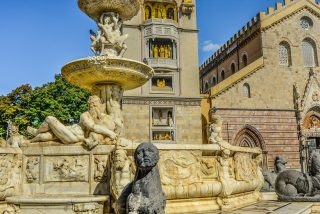
Situated near the infamous Mount Vesuvius, Naples captivates tourists as Italy's third-largest city and one of the oldest continuously inhabited urban areas globally. Originally established by the Greeks as the colony of Parthenope in the 9th century BC, it was later re-founded as Neápolis (“New City” in Greek) in the 6th century BC.

How to Get to Naples

By Plane: Naples is served by Naples International Airport (Aeroporto di Napoli-Capodichino), located just 7 km (4 miles) northeast of the city center. From the airport, travelers can reach central Naples by taxi, bus, or the Alibus shuttle in about 15-20 minutes. For the best deals and a seamless booking experience, check out these flights to Naples on Booking.com.

By Train: Naples is a major rail hub in southern Italy, served by high-speed Frecciarossa, Italo, and regional trains with frequent direct connections to Rome, Florence, Salerno, and beyond. Napoli Centrale is the main station, located in Piazza Garibaldi. From there, the historic centre is easily reached by metro (Linea 1 to Dante or Toledo), bus, or a 20-minute walk. Use Omnio to easily compare schedules, book train tickets, and find the best prices all in one place for a hassle-free journey across Italy.

By Car: Naples is accessible via the A1 (from Rome), A3 (from Salerno), and A16 motorways. Driving in the city centre can be chaotic, and parking is often limited. If you're arriving by car, consider parking at the Parcheggio Brin or Quick Parking Piazza Dante-both offer convenient access to the historic core on foot or via public transit. If you are looking to rent a car in Italy I recommend having a look at Discover Cars, first, as they compare prices and review multiple car rental agencies for you.

Where to Stay in Naples

For a walking tour of Naples’ historic centre, staying in or near the Spaccanapoli and Centro Storico area offers the best access to key landmarks, eateries, and street life. A top luxury choice is Romeo Hotel, a sleek five-star stay near the port with rooftop views and a Michelin-starred restaurant. For boutique charm, Santa Chiara Boutique Hotel places you in the heart of the old town, just steps from the churches and palazzi of Spaccanapoli. Budget travellers will find great value at Hotel Piazza Bellini & Apartments, a stylish and centrally located option popular with independent explorers. All are ideally situated for discovering Naples by foot.

Guided or Self-Guided Tour of Naples?

This guide will take you to all the must-see sights in Naples’ historic centre. However, if you’re short on time or want deeper insights into the city’s culture and complex history, consider joining a walking tour with a local guide. This Street Food Walking Tour with Local Guide is one of the most complete and well-reviewed options, taking 2.5 hours it covers key landmarks whilst also experiencing the flavors of Naples.

History of Naples

Historically, Naples has played a pivotal role, serving as the capital of the Duchy of Naples from 661 to 1139, then the Kingdom of Naples from 1282 until 1816, and subsequently the Kingdom of the Two Sicilies until Italy's unification in 1861. Between 1925 and 1936, under Benito Mussolini's regime, Naples underwent significant expansion and modernization. However, during World War II, the city suffered extensive damage due to Allied bombings and underwent considerable reconstruction in the postwar years. Since the late 20th century, Naples has witnessed substantial economic growth. In 1995, its historic center was designated a UNESCO World Heritage Site.

Your Walking Tour of Naples

This blog covers all the major sites of Naples, you may have to be selective about which venues you enter as you will be unlikely to be able to visit them all in a day!

1. Castel dell'Ovo

Napoli casteldellovo
CC BY-SA 2.0 / Mac9

The Castel dell’Ovo, or Egg Castle, is a historic seaside fortress in Naples, situated on what was once the island of Megaride, now a peninsula on the Gulf of Naples. Its intriguing name stems from a medieval legend involving the Roman poet Virgil, who was believed to be a powerful sorcerer. According to the tale, Virgil placed a magical egg in the castle’s foundations, which, if broken, would lead to the castle’s destruction and bring disaster upon Naples.

Originally settled by the Greeks from Cumae, the site of the Castel dell’Ovo is where they established the nucleus of what would later grow into the city of Naples. The current structure, predominantly dating back to the 15th century, was constructed by the Aragonese dynasty. It has served various roles throughout history, including a royal residence and the state treasury. In the 19th century, a small fishing community developed around the castle, known today for its marina and seafood restaurants.

The castle’s rooftop offers a stunning vantage point, paved with bricks and providing panoramic views of Naples, the Mediterranean Sea, and Mount Vesuvius. The ascent to the top is relatively easy, accessible by a broad, gently sloping road. Visitors will find a few shops and a small art gallery within the castle, alongside numerous spots perfect for taking scenic photographs.

Tip: For the best experience, visit Castel dell’Ovo towards the evening to catch the breathtaking sunset. Remember to bring a camera and binoculars to enhance your visit, and don’t forget a bottle of water. Conveniently located near the boat terminal, it’s easy to return to Sorrento by boat if you’re staying there, making it a perfect day trip.


Location: Castel dell'Ovo, Via Eldorado, Naples, Metropolitan City of Naples, Italy | Hours: Monday to Friday: 9 am to 7 pm; Sunday: 9 am to 1 pm. | Price: Free | Website

We recommend to rent a car in Italy through Discover Cars, they compare prices and review multiple car rental agencies. Book your rental car here.

2. Fontana del Gigante

Fontana del GiganteNaples
CC BY-SA 4.0 / Paolo Villa

From the castel walk with the sea on your right.


The Fontana del Gigante, also known as the Fountain of the Giant, is an iconic 17th-century fountain located in Naples, Italy. Originally erected next to the Royal Palace of Naples, the fountain derived its name from its proximity to a large statue known as “il Gigante” or the Giant. Over the centuries, the fountain has experienced multiple relocations, eventually settling in its current scenic location on via Partenope near Castel dell’Ovo. It is sometimes also referred to as the Fontana dell’Immacolatella.

Commissioned by Antonio Álvarez de Toledo, the 5th Duke of Alba and then Spanish Viceroy of Naples, the fountain originally graced the corner of Largo di Palazzo. Its design is attributed to the Florentine artists Pietro Bernini and Michelangelo Naccherino. The nearby Giant statue, created in 1670 and featured in historical paintings, including one by Gaspar van Wittel housed at Palazzo Zevallos Stigliano, was removed in 1807.

The fountain is celebrated for its exquisite Mannerist style, marked by three ornate rounded arches that are embellished with the heraldic symbols of the Viceroy and the king he served. The central arch showcases a cup held aloft by two marine creatures, and the lateral arches are adorned with statues of river deities gripping sea monsters. Flanking the ends of the arches are caryatid statues bearing cornucopias, adding to the grandeur and historical narrative of this magnificent work of art.


Location: Fontana del Gigante, Via Partenope, Naples, Metropolitan City of Naples, Italy | Hours: 24 hours | Price: Free

Here is a complete selection of hotel options in Naples. Feel free to review each one and choose the stay that best suits your needs.

3. Piazza del Plebiscito (Public Square)

Piazza del Plebiscito, Naples
CC BY-SA 4.0 / Argo Navis

Continue with the sea on your right, turn left at Via Cesario Console and walk throguh the park until you reach Piazza del Plebiscito.


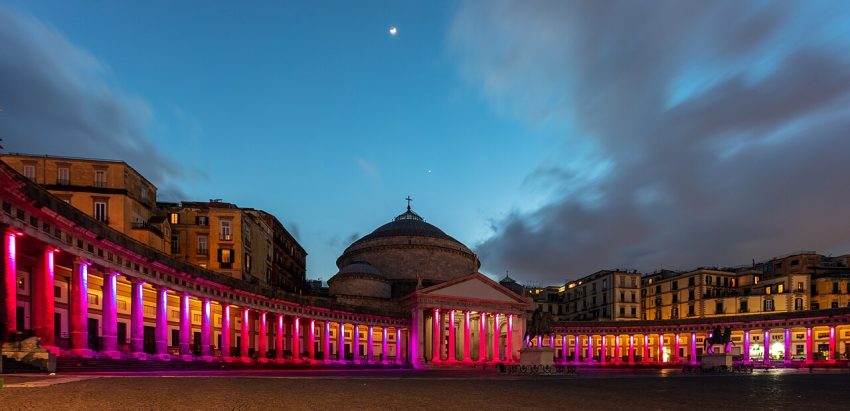
Piazza del Plebiscito, commonly referred to by locals as “Piazza Plebiscito,” stands as one of Naples’ most renowned squares and serves as the city’s elegant epicenter, often featured in numerous films, TV series, and documentaries. This grand square, home to the Royal Palace of Naples, offers a quintessential Neapolitan scene with the majestic Mount Vesuvius in the backdrop. Spanning about 25,000 square meters (approximately 270,000 square feet), it ranks among the largest public spaces in both the Campania region and Italy at large.

Located in the central San Ferdinando district, Piazza del Plebiscito is strategically positioned halfway between the historic heart of Naples and its scenic waterfront. The square is easily accessible via Via Toledo, one of the city’s primary shopping arteries, where both locals and visitors enjoy a vibrant stroll past various shops, cafes, and historical buildings en route to the piazza.

Historically, this site has been significant to Naples’ rich and complex narrative for centuries. The area has hosted an open square since the mid-16th century when Viceroy Don Pedro of Toledo established his palace here, which was later demolished two centuries afterward. The square as it is known today originated in the early 19th century, designed by Domenico Fontana under the commission of Joachim Murat, the then King of Naples during the Napoleonic reign. Initially named Largo di Palazzo, its title was changed following the decisive plebiscite on October 21, 1860, which marked the end of Bourbon rule and facilitated the integration of the Kingdom of the Two Sicilies into the newly unified Kingdom of Italy.


Location: Piazza del Plebiscito, Naples, Metropolitan City of Naples, Italy | Hours: As a public square, Piazza del Plebiscito is accessible at all hours | Price: Free

Traveling to a country with a different currency? Avoid ATM transaction fees and pay in local currency with a Wise Card. Having used it for over 5 years, we've saved loads on fees!

Powered by GetYourGuide

4. The Royal Palace (Palazzo Reale)

Main Facade of Royal Palace of Naples
CC BY-SA 3.0 / pietro scerrato

The entrance to Palazzo Reale is on your right.


The Palazzo Reale di Napoli, a grand edifice, stretches along one side of Piazza del Plebiscito. Originally the residence for Spanish viceroys, it later became the home of the Bourbon kings, followed by the Austrians, and the French, establishing its role as a primary seat of power after Charles III of Bourbon chose it as his official residence in 1734.

Throughout the period leading up to the unification of Italy, the palace played a pivotal role in the history of Naples, serving as a cultural and political hub that welcomed various European dynasties and nobilities. Its main facade features 19 arches, each housing statues of Naples’ most illustrious rulers, spanning from King Ruggiero II the Norman to Vittorio Emanuele II of Savoy.

Since 1919, the Royal Palace has been under the stewardship of the Italian state and now functions as one of Naples’ premier museums. Visitors to the palace can explore its majestic grand staircase, the opulently furnished Royal Apartments, and the extensive National Library with its beautiful gardens. Additionally, the prestigious Teatro San Carlo opera house, which faces the adjacent Piazza Trieste e Trento, forms part of this historic palace complex.


Location: Royal Palace of Naples, Piazza del Plebiscito, Naples, Metropolitan City of Naples, Italy | Hours: Thursday to Tuesday: 9:00 to 20:00. Closed Wednesdays. | Price: Adults: €15.00 | Website

Where to Stay in Naples: An Area by Area Guide!

5. Basilica di San Francesco di Paola

Basilica de San Francesco di Paola, Napoles
CC BY-SA 2.0 / "Diego Delso, delso.photo

Basilica Reale Pontificia San Francesco da Paola is directly opposite the palace.


Directly across from the Royal Palace, the neoclassical Basilica di San Francesco di Paola stands as one of Naples’ most iconic churches. Built in the 19th century, it is renowned for its distinctive architecture, which includes a semicircular colonnade that gracefully frames the square. At the center of this architectural marvel is a large dome, reminiscent of the Pantheon in Rome, adding a majestic touch to the already striking facade. This architectural style marks the basilica as a key highlight in Naples’ rich tapestry of historic and cultural landmarks.


Location: San Francesco di Paola, Piazza del Plebiscito, Naples, Metropolitan City of Naples, Italy | Hours: Monday to Saturday: 6:45 am to 12 pm and 4:30 pm to 7:30 pm. Sundays: 8 am to 12 pm. | Price: Free

6. Bourbon Tunnel

Galleria borbonica
Galleria borbonica
CC BY-SA 4.0 / Associazione Culturale Borbonica Sotterranea

From the Basilica Reale Pontificia San Francesco da Paola turn left and left again to walk down Via Gennaro Serra.


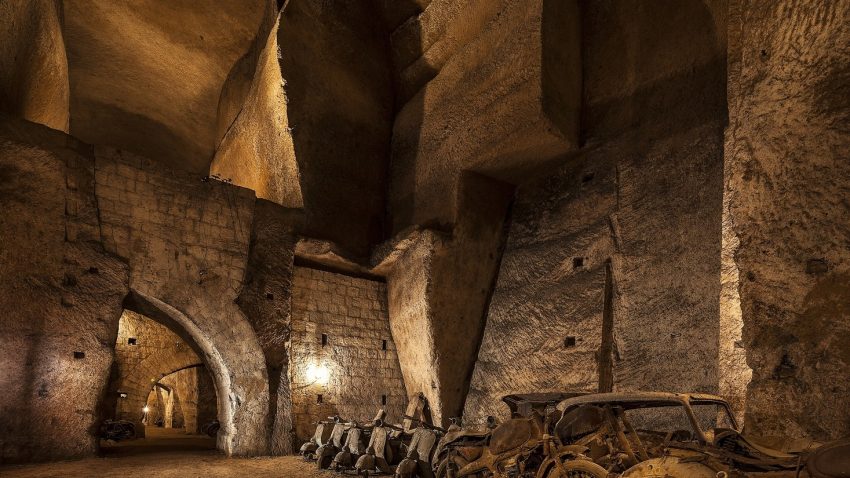
Buried about 100 feet beneath the bustling streets of Naples lies a vast tunnel filled with rusting vintage cars and relics from wartime, originally intended as a secret escape route for the royal family. Commissioned in 1853 by King Ferdinand II of Bourbon, who ruled over Sicily and Naples during a time rife with riots and uprisings, the tunnel was designed to provide a safe passage from the Royal Palace to the military barracks. Carved from the volcanic rock below Naples, it linked to the Carmignano aqueduct, dating back to the early 17th century. Unfortunately, the tunnel remained unfinished at the king’s death, slipping into obscurity until World War II.

During the war, these underground corridors and adjacent cisterns served as air raid shelters for up to 10,000 Neapolitans. Today, historical tours of the tunnels reveal remnants left by those who took refuge here, including children’s toys, gas masks, and everyday items such as hair brushes, alongside the remains of toilet blocks and makeshift beds.

Post-war, the Bourbon Tunnel, or Il Tunnel Borbonico, became a repository for wartime debris and other discarded items, housing everything from fascist statues to impounded vehicles up until the 1970s, after which it was again forgotten.

Rediscovered and restored in the 2000s, the tunnel now serves as a museum known as the Bourbon Gallery (Galleria Borbonica), where the stored vintage cars and wartime remnants are displayed in a haunting setting. Located near the entrance to Naples Underground, this site offers a unique glimpse into the hidden network of tunnels beneath the ancient city. Guided tours provide an in-depth exploration of this historical tunnel, including ventures into its darker, more mysterious sections.


Location: Galleria Borbonica - Ingresso Via Morelli, Via Domenico Morelli, Naples, Metropolitan City of Naples, Italy | Hours: Friday, Saturday, Sunday and holidays: Tour Start times: 10:00, 12:00, 15:00, 17:00 | Price: Adults: €10.00 | Website
Powered by GetYourGuide

7. Teatro di San Carlo

Teatro San Carlo naples
Public Domain / Sony photographer

Return to the Piazza del Plebiscito and leave by the north east exit. Teatro di San Carlo is on your right.


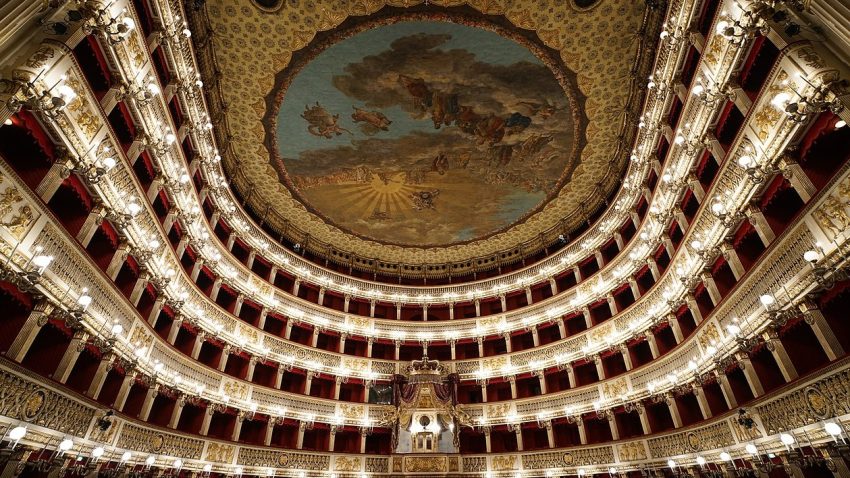
Adjacent to the main square Piazza del Plebiscito is the renowned Teatro di San Carlo, Italy’s prestigious opera house. Founded in 1737 by King Charles II of Bourbon, the theater opened with a celebrated performance of “Achilles in Sciro.” As one of the oldest and most illustrious opera houses in the world, Teatro di San Carlo offers visitors the chance to experience an opera performance in a historically rich setting. Alternatively, guided tours are available, providing insights into its grand architecture and storied past, allowing visitors to explore behind the scenes of this cultural landmark.


Location: Teatro di San Carlo, Via San Carlo, Naples, Metropolitan City of Naples, Italy | Hours: Guided tours: Monday to Saturday (excluding holidays): 10:30 am, 11:30 am, 12:30 pm, 2:30 pm, 3:30 pm and 4:30 pm. | Price: Adults: € 9 (£ 7.70). Young people under 30/seniors over 60: € 7 (£ 6). Children under 10 years old: € 4 (£ 3.40). | Website

8. Galleria Umberto I

Interno cupola Galleria Umberto I
CC BY-SA 3.0 / pietro scerrato

Galleria Umberto I is opposite the Teatro di San Carlo.


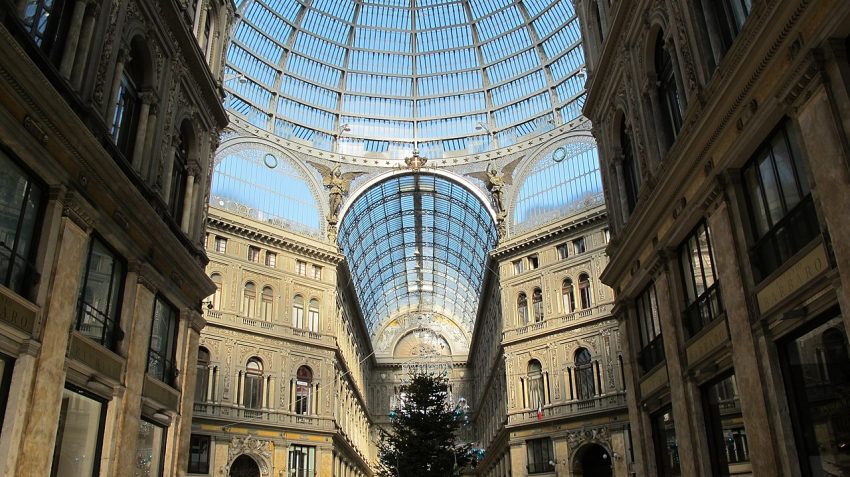
The Galleria Umberto I in Naples, a stunning example of 19th-century architecture, is celebrated as one of Italy’s most beloved public shopping arcades, alongside Milan’s Galleria Vittorio Emanuele II. Constructed between 1887 and 1890 as part of a comprehensive project to rejuvenate Naples, this architectural marvel mirrors the grandeur and timeline of the Eiffel Tower’s construction in Paris.

With its impressive dimensions — 147 meters in length, 15 meters wide, and a towering dome peaking at 57 meters — the Galleria quickly became a social hub for the city. Its design features a glass and steel roof that fills the space with light, murals, sculptures, and a blend of retail shops, cafes, and restaurants on the ground floor, while the upper levels house business offices.


Location: Galleria Umberto I, Via Santa Brigida, Naples, Metropolitan City of Naples, Italy | Hours: As a public passage, the Galleria is generally open from early morning until late evening, with individual shops and cafés keeping their own hours. | Price: There is no entrance fee.

9. Castel Nuovo

Castel Nuovo Naples
Castel Nuovo Naples
CC BY-SA 3.0 / Ra Boe / Wikipedia

Leave the Galleria Umberto I by its eastern entrance. Turn right and then left. Castel Nuovo is infront of you.


Castel Nuovo, also known as Maschio Angioino (Angevin Keep), is a prominent Medieval Renaissance fortress located adjacent to the port of Naples. Initially constructed between 1279 and 1282 by King Charles I of Anjou, it was named “New Castle” to distinguish it from older fortifications in the city. The castle is more commonly referred to by locals as Maschio Angioino.

Following the end of French rule and the subsequent Spanish conquest of Naples in the mid-15th century, Castel Nuovo underwent a significant reconstruction under Alfonso V of Aragon. This redevelopment transformed it into the grand Medieval Renaissance style fortress that today stands as a majestic landmark by the port.


Location: Castel Nuovo, Via Vittorio Emanuele III, Naples, Metropolitan City of Naples, Italy | Hours: Monday to Saturday: 9:00 to 18:00. Sunday: 10:00 to 1300. | Price: Adults: €10.00 | Website

10. Santa Chiara, Naples

Naples   Santa Chiara   Cloitre
Naples Santa Chiara Cloitre
CC BY-SA 4.0 / Jean-Christophe BENOIST

Walk north up P.za Municipio, cross over into Via Monteoliveto. Take a detour to see the Via Santa Maria la Nova and its cloisters (I love cloisters!). Continue up Via Monteoliveto and turn right onto Calata Trinità Maggiore. Continue until you reach the Piazza del Gesù Nuovo and the Guglia dell’Immacolata monument (“Spire of the Immaculate Conception”). Continue and the entrace to the Santa Chiara Complex is on your right.


The Santa Chiara Complex in Naples, a rich ensemble of religious buildings, stands as a testament to medieval devotion and artistry. This historic complex, founded in 1310 by Queen Sancha of Majorca and King Robert of Naples, includes the Church of Santa Chiara, a monastery, tombs, and an archaeological museum. Notably, King Robert is interred within the complex.

Originally constructed in the Provençal-Gothic style, the Church of Santa Chiara was later revamped into Baroque in the 18th century and underwent restoration after sustaining damage during World War II. The church features a modest west facade with a central rose window and houses Naples’ largest interior, boasting ten chapels adorned with magnificent Gothic monuments.

The complex was initially established to house the royal Anjou tombs, including that of Joan I, buried here in 1382. Among its most enchanting features are the cloisters, where seventy-two columns line the garden walkways, connecting a series of benches. These columns and benches are embellished with hand-painted 18th-century Majorca tiles, each unique and collectively depicting various pastoral and maritime scenes amidst lush vines and flowers. The cloister’s porticoes are graced with 17th-century frescoes that adorn the ceilings.

The gardens are a serene haven, dotted with citrus and lavender trees, centered around a fountain situated in a medieval friar’s refectory. The museum within the complex showcases the ruins of a first-century Roman spa and sauna, alongside a collection of ecclesiastical artifacts and historical exhibits.

Why You Should Visit: The Santa Chiara Complex is a cultural treasure, reflecting the devotion of King Robert the Wise and Queen Sancha to their patron saints, Saint Francis of Assisi and Saint Chiara. The exquisite cloisters are a highlight, but the impressive church and the well-preserved Roman ruins also offer compelling reasons to explore.

Tips for Visiting: To avoid the crowds and fully appreciate the tranquility of the cloisters, consider visiting early in the day. Starting your visit with the cloisters can provide a more peaceful and enriching experience.


Location: Santa Chiara, Via Santa Chiara, Naples, Metropolitan City of Naples, Italy | Hours: Monastery (Cloisters): Monday to Saturday 9:30 am - 5:00 pm. Sunday 10:00 am - 2:00 pm. Church: Monday to Sunday 7:45 – 12:45/16:40 – 20:00 | Price: Adults: €7.00 | Website

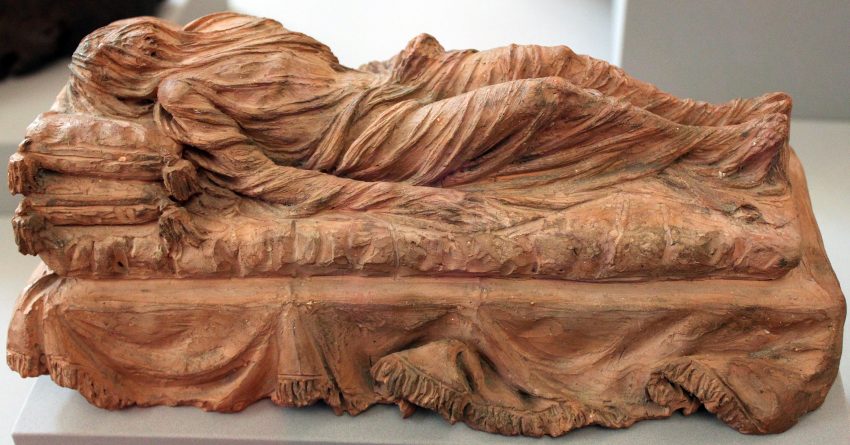
11. Museo Cappella Sansevero (Sansevero Chapel Museum)

The Veiled Christ anagoria
CC BY-SA 3.0 / Anagoria

Walk east along Via Benedetto Croce Until you turn left at the Piazza San Domenico Maggiore. At the centre of Piazza San Domenico Maggiore stands the Obelisco di San Domenico, at the top is a bronze statue of San Domenico blessing the people below. Walk north up Vico San Domenico Maggiore alongside the Chiesa di San Domenico Maggiore and turn first right. Museo Cappella Sansevero will be on your right.


The Sansevero Chapel Museum, also known as the Chapel of Santa Maria della Pietà, is named after a revered painting of the Virgin Mary which holds a miraculous backstory. In the late 16th century, an innocent man wrongfully imprisoned was miraculously released following the appearance of the Virgin Mary. In gratitude, he commissioned The Pietà, which soon attracted pilgrims, including John Francesco di Sangro who, after being cured of an illness by viewing the painting, was inspired to build a private chapel in 1590. This chapel would later serve as a family burial site.

Raimondo di Sangro, Prince of Sansevero, later renovated the chapel, enriching it with the exquisite artworks that draw visitors today. Among the nearly thirty significant pieces housed here, notable works include Antonio Corradini’s “The Veiled Truth” (1752), a poignant tribute to Raimondo’s mother, and Giuseppe Sanmartino’s “The Veiled Christ” (1753), a remarkable marble sculpture depicting Christ under a lifelike transparent shroud. Another striking sculpture, “The Release from Deception” by Francesco Queirolo (1754), represents Raimondo’s father struggling to free himself from a net, symbolizing liberation from deception.

The chapel also features Francesco Maria Russo’s ceiling painting “The Glory of Paradise” (1749) and a unique floor originally designed in a black and white labyrinth pattern. Additionally, it contains two remarkable anatomical displays of preserved human skeletons with silk and wax reconstructed blood vessels.

Why You Should Visit: The Sansevero Chapel Museum is a treasure trove of 18th-century Italian art, presenting a collection that is both hauntingly beautiful and historically significant. Despite its unassuming exterior, the chapel offers a captivating interior filled with masterpieces that reflect both the artistic and scientific curiosities of its patrons.

Tips for Visiting: To enhance your visit, utilize the audio guide available at the museum. It provides invaluable insights into the artworks, the chapel’s history, and the intriguing stories behind each piece, ensuring a deeply enriching experience.


Location: Cappella Sansevero, Via Francesco de Sanctis, Naples, Metropolitan City of Naples, Italy | Hours: Wednesday to Monday: 9:00 to 19:00. Closed Tuesdays. | Price: Adults: €12.00 | Website

12. Chiesa delle Cape di Morte

Chiesa delle Cape di Morte
CC BY-SA 3.0 / Sailko

Turn left when leaving Museo Cappella Sansevero, and left again so you are walking north along Via Nilo. Turn right along Via dei Tribunali. The Complesso Museale Santa Maria delle Anime del Purgatorio ad Arco is on your left. Via dei Tribunali, often referred to as Decumanus Maggiore, is one of the oldest and most historic streets in Naples. Originating from ancient Greek times and continuing into the Roman era, this street was one of the primary east-west thoroughfares in the ancient city of Neapolis.

Today, Via dei Tribunali is affectionately known as the ‘pizza street’ of Naples, celebrated for its abundance of outstanding pizza restaurants. This vibrant street is a must-visit for anyone wanting to experience authentic Neapolitan pizza right in the heart of the city where this world-renowned dish originated.


The Complex of Santa Maria delle anime del Purgatorio ad Arco, dating back to the 17th century, stands prominently along the Decumano Maggiore in the historic center of Naples. At the entrance, visitors are greeted by three bronze skulls on the kerbstones, setting the tone for this unique site that deeply intertwines with Neapolitan spiritual traditions.

This architectural gem consists of two distinct churches built one above the other, an Opera museum, and a historical archive. The complex was established by the lay congregation, Opera Pia Purgatorio ad Arco, which remains active to this day. They dedicated the church to the Virgin Mary, envisioned as the protector of souls languishing in Purgatory. The entire complex, especially the upper church, showcases Baroque architecture rich in death symbolism and houses significant historical, artistic, and anthropological treasures that encapsulate the essence of Neapolitan culture.

The Hypogeum or the lower church is accessed via a trapdoor from the upper church and holds a profound connection to the Neapolitan people through the cult of the purgative souls. Here, skulls housed in niches—known as the skulls of the Holy Land—represent the deceased of unknown identity, the “beggarly souls” seeking respite from their sufferings in Purgatory. According to Neapolitan beliefs, these souls exert a powerful influence over the living, considered benevolent spiritual entities that can bestow real graces upon their adherents.

One of the most venerated figures in the Hypogeum is Princess Lucia, whose spirit is believed to be particularly benevolent. Her niche, adorned with flowers, candles, and small gifts, remains a focal point for those seeking divine intervention.

The Complex of Santa Maria delle anime del Purgatorio ad Arco serves not only as a museum but also as an active place of worship. Mass is still celebrated weekly in the upper church in honor of the deceased, maintaining the sacred tradition and spiritual reverence that define this unique cultural and religious landmark. This site continues to be a poignant testament to the enduring relationship between the Neapolitan people and their cherished ancestral spirits.


Location: Complesso Museale Santa Maria delle Anime del Purgatorio ad Arco, Via dei Tribunali, 39, 80138 Napoli, Metropolitan City of Naples, Italy | Hours: Monday – Saturday: 10.00 – 17.00 Sunday: 10.00 – 14.00 | Price: Upper Church free entry, Guided tours €7 | Website

13. Duomo di Napoli (Naples Cathedral)

Main Facade of Naples Cathedral
CC BY-SA 4.0 / Yair Haklai

Continue along Via dei Tribunali and turn left on Via Duomo.


Naples Cathedral, also revered as The Cathedral of the Assumption of Mary, is affectionately termed Cattedrale di San Gennaro in honor of its patron saint, Saint Januarius. The origins of this grand Gothic structure trace back to the 13th century, with completion in the 14th century, built atop the remnants of earlier churches. Excavations here have revealed Greek and Roman artifacts beneath the cathedral, adding layers to its historical depth.

The cathedral’s neo-Gothic facade, completed only in 1905, fronts an interior adorned with a gilded coffered ceiling and baroque enhancements by artist Luca Giordano in the nave and transept. The Chapel of the Treasury, a brainchild of priest and architect Francesco Grimaldi and completed in 1646, features works by eminent artists like Jusepe de Ribera and Giovanni Lanfranco, including the famed dome fresco and the canvas of Saint Gennaro Escaping the Furnace Unscathed. The chapel also treasures the skull of Saint Januarius and two vials of his blood, encased in a silver strongbox behind the altar.

Adjacent to this, the next chapel houses Saint Januarius’s bones in an urn, with additional relics below the altar in the Cappella Carafa. The Basilica di Santa Restituta, part of the cathedral complex, stands as a testament to early Christian architecture, originally constructed in the 4th century and renovated in the 17th. It is home to Europe’s oldest baptistry, the Battistero di San Giovanni in Fonte, adorned with stunning 4th-century mosaics.

A revered tradition involves the vial of Saint Januarius’s blood, which is displayed thrice yearly; it is believed that if the dried blood fails to liquefy, disaster will befall Naples.

Why You Should Visit: Naples Cathedral offers a profound glimpse into medieval religious culture, adorned with miraculous relics, exquisite Italian art, and significant architectural elements from various eras.


Location: Cathedral of Santa Maria Assunta, Via Duomo, Naples, Metropolitan City of Naples, Italy | Hours: Daily from 8 am to 12:30 pm, and from 4:30 pm to 7 pm. | Price: Free entry. Baptistery: € 2 (£ 1.70) | Website

14. National Archaeological Museum of Naples

National Archeological Museum, Naples
Public Domain / Shonagon

Continue up Via Duomo, cross over P.za Cavour and turn left. At the far end of the small park is the Museo Archeologico Nazionale di Napoli.


The National Archaeological Museum of Naples (MANN) stands as one of Italy’s most esteemed and frequented museums, renowned globally for its vast and unique collection. Established as one of the earliest archaeological museums in Europe, MANN has played a pivotal role in shaping the cultural landscape of the continent with its significant contributions.

Originally serving as a cavalry barracks, the building was later known as Palazzo dei Regi Studi, functioning as a university during the Bourbon reign. The transformation into a museum began in the late 18th century under the auspices of Charles III of Bourbon, who was instrumental in initiating the first excavations of the cities buried by the catastrophic eruption of Mount Vesuvius in 79 AD. This enlightened cultural policy helped preserve the astonishing artifacts unearthed during these digs. Moreover, Charles III enriched the museum’s collection with invaluable pieces from the collection inherited from his mother, Elisabetta Farnese, which are still prominently featured today.

A visit to MANN is an immersion into the core of Italian and Western civilization’s history. The museum houses the famed Farnese Collection, which includes a breathtaking array of sculptures and classical art. Highlights of the museum include relics from Pompeii and Herculaneum such as exquisite frescoes, detailed mosaics, and an array of statues, precious artifacts, and objects from daily life that paint a vivid picture of ancient Roman life.

The museum also boasts a remarkable Egyptian Section and hosts numerous temporary exhibitions each year, offering fresh and insightful perspectives into various aspects of historical and archaeological significance. Not to be missed is the Secret Cabinet, which displays a collection of erotic art and objects from antiquity, providing a candid look into the sexual customs of the past.

A trip to the National Archaeological Museum of Naples is not just a visit; it’s an educational journey through time, offering deep insights into the past civilizations that shaped today’s cultural and historical understanding.


Location: National Archaeological Museum of Naples, Piazza Museo, Naples, Metropolitan City of Naples, Italy | Hours: Wednesday to Monday: 9 am to 7:30 pm. Tuesdays: closed. | Price: Adults: €20.00 | Website
Powered by GetYourGuide

15. Piazza Dante

Monument of Dante Alighieri in Piazza Dante Napoli
CC BY-SA 3.0 / Mstyslav Chernov

Walk south along Via Enrico Pessina until you reach Piazza Dante.


Piazza Dante, also known as Dante Square, is a central landmark in Naples, prominently featuring a statue of the Renaissance poet Dante Alighieri. Originally, this site hosted a large marketplace known as Largo del Mercatello or Market Square. In 1765, the square underwent a significant transformation under the direction of architect Luigi Vanvitelli and was renamed Foro Carolina in honor of Maria Carolina of Austria, the wife of then King Ferdinand IV of Naples. Following Italy’s unification in 1871, a statue crafted by sculptor Tito Angelini was erected in 1872, dedicating the square to Dante Alighieri.

Today, Piazza Dante is a vibrant hub for both locals and tourists. It is conveniently situated near many of Naples’ significant monuments and is adjacent to the new first line of the underground station. Nearby, the Rione della Pignasecca hosts a well-known food market, adding to the square’s appeal. Vanvitelli’s original design features, including a semicircle of ornately decorated columns with statues, still grace the western side of the square and are part of a boarding school’s architecture. Piazza Dante remains a favored spot for family outings and cultural activities in Naples.


Location: Piazza Dante, Naples, Metropolitan City of Naples, Italy | Hours: 24 Hours | Price: There is no fee to enjoy the square itself

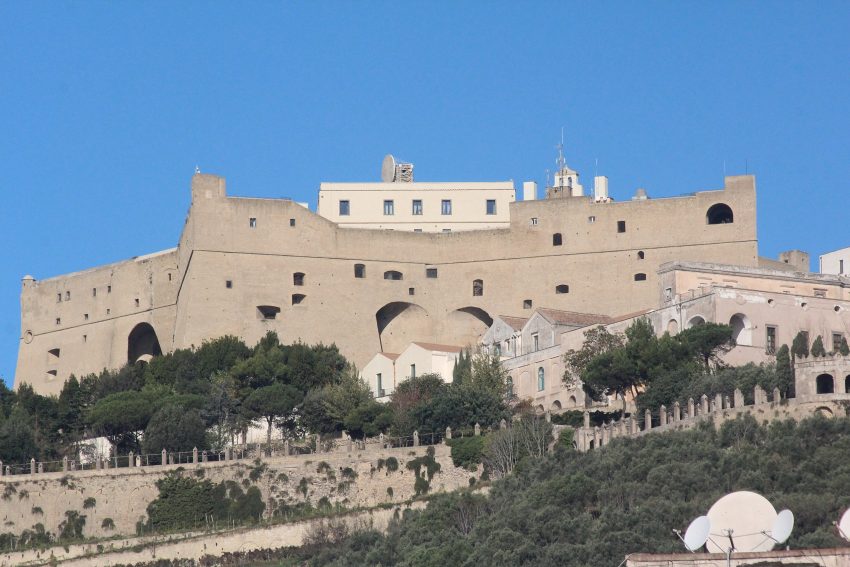
16. Castel Sant'Elmo

SantElmo
SantElmo
CC BY-SA 4.0 / Hotepibre

Walk to the right of the Chiesa di San Michele Arcangelo a Port’Alba, at the south of the piazza, and turn right Via Tarsia. Continue along here when it turns into Via Montesanto. Take the furnicular at Stazione Di Montesanto to go to Morghen. This is in the Vomero neighborhood which is located on top of the hill overlooking the city center. Turn right on exit and right again at Via Tito Angelini.


Castel Sant’Elmo is a historic castle perched atop Vomero Hill in Naples, standing on the site of a 10th-century church dedicated to St. Erasmus, from which the names Eramo, Ermo, and eventually Elmo are derived. The decision to build the castle was made by Roberto d’Angiò, who selected the ideal location during a visit to the nearby Certosa di San Martino, which was then under construction.

The original architectural design was the work of Sienese architect Tino da Camaino, also responsible for the Certosa. Upon his death, the project passed through several hands, including Attanasio Primario, Francesco di Vico, and finally Balduccio de Bacza, who completed the castle in 1343 during the reign of Giovanna I d’Angiò.

Today, Castel Sant’Elmo is not only a symbol of medieval architecture but also a cultural hub. It houses the Museum Novecento, dedicated to documenting artistic achievements in Naples from 1910 to 1990. The museum, situated in the rooms of the castle’s High Prison, showcases approximately 230 works by 116 artists, both Neapolitan and non-Neapolitan, who were influential in the city’s art scene, particularly in painting, sculpture, and graphic experimentation. This museum serves as a testament to the rich cultural and artistic history of Naples throughout the twentieth century.


Location: Castel Sant'Elmo, Via Tito Angelini, Naples, Metropolitan City of Naples, Italy | Hours: Daily from 8:30 am - 7:30 pm (last entry 6:30 pm) | Price: €2.50 | Website
Powered by GetYourGuide

17. Certosa e Museo di San Martino

San Martino Monastery and Museum
CC BY-SA 3.0 / pietro scerrato

The Certosa di San Martino, often heralded as the pinnacle of Neapolitan Baroque architecture, was originally constructed as a Carthusian monastery between 1325 and 1368. Its heart is one of Italy’s most stunning cloisters, enriched over the centuries by illustrious Italian talents including 16th-century architect Giovanni Antonio Dosio and the Baroque sculptor Cosimo Fanzago in the subsequent century. Today, it stands as a magnificent repository of Neapolitan and Italian art.

The monastery complex includes the church, sacristy, treasury, and chapter house, each brimming with a rich array of frescoes and paintings from Naples’ finest 17th-century artists like Battista Caracciolo, Jusepe de Ribera, Guido Reni, and Massimo Stanzione. Notably, Cosimo Fanzago’s intricate marble inlay work graces the nave, showcasing exceptional craftsmanship.

Adjacent to the church is the smaller Chiostro dei Procuratori. A grand corridor from here leads to the larger Chiostro Grande (Great Cloister), a breathtaking assembly of Tuscan-Doric porticoes, marble statues, and lush camellias, further adorned by Fanzago. This area also includes a quaint cemetery marked by Fanzago’s skull sculptures.

Beyond the cloisters, the Sezione Navale chronicles the history of the Bourbon navy from 1734 to 1860 and displays an impressive collection of royal barges. Opposite the refectory, the Sezione Presepiale houses an enchanting array of Neapolitan nativity scenes from the 18th and 19th centuries, including the massive Cuciniello nativity that occupies an entire wall of the former monastery kitchen. The Quarto del Priore, located in the southern wing, contains a significant portion of the historic picture collection and features Pietro Bernini’s Madonna col Bambino e San Giovannino, as well as a notable statue of St. Francis of Assisi by Giuseppe Sanmartino.

The museum also presents Immagini e Memorie della Città e del Regno (Images and Memories of the City and Kingdom of Naples), a comprehensive pictorial history of Naples. This section includes portraits of historical figures, antique maps, and room-specific exhibitions on events like the eruption of Mt. Vesuvius and the Revolt of the Masaniello. Notably, Room 32 showcases the Tavola Strozzi, a celebrated depiction of maritime Naples in the late 15th century.


Location: Largo S. Martino, 5, 80129 Napoli NA, Italy | Hours: Thursday to Tuesday: 8:30 - 17:00; Closed on Wednesdays | Price: Adults: €9.00 | Website

You can take the Funicolare Centrale to head back towards Piazza del Plebiscito.

Powered by GetYourGuide
Moira & Andy
Moira & Andy

Hey! We're Moira & Andy. From hiking the Camino to trips around Europe in Bert our campervan — we've been traveling together since retirement in 2020!

Read our full story here

This website uses affiliate links which earn a small commission at no additional cost to you.
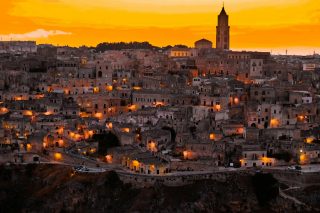
Walking Tour Summary

Distance: 8.5 km
Sites: 17

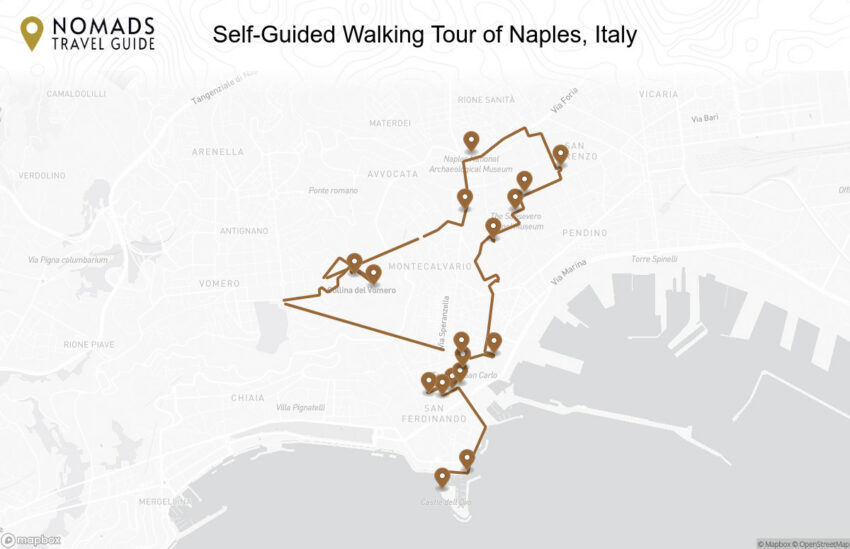
Walking Tour Map
Map of the Self-Guided Walking Tour of Naples, Italy walking route with 17 stops in Naples.
Preview map of the Self-Guided Walking Tour of Naples, Italy route in Naples, showing 17 stops. Use the interactive map to zoom and tap markers.

More from this area

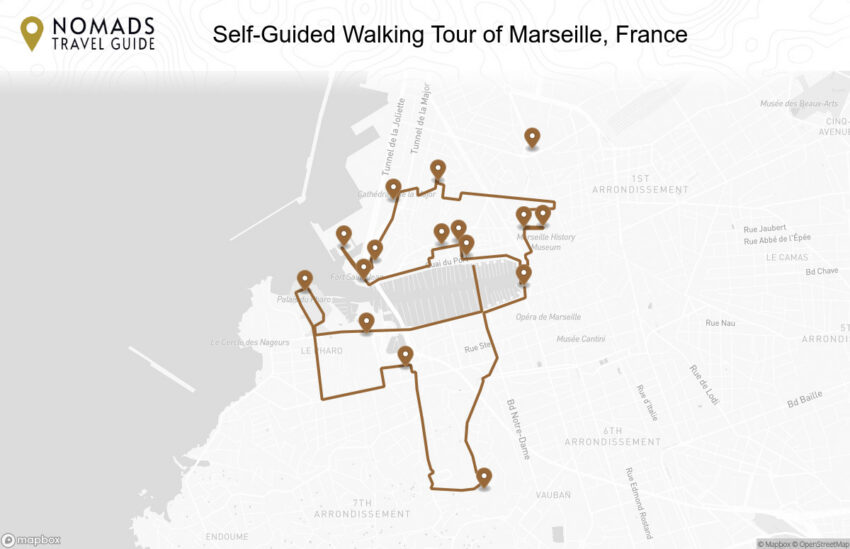
Self-Guided Walking Tour of Marseille, France (2026)

Walking Tour of Marseilles Old Town

This website uses affiliate links which earn a small commission at no additional cost to you.
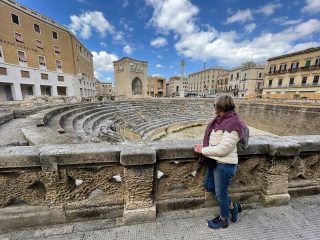
A walking tour of Marseille’s Old Town is the perfect way to dive into the rich tapestry of history, culture, and local life that defines France’s oldest city. From the bustling Vieux-Port (Old Port), where fishermen still sell their catch each morning, to the winding alleyways of Le Panier-the city’s oldest district-every corner reveals another layer of Marseille’s 2,600-year story. Greek traders, Roman engineers, medieval knights, and waves of immigrants have all left their mark here, creating a city that is as diverse and dynamic as it is historic.

This walking tour invites you to explore Marseille on foot, where grand monuments stand beside crumbling staircases and sun-faded street art. You'll stroll past landmarks like the Cathédrale de la Major and Fort Saint-Jean, discover hidden squares and artisan shops, and enjoy sweeping views of the Mediterranean. As you go, your guide-or app-will share the stories behind the façades, from ancient legends to tales of revolution, resilience, and renewal. Whether it's your first time in Marseille or you're rediscovering it with fresh eyes, this tour offers a grounded and authentic way to experience the city.

How to Get to Marseille

By Plane: To get to Marseille by plane, book a flight to Marseille Provence Airport (MRS), which is served by many international and domestic airlines. The airport is located about 27 kilometers from the city center and is easily accessible by shuttle bus, taxi, or rental car. For the best deals and a seamless booking experience, check out these flights to Marseille on Booking.com.

By Train: Marseille is well served by high-speed TGV and regional TER trains, with direct connections to Paris, Lyon, Nice, and Avignon. The Marseille Saint-Charles station is located just uphill from the Old Port and is a 15-minute walk or a quick metro ride to the heart of the city. You can use SNCF Connect to check schedules, compare routes, and purchase tickets for National (SNCF ) and regional trains (TER). For a more streamlined experience, we recommend using Omio, which allows you to easily compare prices, schedules, and book tickets for both National and Regional travel across all of Europe, all in one place.

By Car: Marseille is accessible via the A7 and A50 motorways. While driving in the city centre can be busy and parking limited, park at the Basilique Notre-Dame de la Garde. Otherwise I would suggest the fairly centrally located Parking Bourse. If you are looking to rent a car in France I recommend having a look at Discover Cars, first, as they compare prices and review multiple car rental agencies for you.

Where to Stay in Marseille

For a walking tour of Marseille’s historic and cultural sights, it’s best to stay near the Vieux-Port (Old Port), where the tour begins and many attractions are within easy walking distance. A luxury option is InterContinental Marseille - Hôtel Dieu, housed in an 18th-century building with sweeping views of the port and Notre-Dame de la Garde. For boutique comfort, Maisons du Monde Hôtel & Suites - Marseille Vieux Port combines stylish interiors with a prime waterfront location. Budget-conscious travellers can opt for Hotel Life Marseille VP - Vieux Port, a modern, affordable hotel just steps from restaurants, ferries, and city life. All are ideal bases for exploring Marseille’s mix of ancient history and cosmopolitan flair.

A Short History of Marseille

Marseille, founded around 600 BCE by Greek sailors from Phocaea, is the oldest city in France and has served as a major Mediterranean port for over 2,600 years. Its history is written in its architecture and landmarks, beginning with the Vieux Port (Old Port), the cradle of the city’s development and trade since ancient times.

Nearby, the Le Jardin des Vestiges reveals the remains of the ancient Greek port, unearthed during construction in the 1960s, offering a glimpse into Marseille’s early urban life. The Marseille History Museum, located adjacent to the garden, provides extensive insights into the city’s past, from Greek settlement to modern times.

Religious and civic architecture reflects centuries of growth and influence. The Abbey of Saint-Victor, founded in the 5th century, played a vital role during the early Christian era. In the 12th century, Eglise Saint-Laurent, a Romanesque-style church built by local fishermen, became a spiritual anchor for the city's maritime community. Towering over Marseille, the Basilique Notre-Dame de la Garde, built in the 19th century, remains a symbol of protection and faith, offering panoramic views of the city and sea.

During the 17th century, under Louis XIV, military fortifications were erected, including Fort Saint-Jean and Fort Saint Nicolas, guarding the port entrance. The nearby La Vieille Charité, a former almshouse designed by Pierre Puget in the Baroque style (begun in 1671), stands as a testament to social care during the Ancien Régime.

In the 18th century, the Porte d’Aix triumphal arch was constructed to honor French military victories, while the Cathédrale de la Major, rebuilt in a Byzantine-Roman style between 1852 and 1896, showcased Marseille’s growing religious and political power.

Modern landmarks blend the old and new. The MuCEM (Museum of European and Mediterranean Civilizations), opened in 2013, is built alongside Fort Saint-Jean, connecting ancient and contemporary cultural narratives. Historic homes like the Maison Diamantée (16th century) and civic structures like the Hotel de Ville (City Hall) reflect the city’s Renaissance and Classical heritage. Napoleon III commissioned the Palais du Pharo in the mid-19th century as an imperial residence, later gifted to the city.

Choose a Guided or Self Guided Tour of Marseille?

This guide will take you around all the main attractions, whoever if you are in a hurry or want a more personalised tour, you may want to consider taking a walking tour with a local guide. This is one of the most complete and best-rated city tours that covers the main, must-see attractions in about 3 hours.

Your Walking Tour of Marseille

This walking tour offers a fascinating journey through Naples’ layered history, lively streets, and dramatic contrasts-where royal grandeur and gritty charm exist side by side. Be selective about which locations you enter and explore further as you wont be able to cover it all unless you spend a few days here.

1. Vieux Port (Old Port), Marseille

Vieux Port Marseille
CC BY-SA 4.0 / Bybbisch94, Christian Gebhardt

Walk along the quay with the sea on your left and you will see the Église Saint-Ferréol les Augustins.


Flanked by the historic Panier (Old Town) on one side and the majestic Notre Dame de la Garde on the other, the Old Port, or Vieux Port, has been the vibrant center of Marseille for over 2,000 years. Today, it remains a beloved gathering place where locals and visitors alike come to stroll, dine, debate, fall in love, trade fish, enjoy music, sell sunglasses, and relish life’s moments. Moreover, the city center received a significant facelift in 2013 when Marseille was the focal point of the European Capital of Culture, further cementing the Old Port’s role as a communal hub.

Established in 600 BC by Greek settlers from Phocaea in Asia Minor, now Türkiye, Marseille is France’s oldest city and still carries its ancient moniker, La Cité Phocéenne, with pride. The port evolved through Roman and medieval times and expanded under the direction of Louis XIV in 1666, who also initiated the construction of two fortresses at the harbor’s entrance and the development of the famous Canebière boulevard. Although the original structure was heavily damaged by Nazi bombings in 1944 and subsequently demolished post-World War II, discussions of rebuilding the bridge occasionally resurface, though no concrete plans have materialized. Today, the Old Port, with its shallow depth of just six meters, no longer supports commercial maritime traffic or the daily influx of large cruise ships, which now dock at the nearby Joliette port.

The Vieux Port now serves as the city’s largest marina, accommodating thousands of berths. Here, traditional fishing boats known as pointus compete for space with luxurious yachts, a few majestic tall ships, and various motor launches.


Location: Vieux Port, Rue Breteuil, Marseille, France | Hours: As a public harbourfront, the Old Port is accessible at all hours, though shops and markets follow individual schedules. | Price: The Vieux-Port itself is free to explore; boat trips, ferries, and nearby attractions charge their own separate fees.

We recommend to rent a car in France through Discover Cars, they compare prices and review multiple car rental agencies. Book your rental car here.

2. Le Jardin des Vestiges

Jardin des Vestiges Marseille
CC BY-SA 4.0 / Carl Ha

Walk to the back of Église Saint-Ferréol les Augustins, and turn left to reach Le Jardin des Vestiges and Marseille History Museum.


In 1967, during construction in central Marseille, archaeologists discovered several ancient ruins. These historical remnants, now integrated into a landscaped garden known as Le Jardin des Vestiges, are situated in the bustling heart of the contemporary city. Designed by the esteemed landscape architect Joël-Louis Martin, this garden is a part of the Museum of Marseille. The discovery was made while planning to build a shopping center, unveiling ruins of an ancient Greek port from the Roman era. In its prime, this port was a dynamic hub, extending further east, teeming with traders unloading their goods. Today, the wharves from this port, which date back to Roman times, are still visible and form a key feature of the garden.  Le Jardin des Vestiges stands as a striking juxtaposition of Marseille’s ancient past against the modern urban landscape that now surrounds it.


Location: Jardin des Vestiges, Rue Henri Barbusse, Marseille, France | Hours: Generally aligned with the Marseille History Museum and Centre Bourse opening times. | Price: Often accessible via or included with the Marseille History Museum ticket | Website

Here is a complete selection of hotel options in Marseille. Feel free to review each one and choose the stay that best suits your needs.

3. Marseille History Museum

Musee dhistoire de la Ville de Marseille
CC BY-SA 4.0 / Cover 2020

The Musée d’Histoire de Marseille, or Marseille History Museum, is dedicated to exploring the city’s rich historical tapestry, from its ancient origins to the 18th century. This local history and archaeology museum holds a comprehensive collection that vividly illustrates Marseille’s significant role in French history over the millennia.

Visitors to the museum can explore a wide range of displays, including artifacts, ephemera, photographs, and documents that cover the extensive timeline of the region. From its earliest settlers, through the era of Viking explorers, to Roman conquests and beyond, the museum provides an educational and engaging experience suitable for all ages.

The museum’s vast permanent exhibition features many items unearthed during archaeological excavations that began in the 1960s. Among the standout pieces is the hull of a second-century ship, which is one of the best-preserved of its kind globally. Additionally, visitors will find artifacts from medieval potter workshops and items related to the plague of 1720.

The exhibits also delve into the prehistory of the region, showcasing the lives of the Ligures and Phoaceans, as well as the ancient Greek and Roman ports that once thrived here. Further exhibits cover the spread of Christianity through the sixth century and the era of Louis XIV, providing a thorough and fascinating overview of Marseille’s historical journey.


Location: Musée d'histoire de la Ville de Marseille, Rue Henri Barbusse, Marseille, France | Hours: Daily 09:00 - 18:00 Closed Mondays | Price: Free (Permanent collections) | Website

Traveling to a country with a different currency? Avoid ATM transaction fees and pay in local currency with a Wise Card. Having used it for over 5 years, we've saved loads on fees!

4. Porte d'Aix

Marseille   Porte dAix
Marseille Porte dAix
CC BY-SA 4.0 / Marianne Casamance

Turn right onto Rue Henri Barbusse and next right at Rue Neuve Saint-Martin and left onto the large Cr Belsunce. At the begining of Rue d’Aix you can see the impressive Porte d’Aix at the far end.


Porte d’Aix, also known as Porte Royale, is a triumphal arch located in Marseille, France, which serves as a historical marker for the city’s old entrance from the road leading to Aix-en-Provence. The arch’s design, by Michel-Robert Penchaud, draws inspiration from the grand triumphal arches of the Roman Empire. Originally conceived in 1784, the Porte d’Aix was intended to honor King Louis XVI and commemorate the Peace of Paris (1783), which concluded the American Revolutionary War. However, the project was halted and later resumed in 1823 following the restoration of the Bourbon monarchy, this time to celebrate French military successes during the Spanish Expedition, particularly the victory at the Battle of Trocadero on August 31, 1823. The arch was finally completed in 1839, embodying a broader theme of victory.


Location: Porte d'Aix, Place Jules Guesde, Marseille, France | Hours: Accessible at all times; the arch stands in an open public space with no gates. | Price: Free: Porte d’Aix is an open-air monument in a public square. | Website

5. La Vieille Charité

Chapelle et hospice de la Vieille Charite
CC BY-SA 3.0 / Charliemoon

After admiring Porte d’Aix from afar walk west along Rue Colbert. On your right you will pass the slightly neglected La Halle Puget, designed by Pierre Puget and erected in 1672, the Puget Hall housed fish merchants and butchers’ stalls. In the 19th century, it was walled up and transformed into a chapel, then into a Commissariat in the early 20th century. Abandoned in the 1980s, it threatened to collapse until finally restored. Go straight across at the roundabout and ascend the right Escalier “Le Panier”. “Le Panier” refers to a specific neighborhood in Marseille, known as the oldest quarter of the city. Keep to the right up Rue Saint-Antoine, then left and right again up Petit Puits.


Located in the vibrant Le Panier quarter of Marseille, the grand almshouse designed by Pierre Puget (1620–1694), a native of the area who ascended to the position of architect for Louis XIV, stands as a testament to his architectural and sculptural prowess. This beautiful structure features a neoclassical central chapel and an elegantly arcaded courtyard, embodying a sense of harmony and grace.

The origins of La Vieille Charité in Marseille trace back to a 1640 Royal Edict aimed at “locking up the poor and beggars.” Despite initial plans by the municipality to house this population, the project faced numerous delays. It wasn’t until 30 years later that Pierre Puget, a local and distinguished architect, devised the plans for what would become one of his most notable works. Construction, overseen by his son François Puget, spanned from 1671 to 1745.

For over a century, La Vieille Charité served as a shelter for the city’s beggars, until the French Revolution transformed it into a hospice. By 1905, it was repurposed by the Army, and in 1922, it provided social housing for those whose homes were destroyed. During World War II, in 1943, it housed families evacuated prior to the destruction of the Old Port by German forces.

The building was nearly abandoned by the early 20th century until Le Corbusier alerted the municipality about its deteriorating condition, prompting restoration efforts. In 1951, the chapel and hospice were designated as historic monuments, and comprehensive restoration began in 1961, continuing for nearly 25 years after all residents had been relocated.

Today, La Vieille Charité has been revitalized as a vibrant multi-purpose cultural center. Its tranquil atmosphere and stunning beauty make it a unique landmark in Marseille. The architectural style is emblematic of the 17th century, featuring the magnificent Baroque Puget Chapel with its distinctive ovoid shape. The front facade, in the Second Empire style, is adorned with motifs relating to charity. The structure’s unity of style is highlighted by the use of pink and white stone from the La Couronne quarry in northern Marseille. The building comprises four wings that open inward to face the chapel, connected by three levels of galleries, creating a harmonious and serene space that now hosts various cultural institutions.

Entry to the almshouse itself is free, which also gives access to the permanent collections of the Musée d’Archéologie Méditerranéenne and the Musée d’Arts Africains, Océaniens, et Améridiens.


Location: Centre de la Vieille Charité, Rue de la Charité, Marseille, France | Hours: Tuesday to Sunday, 9am to 6pm; Closed every Monday | Price: Access to the Museum of Mediterranean Archaeology (MAM) and the Museum of African, Oceanic, and Amerindian Arts (MAAOA) is free | Website

6. Cathédrale de la Major (Marseille Cathedral)

Cathedrale Sainte Marie Majeure, Marseille
CC BY-SA 2.0 / Fred Romero

Head across the small Place de la Charité and continue down the Rue du Petit Puits, down the steps at the end and turn right and then left to get to the Cathedral.


Cathédrale La Major stands as one of the grandest cathedrals built in 19th-century Europe, located in the historic Le Panier district of Marseille. This majestic cathedral adopts a Romanesque-Byzantine style, reminiscent of Eastern churches, with its striped facade crafted from multi-colored stones and adorned with multiple ornate domes and cupolas. Overlooking Marseille’s bustling port, it has witnessed the comings and goings of ships from around the world for centuries.

Known affectionately by locals as ‘La Major,’ the site of the cathedral has a rich history, dating back to a Roman temple dedicated to the goddess Diana, followed by a 5th-century baptistry. After a Saracen attack in the 11th century, the church was rebuilt using pink stone from the La Couronne quarries, in a Romanesque style. Elements of this earlier structure are still visible in the cathedral’s choir and part of the nave.

The cornerstone of the current structure was laid by Napoleon III in 1852, symbolizing Marseille’s prosperity and prominence. Designed to accommodate up to 3,000 worshippers, Cathédrale La Major is constructed from lavish materials, including Italian marble, Tunisian onyx, porphyry, and local Cassis stone. Visitors enter through the southern end via red doors, which are intricately detailed with metal scrollwork. Above, Venetian mosaics enrich the arches, while the interior boasts extensive mosaics across the nave floor, a statue of Joan of Arc, and a marble depiction of Saint Veronica aiding Christ.

At the northern end, the cathedral features chapels radiating around the tomb of Saint Eugene de Mazenod, a former bishop of Marseille, and houses his relics, including a reliquary of his arms and skull. The Chapel of the Virgin displays a collection of paintings depicting saints and religious figures. Additionally, two meticulously crafted scale models of the cathedral provide a comprehensive view of its impressive architecture, allowing visitors to appreciate its scale and beauty fully.


Location: Marseille Cathedral, Place de la Major, Marseille, France | Hours: Daily: 10:00 to 19:00 (Summer 01/04 to 31/10) and 10:00 to 17:30 (Winter 01/11 to 31/03) | Price: Admission is free, though donations for maintenance and restoration are welcome. | Website

7. Eglise Saint-Laurent (Saint-Laurent Church)

Marseille Eglise Saint Laurent
CC BY-SA 4.0 / Zairon

Walk directly away from the Cathedral and slightly ascend Esp. de la Tourette.


The origins of Saint-Laurent Church in Marseille trace back to 870 AD, when Bishop Babon constructed a fortified wall to protect the city from invasions. Centuries later, as Marseille flourished, Saint-Laurent Church was erected using pink stones sourced from the Cap Couronne quarry, on a site previously occupied by an ancient pagan temple dedicated to the god Apollo. This marked the church’s beginning as the 4th parish of Marseille. Built in the Romanesque-Provençal style, its unadorned simplicity mirrors the austere elegance of the Cistercian abbeys known as the “Three Provençal Sisters”: Le Thoronet, Sénanque, and Silvacane. The church features three naves, each separated by large square pillars. By the 13th century, Saint-Laurent became the designated parish for Marseille’s fishermen. The 17th century saw the addition of the Sainte Catherine Chapel by the white penitents to accommodate the growing congregation, officially opening in 1604. In 1668, parts of the church facing the sea were demolished to facilitate the construction of Fort Saint Jean, leading to the reconstruction of the church’s bell tower. During the Great Plague of 1720, the Bishop of Marseille held a mass at the church to pray for the city’s protection. The French Revolution brought devastation, with the church’s gold and silver treasures melted down to mint coins, and its use as a military warehouse in 1794. It was eventually reopened for worship in 1801. World War II spared the church from total destruction, unlike much of the Old Port district, but it still suffered significant damage. Reconstruction efforts were gradual and only recently completed.


Location: Eglise Saint Laurent, Esplanade de la Tourette, Marseille, France | Hours: Hours can vary and may follow mass times; check locally or on the day for current opening times. | Price: Free entry

8. MuCEM (Museum of European and Mediterranean Civilizations)

Mucem Villa de la Mediterannee, Marseille
CC BY-SA 2.0 / Sébastien Bertrand

Cross the Passerelle Parvis-St Jean to get to Fort Saint-Jean and MuCEM (Museum of European and Mediterranean Civilizations).


Located at the forefront of the J4 promenade, the MuCEM (Museum of European and Mediterranean Civilizations) represents a landmark initiative by the French government to establish a major national museum outside of Paris. This museum consolidates the collections from the former museum of folk art and the museum of man, focusing on showcasing both the commonalities and unique traits of various European and Mediterranean civilizations and cultures.

The MuCEM features an innovative museography approach, incorporating a permanent reference exhibition alongside temporary exhibitions that explore significant societal issues. It also includes a forum and a cultural center that interact with other public facilities within the Cité de la Méditerranée.

In June 2002, an international architecture competition was initiated by the Minister of Culture, resulting in the selection of a design by the collaborative teams of Rudy Ricciotti and Roland Carta. The museum’s structure is notable for its parallelepipedic volume with a square footprint measuring 72 meters on each side, enveloped by a distinctive perforated concrete mesh inspired by marine rock.

The MuCEM complex consists of two main structures: the rehabilitated Fort Saint-Jean, which hosts temporary exhibitions, and a new building on the J4 esplanade dedicated to both permanent and temporary displays. These two buildings are connected by an elevated pedestrian walkway that stretches over the dock, providing a unique vantage point and linking the historical and contemporary elements of the museum.


Location: Mucem - Museum of Civilizations of Europe and the Mediterranean, Esplanade J4, Marseille, France | Hours: Daily 10 a.m. — 6 p.m. Closed Tuesdays | Price: Adults: €11.00 | Website
Powered by GetYourGuide

9. Fort Saint-Jean

Fort Saint Jean, Marseille
CC BY-SA 3.0 / Christophe.Finot

Fort Saint-Jean stands as a historic fortress in Marseille, France, providing breathtaking panoramic views of the bustling boats in the bay and the cityscape beyond. Constructed in 1660 by King Louis XIV at the entrance of the Old Port, Fort Saint-Jean has become one of the city’s most frequented monuments, rich with centuries of captivating history.

In 2013, two footbridges were added, enhancing access to the fortress. These bridges link Fort Saint-Jean with the historical district of Le Panier and the MuCEM (Museum of the Civilizations of Europe and the Mediterranean), seamlessly connecting the past and present. Visitors to Fort Saint-Jean can embark on a journey through time, exploring the fortress’s extensive heritage while enjoying its strategic views that have overseen Marseille’s evolution over the ages.


Location: Fort Saint-Jean, Promenade Louis Brauquier, Marseille, France | Hours: Daily 10 a.m. — 6 p.m. Closed Tuesdays | Price: €11.00 | Website

10. Museum of the Roman Docks

Musee des docks romains
CC BY-SA 2.0 / Robert Valette

Walk along the quayside cross over the road at the second zebra crossing and to the next street, Rue de la Loge. Turn right and left under the flats to get to Pl. Vivaux. The Museum of the Roman Docks is to the right on the building in front of you.


The Museum of Roman Docks in Marseille is a fascinating site that showcases the remains of one of the few Roman commercial warehouses known globally. Discovered in 1947 during the post-World War II reconstruction of areas destroyed by German occupiers, the site was preserved thanks to the efforts of historian and archaeologist Fernand Benoit. Officially opened to the public in 1963 and later renovated in 1987, the museum displays an impressive collection of 30 dolia—large ceramic containers from Roman times.

These dolia, used primarily for agricultural purposes, were integral to ancient Roman commerce, especially in wine and oil storage. Typically found in vineyards next to presses, these containers could stand approximately 1.70 meters in height and 1.60 meters in diameter, holding between 1,800 to 2,000 liters. They were partially buried in the ground to maintain a stable temperature, sealed with a similar material lid, and coated internally with resin to preserve the contents from temperature fluctuations, which was crucial for maintaining the quality of the wine.

The museum also offers a glimpse into the history of maritime trade, featuring exhibits along the walls that detail findings from underwater excavations of 20 shipwrecks in the Marseille harbor. These displays provide insight into the extensive trade networks and the rich commercial history that shaped the region. Visitors to the museum can explore both the remnants of medieval structures and the ancient Roman dolia, making it a unique and educational experience that bridges the city’s past and present.


Location: Musée des Docks romains de la Ville de Marseille, Place Vivaux, Marseille, France | Hours: Daily 09:00 - 18:00 Closed Mondays | Price: Free | Website

11. Maison Diamantée

Maison Diamantee
Maison Diamantee
CC BY-SA 3.0 / Guiguilacagouille

Continue along Pl. Vivaux past the square whic often has lovely olive trees in pots (Oliviers en pots). Maison Diamantée is on your left as you get to the large square.


The Diamond House, formerly known as the hotel of Saboulin Bollena, is a historically significant building located just behind the City Hall in Marseille. Its name derives from the distinctive diamond-shaped stones that adorn its facade. Together with the Hotel Cabree, it stands as one of the most well-preserved residences in the area today.

Constructed in the 15th century, the Diamond House was built on the former palace gardens of Provence by wealthy Spanish and Italian investors. Over the centuries, it has served as the home for some of Marseille’s most prominent families, including Pierre Sebolin de Bollena, who was the second sheriff of Marseille in 1685, followed by his nephew, Francois de Sabolin Bollena, who became the first sheriff of the city in 1702.

From 1967 until 2009, this building housed the Museum of Old Marseille, preserving and showcasing the city’s rich history. After 2009, its collections were incorporated into the Marseille History Museum. This museum offers a detailed portrayal of life in Marseille during the 18th and 19th centuries and features an impressive exhibit on the Plague of 1720, providing insights into one of the most challenging periods in the city’s history.


Location: Maison Diamantée (La), Rue de la Prison, Marseille, France | Hours: As the building houses municipal services, access is generally limited to office hours on weekdays; the exterior can be seen at any time. | Price: Free to admire from the outside; the interior is not open to public visits.

12. Hotel de Ville (City Hall)

Marseille Hotel de ville
CC BY-SA 4.0 / Bjs

Head back to the quay ant tur left.


You can’t overlook the Town Hall as you stroll through the Old Port. The grand mayoral residence stands tall on the right bank, overlooking Notre-Dame de la Garde. Situated near the Panier district, it’s worth pausing to admire its magnificent architecture and rich history.


Location: Ville de Marseille, Place Villeneuve-Bargemon, Marseille, France | Hours: It can not be visited, except for official business. | Price: Free to view from outside; access to interiors is usually restricted to official events

13. Fort Saint Nicolas & Fort d'Entrecasteaux

Fort Saint Nicolas Marseille
CC BY-SA 3.0 / Ainars Brūvelis

The tour on the southside of the port is more spreadout and does have a bit of a climb to the Basilique Notre-Dame de la Garde. To continue you cross over the dock on the ligne du ferry which runs daily (07:30 – 20:30) and only costs €0.50 (free for RTM or CityPass subscription holders). Or you can either continue along the quay to end the tour where we started.

Crosing over the ferry head west, with the water on your right. Fort Saint-Nicolas will be on your right.


The fortress complex at the entrance to Marseille’s Vieux Port, comprising Fort d’Entrecasteaux and Fort Ganteaume, is a testament to the strategic military architecture of the 17th century under Louis XIV. Designed to maintain control over Marseille in the event of local insurrection, this fortification exemplifies the era’s military foresight and the evolving art of warfare.

The fort occupies a critical limestone spur, strategically positioned between the port, the Saint-Victor abbey, and the Pharo. Historically, it encapsulated the medieval Saint-Nicolas chapel, which was subsequently demolished. The construction, initiated in 1660 by the Chevalier de Clerville, incorporates a sophisticated double-enclosure system of ditches and bastions, specifically engineered to counteract the enhanced offensive capabilities introduced by fire artillery at the time.

This defensive structure was divided into two distinct tiers. The lower tier, known as Fort de Ganteaume, functioned historically as a farmyard with strategic views over the port. It was isolated following the construction of Boulevard Charles Livon in 1862, during the establishment of the nearby Imperial Residence, le Pharo. This lower portion remains under military jurisdiction.

The upper fort, Fort d’Entrecasteaux, features dual interlocking enclosures that adhere to a quadrangular plan optimized for the terrain’s steep escarpment. The construction showcases exemplary masonry with large blocks of pink La Couronne limestone, accentuated by bossed quoins and string courses that trace arabesques of counter-curves along the slopes, lending an air of serene power to the structure.

Currently, the upper fort has undergone extensive restoration and is now accessible to the public. It is managed by the Citadelle de Marseille, offering visitors a unique glimpse into the historical military architecture and the continuous evolution of defense strategies in response to advancements in warfare technology. This fort not only served as a bulwark but also chronicles the broader narrative of military engineering and its implications on urban development and regional control.


Location: Fort Saint-Nicolas, Montée du Souvenir Français, Marseille, France | Hours: Approx: Winter: Saturday/Sunday Summer: Wednesday - Sunday 12 p.m. - 10 p.m. See their website. | Price: €12 Booking Required | Website

14. Palais du Pharo

Palais du Pharo et Vieux Port
CC BY-SA 1.0 / Benoît Prieur

Walk up Bd Charles Livon, stop and admire to view from the small, Jardin Missak Manouchian dedicated to this resistance fighter of Armenian origin and his comrades, foreigners who died fighting for France. Parc Émile Duclaux and Palais du Pharo is on your right.


Intended as an imperial abode, the Palais du Pharo stands as a splendid Napoleonic edifice that merits exploration for both its architectural grandeur and its surrounding park.

While the Palace itself is not open for tours, it is surrounded by nearly six hectares of gardens named after Émile Duclaux. The Parc du Pharo presents a stunning view of the Vieux-Port and Marseille’s northern coastline, making it a popular spot for leisurely walks. These verdant areas attract families, walkers, and tourists, ranking among the city’s most delightful green spaces.


Location: Palais du Pharo, Boulevard Charles Livon, Marseille, France | Hours: The Pharo garden is open all year round to the public from 7 a.m. to 9 p.m. | Price: Free | Website

15. Abbey of Saint-Victor

Abbaye Saint Victor, Marseille, France
CC BY-SA 3.0 / Philippe Alès

Walk down Av. Pasteur and left onto Av. de la Corse. Turn left down Rue du Commandant Lamy to the Abbey of Saint-Victor.


The Abbey of Saint-Victor stands as a premier attraction in Marseille, inviting visitors to immerse themselves in the city’s religious heritage. A visit to the Basilica and its crypts offers a spectacular view of the Vieux-Port (Old Port). Historically, the abbey’s tower has served as a significant landmark for the people of Marseille. Beyond the breathtaking vistas, the abbey is a treasure trove of Early Christian art, deeply entwined with the history of Marseille. Those passionate about culture and history will find great delight in exploring its crypts, chapels, and sarcophagi.


Location: Abbaye Saint-Victor, Place Saint-Victor, Marseille, France | Hours: Daily 09:00 - 18:00 | Price: €2 to visit crypts | Website

16. Basilique Notre-Dame de la Garde

Notre Dame de la Garde Marseille
CC BY-SA 3.0 / Ajay K

Head back past Av. de la Corse and walk up Rue d’Endoume for 700m. Yuo will see the steps on your left leading up to Basilique Notre-Dame de la Garde.


The Basilique Notre-Dame de la Garde is a striking 19th-century landmark visible throughout Marseille. It is built atop the remnants of a 12th-century chapel and a 16th-century fort, serving historically as both a sacred site and a strategic defensive position. Today, it remains a place where locals frequent to seek blessings for safe travels and health recoveries.

The basilica is renowned for its magnificent location which offers stunning panoramic views, attracting visitors as much for its visual appeal as for its richly decorated interior. It plays a central role in many of Marseille’s significant festivities, including being a prime spot for viewing Bastille Day fireworks. Atop the basilica, the golden statue of the Virgin Mary, affectionately known as La Bonne Mère, is said to watch over the city. Historically, Garde Hill, where the basilica stands, has served as a critical lookout point and a pilgrimage site for sailors praying for safe voyages. In the 16th century, King François I ordered the construction of a fort here to protect Marseille from potential Spanish invasions, around the same period the Château d’If was established.

The foundation stone of the current basilica was laid in 1853, incorporating the base of the former fort. Above the north door, the symbol of King François—a salamander—is still visible. The architecture of the basilica is inspired by Byzantine designs, characterized by a striking façade of alternating red and white stones, ornate domes, and elaborate mosaics that adorn the interior.


Location: Basilique Notre-Dame de la Garde, Rue Fort du Sanctuaire, Marseille, France | Hours: Daily 07:00 - 18:00 | Price: Free | Website

Head down Montee de l’Oratoire. You will see a monument Le char Jeanne d’Arc”, a sherman tank left from the second world war. It remains where it was destroyed, advancing up the hill to attack a German position. Carry on down Montee de l’Oratoire, turn right to walk down the steps next to Caniparc. Take a shortcut down Rue des Brusques and head straight across the roundabout to walk down Rue Fort Notre Dame back to the port.

Powered by GetYourGuide
Moira & Andy
Moira & Andy

Hey! We're Moira & Andy. From hiking the Camino to trips around Europe in Bert our campervan — we've been traveling together since retirement in 2020!

Read our full story here

This website uses affiliate links which earn a small commission at no additional cost to you.
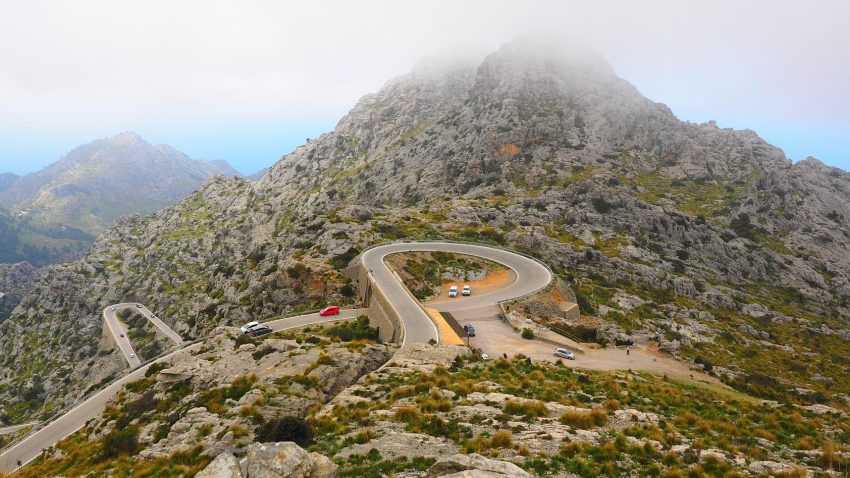
Walking Tour Summary

Distance: 4.5 km
Sites: 16

Walking Tour Map
Map of the Self-Guided Walking Tour of Marseille, France walking route with 16 stops in Marseille.
Preview map of the Self-Guided Walking Tour of Marseille, France route in Marseille, showing 16 stops. Use the interactive map to zoom and tap markers.

More from this area

Self-Guided Walking Tour of Aix-en-Provence, France (2026)

Aix en Provence Place de la Mairie
CC BY-SA 4.0 / Rolf Kranz

This website uses affiliate links which earn a small commission at no additional cost to you.
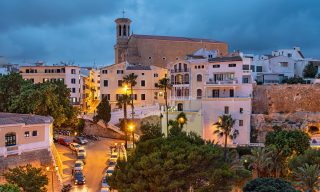
Aix-en-Provence is the embodiment of southern French elegance-a city of sunlit stone, bubbling fountains, and leafy boulevards steeped in art, history, and tradition. Nestled in the heart of Provence, it offers a graceful balance between the grandeur of its aristocratic past and the relaxed rhythm of modern life. Known for its Roman roots, Baroque mansions, and thriving café culture, Aix invites visitors to slow down and savour every detail, from the scent of lavender in the markets to the ripple of water in one of its many historic fountains.

As the birthplace of painter Paul Cézanne, Aix has long been a haven for artists and intellectuals, and its streets reflect that creative legacy. Whether you’re admiring 17th-century architecture, browsing art galleries, or following in Cézanne’s footsteps toward Montagne Sainte-Victoire, a walking tour through Aix-en-Provence is more than just a sightseeing trip-it’s a sensory experience. Rich in charm and beautifully preserved, the city reveals itself best on foot, one quiet square and sun-drenched alley at a time.

How to Get to Aix-en-Provence

By Plane: Aix-en-Provence is served by the nearby Marseille Provence Airport, which is about 25 km (15 miles) southwest of the city center. From the airport, visitors can reach Aix-en-Provence by shuttle, taxi, or car in around 30-40 minutes. For the best deals and a seamless booking experience, check out these flights to Aix en Provence on Booking.com.

By Train: Aix-en-Provence is easily reached by high-speed TGV and regional TER trains. The Aix-en-Provence TGV station is located about 15-20 minutes from the city centre by shuttle or taxi. Alternatively, regional trains connect nearby cities like Marseille, Avignon, and Arles to Aix-en-Provence Ville, the central station just a short walk from the old town. You can use SNCF Connect to check schedules, compare routes, and purchase tickets for National (SNCF ) and regional trains (TER). For a more streamlined experience, we recommend using Omio, which allows you to easily compare prices, schedules, and book tickets for both National and Regional travel across all of Europe, all in one place.

By Car: Aix is well connected by the A8 and A51 motorways, making it convenient for drivers arriving from Marseille, Nice, or the Luberon. The historic centre is largely pedestrianised, so it's best to park nearby. Parking Mignet and Parking La Rotonde are both centrally located and provide easy access to the town’s main sights. If you are looking to rent a car in France I recommend having a look at Discover Cars, first, as they compare prices and review multiple car rental agencies for you.

Where to Stay in Aix-en-Provence

For a walking tour of Aix’s elegant streets and cultural landmarks, staying within or near the historic centre is ideal. A top luxury choice is Villa Gallici, a refined five-star hotel with landscaped gardens and a peaceful location just outside the centre. For a boutique option, Hôtel des Augustins offers unique charm and a prime spot just off Cours Mirabeau in a former medieval convent. Budget-conscious travellers may enjoy Hotel Le Concorde, a practical and well-located stay within walking distance of the Old Town. Each of these options makes a great base for exploring the city on foot.

Guided or Self-Guided Tour of Aix-en-Provence?

For a more immersive experience, consider joining the An Aix-traordinary Walking City Tour of Aix-en-Provence. This 2.5-hour guided tour explores Cours Mirabeau, the Mazarin district, Aix Cathedral, and more-while offering tastings of local treats like Calisson and Madeleines, plus insider tips for the rest of your stay.

A Brief History of Aix-en-Provence

Aix-en-Provence was founded in 123 BCE by the Romans, who named it Aquae Sextiae in honour of its natural hot springs. Originally a Roman spa town, it grew into a major centre of learning, religion, and governance in the south of France. By the Middle Ages, it had become the capital of Provence and a flourishing seat of aristocracy. The city later gained prominence as a centre for the arts and philosophy, and is best known today as the birthplace of post-impressionist painter Paul Cézanne. Its Baroque architecture, tree-lined boulevards, and lively market squares reflect a long legacy of refinement, intellect, and Provençal tradition.

Your Walking Tour of Aix-en-Provence

This walking tour takes you past the most iconic and charming sights in Aix-en-Provence. Begin along the Cours Mirabeau, the grand tree-lined boulevard that serves as the spine of the city, dotted with fountains and cafés. From there, meander through the Old Town, discovering Place de l’Hôtel de Ville, Saint-Sauveur Cathedral, and the bustling Place Richelme. Admire the elegant façades, hidden courtyards, and the sound of trickling fountains that echo throughout the streets.

Be selective about which locations you enter-you won’t have time to see everything in detail unless you’re staying for several days. If time allows, consider visiting Atelier Cézanne, the artist’s preserved studio, or taking a detour to Terrain des Peintres, a peaceful overlook with views of Montagne Sainte-Victoire. Whether self-guided or accompanied by a local expert, this tour provides a graceful introduction to one of Provence’s most cultured and atmospheric cities.

1. Cathedrale Saint-Sauveur d'Aix-en-Provence

Baptistere Cathedrale Saint Sauveur Aix en Provence
CC BY-SA 3.0 / Ddeveze

For millennia, the cathedral of Aix-en-Provence has stood as a revered sanctuary, evolving into a significant religious icon within the region. This imposing edifice showcases a harmonious blend of architectural styles, seamlessly intertwining Romanesque, Gothic, and Baroque elements, alongside subtle traces harkening back to the Roman era. Its grand proportions command attention, drawing visitors from far and wide to marvel at its magnificence.

Designated as a national monument, Aix Cathedral holds a prominent position within the Old Town, solidifying its status as one of the most frequented attractions in the Provençal town. Its sacred aura and historical significance continue to captivate visitors, ensuring its enduring legacy as a revered symbol of faith and architectural prowess.


Location: Paroisse Cathédrale Saint Sauveur Aix-en-Provence, Cathédrale Saint-Sauveur d'Aix-en-Provence, Place des Martyrs de la Resistance, Aix-en-Provence, France | Hours: All year round, every day from 10 a.m. to 5 p.m. Celebration of Masses: Monday to Friday at 8 a.m. Saturday at 8 a.m. and 6:30 p.m. Sunday at 10:30 a.m. and 7 p.m. | Price: Free | Website

We recommend to rent a car in France through Discover Cars, they compare prices and review multiple car rental agencies. Book your rental car here.

2. Musée des Tapisseries

Aix en Provence Palais Archiepiscopal
CC BY-SA 4.0 / François GOGLINS

From the Cathedral head south along Rue Gaston de Saporta. Turn left into Place des Martyrs de la Résistance at the end of which is the Musée des Tapisseries.


Established in 1909 and now recognized as an accredited Musée de France, the Tapestry Museum occupies the first floor of the former Archbishop’s Palace, nestled within the grand staterooms. This palace, designated as a listed Historic Monument, comprises four wings and an interior courtyard, serving as the residence for various Aix prelates until the early 20th century. Over time, the palace has undergone renovations and restoration efforts, preserving its architectural heritage influenced by different eras and occupants.

The museum’s collection, primarily focusing on 17th and 18th-century tapestries, is organized into three distinct suites: ‘The Grotesque,’ inspired by Berain; ‘The Story of Don Quixote,’ by Natoire; and ‘Russian Games,’ by Leprince. Additionally, the collection features notable pieces of furniture such as cabinets, chairs, and dressers, enhancing the museum’s cultural offerings.

On the ground floor, the ‘Gothic’ room serves as a venue for temporary exhibitions, while the courtyard hosts the Theatre of the Archbishop, a significant venue for the renowned Aix-en-Provence Festival (Opera Festival).

With its growing international acclaim, the Aix Festival has played a transformative role in shaping the museum’s direction since the 1970s. This influence has led to the establishment of collections showcasing textile arts, contemporary arts, and performing arts, with a vision to create an ‘Opera Centre’ dedicated to housing the town’s opera heritage collections originally created for the Aix Festival and the Jeu de Paume theatre.


Location: Musée des Tapisseries, Place des Martyrs de la Resistance, Aix-en-Provence, France | Hours: Daily except Tuesday, 10:00 a.m.–12:30 p.m. and 1:30 p.m.–6:00 p.m. | Price: Adults: €4 | Website

Here is a complete selection of hotel options in Aix en Provence. Feel free to review each one and choose the stay that best suits your needs.

3. Place de l'Hôtel de Ville

Place de l'Hotel de Ville, Aix en Provence
Place de l’Hotel de Ville, Aix en Provence
Public Domain / Aix-en-Provence

Continue down Rue Gaston de Saporta, look for the Niche votive, a shrine to the Virgin Mary on your left. You will see the Tour de l’Horloge at the start of the Place de l’Hôtel de Ville.


The town hall, known as the ‘Hotel de Ville,’ in Aix-en-Provence boasts a rich history dating back to the fourteenth century, with subsequent renovations occurring in 1655 and 1678. Adjoined by a majestic clock tower, the building serves as a repository for the portraits of numerous Counts of Provence and Kings of France, echoing centuries of political and cultural heritage. A focal point of the square outside is the fountain, erected in 1755 atop a Roman column, serving as a captivating centerpiece where locals and visitors alike converge to peruse the bustling market or simply savor the ambiance. Dominating the square is the granary, a striking edifice constructed in 1754, adorned with a remarkable triangular-framed carving depicting allegorical figures representing the Durance and Rhone rivers, symbolizing the life-giving benefits of their waters. Cafes and restaurants dot the square, offering a charming respite for indulging in coffee or a delightful meal, making it an inviting destination for both relaxation and culinary delights amidst the vibrant energy of Aix-en-Provence.


Location: Place de l'Hôtel de Ville, Rue Vauvenargues, Aix-en-Provence, France

Traveling to a country with a different currency? Avoid ATM transaction fees and pay in local currency with a Wise Card. Having used it for over 5 years, we've saved loads on fees!

4. Place et Fontaine d'Albertas

Aix Place dAlbertas
Aix Place dAlbertas
CC BY-SA 4.0 / Bjs

Leave the square at the bottom right corner and walk down Rue Maréchal Foch. At the crossroads walk straight across down Rue Aude. At the end of Rue Aude you come to the square with the Albertas Fountain.


The Albertas Fountain stands proudly at the heart of Albertas Square, its construction dating back to the year 1862. In the 18th century, the Albertas family held a prominent position among the city’s elite. In 1724, Henri Rainaud d’Albertas commissioned the architect Laurent Vallon to design the façade and entrance of his opulent private mansion. Seeking to create an expansive and grand vista, Henri acquired and subsequently demolished the buildings opposite his mansion between 1735 and 1741. His vision was to fashion a square reminiscent of the royal palaces found in Paris. Henri’s son, Jean-Baptiste d’Albertas, carried forward his father’s legacy, overseeing the project from 1742 to 1746. The construction duties were entrusted to Laurent Vallon’s son, Georges. The fountain situated at the square’s center was added later, in the year 1862, serving as a testament to the enduring legacy of the Albertas family and their contributions to the architectural and cultural landscape of the city.


Location: Place d'Albertas 11 Rue Espariat 13100 Aix-en-Provence France | Hours: 24 hours | Price: Free

5. Fontaine de la Rotonde

Fontaine de la Rotonde, Aix en Provence
CC BY-SA 2.0 / Rainbow0413

Head west down Rue Espariat. You will come to Fontaine Des Augustins. It was built in 1620, transformed into a public washhouse in 1786 and completely rebuilt in 1820; it is adorned with an ancient Roman granite column at the end of which rests a twelve-pointed copper star; for many years, water from the fountain was used to supply the steam locomotives of the nearby railway station. Continue down Rue Espariat to the Fontaine de la Rotonde.


At the heart of Place du Général de Gaulle lies the Rotonde, a pivotal point where Aix’s urban history converges with its future development. This expansive square, boasting a diameter of 100 meters, was meticulously crafted between 1840 and 1850 to serve as a central gathering place for the city’s inhabitants.

In 1860, the Rotonde fountain emerged as a striking centerpiece, brought to life through the collaborative efforts of engineers Tournadre and Sylvestre. Standing at an impressive height of 12 meters, this majestic fountain is crafted from cold stone and comprises two intricately designed basins. Adorned with exquisite sculptures by Truphème, featuring lions, dolphins, swans, and cherubic figures, the fountain exudes a sense of timeless elegance.

Atop the fountain, three statues symbolize the virtues of Justice, Agriculture, and the Fine Arts, each facing towards prominent destinations—Cours, Marseille, and Avignon, respectively—forming a symbolic road star. These captivating sculptures, crafted by Ramus, Chabaud, and Ferrat, further enhance the fountain’s significance as a cultural and architectural landmark.

Originally supplied with water from the Zola canal in 1854, the fountain now receives a continuous flow from the Verdon canal since 1875, and today, it remains connected to the Provence canal, ensuring its perpetual vitality as a cherished symbol of Aix’s heritage and progress.


Location: Fontaine de la Rotonde, Place du Général de Gaulle, Aix-en-Provence, France | Hours: 24 Hours | Price: Free

6. Cours Mirabeau

Aix en Provence le cours Mirabeau
CC BY-SA 4.0 / Ketounette

Fontaine de la Rotonde is at the western end of Cours Mirabeau.


No thoroughfare captures the essence of Aix-en-Provence’s elegance quite like this 440-meter-long street adorned with charming fountains, Renaissance private mansions, and a verdant canopy of plane trees during the summer months. Originally conceived in the 1650s, the street was later christened in honor of the Revolutionary figure, the Comte de Mirabeau. It links the Place de la Rotonde (west) and Place Forbin (east), and remains the busiest part of town.

This picturesque avenue served as a gathering place for luminaries such as Cézanne and Zola, who frequented Les Deux Garçons, among the bustling pavement cafes that line the street.

One of the most striking private mansions along this prestigious boulevard is the Hôtel d’Espagnet, located at No 38 and dating back to 1647. A quintessential example of Aix’s baroque style, this architectural masterpiece was commissioned by a prosperous cloth merchant who ascended to the ranks of the aristocracy.


Location: Cours Mirabeau, Aix-en-Provence, France | Hours: 24 Hours | Price: Free

7. Hotel de Caumont

Aix Hotel de Caumont
CC BY-SA 4.0 / Bjs

Walk along the Cours Mirabeau until you reach the Fontaine des Neuf-Canons (nine stream fountain), then turn south down Rue Joseph Cabassol. Hôtel de Caumont is on the corner of the next block.


Nestled just a stone’s throw away from Le Cours Mirabeau and framed by the majestic setting of an 18th-century mansion, Caumont Centre d’Art emerges as a true hidden treasure in the heart of the city. Boasting meticulously landscaped gardens, evocative historical chambers, a grand courtyard, and an array of captivating temporary exhibitions, this museum offers a serene respite from the vibrant energy of the bustling main thoroughfare.

Indulge in a slice of delectable cake at the museum’s charming restaurant and luxuriate in the warmth of the midday sun while lounging on the terrace, where inviting seats are thoughtfully scattered to provide a tranquil oasis amidst the urban hustle and bustle. Caumont Centre d’Art promises a delightful blend of cultural immersion and relaxation, inviting visitors to embark on a journey of exploration and rejuvenation in its enchanting surroundings.


Location: Hôtel de Caumont, Rue Joseph Cabassol, Aix-en-Provence, France | Hours: Open every day. From 9 October to 3 May: 10am to 6pm From 4 May to 8 October: 10am to 7pm | Price: Adult: €15,50

8. Mazarin District and Fountain of the Four Dolphins

Aix en Provence Quatre Dauphins
CC BY-SA 2.5 / Wolfgang Moroder

Continue south down Rue Joseph Cabassol and turn left into Rue Cardinale until you reach Place des Quatre-Dauphins.


Situated in the heart of the Mazarin district (Quartier Mazarin) of Aix, the Square of the Four Dolphins occupies a central position at the intersection of Cardinal Street (rue Cardinale) and September 4th Street (rue Quatre-Septembre), adjacent to the picturesque Mirabeau Boulevard. Encircled by stately mansions, including the illustrious Boisgelin Hotel, designed by architect Pierre Pavillon in 1655, the square exudes an air of refined elegance.

The origins of the Mazarin district trace back to 1645 when the archbishop of Aix, Michel Mazarin, obtained King Louis XIV’s authorization to demolish the south ramparts of the city, paving the way for the creation of a modern and upscale residential area. Entrusting the urban planning to architect Jean Lombard, Mazarin envisioned a layout inspired by Italian Renaissance concepts, characterized by a symmetrical grid pattern.

At the heart of Lombard’s design stood Saint-Michel Square, now known as the Square of the Four Dolphins. The focal point of this charming square is the Fountain of the Four Dolphins, a masterpiece sculpted by Jean-Claude Rambot. The fountain features four intricately adorned dolphins encircling a pyramid supporting a column topped with a pine cone. Water gracefully spouts from the dolphins into a large circular basin below, creating a tranquil ambiance. Surrounding the fountain are four majestic chestnut trees, further enhancing the square’s serene atmosphere and offering shade to visitors seeking a moment of repose amidst the urban landscape.


Location: Place des Quatre-Dauphins, Place des 4 Dauphins, 13100 Aix-en-Provence, France | Hours: 24 Hours | Price: Free

9. Musee Granet

Aix en Provence Musee Granet
CC BY-SA 4.0 / François GOGLINS

Continue along Rue Cardinale until you reach Place Saint-Jean-de-Malte and both Musée Granet and Eglise et Paroisse Saint-Jean-de-Malte.


Henri Pointier, who served as the curator of the Museum of Aix from 1892 to 1925, harbored a strong disdain for Cezanne. Legend has it that he adamantly declared that Cézanne’s works would only be exhibited at the museum “Over my dead body.” Pointier’s words proved to be eerily prophetic, as he passed away in 1949, opening the door for a dramatic shift in the museum’s attitude towards Cezanne. Subsequently, in the same year, the museum was renamed in honor of François-Marius Granet, one of its most generous patrons.

Originally housed in a building once belonging to the priory of Saint Jean-de-Malte, the Musee Granet continues to share its grounds with the adjacent church, maintaining a sense of historical connection. In 2009, the museum made a bold statement by organizing an exhibition commemorating the 100th anniversary of Cezanne’s death, serving as a powerful vindication for the artist.

The museum’s impressive collection includes notable works by Jean-Dominique Ingres, such as the monumental masterpiece “Jupiter and Thetis,” as well as a self-portrait by Rembrandt and pieces by Van Dyck, Cezanne, Giacometti, and de Stael.

In June 2011, the Foundation Jean et Suzanne Planque launched an exhibition at the Granet Museum featuring over 180 works from the extensive collection of the renowned Swiss collector Jean Planque. This collection, spanning a period of 15 years, showcases a diverse array of artworks, with plans to expand to over 300 pieces. Artists represented include Degas, Renoir, Monet, Cezanne, Van Gogh, Picasso, Bonnard, Klee, Giacometti, and Dubuffet. Housed in a dedicated annex within the Chapel of the White Penitents, this exhibition provides a unique opportunity to explore the legacy of one of the art world’s most significant collectors.


Location: Musée Granet, Place Saint-Jean de Malte, Aix-en-Provence, France | Hours: Tues-Sun, closed Mondays. Jan2- June 10 noon-6pm; June 11-Oct 2 10am-7pm; Oct 3 - Dec 31 noon-6pm | Price: Adults: €5 | Website

10. Eglise Saint-Jean-de-Malte

Eglise Saint Jean de Malte
CC BY-SA 3.0 / Earwiglet

Located at the intersection of rue d’Italie and rue Cardinale, the St. John-of-Malta Church likely dates back to 1272-1278. It occupies the site of a former sanctuary dedicated to the Hospitallers in the 11th century. Notably, the church stands as the first Gothic sanctuary erected in Provence, breaking away from the prevalent Romanesque architectural style of the region during that era.

The bell tower, a prominent feature of the church, boasts a sturdy base set upon a massive square foundation supported by buttresses. The first floor is adorned with four tall and slender windows, housing the sole bell. Above, a spire rises, encircled by four turrets adorned with eight dormer windows. During the Middle Ages, the bell tower was crowned by a metal cob surmounted by a Latin cross. However, in 1754, the cross was struck by lightning and subsequently replaced with a Maltese Cross.

Standing tall at a height of 67 meters, the tower claims the title of Aix’s tallest structure, surpassing even the Aix Cathedral in stature.

Within the vaulted nave, the side chapels once served as the final resting places for the distinguished tombs of the Counts of Provence and the House of Barcelona, bearing witness to the rich history and heritage of the region.


Location: Eglise et Paroisse Saint-Jean-de-Malte, Rue d'Italie, Aix-en-Provence, France

11. Place des Prêcheurs

Aix en Provence place des Precheurs
CC BY-SA 4.0 / François GOGLINS

Continue along Rue Cardinale left along Rue d’Italie until you reach Place des Prêcheurs.


Situated in front of the Palais de Justice, the Place des Prêcheurs has been a focal point of public and social life since its creation in the 15th century, serving as the central gathering place before the advent of the iconic Cours Mirabeau.

Around 1640, architect Jean Lombard continued the urban development initiated by Jean de Paris during the city’s expansion with the Villeneuve district. Lombard’s contributions included the enhancement of the east bank of the Place des Prêcheurs, marked by the addition of imposing corner buttresses adorned with slits. The Prêcheurs fountain, originally adorned with four medallions by Jean Pancrace Chastel in 1748, suffered destruction during the upheaval of 1793. However, it was restored in 1833, thanks in large part to the support of American benefactors.

The Madeleine church, constructed between 1691 and 1703 under the guidance of Laurent Vallon, underwent a significant transformation between 1855 and 1860 with the addition of a monumental facade crafted by Revoil. Designated as a historical monument in 1988, the church boasts a wealth of artistic treasures created by local artists, including the remarkable Altarpiece of the Annunciation (1444). While undergoing restoration, this masterpiece is currently on display at the Saint-Esprit church (rue Espariat). The Madeleine church holds special significance for the renowned artist Paul Cézanne, as it is the site of his baptism in 1839, his parents’ marriage in 1844, and his sister Rose’s wedding to lawyer Maxime Conil in 1881.


Location: Place des Prêcheurs, Aix-en-Provence, France | Hours: 24 Hours | Price: Free

Slowly make your way back to the Place de l’Hôtel de Ville for a relaxing coffee.

Powered by GetYourGuide
Moira & Andy
Moira & Andy

Hey! We're Moira & Andy. From hiking the Camino to trips around Europe in Bert our campervan — we've been traveling together since retirement in 2020!

Read our full story here

This website uses affiliate links which earn a small commission at no additional cost to you.
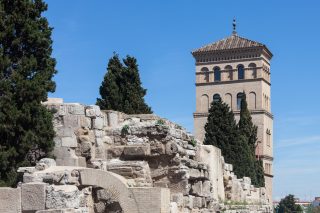
Walking Tour Summary

Distance: 2.5 km
Sites: 11

Walking Tour Map
Map of the Self-Guided Walking Tour of Aix-en-Provence, France walking route with 11 stops in Aix en Provence.
Preview map of the Self-Guided Walking Tour of Aix-en-Provence, France route in Aix en Provence, showing 11 stops. Use the interactive map to zoom and tap markers.

More from this area

Self-Guided Walking Tour of Beaune, France (2026)

Beaune hospice
Beaune hospice

This website uses affiliate links which earn a small commission at no additional cost to you.
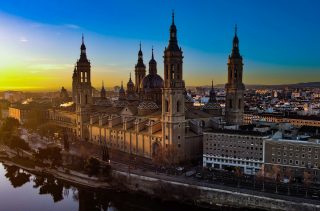
Located 40km south of Dijon and just two hours from Paris by train, Beaune is an easily accessible destination for a day trip or a weekend getaway of two or three days. This charming town lies at the heart of the prestigious Côte de Beaune vineyards and is celebrated as the Capital of Burgundy wines. Beaune's architecture is another significant draw, with the old town home to numerous historical treasures.

While in Beaune, don't miss the chance to explore emblematic medieval structures like the Hôtel-Dieu, also known as the Hospices de Beaune. Additionally, take the opportunity to tour the surrounding vineyards and participate in wine tasting tours where you can savor a grand cru from renowned French wine appellations such as Pommard, Meursault, and Nuits Saint Georges.

How to Get to Beaune

By Plane: Beaune does not have its own major airport, so most visitors fly into nearby airports such as Lyon-Saint Exupéry, Geneva, or Paris Charles de Gaulle. From these airports, you can reach Beaune by train, bus, or car, with Lyon being the closest major option at around 2 hours away by road. For the best deals and a seamless booking experience, check out these flights to Beaune on Booking.com.

By Train: Beaune is connected to Dijon and Lyon via frequent TER regional trains. The train station is just a 10-minute walk from the town centre, making it easy to start your tour upon arrival. You can use SNCF Connect to check schedules, compare routes, and purchase tickets for National (SNCF ) and regional trains (TER). For a more streamlined experience, we recommend using Omio, which allows you to easily compare prices, schedules, and book tickets for both National and Regional travel across all of Europe, all in one place.

By Car: Beaune is just off the A6 motorway and is easily reached from Dijon (45 minutes) or Lyon (1.5 hours). Parking is available in and around the centre, including lots near the city walls and close to the Hospices de Beaune. If you are looking to rent a car in France I recommend having a look at Discover Cars, first, as they compare prices and review multiple car rental agencies for you.

When to Visit Beaune

The optimal time to visit Beaune varies depending on your interests: during the summer months (July and August), the weather is beautiful, making it perfect for renting a bike to explore the vineyards. In autumn (September, October, November), the vineyards are awash with golden hues, offering a stunning backdrop for visits. Winter (December, January, and beyond) is ideal for warming up with winery visits and wine tastings.

Where to Stay in Beaune

To make the most of a walking tour in Beaune, stay within or just outside the medieval walls for easy access to wine bars, historic sites, and charming squares. A refined option is Hostellerie Cèdre & Spa Beaune, offering a five-star experience with lush gardens and a luxury spa. For a boutique-style stay, Hôtel de la Poste provides a blend of elegance and tradition, just minutes from the Hospices. Travellers on a tighter budget might enjoy Hotel Athanor Centre, a charming and affordable hotel right on the main square. All are perfect bases for exploring Beaune’s rich history and world-renowned wine culture on foot.

Choose a Guided or Self-Guided Walking Tour Beaune

If you’re short on timeI recommend this Private Historic Guided Walking Tour of Beaune. This takes you through the cobbled streets of the old town at your own pace. Discover landmarks like the Hospices de Beaune, the Collegiate Church of Notre-Dame, the medieval ramparts, and hidden wine cellars-while learning about the region's deep ties to Pinot Noir, Chardonnay, and centuries of winemaking.

Your Walking Tour of Beaune

This walking tour brings Beaune's storied past and wine-soaked identity to life. Begin at the iconic Hospices de Beaune, a 15th-century masterpiece known for its colourful tiled roof and historic wine auction. Continue through quiet lanes to the ramparts, visit the 13th-century Collegiate Church of Notre-Dame, and explore local wine shops and galleries housed in centuries-old buildings. Whether you're a wine lover, a history enthusiast, or simply looking for a quintessential Burgundy experience, Beaune is a town that rewards every step.

1. Porte Saint Nicolas, Beaune

Beaune Porte Saint Nicolas
CC BY-SA 3.0 / GFreihalter

The name of La Porte Saint Nicolas is derived from a 13th-century church dedicated to Saint Nicolas, located to the north behind the gate, although it is not visible from the gate itself. Historically, this area was the quarter of the wine growers during the Middle Ages. The ceremonial gate that stands here today dates back to 1770, but the original fortified gate, complete with a drawbridge, had a storied past of welcoming numerous important figures. These included King Henri II, who arrived with Catherine de Medici, and King Louis XIII in 1629. A particularly grand entrance was made by Louis XIV and the Queen in 1669.

From 1770 onward, a new ceremonial gate designed by Dijon architect Nicolas Lenoir, also known as Lenoir Le Romain, began greeting visitors from the north. This gate was a part of an extensive city modernization project spearheaded by Mayor Mr. Maufoux, showcasing a move towards contemporary architectural styles and signaling the evolving identity of the city.


Location: Porte Saint-Nicolas, Rue de Lorraine, Beaune, France | Hours: 24 Hours | Price: Free

We recommend to rent a car in France through Discover Cars, they compare prices and review multiple car rental agencies. Book your rental car here.

2. Hôtel de Ville

Beaune Hotel de Ville
CC BY-SA 2.0 / ~Pyb

Walk past the arch down Rue de Lorraine and turn left onto Rue Maurice Emmanuel.


Originally, this building was part of an Ursuline convent, established by a Roman Catholic religious order for women founded in Brescia, Italy, in 1535 by St. Angela Merici. This order was notable as the first institute dedicated solely to the education of girls. The Beaune convent was established in 1626, aiming to provide education primarily to daughters of well-regarded Catholic families during a time when the Protestant Reformation was influencing significant religious and educational reform across Europe.

The space you see between the arches was once the convent’s cloister, which historically would have been enclosed by a fourth wall. However, the street next to where you are standing was created to provide access to the City Hall, resulting in changes to the original convent structure. This adaptation of the space reflects the evolving use and significance of the building within the community over the centuries.


Location: Hôtel de Ville de Beaune, Rue de l'Hôtel de ville, Beaune, France

Here is a complete selection of hotel options in Beaune. Feel free to review each one and choose the stay that best suits your needs.

3. Sainte-Trinité de Beaune Hospital

Beaune Hospice de la Charite Exterieur
CC BY-SA 4.0 / GO69

Walk south along Rue de l’Hôtel de ville and rejoin Rue de Lorraine. Hospice De La Charité is on your left when you get to to the next junction.


The building known as the “Hospice de la Charité” across the street was established by the affluent couple Barbe Deslandes and Antoine Rousseau following several devastating plague outbreaks between 1628 and 1631. This charity hospice was originally founded to care for orphans left parentless by the plague. Today, it continues to serve the community as a functioning retirement home and is part of the broader network of the Hospices of Beaune.

Architecturally, the structure is a compilation of houses that date back to the late 15th or early 16th centuries. However, the chapel façade, which you are currently viewing, is distinctly from the 17th century, characterized by its restrained decorations such as vases, volutes (scroll-like shapes), and an onion-shaped bell tower, marking it as a period piece with significant historical value.


Location: 3 Rue Rousseau Deslandes, 21200 Beaune, France

Traveling to a country with a different currency? Avoid ATM transaction fees and pay in local currency with a Wise Card. Having used it for over 5 years, we've saved loads on fees!

4. Tour de l'horloge de Beaune

Tour de lhorloge de Beaune
CC BY-SA 2.5 / A.C. Koelewijn

Continue down Rue de Lorraine and turn right at the Monument to Gaspard Monge. Gaspard Monge was one of Frances great mathematicians, mainly in the field of geometry. Born in Beaune in 1746 and died in Paris 1818. You can see the Beffroi de Beaunebeyong the statue.


The Clock Tower of Beaune, with its foundations rooted in the 12th century, represents a melding of architectural periods, with significant additions made in the 14th century. Initially constructed in the 1100s, the tower saw substantial enhancements three centuries later, including the installation of the clock.

In 1395, a notable transaction occurred involving Philip the Bold, Duke of Burgundy. He negotiated with the monks of the nearby Abbey of Maizière, who were prolific wine producers and frequently sold their surplus, thus incurring taxes. The Duke proposed that the monks transfer ownership of the tower to the town of Beaune. In return, he offered them a tax exemption on the wines produced from their vineyards, which they used not only for sacramental purposes but also for additional revenue. This proposal aimed to relieve the monks from their tax burdens in exchange for the strategic tower, marking a significant civic and financial arrangement.

The tower’s most distinctive feature, the flamboyant lead decoration atop the belfry, showcases Flemish design elements. This stylistic choice reflects the historical ties between Flanders and Burgundy, as Flanders was part of the Burgundian territory at that time, influencing local architecture and artistry.


Location: Beffroi de Beaune, Place Monge, Beaune, France

5. Notre Dame of Beaune

Beaune   Notre Dame
Beaune Notre Dame
CC BY-SA 4.0 / Johan Allard

Turn left onto Rue Notre Dame and you can see the Basilica in front of you.


The Basilica of Notre Dame in Beaune, constructed in the late 12th century, exemplifies Romanesque architecture, a style that was prevalent from around the mid-1200s to the 1400s. This architectural style draws heavily from ancient Roman designs, characterized by rounded arches and vaulting. The basilica is often considered a smaller counterpart to the grand abbey church in Cluny, located in southern Burgundy. The Cluny Abbey church was once the largest in Christendom until the construction of Saint Peter’s Basilica in Rome began in the 1500s, making it a model for many subsequent Romanesque churches in the region.

Despite its Romanesque roots, the basilica also features notable Gothic elements, such as tracery in the stained glass windows and flying buttresses that support the exterior walls. These Gothic features were added following a fire in 1273, during the subsequent repairs, which infused the original Romanesque structure with Gothic architectural elements.

Additionally, the church functioned as a collegiate church, meaning it was served by a college of canons. These canons, unlike monks who often live in seclusion, lived in a community centered around the church and were permitted to interact with the public, fulfilling both religious and administrative roles within the community.


Location: Collégiale Notre-Dame de Beaune, Place du Général Leclerc, Beaune, France | Hours: April to October: Monday-Tuesday-Wednesday-Thursday-Friday and Sunday: 2.30pm-5.30pm - except during religious ceremonies / no admission on Saturdays.

6. Maison du Colombier

Maison du colombierBeaune
CC BY-SA 3.0 / Arnaud 25

Walk down the steps of the basilica and continue down Pl. du Général Leclerc. Stop when you get to Av. de la République, which you will be turning left into.


“La Maison du Colombier,” or the Dovecote House, derives its name from the slender opening at the top of its corner turret, which doubles as a stairwell. This feature historically allowed observers to watch the comings and goings of small birds. Originally, this house was situated along the banks of the Bouzaise River, a small river that meandered through Beaune. The present-day Avenue de la République now overlays what was once the natural course of this river, altering the immediate surroundings of the house but not its quaint, historical charm.


Location: Maison du Colombier, Rue Charles Cloutier, Beaune, France | Hours: Monday to Friday from 6 P.M.

7. Musée du Vin - Hôtel des Ducs de Bourgogne

Beaune Musee du vin
Beaune Musee du vin
CC BY-SA 2.5 / Christophe.Finot

Walk down Av. de la République and left down Rue Paradis. Musée du Vin – Hôtel des Ducs de Bourgogne is on your left through an arch.


The museum, a beacon of vine-growing and winemaking history, showcases the opulence of Burgundy’s viticulture and accentuates the distinctiveness of the Climats du vignoble de Bourgogne, recognized as a UNESCO World Heritage site. It serves as an informative hub with panels that elucidate the storied past of the venue, which was once the domicile of the Dukes of Burgundy. In 1946, this historic site was transformed into the first museum exclusively devoted to the history of wine-growing in Burgundy, offering visitors a deep dive into the region’s rich wine heritage.


Location: Musée du Vin - Hôtel des Ducs de Bourgogne, Rue d'Enfer, Beaune, France | Hours: Open every day from March 29 to November 4, 2024, from 10 a.m. to 1 p.m. and from 2 p.m. to 6 p.m. except Tuesday Ticket office closes 30 minutes before the museum | Price: €6

8. Hospices de Beaune

Cote dOr   Beaune   Hospices de Beaune
Cote dOr Beaune Hospices de Beaune
CC BY-SA 4.0 / Johan Allard

Continue up Rue Paradis and right onto Rle Gallien and right again onto Rue Monge. Walk across Pl. de la Halle to reach the Hôtel-Dieu Museum – Hospices de Beaune.


The Hospices de Beaune, also known as Hôtel-Dieu, are renowned for their striking roof adorned with colorful geometric tiles and their Gothic facades. Established in the Middle Ages as a hospital for the poor, this historic building now serves as a museum open to the public. Visitors can explore the treatment rooms, the pharmacy, the Gothic chapel, and the kitchen, which features large Gothic chimneys. Additionally, the museum houses an extensive collection of period furniture and tapestries, providing a glimpse into the past.

Aside from its historical and architectural significance, the Hospices de Beaune are also notable for their involvement in wine production. This is made possible by donations of vineyards over the centuries. The wine produced here is sold at the world-famous annual charity wine auction in November, which draws buyers from across the globe. The proceeds from this sale are used for the preservation of the building’s historical heritage and for enhancing hospital facilities. This event not only supports a good cause but also celebrates the rich wine heritage of the region.


Location: Hôtel Dieu, Rue de l'Hôtel Dieu, Beaune, France | Hours: 30/03/24 to 17/11/24 of 09:00 to 19:30 18/11/24 to 31/12/24 of 09:00 to 12:30 - of 14:00 to 18:30 | Price: Adults: €12, Children: €5 | Website | Beaune - Private walking tour

9. Les Remparts de Beaune

Remparts de Beaune Grosse Tours
CC BY-SA 4.0 / Arnaud 25

Walk down Rue de l’Hôtel Dieu and turn left onto Rue Poterne and onto Rem Madeleine. Infront of you is the Tour de Billes, sat within the Grosse Tour.


The establishment of Beaune’s original fortifications, known as the Castrum de Beaune, marked a significant development in the town’s history. These formidable defenses were constructed with walls 5 meters thick and 10 meters high, incorporating about a dozen defensive towers and multiple gates to manage access to the area. The ramparts enclosed a perimeter of 450 meters, effectively safeguarding an area of 2 hectares.

The Tour de Billes is a watchtower, built at the end of the 14th century, it is enclosed within the Grosse Tour. The wood (billets) used for defence were stored here. It overlooks the former postern-gate, or Porte Belvent. The Grosse Tour is one of the four towers built in the early 16th century, it is decorated on the boulevard side with the coat of arms of the governor of Burgundy, La Trémouille. It played a role in monitoring the plain.


| Hours: 24 Hours | Price: Free | Website

10. Maison des Climats

beaune walking tour
beaune walking tour

Continue along Rem Madeleine, you pass Tour des Poudres, a watchtower, built at the end of the 14th century, it was used to store the ingredients for making gunpowder. Only its top can be seen from the Chemin de Ronde. Walk down the steps at the end of the streets and right onto Rue d’Alsace and right again.


Opened in 2017 to mark the two-year anniversary of UNESCO’s designation of Burgundy’s vineyards as a World Heritage Site, this free interpretive center is located next to the tourist office and is an essential visit for anyone interested in French wine. The center features a 25-minute film and an array of bilingual educational displays that delve into the traditions of winegrowing in Burgundy and the specialized vocabulary associated with winemaking. Additionally, a striking 9-meter-long map provides visitors with an opportunity to closely examine the Côte de Beaune and Côte de Nuits climats, the specific wine-growing parcels that define the region’s viticultural uniqueness.

Head back to Rue d’Alsace and walk up the steps onto Rem Saint James, you will pass Tour Renard, built between 1465 and 1477 the tower is pierced by loopholes (i.e. arrowslits) and topped by a domed roof of lava slabs. On 10 October 1888 it witnessed President Sadi Carnot’s triumphal arrival at Beaune railway station. The road turns into Rem de la Comédie and you will pass Tour Blondeau, probably built around 1465, the horseshoe-shaped Tour Blondeau boasts a fine vaulted ceiling with a central column. It used to be called Tour du Quarreau. Walk under the walls when you reach the Théâtre de Verdure. 


Location: Maison des Climats, Porte Marie de Bourgogne, Beaune, France | Hours: Open every day (except December 25, January 1 and winter Sundays) Summer (March to Oct): Monday to Sunday, 10 a.m. - 5:30 p.m. Winter (Oct to March): Monday to Saturday, 10 a.m. to 12:30 p.m. and 2 p.m. to 5:30 p.m. | Price: Free | Website
Powered by GetYourGuide
Moira & Andy
Moira & Andy

Hey! We're Moira & Andy. From hiking the Camino to trips around Europe in Bert our campervan — we've been traveling together since retirement in 2020!

Read our full story here

This website uses affiliate links which earn a small commission at no additional cost to you.
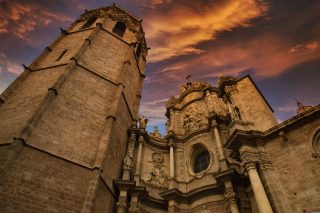
Walking Tour Summary

Distance: 3 km
Sites: 10

Walking Tour Map
Map of the Self-Guided Walking Tour of Beaune, France walking route with 10 stops in Beaune.
Preview map of the Self-Guided Walking Tour of Beaune, France route in Beaune, showing 10 stops. Use the interactive map to zoom and tap markers.

More from this area

Self-Guided Walking Tour of Dijon, France (2026)

Dijon in one day
Dijon in one day

This website uses affiliate links which earn a small commission at no additional cost to you.

Back in the fifteenth century, before France was consolidated under a single monarch, Dijon was the seat of power for the Dukes of Burgundy. It wasn't until 1477, following the death of Duke Charles the Bold, that the region came under the control of the French crown.

With its deep historical roots and a wealth of museums and intriguing sites, Dijon is certainly a city worth spending a day or two to thoroughly explore.

The Owl’s Trail

Dijon’s Tourist Board has created the Owl’s Trail, which is similar to this walk. You can pick up a map from the Tourist Office located on Rue des Forges, near Tour Philippe le Bon. This useful guide offers a self-guided tour that encompasses twenty-two of Dijon’s historic monuments, along with recommendations for an additional three loops around the city. This allows you to gain a comprehensive understanding of the area at your own pace.

Getting to Dijon

By Plane: The closest airport to Dijon is Dijon-Bourgogne Airport, though it mainly handles seasonal and regional flights. For international connections, travelers typically use Lyon-Saint Exupéry Airport or Paris Charles de Gaulle Airport and then continue to Dijon by train or car. For the best deals and a seamless booking experience, check out these flights to Dijon on Booking.com.

By Train: The train station is centrally located, making it easy to start your exploration of Dijon right away, as many of the city's attractions are within walking distance or a short ride on public transport. Dijon is also a major railway hub, making it extremely convenient to reach by train. The Dijon Ville Railway Station is the main station, serving both high-speed TGV trains and regional trains. The TGV connection can take you from Paris to Dijon in just about 1 hour and 35 minutes, for those coming from Switzerland, there are direct trains from cities like Zurich and Lausanne. You can use SNCF Connect to check schedules, compare routes, and purchase tickets for National (SNCF ) and regional trains (TER). For a more streamlined experience, we recommend using Omio, which allows you to easily compare prices, schedules, and book tickets for both National and Regional travel across all of Europe, all in one place.

By Car: Traveling to Dijon Métropole by car is incredibly convenient, with its central location providing optimal connections to numerous cities. From Paris, a drive via the A6 motorway takes around three hours. If you're coming from Lille or Belgium, you can reach Dijon in under five hours using the A26. The journey from Metz and Luxembourg via the A31, or from Switzerland using the A40 and A39, takes less than three hours. If you are looking to rent a car in France I recommend having a look at Discover Cars, first, as they compare prices and review multiple car rental agencies for you.

Parking Dijon Darcy is right by Porte Guillaum and great for normal to small cars. Free parking is available off Rue Daubenton which is about 20 minute walk to the Place de la Libération. If you are coming via campervan consider staying at Camping du Lac Kir.

Where to Stay in Dijon

For a walking tour of Dijon’s historic centre, it’s ideal to stay in or near the Old Town, close to major landmarks and charming pedestrian streets. A luxurious choice is Grand Hôtel La Cloche Dijon - MGallery, offering refined rooms and a spa just steps from the Owl Trail. For a stylish boutique option, Maison Philippe Le Bon blends historic character with modern comfort in the heart of the city. Travellers looking for value might opt for ibis Styles Dijon Central, which is conveniently located near Place de la Libération and Dijon’s top museums. All are perfectly placed for exploring Dijon’s art, architecture, and culinary traditions on foot.

Choose a Guided or Self-Guided Walking Tour of Dijon

If you are visiting Dijon for just a day and want to make the most of your visit, you may want to consider taking a walking tour with a local guide. This Dijon City Tour with Gourmet Break is one of the most complete and best-rated city tours that covers the main, must-see attractions in about 2.5 hours.

Your Walking Tour of Dijon

With its mustard-yellow roofs, Renaissance courtyards, and grand Gothic churches, Dijon is a city best discovered slowly. Follow the brass owls embedded in the pavement as you uncover the city's layered past-beginning at the Palace of the Dukes, strolling through Rue des Forges, and visiting Saint-Bénigne Cathedral. Don't forget to rub the brass owl at the Church of Notre-Dame for good luck! Along the way, stop for a glass of Burgundy wine, a taste of pain d'épices, or a visit to the Musée des Beaux-Arts.

1. Darcy Gardens

Dijon   Parc Darcy
Dijon Parc Darcy
CC BY-SA 3.0 / Eusebius (Guillaume Piolle).

Darcy Garden is a magnificent public garden that exemplifies the neo-Renaissance style, constructed in the late 19th century. This garden honors Henry Darcy, a distinguished hydraulic engineer, and has been recognized as a historical monument since 2015 due to its architectural significance and historical importance.

Designed in 1880 by Félix Vionnois, a notable architect in Dijon at the time, the garden was established on the site of Darcy’s original water reservoir, merging natural beauty with engineering prowess. The garden stretches over extensive grounds and features an assortment of trees and flowers, beautifully arranged balustraded terraces, scenic ponds, elegant fountains, and captivating waterfalls. It also includes play areas for children, making it a perfect spot for family outings.

The centrepiece of the garden is a monument that houses a bust of Henry Darcy, designed by architect Emile Sagot. The monument bears an inscription that celebrates Darcy’s remarkable contributions and underscores his role as the chief engineer of the Department, highlighting his skill and altruism in the design and initiation of the works.

Another significant element of the garden is the “Polar Bear in its Stride” statue at its entrance, which holds considerable symbolic value for Dijon. This statue, a 1937 reproduction by Henry Martinet, honors François Pompon’s original White Bear sculpture, a well-known work by the Burgundian sculptor that is housed in the Musée d’Orsay. The replica in Darcy Garden stands as a cherished emblem of the city.


Location: Jardin Darcy, Place Darcy, Dijon, France | Hours: 7.30am until dusk

We recommend to rent a car in France through Discover Cars, they compare prices and review multiple car rental agencies. Book your rental car here.

2. Facade of the Grand Hôtel de la Cloche

Grand Hotel la Cloche dijon
CC BY-SA 4.0 / Jean Housen

From the main entrance to the Jardin Darcy, look to your left to admire the Facade of the Grand Hôtel de la Cloche, or the Hotel of the Bells.


Dijon has boasted an Hôtel de la Cloche since the 15th century, though the original location was nearer to the city center. The hotel relocated to its current position following the development of Darcy Square in the late 1880s. Like many grand buildings, it nearly met its demise in the 1970s—a period marked by rampant destruction and so-called modernization that impacted many cities globally, not just in France. The hotel was on the brink of being demolished; furniture was auctioned, cutlery was sold, and bulldozers were poised to level it. However, a public outcry turned its impending demolition into a national controversy, sparking a movement that ultimately saved the building’s façade.

The Hôtel de la Cloche was subsequently declared a national monument, a designation that typically ensures preservation, although there have been rare instances where political decisions have overridden such protections. Today, it stands as Dijon’s sole five-star hotel and has accommodated numerous celebrities over the years, including Napoleon III, Grace of Monaco, Joan Baez, Maurice Chevalier, and MC Solaar.

The hotel is distinctively adorned with bells on its windows, which, next to the owls, are perhaps the most beloved symbol of Dijon.


Location: Grand Hôtel La Cloche Dijon - MGallery, Place Darcy, Dijon, France

Here is a complete selection of hotel options in Dijon. Feel free to review each one and choose the stay that best suits your needs.

3. Porte Guillaume

Porte Guillaume   Dijon
Porte Guillaume Dijon
CC BY-SA 4.0 / Chabe01

Walk into the square opposite the park to see Porte Guillaume.


Easily visible from the Jardin Darcy, the stand-alone Porte Guillaume could remind you of the Arc de Triomphe in Paris, given its grand design.

Originally, during the Middle Ages, there was a gateway here complete with flanking towers and a drawbridge, serving as part of the city’s fortifications. As the need for ramparts waned by the 18th century, the old gate was demolished, and in its place, this triumphal arch was erected.

The purpose of the new arch was to project the magnificence of Dijon and to honor the Prince of Condé, the then-governor of Burgundy. Initially named after him, the arch’s designation changed following subsequent revolutions, first to the Gate of Freedom and eventually, it was renamed in honor of Guillaume de Volpiano, the abbot of Saint-Bénigne.

While it now stands alone, try to imagine it in its original context: a simpler, yet formidable gateway, lined by high walls designed to repel invaders.


Location: Porte Guillaume, Place Darcy, Dijon, France | Hours: 24 Hours | Price: Free

Traveling to a country with a different currency? Avoid ATM transaction fees and pay in local currency with a Wise Card. Having used it for over 5 years, we've saved loads on fees!

4. Hôtel des Postes de Dijon

Hotel des Postes de Dijon
CC BY-SA 4.0 / Chabe01

Turn left down Rue de la Poste, or walk a block down Rue de la Liberté and turn left.


The Hôtel des Postes de Dijon, with its distinctive architectural elegance, is a historical gem located in the heart of the city. Originally built in the early 20th century, this building is a striking example of neoclassical design, characterized by its ornate facades and grand scale. The structure was initially designed to serve as the main post office and still stands out today for its impressive detailing and the historical significance it holds. As you gaze upon the Hôtel des Postes, you can appreciate the meticulous craftsmanship and the aura of a bygone era that it embodies, making it not just a functional space but also a key piece of Dijon’s architectural heritage. Whether you are an architecture enthusiast or a casual observer, the Hôtel des Postes de Dijon offers a fascinating glimpse into the artistic and cultural flourishes that define this historic city.


Location: Postes et Télécommunications, Place Grangier, Dijon, France

5. Les Halles

Halles Centrales, Dijon
CC BY-SA 4.0 / Chabe01

Continue down Pl. Grangier and cross onto Rue Musette for one block. Les Halles is on your left.


Like the Grand Hôtel de la Cloche, Les Halles in Dijon was nearly demolished in 1975. Plans were in place to tear it down and replace it with a parking lot, but it was saved at the last minute when it was added to the national list of historical monuments, preserving its rich heritage from the grasp of developers.

The iron structure of Les Halles is often mistakenly credited to Gustave Eiffel, likely because of his Dijon origins and his famous architectural style. However, the real credit for this iconic indoor market goes to a number of city architects and engineers. Before becoming a market, the site housed an old Jacobean convent, adding layers to its historical narrative.

Visiting Les Halles around lunchtime is highly recommended. The market is open on Tuesdays, Thursdays, Fridays, and Saturdays, offering a vibrant assortment of local products. Grab a French baguette, some cheese, charcuterie, and a little wine, and enjoy a casual lunch in the nearby Jardin Darcy. Alternatively, you can dine at one of the bustling restaurants surrounding Les Halles, but be sure to arrive early as they tend to fill up quickly. This area not only feeds the stomach but also offers a feast for the senses, surrounded by the history and culture of Dijon.


Location: Halles centrales et marché central, Dijon, France | Hours: Tuesday: 7am to 1pm, Thursday: 7am to 1pm (indoor market only), Friday: 7am to 1pm, Saturday: 7am to 1pm

6. Place François Rude & Rue des Forges

Place du Bareuzai Dijon
CC BY-SA 3.0 / Francis of Dijon

Head back to Rue Musette and walk south along Rue François Rude.


In the heart of Dijon, nestled amidst its storied streets, Place François Rude offers a charming stop on any walking tour of this historic city. Often bustling with activity, this square is affectionately known by locals as Place du Bareuzai, a nod to the iconic statue of the Bareuzai winegrower treading grapes that dominates the central fountain. The statue, a symbol of the region’s rich viticultural heritage, adds character to the picturesque setting. Around the square, visitors can admire the blend of medieval and Renaissance architecture, with beautifully restored buildings housing cafes and shops that invite passersby to linger over a coffee or explore unique local crafts.

Just a stone’s throw from Place François Rude, Rue des Forges stretches out as a vibrant artery through Dijon’s historic center. This street is a treasure trove for architecture enthusiasts and casual explorers alike, boasting a series of splendid townhouses, such as the Maison Maillard and the Hôtel Aubriot, which offer a glimpse into the city’s opulent past. As you stroll down Rue des Forges, the buzz of the city life merges with the echoes of history, making it a perfect route for those looking to dive deeper into Dijon’s cultural landscape. Shops along the street present an array of fine Burgundian products, from mustard to wine, ensuring that every visitor can take a piece of Dijon home with them.

Stairs of the Hotel Chambellan: Step through the small portal at number 34 on the street and discover what is arguably Dijon’s most stunning courtyard. As you wander into this hidden gem, don’t miss the opportunity to ascend the stairs of the Hôtel Chambellan. When you reach the top, be sure to look up to admire the captivating sculpture of a gardener cradling a basket, set against the backdrop of the intricately designed roof. This unique artistic detail adds a charming touch to the architectural elegance, making your visit to the Hôtel Chambellan a memorable highlight of Dijon’s rich cultural tapestry.

Tourist Office: Pop in here to get your tickets for Tour Philippe le Bon, if you have not already got them.


Location: Place François Rude, Dijon, France | Hours: 24 Hours | Price: Free

7. Église Notre-Dame de Dijon

Eglise Notre Dame Dijon
CC BY-SA 3.0 / Benh LIEU SONG

At the end of Rue des Forges lies Église Notre-Dame de Dijon.


Église Notre-Dame de Dijon stands as a masterpiece of Gothic architecture, commanding the attention of visitors with its intricate facade and majestic presence in the heart of the city. As you approach, the twin Gothic towers of Notre-Dame rise impressively against the Dijon skyline, offering a perfect photo opportunity. Inside, the church houses a revered statue of the Virgin Mary, believed to protect the city’s residents. Visiting Notre-Dame in Dijon provides not just a glimpse into the religious and architectural history of the region, but also a peaceful retreat from the bustling city streets.

Built in the 13th century, this church is famous for its rows of gargoyles, which dramatically adorn the exterior, and the Jacquemart clock tower.  Jacquelinet and Jacquelinette, charmingly handle the quarter-hour chimes on smaller bells. What’s particularly fascinating about these figures is their historical lineage: Jacquemart first arrived in Dijon in 1383. This early example of mechanical automation was a gift from Philip the Bold, Duke of Burgundy, who brought the original Jacquemart, along with the clock and the big bell, from Kortrijk in Belgium (referred to as Courtrai in French). This was in gratitude for Dijon providing him with 1,000 armed men for his campaign in Flanders. The journey wasn’t without its challenges; notably, the bell broke en route and had to be recast. Over the centuries, the Jacquemart family grew: Jacqueline was introduced in 1651 to share the hourly duties, likely to give Jacquemart some much-needed rest. The family expanded further with the addition of Jacquelinet in 1714 for the quarter-hour strikes, and finally, Jacquelinette joined in 1884, completing the family ensemble.


Location: Église Notre-Dame, Place Notre Dame, Dijon, France | Hours: Open every day from 8 a.m. to 6 p.m., except Sundays from 9 a.m.

8. La Chouette de Dijon

Dijon Eglise Notre Dame de Dijon
CC BY-SA 2.0 / StéphaneMarie

Walk to the north side of the Church along Rue de la Chouette to see its famous owl.


On the north side of Notre-Dame in Dijon, there lies a small chapel along the quaint rue de la Chouette (Owl Street), a popular pedestrian way. A particular corner of a chapel buttress features a sculpted bird, commonly thought to represent an owl. This carving may have been the personal insignia of a stonemason; it is certainly not the mark of the original architect, as the chapel was constructed in the late 15th or early 16th century, well after the church itself. Over the years, the owl sculpture has become smooth and detail-less, worn down by the touch of countless hands. A local superstition holds that rubbing the owl with your left hand while making a wish brings good luck, contributing to its worn condition. The caress should be done by turning her back on the little salamander under the left window, she has the power to cancel the wish!

Tragically, on January 5, 2001, this cherished owl was vandalized with several hammer blows. Fortunately, a mould of the owl made in 1988 by a Louvre expert was available and used to restore the sculpture to its former glory by February 2001. Now under video surveillance, the restored owl was officially reinaugurated on May 12, 2001. Beyond its allure as a local curiosity, the owl has grown into a broader symbol of Dijon. In 2001, it was selected as the emblem for the Parcours de la Chouette (Owl Walk), a tourist trail that guides visitors through the city’s historic center, marked by 22 square plaques each bearing the image of an owl. Additionally, Dijon Football Côte d’Or, the city’s football club, proudly features an owl as its emblem, further embedding this unique sculpture into the cultural fabric of Dijon.


Location: The Owl of Dijon, Rue de la Chouette, Dijon, France | Hours: 24 Hours | Price: Free

9. Maison Millière

Maison Milliere, Dijon
CC BY-SA 4.0 / Chabe01

Maison Millière is on the north east side of the church.


The Doyenne of Dijon, one of the city’s oldest half-timbered houses, dates back to 1483. Originally owned by Guillaume Millière and his wife, Guillemette, both drapers from Beaune, they chose to demolish an even older house on the site to construct this larger, more modern structure. At the time, they even sought a tax rebate to offset their costs, though it’s unclear if it was ever granted. Interestingly, if Millière had delayed his construction a few years, he might have benefited from his great-grandson’s tenure as Mayor of Dijon, potentially saving on those taxes.

Over the centuries, despite laws that discouraged the renovation of wooden structures due to fire hazards, this house managed to survive and change hands multiple times. It faced structural issues and was temporarily closed, but in 1927, it reopened as a hardware store. The late 1990s saw further restorations that transformed it into its current iteration: a charming restaurant with a traditional boutique on-site.

Adding a touch of whimsy and superstition to the structure, a black bronze cat sits atop the roof. Local lore warns that after touching the famed Dijon owl, one should avoid looking at this cat, as it might thwart your wishes, similar to the dragon/salamander legend. Adjacent to the cat, a ceramic owl stands guard, tasked with ensuring that any wishes made do indeed reach the heavens. So, when visiting, remember to craft your wishes carefully—this place seems to demand a bit of magical maneuvering to ensure they come true!


Location: Maison Millière - Restaurant Boutique Bar à vin et Salon de thé, Rue de la Chouette, Dijon, France

10. Hôtel de Vogüé

Dijon Hotel de Vogue
CC BY-SA 4.0 / Zairon

Just to the east of the church is the Hôtel de Vogüé.


The Hôtel de Vogüé in Dijon is not a typical hotel for overnight stays but rather a grand ‘hôtel particulier’—a private mansion designed as a testament to wealth and status. Constructed around 1614, this town mansion was built for Étienne Bouhier, a Councillor at the Burgundy Parliament. Renowned as one of the finest parliamentary mansions of the 17th century in France, the Hôtel de Vogüé showcases the opulent Renaissance style akin to that of the Maison Maillard on rue des Forges. Its grand entrance porch, highlighted by ornate bosses, leads into a courtyard framed by a beautifully sculpted portico. The architecture combines a classical structure with the luxurious decorative flourishes of the Italian Renaissance. In 1766, the property transitioned to the de Vogüé family and was later acquired by the city. It currently serves a practical role, housing the Human Resources Department of the City of Dijon, continuing its legacy of public service in a different capacity.


Location: Hôtel de Vogüé, Rue de la Chouette, Dijon, France | Hours: Courtyard access varies; check local listings. | Price: Free to view the exterior; interior access limited due to municipal use.

11. Tour Philippe le Bon

Dijon tour Philippe le Bon
CC BY-SA 3.0 / François de Dijon

Head south to the Place des Ducs de Bourgogne and the entrance to the Tour Philippe le Bon.


Nestled in the heart of Dijon, the Tour Philippe le Bon offers a captivating glimpse into the rich history of Burgundy. Standing tall since the 15th century, this iconic tower is part of the Ducal Palace complex, and invites visitors to climb its 316 steps for a panoramic view of the city. The ascent reveals the architectural splendor of the Gothic era, with each step and turn bringing into focus the intricate craftsmanship of a bygone era. At the summit, travelers are rewarded with sweeping vistas of Dijon’s terracotta rooftops, bustling streets, and verdant surroundings. Whether you’re a history enthusiast or simply in search of a picturesque view, a visit to Tour Philippe le Bon is an enchanting step back in time, offering a unique perspective on Dijon’s heritage and beauty.

N.B. You have to book a ticket for a timed entry, but this can be done either in the tourist office, or online.


Location: Tour Philippe le Bon, Place des Ducs de Bourgogne, Dijon, France | Hours: 10.00-17.50 | Price: €6.00 | Website

12. Musée des Beaux Arts

Tombeaux ducs Bourgogne
CC BY-SA 3.0 / Arnaud 25

At the southeast corner of the Place des Ducs de Bourgogne is the entrance to the Musée des Beaux-Arts de Dijon


Nestled within the opulent Palace of the Dukes of Burgundy, the Musée des Beaux-Arts de Dijon is one of the oldest in France and boasts an impressive collection that spans from ancient Egyptian artifacts to modern masterpieces. As you wander through the lavishly decorated rooms, you’ll encounter works by renowned artists such as Titian, Veronese, and Poussin, alongside a rich array of French art and intricate medieval sculptures. The museum’s recent renovations enhance the visitor experience, beautifully blending its historical architecture with contemporary design elements. Whether you’re an avid art connoisseur or a curious traveler, the Musée des Beaux-Arts de Dijon offers a deep dive into the artistic heritage that has shaped this region’s cultural identity.


Location: Musée des Beaux-Arts, Rue Rameau, Dijon, France | Hours: October 1 to May 31: 9:30 a.m. to 6 p.m. / June 1 to September 30: 10 a.m. to 6:30 p.m. Closed on Tuesdays, as well as January 1, May 1 and May 8, July 14, November 1 and 11, December 25. | Price: Guided tour: €6 | Website

13. Église Saint-Michel

Dijon Eglise Saint Michel
CC BY-SA 3.0 / Provence13

Turn right and walk along the Rue Longepierre until you get the Église Saint-Michel.


The Église Saint-Michel in Dijon stands as a stunning example of the architectural transition from Gothic to Renaissance styles, making it a fascinating destination for anyone interested in history and architecture. This beautiful church, located just a short walk from the city center, boasts an impressive façade with elaborately carved portals that are a testament to the artistic prowess of the 16th century. Inside, visitors are treated to a wealth of artistic treasures, including stained glass windows that cast colorful light onto the church’s intricate interior, and altarpieces that display remarkable craftsmanship. The mix of serene gothic arches and ornate renaissance decoration makes the Église Saint-Michel not just a place of worship, but a captivating historical monument that offers a quiet respite from the bustling city, while also telling stories of Dijon’s rich past through its art and architecture.


Location: Église Saint-Michel, Place Saint-Michel, Dijon, France | Hours: Open every day from 8 a.m. to 7 p.m., except Sundays from 9 a.m.

14. Musée Rude

Musee Rude
Musee Rude
CC BY-SA 3.0 / Arnaud 25

Head west along Rue Vaillant towards Place du theatre, Musée Rude is on your left.


Visiting the Musée Rude in Dijon offers a unique opportunity to delve into the artistic legacy of François Rude, a celebrated French sculptor. Housed in the historic setting of the former Église Saint-Étienne, an 11th-century building, the museum showcases an impressive array of life-size plaster casts of Rude’s significant works. These casts, originally collected by the city between 1887 and 1910, mirror the originals that grace major French museums, including the Louvre. In addition to these sculptures, the Musée Rude also features an archaeological crypt from the 11th century and the ancient St. Stephen’s Gate from the 3rd century, adding layers of historical depth to your visit. Open from early June to the end of September, with free admission, this museum not only highlights Rude’s contributions to French art but also beautifully integrates Dijon’s rich cultural tapestry. It’s a perfect destination for those who appreciate fine art and history nestled within a serene, historical setting.


Location: Musée Rude, Rue Vaillant, Dijon, France | Hours: Daily from 9:30 am to 6 pm from June 1 to September 30 | Price: Free

15. Place du Théâtre

Place Theatre   Dijon
Place Theatre Dijon
CC BY-SA 4.0 / Chabe01

The entrance to Musée Rude is on the Place du Théâtre.


Place du Théâtre in Dijon is a must-visit for anyone exploring this historic city. This charming square is home to the grand Dijon Theatre, an architectural gem that stages a variety of performances throughout the year. The square is also dotted with lovely cafes and restaurants where visitors can sit back and enjoy the lively atmosphere, making it the perfect spot to take a break and people-watch. The surrounding buildings boast elegant facades, reflecting the rich history and artistic heritage of Dijon. As you stroll through Place du Théâtre, you’re walking on cobblestones steeped in centuries of stories and culture, truly a delightful experience for any traveler seeking to immerse themselves in the local vibe of Dijon.


Location: Place du Théâtre, Dijon, France | Hours: 24 Hours | Price: Free

16. Place de la Libération

Dijon   Place de la Liberation
Dijon Place de la Liberation
CC BY-SA 2.0 / Christophe.Finot

Head along Rue Rameau to get to Place de la Libération.


The square once boasted a statue of Louis XIV but, like many kingly statues, it was melted into cannonballs during the French Revolution. Today the square is lined with cafés and restaurants, with a central fountain, dancing with lights after sunset, focuses the eye as we gaze at the Palace of the Dukes of Burgundy straight ahead.

Location: Place de la Libération, Dijon, France | Hours: 24 Hours | Price: Free

17. Musée Archéologique de Dijon

Musee Archeologique de Dijon
Public Domain / Jochen Jahnke

Continue along Rue de la Libération. Be sure to spot the plaque on the right side of the palace wall that marks the site of the ancient Roman castrum. Just beyond this plaque, you’ll find large double doors—always open. Step through these doors and immediately turn to the right to behold what is widely regarded as one of the most exquisite staircases in France.

This architectural marvel is known as the Gabriel Staircase, named after its designer Jacques Gabriel, the esteemed architect to the King in the 18th century. The staircase is not only a visual masterpiece but also ingeniously functional. Gabriel cleverly positioned it directly above the archives, providing a solution to the States-General’s long-standing need for a permanent archive location. To this day, the archives continue to be preserved within this wing of the palace.

Continue along Rue de la Libération and turn left when you get to the Porte Guillaume. Musée archéologique de Dijon is on your left.


Delve into Burgundy’s ancient past at the Musée Archéologique de Dijon, housed in the historic Abbey of St. Bénigne. Established in 1832, this museum is a treasure trove of artifacts that tell the story of the region from prehistory through the Middle Ages. Highlights include impressive collections of paleochristian and sacred art, along with relics from ancient Roman rule. The museum’s setting next to the majestic Dijon Cathedral adds to its historic allure, making it a must-visit for history buffs exploring Dijon.


Location: Musée archéologique de Dijon, Rue Docteur Maret, Dijon, France | Hours: Open every day except Tuesday April 1 to October 31 from 9:30 a.m. to 12:30 p.m. and from 1:30 p.m. to 6 p.m. November 2 to March 31 from 9:30 a.m. to 12:30 p.m. and from 1:30 p.m. to 6 p.m. Closed on January 1 , May 1 and May 8, July 14, November 1 and 11, December 25 N.B. Museum not heated during winter | Price: Guided tour: €6 | Website

18. Cathédrale Saint-Bénigne de Dijon

Cathedrale Saint Benigne   Dijon
Cathedrale Saint Benigne Dijon
CC BY-SA 4.0 / Chabe01

Cathédrale Saint-Bénigne de Dijon is adjacent to the Musée archéologique de Dijon.


The Cathédrale Saint-Bénigne de Dijon stands as a monumental piece of Gothic architecture and a spiritual cornerstone of the city. Originally built in the 11th century and reconstructed in the 13th and 14th centuries, this cathedral boasts a stunningly intricate façade and a richly decorated interior. Beneath its floors, the crypt, one of the oldest in France, offers a glimpse into the early Christian era, making the cathedral not only a place of worship but also a fascinating historical site.


Location: Cathédrale Saint-Bénigne de Dijon, Place Saint Bénigne, Dijon, France | Hours: Open every day from 9am to 12pm and from 2pm to 6.30pm, except Saturdays when it is open until 5.30pm.

19. Jardin Botanique de l'Arquebuse

Jardin Arquebuse   Dijon
Jardin Arquebuse Dijon
CC BY-SA 4.0 / Chabe01

Head down Rue Mariotte and at the end walk under the railway bridge to reach the Jardin Botanique de l’Arquebuse.


Explore the wonders of the natural world at the Muséum d’histoire naturelle de Dijon. Located in the heart of the city, this museum is dedicated to the preservation and exhibition of a wide range of natural specimens, from regional flora and fauna to fascinating geological displays. The museum’s interactive exhibits and educational programs make it an engaging destination for families and anyone interested in learning more about our planet’s biodiversity.

A serene escape within the city, the Jardin Botanique de l’Arquebuse is both a botanical garden and an arboretum that spans over 5 hectares. This peaceful oasis showcases an extensive collection of plants and trees, meticulously arranged to display the diversity of Burgundy’s natural flora. With its thematic gardens, educational displays, and tranquil walkways, the Jardin Botanique is a delightful retreat for nature lovers and those seeking a quiet moment away from the urban hustle.


Location: Jardin Botanique de l'Arquebuse, Avenue Albert 1er, Dijon, France | Hours: 7.30am until dusk

20. Chartreuse de Champmol

Dijon Chartreuse de Champmol Puit de Moise
CC BY-SA 2.0 / Allie_Caulfield

The Chartreuse de Champmol is an optional extra as it is at least 15 mins walk from the Jardin Botanique de l’Arquebuse.


The Chartreuse de Champmol, historically known as the Carthusian monastery of Champmol, is a fascinating site on the outskirts of Dijon that offers a unique glimpse into Burgundian art and history. Founded in 1383 by Duke Philip the Bold of Burgundy, the monastery was intended as a dynastic burial place and is renowned for its rich sculptural decoration. Although much of the monastery no longer exists, visitors can still explore the remaining sculptures, including the famous “Well of Moses” by Claus Sluter, which is an outstanding example of Burgundian Gothic art. This masterpiece features detailed statues of prophets and an impressive array of biblical iconography. The tranquility of the site, combined with its historical and artistic significance, makes the Chartreuse de Champmol a must-visit for those interested in medieval art and the history of Burgundy.


Location: Chartreuse de Champmol, Dijon, France | Hours: 9am to 5.30pm
Powered by GetYourGuide
Moira & Andy
Moira & Andy

Hey! We're Moira & Andy. From hiking the Camino to trips around Europe in Bert our campervan — we've been traveling together since retirement in 2020!

Read our full story here

This website uses affiliate links which earn a small commission at no additional cost to you.
Walking Tour Summary

Distance: 4.5 km
Sites: 20

Walking Tour Map
Map of the Self-Guided Walking Tour of Dijon, France walking route with 20 stops in Dijon.
Preview map of the Self-Guided Walking Tour of Dijon, France route in Dijon, showing 20 stops. Use the interactive map to zoom and tap markers.

More from this area

Self-Guided Walking Tour of Van Gogh’s Arles (2026)

Starry Night Over the Rhone
Public Domain / Vincent van Gogh

This website uses affiliate links which earn a small commission at no additional cost to you.

You're about to embark on a self-led tour through the heart of Arles, where history is palpable in every quaint street and enduring building. Whether they hail from the Roman era, the Middle Ages, or more modern times, these structures lend the city a timeless charm. This charm has not only captivated artists throughout history but also continues to draw visitors from around the globe in the 21st century. Recognizing the significance of Van Gogh and other artists to the city's cultural heritage, local authorities have installed numerous informational panels across Arles. These panels showcase various works by the renowned artist at the very locations where they were created.

How to Get to Arles

By Plane: The nearest airport to Arles is Marseille Provence Airport, about 25 km (15 miles) away. From there, you can reach Arles by shuttle, taxi, or rental car in around 30-40 minutes. For the best deals and a seamless booking experience, check out these flights to Arles on Booking.com.

By Train: Arles is served by frequent TER and TGV trains from Avignon, Nîmes, and Marseille. The train station is located just a 10-minute walk from the historic centre, making it easy to start your walking tour right away. You can use SNCF Connect to check schedules, compare routes, and purchase tickets for National (SNCF ) and regional trains (TER). For a more streamlined experience, we recommend using Omio, which allows you to easily compare prices, schedules, and book tickets for both National and Regional travel across all of Europe, all in one place.

By Car: Accessible via the A54 and N113, Arles has several parking options on the edge of the old town. Try Parking du Centre or Parking Lamartine-both provide quick access to the Van Gogh trail on foot. Reasonably priced parking can be found at Point de vue and a little further on, by the train station is a large free car park. If you are looking to rent a car in France I recommend having a look at Discover Cars, first, as they compare prices and review multiple car rental agencies for you.

Where to Stay in Arles

To explore Van Gogh's Arles on foot, it's best to stay in the heart of the old town, close to the key locations that inspired his most famous works. A refined option is Hôtel & Spa Jules César Arles - MGallery, blending luxury with heritage in a former Carmelite convent. For something more intimate and creative, Maison Volver provides vibrant interiors and a warm welcome near the Amphitheatre. Travellers on a budget can try Hôtel Acacias, a comfortable, centrally located stay just steps from Van Gogh landmarks. Each of these hotels places you within easy reach of the self-guided trail.

About Van Gogh

Born in Holland in 1853 and passing away in France in 1890, Van Gogh's life was brief, ending at the age of 37, with an artistic career that spanned only a decade. However, it was in Arles that he truly found his voice as an artist, developing a unique, emotionally rich, and intensely personal style. This was a time of remarkable creative output, with Van Gogh completing around 200 paintings and 200 drawings. Despite this productivity, it was also a time marked by personal struggle, with periods of tension and anxiety. His working relationship with Paul Gauguin, another artist, soured, concluding abruptly after just 9 weeks. Van Gogh's time in Arles is infamously remembered for its tumultuous end, with the artist severing his own ear.

Choose a Guided or Self-Guided Walking Tour of Arles

If you are short on time embark on this Van Gogh Self-Guided Walking Tour of Arles. This extensive 5-hour tour allows you to follow in the footsteps of Vincent Van Gogh, showing you where he lived and what he painted during his stay in Provence. 

Your Van Gogh Walking Tour of Arles

This self-guided experience lets you move at your own pace as you retrace Van Gogh's life during his 15-month stay in Arles. From the café at Place du Forum (made famous in Café Terrace at Night) to the courtyard of the former hospital (Garden of the Hospital in Arles), each stop reveals the colours and atmosphere that defined his work. You’ll pass through quiet corners, lively streets, and peaceful riversides-just as Van Gogh did in search of light, solitude, and inspiration. Whether you’re an art lover or just curious about his journey, this walking tour is a deeply personal way to see Arles through the eyes of a master.

1. Place du Forum

Vincent van gogh cafe terrace on the place du forum arles at night
CC BY-SA 1.0 / Kröller-Müller Museum

The journey begins at the Place du Forum, the vibrant heart of Arles’ old town, enveloped by a delightful array of cafés, restaurants, hotels, and shops. Year-round, the square thrives with the energy of visitors gathered at the myriad of tables scattered across it. At the onset of our tour, we encounter the first informational panel dedicated to one of Vincent van Gogh’s most celebrated works: the “Café Terrace at Night,” located at the Place du Forum in Arles, 1888, currently housed in the Kröller-Müller Museum in Otterlo, Netherlands. You’ll find the panel positioned at the intersection of Rue Favorin and the Place du Forum.

This nocturnal masterpiece, with its revolutionary interplay of blues against yellows, captures the eye with the warm glow of restaurant lights and the twinkle of stars in the clear night sky. Even under the sun’s glare, the scene is unmistakable. Today, La Café la Nuit still sports its iconic yellow facade, round tables, and the same lantern hanging from its wrought iron bracket, though some creative restoration may have been applied to replicate the original ambiance. While the left’s roofline shows minor alterations and Van Gogh exercised creative freedom to include the church bell tower in the background, the essence of the place remains unchanged. The cobblestones may have disappeared, and Van Gogh deliberately altered the buildings on the right, omitting the Roman architectural fragments from the ancient forum. This choice underscores his focus not on a precise architectural recounting but on capturing the vibrant atmosphere and the moment’s spirit.

Today, the square remains a bustling and friendly spot, inviting visitors to while away the hours in leisure and enjoyment, much like the vivid tableau Van Gogh immortalized over a century ago.


Location: Place du Forum, Arles, France | Hours: 24 Hours | Price: Free

We recommend to rent a car in France through Discover Cars, they compare prices and review multiple car rental agencies. Book your rental car here.

2. Fondation Vincent Van Gogh

Arles Fond Van Gogh
Arles Fond Van Gogh
CC BY-SA 4.0 / Rolf Süssbrich

Start at the corner of the square and proceed along Rue de la Liberté. Then, make a right turn onto Rue des Pénitents Bleus. Look for a sign pointing towards the Fondation Vincent Van Gogh. Once you turn onto Rue Docteur Fanton, you’ll quickly find the entrance to the foundation on your left.


The Van Gogh Foundation was established with the aim of bringing Vincent van Gogh’s vision to life: a collective of artists coming together to share ideas and collaborate, forging what he saw as the ‘art of the future.’ This aspiration dissipated following Gauguin’s departure from Arles, until the foundation’s inception. Launched in 2014, the foundation’s mission is to honour Van Gogh’s legacy by highlighting how his work continues to resonate with artists today. It hosts temporary exhibitions that delve into various facets of his oeuvre, successfully securing loans of Van Gogh’s paintings to be exhibited alongside pieces by contemporary artists. This creates a dynamic conversation that engages with both introspection and critique—a dialogue Van Gogh would surely have appreciated.


Location: Fondation Vincent van Gogh Arles, Rue du Docteur Fanton, Arles, France | Hours: 10:00 - 18:00 | Price: €10 (€12 with Musée Réattu) | Website

Here is a complete selection of hotel options in Arles. Feel free to review each one and choose the stay that best suits your needs.

3. L’Escalier du Pont de Trinquetaille

Vincent van Gogh LEscalier du Pont de Trinquetaille
Public Domain / Vincent van Gogh

Continue to the end of the street, then turn right to find yourself facing the river embankment. Cross the street and ascend the steps to the riverside walkway, turning left to observe the modern road bridge stretching over the Rhône. Walking under the bridge and a bit further, you’ll encounter another information panel, showcasing “L’Escalier du Pont de Trinquetaille, 1888” (held in a private collection).


Although the original iron bridge depicted in Van Gogh’s painting has been replaced by a modern counterpart lacking in aesthetic charm, the stone embankment steps and those leading up to the bridge remain unchanged. An interesting addition is a large plane tree beside the steps, which, curiously, might be the same tree that Van Gogh painted as a young sapling. The presence of parked vehicles and a street rubbish bin, however, somewhat mars the scene.

I have a View of the Rhône — the Trinquetaille iron bridge, where the sky and the river are the colour of absinthe — the quays a lilac tone, the people leaning on the parapet almost black, the iron bridge an intense blue — with a bright orange note in the blue background and an intense Veronese green note. One more effort that’s far from finished — but one at least where I’m attempting something more heartbroken and therefore more heartbreaking. Van Goch, in a Letter to his Brother

Traveling to a country with a different currency? Avoid ATM transaction fees and pay in local currency with a Wise Card. Having used it for over 5 years, we've saved loads on fees!

4. Restaurant Carrel

Vincent van Gogh   View of a butchers shop
Vincent van Gogh View of a butchers shop
Public Domain / Vincent van Gogh

In his initial two months in Arles, Vincent van Gogh stayed at the Carrel hotel-restaurant, a property run by Albert Carrel and his wife, Cathérine Carrel-Garcin. This two-story establishment featured a quaint roof terrace and a balcony on the first floor.

At times it seems to me that my blood is more or less ready to start circulating again, which wasn’t the case lately in Paris, I really couldn’t stand it any more. Van Goch, in a Letter to his Brother

Fueled by a revitalized zeal for his work, Vincent was remarkably productive right from the outset, creating three studies within his first three days: “An old woman of Arles,” “Landscape with Snow,” and “View of a Butcher’s Shop.” These works were a prelude to the intensely fruitful period that was to unfold.

However, Van Gogh’s relationship with his lodgings soon soured. He expressed dissatisfaction with the Carrel hotel, feeling exploited and discontent with the quality of food served. Albert Carrel, on his part, felt burdened by the extra space Van Gogh’s painting materials occupied. Following a dispute over an increase in rent, Vincent departed the hotel on May 7 to take up residence at the Café de la Gare. Despite Carrel’s initial refusal to return Van Gogh’s belongings, a court order eventually compelled him to do so. Concurrently, Vincent had begun renting space in the “Yellow House” on May 1 to serve as his studio. Reflecting on his stay at the Carrel hotel, Vincent recounted his misery, attributing a decline in his health to the substandard food and wine, which he described as “real poison.”

Explore Arles at your own pace with our self-guided walking tour! Follow our curated route to discover must-see sights and local secrets that makes Arles one of the best places to visit in France.

5. Starry Night Over the Rhone

Starry Night Over the Rhone
Public Domain / Vincent van Gogh

Looking ahead, the remnants of the old railway bridge, its buttresses crowned with majestic stone lions, come into view. Constructed in 1866, the bridge met its end under Allied bombing in World War II. As you pass remnants of the ancient city walls on your right, you’ll reach an expanse bordered by plane trees, known as Place Lamartine. Here stood Vincent’s “Little Yellow House.” However, before examining this site more closely, continue a short distance along the embankment. Here, embedded in the wall, you’ll find the next information panel.


this is the scene from “Starry Night Over the Rhône,” 1888, held by the Musée d’Orsay in Paris. This painting captures the night sky’s ethereal beauty, with stars and the river below mirroring the celestial display and the ambient glow of streetlights along the embankment. Faintly visible in the foreground are a couple of riverboats, possibly next to a pile of sand that catches the light, and two figures strolling by. Today, this spot is a popular mooring point for large river cruisers, bringing waves of tourists to the area.

6. The Yellow House

The yellow house
The yellow house
Public Domain / Vincent van Gogh

Turn your back to the river and navigate towards Place Lamartine, now a bustling roundabout and junction filled with the flow of modern traffic. Here, amidst the hustle, you’ll encounter the next information panel.


This is his “The Yellow House” (La Maison Jaune), 1888, preserved in the Van Gogh Museum in Amsterdam. Unfortunately, the quaint yellow house that once served as a residence for Van Gogh and Gauguin no longer stands, having been destroyed during the Second World War. Yet, many elements of the original scene remain recognizable. The prominent structure that stood behind the cottage still exists and currently operates as La Civette Arlésienne, a local bar and brasserie that echoes the social hubs of Van Gogh’s era. The railway bridge depicted to the right of the house remains in place, though now it is adorned with overhead cables to accommodate electric trains. Despite the transformation brought about by ceaseless traffic, altering the once tranquil ambiance captured in Van Gogh’s painting of vibrant blues and sun-baked yellows, the palpable sensation of warmth that permeates his work can still be felt on a sunny day.

7. La Maison de la Crau

Vincent van Gogh   La Maison de la Crau
Vincent van Gogh La Maison de la Crau
Public Domain / Vincent van Gogh

As we explore beyond the typical paths, heading across the railway tracks with the river behind us, depart from Place Lamartine. Keep the remnants of the city walls and the Porte de la Cavalerie to your right, venturing onto Boulevard Emile Combs. On certain days, this area comes alive with the buzz of a vibrant street market. With the railway line to your left, you’ll soon encounter a pedestrian tunnel. Pass through it, then make a right onto Rue Mireille, walking alongside the railway line now on your right. This area, rather unremarkable today, would have been on the outskirts of the town in Vincent’s time, bordering the open landscapes of the Crau. Before long, you’ll find a set of steps to your right leading up to a bridge crossing the railway lines.


From this vantage point, looking back across the road, you can see a structure that once was a mill with an incomplete extension. This building served as the muse for Van Gogh’s “La Maison de la Crau,” 1888, now part of the collection at the Albright-Knox Art Gallery in Buffalo, NY. Currently, there’s no informational panel to mark this spot, reflecting significant changes over time. While the mill itself remains recognizable, its surroundings have dramatically transformed. The once-present stream and the pastoral backdrop with blue hills have been swallowed by urban expansion, leaving behind a somewhat dishevelled and overlooked scene. This absence of commemoration may be due to the area’s decline from its picturesque past. Interestingly, the present-day disarray and the touch of melancholy it conveys could have offered Van Gogh, were he painting in today’s era, a compelling subject, echoing his interest in capturing the essence of both beauty and desolation in his work.

8. L’Amphithéâtre Romain, Arles

Vincent van Gogh Les Arenesjpg
Public Domain / Vincent van Gogh

After crossing the bridge, follow Rue Camille Pelletan as it curves to the right, leading you towards the main road. There, you’ll be greeted by a segment of the old city walls. Cross this road and proceed up Rue Portagnel, then make a left onto Rue du Refuge. Shortly, the impressive remnants of the Roman arena will come into view. Cross the road and ascend the elevated walkway encircling the monument, continuing to the right. Near the steps ascending from Rond Pont des Arènes, you’ll discover the next informational panel.


In 1888, Van Gogh captured this historical site in his work “Arena in Arles.” Interestingly, this painting places greater emphasis on the audience rather than the spectacle or surroundings. Characterized by rapid brushwork and indistinct forms in the backdrop, the artwork vibrantly reflects the frenetic ambiance of the bullfights, with a small bull depicted in the far off. The spectators, depicted in a state of animated conversation and cheering, add to the lively scene.

The energetic dynamism seen throughout this painting is a testament to Van Gogh’s mastery of a technique influenced by Gauguin. Similar to his depictions of dance halls, this approach suggests a space so charged with activity that it defies a static representation, capturing the essence of scenes where the sheer vitality cannot be fully conveyed through a single, frozen moment.

Have seen bullfights in the arenas. The crowd was magnificent, great multicoloured crowds. One on top of the other on 2, three tiers, with the effect of sun and shade and the shadow cast by the immense circle. Van Goch, in a Letter to his Brother

Just weeks after completing this canvas, Van Gogh famously severed part of his own ear, an act that has been the subject of much speculation and many theories over the years. One intriguing hypothesis suggests that the bullfights—or “bull games” as they are referred to in Arles—left a profound impact on Van Gogh. Specifically, the tradition of cutting off one ear of a defeated bull was thought to have resonated with him. In this ritual, the victorious matador parades around the arena with the ear as a trophy, eventually offering it to a woman of his choosing. However, there’s some uncertainty regarding whether this practice of bull execution was prevalent in Arles during Van Gogh’s era.


Location: Arles Amphitheatre 1 Rdpt des Arènes 13200 Arles France | Hours: From 02-11 to 28-02 : 10am - 5pm // From 01-03 to 30-04 : 9am - 6pm.// from 02-05 to 30-09 : 9am - 7pm // From 01-10 to 31-10 : 9am - 6pm. | Price: Adult: €9/€11

9. Jardin d'Ete, Arles

Van Gogh Entrance to the Public Park in Arles
Public Domain / Vincent van Gogh

Look out for the plaque that shows where he painted the “Entrance to the Public Park in Arles”. The painting showcases Van Gogh’s fascination with the interplay of light and colour, using it to evoke a sense of warmth and vitality that was characteristic of the region’s climate and atmosphere. The composition is notable for its inviting path that leads the viewer’s eye into the lush garden beyond, a technique that Van Gogh used to draw the viewer into the scene. The painting is filled with a sense of peace and serenity, contrasting with the tumultuous nature of Van Gogh’s personal life.

This commemorative bust of Van Gogh by American artist William Earl Singer was commissioned by the city in 1969 to mark the artist’s residency in Arles from February 1888 to May 1890.


Location: Jardin d'été, Boulevard des Lices, Arles, France | Hours: April 1st to September 30th, 07:00 - 20:30 October 1st to March 31st, 07:00 - 18:30.

10. Les Alyscamps

Van gogh lallee des alyscamps
Public Domain / Vincent van Gogh

This picturesque avenue, adorned with a canopy of trees and lined by ancient tombs and sarcophagi from Roman and early Christian eras, served as a source of inspiration for both Van Gogh and Gauguin, who painted it multiple times. In at least two portrait-oriented versions, Van Gogh captured the view stretching down towards the church of Saint-Honorat. Over the years, the trees along the avenue have transformed, making it challenging to recreate the exact perspectives from the past. In “Les Alyscamps, 1888” (held by the Collection Basil P. and Elise Goulandris in Lausanne, Switzerland), industrial structures visible through the trees on the left side have since disappeared. Van Gogh also explored this scene in landscape format in several works, including “Falling Autumn Leaves, 1888” (housed in the Kröller-Müller Museum, Otterlo, Netherlands), with an informational panel (7) along the avenue guiding visitors to this particular view. Van Gogh likely painted this scene from an elevated position, looking back towards the entrance, a perspective that is currently inaccessible but whose essential features remain identifiable.

The avenue also features in Gauguin’s work; “Allée des Alyscamps, 1888” (located at the Seiji Togo Memorial Sompo Japan Museum of Art in Tokyo) prominently includes the church of Saint-Honorat. However, Gauguin’s more famous depiction, “Les Alyscamps, 1888” (Musée d’Orsay, Paris), was painted from a vantage point outside the monument, likely from the right bank of the Canal de Craponnie. Although a footpath still runs atop the left bank, the opposite side has become overgrown, concealing the church tower behind foliage. The quaint scene of three nuns leisurely strolling by the water’s edge, once possible to observe, is now obscured, reflecting the changes that have enveloped this historic avenue over time.


Location: Alyscamps, Avenue des Alyscamps, Arles, France | Hours: 01/03 to 30/04: daily between 9 am and 6 pm. 01/05 to 30/09: daily between 9 am and 7 pm. 01/10 to 31/10: daily between 9 am and 6 pm. 02/11 to 01/03: daily between 10.30 am and 4.30 pm. Closed January 1st, May 1st & December 25th. | Price: €5

11. The Garden of the Hospital in Arles

Van Gogh   Garten des Hospitals in Arles
Van Gogh Garten des Hospitals in Arles
Public Domain / Vincent van Gogh

Espace Van Gogh, now occupying the former Hôtel Dieu, can be entered from Place du Docteur Félix Rey. Here, visitors find themselves in a garden that Vincent van Gogh famously captured in “The Garden of the Hospital in Arles” (Le Jardin de la Maison de Santé à Arles), 1889, part of the Oskar Reinhart Collection ‘Am Römerholz’ in Winterthur, Switzerland, and highlighted by another information panel. This location holds significant historical relevance as it was where Van Gogh was taken for medical care under Doctor Rey after his notorious altercation with Gauguin, which resulted in Vincent severing his own left ear. The architecture of the building and the garden’s layout remain much as Van Gogh depicted them. The artist’s forced admission here, following a petition by concerned townsfolk, effectively shattered his aspirations for establishing a ‘studio of the south’ and soured his relations with the Arles community. Van Gogh’s experience and the environment of the hospital are further documented in his painting “The Ward in the Hospital at Arles,” 1889, also in the Oskar Reinhart Collection.

Following his release, Van Gogh, unable to bear the thought of continuing his stay in Arles, chose to enter the Saint-Paul-de-Mausole asylum in Saint-Rémy-de-Provence voluntarily. This marks a poignant conclusion to our exploration of Arles, as Vincent ceased to produce any more works in the city. Today, the Espace Van Gogh stands in stark contrast to its historical past; the once-daunting hospital setting has been transformed into a lively area brimming with gift shops, galleries, and cafés, offering a contemporary homage to the artist’s legacy in Arles.

Powered by GetYourGuide
Moira & Andy
Moira & Andy

Hey! We're Moira & Andy. From hiking the Camino to trips around Europe in Bert our campervan — we've been traveling together since retirement in 2020!

Read our full story here

This website uses affiliate links which earn a small commission at no additional cost to you.
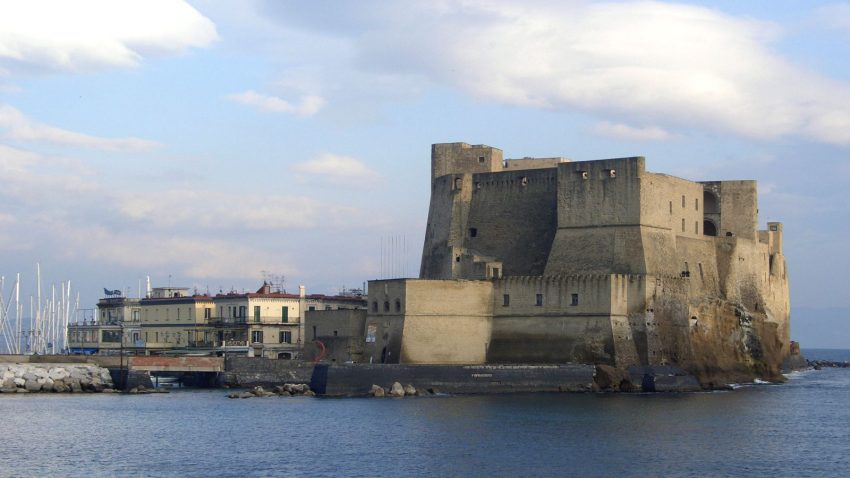
Walking Tour Summary

Distance: 5.5 km
Sites: 11

Walking Tour Map
Map of the Self-Guided Walking Tour of Van Gogh’s Arles walking route with 11 stops in Arles.
Preview map of the Self-Guided Walking Tour of Van Gogh’s Arles route in Arles, showing 11 stops. Use the interactive map to zoom and tap markers.

More from this area

Self-Guided Walking Tour of Arles, France (2026)

Self Guided Walking Tour of Arles

This website uses affiliate links which earn a small commission at no additional cost to you.

Embarking on a walking tour of Arles is like stepping into a vivid tapestry woven with the threads of ancient history, artistic heritage, and Provençal charm. Nestled in the heart of the sun-drenched region of Provence in southern France, Arles serves as a captivating portal to the past, boasting an array of well-preserved Roman monuments, medieval buildings, and streets that echo with the footsteps of Vincent van Gogh, who found profound inspiration in this picturesque town.

As you meander through the cobblestone lanes, every turn presents a new page of history, a burst of colorful culture, or a masterpiece of nature. From the imposing Roman Amphitheatre, whispering tales of gladiators and spectators of yore, to the serene beauty of the Rhône River that gently nudges the town's edges, Arles is a mosaic of timeless moments.

How to Get to Arles

By Plane: The nearest major airport to Arles is Marseille Provence Airport, located about 25 km (15 miles) from the city. From the airport, you can take a shuttle, taxi, or rent a car to reach Arles in roughly 30-40 minutes. For the best deals and a seamless booking experience, check out these flights to Arles on Booking.com.

By Train: Arles is well connected by regional and high-speed trains. Regular TER and TGV services run from Avignon, Marseille, Nîmes, and beyond. The station is just a 10-minute walk from the old town, making it very convenient for visitors arriving by rail. You can use SNCF Connect to check schedules, compare routes, and purchase tickets for National (SNCF ) and regional trains (TER). For a more streamlined experience, we recommend using Omio, which allows you to easily compare prices, schedules, and book tickets for both National and Regional travel across all of Europe, all in one place.

By Car: Arles is accessible via the A54 motorway and national roads like the N113. Parking is available just outside the city walls, with lots at Parking du Centre or Parking Lamartine. The historic centre is compact and pedestrian-friendly, so it's best explored on foot. If you are looking to rent a car in France I recommend having a look at Discover Cars, first, as they compare prices and review multiple car rental agencies for you.

A Brief History of Arles

Arles boasts a rich history that dates back to the 6th century BCE, when it was known as Theline, a trading partner of the Greek city Massilia (modern-day Marseille). The Romans captured the town in 123 BCE, renaming it Arelate and transforming it into a significant city in the Roman province of Gallia Narbonensis. The city's Roman heritage is evident in its well-preserved monuments, including the Arles Amphitheatre, built around the first century AD, which could seat over 20,000 spectators and is still used for events today.

During the Middle Ages, Arles became a major religious center, with the construction of the Church of St. Trophime and its cloister, showcasing Romanesque architecture. In the 19th century, the city gained fame as the residence of Vincent van Gogh, who created over 300 works during his time in Arles, capturing the city's landscapes and vibrant colors.

Where to Stay in Arles

For a walking tour of Arles’ Roman monuments and artistic streets, staying in or near the historic centre is ideal. A luxurious option is Hôtel & Spa Jules César Arles - MGallery, a 5-star hotel in a converted 17th-century convent with interiors designed by Christian Lacroix and a full-service spa. For a boutique stay, Maison Volver offers colourful rooms and Provençal charm just steps from the Amphitheatre. Budget travellers might opt for Hôtel Acacias, a friendly and well-located hotel close to both the train station and old town. Each of these options places you within walking distance of Arles’ ancient wonders, charming squares, and lively market streets.

Choose a Guided or Self-Guided Walking Tour of Arles

If you’re pushed for time, consider joining this Arles Walking Tour with a Local Guide. This 2-hour tour led by a knowledgeable local takes you through the heart of the historic centre, from the mighty Roman Amphitheatre to the ancient Théâtre Antique, and across the squares and cafés once immortalized by Vincent van Gogh.

Your Walking Tour of Arles

This blog aims to guide you through the most enchanting corners of Arles, ensuring you soak up the essence of its storied past and vibrant present. Whether you're a history buff, an art enthusiast, or simply in search of the Provençal dolce vita, our walking tour itinerary is designed to offer a comprehensive experience of Arles's unique allure. We'll explore hidden gems and iconic landmarks, delve into the town's rich artistic legacy, and perhaps, find ourselves walking in the very steps of Van Gogh, immersing in the landscapes that inspired some of his most celebrated works.

1. Place de la Republique (Republic Square)

Arles Place de la Republique
CC BY-SA 2.0 / Wolfgang Staudt

The Place de la République, nestled at the heart of Arles, embodies a pivotal spot within the city’s vibrant core. This square is a tapestry of architectural evolution and urban metamorphosis over centuries, crafting its distinctive, multifaceted identity. Located to the south of the erstwhile Roman forum, this space was initially a compact antechamber flanked by the Saint-Trophime and Sainte-Anne churches during the medieval era. The construction of the town hall in the 17th century marked a significant transformation, broadening the square and altering its façade considerably. Over the years, the Place de la République has been embellished with a variety of monuments, each bearing different styles and purposes, assembling an eclectic mix reminiscent of an Italian piazza. It has become a focal point for significant local traditions, including the triennial crowning of the “Queen of Arles,” which draws community engagement and infuses the area with energy.

Clock Tower of Arles

Featuring classical Provençal Renaissance decorations, the clock tower is a testament to the area’s refined architectural taste. Even with the new town hall’s construction, the decision to keep the clock tower by the city’s leaders emphasizes a commitment to preserving the classical elegance of that era.


Location: Place de la République, Arles, France | Hours: 24 hours | Price: Free

We recommend to rent a car in France through Discover Cars, they compare prices and review multiple car rental agencies. Book your rental car here.

2. Obélisque d'Arles

Obelisque dArles
Obelisque dArles

The Arles Obelisk is a significant ancient Roman monument located in Arles, France, recognized for its historical and cultural importance. It is an anepigraphic obelisk, meaning it lacks inscriptions, and stands out due to its Roman origins and inclusion on the UNESCO World Heritage list since 1981. Unlike traditional Egyptian obelisks made from Egyptian granite, the Arles Obelisk is crafted from red granite from Asia Minor, around the ancient city of Troy, and stands approximately 20 meters tall, including its base.

Originally erected in the 4th century during Emperor Constantine’s reign, it was positioned in the Roman circus of Arles, a site for chariot races. The obelisk fell into disrepair by the 6th century, breaking into two parts. Rediscovered in 1389, there were plans by King Henri IV to relocate it to the Arènes d’Arles, which were never realized. In the 19th century, the obelisk’s base was adorned with a basin and bronze lions designed by sculptor Antoine Laurent Dantan, enhancing its visual and historical appeal. Since 1840, it has been recognized as a historic monument, underscoring its significance within Arles’ rich Roman and Romanesque heritage.


Location: Obélisque d'Arles, Place de la République, Arles, France | Hours: 24 Hours | Price: Free

Here is a complete selection of hotel options in Arles. Feel free to review each one and choose the stay that best suits your needs.

3. Saint-Trophime Cloister

Cloister view Saint Trophime cathedralArles
CC BY-SA 4.0 / John Samuel

The Cloister of St. Trophime, nestled within the ancient cathedral of Arles, stands as a testament to exquisite craftsmanship spanning the 12th to 14th centuries, imbuing it with profound historical and artistic value.

Distinctively positioned in relation to the cathedral, the St. Trophime Cloister diverges from common architectural practices; it’s linked to the choir via a staircase of twenty-five steps, rather than adjoining the nave or transept directly.

Initiated around 1150, the construction of the cloister began with the north gallery and was swiftly followed by the east gallery. It was only by the late 14th century, during Jean de Rochechouart’s episcopacy (1390-1398), that the construction saw completion, including the west and south galleries. This phased development bestowed the cloister with a blend of Romanesque styles in the north and east galleries and Gothic styles in the west and south galleries, marking a fusion of architectural influences.

The architectural finesse of the St. Trophime Cloister, with its balanced volumes and intricate sculptural details, reflects the artisans’ pursuit of aesthetic excellence.

Since being designated a historical monument in 1846, and later a part of the UNESCO World Heritage list in 1981 for its inclusion among the Roman and Romanesque monuments of Arles, the St. Trophime Cloister has been celebrated for its exceptional cultural significance and contribution to the architectural heritage of the region.


Location: Cloître Saint-Trophime, Rue du Cloître, Arles, France | Hours: From 01/03 to 30/04, daily between 9 am and 6 pm. From 01/05 to 30/09, daily between 9 am and 7 pm. From 01/10 to 31/10, daily between 9 am and 6 pm. From 02/11 to 01/03, daily between 10.30 am and 4.30 pm. Closed exceptionally on May 1st., January 1st and December 25th. Last entry 16h. | Price: Full price: 6 € Reduced price: 5 €.

Traveling to a country with a different currency? Avoid ATM transaction fees and pay in local currency with a Wise Card. Having used it for over 5 years, we've saved loads on fees!

4. Église Sainte-Anne d'Arles

1024px Eglise Sainte Anne dArles
CC BY-SA 3.0 / Guiguilacagouille

The Sainte-Anne church, erected between 1614 and 1630, exhibits the enduring charm of southern Gothic architecture, providing insights into the area’s rich artistic legacy. Furthermore, the 17th-century revamp of the archdiocese and the late 18th-century reconstruction of its façade add to the Place de la République’s architectural richness, creating a layered and compelling narrative of Arles’ historical and cultural landscape.


Location: Église Sainte-Anne d'Arles, Place de la République, Arles, France

Explore Arles at your own pace with our self-guided walking tour! Follow our curated route to discover must-see sights and local secrets that makes Arles one of the best places to visit in France.

5. Town Hall and Cryptoportics of Arles

Arles Cryptoportiques
CC BY-SA 4.0 / Bjs

Arles boasts two notable yet intertwined heritage sites: the Town Hall and the Cryptoportics, each reflecting the city’s rich history.

The Arles Town Hall, finalized in 1676 and declared a historical monument, stands as a testament to architectural magnificence and fine craftsmanship across its three stories. Upon entering, visitors are welcomed by a grand vestibule under a low vault, demonstrating the intricate French stereotomy. This architectural feature, with its dual intersecting barrel vaults tied elegantly to the walls through arches and spanning 15 meters with minimal sagging, highlights the exceptional skill of its creators. It showcases the essentials of stereotomy, like the precision in lowering and the masonry’s interplay, all while revealing the inner beauty of the vault’s structure.

The ascent up the main staircase introduces guests to lion sculptures by Jean Dedieu, adding to the space’s splendor. A reproduction of the Venus of Arles, a find from Arles’s ancient theater now in the Louvre, graces the staircase. A replica by Girardon enriches this setting with classical elegance. The first floor features a balcony supported by double columns, and the second floor is distinguished by a central pediment with the sun symbol of Louis XIV, decorative balusters, and fire pots, enhancing the Town Hall’s historical allure.

In close proximity, the Cryptoportics form a mysterious underground network dating back to Roman times, lying beneath the city’s contemporary heart. Originating from the first Roman colony in 46 BC, these subterranean passages, possibly built upon older Greek structures, invite visitors to traverse through millennia. Likely serving as commercial or storage spaces in the Roman forum, the Cryptoportics offer an immersive journey into Arles’s ancient commercial practices and everyday life.

The combination of the Town Hall and Cryptoportics in Arles presents an enriching narrative of the city’s past, from the splendor of municipal architecture to the underground echoes of ancient commerce, offering a comprehensive glimpse into the legacy and daily existence of historic Arles.


6. Église Saint Trophime d'Arles

1280px Arles Eglise Saint Trophime
CC BY-SA 2.0 / Wolfgang Staudt

Dedicated to the legendary first archbishop of Arles, this church showcases the Romanesque architectural style and stands on the foundations of a 5th-century basilica. It functioned as a cathedral until the episcopal see was relocated to Aix in 1801. Constructed from the 12th to the 15th centuries, it is celebrated as a quintessential example of Provençal Romanesque art. Noteworthy is the elaborately carved western entrance, crowned by a tympanum that illustrates the Apocalypse, featuring St. Trophime wielding his bishop’s staff. The interior houses a treasury with relics of Arles’ bishops. The adjacent Cloître St-Trophime cloister occasionally serves as a venue for exhibitions.


Location: Eglise Saint-Trophime, Place de la République, Arles, France | Hours: Typically open daily; hours vary seasonally. | Price: Free entry to the church; a small fee for the cloister (usually around €3–€5).

7. Théâtre Antique, Arles (Ancient Theatre of Arles)

Roman theater in Arles
CC BY-SA 3.0 / Bokeby

The Arles Ancient Theater, nestled in Arles, France, is a significant historical landmark, constructed towards the close of the 1st century BC under Emperor Augustus’s rule. It emerged as one of the initial Roman stone theaters, with its construction phase stretching from around 40/30 BC to approximately 12 BC, coinciding with Arles’s elevation to a Roman colony status.

Positioned along the decumanus, the primary east-west thoroughfare in the Roman urban layout, the theater exemplifies the Romans’ sophisticated approach to city planning. Since 1840, it has been acknowledged as a historical monument, underscoring its profound historical importance.

Presently, this site offers a window into the past for visitors. Despite the survival of only a single section of the original seating structure, this remnant, repurposed as a part of the medieval city’s fortifications, speaks volumes about the theater’s former splendor. The orchestra, the space preceding the stage, retains evidence of an altar dedicated to Apollo, featuring swan motifs, a nod to Emperor Augustus’s symbol.

A notable aspect of the Arles Ancient Theater is the “two widows,” solitary columns from what was once a hundred-column stage facade, standing as silent witnesses to history’s passage.

Beyond its historical allure, the theater doubles as a vibrant cultural hub, hosting an array of events and festivals from June to August. These include the Arles and Costume Festivals, the International Photography Meetings, Les Suds, Cargo Stopovers, and the Peplum Film Festival, breathing life into this ancient venue and perpetuating its role as a center for cultural and artistic endeavors.


Location: Roman Theatre of Arles, Rue du Cloître, Arles, France | Hours: 01/03 to 30/04: daily between 9 am and 6 pm. 01/05 to 30/09: daily between 9 am and 7 pm. 01/10 to 31/10: daily between 9 am and 6 pm. 02/11 to 01/03: daily between 10.30 am and 4.30 pm. Closed January 1st, May 1st & December 25th. | Price: Full price: 9 € Reduced price: 7 €.

8. Arenes d'Arles (Arles Amphitheatre)

Arles Amphitheatre
Arles Amphitheatre
CC BY-SA 2.0 / Wolfgang Staudt

Located in the charming town of Arles, the Arles Amphitheatre is a monumental structure from Ancient Rome, constructed in 90 AD. This magnificent amphitheatre is a testament to the architectural prowess and enduring legacy of Roman civilization, making it a key attraction for visitors to Arles.

Designed as a two-tiered coliseum, it could host over 20,000 spectators, offering them a variety of spectacles, from thrilling chariot races to intense gladiatorial combat, reflecting Arles’s cultural prominence in the Roman world.

Despite its ancient origins, the amphitheatre underwent changes in the medieval period, including the addition of towers that contribute to its distinctive appearance by merging Roman and medieval architectural styles.

Today, the Arles Amphitheatre continues to enchant audiences, serving as a venue for cultural activities rather than ancient sports. It is the centerpiece of the Feria d’Arles, a lively annual festival, and hosts an array of performances such as plays and concerts during the summer, drawing both local and international crowds.

In 1981, UNESCO acknowledged the amphitheatre’s significant cultural contribution by designating it a World Heritage Site, under the “Arles, Roman, and Romanesque Monuments” category. This honor emphasizes the amphitheatre’s role in global heritage, celebrating its historical and cultural importance.


Location: Arles Amphitheatre 1 Rdpt des Arènes 13200 Arles France | Hours: From 02-11 to 28-02 : 10am - 5pm // From 01-03 to 30-04 : 9am - 6pm.// from 02-05 to 30-09 : 9am - 7pm // From 01-10 to 31-10 : 9am - 6pm. | Price: Adult: €9/€11

9. Musee Reattu (Reattu Museum)

Arles Musee Reattu
Arles Musee Reattu
CC BY-SA 2.0 / Mbzt

The Reattu Museum stands out for its eclectic array of art, including paintings, drawings, sculptures, and photographs. It highlights works by Jacques Réattu, a native of Arles, alongside pieces by Picasso and a range of contemporary artists. The museum also frequently organizes contemporary art exhibitions.

Home to a remarkable collection of 800 works by Jacques Réattu, the museum dedicates twelve rooms to both his creations and personal collections, primarily featuring 17th-century paintings. The exhibition space also honors Réattu’s connections, showcasing works by his uncle Antoine Raspal, among others, with “The Couturiers’ Workshop” from the 1780s as a standout piece. Picasso’s artistic genius is spotlighted in three rooms, while a separate area is reserved for an extensive photography collection, representing various artists and eras.

The Musée Réattu’s holdings are rich in contemporary sculptures by figures like César, Richier, Bourdelle, and Zadkine, and modern paintings by Dufy, Vlaminck, and Prassinos. This breadth offers a panoramic view of historical and contemporary art movements.

A distinctive feature of the museum is its vast photography collection, initiated with contributions from notable photographers such as Richard Avedon and Man Ray, expanding to over 4,000 works by 2001. This collection has grown through donations from participants of the Rencontres d’Arles photography festival, enriching the museum’s offerings and providing a deep dive into the development of photography as an art form.


Location: Musée Réattu, Rue du Grand Prieuré, Arles, France | Hours: Tuesday to Sunday 02 November - 28 Februar : 10am to 5pm 1st March - 31 October: 10am to 6pm Closed on Monday. Closed on 1st January, 1st May, 1st November and 25 December | Price: Full: 6€ - Reduced*: 4€ (Combined ticket Réattu museum + Vincent van Gogh Foundation: 12 €)

10. Thermes de Constantin (Baths of Constantine)

Thermes de Constantin
CC BY-SA 3.0 / Sailko

The Baths of Constantine, also known as the Thermes du Nord, are historic Roman bath ruins situated along the Rhône River in Arles. Constructed in the early 4th century during Emperor Constantine’s stay in Arelate (Arles), these baths later earned the moniker “Palais de la Trouille” in the Middle Ages, mistakenly thought to be a palace built by Constantine himself.

Recognized as historical monuments in 1840, with the Roman wall and adjacent cellars additionally classified in 1922, the city acquired and meticulously renovated the site from 1980 to 1995, aiming to safeguard its architectural legacy.

Today, the Thermes de Constantin rank among France’s most well-preserved Roman baths, alongside the Thermes de Chassenon in Charente and the Thermes de Cluny in Paris. Initial excavation and cleaning in the 19th century revealed much of what is visible today.

Presently, the baths’ most prominent features are the remains of the caldarium, the hot-water bath area, characterized by its underfloor heating system (hypocaust) and three pools, two rectangular and one semi-circular with an apse, showcasing three windows under a half-dome vault. This area links to the laconicum (a dry sauna) and the tepidarium (a warm bath), the latter ending in a semi-circular apse on its western side.

Visitors to the Thermes de Constantin are offered a fascinating insight into Roman bathing culture and architectural ingenuity. The diligent restoration and conservation efforts by Arles highlight the enduring allure and historical importance of these ancient baths.


Location: Thermes de Constantin, Rue du Grand Prieuré, Arles, France | Hours: 01/03 to 30/04: daily between 9 am and 6 pm. 01/05 to 30/09, daily between 9 am and 7 pm. 01/10 to 31/10, daily between 9 am and 6 pm. Closed exceptionally on May 1st, January 1st and December 25th. | Price: Adults €5 Children €2.5

11. Place du Forum, Arles

Arles PlaceDuForum
Arles PlaceDuForum
Public Domain / AlanFord

Forum Square is a place of considerable historical and artistic value, historically serving as the heart of activity in many Roman cities, including Arles. Originally, it covered a vast area from what is now Boulevard des Lices to the north, reaching towards the river.

The square’s fame is significantly attributed to Vincent van Gogh’s iconic painting, “Cafe Terrace at Night,” created in September 1888. This artwork captures a lively café scene on Forum Square, where the café now known as Cafe Van Gogh stands, painted in the same yellow hues featured in Van Gogh’s piece. Though the painting bears no signature, Van Gogh frequently discussed and referenced it in his correspondence, and a pen drawing of the scene is part of his estate.

Present-day visitors to Forum Square can experience the same view Van Gogh did when he painted the enchanting café scene. The square remains a vibrant center of life in Arles, bustling with energy both day and night. Tourists are invited to enjoy the lively scenes, absorb the square’s ambiance, and witness the timeless allure that inspired Van Gogh.

Forum Square not only highlights the historical prominence of Arles as a Roman metropolis but also stands as an emblematic site in the art world, famed for being depicted in one of Van Gogh’s most celebrated paintings. Its rich history intertwined with notable artistry continues to attract global visitors, offering them a chance to delve into Arles’s cultural heritage.


Location: Place du Forum, Arles, France | Hours: 24 Hours | Price: Free
Powered by GetYourGuide
Moira & Andy
Moira & Andy

Hey! We're Moira & Andy. From hiking the Camino to trips around Europe in Bert our campervan — we've been traveling together since retirement in 2020!

Read our full story here

This website uses affiliate links which earn a small commission at no additional cost to you.

Walking Tour Summary

Distance: 1.5 km
Sites: 11

Walking Tour Map
Map of the Self-Guided Walking Tour of Arles, France walking route with 11 stops in Arles.
Preview map of the Self-Guided Walking Tour of Arles, France route in Arles, showing 11 stops. Use the interactive map to zoom and tap markers.

More from this area

Walking Tour of Dinan, France (2026)

Walking Tour of Dinan Lehon

This website uses affiliate links which earn a small commission at no additional cost to you.

Embark on a captivating walking tour of Dinan and Léhon, two jewels nestled in the heart of Brittany, France. This journey will guide you through the medieval charm and historical richness of these towns, offering a deep dive into their cultural heritage and architectural beauty.

Historically Dinan, served as a residence for the Duke of Brittany, a crucial port along the English Channel, and a vibrant trading hub enriched by robust guilds and flourishing trade relations with England and Holland. By the 13th century, as maritime advancements saw ships outsize its river port capabilities, the focal point of harbor activity shifted to the neighboring St-Malo. Consequently, Dinan's heart migrated uphill, seeking refuge and strategic advantage behind sturdy defensive walls.

Presently, Dinan’s imposing ramparts encircle a treasure trove of historical allure, from its half-timbered houses to its cobblestoned streets, securing its status as Brittany’s premier medieval town center.

How to Get to Dinan & Léhon

By Plane: To get to Dinan by plane, the nearest major airport is Rennes-Saint-Jacques Airport (RNS), located about 55 km away. From the airport, you can reach Dinan by rental car, taxi, or train via Rennes. For the best deals and a seamless booking experience, check out these flights to Dinan on Booking.com.

By Train: Dinan is connected by regional TER trains to Saint-Malo, Rennes, and Dol-de-Bretagne. From Dinan station, it’s about a 10-minute walk to the medieval centre. Léhon is just a 20-minute walk along the river towpath from Dinan’s port area, making it easy to explore both locations on foot. You can use SNCF Connect to check schedules, compare routes, and purchase tickets for National (SNCF ) and regional trains (TER). For a more streamlined experience, we recommend using Omio, which allows you to easily compare prices, schedules, and book tickets for both National and Regional travel across all of Europe, all in one place.

By Car: Dinan is easily accessible by car from Rennes (around 45 minutes) or Saint-Malo (35 minutes), via the N176. There is free parking available in Léhon next the open air swimming pool and the Abbey, although, you do have to pass through narrow cobbled streets to get there! Just across the river is additional parking across the river. There is also a Aire de camping car in the village. There is a centrally located campsite in Dinan Camping Municipal Chateaubriand. If you are looking to rent a car in France I recommend having a look at Discover Cars, first, as they compare prices and review multiple car rental agencies for you.

Where to Stay in Dinan

For a walking tour of Dinan and Léhon, staying in or around Dinan's historic centre provides the ideal base for exploring both towns on foot. A top boutique option is Hôtel Le d’Avaugour, a charming 15th-century building with garden views and traditional Breton character. For something modern and convenient, Mercure Dinan Port Le Jerzual sits by the scenic riverfront and offers easy access to the walk toward Léhon. Budget-conscious travellers may enjoy Hôtel du Château, right by the town walls and close to Dinan’s major sights. All three allow you to explore Dinan’s ramparts, towers, and medieval streets, as well as the peaceful beauty of Léhon, without needing a car.

Choose a Guided or Self-Guided Walking Tour of Dinan & Léhon

If you’re a little short on time then, a guided walking tour is one of the best ways to uncover the medieval charm, riverside tranquillity, and architectural beauty of this corner of Brittany. We recommend this 2-hour Dinan Private Guided Walking Tour a journey led by a local guide that takes you through Dinan’s cobbled lanes, half-timbered houses, and hilltop views.

Your Walking Tour of Dinan & Léhon

Begin your tour in Dinan's historic heart, with highlights like the clock tower, Saint-Malo Church, and Rue du Jerzual-a steep, cobbled street that winds down to the port, lined with artists' workshops and boutiques. Follow the river Rance along a tranquil path to the village of Léhon, where you'll find the elegant Abbaye Saint-Magloire and the ruins of a medieval castle. Whether you're drawn to history, heritage, or just a peaceful stroll through beautiful scenery, this tour captures the essence of inland Brittany.

1. Saint-Magloire de Léhon Abbey

Abbaye Saint Magloire de Lehon cloitre
CC BY-SA 4.0 / Nono314

Saint-Magloire de Léhon Abbey stands as a beacon of serenity and spiritual heritage in the quaint town of Léhon. Founded in the 9th century by Nominoë, Brittany’s inaugural duke, the abbey’s submission to Marmoutier Abbey near Tours was officially declared in 1093 through a charter signed by King Philip I of France. Throughout the 11th to 13th centuries, the abbey saw a significant increase in its income, bolstering its holdings across various dioceses including Saint-Malo, Dol, Saint-Brieuc, Tréguier, Saint-Pol, Avranches, and even extending to England. This financial prosperity facilitated the abbey’s reconstruction, driven by Peter I, Duke of Brittany.

The turmoil of the French Revolution saw Joseph Bullourde taking possession of the abbey, where he resided for three decades. A pivotal moment in its restoration journey occurred in 1885 when the first stone of the new work was blessed, marking the beginning of a new era for the abbey. However, it wasn’t until 1956 that the convent buildings themselves saw restoration, indicating a lengthy and phased process of renewal and preservation.


Location: Abbaye de Léhon, Le Bourg, Dinan, France | Price: Free

We recommend to rent a car in France through Discover Cars, they compare prices and review multiple car rental agencies. Book your rental car here.

2. Viaduc de Dinan

Le Vieux Pont Dinan
Le Vieux Pont Dinan
CC BY-SA 2.0 / Patrick from Compiègne, France

Head along Le Bourg, with the Abbey on your left to cross the river. Turn left and walk along the path alongside the Rance River. After about 30 mins / 2km you will come the the Viaduc de Dinan.


The Viaduc de Dinan, an engineering marvel of the mid-19th century, stands as a testament to the architectural ambition and technological prowess of its time. Officially opened to traffic in 1852, this imposing structure stretches 250 meters in length and soars 40 meters above the picturesque Rance River, connecting the hillside community of Lanvallay with the historic walled city of Dinan. Comprising ten elegantly designed arches constructed from grey granite, the viaduct not only facilitated a significant improvement in local traffic flow by offering an alternative route that bypassed the narrow, congested lanes leading to the old port and the ascent of Rue du Petit-Fort, but it also became a symbol of progress and connectivity in the region. Beyond its practical utility, the Viaduc de Dinan is celebrated for its breathtaking views of the river and surrounding landscapes, making it a cherished landmark and a favored spot for both residents and visitors seeking to capture the beauty of Brittany.


Location: Viaduc de Dinan Rue Général de Gaulle 22100 Dinan France

Here is a complete selection of hotel options in Dinan. Feel free to review each one and choose the stay that best suits your needs.

3. The Rance River

Dinan on the banks of the Rance

Carry on long the river and cross the old stone bridge, Le Vieux Pont. You can walk through the Port de Dinan with the river on your left.


The Rance River winds its way through the picturesque landscapes of Brittany, offering a tranquil escape into nature’s embrace. As it flows past Dinan, the river becomes a mirror reflecting the town’s medieval charm, with boats gently bobbing at the docks replacing the cargo ships of yesteryears. The banks of the Rance invite leisurely strolls and picnics, providing a peaceful backdrop for relaxation and contemplation amidst the bustling life of the surrounding towns.

You can rent small electric boats here or take a cruise.  You can also take a cruise from here to St Samson along the Rance. Ride on a comfortable boat while admiring the coast and nature from the water. In the summer months it may be worth booking in advance.


Location: Port de Dinan Rue du Quai 22100 Dinan France | Book Boat trip tickets on the river La Rance

Traveling to a country with a different currency? Avoid ATM transaction fees and pay in local currency with a Wise Card. Having used it for over 5 years, we've saved loads on fees!

Powered by GetYourGuide

4. Rue du Petit Fort & Maison du Gouverneur

Rue du Petit Fort Maison du Gouverneur
CC BY-SA 2.0 / Patrick from Compiègne, France

From the bridge climb up Rue du Petit Fort, renowned as Dinan’s most charming street. The street stretches from the harbour at the town’s base up to the bustling city centre. This enchanting thoroughfare is lined with picturesque half-timbered houses and quaint art galleries.


The Maison du Gouverneur was constructed in the late 15th century, this striking half-timbered building was once the abode of a wealthy cloth merchant. Designated as a Historic Monument in 1938 and subsequently restored in the 1950s, the structure has preserved exceptional architectural features that now serve as a unique backdrop for art exhibitions.


Location: Maison du Gouverneur, Rue du Petit Fort, Dinan, France

5. Town Walls of Dinan

Town Walls of Dinan
Town Walls of Dinan
CC BY-SA 4.0 / Avi1111 dr. avishai teicher

At the top of Rue du Petit Fort you come to Porte du Jerzual, this gateway to the town was built in the 14th century in the base of a tower and once formed part of the defences of Dinan. In later years a drawbridge was also added here, to further strengthen the town defences. After having a look at the gateway, to climb to walls you need to turn left just before you get the the gates and walk up Ven. Michel, turn left onto Rue Michel and access to the Chemin de Ronde is on your right.


The Town Walls of Dinan encase the old town in a protective embrace, standing as a testament to the town’s strategic importance throughout history. These imposing ramparts, dating back to the Middle Ages, offer visitors a chance to walk through history, enjoying stunning views of Dinan and the verdant countryside beyond. A stroll along these ancient defenses is a journey back in time, offering insights into the town’s past and the architectural ingenuity of its people.

Next you will come to the Mercoeur Bastion and then the Porte de Saint-Malo, where you will have to descend. Walk out of the city walls and walk along the Pascalou or La Contrescarpe. You pass the Tour Beaumanoir, navigate across a roundabout and pass Tour Lesquen. As you reach the corner of the city and the Tour Saint Julien you pass back within its walls. At the end of the street, cross back outside the walls. 


Location: 24 Rue de l'École, 22100 Dinan, France

6. Val Cocherel Garden

Val Cocherel Garden
Val Cocherel Garden
© Dinan Town Hall

As you  pass the location of the La Tour Beaufort turn right and head for the Jardin du Val Cocherel or Jardin des Petits Diables.


Named after the “Cocherel” stream that meanders through the bottom of its garden, this splendid park spans roughly 4 hectares of lush green space in the core of Dinan. Designed with fun and family in mind, it features an array of amenities including slides and swings for the kids, a sheltered picnic spot, mini-golf, ping-pong tables, and even a small collection of animals. For those looking to relax among nature, there’s a rose garden to explore, and a kiosk on-site provides cold beverages, ice cream, and sandwiches, making it a perfect destination for a leisurely day out with the family.


Location: Jardin des Petits Diables, Promenade des Petits Fossés, Dinan, France | Hours: Opening of the garden: Summer: From April 1 to September 30: 8:30 a.m. – 7:30 p.m. Winter: From October 1 to March 30: 9 a.m. – 5:30 p.m. Opening of the kiosk: from April 1 to September 30, open 7 days a week, from 11 a.m. to 7:30 p.m. from October 1 to November 15, open Wednesdays, Saturdays and Sundays from 2 p.m. to 6 p.m. or 5:30 p.m.

7. Château de Dinan

Chateau Dinan
Chateau Dinan
CC BY-SA 3.0 /

Climb back unto the city walls and pass through the Porte du Guichet, bear left to get to the Château de Dinan. Just outside on the road is the Dinan-Cap Fréhel Tourisme


Château de Dinan commands attention with its formidable structure, dominating the town’s skyline as a symbol of medieval might and architectural prowess. This castle, with its robust towers and defensive walls, offers a deep dive into the feudal history of Brittany, inviting visitors to explore its chambers and dungeons. The Château de Dinan is not just a historical monument; it’s a gateway to understanding the medieval life, conflicts, and cultures that shaped the region.


Location: Château de Dinan, Dinan, France | Hours: April - September: 10:30 a.m. to 7:00 p.m. October - December: 1:30 p.m. to 6:30 p.m. | Price: Adult: €7.50 Child: €3.50 | Website
Powered by GetYourGuide

8. Basilique St-Saveur of Dinan

Basilique St Saveur of Dinan
CC BY-SA 3.0 / Manuel Velazquez

From the Chateau walk along the Rue Général de Gaulle, and cut across the road to the Prom. de la Duchesse Anne when you can until you reach the La Tour Cardinal and the Jardin Anglais. The Jardin Anglais is located on the site of the old medieval church cemetery. It was created in 1853 and is dedicated to the many English who moved to Dinan in the 19th century which at the time was called The English Colony. Look out for the Ginkgo biloba and a gigantic Himalayan cedar.


Basilique St-Saveur of Dinan stands as a spiritual landmark, boasting a harmonious blend of architectural styles that span centuries. This basilica, with its unique facade and richly decorated interior, houses sacred relics and art, serving as a focal point for pilgrimage and reflection. The Basilique St-Saveur is a testament to the town’s enduring faith and its role in the religious history of Brittany.


Location: Basilique Saint-Sauveur de Dinan, Place Saint-Sauveur, Dinan, France

9. La tour de l’Horloge

La tour de lHorloge Dinan
CC BY-SA 3.0 / Manuel Velazquez

Head around the Basilique Saint-Sauveur and turn left to see the St. Catherine Kapelle, pop inside to see the upside-down boat-style wooden ceiling. Past the chapel turn right and walk along the impressive Esplanade de la fraternité, built in 2015. Behind you is the impressive looking Bibliothèque Municipale de Dinan. Turn right then first left, with the Théâtre Des Jacobins on your right. Turn right onto Rue de l’Horloge, which is halfway along the street on the left.


La tour de l’Horloge, with its timeless elegance, punctuates the skyline of Dinan. This 15th-century clock tower, offering panoramic views of the town and its surroundings, is a highlight for visitors seeking to capture the essence of Dinan from above. The journey to the top is a step back in time, with each tick of the clock marking the passage of centuries and the stories that have unfolded beneath its watchful gaze.


Location: Rue de l'Horloge, Dinan, France, 22100 | Hours: From February 10 to March 30: Tuesday to Sunday from 2 p.m. to 6:30 p.m. From April 1 to October 6: Every day from 10:30 a.m. to 6:30 p.m. except Mondays and Wednesdays from 10:30 a.m. to 1 p.m. and from 2 p.m. to 6:30 p.m. | Price: €4 / €2.50 | Website

10. Place des Merciers

Place des Merciers Dinan
CC BY-SA 4.0 / Avi1111 dr. avishai teicher

Turn left onto Rue de l’Horloge and left again at the end to walk along Place des Merciers.


Place des Merciers encapsulates the bustling market life of medieval Dinan, with its beautifully preserved timber-framed houses and cobblestone streets. This charming square, once the heart of the town’s commercial activities, continues to enchant visitors with its historic ambiance and vibrant energy. Place des Merciers is not just a place to visit; it’s an experience, offering a glimpse into the daily lives of the people who have walked its paths through the ages.


Location: Place des Merciers, Dinan, France

11. Église Saint-Malo

Saint Malo Church Dinan
©

At the end of Place des Merciers turn right onto Grand Rue and you will soon come to Eglise Saint-Malo.


Dating back to the 11th century, Dinan was home to a church dedicated to Saint-Malo, located outside the city’s defensive walls. In the late 15th century, as France sought to extend its control over Brittany, concerns grew in Dinan that the church could be exploited by French forces in the event of a siege. Responding to these strategic considerations, François II, Duke of Brittany, decreed in 1487 that the Saint-Malo church be torn down and reconstructed safely within the city’s walls. The rebuilding effort kicked off in 1490, fueled by generous contributions from the thriving community of Dinan. The new edifice, characterized by its flamboyant Gothic style, was constructed using the region’s distinctive granite.

The influx of financial support for the church waned with the onset of the 16th-century Reformation. Despite receiving a donation from François I, completion of the choir and transept was delayed until the 17th century. Remarkably, the nave remained incomplete for nearly 400 years.

The French Revolution repurposed the then-abandoned church for various secular uses, including a grain market and barracks. Worship was restored to the dilapidated building in 1803. It was not until the mid-19th century, between 1855 and 1865, that the state undertook a significant restoration, rebuilding the nave by drawing on existing plans and the architectural details of the choir, breathing new life into this historic sanctuary.


Location: Église Saint-Malo, Rue du Chanoine Meinser, Dinan, France

12. Château de Léhon

Chateau de Lehon
Chateau de Lehon
CC BY-SA 4.0 / Patrbe

After walking around the Eglise Saint-Malo to see all the gargoyles, walk back along Grand Rue and a little later walk down Rue du Jerzual. Rue du Jerzual, historically known as the artisans’ street, is adorned with shops originating from the 15th and 16th centuries. Today, it continues to host approximately a dozen artisans and artists, preserving its rich heritage of craftsmanship and creativity. Turn right onto Rue Croix Quart and left onto Rue Michel until you see the Torre Sainte-Catherine on your right and step down on your right to the river. Walk back along the river to the Château de Léhon.


Château de Léhon, though now in ruins, whispers tales of a bygone era when it stood as a fortress overseeing the strategic Rance valley. The remnants of this 13th-century castle, set amidst the scenic beauty of Léhon, invite imagination to reconstruct its former glory and the historical events it witnessed. Visiting the Château de Léhon is a pilgrimage for those fascinated by the feudal history of Brittany, offering a serene yet poignant reminder of the passage of time and the stories etched into the landscape.


Location: Château de Léhon, Allée du Château, Dinan, France | Hours: 24 hours | Price: Free
Powered by GetYourGuide
Moira & Andy
Moira & Andy

Hey! We're Moira & Andy. From hiking the Camino to trips around Europe in Bert our campervan — we've been traveling together since retirement in 2020!

Read our full story here

This website uses affiliate links which earn a small commission at no additional cost to you.

Walking Tour Summary

Distance: 10.5 km
Sites: 12

Walking Tour Map
Map of the Walking Tour of Dinan, France walking route with 12 stops in Dinan.
Preview map of the Walking Tour of Dinan, France route in Dinan, showing 12 stops. Use the interactive map to zoom and tap markers.

More from this area