Self-Guided Walking Tour of Hanoi’s Old Quarter (2026)
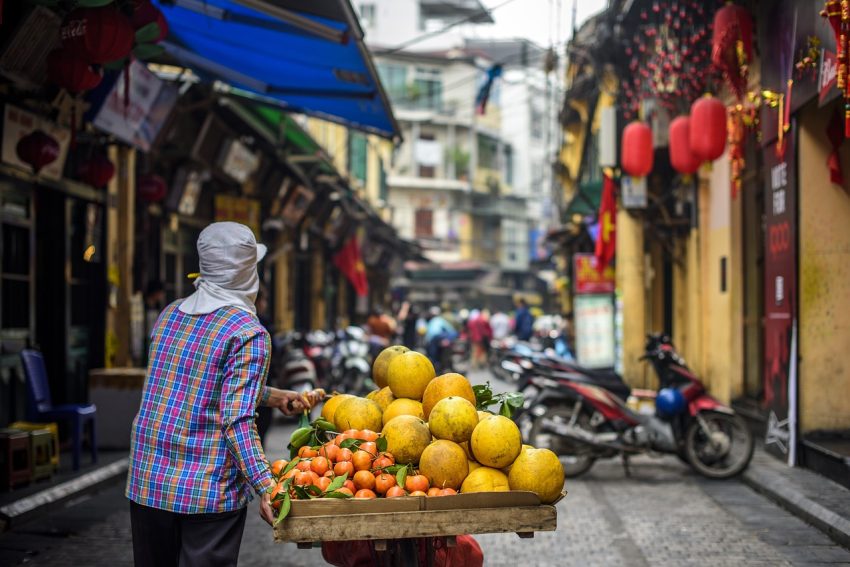
Hanoi Old Quarter
Hanoi Old Quarter

This website uses affiliate links which earn a small commission at no additional cost to you.

Hanoi's Old Quarter is a fascinating maze of history, street life, and timeless culture. With its tangle of narrow alleys, colonial-era buildings, and ancient temples, this district offers an immersive snapshot of Vietnamese life both past and present. Each street specializes in a particular trade-from silks and silver to street food-and every corner reveals another layer of the city's vibrant character.

Whether you're sipping egg coffee beside a centuries-old shrine or watching scooters stream past yellow-painted shopfronts, the Old Quarter is a place best explored on foot. A walking tour brings clarity to the chaos, guiding you to the hidden gems and historical treasures that lie beyond the guidebooks.

How to Get to Hanoi’s Old Quarter

By Train: While Hanoi Railway Station is not located in the Old Quarter, it's only about a 10-minute drive or 30-minute walk from the historic centre. Hanoi Railway Station is well connected to other cities like Da Nang, Hue, and Ho Chi Minh City.

By Car: If arriving by car or taxi from the airport or elsewhere in Hanoi, the best drop-off points for walking the Old Quarter are Dong Kinh Nghia Thuc Square or Ly Thai To Park, both of which are close to Hoan Kiem Lake.

Where to Stay in Hanoi’s Old Quarter

To enjoy a walking tour of the Old Quarter, stay right in the heart of the district. For a luxurious experience, La Siesta Premium Hang Be offers comfort and views of Hoan Kiem Lake. A boutique option is Hanoi La Selva Hotel, known for warm service and a central location. For budget travellers, See You at Lily's is a social and affordable hostel close to St. Joseph’s Cathedral.

Guided or Self-Guided Tour of Hanoi’s Old Quarter?

If you're visiting Hanoi's Old Quarter and want to get beyond the surface, a guided walking tour offers rich local insight. The Uncover Hanoi’s Hidden Treasures: Old Quarter & Train Street is a 3.5-hour small group tour led by a local expert. Starting near Hoan Kiem Lake, you'll explore landmarks like Ngoc Son Temple, the Ancient House on Ma May Street, and bustling Hang Bac. The tour ends with a coffee stop at the iconic Train Street, where the tracks run just inches from café tables-an unforgettable Hanoi moment.

A Brief History of Hanoi’s Old Quarter

The Old Quarter has its origins in the 11th century when craftsmen from surrounding villages settled here and formed guilds. Each street became associated with a specific craft-hence the name “36 Streets.” Over the centuries, the area expanded and adapted, welcoming influences from French colonial rule, Chinese occupation, and Vietnam's own dynastic legacies.

Though Hanoi has grown into a modern metropolis, the Old Quarter remains its historic soul. Its architecture, traditions, and street life reflect the resilience of the Vietnamese people and the continuity of culture in the heart of a fast-changing capital.

Your Walking Tour of Hanoi’s Old Quarter

This blog covers all the major sites of Hanoi's Old Quarter, but you may need to be selective about which venues you enter-you're unlikely to fit them all into one day!

1. Hoan Kiem Lake
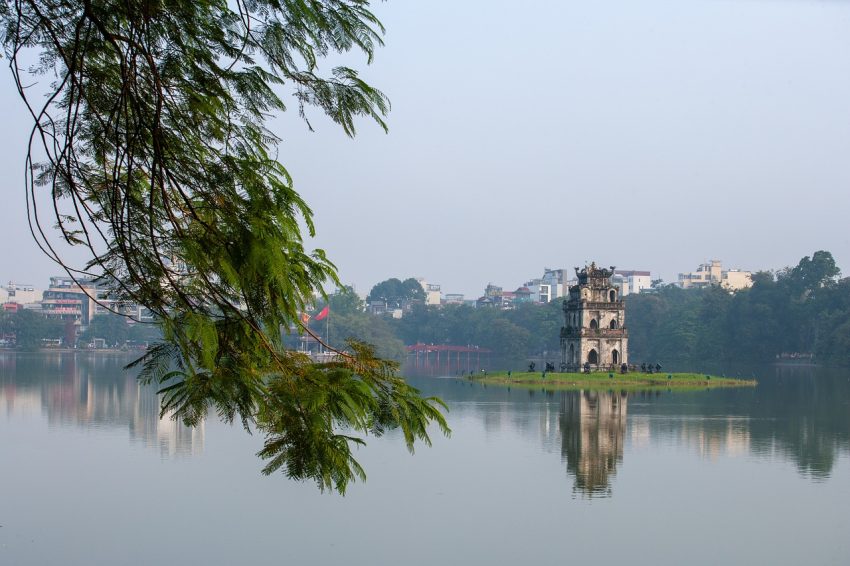
turtle tower hanoi
turtle tower hanoi

You start this walking tour at Hoan Kiem Lake.


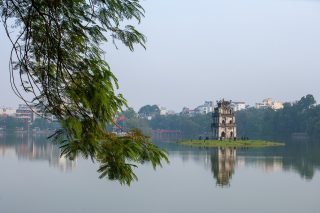
The lake sits in the middle of the city, surrounded by manicured gardens, and is steeped in a legendary story dating back to the mid-15th century.According to the tale, Heaven sent a sword to Emperor Le Thai To to drive the Chinese from Vietnam. After his success, a giant turtle took the sword to the bottom of the lake to return it to its divine owners, hence the name Ho Hoan Kiem, or Lake of the Restored Sword. Besides Jade Island, home to Ngoc Son Temple, the lake also features Turtle Islet, with the ancient Thap Rua (Turtle Tower) standing prominently.


Location: Hoàn Kiếm Lake, Hang Trong, Hoàn Kiếm, Hanoi, Vietnam | Hours: 24 Hours | Price: Free

Here is a complete selection of hotel options in Hanoi. Feel free to review each one and choose the stay that best suits your needs.

Powered by GetYourGuide

2. Ngoc Son Temple

Temple of the Jade Mountain Hanoi Vietnam
CC BY-SA 4.0 / Jakub Hałun

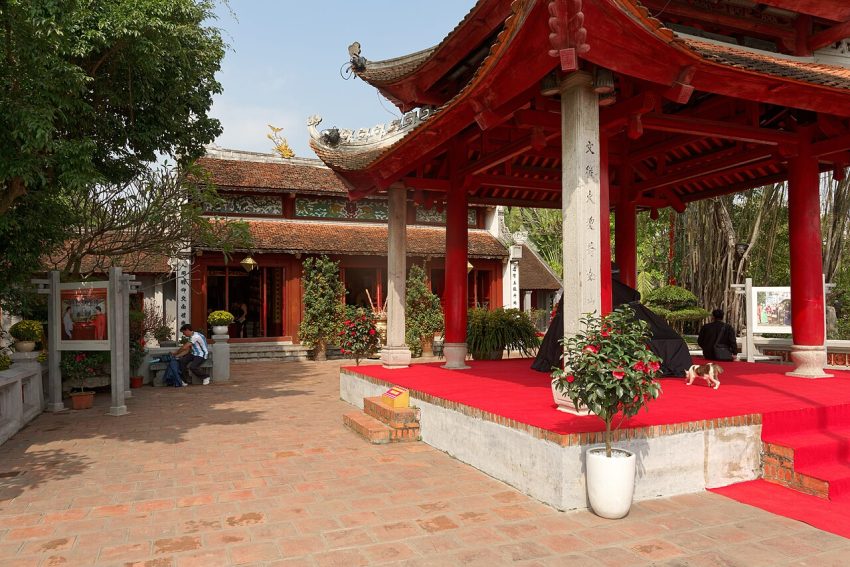
Walk towards the entrance to the Ngoc Son Temple complex.


Nghi Mon Gate marks the entrance to the complex, featuring two columns and walls engraved with Chinese characters. Inside, you can see Tháp Bút or Pen Tower on the left, constructed atop a stone hill in 1865 during King Tu Duc’s reign. Standing 28 meters tall with a stone feather pen on top, the tower is inscribed with “Ta Thanh Thien,” meaning “Write onto the sky,” honoring the Trinh Lords’ literary contributions and battles against northern invaders.

Beyond Pen Tower lies Long Mon Ho Bang Gate, which also has two columns and pagoda-style walls. The right wall features a dragon, symbolizing “Dragon Gate,” while the left wall displays a white tiger, representing “Tiger Board.” These symbols inspire academic success. Dai Nghien Gate, located near The Huc Bridge, features an ink pot atop three stone toads, with a poem by Nguyen Van Sieu carved in the center. The Huc Bridge, symbolizing the Sun God, is a curved, red-painted wooden bridge. It offers a beautiful view of the sunrise and cool breezes over the water, and at night, it illuminates, creating an enchanting sight.

The Ngoc Son Temple is located on Jade Island in Hoan Kiem Lake, this serene 18th-century shrine, named for the “jade mountain,” is one of Hanoi’s most picturesque temples. Dedicated to the 13th-century military hero Tran Hung Dao, scholar Van Xuong, and Confucian master Nguyen Van Sieu, who undertook repairs in 1864, the temple features Pen Tower and the Writing Pad. Access the temple via Three-Passage Gate and the Flood of Morning Sunlight Bridge. The temple opens to a courtyard where locals play Chinese chess, and houses a 6-foot-long stuffed tortoise from 1968.


Location: Ngoc Son Temple, Phố Đinh Tiên Hoàng, Ly Thai To, Hoàn Kiếm, Hanoi, Vietnam | Hours: Open 8-6pm daily | Price: Free

Traveling to a country with a different currency? Avoid ATM transaction fees and pay in local currency with a Wise Card. Having used it for over 5 years, we've saved loads on fees!

3. Ba Kieu Temple

Den Ba Kieu
Den Ba Kieu
CC BY-SA 3.0 / Codobai

After leaving Ngoc Son Temple cross over P. Đinh Tiên Hoàng to see the Monument of Determination, sometimes called the Martyrs Monument, which is located in the Vạn Xuân Flower garden.

The Martyrs’ Monument is a picturesque monument erected as a memorial for those who died fighting for Vietnam’s independence. It depicts two men, one holding a torch and the other holding a gun, and a woman with a sword to show how regardless of gender, everyone was involved in the Vietnam War equally.

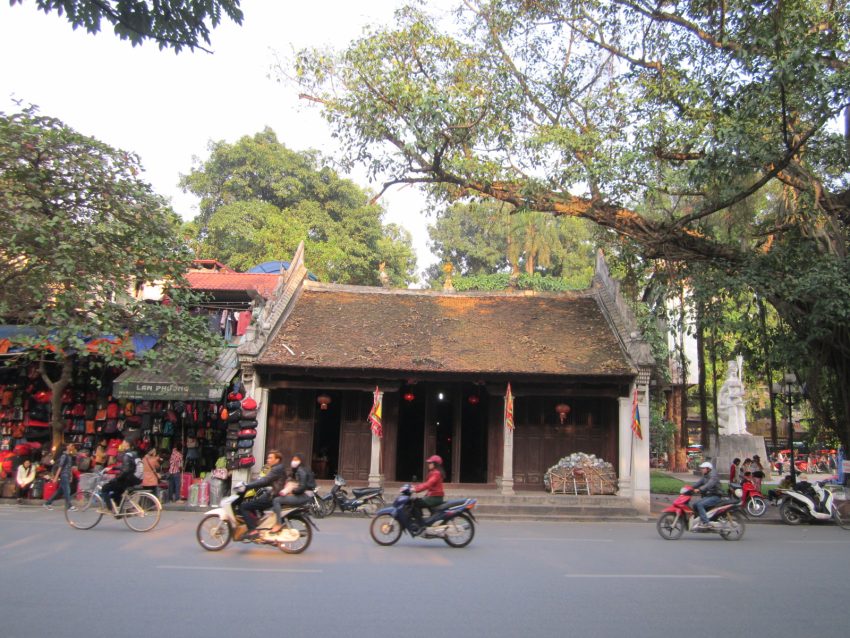
Behind the Martyrs’ Monument is Ba Kieu Temple.


The next stop on your Walking Tour of Hanoi’s Old Quarter is the small, historic Den Ba Kieu Temple, which sits inconspicuously along a busy road. This beautiful temple dates back to the 17th century and was once part of the Hoan Kiem Lake waterfront. However, a road built around the lake now separates it from its original gate.


Location: Đền Bà Kiệu, Phố Đinh Tiên Hoàng, French Quarter, Ly Thai To, Hoàn Kiếm, Hanoi, Vietnam | Hours: Open daily 08:30am – 04:30pm, midday break 11:30am-01:30pm.

Explore Hanoi at your own pace with our self-guided walking tour! Follow our curated route to discover must-see sights and local secrets that makes Hanoi one of the best places to visit in Vietnam.

4. Thang Long Water Puppet Theater

Thang Long Water Puppet Theatre
CC BY-SA 3.0 / Gryffindor

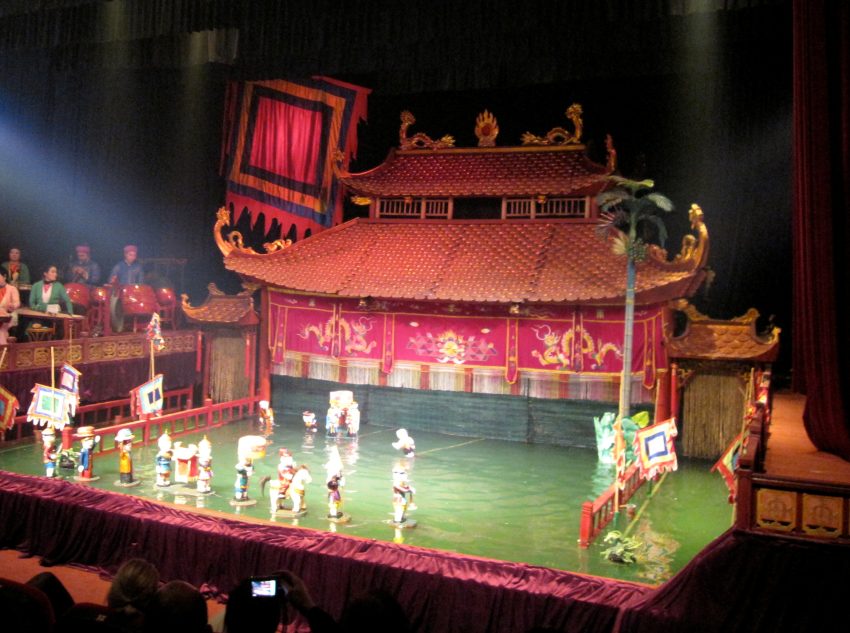
Continue to walk north along P. Đinh Tiên Hoàng and the Thang Long Water Puppet Theatre is on your right.


Established in 1969, the Thang Long Theater can accommodate 300 guests for its multiple daily shows (tickets required). The entertaining performances are based on Vietnamese folklore and culture.


Location: Thang Long Water Puppet Theatre, Phố Đinh Tiên Hoàng, Ly Thai To, Hoàn Kiếm, Hà Nội, Vietnam | Website

Explore Hanoi at your own pace with our self-guided walking tour! Follow our curated route to discover must-see sights and local secrets that makes Hanoi one of the best places to visit in Vietnam.

Powered by GetYourGuide

5. Hanoi Memorial House

Heritage House in Hanoi
CC BY-SA 4.0 / Christophe95

Continue north and walk away from the lake. When you reach P. Cầu Gỗ turn right and then left to walk up Hang Be street. At the end turn left onto Hang Bac Street or silver craft street ( “Hang” means a shop or store and “Bac” is silver). Walk north up P. Mã Mây and Heritage House (Ngôi Nhà Di Sản) is on your right.


On the southern edge of the Old Quarter’s Rattan Street stands a Chinese-style house built in the late 19th century. Its rich dark-wood facade fronts a sparsely decorated interior. The second floor features exquisitely carved chairs, bureaus, and tea tables, with a balcony overlooking a courtyard adorned with Chinese lanterns. Originally occupied by a Chinese family selling traditional medicines until their resettlement in 1954, the house became a museum in 1999 through a cooperative effort between the local government and architects from Toulouse, France, after being shared by five families for decades.


Location: Old House, Phố Mã Mây, Old Quarter, Hàng Buồm, Hoàn Kiếm, Hanoi, Vietnam | Hours: 8:30AM - 4:30PM | Price: Small fee

6. Hanoi Bach Ma Temple

Bac Ma Temple
Bac Ma Temple
CC BY-SA 2.0 / Greg Willis

Continue up P. Mã Mây following it around to the left onto Hang Buom Street.

Hang Buom Street was once adjacent to a small tributary of the To Lich River, which facilitated the transport of goods to the city, Hang Buom was historically a place where local merchant vessels came to refit their ships. Today, you can find numerous colonial buildings and traditional Vietnamese houses along this street, as well as a communal house located at no. 22 Hang Buom.

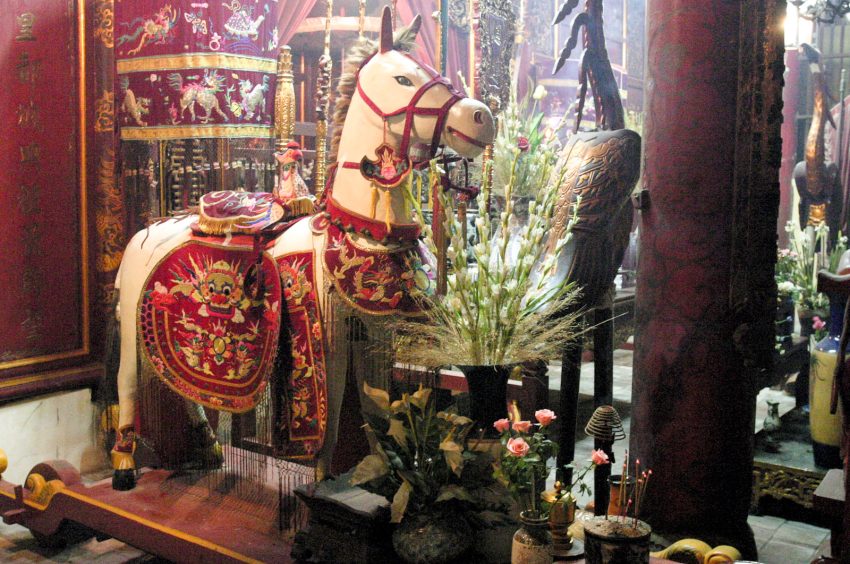
Continue along Hang Buom Street until you reach the Bach Ma Temple on your right.


Bach Ma Temple is an exquisite 11th-century Buddhist temple in Hanoi. It is dedicated to Bach Ma, the ‘White Horse’ that legendarily guided Emperor Ly Thai To to the optimal temple construction site. The temple is a vibrant spot for observing local traditions, especially on the 1st and 15th days of each lunar month, when extended prayers, offerings, and ceremonies take place.

Upon entering, you’ll encounter a red-lacquered palanquin, a Confucius shrine, and a Phoenix altar. Bach Ma Temple, Hanoi’s oldest standing temple, sits between Hang Buom Street and Ngo Gach Street. It is historically significant, serving as a major hideout for resistance fighters during the French occupation. This temple is a vital cultural relic, celebrated for its ancient architecture and rich traditions, deeply revered by the Vietnamese people. Its history is intertwined with both factual events and mythology, enhancing its appeal.


Location: Bach Ma Temple, Phố Hàng Buồm, Old Quarter, Hàng Buồm, Hoàn Kiếm, Hanoi, Vietnam | Hours: 8:00 AM - 11:00 AM and 2:00 PM - 8:00 PM every day | Price: Free

7. Old East Gate (Ô Quan Chưởng)

Old East Gate Hanoi
Old East Gate Hanoi
CC BY-SA 2.0 / Richard Mortel

Come out of the temple and turn right and right again so you are walking to the side of the Temple. Turn right along P. Nguyễn Siêu.

Nguyen Sieu Street, named after a prominent 18th-century scholar, is lined with colonial buildings, perfect for those who enjoy spotting architectural gems. On the right side, look out for the small alley leading to the Co Luong Communal House, a vibrant temple adorned with modern relief sculptures, including whimsical Alice in Wonderland mushrooms and fearsome demons!

At the end of P. Nguyễn Siêu turn left on P. Đào Duy Từ. As you turn into the street look for the small entrance to the Huong Nghia Communal House on the left side.

The Old East Gate (Ô Quan Chưởng) is on your right.


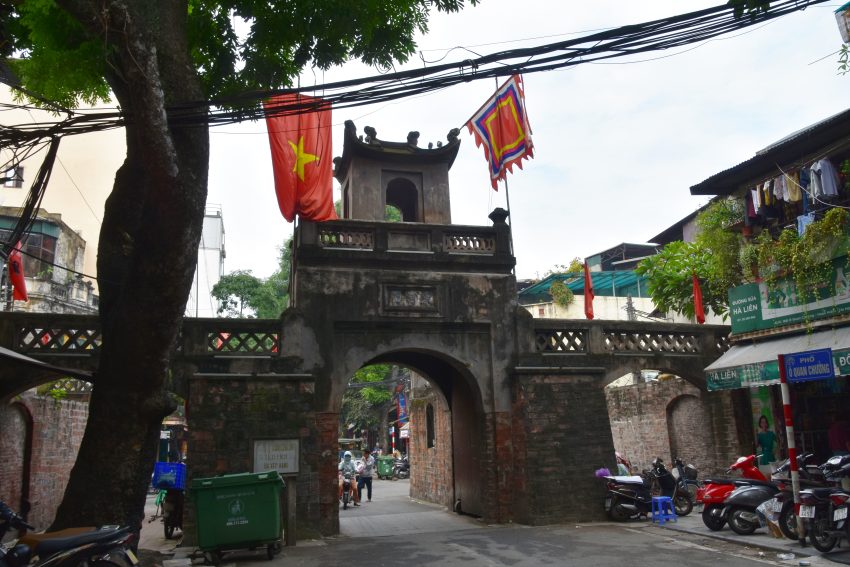
A must-see on your free tour in Hanoi, the Hanoi Old City Gate is a relic of the past. Built in 1749, O Quan Chuong is the last remaining gate of the ancient Thang Long Citadel.

Originally one of 21 entrances to the ancient city, it was named after an army chief, Quan Chuong. The Hanoi East Gate features three arched openings and a two-story watchtower.


Location: Old East Gate, Phố Hàng Chiếu, Old Quarter, Dong Xuan, Hoàn Kiếm, Hanoi, Vietnam | Hours: 24 Hours | Price: Free

8. Dong Xuan Market
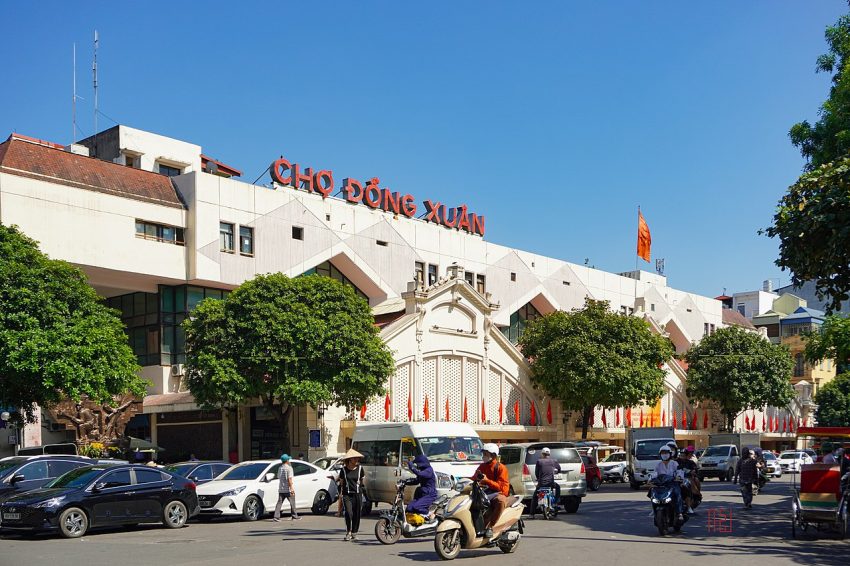
Dong Xuan Market
Dong Xuan Market
CC BY-SA 4.0 / NKSTTSSHNVN

Continue the direction you were heading and walk along P. Thanh Hà as it turns to the left. At the end turn to your right and at the next intersection you will see the Dong Xuan Market on your left.


The sprawling Hanoi market hall, constructed by the French in 1889. As the largest market in Hanoi, the three-story Dong Xuan Market buzzes with activity. Vendors sell everything from clothes and food to household goods—and plenty of counterfeit items, too. Shopping at this market is one of the top activities in Hanoi!


Location: Dong Xuan Market, Old Quarter, Dong Xuan, Hoàn Kiếm, Hanoi, Vietnam | Hours: Open 7-6pm Mon-Thur; 7-12noon (sometimes later) Fri-Sun.

9. Hang Gai Street
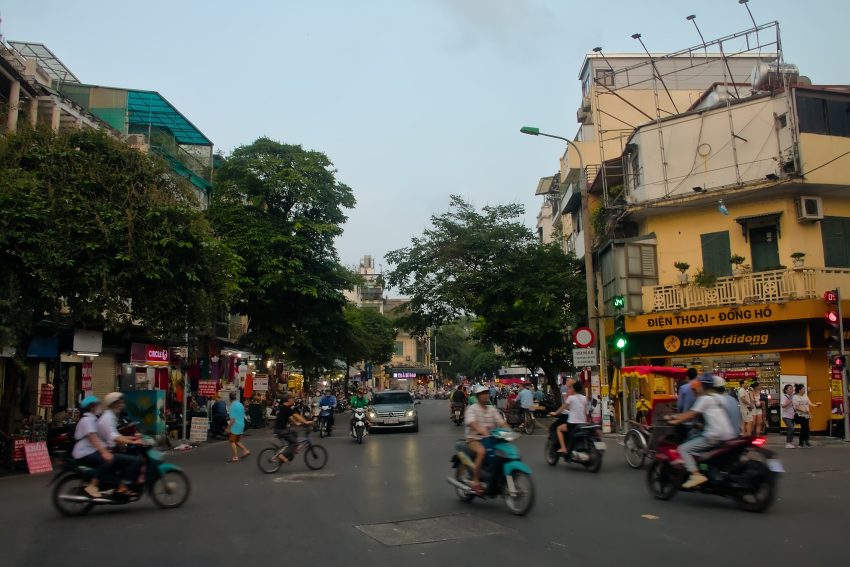
Hanoi   Hang Gai
Hanoi Hang Gai
CC BY-SA 2.0 / Benjamin Smith

From the Dong Xuan Market head south along P. Đồng Xuân, which then turns into Hàng Ngang.

Hàng Ngang, together Hang Dao Street, and Hang Luoc Streets are the location of the Hanoi weekend night market, or Hanoi Old Quarter night market (Friday to Sunday 6 p.m. – 11 p.m). The streets are closed to cars and out come hundreds of stalls offering a wide variety of products, including souvenirs, food, clothing, and Hanoi specialties.

Just before you reach Dong Kinh Nghia Thuc Square and Hoan Kiem Lake turn left.


Also known as Silk Street, this 300-meter-long street is entirely lined with fashion boutiques and local tailor shops that have been operating for decades. Here, you can order custom-made suits and dresses. Located on the edge of Hanoi’s Old Quarter near Hoan Kiem Lake, Silk Street is famous for its high-quality craftsmanship. Two of our top picks on Hang Gai Street are Khai Silk and Tan My Design, both of which offer ready-to-wear pieces – ideal if you’re short on time and can’t wait for a tailor-made outfit during your stay in Hanoi. Suits can be completed within 24 hours, though it’s recommended to allow more time for a second fitting to ensure a perfect fit.


Location: Phố Hàng Gai, Hang Gai, Hoàn Kiếm, Hanoi, Vietnam | Hours: 9:00 am to 8:00 pm

From Hang Gai street head south down P. Lý Quốc Sư to reach St. Joseph's Cathedral and the start of our French Quarter Walking Tour!

Powered by GetYourGuide
Moira & Andy
Moira & Andy

Hey! We're Moira & Andy. From hiking the Camino to trips around Europe in Bert our campervan — we've been traveling together since retirement in 2020!

Read our full story here

This website uses affiliate links which earn a small commission at no additional cost to you.

Walking Tour Summary

Distance: 3.5 km
Sites: 9

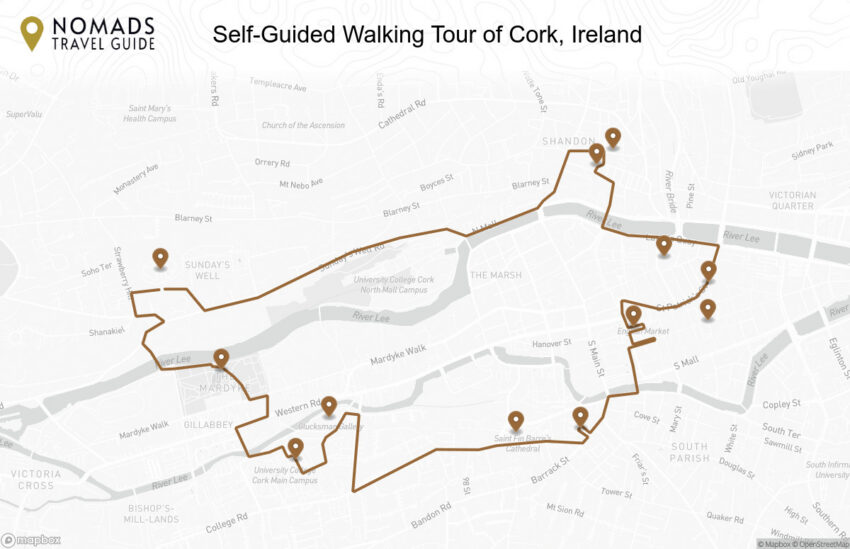
Walking Tour Map
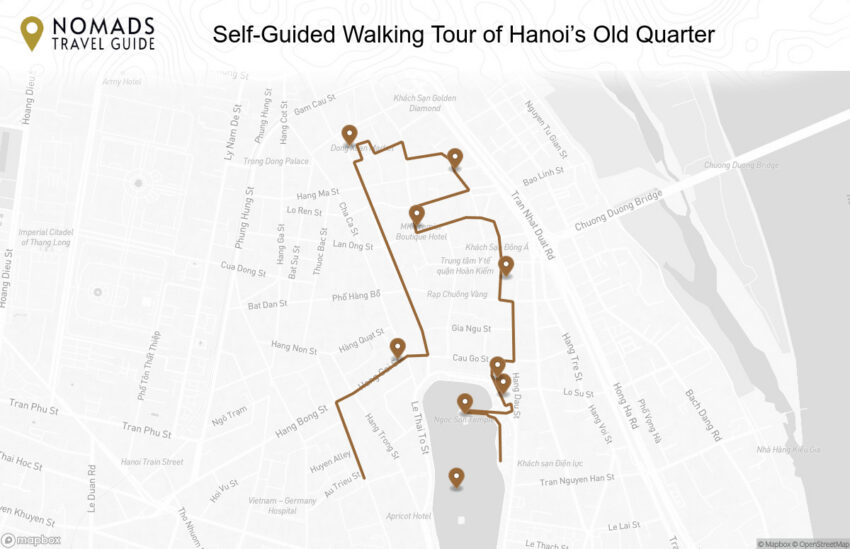
Map of the Self-Guided Walking Tour of Hanoi’s Old Quarter walking route with 9 stops in Hanoi.
Preview map of the Self-Guided Walking Tour of Hanoi’s Old Quarter route in Hanoi, showing 9 stops. Use the interactive map to zoom and tap markers.

More from this area

Self-Guided Walking Tour of Cork, Ireland (2026)

Walking Tour of Cork

This website uses affiliate links which earn a small commission at no additional cost to you.

Cork, Ireland's second city, is a lively mix of waterways, steep streets, and independent spirit. Built on an island in the River Lee, its compact centre is filled with historic architecture, vibrant markets, and a renowned food scene. With a rich maritime past and a strong cultural identity, Cork rewards slow exploration, best done on foot.

From the bustling English Market to the quiet charm of Shandon’s bell tower, Cork’s layered history and local pride shine through. A walking tour is the perfect way to uncover hidden alleys, hear stories of rebellion and trade, and get a real sense of what makes this southern city so special.

How to Get to Cork

By Plane: Cork is served by Cork Airport (ORK), located about 8 km south of the city center. The airport has direct flights from many European cities, and for longer international journeys, travelers often connect via Dublin Airport (DUB) before taking a short domestic flight or a 3-hour drive to Cork. For the best deals and a seamless booking experience, check out these flights to Cork on Booking.com.

By Train: Cork is well connected by rail, with frequent services from Dublin, Limerick, and other major cities. Kent Railway Station is located just east of the city centre, about a 10-minute walk or short bus ride from the central sights. Train schedules and bookings can be found on Omio.

By Car: Cork can be reached via the M8 from Dublin or the N22 from Killarney. Central parking is available at Q-Park Carroll’s Quay or Paul Street Car Park, both of which are conveniently located for exploring the city on foot.

Where to Stay in Cork

To make the most of a walking tour in Cork, stay in or near the city centre. A luxurious option is The River Lee Hotel, which offers modern comfort and views of the River Lee. For boutique style, Hotel Isaacs Cork places you close to the action in the Victorian Quarter. For budget-friendly convenience, Kinlay House Cork is a great base near the Shandon Bells.

Guided or Self-Guided Tour of Cork?

If you're visiting Cork for just a day and want to make the most of your time, consider joining a walking tour with a local guide. The Cork Guided Historical Walking Tour is a 2-hour small-group experience that explores Cork’s origins, uprisings, and evolution through the centuries. Led by a passionate local, the tour brings you past key landmarks like Bishop Lucey Park, the old city walls, Shandon Tower, and the historic English Market-all while weaving in tales of trade, rebellion, and resilience.

A Brief History of Cork

Cork traces its roots back to a 6th-century monastic settlement founded by Saint Fin Barre. By the 12th century, it had grown into a walled trading port under Viking and later Norman influence. The city prospered through maritime trade, particularly with France and Spain, and played a prominent role in Ireland's fight for independence in the 20th century.

Despite fires, sieges, and political upheavals, Cork has maintained its reputation as a city of rebels and resilience. Today, it's a thriving cultural hub known for its music, food, and proud local identity-where the past is never far from the present.

Your Walking Tour of Cork

This blog covers all the major sites of Cork, but you may need to be selective about which venues you enter-you're unlikely to fit them all into one day!

1. Fitzgerald Park: A Tranquil Oasis in Cork

Fitzgeralds Park Cork Ireland
CC BY-SA 3.0 / K.ristof

Named after Edward Fitzgerald, the city’s Lord Mayor who organized Cork’s International Exhibition in 1902, Fitzgerald Park serves as a serene retreat on the outskirts of Cork city. The park still features the original pavilion and ornamental fountain from that era.

Within the gardens, visitors can enjoy a café, various sculptures, a skate park, and a water-lily pond. The picturesque Daly’s Bridge, built in 1926 and known locally as the “Shaky Bridge,” provides a charming connection to Sundays Well Road.

Fitzgerald Park is also home to the Cork Public Museum, housed in the former “Shrubbery House.” This fascinating attraction boasts collections of silver and ceramics, along with exhibits detailing the rich history of Cork.


Location: Fitzgerald Park, Mardyke, Cork, Ireland | Hours: November - February: 8.30 - 17.00 October & MArch: 8.30 - 18.00 April & September 8.30 - 20.00 May & August: 8.30 - 21.00 June & July: 8.30 - 22.00 | Price: Free

Here is a complete selection of hotel options in Cork. Feel free to review each one and choose the stay that best suits your needs.

2. Discover University College Cork: A Blend of History and Modernity

County Cork   University College Cork
County Cork University College Cork
CC BY-SA 4.0 / Michael O'Sheil

From Fitzgerald Park cross over Mardyke Walk and go down Noel Cartwell Walk. Turn right onto Western Road. Turn first left onto Gaol Walk and cross Gaol Bridge. Turn left and walk along River Lee. You will see the University Quad on your right under the archway.


University College Cork (UCC), established in 1845, offers an inspiring blend of old and new architecture, making it a must-visit in Cork City. The UCC Visitor Centre, situated at the heart of the campus, serves as the main information hub and the starting point for regular walking tours. These tours explore the university’s history and culture, featuring landmarks such as the Gothic Revival Quadrangle, Ogham stones, Aula Maxima (Great Hall), and The Glucksman Gallery. Audio tours are also available for a self-guided experience. On campus, visitors can find a variety of shops, whether you’re looking for today’s newspaper, a book on your favorite subject, or a souvenir of your visit to Cork City and UCC. Additionally, there are numerous cafés, bars, and restaurants to choose from, ensuring a pleasant and enriching visit.


Location: University College Cork, College Road, University College, Cork, Ireland

Traveling to a country with a different currency? Avoid ATM transaction fees and pay in local currency with a Wise Card. Having used it for over 5 years, we've saved loads on fees!

3. The Glucksman: An Artistic Hub at University College Cork

Glucksman
Glucksman
CC BY-SA 2.0 / Lewis Glucksman Gallery

With the archway at your back turn left and walk out of the quad towards the amphitheatre. Turn left back to the River lee and The Glucksman.


The Glucksman, situated at the main entrance to University College Cork (UCC), stands as one of Ireland’s leading university art galleries and a vibrant centre for contemporary art. Designed by the acclaimed architects O’Donnell + Tuomey, the award-winning building integrates harmoniously with the surrounding landscape and offers dramatic views over the university’s historic lower grounds. Since its opening in 2004, the Glucksman has developed a reputation for its ambitious exhibitions and innovative programming, showcasing works by both Irish and international artists. It actively engages with themes that bridge art, science, politics, and society, making it more than just a gallery — it’s a platform for cultural dialogue and critical thinking.

Inside, the Glucksman provides a dynamic and welcoming space for students, artists, and the public alike. The gallery’s exhibitions are complemented by an active schedule of talks, performances, and education programmes aimed at all ages. Its commitment to inclusion and accessibility ensures that contemporary art is not only seen but experienced and understood by a broad audience. Whether you’re a first-time visitor or a returning enthusiast, the Glucksman offers a thoughtful and ever-evolving artistic encounter in the heart of Cork. Admission is free, and the gallery is typically open Tuesday to Sunday.


Location: The Glucksman, University College, Cork, Ireland

4. St. Fin Barre's Cathedral: A Gothic Revival Marvel

Saint Fin Barres Cathedral
CC BY-SA 4.0 / Debora Guidi

Head south along Donovan Road and east along College Road unitl you reach St. Fin Barre’s Cathedral.


Europe is rich with cathedrals, but St. Fin Barre’s Cathedral in Cork is one that will undoubtedly leave you in awe. Just a pleasant stroll from St. Patrick’s Street, this magnificent Anglican Cathedral awaits.

The Gothic Revival structure is situated on a site that has been a place of worship since the seventh century. The original church stood until the 12th century, and in the 16th century, a new cathedral was built, which was eventually demolished in the 1800s.

In 1862, architect William Burges’ design was chosen from numerous entries for a new cathedral, with an initial budget of £15,000. By the time it was completed, the cost had soared to over £100,000, but the final result was undeniably worth it. The cathedral was constructed using Cork limestone, with an interior made of Cork marble. Although little of the previous cathedrals remains, nine carved heads and the Dean’s Gate from the medieval structure have survived.

The cathedral’s echoing chambers are beautifully lit through stained-glass panels. One of the interior’s most impressive features is its elaborate pipe organ, built in the 19th century and boasting more than 4,500 pipes. This organ, along with the cathedral’s architectural splendor, makes St. Fin Barre’s a must-visit landmark in Cork.


Location: Saint Fin Barre's Cathedral, Bishop Street, The Lough, Cork, Ireland | Hours: Monday through Saturday from 10 AM to 1 PM and from 2 PM to 5:30 PM.

5. Elizabeth Fort: A Star-Shaped Fortress Rich in History

Cork   Elizabeth Fort
Cork Elizabeth Fort
CC BY-SA 4.0 / Vimalkvn

Head east along Dean Street and Fort Street to reach Elizabeth Fort.


Step back in time with a visit to the 17th-century Elizabeth Fort. Shaped like a star, this historic structure sits on the River Lee, not far from St. Finbarr’s Cathedral. Steeped in history, the fort was first used in 1601 to reinforce the city walls of Cork.

Elizabeth Fort played a significant role in 1690 during the Siege of Cork, when Jacobite forces held the city against attacking Williamite soldiers. Today, it offers a remarkable glimpse into centuries of Cork’s history.

Visitors can explore the fort’s walls on a guided tour or with an audio guide. The best part? Admission is absolutely free, and it offers one of the best views of the city.


Location: Elizabeth Fort, Barrack Street, The Lough, Cork, Ireland | Hours: May–September: Tuesday–Saturday 10:00–17:00; Sunday 12:00–17:00 October–April: Tuesday–Saturday 10:00–17:00; Sunday 12:00–17:00

6. Oliver Plunkett Street

OliverPlunkettStCork
CC BY-SA 4.0 / Charles Curling

Hea up Barrack street, and walk east along the River Lee and cross over the Nano Nagle Pedestrian Bridge and along the Grand Parade. The bridge is named after Nano Nagle (1718 – 1784) was a pioneer of Catholic education in Ireland despite legal prohibitions.

On your right is the National Monument which commemorates the rebellions of 1798, 1803, 1848 and 1867. It was first unveiled on St. Patrick’s day in 1906 and was designed by architect D.J. Coakley. The figure in the middle is the “Maid of Erin”.


Oliver Plunkett Street is a vibrant and historic shopping area in Cork City, perfect for a day of exploring, shopping, and enjoying the local culture. Oliver Plunkett Street is renowned for its diverse range of shops. From high-street brands to unique local boutiques, there’s something for every shopper. Whether you’re looking for fashion, accessories, books, or souvenirs, you’ll find plenty of options to suit your tastes. The street is also a hotspot for dining and nightlife. Numerous cafes, bars, and restaurants line the street, offering a variety of cuisines and atmospheres. Whether you’re in the mood for a quick coffee, a leisurely lunch, or a night out with friends, Oliver Plunkett Street has plenty of choices. Many establishments feature live music, making it a lively spot to enjoy Cork’s vibrant nightlife.


Location: Oliver Plunkett Street, Cork, Ireland

7. The English Market: Cork's Historic Culinary Hub

A fantastic food market in Cork
CC BY-SA 2.0 / WordRidden

Continue along the Grand Parade to reach the English Market.


Located in the heart of Cork City, this distinctive roofed food market, featuring an eye-catching fountain at its center, has been trading since 1788. Owned by the Cork City Council, it is one of the world’s oldest municipal markets. Here, you’ll find a variety of specialties, including artisan breads, fresh fruit, and seafood.

The market gained international fame in 2011 when Queen Elizabeth II of Great Britain visited during her first-ever state visit to the Republic of Ireland. In addition to the wide range of produce, visitors can enjoy a coffee, sample local fare at Farmgate Restaurant, or try freshly prepared meals and snacks from various stalls (though seating is limited).


Location: English Market, Grand Parade, Centre, Cork, Ireland
Powered by GetYourGuide

8. St. Patrick's Street: Cork's Premier Shopping Destination

St. Patricks Street Cork
CC BY-SA 3.0 / Sebastian “sebrem” B…

Continue to walk up Grand Parade. On your left is the Queen’s Old Castle.

The Queen’s Old Castle stands on the site of the medieval King’s Castle and the post-medieval County Courthouse. It became known as the ‘Queen’s Castle’ in honour of the newly coronated English Queen in the late 1830s. In 1835, the Queen’s Old Castle was developed as an elegant department store that survived until 1978.

Daunt’s Square: In medieval times, Cork was enclosed by high stone walls on either side of North and South Main Streets. The area that would become Daunt’s Square was a marshy expanse outside these walls, bordered by rivers that followed the paths of the Grand Parade, St. Patrick’s Street, Daunt’s Square itself, and Cornmarket Street. As Cork expanded beyond its medieval core, the marsh was drained, and the rivers were culverted and paved over. Mid-1700s maps show Daunt’s Bridge crossing the river that once flowed along the Grand Parade and St. Patrick’s Street. This river was filled in and culverted starting in 1714, leading to the formation of Daunt’s Square as a plaza. The exact Daunt after whom the square and bridge were named remains unclear, but it is possibly the 18th-century local surgeon Hungerford Daunt.


Initially conceived in the early 18th century by wealthy merchants eager to part their fellow citizens from their cash, St. Patrick’s Street has remained Cork’s main shopping hub ever since. Just a few minutes’ stroll from The English Market and known locally as “Pana,” this broad, curving street boasts many fine shops and is regarded as one of the best places to shop in Ireland, with the upmarket department store Brown Thomas being a notable highlight.

While shopping is a primary attraction, the sociable nature of Cork’s residents adds to the street’s charm. Particularly during fine weather, visitors will see groups of friends and family chatting and spending time together.

The street’s various architectural styles reflect changes over the past two centuries. Dating from 1786 and rebuilt several times, St. Patrick’s Bridge connects directly to this bustling thoroughfare.


Location: St Patrick's Street, Centre, Cork, Ireland

9. Crawford Art Gallery: A Treasure Trove of Art and History

Crawford Art Gallery
CC BY-SA 4.0 / Digital Eye

At the end of St Patricks Street is a statue to Father Theobald Mathew. Known as the Apostle of Temperance, was born near Cashel in 1790. Ordained as a Capuchin priest in 1814, he spent most of his life serving in Cork, where he became a highly influential figure in the city’s social life during the first half of the nineteenth century. He gained national prominence during the temperance crusade of the late 1830s and 1840s. Beyond his temperance work, Father Mathew was beloved in Cork for his efforts to alleviate suffering during the cholera epidemic of 1832 and the Great Famine from 1845 to 1850. He also played a significant role in the community by purchasing the botanic gardens in Ballyphehane and establishing St. Joseph’s Cemetery on that site.

Turn left and walk along the River Lee. As you pass the Cork Opera House walk left up Half Moon Street to reach Crawford Art Gallery.

Cork Opera House was originally built in the 1850s and was known as the Athenaeum. It went on to become The Munster Hall, The Great & Royal Opera House Company, and finally, Cork Opera House in 1877. It was devastated in a fire in December 1955 and a new front-of-house was built in 1993.


The permanent collections of the Crawford Art Gallery feature a diverse array of paintings, sculptures, and prints, as well as crafts, stained glass, and ceramics. The sculpture galleries include Greco-Roman casts by Antonio Canova and Irish and European sculptures dating from the 19th century to modern times.

The museum’s extensive collection of paintings spans from the 16th century to the present, with a special exhibit dedicated to female artists. The gallery also frequently hosts drop-in creative events, including presentations and hands-on experiences. The Crawford Gallery Cafe is a popular spot for both tourists and locals to enjoy a meal or coffee.


Location: Crawford Municipal Art Gallery, Emmett Place, Centre, Cork, Ireland | Hours: Monday–Saturday 10.00am–5.00pm* Thursday until 8.00pm Sundays and Bank Holidays: 11.00 am–4.00pm | Price: Free

10. Cork Butter Museum

Cork Butter Museum Brands
CC BY-SA 4.0 / Whoisjohngalt

Walk back to the River Lee and walk along with the river on your right. Cross over the Shandon Bridge. The bridge stretches from Kyrl’s Quay (probably named after Sir Richard Kearle) to Pope’s Quay (named for the Widow Pope, who built the quay in the early 1700s). Walk straight across the road and up Widderlings Lane. Widderlings Lane is an intriguing name, possibly named after a Swedish surname. This steep laneway leads up to Dominick Street which you turn left onto.

Walk past the Firkin Crance-Dance centre to the Cork Butter Museum. This heritage building, which was part of the Butter Market was opened in 1855. “Firkin” is a Danish word meaning quarter barrel, the firkins, or casks, were weighed on a balance known as a “Crane”, hence the building’s unusual name.


Situated in Cork’s historic Shandon area, the Cork Butter Museum is unique in its focus on one of Ireland’s greatest success stories: the butter trade. Dairy culture has long been a cornerstone of the economy on the Island of Saints and Scholars. The museum highlights the 19th-century Butter Exchange in Cork, the traditional craft of domestic butter making, and the modern-day popularity of the Kerrygold brand. The exhibits also explore the commercial, social, and domestic aspects of life in Ireland.


Location: The Butter Museum, O'Connell Square, Shandon, Cork, Ireland | Hours: Jun - Sep open daily, Mon - Sat 10.00 - 4.00, Sun 11.00 - 4.00 Oct - Nov, Wed - Sat 10.00 - 4.00, Sun 11.00 - 4.00 | Price: Adults €5.00 | Website

11. Shandon Bells, St. Anne's Church

St. Annes Cork
St. Annes Cork
CC BY-SA 3.0 / Sebastian “sebrem” B…

Turn left out of the Butter museum and walk up Excahnge street to reach Shandon Bells and St. Anne’s Church.


Situated on the north side of the city across the River Lee, St. Anne’s Church (1722) is renowned for its iconic Shandon Bells tower. The church still uses its original 18th-century bells, making it one of Cork’s must-see attractions.

St. Anne’s Tower is a distinctive landmark on the city skyline, featuring a facade of red sandstone on the north and east sides, and white ashlar limestone on the south and west sides. Visitors have the opportunity to ring the bells from the first floor, observe the internal workings of the clocks, see the bells up close, and enjoy spectacular 360-degree views of Cork City and beyond from the balcony. Although the climb consists of 132 steps, the panoramic views make the effort well worthwhile.


Location: Shandon Bells & Tower St Anne's Church, Church Street, Shandon, Cork, Ireland | Hours: Mon-Sat 10.00-16.30 Sun 11:30-16:30 Last Entry 16.00 | Price: Adults €6.00

12. Cork City Gaol: A Journey Through History

Cork city gaol
Cork city gaol
CC BY-SA 2.0 / psyberartist

Walk east along Church Street and left along Shandon St. When you reach the river walk along it with the river on your left.

You pass the Franciscan Well, a renowned craft brewery which occupies the site of a former Franciscan monastery dating back to 1219. The monastery’s walls, including the namesake well, now enclose the pub’s beer garden, where contemporary fermentation vessels are also visible.

When the road splits come away from the river and stay on Sunday’s Well Rd. Stay on this road until you reach Convernt Lane which will take you to Cork City Gaol.


Another must-see attraction in Cork city is the atmospheric and historic Cork City Gaol. Opened in 1824 and closed in 1923, the prison originally housed both male and female prisoners who committed crimes within the city’s borders. In 1878, it became an all-female prison, a status it maintained until 1922-1923 when men opposed to the Anglo-Irish Treaty were incarcerated there.

After its closure, the complex fell into disrepair until it was restored and reopened as a tourist attraction in 1993. For a truly memorable and atmospheric experience, consider booking one of the attraction’s private evening tours.


Location: Cork City Gaol, Convent Avenue, Sunday's Well, Cork, Ireland | Hours: March to October: Monday to Sunday 10am to 5pm November to February: Monday to Sunday 10am to 4pm | Price: €11.00 | Website
Powered by GetYourGuide

From the Cork City Gaol entrance, turn right and then first left and left again on Shanakiel Road. When you are back on Sunday's Well Rd turn right, look for a brown sign pointing you back to Fitzgerald Park.

Powered by GetYourGuide
Moira & Andy
Moira & Andy

Hey! We're Moira & Andy. From hiking the Camino to trips around Europe in Bert our campervan — we've been traveling together since retirement in 2020!

Read our full story here

This website uses affiliate links which earn a small commission at no additional cost to you.

Walking Tour Summary

Distance: 7 km
Sites: 12

Walking Tour Map
Map of the Self-Guided Walking Tour of Cork, Ireland walking route with 12 stops in Cork.
Preview map of the Self-Guided Walking Tour of Cork, Ireland route in Cork, showing 12 stops. Use the interactive map to zoom and tap markers.

Renting a Car in Ireland 2026: A Complete Guide for Travelers

ireland car hire
ireland car hire

This website uses affiliate links which earn a small commission at no additional cost to you.

If you're planning to drive from Dublin to Galway, or perhaps explore the breathtaking landscapes of the Wild Atlantic Way, renting a car in Ireland offers unmatched freedom to discover the country at your own pace. This guide provides comprehensive information on how to rent a car in Ireland, what to expect while driving, and essential tips to enhance your driving experience. From understanding local driving laws and finding the best rental deals to navigating the scenic yet sometimes challenging Irish roads, this guide will equip you with all the necessary knowledge to ensure a smooth and enjoyable journey.

Do I need a car in Ireland?

Whether you rent a car or not depends on what you want to do in Ireland. If you plan to visit major tourist destinations like Dublin, Galway, the Cliffs of Moher, or Killarney, you can easily find tour groups that will take you to these areas by bus.

©

However, if you wanted to discover more of Ireland or wanted to travel at your own pace then a rental car is ideal! I chose to drive in Ireland to truly immerse myself in the country and visit places that a tour bus wouldn't reach-the beautiful, uncrowded hidden gems of the island. While Ireland has plenty of public transportation, it wouldn't take me to the places I wanted to explore.

A car also allows you to explore some of the best road trips in Europe. The Wild Atlantic Way is one of the most famous and my personal favorite Irish road trip. Stretching from Kinsale in West Cork to Donegal, it spans 2,500 km, making it the longest coastal driving route in the world. Another drive I love is the breathtaking Ring of Kerry, which is 180 km long and begins in Killarney, one of Ireland's must-visit towns. Essential stops along the Ring of Kerry include Killarney National Park, Glenbeigh, Caherdaniel, Sneem, and Kenmare.

Where Should I Rent My Car from?

Renting a car from the airport is the most convenient option. You can rent a car from Shannon Airport, Cork Airport, Kerry Airport, and major cities like Dublin and Galway.

I recommend using Discover Cars to search and compare rental options. I always use their website to book rental cars for the best prices. You can search multiple companies and find the best rates online.

Renting a Car in Ireland: Insurance Explained

Unlike in many other countries, you must purchase Collision Damage Waiver (CDW) insurance in Ireland. Most credit cards do not include CDW insurance for Ireland, so you'll need to buy it when renting a car there. Typically, rental cars in Ireland come with a basic CDW, but this isn't true insurance. It only covers up to €1,000-3,000 worth of damage and doesn't include tire, cracked windshield, or undercarriage damage. This amount is held on your credit card until you return the car undamaged.

Excess Damage/Super Damage (Super Collision Damage Waiver) insurance is an additional cost but covers minor damages such as scratches, dents, and small bumps, which are common on Ireland’s roads. Even if you are an exceptionally careful driver, Ireland’s roads can still cause damage to your car. The roads can be incredibly narrow, and you’re likely to encounter rocks, debris, and branches.

Your Credit Card Company May Cover CDW Insurance

While you can often save money by booking with a travel credit card that includes car rental insurance, it's crucial to read the fine print. Many people mistakenly believe their card covers them in Ireland when it doesn't. If you decline full coverage, get into an accident, and discover your credit card doesn't cover the damage, you'll be in a tough spot. I've heard countless travel horror stories about this.

Car rental agencies may also ask you to prove that your credit card covers car rental insurance. To prepare for this, you can call your credit card company ahead of time and request they email you a letter verifying this coverage.

Do you need an International Driver’s License to Rent a Car in Ireland?

If you have a valid driving license issued by an EU or EEA country, you can rent a car in Ireland without needing an International Driver's Permit (IDP). If your driving license is issued by a country outside the EU or EEA, you can use your home country's driving license for renting a car in Ireland. However, it is recommended to have an International Driver's Permit (IDP) if your original license is not in English.

[car_hire country=”Ireland”]

What size car should I rent in Ireland?

Opt for a small car if possible, as the roads in Ireland are very narrow. This will also help you save on fuel costs, as gas prices are high. However, ensure the car you choose can accommodate everyone in your party, as well as your luggage. Some compact cars can be quite small, so make sure they'll fit you and your belongings.

Our rental car wasn’t the smallest option available, but it comfortably fit two suitcases and carry-on bags in the trunk. When selecting your rental car, the rental agency will typically specify how many people can fit in the car and how much luggage the trunk can hold.

©

Toll Roads in Ireland

Ireland has several toll roads, primarily located on major motorways and key routes across the country. These toll roads help maintain and improve the national road network, ensuring smoother and faster travel for drivers. The most notable toll roads include the M50 around Dublin, which is the busiest and most significant, and other major motorways like the M1, M6, M7, and M8.

The M50, Dublin’s ring road, operates an electronic barrier-free tolling system known as eFlow. There are no physical toll booths on this road; instead, cameras capture your vehicle’s license plate, and the toll must be paid either online, by phone, or at designated retail outlets before 8 PM the following day. Failure to pay on time results in significant fines.

Other toll roads in Ireland typically use traditional toll plazas where you can pay with cash or card. These plazas are well-marked, and the fees are generally between €1.90 and €3.10 for cars, depending on the specific road. It's advisable to carry some change or have a contactless payment option available when traveling on these routes.

For frequent users, many toll roads offer a tag system, where you can affix an electronic tag to your windshield that automatically deducts the toll fee as you pass through. This system is convenient for regular commuters and helps avoid delays at toll plazas.

Age Requirements For Renting A Car in Ireland

The minimum legal driving age in Ireland is 18, but most car rental companies require drivers to be at least 21 years old to rent a car. Additionally, they often impose an extra fee for drivers under 24 years old.

Moira & Andy
Moira & Andy

Hey! We're Moira & Andy. From hiking the Camino to trips around Europe in Bert our campervan — we've been traveling together since retirement in 2020!

Read our full story here

This website uses affiliate links which earn a small commission at no additional cost to you.

Self-Guided Walking Tour of Galway, Ireland (2026)

galway hookers
galway hookers

This website uses affiliate links which earn a small commission at no additional cost to you.

Galway, on Ireland's rugged west coast, blends traditional Irish culture with a youthful, bohemian energy. Known for its medieval streets, vibrant music scene, and colourful shopfronts, this harbour city is a hub of creativity and history. Compact and charming, Galway is best explored on foot, revealing lively markets, historic churches, and ocean views at every turn.

Whether you're wandering down Latin Quarter lanes, tracing the city's medieval walls, or enjoying the sounds of street performers, Galway offers an unforgettable experience. A walking tour gives you a deep sense of the city's unique rhythm, where ancient traditions meet modern flair.

How to Get to Galway

By Plane: Galway is served by Ireland West Airport Knock (NOC), about 90 minutes away by car, and Shannon Airport (SNN), roughly two hours away. Direct flights to Galway itself are limited, so most visitors fly into Dublin Airport (DUB) and take a domestic flight, train, or bus for the 2-3 hour journey west to the city. For the best deals and a seamless booking experience, check out these flights to Galway on Booking.com.

By Train: Galway is well connected by rail to Dublin, with regular trains arriving at Ceannt Station, just a few minutes’ walk from Eyre Square and the city centre. Train schedules and bookings can be found on Omio.

By Car: Galway is accessible via the M6 motorway from Dublin. There is a small free parking are near to town at Nimmo’s Peir. There is also parking at the Aquarium in Salthill (height restricted). A convenient paid parking is available at Dyke Road Car Park,, both of which are centrally located and within walking distance of the historic core.

Where to Stay in Galway

To make the most of a walking tour in Galway, stay in or near the Latin Quarter or Eyre Square. A luxury option is The Hardiman, offering classic elegance in the heart of the city. For boutique comfort, The House Hotel combines modern design with a great location. Budget travellers will appreciate Snoozles Hostel, which offers affordable accommodation just steps from the train station.

Guided or Self-Guided Tour of Galway?

If you're visiting Galway for just a day and want to get the most out of your time, consider a walking tour with a local guide. The Welcome to Galway: Small Group Walking Tour is a highly rated 75-minute experience that introduces you to the heart of the city. Starting in Eyre Square, this tour takes you through Galway’s historic lanes, past landmarks like Lynch’s Castle, the Spanish Arch, and St. Nicholas’ Collegiate Church. Along the way, your guide will share fascinating stories about Galway’s merchant roots, music culture, and legendary traditions-making it a perfect introduction to the city. If you want to look into the history of Galway city then the Dark History Walking Tour, run by Fáilte Ireland may be better.

A Brief History of Galway

Founded in the 12th century at the mouth of the River Corrib, Galway grew from a small fishing village into a flourishing medieval walled town. It became a centre of trade with Spain and France, earning it the nickname “City of the Tribes” after the 14 ruling merchant families who governed it for centuries. Remnants of this golden age are still visible in stone facades, city walls, and the famous Lynch's Castle.

Galway’s history also includes periods of decline and revival-from Cromwellian sieges to the cultural renaissance of the 20th century. Today, it’s a vibrant university city known for its festivals, street culture, and deep sense of Irish identity.

Your Walking Tour of Galway

This blog covers all the major sites of Galway, but you may need to be selective about which venues you enter-you're unlikely to fit them all into one day!

1. Eyre Square

The Tribes of Galway Eyre Square
CC BY-SA 2.0 / Eoin Gardiner

The tour starts at Eyre Square, have a look round and head towards the Browne Doorway.


Nestled among shops, cafes, and historic sites, Eyre Square serves as an ideal starting point for those looking to dive into the vibrant life of Galway. This central spot originated as a medieval open area in front of the town gate, once known as the Green. The land that transformed into Eyre Square was formally gifted to the city in 1710 by Mayor Edward Eyre, after whom the square is named. In 1965, it was officially renamed “John F. Kennedy Memorial Park” to honor U.S. President John F. Kennedy following his visit and speech there on June 29, 1963. Despite this official change, locals and visitors alike continue to refer to it as Eyre Square.


Location: Eyre Square, Eyre Square, Galway, Ireland | Hours: 24 hors | Price: Free

Here is a complete selection of hotel options in Galway. Feel free to review each one and choose the stay that best suits your needs.

2. The Browne Doorway

The Browne Doorway Eyre Square Galway
CC BY-SA 3.0 / Bob Linsdell

Originally situated on Abbeygate Street in the heart of Galway, the Browne Doorway was relocated in 1904 to become the entrance to the nearby park, where it remained until the park’s redevelopment in 2006. This historic doorway was once part of the townhouse belonging to the Browne family, who were prominent members of the 14 Tribes of Galway. These tribes were influential merchant families who greatly prospered after the city was officially incorporated in 1484.

The Browne Doorway is not only a piece of architectural heritage but also a symbol of the city’s mercantile history. If you observe the area around the doorway, you will notice 14 flagpoles, each bearing the coat of arms of one of the tribes. Of these 14 families, 12 were of English descent and two of Irish origin, reflecting the social dynamics of the time. These families often intermarried, a strategy aimed at consolidating their power and influence within the city. To commemorate these alliances, they frequently commissioned sculptures or marriage stones, which served both as art and as public records of their familial and political connections. The Browne Doorway, with its detailed carvings and historical significance, continues to be a focal point for those exploring Galway’s rich past.


Location: The Browne Doorway, Eyre Square, Galway, Ireland

Traveling to a country with a different currency? Avoid ATM transaction fees and pay in local currency with a Wise Card. Having used it for over 5 years, we've saved loads on fees!

3. The Statue of Oscar Wilde and Eduard Vilde

Oscar Wilde and Eduard Vilde
CC BY-SA 2.0 / Oliver Dixon

From Eyre Square head south west along Williamsgate Street. Bear stright ahead onto the pedestianised William St and you will soon see the Statue of Oscar Wilde and Eduard Vilde on your right.


Unveiled in 1997, this distinctive monument features the celebrated Irish playwright and poet Oscar Wilde on the left, and the esteemed Estonian writer Eduard Vilde on the right. The statue highlights the significant contributions both writers made to their respective cultural spheres and to the worldwide literary scene. It underscores the notion that literature goes beyond national borders and promotes unity among peoples from diverse backgrounds.


Location: Statue of Oscar Wilde and Eduard Vilde, William Street, Galway, Ireland

4. Lynch’s Castle

Lynch Castle Shop St Galway
CC BY-SA 3.0 / Bob Linsdell

Continue along Williams St until you reach the next juction with Abbeygate Street. The building on the corner of Abbeygate and Williams St is Lynch’s Castle.


Lynch’s Castle, is one of the finest town castle in Ireland, with its earliest origins in the 14th century although most of what you see today stems from the 16th. It was built by the Lynch family, a leading merchant clan in Galway. This structure served both as a family home and as a testament to their wealth and status. Its most striking feature is the elaborate sandstone carvings that adorn its exterior, featuring intricate details and sculptures that capture both biblical and mythological scenes. The Lynch family crest is also prominently displayed on the building’s facade. Today, the castle is remarkably well-preserved and functions as a branch of the Allied Irish Banks (AIB), making it the oldest building in Ireland still in commercial use.


Location: Lynch's Castle, Shop Street, Galway, Ireland | Hours: Visitors are welcome to explore the ground floor during business hours.

5. Lynch Memorial Window

Lynch Memorial Window Market St Galway
CC BY-SA 3.0 / Bob Linsdell

Walk up Abbeygate Street Upper and turn first left down Market Street. Lynch Memorial Window in on your left.


This window marks the site of one of Galway’s most famous legends. Local lore holds that in 1493, James Lynch FitzStephen, the mayor of Galway, executed his own son by hanging him from the window of his house. This act is where the term “lynching” is believed to have originated, following his son’s murder of a Spanish guest under their protection. Known as Lynch’s Window, this historical point is located on Market Street beside St. Nicholas’ Church.


Location: Lynch Memorial Window, Market Street, Galway, Ireland

6. Collegiate Church of Saint Nicholas

Galway St Nicholas
Galway St Nicholas
CC BY-SA 4.0 / Gerd Eichmann

Continue walking down Lombard Street and Saint Nicholas’ Collegiate Church is on your left. Most Saturdays there is a Farmers market along Church Yard Street.


Topped with a pyramidal spire, the Collegiate Church of St Nicholas of Myra stands as Ireland’s largest medieval parish church still in operation. Finalized by 1320, the church has undergone numerous renovations and expansions through the years yet preserves much of its initial architecture. The church has a strong maritime connection, dedicated to St Nicholas, the patron saint of sailors, and it is said that Christopher Columbus once worshipped here in 1477. Typically quiet during the day, the church offers a peaceful retreat from the bustle of Galway, welcoming visitors to its serene environment.

Location: Saint Nicholas' Collegiate Church, St. Nicholas Collegiate Church, Lombard Street, Galway, Ireland

7. The Latin Quarter

Galway Latin Quarter
GNU 1.2 / Tofts at Faroese Wikipedia

Walk alongside Collegiate Church of Saint Nicholas along Churchyard St. At the end turn right along High Street. This street and Quay Street are the heart Latin Quarter.


The Latin Quarter, often called the cultural heart of Galway, is a vibrant area known for its eclectic mix of shops, pubs, restaurants, and hotels, as well as historic landmarks and events. This popular destination for locals and visitors alike boasts pedestrian-friendly cobblestone streets, creating a festive atmosphere often filled with street performers and entertainers. Defined by historic landmarks, the Latin Quarter stretches from the Spanish Arch at Long Walk to O’Brien’s Bridge, to St Nicholas’ Church, and back to An Taibhdhearc on Middle Street via Buttermilk Lane. It serves as the lively heartbeat of the City of the Tribes.


Location: The Latin Quarter, High Street, Galway, Ireland

8. Kirwan's Lane

Kirwans Lane
Kirwans Lane
GNU 1.2 / Tofts

As you reach Quay street turn right up Cross Street Upper and turn left into Kirwan’s Lane.


This narrow, cobbled street is considered one of only five remaining medieval lanes in Galway, out of an original fourteen. Dating back to the 16th century, it stands as the city’s finest example of its historic medieval lanes.

The lane was named after the Kirwan family, one of only two of the ‘tribes’ of Galway of Gaelic origin. Arriving in the city around 1490, the Kirwans were prosperous merchants and landowners. Their wealth significantly contributed to Galway’s peak of splendor during the 16th and 17th centuries.


Location: Kirwan's Lane, Galway, Ireland

9. Hall of the Red Earl

Hall of the Red Earl
© thisisgalway.ie

At the end of Kirwan’s Lane turn left and walk along Quay Street.

Quay Street in Galway is a vibrant and bustling thoroughfare, renowned for its lively atmosphere and rich cultural heritage. Lined with colorful storefronts, traditional pubs, and a variety of restaurants, it offers a delightful blend of local cuisine and international flavors. Street performers and musicians add to the lively ambiance, making it a popular spot for both locals and tourists. Its historic charm, combined with contemporary attractions, makes Quay Street a must-visit destination in the heart of Galway.

Half way up turn right into Druids Lane, the ruins of the Hall of the Red Earl are on your right.


The Hall of the Red Earl, a significant archaeological site in Galway, serves as a vivid reminder of the city’s medieval past. Named after Richard de Burgo, the Earl of Ulster, known as the Red Earl, who played a crucial role in the city’s development during the 13th century. This hall was Galway’s first municipal building, functioning as a hub for administrative and judicial activities including tax collection, the dispensation of justice, and hosting banquets. Located in the heart of Galway near the Spanish Arch, the site was uncovered in 1997 during a construction project, revealing a wealth of artifacts and remnants that provide insights into daily life in medieval Galway. Today, the Hall of the Red Earl is managed by the Galway Civic Trust and has been preserved as an open archaeological site, where visitors can explore the ruins and learn about its historical context through various displays and interpretive signs, making it a cornerstone for cultural heritage in the city.


Location: Hall of the Red Earl, Druid Lane, Galway, Ireland

10. Galway City Museum

Galway City Museum
Galway City Museum
GNU 1.2 / paddy (Patrick-Emil Zörner)

At the end of Druid Lane, turn right onto Flood Street, at the end turn left onto Spanish Parade. The Museum is on your right.


Founded in the mid-1970s, the Galway City Museum was initially housed in Comerford House next to the Spanish Arch. In April 2007, the museum transitioned to a new, purpose-built facility located just behind the original site at Comerford House. This move was part of an initiative by the Galway City Council to enrich the cultural and heritage landscape of Galway City.

The Galway City Museum is dedicated to collecting, preserving, and exhibiting items that chronicle the history of Galway City. Its collections span various domains including Archaeology, Art, Geology, Natural History, as well as Social, Political, Industrial History, and Folk-life, providing comprehensive insights into the city’s rich and diverse heritage.


Location: Galway City Museum, Spanish Parade, Galway, Ireland | Hours: Tuesday to Saturday, 10am – 5pm Sunday, 12pm - 5pm (until September) Closed Christmas Day, Stephen’s Day and Good Friday | Price: Free | Website

11. Spanish Arch

The Spanish Arch Spanish Parade Galway
CC BY-SA 3.0 / Bob Linsdell

From the Museum entrance you can see the old Medieval wall and the Spanish Arch.


Constructed in 1584 as an addition to the 12th-century Norman town wall, this iconic arch is an integral part of Galway’s medieval fortifications and stands as a testament to the city’s deep-seated maritime history. Originally serving both a defensive role and as a gateway for maritime trade, ships would pass through the arch to offload goods at the bustling Claddagh Quay. Over time, the Spanish Arch has evolved into a beloved landmark, attracting both locals and visitors who come to enjoy the scenic views of the River Corrib and its environs. Today, it merges historical significance with the lively atmosphere of Galway, offering a picturesque slice of the city’s enduring connection to the sea.


Location: Spanish Arch, The Long Walk, Galway, Ireland | Hours: 24 HOURS | Price: Free

12. The Long Walk

The Long Walk Galway
CC BY-SA 2.0 / Nadia Prigoda-Lee

The best view of the long Walk is from acros the river, so head through the Spanish Arch and cross the square to the Wolfe Tone Bridge. Half way across the Wolfe Tone Bridge you can turn left to walk along the banks of the River Corrib. There are great views of the Long Walk from Eglinton Canal Sea Lock.


This picturesque row of 18th-century houses, known for their vividly painted facades, is a cherished feature of Galway’s cityscape, offering stunning views of Galway Bay and the Claddagh neighborhood. The Long Walk, as it is called, traces its origins back to the 18th century, a period of substantial growth and development for the city. Initially constructed to accommodate affluent merchants and fishermen, these homes reflect Galway’s profound maritime roots. Through the years, these historic structures have borne witness to Galway’s evolution from a thriving trade port to a dynamic center of culture and tourism. Today, The Long Walk stands as not only a picturesque location but also a testament to Galway’s rich heritage and its lasting bond with the sea. It’s an ideal place for visitors to enjoy leisurely walks along the promenade, soak in views of the river, observe the nearby Spanish Arch, and experience the lively ambiance of the city.


Location: The Long Walk, Galway, Ireland

13. Galway Fisheries Watchtower Museum

Watch Tower   Galway
Watch Tower Galway
CC BY-SA 2.0 / Ian Capper

Walk back to the Wolfe Tone Bridge, across the road is the Galway Fisheries Watchtower Museum.


The Galway Fisheries Watchtower Museum, nestled along the River Corrib near the Spanish Arch, is a unique landmark with a storied past that dates back to 1853. Originally built by the Ashworth family as a draft netting station, this distinctive structure later served as a watchtower where fishery staff monitored for illegal fishing activities. After falling into disrepair, the building was lovingly restored and opened as a museum in 2015, thanks to efforts by the Galway Civic Trust. Today, the museum offers visitors a fascinating glimpse into Galway’s rich history of river fishing through a collection of artifacts, memorabilia, and photographs. Its panoramic views of the River Corrib and the Claddagh add to the allure, making it a cherished spot for both history enthusiasts and casual visitors looking to capture the essence of Galway’s maritime heritage.


Location: The Fisheries Watchtower Museum, Wolfe Tone Bridge, Galway, Ireland

14. Galway Cathedral

Galway   Cathedral of Our Lady Assumed into Heaven and St Nicholas Galway
Galway Cathedral of Our Lady Assumed into Heaven and St Nicholas Galway
CC BY-SA 4.0 / Olliebailie

Continue to corss the Bridge and turn right to walk along Raven Terrace. At the end cross over Ball’s Bridge and walk up Dominick St Lower. At the end turn left then right to cross over the Nun’s Island.

The area known as Nuns Island gets its name from the Convent of the Poor Clares situated there. This religious order, established in 1212 by Clare of Assisi, a follower of St. Francis of Assisi, adheres to strict vows of silence and poverty. In medieval times, the sisters rang a bell when they needed food, prompting the local community to bring alms. Although the convent remains active today, the alms bell is no longer in use. Additionally, the impressive green dome to your right belongs to Galway Catholic Cathedral.

Continue to walk on Nun’s island Road and turn right before you reach the Poor Clare Convent. Following the road round you come to Galway Cathedral.


The Cathedral of Our Lady Assumed into Heaven and St Nicholas is among the most prominent and majestic structures in the city, located on Gaol Road. This Roman Catholic cathedral, whose construction commenced in 1958 and concluded in 1965, stands as one of the last great stone cathedrals built in Europe. It features Renaissance-style pillars and a dome, and its numerous mosaics and rose windows are truly stunning.


| Hours: 8:30 am to 6:30 pm | Price: Free

15. National University of Ireland Quadrangle

NUI Galway
NUI Galway
CC BY-SA 4.0 / 瑞丽江的河水

At the back of the Cathedral head left along University Road. after crossing over two bridges of the Eglinton Canal, Turn right into the University Grounds, the Quadrangle is in the large building in front of you.

The Eglinton Canal, built between 1848 and 1852, is a short canal, about three quarters of a mile long, that allowed a connection between Lough Corrib and Galway Bay.


The Quadrangle at the National University of Ireland, Galway (NUIG) is one of the most iconic and historic buildings on the campus. Reminiscent of the architectural style of the University of Oxford, particularly Christ Church, the Quadrangle exudes a classic collegiate gothic charm that has become synonymous with the university’s identity.

Constructed in the mid-19th century, the Quadrangle was the original building of what was then known as Queen’s College Galway, established in 1849. Its richly decorated limestone façade features turrets, intricately carved windows, and gothic arches, making it a visually striking landmark.

Beyond its architectural beauty, the Quadrangle holds a central place in the university’s academic and administrative life. Originally housing all of the university’s functions, including lecture rooms, laboratories, and offices, it now primarily serves administrative roles and is home to several key offices, including those of the university’s senior administration.

The Quadrangle is not just a hub of administrative activity but also a favorite spot among students, faculty, and visitors for its historical ambiance and as a picturesque backdrop for photographs, particularly during graduation ceremonies. Its central lawn is a common gathering place for various university events and celebrations, further cementing the Quadrangle’s role as a heart of campus life at NUIG.


Location: National University of Ireland, Galway, University Road, Galway, Ireland

16. Salmon Weir Bridge

Salmon Weir Bridge
Salmon Weir Bridge
CC BY-SA 4.0 / Gyula Torok

Walk to the to rear of the open air car park and cross over O’Shaughnessy Bridge. Walk around the Fisheries Field back towards the Cathedral and the Salmon Weir Bridge.


The Salmon Weir Bridge, built in 1818, is a historic structure spanning the River Corrib in Galway, Ireland. Situated near the Galway Cathedral, it serves as a vital link between the city center and the university district. Originally constructed to facilitate access between the old city jail and the courthouse, the bridge now serves a more scenic and recreational role. It is particularly popular during the salmon migration seasons in May and September when the bridge provides a prime vantage point for spectators hoping to catch a glimpse of the salmon as they leap upstream to spawn. The bridge’s proximity to significant city landmarks and its role in local salmon fishing traditions make it a cherished site, embodying both the natural beauty and the historical tapestry of Galway.


Location: Salmon Weir Bridge, University Road, Galway, Ireland

You can make your war back to Eyre Square along Eglinton St.

Powered by GetYourGuide
Moira & Andy
Moira & Andy

Hey! We're Moira & Andy. From hiking the Camino to trips around Europe in Bert our campervan — we've been traveling together since retirement in 2020!

Read our full story here

This website uses affiliate links which earn a small commission at no additional cost to you.

Walking Tour Summary

Distance: 4 km
Sites: 16

Walking Tour Map
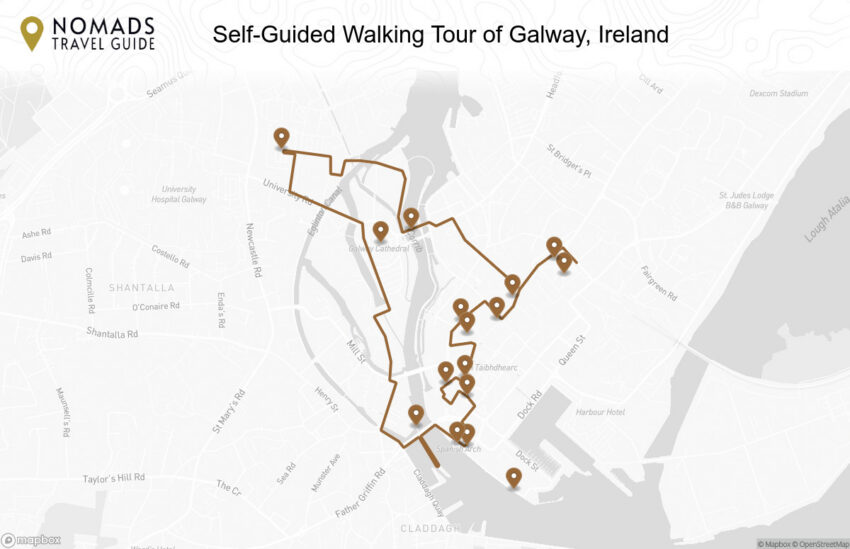
Map of the Self-Guided Walking Tour of Galway, Ireland walking route with 16 stops in Galway.
Preview map of the Self-Guided Walking Tour of Galway, Ireland route in Galway, showing 16 stops. Use the interactive map to zoom and tap markers.

More from this area

Renting a Car in Portugal 2026: A Complete Guide for Travelers

portugal car hire
portugal car hire

This website uses affiliate links which earn a small commission at no additional cost to you.

Welcome to Portugal, a picturesque gem in Europe. With its breathtaking coastlines ideal for surfing, varied national parks, verdant vineyard-covered hills, and cities rich in history, there is certainly much to explore here. The best way to experience all that Portugal has to offer is by driving. Travel at your leisure and uncover hidden treasures on your personal road trip.

How to rent a car in Portugal

Portugal is often synonymous with the vibrant streets of Lisbon or the renowned beaches of the Algarve region in the south. Yet, there is so much more to explore beyond these popular areas. Public transportation becomes scarce once you leave the major cities and is typically restricted by schedules. To truly experience the lush vineyards, stunning coastal cliffs, and ancient cities at your own pace, traveling by car is ideal. This guide will provide detailed instructions on how to rent a car in Portugal and what driving in the country entails.

©

What do you need to rent a car in Portugal? 

When renting a car in Portugal, make sure to have the following documents with you:

  • Your driver’s license from your home country
  • Your passport (as a form of ID)
  • A credit card issued in your name
  • An International Driver’s Permit (recommended)

While you can legally drive in Portugal at 18, renting a car usually requires you to be older. Most companies set a minimum age of 21, and some might even require you to have held your license for at least a year. To rent a car, you'll always need to show a valid driver's license, identification proving your identity, and a credit card for payment.

Please Note: Most car rentals in Portugal do charge an extra fee if you're under 25 years old.

For non-EU citizens with an English or Portuguese license, an International Driver’s Permit (IDP) isn’t legally required in Portugal. However, if your European travels extend beyond Portugal, consider getting an IDP. It's mandatory in some countries, like Spain, for non-EU drivers with foreign licenses.

Rental car insurance in Portugal

Renting a car in Portugal automatically includes basic third-party liability insurance, which covers damage to other vehicles you might accidentally hit. However, this type of insurance often comes with an “excess” - a deductible amount you'd still be responsible for if your rental car is damaged.

To minimize your financial risk, consider adding additional coverage that lowers your excess. It’s a good idea to check if your travel credit card offers such coverage, especially if you use that card to reserve and pay for your rental.

If your credit card doesn’t provide any coverage, most rental companies allow you to pay a daily fee to waive the excess on the Collision Damage Waiver (CDW). This eliminates your financial responsibility for any accidental damage to the rental car.

We highly recommend opting for full coverage, especially if you’ll be driving in busy cities. Unexpected nicks or dents can happen easily, and full coverage offers peace of mind. An added benefit is that full coverage often speeds up the car return process, as there’s no need to debate who’s responsible for minor damage.

  • Beware the deductible: This type of insurance usually comes with a deductible, which is the amount you’d still be responsible for if there’s damage. The rental agency might put a hold on your credit card for this amount, so make sure you have enough available credit.
  • Extra coverage is optional: You’re not obligated to buy extra insurance, but it can provide peace of mind. If you’re interested, book it at the same time as your car rental to get the best price.
  • Check your credit card: Some credit cards offer car rental insurance for Portugal. It's worth checking your card's policy before you decide to buy additional coverage from the rental company.

Crossing borders with your rental car:

  • Inform the rental company: If you plan to drive your rental car into Spain or any other country, letting the rental company know beforehand is crucial. There are two main reasons for this:
    • An extra fee typically applies for crossing borders. Failing to tell the company can void your insurance.
    • Different insurance requirements might exist in other countries. It’s always best to clarify these details before signing the contract.

[car_hire_portugal]

Is it easy to drive in Portugal?

©

Portugal offers a smooth driving experience with a well-maintained road network. Recent construction projects have kept many roads in great condition, making road trips a breeze. Here's a quick rundown of the different road types and their corresponding speed limits:

  • Motorways: Buckle up for speeds of up to 120 km/h.
  • Departmental roads: These open roads dominate the countryside and allow you to cruise at 90 km/h.
  • Mountain roads and residential areas: Keep your speed down to 50 km/h for safety reasons.

Be aware of the “velocidade controlada” traffic light signs you’ll find in most residential areas. These signs warn you about an upcoming traffic light and indicate the need to slow down to 50 km/h as you enter the town or city.

Traveling with a trailer? Remember to adjust your speed accordingly! Here are the reduced speed limits for towing a trailer in Portugal:

  • Motorways: 100 km/h (down from 120 km/h)
  • Open roads: 70 km/h (down from 90 km/h)

Heads-up for busy areas:

  • Cities and the Algarve: Traffic jams and congestion can occur, especially during peak season. Consider these factors when planning your route.
  • Historic centers and villages: Narrow streets are common. Exploring these areas on foot is often the best way to experience their charm.

[car_hire_portugal]

Mountain driving:

  • Conditions: Most mountain roads are well-maintained, but cautious driving is essential due to winding roads and potential drop-offs.
  • Winter travel: Snow chains might be required in the mountains during winter. Ask your rental company about snow chain availability when picking up your car.

Top tips for renting a car in Portugal

Renting a car:

  • Do a thorough check: Upon pickup, inspect the car for existing damage and ensure it has a warning triangle, reflective vest, and spare wheel. Take pictures of any damage and the fuel gauge reading.
  • Smaller car for convenience: Opt for a smaller car for easier navigation on narrow streets and parking. Consider declining upgrades unless you have specific needs.
    N.B. If you are in Madiera then choose a small car with a hefty engine, the hills are steep!
  • Carry your Documents: Always carry your rental agreement, valid licence and photo ID with you in the car.
  • City driving? Skip the car: Public transportation is often a better option in major cities due to traffic, narrow streets, and limited parking.

Driving in Portugal:

  • Navigation tips: Use an updated navigation system and prioritize main roads over shortcuts suggested by your navigation system, especially in cities.
  • Toll roads: Portugal uses electronic tolls (e-tolls) via a Via Verde transponder. Rental companies typically offer these with your rental; the cost is deducted from your credit card. Alternatively, register for EasyToll online and link your license plate with a credit card.
  • Fueling your car: Gas stations are widely available, but consider planning ahead in Alentejo. Use the 1-2-3 Fuel app to find the cheapest stations. Portugal has relatively expensive fuel (around €2.04 per liter). Choose diesel (gasoleo) or unleaded petrol (gasolina sem chumbo 95 or 98). Check the fuel type sticker on your car if unsure. Electric car charging stations can be found on Google Maps.

Additional notes:

  • Not paying tolls without e-tolls or EasyToll can result in a fine (applicable only in southern Portugal without toll booths).
  • Winter travel in mountainous regions might require snow chains; check with your rental company.
  • Seat belts must be worn in both front and back seats

Where do I rent a car in Portugal?

Portugal offers a variety of reputable car rental companies to choose from. They have offices conveniently located in major cities, airports, and on islands like Madeira and the Azores. Booking your car in advance is particularly wise for summer travel. This ensures you get the car type you desire, potentially at a better price, and gives you more time to compare different rental options.

[car_hire_portugal]

Parking your car in Portugal

A white or blue sign with a red circle and diagonal cross, means don’t park. Yellow and red lines on curbs also mean “no parking.” Always park in the direction of traffic flow when using street parking

City Parking:

  • Street Parking: Forget free spots – most are paid with coin meters. Rates range from €0.80 to €3 per hour depending on the zone.
  • Free Night Parking: Look for marked areas with free parking between 7pm and 9am (check signs for variations). Great for overnight stays near your hotel.
  • Parking Garages: Consider garages for longer stays. Most offer hourly and daily rates displayed upfront.
  • Hotel Tip: While hotels recommend garages, do your own research! We found a cheaper option near our Lisbon hotel that was just as convenient.

Outside the Cities:

  • Small Towns: Parking is much easier. Some larger towns might have paid street parking, but finding a short-term spot is usually a breeze.
  • Attractions: Most UNESCO World Heritage Sites and attractions we visited offered ample free parking.

Why we recomend Discover Cars

Discover Cars serves as a comprehensive platform for all car rental needs, providing options for both car hire and rentals. As a third-party rental car aggregator, Discover Cars aggregates pricing from multiple car rental agencies across nearly 150 countries. This enables customers to effortlessly find the most competitive prices for their car rental, saving them both time and effort that would otherwise be spent on searching for rentals independently.

Moira & Andy
Moira & Andy

Hey! We're Moira & Andy. From hiking the Camino to trips around Europe in Bert our campervan — we've been traveling together since retirement in 2020!

Read our full story here

This website uses affiliate links which earn a small commission at no additional cost to you.

More from this area

Self-Guided Walking Tour of Bern, Switzerland (2026)

View on Bern Walking Tour

This website uses affiliate links which earn a small commission at no additional cost to you.

Bern, the capital of Switzerland, combines medieval charm with modern flair. Set along a scenic loop of the Aare River, the city is famous for its UNESCO-listed Old Town, arcaded streets, and its landmark clock tower. With its laid-back atmosphere and compact historic centre, Bern is ideal for exploring on foot, revealing centuries of history and Swiss culture at every turn.

Whether you're drawn to Gothic cathedrals, Einstein's footsteps, or vibrant market squares, Bern offers a calm yet captivating urban experience. A walking tour through its cobbled streets provides a perfect introduction to the city's past and present, with surprises tucked around every fountain and clock face.

How to Get to Bern

By Plane: Bern is served by Bern Airport (BRN), also known as Bern-Belp Airport, which handles mainly regional and domestic flights. For international connections, many travelers use Zurich Airport (ZRH) or Geneva Airport (GVA), both about 1-2 hours away by train or car, with frequent services connecting to Bern's city center. For the best deals and a seamless booking experience, check out these flights to Bern on Booking.com.

By Train: Bern is easily accessible by train from major Swiss cities including Zurich, Geneva, Basel, and Lucerne. The Bern Main Station is centrally located and just a short walk or tram ride to the Old Town. Train schedules and bookings can be found on Omio.

By Car: Driving into Bern is straightforward, though the Old Town is mostly car-free. Good parking options include Metro Parking Bern and City West Parking, both of which are well connected to the city centre by tram or foot.

Where to Stay in Bern

To fully enjoy a walking tour of Bern’s Old Town, it’s best to stay within or near the historic district. A luxurious option is Hotel Schweizerhof Bern & Spa, known for its elegant rooms and rooftop terrace. For boutique comfort, Hotel Savoy Bern places you steps from the action. Budget-conscious travellers might enjoy Hotel Kreuz Bern, which offers cozy rooms right in the heart of the Old Town.

Guided or Self-Guided Tour of Bern?

If you're visiting Bern for just a day and want to make the most of your time, consider joining a walking tour with a local guide. This 90-Minute Stroll Through the Old Town is a well-reviewed experience that takes you through the city’s UNESCO-listed centre. You’ll visit the famous Zytglogge (Clock Tower), the Parliament Building, arcaded streets, fountains, and even sites linked to Einstein, who once lived in the city. This tour is ideal for getting oriented and appreciating Bern’s mix of political history, timeless architecture, and local life.

A Brief History of Bern

Bern was founded in 1191 by Duke Berchtold V of Zähringen and quickly developed into a key trading and political centre. Its strategic location on the Aare River and proximity to alpine routes contributed to its growth and prominence. The city joined the Swiss Confederation in 1353 and became its de facto capital in the 19th century when Switzerland formalised its federal structure.

Despite fires and wars, Bern’s Old Town has remained remarkably intact. With its distinctive sandstone buildings, arched promenades, and colourful fountains, the city has preserved its medieval layout while embracing its role as the seat of Swiss government and diplomacy. It’s a place where civic pride and historic continuity go hand in hand.

Your Walking Tour of Bern

This blog covers all the major sites of Bern, but you may need to be selective about which venues you enter-you're unlikely to fit them all into one day!

1. Bundeshaus

Bundeshaus Bern
Bundeshaus Bern
CC BY-SA 2.0 / Peter Gronemann

Located in the heart of Bern, Bundesplatz is an excellent spot for a stroll or a picnic in the park. Surrounded by numerous cafes and restaurants, it’s an ideal place for people-watching. The square is flanked by the Swiss Parliament building on one side and the Federal Palace on the other. Nearby, you’ll find a charming fountain with four life-size bronze figures and plenty of greenery and trees that offer welcome shade during the summer months. Bundesplatz hosts a variety of events, including concerts and markets, so be sure to check the schedule before your visit to make the most of your time there.


Location: Bundeshaus, Bundesplatz, Bern, Switzerland

Here is a complete selection of hotel options in Bern. Feel free to review each one and choose the stay that best suits your needs.

2. Heiliggeistkirche

Bern Heilig Geist Kirche
CC BY-SA 3.0 / Absolutely new

Walk north across the Bundesplatz and Left down Schauplatzgasse. Turn right at the end to reach Heiliggeistkirche.


The Church of the Holy Spirit was built by the city architect Niklaus Schiltknecht and consecrated in 1729. It stands where the so-called Spitalkirche previously stood. The Church of the Holy Spirit is considered the most beautiful Reformed Baroque church in Switzerland. It is richly furnished. The interior is dominated by the fourteen sandstone columns and the free-standing pulpit in the north part of the central nave.


Location: Heiliggeistkirche, Spitalgasse, Bern, Switzerland

Traveling to a country with a different currency? Avoid ATM transaction fees and pay in local currency with a Wise Card. Having used it for over 5 years, we've saved loads on fees!

3. Käfigturm

Berna torre dellorologio
CC BY-SA 3.0 / Maksym Kozlenko

Walk east along Spitalgasse, look out for the Pfeiferbrunnen (Bagpiper Fountain). Pfeiferbrunnen was created by Hans Gieng in 1545, and has the figure of a bagpiper on it.


The Käfigturm, located in Bern, Switzerland, is a medieval watchtower dating back to the 13th century. It stands as a testament to the city’s rich history and architectural prowess. Initially built during Bern’s second expansion, the tower has undergone several modifications and renovations, making it a significant historical landmark today. In 1405, a major event reshaped the role of the Käfigturm. After a devastating fire destroyed much of Bern, the city’s prison was relocated from the Zytglogge tower to the Käfigturm. This transition marked a new chapter in the tower’s history, as it began to serve as the city’s main prison. In 1640, the Käfigturm underwent a significant transformation. The old tower was demolished, and a new tower was constructed slightly to the west of the original site. This reconstruction marked a major change in the city’s landscape. The new tower, which still stands today, exemplifies Bern’s resilience and ability to rebuild and adapt over time.


Location: Käfigturm, Marktgasse, Bern, Switzerland

4. Zytglogge

Zytglogge Bern
Zytglogge Bern
CC BY-SA 4.0 / Daniel Schwen

Walk past the Käfigturm along Marktgasse. You will pass the Anna-Seiler-Brunnen (Anna-Seiler Fountain), Schutzenbrunnun (Musketeer Fountain) and and you get to the Zytglogge to the north is the Kinderlifresserbrunnen (Ogre Fountain).


The Zytglogge was constructed in the early 13th century as a gatehouse for Bern’s western fortifications. After a fire devastated much of Bern in 1405, the tower was repurposed as a prison for petty criminals, earning the nickname “the hollow tower.” Over the centuries, it served various functions, including as a women’s prison and even as an observatory during the Middle Ages. In terms of architectural evolution, the Zytglogge underwent numerous transformations, transitioning from Gothic to Baroque styles. It ultimately achieved its current form as an impressive example of late Baroque architecture, with Rococo elements added in later stages.


Location: Zytglogge, Bim Zytglogge, Bern, Switzerland | Hours: Monday to Sunday, 10:00 AM to 4:00 PM | Price: CHF 15.00
Powered by GetYourGuide

5. Einsteinhaus

Einsteinhausberne
Einsteinhausberne
Public Domain / Gerd Kortemeyer

Continue east along Kramgasse, passing Zähringerbrunnen (Zähringer Fountain). Einsteinhaus is on your right.


The Einsteinhaus museum features interactive displays, historical artifacts, and photographs that illustrate the development of Einstein’s theories and their global impact. The museum houses numerous original documents and personal items, including furniture and papers that belonged to Einstein himself. Visitors can also tour the house to learn more about Einstein’s life and legacy. The museum hosts lectures, seminars, and events related to science and Einstein’s work, offering deeper insights into his contributions.


Location: Einsteinhaus, Kramgasse, Bern, Switzerland | Hours: Monday - Sunday 10 a.m. - 5 p.m. | Price: CHF 7 | Website

6. Rathaus Bern

Rathaus Bern
Rathaus Bern
CC BY-SA 3.0 / Nemo bis

Continue east along Kramgasse, passing Simsonbrunnen (Samson Fountain) and turn first left to reach Rathausplatz and Rathaus Bern. In the middle of the Rathausplatz is the Vennerbrunnen (Ensign Fountain).


Rathaus Bern is located in the heart of Bern’s Old City, this historic town hall serves as a hub for both the cantonal and city governments. As you approach the Rathaus, you’ll be struck by its impressive sandstone facade, adorned with intricate details and symbols of Bern’s heritage. Inside, the grand halls and chambers, supported by majestic columns and steeped in history, offer a glimpse into the governance and cultural evolution of the city. The panoramic views from the terrace provide a stunning perspective of the surrounding old town and Aare River. Whether you’re interested in architecture, history, or politics, a visit to Rathaus Bern is an enriching experience that shouldn’t be missed.


Location: Rathauspl. 2, 3011 Bern, Switzerland | Hours: 08:00-12:00 & 13:30-17:00 (Mon-Thur) & 08:00-12:00 (Fri) | Price: Public tours are free

7. Nydeggkirche

Nydeggkirche und Untertorbrucke
CC BY-SA 4.0 / Falk2

Walk back towards Kramgasse but turn left along Gerechtigkeitsgasse. You will pass Gerechtigkeitsbrunnen (Justice Fountain). At the end of Gerechtigkeitsgassebear left and walk down the slope. Just outsode the church is the Zähringerdenkmal, a bronze statue from 1847 of Berchtold V. von Zähringen, the last duke of the Zähringer line.


The Nydeggkirche stands on the original site of Nydegg Castle, which was built in 1150 by Duke Berchtold V. von Zähringen just before he ordered the construction of the city of Bern. From this vantage point, the duke oversaw Bern’s development. In a classic example of real estate development, the castle was demolished in the 13th century to make way for the Nydegg neighborhood, and a small church was built as a consolation.

Following the Protestant Reformation, the church was repurposed as a timber and grain warehouse. However, in the 16th century, the structure was restored to its original function as a church.


Location: Nydeggkirche, Nydeggasse, Bern, Switzerland

8. Untertorbrucke

Bern Untertorbrucke
Bern Untertorbrucke
CC BY-SA 3.0 / Daniel Schwen

Walk down Nydeggstalden to reach Untertorbrucke.


Located in the heart of Bern, the Untertorbrücke Bridge is one of the city’s most stunning and iconic landmarks. This historic bridge spans the Aare River, connecting the old town with the river’s eastern bank. Originally built in the 15th century, the bridge has undergone several renovations over the years. Today, it is a popular spot for both locals and tourists to enjoy breathtaking views of the river and the city. It’s a particularly picturesque location for photography enthusiasts.

Insider travel tip: Visit the Untertorbrücke Bridge at sunset for a scene straight out of a film. The reflection of the lights on the river creates a magical atmosphere that is truly unforgettable.

Location: Untertorbrücke, Bern, Switzerland | Hours: 24 Hours | Price: Free

9. Rosengarten

RosengartenBern
RosengartenBern
CC BY-SA 2.5 / Mike Lehmann

Walk through the car park on your right after crossing the bridge. Either cross the road to your left and walk up to see the rose garden, or cross over the right to see the BärenPark.


Not far from the Bear Pit, Bern’s beautiful Rose Garden Park (Rosengarten) is situated high on a steep hill, offering exceptional views of the Old Town and the Alps. Originally a cemetery, Rosengarten was converted into a public park in 1913, with its first roses planted a few years later. Today, the park boasts over 200 types of roses, along with hundreds of rhododendrons, azaleas, and irises. It also features a pond adorned with lilies in July, as well as sculptures, fountains, and a pavilion. Green and tranquil, Rosengarten is a favorite spot for local families and couples. During our visit, we even saw a morning yoga class on the lawn with stunning city views. The park also has a large playground, making it an excellent place for children to play.

TIP: Don’t miss the Einstein bench near the restaurant, which offers a great photo opportunity overlooking the city. This is one of four Einstein benches in Bern, with another easily accessible bench located at the Bern Historical Museum/Einstein Museum.


Location: Rosengarten, Alter Aargauerstalden, Bern, Switzerland

10. Barengraben

Barengraben Bern
Barengraben Bern
CC BY-SA 3.0 / Patrick Nouhailler's

The Bärengraben (Bear Pit) in Bern, Switzerland, is a historic tourist attraction located at the eastern edge of the old city, next to the Nydeggbrücke and the River Aare. Initially built in 1857, it served as a bear enclosure and has been a significant part of Bern’s heritage, reflecting the city’s symbol of the bear. In 2009, the Bärengraben was supplemented by the adjacent BärenPark, a larger and more natural habitat for the bears. Managed as part of the city’s Dählhölzli Zoo, the Bärengraben remains a notable heritage site, drawing visitors to see its resident bears and learn about Bern’s history.


Location: Bärengraben, Grosser Muristalden, Bern, Switzerland | Hours: 24 Hours | Price: Free

11. Münsterplattform

Munsterplattform Bern
CC BY-SA 4.0 / H. Helmlechner

Cross over the Nydeggbrücke, and turn left down Junkerngasse. As you reach the back of the Berner Münster turn left to the Münsterplattform.


Perched atop Münster hill, the Münsterplattform is a terrace that offers stunning panoramic views of Bern’s old town. It’s the perfect spot to enjoy a sunny day and take in the beauty of Switzerland. This terrace is particularly popular for weddings, thanks to its breathtaking backdrop. The Münsterplattform also provides excellent opportunities for photography and a chance to soak in Bern’s rich history and culture.


Location: Münsterplattform, Bern, Switzerland

12. Berner Münster

Bern Munster
Bern Munster
CC BY-SA 2.0 / Thomas Woodtli

On the Münsterplatz you will see the Mosesbrunnen (Moses Fountain).


Located in the heart of Bern, the Münster of Bern is one of the city’s most impressive attractions. Constructed between 1421 and 1893, this Gothic-style cathedral boasts towering spires that dominate the Swiss skyline. Inside, visitors can marvel at an incredible altarpiece, intricately painted and detailed woodwork, and numerous stained glass windows. The Münster is also home to the largest clock face in Europe, built in 1530 and weighing over 24 tons.

For breathtaking views of Bern and its surroundings, head to the top of the tower. From there, you can see the Aare River winding through the city, the famous Einstein Tower, and the Niesen mountain. On special occasions such as Easter and Christmas, you can enjoy a spectacular fireworks display from this vantage point.

No visit to Bern is complete without experiencing the beauty of the Münster of Bern. Its stunning architecture and incredible views make it a must-see attraction in this charming city.


Location: Munster of Berne, Münsterplatz, Bern, Switzerland | Hours: Church: Mon.–Sat.: 10.00 – 16.00, Su.: 11.30 – 16.00 Tower: Mon.–Sat.: 10.00 – 16.30*, Su.: 11.30 – 16.30* *last ascent | Website
Powered by GetYourGuide
Moira & Andy
Moira & Andy

Hey! We're Moira & Andy. From hiking the Camino to trips around Europe in Bert our campervan — we've been traveling together since retirement in 2020!

Read our full story here

This website uses affiliate links which earn a small commission at no additional cost to you.

Walking Tour Summary

Distance: 4 km
Sites: 12

Walking Tour Map
Map of the Self-Guided Walking Tour of Bern, Switzerland walking route with 12 stops in Bern.
Preview map of the Self-Guided Walking Tour of Bern, Switzerland route in Bern, showing 12 stops. Use the interactive map to zoom and tap markers.

Self-Guided Walking Tour of Milan, Italy (2026)

View of Milan Catheral

This website uses affiliate links which earn a small commission at no additional cost to you.

Milan is Italy's capital of fashion and design, but it also boasts a deep well of history, art, and architectural treasures. From Gothic spires and Renaissance frescoes to sleek modern galleries, Milan offers a rich and varied experience for any visitor. The best way to take in the city's dynamic character is on foot, where each neighbourhood reveals a distinct layer of culture, creativity, and history.

Whether you’re marveling at the grandeur of the Duomo or standing before da Vinci’s Last Supper, Milan is full of world-class landmarks. A walking tour brings you face to face with its highlights, blending iconic sites with insights into the stories that shaped the city-from the powerful Visconti and Sforza families to the forward-thinking Milanese of today.

How to Get to Milan

By Plane: Milan is served by three main airports: Malpensa (MXP), Linate (LIN), and Orio al Serio/Bergamo (BGY). Malpensa handles most international flights, Linate is closer to the city center for domestic and short-haul flights, and Bergamo is often used by low-cost carriers; from any of these airports, Milan's center can be reached by train, bus, or taxi in 30-60 minutes depending on the airport. For the best deals and a seamless booking experience, check out these flights to Milan on Booking.com.

By Train: Milan is extremely well-connected by rail, with three main stations: Milano Centrale, Milano Porta Garibaldi, and Milano Cadorna. High-speed trains from Rome, Florence, Venice, and Switzerland arrive daily. From any of these stations, it's easy to reach the city centre by metro, tram, or taxi. Use Omnio to easily compare schedules, book train tickets, and find the best prices all in one place for a hassle-free journey across Italy.

By Car: Driving into Milan is possible, but keep in mind that much of the centre falls under a restricted traffic zone (ZTL). If you're bringing a car, use parking garages such as Parking Car Central or Autorimessa Carducci, which are located near metro stations for easy access into the city. If you are looking to rent a car in Italy I recommend having a look at Discover Cars, first, as they compare prices and review multiple car rental agencies for you.

Where to Stay in Milan

To make the most of a walking tour, stay near the city centre around the Duomo or Brera districts. A luxurious option is Park Hyatt Milan, just steps from the Galleria Vittorio Emanuele II. For boutique charm, Room Mate Giulia combines playful design with a central location. For budget-friendly comfort, B&B Hotel Milano Sant'Ambrogio is a well-connected choice just outside the historic core.

Guided or Self-Guided Tour of Milan?

If you're visiting Milan for just a day and want to make the most of your time, consider joining a guided tour that covers the city's essential highlights. The Milan: Last Supper, Sforza Castle & Duomo Guided Tour is a comprehensive 3-hour experience that includes skip-the-line access to Leonardo da Vinci’s The Last Supper, a tour of the monumental Sforza Castle, and an in-depth visit to the stunning Milan Cathedral. It’s a perfect choice for first-time visitors who want to see Milan’s most famous sights with expert insight.

A Brief History of Milan

Founded by Celtic tribes in the 6th century BCE, Milan-then known as Mediolanum-became an important Roman settlement due to its strategic location in northern Italy. By the 3rd century CE, it was a major hub of the Western Roman Empire and later served as one of its capitals. Christianity took strong root here early on, with Saint Ambrose shaping both religious and civic life in the 4th century, a legacy still visible in the city's ancient basilicas.

In the medieval and Renaissance periods, Milan flourished under the rule of the Visconti and Sforza families, who transformed the city into a cultural and military stronghold. These powerful dynasties commissioned architectural landmarks like the Castello Sforzesco and fostered the careers of renowned artists and thinkers, including Leonardo da Vinci. Milan's economic and political influence grew steadily, and in the 19th and 20th centuries, it emerged as the industrial engine of a newly unified Italy.

Your Walking Tour of Milan

This blog covers all the major sites of Milan, but you may need to be selective about which venues you enter-you're unlikely to fit them all into one day!

1. Duomo Museum, Milan

Duomo Museum, Milan
Duomo Museum, Milan
CC BY-SA 3.0 / 23vita

The Duomo Museum in Milan (Museum of the Duomo of Milan) is a museum dedicated to preserving and showcasing works originally from the cathedral itself. Located inside the Royal Palace, the museum offers a comprehensive tour that also includes the Church of San Gottardo in Corte.

The museum tour begins with the Cathedral Treasury, displaying a collection of liturgical objects such as pastoral items, gospel books, gilded and silver statues, and relics spanning from the 4th to the 19th century. Following this, visitors are taken through the rich history of the Duomo across the centuries, with exhibits featuring statues, stained-glass windows, paintings, tapestries, architectural models, terracottas, and plaster casts. Each artifact tells a part of the story of the Duomo’s construction, artistic evolution, and cultural significance, offering a deep dive into the legacy of one of Milan’s most iconic landmarks.


Location: Museo del Duomo di Milano, Piazza del Duomo, Milan, Metropolitan City of Milan, Italy | Hours: Thursday - Tuesday: 10:00 am - 7:00 pm; Closed on Wednesdays | Price: €10 includes admission to the Duomo | Website

We recommend to rent a car in Italy through Discover Cars, they compare prices and review multiple car rental agencies. Book your rental car here.

2. Palazzo Reale di Milano

Milano   Palazzo Reale di Milano
Milano Palazzo Reale di Milano
CC BY-SA 4.0 / Lauraderiu

Visiting Palazzo Reale di Milano offers a captivating journey through Milan’s rich cultural and artistic heritage. Located adjacent to the iconic Duomo, the Palazzo Reale, or Royal Palace, is a magnificent historical building that once served as the seat of the city’s government. Today, it functions as a premier cultural center and exhibition space, hosting a variety of high-profile art exhibitions and cultural events throughout the year.

Upon entering, visitors are greeted by the grandeur of the building’s neoclassical architecture. The palace’s interior features opulent rooms adorned with intricate decorations, grand staircases, and beautifully restored frescoes. Each room tells a story, offering a glimpse into the luxurious lifestyles of Milanese nobility. The palace’s history dates back to the Middle Ages, with significant renovations in the 18th century under the direction of architect Giuseppe Piermarini, who infused it with neoclassical elegance.

One of the highlights of a visit to Palazzo Reale is its extensive art exhibitions, which often include works from renowned artists such as Caravaggio, Raphael, and Picasso. The exhibitions are thoughtfully curated, providing deep insights into various art movements and historical contexts. These temporary exhibitions rotate regularly, ensuring that each visit offers a new experience.

The palace also boasts a tranquil courtyard and a terrace that provides stunning views of the adjacent Duomo. This peaceful outdoor space is perfect for a leisurely stroll or a moment of reflection amid the vibrant cityscape of Milan.


Location: Palazzo Reale di Milano, Piazza del Duomo, Milan, Metropolitan City of Milan, Italy | Hours: Tuesday to Friday: from 9.30 a.m. to 7.30 p.m. ; Saturdays: from 9.30 a.m. to 10.30 p.m.; Sunday: from 9.30 a.m. to 7.30 p.m.; Monday Closed | Price: €17.00 | Website

Here is a complete selection of hotel options in Milan. Feel free to review each one and choose the stay that best suits your needs.

3. Il Duomo

Milan Cathedral
Milan Cathedral

The massive Cathedral of Santa Maria Nascente, known to the Milanese simply as “Il Duomo,” is one of the world’s largest and most magnificent churches, accommodating up to 40,000 people. It stands as the ultimate example of Flamboyant Gothic architecture. Construction began in the 14th century, but the façade wasn’t completed until the early 1800s under Napoleon’s direction.

Topping the roof are 135 intricately carved stone pinnacles, and the exterior boasts 2,245 marble statues. In stark contrast, the dim interior impresses with its 52 gigantic pillars. The cathedral’s nave features the largest stained-glass windows in the world, dating mostly from the 15th and 16th centuries, with the earliest located in the south aisle.

Notable highlights include the seven-branched bronze candelabrum by Nicholas of Verdun (circa 1200) in the north transept, the 16th-century tomb of Gian Giacomo Medici, and the jeweled gold reliquary of San Carlo Borromeo in the octagonal Borromeo Chapel off the crypt. Behind the high altar, the choir is adorned with deeply carved panels and misericords under the seats.

The south sacristy houses the treasury, with gold and silver works dating from the fourth to the 17th century. Walking on the roof of the cathedral is a remarkable experience, offering panoramic views of the city and, on clear days, extending to the snow-covered Alps. An elevator takes visitors up all but the last 73 steps to the dome’s platform.

At the front of the Duomo, near the central doorway, you can descend under Piazza del Duomo into the foundations of the Basilica di Santa Tecla (dating from the fourth to the seventh century) and the fourth-century baptistery, Battistero di San Giovanni alle Fonti, discovered during the construction of the Milan Metro.

Ticketing Tips: There are various ticket options, both for the attractions included and for the length of wait time. Generally, the less you pay, the longer you wait. To avoid the longest lines, purchase tickets online in advance, though you may still encounter a wait of up to half an hour in “Queue 2,” located just to the right of the entrance. If you’re not booking online, review the ticket options before you go, as there are ten different choices offering access to various areas individually or in combination. This can be overwhelming to decide on-the-spot with a long queue behind you. If you’re short on time, you can buy tickets separately for the roof (terrace) only, including “skip the line” options. You can choose between taking the stairs or the lift, but note that even if you pay extra for the elevator, you will still have to descend via the stairs.

Location: Milan Cathedral, Piazza del Duomo, Milan, Metropolitan City of Milan, Italy | Hours: 9am-7pm | Price: Adults: from around €15.00–€30.00 depending on whether you include the terraces (stairs or lift) and archaeological area. | Website | Skip the Line Tickets Available!

Traveling to a country with a different currency? Avoid ATM transaction fees and pay in local currency with a Wise Card. Having used it for over 5 years, we've saved loads on fees!

Powered by GetYourGuide

4. Galleria Vittorio Emanuele II

Galleria Vittorio Emanuele II, Milan
CC BY-SA 4.0 / Romain.pontida

To the north of Piazza del Duomo is the Galleria Vittorio Emanuele II.


The Galleria Vittorio Emanuele II is a stylish five-story mall, notable for its curved glass roof, iron framework, and opulent decorations featuring patriotic mosaics and statues. This impressive structure is a testament to the era of Italian unification, reflecting the country’s newfound self-confidence.

Constructed between 1865 and 1877 by architect Giuseppe Mengoni, who also designed the area between the Milan Cathedral and La Scala, the Galleria is named after Vittorio Emanuele II, the first king of unified Italy. Although officially inaugurated on September 15, 1867, it took another ten years to complete. Sadly, Giuseppe Mengoni died in an accident, falling from the top of the triumphal arch just a day before the project was finished in December 1877.

The Galleria is designed in the shape of a Latin cross, consisting of two glass-vaulted passages. The longer passage is 196 meters, while the shorter one is 105.5 meters. They intersect at an octagonal central piazza beneath an impressive glass dome that is 47 meters high and 36 meters wide. This innovative use of iron and glass was groundbreaking for 19th-century enclosed shopping malls and even inspired the design of the Eiffel Tower in Paris.

One notable feature of the Galleria is its marble mosaic floor, adorned with the emblems of major Italian cities. It is believed that stepping on the image of the bull in the center of the floor with your right heel and spinning around brings good luck. This tradition has worn a hole in the floor over time.

Why You Should Visit: Stepping into the Galleria Vittorio Emanuele II is like entering a scene from 19th-century Milan, filled with vibrant lights, colors, and timeless elegance. There are several restaurants, surprisingly affordable given the location, where you can relax, enjoy a meal, and watch the bustling crowds. Additionally, there’s a fascinating Leonardo Museum at the end of the mall, directly opposite the statue of Leonardo da Vinci.
Tip: Visit late at night or early in the morning to avoid the crowds. And don’t forget to find the “bull” on the floor and join in the fun tradition!

Location: Galleria Vittorio Emanuele II, Piazza del Duomo, Milan, Metropolitan City of Milan, Italy | Hours: Open to pedestrians at all hours, though individual shops and cafés keep their own business hours. | Price: Free; the Galleria is a public passageway.

Where to Stay in Milan: An Area by Area Guide!

5. La Scala

Teatro alla Scala, Milan
CC BY-SA 3.0 / BackFire

Walk through Galleria Vittorio Emanuele II and into the Piazza della Scala. The Teatro alla Scala is directly infront of you.


Considered the world’s most prestigious opera house, Teatro alla Scala has hosted the music of all the great operatic composers and singers. Its audience, known for being the most discerning in Italy, can be a formidable crowd. The theater seats 2,800 people, and attending a performance is a coveted experience.

The opera season runs from early December through May, but obtaining tickets can be challenging. The best approach is to secure tickets through your hotel concierge, though it’s also worth checking availability at the box office.

Within the same building is the Museo Teatrale alla Scala, which houses a collection of costumes from iconic performances and personal artifacts of the legends who have performed at La Scala, including Verdi, Rossini, and the renowned conductor Arturo Toscanini.

When rehearsals are not in progress, the museum allows access to the opera house itself, offering a glimpse into one of the world’s most magnificent theaters.


Location: Teatro alla Scala, Via Filodrammatici, Milan, Metropolitan City of Milan, Italy | Hours: The museum usually opens daily with one weekly closing day; performance times and box office hours vary by season. | Price: Museum visits from around €10.00; performance tickets vary widely depending on seat and production. | Website | La Scala Theater and Museum Tour with Entry Tickets
Powered by GetYourGuide

6. Museo Poldi Pezzoli

Suits of Armour at Museo Poldi Pezzoli, Milan
CC BY-SA 4.0 / Paolobon140

Walk up Via Alessandro Manzoni and Museo Poldi Pezzoli is on your right.


Housed in an elegant old patrician residence, this art museum began in the 19th century as the private collection of Gian Giacomo Poldi Pezzoli and his mother, Rosa Trivulzio. The museum boasts masterpieces by renowned artists such as Botticelli, Mantegna, Piero della Francesca, and Guardí. In addition to paintings, the collection includes exquisite jewelry, silver, bronzes, porcelains, Etruscan pottery, armor, and weapons.

The textile collection features Flemish and Persian carpets, tapestries, an extensive array of hand-worked lace, and a rare embroidery designed by Botticelli.

The house itself is a highlight, with artworks and collections displayed in a mix of room settings and gallery spaces. Many rooms were redecorated in the mid-1800s specifically to showcase these collections. The Poldi-Pezzoli Museum is part of the Circuito delle Case Museo di Milano, or Milan Museum House Network, which allows visitors to access four historic house museums with a single ticket.


Location: Museo Poldi Pezzoli, Via Alessandro Manzoni, Milan, Metropolitan City of Milan, Italy | Hours: Wednesday to Monday: 10 am to 1 pm and from 2 pm to 6 pm Tuesday: closed | Price: Adults: €14.00 | Website

7. Brera Botanical Garden

Brera Botanical Garden
CC BY-SA 4.0 / Danielle Jansen

Continue up the street and trun left at the piazza with the Montenapoleone Metro Station. Turn left into Via Monte di Pietà and right up Via Privata Fratelli Gabba, at the end of which you can access Orto Botanico di Brera (Via privata F.lli Gabba 10).


The Orto Botanico di Brera spans 5,000 square meters and is situated behind Palazzo Brera on Via Brera 28, right in the heart of Milan, Lombardy, Italy. Managed by the Istituto di Fisica Generale Applicata of the University of Milan, this botanical garden welcomes visitors on weekdays at no cost.

Originally established in 1774 by Abbot Fulgenzio Vitman under the patronage of Empress Maria Theresa of Austria, the garden was initially intended to support the studies of medicine and pharmacology for students. In 1998, after a period of neglect and deterioration, the garden underwent extensive restoration.

Today, visitors to the garden will find meticulously arranged rectangular flower-beds bordered with brick, complemented by 18th-century elliptical ponds. The garden also features a collection of structures including a specula and greenhouse dating back to the 19th century, which are now utilized by the Academy of Fine Arts. Notable botanical highlights include one of Europe’s oldest Ginkgo biloba trees, along with mature specimens of Firmiana platanifolia, Juglans nigra, Pterocarya fraxinifolia, and Tilia.


Location: Orto Botanico di Brera, Via Brera, Milan, Metropolitan City of Milan, Italy | Hours: Mon-sat working days, 10:00am to 6:00pm (1st April to 31st October) Mon-sat working days, 9:30am to 4:30pm (1st November to 31st March) | Price: Free | Website

8. Pinacoteca di Brera

Pinacoteca di Brera
Pinacoteca di Brera
CC BY-SA 4.0 / Danielle Jansen

Leave the botanical gardens via Via Fiori Oscuri or Via Brera.


The Renaissance Palazzo di Brera, constructed between 1651 and 1773, originally served as a Jesuit college. Since 1776, it has housed the Accademia di Belle Arti (Academy of Fine Arts). This impressive building also contains the Pinacoteca di Brera, one of Italy’s premier art museums.

The museum’s collection grew significantly as churches closed or were demolished, leading to an extensive array of paintings by northern Italian masters. Upon entering through the courtyard, visitors are greeted by an 1809 monument to Napoleon I, crafted by the sculptor Canova.

The museum boasts a remarkable collection of 15th-century art, including works by Mantegna (Madonna in a Ring of Angels’ Heads and Lamentation). Venetian masters are well-represented with pieces by Giovanni Bellini (Lamentation and two Madonnas), Paolo Veronese, Titian (Count Antonio Porcia and St. Jerome), and Tintoretto (Finding of St. Mark’s Body and Descent from the Cross), along with portraits by Lorenzo Lotto and Giovanni Battista Moroni.

The gallery also features Lombard masters, disciples of Leonardo da Vinci, and artists of the Ferrarese school. Notable works by Correggio of Parma include a Nativity and an Adoration of the Kings. The Umbrian school is represented by Piero della Francesca (Madonna with Saints and Duke Federico da Montefeltro) and Bramante (eight frescoes Christ of the Column).

Raphael’s Marriage of the Virgin (Lo Sposalizio), considered the finest work of his early period, is the gallery’s most famous painting. The collection also includes masterpieces by foreign artists such as Rembrandt (portraits of women, including The Artist’s Sister), Van Dyck (Princess Amalia of Solms), Rubens (Last Supper), and El Greco (St. Francis).

The museum’s collection isn’t limited to old masters; it also features works by modern artists like Picasso, Braque, and Modigliani. A hidden gem within the Brera is the Orto Botanico di Brera, a charming botanical garden located in one of the inner courtyards. This tranquil oasis boasts exotic trees, pools, flower beds, and a 19th-century greenhouse, offering visitors a peaceful retreat amidst their art exploration.


Location: Pinacoteca di Brera, Via Brera, Milan, Metropolitan City of Milan, Italy | Hours: Tuesday – Sunday: 8.30am-7.15pm (last entrance at 6pm) Closed: every Monday | Price: Adult: €16:00 | Website | Pinacoteca Art Gallery and Brera District Guided Tour
Powered by GetYourGuide

9. Castello Sforzesc

Castello Sforzesco, Milan
CC BY-SA 4.0 / Marilena Mastino

Walk all the way down Via Fiori Chiari, at the bottom turn right and then left onto Via Tivoli. Head straight and Sforzesco Castle will be infront of you.


The Castello Sforzesco, originally built in 1368 and rebuilt in 1450, was held by the Visconti and Sforza families who ruled Milan from 1277 to 1447 and from 1450 to 1535, respectively. The castle’s iconic 70-meter Torre de Filarete is a 1905 reconstruction of the original gate tower.

Today, the Castello Sforzesco houses the Musei del Castello Sforzesco, a collection of museums with diverse exhibits. One museum features an impressive sculpture collection, including Michelangelo’s last masterpiece, the Pietà Rondanini, which was relocated here in 1953 from the Palazzo Rondanini in Rome.

Other museums within the Castello Sforzesco offer a wide range of collections, including decorative art, prehistoric and Egyptian antiquities, a history of musical instruments, and an armory with medieval weapons and armor.

The castle’s picture gallery showcases works by renowned artists such as Bellini, Correggio, Mantegna, Bergognone, Foppa, Lotto, Tintoretto, and Antonello da Messina. Between the two rear courtyards, a passage leads into a park that was originally the dukes of Milan’s garden and later served as a military training ground. This transition from fortress to cultural hub makes the Castello Sforzesco a significant landmark in Milan’s rich history.


Location: Castello Sforzesco, Piazza Castello, Milan, Metropolitan City of Milan, Italy | Hours: Museum: Tuesday to Sunday: 10:00 - 17:30. Closed Mondays. Courtyard: Monday to Sunday 7:00 am - 7:30 pm | Price: Adults: €5.00; Courtyard free | Website | Sforza Castle and Michelangelo's Pietà Rondanini Tour
Powered by GetYourGuide

10. Parco Sempione & the Peace Arch

Parco Sempione, Milan
CC BY-SA 4.0 / Alessandro Perazzoli

Parco Sempione lies behind Sforzesco Castle. The Arco della Pace is the far side of the park.


The English-style landscape of Parco Sempione offers a refreshing break from Milan’s stone and architecture. Here, you can wander along curving pathways and enjoy a peaceful setting frequented by walkers, joggers, local office workers on their lunch breaks, and parents with children. During the summer, the park comes alive with concerts.

At the park’s entrance stands the monumental Arco della Pace (Peace Arch), and towering above the park is the Torre Branca, designed by the renowned architect Gio Ponti in 1933. On a clear day, the tower provides spectacular views of Milan and the Alps. Additionally, if you’re an Art Nouveau enthusiast, don’t miss the whimsical aquarium pavilion located at the Via Gadio edge of the park.


Location: Parco Sempione, Piazza Sempione, Milan, Metropolitan City of Milan, Italy | Hours: Generally open daily during daylight hours | Price: Free; Parco Sempione is a public park open to all visitors. | Website

11. Chiesa di San Maurizio al Monastero Maggiore

Chiesa di San Maurizio al Monastero Maggiore
CC BY-SA 4.0 / Zairon

From the Fontana di Piazza Castello at the front of the castle walk down Via Luca Beltrami. Head across Cairoli roundabout and bear right to walk down Via S. Giovanni sul Muro. Turn right onto Corso Magenta and Chiesa di San Maurizio al Monastero Maggiore and the Civic Archaeological Museum are on your left.


Chiesa di San Maurizio al Monastero Maggiore in Milan is like stepping into a vibrant tapestry of Renaissance art and history. As you enter the church, you’re immediately struck by the profusion of colors and intricate details that adorn every surface. The walls, ceilings, and pillars are covered with magnificent frescoes by renowned artists such as Bernardino Luini, Antonio Campi, and Simone Peterzano, depicting religious scenes with a captivating blend of realism and divine splendor. The division wall, once separating the nuns from the congregation, still stands, embellished with stunning frescoes of the Life of San Maurizio and the Adoration of the Magi. The visual feast continues with the vibrant stained glass windows, casting a kaleidoscope of light across the richly decorated interior, making each visit a unique experience.

The church also offers a serene and contemplative atmosphere, perfect for both art enthusiasts and those seeking spiritual solace. Beyond its visual grandeur, the church holds a fascinating history, from its origins in Lombard times to its current role as both a place of worship and a concert hall. The presence of the 1554 Antegnati organ, with its beautifully preserved mechanics, adds to the historical ambiance. Exploring the “Aula delle Monache,” where the nuns once worshipped, reveals more breathtaking frescoes, including a starry sky and images of saints and angels.


Location: Chiesa di San Maurizio al Monastero Maggiore, Corso Magenta, Milan, Metropolitan City of Milan, Italy

12. Civico Museo Archeologico

Museo Archeologico, Milan
CC BY-SA 3.0 / Stefano Stabile

The 8th-century Monastero Maggiore, which was once the most significant Benedictine convent in Milan, now houses the city’s archaeological museum. Visitors can access the museum via a cloister, where fragments of Milan’s Roman walls are on display. On the ground floor, rooms showcase important artifacts from Roman Mediolanum, while the upper floors offer well-curated collections that detail the city’s history through Etruscan, Greek, Gothic, and Lombard artifacts. In the garden, the 3rd-century frescoed Ansperto Tower serves as a historical marker delineating the limits of Mediolanum’s city walls.


Location: Civico Museo Archeologico, Corso Magenta, Milano, Metropolitan City of Milan, Italy | Hours: Tuesday to Sunday, from 10.00 to 17.30 | Price: Adult: €5.00 | Website

13. Leonardo da Vinci's Last Supper

Santa Maria delle Grazie, Milan
CC BY-SA 3.0 / Marcin Białek

If you managed to get hold of tickets for the Last Supper then continue along Corso Magenta and Santa Maria delle Grazie is on your right.


The Gothic brick church of Santa Maria delle Grazie, located on Corso Magenta, was initiated around 1465. Its impressive six-sided dome, exemplifying the finest Early Renaissance style, was designed by Bramante, one of Italy’s most prominent Renaissance architects.

Both the church and the adjacent refectory, which houses Leonardo da Vinci’s Last Supper, suffered significant damage during World War II. During the restoration, ancient sgraffito paintings in the dome were uncovered. At the end of the north aisle is the Baroque chapel of the Madonna delle Grazie, featuring an altarpiece of the Madonna.

However, the main draw for most visitors to Santa Maria delle Grazie is da Vinci’s iconic Last Supper, painted on the refectory wall of the former Dominican monastery. Known locally as the Cenacolo Vinciano, this masterpiece was created in tempera between 1495 and 1497. Unlike previous static depictions of Christ’s last meal with his disciples, da Vinci’s rendition is dynamic and dramatic, marking a significant evolution in art. Although the painting began to deteriorate before the room was damaged, it has undergone several restorations, with efforts to preserve it ongoing.

Access to view The Last Supper is highly regulated, requiring advance-timed tickets. An efficient way to visit this and other famous Milanese sites is through a Milan Half-Day Sightseeing Tour, which includes a 3.5-hour walking tour covering major attractions, admission to La Scala, and an entrance ticket to The Last Supper.

Top Tip: Be sure to purchase your ticket online in advance, as it will have a specific entry time. Arrive at least 30 minutes before your scheduled time to ensure you don’t lose your spot.

Location: Santa Maria delle Grazie, Piazza di Santa Maria delle Grazie, Milan, Metropolitan City of Milan, Italy | Hours: Tuesday to Saturday from 9.00 am to 7.00 pm. | Price: Adults: € 30.00 | Website | Leonardo Da Vinci's Last Supper Guided Tour
Powered by GetYourGuide

14. Palazo Imperiale Romani

Ruins of Roman Imperial Palace, Milan
CC BY-SA 4.0 / Eighty hungry

From Chiesa di San Maurizio al Monastero Maggiore head south down Via Bernardino Luini and then first left along Via Ansperto, at the end of which are the Roman Palace Ruins.


Palazzo Imperiale di Massimiano, also known as the Imperial Palace of Maximian, is a significant historical site located in Milan, Italy. Constructed during the late Roman period, around the 3rd century AD, it served as a residence and administrative center for the Roman Emperor Maximian. The palace complex boasted impressive architectural features, including grand halls, courtyards, and decorative elements typical of Roman imperial architecture. Today, it stands as a testament to Milan’s rich Roman history and is a popular destination for tourists and history enthusiasts.


Location: Palazzo Imperiale di Massimiano, Via Brisa, Milano, Metropolitan City of Milan, Italy
Powered by GetYourGuide
Moira & Andy
Moira & Andy

Hey! We're Moira & Andy. From hiking the Camino to trips around Europe in Bert our campervan — we've been traveling together since retirement in 2020!

Read our full story here

This website uses affiliate links which earn a small commission at no additional cost to you.

Walking Tour Summary

Distance: 5 km
Sites: 14

Walking Tour Map
Map of the Self-Guided Walking Tour of Milan, Italy walking route with 14 stops in Milan.
Preview map of the Self-Guided Walking Tour of Milan, Italy route in Milan, showing 14 stops. Use the interactive map to zoom and tap markers.

More from this area

Self-Guided Walking Tour of Assisi, Italy (2026)

Walking Tour of Assisi Map and Route

This website uses affiliate links which earn a small commission at no additional cost to you.

Assisi is a hilltop town in Umbria, famous as the birthplace of Saint Francis and revered for its spiritual atmosphere, medieval architecture, and panoramic views of the Umbrian valley. With pink-hued stone buildings, narrow cobbled streets, and peaceful piazzas, Assisi offers a perfect blend of sacred heritage and timeless charm. Whether you're visiting for pilgrimage, history, or picturesque strolling, it's a town best experienced on foot.

From Roman ruins and Gothic churches to the peaceful cloisters of ancient monasteries, Assisi reveals centuries of history at every turn. A walking tour is the ideal way to explore this UNESCO World Heritage Site-uncovering layers of art, faith, and culture while soaking in the views and serenity that have drawn visitors here for centuries.

How to Get to Assisi

By Plane: Assisi is served by Perugia San Francesco d'Assisi - Umbria International Airport (PEG), which is the closest airport, about 15 km (9 miles) from the town. From the airport, travelers can reach Assisi by taxi, rental car, or shuttle bus in around 25-30 minutes. For the best deals and a seamless booking experience, check out these flights to Assisi on Booking.com.

By Train: Trains run regularly from Perugia, Florence, and Rome to Assisi Railway Station. The station is located in the valley below the historic centre, in Santa Maria degli Angeli. From there, you can take a local bus or taxi to the top of the hill where the old town begins.

By Car: If you’re driving, use Parcheggio Mojano or Parcheggio Giovanni Paolo II, both of which are located near the historic centre and offer escalator or shuttle access to the upper town. Note that parking inside the town is very limited and mostly restricted to residents. If you are looking to rent a car in Italy I recommend having a look at Discover Cars, first, as they compare prices and review multiple car rental agencies for you.

Where to Stay in Assisi

For the most convenient walking experience, stay in or just outside the old town walls. A beautiful and refined option is Nun Assisi Relais & Spa Museum, offering a luxury stay in a restored monastery. For boutique comfort, Hotel La Terrazza provides peaceful surroundings just a short walk from the town centre. A budget-friendly choice is Cittadella Ospitalità, which is centrally located and ideal for exploring on foot.

Guided or Self-Guided Tour of Assisi?

If you're visiting Assisi for just a day and want to make the most of your time, consider joining a walking tour with a local expert. The Assisi: Old Town Guided Walking Tour is a well-reviewed 1.5 to 2.5-hour experience that explores the highlights of the historic centre. Led by a knowledgeable guide, you’ll delve into Assisi’s rich history, following in the footsteps of Saint Francis and Saint Clare. Discover how Roman remains blend seamlessly with medieval architecture, as seen in landmarks like the Church of Santa Maria sopra Minerva. This tour offers a comprehensive overview of the city’s sacred sites and historical treasures, making it an excellent choice for first-time visitors.

A Brief History of Assisi

Assisi's history stretches back to Roman times, as evidenced by ancient walls, temples, and amphitheatres still visible today. The town reached its spiritual and cultural peak in the 13th century with the life and legacy of Saint Francis, whose teachings of humility and peace spread across the world. In the centuries that followed, Assisi became an artistic and pilgrimage centre, its streets lined with monasteries, frescoes, and peaceful cloisters. Today, its enduring beauty and deep sense of tranquility continue to attract pilgrims, history lovers, and curious travellers alike.

Your Walking Tour of Assisi

This blog covers all the major sites to see in Assisi, but you may need to be selective about which venues you enter-you're unlikely to fit them all into one day!

1. Piazza del Comune

Assisi Province of Perugia Italy
CC BY-SA 32.0 / trolvag

The Tempio di Minerva, Palazzo del Capitano del Popolo with its Torre and Roman Forum and Archaeological Museum are all located around the Piazza.


Piazza del Comune remains the central square of the town, echoing its significance since ancient Roman times when it served as the forum. The Renaissance fountain of the three lions is located here. It is made up of 3 overlapping basins, where in the larger one there are three lions representing the three urban districts of Assisi from whose mouth the water comes out. Today, the square remains a vibrant hub of local activity, surrounded by shops and eateries, continuing to play a central role in the community’s life.


Location: Piazza del Comune, Assisi, Province of Perugia, Italy | Hours: 24 Hours | Price: Free

We recommend to rent a car in Italy through Discover Cars, they compare prices and review multiple car rental agencies. Book your rental car here.

2. Tempio di Minerva

Temple.of .Minerva Assissi
CC BY-SA 3.0 / Georges Jansoone

The portico of the Temple of Minerva, dating back to the first century BC, was transformed into the church of Santa Maria della Minerva in 1539. Despite a 17th-century renovation in the Baroque style, the façade retains its original Roman columns and architrave, preserving the ancient architectural essence. A fresco by Giotto in the Basilica of St. Francis depicts the building with bars on its windows, suggesting that it served as a jail during medieval times, adding a layer of historical intrigue to this already fascinating structure.


Location: Temple of Minerva, Piazza del Comune, Assisi, Province of Perugia, Italy

Here is a complete selection of hotel options in Assisi. Feel free to review each one and choose the stay that best suits your needs.

3. Palazzo del Capitano del Popolo

Assisi   Palazzo del capitano del popolo
Assisi Palazzo del capitano del popolo
CC BY-SA 3.0 / giomodica

The Palazzo del Capitano del Popolo is situated in Piazza del Comune, to the left of the church of Santa Maria Sopra Minerva. Constructed between the mid-13th century and 1282, it underwent significant restoration in 1927, during which its original roof was replaced with a Guelph battlement that also crowns the nearby bell tower. The building features three levels of windows, corresponding to the internal floors, and its ground floor is characterized by three large round arches that still house commercial activities today. At the base of the adjacent Torre del Popolo, built between 1275 and 1305, you can see the measurements of the tiles and bricks used in the buildings of that era.


Location: Torre del Popolo, Piazza del Comune, Assisi, Province of Perugia, Italy | Hours: From November to February: 10.00am – 5.00pm (last entry 4.30pm) From March to October: 10.00am – 6.00pm (last entry 5.30pm) December 25: closed Opening hours of the Civic Tower: every day from 10.00 to 17.00 (last entry 16.30) | Price: €5

Traveling to a country with a different currency? Avoid ATM transaction fees and pay in local currency with a Wise Card. Having used it for over 5 years, we've saved loads on fees!

4. Roman Forum and Archaeological Museum

Ancient cellar   Ruins of the ancient Roman forum   Assisi
Ancient cellar Ruins of the ancient Roman forum Assisi
CC BY-SA 4.0 / José Luiz

Beneath today’s Town Hall Square, dominated by the Roman Temple of Minerva (1st century BC), lies the ancient Roman Forum, discovered during excavations in 1836. Access the underground area from via Portica through the Romanesque crypt of the former church of San Nicolò “de platea,” which showcases sarcophagi, capitals, and inscriptions from Assisi and its immediate surroundings. The remains of the Forum include the base of the temple with access doors to the vestibule, a monumental cistern, a podium with seats for the judiciary, and a small tetrastyle temple dedicated to Castor and Pollux. In a second room, three marble statues found in the Forum are preserved.


Location: Foro Romano e Museo Archeologico, Via Portica, Assisi, Province of Perugia, Italy | Hours: Every day from 10 am to 5.0 pm; last entrance allowed 4:30 pm; | Price: €5.00

5. St. Francis Basilica

Basilica di San Francesco dAssisi

Walk past the entrance to the Roman Forum and Archaeological Museum and walk slighly down hill along Via Portica, bearing right along Via Arnaldo Fortini. As you pass under Porta Romana, the old city gate that lead to Rome, the road becomes the Via San Francesco.

On your left you will pass the Fonte Oliviera, which was built by Olivero Lodovici in 1570. A warning engraved on the plaque set in the back wall of the fountain reads: “Whoever washes in this fountain will pay a shield and lose their clothes.” This inscription suggests that pilgrims’ habit of washing their clothes here was deemed inappropriate, given the location on the street once known as Superba and the fountain’s intended purpose of providing drinking water for people and animals.

Adjacent to it is the thirteenth-century Portico of Monte Frumentario. The elegant portico is supported by six columns resting on a high base. The richness of the sculpted capitals, on which two-tone stone arches rest, is particularly striking. In the center of the portico, there is an opening that leads to a covered space, intended for hospitality.

At the end of the street you reach the Basilica of Saint Francis of Assisi. After admiring it from the Via San Francesco, walk the wide walkway to the upper church.


The basilica erected above the tomb of St. Francis of Assisi during the early 13th century stands as one of Italy’s and the world’s foremost pilgrimage sites. Its construction began promptly after St. Francis was canonized by Pope Gregory IX on July 17, 1228, symbolized by the laying of the first stone. Completed in 1253, it claims the title of Italy’s oldest Gothic church.  The basilica comprises two distinct churches: the upper church and the lower one.

The walls of the upper church are covered with brightly colored frescoes and stained-glass windows. Along the nave, the frescoes tell the Stories from the Life of Saint Francis (painted by Giotto) on the lower walls and Stories from the Old and New Testament along the upper walls. The ceiling is painted a vibrant blue color and is a gorgeous sight to see.

Exit the upper church and take the stairs down to the lower church. This church is much smaller and more solemn than the upper church. It is here that you can enter the crypt of St. Francis. The frescoes on the walls of the lower church were painted by artists Cimabue, Giotto, Lorenzetti, and Martini. The first chapel of the lower church features remarkable depictions from the life of St. Francis by acclaimed artists Giotto and Simone Martini. In the lower transept, the chapel of St. Catherine of Alexandria showcases 14th-century frescoes by Andrea da Bologna, while the nave’s cycle, painted around 1260, is attributed to an artist known only as the Maestro di San Francesco. Despite centuries of wear, these frescoes represent some of Tuscany’s most significant artwork predating Cimabue. The upper church’s choir and transepts also feature frescoes by Cimabue, while the nave displays 28 scenes from St. Francis’s life attributed to Giotto and his pupils.

In the crypt, visitors can behold a stone sarcophagus housing the saint’s remains, brought here during the basilica’s construction and rediscovered in the 19th century after being lost for centuries.


Location: Basilica di San Francesco d'Assisi, Piazza Inferiore di San Francesco, Assisi, Province of Perugia, Italy | Hours: Lower Church: from 6:00 to 18:30 Upper Church: from 8.30am to5.45pm Tomb of St. Francis: from 6:00 to 18:00 | Price: Free | Website

6. Rocca Maggiore

Rocca Maggiore Assissi
CC BY-SA 4.0 / Hagai Agmon-Snir

Head west towards Porta San Giacomo, one of the nine gates of Assisi. Turn right before the gate and walk up the street. The road swings to the left, as you pass the Piccolo Teatro degli Instabili go up the steps to your left along Via Santa Croce. You are looking to turn off along Via del Colle to your left. When you join Via della Rocca turn left. Head all the way to the Via della Rocca Tower for great views over the city.


Constructed in 1265, the Gothic basilica dedicated to St. Clare stands as a testament to the devout disciple of St. Francis, revered for founding the order of Clarissines or Poor Clares. Beneath the grandeur of its high altar lies the open tomb of St. Clare herself, who passed away in 1253.

Within the confines of the Cappella del Crocefisso, nestled along the left side of the nave, hangs the revered Speaking Cross originating from the convent of San Damiano. Legend has it that it was before this very cross that St. Francis received the divine message from God to “go forth and rebuild my house.”

The basilica’s interior is adorned with a captivating cycle of frescoes portraying the life of St. Clare, contributed by various talented artists. A visit to the charming Piazza Santa Chiara, situated in front of the church.


Location: Rocca Maggiore, Via della Rocca, Assisi, Province of Perugia, Italy | Hours: From November to February: 10.00am – 5.00pm (last entry 4.15pm) March: 10.00 – 18.00 (last entry 17.15) April and May: 10.00am – 7.00pm (last entry 6.15pm) June and August: 10.00am – 8.00pm (last entry 7.15pm) September and October: 10.00am – 7.00pm (last entry 6.15pm) December 25: closed | Price: €8.00

7. Cathedral of San Rufino

Cattedrale di San Rufino di Assisi
CC BY-SA 4.0 / Fczarnowski

Walk down Via della Rocca, past where you joined it. At the first bend, walk down the sloped path on your right. Continue down the steps until you reach Via Porta Perlici then turn right. You soon come to Piazza San Rufino and the Fountain of the Six Lions. The fountain was originally in the Piazza San Francesco but was moved here in the seventeenth and eighteenth centuries.


Adjacent to the cathedral is the Cappella delle Rose, adorned with exquisite frescoes by Tiberio d’Assisi dating back to 1518, portraying various episodes from the life of the saint. For those fond of leisurely strolls, the sanctuary offers an ideal half-day excursion, or it can be seamlessly integrated into a circular driving route that includes a visit to Rivolato, another significant pilgrimage site associated with St. Francis.

Constructed during the 12th and 13th centuries, the cathedral of San Rufino showcases remarkable examples of early medieval stone carving. Intricately carved animals serve as corbels, mythical creatures ascend pilasters, and delicate foliage intertwines with capitals, while saints and their symbols stand sentinel at doorways. St. Francis himself sought solace in its crypt, dating back to the 11th century, during his visits to preach at the church.

Today, the crypt exudes a captivating atmosphere, featuring three aisles and an apse adorned with an exceptional third-century Roman sarcophagus sculpted from marble. Within the cloisters, visitors encounter a Roman well, adding to the site’s historical allure. The cathedral’s extensive treasures, encompassing both historical artifacts and artistic masterpieces, including Roman relics unearthed from the cathedral precinct, are showcased in the museum.

Notable highlights within the collection include the multi-paneled canvas Madonna of the Rosary, crafted in 1581 by Lorenzo Doni, 13th-century frescoes narrating the life of Christ, a stunning polyptych of San Rufino from 1462, and a second-century Roman sarcophagus. Additionally, visitors can admire paintings by renowned artists such as Jacopo della Quercia and Filippo Lippi, further enhancing the museum’s appeal as a repository of cultural and artistic heritage.


Location: Cattedrale di Assisi, Piazza San Rufino, Assisi, Province of Perugia, Italy | Hours: Diocesan Museum and Crypt of San Rufino open from 10.00 to 18.00 Closed: Wednesday, December 25th, January 1st Bell tower of San Rufino open from 10.00 to 11.30 and from 15.00 to 17.00 closed on Wednesdays and cannot be visited in case of rain or strong winds – ticket €1.50 | Price: €3.50

8. Museo Diocesano e Cripta di San Rufino

Assisi, Museo diocesano
Public Domain / Eumolpa

Just steps away from the city’s Cathedral, the Diocesan Museum houses a small yet captivating collection of artworks, including a notable 1470 masterpiece by Niccolò Alunno. For those intrigued by mystery and history, the atmospheric crypt, accessed via steps to the right of the facade, offers an enthralling exploration. Discovered in 1895, the crypt contains fragments from earlier churches, such as remnants of ancient frescoes, sections of a Roman wall and conduit, and a 3rd-century Roman sarcophagus that once served as Rufinus’s original tomb.

Legend suggests that Bishop Ugone initially planned to inter Rufinus in the Church of Saint Mary Major (“Santa Maria Maggiore”), then the town’s cathedral. However, the townspeople advocated for the new church, leading to a symbolic tug-of-war over the saint’s coffin. Although the locals prevailed, this tale likely symbolizes the increasing influence of lay city councils during that era.


Location: Cathedral of San Rufino, Piazza San Rufino, Assisi, Province of Perugia, Italy | Hours: Diocesan Museum and Crypt of San Rufino open from 10.00 to 18.00 Closed: Wednesday, December 25th, January 1st Bell tower of San Rufino open from 10.00 to 11.30 and from 15.00 to 17.00 closed on Wednesdays and cannot be visited in case of rain or strong winds – ticket €1.50 | Price: €3.50

9. Anfiteatro Romano

Roman arena Assisi
Roman arena Assisi
CC BY-SA 3.0 / Jan Hazevoet

The next two places are optional, as you will be returning this way. Walk up along Via del Torrione, under the arch, to the north east of the Chiesa Nuova. At the end of the street make a note of the Matteotti car park opposite, this will give you access to the Roman Forum and a shortcut to the Basilica di Santa Chiara. Trun right and walk alongside the car park and at the end take the road that slopes down to reach the amphitheatre.


The Roman Amphitheater of Assisi, situated near one of the city’s gateways, is a remnant of its ancient past, though only fragments of its original magnificence remain. The most prominent feature is an arch built from travertine wedges. Dating back to the early 1st century AD, the amphitheater originally boasted two tiers of seating, some portions of which are still discernible today. While much of its elliptical form has eroded over time, you can still trace its outline between the garden wall and the medieval buildings that now occupy the space where spectators once gathered.


Location: Via Teatro Romano, Assisi, PG 06081, 06081 Assisi PG, Italy

10. Rocca Minore

Assisi   Rocca Minore
Assisi Rocca Minore
CC BY-SA 4.0 / Luca Aless

Walk back towards the car park and up Via Eremo delle Carceri. You will come to Capuchins Gate, one of the old city gates, the square tower features an internal staircase, although the top has suffered some collapse over time. Look for the niche housing a statue of the Madonna. As you leave the gate turn left and walk up the lane to reach Rocca Minore.


Perched on the hillside to the right of the Major Fortress, or “Rocca Maggiore,” Assisi’s Minor Fortress, known as the “Rocca Minore,” offers a captivating contrast to its larger counterpart. Although more recent, dating back to 1174, it still commands impressive views over Assisi.

Once connected to Rocca Maggiore by walkable walls, these two fortresses stand as imposing symbols of Assisi’s medieval defenses. A long wall reportedly connects them, concealing a secret path beneath it—a testament to the strategic importance of these fortifications during times of conflict.

Visitors who make the climb are rewarded with breathtaking panoramas of Assisi and the surrounding Mount Subasio Park. It’s an ideal spot for a peaceful picnic amidst nature’s beauty. However, come prepared, as there are no nearby amenities like bars or bathrooms—just uninterrupted immersion in the serene landscape.


Location: Rocca Minore, Via Renzo Rosati, Assisi, Province of Perugia, Italy

11. Basilica di Santa Chiara

Basilica di Santa Chiara Piazza Santa Chiara Assisi
CC BY-SA 4.0 / Fczarnowski

Head down Via Dono Doni, as you cross the road there is an entrance to the Roman Tunnel, which leads to the Roman Forum. If you went to the amphiteatre you will be joining us from there. Cross the road and walk down. At the end you will see the Basilica di Santa Chiara.


Location: Basilica di Santa Chiara, Piazza Santa Chiara, Assisi, Province of Perugia, Italy

12. Casa natale di San Francesco

Casa natale di San Francesco
CC BY-SA 3.0 / Superchilum

Head away from the Basilica di Santa Chiara across Piazza Santa Chiara, and at the fork in the road bear right to walk under the Portella di San Giorgio. Just as you pass Bar Senssi you will see a passageway that leads to the Oratory of San Francesco Piccolino. After descending the stairs the Santuario di San Francesco Piccolino is on your left.


The Casa natale di San Francesco, or the Birthplace of St. Francis, holds a significant place in the hearts of those who revere the life and teachings of the beloved saint. This humble abode serves as a poignant reminder of the saint’s origins and his remarkable journey towards spiritual enlightenment.

Located in Assisi, Italy, the oratory within the Casa natale di San Francesco is believed to be the precise spot where St. Francis was born. However, the site’s history is imbued with layers of significance. Originally, it was not a grandiose mansion or an opulent residence, but rather a simple stable, a place where animals were sheltered and cared for.

According to tradition, it was within these humble surroundings that St. Francis’s mother, Pica de Bourlemont, gave birth to him on July 5, 1182. The rustic setting of a stable, with its earthy simplicity and modest surroundings, underscores the humility and simplicity that would come to define St. Francis’s life and teachings.

Over time, as St. Francis’s legacy grew and his followers sought to commemorate his birthplace, the stable was transformed into an oratory. This conversion was not merely a physical alteration but a symbolic gesture, signifying the sanctification of a place where a saint was born. The oratory became a place of reverence, where pilgrims could come to pay homage to the memory of St. Francis and reflect on his profound spiritual journey.


Location: Casa Natale San Francesco d'Assisi, Piazza Chiesa Nuova, Assisi, Province of Perugia, Italy

13. Chiesa Nuova

Chiesa Nuova Assisi
Chiesa Nuova Assisi
CC BY-SA 4.0 / Feldstein

A little way south of the Palazzo Comunale, on a lower level, stands the Chiesa Nuova, built in 1615. This small church, designed on a centralized plan, was erected on what was believed to be the birthplace of St. Francis. The story of its construction is intertwined with the legacy of St. Francis and the Franciscans’ efforts to preserve his memory.

In 1613, the Spanish Vicar General of the Franciscans visited Assisi and discovered the dilapidated condition of the house of Pietro di Bernardone, where it was believed St. Francis was born. Moved by the state of the site, he sought to preserve this sacred place. With a generous gift from King Philip III of Spain, he was able to purchase the house and commission the building of a new church.

The Chiesa Nuova was constructed with its high altar situated over what was considered to be the room where St. Francis was born. This late Renaissance-style church features beautiful 17th-century frescoes by artists Cesare Sermei and Giacomo Giorgetti, adding to its artistic and historical significance.

Adjacent to the church is a small museum located in the friary. This museum offers visitors a glimpse into the life and times of St. Francis, with various artifacts and exhibits that commemorate his enduring legacy. The Chiesa Nuova and its museum provide a poignant connection to the humble beginnings of one of Christianity’s most beloved saints.


Moira & Andy
Moira & Andy

Hey! We're Moira & Andy. From hiking the Camino to trips around Europe in Bert our campervan — we've been traveling together since retirement in 2020!

Read our full story here

This website uses affiliate links which earn a small commission at no additional cost to you.

Walking Tour Summary

Distance: 3.5 km
Sites: 13

Walking Tour Map
Map of the Self-Guided Walking Tour of Assisi, Italy walking route with 13 stops in Assisi.
Preview map of the Self-Guided Walking Tour of Assisi, Italy route in Assisi, showing 13 stops. Use the interactive map to zoom and tap markers.

More from this area

Self-Guided Walking Tour of Perugia, Italy (2026)

Self guided Walking Tour of Perugia

This website uses affiliate links which earn a small commission at no additional cost to you.

Perugia is a hilltop city in the heart of Umbria, known for its medieval skyline, artistic treasures, and lively student population. With its cobbled lanes, dramatic views, and atmospheric piazzas, it offers a perfect blend of history and modern vibrancy. Whether you're exploring ancient Etruscan gates or sipping espresso in a Renaissance square, Perugia feels both grand and intimate, revealing its charm best on foot.

As the home of one of Italy's oldest universities and the world-renowned Umbria Jazz Festival, Perugia has long attracted artists, thinkers, and travellers alike. A walking tour through its compact historic centre reveals centuries of architecture, hidden archways, and sweeping panoramas over the Umbrian countryside. Whether you're here for art, archaeology, or just a good gelato, Perugia rewards curious wanderers.

How to Get to Perugia

By Plane: Perugia is served by Perugia San Francesco d'Assisi - Umbria International Airport (PEG), located about 12 km (7.5 miles) southeast of the city center. From the airport, you can reach the city by shuttle bus, taxi, or car in roughly 20-30 minutes. For the best deals and a seamless booking experience, check out these flights to Perugia on Booking.com.

By Train: Perugia is well suited to travelling to by train, with Stazione St.Anna being close to the start of this walk. Alternatively, regional trains from Rome and Florence arrive at Perugia Fontivegge Station, with connections into the historic centre via the MiniMetrò or local buses. Use Omnio to easily compare schedules, book train tickets, and find the best prices all in one place for a hassle-free journey across Italy.

By Car: If driving, you can park at Parcheggio Saba Piazza Partigiani; for larger vehicles, try Parcheggio Auto 4. Both are connected to the upper town by escalators or lifts, making access to the city centre easier. If you are looking to rent a car in Italy I recommend having a look at Discover Cars, first, as they compare prices and review multiple car rental agencies for you.

Where to Stay in Perugia

For a walking tour of Perugia’s historic centre, staying near Corso Vannucci or Piazza IV Novembre is ideal. A stylish option is Sina Brufani, a luxurious hotel with historic interiors and sweeping valley views. For a boutique stay, Hotel Priori Secret Garden offers charm and comfort in a great location. Budget-conscious travellers might enjoy Little Italy Boutique Hostel, which offers affordable rates in a fun, artsy setting.

Guided or Self-Guided Tour of Perugia?

If you're visiting Perugia for just a day and want to make the most of your time, consider joining a walking tour with a local expert. The Perugia: Old Town Walking Tour - Piazza IV Novembre is a top-rated 1.5-hour experience that delves into the city’s rich history. Led by a knowledgeable guide, you’ll explore key landmarks such as the Fontana Maggiore, the Etruscan Arch, and the underground Rocca Paolina, gaining insights into Perugia’s evolution from Etruscan times through the Middle Ages. This tour offers a comprehensive overview of the city’s highlights, making it an excellent choice for first-time visitors.

A Brief History of Perugia

Perugia's history stretches back to Etruscan times, and its ancient roots can still be seen in the city's massive gateways and underground vaults. During the Middle Ages and Renaissance, Perugia flourished as a powerful city-state and cultural hub, producing masterworks in art and architecture. It later became part of the Papal States and experienced periods of both strife and splendour. Today, the city blends its layered history with youthful energy, thanks to its large student population and vibrant arts scene.

Your Walking Tour of Perugia

This blog covers all the major sites of Perugia, but you may need to be selective about which venues you enter-you're unlikely to fit them all into one day!

1. Rocca Paolina

Rocca Paolina a Perugia
CC BY-SA 3.0 / Andrea Biagi

It is quite difficult to find the entrance to the undercity. Your best bet is to walk from the bus station and Piazza Partigiani along the escalators. If you are coming from another directio head for Porta Marzia.


Commissioned by Pope Paul III in the 1540s, this fortress eradicated entire sections of what was once a prosperous neighborhood. Although its interior has been transformed to accommodate escalators (scale mobili) leading up to the historic center, the fortress remains a fascinating site. Its formidable walls, atmospheric lighting, and dark nooks and crannies create an intriguing ambiance. Occasionally, the space is used for temporary exhibitions. Above the fortress lies a small park, the Giardini Carducci, offering a peaceful retreat.


Location: Rocca Paolina, Piazza Italia, Perugia, Province of Perugia, Italy | Hours: Rocca: Daily 6:15am-2:00am C.E.R.P: Tuesday to Sunday 11:00 – 19:00 | Price: Free – access to Rocca Paolina and its passageways is generally free of charge. | Website

We recommend to rent a car in Italy through Discover Cars, they compare prices and review multiple car rental agencies. Book your rental car here.

2. Piazza Italia

Piazza Italia, Perugia
CC BY-SA 3.0 / trolvag

As you ride the escalators from the underground car park at Piazza Partigiani, you’ll pass under or through the impressive Paolina Fortress and under the portico of the Government Palace, established in 1870.


The historic Piazza Italia, is a square built to commemorate the events of 1860-1861 that led to the unification of Italy. Piazza Italia is flanked by significant buildings constructed after the demolition of the Paolina Fortress in 1861. Notable structures include the Albergo Brufani, built in 1880, the Bank of Italy from 1871, and the Cesaroni Palace, designed in 1897 by Gugliemo Calderini of Perugia. Calderini also designed the Palace of Justice in Rome. Another of his designs, a residential condominium built in 1872, adds to the architectural landscape of the square.

The distinguished La Rosetta Hotel, dating back to 1716, and the Donini Palace, built in 1724 and known for its magnificent frescoes, also grace the square. At the center of Piazza Italia stands a bronze statue of King Victor Emmanuel II, erected in 1890, symbolizing the unity and pride of the Italian nation.


Location: Piazza Italia, Perugia, Province of Perugia, Italy | Hours: Piazza Italia is open at all hours as a public square. | Price: The square, viewpoints and access via the escalators are free.

Here is a complete selection of hotel options in Perugia. Feel free to review each one and choose the stay that best suits your needs.

3. Palazzo Baldeschi

Palazzo Baldeschi Perugia
CC BY-SA 1.0 / Palazzo Baldeschi al Corso

Walk north up Corso Vannucci. As you pass through Piazza della Repubblica, admire the elegant façade of the former Church of Sant Isidoro. Palazzo Baldeschi al Corso is at the north end of the small square.


Location: Palazzo Baldeschi al Corso, Corso Pietro Vannucci, Perugia, Province of Perugia, Italy | Hours: Tuesday - Thursday: 3:00 pm - 7:30 pm; Friday - Sunday: 11:00 am - 1:30 pm / 2:30 pm - 7:30 pm | Price: Adults: €15.00 | Website

Traveling to a country with a different currency? Avoid ATM transaction fees and pay in local currency with a Wise Card. Having used it for over 5 years, we've saved loads on fees!

4. Nobile Collegio del Cambio

Collegio del Cambio
Collegio del Cambio
CC BY-SA 4.0 / Accurimbono

Continue to wlk north up Corso Vannucci Nobile Collegio del Cambio will be on your left.


From 1452 to 1457, the Nobile Collegio del Cambio served as the seat of Perugia’s Moneychangers Guild. This richly adorned building features three notable rooms. The first, the Sala dei Legisti, also known as the Jurists’ Hall, boasts 17th-century wooden stalls intricately carved by Giampiero Zuccari. The second, the Sala dell’Udienza, or Audience Chamber, is known for its inlaid wooden furniture and remarkable Renaissance frescoes by Perugino. The third room, the Cappella di San Giovanni Battista, or Chapel of San Giovanni Battista, showcases exquisite artwork painted by Giannicola di Paolo, a student of Perugino. Together, these rooms reflect the opulence and artistic heritage of Perugia’s guilds.


Location: Nobile Collegio del Cambio, Corso Pietro Vannucci, Perugia, Province of Perugia, Italy | Hours: Monday to Saturday: 10:00am – 13:00pm & 14.30 – 17.30 Sundays and holidays: 9.00 – 13.00 | Price: Adults: €6.00 | Website

5. Piazza IV Novembre

Perugia, Umbria
Perugia, Umbria

Continue to way you were heading and you reach Piazza IV Novembre.


In Perugia, Piazza IV Novembre is the ultimate crossroads, drawing everyone to its historic embrace. Surrounded by the imposing Palazzo dei Priori and the grand Cattedrale, this square has been central to the city’s life since its time as the Roman forum, continuing through its role as the medieval political and geographic hub. Nowadays, it thrives as a lively meeting spot where locals and visitors alike relax on the cathedral steps, bask in the sunshine, and enjoy the performances of street entertainers.


Location: Piazza IV Novembre, Perugia, Province of Perugia, Italy | Hours: Open 24 hours a day; surrounding churches, museums and shops follow their own schedules. | Price: Free – Piazza IV Novembre is a public square open to everyone.

6. Palazzo dei Priori

Palazzo dei priori Perugia
CC BY-SA 3.0 / Robertofavini

The Palazzo dei Priori in Perugia is a striking example of medieval architecture, located on the city’s main street, Corso Vannucci. Constructed between 1293 and 1443, this Gothic-style palace has a distinctive crenellated roofline and features ornate stone carvings. It served as the seat of the city’s magistrates and is still home to the Municipal Council and the National Gallery of Umbria. Notable elements include the Sala dei Notari, with its impressive frescoes, and the richly decorated portals and windows that reflect the building’s historical significance and artistic heritage.


Location: Palazzo dei Priori, Piazza IV Novembre, Perugia, Province of Perugia, Italy | Hours: Tuesday to Friday 8:30 – 19:00 Monday From April 1 to October 31: 12:00-19:30 | Price: Adults: €10 | Website

7. National Gallery of Umbria

National Gallery of Umbria
CC BY-SA 3.0 / Sailko

Umbria’s premier art gallery is located in Palazzo dei Priori on Perugia’s main thoroughfare. This extensive collection, displayed chronologically across 40 rooms, is one of central Italy’s most esteemed, featuring over 3,000 works. The gallery’s holdings span from Byzantine-inspired 13th-century paintings to Gothic works by Gentile da Fabriano and Renaissance masterpieces by local luminaries Pinturicchio and Perugino. Noteworthy pieces include Gentile da Fabriano’s “Madonna con il Bambino e angeli” (early 15th century), Pinturicchio’s “Pala di Santa Maria dei Fossi” altarpiece (1496–98), and Benedetto Bonfigli’s fresco cycle for the Cappella dei Priori (circa 1454–80).


Location: National Gallery, Corso Pietro Vannucci, Perugia, Province of Perugia, Italy | Hours: Tuesday to Friday 8:30 – 19:00 Monday From April 1 to October 31: 12:00-19:30 | Price: Adults: €10 | Website

8. Fontana Maggiore

Fontana Maggiore Perugia
CC BY-SA 2.0 / Monica

The highlight of Piazza IV Novembre is the exquisite Fontana Maggiore, crafted from delicate pink-and-white marble. This remarkable fountain was conceived by Fra Bevignate and constructed between 1275 and 1278 by the renowned sculptors Nicola and Giovanni Pisano, a talented father-and-son duo. The fountain features a two-tier polygonal basin adorned with around 50 bas-reliefs and 24 statues. These intricate carvings depict scenes from the Old Testament, the founding of Rome, the seven liberal arts, and the signs of the zodiac, along with a griffin and a lion. In this artistic ensemble, the griffin symbolizes Perugia, while the lion represents the Guelphs, the medieval faction that supported the papacy in its conflicts with the Holy Roman Empire.


Location: Fontana Maggiore, Piazza IV Novembre, Perugia, Province of Perugia, Italy | Hours: Accessible at all hours; illumination in the evening depends on local lighting schedules. | Price: Free – the Great Fountain is an open-air monument in a public square.

9. Cattedrale di San Lorenzo

Perugia   Cattedrale di San Lorenzo
Perugia Cattedrale di San Lorenzo
CC BY-SA 4.0 / Undergrowth90

Dominating Piazza IV Novembre is Perugia’s imposing medieval cathedral. While a church has occupied this site since the 900s, the current structure was initiated in 1345 based on designs by Fra Bevignate. Construction continued until 1587, although the main facade remains unfinished. Inside, visitors can admire striking late-Gothic architecture, an altarpiece by Signorelli, and sculptures by Duccio. The steps in front of the cathedral are a popular gathering spot for locals and tourists alike, offering a prime view of the pink-and-white Fontana Maggiore.


Location: Cattedrale di San Lorenzo, Piazza IV Novembre, Perugia, Province of Perugia, Italy | Hours: From Monday to Saturday 8.30/12.30 – 15.30/19.30 Sunday and holidays 8.30/12.30 – 15.00/19.00 | Price: Free | Website

10. The Historic Aqueduct of Perugia

Acquedotto Medievale, Perugia
CC BY-SA 4.0 / Comune di Perugia

Walk along the north side of the cathedral, when you come to a road walk directly across towards the arches and down the steps. Walk along the top of the aquaduct.


This Roman aqueduct was significantly expanded during the medieval period. In 1254, Fra Bevignate and Boninsegna da Venezia directed the creation of a roughly four-kilometer route to transport water from the springs of Monte Pacciano directly to the city. The project was particularly challenging due to Perugia’s elevated position, which required an innovative solution to move water uphill and across the depressions and steep slopes between the hill and the city. After years of study, the engineers employed a forced pressure conduit, achieving a remarkable hydraulic feat that allowed the water to flow in reverse motion. The project was completed in 1278, when water finally reached the Fontana Maggiore in Piazza IV Novembre. By 1322, as noted on a plaque in the fountain’s upper basin, a more direct route with a greater difference in height and pressure was constructed, further enhancing the aqueduct’s efficiency.


Location: Acquedotto medievale di Perugia, Via Appia, Perugia, Province of Perugia, Italy | Hours: 24 Hours | Price: Free
Powered by GetYourGuide

11. Arco d'Augusto

Etruscan Arch
Etruscan Arch
CC BY-SA 3.0 / Bibopg79

When you reach to road turn right, at the end of the street Arco Etrusco is on your right.


The Arco d’Augusto, once one of seven gates providing access through the Etruscan walls surrounding Perugia, was constructed in the second half of the third century BC. It is named after the Roman Emperor Augustus, who restored the gate in 40 BC following his conquest of the city. Due to the fortified walls and Perugia’s elevated position, Augustus succeeded in capturing Perugia only after a grueling seven-month siege. The inscription “Augusta Perusia” on the gate dates back to this period. The gate’s two arches connect two trapezoidal towers, one of which features a Renaissance loggia added later. Additionally, the fountain at the base of this tower was completed in 1621.


Location: Etruscan Arch, Via Ulisse Rocchi, Perugia, Province of Perugia, Italy | Hours: The walls and arch can be seen at any time, though nearby museums and information points follow regular daytime opening hours. | Price: Walking the walls and viewing the Etruscan Arch is generally free; some nearby museums or sites may charge a modest fee.

12. Casa Museo di Palazzo Sorbello

House Museum of Palazzo Sorbello
CC BY-SA 4.0 / PozzoEtrusco

Walk to the right of the arch with the walls on your right. at the next arch, walk up the stairs on the left. There are great views over Perugia from the top. Walk up Via delle Prome and turn left at the end to reach Piaza Piccinino and the Casa Museo di Palazzo Sorbello.


This exquisite 17th-century mansion, once owned by the aristocratic Sorbello family, has been meticulously restored to its opulent 18th-century glory. Adorned with frescoes, gilt detailing, and sparkling chandeliers, the mansion offers guided tours in both Italian and English. Visitors can marvel at the family’s lavish collection of art, porcelain, embroidery, and manuscripts. Among the highlights is a particularly graphic painting by Francesco Vanni depicting the beheading of St. John the Baptist from 1589. Additionally, the mansion features a rare Ca’ Rezzonico–style chandelier by Briati dating back to the 1450s, one of the few such pieces in existence outside of private collections.


Location: Palazzo Sorbello Casa Museo, Piazza Piccinino, Perugia, Province of Perugia, Italy | Hours: Spring/Summer: Monday-Saturday 10:30am – 2:00pm Fall/Winter: Monday-Friday 11:00am – 2:00pm | Price: €4 | Website

13. Pozzo Etrusco

The Etruscan Well
The Etruscan Well
CC BY-SA 4.0 / PozzoEtrusco

Head back the way you came and opposite Via del Sole is the Pozzo Etrusco or Etruscan Well.


The Etruscan Well, also known as Pozzo Etrusco, offers a rare glimpse into the advanced engineering skills of the Etruscan civilization. The well was built to provide a reliable water supply to the city, showcasing the importance of water management in ancient urban planning. Upon entering the well, visitors first view an educational video providing context and historical background. The well itself, constructed in the third century BC, is an impressive feat of ancient hydraulic engineering. A modern walkway allows visitors to explore the interior and view the water source 121 feet (37 meters) below. The chamber is atmospheric, with dim lighting highlighting the ancient stonework.


Location: Etruscan Well, Piazza Ignazio Danti, Perugia, Province of Perugia, Italy | Hours: Monday - Friday 10:00 - 14:00; Saturday and Sunday: 10:00 - 14:00 & 15:00 - 17:30 The museum is closed on Monday afternoons from May 2 to July 10 | Price: Adults: € 4,00; €9.00 Combined ticket (Etruscan Well & House Museum of Palazzo Sorbello) | Website

14. Palazzo di Capitano del Popolo

Perugia palazzo del Capitano del popolo
CC BY-SA 4.0 / Gianni Careddu

Walk back to the Piazza IV Novembre and left down Via Guglielmo Calderini and then right onto Piazza Giacomo Matteotti. Palazzo del Capitano del Popolo is on your left.


Built between 1473 and 1481 in the ancient Piazza del Sopramuro, this palace was designed by Lombard architects Gasperino di Antonio and Leone di Matteo. Initially, it served as the residence for the Captains of the People and later the Bargelli (Captains of the Guards). The palace showcases a blend of medieval and Renaissance architectural elements, incorporating pre-existing ancient structures. Originally, the facade featured an additional upper level and was crowned with battlements, which were destroyed in the earthquake of 1741. Luigi Vanvitelli later restored the facade to its current form. The basement of the palace houses buildings with Roman foundations, which were reconstructed at the end of the 14th century.


Location: Palazzo del Capitano del Popolo, Piazza Giacomo Matteotti, Perugia, Province of Perugia, Italy | Hours: Piazza Matteotti is accessible at all time | Price: The square and palace exterior are free to admire

15. Civic Museum at Palazzo della Penna

Palazzo Penna   Bertel Thorvaldsen
Palazzo Penna Bertel Thorvaldsen
CC BY-SA 2.0 / G.dallorto

At the end of Piazza Giacomo Matteotti turn left down Via Guglielmo Oberdan. Turn down the steps of Via Sant’Ercolano to allow you to pass under Etruscan Arco di Sant’Ercolano. At the bottom of the steps turn to you right in front of the impressive Church of Sant’Ercolano. Turn first left down the narrow Prospero Podiani, to get to the Civic Museum at Palazzo della Penna.


At the end of the staircase on Via Sant’Ercolano, you’ll find a stunning 16th-century building, accessed through an impressive wooden portal. In the 16th century, this palace, built on the ruins of a Roman amphitheater, served as the residence of the Arcipriests della Penna. Ascanio della Penna began the art collection in the 18th century, which was relocated at the end of the 19th century. Today, the museum boasts an extensive collection of works by German artist Joseph Beuys and renowned Perugian futurist painter Gerardo Dottori, who co-authored the “Futurist Aeropainting Manifesto” in 1929.


Location: Museo Civico di Palazzo della Penna, Via Prospero Podiani, Perugia, Province of Perugia, Italy | Hours: Summer Season (May-October): Tuesdays – Sundays 10:00 am–7:00 pm April and August Only: Open 7 days a week: 10:00 am–7:00 pm Winter Season (November – March): Tuesdays – Sundays 10:00 am-6:00 pm | Price: € 3

16. Museo Archeologico Nazionale dell'Umbria

Museo Archeologico Nazionale dell, Perugia, Umbria
CC BY-SA 3.0 / SBAUmbria

Continue to walk down Prospero Podiani to join Corso Cavour, and turn right. The Basilica di San Domenico and Museo Archeologico Nazionale dell’Umbria is on your left.


Housed in the former convent of the Basilica di San Domenico, Umbria’s regional archaeology museum boasts an extensive collection of Etruscan and prehistoric artifacts. The collection includes carved funerary urns, coins, and Bronze Age statuary, with pieces dating back to the 16th century BC. One of the museum’s standout pieces is the Cippo Perugino (Perugian Memorial Stone), which features the longest Etruscan-language engraving ever discovered, providing a rare glimpse into this ancient and obscure culture.


Location: National Archaeological Museum of Umbria, Piazza Giordano Bruno, Perugia, Province of Perugia, Italy | Hours: Tuesday to Sunday 8:30am – 7:30pm, Mondays 10am-7:30pm. Closed on January 1st and December 25th. | Price: Adults: €5.00 | Website

17. Abbazia di San Pietro

Basilica di San Pietro Perugia
CC BY-SA 4.0 / AliasXX00

Continue down Corso Cavour to reach the Abbazia di San Pietro.


South of the town center, beyond the Porta di San Pietro, lies the atmospheric 10th-century basilica complex. Dominated by a landmark bell tower, the basilica’s interior is breathtaking, adorned with opulent displays of gilt and marble. Among its remarkable artworks is a Pietà by Perugino, depicting the dead Christ supported by the Madonna. After exploring the basilica, you can clear your head with a stroll or a picnic in the serene Orto Medievale gardens located behind the complex.


Location: Abbazia di San Pietro, Borgo XX Giugno, Perugia, Province of Perugia, Italy | Hours: Tuesdays to Saturdays h. 10:00 am – 1:00 pm / 3:00 pm – 6:00 pm The church is free for worshippers Sundays and Mondays h. 7:30 pm - 12:30 pm / 3:00 pm - 6:00 pm | Price: Adults: €6.00 | Website
Powered by GetYourGuide
Moira & Andy
Moira & Andy

Hey! We're Moira & Andy. From hiking the Camino to trips around Europe in Bert our campervan — we've been traveling together since retirement in 2020!

Read our full story here

This website uses affiliate links which earn a small commission at no additional cost to you.

Walking Tour Summary

Distance: 3.5 km
Sites: 17

Walking Tour Map
Map of the Self-Guided Walking Tour of Perugia, Italy walking route with 17 stops in Perugia.
Preview map of the Self-Guided Walking Tour of Perugia, Italy route in Perugia, showing 17 stops. Use the interactive map to zoom and tap markers.

More from this area

Self-Guided Walking Tour of Salerno, Italy (2026)

Self guided walking tour of Salerno
CC BY-SA 2.0 / Leandro Neumann Ciuffo

This website uses affiliate links which earn a small commission at no additional cost to you.

Salerno is a captivating coastal city in southern Italy where medieval lanes meet sweeping seafront views. With its roots stretching back to Roman times, Salerno offers a rich mix of ancient ruins, baroque churches, and modern charm. As the gateway to the Amalfi Coast, it's often overlooked in favour of more famous neighbours-but for those who linger, Salerno rewards with a relaxed pace, friendly locals, and a well-preserved historic centre ideal for exploring on foot.

Home to one of the oldest medical schools in Europe and a vibrant waterfront promenade, Salerno is both historic and forward-looking. A walking tour reveals its many layers-from the narrow alleys of the old town and the imposing Cathedral of San Matteo to the seaside views from the medieval Arechi Castle. Whether you're here for a day or staying longer, Salerno's blend of culture, history, and coastal beauty comes to life best when experienced step by step.

How to Get to Salerno

By Plane: Salerno is served by Naples International Airport (Aeroporto di Napoli-Capodichino), located about 60 km (37 miles) to the northwest. From the airport, you can reach Salerno by train, bus, or car in approximately 1-1.5 hours. For the best deals and a seamless booking experience, check out these flights to Salerno on Booking.com.

By Train: Salerno is well connected by high-speed Frecciarossa and regional trains, with direct service from Naples, Rome, and Florence. The Salerno train station is located right near the waterfront and just a 10-minute walk from the historic centre. Use Omnio to easily compare schedules, book train tickets, and find the best prices all in one place for a hassle-free journey across Italy.

By Car: Salerno is easily reached via the A3 motorway and is well placed for access to both the Amalfi Coast and inland Campania. Parking is available at garages near the old town, such as Parking Granati or Parcheggio Via Vinciprova, both convenient for starting a walking tour. There is free parking at the castle, although it is a bit of a hike to the city. Parking at the port in Parking Via Ligea is about 30 minutes from Piazza della Libertà, but only costs €2 for 5 hours. If you are looking to rent a car in Italy I recommend having a look at Discover Cars, first, as they compare prices and review multiple car rental agencies for you.

Where to Stay in Salerno

To make the most of a walking tour, stay near the historic centre or along the Lungomare. For refined comfort, Hotel Montestella Boutique places you directly on the city’s main shopping street. For sea views and charm, Hotel Mediterranea offers coastal comfort just a short ride from the centre. A great value pick is B&B Verdi, a cosy, centrally located option near the Duomo and the Lungomare.

Guided or Self-Guided Tour of Salerno?

If you are visiting Salerno for just a day and want to make the most of your visit, consider taking a walking tour with a local guide. The Salerno: Must-See Attractions Walking Tour is one of the most complete and best-rated tours, covering the city’s main attractions in about 2 hours.

A Brief History of Salerno

Founded in Roman times and flourishing in the Middle Ages, Salerno became a major cultural hub thanks to its world-renowned medical school-Europe's oldest. During Norman and Lombard rule, the city developed as both a spiritual and scholarly centre. Its cathedral, built in the 11th century, is a masterpiece of Romanesque architecture and houses relics of Saint Matthew. Though Salerno later faded under Neapolitan rule, it saw a resurgence in the 19th and 20th centuries and played a key role during World War II as the temporary capital of Italy. Today, its layered past is visible in every street and piazza.

Your Walking Tour of Salerno

This blog covers all the major sites of Salerno, but you may need to be selective about which venues you enter-you're unlikely to fit them all into one day!

1. Piazza della Libertà

Stazione Marittima di Salerno
CC BY-SA 2.0 / Jack45

Start at Piazza della Libertà.


Freedom Square, a recent addition to Salerno’s landscape, bears the signature touch of acclaimed architect Ricardo Bofill. Expansive in size, spanning approximately 28,000 square meters and situated about 5 meters above sea level, the square boasts a sizable underground parking facility. Its design embodies a dual purpose: to provide a gateway from the city to the sea while seamlessly connecting with a scenic pathway along the Trieste seafront leading to the city’s main port, the Manfredi pier, and the maritime station. Positioned strategically, the square facilitates convenient access for tourists disembarking from cruise ships to various key attractions in Salerno, including the Verdi Theatre, Villa Comunale, City Palace, and the historic center.

The square’s defining feature is its “ice cream cone” structure, encircled by a semicircular building known as the Crescent, adorned with a charming portico. Two sides of the Crescent, designated as “sea-facing,” offer captivating views of this integral element in the city’s history. Below, near sea level, two splendid promenades have been crafted, one leading towards the historic Santa Teresa beach and the other towards the port. These avenues are lined with spaces set to be occupied by leisure establishments such as pubs, restaurants, and bars, adding to the square’s vibrancy and allure.


Location: Piazza della Libertà, Piazza della Libertà, Salerno, SA, Italy | Hours: 24 Hours | Price: Free

We recommend to rent a car in Italy through Discover Cars, they compare prices and review multiple car rental agencies. Book your rental car here.

2. Villa Comunale

Villa Comunale salerno
Public Domain / Lucus

Walk with the sea on your right. Turn left after you enter the park and you shuld see the park across the road from you.


The Villa Comunale of Salerno stands as one of the city’s earliest and most cherished green spaces. Its inception dates back to 1874, occupying a prime location between the sea and the road leading to the Amalfi Coast or Naples. A notable feature of the villa is the incorporation of the ancient Asclepius fountain, dating back to 1790 AD, which once provided refreshment to weary travelers. Majestic trees dot the landscape, offering welcome respite from the summer heat and creating a serene environment for relaxation.

The villa serves as a venue for various significant events throughout the year. From November to January, it transforms into an enchanted garden, where luminous artworks inspired by fairy tales adorn every corner, creating a magical atmosphere. Another highlight is the Minerva exhibition, which welcomes horticultural professionals from across Italy. This event provides a unique opportunity for visitors to receive expert botanical advice, participate in educational workshops on plant cultivation and their culinary and therapeutic uses, learn about extracting colors from plants for decorations, and discover and purchase rare and lesser-known plant varieties.


Location: Villa Comunale di Salerno, Via Roma, Salerno, SA, Italy | Hours: Monday–Sunday; April–September 08:00–24:00, November–March 08:00–20:00 (last entry 30 minutes before closing). | Price: Free. | Website

Here is a complete selection of hotel options in Salerno. Feel free to review each one and choose the stay that best suits your needs.

3. Chiesa della Santissima Annunziata

Chiesa annunziata salerno
CC BY-SA 3.0 / Jack56

Walk throgh the park and head for the dome of Chiesa della Santissima Annunziata. You need to walk to the far side to reach the entrance.


Constructed in 1627 upon the remnants of a fifteenth-century church ravaged by a flood, this church underwent significant renovations in the eighteenth century. Renowned architect Ferdinando Sanfelice spearheaded these enhancements, including the design of the distinctive bell tower featuring a clock, in the quintessential Salerno baroque style. Situated in the vicinity of the former Porta Catena, the church has become a landmark place of worship for the residents of the historic center, particularly those residing near the town hall. Its magnificent and vibrantly colored dome adds a captivating splash of hue to the city’s skyline, contributing to the visual allure of the landscape.


Location: Chiesa della Santissima Annunziata, Via Portacatena, Salerno, SA, Italy | Hours: Varies; typically accessible around services (Mon–Sat Mass at 08:00 and 18:30, Sunday at 10:30, 12:15 and 18:30). | Price: Free. | Website

Traveling to a country with a different currency? Avoid ATM transaction fees and pay in local currency with a Wise Card. Having used it for over 5 years, we've saved loads on fees!

4. Giardino della Minerva

Giardino della Minerva Salerno
CC BY-SA 4.0 / Miguel Hermoso Cuesta

From the entrance to the charch, turn right and first left through the tunnel under the buildings. Turn right, then left, following a brown sign for Giardino della Minerva. The brown sign now takes you up through a another block of apartments, then up steps. After reaching the lane, Via Torquato Tasso, walk across and continue up the steps. Entrance to the Giardino della Minerva are on your left.


The Minerva Garden, situated in the upper reaches of Salerno’s historic center, holds significant historical importance. Dating back to the Middle Ages, it served as a pioneering educational laboratory for students of the Salerno medical school. Here, simple herbs were cultivated to create medicinal compounds based on proportions outlined in various medical treatises, making it likely the first botanical garden in Europe.

Originally belonging to the esteemed Silvatico family, it was around the 1300s that Matteo Silvatico, a distinguished master of the Salerno medical school, utilized the garden to cultivate medicinal plants from diverse regions and study their therapeutic properties. This scholarly pursuit culminated in the publication of the Opus Pandectarum Medicinae in 1317.

Today, the garden continues its legacy through educational initiatives and conferences. Inside, a herbal tea shop managed by the association overseeing the municipal complex promotes the appreciation and utilization of herbal aromas. Visitors can enjoy tasting herbal teas amidst the picturesque setting of the terrace, offering panoramic views of the city.


Location: Giardino della Minerva, Vicolo Ferrante Sanseverino, Salerno, SA, Italy | Hours: Daily: 09:30–16:30. Closed on Monday. | Price: Adults: €6.00 | Website

5. Castello di Arechi

Salerno Arechi castle
CC BY-SA 3.0 / Pan Camel

Ok, it is a little bit of a uphill trek to the castle, if you dont fancy it, walk up the steps to the next road, Largo Giovanni Luciani and walk along it until you reach Torquato Tasso. Complesso Monumentale di Santa Sofia is on your right.
if you want to put those steps in, continue up the steps, when you reach Via Salvatore de Renzi turn right, and first left until you find some more steps. Continue up and cross over Via Fra’ Generoso. After this it is eas to follow the path up to the castle.


The city of Salerno traces its origins back to its role as a Roman sentinel against the Lucanian people, with some historians suggesting that its castle has its roots in a Roman castrum, as indicated in ancient texts.

Archaeological investigations reveal the earliest traces of structures dating back to the Byzantine period. However, it was during the Lombard era under Prince Arechi in the 8th century that the castle of Arechi assumed its pivotal role as a stronghold for the city’s defense. Throughout the subsequent centuries, from the Normans to the Aragonese, the castle dutifully fulfilled its defensive duties until it was eventually abandoned in the 19th century.

Visible atop Mount Bonadies at an elevation of 300 meters above sea level, the formidable castle stands as an iconic symbol of Salerno. Its commanding terrace offers panoramic views of the city, while a nearby watchtower known as the “bastilla” provided sentries with comprehensive oversight of the surrounding area.

Extensive restoration efforts in the 1970s and 1980s rendered many chambers of the fortress accessible, resulting in the creation of spaces for a small museum housing artifacts unearthed from the ruins and surrounding vicinity. These artifacts offer insights into the daily lives of the garrisons who safeguarded the city’s security from the early Middle Ages through the Aragonese period.

Today, the castle serves as an exclusive venue for meetings and conferences, boasting a 100-seat room and a refreshment area. An adjacent forest provides a serene environment for leisurely strolls, enhancing the allure of this historic landmark.


Location: Arechi Castle, Località Croce, Salerno, SA, Italy | Hours: Daily: 9.00-17.00. Sundays, 9.00-15.00. Closed on Mondays. | Price: Adults: €6 | Website
Powered by GetYourGuide

6. Complesso Monumentale di Santa Sofia

Salerno   Complesso di Santa Sofia
Salerno Complesso di Santa Sofia
CC BY-SA 3.0 / Luca Aless

The Complex of the Church of Addolorata and the Monastery of Santa Sofia boasts a rich and ancient history. The monastery, dating back to the 9th century, bears Lombard origins, evident in its name, referencing the Church of Benevento and the imperial church of Constantinople, both dedicated to the Saint of Knowledge.

In the 16th century, the arrival of the Jesuits in Salerno led to significant transformations. They inhabited the monastery, shaping the church into its present form. The striking staircase leading to the church exemplifies the theatrical intentions characteristic of the Counter-Reformation and the Jesuits’ dedication to sacred representation. The surrounding square, believed by some to be the ancient Roman Forum and undoubtedly the starting point of the road leading to Nocera, adds to the site’s picturesque allure.

Today, the church serves as a venue for cultural events and exhibitions. Its interior is adorned with wall paintings dating back to the 16th and 17th centuries, adding to its historical and artistic significance.

Originally a male monastery, it later became female under the jurisdiction of the Benedictine Abbey of Cava. The current structure, overlooking Largo Abate Conforti, consists of two interconnected buildings with a garden passage.

On the façade facing via Trotula de Ruggiero, a notable architectural feature emerges: a four-light window with intertwined arches, believed to date back to the 13th century, further enriching the complex’s historical legacy.


Location: Complesso Monumentale di Santa Sofia, Largo Abate Conforti, Salerno, SA, Italy | Hours: Open during exhibitions and cultural events; hours vary by programme. Entrance | Price: Fee: Usually free to enter when open; ticketing can vary for special events. | Website

7. Duomo di Salerno

Cattedrale di Salerno
CC BY-SA 2.0 / Leandro Neumann Ciuffo

From Complesso Monumentale di Santa Sofia walk along Via Torquato Tasso, taking the road on the right sloping down. The Duomo is around the corner.


The cathedral, a testament to the fervent desires of Robert Guiscard, was consecrated by Pope Gregory VII himself, who sought refuge in Salerno to evade Emperor Henry IV.

Access to the Salerno Cathedral is granted through a staircase leading to a door flanked by sculptures of a lion and a lioness. The atrium boasts a distinctive portico adorned with 28 stripped columns salvaged from ancient Roman edifices. Norman and Arab motifs grace the decorations and structures, while Roman-era sarcophagi line the walls. Dominating the scene is the 12th-century bell tower.

Entrance into the sanctuary itself is via a bronze door crafted in Byzantium. The cathedral houses a wealth of artistic treasures, including the funerary monument of Queen Margherita of Durazzo, 12th-century ambos, mosaics adorning the lateral apses, the tomb of Pope Gregory VII, and 18th-century paintings by Francesco Solimena and Francesco De Mura.

The focal point of the cathedral lies in its crypt, where the relics of Saint Matthew and the holy martyrs of Salerno were enshrined in 1081. At the heart of the crypt rests the tomb containing the relics of Saint Matthew, strategically positioned to underscore the apostle’s centrality within the sacred space, serving as a poignant reminder for all visitors.


Location: Duomo di Salerno - Cattedrale di Santa Maria degli Angeli, San Matteo e San Gregorio VII, Piazza Alfano I, Salerno, SA, Italy | Hours: Monday – Saturday: 08:30–20:00. Sunday: 08:30–13:00 & 16:00–20:00. | Price: €10 For Cathedram, Museum and San Giorgio, €7 for two, €5 for museaum only | Website

8. Museo Diocesano San Matteo di Salerno

Museo diocesano Salerno
CC BY-SA 3.0 / Jack56

Walk along the north side of the Duomo and follow the brown signs to get to the Museo Diocesano.


The Diocesan Museum boasts a remarkable collection, with the highlight being the cycle of ivories dating back to the 11th-12th century. These intricately carved ivory tablets depict scenes from the Sacred Books and are prominently displayed in the first room.

Moving into the second room, visitors encounter medieval works from the Cathedral and other Salerno churches. Among the treasures is the precious 11th-century cross, steeped in legend as it is said to have protected Robert Guiscard in battle. Additionally, eleven illuminated parchment sheets from the 13th century, dedicated entirely to the Exultet prayer, add to the room’s allure.

The subsequent room, spanning from the Middle Ages to the Renaissance, houses works created between the 14th and 16th centuries, while another room dedicated to the Renaissance showcases pieces by esteemed artists such as Andrea Sabatini.

The seventeenth-century room offers a captivating display of “Neapolitan” painting, characterized by naturalistic subjects and the typical baroque aesthetic. Equally noteworthy are the corridors, where stone artifacts dating from the 1st century BC to the 17th century AD are showcased, alongside a rich collection of coins from Magna Graecia, the Republic of Rome, the Roman Empire, and the Mint of Salerno.

Of significant cultural importance to Salerno is the medieval wooden crucifix preserved within the museum. Legend surrounds this crucifix, intertwined with the tale of the magician and alchemist Barliario, who, after repenting for the death of his nephews in his laboratory, received confirmation of forgiveness from Christ himself after three days and nights of penance before this very crucifix.


Location: Museo Diocesano San Matteo, Largo Plebiscito, Salerno, SA, Italy | Hours: Daily 09:30–18:30 | Price: €10 For Cathedram, Museum and San Giorgio, €7 for two, €5 for museaum only |

9. Acquedotto Medievale di Salerno

Acquedotto medievale di Salerno
CC BY-SA 3.0 / M2m

Walk up Piazza Porta Rotese and first right along Via Arce to get to the Acquedotto Medievale.


The medieval aqueduct, a marvel constructed by the Lombards in the 7th-8th century, comprises two branches extending in perpendicular directions: one north-south and the other east-west. Its imposing presence can be observed from vantage points along Via Arce, Via Gonzaga, Via Velia, and Via Fieravecchia.

Dubbed the “Devil’s Bridge” by the locals, this aqueduct is steeped in legend. According to popular lore, it was miraculously erected in a single night by the Salerno magician Pietro Barliario, aided by malevolent demons. Additionally, tales circulated that traversing beneath the arches between dusk and dawn would invite encounters with sinister spirits and infernal beings.


Location: Acquedotto medievale di Salerno, Via Fiera Vecchia, Salerno, SA, Italy | Hours: 24 Hours | Price: Free

10. Museo Archeologico Provinciale of Salerno 

Museo Archeologico Provinciale of Salerno
CC BY-SA 3.0 / Jack56

Walk down Via Velia and right along Via S. Benedetto. At the fork bear right. The Provincial Archaeological Museum of Salerno will be on your left.


The Provincial Archaeological Museum of Salerno offers an enriching journey through the region’s ancient history, housed within the captivating spaces of the former monastery of San Benedetto. Established in 1927, this museum has undergone several relocations before finding its permanent home in the heart of Salerno, just steps away from Via dei Mercanti.

Initially situated in the Government Palace, the museum moved to the Casina dell’Orto agrario in 1939 due to the outbreak of World War II, only to return to its original location until 1964. It was then that the visionary director Venturino Panebianco selected the medieval complex of San Benedetto as its definitive residence. Designed by the architect Ezio de Felice, the layout of this two-storey museum is still revered for its innovative design and reverence for the historic setting.

In 2013, the provincial administration undertook an expansion and modernization of the exhibition itinerary, revitalizing the museum’s offerings and fostering educational programs, exhibitions, and cultural events.

The museum’s collection is a treasure trove of artifacts spanning from Prehistory to the Late Roman Imperial Age, sourced from Salerno and major archaeological sites across the province. Visitors can marvel at a diverse array of items, including animal remains, household items, weaponry, jewelry, statues, and architectural fragments. Highlights along the exhibition route include everyday objects, ceremonial offerings, exquisite decorative vases, and the iconic head of Apollo, which has become synonymous with the Provincial Museums of Salerno.


Location: Museo Archeologico Provinciale di Salerno, Via San Benedetto, Salerno, SA, Italy | Hours: Daily: 9.30 - 19.00. Closed on Mondays. | Price: Free | Website

11. Chiesa di San Giorgio

Chiesa e Monastero di San Giorgio
CC BY-SA 4.0 / Jack45

Continue on Via S. Benedetto, and at the end turn left onto Via Antonio Genovese and at the end of that turn right onto Via Mercanti (Merchants’ Street).

Via Mercanti in Salerno has been a vital artery in the historic core of the city, serving as its primary hub for trade and interaction since the medieval period. With origins dating back to the 11th century, this thoroughfare was initially known as Drapparia, reflecting its association with the flourishing fabric trade that characterized the Lombard principality of Salerno. This medieval street maintains an average width of around 5 meters, occasionally narrowing to just three meters in some sections. Stretching for approximately one kilometer, it links the renowned Arch of Arechi, a vestige of the Lombard palace bearing the same name, to the lively Portanova Square, which marks the gateway to modern Salerno. Throughout its history, spanning from Lombard times onwards, the Merchants’ Street has retained its significance as the focal point of the city’s commercial and mercantile endeavors.

Turn left inot Via Duomo and Chiesa e Monastero di San Giorgio is on your right.


The church of San Giorgio stands as a treasure trove of Salerno’s sacred art. Originating in the 9th century, it was originally affiliated with the monastery of the Benedictine nuns, undergoing significant renovation in the 18th century.

Adorning its walls are a plethora of valuable artworks, including depictions of the life of San Benedetto by Solimena, the renowned painter responsible for the masterpiece known as the “Salerno Paradise.” Additionally, frescoes portraying the lives of saints such as Thecla, Susanna, and Archelaa are attributed to Solimena’s son, Francesco, who achieved greater fame than his predecessor.

Within this hallowed space, visitors can also admire two paintings by the esteemed artist Andrea Sabatini, further enriching the church’s cultural heritage.


Location: Chiesa e Monastero di San Giorgio, Via Duomo, Salerno, SA, Italy | Hours: Daily: 09:30–18:30. | Price: €10 For Cathedram, Museum and San Giorgio, €7 for two, €5 for museaum only | Website

12. Palazzo Fruscione & Complesso di San Pietro a Corte

Complesso Monumentale di San Pietro a Corte
Public Domain / Jack56

Head back to Via Mercanti and turn left. Turn right onto Via dei Canali and right again.


The construction of Fruscione Palace, which commenced in the 13th century, weaves a rich historical narrative deeply entwined with the city’s past. Built partly upon the remnants of an imperial-era thermal complex, the palace stands in close proximity to the ancient Arechian court, adding to its historical significance.

The palace itself embodies traces of a Norman structure spanning multiple floors, showcasing varying building levels. Renovation efforts in the 13th century, accompanied by street reorganization, are evident through the presence of three portals on Vicolo dei Barbuti. Rooms along Vicolo Adelberga began to take shape towards the latter part of the 13th century, while the second floor underwent comprehensive intervention in the early 14th century.

During the 17th century, the ground floor underwent a transformation into stables, leading to the unfortunate loss of the ancient peacock-tail staircase that once led to the upper levels. In the 19th century, restoration endeavors aimed to revive the splendor of these spaces, with embellishments such as two marble jambs adorned with intricate vegetal motifs.

Palazzo Fruscione proudly showcases three orders adorned with notable architectural features. The eastern façade boasts three portals on the ground floor crowned by round arches featuring gray and yellow tuff inlays. The first floor is distinguished by five sculpted mullioned windows, one of which displays a red-painted decoration depicting intertwined rings. The second floor exhibits a series of intertwined multi-lancet windows characterized by pointed arches and supported by small columns, further enhancing the palace’s architectural grandeur.


Location: Complesso Monumentale di San Pietro a Corte - Ipogeo e Cappella Palatina, Larghetto San Pietro a Corte, Salerno, SA, Italy | Hours: Tuesday–Sunday 10:00–18:00; Monday not accessible. | Price: Free entry | Website
Powered by GetYourGuide

13. Lungomare di Salerno

Lungomare Salerno
Lungomare Salerno
CC BY-SA 3.0 / Jack45

Walk back along Via dei Canali and continue until the sea!


The Trieste seafront in Salerno stands as a historic and beloved waterfront in the western part of the city, renowned as one of the most popular gathering spots for locals. Spanning over 2 kilometers, it stretches from the Santa Teresa beach, situated opposite the historic center, to the tourist port.

Comprising three lanes, the seafront offers a bustling promenade along the waterfront, with the lane closest to the sea being the most frequented. From the benches along this lane, visitors can enjoy a breathtaking view of the gulf. Additionally, there is a dedicated cycle path along the outer lane, providing a scenic route for cyclists and pedestrians alike to enjoy.


Location: Lungomare di Salerno, Salerno, SA, Italy | Hours: 24 Hours | Price: Free | Website
Powered by GetYourGuide
Moira & Andy
Moira & Andy

Hey! We're Moira & Andy. From hiking the Camino to trips around Europe in Bert our campervan — we've been traveling together since retirement in 2020!

Read our full story here

This website uses affiliate links which earn a small commission at no additional cost to you.

Walking Tour Summary

Distance: 4 km
Sites: 13

Walking Tour Map
Map of the Self-Guided Walking Tour of Salerno, Italy walking route with 13 stops in Salerno.
Preview map of the Self-Guided Walking Tour of Salerno, Italy route in Salerno, showing 13 stops. Use the interactive map to zoom and tap markers.
More from this area