Cinque Terre in One Day 2026: Complete Guide with Maps & Tips
The Best of Cinque Terre in One Day
This website uses affiliate links which earn a small commission at no additional cost to you.
Cinque Terre, nestled along the stunning Northern Ligurian Coast of Italy, a little way above Pisa, is a magnetic draw for travellers and often hailed as one of Italy’s finest destinations. As I prepared for my Italian adventure, Cinque Terre’s allure beckoned me through images of vibrant, multi-coloured buildings and winding, cobblestone lanes. Although I was initially unfamiliar with its details, the urge to include this picturesque haven in my journey was undeniable. And oh, how grateful I am that I did - a sentiment I’m eager to impart, hoping it might inspire others to embark on the same delightful journey.
While envisioning my trip, I imagined having ample time to luxuriate in Cinque Terre's charm, allowing myself the freedom to immerse in each of its five unique villages - Vernazza, Monterosso, Corniglia, Riomaggiore, and Manarola. Yet, reality dictated a single day for my adventure! Determined to make the most of this precious time, I resolved to explore all five towns in this brief span. And now, I'm thrilled to share my guide, crafted to help others savour their own one-day sojourn through Cinque Terre.
Though my visit was swift, the memories I collected were rich and profound. Cinque Terre, with its vibrant palette and enchanting streets, offered me an unforgettable day - a mosaic of experiences that I hope will resonate with those who are equally tempted to seize the opportunity to explore this gem on Italy’s coast.
How to get to Cinque Terre
Reaching Cinque Terre had been a source of concern as I contemplated the relatively remote locations of its towns. Yet, to my pleasant surprise, the process was remarkably straightforward! Our day began with an early drive from our cosy bed and breakfast, leading us to a parking garage adjacent to the train station in La Spezia. Armed with our day train passes, we embarked on our journey. The train whisked us away, a mere 7 minutes to the nearest town, Riomaggiore, and approximately 15 minutes to reach the farthest, Monterosso.
The train, undoubtedly a popular choice, proved to be an incredibly convenient mode of transportation. Its simplicity ensured a stress-free travel experience, and it remains a favoured means of accessing Cinque Terre. Nevertheless, it's important to note that alternatives exist. For instance, you can opt to arrive by car and park in Monterosso or Riomaggiore. Even so, you'll still find yourself relying on the train or hiking to traverse between the towns in the middle. Regardless of the path you choose, one thing is certain: the enchanting allure of Cinque Terre awaits, beckoning you to explore its colorful streets and embrace its coastal charm.
How to get around Cinque Terre
When it comes to moving between the enchanting Cinque Terre towns, there exist two primary options: train travel and hiking the trails. My original intention had been to partake in a hike spanning two of the towns, but the scorching heat, swiftly dashed that notion, compelling us to favour the train for the entirety of the day. Regardless of your choice, both methods entail a fee: 7.50 euros for the trails and 16 euros for the train.
Numerous trails crisscross the region, with The Blue Trail reigning as the most renowned. This particular path traverses all five towns, extending over a total of 7.5 miles. For those contemplating a visit, it’s imperative to conduct preliminary research, as some trails are closed.
For those seeking a simpler mode of transportation, the train proves to be a convenient solution. It efficiently links all five towns and extends its route to La Spezia. Visitors arriving via train already possess a day pass for train travel. If this isn't the case, you can effortlessly procure a ticket at any train station. The trains operate at regular intervals, well-equipped to accommodate the influx of tourists. Even when retracing our steps between towns, we had ample time to explore all five villages in the span of a single day.
Order of visiting the towns of Cinque Terre
When contemplating a visit to all five towns, a crucial consideration is the sequence in which you choose to explore them. The most straightforward approach especially if you are hiking involves either commencing from the east and progressing to the west or vice versa.
If you are traveling by train you may want to try Starting your journey in Cinque Terre from Vernazza can offer the advantage of experiencing one of the most picturesque towns with fewer crowds, especially if you arrive early. This provides an opportunity to relish the charm of Vernazza without the bustling tourist activity. Additionally, structuring your itinerary in this manner allows you to witness the captivating sunset over the scenic town of Manarola, enhancing your overall experience.
Vernazza was the initial town we explored and arguably the most exquisite. Not that this is an understatement, as they are all truly stunning! Strolling along the narrow lanes and admiring the vividly coloured buildings is an experience I will always remember. A broad street and square pave the way through the town, adorned with numerous cafes and boutiques.
Ascending the Belforte Tower rewards you with a breath-taking view overlooking the town. There is a nominal fee to access the tower, or alternatively, you can dine right next to the tower. Additionally, there is a splendid vista of Vernazza from a brief hike to the top of the town. If time permits, Vernazza boasts two petite beaches for a swift swim!
Monterosso is an ideal destination for those seeking a quintessential Italian beach experience. The beach is adorned with a vibrant array of umbrellas, creating rows upon rows of vivid colors. While our visit to Monterosso was relatively brief due to time constraints, we managed to capture a few photographs and indulge in a refreshing granita, the Italian equivalent of a slushie.
Corniglia stands out as perhaps the most serene village within Cinque Terre due to its relatively challenging accessibility. Perched atop a hill, it holds the distinction of being the sole village in Cinque Terre inaccessible by boat. While it does have a train station, this station is positioned by the sea. To reach the village, one must ascend the Lardarina staircase, a steep ascent comprising 382 steps. Alternatively, a shuttle bus is available to transport visitors from the train station to the village’s elevated position. Once within the village, the terrain levels out, providing a relatively flat expanse to explore.
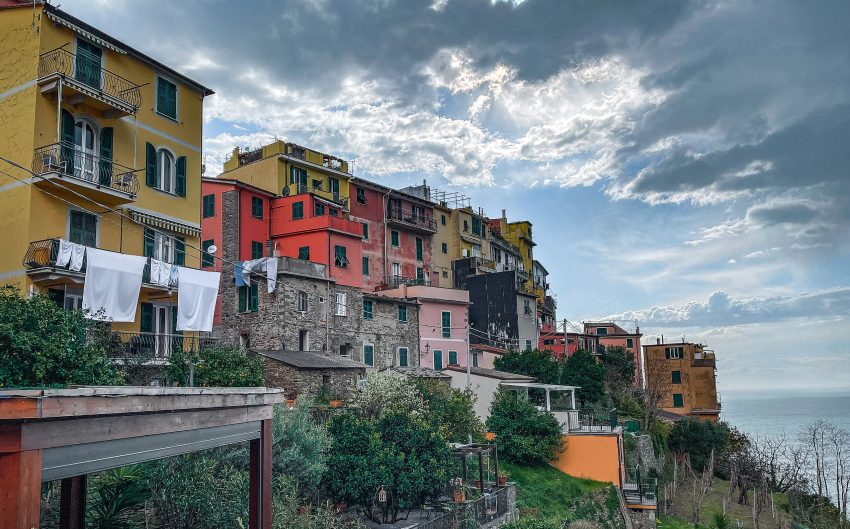
Corniglia, with roots tracing back to ancient Roman times, boasts a storied history centered around its strong agricultural heritage. Encircled by vineyards and stone terraces on three sides, the village’s agricultural tradition endures. Due to its size and comparatively challenging accessibility, Corniglia draws fewer tourists, offering a more authentic local experience. While the village provides various bars and restaurants, a vibrant nightlife is notably absent.
Corniglia’s charm is particularly appealing to hiking enthusiasts and nature aficionados. A must-visit spot for catching the sunset is the terrace and bar called La Terza Terra, situated at the terminus of the main street, where the sweeping views provide one of the finest sunset experiences in all of Cinque Terre.
Traveling to a country with a different currency? Avoid ATM transaction fees and pay in local currency with a Wise Card. Having used it for over 5 years, we've saved loads on fees!
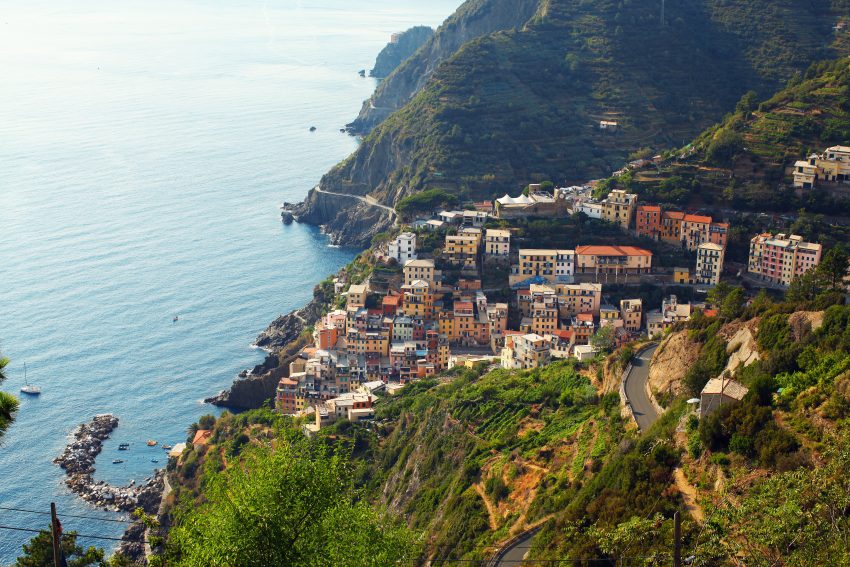
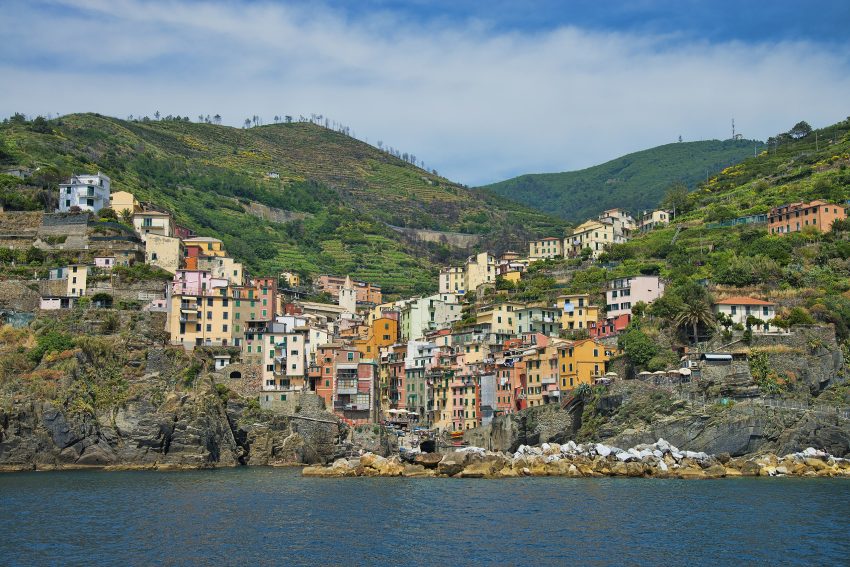
Riomaggiore, the southernmost village of the Cinque Terre, is conveniently located just a brief two-minute train ride away from Manarola. The village gracefully ascends along the coastal ridges, offering captivating vistas of the sea. Its distinct character is characterized by traditional stone houses adorned with colourful facades and slate roofs. A leisurely stroll down the main thoroughfare, Via Colombo, guides you towards the seafront. Here, a charming small harbour, the marina, unfolds, embraced by delightful pastel-hued houses and an array of vibrantly painted fishing boats. Adjacent to the boat docking area lies a pebble beach, adding to the picturesque allure of the harbour.
Riomaggiore claims its title as the prime spot for capturing the quintessential Cinque Terre sunset. As the sun gently descends, a gathering of individuals congregates on the rocky shores by the harbour, creating an enchanting scene. Moreover, the village boasts a modest nightlife scene, complete with numerous restaurants and bars that remain open until the early hours, extending until 1 am.
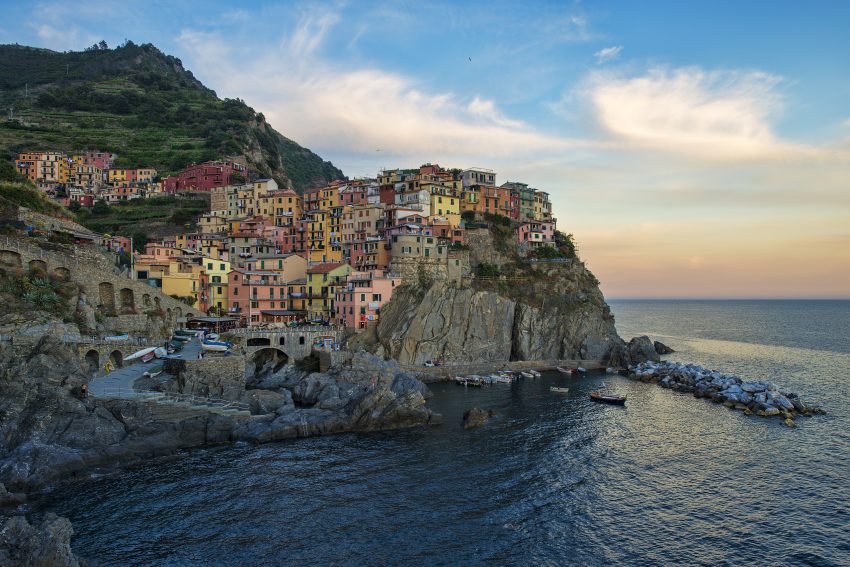
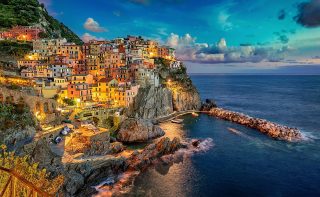
Perched atop a lofty rock 70 meters above sea level, Manarola stands as one of the most enchanting and romantically imbued villages in the Cinque Terre. The petite harbour, adorned with a dainty boat ramp, a charming piazza, and an array of picturesque multicoloured houses gazing towards the sea, exudes a captivating allure.
Indulge in a delectable lunch experience at one of the inviting fish restaurants nestled in the quaint square adjacent to the harbour. The harbour vicinity is bedecked with vibrant rowing boats, serving as a hub for sunbathing and swimming from dawn to dusk. Indeed, it is the ideal haven to spend a leisurely day basking under the sun’s embrace, all while relishing the spectacle of daring individuals diving off the cliffs. Despite the absence of a traditional beach, Manarola offers some of the region’s finest deep-water swimming opportunities.
The primary road meanders along the waterfront, revealing a scene where boats are hauled ashore whenever the sea becomes tumultuous. The village’s topography is an intricate interplay of ascents and descents, with narrow alleys known as “carrugi” leading the way towards the shoreline.
Explore Pisa at your own pace with our self-guided walking tour! Follow our curated route to discover must-see sights and local secrets that makes Pisa one of the best places to visit in Italy.
This website uses affiliate links which earn a small commission at no additional cost to you.
Walking Tour Map
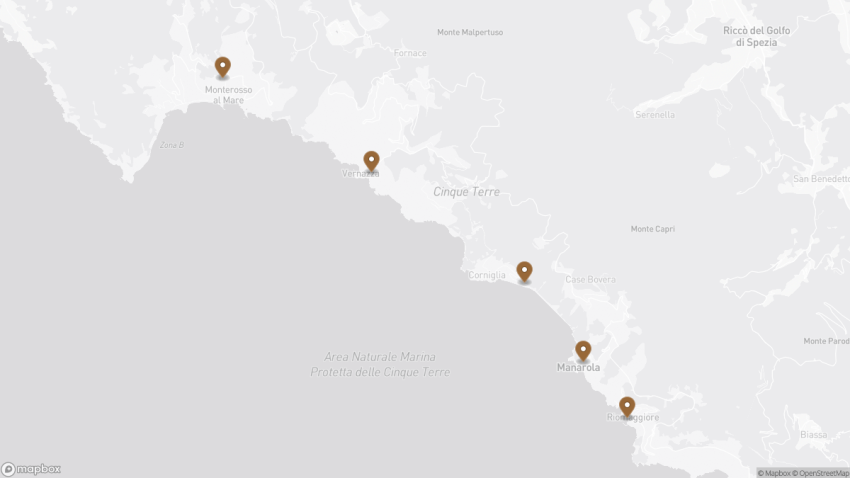
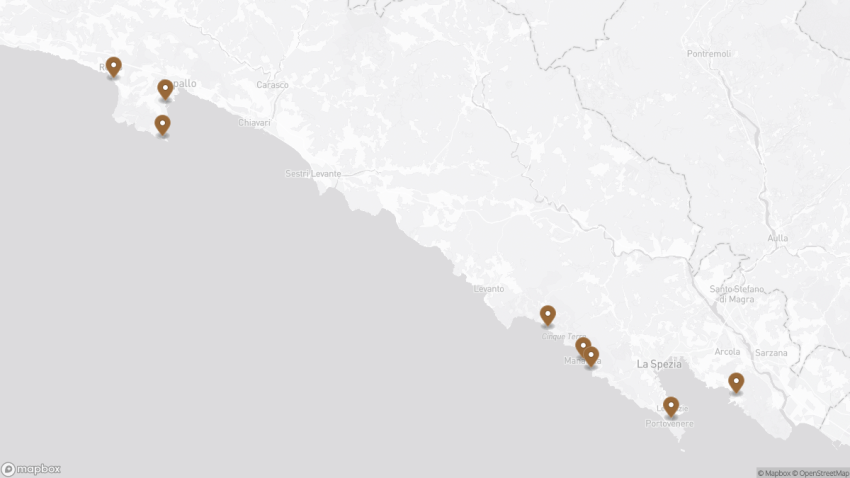
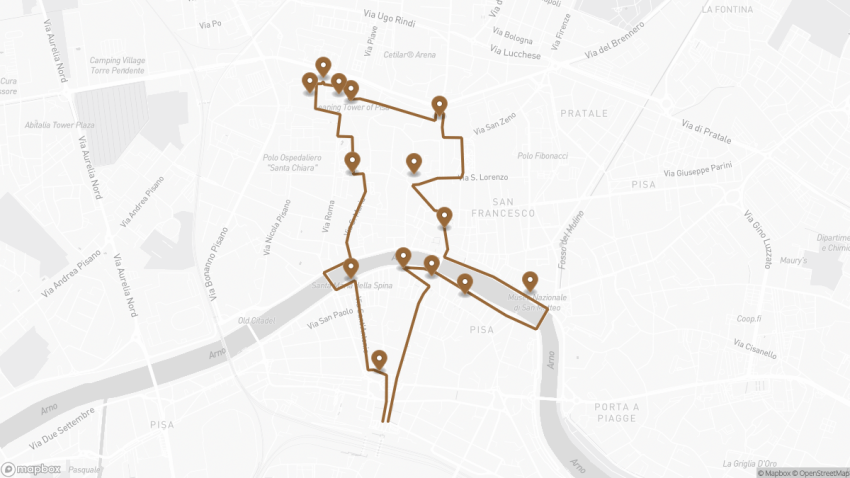
Preview map of the Cinque Terre in One Day: Complete Guide with Maps & Tips route in Pisa, showing 5 stops. Use the interactive map to zoom and tap markers.
Italian Riviera Towns Guide 2026: Top Coastal Destinations in Italy
Coastal Towns of the Italian Riviera
This website uses affiliate links which earn a small commission at no additional cost to you.
The Italian Riviera, a captivating coastal stretch nestled between the South of France and the borders of Tuscany, emerges as a coveted haven for vacationers. It presents a tapestry of vibrant seaside villages adorned in a spectrum of hues, vistas that embrace the panorama, the azure expanse of the Mediterranean Sea, and the allure of pristine beaches. This Italian haven is nothing short of a celestial retreat.
The Italian Riviera is renowned among international travellers for its enchanting coastal villages such as the famous Cinque Terre and the luxurious holiday retreat of Portofino. However, this region has much more to offer than its well-known attractions. Let’s delve into these remarkable destinations!
1. Portovenere
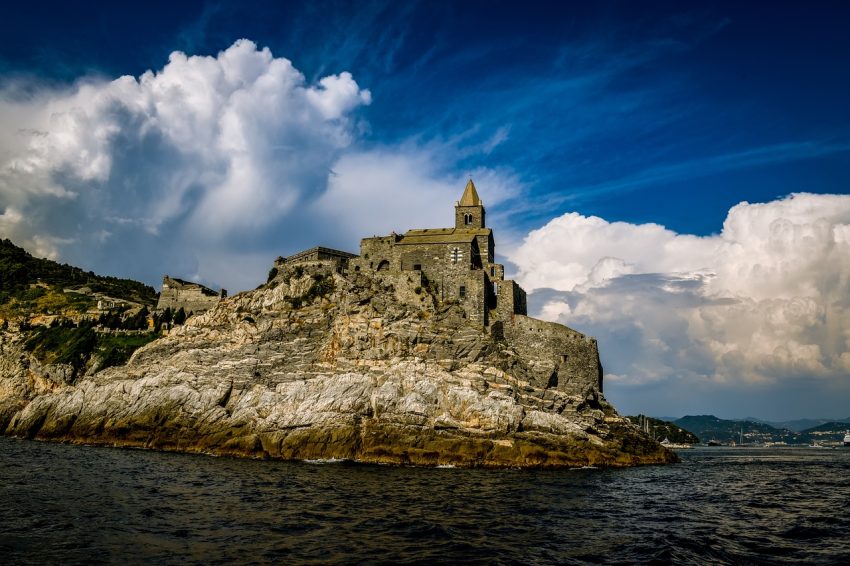
Church of Saint Peter in Portovenere
Portovenere holds a special place in our hearts as one of the most captivating towns along the Ligurian coast. Nestled in the charming Bay of Poets (Golfo di Poeti), this colorful gem is steeped in history and surrounded by breathtaking natural beauty, making it an undisputed favorite of ours on the Italian Riviera.
Our journey to Portovenere began on the final day of October, coinciding with the closure of the coastal Cinque Terre ferry season. The town serves as the initial stop on the ferry route from La Spezia to Cinque Terre, positioning it ideally for exploring both destinations and the adjacent coastal areas.
In the bustling summer months, the options are boundless. However, on our visit day, the waterfront was surprisingly calm, with only a few boats moored. As we entered the quaint and picturesque harbour, we questioned how we would fill our time here, especially with our children in tow.
Our initial impressions couldn’t have been more wrong. Portovenere unfolded to us as a treasure trove of attractions. We delved into the 12th-century castle and the 13th-century San Pietro church, traced the rugged cliffs and admired nearby grottoes, scaled countless staircases, and wandered through the labyrinthine alleys of this medieval haven. The town presented an abundance of dining options, gelaterias, and charming boutiques.
Our hours in Portovenere slipped away all too quickly. The experience was an enchanting blend of history, sweeping views of the Mediterranean, and the welcome absence of the crowds that often swarm Cinque Terre.
Notably, you can embark on a scenic boat excursion to the UNESCO World Heritage Site encompassing the nearby islands of Palmaria, Tino, and Tinetto. During the summer, additional opportunities arise, including boat rentals, beach visits, and water activities like swimming, snorkelling, and diving.
In essence, Portovenere unveiled itself as a hidden jewel, waiting to be discovered in all its splendour.
Camogli truly presents itself as a hidden treasure waiting to be discovered. While its beauty may be known among international travellers, stumbling upon it unexpectedly can create a truly magical experience. The first encounter, even on a rainy day, can leave an indelible mark.
Arriving by car might lead you to a hidden aspect of Camogli, as the town’s charm often sneaks up on visitors. A simple decision to explore for just a few minutes can quickly transform into hours of enchantment.
Nestled amidst rolling hills adorned with vibrant houses, Camogli’s natural and architectural beauty forms a picturesque backdrop that leaves a lasting impact. The captivating beach, which reveals itself as you walk down, can evoke a sense of awe and wonder, offering a mesmerizing sight that surpasses what photographs can capture.
This place has the power to create “wow” moments, those special instances that remain etched in one’s memory. That sense of being in a location that will forever hold a place in your heart.
Pictures may not fully convey the emotions that a visit to Camogli can evoke. The experience of being on a serene beach, even during a stormy day in November, can be a unique and unforgettable memory. Children playing and collecting colourful stones add an extra layer of delight to the atmosphere.
And just like the neighbouring towns, Camogli has much to offer throughout the seasons. From its beauty as a vacation destination to its practicality as a base for exploring the Portofino Peninsula by hiking or boating, the town invites visitors to immerse themselves in its charm. In the end, Camogli’s allure isn’t just about its visual appeal; it’s the emotions and memories it elicits that make it a true hidden gem along the Italian Riviera.
Manarola, a village older than Riomaggiore, traces its origins back to the beginning of the 13th century. Nestled amidst picturesque vineyards and situated along a charming stream, Manarola boasts a notable reputation for its wine production. The village’s famous “Via dell’Amore” originates here, a pleasant and paved pathway that spans two kilometres, linking Manarola to Riomaggiore.
The village’s architecture is captivating, as the houses seem to cascade down to the water’s edge, gripping onto rugged rocks that are lapped by the waves. The main street itself is built atop the covering of a former torrent, while narrow stone-paved alleyways branch off from it. The etymology of Manarola’s name traces back to “Manium Arula,” a small temple dedicated to the Manes, which was erected during Roman times. It maintains a connection to Riomaggiore, of which it is considered an outlying village, through the renowned Via dell’Amore.
High up in the village, a visit to the Church of San Lorenzo, constructed in 1338, is recommended. The church’s standout feature is its exquisite rose window, which dates back to the 14th century.
Manarola’s rich history, breath-taking scenery, and festive traditions make it a truly enchanting destination to explore and enjoy throughout the year.
Traveling to a country with a different currency? Avoid ATM transaction fees and pay in local currency with a Wise Card. Having used it for over 5 years, we've saved loads on fees!
Portofino, often hailed as one of the most picturesque towns on the Italian Riviera and even in all of Italy, is a true postcard-worthy destination. Its azure blue waters adorned with luxury yachts, colourful houses that grace the landscape, and opulent estates create an idyllic scene that seems to have been plucked from the pages of travel guides. Nestled between majestic mountains and a captivating coastline, the Portofino Peninsula is a captivating gem that Liguria proudly offers.
The journey to Portofino along the narrow coastal road is an experience in itself, with scenic vistas that mirror the beauty of the surrounding area. One delightful highlight is the walk leading to Castello Brown and the iconic lighthouse of Portofino. Moreover, embarking on a boat trip to the nearby San Fruttuoso Abbey, a historic abbey dating back to the 10th century, is an opportunity not to be missed.
However, amidst its undeniable charm, there’s a sentiment that Portofino might not evoke the same level of affection as some of the other Ligurian towns. A notable issue is the prevalence of overpriced restaurants coupled with personnel that might come across as snobbish, detracting from the overall experience. There’s a contemplation about whether traditional local fishermen still frequent the waters of this once-renowned “fishing village.” Over time, Portofino has transformed into a destination that caters to the affluent and famous.
Santa Margherita Ligure, Italy, is a compelling reason in itself to explore the sun-drenched and enchanting Italian Riviera. Affectionately known as “Santa” by its bronzed locals, this destination is a vision of pastel perfection, enticing boats to chart a course towards its shores.
Once a simple Ligurian fishing village, Santa Margherita has transformed into a splendid coastal resort that occupies a prominent spot on one of the Riviera’s most renowned stretches. Positioned between the stylish Portofino to the south and the vibrant Rapallo to the north, Santa Margherita presents all the allure of the Riviera with a slightly more subdued ambiance. Nestled within lush hills adorned with vibrant villas that rival the hues of the shirts fluttering along the classic promenade, Santa Margherita exudes a relaxed charm.
In the expanse of the Tigullio Gulf, where Santa Margherita is situated, opulent superyachts glide gracefully into view. The adjacent Portofino National Park and the Portofino Marine Reserve contribute to the region’s exceptional biodiversity, both above and beneath the undulating surface of the Ligurian Sea.
Explore Genoa at your own pace with our self-guided walking tour! Follow our curated route to discover must-see sights and local secrets that makes Genoa one of the best places to visit in Italy.
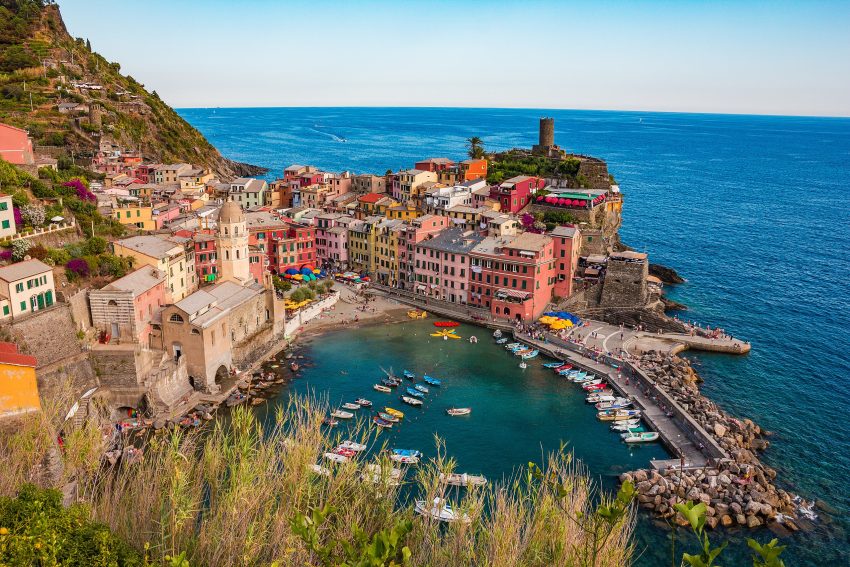
Vernazza, the quaint fishing village, is arguably the quintessential representation of the Cinque Terre and has earned its place as one of Italy’s most picturesque villages.
With its origins tracing back to around 1000 A.D., Vernazza’s history intertwines with the Republic of Genoa, which held dominion over it from 1276 onward. The construction of Belforte, a medieval castle, took place in the mid-1500s primarily to safeguard the village from marauding pirates.
Approaching this enchanting village by sea provides an idyllic experience. The petite harbor is enclosed by the characteristic pastel-colored Ligurian houses, while the charming piazza is graced with inviting restaurants and bars. Within the natural harbor, one can find a small sandy beach and the Church of Santa Margherita di Antiochia.
Surrounding the village are olive groves organized into steep terraces, famed for yielding some of the nation’s finest olive oil.
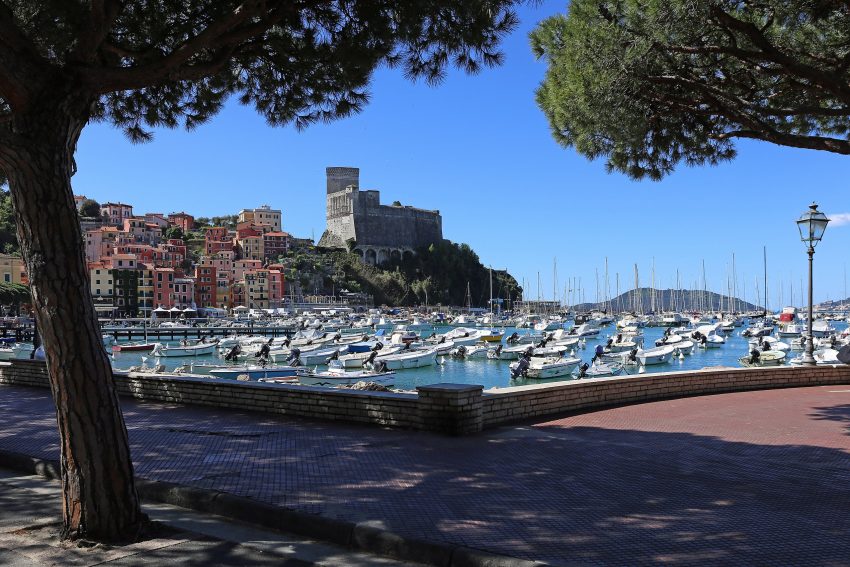
Lerici, positioned gracefully on the Gulf of Poets, possesses an inherent charm that has made it an inevitable destination. A town adorned with pastel hues, nestled by the serene gulf, Lerici’s allure to literary figures and travelers is undeniable. Often referred to as the Pearl of the Gulf, Lerici is indeed a precious gem in its own right.
Its significance is not lost on history, with mentions by Dante and the visits of celebrated poets like Shelley, Byron, and D.H. Lawrence, who found themselves drawn to its shores for inspiration. The town’s captivating features include sinuous coves, rugged cliffs, a glistening sea, and the cheerful façades of its painted houses, all beneath the watchful gaze of its dominant castle. Lerici exudes a magnetic appeal akin to the renowned Cinque Terre but maintains its own character, less crowded yet boasting ample sandy expanses along its beaches.
Traversing the town unveils numerous hiking trails, a picturesque boat harbor, vistas of unparalleled beauty, abundant sunlight, and a welcoming local populace. The seaside is graced by a mile-long promenade, perfect for leisurely strolls. Wandering through the narrow alleyways reveals the town’s richness, including a captivating Jewish ghetto, intimate piazzas, and architecturally intriguing structures. Amidst these passages, artisanal shops, charming cafes, and a wealth of dining establishments await, collectively adding to the vibrant tapestry of Lerici.
Explore Genoa at your own pace with our self-guided walking tour! Follow our curated route to discover must-see sights and local secrets that makes Genoa one of the best places to visit in Italy.
Riomaggiore, the southernmost jewel of the Cinque Terre, rests a mere two-minute train journey away from Manarola. This picturesque village gracefully ascends along the coastal ridges, overlooking the serene expanse of the sea. Its hallmark lies in the quintessential stone houses, adorned with colorful façades and roofs of slate. A leisurely stroll along the main thoroughfare, Via Colombo, carries you towards the tranquil sea, where a charming marina and harbor emerge. This harbor is embraced by delightful pastel-hued dwellings and enlivened by the vibrant colors of fishing boats. Close to the docking area and this idyllic harbor, a pebble-strewn beach unfurls, offering a touch of seaside respite.
Riomaggiore holds a special distinction among the Cinque Terre villages as the premier vantage point for capturing the mesmerizing hues of the setting sun. As daylight fades, a gathering of people assembles on the rocky enclaves surrounding the harbor, embracing the spellbinding view. Furthermore, Riomaggiore does not lack nightlife, boasting an array of restaurants and bars that remain open until the early hours of the morning. This vibrant tapestry adds to the allure of this coastal gem.
This website uses affiliate links which earn a small commission at no additional cost to you.
Walking Tour Map
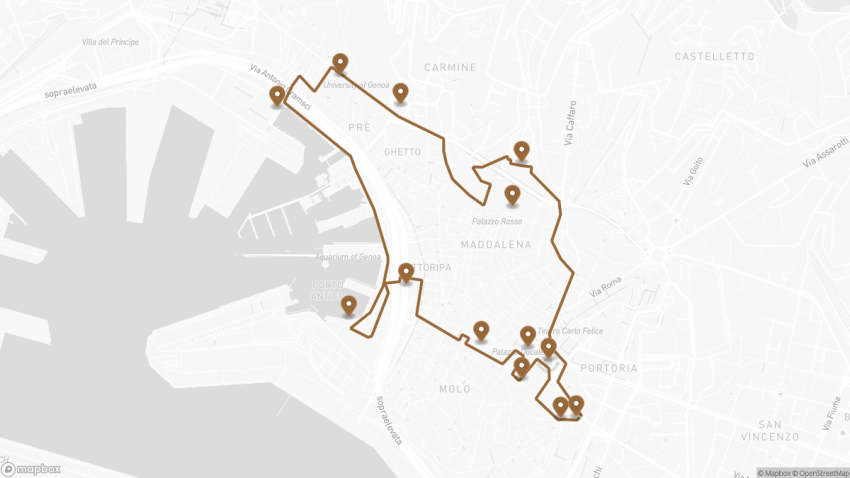
Preview map of the Italian Riviera Towns Guide: Top Coastal Destinations in Italy route in Genoa, showing 8 stops. Use the interactive map to zoom and tap markers.
This website uses affiliate links which earn a small commission at no additional cost to you.
Welcome to Genoa, a city steeped in history, culture, and captivating charm. While renowned cities like Venice, Florence, and Rome tend to capture the attention of international tourists, Genoa stands as a destination that merits greater recognition for those in search of genuine Italian encounters.
Nestled on the Ligurian Sea, Genoa is a hidden gem waiting to be explored-a city that boasts a rich maritime heritage, a labyrinthine medieval quarter, and a vibrant mix of old-world elegance and modern flair. Join us as we meander through its alleys, uncover its hidden treasures, and immerse ourselves in the tales of a city that has shaped Italy's narrative for centuries.
As you embark on this walking tour, you’ll step into the footsteps of explorers, merchants, and artisans who have left their indelible mark on its cobbled streets and grand piazzas.
By Plane:Genoa is served by Genoa Cristoforo Colombo Airport, located about 7 km west of the city center. From the airport, travelers can reach central Genoa by taxi, shuttle bus, or car in around 15-20 minutes. For the best deals and a seamless booking experience, check out these flights to Genoa on Booking.com.
By Train:Genoa is well-connected by rail, with regular services from major Italian cities like Milan, Turin, and Pisa. The main train stations, Genova Piazza Principe and Genova Brignole, are centrally located and provide easy access to the city's attractions. Use Omnio to easily compare schedules, book train tickets, and find the best prices all in one place for a hassle-free journey across Italy.
By Car: Accessible via the A10, A12, and A7 motorways, Genoa is approximately a 2-hour drive from Milan. Parking is available at various locations, including Park Marina Porto Antico and Park Mercanzia. If you are looking to rent a car in Italy I recommend having a look at Discover Cars, first, as they compare prices and review multiple car rental agencies for you.
Where to Stay in Genoa
To fully experience Genoa’s historic ambiance, consider staying in the city center. For luxury, Grand Hotel Savoia offers elegant accommodations near Piazza Principe station. For mid-range comfort, Hotel Continental Genova provides a great location with classic style. Budget travellers may enjoy Hotel Nologo for its modern design and central setting.
A Brief History of Genoa
Genoa’s roots stretch back to antiquity, but its real rise came in the Middle Ages when it became one of the most powerful maritime republics in the Mediterranean. The city’s wealth funded the construction of ornate palaces, grand churches, and an extensive system of narrow lanes, or caruggi. Genoa’s historic center is now a UNESCO World Heritage site.
The city is also the birthplace of explorer Christopher Columbus, whose legacy is commemorated throughout the old town.
Guided or Self-Guided Tour of Genoa?
While Genoa is rewarding to explore independently, a walking tour can illuminate its layered history. The Genoa Must-See Attractions Walking Tour is led by a knowledgeable local and covers key sights like the Cathedral of San Lorenzo, Piazza de Ferrari, Via Garibaldi, and the House of Columbus. It’s a fantastic way to grasp the scale and complexity of Genoa’s past and present.
Your Walking Tour of Genoa
This guide introduces Genoa’s essential landmarks, but the city’s charm lies in the details-peeling frescoes, hidden courtyards, and buzzing piazzette. Pause for focaccia in a bakery, explore a palace courtyard, or stroll the waterfront promenade. Genoa’s rich layers of history and vibrant street life make it a rewarding destination for curious travelers.
1. Casa della Famiglia Colombo (Columbus' House)
Christopher Columbus House
CC BY-SA 4.0 / Graziella taibi
The Christopher Columbus House stands today as a faithful 18th-century reconstruction of the very dwelling where Christopher Columbus spent his formative years. Situated beyond the precincts of Genoa’s 14th-century fortifications, this location witnessed intense Renaissance-era urban development, predominantly marked by the emergence of public housing.
Born in 1451, Columbus’s presence in this dwelling is attested by historical records, placing his residency here between roughly 1455 and 1470. During this period, the house encompassed two, and perhaps even three, stories. The ground floor featured a shop, with the entrance situated to the left of the shop.
Historian Marcello Staglieno’s insights suggest that the original house likely met its demise during the French Bombardment of Genoa in 1684. However, its revival commenced in the early 18th century, rooted in the remnants of the original structure. This renewed incarnation reached a soaring height of five stories, yet this elevation was achieved by anchoring upper stories onto neighboring buildings. With the eventual demolition of these neighbouring structures around 1900, as part of the Via XX September construction, the building underwent alterations. Its uppermost stories were dismantled, resulting in the present-day stature of two stories.
At present, the premises operate as a museum, offering an immersive experience into Columbus’s world and era. The central location, coupled with convenient nearby parking, renders it a favoured rendezvous point for the local Genovese community.
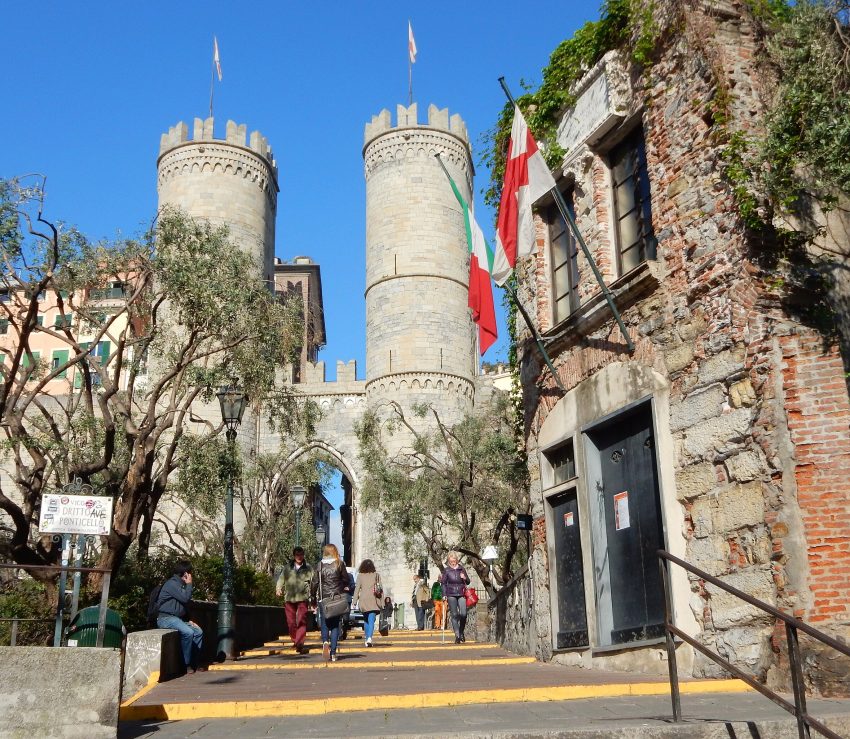
During the year 1155, as an integral component of a comprehensive defensive wall system, Genoa undertook the construction of three grandiose gates. Porta Soprana stands as one of this trio, joined only by Porta dei Vacca as the sole survivors of this endeavor. These gates are distinguished by their striking circular towers, a shared architectural feature that binds them together.
Porta Soprana, an enduring monument of historical significance, stands as a testament to Genoa’s strategic approach to fortification. Its counterpart, Porta dei Vacca, stands in harmony, embodying the city’s resolute dedication to safeguarding its boundaries.
Here is a complete selection of hotel options in Genoa. Feel free to review each one and choose the stay that best suits your needs.
3. Jesuit church of Santi Ambrogio e Andreaw
Jesuit church of Santi Ambrogio e Andreaw
CC BY-SA 3.0 / Davide Papalini
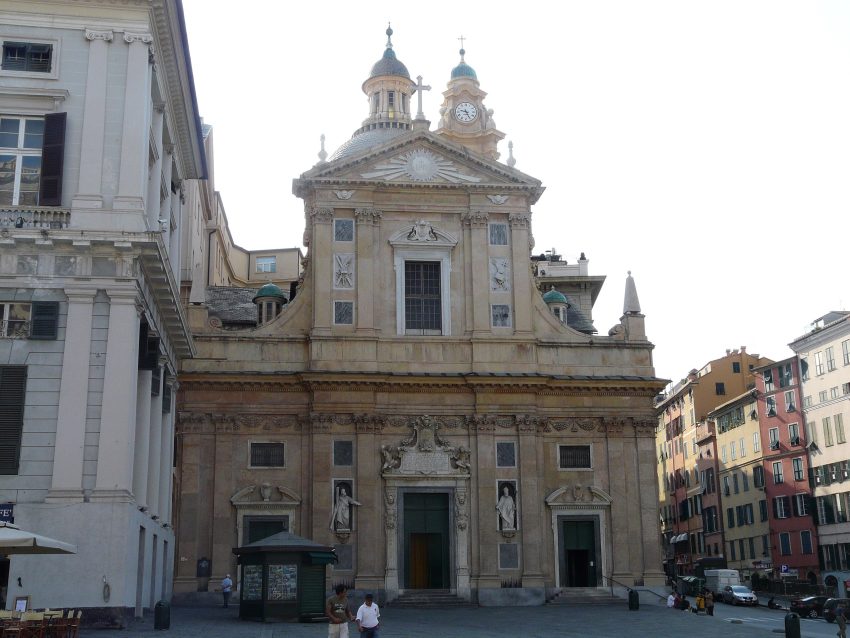
During the tumultuous 6th century, Bishop Onorato of Milan found himself in a precarious situation, fleeing from the Longobard persecutions that swept through the region. Seeking refuge, he embarked on a journey that led him to the welcoming shores of Genoa. It was here, amidst the embrace of this coastal city, that Bishop Onorato laid the foundation for the Church of Saint Ambrose, a name that held deep significance as Ambrose stood as the revered patron Saint of Milan.
The early days of the church were marked by a sense of communal devotion, as the Milanese community rallied around this sanctuary. However, as the centuries passed, circumstances shifted. Abandoned by its original congregants in the 7th century, the church would find new life in the 16th century under a different stewardship—the Jesuits.
In 1522, a transformative chapter began for the Church of Saint Ambrose as the Jesuits undertook the task of rebuilding the aging structure. Guided by the visionary designs of architect Giuseppe Valeriano, the church underwent a remarkable metamorphosis. The façade itself underwent a profound transformation in the late 19th century, reflecting the intricate tapestry of influences that shaped its identity. Inspired by the artistic essence of Rubens, the façade took on a Baroque visage, adorned with sculptures of Sant Ambrogio and Sant Andrea, masterfully crafted by the skilled hands of Michele Ramognino.
Stepping within the hallowed walls, one is greeted by a symphony of artistic expressions that narrate stories of faith and devotion. The intricate frescoes adorning the nave and dome, meticulously painted by Giovanni Battista Carlone, infuse the atmosphere with vibrant hues and timeless narratives. At the heart of the sanctuary, the main altar stands adorned with a trio of paintings that unfurl the stories of old. Peter Rubens’ “Circumcision,” Giovanni Battista Merano’s “Massacre of the Innocents,” and Domenico Piola’s “Flight into Egypt” form a tableau of spiritual contemplation. The statues of Peter and Paul, sculpted by Giuseppe Carlone, lend an air of reverence to this sacred space.
Chapels unfold like chapters in a rich tapestry of devotion. The first chapel beckons with a fresco by Giuseppe Galeotti, juxtaposed with a painting by Giovanni Andrea De Ferrari. Saint Carlo Borlomeo and Sant Ambrogio stand as sentinels in sculptural form, their presence a testament to the intertwining of faith and history, meticulously chiselled by the hands of Giovanni Domenico Casella.
Venturing deeper, the second chapel reveals frescoes by Lorenzo De Ferrari, resonating with a sense of divine narrative. It is here that Simon Vouet’s “Crucifixion” commands attention, a testament to the evocative power of art to convey the timeless message of sacrifice. Nestled beside the altar, Tommaso Orsolino’s nativity scene emanates an aura of contemplative serenity.
The third chapel unveils frescoes that trace Lorenzo De Ferrari’s artistry, while Guido Reni’s luminous painting of the Assumption takes centre stage, inviting reflection on the profound mysteries of faith. With each stroke of the brush and every chiseled contour, this sacred space becomes a repository of devotion, encapsulating the essence of generations past and inviting all who enter to partake in the spiritual journey it embodies.
Traveling to a country with a different currency? Avoid ATM transaction fees and pay in local currency with a Wise Card. Having used it for over 5 years, we've saved loads on fees!
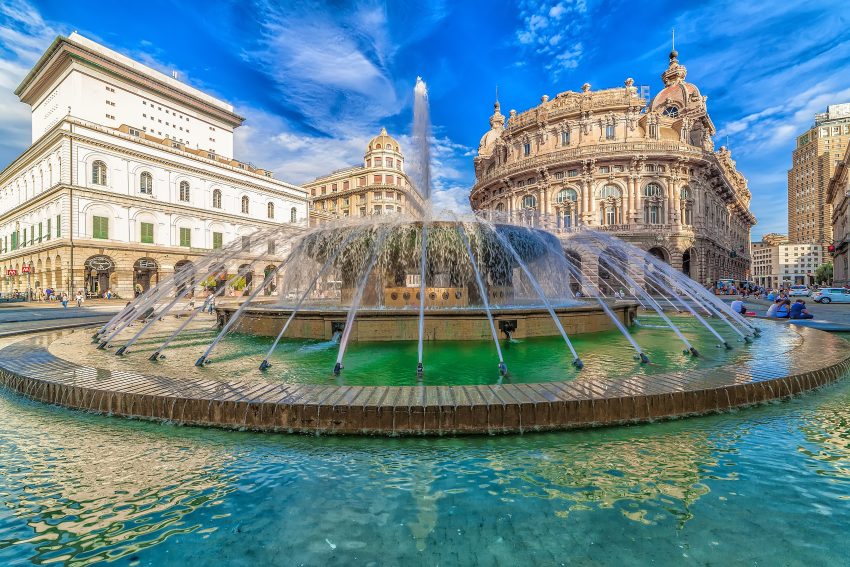
4. Piazza De Ferrari (Ferrari Square)
Fontana di Piazza De Ferrari
CC BY-SA 4.0 / Maurizio Beatrici
Raffaele Luigi De Ferrari, renowned as the Prince of Lucedio, Duke of Galliera, and esteemed senator of the Kingdom of Sardinia, displayed his acumen in 1837 when he acquired the entire collection of assets that had been bestowed by Napoleon I in 1812, procured through Prince Oscar of Sweden. His affluence was boundless, as was his status as a Grand Officer of the Order of Italy. These distinctions, while not exhaustive, were ample enough to lead to the christening of Genoa’s principal square in his name.
Spanning an expanse of 120,000 square feet, Ferrari Square stands at the heart of the city. In its midst stands an imposing bronze fountain, a grand creation brought to life in 1936 through the design prowess of architect Giuseppe Crosa di Vergagni.
The historical evolution of this square is fascinating. In 1814, the venerable Church of San Domenico made way for the construction of the magnificent Carlo Felice Theater, an architectural marvel designed by Carlo Barabino that was finally completed in 1827. Subsequently, in 1831, the two-story Linguistic Academy took up residence in this revered space.
The year 1877 marked a significant milestone, when the square was officially named Ferrari Square in honour of Raffaele Luigi De Ferrari, a year after his passing. A notable commemoration graced the square in 1893, with the striking equestrian statue of Giuseppe Garibaldi, a revered figure in the annals of Italian revolution, finding its place before the entrance of the Carlo Felice Theatre.
Over time, a quartet of imposing edifices showcasing eclectic architectural styles came into being. The New Stock Exchange Palace (Palazzo della Nuova Borsa) was unveiled in 1912, followed by the Palace of the Italian Credit (Palazzo del Credito Italiano) in 1914, and the Palace of the Liguria Region (Palazzo della Regione Liguria) in 1923.
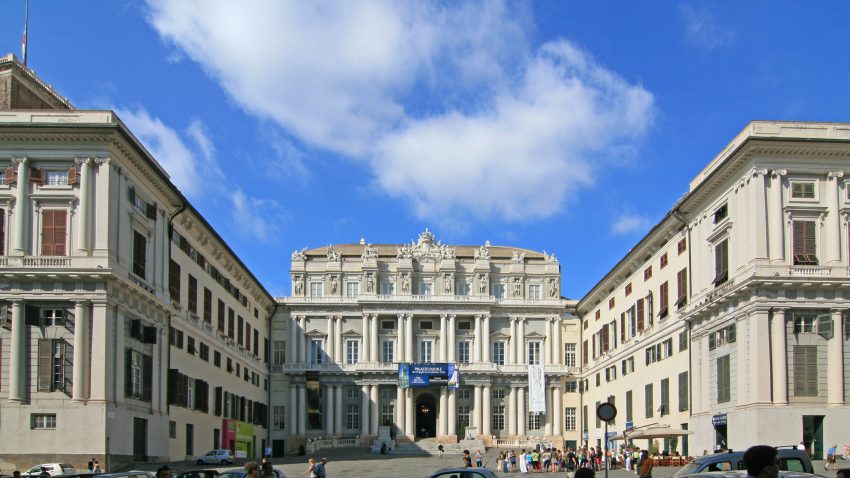
Amid this dynamic urban landscape, historic structures also hold their ground. The Ducal Palace, originating from the 13th century and meticulously restored in 1992, stands as a beacon of cultural heritage, housing both a museum and a hub of intellectual exchange. The Giulio Pallavicini Palace, an architectural gem built in 1586, exudes timeless elegance. Equally notable is the Agostino Spinola Palace, a resplendent creation from the 18th century, which today serves as the Bank of Rome, a testament to the enduring significance of this remarkable square.
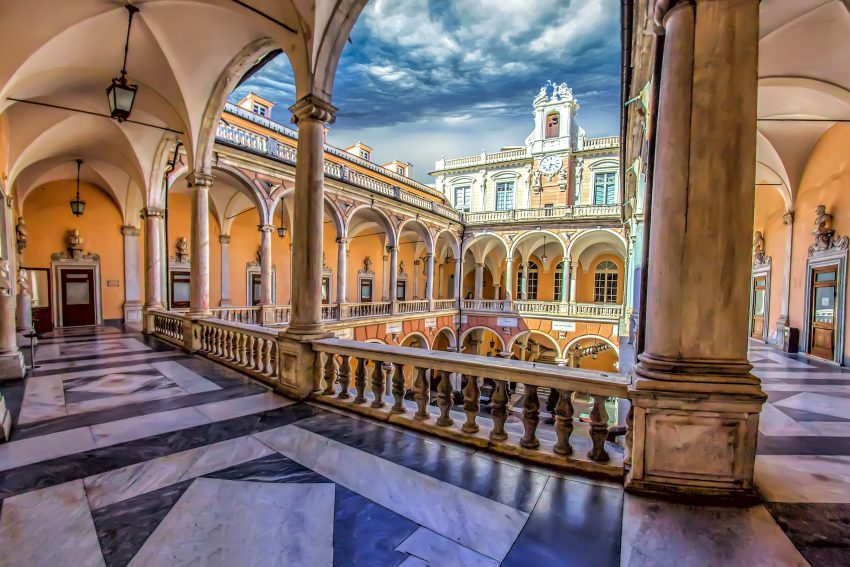
Once the residence of the Doges of Genoa, The Duke’s Palace stands as a testament to the city’s historical legacy. Nestled at the heart of the city, it can be accessed from both Matteotti Square and Ferrari Square. Its origins trace back to the 13th century, a pivotal period when Genoa was asserting itself as a dominant maritime force.
During that time, the leader of the state was known as the Captain of the People. However, the Captain and their entourage lacked a permanent residence, often finding shelter in the Archbishop’s Palace or the homes of prominent families like the Doria and Fieschi.
This situation underwent a significant transformation by 1294 when Corrado Doria, a Co-Captain of the People, and Oberto Spinola acquired the Doria family buildings and Alberto Fieschi’s mansion. These structures were amalgamated to create what later became the abbots’ palaces.
In the year 1339, Simone Boccanegra, also known as “Simon Blackmouth,” ascended to the position of Genoa’s first doge. This marked a turning point, and the palace was henceforth referred to as the “Duke’s Palace.” Over the 14th century, further architectural additions expanded the complex, while the 15th century saw the incorporation of a garrison building, culminating in the square’s transformation into a fortified courtyard.
Tragedy struck in the 18th century when a devastating fire consumed the palace. However, it was resurrected under the direction of architect Simone Cantoni. The reconstruction included a new marble facade and a redesign of the public spaces adorned with opulent gilded stucco and marble elements.
In the present day, this venerable center of authority serves a multifaceted purpose. It hosts exhibitions, meetings, special events, and functions as a library and museum. Notably, it represents Europe’s most extensive restoration endeavor, encompassing a sprawling 300,000-square-meter structure.
Explore Genoa at your own pace with our self-guided walking tour! Follow our curated route to discover must-see sights and local secrets that makes Genoa one of the best places to visit in Italy.
6. Cathedral of San Lorenzo
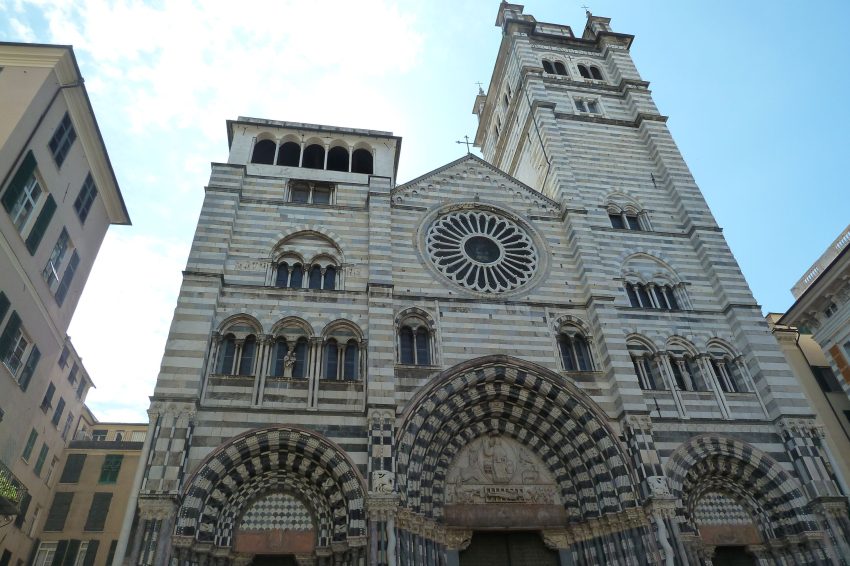
Cathedral of San Lorenzo
CC BY-SA 2.0 / VillageHero
The Cathedral of San Lorenzo stands as the paramount ecclesiastical structure in Genoa. Its origins trace back to around 1098, and the inaugural ceremony was graced by Pope Gelasius II in 1118. With the fortification of the city’s walls, the vicinity surrounding San Lorenzo evolved into the pulsating heart of the city. During the medieval era, this church assumed the role of a central stage, profoundly influencing the social and political fabric of Genoa’s inhabitants.
A catastrophic fire in 1296 precipitated the church’s reconstruction, culminating in the completion of its facade in 1312. During this phase, the colonnades were meticulously refurbished, and matron galleries found their place. The comprehensive construction process spanned centuries, with final touches materializing in the 17th century. The subsequent restoration efforts of the dome and medieval sections occurred between 1894 and 1900.
The cathedral’s main facade is characterized by three resplendent Gothic portals embellished with recessed arches. Above the central portal, a lunette boasts reliefs portraying Christ alongside Saint Lawrence. Dominating the center portal, a sizable rose window emanates an exquisite radiance. The front steps are flanked by two stone lions and a pair of shorter columns. Adding to the facade’s allure are two unequal-height towers, gracing the vista with an imposing presence.
Internally, the cathedral adheres to a basilica plan, encompassing a transept and choir. Three naves are demarcated by columns bedecked in marble, crowned by arches characterized by alternating light and dark bands. Above this level, smaller Romanesque arches crafted from gray stone grace the space.
One of the side chapels on the left side is dedicated to Saint John the Baptist, the patron saint of Genoa. This sanctuary harbors an urn containing relics of the revered saint, transported here at the culmination of the First Crusade.
A curious historical footnote unfolded on February 9, 1941, when the Cathedral of Saint Lawrence found itself in the line of fire from the English battleship HMS Malaya. Remarkably, an armor-piercing shell penetrated a corner of the nave. Due to the relatively soft material, the fuse failed to detonate, resulting in the shell’s preservation within the structure. This intriguing artifact beckons your attention as you explore the cathedral.
Entry to the cathedral is free, yet admission fees apply for those wishing to access the treasure museum housed within its walls.
The Byzantine Emperor Michael VIII found himself indebted to Genoa due to their alliance during the conflict against the Latin Empire. In a gesture of gratitude, Emperor Michael contributed materials taken from the Venetian embassy in Constantinople to Guglielmo Boccanegra. With these resources, Boccanegra brought his waterfront palace aspirations to life in the year 1260.
The facade of Guglielmo’s magnificent palace was adorned with stone lions, symbols associated with Venice’s patron saint, Mark. However, this grandeur was short-lived, for merely two years later, Boccanegra was ousted from his role as Captain of the People and compelled into exile. The palace’s function transitioned into that of a prison, housing the likes of Marco Polo, whose captivating memoirs were dictated to Rustichello of Pisa. This accomplished romance writer notably collaborated with Marco Polo in crafting his autobiography, “The Travels of Marco Polo,” during their shared imprisonment.
Originally conceived to serve as the hub for port authorities, the palace’s design was entrusted to Frate Oliverio, a Cistercian monk. By the year 1400, the edifice transformed into the headquarters of the Bank of San Giorgio, a pioneering Italian financial institution.
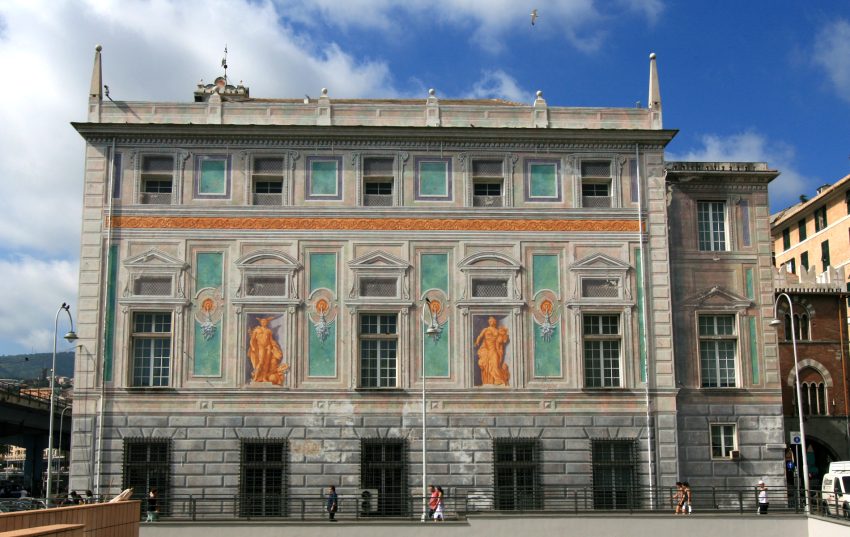
In 1570, an Eastern wing was incorporated, housing customs offices, archives, and the secure vaults of the bank. Subsequently, in 1608, the main facade was adorned with heroic frescoes, with the centerpiece featuring the depiction of Saint George and the dragon. The roof above the central portion of the facade saw the addition of a clock tower.
Adorning the facade’s niches are statues commemorating iconic figures from Genoa’s history. This distinguished lineup includes Christopher Columbus, Andrea Doria, Biagio Assereto, Simone Boccanegra, Guglielmo Embriaco, and Caffaro di Rustico.
In the present day, the Palace of St. George serves as the administrative nucleus of the Port, embodying a convergence of history and contemporary utility.
The Genoa Old Port serves as a nostalgic gateway to the city’s illustrious past as a prominent maritime hub and sea-faring powerhouse. With a keen focus on catering to tourists, the Old Port seamlessly conjures the essence of bygone eras. Within its expanse, visitors can feast their eyes on an eclectic mix of historical galleons, contemporary sleek yachts, and imposing cruise ships, all nestled in the harbor.
Encompassing a blend of offerings, the Old Port boasts an array of restaurants, museums, an engaging aquarium, a dynamic auditorium, a unique botanical garden encapsulated within a bubble, and a colossal octopus crane that elevates visitors for an enhanced vista of the captivating Genoa Old Port. This harbor proves to be an idyllic setting for a leisurely sunset stroll, affording panoramic views of the sea while still immersed within the city’s embrace. Even a moonlit walk holds its own allure.
The realization of this transformation was achieved under the visionary guidance of Renzo Piano, a globally acclaimed architect hailing from Genoa. His vision aimed to breathe new life into the timeworn industrial expanse of the old port, converting it into a cultural epicenter and a prime destination for tourists.
A noteworthy milestone in this rejuvenation was the International Exhibition Genoa ’92 – Colombo ’92, which unfolded from May to August. Reverberating with the theme “Christopher Columbus, the Ship, and the Sea,” the event commemorated the 500th anniversary of Columbus’ momentous voyage to the New World. It concurrently marked the unveiling of the revitalized Genoa Old Port, solidifying its place as a timeless testament to the city’s maritime heritage and modern-day allure.
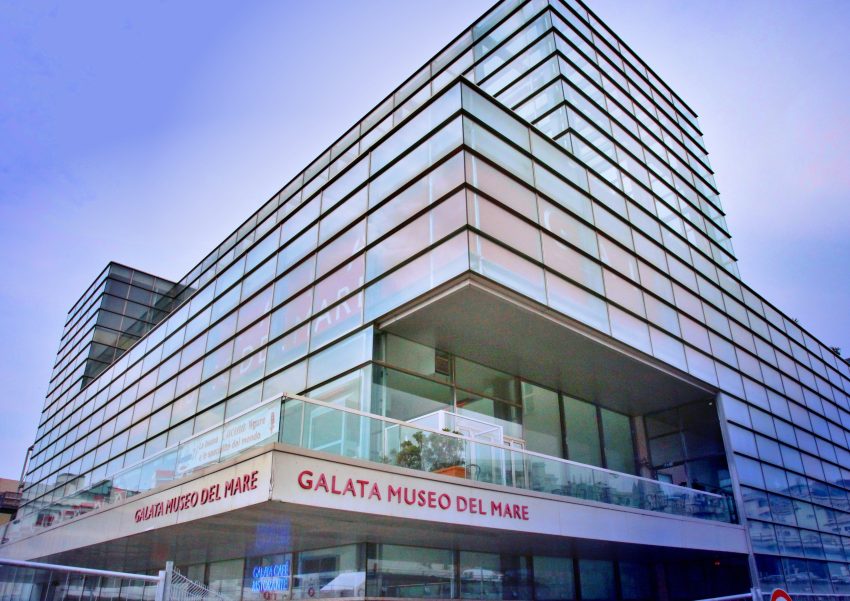
The term “Galata” refers to the historical Genoese enclave situated in Istanbul, Turkey. This enclave held a position of paramount importance among the Genoese colonies in the Mediterranean. However, by the 15th century, their presence in this community had waned. In the 19th century, the Genoa municipality embarked on the construction of an expansive network of commercial docks, and the oldest of these docks bore the name of the erstwhile lost colony.
Galata thrived as a vibrant shipyard where Genoese galleys were meticulously crafted. As the 20th century unfolded, Genoa’s maritime prominence underwent transformation, leading to the eventual abandonment of the district. The 1990s marked a pivotal turning point when the decision was made to establish a maritime museum within the Galata district. The Galata Palace, meticulously revitalized by architect Guillermo Consuegra, was designated as the museum’s home.
Subsequently, the museum opened its doors in 2004. In 2005, it amalgamated with the Commenda Museum-Theatre and the Naval Museum of Pegli, evolving into the Institute of Museums of the Sea and Migration.
The museum’s ground floor unfolds the saga of galleys, featuring a life-size model of a 17th-century galley and an exhibition showcasing armour, weaponry, portraits of noteworthy figures like Columbus and Andrea Doria, alongside an array of documents, charts, and navigational tools.
The first and second floors are a tribute to sailing and shipyards, housing a reproduction of a Brigantine, a shipyard workshop display, and an immersive experience simulating a tempestuous ordeal off Cape Horn. The third floor is dedicated to the grand era of Transatlantic liners, boasting a mockup ship’s bridge and a simulation detailing an immigrant’s journey from Gibraltar to New York.
Notably, the museum’s dock serves as a mooring site for the submarine Nazario Sauro, an intriguing floating extension of the museum experience.
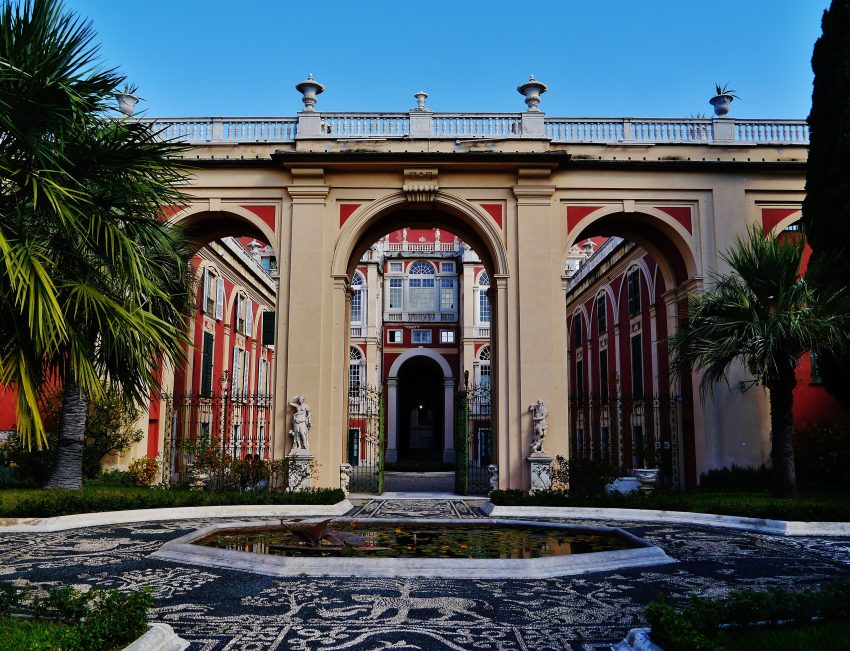
The Balbi family’s prosperity stemmed from their involvement in the silk trade and financial ventures. In the 17th century, they brought their aspirations to life by constructing a magnificent palace, a marvel that now holds a revered spot on the esteemed list of World Heritage Sites.
Tragedy struck Stefano and Giovanni Battista Balbi, as they fell victim to the devastating plague of 1657. Subsequently, the palace exchanged hands and found new owners in the Durazzo family. The Durazzo lineage, originating from Albania and having evolved into prosperous merchants in Genoa, took charge of the palace’s legacy.
In the year 1823, the Royal Savoia family entered the picture, acquiring the palace. King Carlo Felice di Savoie utilized the palace as his summer residence, adding another layer of historical significance. From 1919 onward, the palace has been under state ownership.
Today, the palace serves as the domicile for Liguria’s Department for Artistic, Historical, and Archaeological Heritage and the Royal Palace Museum. Notably, each room within the palace boasts a distinct interior style, contributing to a captivating tapestry of design.
The Battle Room pays homage to naval engagements of the 18th century through vivid paintings. The Hall of Time showcases an assemblage of 23 masterpieces by Tintoretto and Bassano. Meanwhile, the Hall of the Veronese features a 17th-century replica of “The Supper of Christ in the House of Simon the Pharisee.”
Drawing inspiration from the Versailles Ice Gallery, the Hall of Mirrors is a creation by Domenico Parodi for Girolamo II Durazzo. This opulent space was once employed as a grand dining hall, hosting luminaries such as Emperor Joseph II of Austria and Napoleon Bonaparte.
Lastly, the Chapel Gallery is a haven dedicated to the Passion of Christ. Among its treasures is a striking portrayal of Christ at the Column, a masterpiece painted by Filippo Parodi.
11. Basilica of the Santissima Annunziata del Vastato
Basilica of the Santissima Annunziata del Vastato
CC BY-SA 4.0 / Zairon
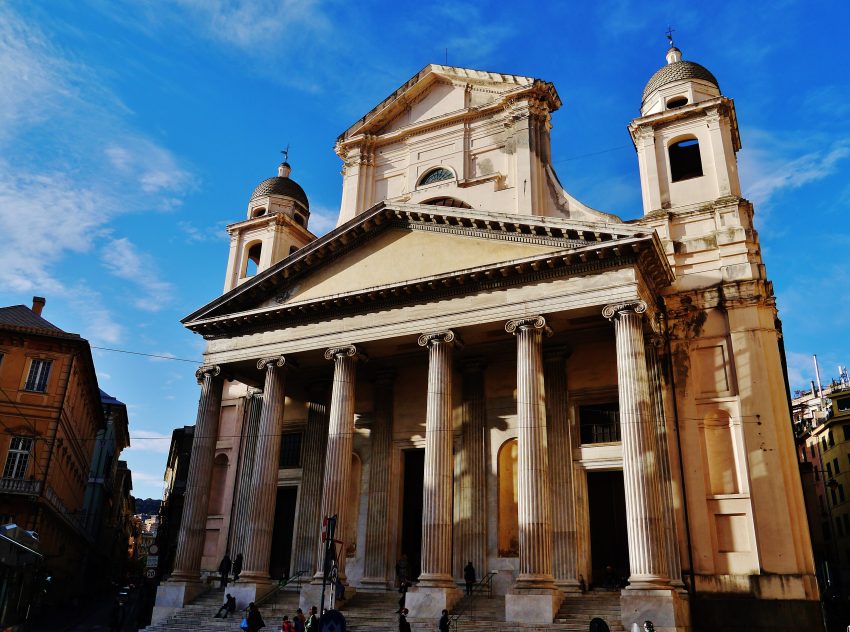
The term “vastato” has its roots in the Latin word “vastinium.” This term signifies a strip of land lying beyond the city walls that was cleared for defensive purposes. The Basilica of the Santissima Annunziata del Vastato was erected beyond the city’s protective walls. The inception of its construction took place in 1520 under the auspices of the Franciscans, situated on the former grounds of the Church of Santa Maria del Prato.
However, progress was halted in 1537 and only recommenced in 1591, under the patronage of the Lomellini family. Architect Taddeo Carlone spearheaded the continuation of the construction. During the 17th century, Baroque embellishments were incorporated, guided by the artistic direction of painter Andrea Ansaldo. The contemporary Neoclassical facade, a creation of Carlo Barabino, was integrated between 1830 and 1840.
A Latin portico, adorned with a triangular roof, stands as the entrance to the basilica. This feature is supported by six ionic stone columns and two pilasters. The facade’s upper portion is embellished with two lunette windows, with the smaller window positioned above the larger one. Flanking the facade are two bell towers, adding to the basilica’s architectural grandeur.
Internally, the church follows a Latin cross layout, with three naves divided by rows of Corinthian columns and arches. This arrangement forms an exquisite setting that resembles a 17th-century art gallery. The interior is bedecked with opulent inlaid marble, ornate gilded stucco, and frescoes contributed by 23 local artists and sculptures by 13 craftsmen. The result is a sumptuous visual feast that captures the essence of artistry and devotion.
12. Spianata di Castelletto (Esplanade of Castelletto)
Belvedere Castelletto
CC BY-SA 4.0 / EvelinaRibarova
The term “Castelletto” means “little castle.” It generally refers to a neighborhood, not a mini fortress. There was a small fortress overlooking Genoa proper. It was built in the 10th century and torn down in the 19th century to clear room for residential buildings.
When the Castelletto was demolished, it left behind the Belvedere Montaldo, a vantage point 240 feet high offering great views of Genoa proper. The best way to reach the Belvedere is the public lift in Portale Square, described as the best route to heaven by the poet Giorgio Caproni. The lift terminus is a beautiful art nouveau tower.
It is not widely known that the city’s old reservoirs, which collected water from the ancient aqueduct over the Bisagno Valley, are located under the ruin of the Castelletto.
The Esplanade of Castelletto neighborhood is in the hills above the city. It is a real neighborhood, ideal for afternoon or evening explorations. It is easily reached from the city center.E
13. Via Giuseppe Garibaldi (Giuseppe Garibaldi Street)
Doria Tursi interno
CC BY-SA 4.0 / Maurizio Beatrici
Giuseppe Garibaldi Street stands as one of the captivating “New Streets” that emerged during the Renaissance era, a testament to the vision of Genoese aristocrats. Constructed in 1583, the street initially bore the names Major Street (Strada Maggiore) or New Street (Strada Nuova). In 1882, it was bestowed the name Giuseppe Garibaldi. The street spans 956 feet in length and spans 25 feet in width.
During the 16th and 17th centuries, the affluent oligarchs of Genoa harbored aspirations to reshape their medieval city and expand it into the northern regions. The city was basking in unprecedented opulence, equipped with ample resources to fuel its urban expansion ambitions. The elite, brimming with nobility and prosperity, envisioned a city adorned with opulent palaces and splendid villas nestled in the outskirts.
The street’s nomenclature underwent transformation, evolving from New Street and Major Street to the evocative Golden Street (Strada Aurea). Ultimately, in 1882, the name solidified as Giuseppe Garibaldi Street. Along this notable avenue, the New Street Museum complex finds its place, flanked by three prominent palaces: Doria Tursi Palace (which serves as the Town Hall), White Palace, and Podesta Palace.
During the days of the Republic, the city maintained Rolli, curated lists cataloging the most magnificent homes and palaces belonging to noble families. These illustrious abodes would host significant state visits. Depending on the visitor’s stature, a palace would be designated as the host venue. Notably distinguished guests were afforded the most sumptuous, opulent accommodations.
Twice each year, in both spring and autumn, Genoa ushers in Rolli Days. On these weekends, the exquisite edifices lining Giuseppe Garibaldi Street fling open their doors to welcome the public within their ornate confines.
Charles Dickens, in his work “Pictures from Italy,” eloquently penned: “…When shall I forget the Streets of Palaces: the Strada Nuova and the Strada Balbi!…again, and again, and again,…every palace is succeeded by another…” These streets are a captivating facet of Genoa that never ceases to surprise and inspire.
Location: Palazzo Doria Tursi, Via Garibaldi, Genoa, Metropolitan City of Genoa, Italy | Hours: From 1st Novemeber
From Tuesday to Friday 9 am - 6.30 pm
Saturday and Sunday 9.30 am - 6.30 pm
Closed: Monday
From 18 April
from Tuesday to Friday 9 am - 7 pm
Saturday and Sunday 10 am - 7,30 pm
Closed on non-holiday Mondays
Last admission one hour before closing | Price: The Genova Museum Card is a single ticket, valid for 24 hours , which allows you to access only once the 28 city museums, 19 civic museums and 9 non-civic museums, for the price of 15 euro inclusive of AMT public transport | Website
Self-Guided Walking Tour of Florence, Italy (2026)
Walking tour of florence
This website uses affiliate links which earn a small commission at no additional cost to you.
Florence, located in Italy's Tuscany region, serves as its capital. It's an exquisite city boasting centuries of history and showcasing remarkable Renaissance art and architecture. Among its renowned landmarks are the iconic Florence Duomo, the Galleria dell'Accademia, where Michelangelo's masterpiece sculpture “David” is housed, and the Uffizi Gallery.
Whether you have just a day to explore Florence or an extended stay in this picturesque city, there's an abundance of activities to keep you occupied. As one of my preferred Tuscan cities, Florence never fails to offer fresh discoveries!
By Plane:Florence is served by Florence Airport, Peretola (Amerigo Vespucci Airport), which connects the city to major European hubs. From the airport, the city center is easily accessible by taxi, tram, or bus in around 15-20 minutes. For the best deals and a seamless booking experience, check out these flights to Florence on Booking.com.
By Train:Florence is well-connected by rail, with regular services from major Italian cities like Rome, Milan, and Venice. The main train station, Firenze Santa Maria Novella, is a short walk from the city center. Use Omnio to easily compare schedules, book train tickets, and find the best prices all in one place for a hassle-free journey across Italy.
By Car: Accessible via the A1 motorway, Florence is approximately a 3-hour drive from Rome. Parking is limited in the city center; recommended options include Parcheggio Santa Maria Novella and Parcheggio Porta al Prato. If you are looking to rent a car in Italy I recommend having a look at Discover Cars, first, as they compare prices and review multiple car rental agencies for you.
Where to Stay in Florence
To fully experience Florence’s historic ambiance, consider staying in the city center. For luxury, Hotel Savoy offers elegant accommodations near the Duomo. For mid-range comfort, Hotel L'Orologio provides stylish rooms steps from the train station. Budget-conscious travellers may enjoy Hotel Casci for excellent value near major sights.
A Brief History of Florence
Florence began as a Roman colony but flourished in the medieval and Renaissance periods, becoming one of Europe's wealthiest and most influential cities. It gave rise to banking dynasties, such as the Medici family, and was a haven for artists and thinkers including Leonardo da Vinci, Michelangelo, and Dante Alighieri. Florence helped shape modern Western culture through its innovations in art, science, and politics.
Today, the city balances its illustrious past with a vibrant contemporary scene.
Guided or Self-Guided Tour of Florence?
While Florence can be explored independently, a guided tour enhances the experience with rich historical context. The Florence: 2-Hour Guided Walking Tour is ideal for first-time visitors. Led by a knowledgeable guide, the tour covers highlights such as the Duomo, Piazza della Signoria, Ponte Vecchio, and the exterior of the Uffizi Gallery.
Your Walking Tour of Florence
This guide covers Florence’s essential sights, but the city rewards curiosity. Venture into artisan workshops, discover hidden chapels, or enjoy a gelato while admiring sunset views from Piazzale Michelangelo. Florence’s compact layout makes it perfect for walking-and for falling under its timeless spell.
1. Uffizi Gallery
Florence Italy Uffizi Museum
CC BY-SA 3.0 / Michelle Maria
If you had to choose just one Renaissance location to visit in Florence or in the entire world, the most obvious and compelling choice would be the Uffizi Gallery. Housed in the Palazzo degli Uffizi, originally intended as the offices of magistrates, this magnificent structure was constructed in the 16th century by Giorgio Vasari for Cosimo Medici, the first Duke of Florence. It became an ideal space to house the Medici family’s remarkable art collection and has grown to become one of Florence’s most popular tourist attractions.
The Uffizi Gallery boasts an awe-inspiring collection of must-see works of art, including masterpieces by Sandro Botticelli, Leonardo da Vinci, Michelangelo, and Caravaggio, among others. The interior decoration, particularly the intricate ceilings, is equally spectacular and worth exploring. With over 50 lavish rooms to wander through, visitors may find it challenging to absorb everything in one visit. Taking a break and recharging at the on-site café with a terrace is highly recommended, offering unparalleled views of Florence.
Due to its world-class status, the museum is often crowded, and long queues are not uncommon, especially during peak seasons. Booking tickets in advance through the official website can significantly reduce wait times and may offer discounted rates.
The Uffizi’s internal courtyard, designed by Vasari, is a long and narrow space opening towards the Arno River through a Doric screen, and its innovative architectural features set a precedent for standardized streetscapes in Europe. Michelangelo’s masterpieces, including “David” and the “Doni Tondo,” can also be admired within the gallery, displaying his extraordinary talent as both a sculptor and a painter.
Overall, the Uffizi Gallery is a true treasure trove of Renaissance art and a captivating experience that immerses visitors in the beauty of history and creativity.
From the Uffizi Gallery walk under the archway and onto the road overlooking the Arno river. Turn left and the next building you come to is the Uffizi Gallery.
The museum dedicated to Galileo Galilei in Florence is a remarkable tribute to the renowned scientist and a must-visit destination for anyone interested in the history of science and astronomy. Galileo, born in Pisa in 1564, made groundbreaking discoveries that revolutionized our understanding of the universe. His telescopes and lens, which played a pivotal role in observing Jupiter’s moons, are on display, providing a unique opportunity to connect with the scientific legacy of this great mind.
One of the highlights of the museum is the large-scale reconstructions of Galileo’s experiments on motion, weight, velocity, and acceleration. These interactive displays, sometimes demonstrated by knowledgeable staff members, offer visitors a hands-on experience of the scientific principles Galileo explored.
The museum also pays homage to the Academy for Experimentation (“Accademia del Cimento”), founded in 1657 in Florence, making it the world’s first scientific institution. The academy was established as a tribute to Galileo, and its pioneering inventions are proudly showcased here. Early thermometers, hygrometers, and barometers developed by the academy members provide fascinating insights into the early advancements in scientific instruments.
Aside from Galileo’s contributions, the museum features other historical artifacts related to exploration and navigation. The 1554 world map created by Portuguese cartographer Lopo Homem and the nautical instruments devised by Sir Robert Dudley are just some of the treasures that visitors can admire during their visit.
Overall, the museum dedicated to Galileo Galilei is a journey through the scientific legacy of one of history’s most influential figures. It offers a unique opportunity to appreciate the wonders of astronomy, scientific experimentation, and the remarkable innovations that emerged during Galileo’s time.
Visiting Museo Galileo: Daily 09:30 – 18:00, Tuesday 09:30 – 13:00 € 13,00 Buy Now
From the entrance turn left and walk down Via dei Castellani. Turn second left into Via della Ninna.
Signoria Square, located alongside the Cathedral Square, is a significant center of attraction in Florence and serves as the city’s civil heart. Dominated by the formidable Palazzo Vecchio, a fortified palace, the square is steeped in historical importance as it was the birthplace of the Florentine Republic. This square holds a special place in the hearts of the locals, serving as a hub of social life and evoking images of Michelangelo’s “David,” which once stood here in its original location, now replaced by a replica.
The square’s central location dates back to Roman times when it was a small town called Florentia, surrounded by a theatre, baths, and a textile workshop. Over the centuries, various additions were made, including a church, a loggia, and an enormous 5th-century basilica, as revealed during excavations in the 1980s.
One of the captivating aspects of Signoria Square is its asymmetrical shape and the multitude of artworks it houses, both large and small. This makes it a favourite spot for photographers, who capture the square’s beauty from various angles. Even without a camera, standing in the middle of the square and taking in the 360-degree view is a mesmerizing experience.
The square is dominated by the formidable Palazzo Vecchio, a fortified palace. Adjacent to it is the “Loggia dei Lanzi” or Lanterns’ Lodge stands, functioning as an open-air museum accessible to the public free of charge. The lodge boasts an impressive collection of statues, including the renowned “Rape of the Sabine Women,” “Hercules and the Centaur,” and a bronze “Perseus,” all strategically positioned to engage the visitors.
Traveling to a country with a different currency? Avoid ATM transaction fees and pay in local currency with a Wise Card. Having used it for over 5 years, we've saved loads on fees!
4. Palazzo Vecchio (Old Palace)
Exterior of Palazzo Vecchio
CC BY-SA 4.0 / Jordiferrer
The Palazzo Vecchio, also known as the Old Palace, is an essential site to visit in Florence, offering a profound understanding of the city’s history and culture. This grand Romanesque-style palace has been a significant seat of power in Florence since its construction in 1299, serving as the town hall for centuries and currently housing the office of the Florence mayor since 1872.
During the reign of Cosimo I de’ Medici, who became the Grand Duke, the palace underwent a transformation as it was enlarged and renovated in the Renaissance style. The palace’s facade is adorned with shields depicting the city’s political history and is embellished with a series of sculptures, including remarkable works like Michelangelo’s “David,” Donatello’s “Judith and Holofernes,” the “Hercules and Cacus,” and the heraldic lion symbolizing Florence known as “Marzocco.”
Exploring the Palazzo Vecchio offers a captivating journey through time. From the grand Hall of the Five Hundred (“Salone dei Cinquecento”), designed to celebrate the Duke’s victories, to the more intimate quarters, visitors are immersed in historical intensity and artistic wonders. Giorgio Vasari’s iconographic program has adorned the private quarters of the Medici rulers with magnificent decorations, providing a glimpse into their secluded lives.
The palace’s Tower of Arnolfo is an additional attraction, and access may require an additional fee. Marvelling at the breath-taking ceilings in each room is a memorable experience, although it may lead to a crick in the neck due to their grandeur.
One of the remarkable sculptures in the grand hall is Michelangelo’s marble group, “The Genius of Victory.” Originally intended for Julius II’s tomb, the sculpture represents an allegory of triumph rather than a moment of battle. The expressive treatment of the surfaces and the contrast between the young and elegant genius and the dominated older captive create an extraordinary visual impact.
In addition to the museum, you can also climb the Torre di Arnolfo, tower of Palazzo Vecchio. The tower is 95 metres high and you have a great view over the city centre of Florence. You can also go up to the fortress wall. There are tickets for the museum, for the wall and for the tower individually or as a cheaper combination ticket.
Visiting Palazzo Vecchio (Old Palace):
Museum:€12.50 Friday to Wednesday 9:00 am – 7:00 pm and Thursday 9:00 am – 2:00 pm Palazzo Vecchio Tower (Torre di Arnolfo): €12.50 Friday to Wednesday 9:00 am – 5:00 pm and Thursday 9:00 am – 2:00 pm
Top Tip for Visiting Palazzo Vecchio: The queues at the ticket counter in Palazzo Vecchio are often very long. Waiting for 2 hours or more is not uncommon. Skip the Line tickets for Palazzo Vecchio are available. These tickets without queuing are slightly more expensive at about €20.00. You also have the option of taking a Palazzo Vecchio Guided Tour (€50).
Explore Florence at your own pace with our self-guided walking tour! Follow our curated route to discover must-see sights and local secrets that makes Florence one of the best places to visit in Italy.
The 14th-century loggia that showcases remarkable works of art. Among these are Giambologna’s “Rape of the Sabine Women,” Benvenuto Cellini’s bronze “Perseus” (1554), and Agnolo Gaddi’s “Seven Virtues” (1384–89). The loggia derives its name from the Lanzichenecchi, Swiss bodyguards of Cosimo I, who were stationed here. Present-day guards continue this tradition, vigilantly monitoring crowd behaviour and strictly forbidding anyone from carrying food or drink within the area.
On the Loggia dei Lanzi, the statues are arranged in three rows. In the first row, there are two lions, and on the right and left of them stand two very well-known statues. In the middle row, there are three sculptures, and behind the back wall, there are six more statues.
Walk past the Replica of statue of David and turn left at the Fountain of Neptune. The Palazzo Gondi built in 1490 is on your left. Turn left into Piazza di S. Firenze, the Complex of San Firenze, located on the southeast corner of San Firenze Square.
The complex of San Firenze (Complesso di San Firenze) in Florence is one of the rare examples of the Baroque style in the city, which now houses the Museum Zeffirelli (Museo Zeffirelli) and the Church of San Filippo Neri (Chiesa di San Filippo Neri). A part of it was used as the city court until a few years ago.
The museum exhibition at the Franco Zeffirelli Foundation takes visitors on a journey through Zeffirelli’s life and career, starting from his humble beginnings in 1953. The exhibition is organized into 20 chapters, each represented in different rooms, showcasing nearly 300 sketches, posters, fliers, costumes, set-design models, original drawings, and behind-the-scenes photographs from his film sets. Zeffirelli’s work includes notable films such as “Tea with Mussolini,” “Hamlet,” “Jane Eyre,” “The Taming of the Shrew,” and his acclaimed 1968 version of “Romeo and Juliet,” which earned him an Academy Award nomination. The museum also features a tearoom on the ground floor, extending into the palazzo courtyard, providing visitors with a pleasant space to relax. Adjacent to the tearoom, a store offers Zeffirelli’s books and film memorabilia, allowing enthusiasts to delve deeper into the legacy of this extraordinary filmmaker.
Visitng Zeffirelli Museum: €12, 10.00 to 18.00 from Tuesday to Sunday.
Continuing up Via del Proconsolo you soon come to the Museo Nazionale del Bargello on your right.
The Bargello Museum in Florence is a must-visit destination for architecture enthusiasts and art lovers alike. Housed in a medieval fortress, the museum boasts a remarkable collection of some of Italy’s most treasured sculptures and artworks. Originally known as the People’s Palace (“Palazzo del Popolo”), the Bargello is one of the city’s oldest structures, dating back to 1255. Over the centuries, the building has served various functions, including housing the “Captain of the People,” the chief of police in Florence, known as the “bargello,” which gave the palace its name. Later, it was used as a prison until the mid-19th century when it was transformed into a museum showcasing a vast array of Gothic and Renaissance sculptures.
Inside the museum, visitors can admire works by renowned artists such as Michelangelo, Verrochio, Brunelleschi, and Donatello, among others. Donatello’s statue of David is a particular highlight, as it holds great significance as the first male nude sculpture publicly exhibited since ancient times, representing a pivotal moment in the evolution of European art.
The Bargello’s inner courtyard provides an elegant space adorned with relief and freestanding sculptures, creating a picturesque setting for visitors to enjoy. The gallery, located off the courtyard, and the spacious exhibition area above house some of the museum’s most famous pieces.
In addition to its exceptional Renaissance treasures, the museum’s collection includes rare artifacts from the Byzantine, Roman, and Medieval periods. Visitors can also appreciate jewelry pieces from the European Renaissance and Islamic origins, adding to the diverse and enriching experience.
To enhance the visitor experience, all exhibits at the Bargello Museum are accompanied by English descriptions, ensuring that art enthusiasts from around the world can fully immerse themselves in the historical and artistic significance of the museum’s remarkable collection.
Visiting Museo Nazionale del Bargello: €11.00 Monday, Friday, Saturday and Sunday 08.15-18.50; Wednesday, Thursday. 08.15-13.50. Bargello Museum: Skip the Line Tickets
A little further up Via del Proconsolo on the opposite side of the road to the Bargello National Museum is the Badia Fiorentina – Monastero
The Badìa Fiorentina is a beautiful old monastery that is situated in the historical centre of Florence. It is also known as the Abbey of Santa Maria Assunta and is one of the five ancient abbeys of the city. It is located very close to where Dante grew up. Established in 978 by Willa, the widowed spouse of Count Uberto of Tuscany, it has witnessed centuries of religious and cultural significance. The tomb of their son, Count Ugo, sculpted by Mino da Fiesole, adds to the abbey’s historical importance and showcases the skilled craftsmanship of the Renaissance era.
Inside the church, visitors are treated to Filippino Lippi’s masterpiece, “The Virgin Appearing to St Bernard,” a captivating artwork that brings life and emotion to the sacred space.
Exploring the Chiostro degli Aranci, or “cloister of the orange trees,” provides a tranquil retreat within the abbey complex. Although the orange trees cultivated by the monks are no longer present, the cloister’s early frescoes and the glimpse of the hexagonal 14th-century campanile mentioned by Dante in “The Divine Comedy” create a unique and enchanting atmosphere.
Continue up Via del Proconsolo and turn first left onto Via Dante Alighieri. The second turning on the right is the Museo Casa di Dante. It stands opposite the early 14th century Torre della Castagna. The tower is called Chestnut, as the city council that used to place chestnuts in special bags during voting.
During the Renaissance, Florence witnessed extensive reconstruction, yet the eastern part of the city retains a distinctive medieval atmosphere. As you wander through the intricate maze of narrow alleyways and concealed passages, you will encounter scenes that would still be familiar to Dante Alighieri, the beloved Italian poet. Casa di Dante, his former residence, still stands near the parish church where he first caught sight of his beloved Beatrice Portinari.
Inside the three-story house-museum, you will find a captivating display of artifacts that shed light on crucial moments in Dante’s life. The first floor is dedicated to his early years, while the second floor showcases documents relating to his exile in 1301 and the final chapters of his life spent in Ravenna. As you ascend to the top floor, you will be greeted by an extensive collection of Dante’s personal belongings, including original items and carefully crafted replicas. Among these treasures, take delight in the miniature copy of the “Divina Comedia,” a testament to its enduring legacy as the smallest printed edition.
In Dante’s epic poem, he embarks on a journey through Hell and Purgatory, guided by the poet Virgil, only to be led through Paradise by his beloved Beatrice. Although Dante initially referred to his work as the “Comedy,” it gained immense popularity. Eventually, a lavish edition published in Venice in 1555 assumed the title we now universally recognize.
Visitng Casa di Dante: €8.00 Winter: November 1 – March 31: Tue. – Fri. 10am – 5pm & Sat. and Sun. 10 a.m. – 6 p.m. Summer: April 1 – October 31: Daily 10am – 6pm
10. Cattedrale di Santa Maria del Fiore (Florence Cathedral)
Cathedral of Santa Maria del Fiore Piazza Duomo
Walk along the lane to the side of the museum. Turn left into via del Corso and then first right onto Via dello Studio at the end of which lies Florence Cathedral.
Indeed, the Florence Cathedral, commonly known as the Duomo, is a true architectural marvel and a symbol of Renaissance ingenuity. Its dome, designed by Filippo Brunelleschi, remains an engineering wonder to this day. The entire cathedral complex, including the dome, is a testament to the skill and creativity of the Renaissance masters who contributed to its construction.
The construction of the cathedral took several generations of architects and craftsmen, and Brunelleschi’s innovative approach to completing the dome was a game-changer. His use of large-scale models and specially designed machinery demonstrated his genius as an architect and engineer. It is fascinating to know that Leonardo da Vinci, one of history’s greatest polymaths, was inspired by Brunelleschi’s machinery and created sketches of it.
The statue of Brunelleschi standing in the piazza in front of the Cathedral pays tribute to his contribution and serves as a reminder of the extraordinary effort that went into creating this architectural masterpiece.
Inside the Dome, the fresco “Dante and the Divine Comedy” by Domenico di Michelino adds to the artistic and historical significance of the Cathedral. Depicting the renowned poet Dante Alighieri holding his masterpiece, “The Divine Comedy,” alongside scenes from Hell, Purgatory, and Heaven, the fresco celebrates Dante’s legacy. The inclusion of depictions of 15th-century Florence in the painting offers a unique perspective on the city’s history.
The exterior of the Cathedral, with its intricate mix of marbles, is another splendid aspect of the structure. The skilful combination of marbles creates a visual spectacle, almost resembling a work of art rather than solid stone.
Visiting Florence Cathedral: There are 3 types of ticket available see https://operaduomofirenze.skiperformance.com/
Ghiberti Pass €15.00
Santa Reparata (Cathedral) : daily from 10 a.m. to 5 p.m., but on Sundays only from 1:30 p.m. to 4:45 p.m., probably because there is a service in the morning.
Baptistery: Mon – Sat: 8:15 to 10:15, then small break and again from 11:15 to 19:30. On Sunday continuous from 8;15 to 13:30.
Cathedral-Museum Florence: opening hours every day from 9 to 19 o’clock
Giotto Pass €20.00 (The above plus)
Giotto’s Bell Tower: Very long opening hours every day from 8:20 to 19:15, also on weekends.
Brunelleschi Pass €30.00 (The above plus)
Brunelleschi’s Dome: 8:30 a.m. to 7 p.m., on weekends shorter in the evening (Saturday to 5 p.m., Sunday to 4 p.m.).
The famous Giotto’s Bell Tower is a freestanding belfry belonging to the Santa Maria del Fiore Cathedral in Florence. It was designed by the acclaimed painter and architect Giotto di Bondone, after whom it is named. Giotto is widely regarded as the first of many great Italian artists who contributed to the Renaissance. Soaring to a height of 85 metres, this tower stands as an exceptional example of Florentine Gothic architecture, adorned with intricate sculptural decorations and vibrant marble embellishments.
Tragically, Giotto passed away during the tower’s construction, and the project had to be completed by two other architects. Besides his contributions to Renaissance architecture, Giotto also left his mark as a skilled painter and sculptor. His artistic legacy is evident in the exquisite white, green, and red marble adornments on the tower, as well as the grand figurative cycle within the belfry, which he left unfinished.
Exploring the interior of the tower is possible, and out of the three major tall structures in Florence, climbing this one is arguably the easiest. Despite the seemingly daunting 414 steps, the staircase is designed in a way that allows for rest stops along the way. Each level within the tower houses a large bell, totaling seven bells—one for each musical note. Unlike the crowded spaces of the Duomo Cathedral and the Arnolfo Tower in the Old Palace (or “Palazzo Vecchio”), the resting areas within Giotto’s Tower are relatively spacious and engaging, offering visitors diverse and remarkable views of the city below.
From the very top, one can observe the Cathedral’s dome and the Baptistery of San Giovanni from a unique and somewhat unconventional perspective. The sweeping view of Florence includes its timeless alleys and rooftops that have retained much of their charm over the past five centuries.
12. Battistero di San Giovanni (Baptistery of St. John)
Baptistery Florence
CC BY-SA 2.0 / Bradley Weber
The exquisite Florence Baptistry, named after Saint John the Baptist, the patron saint of the city, is located in the Cathedral Square and San Giovanni Square, diagonally opposite the Duomo Cathedral. It was constructed in the 7th century atop a Roman structure believed to have been a temple dedicated to Mars. The baptistery has an octagonal shape, a common feature of baptisteries since early Christian times. The number eight symbolizes regeneration in Christianity, representing the six days of creation, the day of rest, and the day of re-creation through the sacrament of baptism.
During its reconstruction in 1059, the baptistery was adorned with white and dark green marble, creating a striking zebra-like pattern. However, it is most renowned for its three sets of bronze doors. The south doors, designed by Andrea Pisano, depict scenes from the life of St. John and elegantly illustrate the eight virtues of Christianity in bronze. The north doors, crafted by Lorenzo Ghiberti, took him 21 years to complete and portray the life of Christ. Ghiberti was then commissioned to create the east door, on which he worked for an additional 27 years. These doors were famously dubbed by Michelangelo as the “Gates of Paradise,” and the ten panels on this door depict “the Story of Joseph.”
Inside, visitors can admire magnificent mosaics adorning the ceiling and a baptismal font that has been in place since 1576, used for the baptism of the son of Francesco I de’ Medici, the ruler of Florence. Besides members of the Medici family, the baptistery witnessed the baptisms of many Renaissance-era personalities and almost all Catholic Florentines until the 19th century. Exploring this architectural marvel is, therefore, a journey into the rich Catholic history of Florence.
13. Palazzo Medici Riccardi (Medici Riccardi Palace)
Medici Riccardi Palace
CC BY-SA 3.0 / Sailko
Walk down Via dei Servi to the north east of the Cathedral. Turn left down Via de’ Pucci. On your right is the Palazzo Pucci, owned by the aristocratic Pucci family since around 1480. The present palace was designed around 1748 by the architect Paolo Falconieri. Walk on another two blocks until you come to Riccardi Medici Palace.
The first Medici palace, once the residence of Cosimo the Elder and Lorenzo the Magnificent, served as a bustling hub for numerous prominent Renaissance artists, including the prodigious Michelangelo, who was discovered by Lorenzo while still in his formative teenage years.
This grand edifice was an imposing spectacle of its time, setting a new standard with its three tiers of progressively textured stonework and sizeable, evenly spaced two-light windows. A magnificent cornice adorned the entire exterior, exemplifying its imposing presence. The building encloses an elegant square courtyard at its core, in stark contrast to the commanding impression projected by its façade. Together, they symbolize the duality of the Medici family, projecting an image of wealth, influence, and even ruthlessness to the outside world, while fostering an atmosphere of refinement as patrons of the humanist Renaissance within their sanctuary.
While the courtyard and gardens offer a delightful and complementary experience, it is undoubtedly worthwhile to pay the admission fee and ascend to the upper rooms. These spaces exhibit designs, decor, style, furnishings, and collections that bear testament to the profound power, far-reaching influence, and immense wealth of the Medici dynasty.
A hidden gem within the palace is the Magi Chapel, mesmerizing with its diminutive size yet resplendent floor-to-ceiling frescoes by the gifted artist Benozzo Gozzoli. The intricate details within the artwork, such as the elaborate costumes, depictions of animals, and picturesque scenery, captivate the observer’s gaze. One can spend an hour studying the reputed likenesses of various members of the illustrious Medici clan, along with notable figures like the Wolf of Rimini: Sigismondo Malatesta. The vibrant colours – considering the work was started in 1459 – create a visual feast where the composition unfolds in a bit of a whirlwind.
Near the end of the tour is the astonishing Galleria, a completely “over-the-top” Baroque marvel, resplendent with walls covered in shimmering gold and a grand domed ceiling adorned with scenes from Greek mythology. Additionally, there is an underground sculpture museum, housed within the former stables. Fortunately, there are minimal queues for entry, allowing visitors to relish the magnificence of the rooms comfortably and at their leisure.
Cappelle Medici Basilica di San Lorenzo Florence Italy
CC BY-SA 2.0 / Adam63
Continue along the road to the square and the Basilica di San Lorenzo.
The first Medici palace, once the residence of Cosimo the Elder and Lorenzo the Magnificent, served as a bustling hub for numerous prominent Renaissance artists, including the prodigious Michelangelo, who was discovered by Lorenzo while still in his formative teenage years.
This grand edifice was an imposing spectacle of its time, setting a new standard with its three tiers of progressively textured stonework and sizeable, evenly spaced two-light windows. A magnificent cornice adorned the entire exterior, exemplifying its imposing presence. The building encloses an elegant square courtyard at its core, in stark contrast to the commanding impression projected by its facade. Together, they symbolize the duality of the Medici family, projecting an image of wealth, influence, and even ruthlessness to the outside world, while fostering an atmosphere of refinement as patrons of the humanist Renaissance within their sanctuary.
While the courtyard and gardens offer a delightful and complementary experience, it is undoubtedly worthwhile to pay the admission fee and ascend to the upper rooms. These spaces exhibit designs, decor, style, furnishings, and collections that bear testament to the profound power, far-reaching influence, and immense wealth of the Medici dynasty.
A hidden gem within the palace is the Magi Chapel, mesmerizing with its diminutive size yet resplendent floor-to-ceiling frescoes by the gifted artist Benozzo Gozzoli. The intricate details within the artwork, such as the elaborate costumes, depictions of animals, and picturesque scenery, captivate the observer’s gaze. One can spend an hour studying the reputed likenesses of various members of the illustrious Medici clan, along with notable figures like the Wolf of Rimini: Sigismondo Malatesta. The vibrant colors – considering the work was started in 1459 – create a visual feast where the composition unfolds in a bit of a whirlwind.
Near the end of the tour is the astonishing Galleria, a completely “over-the-top” Baroque marvel, resplendent with walls covered in shimmering gold and a grand domed ceiling adorned with scenes from Greek mythology. Additionally, there is an underground sculpture museum, housed within the former stables. Fortunately, there are minimal queues for entry, allowing visitors to relish the magnificence of the rooms comfortably and at their leisure.
Head back towards Riccardi Medici Palace and turn right down Borgo S. Lorenzo. You pass the Battistero di San Giovanni and soon arrive at Piazza della Repubblica.
.
The Piazza della Repubblica stands as the center of Florence. The Colonna dell’Abbondanza, or Column of Abundance, signifies the exact geographical midpoint of the city, originally the ancient midpoint of the Roman Forum. It also serves as the boundary between three of Florence’s four historic neighborhoods on this side of the Arno River: the Santa Croce azzurri, San Giovanni verdi, and Santa Maria Novella rossi; while the Santo Spirito bianchi neighborhood is situated in the Oltrarno district across the river.
A part of the current piazza was once used as a market due to its significance in terms of commerce, politics, and social activities in the city. Many stories and tales related to Florence originate from this square. According to one such tale, in 1245, St. Peter Martyr was trying to preach to a large crowd when the devil, disguised as an imposing black horse, attempted to disturb the onlookers by running wildly through the market and endangering them. Recognizing the danger, St. Peter raised his arm and made the sign of the cross towards the skittish horse, which immediately stopped and vanished. Centuries later, in memory of this event, Bernardo Vecchietti commissioned Giambologna to create a bronze standard-bearer in the shape of a small devil, placing it at the corner of his palace between Via Vecchietti and Via Strozzi.
The current appearance of the piazza can be attributed to urban renovations that took place during Florence’s period as the capital of the Kingdom of Italy, known as the Risanamento. During this time, older buildings, including medieval towers and noble palaces, were demolished and replaced with elegant structures, including the historic Caffè Le Giubbe Rosse, which transformed Piazza della Repubblica into a sophisticated center of public life.
Walk directly across the Piazza and right into Via Porta Rossa.
The Davanzati Palace, originally constructed in the 14th century as the residence of the Davizzi family, who were merchants and bankers, now bears the name of the Davanzati family, who were bankers for the Popes at Avignon. The Davanzati family acquired the palace in 1578 and added their large coat of arms to the facade. Today, the palace is open to the public as the Museum of the Old Florentine House, offering a captivating and invaluable glimpse into a typical wealthy Florentine home from the Medieval to Renaissance era. Visitors can explore frescoes, paintings, sculptures, and period furniture that adorn the interior.
To visit the upper floors of the palace, which showcases the rooms where a wealthy family would have lived, including a kitchen equipped with period-appropriate equipment, a guide is required. Visitors can either book in advance on the website or arrange a time with the receptionist. It is highly recommended to see these upper floors, as the bedrooms, in particular, boast stunning wall paintings. However, the lower floors, holding delightful collections of embroidery and lace-making, can also be visited without a guide.
For older children, this experience will be both educational and fascinating, surpassing any description in a history schoolbook. The Museum of the Old Florentine House offers a unique opportunity to step back in time and immerse oneself in the opulence and lifestyle of a wealthy Florentine family during the Medieval and Renaissance periods.
Head back along Via Porta Rossa and turn right into Via Calimala.
The Ponte Vecchio, also known as The Old Bridge, first appeared in documents in 996. During World War II, while all the other six local bridges crossing the Arno River were destroyed by retreating German forces, Ponte Vecchio was miraculously spared. This Medieval stone arch bridge stands as a testament to the lasting legacy that a monarch can create.
Today, the bridge is still lined with shops, just as it was in the Middle Ages. These days, the shops are occupied by jewelers, art dealers, and souvenir sellers. However, in the past, the bridge’s tenants were all butchers who disposed of rotten animal carcasses directly into the river below. It wasn’t until the 16th century when Grand Duke Fernandino I de’ Medici ordered that all the butcher shops be replaced by goldsmiths. This not only got rid of the unpleasant smell but also transformed the bridge into one of the most charming and golden spots in Italy.
From a distance, the bridge reveals a fascinating secret—a hidden upper level that features a kilometer-long tunnel connecting the Pitti Palace with the Old Palace. Historically, this tunnel provided a secure route for Duke Fernandino to move between the two palaces discreetly when he felt uneasy in public. Although the passageway has been closed for safety reasons since 2016, the Uffizi Gallery has exciting plans to reopen it.
One of the legends surrounding the bridge is the origin of the economic term “bankruptcy.” The story goes that a money-changer who couldn’t pay his debts had his trading table physically broken by soldiers as punishment for his insolvency. The table was called “banco,” and from this incident, the term “bancorotto” came into existence.
Today, the Old Bridge offers a delightful stroll, especially in the evenings, if it’s not packed end to end with thousands of tourists crossing the river over its cobblestones.
The Pitti Palace is truly an architectural marvel in Florence, and missing a visit to this splendid site would be a regrettable omission. Its main highlight is undoubtedly the stunning Renaissance architecture, complemented by the breathtaking gardens that offer new adventures at every turn.
Today, the enormous palace houses several museums under one roof. However, its origins trace back to being the official residence of the immensely powerful Medici family from the 16th to the 18th century. Initially built in the second half of the 15th century for Luca Pitti, the construction remained unfinished at the time of his death in 1472. In 1550, the palace was acquired by Eleonora di Toledo, the wife of Grand Duke Cosimo I de’ Medici. Later, when the Medici dynasty ended, the property passed into the hands of the House of Lorraine, and during the early 19th century, Napoleon Bonaparte used it as a power base during his rule over Italy.
Every aspect of this palace exudes elegance and sophistication, whether it’s the Palatine Gallery featuring over 500 paintings, the opulent Royal Apartments of the Medicis, the “Medici Treasury” housing priceless 15th-century silver, the Costumes Gallery, or the Porcelain and Carriages Museums. The impressive painted ceilings, walls, and intricate ground decorations create an ambiance of a private royal residence. Remarkably, since 1919, the palace and all its contents have belonged to the Italian people, attracting over 5 million visitors each year.
Visiting the Pitti Palace offers an extraordinary opportunity to immerse oneself in the grandeur and cultural richness that defines Florence’s history and artistic legacy.
Fort Belvedere stands as a remarkable example of Italian Renaissance and military architecture, dating back to the end of the 16th century when it was built by Grand Duke Ferdinando I de’ Medici. This grand fortress served a dual purpose: to protect the city of Florence and to showcase the power and prestige of the Medici Family. It also functioned as a repository for the Medici’s treasury and offered a secure refuge for the Grand Duke during times of potential attack. To facilitate this, the fort was connected to the Old Palace (“Palazzo Vecchio”) via a corridor over the Old Bridge (“Ponte Vecchio”), as well as through other passages linking it to the Pitti Palace and Boboli Gardens.
From a military perspective, Fort Belvedere, being the largest fortress in Florence, occupied a strategic vantage point over the city and its surroundings. In the context of warfare during the Renaissance period, forts played a crucial role in defense strategies, and Belvedere excelled as a citadel and garrison for over a century after its completion. Its walls were intentionally positioned at angles to one another, enabling effective observation and, if necessary, crossfire to defend the neighboring walls. Interestingly, the renowned scientist Galileo Galilei used the fort for astronomical observations and, following his life imprisonment sentence in 1633, resided nearby at Villa Arcetri.
After undergoing a five-year renovation to enhance safety measures, the fort reopened to the public in July 2013, now primarily serving as an exhibition center. The nominal entry fee is well worth it, as visitors can freely explore the site and enjoy breathtaking panoramic views of Florence and the surrounding hills. Fort Belvedere remains a captivating testament to the rich history and architectural prowess of the Italian Renaissance period.
San Miniato, perched on one of the highest points in Florence, is celebrated as one of the most exquisite examples of Romanesque architecture in Tuscany and one of Italy’s most splendid churches. Though it may present challenges for those with limited mobility, it forms a delightful combination with the nearby Michelangelo Square (“Piazzale Michelangelo”). The best part is that admission to San Miniato is completely free, allowing visitors to explore the church and the adjacent Olivetan monastery, situated to the right of the basilica as they ascend the stairs.
According to legend, St. Miniato, also known as Minas, an Armenian prince serving in the Roman army under Emperor Decius, was denounced as a Christian after becoming a hermit. He was brought before the Emperor, who ordered him to be thrown to wild beasts in an amphitheater. Surprisingly, a panther summoned to attack him refused to harm him. Despite eventually being beheaded in the presence of the Emperor, St. Miniato is said to have picked up his own head, crossed the Arno River, and ascended the hill of Mons Fiorentinus to his hermitage. A shrine was later established at this spot, followed by a chapel in the 8th century.
The present-day basilica was funded by a guild of cloth merchants, who took responsibility for its upkeep. Adorned with stunning mosaic decorations, an exquisite marble inlay altar, and even a “pagan” horoscope, the basilica is a spectacular sight, showcasing remarkable craftsmanship by some of Florence’s most esteemed artists. San Miniato’s architectural beauty and historical significance make it a must-visit destination for those exploring the cultural treasures of Florence.
Florence undeniably captivates with its stunning beauty, and Michelangelo Square stands as irrefutable proof of this fact. Designed by Giuseppe Poggi, this expansive space, adorned with souvenir stalls, offers a magnificent panorama of Florence’s rooftops. The most iconic and photographed view from here showcases the Duomo Cathedral and its cupola, along with the Giotto Bell Tower and the Old Palace (“Palazzo Vecchio”). Over time, this famous vista has graced countless postcards, yet other notable landmarks can also be spotted nearby, such as Fort Belvedere, the Holy Cross Basilica (“Santa Croce”), and the Old Bridge (“Ponte Vecchio”).
The square itself was laid out in 1869 when Florence served as the capital of Italy, during an urban renewal program known as the “Risanamento” or “Rebirth” of the middle class.
Dedicated to the renowned Renaissance sculptor Michelangelo, the square features replicas of some of his works found elsewhere in Florence, including the famous “David” and the four allegories from the Medici Chapel of San Lorenzo. While the originals are crafted from white marble, the bronze copies displayed here were transported uphill by nine pairs of oxen, likely leaving them rather sweaty, to fulfil Giuseppe Poggi’s visionary concept.
Thousands of visitors flock here to witness the sunset, which is truly a sight to behold. Finding the perfect spot, you can revel in the sun’s reflection on the Arno River while sipping a glass of wine. Bringing your own drink is a good option, unless you prefer to take advantage of the various restaurants and bars situated around the square, with the most renowned boasting a Neoclassical design. Considering the prime location, prices here are actually quite reasonable.
Midway up the main staircase, you’ll discover a delightful city rose garden, where you can spend a serene half-hour strolling amidst the trees and roses, enjoying enchanting views of the Duomo and the cityscape.
After sunset, you can easily descend the hill, relishing the tranquillity of dusk along the way. Michelangelo Square provides an unforgettable experience that captures the essence of Florence’s timeless charm.
The Ultimate Self-Guided Tour of the Duomo and Baptistery in Florence (2026)
Florence
This website uses affiliate links which earn a small commission at no additional cost to you.
Standing on opposite sides of Piazza del Duomo, separated by Via dei Calzaiuoli, are two of the most renowned structures in Florence: the Baptistery of St. John and the Cathedral of Santa Maria del Fiore. Locally, the latter is often referred to as the “Duomo.” Their bright white marble exteriors, adorned with green and pink stone trimmings, possess a unique and quintessentially Florentine charm. If there were a pulsating heart at the core of this city, it would undoubtedly reside right here.
Whether you are captivated by their grandeur, historical significance, or spiritual aura, visiting these landmarks in Florence is a rite of passage for many. However, numerous individuals come here and admire these structures without fully grasping the context behind their construction and artistic brilliance. In this post, I aim to shed light on some of these mysteries and hopefully enable you to appreciate these attractions for more than just their outer beauty.
Crypt of Santa Reparata: Mon-Fri: 10am-5pm; Sat: 10am-4:30pm; Sun: Closed
The museum will be closed on the first Tuesday of each month.
Tickets
While exploring the interior of the Duomo is free you’ll need a ticket if you want to see the inside of the Baptistery, to climb up the bell tower or the dome and visit the Duomo Museum. These attractions are all included in one ticket, so if you want to visit just one, you’ll still have to pay the same price as visiting them all. The best way to buy your ticket inside is online and in advance, so you can assure yourself access into the Duomo’s attractions.
Adults: €18 (if booking online there is an extra €2 pre-booking fee) Children: €3 Audio guides: €2,50 per person
Climbing the Dome: When booking online you need to select the time when you want to do the dome climb. You cannot change this time after booking and must be there within 15 minutes of your pre-selected time-slot.
Is it worth going inside the Florence’s Duomo?
I personally find the interior of Santa Croce far more appealing than the somewhat plain interior of the mentioned location. Although the frescoes on the dome are breath-taking, the rest of the interior may not be as captivating. On the other hand, the interior of the Baptistry is simply exceptional, with its mesmerizing mosaics that are truly out of this world. Some visitors enjoy ascending the tower and dome inside the cathedral for the panoramic view from the top, but be prepared to wait in line if you choose to do so. If time is limited, I would suggest skipping the interior visits.
The exteriors of these structures are equally impressive, and Florence has so much more to offer, making it more worthwhile to explore other attractions instead of waiting in line. However, if you have ample time or a deep interest in interior artworks, it's worth making the effort to see them. Early morning visits may help avoid long lines. One highlight of the ticketed entry is the museum, which showcases original artworks and sculptures that were once housed within the church. You can also admire the original Baptistery doors and exquisite robes worn by priests during various events on the Catholic calendar, making it an intriguing part of your visit.
Basilica of Santa Maria del Fiore
The magnificent Basilica of Santa Maria del Fiore, a truly awe-inspiring Cathedral that commenced construction in 1296 and was finally completed in 1436-over the course of more than 140 years! The temple is dedicated to Santa Maria del Fiore, or “Saint Mary of the Flowers.” In Italian culture, Mary is often associated with flowers, particularly roses, which symbolize the transience of life and death. Mary carries the weight of knowing her son’s fate, yet she continues to raise him with boundless love in her heart. Like a beautiful flower that we know will eventually fade, we still admire its splendour until its final moments.
The History of the Basilica of Santa Maria del Fiore
The city’s main religious monument, a grand and impressive church, among the world’s largest in volume. Brunelleschi’s majestic cupola is an iconic symbol, visible from the surrounding hills. The cathedral’s construction spanned a long period, with the present façade completed in 1887. The use of pink, green, and white marble creates a harmonious composition with the nearby baptistery and campanile.
Santa Maria del Fiore is situated on the site of the earlier, smaller Santa Reparata church, originally built in the late fourth or early fifth century. In the eleventh century, it was reconstructed as a Romanesque basilica. In the twelfth century, Santa Reparata became the city’s cathedral, replacing San Lorenzo. The church featured a six-bay aisled nave and three semicircular eastern apses, with the central apse larger than the flanking ones. Its facade was located ahead of the present cathedral’s west front and extended halfway along the present nave.
Basilica of Santa Maria del Fiore in the Late thirteenth century
By the late thirteenth century, Florence’s size and wealth had significantly increased, rendering Santa Reparata too small. In 1294, Arnolfo di Cambio was tasked by the city’s government to build a new cathedral. The construction began on September 8, 1296, and the church was dedicated to Santa Maria del Fiore, symbolized by the lily, emblem of the city and Virgin Mary. Arnolfo initiated the wider facade and raised the nave flank walls before his death in 1302. Progress slowed after his passing. In 1331, the Magistrati dell’Opera was established to oversee the project, and funding from the Arte della Lana guild boosted the progress. Giotto was appointed chief master in 1334 but mainly focused on the campanile’s construction before passing away three years later. His successor, Andrea Pisano, also worked on the campanile. Francesco Talenti took over around 1350 and completed the campanile in 1359. However, his attention later returned to the church itself by 1356.
During this phase of construction, the eastern part of Santa Reparata, the canons’ residence, and the monastic buildings were still intact, along with the church of San Michele Visdomini to the east. Francesco Talenti introduced a new model for the cathedral, retaining the Latin cross plan but reducing the number of nave bays to four while increasing their size and raising the height of the nave vault. Talenti also proposed a large cupola at the crossing. By 1364, the first three nave bays were completed, but Talenti was later replaced. Lapo Ghini, his colleague and successor, presented a revised proposal with a modified plan for the eastern apses. The cupola’s diameter was increased from approximately 36m to 41m, and it was to stand on an octagonal drum with circular windows, as it appears today. Talenti returned as master, and by around 1370, the form of the cupola and eastern apses had been defined. The nave vault was completed in 1378, followed by the aisle vaults two years later. Construction continued until 1421 on the transepts, chancel, and the drum supporting the cupola.
In 1418, a competition was held to design the cupola, and both Lorenzo Ghiberti and Brunelleschi participated. Although Ghiberti won, his role was limited, and eventually, Brunelleschi took full control of the project. The construction of the cupola progressed under Brunelleschi’s direction and was completed up to the base of the lantern in 1436.
After winning the competition for the design of the crowning lantern, Brunelleschi began its construction in 1443 but passed away three years later. The project was then continued by Michelozzo di Bartolomeo and later by Bernardo Rossellino. Finally, under Andrea del Verrocchio’s supervision, the lantern was completed in 1468. The lengthy construction period was due to the challenging logistics of hauling marble to such heights. The lantern takes the form of an octagonal classical tempietto, resembling a small chapel. During this period, Brunelleschi also designed the four exedrae, situated below the circular windows of the drum and between the cupolas of the three tribunes or eastern apses. They feature deep niches separated by paired pilasters, showcasing a refined early Renaissance style.
The Exterior of Basilica of Santa Maria del Fiore
The Southern flank of the Basilica of Santa Maria del Fiore
The southern flank of the cathedral is the oldest section, covered in white Carrara marble and adorned with decorative green Prato marble panels. A relief of the Annunciation from 1310 can be found on the wall near the campanile. Close by is the Porta del Campanile, featuring a Virgin and Child in the lunette, previously attributed to Andrea Pisano but now generally credited to Simone Talenti. Further east, there is the Porta dei Canonici from 1378, designed by Piero di Giovanni Tedesco and others. In its lunette, there is another depiction of the Virgin and Child, created by Niccolò di Pietro Lamberti in 1395.
The Eastern End of the Basilica of Santa Maria del Fiore
At the east end of the cathedral, you’ll find the impressive three equal arms of the transepts and chancel, all rising towards Brunelleschi’s magnificent cupola. Each of these arms has five facets, featuring tall Gothic two-light windows on each face. Above the lower order, raking buttresses support the smaller upper order, topped by a small but incomplete cupola that abuts the base of the octagonal drum. The drum has a large oculus on each face, and it was originally planned to construct eight marble-clad galleries just above it. However, only one facet was completed, and the remaining seven were never built, leaving rough masonry in their place. Several proposals for the galleries’ completion, preserved as models, can be found in the Museo dell’Opera di Santa Maria del Fiore.
The North Face of the Basilica of Santa Maria del Fiore
On the north face of the exterior, the Porta della Mandorla (1391-7) was created by multiple masters, including Giovanni d’Ambrogio, Piero di Giovanni Tedesco, and Niccolò Lamberti. The spandrel above the lower arch features a rich relief by Nanni di Banco, while the lower lunette once held an Annunciation attributed to Jacopo della Quercia, now housed in the Museo dell’Opera. In the gable, enclosed within an almond-shaped mandorla, is the Assumption of the Virgin with St. Thomas, also sculpted by Nanni di Banco.
The west façade of the Basilica of Santa Maria del Fiore
The original west façade, designed by Arnolfo di Cambio, was only completed up to the top of the central portal. It was a complex late Gothic work with sculpted pieces by Nanni di Banco, Donatello, and Niccolò Lamberti, now housed in the Museo dell’Opera. In 1587, it was dismantled by decree of Grand Duke Francesco I and undertaken by Bernardo Buontalenti.
The façade remained bare until 1843 when Nicola Matas proposed a new design. The present neo-Gothic façade, completed in 1871-87, was designed by Emilio de Fabris and finished by Luigi del Moro after Fabris’s death. It showcases the greatness of Christianity and the significance of the Virgin Mary, with principal figures such as St. Antonino and Pope Eugenius IV in the niches.
The bronze doors, created by Augusto Passaglia and Giuseppe Cassioli, depict scenes from the Life of the Virgin, and the upper gallery features the Virgin and Child, flanked by the Twelve Apostles, also by Passaglia.
The Great Dome
The design of the church followed the Italian Gothic architectural tradition, characterized by pointed arches and cross-ribbed vaults. The Cathedral’s overall layout adheres to a Latin cross design, with a particular focus on accommodating the most iconic feature of the church-the enormous dome. Arnolfo di Cambio, the initial architect, had already incorporated space for the dome in his floorplans. However, by the time of his passing, the concept of constructing such a colossal dome had not yet been fully realized.
During the 140 years of the Cathedral’s construction, architects from all over the world grappled with the immense challenge of figuring out how to build a dome of such scale without it collapsing. Giotto di Bondone, Andrea Pisano, and Francesco Talenti were among the architects who worked on different aspects of the church and contributed to the development of the dome.
Ultimately, it was Filippo Brunelleschi, a Florentine architect, who successfully completed the construction of the magnificent dome. His innovative and revolutionary approach involved the use of innovative engineering techniques, such as a double-shell structure and an ingenious herringbone pattern, to ensure the stability and strength of the dome. Brunelleschi's ingenious design remains an exceptional feat of engineering and a masterpiece of Renaissance architecture. The dome stands as a testament to human ingenuity and artistic brilliance, crowning the Florence Cathedral with its awe-inspiring presence.
The Interior of the Basilica of Santa Maria del Fiore
The cathedral interior exudes a grand and unadorned simplicity, except for the remarkable stained-glass windows. It measures 153 m in length, 38 m wide across the nave and aisles, and 90 m across the transepts. The plan is a modified Latin cross, featuring a nave with only four large square bays and relatively narrow aisles. The nave is articulated by massive compound piers and pilasters, supporting simple pointed arches and rising to a continuous walkway on corbels. Above are plain quadripartite vaults with stone ribs. The clerestory features large oculi in the centre of each bay. The cathedral boasts forty-four exquisite stained glass windows, making it one of Italy’s finest collections.
The floor is made of polychrome marble, displaying intricate geometric patterns. Its construction started in 1526 based on Baccio d’Agnolo’s design, but it took over a century to finish.
Western Nave & Remains of the Church of Santa Reparata
Below the western part of the nave lies a crypt, which is the remains of the earlier church of Santa Reparata. These excavations, conducted from 1965 to 1974, unveiled a complex history of successive buildings and alterations, including some from the Roman and early Christian periods. Notably, in the southeast corner, near the foot of the stairs, lies the tomb slab of Brunelleschi, the only artist of Florentine origin buried in the church.
West Wall of Basilica of Santa Maria del Fiore
Inside the west wall of the cathedral, you can find several notable features. Firstly, there is a mosaic depicting the Coronation of the Virgin, created around 1290, originally located in the baptistery. Adjacent to the mosaic, there is a large clock adorned by the artwork of Paolo Uccello, dating back to 1443. On the west wall itself, there are three circular stained-glass windows designed by Ghiberti: one featuring St. Lawrence with Angels, another depicting the Assumption, and the third showcasing St. Stephen with Angels. These artistic elements contribute to the rich and awe-inspiring ambiance within the cathedral.
In the right aisle of the cathedral, as you move along, you’ll come across several remarkable sculptures and artworks. In the first bay, near the corner, there is a bust of Filippo Brunelleschi, likely crafted from his death mask, skillfully made by his adopted son, Andrea Cavalcanti, in 1446. Next to it, within a wooden aedicule, you’ll find a statue of Isaiah, attributed to the renowned artist Donatello. As you proceed further along in the same bay, there is a bust of the famous painter Giotto, sculpted by Benedetto da Maiano in 1490. In the fourth bay, just before the Porta della Canonica, there’s a bust of Marsilio Ficino, the prominent neo-Platonist philosopher, created by Andrea Ferrucci in 1521. The adjacent stained-glass window, dated to 1394-5, is a masterpiece by Agnolo Gaddi, adding to the splendor of the cathedral’s interior.
Internal Dome
The crossing and cupola of the cathedral hold impressive artworks and decorations. Originally, Brunelleschi envisioned covering the inner surface of the cupola with mosaics similar to those found in the nearby baptistery. However, instead, a massive fresco depicting the Last Judgment was painted by Giorgio Vasari and Federico Zuccari between 1572 and 1579, continuing even after Vasari’s death in 1574.In the drum of the cupola, you’ll find seven exquisite stained-glass windows, created between 1443 and 1445. Regrettably, one window by Uccello is now lost. These windows portray scenes from the Life of Christ and were designed by Uccello (2), Andrea del Castagno (1), Donatello (1), and Ghiberti (3). Together, these artworks add grandeur and religious significance to the magnificent interior of the cathedral.
Within each of the three arms of the tribunes, there are five square chapels, each illuminated by Gothic two-light windows that showcase exquisite stained-glass images of saints set into elegant aedicules. This impressive design and arrangement of the chapels and stained-glass windows were proposed by Brunelleschi and Ghiberti in 1435, with Ghiberti being responsible for their creation. The chapels and their beautiful stained-glass depictions add to the overall grandeur and spiritual atmosphere of the cathedral’s interior.
South East Sacristy: Sacristy of the Canons
To the southeast of the central octagon, you will find the ‘old sacristy,’ also known as the sacristy of the canons. Above its entrance, there is a captivating Ascension in enamelled terracotta, skilfully crafted by Luca della Robbia in 1451.
The splendid cantoria (choir loft) by Donatello, which was created in 1439, once adorned the space above the doorway, but it was relocated to the Museo dell’Opera in 1688.
In the chancel’s eastern chapel, you will discover two graceful kneeling angels made of white glazed terracotta, also crafted by Luca della Robbia. Additionally, there is a bronze reliquary urn created by Ghiberti, adding to the beauty and significance of this sacred space within the cathedral.
North Sacristy: Sacristy of the Masses
In the North Sacristy, also known as the Sacristy of the Masses or of the Servites, you will be greeted by a beautiful relief of the Resurrection, expertly crafted by Luca della Robbia in 1442, positioned above the doorway. The bronze doors at the entrance are another remarkable work by Luca, created in collaboration with Michelozzo and Maso di Bartolomeo. Just like in the old sacristy, Luca della Robbia’s magnificent cantoria once adorned the space above the doorway, but it is now displayed in the Museo dell’Opera.
Inside the sacristy, the interior is adorned with stunning intarsia panels made of timber, designed in trompe l’oeil perspective. These panels were crafted by various artists, including Giuliano and Benedetto da Maiano, between 1436 and 1465. They add to the richness and beauty of this sacred space. In the north transept, you will notice a gnomon set into the floor, created in 1475. This gnomon was once used for solar observations through a window in the cupola lantern, showcasing the ingenuity and scientific curiosity of the time.
Left Aisle
In the left aisle of the cathedral, as you walk through the first bay, you will come across a figure of Joshua, attributed to the renowned sculptor Donatello. In the second bay, you will find a portrait bust of Antonio Squarcialupi, skilfully created by Benedetto da Maiano in 1490. Moving to the right, there are two notable trompe l’oeil frescoes honouring condottieri (mercenary captains). The first fresco, by Uccello and dated 1436, commemorates Sir John Hawkwood (known as Giovanni Acuto). The second fresco, by Andrea del Castagno in 1456, pays tribute to Niccolò da Tolentino.
As you proceed to the fourth bay, near the Porta della Mandorla, you will encounter the famous portrait of Dante and his Worlds, an artwork by Domenico di Michelino from 1465. The portrait depicts the renowned poet Dante Alighieri holding a copy of his magnum opus, the Divine Comedy. The backdrop showcases contemporary Florence, where Brunelleschi's newly completed cupola now dominates the cityscape, providing a glimpse of the architectural pride of the time.
Baptistery of San Giovanni Battista
The Baptistery of San Giovanni Battista is believed to be one of the oldest places of worship in Florence. The current Baptistery was constructed between 1059 and 1128 and received its name in honour of St. John the Baptist, the patron saint of Florence. During the spread of Christianity and the decline of the Pagan religion, Christians sought ways to transition smoothly from one belief system to another.
One such method was replacing a Roman god with a Christian saint. This is how St. John the Baptist became the patron saint of Florence, taking the place of the widely worshiped god, Mars, who was associated with war. Since Mars had a strong appeal, they needed a saint who could captivate in a similar manner. Saint John possessed a rugged character, not necessarily appearing “holy” or pristine, which resonated well with the sensibilities of the people of Florence.
The octagonal floor plan of the Baptistery was commonly used during the early centuries of Christianity, though nowadays it has become quite rare. The octagonal design brings about a beautiful sense of symmetry, creating a unified and serene structure. The original architect of the Baptistery remains uncertain, but various renowned artists have been credited with contributing to its design. The likes of Pisano, Giotto, Ghiberti, Donatello, and even Leonardo da Vinci have been associated with its creation. Being a place touched by the hands of so many masters adds to its significance in the city’s history.
The Baptistery Portals
In addition to the use of marble and other materials discussed earlier, bronze played a primary role in crafting lavish and majestic doorways. These entrances were referred to as “portals” and symbolized the gateways to the palace of God.
The oldest set of doors, crafted by Andrea Pisano in 1329, originally faced east toward the Duomo but were later moved to the south in 1452 and replaced by newer designs. These doors depict stories from the Old Testament and were commissioned by the Merchants Guild of Florence, one of the wealthiest guilds in the city. Their choice to prominently display intricate clothing carvings possibly served as subtle advertising, referencing their trade's manufacturing. Compared to the newer doors, these designs appear more subdued, with less realistic shapes of people and facial features lacking strong emotions. My personal favourite aspect of these designs is the lavishly decorated door frames, abundant with lush greenery and flowers, giving a sense of vibrant growth and beauty.
Northern Portal
The second set of doors, situated on the northern side, was designed by Lorenzo Ghiberti in 1422. However, Ghiberti didn't simply receive the commission right away. In 1401, the church organized a competition to determine who would be honoured with this prestigious commission. The purpose of these doors was to commemorate the end of the devastating Black Death that had swept through much of Europe, resulting in the death of millions. Remarkably, Florence had been relatively spared, with only a comparatively small fraction of its citizens succumbing to the disease. To participate in the competition, artists had to submit a small bronze panel depicting the scene of Abraham Sacrificing Isaac.
Ultimately, the selection committee faced a dilemma between Brunelleschi’s design and Ghiberti’s. Unable to make a decision, they proposed that the artists collaborate on the project. However, Brunelleschi declined the offer, insisting that anything less than a creation entirely his own wasn’t worth his time. As a result, Ghiberti was awarded the job.
It took him a staggering 21 years to complete these doors. The panels on these doors feature 28 scenes from the New Testament, illustrating the life of Jesus Christ. Each scene is adorned with rich decorative elements, framed by abundant foliage, and complemented by gilded busts of prophets and sibyls (women believed to possess the ability to foretell the future).
The current doors are actually replicas, as the original ones are now housed at the Cathedral Museum. Nevertheless, these recreations are awe-inspiring examples of the sculptural art form that was emerging during that time. Ghiberti’s masterful work has left an enduring legacy, and the doors are rightfully regarded as some of the most remarkable artistic achievements of their era.
Ghiberti’s Eastern Portal
The third set of doors, crafted between 1425 and 1452, was also the work of Ghiberti, following the tremendous success of his first commission. These doors earned the name “the gates of paradise,” a title that endures to this day, thanks to Michelangelo, who was deeply impressed by them. As a student, Michelangelo would frequently visit the Baptistery to study these magnificent works of art. In contrast to the quarter foil frames of the previous gates, these panels are larger, totalling ten in number, and they portray scenes from both the Old Testament and the life of Saint John the Baptist.
In this new series, Ghiberti utilized a technique called “schiacciato,” which allowed him to create a sculpted relief by carving only a few millimetres deep. This technique produced an illusion of greater depth and motion within each scene. Unlike the previous panels that mainly focused on the characters, these new renditions incorporated landscape elements, infusing each panel with a more immersive atmosphere. Surrounding the doors are a series of miniature busts and sculptures. Of particular note are the two busts featured in the centre, which represent a self-portrait of the artist, Ghiberti, and his father, Bartolomeo Ghiberti. This level of artistry and attention to detail further solidifies the doors’ reputation as truly exceptional and deserving of their “gates of paradise” title.
Baptistery Interior
The interior of the Baptistery was inspired by the grandeur of the Roman Pantheon, featuring a majestic domed ceiling adorned with intricate Byzantine mosaics. The construction of the roof dates back to the 1200s, and it remains a remarkable masterpiece. Millions of tiny gold and glass tiles were meticulously arranged to create the captivating scene of “universal judgement.” Remarkably, it took over a century to complete this entire piece. The lengthy timeline of its creation allows visitors to observe the evolution of art styles over the years, as techniques improved and changed throughout the process.
Descending from the centre of the octagonal dome, various rings of mosaics depict specific storylines, all cantered around the theme of judgment. These captivating scenes add depth and significance to the central theme and create a truly awe-inspiring visual experience for those visiting the Baptistery. The combination of historical inspiration, masterful artistry, and the gradual development of techniques over time makes the interior of the Baptistery a treasure trove of artistic and cultural richness.
Life of Joseph, the Virgin Mary and Jesus and St. John the Baptist
The top layer of the octagonal dome, situated under the lantern, is adorned with intricate depictions of plants and animals. Just below this section, a series of angels surround and offer praise towards the central image of Jesus. Continuing downward, there are scenes from the story of Genesis, followed by depictions from the Life of Joseph, the Virgin Mary, Jesus, and finally, scenes from the life of St. John the Baptist, the patron saint of Florence.
In the center of the mosaics, breaking into multiple rows, stands the central figure of Jesus. He is depicted with his hands outstretched to either side, and the marks of the crucifixion nails are visible, still bleeding in the center of his palms. On the right side of his feet are images of damnation, portraying terrifying representations of the tortures of hell in an extremely brutal manner. The shapes of the various figures in this section aren't human-like and appear almost alien, as if hell itself distorts the human form. These depictions were meant to instill fear in the citizens of Florence, serving as a reminder to lead virtuous lives to avoid suffering in the afterlife for eternity.
The contrasting images on the left side of Jesus show salvation, offering a glimmer of hope for those who follow a righteous path. The mosaics in the Baptistery’s dome serve not only as artistic marvels but also as powerful expressions of religious beliefs and the consequences of one’s actions in the afterlife.
The Marble Floor of the Baptistery
The marble floor of the Baptistery is crafted using a technique called ‘intarsia’ or ‘intarso.’ This method involves using multiple colors of marble, carefully arranged together to create a unified and intricate design. The result is a stunning and harmonious piece of art beneath your feet.
At one point in history, the lantern in the ceiling of the Baptistery was open to the outside air, allowing natural light to enter. This light would shine upon a sundial embedded into the marble floor. The Florentine designers ingeniously incorporated astrological signs and the sundial to tell the time based on the position of the sun. While the lantern is no longer open and the sundial has been removed, the zodiac signs on the marble floor can still be observed today. These astrological symbols offer a fascinating glimpse into the ingenuity and cultural significance of the Baptistery’s design, combining both artistic beauty and functional utility in one magnificent structure.
The Tomb of Guccio de Medici
The tomb of Guccio de Medici, who passed away in the 1300s, serves as the earliest example of the Medicis’ preoccupation with making their funerals as splendid as their lifestyles. Upon his death, Guccio was interred within an ancient Roman sarcophagus. To enhance the tomb’s significance and reflect the family’s prominence, a carving of the Medici coat of arms and renowned Medici coins were added to the Roman structure. This blending of ancient and contemporary elements showcases the Medicis’ desire to leave an enduring mark of grandeur and prestige even in their final resting places.
The Tomb of the Anti Pope John XXIII
The tomb of Antipope John XXIII in the Baptistery remains one of the most contentious and controversial tombs within the building. Pope John XXIII, whose birth name was Baldassari Cossa, was buried in this illustrious setting. However, despite the grandeur of his burial place, he was posthumously stripped of his papal title due to his numerous wrongdoings and scandalous life. His actions and behavior had earned him widespread disapproval and dislike from nearly everyone in Florence, with one notable exception-the Medici family.as
Interestingly, the Medici family held a favorable view of Antipope John XXIII. When Cossa assumed power, he entrusted the financing of the Vatican to the Medici bank. As one of the largest institutions in the world, the Vatican's choice of the Medici bank as their primary money lender catapulted the Medici family to prominence and wealth. Prior to this significant association, the Medici were merely one of many money lenders in Florence. However, with the Vatican's support, they transformed into one of the wealthiest non-royal families in Europe. This financial arrangement cemented the Medici family's rise to fame and became a crucial factor in their ascent to power and influence in Renaissance Florence.
Donatello and the Baptistry
Despite the public’s dislike and disdain for Antipope John XXIII (Baldassari Cossa), the Medici family found themselves indebted to him. Under his influence, the Medici’s were somewhat under his control. When Cossa expressed his dying wish to be buried in the Baptistery, the Medici family honored his request, despite the ensuing public outrage.
In 1420, the Medici’s commissioned the renowned sculptor Donatello to create his funerary monument. The tomb features Cossa’s death mask, a representation of his face looking directly at the onlooker, rather than gazing upward towards the heavens as was typical of many death masks of that time. This positioning seems to challenge and defy the public to speak against him, as it appears he is always vigilant and listening.
Above his coffin, a lunette of the Madonna and child is placed, adorned with golden fringe. The entire monument is a stone canopy, exquisitely embellished. On either side of the coffin stand two Marzocco Lions, symbolizing the protectors of Florence.
The Medici's fulfilled Antipope John XXIII's last wish, and the monument erected in his honor is a display of their power, even in the face of public disapproval. This act further solidified the Medici family's role in shaping the political and cultural landscape of Renaissance Florence.
The Campanile or Giotto’s Bell Tower
To comprehend the design of the Cathedral’s façade as it appears today, it’s crucial to first examine the campanile, or bell tower, designed by Giotto in 1334. The façade, as we’ll discover later, was relatively plain until its redesign in the 18th century. However, the bell tower, before the completion of the dome, was a multi-coloured treasure and nearly the most impressive feature of the Cathedral. The tower stands an impressive 15 meters wide and over 84 meters tall, showcasing its remarkable size and grandeur. Yet, beyond its dimensions, the most captivating aspect of the bell tower lies in its vibrant colours. Giotto explained that he used different hues to exemplify the two fundamental principles of Florentine art: “rectitude (righteousness) and beauty.”
Sadly, Giotto passed away before witnessing the tower’s completion in 1387. It was reported that he died of grief over the bell tower’s one design flaw. Giotto had inadvertently made the base of the tower a little too narrow, hindering the effect of vertical momentum. He deeply regretted this decision, stating that he had made “too-small a bed for your feet” concerning the tower’s design. His concerns were warranted, as the tower later required renovation to support the full height of the construction at its base. However, today, such an imperfection is hardly noticeable. After Giotto’s death, two additional architects, Andrea Pisano and Francesco Talenti, stepped in to fulfil and complete Giotto’s vision for the bell tower. Together, they brought Giotto’s masterpiece to its awe-inspiring final form, ensuring that his legacy would live on in the splendour of the magnificent campanile.
Andrea Pisano
The first floor of the bell tower holds one of its most captivating features. Upon closer inspection of the hexagonal panels encircling the base of the tower, one can marvel at the intricate white stone reliefs, beautifully framed by pink marble, which further contrasts against the green, serpentine marble. These reliefs depict a fascinating tapestry of medieval life, combining religious doctrines, historical events, and liberal arts.
These panels serve as a visual narrative, showcasing the history of mankind as understood during medieval times. Alongside the stories from the Bible, they depict humanity’s most significant discoveries and achievements.
South side: astronomy, medicine, hunting, wool-working, and legislation
East side: navigation, social justice, agriculture, festivals, and architecture.
North side: sculpture, painting, harmony, grammar, logic, music, poetry, geometry, and arithmetic.
Francesco Taletnti
As we ascend to the upper levels of the tower, designed by Francesco Talenti, we encounter a new mathematical treatment that adds to its unique charm. Each level is slightly taller than the one below it, a deliberate design choice that creates an optical illusion when viewed from above. This ingenious use of perspective gives the tower a sense of height that surpasses its actual dimensions, showcasing the Renaissance fascination with the intersection of science, mathematics, and art.
The Bells of the Campanile
At the summit of the tower, one can find seven bells, each with its own unique sound. The largest of these bells is named Santa Reparata, in homage to the saint to whom the original church was dedicated. The sound of this bell ringing across the square, accompanied by pigeons taking flight, creates an enchanting and evocative soundscape that echoes the history and spirit of Florence. This sweet melody of the bells adds to the allure and magic of the Cathedral, leaving a lasting impression on visitors and locals alike.
Climbing the Campanile Bell Tower
For those adventurous souls eager to experience the breathtaking view from the bell tower, or even the more ambitious individuals looking to climb both the bell tower and the dome, the entrance can be found at the northeast corner of the bell tower. Thankfully, you can use the same grand ticket for entry, providing you access to these awe-inspiring heights.
As you embark on the ascent, be prepared to conquer 400 steps to reach the top. The climb may demand some effort, but the panoramic vista that awaits from above makes it an endeavour well worth undertaking. From this elevated vantage point, you’ll be treated to an unforgettable view of Florence’s iconic skyline and the surrounding beauty of the city.
This website uses affiliate links which earn a small commission at no additional cost to you.
Lucca, Italy, is a stunning city in Tuscany with a unique charm. Its well-preserved medieval walls encircle the city, giving it a cozy and untouched feel. Lucca is renowned for its numerous churches, earning it the nickname “the city of a hundred churches.” Additionally, the city's thriving pottery shops have earned it the title “the city of ceramics.” This combination of history, architecture, and artistic traditions makes Lucca a captivating destination in Italy.
By Plane: The easiest way to get to Lucca by plane is to fly into Pisa International Airport (Galileo Galilei), which is the nearest major airport, located about 35 kilometers away. Pisa has frequent flights from major European cities and some international destinations. From the airport, you can reach Lucca in about 30-40 minutes by train, taxi, or rental car. Florence Airport (Peretola) is another option, about 70 kilometers away, and also well connected to Lucca by train or road. Both airports make Lucca easily accessible for travelers flying into Tuscany. For the best deals and a seamless booking experience, check out these flights to Lucca on Booking.com.
By Train:Lucca is easily reached by train from Florence, Pisa, and other regional cities. The train station is located just outside the historic walls and within easy walking distance to the city center. This walking tour starts and ends at the Train Station in Lucca. Use Omnio to easily compare schedules, book train tickets, and find the best prices all in one place for a hassle-free journey across Italy.
Arriving by Car: Accessible via the A11 motorway, Lucca is around a 30-minute drive from Pisa. Parking is available outside the city walls, including Parcheggio Carducci and Parcheggio Mazzini. Almost all parking in the immediate periphery is “paid parking” (designated by blue lines) or “permit holders only” (designated by yellow lines). Park outside the city walls / ZTL. Free parking is available to the east of the train station is Parking gratuit. Parcheggio Piazzale Umberto I is near to the train station and the start of the walk. If you are looking to rent a car in Italy I recommend having a look at Discover Cars, first, as they compare prices and review multiple car rental agencies for you.
Where to Stay in Lucca
To make the most of visiting Lucca and this walking tour then you should consider staying overnight at the centre. Being inside or just outside Lucca's historic city walls gives you fast access to cafés, shops, churches, the famous walls themselves and all the charm without relying on transport.
If you want luxury and historic elegance, Palazzo Dipinto is a superb option - a boutique hotel right in the heart of the old town with beautifully restored interiors. For another high‑end stay, Albergo Villa Casanova is set a little outside the walls in green surroundings, perfect if you want peace and luxury whilst still being just a short drive or taxi ride from the centre.
For mid‑range and value options still close to the action, San Luca Palace Hotel is a stylish 4‑star in or very near the centro storico, and Hotel Villa La Principessa offers comfort a little further out but still walkable or quick by tuk‑taxi or bus.
If you prefer staying right inside the walls to maximise your walking time, you might like Antica Residenza Del Gallo or Hotel Diana - both are elegant, well‑located and let you soak up the ambiance from waking moments to evening.
A Brief History of Lucca
Lucca, nestled in the heart of Tuscany, has a rich and layered history dating back to Roman times. Founded around 180 BCE as a Roman colony, its original street plan and parts of the Roman amphitheatre still shape the layout of the city today-especially visible in Piazza dell Anfiteatro, which follows the oval form of the original arena. As the Roman Empire declined, Lucca retained its importance through the Middle Ages, becoming a powerful and independent city-state.
In the early medieval period, Lucca grew in influence thanks to its location on the Via Francigena, a key pilgrimage and trade route. During this time, many of the city's most important religious buildings were constructed, including the stunning Church of San Michele in Foro, begun in the 11th century on the site of the old Roman forum, and San Martino, Lucca's Cathedral, built starting in 1060 under Bishop Anselm (later Pope Alexander II). The cathedral is especially notable for its Romanesque façade and later Gothic influences added during the 14th century.
One of the towns most iconic features is its Lucca's Renaissance-era City Walls, constructed between the mid-1500s and early 1600s to protect the city from outside threats, particularly from Florence. Unlike many other cities, Lucca's walls were never torn down and today form a 4-kilometre green belt encircling the old town, now used as a pedestrian promenade. The survival of these walls symbolises Lucca's independence-it remained a republic for nearly 500 years until Napoleon's sister, Elisa Bonaparte, took control in the early 19th century. Throughout its long history, Lucca has managed to preserve its identity, making it one of Tuscany's most architecturally and culturally intact cities.
Guided or Self-Guided Tour of Lucca?
While Lucca is easy to navigate solo, a guided tour offers depth and context. The Lucca: 2-Hour City Center Walking Tour provides a thoughtful exploration of the city’s highlights, including the Cathedral of San Martino, Piazza Napoleone, Torre Guinigi, and Piazza dell’Anfiteatro. Led by a knowledgeable local, the tour brings Lucca’s history and soul to life.
Thought about touring Lucca by bicycle?
One of the best ways to explore the city center is by biking. The city is quite compact, meaning you can easily see all the landmarks in a day, especially if you get around faster with a bicycle. There are several guided bike tours available but you can also opt to do a self-guided tour by just renting a bicycle.
Whether you're cycling atop ancient walls or sipping espresso in Piazza dell'Anfiteatro, Lucca is best enjoyed on foot.
Your Walking Tour of Lucca
This guide introduces Lucca’s main landmarks, but its magic lies in the details. Wander along the walls, discover Romanesque churches, and admire the quiet elegance of its palaces. Pause at a wine bar, explore a hidden garden, or attend a Puccini concert in a deconsecrated church. Lucca’s gentle rhythm and enduring charm make it a memorable stop on any Tuscan itinerary.
1. The City Walls of Lucca
Luccas historical walls
CC BY-SA 3.0 / Colin W
From the train station cross over the small park Piazzale Bettino Ricasoli, carefully crossing the main ring road, at the crossing. Cross the grass to reach the San Colombano Bulwark. Walk anticlockwise around the walls.
Walking along Lucca City Walls is a must-do experience when visiting the city. The entire loop spans just over 4km and offers fantastic views over the rooftops of Lucca. From the walls you can see the medieval defensive towers that still stand within the city, such as the Torre del Ore and Torre Guinigi.
The walls provide convenient on and off-ramps, as well as shady benches for relaxation while walking. Note that weekends, particularly in summer, can get a bit crowded, so early mornings are recommended for a cooler and less crowded experience with the best lighting.
Although not ancient, Lucca City Walls were built in the 16th century as defensive fortifications against rival cities like Genoa, Florence, and Pisa. Standing at 12 meters high and up to 30 meters thick in some places, the walls boast several bastions and town gates to discover during your walk. Don’t miss the opportunity to glimpse into the Botanical Gardens shortly after starting the wall walk and the gardens of the Palazzo Pfanner on the other side!
Tip Tip for Visiting Lucca City Walls: There is a specific guided tour of Lucca’s Renaissance City Walls you can take if you are interested in more specific information.
| Hours: Generally accessible year-round; specific ramps or gates may have limited hours, but the main circuit can usually be enjoyed from early morning until late evening. | Price: Free – the walls are a public park and promenade open to everyone.
When you arrive back at the San Colombano Bulwark you should be able to see the white building of the Cathedral across the green space. Walking anti-clockwise around it you pass through Piazza Antelminelli and Piazza San Martino until you come to the entrance.
Lucca Cathedral is an absolute must-see when visiting Lucca. Its Romanesque façade is a stunning sight, adorned with delicate arches and intricately carved black and white striped columns. The cathedral was reconstructed in the 13th century, built atop a previous church. The bell tower, which precedes the main cathedral, is made of different materials, giving it a unique appearance.
Upon entering, take note of the sculpture on the right, the famous 13th-century carving of St. Martin, after whom the cathedral is named, along with a beggar. According to the tale, Martin, a soldier, generously cut off part of his cloak to provide warmth to a freezing beggar by the wayside. This act of compassion led to visions of Jesus, his conversion to Christianity, and ultimately his sainthood.
The cathedral’s most precious treasure is the Volto Santo, a carving of Christ on the Cross. Every September, this sacred artefact is carried through the streets of Lucca during a religious procession. Additionally, don’t miss the opportunity to explore the impressive pulpit and admire the exquisite stained glass windows inside the cathedral. These captivating features add to the cathedral’s rich historical and artistic significance, making it a truly awe-inspiring destination in Lucca.
Visiting Lucca Cathedral: Entrance to the main cathedral is €3. Open Mon-Sat 10am-6pm, Sun 12-6pm. There’s a combination ticket for the Cathedral and Church of San Giovanni & Santa Reparata (the next place on our tour). This ticket is €10 and allows you into all the attractions within both churches.
Location: St Martin Cathedral, Piazza Antelminelli, Lucca, Province of Lucca, Italy | Hours: Cathedral: Monday – Friday: 9:30 am – 5:00 pm; Saturday: 9:30 am – 6:00 pm; Sunday: 12:00 pm – 5:00 pm
Bell Tower: Monday – Friday: 10:00 - 17:00; Saturday: 10:00 - 18:00; Sunday: 10:00 - 17:00
Cathedral Museum: Monday – Friday: 10:00 - 17:00; Saturday: 10:00 - 18:00; Sunday: 10:00 - 17:00
Church of Saints John and Reparata with Baptistery and archaeological area: Monday – Friday: 10:00 – 17:00; Saturday: 10:00 – 18:00; Sunday: 10:00 – 17:00
| Price: Cathedral + Bell Tower + Museum + Church of Saints John and Reparata with Baptistery and archaeological area: €10.00 | Website
From the Cathedral entrance walk diagonally opposite to the north west and walk down Via Duomo.
The church of Saints Giovanni and Reparata is situated in Piazza San Giovanni, in the Romanesque district of Lucca’s historic center, in close proximity to the Cathedral of San Martino. Throughout history, the church has undergone various transformations and uses. During the Napoleonic period, it served as a storage facility for the archives of the old Republic. In 1828, it was re-consecrated.
Today, the church and baptistery present the result of a reconstruction effort from the twelfth century, blending both elements into the present appearance. Remarkably, visitors have the opportunity to explore the excavations sites that house remnants of the original fifth-century basilica and the early Christian baptistery. These excavations have unearthed a stratification of five levels, corresponding to the five major stages in the history of Lucca, from the Roman period to the late Empire. Below the basilica’s excavations, the remains of the city’s first cathedral can be found.
The building has experienced further changes over time, especially during the High Middle Ages, ultimately leading to its current appearance. Among the fascinating findings in the excavations are a fragment of a first-century BC Roman house pavement, remains of thermal baths dating back to the first-second century BC, Lombard burial sites, and artifacts from the medieval baptistery and Carolingian crypt.
Puccini Festival Opera Recitals and Concerts are held every thur/fri/sat from 1st November until 31st March, in the Church of San Giovanni, book here.
Visiting church of Saints Giovanni and Reparata: It costs €4 to enter the main church, archaeological exhibit and bell tower. Alternatively, see the Combination Ticket. Open 10am-6pm every day.
Traveling to a country with a different currency? Avoid ATM transaction fees and pay in local currency with a Wise Card. Having used it for over 5 years, we've saved loads on fees!
4. Piazza Napoleone
Piazza Napoleone Lucca
CC BY-SA 4.0 / Chabe01
Continue along Via Duomo and you soon come to Piazza del Giglio, in the centre of which is a Statue of Giuseppe Garibaldi. Garibaldi devoted himself to the Italian unification movement and personally led many military campaigns. Italy was unified in Garibaldi 1861. More importantly for the UK the Garibaldi biscuit was invented by Peek Freans in 1861 and was named after the Italian revolutionary of the same name, possibly relating to Garibaldi feeding his Redshirts on raisin sandwiches at some point during the campaign to unify Italy.
Piazza del Giglio connects to the larger Piazza Napoleone.
Piazza Napoleone is a charming and expansive square situated at the heart of Lucca, adorned by numerous impressive buildings. It serves as a vibrant venue for various festivals and events, adding to its lively atmosphere. Along the edges of the square, several inviting cafes offer delightful spots to relax and enjoy the surroundings.
Among the notable buildings facing the square, the Ducale Palace stands out as a prominent attraction. Visitors can pass through its archway, leading to a tranquil courtyard where one can find a sense of serenity amidst the bustling city. Another remarkable edifice is the Giglio Theatre, an architectural gem that adds to the square’s splendour.
Overall, Piazza Napoleone is a captivating destination, combining historical landmarks with a lively ambiance, making it a must-visit location in Lucca for both locals and tourists alike.
Location: Piazza Napoleone, Piazza Napoleone, Lucca, Italy | Hours: Open 24 hours a day as part of Lucca’s historic centre; event set-up may restrict certain areas temporarily. | Price: The piazza itself is a public space with free access; only ticketed events like concerts require paid admission.
Explore Lucca at your own pace with our self-guided walking tour! Follow our curated route to discover must-see sights and local secrets that makes Lucca one of the best places to visit in Italy.
5. Museo Puccini
Casa Natale di Giacomo Puccini Lucca
CC BY-SA 3.0 / kajikawa
After walking across to the Palazzo Ducale di Lucca walk north along Via Pozzotorelli until you reach Piazza San Michele. Before visiting Chiesa di San Michele in Foro in the square turn left into Via S. Paolino and stop at the Piazza Cittadella to see the Puccini Museum.
The Puccini Museum is dedicated to the life and works of the renowned composer Giacomo Puccini, who was born in Lucca in 1858. The museum showcases the fascinating legacy of this musical genius, famous for creating masterpieces like “La bohème,” “Tosca,” and “Madama Butterfly.” Additionally, visitors can book tickets to attend his operas right at the museum.
Located on the second floor of the house where the composer was born, the museum may be considered somewhat typical and a bit uneventful. However, it provides a glimpse into Puccini’s world through a collection of musical instruments, costumes from his operas, musical scores, and a selection of letters penned by him. Furthermore, the museum offers insights into the social history of Puccini’s time, allowing visitors to appreciate the context in which the composer lived and worked.
Though relatively small, the museum can be explored in about 30 minutes, making it a convenient and enriching stop for those interested in the life and artistic contributions of Giacomo Puccini.
Visiting Puccini Museum: Tickets are €9. The museum is open all year round, but closed on Tuesdays Oct-Mar. It opens at 10am and closes from 2pm to 7pm depending on the season. There’s a free guided tour of the museum in English at noon on Fridays from Jun-Sept.
Location: Puccini Museum Corte S. Lorenzo, 9 55100 Lucca LU Italy | Hours: March
Mon – Sun 10:00 am – 6:00 pm
Closed on Tuesdays (except on holidays)
1st April – 30th September
10:00 am – 7:00 pm
Open every day
1st October – 1st November
Mon – Sun 10:00 am – 6:00 pm
Closed on Tuesdays (except on holidays)
2nd November – 7th December
Mon – Fry 10:00 am – 2:00 pm
Sat – Sun 10:00 am – 5:00 pm
Closed on Tuesdays (except on holidays and 29th november) and from 7th to 18th November
8th December – 8th January
10:00 am – 5:00 pm
Closed 25th December
9th January – 28th February
Mon – Sun 10:00 am – 5:00 pm
Closed on Tuesdays (except on holidays)
Last admission 30 minutes before closing | Price: Adults €9:00 | Website
Head back to Piazza San Michele and the Chiesa di San Michele in Foro.
The Church of San Michele, located in the historic center of Lucca, has a history dating back to 1070. It played a significant political role as the meeting place for Lucca’s highest legislative body. The Pisan Romanesque-style facade is adorned with sculptures, including a statue of the Archangel Michael. Inside, notable artworks include Luca della Robbia’s Madonna and Child and Filippino Lippi’s Magrini altarpiece.The church also has the mummified body of The Incorruptible St. Zita on display and the Tomb of St. Richard, the King of Wessex.
Visitng Church of San Michele: Open 9am-5pm weekdays, 9am-6pm Fri-Sun. Free entry.
Location: Church of San Michele in Foro, Piazza San Michele, Lucca, Province of Lucca, Italy | Hours: Generally open daily with a mid-day pause or limited access during services; check posted times at the door on arrival. | Price: Entry to the main church is typically free; occasional donations or separate offerings may be suggested for maintenance or specific chapels.
Leave the square at its south east corner along the Via Roma. Turn first left onto Via Fillungo. The Torre delle Ore is on your right.
Climbing up the Torre delle Ore offers breathtaking views of the city. This clock tower, dating back to the 13th century, chimes every 15 minutes. However, be cautious not to stand near the bell when it rings, as it can be quite loud.
As you ascend the tower, you’ll come across informative boards detailing its fascinating history, providing interesting insights and breaking up the long climb.
Impressively, the Torre delle Ore is actually the tallest tower in Lucca, standing at 50 meters, surpassing the more renowned Guinigi Tower, which is 45 meters tall. The advantage of ascending the Torre delle Ore instead of Guinigi Tower is twofold: from the top, you can enjoy a view of Guinigi Tower adorned with its iconic rooftop oak trees, and the Torre delle Ore is generally less crowded with tourists. On the other hand, if you climb Guinigi Tower, it’s challenging to see the tower itself due to the obstructing trees.
For panoramic vistas and a less crowded experience, the Torre delle Ore is a fantastic choice to admire the enchanting cityscape of Lucca from above.
Visiting Torre delle Ore: Open mid-March to early November only, from 10.30am to between 4pm and 7:30pm depending on the season. Tickets are €5, or get a combination ticket.
Location: Torre delle Ore, Via Fillungo, Lucca, Province of Lucca, Italy | Hours: January – February Closed for maintenance and restoration.
March From 9:30 AM to 5:30 PM
April – May From 9:30 AM to 6:30 PM
June – September From 9:30 AM to 7:30 PM
October From 9:30 AM to 5:30 PM | Price: A combination ticket covering the nearby Torre Guinigi or the Orto Botanico costs €6/4 (or €9/6 for all three sights). | Website
Continue walking along Via Fillungo and take the second lane on the left. At the next corner, the Domus Romana is a short distance on your right.
The Domus Romana in Lucca is a fascinating history museum where you can explore archaeological discoveries and learn about the city’s history spanning over 2000 years. Walking through the museum and its excavations gives you a unique perspective on Lucca’s past. The tour begins with an informative video, and then you’ll be guided through the museum located within the remains of a Roman house unearthed in 2010, found in the basement of a modern building. The museum houses numerous artifacts and intriguing maps, providing a rich and educational experience for visitors.
Visiting Domus Romana: Tickets are €5. Open 10am-6pm every day except Tuesdays.
Continue along Via S. Giorgio and take the first right.
Palazzo Pfanner-Controni is a delightful 17th-century villa featuring a charming Baroque garden. The garden itself is a serene oasis, exuding the enchanting fragrance of roses and lemon blossoms. Visitors can relish in the tranquility while exploring the well-manicured pathways and lush greenery.
Moreover, a tour of a small section of the palace interior is available, allowing guests to step back in time and appreciate the grandeur of the past. This combination of a lovely Baroque garden and the glimpse into the palace’s interior creates a memorable and enriching experience for all who visit Palazzo Pfanner-Controni.
Visiting Palazzo Pfanner-Controni: Open Apr-Nov, 10am-6pm. Tickets to the gardens and residence are €4.50 each or €6.50 combined.
Turn left out of Palazzo Pfanner and first left onto Via Cesare Battisti. When you reach Basilica di San Frediano walk clockwise around it to reach the entrance.
The Basilica of San Frediano is a renowned Romanesque church that boasts a stunning golden mosaic on its facade, capturing the attention of visitors. Constructed during the 12th and 13th centuries, the basilica actually predates the cathedral, adding to its historical significance.
Inside, one of the most captivating attractions is the mummy of St. Zita, a young girl who passed away in 1272. Remarkably, her body naturally mummified, and upon its discovery, it was found to be miraculously preserved, showing no signs of deterioration. This extraordinary occurrence led to her being recognized as a saint, making her mummy an intriguing and sacred relic housed within the basilica. The combination of its striking exterior and unique interior makes the Basilica of San Frediano an extraordinary and spiritually significant site in Lucca.
Basilica of San Frediano Key Information: Open 9:30am-4:30pm every day. Tickets are €3.
Location: Basilica di San Frediano, Piazza San Frediano, Lucca, Province of Lucca, Italy | Hours: Typically open daily with a pause at mid-day and limited access during Mass; check the posted schedule at the entrance on the day of your visit. | Price: Entry to the main basilica is often free or by small donation; a modest ticket may apply for access to specific areas or combined church itineraries.
From the entrance to the Church walk straight across Piazza San Frediano and turn left into to Via Fillungo. Either turn first right and right again to reach Piazza dell’Anfiteatro; if you would like to see more of the shops, turn second right, right again along the narrow Via del Portico. You are now behind the dell’Anfiteatro, so turn right and then left to enter.
Piazza dell’Anfiteatro, also known as Anfiteatro Romano or Piazza del Mercato, holds a fascinating historical background. In the ancient times of the first to second centuries BC, a Roman amphitheatre once stood at this location. Although the original structure was destroyed and its foundations now lie several meters underground, the shape of the amphitheatre is still evident today, thanks to the houses built by the inhabitants of Lucca during the Middle Ages, which followed the old walls.
If you carefully observe the buildings lining the street that follows the outer curve of the amphitheatre, you can spot some old arches and stones that once belonged to the original amphitheatre, providing a glimpse of its past grandeur. In recent history, this square used to host a market, but nowadays, it is adorned with touristy cafes and upscale shops, creating a lively and vibrant atmosphere that attracts visitors from all over. Piazza dell’Anfiteatro is not only a historical gem but also a bustling and charming destination to explore in Lucca.
Take the southenr exit from the Piazza dell’Anfiteatro, turn left then first right down Via Canuleia. Walk straight across at the crossroads into Via delle Chiavi D’Oro, Torre Guinigi is at the end of the road.
The Guinigi Tower is a fascinating and iconic attraction, renowned for its unique rooftop garden filled with trees. Standing at a height of 45 meters, this tower dates back to the 14th century and has become a symbol of Lucca.
Commissioned by the wealthy and influential Guinigi family, the tower served as a display of their affluence and prominence in the city. The rooftop garden, adorned with oak trees, holds symbolic significance, representing the rebirth of the city.
Visitors can enjoy panoramic views from the top of the tower, amidst the lush greenery of the garden. However, it is essential to note that the tower can get quite crowded. To avoid long queues on the narrow steps, it is advisable to visit early in the day or during late hours. This way, you can fully appreciate the beauty and splendor of the Guinigi Tower without the inconvenience of overcrowding. The Guinigi Tower marks the final stop on the walking tour and offers an unforgettable experience in the heart of Lucca.
Visiting Guinigi Tower: Tickets are €5. Opens all year round from 10am. Closes between 4pm and 8:30pm depending on the season.
Location: Guinigi Tower, Via Sant'Andrea, Lucca, Province of Lucca, Italy | Hours: January 1 - March 20: 10.00 - 16.00
21 March - 31 May: 10.00 - 18.30* (* Saturday and Sunday closing 19:30)
1 June - 20 September: 10.00 - 19.30* (* June -Luglio: Saturday and Sunday closing at 8.30 pm; August: Saturday and Sunday closing at 20.00)
21 September - 30 September 10.00 - 18.30
1 October - 31 December: 10.00 - 16.00 (closed on 25 December) | Price: Adults € 6.00 | Website
Turn left out of Guinigi Tower, past the Museo del motore a scoppio Barsanti, a small museum to tell the true story of the inventors of the internal combustion engine, Barsanti and Matteucci (https://www.barsantiematteucci.it/). Turn right at the t-junction down Via dell’Angelo Custode until you reach Chiesa di Santa Maria della Rosa.
The Church of Saint Mary della Rosa is a captivating Gothic church dating back to the 13th century, and what makes it truly remarkable is its integration with a section of the ancient Roman city wall. The church’s exterior features a stunning façade facing the street, while its interior exudes a unique and atmospheric ambiance.
Inside the church, a fascinating sight awaits visitors as they can observe the large stone blocks from the ancient Roman wall, which have been incorporated into the left side of the building. This blend of architectural styles and historical elements adds to the church’s allure and offers a glimpse into the rich layers of history that Lucca holds.
Location: Chiesa di Santa Maria della Rosa, Via della Rosa, Lucca, Province of Lucca, Italy | Hours: Hours can vary and may be limited, especially outside major feast days; check locally for current opening times. | Price: Entrance is typically free, though small donations for the upkeep of the church are always appreciated.
Complete Guide to Visiting the Leaning Tower of Pisa (2026)
Your Complete Guide to Visitng the Leaning Tower of Pisa
This website uses affiliate links which earn a small commission at no additional cost to you.
The Leaning Tower of Pisa is undoubtedly one of the most iconic and recognizable landmarks in the world. It has been a popular stop for tourists en route from Rome to Florence or traveling between the Cinque Terre and Tuscany for years.
Quick Facts about the Leaning Tower of Pisa
How many years did it take to build?
The Leaning Tower of Pisa took nearly 200 years to be constructed.
Was it built to lean?
Its leaning began during the building process, and upper levels were purposely built at an angle to counteract it.
How many steps does it have?
The tower has 294 steps on the north side and 296 steps on the south side.
Is it a UNESCO World Heritage Site?
Both the tower and the cathedral were designated as UNESCO World Heritage Sites in 1987.
Is the Leaning Tower of Pisa going to fall over?
Restoration work took place from 1989 to 2001, following the collapse of a tower in Pavia. The tower was closed to visitors during this time. In 2008, engineers confirmed that the leaning has stabilized, and the tower is expected to remain stable for the next 300 years.
Who were the architects of the Tower at Pisa?
It is thought that the architects and engineers who designed the leaning Tower of Pisa are: Bonanno Pisano, Gherardo di Gherardo, Giovanni Pisano, Giovanni di Simone
How tall is the Leaning Tower of Pisa?
The original completed height of the Tower of Pisa is 60 meters. Actually the tower’s height is 56.67m on the highest side and 55,86m on the lowest side.
What is The Leaning Tower of Pisa’s Name in Italian?
The Leaning Tower of Pisa’s Name in Italian is Torre Pendente is pronounced TOR-reh pen-DEN-teh.
How Long does it take to climb the Leaning Tower of Pisa?
If you plan to climb the Leaning Tower of Pisa, it takes about 30 minutes.
Why was the Leaning Tower of Pisa built?
Pisa had grown from a small seaport town to a regional powerhouse in the 12th century, mostly due to the treasure accumulated from the attack on Palermo and Sicily which left Pisans victorious. To exhibit this prosperity, Pisa began to invest its wealth in the form of grand buildings and opulent structures. Hence, the idea for the Field of Miracles, today’s Piazza dei Miracoli was born. In this compound, the Pisa Cathedral, The Pisa Baptistery, the cemetery and a tall bell tower were designed to be erected. Hence, the tall bell tower which we know today as the Leaning Tower was built.
What is the easiest to get to Pisa
The easiest way to get to Pisa is by train and most people visit Pisa as a day trip from Florence. Direct trains from Florence take between 1 hour and 1 hour and 11 minutes, depending on the speed of the train. These trains leave every 20 to 30 minutes.
After arriving at the Pisa Centrale train station, it is a 22-minuted walk to the Leaning Tower. Taxis are available to speed up your journey and cost roughly €10 one way.
Where is the Leaning Tower of Pisa?
The Tower itself is located in a grassy field known as “Piazza dei Miracoli”, which translates to English as “Square of Miracles“. The Square of Miracles is located in the northern part of Pisa, about 1km (less than 1 mile) from the very centre of the town of the Leaning Tower. Pisa is located just an hour away from Florence and the Cinque Terre by train, it is very easy to see Pisa from either of these locations and even easier when traveling between the two.
What Else is in the Square of Miracles?
The Square of Miracles is another name for the Duomo Complex. The buildings on this square include the Leaning Tower of Pisa, the cathedral, the baptistery, the Camposanto, the Sinopie Museum, and the Opera del Duomo Museum.
Baptistery
Battistero di San Giovanni Pisa Baptistery
Constructed in the 12th century, the round Battistero di San Giovanni (Pisa Baptistery) stands as the second building within the Campo dei Miracoli. Externally, it boasts intricate beauty, but upon entering, one is greeted with a more austere, sparse, and somewhat sombre design.
The atmosphere almost transports you into a scene from The Game of Thrones, where imminent bloodshed seems likely.
The baptistery’s renowned acoustics are a treat, and during our visit, we were fortunate to witness one of the guardians singing, showcasing its mesmerizing sound – an unforgettable moment. Interestingly, this performance occurs every 30 minutes, making it a must-see, preferably from the upper gallery.
On the second floor, a window opens to a breath-taking view of the Cathedral façade and Piazza dei Miracoli – an incredible sight not to be missed.
Pisa Cathedral
Cathedral of Santa Maria Assunta Pisa
Constructed in 1092, the Duomo di Pisa impresses with its splendor both inside and out.
Gaze upwards to marvel at the golden ceiling, take in the exquisite artistry of Giovanni Pisano’s masterful pulpit carvings, and linger to appreciate the delicate fusion of slender pillars and the striking angles of the façade that faces the baptistery.
Camposanto
Camposanto Sacred Field pisa
The last stop at Campo dei Miracoli was the Camposanto Monumentale, the old cemetery. Although slightly fatigued at that point, we admired its frescoes, sarcophagi, arches, and sculptures. The site’s beauty shines through, especially when the light is just perfect. It holds significance as it was built on sacred soil brought from Golgotha and the Third Crusade, serving as the final resting place for several holy figures.
Please note that in the ticketing system, these attractions are collectively referred to as ‘monuments,’ along with the Opera del Duomo museum and Sinopie museum.
How do I buy Tickets to see the Leaning Tower of Pisa?
Tickets can be bought from the official website. At a time, access to the Leaning Tower is limited to 45 people only. Each visit lasts for a strict 30 minutes.
Complete Visit (without Tower): €10, which includes the cathedral, baptistery, Camposanto, and both museums. Even though it is called the Complete ticket, IT DOES NOT INCLUDE THE TOWER.
Cathedral + One Site: €7; for 7 euros, you can visit the cathedral plus one other site, choosing between the baptistery, Camposanto, Opera del Duomo Museum or Sinopie Museum. N.B. This does not include tickets for the tower.
Combined Ticket: €27 which includes everything: the tower, cathedral, baptistery, Camposanto, and both museums
All-Inclusive Guided Tour with Optional Leaning Tower: Discover Piazza dei Miracoli on a guided walking tour and learn about the cathedral, baptistery, and the famous Leaning Tower. Have the option to climb the tower (if ticket selected). All-Inclusive Guided Tour with Optional Leaning Tower
When does the Leaning Tower of Pisa open?
With the exception of the cathedral, the sites at the Duomo Complex open at 9 am and close between 6 and 7 pm. The cathedral is open from 10 am to 6 pm.
What is the Best time of day to Visit the Tower?
With almost 500,000 annual visitors, the Leaning Tower of Pisa and Campo dei Miracoli can get very crowded. If you want to take photos without tons of other people in the frame, try to arrive early in the morning possible before the Tower opens for visits.
This website uses affiliate links which earn a small commission at no additional cost to you.
Pisa is one of the most renowned cities in Tuscany, and its proximity to Florence, less than an hour away, makes it a must-visit destination on any Italian itinerary. While the city is famous for its iconic Leaning Tower, there is much more to explore and discover in this charming city.
The Leaning Tower, undoubtedly a fascinating architectural wonder, is just one part of a vast religious complex. Standing proudly alongside the tower, you’ll find an impressive cathedral and baptistery. The cathedral, with its intricate design and artistic treasures, is a magnificent example of medieval architecture and craftsmanship. The baptistery, with its striking dome and ornate details, is another captivating gem that should not be missed.
Exploring this religious complex offers visitors a deeper understanding of Pisa’s historical and artistic significance. Beyond the iconic Leaning Tower, you’ll find a rich tapestry of culture and heritage waiting to be uncovered in the heart of this beautiful Italian city.
By Plane:Pisa is served by Pisa International Airport (Galileo Galilei Airport), which handles flights from major European cities and some international destinations. From the airport, the city center is easily reached by a short train ride, taxi, or shuttle bus in around 5-10 minutes. For the best deals and a seamless booking experience, check out these flights to Pisa on Booking.com.
By Train: It is most convenient to arrive at Pisaby a train on your day trip to Pisa. You can catch a train from Florence or other nearby cities, which will arrive at the Pisa Centrale, the train station. Use Omnio to easily compare schedules, book train tickets, and find the best prices all in one place for a hassle-free journey across Italy.
By Car: The main concern if driving into Pisa is to avoid the ZTL! It's a restricted driving area with enforcement cameras and they will fine you. Via Paparelli is located outside the city walls, it’s totally free all week long, except for Wednesday and Saturday when the square houses the weekly market. €1 an hour when the machine is working! If you are looking to rent a car in Italy I recommend having a look at Discover Cars, first, as they compare prices and review multiple car rental agencies for you.
Where to Stay in Pisa
To fully experience Pisa’s historic ambiance, consider staying in the city center. For luxury, Hotel Relais dell'Orologio offers elegant accommodations in a historic building near the Leaning Tower. For mid-range comfort, Hotel Bologna provides modern amenities close to the Arno River. Budget-conscious travellers may enjoy Hotel Francesco just steps from the main attractions.
A Brief History of Pisa
Pisa’s origins trace back to Etruscan and Roman times, but its golden age came during the Middle Ages when it became a powerful maritime republic. Its prosperity led to the construction of some of Italy’s most celebrated architecture, particularly in the Campo dei Miracoli, or Square of Miracles, where the Cathedral, Baptistery, and Leaning Tower form a breathtaking ensemble.
Today, Pisa continues to blend its academic, cultural, and architectural heritage, supported by its prestigious university and thriving student population.
Guided or Self-Guided Tour of Pisa?
While Pisa is compact and walkable, a guided tour offers insights beyond what meets the eye. The Pisa: 2-Hour Walking Tour is led by a local expert and covers key landmarks such as the Cathedral, Leaning Tower, Piazza dei Cavalieri, and historic neighborhoods beyond the tourist trails. It’s a great introduction to Pisa’s history, legends, and hidden gems.
Your Walking Tour of Pisa
This guide outlines Pisa's main highlights, but the city reveals itself in layers. Wander into lesser-known piazzas, enjoy a gelato along the Arno, or pause in a quiet cloister. Whether you're here to marvel at engineering wonders or to soak up Italian ambiance, Pisa promises an unforgettable walking experience that's far more than just its famous tilt.
1. Logge dei Banchi
Logge di Banchi
CC BY-SA 2.0 / Damien
Outside the station, the first thing you see is Piazza Vittorio Emanuele, the administrative core of the city: this is an amphitheatre-shaped square surrounded by a circular, fully-pedestrian open gallery full of shops where several historical buildings look onto.
Cross the square and head onto Corso Italia. As one of the main shopping pedestrian streets, Corso Italia was built along a Roman road – Borgo Stretto and Borgo Largo are the other main shopping streets.
Walk down Corso Italia until you come to the Logge dei Banchi.
The Logge dei Banchi, designed by architect Bernardo Buontalenti and built between 1603 and 1605, served as a marketplace for the wool and silk trades. The name “Logge dei Banchi” refers to the market stalls (“banchi” in Italian) that were set up in the loggia. Today, the loggia is still occasionally used for various markets and events.
Originally, the loggia had a square base with twelve pillars supporting a lower floor. In the early 18th century, the floor was raised, and a volute pediment adorned the structure. However, in 1814, the volutes were removed, and the upper floor was further enhanced with a triangular pediment. The loggia was connected to Palazzo Gambacorti via an overpass.
In 1925, a day hotel belonging to the Cobianchi chain was constructed by excavating the basement of the Logge. Today, this space has been converted into public toilets, which were reopened and restored in 2012.
Since 1865, the State Archive of Pisa has been housed in the Logge dei Banchi. The loggia, with its distinctive profile, is one of the most recognizable elements of the views along the riversides of Pisa, especially when seen alongside the clock tower. It remains an important historical and architectural landmark, adding to the charm and character of the city’s urban landscape.
Location: Logge dei Banchi, Via di Banchi, Pisa, Province of Pisa, Italy | Hours: As an open loggia on a public street, it is accessible at all times, though interior spaces and any exhibitions follow their own schedules. | Price: There is no fee to walk under the arches or enjoy the square; costs apply only for any events or exhibitions hosted in the spaces above or below.
Don’t cross the Arno just yet and head to your right onto the Lungarno Galilei: the “lungarni” are the roads that run along the Arno river, both in Pisa and in Florence, and are important streets for both residents and visitors alike. Many splendid buildings dating back to the Renaissance period and the Middle Ages still grace the riverfront, including numerous hotels. Remarkably, these buildings survived the bombings during WWII.
The Blue Palace, located on the banks of the River Arno, has a rich history dating back to the 11th century. Parts of the palace were built in the 16th century, and over the centuries, it has been owned by various famous and influential families.
During the 19th century, the palace underwent significant renovations, and a wing was added to create a symmetrical design. It was during this time that the iconic blue color was applied to the facade, giving the palace its name. The interior of the Blue Palace is adorned with lavish embellishments typical of the 19th-century aristocratic style.
Today, the Blue Palace houses the Museum of Art and Culture in Pisa. The museum’s collection boasts over 300 works of art, spanning from the 14th to the 20th centuries. Visitors can admire pieces by renowned artists such as Nino Pisano, Cecco di Pietro, and Benozzo Gozzoli.
In addition to its impressive art collection, the museum also showcases archaeological records from Pisa’s rich history, including artifacts from the Etruscan, Roman, and Hellenistic eras. On the ground floor, visitors can even see the remains of a road dating back to the 12th or 13th centuries.
The Blue Palace is not only a treasure trove of art and history but also a venue for temporary exhibitions on various captivating themes. These exhibitions may delve into topics as diverse as space exploration or the iconic literary work, Dante’s Inferno.
For those with an interest in art, history, and culture, a visit to the Blue Palace and its Museum of Art and Culture is a must while exploring the city of Pisa.
Here is a complete selection of hotel options in Pisa. Feel free to review each one and choose the stay that best suits your needs.
3. Santo Sepolcro
Chiesa del Santo Sepolcro
CC BY-SA 4.0 / Luca Aless
Head back the way you came with the River Arno on you left. Walk past the Ponte di Mezzo and the unique San Sepolcro church, an octagonal building built as a refuge, a hospital and a monastery, dedicated to the Knights Templar is on your right.
The Church of the Holy Sepulchre in Pisa, also known as San Sepolcro, holds an intriguing history and unique architectural design. It was first mentioned in a document dating back to 1138 and was associated with the Knights Hospitaller, a lay military religious order responsible for protecting the faith and caring for the sick and the poor.
The church’s octagonal shape, though unusual, was a common architectural style during the time of the Crusades. Many churches across Europe were modelled after the “real” Saint Sepulchre in Jerusalem, the mausoleum built by Emperor Constantine in 336 to mark the burial place of Jesus. The octagonal shape is not only a tribute to the original tomb but also carries spiritual significance. In Christian symbolism, the number eight represents resurrection, while the round shape symbolizes God’s infinite nature.
This unique church stands as a testament to Pisa’s ancient connection with the Holy Land and serves as a reminder of the historical and religious importance of the Crusades era. Its design and history make it a significant and intriguing site for visitors to explore and appreciate.
Traveling to a country with a different currency? Avoid ATM transaction fees and pay in local currency with a Wise Card. Having used it for over 5 years, we've saved loads on fees!
4. National Museum of San Matteo
Pisa Museo Nazionale di san Matteo
CC BY-SA 4.0 / Luca Aless
Carry on walking along the Lungarno Galileo Galilei and cross over Ponte della Fortezza. Turn left and walk along the River Arno until you reach National Museum of San Matteo.
The museum is located in the old Benedictine convent of S. Matteo in Soarta, which dates back to the 11th century. The convent has undergone various alterations and restorations over the centuries, resulting in very little remaining of the original structure, except for the church and a few pieces of medieval wall.
The late medieval cloisters, built with brick and featuring double mullions and columns with original capitals, are on the upper floor. These cloisters were largely restructured in the 16th century, along with other parts of the building that are not accessible to the public. In the early 19th century, a Chapter of Canonesses was installed in the convent, and a neoclassical entry was likely added during this time. Between 1866 and 1940, the building served as a town remand home, which required significant structural adaptations.
After the Second World War, the transformation into a museum and restoration of the building took place. The National S. Matteo Museum was established in 1949, thanks to Piero Sanpaolesi, with a focus on the aesthetic quality of the artworks on display. Later, the decision was made to group the exhibits by type and reunite the original ensembles.
The museum houses the largest collection of works of art in Pisa. Notable items include a remarkable collection of medieval pottery, including ceramic basins from around the Mediterranean and medieval and modern crockery found during excavations in Pisa (Tongiorgi collection). There are also precious jewels and a selection of medieval coins and seals from the Franceschi and Supino collections.
The museum’s collection of illuminated codices is impressive, with examples from the 12th to the 14th centuries, known for their rich illuminations. The museum also features stone statues dating from the Middle Ages to the 16th century, including fine examples of Romanesque sculpture and masterpieces by Nicola Pisano and Donatello.
Furthermore, the museum showcases a collection of wooden sculptures and paintings, comprising over two hundred works from the early 1200s to the modern age. These pieces were created by significant artists such as Giunta Pisano, Berlinghiero, Simone Martini, and Masaccio, among others. The museum’s diverse collection makes it a significant cultural and historical treasure in Pisa.
Leaving the National Museum of San Matteo you continue along the river. the next building is the Palazzo Medici. On an 11th century structure, it takes on the form of a royal palace in the 13th century. The former Palazzo Appiano (original name) was acquired in 1446 by the Medici family. For some time now, the palace has been home to the seat of the Prefecture of Pisa.
Carry on along the river until you reach the Ponte di Mezzo, then turn right into Borgo Stretto (Narrow Street).
If you’re in the mood for shopping or simply want to explore the charming medieval streets of Pisa, Narrow Street is the place to be. This long street is mostly pedestrianized and teeming with shops offering a diverse range of products, from books and souvenirs to high-end boutiques.
As you walk down Narrow Street, you’ll notice its unique architecture, with arcades lining each side, supported by Corinthian columns. These arcades provide a sheltered and inviting atmosphere, making it a perfect place to find not only shops but also numerous bars and restaurants to take a break and enjoy some refreshments. The buildings along this street were once the homes of wealthy merchant families, and their two and three-story houses still exude a sense of grandeur and history. Don’t miss the 15th-century Poschi Palace, located on the corner of via San Francesco, a remarkable landmark in itself.
One must-visit spot on Narrow Street is Café Settimelli, which boasts its historical significance by displaying a sign above the arched entrance, stating that this was once the residence of the Galilei family, and it is said that Galileo himself was born there. A little further on there is a statue of Galileo with his gaze turned towards the sky and holds a telescope in one hand and a globe, symbol of the world, in the other.
Location: Borgo Stretto, Pisa, Province of Pisa, Italy | Hours: Open at all times as a public thoroughfare, though individual shops and cafés generally follow standard daytime and early-evening opening hours. | Price: Free to visit, as it is a public street with shops, cafés and arcades open to pedestrians.
Explore Pisa at your own pace with our self-guided walking tour! Follow our curated route to discover must-see sights and local secrets that makes Pisa one of the best places to visit in Italy.
6. Piazza dei Cavalieri (Knights Square)
Palazzo dei Cavalieri
CC BY-SA 4.0 / FrDr
Shortly after you pass the Statua Galileo Galilei, turn left down Via Ulisse Dini which leads to Piazza dei Cavalieri.
During the medieval era, Knights’ Square served as the political hub of Pisa, and it is believed that before that, it might have been the location of the Roman Forum.
In 1406, the end of Pisa’s independence was announced in this very square by Florence’s emissary.
In the 16th century, Cosimo I de Medici, the Grand Duke of Tuscany, commissioned Vasari to redesign the square in the Renaissance style. The Knights of St. Stephen had recently established the Order of the Knights, and the square was dedicated to their honour. The Order of the Knights of Saint Stephen was formed to protect the coast from Turkish pirates.
At the heart of the square stands a statue of the Grand Duke of Tuscany, erected in 1596.
Knights Square is home to several significant buildings. The Cavalieri Palace, also known as the Palace of the Convoy, served as the training ground for Order initiates, undergoing three years of preparation here. The palace is adorned with artistic graffiti depicting allegorical figures, zodiac signs, and busts representing the Grand Dukes of Tuscany.
The Clock Palace is famous as the place where Count Ugolino was imprisoned and met his tragic end of starvation. Today, the palace houses the University library.
The Puteano College was founded in 1605, and the Consiglio dei Dodici Palace features valuable 18th-century paintings.
The Church of the Knights of the Holy and Military Order of St. Stephen, designed by Vasari, was completed in 1569. Inside, visitors will find naval banners captured by successful Knights of St. Stephen, a testament to their maritime endeavours and achievements.
The Leaning Tower of Pisa, renowned as the world’s most famous freestanding bell tower, was constructed between 1173 and 1372 as a companion to the Pisa Cathedral. Its unique architectural feature, the leaning aspect, resulted from the tower sinking into the soft, sandy soil during its early construction. After a century-long pause in construction due to battles and conflicts, the tower was completed with careful adjustments to compensate for its tilt.
One of the tower’s significant historical associations is with Galileo Galilei, who performed his famous experiment by dropping spheres of different masses from the tower to demonstrate that their time of descent was independent of their mass. This groundbreaking experiment challenged Aristotle’s theory of gravity and laid the foundation for modern physics.
Despite facing several major earthquakes, the tower has impressively withstood the test of time, thanks to its height and the soil’s supportive characteristics. To prevent further leaning and preserve this iconic landmark, extensive stabilization efforts were carried out between 1990 and 2001, successfully reducing the tilt and ensuring its stability.
Visiting the Leaning Tower of Pisa is a must-do while in the city. Climbing its 251 steps offers breathtaking views, making it an ideal spot for memorable photographs. Tickets are in high demand, so it’s advisable to purchase them in advance, and please note that children under eight are not permitted to climb.
The Leaning Tower’s fascinating history, remarkable architecture, and cultural significance make it an essential destination for anyone exploring the city of Pisa.
The Pisa Baptistery, a magnificent marble structure, began its construction in 1152 and was completed in 1363, a process spanning over two centuries. Designed by Diotisalvi, the baptistery stands tall at 54.86 meters (180 feet), making it the largest in Italy and almost as tall as its renowned neighbour, the Leaning Tower. The architectural style of the lower portion showcases Romanesque features, while the upper sections display elegant Gothic pointed arches.
The entrance of the baptistery is adorned with two classical columns, and the lintel is divided into two tiers. The lower tier depicts scenes from the life of John the Baptist, while the upper tier features John the Baptist alongside Christ, the Madonna, and angels.
Upon entering the interior, visitors are greeted by 12 columns symbolizing the 12 apostles. In the centre of the baptismal font stands a striking bronze sculpture of John the Baptist. The three steps of the font represent The Father, Son, and Holy Spirit, holding great significance in Christian symbolism. Notably, the renowned scientist and astronomer, Galileo, was baptized in the baptistery in 1564.
The pulpit, an exquisite masterpiece sculpted by Nicola Pisano in 1260, is a remarkable representation of a new focus on realism in art, signifying the beginning of the Italian Renaissance period.
Like its famous neighbour, the Leaning Tower, the Pisa Baptistery also leans slightly, with an inclination of 0.6 degrees. Visitors have the opportunity to climb to the viewing level, providing panoramic views of the captivating Piazza dei Miracoli (Square of Miracles) and its extraordinary ensemble of architectural wonders.
The Pisa Cathedral, situated on the Miracles Square, is a splendid example of Italian-Romanesque architecture. Its construction began in 1064 under the guidance of architect Busketo, whose tomb is incorporated into the façade, adorned with white stone, grey marble, and colorful marble discs. An inscription commemorates the foundation of the Cathedral and Pisa’s triumph over the Saracens.
At the eastern end of the building, a replica of the Pisa Griffon can be seen. The original, an impressive 11th-century Islamic metal sculpture, is now housed in the Cathedral Museum.
Enormous bronze doors were installed after the original wooden ones were destroyed in a fire in 1595. Above the doors, you’ll find four rows of open galleries, featuring a statue of the Madonna and Child and the Four Evangelists. Worshipers commonly enter through a door built by Pisano in 1180 on the side of the cathedral facing the bell tower.
Inside the cathedral, the black and white marble facings create a captivating ambiance, and the mosaics showcase a Byzantine style. The granite Corinthian columns were acquired from a mosque in Palermo, captured by Pisa in 1063.
The interior’s gilded ceiling and frescoed dome were meticulously restored after the 1595 fire, as was the nave’s coffer ceiling. A precious fresco titled “Christ in Majesty with the Virgin Mary and St. John the Evangelist” fortunately survived the blaze and can be admired in the apse.
The cathedral boasts an intriguing tradition to mark the beginning of the Pisan new year. A beam of light shines through a round window on the south side of the nave, landing on the same spot every year precisely at noon on March 25. The light reaches a shelf affixed to a pylon on the opposite side of the church. Known as Galileo’s lamp, the lamp at the center of the nave is tied to a legend suggesting that the renowned scientist formulated his theory of isochronism of the pendulum while observing its oscillations from the roof of the nave. The original lamp, smaller and significantly different, is now located in the Camposanto.
It is noteworthy that Galileo Galilei, the great scientist, was consecrated as a scientist in this magnificent cathedral, adding to the rich historical and cultural significance of this awe-inspiring place of worship.
The Monumental Cemetery, located at the northern boundary of the Miracles Square, acquired its name “Monumental” to distinguish it from later cemeteries. According to legend, it was built around sacred earth brought back from Golgotha in the 12th century by the Archbishop of Pisa, Ubaldo de’Lanfranchi.
An intriguing belief surrounds the cemetery: bodies buried here are said to decay within 24 hours. It was the fourth and final structure to be built on the square, occupying the site of the original Baptistery. The Gothic-style oblong building was initiated by di Simone in 1278 and completed in 1464. Initially intended to be a church, the plans were altered after the western end was finished.
The outer wall features 43 blind arches and two doorways. Above the right-hand entrance, you’ll find a tabernacle housing sculptures of the Virgin and Child, as well as four Saints, crafted by Giovanni Pisano in the 14th century. Most of the tombs are situated under the arches, and although numerous Roman sarcophagi once adorned the cemetery, only 84 remain today.
Within the building, you can explore three chapels: the Chapel Ammannati, dating back to 1360; the Chapel Aulla, constructed in 1518 and featuring an altar made by della Robbia; and the Chapel Dal Pozzo, added in 1594.
Notably, in the Aulla chapel, visitors can see the original incense lamp that Galileo Galilei used for calculating pendular movements. This lamp is the same one Galileo observed inside the cathedral, now substituted by a larger and more elaborate one.
Sadly, during World War II, the cemetery suffered damage from American bombing, resulting in a fire that destroyed much of the marvelous frescoes. The surviving frescoes were removed and an ongoing restoration process commenced in 1954, with the aim of returning them to their original locations, preserving and showcasing the historical and artistic treasures of this significant site.
The Botanical Garden in Pisa holds the distinction of being the first university botanical garden in all of Europe, dating back to its founding in 1544. Since 1591, it has been situated in its current location, offering visitors a serene and captivating environment to wander through, appreciating the beauty of nature and discovering an array of botanical treasures.
The garden encompasses various sections, each with its unique charm, including well-tended gardens, tranquil ponds, the botanical school, and greenhouses that shelter an array of plant species. A remarkable feature is the old botany institute, which was completed in 1595 and boasts an exquisite facade adorned with sea shells, making it a true architectural gem.
One of the garden’s highlights is the Pharaonic collection, a fascinating display of horticultural treasures unearthed from ancient Egyptian tombs. Additionally, the garden houses a collection of endangered aquatic plants that are so scarce in nature that they can no longer be found in the wild. The water gardens with their lovely pools and fountains provide a serene backdrop for contemplation.
For those interested in botanical history and knowledge, the Botanical Garden offers the Botanical Museum, established by the Grand Duke of Tuscany in 1591. Inside, you can explore portraits of renowned botanists and various artworks, delving into the rich history of botany. Moreover, the Herbarium houses an impressive collection of 350,000 samples, including diverse seagrass specimens.
Visiting the Botanical Garden is an enriching experience, allowing you to connect with nature and delve into the captivating world of botanical wonders and scientific exploration.
Location: Botanical Garden and Museum, Via Luca Ghini, Pisa, Province of Pisa, Italy | Hours: From October 31st to March 26th: every day, 8.30am – 5pm
From 27 March to 29 April: every day, 8.30am – 7.00pm
From 30 April to 12 June: every day, 8.30am – 8.00pm
From 13 June to 12 July: every day, 8.30am – 9.00pm
From 13 July to 4 September: every day, 8.30am – 8.00pm
From 5 September to 10 October: every day, 8.30am – 7.00pm
From 11 to 30 October: every day, 8.30am – 6.00pm | Price: Adults: €4:00 | Website
The tiny church in Pisa boasts one of the most remarkable examples of Gothic architecture in all of Europe. Despite its simple rectangular shape, the exterior is a marvel, entirely constructed from marble and adorned with elaborate cusps, tympani, and tabernacles. Intricately detailed sculptures adorn the walls, complemented by elegant rose windows and numerous statues from the 14th century.
Originally built in 1230, the church underwent enlargement in 1325. In its early days, it was known as Santa Maria Di Pontenovo, named after a bridge that once stood nearby. Regrettably, the bridge collapsed in the 1400s and was never reconstructed. Although the church housed a sacred relic believed to be a thorn from the Crown of Thorns worn by Christ during the Crucifixion, the relic now resides at Santa Chiara Church. Nonetheless, the church retains the name “della spina” or “of the thorn” in remembrance of its association with the sacred artifact.
In 1871, the church underwent renovations to elevate it above the flood level of the Arno River. These alterations sparked controversy and dismay among locals and visitors, including the Englishman John Ruskin.
While the interior of the church is relatively austere compared to its ornate exterior, it still holds a notable Gothic sculpture at its center—the Madonna of the Rose by Andrea and Nino Pisano, an exceptional masterpiece of artistry and religious significance. A visit to this outstanding church offers a glimpse into the magnificent world of Gothic architecture and sculpture in the heart of Pisa.
The Church of Sant’Antonio Abate in Pisa is adorned with a remarkable mural on its southern exterior wall. Painted in 1989, it stands as one of the final works of the renowned American artist, Keith Haring, who tragically passed away due to complications from AIDS.
Named “Tuttomondo” or “all the world,” this colossal 180-meter-tall mural holds immense significance to Haring, who considered it one of his most significant projects. Displayed in his signature cartoon style, the mural portrays 30 figures united by the theme of peace and harmony.
Noteworthy elements within the mural include a man conquering an evil serpent, symbolizing the triumph over adversity, and a depiction of a woman with a baby, symbolizing motherhood and nurturing. Additionally, figures supporting dolphins represent humanity’s connection and bond with nature.
As a beloved spot for both art enthusiasts and tourists, the mural attracts many admirers. Visitors often take the opportunity to capture a Pisa selfie with this captivating modern art piece as their backdrop. Across from the mural, the Keith Café and Art Shop offer a delightful setting to savor a meal or sip on coffee while reveling in the beauty of this stunning creation. The Tuttomondo mural stands as a profound and enduring tribute to Keith Haring’s artistic legacy and his powerful message of unity and peace.
Location: P.za V. Emanuele II, 18, 56125 Pisa PI, Italy | Hours: Accessible at all hours from the street; any interior church opening times are separate and may vary. | Price: Viewing the mural is free; there is no ticket required as it is an outdoor public artwork.
Walk east along the Via Consoli del Mare, walk straight over Via Giosuè Carducci and continue until you reach the park Piazza Martiri della Libertà. Head north past the car park and turn left and then right back onto Via Giosuè Carducci. Straight ahead is the Baths of Nero.
The Baths of Nero in Pisa are an important archaeological site located near Porta a Lucca, not far from Piazza del Duomo. These are the remains of a Roman thermal building, often referred to as “of Nero” since the Middle Ages, although it is not actually associated with the Roman Emperor Nero or any of his palaces. The original layout of the complex dates back to the late 1st century AD, during the reign of Emperor Domitian, as indicated by the use of the opus victatum mixtum construction technique, which consists of alternating rows of brick and bench blocks in the facing of the walls.
In the following century, the thermal baths underwent renovations, and an epigraph mentioning the Veruleii Aproniani family, particularly Lucio Venuleio Aproniano Prisco, who financed the renovation, has been found. The Veruleii Aproniani were a prominent family with significant land and ceramic factories. The thermal baths were patronized and restored in the 16th and 17th centuries under the orders of Cosimo III.
The most well-preserved part of the baths is the sudatio laconicum, which is a room for hot air baths. It is octagonal in shape, with an apse and a perforated dome roof, partially restored. The remains of the gymnasium, apodyterium (changing room), and tepidarium (warm room) are also visible. The baths were supplied with water from the nearby Auser River and the Caldaccoli aqueduct from San Giuliano Terme.
The building must have been quite monumental, judging from the marbles and sculptures found on-site, which likely adorned the baths. Over the years, various excavations and restoration efforts have been carried out to preserve and showcase the historical significance of the Baths of Nero, making it an important site to explore and understand the ancient Roman history of Pisa.
This website uses affiliate links which earn a small commission at no additional cost to you.
Spain is abundant with remarkable cities to explore, and while Madrid, Barcelona, and Valencia garner much attention, I have a special fondness for the culturally rich smaller Spanish cities. Among these, the captivating city of Toledo holds a top spot in my heart. Being one of the oldest and most unique cities in Spain, it was once the country's capital and remains esteemed as its cultural centre. Toledo is a treasure trove of historical landmarks and hosts captivating centuries-old festivals. For travellers seeking an authentic Spanish cultural experience, few cities compare to the incredible Toledo. To help others fully enjoy their visit, I've crafted this Toledo Spain travel guide.
By Train: The high-speed train from Toledo to Madrid takes about 30 minutes and costs about 14 euros, so if you are staying near Atocha train station, this is the best way to get to the tourist city. Train schedules and bookings can be found on Omio.
By Bus: The bus is the cheapest method of getting to Toledo with tickets starting at 6 euros costs just about 5 euros each way and takes an hour and a half to get between Madrid and Toledo. Buses leave every half an hour and depart from Plaza Eliptica to the south of Madrid.
By Tour: The easiest way to visit Toledo from Madrid is by guided tour. There are a number of tour companies that operate trips to Toledo from Madrid. We went on the From Madrid: Toledo Full Day Trip which also included a short walking tour.
By Car: Driving from Madrid to Toledo covers a distance of about 75 kilometers (47 miles) and takes approximately 50 minutes to 1 hour via the A-42 motorway. The road is a major, well-maintained highway with clear signage, making the trip easy and direct. If you are looking to rent a car in Spain I recommend having a look at Discover Cars, first, as they compare prices and review multiple car rental agencies for you.
Parking is available outside Toledo’s historic center, with options like Parking Safont offering convenient access via escalators to the old town. It’s recommended to avoid driving inside the medieval core due to very narrow streets and limited parking. If you are looking to rent a car in Spain I recommend having a look at Discover Cars, first, as they compare prices and review multiple car rental agencies for you.
Best Time To Visit Toledo
June is our top recommendation for visiting Toledo, especially during the Corpus Cristi Fiesta when the city is adorned with stunning flower decorations in the streets. However, be prepared for larger crowds during this festive time. Other excellent months to explore Toledo are March, April, May, September, and October.
Keep in mind that many restaurants in Toledo are closed on Sunday nights and Mondays, so plan your dining accordingly.
Where to Stay in Toledo
To fully appreciate the city’s historic ambiance, choose a hotel in or near the old town. For luxury, Eugenia de Montijo, Autograph Collection offers elegant comfort in a former palace. Mid-range travellers may enjoy Hotel San Juan de los Reyes, ideally located within the Jewish Quarter. For budget options, Albergue Juvenil Los Pascuales provides affordable stays inside the historic walls.
History of Toldeo
Toledo’s history dates back to around the 5th century BC when it was settled by Jewish travelers, known to the Romans as Toletum. It fell under Roman rule in 193 BC, becoming the capital of the province of Carpentia. During the Visigoth era, it served as an essential civic center under leader Leovigild, and later, the Moors conquered the city in 711.
Toledo, however, resisted the Moorish conquest and witnessed several rebellions against their rule. Eventually, Christian leaders recaptured the city, with Alfonso VI of Castile taking control in 1085. Under Christian rule, Toledo flourished as a center for Christian learning, while its Arab library remained intact. Sadly, the city's Jewish residents faced persecution, with mass burnings carried out by the Archdiocese of Toledo in various years.
As the Spanish court moved to Madrid in 1560, Toledo experienced a period of decline, becoming a political and economic backwater. Despite its medieval ambiance, the 20th century brought challenges, including the Spanish Civil War in 1936 when the citizens sought refuge within the sturdy walls of the Alcazar castle.
After the war, Toledo experienced a resurgence with its historic center being declared a UNESCO World Heritage Site, attracting tourists and gaining recognition as the capital of Castile-La Mancha. In recent years, the city has enjoyed a revival, embracing its rich history and cultural heritage.
What to See in Toledo
Toledo’s rich history is a testament to the coexistence of Christians, Jews, and Arabs within its ancient walls, leaving behind an extraordinary cultural, historical, and artistic legacy that endures to this day.
1. Toledo Cathedral
Cathedral of Toledo
CC BY-SA 2.0 / Michal Osmenda
Few buildings in Spain deliver the same jaw-drop as Toledo Cathedral. Begun in 1226 and completed in the late 15th century, it fuses French High Gothic ambition with local Mudéjar finesse: five soaring naves, a forest of clustered columns, and stained glass that washes the interior in honeyed light. Step into the main chapel to see the gilded retablo glittering like a jeweled storyboard of the life of Christ; turn to the choir for some of Europe’s most intricate late-medieval woodcarving. In the sacristy, El Greco, Velázquez, Titian, and Goya hang shoulder to shoulder, a compact primer in Spanish art.
What makes the cathedral unforgettable is how it reveals itself in layers. One moment you’re craning up at flying buttresses; the next, you’re in the cloister, where multifoil arches nod to the city’s Islamic past. Don’t miss the Treasury’s monumental Corpus Christi monstrance or the playful Baroque skylight of the Transparente. Outside, approach along Calle del Cardenal Cisneros for the classic spire-framed view, then circle to the understated Puerta del Reloj to feel the building’s medieval weight. You’ll leave with memory cards full and a vivid sense that Toledo’s soul is written in limestone, light, and gold.
| Hours: 10am-6.30pm Mon-Sat, 2-6.30pm Sun | Price: €10, incl Torre de las Campanas €12.50 | Website
Commanding the skyline from the city’s highest point, the Alcázar is a square, four-towered statement piece whose symmetry is half Roman authority, half Renaissance polish. A Roman palace once stood here; Charles I and Philip II later gave the fortress its clean, monumental lines. Inside today, the Army Museum threads Spain’s military story from mailed knights to modern regiments, using models, uniforms, maps, and clever dioramas to animate centuries of conflict and invention.
Yet the Alcázar is more than exhibits. Its courtyards and arcades frame cinematic views over the Tagus, and its war-scarred 20th-century past—rebuilt after the Civil War siege—adds gravitas to every stone. Start at Plaza de Zocodover and climb the short, steady slope; when you reach the terrace, pause and pan slowly: cathedral spire, rooftops, encircling river, hazy plains beyond. Visit late afternoon, when the fortress warms to bronze and the city glows below. Whether you love military history or simply crave Toledo’s finest panorama, the Alcázar delivers scale, story, and spectacle in one visit.
Here is a complete selection of hotel options in Toledo. Feel free to review each one and choose the stay that best suits your needs.
3. Monastery of San Juan de los Reyes
San Juan de los Reyes Toledo
CC BY-SA 3.0 / Choniron
Raised by the Catholic Monarchs to celebrate victory and dynasty, San Juan de los Reyes is Gothic at its most lyrical. Step through the portal and the city’s bustle falls away; ahead, a lantern of stone ribbing unfolds into a church of poised verticals and soft light. The cloister is the showstopper—two levels of filigreed arches, botanical carvings, and a quiet garden that seems to hold the breeze. Look up to spot the delicate wooden artesonado ceilings, a Mudéjar flourish that sweetens the Gothic spine.
Outside, chains hang on the walls—tradition says they belonged to Christian captives freed from Granada. Inside, royal symbols repeat with almost meditative rhythm, imprinting the founders’ presence on every surface. Come mid-morning when rays slant through the windows and the cloister’s shade is cool; then stroll a few minutes to the Puente de San Martín for river views that pair perfectly with the monastery’s calm. If the cathedral is Toledo’s roar, San Juan de los Reyes is its exhale—intimate, contemplative, and deeply beautiful.
Traveling to a country with a different currency? Avoid ATM transaction fees and pay in local currency with a Wise Card. Having used it for over 5 years, we've saved loads on fees!
4. Synagogue of El Tránsito and the Sephardic Museum
Synagogue of El Transito toledo
CC BY-SA 3.0 / Antonio.velez
Built in 1357 for Samuel ha-Levi, treasurer to King Peter of Castile, El Tránsito is a masterclass in Mudéjar stucco: lace-fine Arabic calligraphy, Hebrew inscriptions, and geometric bands that flutter across the walls like woven silk. Sunlight drifts through high windows, and the women’s gallery floats above on wooden beams—elegant, spare, and human in scale. The space later became a church; today it houses the Sephardic Museum, where ritual objects, documents, and multimedia restore the music of a community once central to Toledo’s life.
Take your time with the small details: a carved pomegranate here, a six-pointed star there, the sheen of old timber under your fingertips. Displays explain festivals, crafts, and daily rhythms, grounding the poetry of the hall in real lives. Finish in the garden, breathing cypress and stone, before exploring the Jewish Quarter’s lanes. El Tránsito is not just an aesthetic marvel; it’s a bridge—between faiths, centuries, and stories that still resonate in the city’s bricks and breath.
White, serene, and startlingly modern to the eye, Santa María la Blanca predates El Tránsito and feels like a grove turned to stone. Rows of palm-like columns lift horseshoe arches toward simple timber roofs; light pools on limewashed walls. Built by Jewish patrons in the late 12th/early 13th century and later converted to a church, it distills Toledo’s “Three Cultures” into a single, luminous room where Islamic forms, Jewish heritage, and Christian history intersect without noise.
Stand at the center and rotate slowly—the repetition of arches is calming, the proportions humane. Beyond its beauty, the building’s biography is compelling: prayer hall, church, barracks, warehouse, monument, museum. Each chapter left traces, but the essence endures: a place designed for gathering and quiet, where minimal ornament lets geometry sing. Pair your visit with El Tránsito to feel the dialogue between the two synagogues; together they sketch a civilization’s highs and heartbreaks with extraordinary grace.
Explore Toledo at your own pace with our self-guided walking tour! Follow our curated route to discover must-see sights and local secrets that makes Toledo one of the best places to visit in Spain.
6. Mosque of Cristo de la Luz (Mezquita Bab al-Mardum)
Mezquita Cristo de la Luz de Toledo
CC BY-SA 3.0 / Ignasilm
Tiny by cathedral standards but mighty in presence, this 10th-century mosque is one of Spain’s oldest standing Islamic monuments. Nine bays, nine little domes, and a grid of horseshoe arches create an intimate, harmonious volume that invites you to look up. After 1085 it became a Christian chapel; a Romanesque apse was grafted on, making the building a literal hinge between faiths. Outside, Kufic-style brickwork patterns the façade; inside, light and shadow play across simple plaster and brick.
The setting enhances the experience: just steps from Puerta del Sol and fragments of the old walls, in a neighborhood once called Medina. Linger in the garden to frame the mosque against battlements and sky, then slip back in to study each bay—the domes differ subtly, like variations on a theme. Cristo de la Luz proves that architecture doesn’t need size to be sublime; it needs clarity, proportion, and a story. Here, you get all three in a jewel box of stone.
West of the old town, the Tagus tightens into a bend and the Puente de San Martín leaps it in five handsome arches. Built in the late 14th century, the bridge pairs rugged masonry with a central span that was a medieval engineering flex. Fortified towers anchor each end, and from mid-span you’re rewarded with a sweep of river, monastery, and terraced houses stacked like a Roman theater. It’s a superb place to feel the city’s relationship with its landscape.
Walk it both ways. From the monastery side you get the bridge against Toledo’s ochre cascade; from the town side you see water and sky widen. Early evening is magic: swallows stitch the air, the stone warms to amber, and the current riffles below. If you have more time, follow the riverside path for alternate views and quieter moments. San Martín isn’t just a crossing; it’s a balcony—a place to pause and let the city arrange itself into a perfect composition.
Toledo’s eastern gatehouse to the world, Puente de Alcántara began as a Roman arch, was reworked by Umayyads, and later crowned with Christian towers—each era leaving a signature on this muscular span over the Tagus. Today two principal arches carry you between the Castillo de San Servando and the lower town; carved coats of arms, inscriptions, and battlements provide texture for the eye and clues for the imagination.
Come at sunrise when mist sometimes clings to the river, or at dusk when the Alcázar ignites above the rooftops. From mid-bridge, pivot slowly: the fortress to one side, the mosque-turned-chapel and city walls to the other, water threading it all together. Alcántara feels like a prologue to Toledo—step across and you’ve entered the book. It’s practical, photogenic, and storied, the rare landmark that’s as satisfying to use as it is to admire.
Every great city needs a living room; Zocodover is Toledo’s. Once the souq of beasts (its Arabic name says so), later a Renaissance-rationalized square by Juan de Herrera, it’s now a sociable stage ringed by arcades, cafés, and confectioners. People-watch over a coffee, try a slice of marzipan, overhear the logistics of families and tour guides orchestrating the day. From here, streets radiate like threads into the old town’s tapestry.
History lingers in the corners—markets, proclamations, festivals, and harder stories, too—but today the square hums with an easy civic pulse. Use it as your compass: cathedral one way, Alcázar another, Museo de Santa Cruz down the slope. Come early for photographs with long shadows and empty benches; swing back at blue hour when façades glow and conversations stretch. Zocodover doesn’t demand; it invites—rest, regroup, and let the city gather around you.
For the postcard you’ll frame later, make the gentle trek (or hop the tourist road train) to Mirador del Valle, a string of lookouts along the ridge opposite Toledo. From here the city reveals itself completely: the cathedral’s needle, the Alcázar’s four sentries, the tight spiral of streets, and the Tagus cinching a silver belt around the whole. Morning delivers clarity; sunset paints the stone rose and the water copper. Either way, the viewpoint locks the city’s complexity into a single, graspable image.
Bring a light jacket and time to linger. Trace your day’s path with a finger, pick out bridges, gates, and domes, and plan tomorrow’s wander. Photographers: a moderate telephoto compresses skyline layers beautifully; a wide angle captures river curves and foreground rock. Couples linger, sketchers sketch, and locals pause on evening jogs. You’ll understand why El Greco obsessed over this city’s profile—the view at Mirador del Valle is both geography and theater, a perfect finale or overture.
Housed in a 16th-century hospital designed with Renaissance elegance, the Museo de Santa Cruz blends art, archaeology, and ethnography under one honey-stoned roof. The Plateresque façade is a sculpture in itself; inside, a grand staircase and cross-shaped plan ease you among galleries where El Greco’s brushwork shares space with Roman mosaics and Talavera ceramics. It’s a Toledo sampler—epochs and materials conversing without fuss.
Don’t rush the cloister; it’s a place to breathe between masterpieces. Temporary exhibitions are often thoughtful, and the archaeology wing grounds the city’s story with amphorae, coins, and everyday objects that humanize centuries. If the cathedral is Toledo’s choir, Santa Cruz is its cabinet of curiosities—intimate scale, impeccable setting, and a knack for connecting the dots between the monumental and the domestic.
In the Jewish Quarter, a 16th-century house and early 20th-century annex embrace a shaded garden where the air seems to cool. Within, the El Greco Museum stages the great Cretan’s elongated saints and storm-lit skies with just enough context to make the work sing without smothering it. The Apostles series gathers like a murmuring chorus; portraits pierce with almond eyes and strange grace.
Beyond canvases, period furniture and Talavera ceramics root the art in place and time. Step into the garden to clear your head between rooms; framed views through arcades feel like paintings themselves. Even if you’ve seen El Greco elsewhere, encountering him here, where he lived and worked, lands differently. It’s less a museum and more a conversation with a voice that still shapes how many see Toledo’s light.
Grand, martial, and theatrical, Puerta de Bisagra Nueva is the city’s triumphal hello. Moorish in origin, then reborn in the 16th century, it’s actually a sequence: outer bastion with a Habsburg double-headed eagle, inner courtyard, inner gate—stone choreography drawing you from road to realm. Pause beneath the coats of arms to feel the intention: to impress, to protect, to proclaim.
Photograph from the roundabout island for the full frontal, then slip inside to notice carved details and proportions that feel more palace than mere fortification. Nearby, the older Bisagra (Antigua) whispers of earlier lines of defense. Taken together, they stage Toledo’s threshold drama—one foot in Castilla-La Mancha, the other in a fortified dream.
A more intimate counterpoint to Bisagra’s pomp, Puerta del Sol is a 14th-century confection by the Knights Hospitaller: horseshoe arch, crenellations, blind arcades, and a medallion of Saint Ildephonsus. The name nods to the gate’s eastward orientation; at morning, the stone catches first light and earns it. Stand back to admire the mixed Islamic-Gothic vocabulary; step close to read the carving’s rhythm.
From here, lanes wind quickly into the old town, and the Mosque of Cristo de la Luz sits just minutes away—pair them for a compact lesson in Toledo’s stylistic braid. Puerta del Sol doesn’t overwhelm; it charms, proving that defense can be as graceful as it is stout. Come early, catch the quiet, and let the day unfurl through the arch.
Termas Romanas de la Plaza de Amador de los Rios Toledo
CC BY-SA 2.0 / amaianos
Beneath modern streets, Toledo’s Roman bones run strong. The baths—hypocaust pillars, channels, and vaulted rooms—make the empire’s infrastructure tangible. Stand over the glass walkways and imagine steam, chatter, and the daily reset of hot-warm-cold rituals. It’s a fragment, yes, but fragments sharpen the imagination in ways grand ruins sometimes can’t.
Interpretive panels help decode what’s what, and the subterranean cool offers a welcome pause on a summer day. Pair the baths with a stroll to nearby Roman remains (or the circus site) to widen the lens. You’ll leave with a keener eye for patterns in masonry and a renewed sense that Toledo isn’t just medieval spectacle but a palimpsest written by many hands.
North of the old core, the Roman circus sprawled outside ancient Toletum’s walls, as most did, leaving long embankments and masonry stubs that still sketch its outline. Chariot races once thundered here; now the site is a green, lightly landscaped park where you can pace out the track, breathe, and trade tight alleys for open sky.
Bring a bit of imagination and let the scale land—circuses were social engines as much as sport. Nearby traces of a Roman theater likely linger below ground; together with the baths, they round out a picture of a town woven into the empire’s civic network. It’s not flashy, but it deepens the story, which is often what makes a good trip great.
From the street, Santo Tomé is modest; inside a side chapel, thunder waits. El Greco’s “Burial of the Count of Orgaz” is a vertical symphony—earthly funeral below, celestial reception above—where elongated saints, rippling fabrics, and Toledo’s skyline fuse into visionary theater. The painting alone would justify the stop; the Mudéjar tower and church’s layered history sweeten the visit.
Crowds can swell; come early or late and give the canvas time. Trace individual faces (El Greco inserted contemporaries), then step back to feel the whole lift. It’s art as portal, local legend as universal meditation. When you emerge to sunlight and chatter, you’ll carry a sliver of that charged hush with you.
Tucked off a narrow lane, the “Cave of Hercules” is a Roman cistern turned urban palimpsest: opus signinum linings, barrel vaults, later arches, and whispers of Visigothic and Islamic phases layered into one compact underworld. Descend and you’re in Toledo’s infrastructure—water gathered, directed, stored—made visible as sculptural space.
It’s a short visit that rewards those who like the backstage tour of cities. Combine it with nearby gates and the mosque for a micro-crawl of early Toledo. Emerging back into bright alleys, you’ll feel oriented differently, tuned to the service corridors beneath the show.
19. Puente y Mirador de San Servando (Castillo de San Servando)
toledo roman bridge
Across the Tagus from Puente de Alcántara, the stout bulk of Castillo de San Servando perches above the road—Templar origins, later uses, and today a scout’s-honor severity that contrasts with the Alcázar’s polish. Walk up for angles on the bridge and river few capture; the castle’s silhouette adds medieval bite to photographs of the eastern approach.
Even if interiors aren’t open, the circuit here—bridge to castle terrace and back—delivers a tight loop of views and textures: rusticated towers, river shine, city wall teeth. It’s Toledo’s martial face, less ornament, more posture, and a fine companion to the city’s ecclesiastical jewels.
This website uses affiliate links which earn a small commission at no additional cost to you.
Toledo, situated merely an hour's drive from Madrid, was renowned across Europe for its vibrant intellectual and economic activities, and its illustrious history was deeply intertwined with the Jewish community. Despite facing higher taxes, Jews were granted the freedom to practice their faith during periods of Muslim and Christian rule. The city's history exemplified religious coexistence, although it experienced some challenges along the way. Sadly, the situation deteriorated over time, leading to the expulsion or forced conversion of the Jewish population in 1492 due to increasing persecution.
Today visitors are encouraged to freely delve into the city's rich Jewish history by exploring the charming Jewish quarters and its synagogues. Indeed, the Jewish quarter of Toledo, boasts a collection of historically significant buildings that offer a captivating glimpse into the city's rich past. Among them are the El Tránsito Synagogue, the Synagogue of Santa María de la Blanca (formerly the Synagogue of Ibn Shushan).
By Plane: To get to Toledo by plane, fly into Adolfo Suárez Madrid-Barajas Airport (MAD), the nearest major airport located about 90 km away. From Madrid, you can reach Toledo by high-speed train, bus, or rental car in under an hour. For the best deals and a seamless booking experience, check out these flights to Toledo on Booking.com.
By Train: The high-speed AVE train connects Toledo with Madrid in just over 30 minutes. From the station, it's a scenic 20-minute walk uphill to the historic center, or a short taxi ride. Train schedules and bookings can be found on Omio.
By Car:Toledo is easily accessible via the A-42 or AP-41 highways from Madrid. For convenient access to the old town, consider parking at the Safont or Corralillo de San Miguel lots. If you are looking to rent a car in Spain I recommend having a look at Discover Cars, first, as they compare prices and review multiple car rental agencies for you.
Where to Stay in Toledo
To fully appreciate the city’s historic ambiance, choose a hotel in or near the old town. For luxury, Eugenia de Montijo, Autograph Collection offers elegant comfort in a former palace. Mid-range travellers may enjoy Hotel San Juan de los Reyes, ideally located within the Jewish Quarter. For budget options, Albergue Juvenil Los Pascuales provides affordable stays inside the historic walls.
A Brief History of the Barrio Judio
During the Middle Ages, the majority of Toledo's Jewish community resided in a district known as La Juderia, or the Jewry. In this area, they found a safe haven to work, establish families, and freely practice their religion in one of the region's ten synagogues, free from persecution for their beliefs. Over time, much of this historically significant district has been preserved, offering visitors a glimpse into the lives of Sephardic Jews in Toledo.
A recent project has sought to honour and remember this significant past. By marking out the parameters of the former Jewish community, visitors can now identify the area where Toledo’s Jewish inhabitants once lived.
Jewish Quarter Symbol
Installed in 2012, small blue tiles embedded in the pavement and ancient walls serve as subtle reminders of the former Jewish quarter. These markers guide visitors through the streets, creating a tangible connection to the city’s Jewish history and heritage.
The tiles show three different symbols:
The word “life” (Jai) written in Hebrew.
The symbol of the Network of Spanish Jewish Quarters, reminiscent of a map of the Iberian Peninsula.
The symbol of the Menorah, the seven-armed candelabra.
To aid you in your journey, I’ve prepared a concise guide to exploring Toledo’s Jewish history, highlighting its main attractions for you to discover.
Should I choose a Self Guided or Guided Tour of Toledo’s Sepharad Jewish Quarter?
While the quarter is accessible for independent exploration, a guided tour offers critical context. The Toledo Sepharad Jewish Quarter Walking Tour leads visitors through landmarks such as the Synagogue of El Tránsito, the Sephardic Museum, and the hidden alleyways of the old Judería. Knowledgeable guides share stories of coexistence, conflict, and cultural achievement, enriching your appreciation of this unique heritage site.
Your Walking Tour of the Jewish Quarter
This guide outlines the essential sites, but allow time to wander. Visit the Casa del Judío, peek into artisan shops, and pause in quiet courtyards where history lingers. Whether you're drawn by religious history, architectural beauty, or personal reflection, the Jewish Quarter of Toledo offers a moving and insightful experience that bridges centuries and civilizations.
1. Plaza del Salvador
Iglesia de El Salvador Toledo
CC BY-SA 2.0 / Luis Rogelio HM
The tour commences at Plaza del Salvador, where in 1491, the “Fernando Garbal Jewish Store and Wine Cellar” once stood. This historical site serves as the starting point for an exploration into the city’s Jewish history and the vibrant heritage of the area during that era.
Walk anticlockwise around Iglesia de El Salvador down Calle Sta. Ursula and turn first left down Calle Taler del Moro. Continue down Bajada Descalzos until you see Paseo del Tránsito on your right. As you walk into the park the Museo del Greco is on you right.
El Greco, the renowned artist, resided in Toledo after the expulsion of Jews from Spain. There are suggestions that his wife may have been a converso, meaning she had Jewish ancestry but her family had been compelled to convert to Christianity. Some believe that El Greco expressed his sympathy for the Jewish community through subtle symbolism in his art, such as incorporating vegetation in the shape of a menorah in his painting “Allegory of the Camaldolese Order” from 1599.
The house was constructed atop the remnants of Samuel Halevi’s palace, an influential figure in the city’s Jewish community. Beneath the house, the vaulted brick basements have been preserved, providing a glimpse into the grandeur and opulence that once characterized this prominent residence.
Outside the house, a statue of Samuel Halevi stands, a tribute to this notable historical figure. From this vantage point, visitors can appreciate the breath-taking views that were once enjoyed from Halevi’s home.
Here is a complete selection of hotel options in Toledo. Feel free to review each one and choose the stay that best suits your needs.
3. Tránsito Synagogue
Synagogue of El Transito toledo
CC BY-SA 3.0 / Antonio.velez
From the museum turn right and walk along the C. de los Reyes Católicos with the Sinagoga del Tránsito on your right.
The Tránsito Synagogue, commissioned by Samuel Levi, treasurer to King Pedro I, was constructed in 1357. It is believed to have replaced an older synagogue based on archaeological findings. In 1492, the Catholic monarchs donated it to the Calatrava military order, leading to its transformation into a priory. During the Napoleonic Wars, it served as barracks, and in 1877, it gained recognition as a national monument. Eventually, when Spain’s Jewish community was re-established, the outbuildings became the Sephardic Museum.
While the brick façade appears austere and unadorned, the interior boasts remarkable beauty, showcasing one of Spain’s finest examples of Mudejar style. The synagogue exhibits harmonious proportions, with a stunning coffered larch-wood ceiling. The women’s gallery features a separate entrance and is illuminated by five large windows. Its fame comes from the interior decoration, adorned with panels, a plaster frieze sculpted in the oriental tradition, and numerous inscriptions commemorating Samuel Levi and Pedro I. Psalms verses complement this exquisite decoration, lit by windows featuring ornamental columns and delicate mashrabiyahs.
The museum within the outbuildings displays an array of gifts and artefacts collected from all over Spain, providing visitors with an immersive journey through Spanish Jewish history. Notable exhibits include tombstones from León and the oldest object, a sarcophagus adorned with inscriptions in Hebrew, Greek, and Latin, decorated with royal peacocks, a tree of life, a shofar, and a menorah. Throughout the year, seminars, courses, and talks centered around Spanish Judaism themes are organized. Although no longer utilized for worship, the Tránsito Synagogue stands as a testament to Spain’s rich Jewish heritage and serves as a cherished cultural and historical site.
Traveling to a country with a different currency? Avoid ATM transaction fees and pay in local currency with a Wise Card. Having used it for over 5 years, we've saved loads on fees!
4. Casa del Judío, Toledo
Casa del Judio Toledo
CC BY-SA 4.0 / Rafael Tello
From the Tránsito Synagogue turn left into C. Samuel Levi, head straight across to walk along Tr.ª Judería.
The Casa del Judío, recovered in 2009, is located at Travesía de la Judería number 4, in the heart of the Jewish quarter. It is a privately owned building whose basement has been ceded for 25 years to the Toledo Consortium.
The two spaces of greatest interest are the patio, which preserves abundant Mudejar plasterwork, and the basement, which apparently was a Jewish liturgical bath or miqva, used for spiritual purification and preparation for some important event in the life of a Jew. because, according to the Hebrew custom, on such occasions the person must wash beforehand.
In the accessory rooms, hydraulic plasters have been found with almagra that suggest the use of water both from the underlying cistern and from possible underground currents.
An element of great relevance is a piece of wood used as a lintel to access the basement, carved with floral motifs and with an inscription in Hebrew that, translated, reads:
«I give you thanks, because you have answered me»; text corresponding to verse 21 of Psalm 118:
“Here is the gate of Yahveh, through which the just enter. I give you thanks, because you have answered me, and you have been salvation for me».
The house must have been built in the 14th century and has undergone transformations in subsequent centuries.
Legend has it that this house belonged to the Jew Isaac (Ishaq) Abravanel. Born in 1437 in Lisbon, Abravanel was a Jewish theologian and businessman who was in the service of Isabel de Castilla. His grandfather, Samuel Abravanel, had been treasurer of Enrique II, Juan I and Enrique III of Castile. His father, Judah Abravanel, raised Isaac in a refined and scholarly environment. The Abravanels considered themselves descendants of King David’s lineage.
As you come out of the Casa del Judío turn right and walk towards Plaza Barrio Nuevo. Coninue along C. de los Reyes Católicos. Santa María la Blanca in on your right up some steps.
The Santa María la Blanca, originally a synagogue, now serves as a Christian church. Built in the early thirteenth century, it was converted into a church in 1411 by San Vicente Ferrer, the preacher responsible for the conversions in 1391. Throughout its history, it has been repurposed as an oratory from 1600 to 1791, and later used as a barracks. In 1851, the building underwent restoration and was declared a national monument.
This Mudejar-style structure, while less ornate than the Tránsito Synagogue, still exhibits an impressive design with twenty-five horseshoe arches and thirty-two columns that create a sense of spaciousness. The building’s capitals display remarkable variety and quality, reminiscent of Andalusian mosques.
Explore Toledo at your own pace with our self-guided walking tour! Follow our curated route to discover must-see sights and local secrets that makes Toledo one of the best places to visit in Spain.
Turn right when leaving Santa María la Blanca, and right again into Cjón. de los Jacinto. At the end walk up the steps to reach C. del Ángel and turn right again. Baños judíos del Ángel
is on your right.
Located a 2-minute walk and three streets away from the Synagogue of Santa María de la Blanca is the Baños del Ángel. One of the best-preserved bathhouses in Toledo, the Baños del Ángel assist visitors in understanding social life in the city during the Middle Ages. The baths were restored and also contain the hypocaust, a feature rarely found in other bathhouses.