Temple of Minerva, Assisi
Roman Site in Assisi
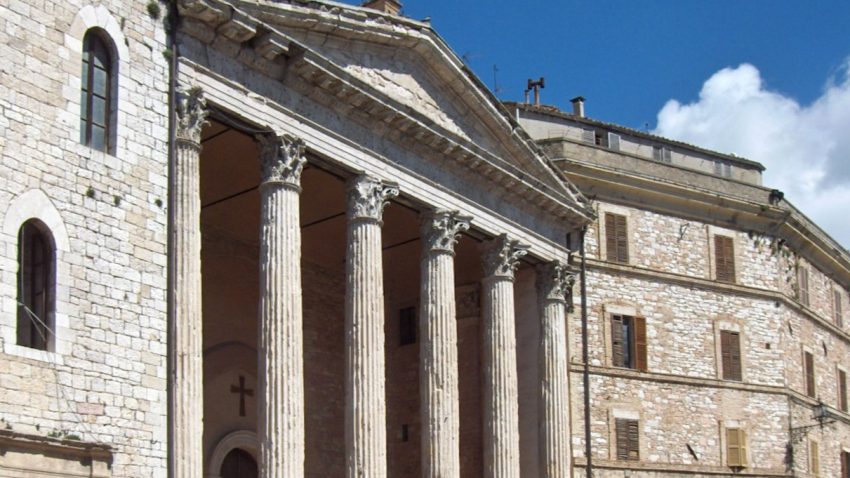
Standing proudly in Piazza del Comune, the Temple of Minerva is one of Assisi's most striking landmarks - a seamless blend of ancient Roman architecture and Renaissance transformation. Its elegant Corinthian columns, rising against the medieval backdrop of the square, remind visitors of the city's deep historical layers. The temple's façade has stood for over two millennia, making it one of the must-see places in Assisi for anyone intrigued by the meeting of classical heritage and Christian devotion.
Today, the structure serves as the church of Santa Maria sopra Minerva, an inspired example of architectural adaptation across centuries. Inside, visitors encounter a richly decorated Baroque interior that contrasts vividly with the simplicity and symmetry of the Roman exterior. This site, often visited on walking tours of Assisi, is a true testament to the city's evolution from Roman outpost to medieval spiritual center.
History and Significance of Temple of Minerva
The Temple of Minerva dates back to the 1st century BC and was commissioned by local magistrates Gnaeus Caesius and Titus Caesius Priscus, whose dedication plaques still attest to their civic pride. Though traditionally attributed to the goddess Minerva due to the discovery of a female statue, evidence suggests it may have been dedicated to Hercules - a symbol of strength and virtue. The temple once formed part of the Roman Forum, serving both religious and social functions at the heart of ancient Assisi.
During the Middle Ages, the temple was repurposed for civic use, functioning as a tribunal and prison. Its stern classical façade became a symbol of law and order, a transformation immortalized in one of Giotto's frescoes in the Basilica of Saint Francis. In 1539, the temple was consecrated as the church of Santa Maria sopra Minerva, marking its enduring role in the city's spiritual life. Later Baroque renovations in the 17th century introduced ornate stuccoes and frescoes, reflecting Assisi's post-Renaissance artistic flair. When Goethe visited in 1786, he famously noted the temple as “the first perfectly preserved ancient structure” he encountered on his Italian journey, expressing awe at its harmony and endurance.
Things to See and Do in Temple of Minerva
The temple's exterior is a masterpiece of Roman proportion and harmony, featuring six Corinthian columns supporting an entablature and triangular pediment. These columns, remarkably intact, dominate Piazza del Comune and set a serene contrast to the neighboring medieval buildings. The interior of Santa Maria sopra Minerva, however, surprises many visitors - its Baroque richness, gilded altars, and frescoed ceilings transport you to a completely different era, illustrating how Assisi's architecture evolved with changing artistic sensibilities.
Don't miss the archaeological remnants visible near the altar, discovered during 20th-century excavations, offering a tangible connection to the temple's ancient origins. The combination of Roman precision and Baroque grandeur makes this one of the top sights in Assisi, offering a vivid snapshot of the city's layered identity.
How to Get There
The nearest major airport is Perugia San Francesco d'Assisi Airport, located about 20 minutes from Assisi. From the airport, travellers can reach the town by taxi, rental car, or pre-booked shuttle transfer. For the best deals and a seamless booking experience, check out these flights to Assisi on Booking.com.
The Temple of Minerva sits in Piazza del Comune, at the very center of Assisi's historic core, beside the Palazzo del Capitano del Popolo and Torre del Popolo. It's easily accessible on foot from most attractions in the old town. Visitors arriving by train can get off at Assisi railway station and take a bus or taxi to the historic center. Drivers can park at Piazza Giovanni Paolo II or Porta Nuova Car Park, both of which are within a 10-15 minute walk.
Practical Tips on Visiting Temple of Minerva
- Best time to visit Temple of Minerva: Early morning or late afternoon to enjoy the façade bathed in golden light.
- Entrance fee in Euros: Free.
- Opening hours: Typically open daily, 8 AM-6 PM (may vary by season).
- Official website: www.assisi.it
- How long to spend: 20-30 minutes.
- Accessibility: Accessible for most visitors; entrance on level ground in Piazza del Comune.
- Facilities: Cafés and restrooms nearby in the square.
- Photography tip: Capture the temple at dusk when the columns are softly illuminated.
- Guided tours: Included in most historical walking tours of Assisi.
- Nearby food options: Restaurants and gelaterias surround Piazza del Comune with outdoor seating overlooking the temple.
Is Temple of Minerva Worth Visiting?
Without question. The Temple of Minerva is one of the top attractions in Assisi, offering a rare opportunity to stand before a perfectly preserved Roman façade that has remained a focal point of civic and spiritual life for over two thousand years. Its blend of antiquity, Renaissance faith, and Baroque artistry makes it a place where history feels alive and tangible.
What Other Travellers Say...
The Church of Santa Maria sopra Minerva in Assisi sits on Piazza del Comune and preserves a Gothic façade from the 14th century built atop an earlier temple, with surprising Roman pillars visible; visitors praise its peaceful atmosphere ideal for quiet prayer, a striking high altar and abundant gold detailing that looks almost solid, and an unconventional stair placement beneath the columns that keeps the square open.





The Temple of Minerva appears in our Complete Guide to Visiting Assisi!

Moira & Andy
Hey! We're Moira & Andy. From hiking the Camino to trips around Europe in Bert our campervan — we've been traveling together since retirement in 2020!
This website uses affiliate links which may earn a commission at no additional cost to you!
Planning Your Visit
Nearby Attractions
- Palazzo del Capitano del Popolo (0) km
Palace - Piazza del Comune (0) km
Square - Palazzo dei Priori (0) km
Palace - Roman Forum and Archaeological Museum (0) km
Roman Site - Chiesa Nuova (0.1) km
Church - Oratorio di San Francesco Piccolino (0.1) km
Religious Building - Casa natale di San Francesco (0.1) km
Historic Site - Chiesa di Santa Maria Maggiore (0.2) km
Basilica, Historic Building and Historic Site - Rocca Maggiore (0.2) km
Castle - Teatro Metastasio in Assisi (0.2) km
Theatre