Best Day Trips from Chiang Mai, Thailand (2026)
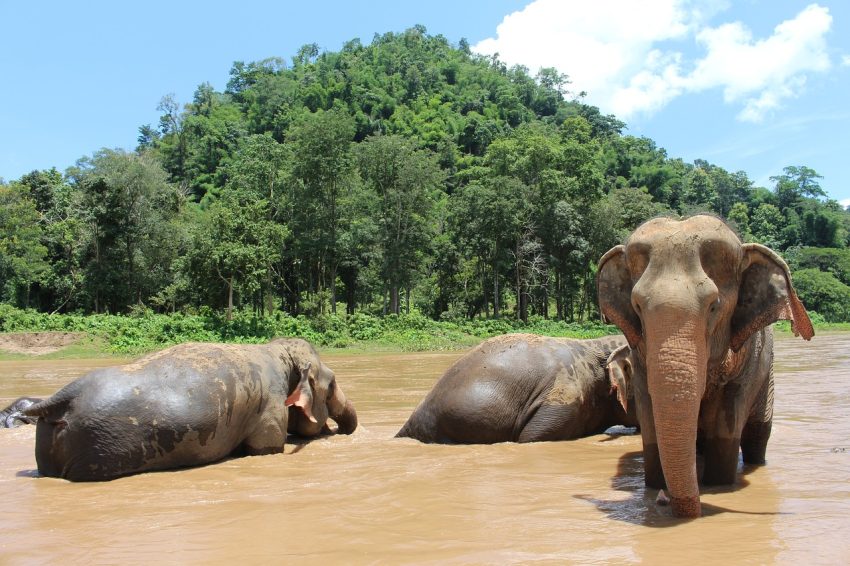
Elephant Sanctury near Chiang Mai

This website uses affiliate links which earn a small commission at no additional cost to you.

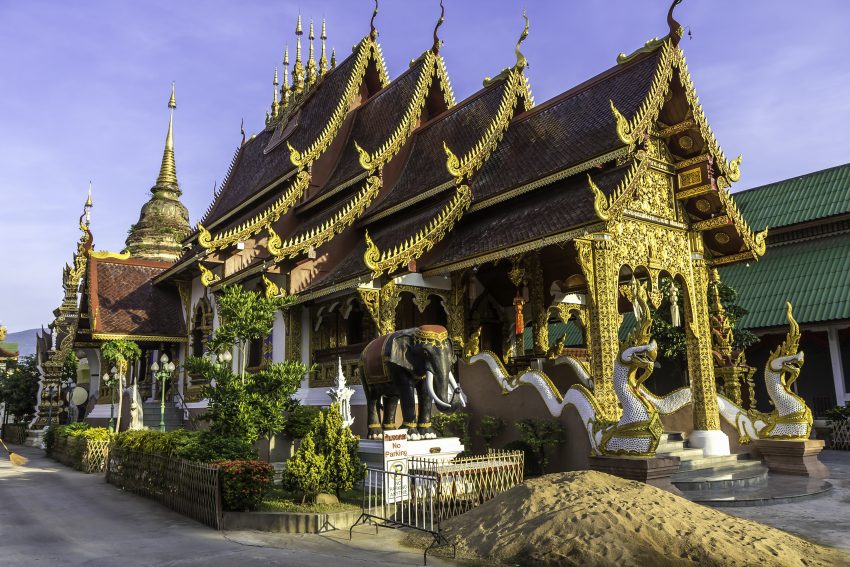
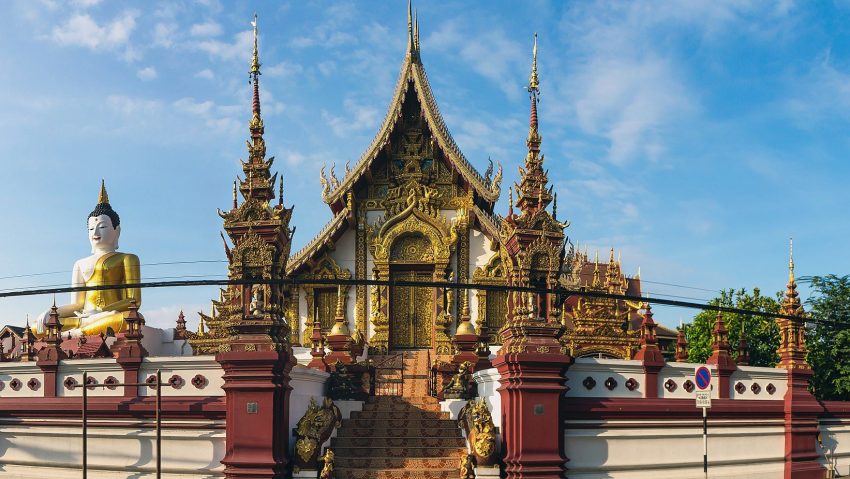
If you find yourself with a few extra days in Chiang Mai and are eager to explore beyond the city, you're in luck! This northern Thai city not only offers a rich tapestry of culture, history, and cuisine-from temple hopping in the Old City to savoring street food at bustling night markets-but also serves as an excellent base for discovering the stunning landscapes and unique experiences of the surrounding province.

In this travel guide, we'll provide you with all the essential information for planning day trips from Chiang Mai. Discover historical gems like Lamphun and breathtaking natural wonders such as Doi Ang Khang. With a wealth of elephant sanctuaries, waterfalls, caves, national parks, and unique temples nearby, there's no shortage of fascinating places to explore.

Having spent a couple of months in Chiang Mai and traveling through northern Thailand, I'm excited to share the best day trip destinations, along with tips on how to get there and make the most of your adventures. So, be sure to carve out some time in your itinerary to experience the incredible sights surrounding Chiang Mai!

How to Explore Northern Thailand

Exploring northern Thailand is quite manageable, whether you choose to join a guided tour, rely on public transportation, or rent a motorbike for an independent adventure. Chiang Mai offers a multitude of options for every type of traveler looking for excitement.

Book an Organised Day Trip

While numerous travel agencies in Chiang Mai provide tours and day trips, the prices and quality can vary significantly. Personally, I prefer booking online through GetYourGuide, as these platforms allow me to secure reservations in advance and read reviews to help ensure a positive experience.

Both websites feature a wide range of group and private tours led by friendly, knowledgeable English-speaking guides, and many come with a free cancellation policy in case your plans change. Most day trips from Chiang Mai also include hotel transportation, making your sightseeing experience hassle-free.

Public Transport and Private Hire

For those who prefer to explore on their own, public transport options such as buses and songthaews can take you to various locations, although a taxi might be necessary for more remote areas. You can conveniently book bus tickets online through 12Go Asia.

One of my preferred methods for exploration is by motorbike, as it offers the greatest freedom. However, this option is best suited for those who are confident riding in Asia and possess an international driving license along with travel insurance that covers motorcycle use. There are several rental shops around the city, with daily rates starting from 150 Baht.

1. Doi Suthep
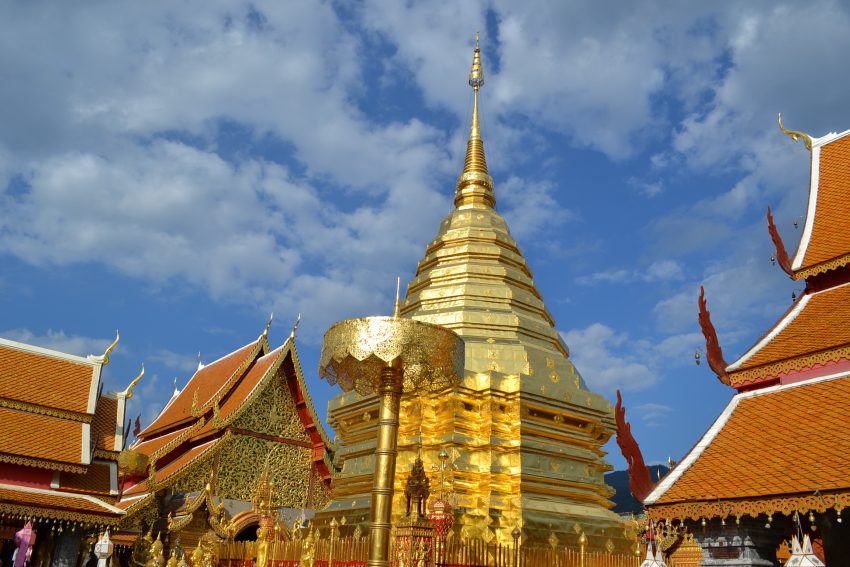
Phra That Doi Suthep
CC BY-SA 3.0 / ผู้สร้างสรรค์ผลงาน/ส่งข้อมูลเก็บในคลังข้อมูลเสรีวิกิมีเดียคอมมอนส์ - เทวประภาส มากคล้าย

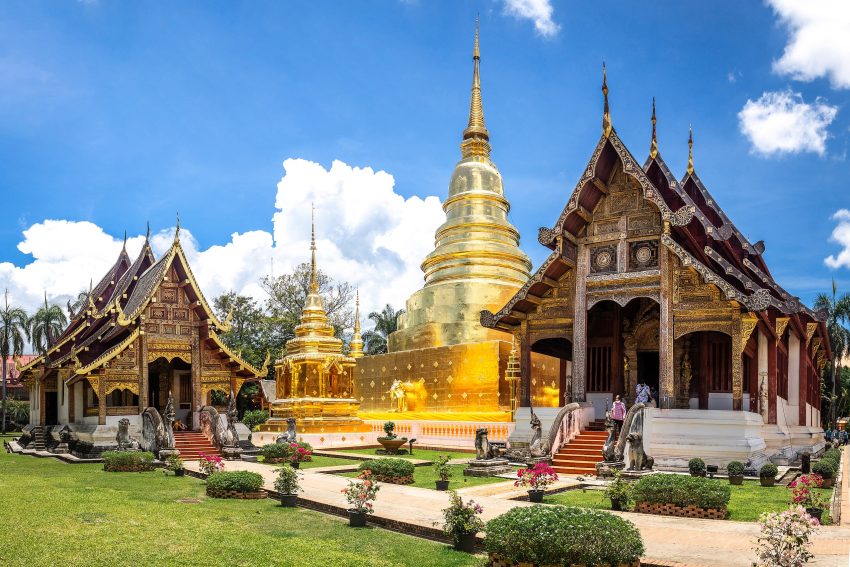
Doi Suthep is one of Chiang Mai’s most iconic landmarks, situated just outside the city and home to Wat Phra That, one of Thailand’s most revered and celebrated temples. A visit to Wat Phra That Doi Suthep is a must when in Chiang Mai, making it one of the most popular half-day excursions.

As you ascend through the jungle along the winding mountain roads, you’ll notice the air turning cool and refreshing. Upon arrival, you’ll be welcomed by vibrant Nagas and will have the option to climb 306 steps to reach the temple (an elevator is also available for a small fee).

Once you reach the summit, you’ll be rewarded with one of the most stunning and renowned sights in Chiang Mai. Prepare to be amazed by the breathtaking architecture, colorful shimmering mosaics, an exquisitely golden stupa, and spectacular views of the surrounding jungle and the city below.


Location: Doi Suthep, Suthep, Mueang Chiang Mai District, Chiang Mai, Thailand

Here is a complete selection of hotel options in Chiang Mai. Feel free to review each one and choose the stay that best suits your needs.

2. Doi Inthanon National Park

Twin Pagodas of Doi Inthanon
CC BY-SA 4.0 / ElliotJW

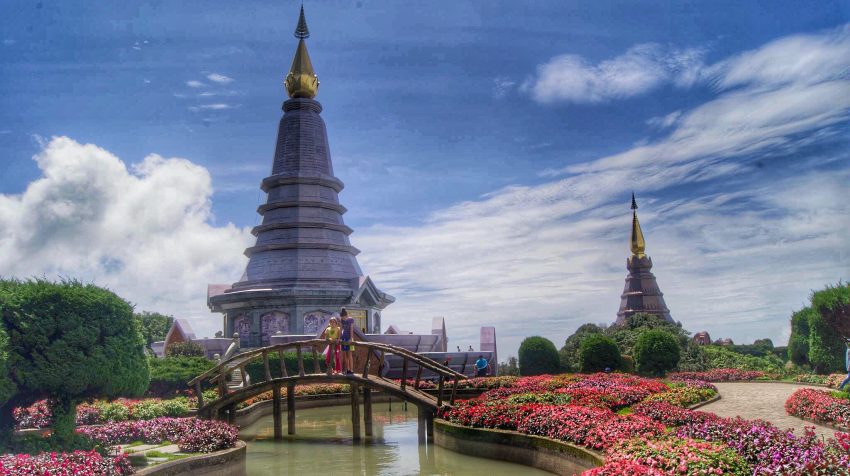
Doi Inthanon National Park is a must-visit destination for nature enthusiasts exploring Chiang Mai, as it is home to Thailand’s highest peak. Standing at 2,565 meters above sea level, Doi Inthanon offers refreshing cooler temperatures, lush jungles, stunning vistas, impressive waterfalls, hiking trails, and hill tribe villages.

One of the park’s highlights is the Twin Royal Pagodas, which were constructed to celebrate the 60th birthdays of the Thai King and Queen. Located just below the summit of Doi Inthanon, these striking structures are encircled by beautiful gardens and provide breathtaking views of the surrounding mountains. The experience is particularly enchanting at sunrise when the landscape is blanketed in a sea of mist.

The best way to experience Doi Inthanon is by hiking through its natural beauty. There are several trails to choose from, with the Kew Mae Pan Nature Trail being the most popular. This two-hour hike is guided by a local Hmong hill tribe member and takes you through lush jungle to various viewpoints. The Pha Dok Siew Nature Trail is also well-known for its waterfalls and has a similar duration of two hours. If you prefer a shorter hike, the Ang Ka Luang Nature Trail offers a quick 20-minute loop around the summit.

Another attraction within the park is its waterfalls. The Mae Klang Waterfall is a stunning seven-tiered cascade that drops into a natural pool where you can take a refreshing dip, while


Location: Doi Inthanon, Ban Luang, Mae Chaem District, Chiang Mai, Thailand

Traveling to a country with a different currency? Avoid ATM transaction fees and pay in local currency with a Wise Card. Having used it for over 5 years, we've saved loads on fees!

3. Visit an Elephant Sactuary

elephant sactuary
elephant sactuary

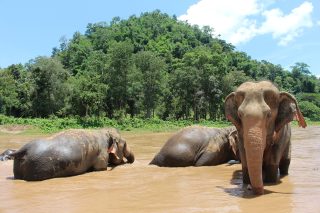
One of the most sought-after activities in Chiang Mai is experiencing close encounters with elephants. While this can be a remarkable experience, it’s important to research any elephant sanctuary you plan to visit to ensure it is ethical and does not cause harm to the elephants. The Elephant Nature Park is a responsible sanctuary that rescues elephants and offers them a safe and comfortable natural environment. Their mission focuses on promoting ethical tourism and educating visitors about the importance of protecting these gentle giants. The park enforces a strict no-riding policy, as riding can be detrimental to the elephants’ well-being. Instead, visitors are encouraged to feed, observe, and interact with the elephants in their natural surroundings, providing a more meaningful experience than riding ever could.

Elephant Nature Park is situated about an hour outside of Chiang Mai and ranks among the most popular day trips from the city. You can book either a half-day or full-day visit through their website or at various travel agencies in town. The park offers a range of packages that include transportation, lunch, and activities involving the elephants. If you plan to visit during the peak season (November to February), it’s advisable to make your reservations in advance, as spots tend to fill up quickly due to the popularity of this unique experience. If Elephant Nature Park is fully booked, don’t worry—there are several other ethical elephant sanctuaries near Chiang Mai, such as the Rantong Elephant Rescue Centre. Here, you can change into traditional red mahout attire associated with the Karen tribe and participate in feeding and bathing the elephants in a natural setting. Additionally, some Chiang Mai tours combine visits to an elephant sanctuary with activities like exploring the sticky waterfalls, bamboo rafting, or trekking. Just be sure to choose a tour that supports ethical practices and does not permit riding.


Location: Ran-Tong Save & Rescue Elephant Centre, Ban Chang, Mae Taeng District, Chiang Mai, Thailand | Website

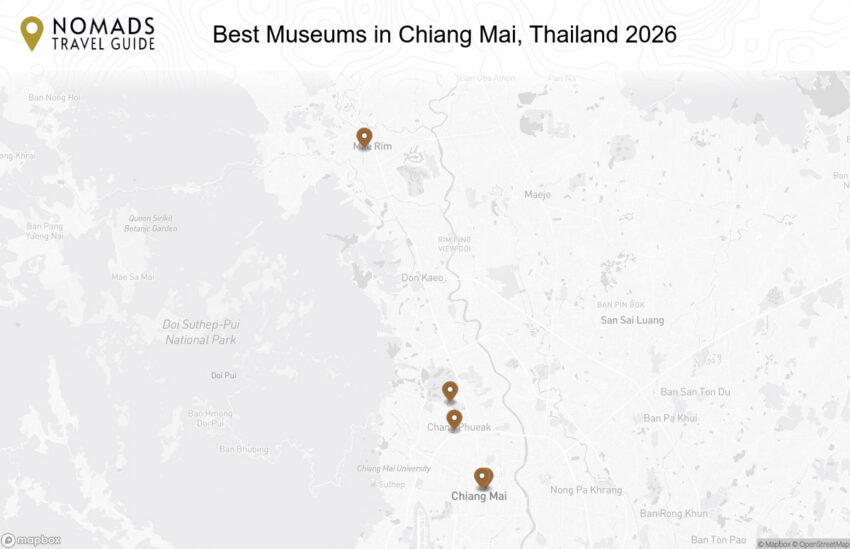
Click here to read our blog about Best Museums in Chiang Mai, Thailand 2026: Art, Culture & Hidden Gems

4. Chiang Rai

chiang rai
chiang rai

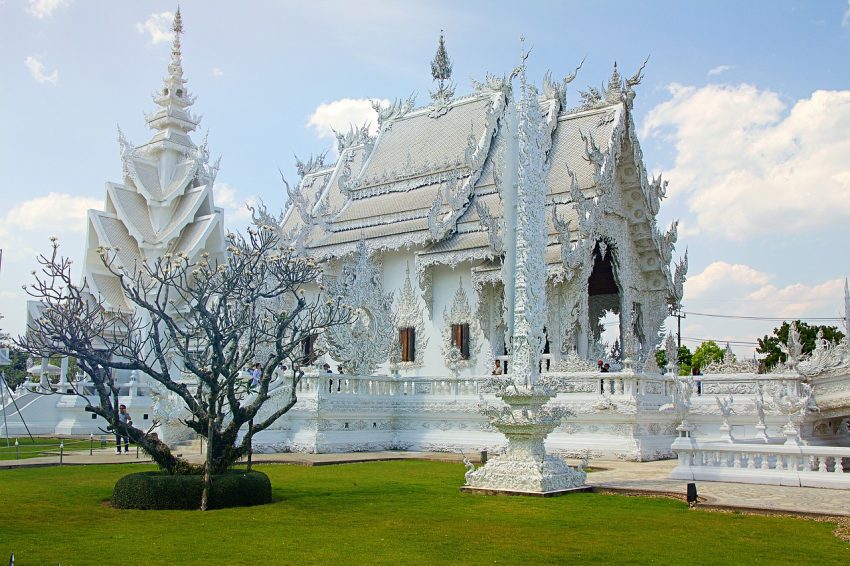
If you’re looking to experience one of the most unique and beautiful temples in Thailand, make your way to Chiang Rai. Nestled in the northernmost province, Chiang Rai offers a relaxed atmosphere and breathtaking natural scenery. The crown jewel of the area is the Wat Rong Khun, commonly referred to as the White Temple. Designed by the acclaimed Thai artist Chalermchai Kositpipat, this temple stands out from traditional Thai architectural styles. Its intricate, all-white exterior symbolizes purity and represents the path to enlightenment. The striking design captivates visitors and invites introspection, making it a must-visit destination. While in Chiang Rai, be sure to explore the Blue Temple (Wat Rong Suea Ten), which features a stunning blue exterior adorned with golden accents, creating a vivid contrast that leaves a lasting impression. Additionally, you can visit the Black House (Baan Dam Museum), an intriguing art museum and cultural center showcasing dark and thought-provoking art pieces, providing a unique perspective on Thai culture and artistry.

From Chiang Mai, you can catch a bus or minivan to Chiang Rai, which typically takes around 3 to 4 hours. The easiest way to book your bus ticket is through 12 Go Asia. Keep in mind that the White Temple is situated about 13 km south of the city center, so you will need to arrange for a taxi to get there from the Chiang Rai bus station. Opting for a guided day tour from Chiang Mai offers a more convenient alternative, as it includes transportation and visits to all the essential attractions. This Chiang Rai Temple Tour encompasses transport and a guided experience that covers the White Temple, the Blue Temple, and the Black House, along with a visit to the hot springs.

Read our Chiang Rai Travel Guide

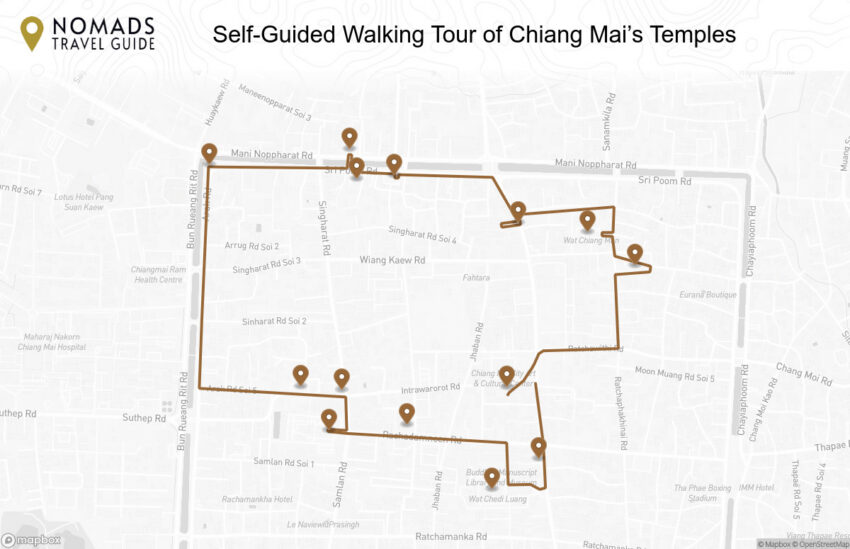
Explore Chiang Mai at your own pace with our self-guided walking tour! Follow our curated route to discover must-see sights and local secrets that makes Chiang Mai one of the best places to visit in Thailand.

Powered by GetYourGuide

5. Wat Phra That Doi Pu Khao & the Golden Triangle

Wat Phra Dhatu Doi Pu Khao Golden Triangle
CC BY-SA 4.0 / Chainwit.

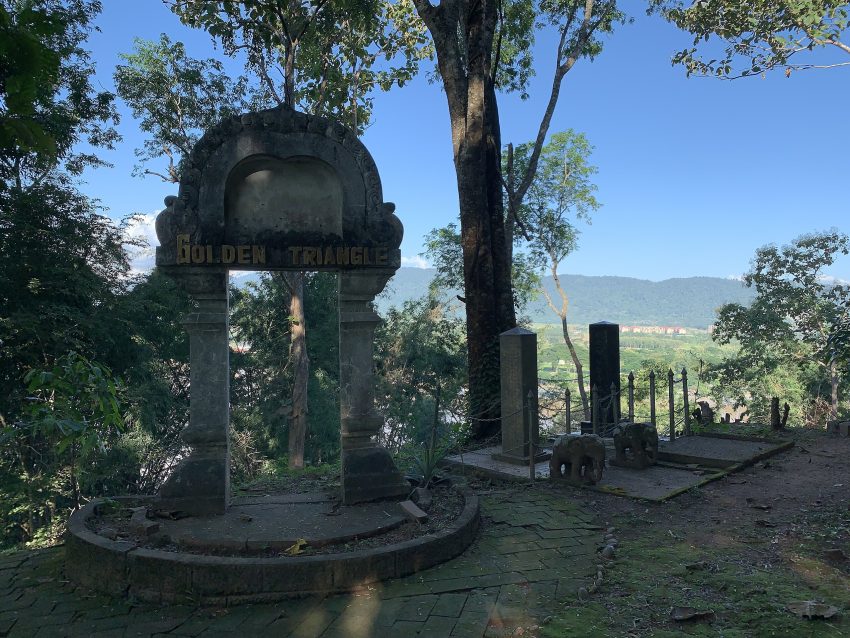
Further north of Chiang Rai lies the Golden Triangle, where the borders of Thailand, Laos, and Myanmar converge. Once infamous for its opium production, this area has transformed into a favored tourist destination, captivating visitors with its breathtaking views of the Mekong River and the surrounding mountains. Key attractions include the Hall of Opium Museum, where you can learn about the opium trade and its societal impacts, as well as boat rides on the Mekong River to witness the meeting point of the three countries. Additionally, stunning views can be enjoyed from Wat Phra That Doi Pu Khao, a magnificent temple located atop a hill overlooking the town.

Getting to the Golden Triangle is convenient, as it’s approximately a four-hour drive from Chiang Mai but just a 1.5-hour journey from Chiang Rai. You can take a bus from Chiang Rai to Mae Sa and then hire a taxi or songthaew. It’s also a popular addition to trips exploring Chiang Rai’s temples. For those making a day trip from Chiang Mai, the most efficient way to experience the highlights is by joining a Chiang Rai and Golden Triangle tour, which includes visits to three temples in Chiang Rai, the Golden Triangle, a stop at the hot springs, a Long Neck Karen Tribe village, and a scenic boat ride on the Mekong River. Although it’s a long day, this tour allows you to cover significant ground and experience the best of far northern Thailand in just one day.


Location: Phra That Doi Pu Khao, Wiang, Chiang Saen District, Chiang Rai, Thailand
Powered by GetYourGuide

6. Sticky Waterfalls (Bua Tong Waterfalls)

Buatong Waterfall Thailand
CC BY-SA 3.0 / chootrong

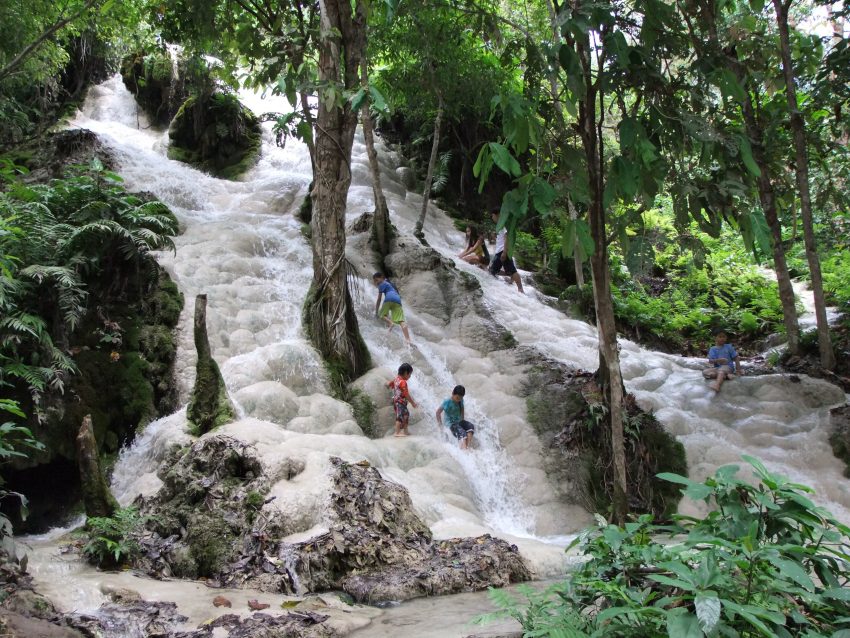
One of Chiang Mai’s most distinctive natural attractions is the Bua Tong Waterfalls, commonly referred to as the Sticky Waterfalls. These falls feature limestone formations with a unique texture that allows visitors to walk and climb up the waterfalls without slipping, making for a fun experience.

The Sticky Waterfalls are situated approximately an hour outside of Chiang Mai and can be reached by taxi, motorbike, or guided tour. Day trip packages from Chiang Mai can include visits to both the Sticky Waterfalls and an elephant sanctuary, giving you two unforgettable experiences in one amazing outing.


Location: Buatong Waterfall-Chet Si Fountain National Park, Mae Ho Phra, Mae Taeng District, Chiang Mai, Thailand | Hours: 06.00 until 18:00 | Price: Free entry
Powered by GetYourGuide

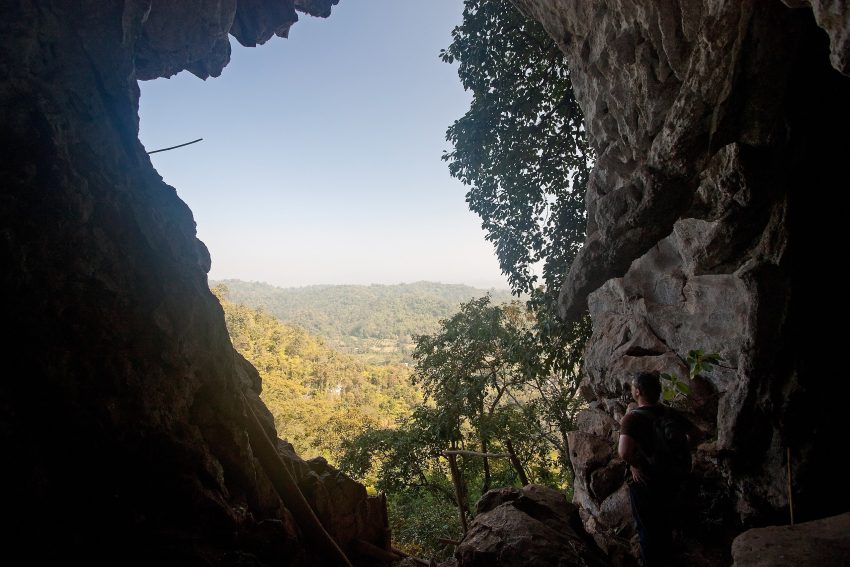
7. Chiang Dao

Bat cave Chiang Dao
Bat cave Chiang Dao
CC BY-SA 2.0 / Andrea Schaffer

The vibrant jungles, towering mountains, intricate caves, and ancient temples of Chiang Dao provide some of the most unique nature adventures in northern Thailand. Be sure to explore Chiang Dao Cave, a stunning limestone cave system extending over 12 kilometers. You can embark on a guided tour to witness the breathtaking stalactites and stalagmites, as well as the serene sleeping Buddha statue within. The nearby Wat Tham Chiang Dao temple, located at the cave’s entrance, is equally enchanting and offers plenty of opportunities for exploration. Another highlight is Wat Tham Pha Plong, a remarkable temple built into the mountainside. Although the ascent can be strenuous, the panoramic views of the surrounding jungle and mountains are well worth the effort, and the chance to explore the unique cave-like temple adds to the experience. After your adventures, you can unwind at the nearby hot springs.

Chiang Dao is situated about 1.5 hours north of Chiang Mai. While you can take a day trip to see the caves and temples from Chiang Mai, consider staying longer to hike to the summit of Doi Chiang Dao Wildlife Sanctuary, a prime location for birdwatching, as well as exploring Pha Daeng National Park. You can reach Chiang Dao via local bus or taxi, but you’ll need transportation to get around once you’re there. Alternatively, guided tours are available, with some options including trekking, rafting, kayaking, or visits to the sticky waterfalls.


Location: Chiang Dao Cave, หมู่ 5 Chiang Dao, Chiang Dao District, Chiang Mai, Thailand
Powered by GetYourGuide

8. Lamphun

Lamphun Thailand
Lamphun Thailand

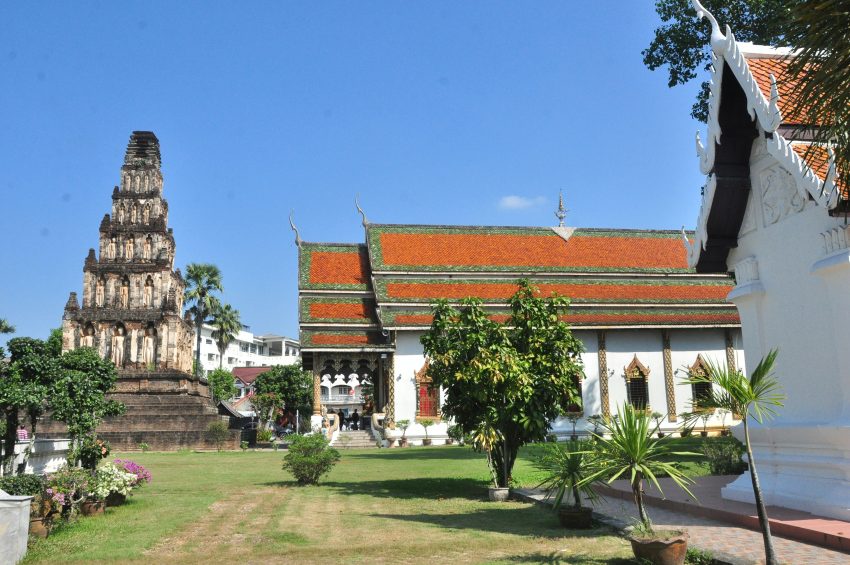
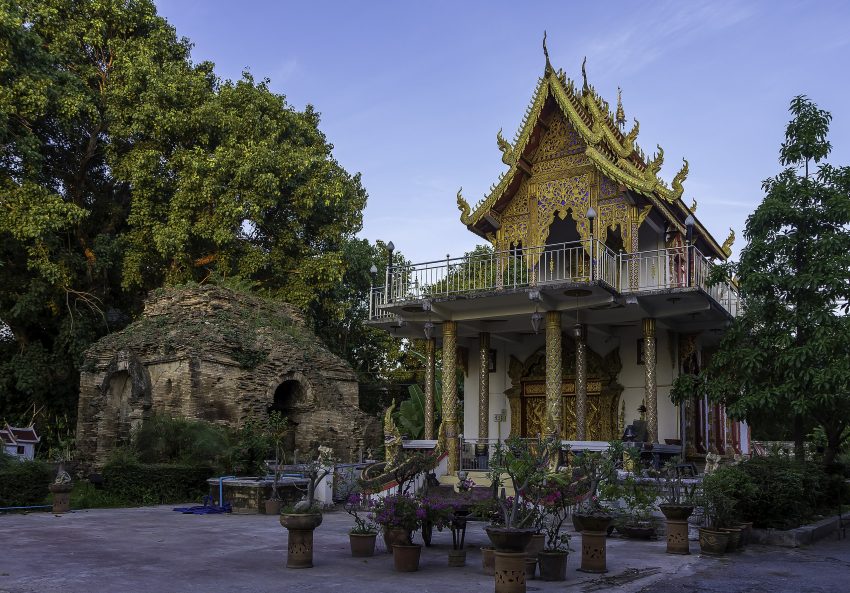
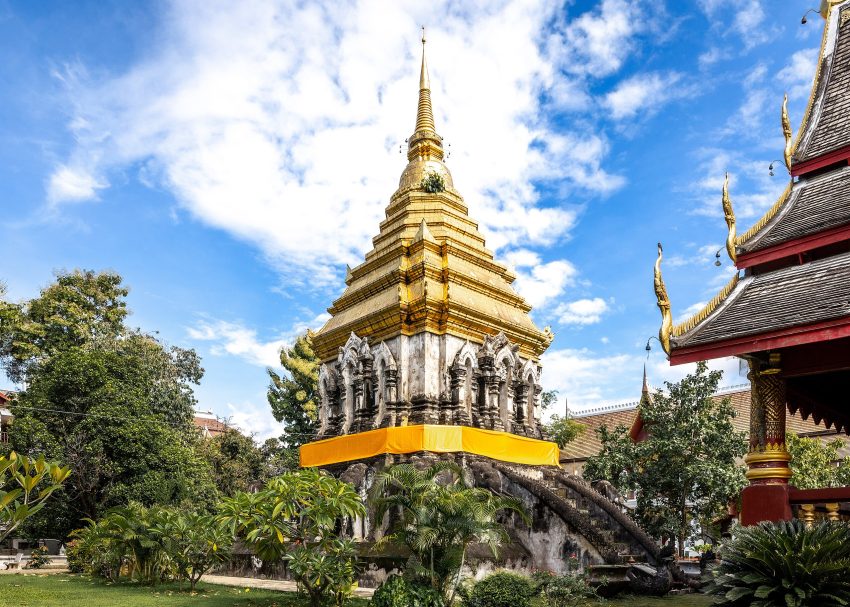
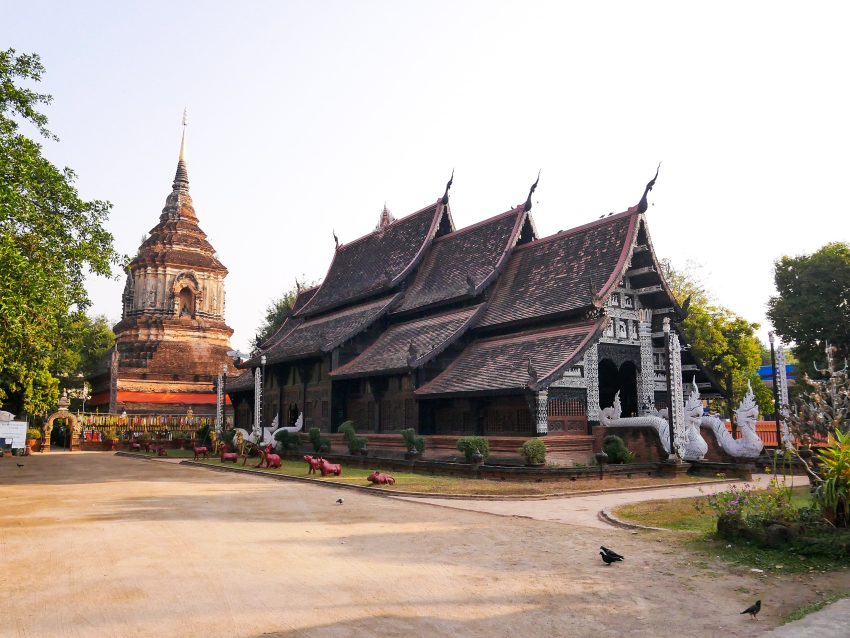
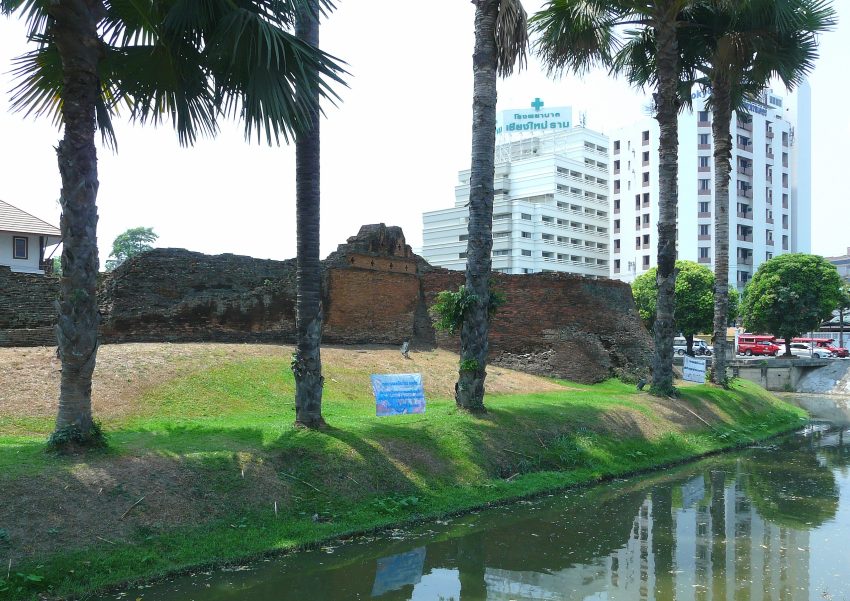
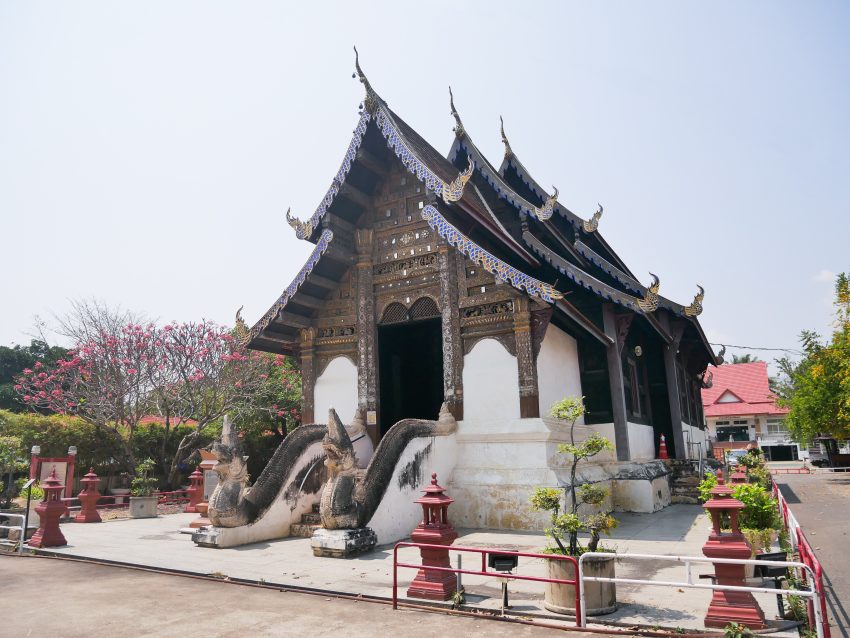
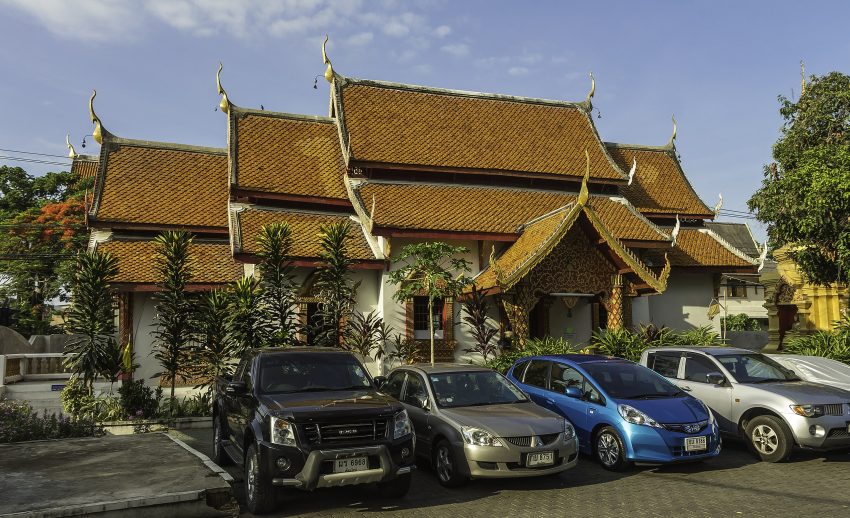
Visiting Lamphun offers a delightful journey into the heart of Thailand’s rich history and culture. As the oldest city in the country, Lamphun is steeped in intriguing stories and ancient traditions. The city’s charming streets are lined with beautiful temples, such as the renowned Wat Phra That Hariphunchai, where visitors can marvel at the intricate architecture that reflects the influence of ancient Mon culture. In addition to its temples and the ancient 9th-century Wat Phra That Hariphunchai Woramahawihan. Lamphun features traditional wooden houses and bustling markets, inviting tourists to immerse themselves in the local way of life. Exploring these sites provides a unique opportunity to experience the authentic ambiance of Thailand beyond the more frequented tourist destinations.

Read our Lamphun Travel Guide
Powered by GetYourGuide

9. Lampang

Wat chalermprakiat Lampang

This historic riverside city of Lampang boasts an impressive array of ancient temples, traditional wooden houses, and museums. It is also the only place in Thailand where horse-drawn carriages are still in use. The most significant temple here is Wat Phra Kaew Don Tao, which once housed the Emerald Buddha and is worth visiting for its stunning Burmese-style architecture and the Lanna Museum. Be sure to check out the remarkable 13th-century Lanna-style complex of Wat Phra That Lampang Luang, home to Thailand’s oldest and most beautiful wooden temple. Other notable attractions include the twenty golden chedis at Wat Chedi Sao and Baan Sao Nak, a historic Lanna-style house transformed into a museum. Located about 2.5 hours from Chiang Mai (and one hour north of Lampang city) is the unique and lesser-known Wat Chalermprakiat. The white pagodas perched atop jagged limestone peaks, surrounded by drifting clouds, create a surreal and enchanting scene, earning it the nickname “sky temple” and “floating pagodas.”

Lamphun city is just a 30-minute drive from Chiang Mai and is easily accessible via bus, train, taxi, or guided tour (keep in mind that trains are often slower than buses). The Lamphun and Lampang Temple Tour is the most convenient way to explore the four most impressive temples in both cities in one day with a small group. Other tours concentrate on visiting Wat Chalermprakiat (the sky temple).

Read our Lampang Travel Guide
Powered by GetYourGuide
Moira & Andy
Moira & Andy

Hey! We're Moira & Andy. From hiking the Camino to trips around Europe in Bert our campervan — we've been traveling together since retirement in 2020!

Read our full story here

This website uses affiliate links which earn a small commission at no additional cost to you.

Walking Tour Map
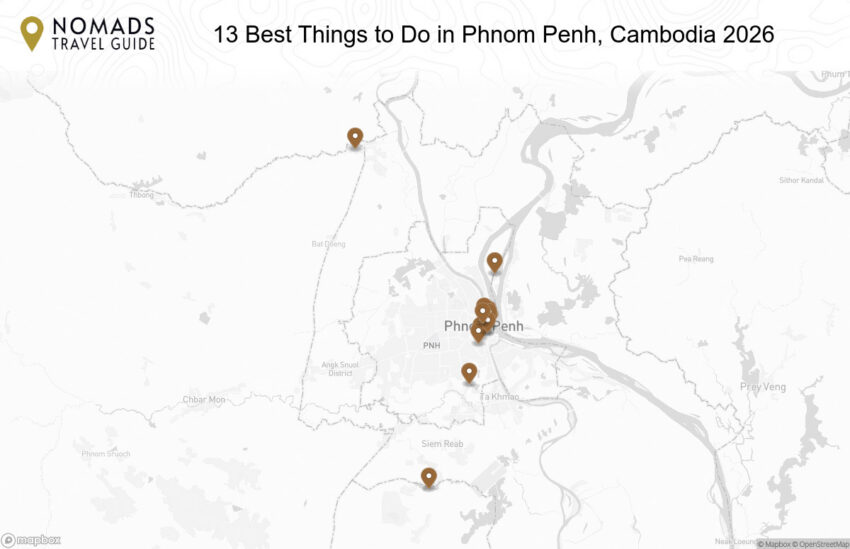
Map of the Best Day Trips from Chiang Mai, Thailand walking route with 9 stops in Chiang Mai.
Preview map of the Best Day Trips from Chiang Mai, Thailand route in Chiang Mai, showing 9 stops. Use the interactive map to zoom and tap markers.

More from this area

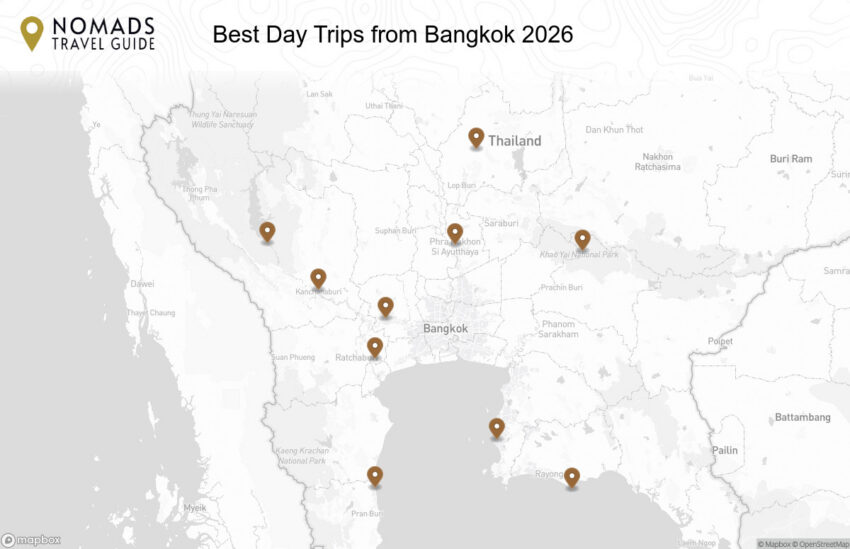
Best Day Trips from Bangkok 2026

Best Day Trips from Bangkok

This website uses affiliate links which earn a small commission at no additional cost to you.

Bangkok is brimming with energy and attractions to keep you entertained throughout your trip, but it also serves as an excellent hub for exploring nearby cities, beaches, and national parks. When you need a break from the bustling capital, a variety of exciting destinations await just a short drive away. From the ancient ruins of Ayutthaya, a former kingdom, to the breathtaking beauty of national parks like Erawan and Khao Yai-where you can even go elephant-watching-the options for day trips are abundant.

Some destinations, while accessible for a day trip, are better enjoyed with an overnight stay. For instance, the seaside town of Hua Hin is close enough for a quick visit but truly shines as a weekend getaway, offering more time to relax and enjoy its charms.

Whether you're seeking history, nature, or a seaside escape, our list of the best day trips from Bangkok will help you plan your ideal getaway.

Table of Contents

1. Explore the Ancient Ruins of Ayutthaya

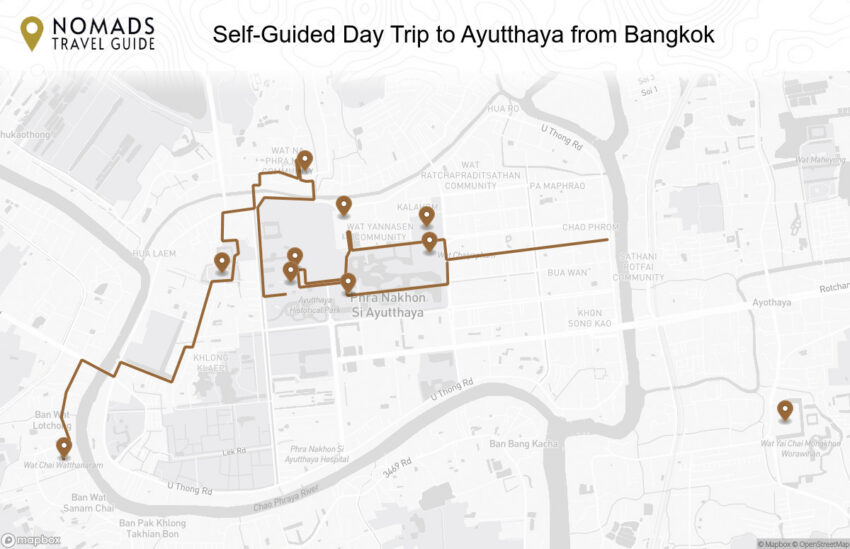
Self Guided Day Trip to Ayutthaya from Bangkok

The ancient city of Ayutthaya spans 289 hectares within a UNESCO-listed historical park. Established in 1351, Ayutthaya was once one of the world’s largest and most influential cities. Today, it stands as a stunning collection of over 100 ruins, including temples (wats), palaces, and iconic prang towers.

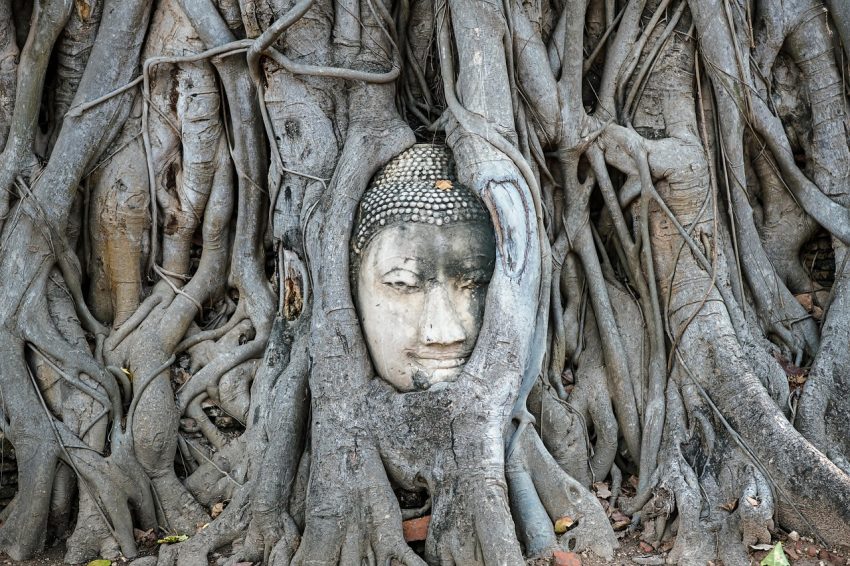
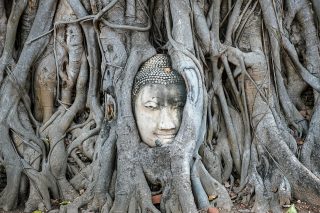
Given its vastness, exploring the entire site in a single day can be challenging. Visitors typically focus on key highlights such as Wat Mahathat, famous for the stucco Buddha head entwined in tree roots; Wat Phra Si Sanphet, Ayutthaya’s largest temple, known for its three towering chedis; and Wat Lokaya Sutha, which features a 42-meter-long reclining Buddha draped in a vibrant golden robe.

With plenty to see and do, you can easily spend 5-8 hours exploring Ayutthaya. Since it’s just an hour’s drive from Bangkok, you can start your journey early and return to the city by 8 PM. For a detailed guide, check out my post on a Self-Guided Day Trip to Ayutthaya from Bangkok. If you prefer a more comfortable and hassle-free experience, I recommend joining this Ayutthaya Temples Guided Tour with Lunch.


Here is a complete selection of hotel options in Bangkok. Feel free to review each one and choose the stay that best suits your needs.

Powered by GetYourGuide

2. Take a Train Trip Down the Bridge of River Kwai

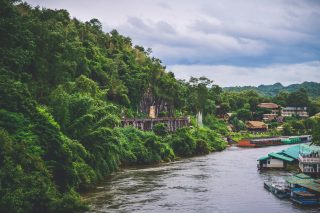
Day Trip to Kanchanaburi scaled

The construction of the Thai-Burma “Death Railway Bridge” marks a somber chapter in history. Over 12,000 French and American WWII POWs, along with 90,000 civilians, lost their lives building the ambitious railway intended to connect Burma and Thailand.

Although the railway was never completed, the bridge remains intact and can still be crossed today via a leisurely local train. Located in Kanchanaburi province, where the River Kwai and the iconic bridge are situated, the area offers several WWII memorials and museums. Visitors can also explore two stunning national parks, Erawan and Khuean Srinagarindra, as well as the Prasat Muang Singh Historical Park, which features a smaller yet remarkable version of the Ayutthaya-style ruins.

This Historical Day Tour to River Kwai is highly recommended for a hassle-free way to visit the River Kwai Bridge from Bangkok and return the same day. Not only will it save you time, but you’ll also gain valuable insights from a knowledgeable local guide.


Traveling to a country with a different currency? Avoid ATM transaction fees and pay in local currency with a Wise Card. Having used it for over 5 years, we've saved loads on fees!

Powered by GetYourGuide

3. Hike to the Stunning Seven-Tiered Erawan Waterfalls in Kanchanaburi

Erawan Waterfall Kanchanaburi Province Thailand
CC BY-SA 3.0 / Diliff

Erawan National Park is located near the River Kwai Bridge, making it possible to visit both in one day. However, to fully immerse yourself in the lush evergreen forest and increase your chances of spotting the park’s elusive wildlife, dedicating an entire day here is ideal.

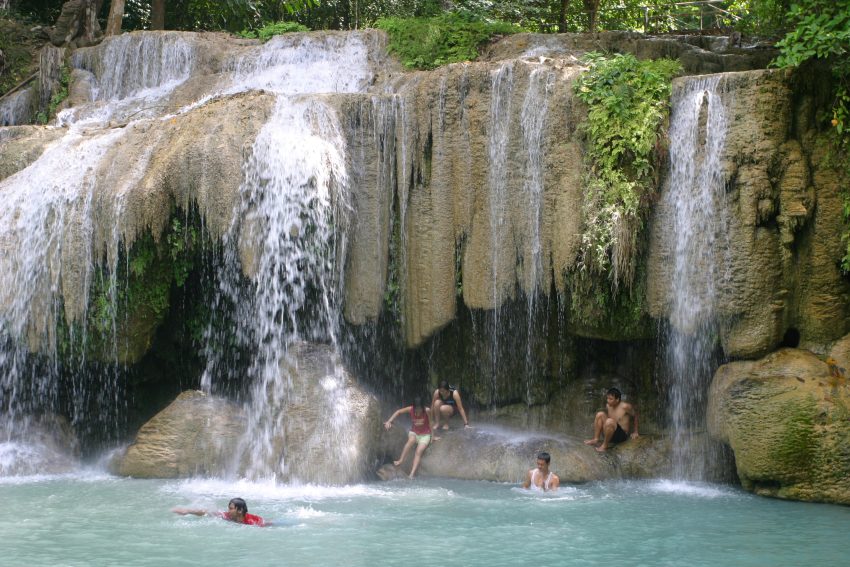
The park’s centerpiece is the stunning seven-tiered Erawan Falls, with emerald green waters flowing into pools perfect for swimming and relaxation. The park also boasts several fascinating caves, featuring intricate stalagmite and stalactite formations, as well as prehistoric rock paintings, making them a must-see for nature and history enthusiasts alike.

A visit to Erawan Falls is often paired with a trip to Kanchanaburi City, making it the perfect addition to your River Kwai journey for an unforgettable full-day adventure from Bangkok.


Location: Erawan Falls, Tha Kradan, Si Sawat District, Kanchanaburi, Thailand

Click here to read our blog about The Perfect Bangkok Itinerary 2026: 3–4 Days in Thailand’s Vibrant Capital

Powered by GetYourGuide

4. Visit a Floating Market

thailand Damnoen Saduak Floating Market

One of the most iconic experiences in Thailand that draws visitors from around the globe is exploring the country’s renowned floating markets.

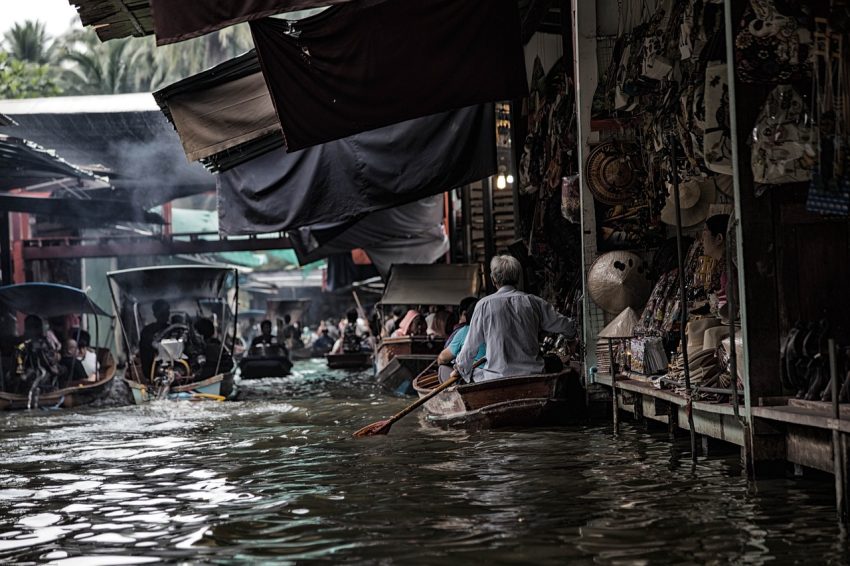
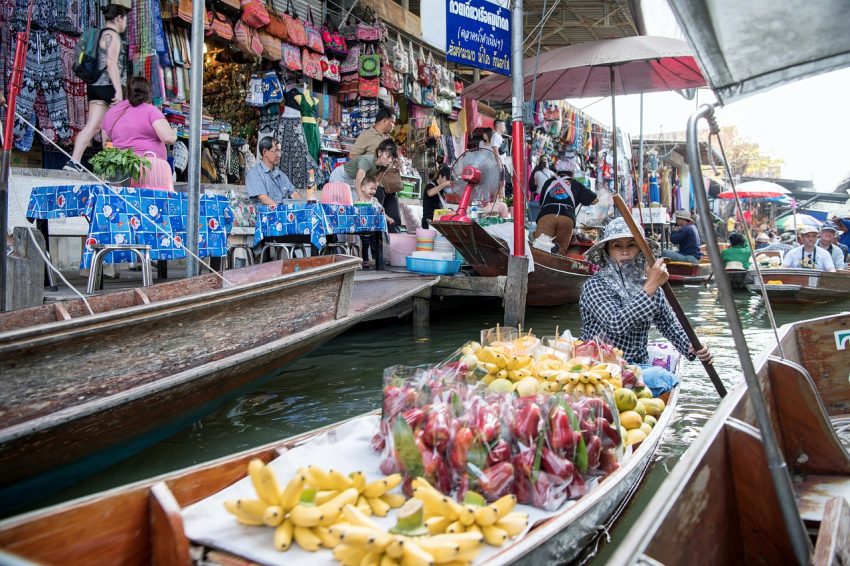
At these markets, you can witness a glimpse of traditional Thai trading practices that date back to a time before modern roads existed. Merchants navigate canals in wooden boats, selling goods ranging from fresh produce to steaming bowls of boat noodles, creating a vibrant and bustling scene along the water.

Some of the most popular floating markets include Amphawa and Damnoen Saduak. While these are highly photogenic, they can also be quite crowded, so it’s good to manage your expectations. For a quieter, more authentic experience, Tha Kha Floating Market is a great alternative. With fewer tourists and local prices, it offers a more relaxed atmosphere.

Another unique market experience in Thailand is the Mae Klong Railway Market, where vendors set up their stalls right on the train tracks. When the train approaches, the entire market swiftly folds away to make room for it to pass, only to resume operations moments later—a truly fascinating sight.


Click here to read our blog about Best Things to Do in Bangkok, Thailand (2026)

Powered by GetYourGuide

5. Discover the island of Ko Samet

Complete guide to Ko Samet

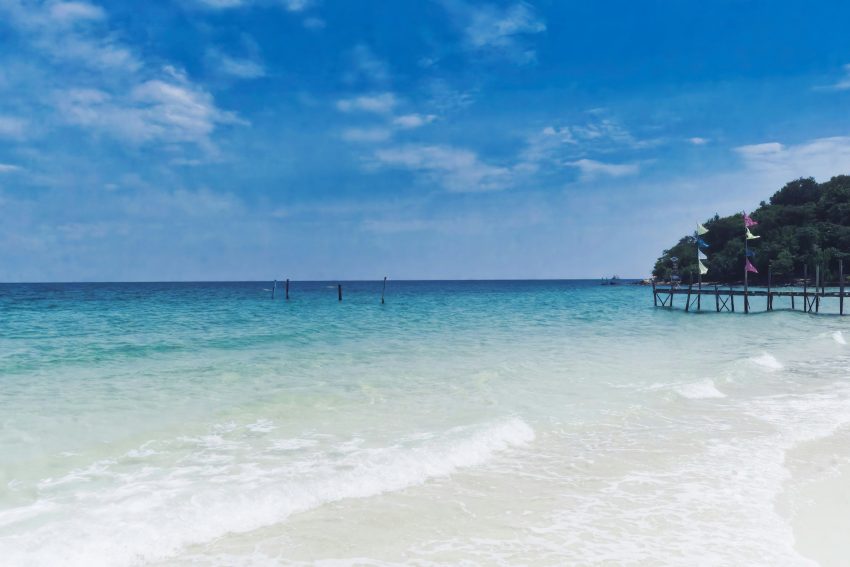
While Pattaya provides the most convenient beach escape from Bangkok, those seeking turquoise waters and scuba diving should venture a bit farther. About three hours from Bangkok, the island of Ko Samet offers pristine white-sand beaches, a variety of water activities, and an array of delicious dining options.

Koh Samet is compact and easy to explore on foot. Popular beaches like Ao Phai and Haad Sai Kaew are bustling hubs, perfect for an active getaway filled with energy and excitement. For a quieter experience, head to secluded spots like Ao Wai, where undeveloped shores attract fewer visitors. Arrive early, and you might just have the serene beach all to yourself.

The easiest way to get there is using this taxi and boat transfer service.

Read our Ko Samet Travel Guide

Where to Stay in Bangkok: An Area by Area Guide!

Powered by GetYourGuide

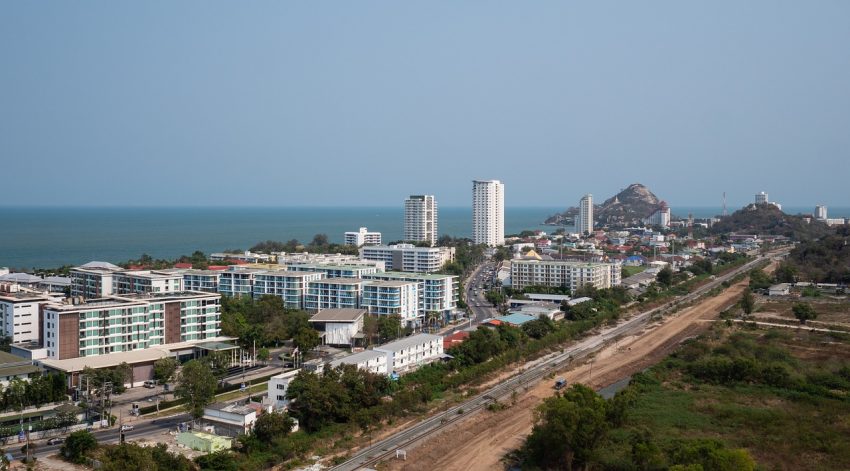
6. Relax on Hua Hin’s Tranquil Beaches

Complete guide to Hua Hin

The charming city of Hua Hin, located 2.5 hours south of Bangkok, is known for the King’s summer palace, a serene beach, and an array of themed attractions and shopping options.

More relaxed than Koh Samet and Pattaya, Hua Hin’s coastline is ideal for activities like kitesurfing, sunbathing, and enjoying local dishes. At the southern end of Hua Hin, you’ll find Khao Takiab (Chopstick Hill), a peaceful beach with beautiful temples. Just outside the city, the Maruekhathaiyawan Palace, an all-teak structure built in the 1920s for King Rama VI, offers breathtaking ocean views.

Hua Hin is also home to world-class golf courses, the expansive Black Mountain water park, and two themed shopping malls, The Venezia and Santorini, featuring gondolas, cobblestone paths, and their own amusement parks. Art lovers will enjoy the Hua Hin Artists Village, which offers galleries and art classes, or you can visit the Sam Pan Nam Floating Market, where boat rides, shopping, and live performances await. Just under an hour away, Khao Sam Roi Yot National Park offers stunning wetlands, mangrove forests, and large caves for nature enthusiasts to explore.

Read our Hua Hin Travel Guide

Explore Bangkok at your own pace with our self-guided walking tour! Follow our curated route to discover must-see sights and local secrets that makes Bangkok one of the best places to visit in Thailand.

Powered by GetYourGuide

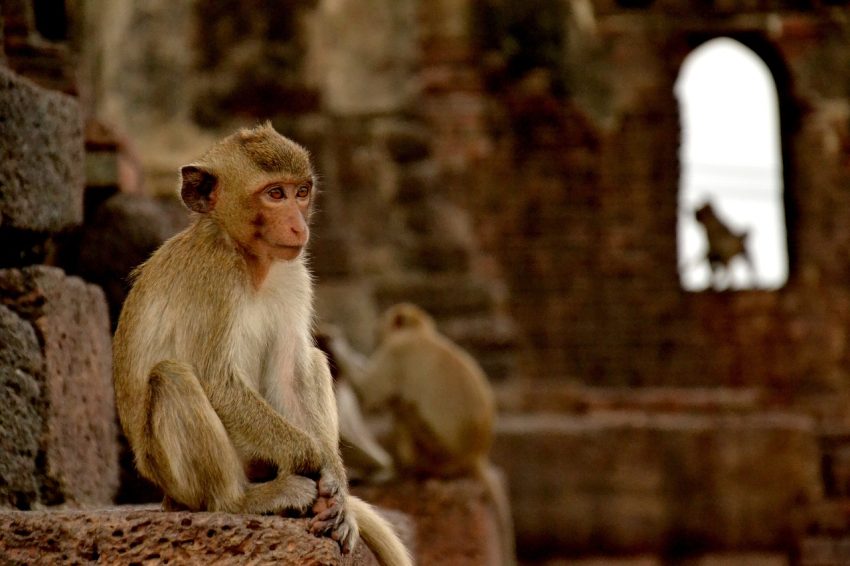
7. Visit the Monkey Ancient City of Lopburi

monkey Lopburi
monkey Lopburi

Ayutthaya and Sukhothai are often top recommendations, for history enthusiasts, however, Lopburi, just an hour and a half from Bangkok, also boasts remarkable historical sites that date back even earlier than those in Sukhothai and Ayutthaya. The city is home to some of the country’s oldest structures, including the beautiful Wat Phra Si Rattana Mahathat and King Narai’s Palace, which were built during the 10th and 11th centuries. But Lopburi isn’t just about ancient ruins—it’s also famous for its cheeky residents, the monkeys. Known as the “Monkey City,” Lopburi has hundreds of monkeys freely roaming the streets, particularly around the Prang Sam Yod monument. While these monkeys are fun to watch, it’s important to keep your distance and avoid carrying food to prevent any unwanted interactions. Lopburi is easily accessible by train or a short drive from Bangkok, making it an ideal day trip. Once you arrive in the city center, most attractions are within walking distance of the train station, so you can explore without needing a car.

Read our Lopburi Travel Guide

Explore Bangkok at your own pace with our self-guided walking tour! Follow our curated route to discover must-see sights and local secrets that makes Bangkok one of the best places to visit in Thailand.

Powered by GetYourGuide

8. Immerse Yourself in Nature at Khao Yai National Park

Haew Suwat Waterfall Khao Yai
CC BY-SA 4.0 / Nawit science

Visiting Khao Yai National Park offers a unique opportunity to immerse yourself in Thailand’s natural beauty. Just a few hours from Bangkok, the park is an easily accessible escape, making it perfect for a day trip or weekend getaway. The park is famous for its diverse ecosystems, ranging from tropical rainforests to expansive grasslands. Visitors can explore the park’s vast network of hiking trails, with options for all levels, including the popular trek to Haew Narok Waterfall, one of the tallest and most scenic waterfalls in the area. The park also provides opportunities for wildlife spotting, where you might see elephants, monkeys, and various bird species, particularly in the early mornings or late afternoons.

For those interested in a more relaxed experience, Khao Yai offers a cooler climate and beautiful scenery that’s perfect for picnicking or enjoying a quiet day in nature. The park is also home to several viewpoints and lush valleys, ideal for photography or simply appreciating the serene surroundings. If you’re looking for a more adventurous experience, consider cycling around the park’s roads or visiting one of its many vineyards. Whether you’re a nature lover, an adventure enthusiast, or just looking to get away from the hustle and bustle of city life, Khao Yai is an excellent destination for a peaceful retreat.


Location: Khao Yai National Park, Nakhon Ratchasima, Thailand
Powered by GetYourGuide

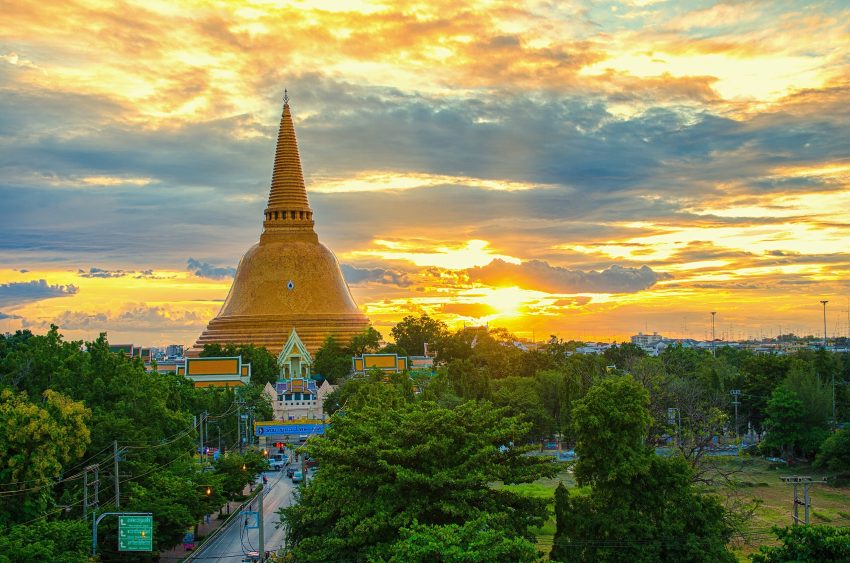
9. Discover the World's Tallest Stupa and Hidden Gems in Nakhon Pathom

Phra Pathom Chedi Nakhon Pathom
CC BY-SA 4.0 / Preecha.MJ

Located just 45 minutes from central Bangkok, Nakhon Pathom is renowned for housing the world’s tallest golden stupa and the only female Buddhist monastery in Thailand. This tranquil province attracts fewer international tourists, making it an ideal destination to experience the authentic, everyday Thailand that many visitors miss.

One of the area’s surprising attractions is the Western-style Sanam Chandra Palace. Built in 1907 by King Rama VI, the palace sits by a serene lake, connected to other buildings by a charming, Disney-esque bridge. The palace grounds feature traditional teak houses and lush gardens, creating a peaceful and picturesque atmosphere.

Also nearby is the Jesada Car Museum, a private collection showcasing over 500 unique vehicles, including three-wheeled cars, a DeLorean made famous by Back to the Future, small helicopters, and even a classic London double-decker bus. It’s a fascinating stop for anyone interested in automobiles.

Read our Nakhon Pathom Travel Guide
Powered by GetYourGuide

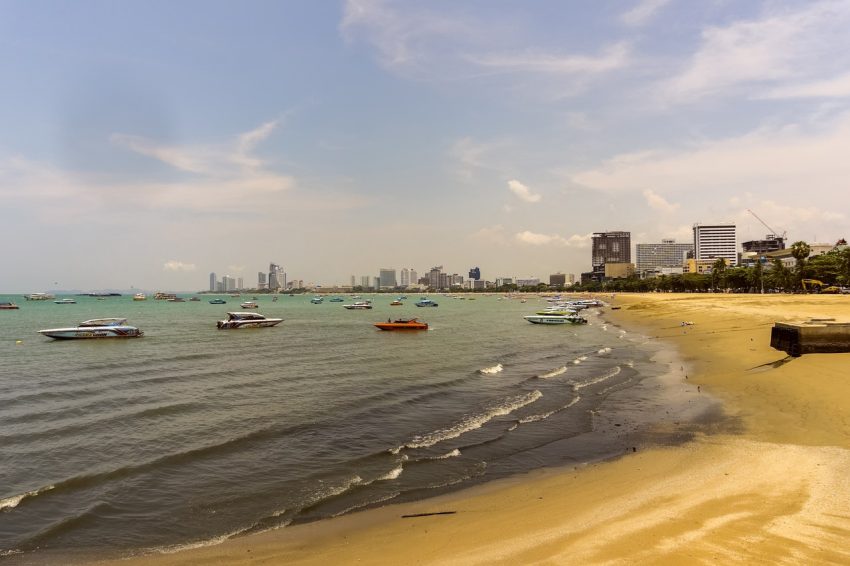
10. Uncover Pattaya’s Popular Attractions and Breathtaking Views

pattaya
pattaya

Just 1.5 hours from Bangkok, the seaside city of Pattaya offers a perfect escape for a day by the coast. With plenty to explore, it’s best to plan ahead to make the most of your visit.

Highlights include the Sanctuary of Truth, an extraordinary teakwood structure, and the beautifully landscaped Nong Nooch Tropical Gardens, inspired by French design. For stunning views, head to Wat Phra Khao Yai (“Big Buddha Hill”), accessible via a grand staircase, or visit Khao Pattaya on Pratumnak Hill, which overlooks the bay.

A short boat ride away, Koh Lan Island is a must-visit. Its pristine white beaches, set against limestone hills, offer not only relaxation but also exciting activities like parasailing, underwater sea walking, and boat tours.

Read our Pattaya Travel Guide
Powered by GetYourGuide
Moira & Andy
Moira & Andy

Hey! We're Moira & Andy. From hiking the Camino to trips around Europe in Bert our campervan — we've been traveling together since retirement in 2020!

Read our full story here

This website uses affiliate links which earn a small commission at no additional cost to you.

Walking Tour Map
Map of the Best Day Trips from Bangkok walking route with 10 stops in Bangkok.
Preview map of the Best Day Trips from Bangkok route in Bangkok, showing 10 stops. Use the interactive map to zoom and tap markers.

More from this area

10 Hidden Temples in Siem Reap (2026)

Banteay Srei cambodia

This website uses affiliate links which earn a small commission at no additional cost to you.

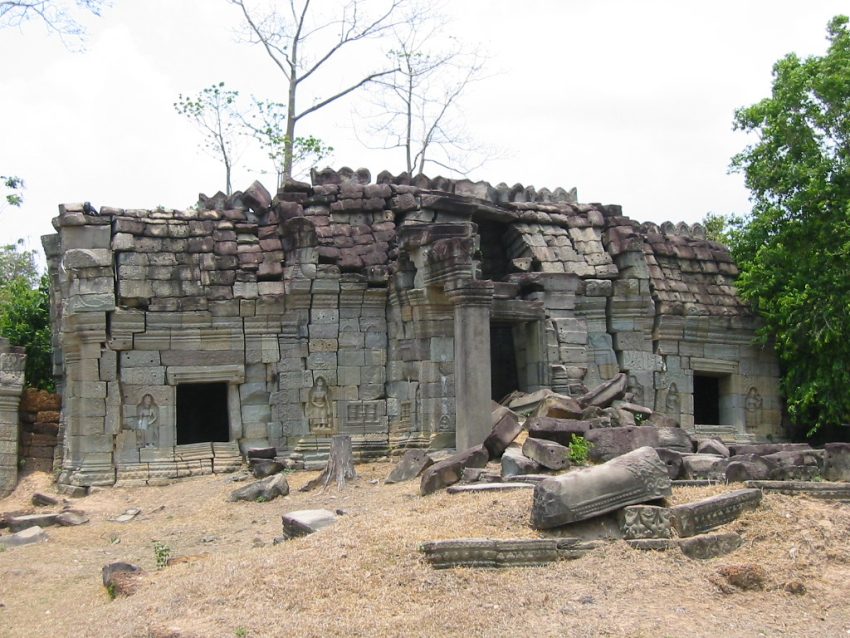
For those seeking a unique experience beyond the main tourist attractions, the hidden temples of Siem Reap and its countryside offer a thrilling adventure. These temples, untouched by restoration for centuries, showcase a raw and mysterious charm. Overgrown with jungle and weathered by time, they exude an atmosphere reminiscent of movie sets like Tomb Raider or Indiana Jones, making them ideal for intrepid explorers and temple enthusiasts looking for something different.

While Angkor Wat and its surrounding temples are undoubtedly some of the most magnificent ancient structures in the world, they are often crowded, with thousands of visitors each day. In contrast, these lesser-known temples provide a serene escape, far from the hustle of the main sites. Off the beaten path, they offer an almost solitary experience, where you can fully immerse yourself in the history and tranquil beauty of these forgotten ruins.

1. Koh Ker

Koh Ker
Koh Ker
CC BY-SA 4.0 / PsamatheM

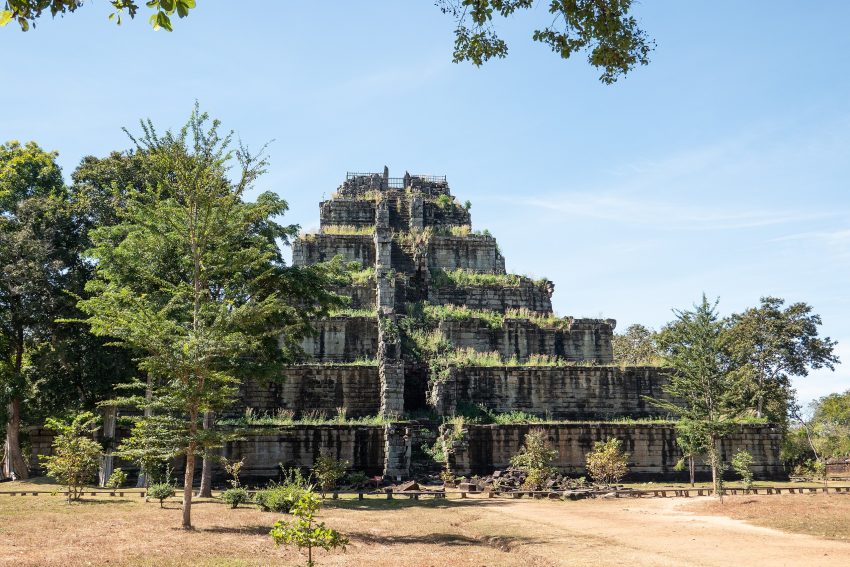
Although Koh Ker once served as the capital of the Khmer Empire for a brief 16 years, its monumental tiered pyramid and expansive grounds are now largely overlooked. This is likely due to its remote location, over 100 km northeast of Siem Reap.

However, the journey is definitely worthwhile. The overgrown ruins, with their intricate and beautiful details, offer a unique and moving experience. Additionally, there are several other fascinating temples and sites nearby, making it a great destination for a day trip.


Location: Koh Ker, Cambodia

Here is a complete selection of hotel options in Siem Reap. Feel free to review each one and choose the stay that best suits your needs.

Powered by GetYourGuide

2. Beng Mealea

Beng Mealea
Beng Mealea
CC BY-SA 4.0 / PsamatheM

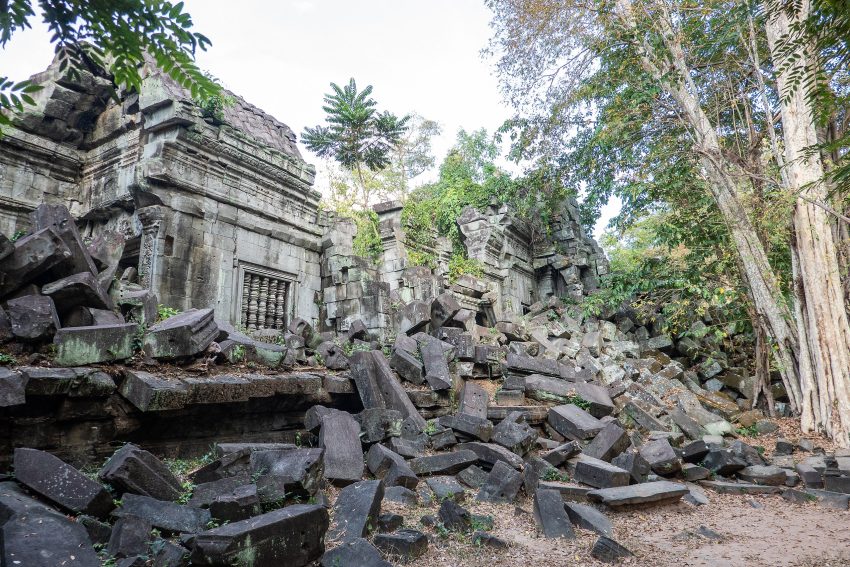
Beng Mealea, one of the largest temples outside the Angkor Wat complex, spans over 1 square kilometer and is largely enveloped by jungle. Built in the same architectural style as Angkor Wat, it is believed to predate its more renowned counterpart. Some historians theorize that Beng Mealea may have served as a prototype or test model for Angkor Wat, showcasing early design elements of Khmer temple architecture.

Unlike the meticulously restored temples in the main Angkor area, Beng Mealea remains in a natural, unrestored state, adding to its mysterious allure. Exploring the site requires some physical effort, as you may need to climb over collapsed walls or crawl through narrow windows to fully experience its layout. For those less inclined to scramble, a wooden walkway has been constructed to provide easier access. Located approximately 66 kilometers from Siem Reap, Beng Mealea offers a blend of adventure and history for those willing to venture beyond the main temple circuit.


Location: Beng Mealea, Cambodia | Website

Traveling to a country with a different currency? Avoid ATM transaction fees and pay in local currency with a Wise Card. Having used it for over 5 years, we've saved loads on fees!

Powered by GetYourGuide

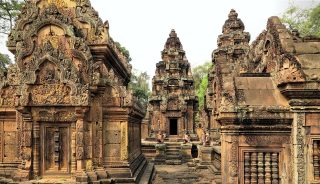
3. Banteay Srei

Banteay Srei
Banteay Srei
CC BY-SA 3.0 / Tsui

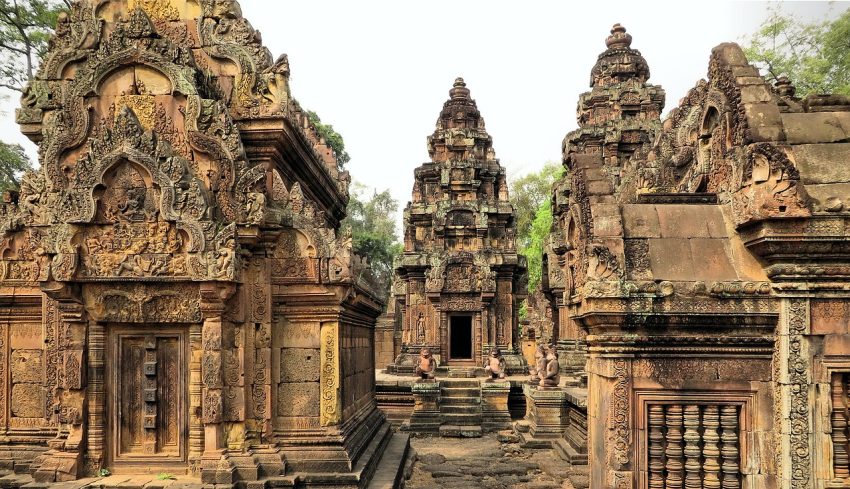
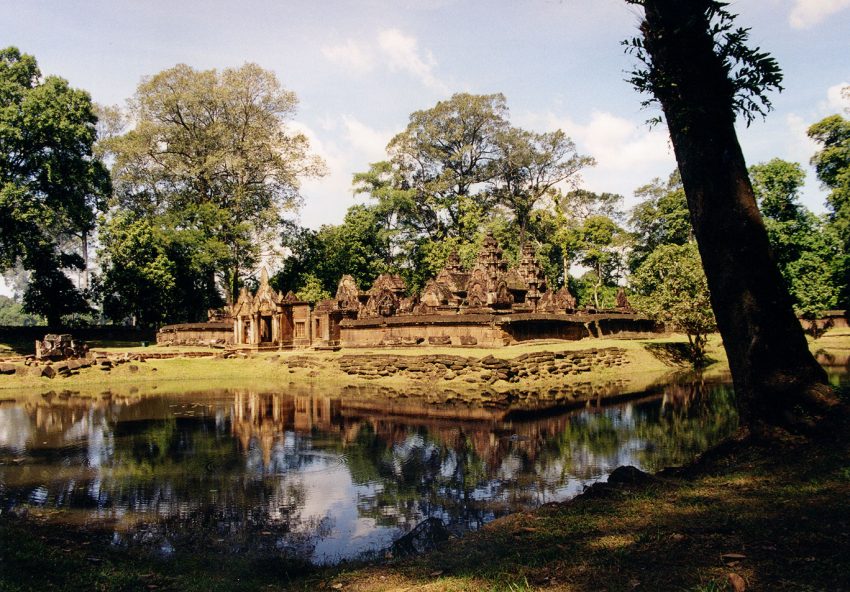
Although this temple is sometimes referred to as ‘Banteay Srey’, the meaning remains the same: ‘citadel of the women’. This relatively modern nickname was given to the 10th-century temple due to the soft pink hue of the sandstone used in its construction, which features intricate carvings dedicated to the Hindu god Shiva.

The temple is remarkably well-preserved, with visible signs of restoration and repair. However, due to its distance from the Angkor Wat complex, it remains a lesser-known site, attracting fewer visitors. Located 41.7 km from Siem Reap, it offers a more tranquil experience compared to the bustling crowds of the larger temples.


Location: Banteay Srei, Cambodia | Hours: 7:30 AM–5:30 PM | Price: Angkor pass required

Click here to read our blog about 10 Best Places to Visit in Cambodia (2026)

Powered by GetYourGuide

4. Preah Vihear

Temple of Preah Vihear
CC BY-SA 3.0 / CHAMRAT CHAROENKHET

Preah Vihear is a temple that most travelers may not be familiar with, which makes it surprising to learn that it is Cambodia’s second UNESCO World Heritage Site. The first one is no mystery, of course.

There’s a reason Preah Vihear has remained under the radar for so long: until 2011, the area was the center of a border dispute between Cambodia and Thailand. It wasn’t until August 2015 that the UK’s Foreign & Commonwealth Office lifted its travel warning for the region.

Thankfully, any potential threats have dissipated, and Preah Vihear now stands as an exceptional destination. The temple, dating back to the 10th century, is beautifully preserved and remarkably free of crowds, making it an ideal spot for those wanting to explore Khmer temple ruins in peace. Perched 525 meters above the surrounding plains on a solitary hill, it offers the most breathtaking views of any temple we’ve seen.

Although Preah Vihear is located in a remote area – over three hours from Siem Reap by well-maintained roads – it’s definitely worth the journey.


Location: Prasat Preah Vihear, Krong Ban Lung Cambodia | Hours: 7.30 AM – 5.30 PM but note that the ticket counter closes by 4 PM. | Price: USD 10

Click here to read our blog about Self-Guided Tour of Angkor Wat Grand Circuit (2026)

Powered by GetYourGuide

5. Sambor Prei Kuk

Sambor Prei Kuk
Sambor Prei Kuk
CC BY-SA 4.0 / PsamatheM

Sambor Prei Kuk, dating back to the 7th century, is one of the earliest temples near Siem Reap. It features what are believed to be the first large bas-reliefs, a design element that later became a hallmark of Khmer architecture.

The most captivating part of the site is Prasat Chrey, a small tower that has become entirely engulfed by a tree, making it appear as though the doorway leads directly into the tree trunk. Located 168.7 km from Siem Reap, Sambor Prei Kuk offers a unique and tranquil experience.


Location: Sambor Prei Kuk, Prasat Sambour​ District, Cambodia | Hours: 7.30 am to 5.30 pm | Price: USD 10

Click here to read our blog about Self-Guided Tour of Angkor Wat Small Circuit (2026)

Powered by GetYourGuide

6. Banteay Prei

Prasat Banteay Prei
Prasat Banteay Prei
CC BY-SA 2.0 / Stefan Fussan

Banteay Prei is located just off a minor road, slightly north of Preah Khan Temple. Although it was constructed around the same time and in a similar style to Bayon Temple, it is much smaller and lacks the iconic towers that define the larger structure, giving it the appearance of a miniature version.

Despite its smaller size, the temple features beautifully decorated walls and a moat surrounding the inner buildings. Although its name translates to “Citadel of the Jungle,” Banteay Prei is now mostly surrounded by grazing land for cattle, which means it doesn’t quite have the same “lost jungle temple” atmosphere that other temples in the area offer.

Located 15.5 km from Siem Reap, Banteay Prei provides a quieter, more intimate experience compared to some of the larger, more visited temples. While it may not offer the traditional jungle setting, its unique charm and peaceful surroundings make it worth the visit.


Location: Prasat Banteay Prei, Krong Siem Reap, Cambodia

7. Ta Nei

Ta Nei Angkor
Ta Nei Angkor
CC BY-SA 4.0 / Siem Reap

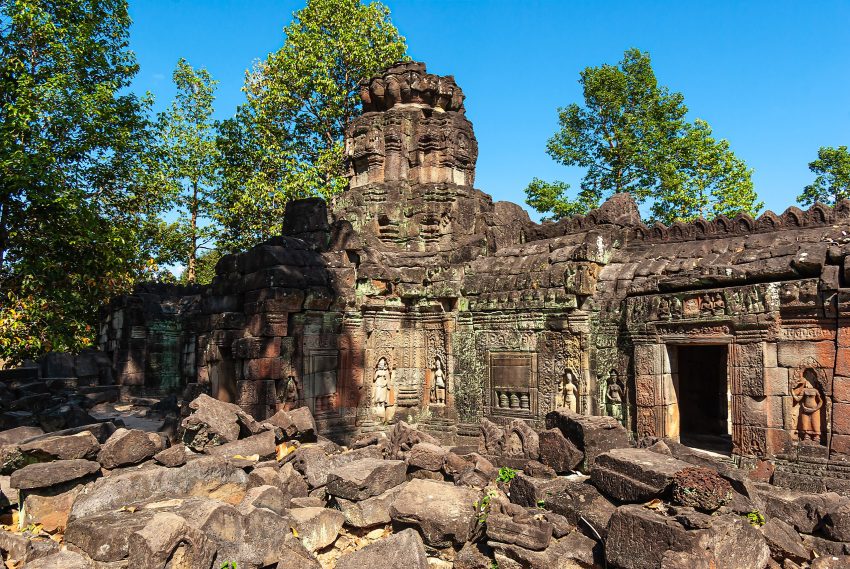
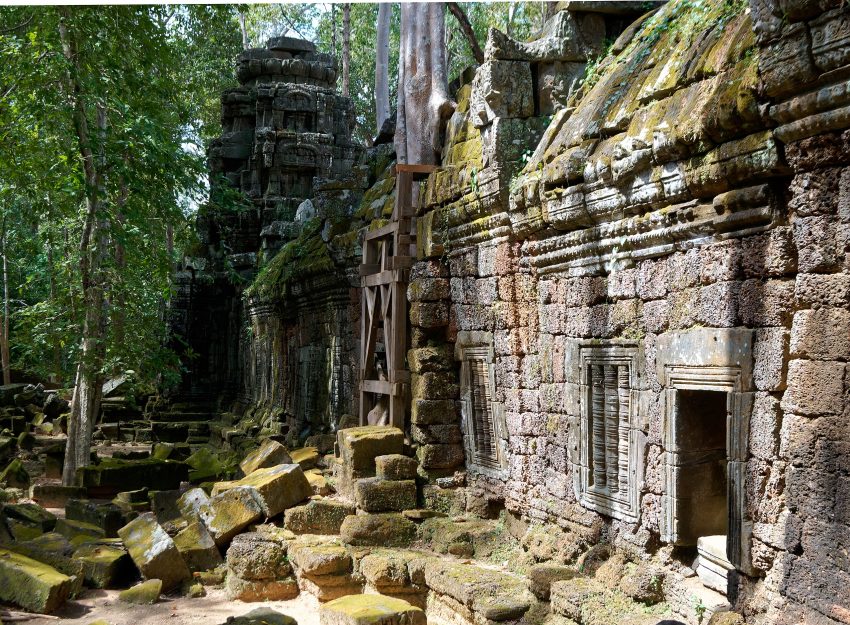
Ta Nei is located close to the Angkor Wat area, just next to the Angkor Zipline attraction. However, due to its position about 1 km down a rough, unpaved path, it doesn’t attract as many visitors, especially since there are other nearby temples that are easier to access.

Constructed in the late 12th century by King Jayavarman VII, Ta Nei features beautiful carvings and bas-reliefs around its flat, Angkor-style structure. While it may not be as grand as the larger temples in the area, its charm lies in its peaceful and secluded atmosphere, making it an ideal spot for those seeking a quieter experience.

Located 10.5 km from Siem Reap, Ta Nei offers the perfect balance of convenience and tranquility. Its hidden location provides a chance to explore a historic site without the crowds, making it a rewarding stop for visitors looking for something off the beaten path.


Location: Ta Nei Temple, Krong Siem Reap, Cambodia | Hours: 7:30 AM to 5:30 PM
Powered by GetYourGuide

8. Banteay Thom

Banteay Thom
Banteay Thom
CC BY-SA 2.0 / Pigalle

Banteay Thom is one of the most peaceful and picturesque temples in the Angkor region, often overlooked due to its challenging accessibility, which requires either a mountain bike or a rugged motorbike ride. Constructed by Angkor’s first Buddhist king, Jayavarman VII, this medium-sized temple follows the Bayon architectural style, with much of its structure still relatively clear of overgrowth. Despite its age and limited upkeep, the temple’s buildings and bas-reliefs remain in remarkable condition. The temple is located 14.6 km from Siem Reap.


Location: Banteay Thom Temple, Krong Siem Reap, Cambodia

9. Phnom Bok

Phnom Bok
Phnom Bok
© Andrew Ashton

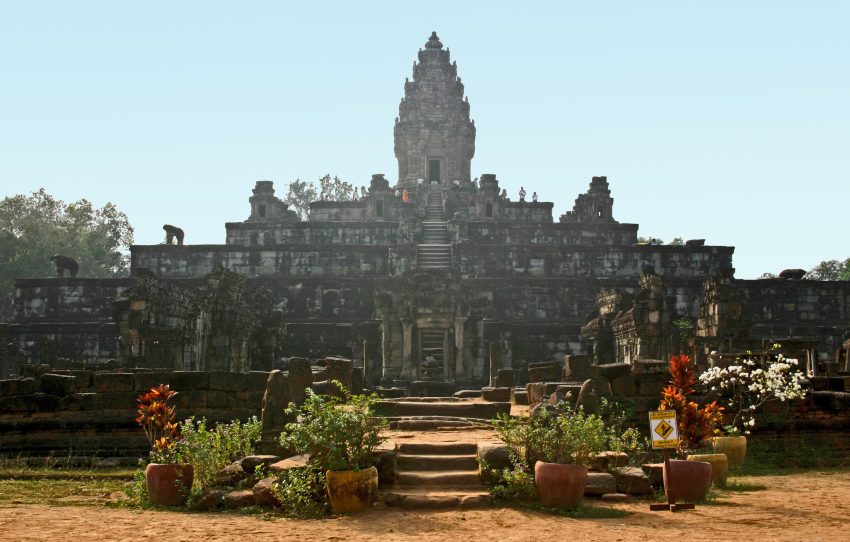
Phnom Bok is one of the oldest temples in Angkor and one of the most thrilling to visit. Many tour operators and drivers are unaware of its existence or its location, so it’s highly likely you could have the site all to yourself. The temple is located 23.7 km from Siem Reap.

Even those who are familiar with the picturesque, overgrown temple often exclude it from their itineraries, as the 600-step climb to the top of the 235-meter hill is challenging for many visitors. If you plan to visit this untouched spot and take in the stunning panoramic views of Angkor and Tonle Sap, be sure to bring plenty of water with you.


Location: Phnom Bok, Krong Siem Reap, Cambodia | Hours: Open daily from 7:30 am to 5:30 pm | Price: Included in the Angkor Pass | Website
Powered by GetYourGuide

10. Bakong Temple

Angkor Bakong
Angkor Bakong
CC BY-SA 4.0 / Gerd Eichmann

Bakong Temple, located 13 km southeast of Siem Reap in the Roluos group, is one of the earliest and most significant temples of the Khmer Empire. Built by King Indravarman I in 881, it is considered a prototype for the classic Khmer temple-mountain style, influencing later structures such as Angkor Wat. The temple features a large pyramid-like central structure, surrounded by an expansive moat and smaller satellite towers dedicated to Shiva. Bakong’s unique design, with its five ascending tiers symbolizing Mount Meru, and the impressive bas-reliefs depicting mythical creatures, makes it a must-see site for visitors interested in exploring the roots of Angkorian architecture. The temple’s peaceful setting and historical significance offer a quieter alternative to the busier temples of the Angkor complex.


Location: Bakong Temples, Prasat Bakong, Cambodia
Powered by GetYourGuide
Moira & Andy
Moira & Andy

Hey! We're Moira & Andy. From hiking the Camino to trips around Europe in Bert our campervan — we've been traveling together since retirement in 2020!

Read our full story here

This website uses affiliate links which earn a small commission at no additional cost to you.

Walking Tour Map
Map of the 10 Hidden Temples in Siem Reap walking route with 10 stops in Siem Reap.
Preview map of the 10 Hidden Temples in Siem Reap route in Siem Reap, showing 10 stops. Use the interactive map to zoom and tap markers.

More from this area

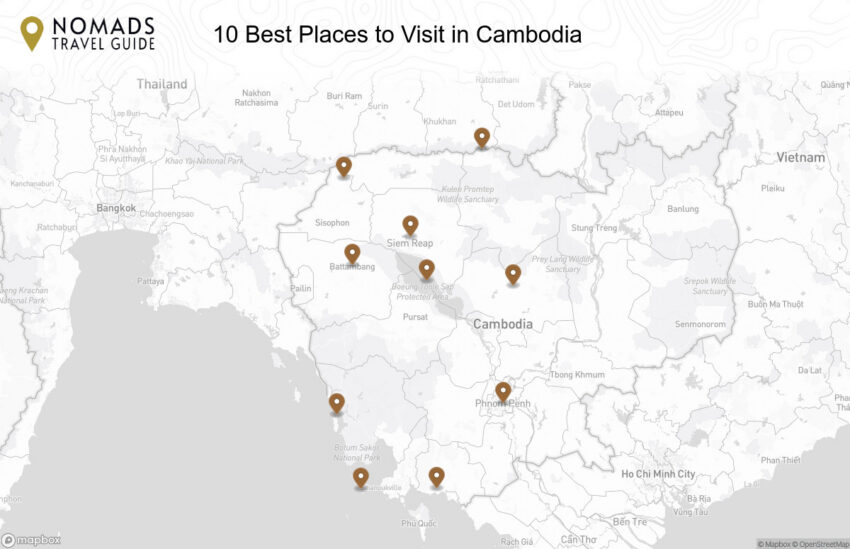
10 Best Places to Visit in Cambodia (2026)

Best Places to Visit in Cambodia

This website uses affiliate links which earn a small commission at no additional cost to you.

Cambodia is renowned for being home to the awe-inspiring temples of Angkor Wat and for the tragic Khmer Rouge era of the 1970s, followed by years of civil war. Its history blends some of humanity's greatest artistic achievements with some of its darkest moments.

While the rich history is a major draw for many travelers, Cambodia has much more to offer for those who stay longer than a quick visit to the temples of Siem Reap.

Beyond the temples, Cambodia is a captivating destination in Southeast Asia that entices visitors with its diverse attractions. Its pristine coastline of white sandy beaches beckons beach lovers, while the lush jungles of the countryside appeal to the more adventurous. The bustling capital, Phnom Penh, immerses visitors in the vibrant energy of modern Cambodian city life.

Explore the best of this fascinating country with our list of the top places to visit in Cambodia.

1. Angkor Wat (Angkor Archaeological Park)

Angkor Wat
Angkor Wat

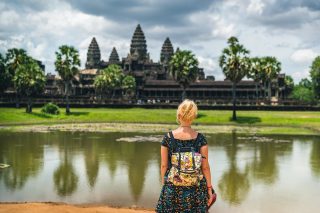
This temple complex is Cambodia’s top tourist destination. Located near the town of Siem Reap, the Angkorian-era temples are so grand in scale and construction that Angkor Wat is considered one of the world’s essential ancient landmarks. Built between 802 and 1432, Angkor was the world’s largest city during the medieval period and the heart of the Khmer Empire, where kings competed to create even more magnificent structures than their predecessors. While the city’s wooden homes were overtaken and decayed by the encroaching jungle, the mighty temples have endured. Angkor Wat, the world’s largest religious building, is just one part of the vast site, and the entire temple circuit requires about three days to fully appreciate the scale and architectural brilliance of the Angkorian period.

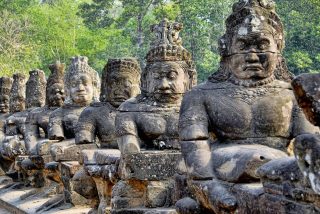
For those short on time, however, the must-see highlights include the tree-covered temple of Ta Prohm (famously featured in the Tomb Raider movie), the Bayon Temple with its 216 stone faces, Angkor Thom, and Preah Khan.


Location: Angkor Wat, Krong Siem Reap, Cambodia

Here is a complete selection of hotel options in Phnom Penh. Feel free to review each one and choose the stay that best suits your needs.

2. Phnom Penh

Phnom Penh
Phnom Penh

Cambodia’s capital, Phnom Penh, is the vibrant heart of the nation, where chaotic streets are filled with the sounds of motorbikes and car horns—a sensory overload that may feel overwhelming at first. Once abandoned during the Khmer Rouge era and left to deteriorate, the city has made a remarkable recovery and now stands as one of Southeast Asia’s most dynamic urban centers.

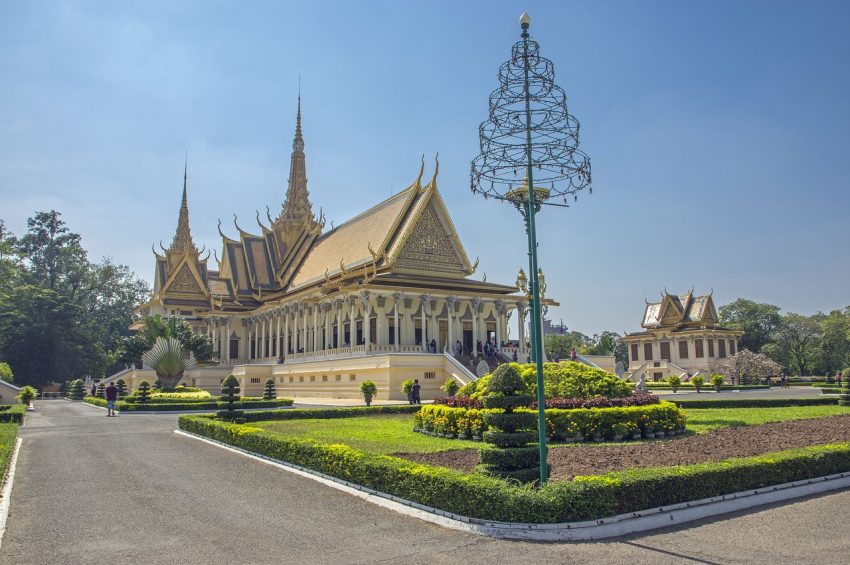
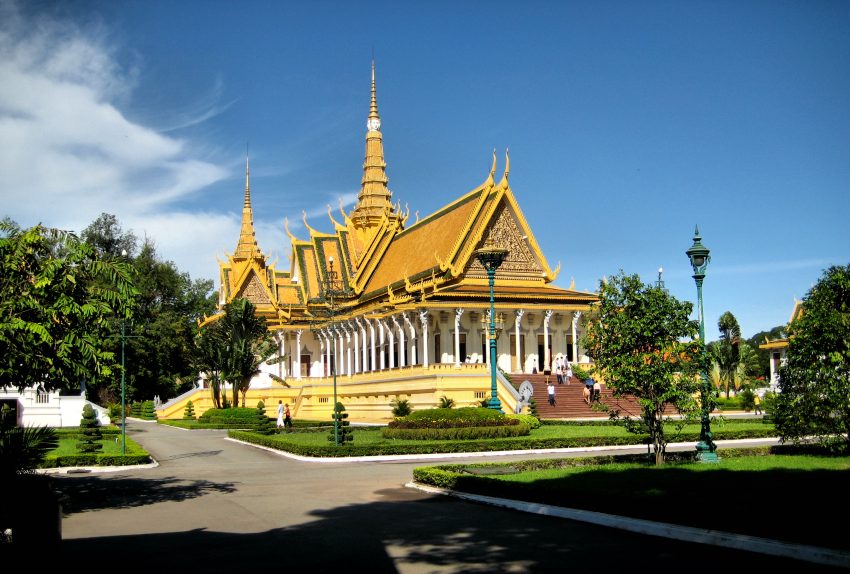
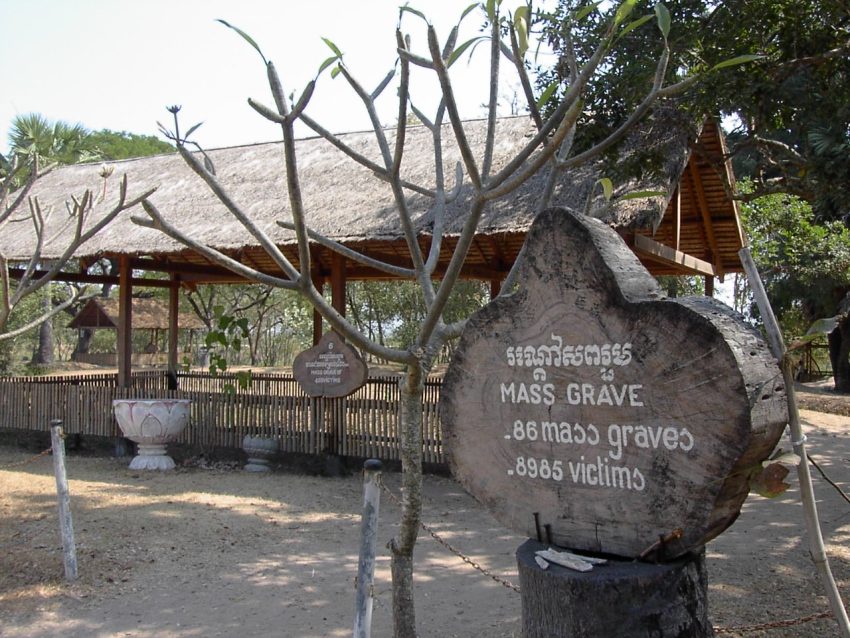
For visitors, Phnom Penh offers the country’s most cosmopolitan experience, with a café and restaurant scene that surpasses the rest of Cambodia. It is also home to several significant historic sites that offer insight into both modern and ancient Cambodia. The National Museum showcases a collection of Khmer sculptures, tracing the nation’s history from the pre-Angkorian era to the grandeur of the Angkorian kings. The Royal Palace is a stunning example of traditional artistry, while the Tuol Sleng Museum and the Killing Fields of Choeung Ek serve as somber reminders of the brutal horrors endured during the Khmer Rouge regime.

Read our Phnom Penh Travel Guide

Traveling to a country with a different currency? Avoid ATM transaction fees and pay in local currency with a Wise Card. Having used it for over 5 years, we've saved loads on fees!

Powered by GetYourGuide

3. Koh Rong Samloem

Koh Rong
Koh Rong

Off Cambodia’s south coast lies a group of islands that rival the beauty of their Thai counterparts, yet remain far less visited. In contrast to the highly developed islands of Koh Samui and Phuket, Cambodia’s islands offer a more relaxed, tropical escape, where sun, sand, and tranquility take center stage, and large resorts are still a distant prospect.

Among these islands, Koh Rong Samloem stands out as one of the most stunning, with the serene, sandy stretch of Saracen Bay hosting a handful of beach hut resorts that provide a peaceful getaway. Here, relaxation is key, with plenty of hammock time to enjoy, though there are also scuba diving opportunities for those seeking more adventure. These islands are easily accessible from Sihanoukville.

Read our Koh Rong Travel Guide

Click here to read our blog about Travelling from Phnom Penh to Siem Reap 2026: Best Ways to Get There

Powered by GetYourGuide

4. Prasat Preah Vihear

Temple of Preah Vihear
CC BY-SA 3.0 / CHAMRAT CHAROENKHET

While the temples of Angkor Wat are globally renowned, Prasat Preah Vihear stands out for its dramatic setting. Perched atop the Dangrek Mountains on a steep escarpment, it offers breathtaking views over the Cambodian floodplains. This monumental temple complex, originally built to honor the god Shiva, features intricately carved pavilions connected by long causeways.

Located near the border with Thailand, Prasat Preah Vihear has long been a source of territorial dispute between the two countries, both claiming it as their own. In 2013, the International Court of Justice ruled in Cambodia’s favor after tensions escalated between 2008 and 2011.

In recent years, the situation has calmed, allowing this UNESCO World Heritage Site to regain its place on the tourist circuit. Visitors typically access the temple from Sra Em, though many opt for a day trip from Siem Reap, located about 200 kilometers to the south.


Location: Prasat Preah Vihear, Krong Ban Lung Cambodia | Hours: 7.30 AM – 5.30 PM but note that the ticket counter closes by 4 PM. | Price: USD 10

Click here to read our blog about 13 Best Things to Do in Phnom Penh, Cambodia 2026: Temples, Markets & Culture

Powered by GetYourGuide

5. Battambang

temple Battambang
temple Battambang

The countryside surrounding Battambang, with its expansive rice fields and quaint villages, offers some of the most peaceful rural landscapes in Cambodia. This serene region is also rich in historical treasures, making the city a popular stop for travelers.

For history enthusiasts, the temples of Phnom Sampeau, Phnom Banan, and Wat Ek Phnom are all easily accessible for day trips. Additionally, the famous Bamboo Train—a unique rail track where makeshift carriages, built from wood and bamboo, travel between Battambang’s east bank and the small village of O Srav—is one of the area’s top attractions.

Read our Battambang Travel Guide
Powered by GetYourGuide

6. Kampot

kampot
kampot
The laid-back river town of Kampot exudes old-world charm with its relaxed atmosphere and colonial-era architecture. The town’s compact central district is perfect for leisurely strolls, where visitors can admire the well-preserved shop-houses, many of which have been carefully restored to maintain their historical character. The riverfront location adds to the town’s serene vibe, offering beautiful views and a peaceful setting.

Kampot’s true appeal lies in its tranquil pace of life, which often leads travelers to linger longer than planned. The town’s calm, unhurried atmosphere invites relaxation, whether you’re enjoying a coffee by the river or exploring its quaint streets. This easygoing charm has made Kampot a beloved destination for those seeking a slower pace and a more authentic experience of Cambodia.

Read our Kampot Travel Guide
Powered by GetYourGuide

7. Tonlé Sap Lake

Tonle Sap Lake Cambodia

Tonlé Sap is the largest freshwater lake in Southeast Asia and a crucial waterway for Cambodia.

In addition to being a vital source of food and an essential tool for irrigation, the lake is home to 170 floating villages. These villages rely on fishing for their livelihood, with homes, shops, churches, schools, and temples built directly on the water. The structures are supported by buoyant foundations made from barrels and bamboo, and all transportation is done by boat, offering a unique and fascinating way of life.

Among the most intriguing villages is Kompong Luong, located near the town of Pursat on the lake’s western shore. However, the most visited village is Chong Kneas, which lies close to Siem Reap. These floating communities offer an unforgettable experience for visitors.


Location: Tonle Sap Lake, Cambodia
Powered by GetYourGuide

8. Koh Kong Island

Koh Kong
Koh Kong

Koh Kong Island is one of Cambodia’s most tranquil and pristine destinations, offering an idyllic escape for nature lovers and adventure seekers. Located on the Gulf of Thailand, the island is surrounded by lush rainforests, pristine beaches, and clear turquoise waters. The island remains relatively undeveloped, providing a peaceful retreat far from the hustle and bustle of more tourist-heavy destinations. Visitors can enjoy a range of activities, from exploring the island’s natural beauty and wildlife to relaxing on its quiet beaches.

Koh Kong Island offers plenty of opportunities for exploration and adventure. The island is home to dense mangrove forests and pristine coral reefs, making it an ideal spot for eco-tourism activities like kayaking, birdwatching, and snorkeling. The nearby Koh Kong National Park is also a highlight, with its rich biodiversity and opportunities for hiking and wildlife spotting. The serene atmosphere and untouched landscapes make Koh Kong Island a perf

Read our Koh Kong Travel Guide
Powered by GetYourGuide

9. Sambor Prei Kuk

Sambor Prei Kuk
Sambor Prei Kuk
CC BY-SA 4.0 / PsamatheM

This pre-Angkorian temple complex, dating back to the early 7th century, once served as the capital of the Upper Chenla Empire. Hidden within the forest, more than 100 brick temples dedicated to various Hindu deities are scattered throughout the site, many of them partially embraced by the sprawling roots of towering trees.

Sambor Prei Kuk holds immense archaeological significance as it preserves some of Cambodia’s oldest surviving structures. Yet, you don’t need to be a history enthusiast to marvel at the mystical beauty of this tree-shrouded site. Key highlights include Prasat Sambor, Prasat Tao, and Prasat Yeay Peau, each adorned with intricate carvings and surrounded by a serene, jungle-clad atmosphere of twisting roots and vines.

Visitors can easily access Sambor Prei Kuk from Kompong Thom, making it a must-visit destination for those exploring Cambodia’s ancient heritage.


Location: Sambor Prei Kuk, Prasat Sambour​ District, Cambodia | Hours: 7.30 am to 5.30 pm | Price: USD 10
Powered by GetYourGuide

10. Banteay Chhmar

Banteay Chhmar Cambodia
CC BY-SA 3.0 / Andrew Marino

This sprawling temple complex lies cloaked in jungle in Cambodia’s remote northwest, offering visitors a chance to explore its highlights in peaceful solitude, away from the usual crowds. Built in the 12th century by Angkorian King Jayavarman VII, Banteay Chhmar is a masterpiece of Khmer architecture and artistry.

The intricately detailed stone reliefs are among the most impressive in Cambodia, with the south wall featuring breathtaking depictions of Avalokiteśvara and the eastern walls showcasing vivid battle scenes that reflect the skill and creativity of the Angkorian era. These bas-reliefs are a testament to the historical and cultural significance of the site.

For accommodations, visitors can stay in the nearby village, which offers simple homestay options, providing an authentic local experience. Alternatively, Sisophon, located 60 kilometers to the south, has more facilities, and many travelers opt for a day trip from Siem Reap to explore these awe-inspiring ruins.


Location: Banteay Chhmar, Cambodia
Powered by GetYourGuide
Moira & Andy
Moira & Andy

Hey! We're Moira & Andy. From hiking the Camino to trips around Europe in Bert our campervan — we've been traveling together since retirement in 2020!

Read our full story here

This website uses affiliate links which earn a small commission at no additional cost to you.

Walking Tour Map
Map of the 10 Best Places to Visit in Cambodia walking route with 10 stops in Phnom Penh.
Preview map of the 10 Best Places to Visit in Cambodia route in Phnom Penh, showing 10 stops. Use the interactive map to zoom and tap markers.

Travelling from Phnom Penh to Siem Reap 2026: Best Ways to Get There

Travelling from Phnom Penh to Siem Reap

This website uses affiliate links which earn a small commission at no additional cost to you.

Despite the distance of over 300 km, traveling between Phnom Penh and Siem Reap is relatively straightforward compared to similar routes in neighboring countries like Laos or Myanmar. This journey is among the most popular for exploring Cambodia. In this comprehensive transfer guide, Nomad Travel Guide breaks down the available transportation options, covering their duration, costs, and advantages and disadvantages. Let's get started!

Flying to Siem Reap from Phnom Penh

Traveling from Phnom Penh to Siem Reap by air is considered the most convenient and safest option. Both cities have domestic airports, though they are relatively small. A direct flight takes just 2 hours and 13 minutes, making it the fastest way to complete the journey.

To Phnom Penh Airport from the City Center

Getting from Phnom Penh city center to the airport is straightforward and can be done by taxi, tuk-tuk, or moto. Taxis are the most convenient option, with a typical fare of around $12-$15 depending on your location in the city. Tuk-tuks and motos are cheaper alternatives, usually costing between $5-$7 and $2-$4, respectively, but they may take longer or be less comfortable due to traffic. It’s advisable to leave with plenty of time before your flight, as traffic in Phnom Penh can sometimes be unpredictable, especially during peak hours. For a hassle-free experience, booking a taxi in advance or asking your hotel to arrange transportation is a great option.

From Siem Reap Airport to the City Center

Arriving at Siem Reap Airport? Getting to the city center is simple with fixed-price taxis, motos, and tuk-tuks. A taxi ride to the city center typically costs around $10, with larger vehicles available for bigger groups at a slightly higher price. For a more affordable option, you can walk a little further from the airport to find cheaper tuk-tuks and motos, which charge around $6 and $2 respectively. However, be cautious with tuk-tuk drivers offering temple tours, as it’s often better to book these tours through your hotel for a more reliable experience.

Airlines Flying from Phnom Penh to Siem Reap

Several airlines offer affordable flights between Phnom Penh and Siem Reap, including Cambodia Angkor Air, which operates four direct flights daily.

Ticket Prices and Booking

Airfare for the route typically ranges from $40 to $180, depending on the time of booking and availability. Tickets can be purchased directly at Cambodia Angkor Air’s website or through online platforms like Skyscanner.

Taking a Bus to Siem Reap from Phnom Penh

Traveling by bus is not only a primary mode of transportation in Cambodia but also the most affordable way to get from Phnom Penh to Siem Reap. Various bus options are available, including economical minibuses, sleeper buses, VIP (luxury) buses, and even hotel buses.

Numerous local companies operate this route, such as Seila Angkor Express, Giant Ibis Transport, Vireak Buntham, Phnom Penh Sorya, KSO Transport, Bayon VIP, Olongpich Transport, and Mey Hong Bus. These companies offer a better experience than public Cambodian buses, with fewer stops, less crowding, and safer driving. Luxury buses, in particular, are smaller and more comfortable, accommodating only 15 passengers per trip.

The cost of a bus ticket from Phnom Penh to Siem Reap varies depending on the type of bus, typically ranging from $8 to $20 one way.

Since the road distance is considerable, the journey takes approximately 6 hours. Buses depart every 30 minutes throughout the day, offering both day and night options. For added convenience, the overnight sleeper bus allows you to rest during the journey and wake up refreshed at your destination.

Phnom Penh to Siem Reap by Bus
Price: £ 5.97–14.56 Duration: 5h – 7h 30m
  • Sleeper Bus 22:30, 23:00
  • Luxury 01:00, 01:30, 22:00, 23:00, 23:45
  • Hotel Bus 00:30, 01:30, 23:00, 23:30, 23:55
  • Luxury Hotel 20:30
  • Night Bus 22:15, 22:30, 23:00, 23:30, 23:55
  • Seater 41 08:00, 13:45
  • Seater 37 08:00, 09:00, 14:30, 15:30
  • Seater 45 10:15, 12:00
  • Premium 25 08:00
  • Sleeper 26 22:00
  • Tourist AC 08:30, 13:30
  • Sleeper 20:15, 22:45, 23:00, 23:30
  • VIP 15 pax 06:30, 07:30, 08:30, 09:30, 10:30, 11:30, 12:30, 13:30, 14:30, 15:30, 16:30, 17:30, 18:30
  • Minibus 07:30, 09:30, 13:30
  • Universe Luxury 08:45, 12:30

Traveling by Boat to Siem Reap from Phnom Penh

Another option for traveling from Phnom Penh to Siem Reap is by boat. The best time to take advantage of boat services is during the wet season (July to March) when the water levels are higher. If you're looking for an exciting adventure, this is definitely the ideal choice for you.

Boats depart daily at 7:00 AM from Phnom Penh Port on Sisowath Quay, with the journey taking around 4 to 6 hours. You can choose from various boat types, including express boats (fast boats), ferries, river cruises, or luxury cruises. This scenic journey offers a unique opportunity to explore local life while enjoying the beautiful landscapes along the way.

Ticket prices for the boat ride from Phnom Penh to Siem Reap usually cost $35. It’s often cheaper to purchase tickets through hotels or travel agencies than directly from the ferry offices. Although the trip is generally safe, some local boat companies may not always enforce the use of life jackets.

For a more luxurious experience, you can opt for Cambodia River Cruises by Top Mekong Cruise. These luxury vessels offer everything you need for a relaxing and memorable trip, including onboard amenities like swimming pools, restaurants, spas, and cafes.

Siem Reap from Phnom Penh by Taxi

Taxis are another convenient way to travel from Phnom Penh to Siem Reap. Unlike buses, taxis offer more flexibility, allowing you to travel at your own preferred time. They are also faster, with the journey taking approximately 5.5 hours.

There are two main types of taxis: private taxis (which can accommodate up to 4 passengers) and van taxis (which can hold up to 15 passengers). If you’re traveling alone, a private taxi is a good option. However, if you need extra space for luggage, a van taxi would be more suitable.

Taxi fares for the Phnom Penh to Siem Reap route typically range from $70 to $200. Negotiating the price with the driver before getting into the taxi is important. You can contact Phnom Penh Taxi or Cambodia Taxi.

Phnom Penh to Siem Reap by Van
Price: £ 8.05–12.07 Duration: 5h – 6h
  • Van 06:00, 07:00, 09:00, 10:00, 11:00, 12:00, 13:00, 14:30, 15:30, 16:30, 17:30, 18:30
  • Van 15pax 06:00, 06:30, 07:00, 07:30, 07:40, 08:00, 08:30, 09:00, 09:30, 10:00, 10:30, 11:00, 11:30, 12:00, 12:30, 13:00, 13:30, 14:00, 14:30, 15:00, 15:30, 16:00, 16:30, 17:00, 17:30, 18:00, 18:30, 19:00, 19:30
  • VIP 06:30, 07:30, 08:30, 09:30, 14:00, 15:30, 17:30
  • Minivan 06:30, 07:30, 08:30, 09:30, 12:00, 13:00, 14:30, 15:30, 17:00, 18:30
  • Shared van 13pax 07:30, 09:00, 14:30, 16:00
  • VIP Van 07:31, 08:01, 09:01, 09:31, 10:01, 11:01, 14:01, 14:31, 15:31

Private Transfer from Phnom Penh to Siem Reap

Traveling from Phnom Penh to Siem Reap by private transfer is another great option, especially if you're traveling with a larger group. The journey typically takes around six hours, and the driver can pick you up from your hotel, the airport, or any other convenient location. Along the way, you can make stops for bathroom breaks, coffee, or even sightseeing if you’d like. Great places to see on the way would be  Spider Market (Tarantula) or the Old Bridge (Kampong Kdei).

Prices for a private transfer from Phnom Penh to Siem Reap generally range from $30 per person. To ensure a more comfortable ride with better service at a reasonable price, it’s advisable to book your private car in advance. You can book a Private Transfer from Phnom Penh to Siem Reap with Angkor Dynasty Travel. If there are more than three of you it might be cheaper to book a regular taxi.

Powered by GetYourGuide
Moira & Andy
Moira & Andy

Hey! We're Moira & Andy. From hiking the Camino to trips around Europe in Bert our campervan — we've been traveling together since retirement in 2020!

Read our full story here

This website uses affiliate links which earn a small commission at no additional cost to you.

More from this area

Bangkok to Kanchanaburi Day Trip (2026)

Day Trip to Kanchanaburi scaled

This website uses affiliate links which earn a small commission at no additional cost to you.

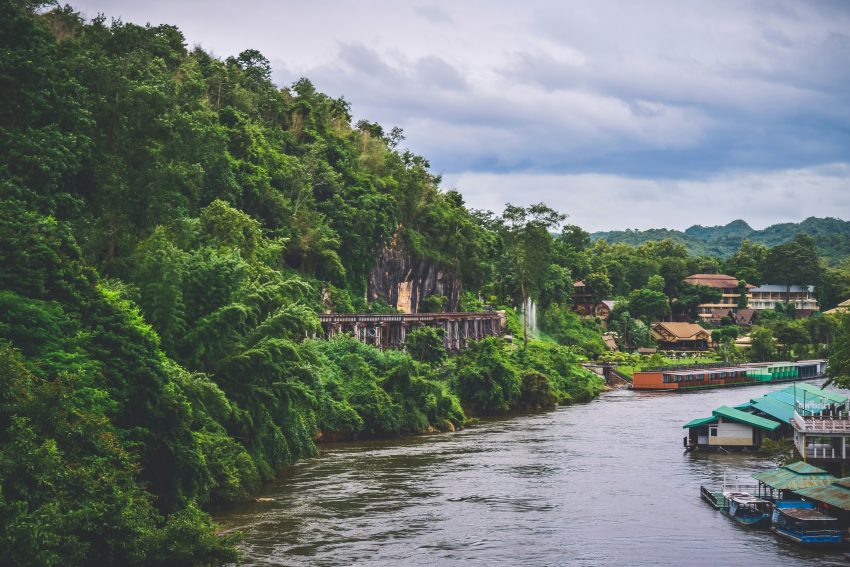
Many visitors opt to explore Kanchanaburi through organized day trips from Bangkok, a convenient option for those with limited time. These tours typically cover key attractions such as the Bridge on the River Kwai, the Kanchanaburi War Cemetery, and the Death Railway. However, if you're traveling independently, it's well worth allocating extra time to fully experience Kanchanaburi. The region's stunning natural beauty, with its winding rivers, cascading waterfalls, and lush jungle-covered hills, stands in poignant contrast to its tragic history.

A Short History of Kanchanaburi

Kanchanaburi's somber history is deeply tied to World War II, particularly the events of 1942. In January of that year, the Japanese army launched an attack on Victoria Point in Myanmar (then Burma, a British colony), and by March, they had captured Rangoon. By May 1942, Allied forces were forced to retreat, and Japan had gained control of the colony. While you may be thinking about Kanchanaburi in Thailand, its historical connection to Myanmar is significant due to the Japanese invasion during this time.

Following their invasion of Burma, the Japanese needed a more secure route to supply their troops, as the lengthy 3,200 km sea route was vulnerable to attacks by Allied submarines. The alternative was a railway stretching from Bangkok to Rangoon, passing through the Three Pagodas Pass and alongside the River Kwai Noi. This route, previously deemed too difficult by the British due to challenging terrain and numerous rivers, was chosen by the Japanese. The railway's construction involved over 180,000 Southeast Asian civilian laborers, known as Romusha, and 60,000 Allied POWs, mostly British, Australian, and Dutch. Known as the Death Railway, this 415 km stretch led to the deaths of over 90,000 Romusha and 12,000 POWs due to brutal working conditions and harsh treatment. The Death Railway stands as a poignant reminder of the cruelty of wartime labor and is a crucial part of Kanchanaburi's history, making the area an essential visit for those staying in Bangkok.

Getting from Bangkok to Kanchanaburi

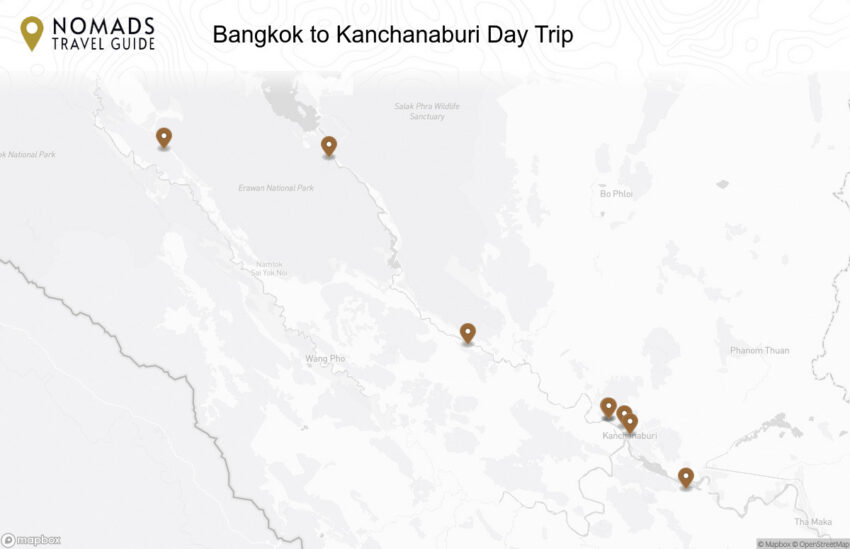
There are three main ways to travel from Bangkok to Kanchanaburi: private tour, by bus or by train.

Kanchanaburi by Train

I highly recommend taking the train at least one way, as it offers a scenic and relaxing journey. Trains to Kanchanaburi depart from Bangkok Thonburi station, which is quieter than the main train station in Bangkok, as it primarily serves the Kanchanaburi and Nam Thok routes. The train runs twice daily, with departures at 7:50am and 1:55pm, arriving in Kanchanaburi 2.5 hours later at 10:35am and 4:26pm. While the train is a standard commuter-style with bench seating, it's a comfortable and easy journey that costs around 100 THB (approximately £2.50 or €3).

To reach Thonburi station from central Bangkok, you can take a Grab Taxi (the local equivalent of Uber), which is affordable and convenient. Alternatively, if you're traveling alone, a GrabBike (motorbike taxi) is an inexpensive and quick option, although it's only practical for solo travelers. From Khao San Road, it's about a 30-minute walk to Thonburi Station, or a 12-minute taxi ride costing around 80-100 THB.

If you're planning to return to Bangkok by train, the return service leaves Kanchanaburi at 7:19am and 2:48pm, arriving back in Bangkok at 10:25am and 5:40pm. However, for a day trip, it may be more practical to take the bus one way and the train back due to the train schedule.

Getting a bus to/from Kanchanaburi

Another option for getting to Kanchanaburi is by minivan or bus. While the journey takes a bit longer (around 3 hours) and can be slightly more expensive, buses and minivans run more frequently than the trains.

Minivans depart from several locations, including Morchit Bus Station (in northern Bangkok), Sai Tai Kao (on the far west side of the city), and Burana Sat Road (near Khao San Road). The one-way fare is typically around 150-160 THB (approximately £4 or €4.50). The minivans arrive at the bus station in Kanchanaburi, which is about a 55-60 minute walk from the famous River Kwai Bridge.

Kanchanaburi to Bangkok by Bus, Van
Price: £ 3.86 Duration: 3h 20m
  • Minibus 03:00, 03:30, 05:00, 07:00, 08:00, 09:00, 11:00, 13:00, 14:00, 15:00, 17:00, 18:00
  • Intercity 04:00, 04:15, 04:40, 04:45, 04:50, 04:55, 05:10, 05:20, 05:25, 05:40, 05:50, 05:55, 06:05, 06:10, 06:20, 06:30, 06:35, 06:40, 06:45, 06:50, 07:05, 07:15, 07:20, 07:35, 07:50, 08:05, 08:30, 08:35, 08:45, 09:10, 09:15, 09:25, 09:50, 09:55, 10:05, 10:30, 10:35, 10:45, 11:10, 11:15, 11:25, 11:50, 11:55, 12:05, 12:20, 12:35, 12:50, 13:05, 13:20, 13:35, 13:50, 14:05, 14:20, 14:35, 14:50, 15:05, 15:20, 15:35, 15:50, 16:05, 16:30, 16:35, 16:45, 17:10, 17:15, 17:25, 17:55, 18:00, 18:15, 18:45, 19:00, 19:15, 19:45
  • Minibus 06:20, 08:30, 09:50, 11:50, 12:30, 13:50, 15:50, 18:00

Getting a Pirvate Tour to Kanchanaburi

If you prefer not to navigate public transport and would rather have a guided experience, joining a group or private tour is a great alternative. GetYourGuide offers several highly rated tours from Bangkok to Kanchanaburi.

One popular option is Historical Day Tour to River Kwai that includes air-conditioned transport, an English-speaking guide, a visit to the War Cemetery, and a ticket for a scenic train ride on the Death Railway (from Kanchanaburi to Nam Thok). This tour is priced under £40 per person and provides an easy, stress-free way to explore Kanchanaburi while learning about the history of the Death Railway.

For a more adventurous experience, the Kanchanaburi and Erawan Waterfall Private Tour, is another excellent option. This memorable adventure to Erawan National Park, where you’ll hike through lush jungles and swim in the breathtaking seven-tiered waterfalls costs £126.35 per person. Afterward, dive into history as you visit the iconic Bridge over the River Kwai, followed by visitng the JEATH War Museum, where you’ll learn about the construction of the infamous Death Railway. You will also get to enjoy a delicious lunch at a local restaurant, savoring authentic flavors.

What to See and do in Kanchanaburi

Kanchanaburi offers a captivating mix of natural beauty and historical significance, making it a must-visit destination in Thailand. Explore the stunning Erawan Waterfalls, hike through lush forests, and immerse yourself in the poignant history of the Death Railway with visits to the Bridge over the River Kwai and Hellfire Pass. Learn about the region's WWII history at the JEATH War Museum and Kanchanaburi War Cemetery, and enjoy the serene surroundings of the river and mountains. Whether you're seeking adventure, history, or relaxation, Kanchanaburi has something for everyone.

1. Bridge Over the River Kwai

River Khwae Bridge
River Khwae Bridge

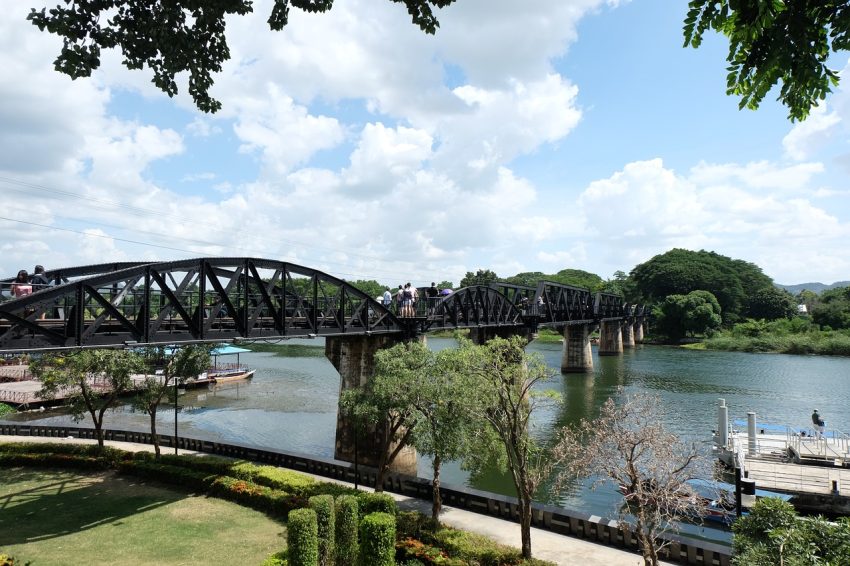
The Bridge Over the River Kwai is an iconic symbol of resilience and remembrance, serving as a stark reminder of the atrocities endured by prisoners of war (POWs) during World War II. Part of the infamous Death Railway built by the Japanese to connect Thailand and Burma, the bridge was constructed under brutal conditions using forced labor. Today, visitors can walk across the bridge, take a scenic train ride over it, or simply reflect on its historical significance while enjoying views of the surrounding River Kwai area.


Location: River Khwae Bridge, River Kwai Road, Tha Ma Kham, Mueang Kanchanaburi District, Kanchanaburi, Thailand

Here is a complete selection of hotel options in Kanchanaburi. Feel free to review each one and choose the stay that best suits your needs.

Powered by GetYourGuide

2. Kanchanaburi War Cemetery

Kanchanaburi War Cemetery

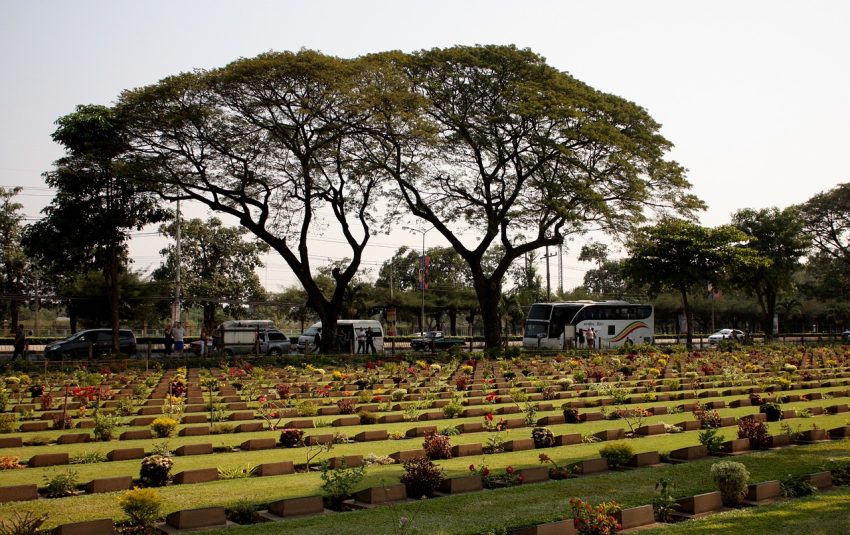
The Kanchanaburi War Cemetery is a solemn tribute to the thousands of Allied soldiers who lost their lives during the construction of the Death Railway. Carefully maintained and serene, the cemetery is the final resting place for many British, Australian, and Dutch POWs. Visitors come here to pay their respects, reflect on the sacrifices made, and honor the memory of those who endured unimaginable hardship.


Location: Kanchanaburi War Cemetery (DonRak), Sangchuto Road, Ban Tai, Mueang Kanchanaburi District, Kanchanaburi, Thailand | Hours: 0800 hrs – 1700 hrs Monday to Friday 0800 hrs – 1200 hrs Saturday.

Traveling to a country with a different currency? Avoid ATM transaction fees and pay in local currency with a Wise Card. Having used it for over 5 years, we've saved loads on fees!

Powered by GetYourGuide

3. JEATH War Museum

JEATH Museum
JEATH Museum
CC BY-SA 3.0 / BrokenSphere

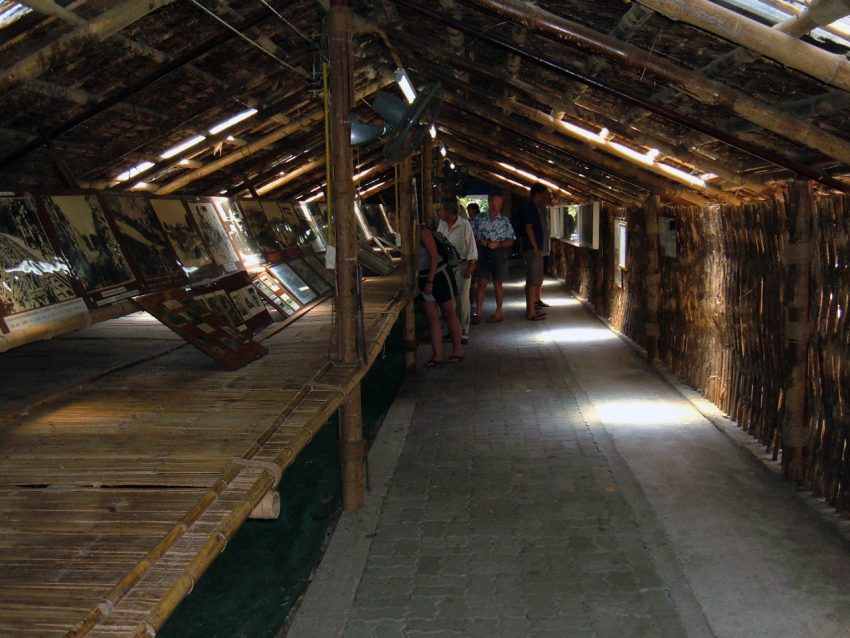
The JEATH War Museum provides an intimate look at the harrowing experiences of prisoners of war and laborers who built the Death Railway. Its exhibits include photographs, artifacts, and recreations of wartime conditions, offering a sobering insight into the human cost of war. Located near the Bridge Over the River Kwai, this museum plays a crucial role in preserving the memory of this tragic chapter in history.


Location: JEATH War Museum, Ban Tai, Mueang Kanchanaburi District, Kanchanaburi, Thailand | Hours: 8:30 a.m. to 4:30 p.m. daily | Price: 50 THB

4. Erawan National Park

Erawan Waterfall Kanchanaburi Province Thailand
CC BY-SA 3.0 / Diliff

Erawan National Park is a breathtaking natural haven, renowned for its seven-tiered waterfall, Erawan Falls, which cascades through lush green forests into emerald pools perfect for swimming. The park offers hiking trails that allow visitors to explore its pristine landscapes, spot wildlife, and marvel at limestone caves. Its stunning natural beauty and tranquility make it a popular destination for nature lovers and adventure seekers alike.


Location: Erawan Falls, Tha Kradan, Si Sawat District, Kanchanaburi, Thailand
Powered by GetYourGuide

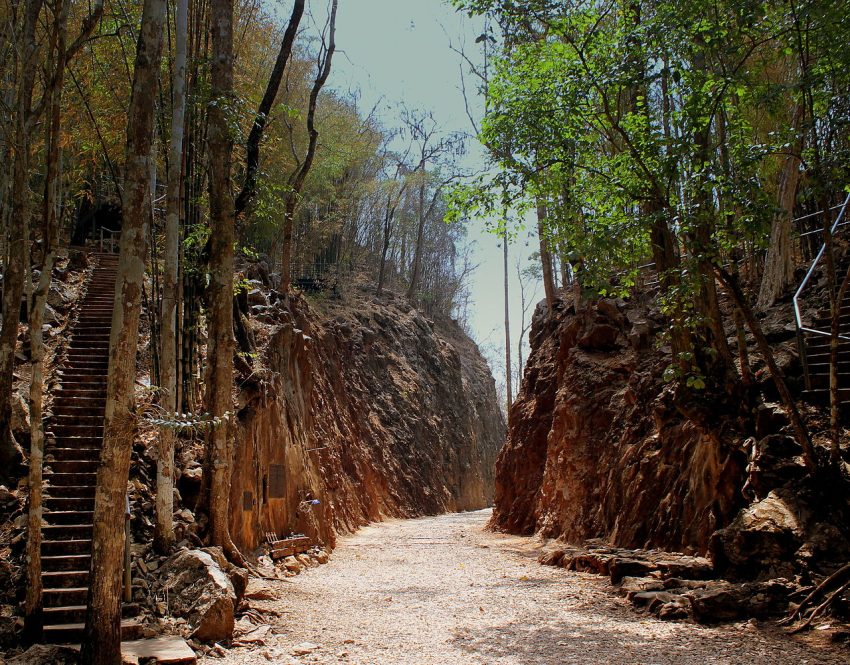
5. Hellfire Pass

Hellfire Pass
Hellfire Pass
CC BY-SA 2.0 / calflier001

Hellfire Pass, or Konyu Cutting, is a poignant historical site that was carved through mountains during the construction of the Death Railway. This arduous task was carried out by Allied POWs and forced laborers under unimaginable conditions. Today, the Hellfire Pass Memorial Museum and walking trail honor the sacrifices of those who suffered and perished, offering visitors an emotional and educational experience amidst the haunting beauty of the landscape.


Location: Hellfire Pass, Tha Sao, Sai Yok District, Kanchanaburi, Thailand | Hours: Daily 9:00 am to 4:00 pm, excluding Christmas Day. | Price: Free entry, 200 baht deposit for audio tour
Powered by GetYourGuide

6. Wang Po Viaduct

Day Trip to Kanchanaburi scaled

The Wang Po Viaduct is one of the most iconic and dramatic sections of the Death Railway, located near Kanchanaburi. Built by Allied prisoners of war and forced laborers during World War II, this wooden trestle bridge hugs the edge of steep cliffs, with the River Kwai Noi flowing below. The viaduct showcases the immense challenges and sacrifices faced during its construction, as workers toiled under brutal conditions to complete this perilous section. Today, the viaduct is both a poignant historical site and a popular scenic highlight for train passengers traveling along the Death Railway, offering stunning views of the river and surrounding countryside.


Location: Wang Po Viaduct, Kanchanaburi
Powered by GetYourGuide

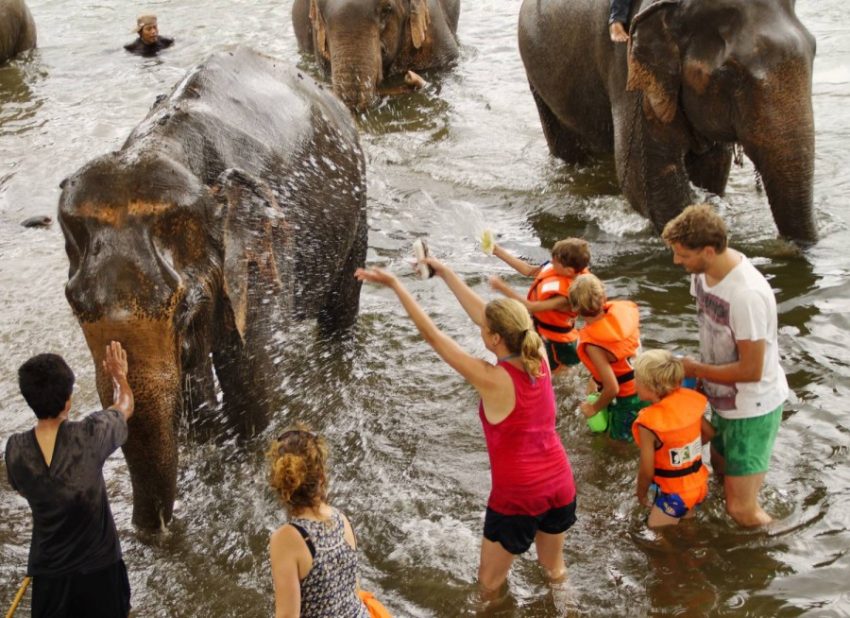
7. Elephant’s World Sanctuary

Kanchanaburi Elephant World
All Rights Reserved / www.elephantsworld.org

Elephant’s World Sanctuary in Kanchanaburi is a sanctuary dedicated to the rescue and rehabilitation of elephants, offering a unique and ethical way to interact with these majestic animals. Unlike traditional elephant tourism, where elephants are often used for rides or shows, Elephant’s World focuses on the well-being and care of retired working elephants, many of whom have suffered from abuse or neglect in the past. Visitors to the sanctuary can learn about the elephants’ individual stories, feed them, bathe them, and even participate in activities that help care for the elephants, such as preparing their food and cleaning their living areas. This hands-on experience not only supports the elephants’ health and happiness but also promotes awareness of ethical wildlife tourism. Located near the River Kwai, the sanctuary offers a peaceful and meaningful visit, allowing guests to connect with elephants in a safe and respectful environment.


Location: Elephants World, Wang Dong, Mueang Kanchanaburi District, Kanchanaburi, Thailand | Hours: From 10.00 AM
Powered by GetYourGuide

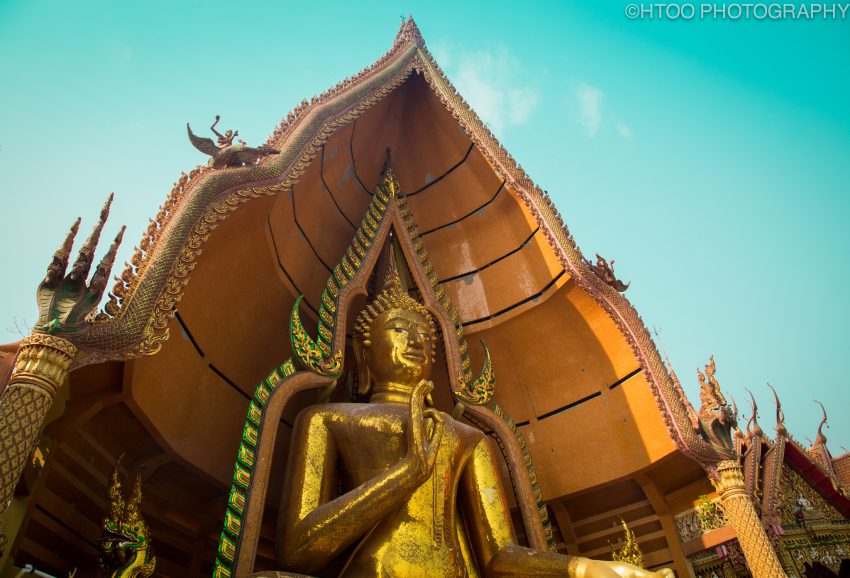
8. Tiger Cave Temple (Wat Tham Suea)

The Tiger Cave Temple Kanchanaburi
CC BY-SA 3.0 / Htoo Aung Hlaing

The Tiger Cave Temple, or Wat Tham Suea, is one of Kanchanaburi’s most iconic spiritual landmarks, known for its magnificent 18-meter-tall Buddha statue, Chin Prathanporn, the largest in the province. Perched atop a hill in Tha Muang District, this stunning temple offers breathtaking panoramic views of the Mae Klong River and surrounding emerald rice fields. Visitors can reach the summit by climbing a 157-step staircase or taking a tram ride, where they can also explore the striking Ketkaew Prasat Chedi housing sacred relics. With its serene atmosphere and picturesque setting, Wat Tham Suea is a must-visit destination blending spiritual reverence with natural beauty.


Location: Wat Tham Suea, Muang Chum, Tha Muang District, Kanchanaburi, Thailand
Powered by GetYourGuide
Moira & Andy
Moira & Andy

Hey! We're Moira & Andy. From hiking the Camino to trips around Europe in Bert our campervan — we've been traveling together since retirement in 2020!

Read our full story here

This website uses affiliate links which earn a small commission at no additional cost to you.

Walking Tour Map
Map of the Bangkok to Kanchanaburi Day Trip walking route with 8 stops in Kanchanaburi.
Preview map of the Bangkok to Kanchanaburi Day Trip route in Kanchanaburi, showing 8 stops. Use the interactive map to zoom and tap markers.

More from this area

Self-Guided Day Trip to Ayutthaya from Bangkok (2026)

Self Guided Day Trip to Ayutthaya from Bangkok

This website uses affiliate links which earn a small commission at no additional cost to you.

Bangkok is undeniably an excellent starting point for day trips, and while the famous floating markets of Damnoen Saduak and the railway bazaar of Maeklong are highly popular, a visit to Ayutthaya is, in my opinion, one of the best excursions from the Thai capital.

Located just 80 kilometers north of Bangkok, Ayutthaya is a major historical site that once served as the capital of the Kingdom of Siam. For over 400 years, it flourished as a vibrant and cosmopolitan port city. However, in the late 18th century, the city was destroyed by the Burmese army.

In 1991, what remained of Ayutthaya was designated a UNESCO World Heritage Site, with its temples, palaces, and statues forming the heart of the Ayutthaya Historical Park.

Today, Ayutthaya is a haven for historians and anyone eager to experience a different side of Thailand. Beyond its impressive archaeological sites, there is much more to discover in this fascinating area. Below, you'll find a comprehensive guide on how to plan your trip to Ayutthaya, including the must-see attractions and my tried-and-true tips and tricks.

Getting to Ayutthaya from Bangkok

Group tours to Ayutthaya from Bangkok

Group tours to Ayutthaya from Bangkok are quite common, but traveling independently between the two cities is simpler than you might think.

Catching a Train to Ayutthaya from Bangkok

Trains to Ayutthaya run frequently throughout the day, typically from early morning to late afternoon. The journey takes from 30 mins to an hour, depending on the type of train and stops along the way. Most trains depart from Don Mueang Train Staion, which is by the airport, and a few from Krung Thep Aphiwat Central Terminal Station, which is connected to the MRT Blue line (Bang Sue).

First-Class Trains: The most comfortable option, with private cabins or seats, air conditioning, and more luxury. First-class tickets can also be booked in advance, providing a more peaceful and quiet environment for the journey.

Second-Class Trains: These trains offer more comfort than third-class options, with cushioned seats and air conditioning. They are a more comfortable option if you prefer a cooler and more relaxed ride, and tickets can be bought online in advance.

Third-Class Trains: These are the most affordable options, costing between 15 and 45 THB ($0.42-1.26). These trains typically have wooden or hard plastic benches, no air conditioning, and are quite basic, but they are perfect for short journeys like this one. Tickets must be purchased in person at the station.

Bangkok to Ayutthaya by Train
Price: £ 1.59–18.85 Duration: 44m – 1h 17m
  • 2nd Class Sleeper AC 14:15, 18:40, 18:57, 19:25, 19:41, 20:05, 20:22, 20:25, 20:42, 20:45, 21:02, 21:05, 22:30, 22:47
  • 2nd Class Fan seats only 07:10, 07:27, 07:30, 07:47, 14:15, 14:32, 19:25, 19:41, 20:05, 20:22, 20:45, 21:02, 21:25, 21:42, 22:30, 22:47, 23:05, 23:23
  • 3rd Class Fan 07:10, 07:30, 08:45, 10:35, 14:15, 19:25, 20:05, 20:22, 20:45, 21:25, 22:30, 22:47, 23:05
  • 2nd Class AC seats only 06:10, 08:45, 09:05, 10:35

Van tours to Ayutthaya from Bangkok

Traveling from Bangkok to Ayutthaya by van is a convenient and efficient way to explore the ancient capital of Thailand. The journey typically takes around 1.5 to 2 hours, depending on traffic, and covers a distance of approximately 80 kilometers. Vans are a popular option for both tourists and locals, offering a comfortable ride with air-conditioning, making it an ideal choice, especially during the hot season. Many van services operate from central locations in Bangkok, such as Mo Chit or Khao San Road, and run frequently throughout the day

Bangkok to Ayutthaya by Van
Price: £ 3.40–7.71 Duration: 1h 30m – 2h 30m
  • Regional 14pax 07:15, 09:15, 09:30, 11:30, 12:30
  • Regional 13pax 06:00, 07:00, 08:00, 09:00, 10:00, 11:00, 12:00, 13:00, 14:00, 15:00, 16:00, 17:00, 18:00

Getting around Ayutthaya

There are several ways to get around Ayutthaya and explore its historical sites. The main section you want to visit is an island within the city to the west.

Walking around Ayutthaya

Walking is also a good choice if you prefer a slower pace, especially within the compact Ayutthaya Historical Park. This allows you to take in the historical atmosphere at your leisure, though the distances between attractions can be considerable, and the heat might be a factor to consider. You can cross the river at the Ayutthaya Train Station Pier to the historical park.

Renting a Bicycle

One of the most popular and budget-friendly options is renting a bicycle. Many rental shops around the city offer bikes for around 30 to 50 THB per day, and cycling allows you to easily visit the many temples and ruins within the Ayutthaya Historical Park. The city's flat terrain makes it ideal for cycling, and it offers a pleasant and efficient way to explore. Ayutthaya Rent A Ride is located just outside the train station, although it may be easier first to take the boat across the river and pick up your bike on the other side.

Tuk-Tuk Tour

For a more fun and unique experience, tuk-tuks are another great option. These are small, motorized vehicles that can be hired for short trips or for a few hours to visit multiple temples. It’s common to negotiate the price before setting off, with fares typically ranging from 200 to 500 THB for a few hours, depending on the distance and duration. There is usually a queue of these outside the train station.

What to see in Ayutthaya

Notable attractions include Wat Mahathat, Wat Ratchaburana, and Wat Phra Si Sanphet. For those looking to explore further, consider visiting Wat Yai Chai Mongkhon and Wat Lokaya Sutha.

1. Wat Mahathat (Must See)

The head of a sandstone Buddha statue nestled in the tree roots beside the minor chapels of Wat Mahathat
CC BY-SA 4.0 / Ananyut Maneechan

King Boromracha II (1424-48) commissioned the construction of Wat Ratchaburana to honor his older brothers, Ay and Yi, who were killed in a duel over the throne’s succession. The walls and columns of the viharn still stand, along with several ruined chedis. The large prang, featuring intricate stucco depictions of nagas supporting garudas, is exceptionally well preserved.

Within the two crypts at the base of the prang, you’ll find fascinating wall paintings, likely created by Chinese artists who had settled in Ayutthaya. These artists were skilled at blending various artistic styles, including those of the Khmer, Burmese, Lopburi, and Sukhothai.

At the crossroads of the temple, two additional chedis house the ashes of the royal brothers, while a third commemorates Queen Si Suriyothai. She heroically dressed as a man and rode into battle on a white elephant to save her husband during a confrontation with the Burmese around 1550. Tragically, she lost her life in the process.


Location: Wat Mahathat, Tha Wasukri, Phra Nakhon Si Ayutthaya District, Phra Nakhon Si Ayutthaya, Thailand | Hours: 8:30 a.m. to 4:30 p.m. | Price: 50 THB

Here is a complete selection of hotel options in Ayutthaya. Feel free to review each one and choose the stay that best suits your needs.

2. Wat Ratchaburana (Must See)

Wat Ratchaburana, Ayutthaya
CC BY-SA 4.0 / Supanut Arunoprayote

Wat Ratchaburana was built by King Borom Ratchathirat II at the site where his two brothers died in a duel over the throne of Ayutthaya. Following their deaths, he became the king. The temple, constructed during the early Ayutthaya period, features a central prang as its focal point.

In 1957, the temple’s vault was looted, and although the thieves were caught, many of the stolen items were never recovered. However, over 100,000 Buddhist votive tablets and more than 100 kilograms of gold jewelry were eventually found. The vaults inside the prang also featured murals depicting the Buddha’s previous lives, but these images have since deteriorated significantly.

Many of the gold artifacts and treasures found at Wat Ratchaburana are now displayed in the Chao Sam Phraya National Museum, which also houses an impressive collection of Buddha images and wooden door panels from various temples in Ayutthaya.


Location: Wat Ratchaburana, Chikun Alley, Tha Wasukri, Phra Nakhon Si Ayutthaya District, Phra Nakhon Si Ayutthaya, Thailand | Hours: 8:00 AM - 5:00 PM | Price: THB 50

Traveling to a country with a different currency? Avoid ATM transaction fees and pay in local currency with a Wise Card. Having used it for over 5 years, we've saved loads on fees!

3. Wat Thammikarat

Ayutthaya   Wat Thammikarat
Ayutthaya Wat Thammikarat
CC BY-SA 3.0 / Stefan Fussan

Wat Thammikarat is known for its striking mix of ancient ruins and architectural remnants. The temple’s origins date back to the early Ayutthaya period, and it stands out for its unique layout, which includes a large viharn and a series of chedis. The temple is most famous for its impressive prang, which was originally a Khmer-style tower, and the surrounding ruins, which offer a glimpse into the grandeur of the past. Despite being partially destroyed over the years, the site still exudes a sense of tranquility and historical significance.

One of the most notable features of Wat Thammikarat is the large, seated Buddha statue that greets visitors upon arrival. This statue, along with the other smaller Buddha figures scattered around the temple, creates a peaceful atmosphere for contemplation. The temple is also home to ancient stone inscriptions and decorative elements that tell the story of Ayutthaya’s early religious and cultural developments. Wat Thammikarat remains an important site for both local worship and tourists interested in exploring the ancient history of the Ayutthaya Kingdom.


Location: Wat Thammikarat, U Thong Road, Tha Wasukri, Phra Nakhon Si Ayutthaya District, Phra Nakhon Si Ayutthaya, Thailand | Hours: 8.30 am-4.30 pm

4. Wat Phra Si Sanphet (Must See)

Three Chedis of Wat Phra Si Sanphet
CC BY-SA 4.0 / Supanut Arunoprayote.

Wat Phra Si Sanphet is not only the most beautiful temple in old Ayutthaya but also its most historically significant. Known as the King’s Temple, this site is famous for its three grand chedis and numerous smaller ones, making it one of the most striking landmarks in the ancient city.

Two of the large chedis, the eastern and central ones, were constructed in 1492 by King Ramathibodi II to enshrine the ashes of his father and older brother. The third chedi, built in 1530 by his son, King Boromaraja IV, houses the king’s own ashes.

All three chedis were looted by the Burmese, though they were unable to take the hundreds of small Buddha statues made of bronze, crystal, silver, lead, and gold, which are now housed in the National Museum in Bangkok. Additional smaller Buddha figures were also seized and placed in Wat Buddhaisawan and the western viharn of Wat Pho, both of which are now part of the National Museum collection. As you leave the temple, you’ll see the ruins of Wang Luang, the Grand Palace, to your left. Only the foundations remain, as the palace was destroyed by the Burmese.


Location: Wat Phra Si Sanphet, Pratu Chai Sub-district, Phra Nakhon Si Ayutthaya District, Phra Nakhon Si Ayutthaya, Thailand | Hours: 7:00 a.m. to 6:00 p.m. | Price: 50 baht

5. Wat Phra Ram

Wat Phra Ram
Wat Phra Ram
CC BY-SA 1.0 / Iudexvivorum

Wat Phra Ram was constructed in 1912 B.E. by King Ramesuan at the cremation site of his father, King Uthong. Since King Ramesuan reigned for only one year, it is believed that the temple’s construction was completed either by his successor, King Borom Rachathirat I, or by King Ramesuan during his second reign.

The temple has undergone several restorations over the centuries, including during the reign of King Borom Trailokanath and later by King Borom Kot in 2284 B.E. The temple complex features a large prang and numerous chedis.

In front of the temple is a large pond, originally called ‘Nong Sono,’ now known as Bung Phra Ram. The earth from this pond was excavated for the construction of nearby temples, including Wat Mahathat, Wat Ratchaburana, and the former Royal Palace.


Location: Wat Phra Ram, Pratu Chai Sub-district, Phra Nakhon Si Ayutthaya District, Phra Nakhon Si Ayutthaya, Thailand | Hours: 8:30 am to 5:00 pm | Price: 50 Baht

6. Wihan Phra Mongkhon Bophit

Wihan Phra Mongkhon Bophit
CC BY-SA 2.0 / Photo Dharma

Phra Mongkhon Bophit Temple is a revered Buddhist temple located in the heart of Ayutthaya, known for housing one of the largest bronze Buddha statues in Thailand. The statue, which stands over 9 meters tall, is a central feature of the temple and is a popular site for both worshippers and tourists. Originally built in the 15th century during the reign of King Borom Rachathirat II, the temple was severely damaged during the Burmese invasion in 1767. It was later restored in the 1950s, with the restoration of the Buddha statue being a significant part of the work.

The temple complex is home to a large open hall that houses the Buddha statue, surrounded by smaller chedis and a serene atmosphere that attracts those seeking a peaceful and spiritual environment. Phra Mongkhon Bophit is often considered a symbol of the revival of Ayutthaya’s religious heritage after its destruction. The temple continues to be a significant center for religious practice, with daily rituals and ceremonies conducted by monks and visitors coming to pay respects to the sacred statue.


Location: Wihan Phra Mongkhon Bophit, Naresuan Road, Pratu Chai Sub-district, Phra Nakhon Si Ayutthaya District, Phra Nakhon Si Ayutthaya, Thailand | Hours: 8 AM to 4:30 PM

7. Wat Yai Chai Mongkol

Wat Yai Chai Mongkol
CC BY-SA 3.0 / Toey19863

Located on the eastern outskirts of Ayutthaya, Wat Yai Chai Mongkol (or Mongkhon) is an incredibly impressive temple, with its towering chedi rising from a square base and surrounded by four smaller chedis. A standout feature of the temple is the large reclining Buddha near the entrance.

Constructed in 1357 by King U Thong, the temple was originally assigned to monks of a strict order trained in Sri Lanka, and members of this order still reside there today. Before leaving, be sure to climb the stairs of the chedi for stunning views of the surrounding statues and gardens.


Location: Wat Yai Chai Mongkhon, 3 Phai Ling, Phra Nakhon Si Ayutthaya District, Phra Nakhon Si Ayutthaya, Thailand | Hours: 8:30 a.m. to 4:30 p.m. | Price: 20 baht

8. Wat Chaiwatthanaram (Good)

Wat Chaiwatthanaram
Wat Chaiwatthanaram
CC BY-SA 4.0 / Average trinmo

Restoration efforts that began in 1987 turned Wat Chaiwatthanaram from a looted ruin into one of the most popular attractions in the Ayutthaya Historical Park. Located on the west bank of the Chao Phraya River, this expansive temple complex is one of Ayutthaya’s most impressive and offers a glimpse into the deep influence of Buddhism on Thai culture.

Constructed in the traditional Khmer architectural style, the complex features a central prang, or spire, standing on a rectangular base, surrounded by four smaller prang and eight chedi-like temples, also known as merus. The exterior of the merus once displayed reliefs depicting scenes from the Buddha’s life, though only fragments of these remain today. Sunset is a particularly stunning time to visit, as the warm light enhances the beauty of the structures.


Location: Wat Chaiwatthanaram, Ban Pom, Phra Nakhon Si Ayutthaya District, Phra Nakhon Si Ayutthaya, Thailand | Hours: 8:00 AM - 5:00 PM | Price: THB 50

9. Wat Lokaya Sutha (Good)

Wat Lokayasutharam Temple Ayuthaya Thailand
CC BY-SA 3.0 / Nayika C.

Wat Lokaya Sutha, also known as the “Temple of the Reclining Buddha,” is one of Ayutthaya’s most iconic historical sites. The temple is best known for its massive reclining Buddha statue, which measures 37 meters in length and 8 meters in height. This awe-inspiring image, crafted from brick and covered with stucco, depicts the Buddha in a serene repose, symbolizing his entry into Nirvana. The statue’s graceful posture and the tranquil expression on the Buddha’s face make it a powerful representation of peace and enlightenment. Despite the surrounding ruins, the reclining Buddha remains well-preserved and continues to be a significant site of worship for locals and visitors alike.

The temple itself, though largely in ruins, still offers a glimpse into its former grandeur during Ayutthaya’s golden era. The remains of the central prang, surrounded by crumbled chedis and walls, suggest the scale and importance of Wat Lokaya Sutha in its prime. Situated near other historical landmarks, the temple is easy to include in a tour of Ayutthaya’s ancient city. Visitors often leave offerings or drape the reclining Buddha in saffron-colored cloth as a gesture of respect and devotion. The peaceful ambiance of Wat Lokaya Sutha, combined with its historical and spiritual significance, makes it a must-visit for those exploring Ayutthaya’s rich heritage.


Location: Wat Lokkayasutha, Pratu Chai Sub-district, Phra Nakhon Si Ayutthaya District, Phra Nakhon Si Ayutthaya, Thailand | Hours: Daily 09:00 - 18:00

10. Wat Na Phra Men

Ayutthaya   Wat Na Phra Men
Ayutthaya Wat Na Phra Men
CC BY-SA 3.0 / Stefan Fussan

Situated across from the Grand Palace, Wat Na Phra Men (also known as Wat Na Phra Meru) is one of the few temples that survived the destruction wrought by the Burmese. The exact date of its construction remains unknown; however, records indicate that it was restored during the reign of King Boromakot (1732-58) and again in the early Bangkok period.

The temple’s bot, the largest room in the complex, is both spacious and impressive, featuring intricate wood carvings on the gable and door panels. Interestingly, a large Buddha statue inside the bot is dressed in royal attire, which is an uncommon and striking feature.


Location: Wat Na Phra Men, Lum Phli, Phra Nakhon Si Ayutthaya District, Phra Nakhon Si Ayutthaya, Thailand | Hours: 08.00 a.m.-06.00 p.m. | Price: 20 Baht
Powered by GetYourGuide
Moira & Andy
Moira & Andy

Hey! We're Moira & Andy. From hiking the Camino to trips around Europe in Bert our campervan — we've been traveling together since retirement in 2020!

Read our full story here

This website uses affiliate links which earn a small commission at no additional cost to you.

Walking Tour Summary

Distance: 4.5 km
Sites: 10

Walking Tour Map
Map of the Self-Guided Day Trip to Ayutthaya from Bangkok walking route with 10 stops in Ayutthaya.
Preview map of the Self-Guided Day Trip to Ayutthaya from Bangkok route in Ayutthaya, showing 10 stops. Use the interactive map to zoom and tap markers.

More from this area

Best Museums in Chiang Mai, Thailand 2026: Art, Culture & Hidden Gems

Chiang Mai City Art and Cultural Center interior
CC BY-SA 4.0 / Christophe95

This website uses affiliate links which earn a small commission at no additional cost to you.

Chiang Mai, the cultural heart of northern Thailand, is celebrated for its rich history, delectable cuisine, stunning architecture, and vibrant artistic scene. As a UNESCO Creative City for Crafts and Folk Arts, it proudly highlights the traditions and creativity of the Lanna Kingdom. With so much to see and experience, organizing a visit can feel daunting. Fortunately, the city's impressive range of museums offers a perfect gateway to understanding its heritage.

From its history as an independent kingdom to the accomplishments of its iconic figures, Chiang Mai’s museums capture the essence of Lanna culture. Whether your passions lie in art, history, science, politics, or military heritage, these museums provide fascinating insights and deepen your appreciation of this remarkable city and its enduring legacy.

1. Chiang Mai National Museum

Chiang Mai National Museum
CC BY-SA 1.0 / Zhou Guanhuai

The Chiang Mai National Museum is a prominent cultural institution that offers visitors an in-depth understanding of the history and heritage of northern Thailand. Situated near the historic Wat Jed Yod Temple, the museum houses a fascinating collection of artifacts, including ancient pottery and intricately crafted Buddhist icons. These exhibits provide a glimpse into the artistic and spiritual traditions of the Lanna Kingdom and the broader region.


Location: Chiang Mai National Museum, Chang Phueak, Mueang Chiang Mai District, Chiang Mai, Thailand | Hours: Wednesday through Sunday, from 9:00 AM to 4:00 PM | Price: 30 baht

Here is a complete selection of hotel options in Chiang Mai. Feel free to review each one and choose the stay that best suits your needs.

2. Lanna Folklife Museum

Lanna Folklife Museum
CC BY-SA 4.0 / Supanut Arunoprayote.

The former Municipal Court Building in Chiang Mai’s Old City, like its counterpart, the former City Hall, has been repurposed into a museum after administrative operations moved to larger facilities. It now serves as the Lanna Folklife Museum, dedicated to showcasing the traditional lifestyle and artistic heritage of Northern Thailand.

The museum’s exhibits highlight the intricate interplay between Lanna culture, religion, and nature. Visitors can explore displays on Buddhist worship practices, traditional mural paintings, and the exquisite craftsmanship of lacquerware and pottery. Architectural models reveal distinctive styles from local builders, while sections on textile arts showcase the intricate work of Northern Thai weavers. Each exhibit offers insights into the harmony and creativity that define the Lanna way of life.


Location: Lanna Folklife Centre, Prapokkloa Road, Si Phum, Mueang Chiang Mai District, Chiang Mai, Thailand | Hours: 8:30am-16:30pm Open on Wednesday - Sunday (Including public holidays) Closed on Monday and Tuesday | Price: Adult 90 Baht | Website

Traveling to a country with a different currency? Avoid ATM transaction fees and pay in local currency with a Wise Card. Having used it for over 5 years, we've saved loads on fees!

3. Chiang Mai City Arts & Cultural Center

Chiang Mai   Chiang Mai City Art and Cultural Center
Chiang Mai Chiang Mai City Art and Cultural Center
CC BY-SA 3.0 / Stefan Fussan

Housed in the former Chiang Mai City Hall within the Old City, the Chiang Mai City Arts and Cultural Center features 15 exhibition rooms spread across two floors. These exhibits chronicle over 700 years of Chiang Mai’s history as a city and as the capital of the Lanna Kingdom. The museum offers a comprehensive narrative, starting from the early settlements along the Ping River, progressing through the establishment and evolution of the Lanna Kingdom, and exploring its interactions with Siam. It also delves into the city’s modern history following its integration into Thailand, providing a well-rounded view of Chiang Mai’s cultural and historical journey.


Location: Chiang Mai City Arts & Cultural Centre, Prapokkloa Road, Si Phum, Mueang Chiang Mai District, Chiang Mai, Thailand

Click here to read our blog about Best Day Trips from Chiang Mai, Thailand (2026)

4. Darapirom Palace Museum

Darapirom Palace Museum
CC BY-SA 4.0 / Supanut Arunoprayote.
As the Lanna Kingdom was integrated into Siam (modern-day Thailand) during the late 19th and early 20th centuries, Princess Dara Rasmi, the daughter of the last Lanna king, became a consort of King Rama V (Chulalongkorn). Her union with the king symbolized the merging of Lanna and Siamese cultures. Following King Rama V’s death, Princess Dara Rasmi was permitted to return to her hometown of Chiang Mai in 1914, where she lived until her death in 1933.

The interior of her residence narrates her life in vivid detail. The exhibits within its halls and rooms showcase her personal journey and her significant efforts to preserve and promote Lanna arts, agricultural practices, and religious traditions. Outside, the palace gardens, which Princess Dara Rasmi cherished, feature roses donated by the British Rose Society, reflecting her love for horticulture and cross-cultural appreciation.


Location: Darapirom Palace Museum, Chulalongkorn University, Rim Tai, Mae Rim District, Chiang Mai, Thailand | Hours: Tuesday to Sunday, and on public holidays, from 9 a.m. to 5 p.m. | Price: 20 baht

Explore Chiang Mai at your own pace with our self-guided walking tour! Follow our curated route to discover must-see sights and local secrets that makes Chiang Mai one of the best places to visit in Thailand.

5. Highland People Discovery Museum

Tribal Museum Chiang Mai
CC BY-SA 4.0 / FredTC

The Karen, Hmong, Yao, Akha, Lisu, Lahu, Khmu, Lua, Tin, and Mlabri peoples have lived in the Chiang Mai region long before modern borders were established. Their relative isolation from major centers of power has helped preserve their unique traditions, beliefs, and customs, which continue to thrive today.

This cultural museum, which originated from Chiang Mai University’s Tribal Research Institute in 2017, now resides in its own building next to a lake in Rama IX Lanna Park. The three-story museum offers visitors a comprehensive look at the lifestyles of the hill tribes through its exhibits, providing valuable context before visitors venture to see these communities in person later on. Many people choose to visit this museum in conjunction with a trip to the nearby National Museum.


Location: The Highland People Discovery Museum, 9 Chotana Road, Chang Phueak, Mueang Chiang Mai District, Chiang Mai, Thailand | Hours: 8:30 AM to 4 PM Monday through Friday | Price: Free entry
Powered by GetYourGuide
Moira & Andy
Moira & Andy

Hey! We're Moira & Andy. From hiking the Camino to trips around Europe in Bert our campervan — we've been traveling together since retirement in 2020!

Read our full story here

This website uses affiliate links which earn a small commission at no additional cost to you.

Walking Tour Map
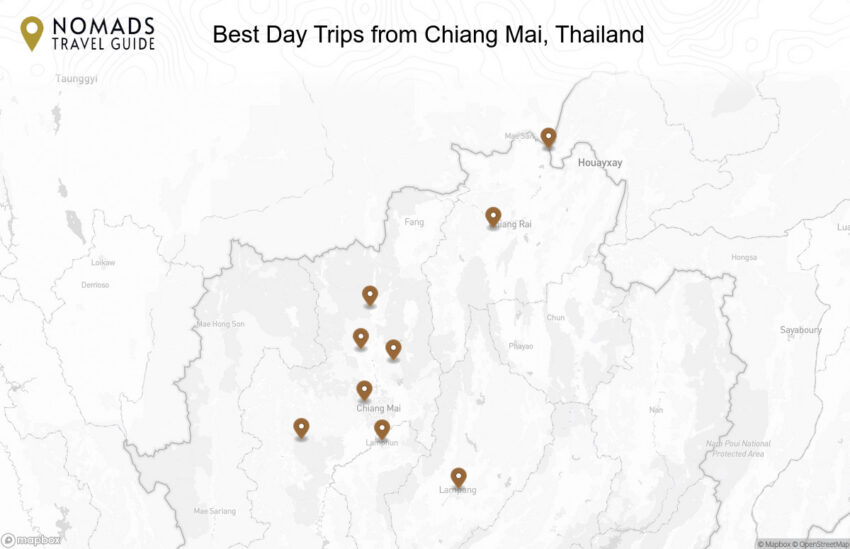
Map of the Best Museums in Chiang Mai, Thailand: Art, Culture & Hidden Gems walking route with 5 stops in Chiang Mai.
Preview map of the Best Museums in Chiang Mai, Thailand: Art, Culture & Hidden Gems route in Chiang Mai, showing 5 stops. Use the interactive map to zoom and tap markers.

More from this area

Self-Guided Walking Tour of Chiang Mai’s Temples (2026)

Self Guided Walking Tour of Chiang Mai

This website uses affiliate links which earn a small commission at no additional cost to you.

The streets and byways of Chiang Mai are alive with vibrant wonders waiting to be explored. From its dazzling temples and bustling markets to the tantalizing aromas of its world-renowned cuisine, this city has a charm that captivates every traveler. Some sights will make you laugh with delight, others may move you to tears, but all will leave an indelible impression on your heart and mind.

As you wander through the city, you'll encounter remnants of its storied past. The ancient walls and gates, built when Chiang Mai was founded, are more than just historical structures. They reflect the city's deep ties to traditional astrological and religious principles. Every aspect of their design-walls, gates, and protective moats-was intended to harmonize with the spiritual world, ensuring the guardianship of spirits and gods.

Join us as we set off on a walking tour of this enchanting city, where every step uncovers a story and every corner holds a surprise.

How to Get to Chiang Mai

By Plane: Chiang Mai International Airport (CNX) is located about 4 km west of the city center and serves both domestic and international flights. From the airport, you can reach downtown by taxi, shuttle bus, or rideshare in around 15-20 minutes. For the best deals and a seamless booking experience, check out these flights to Chiang Mai on Booking.com.

By Train: Chiang Mai is the northern terminus of the Thai railway system. Trains from Bangkok take 10-13 hours and offer sleeper options for comfort. Once you arrive at Chiang Mai Railway Station, the Old City is about a 10-15 minute ride by tuk-tuk, songthaew, or taxi. Train schedules and bookings can be found on Omio.

By Car or Bus: Chiang Mai is connected to other cities by good highways and a network of long-distance buses. If you're driving, keep in mind that much of the Old City is pedestrian-friendly, with limited parking. Public parking is available just outside the old walls, and the rest can easily be explored on foot.

Where to Stay in Chiang Mai

For a walking tour of Chiang Mai’s historic centre, staying within the Old City walls or just outside the gates gives you easy access to temples, cafés, and markets. A top luxury pick is Phra Singh Village, located near the famous Wat Phra Singh with elegant Lanna-style rooms and an inviting pool. For a boutique stay, Tamarind Village is a serene retreat with traditional design in the heart of the Old City. Budget travellers might enjoy Green Tiger House, an eco-friendly guesthouse with a friendly atmosphere and plant-based café. All three options put you just steps from Chiang Mai’s most walkable and fascinating attractions.

Guided or Self-Guided Walking Tour of the Temples of Chiang Mai

If you're spending a day in Chiang Mai and want to dive into its layered history and vibrant street life, consider joining this Chiang Mai Old City Walking Tour. This 3-hour guided tour offers a fantastic introduction to the city’s cultural heart, with visits to ancient temples like Wat Chedi Luang and Wat Phra Singh, plus stories of the Lanna Kingdom, local traditions, and the city’s transformation into Thailand’s northern capital of creativity.

Your Walking Tour of Chiang Mai’s Temples

This walking tour weaves through Chiang Mai's historic Old City, where centuries-old temples sit alongside leafy lanes, art galleries, and local food stalls. You'll pass through ancient city gates, visit the spiritual centres of Lanna Buddhism, and learn how Chiang Mai has grown from a fortified capital to a cultural hub. While the tour focuses on key highlights, you can choose to linger at your favourite sites or return later for deeper exploration-especially at temples that host evening chants or morning alms-giving rituals.

1. Wat Inthakhin Sadue Mueang

Chiang Mai   Wat Inthakin Sadue Muang
Chiang Mai Wat Inthakin Sadue Muang
CC BY-SA 3.0 / Stefan Fussan

Wat (Inthakhin) Sadeau Muang, also known as the Temple of the Navel of the City, is a small yet strikingly beautiful temple located in the courtyard near the Three Kings Monument in Chiang Mai. Constructed from dark teak wood with intricate gold accents, this temple exudes a serene charm that stands in contrast to its bustling surroundings. Historically significant, it was once the site of the city’s original pillar, or Inthakin, which symbolized spiritual protection and the well-being of the city. This sacred spot played a crucial role in King Mengrai’s decision to establish Chiang Mai here in the late 13th century. According to legend, the area was chosen after the king witnessed two white deer fearlessly fending off a pack of hunting dogs, a powerful omen suggesting divine approval for the site.

Today, Wat Sadeau Muang is a quiet sanctuary where visitors can appreciate its artistic craftsmanship and historical importance. The temple’s teak construction features intricate carvings and gilded embellishments that reflect the Lanna architectural style, evoking a sense of timeless elegance. Despite its modest size, it holds deep cultural significance as a spiritual anchor of the city’s founding. Visitors often come here to experience its tranquil atmosphere, reflect on its storied past, and pay respects to the sacred traditions that continue to resonate through Chiang Mai’s history.


Location: Wat Inthakhin Sadue Muang, Intrawarorot Road, Si Phum, Mueang Chiang Mai District, Chiang Mai, Thailand

Here is a complete selection of hotel options in Chiang Mai. Feel free to review each one and choose the stay that best suits your needs.

2. Wat Lam Chang

Wat Lam Chang
Wat Lam Chang
CC BY-SA 3.0 / Stefan Fussan

Wat Lam Chang, located in the heart of Chiang Mai, is one of the city’s lesser-known temples but offers a quiet and peaceful atmosphere that contrasts with the more tourist-heavy spots. The temple’s name, which translates to “Temple of the Elephant Stable,” refers to its history when it once housed royal elephants. Wat Lam Chang’s serene ambiance is complemented by a lovely garden setting, where visitors can enjoy the calming environment and the occasional sight of the temple’s resident monks. This is a place for those looking to escape the crowds and immerse themselves in a bit of local history and culture.

The temple complex features a traditional Lanna-style viharn (sermon hall), adorned with ornate teak wood carvings and golden embellishments. One of the main attractions is its chedi, a large, bell-shaped stupa that sits at the center of the temple grounds. The chedi is particularly notable for its unique design, which stands out from other temples in the area. The peaceful atmosphere and the historical significance of the temple, along with the scenic surroundings, make Wat Lam Chang a hidden gem for those exploring Chiang Mai’s spiritual sites.


Location: Wat Lam Chang, Moon Muang Road Lane 7, Si Phum, Mueang Chiang Mai District, Chiang Mai, Thailand | Hours: 6.00am to 6.00pm | Price: Free entry

Traveling to a country with a different currency? Avoid ATM transaction fees and pay in local currency with a Wise Card. Having used it for over 5 years, we've saved loads on fees!

3. Wat Chiang Man Complex

Wat Chiang Man
Wat Chiang Man
CC BY-SA 4.0 / Supanut Arunoprayote.

Wat Chiang Man, the oldest temple in Chiang Mai, was established shortly after the city’s founding in 1296. This historic site occupies the same grounds where King Mengrai built his palace when he relocated the Lanna Kingdom’s capital from Chiang Rai to Chiang Mai. Despite its somewhat understated appearance, the temple is rich in history and spiritual significance. It is home to two revered Buddha images: the marble Phra Sila and the crystal Phra Satang Man, both believed to be over 2,000 years old, drawing pilgrims and visitors alike to admire their ancient craftsmanship.

The temple complex is a prime example of Lanna architecture, reflecting the distinct style of the kingdom over which Chiang Mai once ruled. Among its highlights is the Sri Lankan-style Chang Lom Chedi, or “Chedi Surrounded by Elephants,” the oldest structure on the grounds. This pagoda, inspired by Pagan design, features 15 elephant statues at its base, symbolizing the sea of unformed matter, while the chedi above represents the cosmos. Though weathered, the elephant statues exude a timeless charm.

Inside the ordination hall, visitors will find the oldest intact Buddha statue in Chiang Mai, dating back to 1465. The hall’s interiors are adorned with stunning red-and-gold murals depicting the Buddha’s life, while the window shutters echo the same vibrant patterns. The spacious, garden-like grounds around the hall create a serene atmosphere, perfect for reflection. For those curious about Chiang Mai’s early days, nearby Wat Lam Chang offers an intriguing detour. This site, named “Shackled Elephants,” is where King Mengrai kept his white elephants while constructing the city.


Location: Wat Chiang Man, Ratchapakhinai Road, Si Phum, Mueang Chiang Mai District, Chiang Mai, Thailand

Click here to read our blog about Best Day Trips from Chiang Mai, Thailand (2026)

4. Wat Saen Muang Ma Luang

Chiang Mai   Wat Saen Mueang Ma Luang
Chiang Mai Wat Saen Mueang Ma Luang
CC BY-SA 3.0 / Stefan Fussan

Passing through the striking red gate of Wat Hua Kuang, also known as Wat Saen Muang Ma Luang, visitors are greeted with a delightful surprise. While the temple complex appears modest at first glance, it unfolds into a much larger area as you venture further in. The initial structures feature classic multi-tiered Lanna-style roofs, with the building on the left guarded by fierce white lions and the Ordination Hall on the right flanked by serpentine naga statues. Unlike many other temples in Chiang Mai, the Ordination Hall boasts a distinctive grey elephant statue rather than the traditional white royal elephants, complementing its golden lattice facade.

Continuing along the walkway between these two buildings, you’ll notice intricate red and white architectural details adorning the sides of the main structure. As you approach the rear courtyard, gold-painted accents become more prominent, culminating in the centerpiece of the complex—a large stone chedi mound. While Wat Hua Kuang might be overlooked by some, its unique details and serene atmosphere make it a worthwhile stop, especially for photography enthusiasts seeking to capture the charm of Chiang Mai’s temple art and design.


Location: Wat Saen Muang Ma Luang (Wat Hua Khuang), Prapokkloa Road, Si Phum, Mueang Chiang Mai District, Chiang Mai, Thailand

Click here to read our blog about Best Museums in Chiang Mai, Thailand 2026: Art, Culture & Hidden Gems

5. Wat Khuan Khama

Golden Horse Temple
Golden Horse Temple
CC BY-SA 2.0 / Coggleswort00

Wat Khuan Khama, also known as the Golden Horse Temple, is an unmistakable sight with its unique wall adorned by approximately 50 golden horse statues. These statues, varying in size, line the entire length of the temple’s perimeter and immediately catch the eye of passersby. Inside the temple grounds, visitors can find statues representing various animals associated with the Symbols of Everybody—similar to the zodiac animals of the Chinese calendar, such as the rat, ox, and snake. It’s worth noting that this temple should not be confused with the Golden Horse Monastery near Chiang Rai, which is known for training monks in Muay Thai for self-defense.


Location: Wat Khuan Khama 143 Sri Poom Rd Tambon Si Phum, Mueang Chiang Mai District Chiang Mai 50200 Thailand | Hours: 6.00am to 6.00pm | Price: Free entry

6. Wat Ratcha Monthian

Wat Ratcha Monthian, Chiang Mai
CC BY-SA 3.0 / Stefan Fussan

Wat Ratcha Monthian, situated on the south side of Chiang Mai’s historic moat, is a temple that immediately captures attention with its large, seated white Buddha overlooking the road. This serene figure, crafted in a Burmese-Shan style, is unlike the golden Buddhas typically seen in the region. The temple’s upper viharn, accessed by steep steps, is a marvel of ornate design, featuring intricate gold floral motifs and a roof adorned with naga and chofa accents. Inside, the red lacquer columns and marble flooring create a stately ambiance, drawing the eye to the principal Buddha image, whose crowned elegance and tranquil demeanor embody a unique blend of grace and spirituality.

The temple grounds are equally distinctive. The square, tiered chedi reflects Burmese architectural influences, with niches housing Buddha images on its upper levels, and a golden mini-chedi crowning the structure. Additional features like the black-painted statue of Rahu, the mythical deity responsible for eclipses, and golden-leafed luk nimit balls awaiting ritual burial, add layers of cultural and religious significance. Wat Ratcha Monthian is not just a place of worship but a testament to the blending of artistic styles and traditions, making it a fascinating and meaningful stop in Chiang Mai.


Location: Wat Ratcha Monthian, 238/40 Manee Nopparat Rd, Tambon Si Phum, Amphoe Mueang Chiang Mai, 50200, Thailand | Hours: 6.00am to 6.00pm | Price: Free entry

7. Wat Lok Moli

Wat Lok Moli
Wat Lok Moli
CC BY-SA 4.0 / กสิณธร ราชโอรส

Wat Lok Moli, dating back to the mid-1300s, stands out as one of Chiang Mai’s most beloved temples. Initially serving as a royal palace, the grounds were transformed by King Guna in 1397 to accommodate 10 monks from Burma, whom he invited to help spread Buddhism. The temple complex remained relatively unchanged until 1527 when King Phra Muang Kaew initiated the construction of the current buildings, starting with a large, three-tiered brick chedi followed by the Ordination Hall (ubosot).

After King Phra Muang Kaew’s assassination in 1545, his ashes were interred at the temple. His widow, Queen Wissuthidhevee, took over the rule of Chiang Mai, but in 1578, during the Burmese occupation, the temple remained largely undisturbed. The Queen was also buried at Wat Lok Moli in a grand ceremony. This period of Burmese influence lasted for 224 years but did not significantly alter the temple’s structure.


Location: Wat Lok Moli, Manee Nopparat Road, ตำบล ศรีภูมิ อำเภอ เมืองเชียงใหม่ Chiang Mai, Thailand

8. Hua Lin Corner

Chiang Mai City Wall Hua Lin Corner
CC BY-SA 3.0 / Hartmann Linge

The Hua-Lin Corner Wall Section offers a fascinating glimpse into Chiang Mai’s medieval defenses. This reconstructed section of the city’s ancient wall provides a great opportunity to walk along the top and admire its worn, weathered appearance, which gives it an aged look despite its more recent reconstruction. Originally built when Chiang Mai became the capital of the Lanna Kingdom in 1296, the city walls were fortified and moated over the centuries to protect the capital. However, much of the wall was dismantled during the Japanese occupation in World War II, with the bricks repurposed for other uses.

In the years following the war, from 1966 to 1969, the city of Chiang Mai embarked on a restoration project to rebuild the wall, using old photographs from 1899 as a reference to recreate its original appearance. One notable feature of this section is the curved outcrop at the corner, once home to a watchtower known as Hua-Lin Fort, which adds to the historical charm of the site


Location: Hua Lin Corner, Si Phum, Mueang Chiang Mai District, Chiang Mai, Thailand

9. Wat Prasat

Wat Prasat
Wat Prasat
CC BY-SA 4.0 / กสิณธร ราชโอรส

Wat Prasat is a small but historically rich temple located in Chiang Mai. This serene and lesser-known site is known for its beautiful, Lanna-style architecture, with a distinctive wooden viharn (sermon hall) and a large, elegantly designed chedi. The temple’s significance lies in its historical connection to the region’s early religious development, being one of the temples established in the 14th century during the reign of the Lanna kingdom. Wat Prasat is less frequented by tourists, which allows visitors to enjoy its tranquil setting and appreciate its peaceful atmosphere. The temple is also home to intricate wooden carvings, offering a glimpse into traditional craftsmanship.


Location: Wat Prasat, Intra Warorot Lane 3 Alley, Si Phum, Mueang Chiang Mai District, Chiang Mai, Thailand | Hours: 8:00 AM to 5:00 PM.

10. Wat Pha Bong

Chiang Mai   Wat Pha Bong
Chiang Mai Wat Pha Bong
CC BY-SA 3.0 / Stefan Fussan

Wat Pha Bong, also known as Wat Mank Kalaram, is a small yet enchanting temple in Chiang Mai, celebrated for its serene ambiance and unique offerings. One of its most distinctive features is the large gong in the temple’s courtyard, where visitors are encouraged to strike it three times, invoking “happiness, health, and peace.” Afterward, donations are often placed in a box by the cheerful shopkeeper nearby. Although the temple draws visitors with its charm, it remains modest in size, consisting mainly of a viharn (hall) and a chedi (stupa), along with the usual monk’s quarters and administrative structures. Its tranquil environment makes it a perfect spot for a brief but enriching visit.


Location: Wat Pha Bong (Mangkhalaram) 1/3 Singharat Rd Chiang Mai 50200 Thailand | Hours: 5.00am to 6.00pm | Price: Free entry

11. Wat Phra Singh

Wat Phra Sing Chiang Mai
CC BY-SA 4.0 / Supanut Arunoprayote.

Wat Phra Sing, one of Chiang Mai’s most famous temples, is home to over 600 monks and offers a rich blend of historical and architectural features. The complex includes the main Wihan Luang Sermon Hall (Viharn), which dates back to the 1300s (rebuilt in 1925) and houses the iconic Subdued Buddha Statue from 1477. Nearby, the Scripture Library (Ho Trai), built in the late 1400s, showcases Lanna-style architecture with a red roof and is elevated to protect its precious Buddhist texts. The Golden Pagoda (Chedi), originally constructed in 1345 by King Phayu to house his father’s ashes, stands as a central landmark of the temple, framed by the Ordination Hall (Ubosot) and the Gilded Sermon Hall (Lai Kham Viharn).

Inside the Lai Kham Sermon Hall, visitors can admire the famous Lion Buddha Statue, believed to be the holiest icon in Chiang Mai, which was brought here in 1367 from Bodhgaya, India. Despite its name, the statue resembles a traditional golden Buddha, though it once lost its head in 1922, replaced with a replica. The hall is adorned with beautiful murals depicting historical events. The temple also houses an Ordination Hall from 1806, a replica of the Emerald Buddha, and a reclining Golden Buddha Statue, symbolizing the Buddha’s transition into nirvana. As visitors exit the temple, they may encounter individuals offering to release birds for good luck, though it’s recommended to avoid participating, as it encourages the practice of trapping birds.


Location: Wat Phra Singh, Samlarn Road, Phra Sing, Mueang Chiang Mai District, Chiang Mai, Thailand | Hours: Daily 06.00-18.30 hrs | Price: Grounds are free, but the Main Sermon Hall is 50 Baht. | Website

12. Wat Tung Yu

Chiang Mai   Wat Tung Yu
Chiang Mai Wat Tung Yu
CC BY-SA 3.0 / Stefan Fussan

At Wat Tung Yu, visitors are greeted by a pavilion featuring life-sized wax monk figures holding bowls, which visitors can make offerings to—a practice that may seem a bit unusual. As part of the offering, the temple allows you to write your name on a wooden shingle, which is then used to re-shingle nearby temples. If you take a moment to look closely at the main Wihan, you can observe how these lacquered shingles fit together. The Wihan itself is beautifully adorned with naga (serpent) guardians and golden doors, providing an opportunity for a more personal and peaceful inspection since there are typically few tourists around.

Just past the main Wihan, you’ll find a striking statue grouping: a golden parasol stands at the center, flanked by a golden monk on the left and a silver monk on the right. The exact symbolism of the pairing is unclear, but the display is unique and visually appealing. This grouping is so captivating that it might make you overlook the meditating Buddha statue beside it. Behind these statues is a smaller golden Wihan building, again guarded by nagas, with a vibrant red and gold door featuring intricate carvings of heavenly dancers. The entire area offers a serene and less crowded environment for reflection and admiration of the temple’s stunning art and architecture.


Location: Wat Tung Yu, Rachadamnoen Road, Si Phum, Mueang Chiang Mai District, Chiang Mai, Thailand

13. Wat Chedi Luang

Wat Chedi Luang
Wat Chedi Luang
CC BY-SA 3.0 / Fumihiko Ueno

Wat Chedi Luang Temple is one of Chiang Mai’s most remarkable sites, offering a rich blend of history, art, and spiritual significance. The complex is anchored by the towering Great Stupa, which was originally constructed in 1391 by King Saen Muang Ma to house the ashes of his father, King Ku Na. Over the years, successive Thai Kings expanded the structure, adding silver-plated walls and a spire to hold the famous Emerald Buddha, which was moved here from Lampang in 1468. At its peak, the Stupa stood 275 feet tall and 184 feet wide, adorned with bronze plates and gold leaf. Unfortunately, an earthquake in 1545 severely damaged the Stupa, reducing its height to 197 feet and causing the spire to collapse. The Emerald Buddha was relocated to Laos in 1556 to protect it from invading Burmese forces, and it is now housed in the Grand Palace in Bangkok. Despite this, the Stupa remains the tallest structure in Chiang Mai’s Old City, a testament to the grandeur of its original design.

In addition to the Stupa, the Wat Chedi Luang complex features other fascinating elements. The entrance is marked by a stunning triangular facade on the Sermon Hall, which is gilded and adorned with peacock-like blue and green accents. Inside, the hall’s black columns are decorated with gold patterns, leading to the enormous Phra Chao Attarot Buddha statue. The surrounding grounds are equally captivating, with a massive Gum Tree said to bring good fortune to the city as long as it stands, and a White Chapel housing a log from the original City Pillar, believed to protect Chiang Mai from evil. The small chapel is adorned with vibrant murals and is a key stop during the Inthakin Festival in May. The Golden Shrine at the center contains a piece of the City Pillar, a symbol of the city’s founding by King Mengrai in 1296. Visitors are also encouraged to explore the green guardian statues near the gate for a full experience of the temple’s spiritual and historical depth.


Location: Wat Chedi Luang, Prapokkloa Road, Si Phum, Mueang Chiang Mai District, Chiang Mai, Thailand | Hours: The Grand Viharn Assembly Hall is open from 8.00am to 5.00pm. The temple’s general opening hours are from 5.00am to 10.30pm. | Price: Adult: 50THB

14. Wat Pan Tao

Wat Phan Tao
Wat Phan Tao
CC BY-SA 4.0 / กสิณธร ราชโอรส

Wat Pan Tao, established in the 1300s, was one of the four temples within the Royal Stupa Complex located nearby. Entering the temple, you walk through an intricately carved red sandstone archway along a dirt path, which leads past the large wooden Sermon Hall, small huts, colorful tung banner flags, a tulip pond, and even the monks’ outdoor laundry area. It’s not unusual to encounter chickens and other animals roaming the grounds, accompanied by the sounds of chanting and ringing bells. Historically, Wat Pan Tao earned the nickname “The Monastery of a Thousand Kilns” because it once served as a factory where monks crafted handmade Buddha statues for other temples.

The main attraction at Wat Pan Tao is the impressive teakwood Sermon Hall, relocated here in 1875 by King Inthawichayanon. This hall is one of the few remaining all-wood temple buildings in Chiang Mai and was originally part of the royal residence before being repurposed. As per Lanna tradition, each new king would build a new palace, often reusing the previous king’s structures. The deep, dark teak wood of the Sermon Hall beautifully contrasts with the golden peacock symbol above the entrance, representing the king. Inside, you can find a Dhamma Casket that holds ancient Buddhist scriptures written on dried palm leaves, a common method of recording texts in Asia before the invention of the printing press.


Location: Wat Phan tao Chiang Mai Thailand, Si Phum, Mueang Chiang Mai District, Chiang Mai, Thailand | Hours: 8.00am to 5.00pm | Price: Free entry
Powered by GetYourGuide
Moira & Andy
Moira & Andy

Hey! We're Moira & Andy. From hiking the Camino to trips around Europe in Bert our campervan — we've been traveling together since retirement in 2020!

Read our full story here

This website uses affiliate links which earn a small commission at no additional cost to you.

Walking Tour Summary

Distance: 5 km
Sites: 14

Walking Tour Map
Map of the Self-Guided Walking Tour of Chiang Mai’s Temples walking route with 14 stops in Chiang Mai.
Preview map of the Self-Guided Walking Tour of Chiang Mai’s Temples route in Chiang Mai, showing 14 stops. Use the interactive map to zoom and tap markers.

More from this area

13 Best Things to Do in Phnom Penh, Cambodia 2026: Temples, Markets & Culture

Unmissable Things to Do in Phnom Penh Cambodia

This website uses affiliate links which earn a small commission at no additional cost to you.

Phnom Penh is a city rich in both haunting history and vibrant culture, offering a diverse range of experiences for visitors. From uncovering the stories behind its beautiful temples to delving into the nation's poignant past, the capital has something to captivate every traveler. Here are some top places to experience in Phnom Penh.

1. Explore the Magnificent Royal Palace

Royal Palace of Cambodia
CC BY-SA 2.0 / Francisco Anzola

The Royal Palace of Cambodia, located in the heart of Phnom Penh, is a striking symbol of the nation’s heritage and the official residence of the King of Cambodia. Constructed in 1866 under King Norodom, the palace showcases traditional Khmer architecture with intricate details and golden roofs, blending seamlessly with French colonial influences. Within the palace grounds lies the Silver Pagoda, home to priceless cultural treasures, including the Emerald Buddha and a life-sized gold Buddha encrusted with diamonds. The meticulously landscaped gardens and ornate structures further enhance the regal ambiance of this historic site.

Visitors to the Royal Palace can explore the Throne Hall, where official ceremonies and royal audiences take place, and admire its elaborate gilded interior and murals. The Silver Pagoda, with its gleaming silver-tiled floor, offers a glimpse into Cambodia’s rich spiritual traditions. While some areas of the palace remain closed to the public as they serve as the king’s residence, the accessible sections provide a unique opportunity to appreciate Cambodia’s royal history and architectural splendor. The palace is best visited in the morning to avoid the heat and crowds, and modest attire is required for entry.


Location: Royal Palace, Samdach Sothearos Boulevard (3), Phnom Penh, Cambodia | Hours: 8–10:30am & 2–5pm daily | Price: Adults: $10.00 | Website

Here is a complete selection of hotel options in Phnom Penh. Feel free to review each one and choose the stay that best suits your needs.

Powered by GetYourGuide

2. Pay Your Respects at the Killing Fields of Choeung Ek

Choeung Ek Killing Fields
Public Domain / Adam Carr

The Killing Fields of Choeung Ek, located about 17 kilometers south of Phnom Penh, stand as a chilling reminder of Cambodia’s tragic past under the Khmer Rouge regime. This site was one of many execution and burial grounds where thousands of men, women, and children were killed between 1975 and 1979. Over 8,000 skulls and human remains, unearthed from mass graves, are displayed in a Buddhist stupa, providing a stark and sobering insight into the horrors of the Cambodian genocide. The peaceful atmosphere of the site today contrasts sharply with the atrocities once committed there.

Visitors to Choeung Ek can walk through the grounds, where remnants of mass graves are visible, and listen to an audio guide recounting survivor testimonies and historical details. The stupa, filled with skulls and bones, stands as a somber memorial to the victims. Despite its grim history, the site offers a chance for reflection and serves as a powerful tribute to those who lost their lives, reminding visitors of the resilience of the Cambodian people and the importance of remembering such atrocities to prevent them in the future.


Location: Choeung Ek Killing Fields, Phnom Penh, Cambodia | Hours: Daily 7:30 to 17:30 | Price: Adults: $6.00 – including the audio guide

Traveling to a country with a different currency? Avoid ATM transaction fees and pay in local currency with a Wise Card. Having used it for over 5 years, we've saved loads on fees!

Powered by GetYourGuide

3. Uncover History at Tuol Sleng Genocide Museum

Tuol Sleng Genocide Museum
CC BY-SA 3.0 / Michael Gruijters

Tuol Sleng Genocide Museum, also known as S-21, is one of the most harrowing reminders of Cambodia’s Khmer Rouge era. Located in Phnom Penh, this former high school was transformed into a detention and interrogation center between 1975 and 1979. Over 17,000 prisoners passed through its gates, many of whom were tortured before being sent to the Killing Fields of Choeung Ek for execution. Today, the site stands as a museum preserving the memory of the victims and documenting the atrocities committed during this dark period.

Visitors to Tuol Sleng can explore the haunting classrooms-turned-prison cells and view exhibits of chilling photographs, prisoner records, and torture instruments. The walls display haunting black-and-white portraits of the detainees, including men, women, and children, offering a stark glimpse into their final days. Guides and audio tours provide detailed narratives of the Khmer Rouge’s policies and the stories of survivors, making Tuol Sleng not just a place of mourning but also a powerful educational experience. It is a sobering yet essential stop for those seeking to understand Cambodia’s tragic past.


Location: Tuol Sleng Genocide Museum St.113, Boeung Keng Kang III, Boeung Keng Kang Phnom Penh, Cambodia | Hours: Every day from 8:00am – 5:00pm | Price: Adults: $5.00, Audio guide: +$5.00 | Website

Click here to read our blog about 10 Best Places to Visit in Cambodia (2026)

Powered by GetYourGuide

4. Stroll Along the Sisowath Quay

Sisowath Quay, Phnom Penh

Sisowath Quay, also known as Riverside, is a bustling promenade in the heart of Phnom Penh that stretches along the eastern bank of the Tonle Sap River. This vibrant boulevard serves as a central hub for cultural, social, and culinary activities, making it a must-visit destination for locals and tourists alike. Named after King Sisowath, the area is steeped in history and offers scenic views of the river, with palm-lined walkways and a lively atmosphere. Visitors can explore iconic landmarks nearby, such as the Royal Palace, Silver Pagoda, and the National Museum of Cambodia, or simply enjoy a leisurely stroll while taking in the riverside charm.

Beyond its cultural appeal, Sisowath Quay is renowned for its dynamic dining and entertainment scene. The boulevard is home to an array of riverside cafes, bars, and restaurants serving both traditional Khmer cuisine and international dishes. As the sun sets, the area comes alive with vibrant nightlife and stunning views of the Tonle Sap River bathed in golden hues. Whether you’re shopping for local handicrafts at nearby markets, enjoying live music, or savoring the fresh river breeze, Sisowath Quay offers an unforgettable experience that captures the spirit of Phnom Penh.


Location: Sisowath Quay, Phnom Penh, Cambodia | Hours: The promenade is accessible at all hours | Price: There is no fee to walk along Sisowath Quay

Click here to read our blog about Travelling from Phnom Penh to Siem Reap 2026: Best Ways to Get There

Powered by GetYourGuide

5. Visit the Iconic Wat Phnom Temple

Phnom Penh Wat Phnom
CC BY-SA 4.0 / Marcin Konsek

Wat Phnom, perched atop a 27-meter hill in the heart of Phnom Penh, is one of the city’s most iconic landmarks and a symbol of its origin story. Built in 1372, this revered Buddhist temple is said to mark the spot where Lady Penh discovered sacred statues of the Buddha in the Mekong River, giving the Cambodian capital its name. Surrounded by lush greenery, the temple is a serene escape from the bustling city below, attracting both worshippers and visitors who come to pray, make offerings, or simply enjoy the peaceful ambiance. With its beautifully restored architecture, vibrant murals, and spiritual significance, Wat Phnom offers a fascinating glimpse into Cambodia’s history and culture.


Location: Wat Phnom, ផ្លូវវត្តភ្នំ, Phnom Penh, Cambodia | Hours: Usually open daily during daylight hours | Price: Foreign visitors pay a small entrance fee

6. Meditate at the Tranquil Wat Langka

Phnom PenhWat Langka
CC BY-SA 4.0 / Marcin Konsek

Wat Langka, one of Phnom Penh’s oldest pagodas, was founded in 1442 as a sanctuary and library of Buddhist scriptures, serving as a meeting point for Cambodian and Sri Lankan monks. Located near Independence Monument, this vibrant temple is notable for its well-preserved stupas and tranquil ambiance, offering a spiritual retreat amid the city’s hustle. Visitors are welcome to explore its intricate architecture, admire the colorful murals, or join free English-speaking meditation sessions held every Sunday morning. Wat Langka remains a significant site for Buddhist practice and a peaceful spot for cultural exploration in the Cambodian capital.


Location: Wat Langka, Samdach Louis Em, Phnom Penh, Cambodia | Hours: Daily from 6 am to 7 pm | Price: Entry is free, though small donations in the boxes around the temple are appreciated.

7. Discover Buddhism at Wat Ounalom

Wat Ounalom
Wat Ounalom
CC BY-SA 3.0 / VCTBR

Wat Ounalom, situated near Phnom Penh’s bustling Riverside, is the spiritual heart of Cambodian Buddhism and one of the city’s oldest and most significant pagodas. Founded in 1443, it originally housed over 500 monks and a vast library of Buddhist scriptures, most of which were tragically destroyed during the Khmer Rouge era. Remarkably, the shrine’s most sacred relic, an eyebrow hair of the Buddha, survived and continues to draw visitors from around the world. With its serene courtyards, ornate stupas, and historical significance, Wat Ounalom offers an insightful glimpse into Cambodia’s religious traditions and cultural heritage.


Location: Wat Ounalom Monastery, Preah Ang Eng St. (13), Phnom Penh, Cambodia | Hours: Daily from 6 am to 6 pm | Price: Entrance is free, though donations placed in marked boxes are appreciated and help support the temple.

8. Shop for Souvenirs at the Russian Market

Russian Market Phsar Toul Tum Poung
CC BY-SA 2.0 / Phnom Penh

The Russian Market (Phsar Toul Tum Poung) is a must-visit destination in Phnom Penh, offering a vibrant and authentic shopping experience. Renowned for its eclectic mix of goods, it’s the perfect spot to hunt for souvenirs, from handcrafted Cambodian silk and intricate wood carvings to affordable clothing, jewelry, and unique antiques. Food enthusiasts will delight in the market’s bustling food stalls, serving local delicacies like Khmer noodles and fresh tropical fruits. Its lively atmosphere, combined with the opportunity to interact with local vendors and explore the city’s craftsmanship, makes the Russian Market an unforgettable cultural and shopping experience.


Location: Russian Market Corner of St. 163 St 440 Phnom Penh 12310, Cambodia | Hours: Typically open daily from early morning until late afternoon or early evening, with some stalls opening or closing at different times. | Price: There is no entrance fee to visit the Russian Market; you only pay for your purchases and any food or drinks.
Powered by GetYourGuide

9. Take a Scenic Ferry Ride to Koh Dach

Phnom Penh Silk Island
CC BY-SA 2.0 / Kent Kruhoeffer

A little outside the city up the Mekong River, you’ll find Koh Dach, or Silk Island, a serene retreat from the bustle of Phnom Penh. From the ferry, you can cycle through the lush, peaceful island, passing by traditional stilted houses, vegetable farms, and fruit orchards. Along the way, visit some of the finest silk weaving workshops in Southeast Asia, where skilled artisans demonstrate the intricate process of creating stunning silk fabrics. You can even try weaving yourself or purchase high-quality silk products directly from the weavers. As the day warms, enjoy the tranquil ambiance before heading back to the boat, taking in the scenic river views on your return.


Location: Silk Island JWRQ+38H Phnom Penh Cambodia | Hours: Accessible year-round during daylight hours | Price: There is no entrance fee for the island itself. | Website
Powered by GetYourGuide

10. Visit Tonle Bati and Ta Prohm Temple

Ta Prohm Tonle Bati
Ta Prohm Tonle Bati
CC BY-SA 3.0 / Stefan Fussan

Take a day trip to Tonle Bati, a serene lakeside destination south of Phnom Penh, where you can explore the historic Ta Prohm Temple. Not to be confused with the jungle temple in Siem Reap, this smaller Angkorian temple was built in the 12th century under King Jayavarman VII and showcases the intricate Bayon-style architecture. Wander through its beautifully preserved sanctuaries, admire the bas-reliefs depicting Hindu myths, and marvel at the ancient carvings, including a reclining Buddha above the temple’s main entrance.

Tonle Bati offers more than just history—its tranquil setting is perfect for a picnic or relaxing by the water. Nearby, you can visit Yeay Peau Temple, a smaller but equally historic site, and enjoy the peaceful surroundings of this rural escape. Whether you’re a history enthusiast or just looking for a quiet retreat from the city, Tonle Bati and Ta Prohm Temple make for an enriching and scenic excursion.


Location: Tonle Bati, Cambodia | Hours: The temple and lake area are generally accessible during daylight hours. | Price: Adults: $35 | Website
Powered by GetYourGuide

11. Admire the Independence Monument

Phnom Penh Independance Monument

The Independence Monument is a striking lotus-shaped structure in the heart of Phnom Penh, built in 1958 to commemorate Cambodia’s independence from France. Designed by renowned Cambodian architect Vann Molyvann, it blends traditional Khmer architectural elements with modernist flair. Located at the intersection of Norodom and Sihanouk Boulevards, the monument serves as a center for national celebrations and a symbol of freedom. Visit at night to see it illuminated, adding to its grandeur.


Location: Independence Monument, 41, Phnom Penh, Cambodia | Hours: The monument and park can be viewed at any time from the surrounding pavements. | Price: There is no fee to view the monument and surrounding park

12. Shop at Central Market

Phnom Penh Central Market Phsar Thmey
CC BY-SA 3.0 / Olaf Tausch

Central Market, or Phsar Thmey, is a must-visit for shopping enthusiasts and culture seekers alike. Housed in an art deco-style building constructed in 1937, this bustling market offers everything from souvenirs and local crafts to jewelry, clothing, and fresh produce. Its iconic yellow dome and vibrant atmosphere make it a landmark of Phnom Penh. Whether you’re hunting for bargains or soaking in the local vibe, Central Market promises a dynamic experience.


Location: Central Market, Central Market, Phsar Thmei, Street 51, Phnom Penh, Cambodia | Hours: Daily from 7 am to 6 pm | Price: Free

13. Explore the History of Oudong

Oudong
Oudong

Venture outside Phnom Penh to Oudong, Cambodia’s former royal capital located atop a series of hills about 40 kilometers northwest of the city. Once a thriving center of power, it is now a tranquil site with ancient stupas, offering panoramic views of the countryside. Climb the steps to pay homage at religious shrines and explore historic stupas containing the remains of Cambodian kings. The peaceful ambiance and spiritual significance of Oudong make it a fascinating day trip.


Location: Oudong, Cambodia | Hours: Accessible during daylight hours | Price: There is usually no formal ticket, but small donations for the pagodas and upkeep are appreciated.
Powered by GetYourGuide
Moira & Andy
Moira & Andy

Hey! We're Moira & Andy. From hiking the Camino to trips around Europe in Bert our campervan — we've been traveling together since retirement in 2020!

Read our full story here

This website uses affiliate links which earn a small commission at no additional cost to you.

Walking Tour Map

Map of the 13 Best Things to Do in Phnom Penh, Cambodia: Temples, Markets & Culture walking route with 13 stops in Phnom Penh.
Preview map of the 13 Best Things to Do in Phnom Penh, Cambodia: Temples, Markets & Culture route in Phnom Penh, showing 13 stops. Use the interactive map to zoom and tap markers.
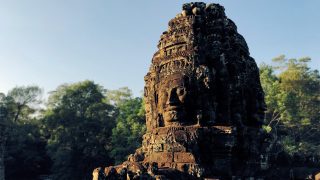
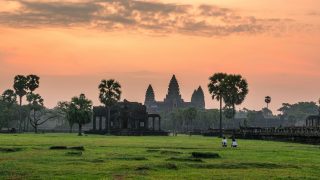
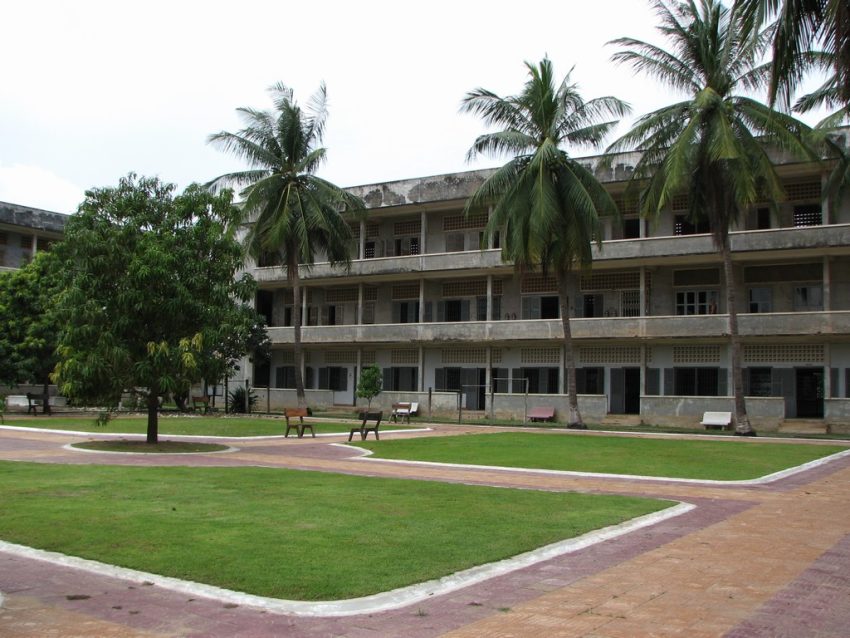
More from this area