Angkor Thom, Siem Reap
Buddhist Temple in Siem Reap
Angkor Thom is a large, walled historic city within the Angkor Archaeological Park near Siem Reap, Cambodia. Built in the late 12th century under King Jayavarman VII, it became the final and longest-lasting capital of the Khmer Empire and covers roughly 9 square kilometers. Today, visiting Angkor Thom feels like moving through a planned royal city: broad causeways over a moat, five monumental gates, and a dense cluster of temples and terraces inside the walls.
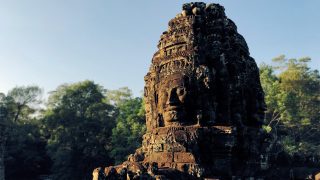
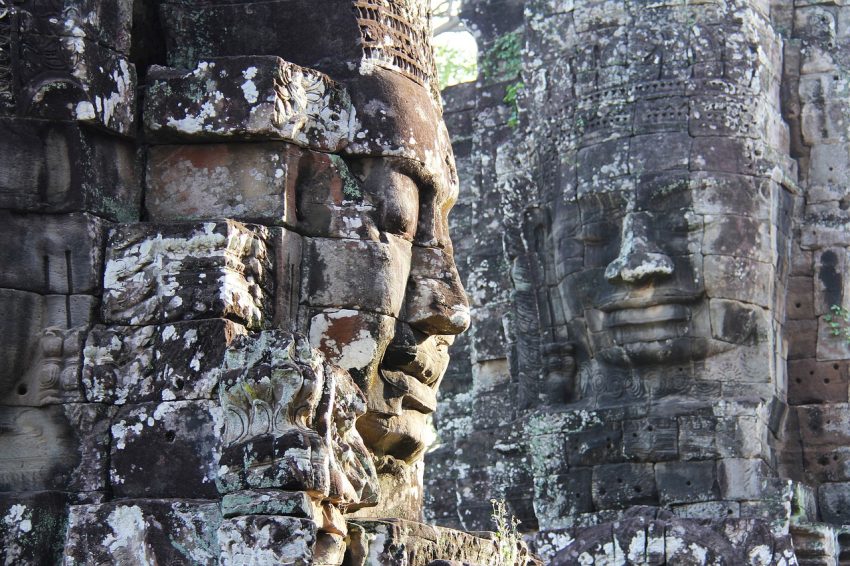
What stands out most is the Bayon at the center, along with the city’s distinctive Bayon-style architecture, including laterite construction and face-towers at the gates. It suits travelers who want more than a single temple stop and prefer exploring a complex with multiple major sites close together, from earlier temples incorporated into the royal area to long terraces that were part of the ceremonial heart of the city.
History and Significance of the Angkor Thom
From Yasodharapura to a new royal city
Angkor Thom was not the first Khmer capital in this area. An earlier city, Yasodharapura, had developed nearby about three centuries earlier, and parts of Angkor Thom were later built over it. Because the boundaries between the two were not sharply defined, older monuments remained embedded in the later urban plan.
Jayavarman VII and the Bayon-centered capital
In the late 12th century, King Jayavarman VII founded Angkor Thom as a new capital and shaped it around the Bayon Temple at its center. The city's scale and planning reflect a long-lasting seat of power, with major structures from Jayavarman's reign alongside earlier temples such as Baphuon and Phimeanakas, which were integrated into the Royal Palace area.
Later phases, decline, and abandonment
The name “Angkor Thom,” meaning “Great City,” began to be used around the 16th century. The last known temple built in the city was Mangalartha, completed in 1295; after that, existing buildings were modified but no new stone monuments were added. Following an attack by the Ayutthaya Kingdom under King Borommarachathirat II, the city was captured and later abandoned as the Khmer capital shifted to Phnom Penh, and by the early 1600s visitors described it as deserted.
Things to See and Do in the Angkor Thom
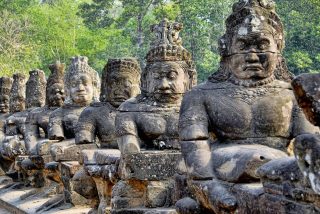
I'd start with the South Gate approach and take time to look up at the face-towers and along the causeway, where rows of giants hold nagas (serpent deities). From there, I'd head straight to the Bayon, since its central location makes it easy to orient yourself before branching out to other stops. The Bayon's grand scale and distinctive style are the clearest “you're in Angkor Thom” moment.
After the Bayon, I like slowing down around the Royal Palace area to connect the layers of the site, especially where earlier temples such as Baphuon and Phimeanakas sit within the later city. If you have the energy, the long terraces (including the Terrace of the Elephants and the Terrace of the Leper King) add a different feel from temple interiors: more open, processional, and easier to appreciate at a walking pace.
How to Get to the Angkor Thom
The nearest airport is Siem Reap-Angkor International Airport (SAI), from which you can continue by road to Siem Reap and onward to Angkor Archaeological Park. For the best deals and a seamless booking experience, check out these flights to Siem Reap on Booking.com.
Siem Reap does not have a central passenger rail service for straightforward tourist arrivals, so most travelers reach the city by road rather than train. Train schedules and bookings can be found on Omio.
By car or tuk-tuk from Siem Reap, Angkor Thom is a short drive into the Angkor Archaeological Park, with access via its major gates and roadside drop-off areas near key sites.
Is the Angkor Thom Worth Visiting?
Angkor Thom is worth prioritizing if you want a concentrated look at Khmer imperial city planning and you're keen to see the Bayon alongside gates, terraces, and multiple temples in one connected area. It's best for travelers who enjoy walking and exploring several stops in sequence rather than “one temple and done.” It's less essential if you're very short on time and only plan to see a single headline site in the park, or if heat and uneven paths make extended walking difficult-then treat it as optional and focus on one or two highlights rather than trying to cover the whole walled city.
What Other Travellers Say...
Angkor Thum is a locality in Cambodia identified by its name and location; visitors can find it at Angkor Thum with coordinates approximately 13.48404 N, 103.8738031 E.




Practical Tips on Visiting the Angkor Thom
- Best time to visit: Go earlier in the day for cooler temperatures and calmer paths around the gates and central temples.
- How long to spend: Plan around 3 hours for the main highlights, and add more time if you want to explore additional temples and terraces at a slower pace.
- Accessibility: Expect uneven ground and steps at many structures; moving between sites involves a fair amount of walking within the walled area.
- Facilities: Basic visitor facilities and food stalls are commonly found near major stopping points such as the Terrace of the Elephants.
Where to Stay Close to the Angkor Thom
Base yourself along Charles de Gaulle Boulevard (between central Siem Reap and the Angkor Archaeological Park) for the easiest access to Angkor Thom while still being close to town services.
These hotels sit in the most convenient corridor for early temple starts and straightforward transfers into Siem Reap. Raffles Grand Hotel d'Angkor works well for good choice if you want a direct, quick run to the Angkor Park entrance while staying in a quieter, leafy part of town. Sofitel Angkor Phokeethra Golf & Spa Resort works well for works well for travellers prioritizing easy vehicle access and a calmer base between the temples and the city. Angkor Village Hotel works well for best if you want to be closer to riverside dining and town amenities while still keeping temple transport simple by tuk-tuk or car.
FAQs for Visiting the Angkor Thom
Getting There
Tickets & Entry
Visiting Experience
Tours, Context & Itineraries
Photography
Accessibility & Facilities
Food & Breaks Nearby
Safety & Timing
The Angkor Thom appears in our Complete Guide to Visiting Siem Reap!

Moira & Andy
Hey! We're Moira & Andy. From hiking the Camino to trips around Europe in Bert our campervan — we've been traveling together since retirement in 2020!
This website uses affiliate links which may earn a commission at no additional cost to you!
Nearby Attractions
- Prasat Bayon (0.5) km
Buddhist Temple - Bayon Temple (0.5) km
Buddhist Temple - Baphuon (0.8) km
Buddhist Temple - Prasat Suor Prat (0.9) km
Tower - Terrace of the Elephants (1) km
Historic Site - Phimeanakas (1) km
Buddhist Temple - South Gate of Angkor Thom (1.1) km
City Gate - Terrace of the Leper King (1.2) km
Historic Site - Preah Palilay (1.4) km
Buddhist Temple - Phnom Bakheng (1.5) km
Buddhist Temple