Sambor Prei Kuk
Buddhist Temple near Siem Reap

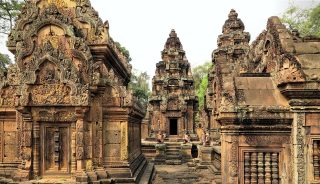
Sambor Prei Kuk is a vast archaeological site of pre-Angkorian temples and ancient urban remains in Cambodia, often visited as a long day trip from the Siem Reap area. Spread across roughly 13 square kilometers, it includes 141 recorded temple sites, three main temple clusters, and traces of a planned settlement with moats, basins, and other waterworks.
In its 6th-7th century peak it was known as Ishanapura, capital of the Chenla Kingdom, and it was inscribed as a UNESCO World Heritage Site in 2017. On the ground, what stands out is the atmosphere of brick towers among trees, the variety between temple groups, and the feeling of space compared with more crowded headline sites. It suits visitors who enjoy walking or cycling between ruins, want context for Khmer art before Angkor, and don’t mind covering several kilometers to see the highlights.
Table of Contents
History and Significance of the Sambor Prei Kuk
From Funan to Chenla
Sambor Prei Kuk rose to prominence after the earlier Funan period (1st to early 6th century), during the era when the Chenla Kingdom consolidated power in mainland Southeast Asia. In its prime, the city was known as Ishanapura and functioned as a political and religious center.
Ishanapura: a capital landscape
The site is more than a handful of temples: it combines sanctuary clusters with a large habitation zone and engineered water features. To the east of the main temples, an ancient urban area of about 4 square kilometers is bounded by moats and includes remains of basins and shrines, underlining the scale of the settlement.
UNESCO recognition
Sambor Prei Kuk is recognized for well-preserved brick temples and distinctive pre-Angkorian art and architecture. Its UNESCO World Heritage listing in 2017 reflects the site's value in understanding early Khmer religious building traditions and city planning.
Things to See and Do in the Sambor Prei Kuk
I focus first on the three main temple clusters-Prasat Sambor, Prasat Tao, and Prasat Yeay Poan-because they give you the clearest sense of the site’s variety and layout. The distances are part of the experience: the trails between major groups run about 6-7 km, so I’d plan to explore with a bicycle, motorbike, or car rather than on foot alone.
After the main clusters, I like to detour to smaller satellite zones for a quieter feel, including Robang Romeas and Srei Krup Leak (about 2 km northwest) and Prasat Tamon (around 1.5 km west). If you want a change of pace from the ruins, nearby pagodas such as Wat Mohar, Wat Cheay Sampov, and Wat Sambor add living religious sites to the day; Wat Sambor is noted for its traditional vihara, ornate sema stones, and remnants linked to older Buddhist relics.
How to Get to the Sambor Prei Kuk
The nearest major airports for most travelers are Siem Reap and Phnom Penh, and Sambor Prei Kuk is commonly reached overland via Kampong Thom. For the best deals and a seamless booking experience, check out these flights to Siem Reap on Booking.com.
Train travel isn’t a practical way to reach the site directly, so plan on road transport for the final approach from your base. Train schedules and bookings can be found on Omio.
By car or scooter, access is straightforward via the RN6 corridor (Siem Reap-Phnom Penh) with a turn toward the site; roads are described as well maintained, with dirt tracks inside the complex.
Is the Sambor Prei Kuk Worth Visiting?
Yes-Sambor Prei Kuk is worth visiting if you're interested in pre-Angkorian architecture, want a spacious archaeological landscape, and are happy to spend time moving between temple groups rather than seeing one compact monument. It's less essential if your Siem Reap trip is short and you're prioritizing Angkor's headline temples, or if you prefer attractions with minimal walking and simple logistics; in that case, treat it as optional or plan it only if you can commit to a full day with transport.
What Other Travellers Say...
Prasat Sambor Prei Kuk is a UNESCO World Heritage complex of roughly 100–150 pre-Angkorian Hindu temples hidden in forested countryside near Prasat Sambouru200b District, offering a peaceful, less crowded alternative to larger sites; visitors describe cycling through extensive ruins, encountering shy monkeys, and enjoying calm roads and guided tours, with local guides available and homestays in nearby villages welcoming overnight guests (note: foreigners need to buy a ticket).


Practical Tips on Visiting the Sambor Prei Kuk
- Best time to visit: Aim for an early start so you can cover the longer distances between temple clusters before the day gets too hot.
- How long to spend: Plan several hours on-site; the main groups are spread out and the trails between them total roughly 6-7 km.
- Accessibility: Expect uneven ground and dirt tracks within the complex; a vehicle or bike helps reduce walking between clusters.
- Facilities: Tickets are sold at the entrance (listed at $10) and hours are given as 7:30 AM-5:30 PM; there are clean restrooms near the main cluster and small stalls near entry/parking for drinks and snacks.
Where to Stay Close to the Sambor Prei Kuk
Base yourself in Kampong Thom (Stueng Saen) near National Road 6 for the most practical access to Sambor Prei Kuk while still having restaurants and transport options nearby.
These Kampong Thom hotels make convenient bases for day trips to Sambor Prei Kuk. Sambor Village Hotel works well for a central in-town base that keeps dining and everyday services close, making it easy to organize onward transport and early starts. Glorious Hotel & Spa works well for good for drivers and travellers prioritizing quick highway access and straightforward parking for day trips to the temples. Kampong Thom Palace Hotel works well for a practical option if you want a simple city base with easy access to local transport and services for arranging a temple visit.
FAQs for Visiting the Sambor Prei Kuk
Getting There
Tickets & Entry
Visiting Experience
Tours, Context & Itineraries
Photography
Accessibility & Facilities
Food & Breaks Nearby
Safety & Timing
The Sambor Prei Kuk appears in our Complete Guide to Visiting Siem Reap!

Moira & Andy
Hey! We're Moira & Andy. From hiking the Camino to trips around Europe in Bert our campervan — we've been traveling together since retirement in 2020!
This website uses affiliate links which may earn a commission at no additional cost to you!
Planning Your Visit
7.30 am to 5.30 pm
USD 10
Nearby Attractions
- Tonlé Sap Lake (107.4) km
Lake - Beng Mealea (110.5) km
Buddhist Temple - Koh Ker Pyramid Temple (115.3) km
Buddhist Temple - Oudong (121.9) km
Town - Bakong Temple (126.8) km
Buddhist Temple - Phnom Bok (132.5) km
Buddhist Temple - Pre Rup Temple (136.8) km
Buddhist Temple - Pre Rup Temple (136.8) km
Hindu Temple - Mekong Island (137.3) km
Island - East Mebon Temple (137.4) km
Buddhist Temple