Choeung Ek, Killing Fields
Historic Site in Phnom Penh
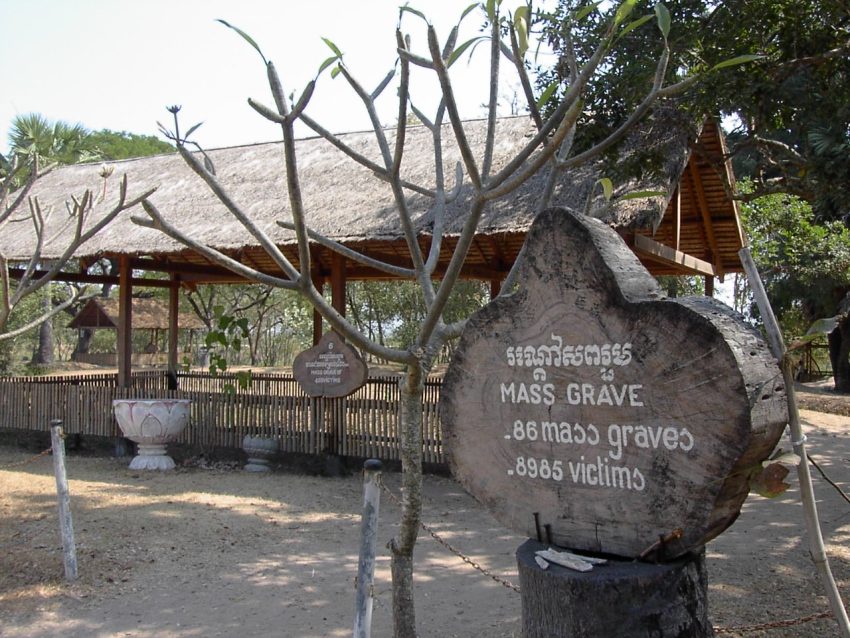
Choeung Ek, a former orchard and Chinese cemetery around 17 kilometres south of Phnom Penh, is now the country's most well-known Killing Field and national memorial to the victims of the Khmer Rouge. Linked directly to the Tuol Sleng (S-21) prison in the capital, it is believed that thousands of prisoners were transported here at night, executed - often with crude, blunt tools to save bullets - and buried in mass graves. Walking among the shallow depressions, now covered with grass and trees, is a sobering experience that gives emotional weight to the history you may have already read about.
Today, Choeung Ek is dominated by a striking Buddhist stupa filled with more than 5,000 human skulls, many showing evidence of the brutal methods used to kill. Paths wind past former mass grave sites, explanatory panels and small shrines, while an audio guide or local guide helps you understand what happened here between 1975 and 1979, when around a quarter of Cambodia's population died under the Khmer Rouge regime. It is not an easy visit, but for many travellers it is one of the most important things to do in Phnom Penh to truly grasp the country's recent past.
History and Significance of Choeung Ek
Between 1975 and 1979, the Khmer Rouge transformed Cambodia into a closed, agrarian dictatorship, systematically eliminating perceived enemies of the regime: educated people, former officials, religious figures and anyone suspected of disloyalty. Across the country, more than 300 execution grounds later became known collectively as the Killing Fields, where over a million people were murdered and buried in mass graves. Choeung Ek is the most famous of these sites because it has been carefully preserved and opened as a memorial and educational centre close to the capital.
Prisoners were typically detained and tortured at Tuol Sleng (S-21), a former school turned interrogation centre in Phnom Penh, before being transported to Choeung Ek under cover of darkness. Here, they were executed and buried in pits dug into what had once been an orchard and burial ground. After the fall of the Khmer Rouge, excavations at Choeung Ek uncovered approximately 8,895 bodies, and human remains and fragments of clothing are still occasionally brought to the surface by rain.
The site's central stupa, with acrylic panels revealing stacked skulls and bones, serves both as a memorial and a stark visual reminder of the scale of the atrocities. Today, Choeung Ek functions as a place of mourning, reflection and learning, where Cambodians and visitors alike come to honour the victims and to ensure that the events of the genocide are not forgotten. For travellers, visiting here alongside Tuol Sleng can be deeply confronting but is also a powerful act of bearing witness.
Things to See and Do in Choeung Ek
Most visits begin at the entrance pavilion, where you can purchase tickets and, in many cases, an audio guide. The audio commentary is highly recommended: it leads you around the site, combining survivor testimony, historical context and moments of silence to help you process what you are seeing. Unlike a typical “attraction,” Choeung Ek is quiet and understated; there are no large exhibits, just signs, paths and a few simple structures set within a peaceful, almost ordinary landscape.
As you follow the path, you will pass a series of marked mass graves, some of which once contained hundreds of bodies. Simple wooden or stone markers explain their significance, including areas where victims’ clothing and bones still occasionally surface. One of the most haunting stops is the so-called “Killing Tree,” believed to have been used in some of the most brutal murders; today it is covered in bracelets and offerings left by visitors in remembrance.
The culmination of your visit is the memorial stupa. Removing your shoes before entering, you can step inside to view the skulls and bones arranged on multiple levels. Many skulls show fractures and damage that correspond with the methods of execution described on the audio guide. It is a deeply affecting space, and most visitors spend a few quiet minutes here in reflection. After leaving the stupa, it is worth taking time to sit on a bench or under a tree and process what you have experienced before heading back to Phnom Penh. This spot is one of the best places to see in Choeung Ek if you want to understand how an apparently ordinary landscape can hold such extraordinary pain and memory.
How to Get to Choeung Ek
Most international travellers arrive in Cambodia via Phnom Penh International Airport before heading into the capital and arranging a day trip to Choeung Ek from there. For the best deals and a seamless booking experience, check out these flights to Phnom Penh on Booking.com.
There is no direct train service to Choeung Ek itself, and Cambodia's rail network is limited, so in practice visitors reach Phnom Penh by bus, minivan or occasional train services from other cities and then continue by road to the Killing Fields.Train schedules and bookings can be found on Omio. From central Phnom Penh, Choeung Ek is roughly 16-17 kilometres to the south; the most common options are hiring a tuk-tuk or taxi, or booking a half-day tour that combines Choeung Ek with Tuol Sleng, including hotel pick-up and drop-off.
If you are travelling by car, follow the main southern routes out of Phnom Penh towards Dangkao district; the site is well known locally, so drivers usually have no difficulty finding it, and you can arrange a round-trip fare with waiting time included in the price. There are also local bus routes and BRT lines serving the general area south of the city, but they are less convenient for first-time visitors than a direct tuk-tuk or organised tour.
Practical Tips on Visiting Choeung Ek
- Suggested tips: Approach Choeung Ek as you would a cemetery or place of worship: move slowly, speak quietly and give yourself time afterwards to decompress, ideally somewhere calm like the riverside in Phnom Penh.
- Best time to visit: Mornings or late afternoons are cooler and less harsh in terms of light and heat; pairing a morning visit to Tuol Sleng with an afternoon at Choeung Ek (or vice versa) works well logistically but can be emotionally intense.
- Entrance fee: Adults: $6.00 – including the audio guide
- Opening hours: Daily 7:30 to 17:30
- How long to spend: Allow 1.5-2 hours on site to follow the full audio guide route, spend time at the stupa and pause quietly where you need to; add travel time from Phnom Penh on top.
- Accessibility: The paths are mostly flat but can be uneven or muddy after rain; there are few shaded seating areas, so visitors with mobility or stamina issues should take frequent breaks and bring water.
- Facilities: Basic restrooms are available near the entrance along with simple drink and snack stalls; for full meals or air-conditioned cafés, plan to eat back in Phnom Penh.
- Photography tip: Limit photography to general views and signage; avoid close-ups of remains and be sensitive to other visitors who may be grieving or reflecting, as this is first and foremost a memorial.
- Guided tours: Many travellers choose a guided tour that links Tuol Sleng and Choeung Ek, giving historical context and help with logistics; if you visit independently, strongly consider renting the audio guide on site.
- Nearby food options: Simple cafés and stalls cluster along the access road, but most visitors prefer to eat before or after their visit in Phnom Penh, where choices range from Khmer restaurants to international cuisine.
Where to Stay close to Choeung Ek
Because Choeung Ek lies outside Phnom Penh in a more rural district, most visitors base themselves in the capital and make a half-day trip to the Killing Fields. A convenient riverside base with easy access to tour pick-up points and tuk-tuks is Hotel Cambodiana, placing you within reach of both the memorial and key city sights like the Royal Palace and National Museum. If you prefer a calm, resort-style retreat to return to after an emotionally heavy day, Aquarius Hotel and Urban Resort offers a pool and rooftop views not far from the riverside. For a more urban, design-forward option with good city access, SUN & MOON Urban Hotel makes organising private drivers or joining group tours to Tuol Sleng and Choeung Ek straightforward.
Is Choeung Ek Worth Visiting
Choeung Ek is unquestionably worth visiting if you want to understand Cambodia beyond its temples and beaches. It is not a “pleasant” excursion, and many visitors describe it as one of the most difficult experiences of their trip, but that discomfort is part of its importance. By walking the paths, listening to stories, standing before the memorial stupa and seeing how ordinary people come here to remember, you gain a far deeper sense of the trauma the country has endured and the resilience it continues to show. For anyone serious about learning Cambodia's modern history, Choeung Ek is one of the top attractions in Phnom Penh's wider area, not for entertainment but for empathy and awareness.
What Other Travellers Say...
Choeung Ek Genocidal Center, located near Phnom Penh, is a somber memorial on the site of mass executions and burials from the Khmer Rouge era, featuring a glass-walled memorial stupa containing skulls and bones, preserved mass grave sites, displays of bone fragments and rusted tools, marked locations such as the "Killing-Tree," and signage throughout; visitors say the peaceful grounds and audio guide make the experience emotionally powerful and reflective, though some find an on-site souvenir shop inappropriate and advise dressing to cover shoulders and knees.


FAQs for Visiting Choeung Ek
The Choeung Ek, Killing Fields appears in our Complete Guide to Visiting Phnom Penh!

Moira & Andy
Hey! We're Moira & Andy. From hiking the Camino to trips around Europe in Bert our campervan — we've been traveling together since retirement in 2020!
This website uses affiliate links which may earn a commission at no additional cost to you!
Planning Your Visit
Daily 7:30 to 17:30
Adults: $6.00 - including the audio guide
Nearby Attractions
- Russian Market (Phsar Toul Tum Poung) (6.4) km
Market - Tuol Sleng Genocide Museum (7.4) km
Museum - Wat Langka (8.4) km
Buddhist Temple - Independence Monument (8.5) km
Monument - Royal Palace of Cambodia (9.4) km
Palace - National Museum of Cambodia (9.6) km
Museum - Central Market (Phsar Thmey) (9.7) km
Market - Wat Ounalom (9.9) km
Buddhist Temple - Sisowath Quay (10.3) km
Walk - Phnom Penh Night Market (10.4) km
Market