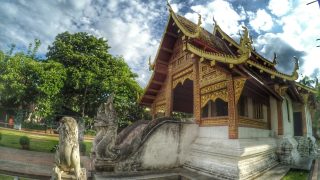
Wihan Phra Mongkhon Bophit, Ayutthaya
Buddhist Temple in Ayutthaya

Phra Mongkhon Bophit is one of Ayutthaya's most revered monuments, famous for its massive bronze Buddha statue and deep ties to the royal history of the Siamese kingdom. The site began as a royal cremation ground during the early Ayutthaya period, later transformed into sacred space as successive kings constructed monasteries and ceremonial structures around it. Today, its monumental Buddha image makes it one of the must-see places in Ayutthaya for travellers seeking to understand the kingdom's spiritual legacy. Thanks to its proximity to nearby royal temples, it is also often visited on walking tours of Ayutthaya.
The gleaming Buddha statue housed inside the viharn stands at 12.45 metres tall, with a lap width of 9.55 metres, and depicts the Buddha in the iconic pose of subduing Mara. Its serene expression and immense scale create an atmosphere of awe and reverence, drawing both worshippers and visitors seeking a moment of calm reflection.
History and Significance of Phra Mongkhon Bophit
The origins of Phra Mongkhon Bophit trace back to 1538 AD, when King Chairachathirat commissioned Wat Chichiang and a chedi near a royal cremation site. As part of this project, a large bronze Buddha statue was created-later known as Phra Mongkhon Bophit. Over the next century, the area became increasingly important to the royal court, especially after King Songtham moved the Buddha image in 1610 AD from its original position in the east to a new mandapa in the west and designated the nearby grounds as a central cremation site.
During the reign of King Sua (1697-1706 AD), the mandapa was struck by lightning, collapsing and breaking the Buddha’s head. The king rebuilt the structure as a viharn, laying foundations for the current layout. King Borommakot later restored the temple again in the mid-18th century, but the viharn was eventually destroyed during the Burmese invasion of 1767.
The modern structure owes much to its 20th-century restorations. A major restoration in 1955 stabilised and repaired the statue, while an extensive conservation project in 1990-overseen by the Fine Arts Department-covered the bronze with gold leaf. Completed in 1992, the project restored the statue’s radiance and reaffirmed its symbolic importance for Thai Buddhists.
Things to See and Do in Phra Mongkhon Bophit
The central attraction is the enormous seated Buddha statue, one of the largest bronze Buddhas in Thailand. Its posture-subduing Mara-symbolises the moment the Buddha overcame temptation and achieved enlightenment, making it a deeply revered icon. Visitors often spend time observing the statue from multiple angles to appreciate its size, craftsmanship, and elegant contours.
Inside the viharn, offerings of incense, lotus flowers, and candles show the continuing devotion the statue inspires. The atmosphere blends active worship with quiet spaces for contemplation, allowing visitors to experience both the spiritual and cultural significance of the site.
Outside the main hall, the grounds are open and airy, with views toward the nearby Wat Phra Si Sanphet complex. The location makes Phra Mongkhon Bophit an ideal stop during a broader exploration of Ayutthaya's royal precinct.
How to Get There
Phra Mongkhon Bophit is located in the heart of the Ayutthaya Historical Park, close to the former Grand Palace grounds. It is easily reached by bicycle, tuk-tuk, or taxi from anywhere in the city. Travelling by car is convenient if you are exploring several temples in one trip.
Travellers from Bangkok often arrive by train at Ayutthaya Station and then continue to the historical park by local transport. Train schedules and bookings can be found on Omio.
Practical Tips on Visiting Phra Mongkhon Bophit
- Best time to visit Phra Mongkhon Bophit: Early morning for quieter crowds and soft light.
- Entrance fee in Euros: Free (viharn access may vary depending on donation practices).
- Opening hours: Approximately 8:00-17:00.
- Official website: Visit the Tourism Authority of Thailand’s site for updates.
- How long to spend: 20-40 minutes.
- Accessibility: Mostly level surfaces with easy access into the viharn.
- Facilities: Vendors and restrooms available nearby.
- Photography tip: Capture the statue from the entrance of the viharn for perfect symmetry.
- Guided tours: Common in historical park itineraries.
- Nearby food options: Plenty of food stalls and cafés just outside the temple area.
Where to Stay close to Phra Mongkhon Bophit
Staying near the historical park gives easy access to Phra Mongkhon Bophit and other major temples. Sala Ayutthaya offers boutique riverside views with modern comforts. For a more traditional, garden-like stay, Baan Tye Wang provides a peaceful retreat. Travellers seeking contemporary amenities might prefer Kantary Hotel Ayutthaya.
Is Phra Mongkhon Bophit Worth Visiting?
Phra Mongkhon Bophit is absolutely worth visiting for its monumental Buddha statue, rich royal history, and active spiritual atmosphere. It provides a powerful sense of Ayutthaya’s ceremonial traditions and makes a meaningful stop within the historical park.
What Other Travellers Say...
Wiharn Phra Mongkhon Bophit is a busy, modern white temple in Ayutthaya noted for its massive gilded sitting Buddha; visitors describe a peaceful, solemn atmosphere with ample seating, shade, wheelchair access, toilets and handwashing facilities, and no entry fee, making it an easy stop when exploring the nearby ruins and Wat Sri Sanphet and a pleasant place to pause and take in the architecture even if the main statue may occasionally be covered for restoration.





FAQs for Visiting
The Wihan Phra Mongkhon Bophit appears in our Complete Guide to Visiting Ayutthaya!

Moira & Andy
Hey! We're Moira & Andy. From hiking the Camino to trips around Europe in Bert our campervan — we've been traveling together since retirement in 2020!
This website uses affiliate links which may earn a commission at no additional cost to you!
Planning Your Visit
8 AM to 4:30 PM
Nearby Attractions
- Wat Phra Si Sanphet (0.1) km
Buddhist Temple - Wat Phra Ram (0.4) km
Buddhist Temple - Wat Lokaya Sutha (0.5) km
Buddhist Temple - Chao Sam Phraya Museum (0.6) km
Museum - Wat Thammikarat (0.6) km
Buddhist Temple - Wat Na Phra Men (0.9) km
Buddhist Temple - Wat Mahathat (1.1) km
Buddhist Temple - Wat Ratchaburana (1.1) km
Buddhist Temple - Wat Chaiwatthanaram (2.2) km
Buddhist Temple - Wat Suwan Dararam (2.3) km
Buddhist Temple