Alcazaba, Alhambra 2026: The Fortress of the Alhambra
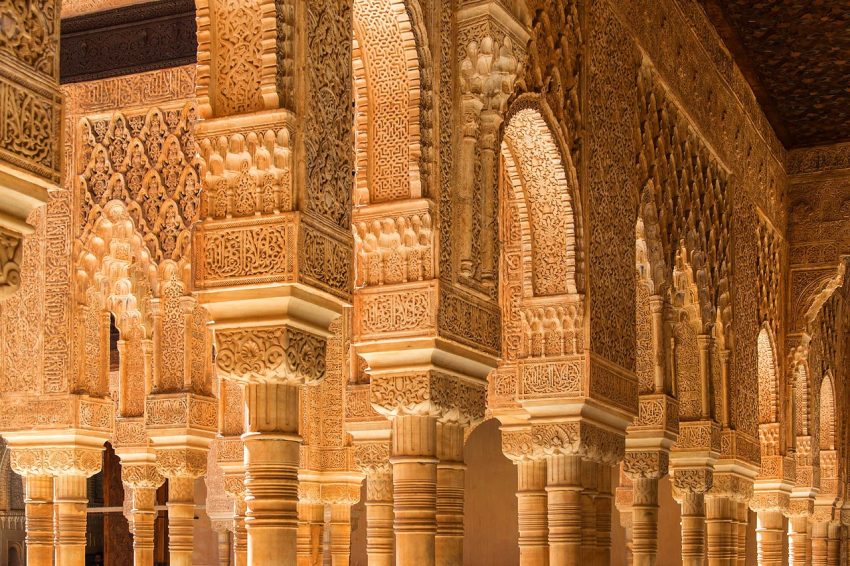
Plaza de Los Aljibes, Alhambra, Grenada
CC BY-SA 1.0 / Jebulon

This website uses affiliate links which earn a small commission at no additional cost to you.

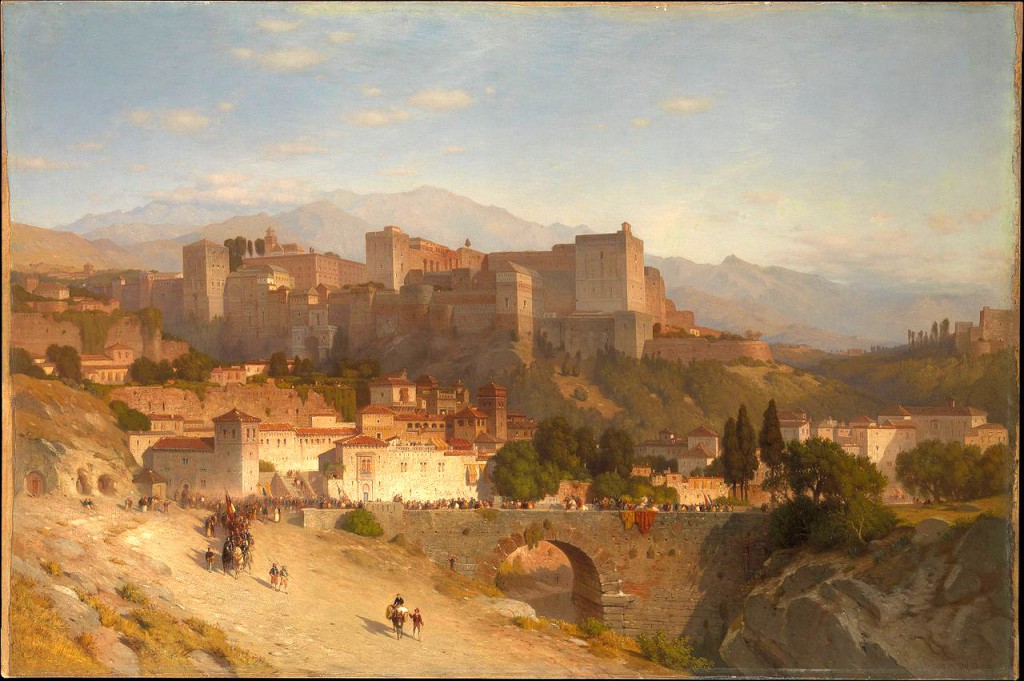
The history of Granada is somewhat distinctive from most of Spain. Lying just a couple of hundred kilometers from Morocco, this part of Spain has experienced the best of the Moorish era. The way of living in this part of the country, its architecture and culture, still blatantly reflects its quintessential Andalusian roots. Granada's Alhambra is a prime example and a testament to its origins.

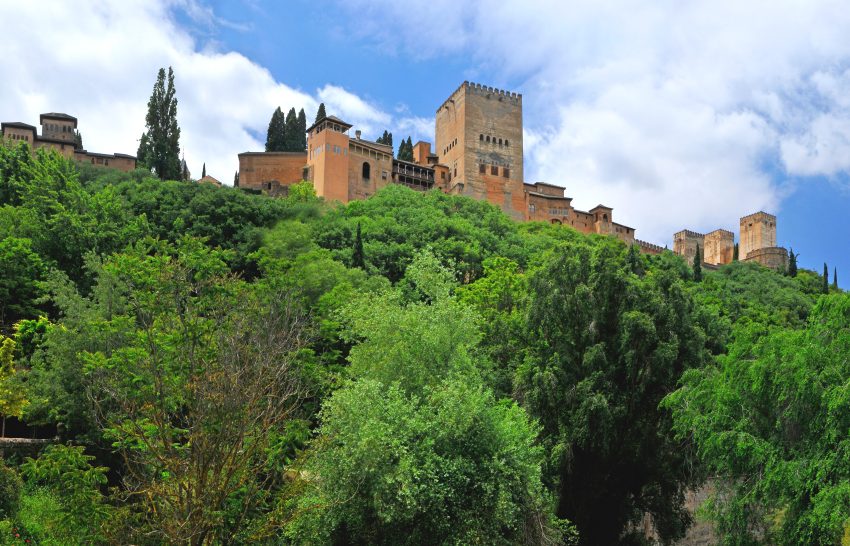
Within the limits of Alhambra is the Alcazaba, a walled fortification meant for the rulers and their subjects. According to some sources, Alhambra's Alcazaba was said to be built around the 11th century. This later became the last Moorish stronghold, and as such, is at the center of historical attention. It is also a bustling tourist attraction. So if you plan to visit the Alcazaba at Alhambra, make sure you book your tickets in advance.

Alcazaba Granada – History Under a Minute

History dictates that there was some sort of construction already present at the current Alcazaba site before it was transformed into the structure we see today. There are contradictory historical accounts regarding the final additions to the Alcazaba. The Broken Tower (Torre Quebrada), the Keep (Torre del Homenaje), and the WatchTower (Torre de la Vela) were subsequently added to shape it into a stronghold.

The king, Mohammed I is said to have initially established a residence there and was succeeded by his son, Mohammed II who lived there for a short while too. After the palaces were completed, the Alcazaba was used exclusively for military purposes. When the Christians subsequently took over, they carried out restorative work on the structure and transformed it into the state prison. Until the late 19th century, the Alcazaba lay unattended and since then different parts of the Alcazaba were explored and restored to the current state.

Tour of the Alcazaba Granada

1. Tower of the Cube
Torre del Cubo Alhambra Grenada 4
CC BY-SA 4.0 / Rumomo

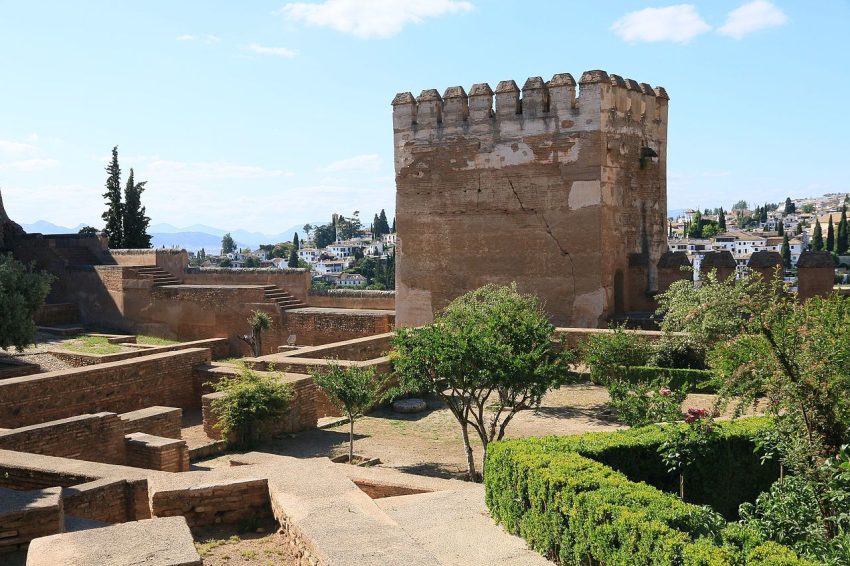
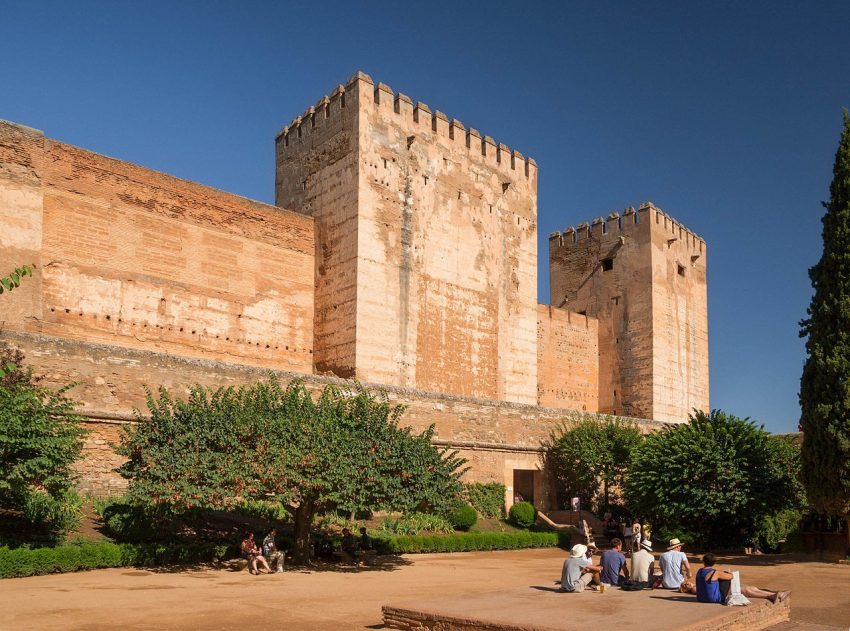
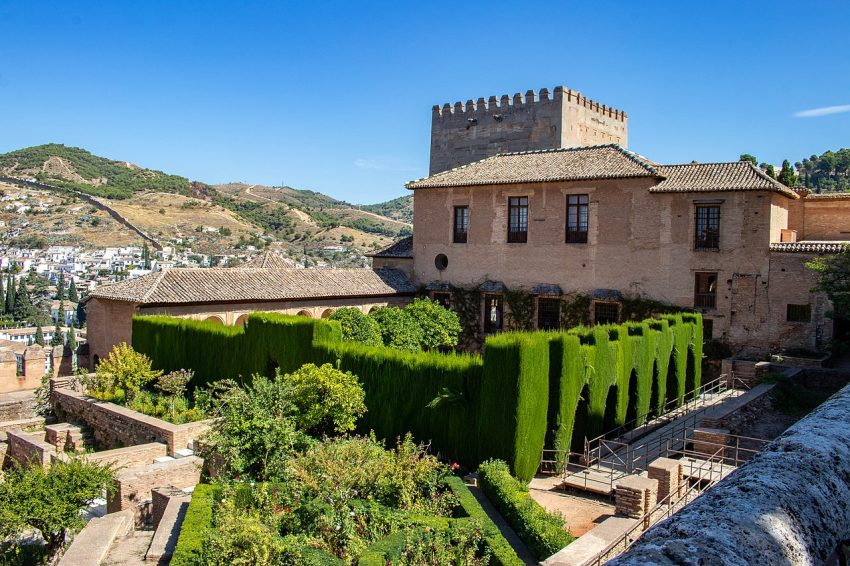
As you enter face the fortress from the Plaza de Los Aljibes, there are three towers. The center one Torre Quebrada stands overlooking the main entrance. To its right is the Torre del Homenaje or Broken Tower. which overlooks the Torre del Cubo. To the left the Torre del Adarguero is harder to make out as the hollow tower as it is also called has been partly demolished.

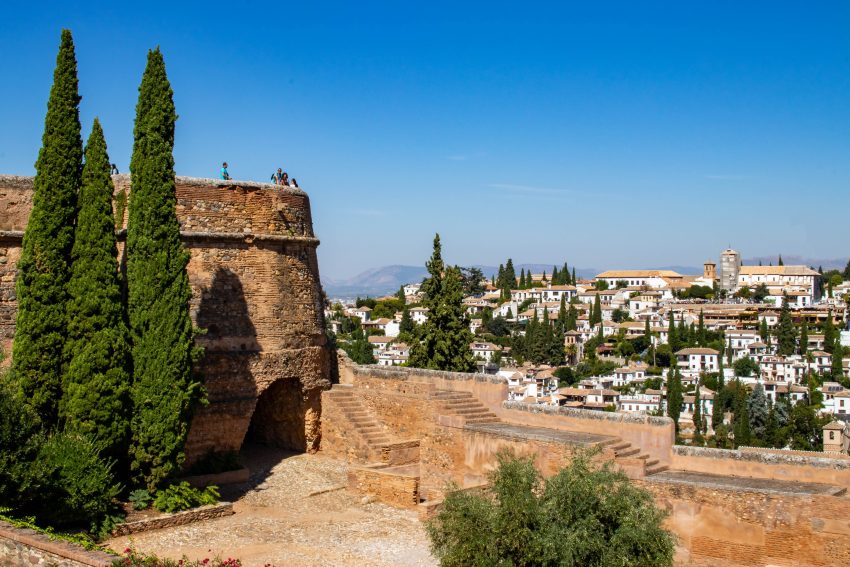
You will enter the dry moat of the Alcazaba beneath the Torre Quebrada, turn right and head up the steps at the end to ascend to the Tower if the Cube. The tower is a defensive artillery bastion, built by the Catholic Monarchs, over the top of and sealing up the Puerta de la Tahona or Gate of the Bakery.

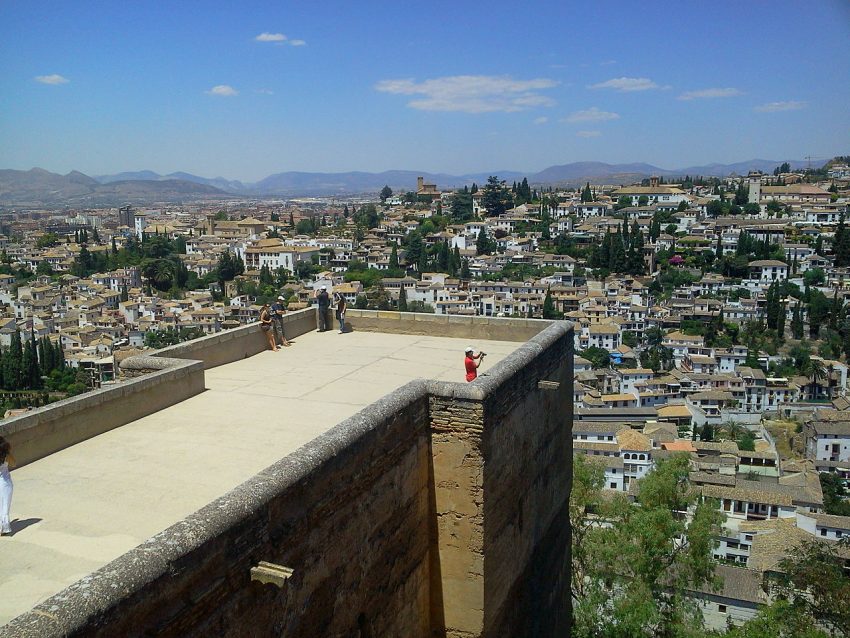
From here there are great views over Granada and the Alhambra. As you look out to the left you can see the  Camino de Ronda leading to the Puerta de las Armas at the base of the Torre de las Armas. On the other side you have probably the best views over the Palacio del Mexuar and the Madrasa de los Príncipes and the Patio de Machuca. Along the battlements towards the Palacio Nazaríes you can see the Torre de Mohamed.


Location: Torre del Cubo de la Alhambra Calle Real de la Alhambra 18009 Granada Spain | Hours: For opening times of the Torre del Cubo see Alhambra Opening Times. | Price: The Torre del Cubo is part of the Alhambra Complex and access it you need to purchase Alhambra Tickets or a Alhambra Guided Tour.

We recommend to rent a car in Spain through Discover Cars, they compare prices and review multiple car rental agencies. Book your rental car here.

2. The Arms Square

Plaza de las Armas Alhambra Granada 6
CC BY-SA 3.0 / Богдан Митронов-Слоб…

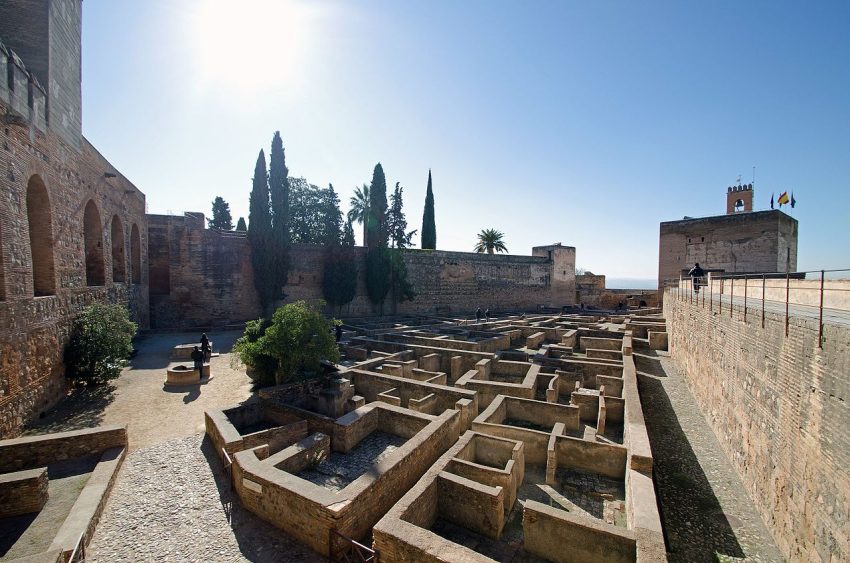
Head back down the steps and around the  Torre del Homenaje to enter the Plaza de las Armas or the Arms Square. This area was the main mustering grounds of the castle and it was also called the Barrio Castrense or Military Quarters of the Castle as it housed its soldiers and servants.  Just where you entered you can head up the steps to get a better view. The low walls are the foundations of the buildings that used to stand here.

You can walk along the northern battlements. The first tower you walk on is called the Torre del Criado del Doctor Ortiz  or Tower of the Servant of Doctor Ortiz , followed by the Torre de Alquiza and the final tower being the tower overlooking the Torre de las Armas. There are great views on the defenses below, the area between the wall you are currently on and the outer curtain wall was called the  Camino de Ronda and went all around the Alhambra.

Head back the way you came and descend to the Arms Square to wander among the ruins. Scattered around are the remains of a rainwater cistern, barracks, baths. The circular stairs  at the foot of the Torre Quebrada, which descending into the ground lead to a dungeon.

As you head towards the Torre de la Vela you should turn to your right and head out to the Torre de las Armas.


| Hours: For opening times of the Plaza de las Armas see Alhambra Opening Times. | Price: The Plaza de las Armas is part of the Alhambra Complex and access it you need to purchase Alhambra Tickets or a Alhambra Guided Tour. | Website

Here is a complete selection of hotel options in Granada. Feel free to review each one and choose the stay that best suits your needs.

3. Tower of the Arms

Torre de las armas Alhambra Granada
CC BY-SA 3.0 / Jhoczbox

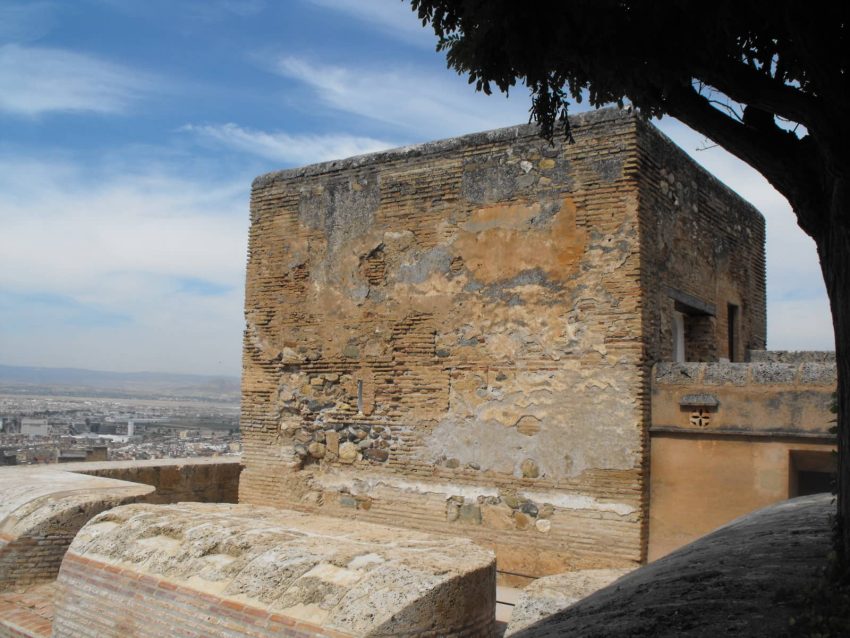
As you cross to the far end of the Torre de las Armas, to your left you can see the small defensive tower called the Torre de los Hidalgos or Tower of the Nobles. The Torre de las Armas stands above the Puerta de las Armas, which would have been main access gate to the Alhambra in the early days of the Nasrid period. It gets its name as the visitors to the Alhambra would need to leave their weapons at the gate below.

There are not only great views over Granada, but also of the Alcazaba. You can look back at the Tower of the Cube, standing over the Gate of the Bakery, and behind you at the Torre de la Vela. If you look over the north side of the tower you should be able to make out the ruins of another tower by the river.  This was the Puerta de los Tablero or Gate of the Boards, a bridge over the river which had a water gate. The bridge had a damming mechanism that could store water and then flood the channel below in times of attack. There would have been a defensive wall connecting the Puerta de los Tablero with the Tower of Arms.

Head back the way you came and follow signs to the Torre de la Vela.


Location: Torre de las Armas 18009 Granada Spain | Hours: For opening times of the Torre de las Armas see Alhambra Opening Times. | Price: The Torre de las Armas is part of the Alhambra Complex and access it you need to purchase Alhambra Tickets or a Alhambra Guided Tour. | Website

Traveling to a country with a different currency? Avoid ATM transaction fees and pay in local currency with a Wise Card. Having used it for over 5 years, we've saved loads on fees!

4. The Candle Tower

Torre de la Vela Alhambra 2
CC BY-SA 24.0 / Rumomo

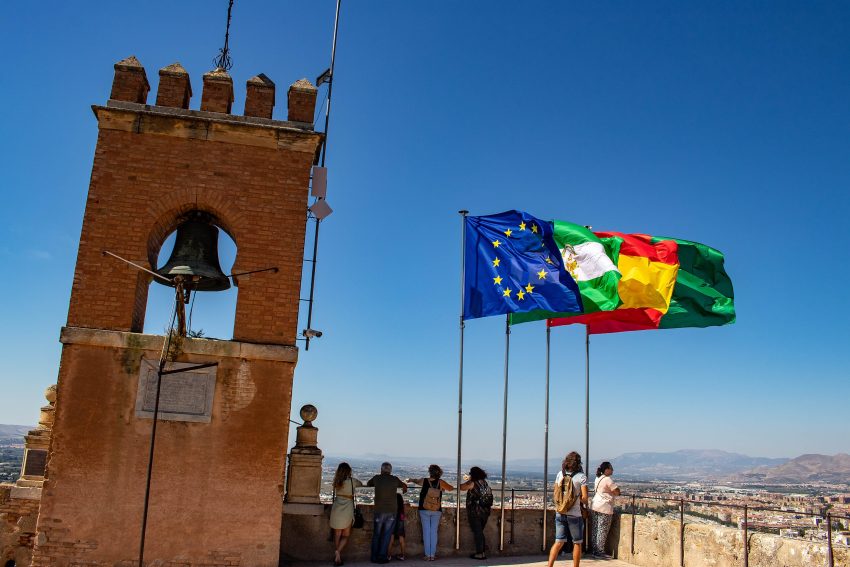
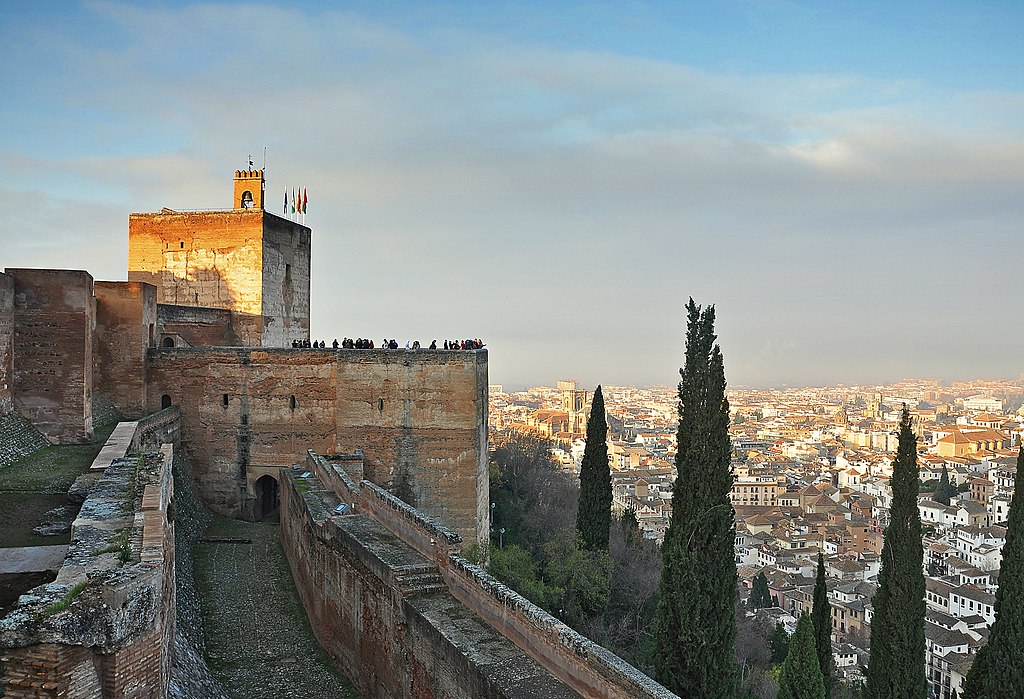
There is a little climb up a spiral staircase to climb through the four floors of the tower get to the top, but it is well worth it.  It is a very recognizable feature at the Alcazaba owing to its flags and the bell tower. Originally and as a defensive element, it had battlements on its terrace, which were lost during earthquakes.

The tower gets its name from its Bell, called La Vela, which was brought with the Catholic Monarchs took Granada.

Enjoy the spectacular views from the top before heading back down.


Location: Torre de la Vela, Alhambra Cuesta de Gomérez, 39 18009 Granada Spain | Hours: For opening times of the Torre de la Vela see Alhambra Opening Times. | Price: The Torre de la Vela is part of the Alhambra Complex and access it you need to purchase Alhambra Tickets or a Alhambra Guided Tour. | Website

Click here to read our blog about 15 Best Things to See and Do in Granada, Spain (2026)

5. Torre de la Pólvora

torre polvora Alhambra
Copyright / Alhambra and Generalife

As you head down you will pass the Torre de la Pólvora or the Powder Tower is one of the minor small medieval Moorish defensive towers of Alcazaba. It receives its name because this tower is the place where the gunpowder used by artillery was stored. It will occasionally be open as part of the Alhambra’s “Space of the Month”. If it is pop in and have a look around.

The head down and enter the Jardín de Los Adarves.


| Hours: For opening times of the Torre de la Pólvora see Alhambra Opening Times. The Torre de la Pólvora is part of the Alhambra Complex and access it you need to purchase Alhambra Tickets or a Alhambra Guided Tour. | Price: The Torre de la Pólvora is part of the Alhambra Complex and access it you need to purchase Alhambra Tickets or a Alhambra Guided Tour. | Website

Click here to read our blog about The Nasrid Palaces 2026: The Heart of the Alhambra

6. Garden of Adarves

Jardin de los Adarves Alhambra Genada 6
© la-alhambra.org.es

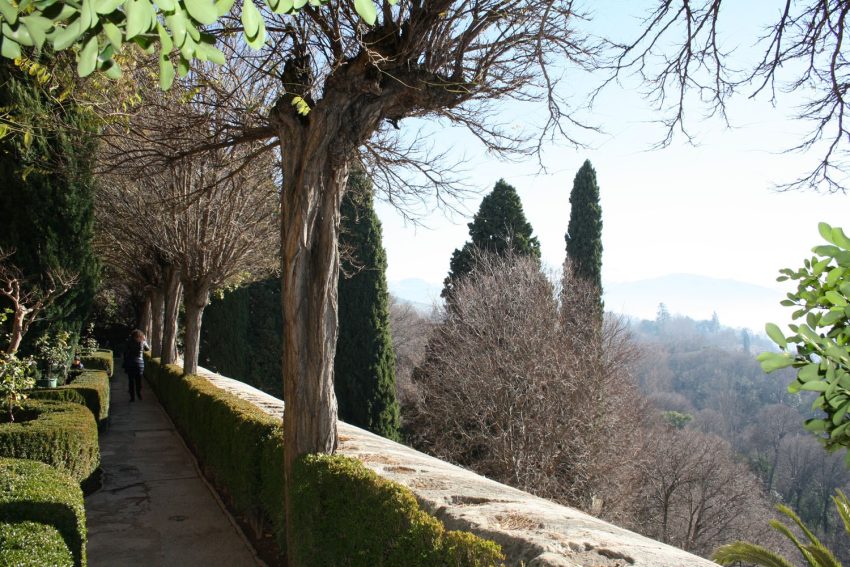
The Jardín de Los Adarves or Garden of Adarves are beautiful gardens built on the Adarves or battlements of the castle.

There is a mirador, or viewing platform on the western end of the garden, below which you can see the defensive wall that links to the Puerta de las Granadas and the Torres Bermejas.

The gardens has two water troughs filles with 3 water spouts from 1628. Among the fountains that can be seen in this garden, the one that stood on the bowl of the Fuente de los Leones in the Patio de los Leones  until 1949.

As you pass under the Torre del Adarguero you head towards the exit.


Click here to read our blog about Generalife, Alhambra 2026: The Architect’s Garden

Best Alhambra Tickets With Alcazaba Access

Getting to Alcazaba Granada

By Walk

If you are already in Granada, you could take a walk down Cuesta de Gomérez from Plaza Nueva. The 15 minutes' pleasant walk takes you to the Gate of Justice after passing through the woods.

By Car

If you are getting there by car, you will only be allowed to take the vehicle up to Paseo de la Sabica and then opt for paid parking nearby. You can also take a taxi to the Alhambra and then walk to the Alcazaba. The closest entrance would be from Torre Quebrada, which will take you the Torre del Homenaje next. This route will end your tour at Torre de la Vela and Plaza de Los Aljibes.

By Bus

Bus C3 and C4 also take you to the Alhambra complex.

Alcazaba Granada Opening Hours

The Alhambra Monument is open every day except 25th December and 1st January. The general visiting hours for the Alhambra are as follows:

Visiting Alhambra between 15th October – 31st March 

Monday – Sunday: 8:30 AM to 6:00 PM
Nasrid Palaces – Night session: (Fri to Sat) 8.00 PM to 9.30 PM
Generalife Palace – Night session: (Fri to Sat) 8.00 PM to 9.30 PM

Visiting Alhambra between 1st April to 14th October

Monday – Sunday: 8:30 AM to 8.00 PM
Nasrid Palaces Night session: (Tuesday – Saturday) 10.00 PM to 11.30 PM
Generalife Palace and Gardens – Night session – 1st April – 31st May: (Tues to Sat) 10.00 PM to 11.30 PM
Generalife Palace – Night session – 1st Sept – 14th Oct: (Fri to Sat) 10.00 PM to 11.30 PM

Tips For Visiting The Alcazaba

  • Buy your Alcazaba entrance tickets online and well in advance. The Alhambra attracts the most number of tourists in this part of the country and you wouldn't want to miss out.
  • Remember that the time mentioned on your tickets are for Nasrid Palace visit. Start with the palaces and then come to the Alcazaba to make sure you have enough time.
  • Wear comfortable walking shoes or sandals. Suntan and hat are a must in the Summer.
  • There are steps so the Alcazaba is not suitable if you have mobility issues. If you're fit, climbing to the top of the The Candle Tower for the terrific views of Sierra Nevada. The views are especially beautiful around sunset.
  • Read up about the Alcazaba and the Alhambra in general to enrich your visit. There are many articles available to quench your thirst for knowledge.
  • Be prepared to be surrounded by other tourists. The Alcazaba complex is large and has some interesting parts which are missed most tourists. Head to those places first and return to see the more famous ones later.

1. Tower of the Cube

Torre del Cubo Alhambra Grenada 4
CC BY-SA 4.0 / Rumomo

As you enter face the fortress from the Plaza de Los Aljibes, there are three towers. The center one Torre Quebrada stands overlooking the main entrance. To its right is the Torre del Homenaje or Broken Tower. which overlooks the Torre del Cubo. To the left the Torre del Adarguero is harder to make out as the hollow tower as it is also called has been partly demolished.

You will enter the dry moat of the Alcazaba beneath the Torre Quebrada, turn right and head up the steps at the end to ascend to the Tower if the Cube. The tower is a defensive artillery bastion, built by the Catholic Monarchs, over the top of and sealing up the Puerta de la Tahona or Gate of the Bakery.

From here there are great views over Granada and the Alhambra. As you look out to the left you can see the  Camino de Ronda leading to the Puerta de las Armas at the base of the Torre de las Armas. On the other side you have probably the best views over the Palacio del Mexuar and the Madrasa de los Príncipes and the Patio de Machuca. Along the battlements towards the Palacio Nazaríes you can see the Torre de Mohamed.


Location: Torre del Cubo de la Alhambra Calle Real de la Alhambra 18009 Granada Spain | Hours: For opening times of the Torre del Cubo see Alhambra Opening Times. | Price: The Torre del Cubo is part of the Alhambra Complex and access it you need to purchase Alhambra Tickets or a Alhambra Guided Tour.

We recommend to rent a car in Spain through Discover Cars, they compare prices and review multiple car rental agencies. Book your rental car here.

2. The Arms Square

Plaza de las Armas Alhambra Granada 6
CC BY-SA 3.0 / Богдан Митронов-Слоб…

Head back down the steps and around the  Torre del Homenaje to enter the Plaza de las Armas or the Arms Square. This area was the main mustering grounds of the castle and it was also called the Barrio Castrense or Military Quarters of the Castle as it housed its soldiers and servants.  Just where you entered you can head up the steps to get a better view. The low walls are the foundations of the buildings that used to stand here.

You can walk along the northern battlements. The first tower you walk on is called the Torre del Criado del Doctor Ortiz  or Tower of the Servant of Doctor Ortiz , followed by the Torre de Alquiza and the final tower being the tower overlooking the Torre de las Armas. There are great views on the defenses below, the area between the wall you are currently on and the outer curtain wall was called the  Camino de Ronda and went all around the Alhambra.

Head back the way you came and descend to the Arms Square to wander among the ruins. Scattered around are the remains of a rainwater cistern, barracks, baths. The circular stairs  at the foot of the Torre Quebrada, which descending into the ground lead to a dungeon.

As you head towards the Torre de la Vela you should turn to your right and head out to the Torre de las Armas.


| Hours: For opening times of the Plaza de las Armas see Alhambra Opening Times. | Price: The Plaza de las Armas is part of the Alhambra Complex and access it you need to purchase Alhambra Tickets or a Alhambra Guided Tour. | Website

Here is a complete selection of hotel options in Granada. Feel free to review each one and choose the stay that best suits your needs.

3. Tower of the Arms

Torre de las armas Alhambra Granada
CC BY-SA 3.0 / Jhoczbox

As you cross to the far end of the Torre de las Armas, to your left you can see the small defensive tower called the Torre de los Hidalgos or Tower of the Nobles. The Torre de las Armas stands above the Puerta de las Armas, which would have been main access gate to the Alhambra in the early days of the Nasrid period. It gets its name as the visitors to the Alhambra would need to leave their weapons at the gate below.

There are not only great views over Granada, but also of the Alcazaba. You can look back at the Tower of the Cube, standing over the Gate of the Bakery, and behind you at the Torre de la Vela. If you look over the north side of the tower you should be able to make out the ruins of another tower by the river.  This was the Puerta de los Tablero or Gate of the Boards, a bridge over the river which had a water gate. The bridge had a damming mechanism that could store water and then flood the channel below in times of attack. There would have been a defensive wall connecting the Puerta de los Tablero with the Tower of Arms.

Head back the way you came and follow signs to the Torre de la Vela.


Location: Torre de las Armas 18009 Granada Spain | Hours: For opening times of the Torre de las Armas see Alhambra Opening Times. | Price: The Torre de las Armas is part of the Alhambra Complex and access it you need to purchase Alhambra Tickets or a Alhambra Guided Tour. | Website

Traveling to a country with a different currency? Avoid ATM transaction fees and pay in local currency with a Wise Card. Having used it for over 5 years, we've saved loads on fees!

4. The Candle Tower

Torre de la Vela Alhambra 2
CC BY-SA 24.0 / Rumomo

There is a little climb up a spiral staircase to climb through the four floors of the tower get to the top, but it is well worth it.  It is a very recognizable feature at the Alcazaba owing to its flags and the bell tower. Originally and as a defensive element, it had battlements on its terrace, which were lost during earthquakes.

The tower gets its name from its Bell, called La Vela, which was brought with the Catholic Monarchs took Granada.

Enjoy the spectacular views from the top before heading back down.


Location: Torre de la Vela, Alhambra Cuesta de Gomérez, 39 18009 Granada Spain | Hours: For opening times of the Torre de la Vela see Alhambra Opening Times. | Price: The Torre de la Vela is part of the Alhambra Complex and access it you need to purchase Alhambra Tickets or a Alhambra Guided Tour. | Website

Click here to read our blog about 15 Best Things to See and Do in Granada, Spain (2026)

5. Torre de la Pólvora

torre polvora Alhambra
Copyright / Alhambra and Generalife

As you head down you will pass the Torre de la Pólvora or the Powder Tower is one of the minor small medieval Moorish defensive towers of Alcazaba. It receives its name because this tower is the place where the gunpowder used by artillery was stored. It will occasionally be open as part of the Alhambra’s “Space of the Month”. If it is pop in and have a look around.

The head down and enter the Jardín de Los Adarves.


| Hours: For opening times of the Torre de la Pólvora see Alhambra Opening Times. The Torre de la Pólvora is part of the Alhambra Complex and access it you need to purchase Alhambra Tickets or a Alhambra Guided Tour. | Price: The Torre de la Pólvora is part of the Alhambra Complex and access it you need to purchase Alhambra Tickets or a Alhambra Guided Tour. | Website

Click here to read our blog about The Nasrid Palaces 2026: The Heart of the Alhambra

6. Garden of Adarves

Jardin de los Adarves Alhambra Genada 6
© la-alhambra.org.es

The Jardín de Los Adarves or Garden of Adarves are beautiful gardens built on the Adarves or battlements of the castle.

There is a mirador, or viewing platform on the western end of the garden, below which you can see the defensive wall that links to the Puerta de las Granadas and the Torres Bermejas.

The gardens has two water troughs filles with 3 water spouts from 1628. Among the fountains that can be seen in this garden, the one that stood on the bowl of the Fuente de los Leones in the Patio de los Leones  until 1949.

As you pass under the Torre del Adarguero you head towards the exit.


Click here to read our blog about Generalife, Alhambra 2026: The Architect’s Garden

If you have not see the Nasrid Palaces yet the have a look at our Guides on visiting The Mexuar, The Comres Palace and the Palace of the Lions.

Powered by GetYourGuide
Moira & Andy
Moira & Andy

Hey! We're Moira & Andy. From hiking the Camino to trips around Europe in Bert our campervan — we've been traveling together since retirement in 2020!

Read our full story here

This website uses affiliate links which earn a small commission at no additional cost to you.

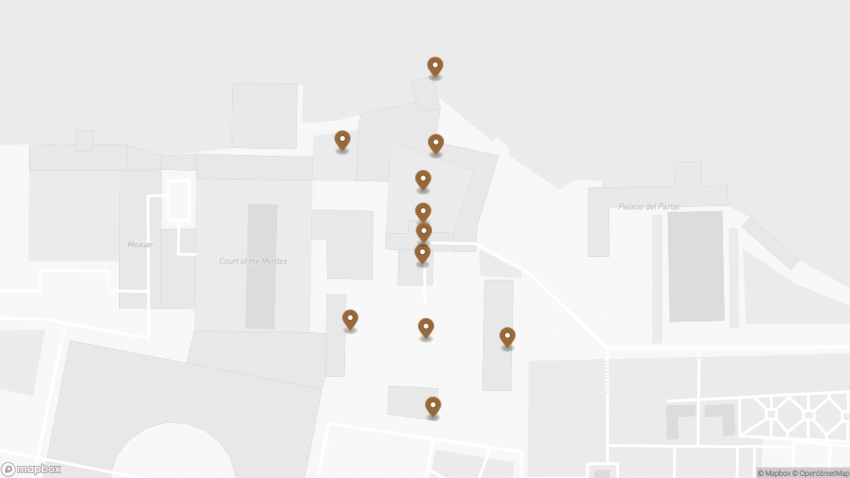
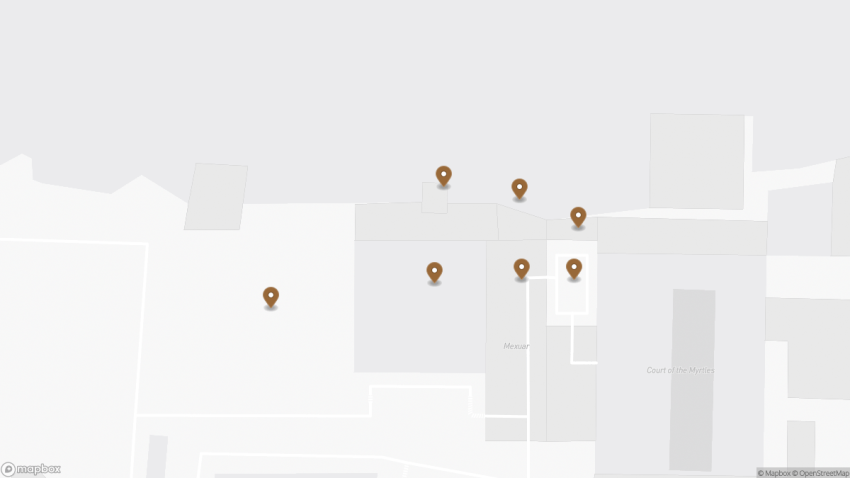
Walking Tour Map
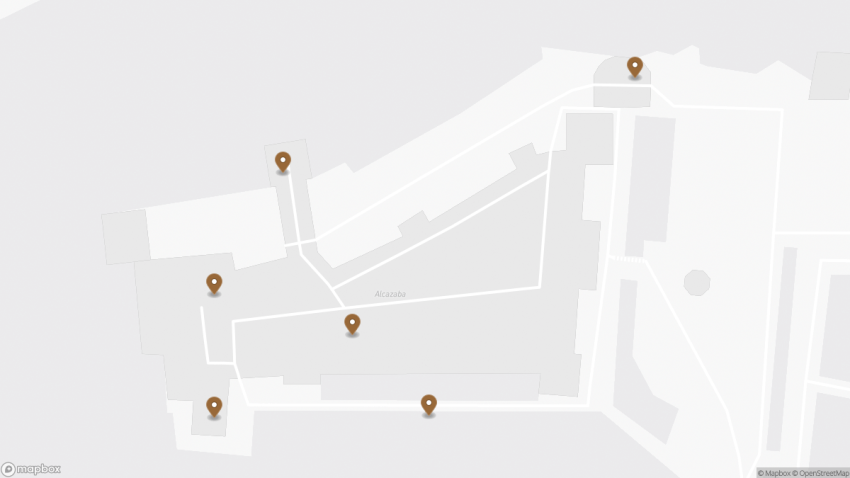
Map of the Alcazaba, Alhambra: The Fortress of the Alhambra walking route with 6 stops in Granada.
Preview map of the Alcazaba, Alhambra: The Fortress of the Alhambra route in Granada, showing 6 stops. Use the interactive map to zoom and tap markers.

Similar Blogs

The Nasrid Palaces 2026 | Palace of the Lions

Patio De Los Leones, Alhambra

This website uses affiliate links which earn a small commission at no additional cost to you.

In the Alhambra, the Palace of the Lions or El Palacio de los Leones marks the highlight of its splendor. The Palacio de los Leones (Palace of the Lions) stands next to the Comares Palace but should be considered an independent building. The two structures were connected after Granada fell to the Christians. This palace was the private rooms of the royal family.

History of Palace of the Lions in Under a Minute

The Palace of the Lions changes subtly from the Palcio del Mexuar and the Palacio del Comres, with fewer  geometric decorations and a more naturalistic style. This is undoubtedly influenced Christian architecture and the increasing friendship between Mohamed V and Pedro I, the Cruel.

When Mohamed V succeeded his father Yusuf I (1377), he did not just complete the work that had begun, but began to build what would be his great work, the magnificent legacy he left us in the Alhambra: the Palacio de the Lions. 

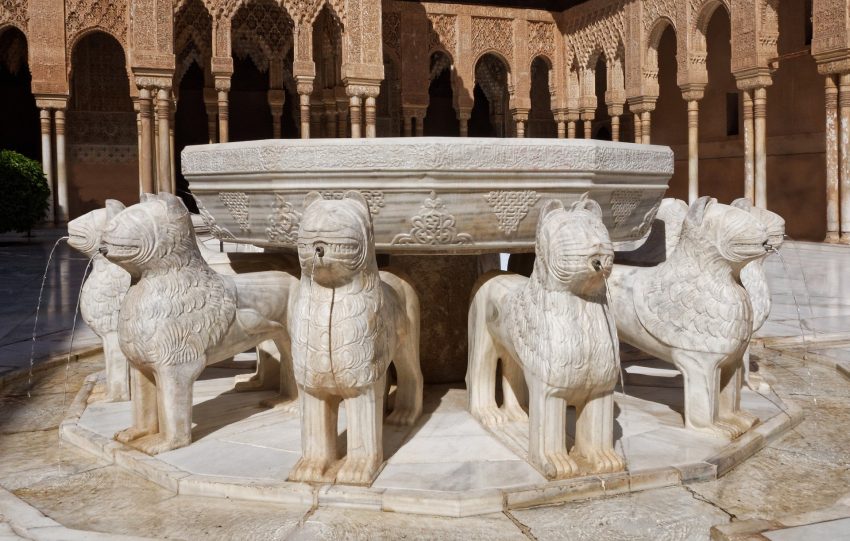
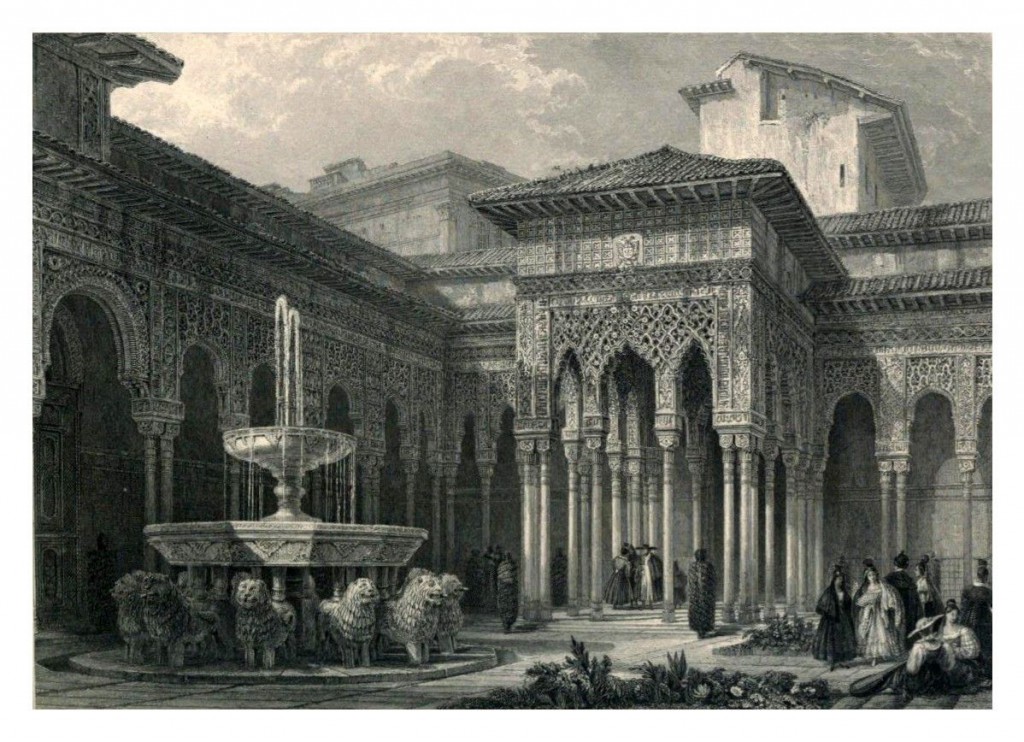
Muhammad V built the Palace of the Lions’ most celebrated feature in the 14th century, a fountain with a complex hydraulic system consisting of a marble basin on the backs of twelve carved stone lions situated at the intersection of two water channels that form a cross in the rectilinear courtyard. 

A Tour of the Palace of the Lions

Palace of the Lions is located just after the Place of Comres and exits into the Partal Palace.

1. Room of the Mocárabes

Ceiling of the Sala de los Mocarabes
CC BY-SA 4.0 / Kolforn

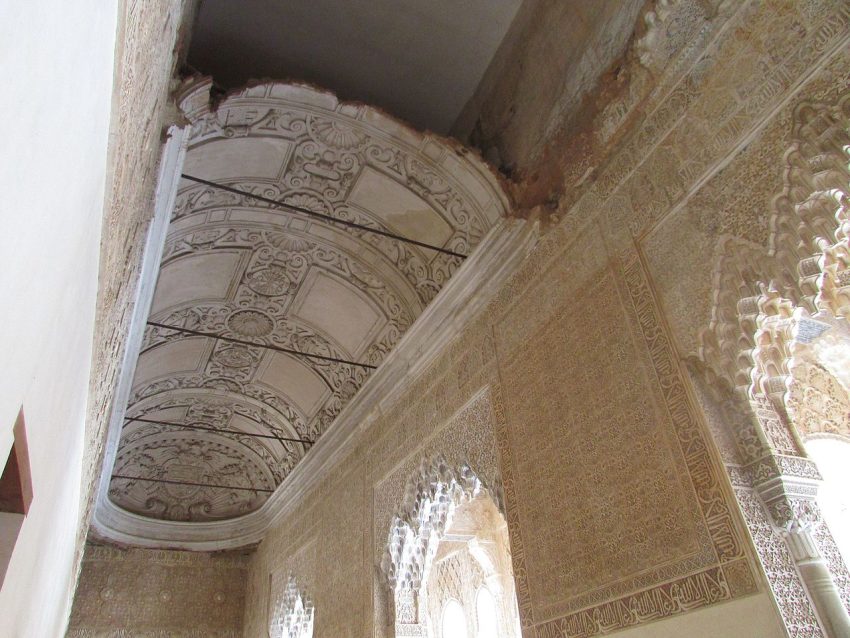
The Sala de los Mocárabes or Room of the Mocárabes is the first room you will enter in the Palace. It is one of the most simple rooms in the Palace, and a soon as you enter your eyes will be drawn to the three arches on the east wall, and the view through them, which gives you your first sight of the Patio of the Lions.

The room received its name from the ceiling which was adorned with a magnificent muqarnas vault.  However looking up you will not discover it, as it was demolished after it was damaged in an explosion of a powder magazine in 1590. The ceiling you can see today is still impressive


| Hours: For opening times of the Sala de los Mocárabes see Alhambra Opening Times. | Price: The Sala de los Mocárabes is part of the Alhambra Complex and access it you need to purchase Alhambra Tickets or a Alhambra Guided Tour. | Website

We recommend to rent a car in Spain through Discover Cars, they compare prices and review multiple car rental agencies. Book your rental car here.

2. Patio of the Lions

Patio de los Leones Alhambra alt

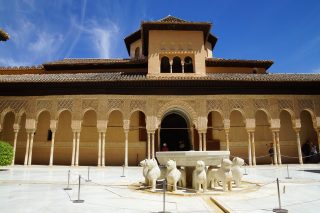
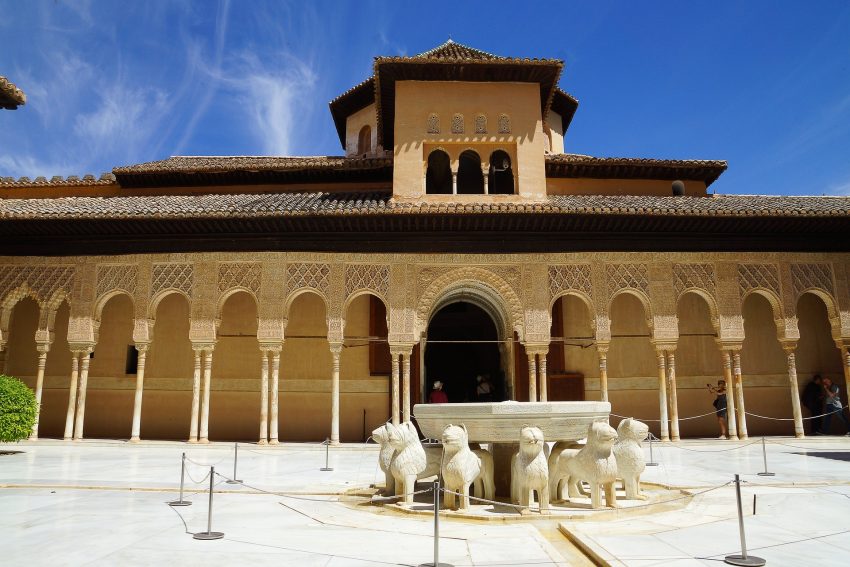
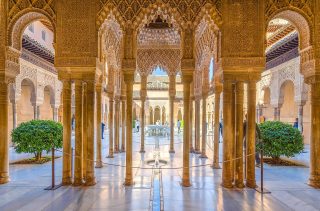
The Patio de los Leones or the Patio of the Lions,  is at the heart of the original place of the Palace. In the center of the patio is the La Fuente de los Leones or Fountain of the Lions, which spouts water from the mouths of twelve white marble lions. They are placed in a circle around a basin. There are four entrances to the patio and from each a channel of water flows to the center. The four channels are said to represent the four rivers of paradise.


Location: Patio de Los Leones Calle Real de la Alhambra, s/n 18009 Granada Spain | Hours: For opening times of the Patio de los Leones see Alhambra Opening Times. | Price: The Patio de los Leones is part of the Alhambra Complex and access it you need to purchase Alhambra Tickets or a Alhambra Guided Tour. | Website

Here is a complete selection of hotel options in Granada. Feel free to review each one and choose the stay that best suits your needs.

Powered by GetYourGuide

3. The Hall of the Abencerrajes

Ceiling in Hall of the Abencerrajes alhambra Granada
CC BY-SA 2.0 / jvwpc

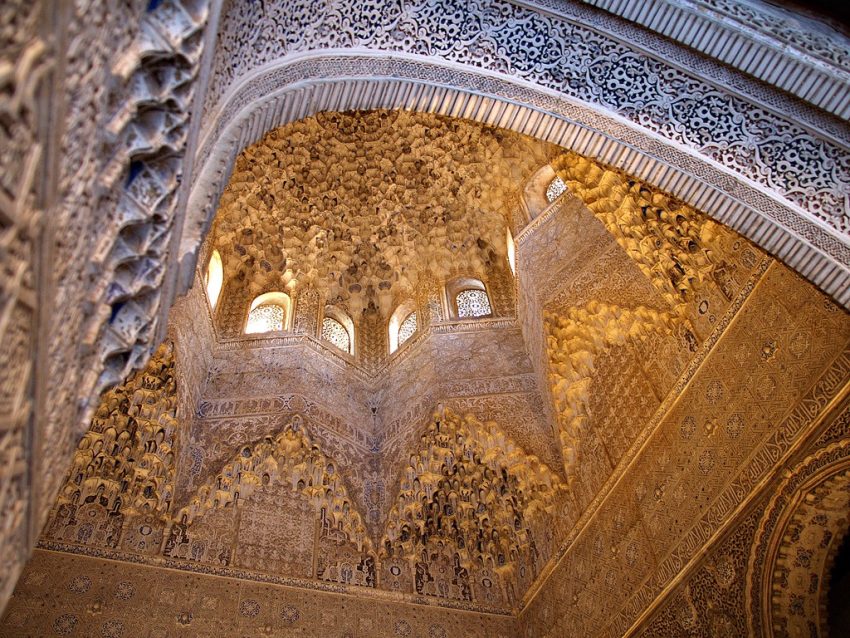
La Sala se los Abencerrajes or the The Hall of the Abencerrajes is the hall to the south of the Patio of the Lions. This was the kings bedroom. the alcoves to the east and west could have been partitioned with curtains for more privacy. In the center of the room is a small fountain which feeds the channel of water for the Fountain of Lions. The ceiling is of muqarnas whose stalactites like appearance combined with the pool at the bottom give this room a cave like appearance.

The room has a grisly legend associated with it. There was a rivalry between two powerful Granadan families, the Abencerrajes and the Zenetes. The Zenetes wished to destroy the Abencerrajes so they spread the rumor that one of their knights was having an affair with the kings favorite concubine. When the king heard he invited thirty-six knights from Abencerrajes family to a banquet in this hall. As they entered one by one the king decapitated each, throwing their heads into the fountain, which is still stained red with their blood.


Location: Sala de los Abencerrajes, Calle Real de la Alhambra, Granada, Spain | Hours: For opening times of the Sala de los Abencerrajes see Alhambra Opening Times. | Price: The Sala de los Abencerrajes is part of the Alhambra Complex and access it you need to purchase Alhambra Tickets or a Alhambra Guided Tour. | Website

Traveling to a country with a different currency? Avoid ATM transaction fees and pay in local currency with a Wise Card. Having used it for over 5 years, we've saved loads on fees!

4. The Kings Room

Paintings of the 10 Kings, Sala de los Reyes, Alhambra
CC BY-SA 2.0 / Junta Granada Informa

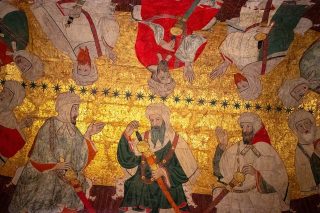
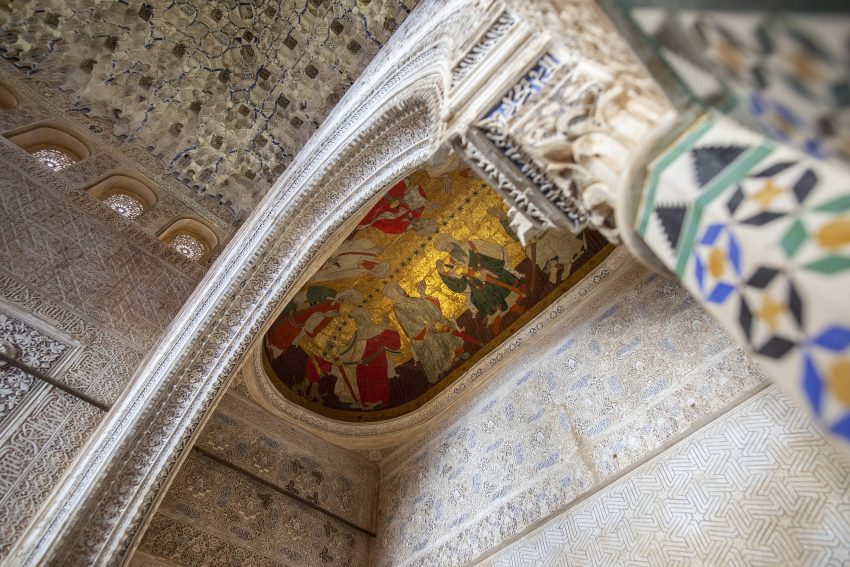
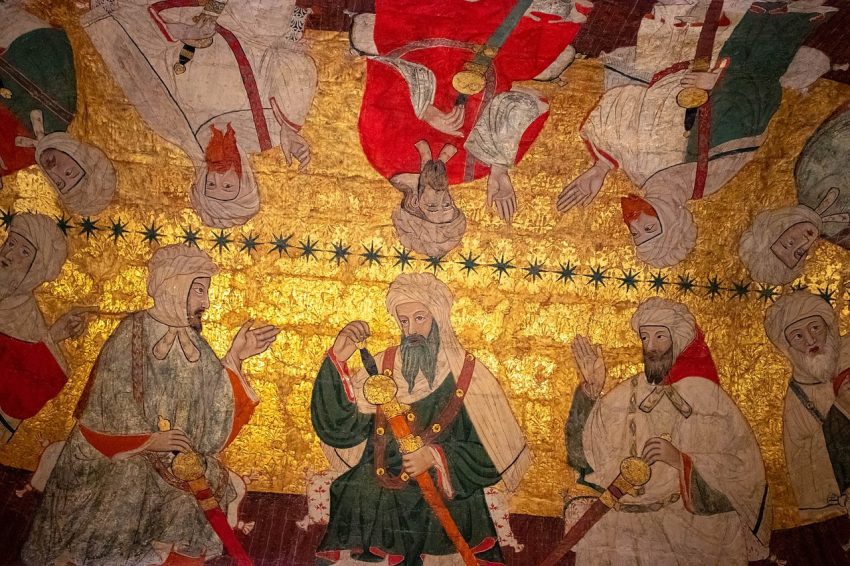
The Sala de los Reyes or The Kings Room is located to the east of the Patio of the Lions. This is the longest room of the palace and is split into three sections, between which are arches decorated with muqarnas. The ceilings have scenes painted on them. One is a scene with ten Nasarid nobles, thought to be kings and is where the room gets its name.


Location: s/n, Calle Real de la Alhambra, 18009 Granada, Spain | Hours: For opening times of the Sala de los Reyes see Alhambra Opening Times. | Price: The Sala de los Reyes is part of the Alhambra Complex and access it you need to purchase Alhambra Tickets or a Alhambra Guided Tour. | Website

Click here to read our blog about 15 Best Things to See and Do in Granada, Spain (2026)

5. The Hall of the Two Sisters

Vaulting in the Sala de Dos Hermanas Alhambra 2
CC BY-SA 3.0 / Javier Puig Ochoa

The La Sala de las dos Hermanas or the Hall of the Two Sisters is located on the on the north side of the Patio de los Leones and the oldest of all those that surround the courtyard. Its name comes from the two central Macael white marble slabs on the ground. There is a dome of muqarnas which symbolizes the celestial vault.

The room was intended for the sultan’s favored wives or concubines ladies, who would have lived with some independence.


Location: Sala de las Dos Hermanas, Calle Real de la Alhambra, Granada, Spain | Hours: For opening times of the Sala de Dos Hermanas see Alhambra Opening Times. | Price: The Sala de Dos Hermanas is part of the Alhambra Complex and access it you need to purchase Alhambra Tickets or a Alhambra Guided Tour. | Website

Click here to read our blog about The Nasrid Palaces 2026: The Heart of the Alhambra

6. The Room of the Ajimeces

Doorway to Sala de los Ajimeces Alhambra 1
CC BY-SA 4.0 / Rumomo

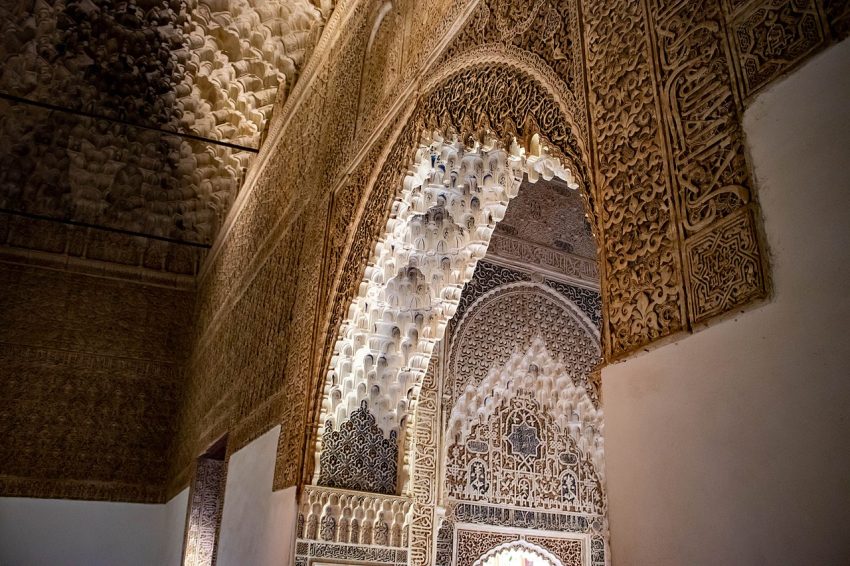
The Sala de los Ajimeces or Hall of the Ajimeces is to the north of the Hall of the Two Sisters. This is a well lit room, due to its double twin balconies on its north wall and the entrance to the Mirador de Lindaraja. The room is rectangular and is covered by a dome of mocarabes from the 16th century. The walls are heavily decorated with plaster-work with religious inscriptions and coats of arms with the Nasrid motto.


| Hours: For opening times of the Sala de los Ajimeces see Alhambra Opening Times. | Price: The Sala de los Ajimeces is part of the Alhambra Complex and access it you need to purchase Alhambra Tickets or a Alhambra Guided Tour. | Website

Click here to read our blog about Generalife, Alhambra 2026: The Architect’s Garden

7. The Lindaraja Lookout

Mirador de Daraxa Alhambra 2
CC BY-SA 2.0 / Brett Hodnett

The El Mirador de Lindaraja or Lindaraja Lookout is a small room overlooking the gardens of Lindaraja. You enter it through a large archway of mocarabes. The lookout would have had views over the valley below, as the chambers further to the north were latter extensions built for Charles V.


Location: Mirador de Daraxa Alhambra 18009 Granada Spain | Hours: For opening times of the Mirador de Daraxa see Alhambra Opening Times. | Price: The Mirador de Daraxa is part of the Alhambra Complex and access it you need to purchase Alhambra Tickets or a Alhambra Guided Tour. | Website

Click here to read our blog about Alcazaba, Alhambra 2026: The Fortress of the Alhambra

8. Rooms of Charles V

Habitaciones de Carlos V Alhambra 2
CC BY-SA 3.0 / Alberto-g-rovi

The Habitaciones de Carlos V or Rooms of Charles V were built around the Patio of the Iron Grille and the Gardens of Daraxa. They were built to house  Carlos V while his Palace was being built, although he never actually stayed in them. They are made up of six rooms, to which you are normally only allowed to visit the first two. As you walk through the first rooms look out of the windows and look for the elusive Comres Baths.

The four rooms you cannot enter are the rooms the Washington Irving lived in when he stayed at the Alhambra.


| Hours: For opening times of the Habitaciones de Carlos V see Alhambra Opening Times. Entrance to this part of the Alhambra is usually restricted and cannot be visited during the ordinary visit of the Alhambra Complex. It may also be included in the "Space of the Month" program, where it will be open one month of the year. | Price: The Habitaciones de Carlos V is part of the Alhambra Complex and access it you need to purchase Alhambra Tickets or a Alhambra Guided Tour. | Website

Click here to read our blog about The Nasrid Palaces 2026 | The Comres Palace

9. Queen's Dressing Room

Torre del Peinador de la Reina Alhambra 4
CC BY-SA 4.0 / LBM1948

The Peinador de la Reina or Queen’s Dressing Room was built around the year 1537 at the top of an existing tower and is so called because the Empress Isabel, Charles V’s wife, lived there. The original tower was built on the walk of the ramparts and it has a view over the whole valley of the river Darro. The tower was decorated by Yusuf I and finished by Mohammed V. During works carried out in 1831 a secret staircase was found that leads to the base of the tower.


Location: Peinador de la Reina Calle Chirimías, 5 18010 Granada Spain | Hours: For opening times of the Torre del Peinador de la Reina see Alhambra Opening Times. | Price: The Torre del Peinador de la Reina is part of the Alhambra Complex and access it you need to purchase Alhambra Tickets or a Alhambra Guided Tour. | Website

Click here to read our blog about The Nasrid Palaces 2026 | The Mexuar

10. Patio of the Iron Grille

Fountain and viewing platform, Patio de la Reja, Alhambra
CC BY-SA 3.0 / Shesmax

The Patio de la Reja or Patio of the Iron Grille is so called because of the iron grilled balcony that was added to its southern wall in 1655. The patio was built at the same time as the Emperor’s Chambers. In the middle of the patio there is a stone fountain and in the corners there are hundred-year-old cypresses.


| Hours: For opening times of the Patio de la Reja see Alhambra Opening Times. | Price: The Patio de la Reja is part of the Alhambra Complex and access it you need to purchase Alhambra Tickets or a Alhambra Guided Tour. | Website

Click here to read our blog about Boabdil, the Kast King of Granada

11. Gardens of Daraxa

Jardin de Daraxa Alhambra
CC BY-SA 3.0 / AdriPozuelo

The Jardines de Daraxa or Daraxa’s Garden was originally a planted in the time of the Nasrid Princes. It was rebuilt between 1526 and 1538, when the Emperor’s Chambers were built.

In the garden there are cypresses,  orange trees and bushes which all surround the big central marble fountain. Originally the fountain was in the was in the Patio of the Gilded Room.

To the south of the patio, you can walk through the basements rooms below the Hall of the Two Sisters, which include a Hall of the Secrets. The room gets its name as if two people stand in opposite corners of the room and one of them speaks quietly towards the corner, the person in the opposite side will hear the words perfectly well. This is possible thanks to the acoustics provided by the special vault.


| Hours: For opening times of the Jardín de Daraxa see Alhambra Opening Times. | Price: The Jardín de Daraxa is part of the Alhambra Complex and access it you need to purchase Alhambra Tickets or a Alhambra Guided Tour. | Website

Click here to read our blog about The Nasrid Dynasty: Rulers of Granada, the Alhambra, and Their Lasting Legacy

Best Tours to Visit Palace of the Lions

If you were wondering which tickets work best to explore the Palace of the Lions? Here’s our selection of the top 4 Alhambra Gardens tickets.

Tips on Visiting the Palace of the Lions

  • Brush up on your history - understanding the history behind the Alhambra is crucial to really immersing yourself in the visit.
  • An Audio Guide is helpful to guide you through the buildings and gardens without having to stop and read.
  • Bring snacks and drinks as there are limited options within.
  • Be prepared to be here for a few hours - wear comfy shoes, bring sunscreen or a jacket as the weather is changeable on the hill.

Palace of the Lions Opening Hours

The Alhambra Monument is open every day except 25th December and 1st January. The general visiting hours for the Alhambra are as follows:

Visiting Alhambra between 15th October – 31st March 

Monday – Sunday: 8:30 AM to 6:00 PM
Nasrid Palaces – Night session: (Fri to Sat) 8.00 PM to 9.30 PM
Generalife Palace – Night session: (Fri to Sat) 8.00 PM to 9.30 PM

Visiting Alhambra between 1st April to 14th October

Monday – Sunday: 8:30 AM to 8.00 PM
Nasrid Palaces Night session: (Tuesday – Saturday) 10.00 PM to 11.30 PM
Generalife Palace and Gardens – Night session – 1st April – 31st May: (Tues to Sat) 10.00 PM to 11.30 PM
Generalife Palace – Night session – 1st Sept – 14th Oct: (Fri to Sat) 10.00 PM to 11.30 PM

Getting to the Palace of the Lions

The Alhambra towers over Granada to the southeast of the old town. Two entrances are available - the pavilion main entrance to the far east of the Alhambra and near the Generalife and the Gate of Justice entrance closer to the old town but only for visitors with QR barcoded tickets.

Walking to the Palace of the Lions

It is at least a 15-minute uphill walk from Plaza Neuva to the Justice Gate and half an hour or more to the main entrance. Bearing in mind that a lot of further walking will be done inside the Alhambra, a taxi - around €8 - may be a sound investment.

Driving to the Palace of the Lions

Several parking lots are available near the Pavilion entrance - simply follow the signs for Alhambra parking. Driving is restricted in many parts of the old town - use the main roads circling around the center and approach the Alhambra by car from the south.

Bus to the Palace of the Lions

Bus C3 connects downtown (Plaza Isabel Catolica) with the Alhambra - use Generalife stop for main entrance or Justice Gate. This is a mini bus so may get full and best not used for time critical journeys.

Powered by GetYourGuide
Moira & Andy
Moira & Andy

Hey! We're Moira & Andy. From hiking the Camino to trips around Europe in Bert our campervan — we've been traveling together since retirement in 2020!

Read our full story here

This website uses affiliate links which earn a small commission at no additional cost to you.

Walking Tour Map
Map of the The Nasrid Palaces | Palace of the Lions walking route with 11 stops in Granada.
Preview map of the The Nasrid Palaces | Palace of the Lions route in Granada, showing 11 stops. Use the interactive map to zoom and tap markers.

Similar Blogs

The Nasrid Palaces 2026 | The Comres Palace

Patio of the Myrtles, Alhambra

This website uses affiliate links which earn a small commission at no additional cost to you.

The Comares Palace was the official residence of the king and it comprises several rooms that surrounded the Patio de los Arrayanes. Its building was initiated by the Nasrid ruler of Granada, Ismail I (1314-25), and continued by Yusuf I (1333-54), though he was assassinated before he could complete the work. So Muhammad V finished it in 1370.

The Sultans wanted this palace to amaze the visitor, so he ordered the architects to build it and adorn it in a exquisite way. The Palace surrounds the Patio de los Arrayanes. The courtyard would be vitally important, it is the core of and building around which all the other rooms are distributed. 

1. Facade of the Palace of Comares

Patio Cuarto Dorado, Palacio Del Mexuar, Alhambra
CC BY-SA 4.0 / Øyvind Holmstad

Behind El Mexuar stands the formal and elaborate Comares façade set back from a courtyard and fountain. The façade is built on a raised three-stepped platform that might have served as a kind of outdoor stage for the ruler. The carved stucco façade was once painted in brilliant colors, though only traces remain.

A dark winding passage beyond the Comares façade leads to a covered patio surrounding a large courtyard with a pool, now known as the Court of the Myrtles.


We recommend to rent a car in Spain through Discover Cars, they compare prices and review multiple car rental agencies. Book your rental car here.

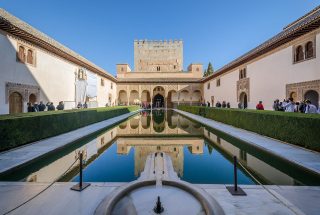
2. Court of the Myrtles

Patio de los Arrayanes with Palacio Carlos V behind Palcia de Comres
CC BY-SA 2.0 / Xavi

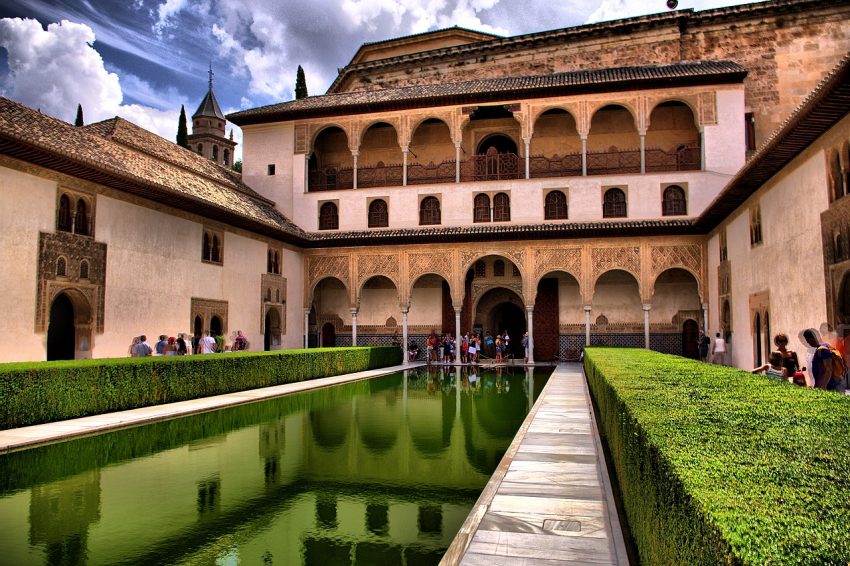
The Patio de los Arrayanes or Court of the Myrtles is the central courtyard of the Palacio de Comares. The elegant and tranquil space takes its name from the myrtle hedges that surround the beautiful reflecting pool. Finely carved arches atop marble pillars form porticoes at both ends of the patio.

Situated at the northern and southern and ends of the pool are the fountains, and behind the fountains are the corridors, each with seven exquisitely embellished arches. As you can see, the middle arch is higher than the other six.

This southern façade have wooden panels decorated with fretwork or intricate carvings and Koranic inscriptions. Across the center are lattice windows with a classic, Moorish arch design. The chambers that originally occupied the second floor were truncated during the construction of the adjacent Palace of Charles V.

The north end of the Court of the Myrtles is similar to the south, although single story.  In the background is Comares Tower, built in the first half of the 14th century.


Location: Court of the Myrtles Calle Real de la Alhambra, 1T 18009 Granada Spain | Hours: For opening times of the Patio de los Arrayanes see Alhambra Opening Times. | Price: The Patio de los Arrayanes is part of the Alhambra Complex and access it you need to purchase Alhambra Tickets or a Alhambra Guided Tour. | Website

Here is a complete selection of hotel options in Granada. Feel free to review each one and choose the stay that best suits your needs.

3. Sala de la Barca

Entrance to the Sala de la Barca Palacio de Comares
CC BY-SA 3.0 / Ismael zniber

The Sala de la Barca or Hall of the Boat is entered via a pointed arch of mocarabes, in the northern gallery of the Court of the Myrtles.

The origin of its name is the Arabic word for blessing, and which seems to have degenerated into the Spanish word barca, which means boat. Although the shape of the ceiling does suggest the inverted hull of a boat, so that could be another reason for it. The original ceiling was destroyed by a fire in 1890 and it was replaced by a copy in 1964.

On the walls you will see plaster work with the Nasrid coat of arms and, inside it, the word “Blessing” and the dynasty’s motto “Only God is Victor”.

The ends of the hall were bedchambers, and the upper floors the Sultans winter quarters. The double arch in the northern wall leads to the Hall of the Ambassadors.


Location: Boat Room Alhambra Calle Real de la Alhambra, s / n 18009 Granada Spain | Hours: For opening times of the Sala de la Barca see Alhambra Opening Times. | Price: The Sala de la Barca is part of the Alhambra Complex and access it you need to purchase Alhambra Tickets or a Alhambra Guided Tour.

Traveling to a country with a different currency? Avoid ATM transaction fees and pay in local currency with a Wise Card. Having used it for over 5 years, we've saved loads on fees!

4. Hall of the Ambassadors

Salon de Embajadores Palacio de Comres
CC BY-SA 3.0 / Shesmax

The Salón de Embajadores or Hall of the Ambassadors is the centerpiece of the Royal Palaces. The Hall is covered by a majestic dome of gilded wood. The ceiling, has a symbolic layout, emphasized the power of the Sultan, sitting on his throne and presiding over the room.

The lower part of the wall are tiles above which a rich plaster-work combines geometrical patterns with vegetal patterns decorated with leaf and flower motifs.


Location: Salón de los Embajadores s/n Calle Real de la Alhambra 18009 Granada Spain | Hours: For opening times of the Salón de Embajadores see Alhambra Opening Times. | Price: The Salón de Embajadores is part of the Alhambra Complex and access it you need to purchase Alhambra Tickets or a Alhambra Guided Tour. | Website

Click here to read our blog about 15 Best Things to See and Do in Granada, Spain (2026)

5. Comres Baths

Bano de Comares Palacio de ComaresAlhambra 5
CC BY-SA 3.0 / AdriPozuelo

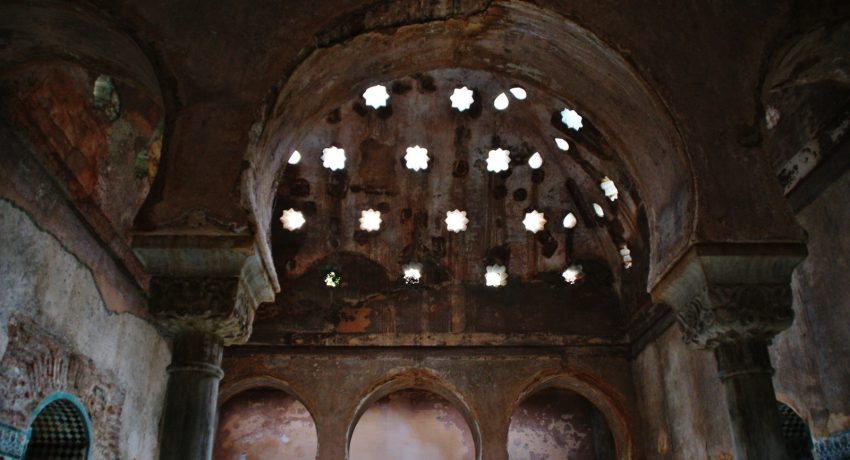
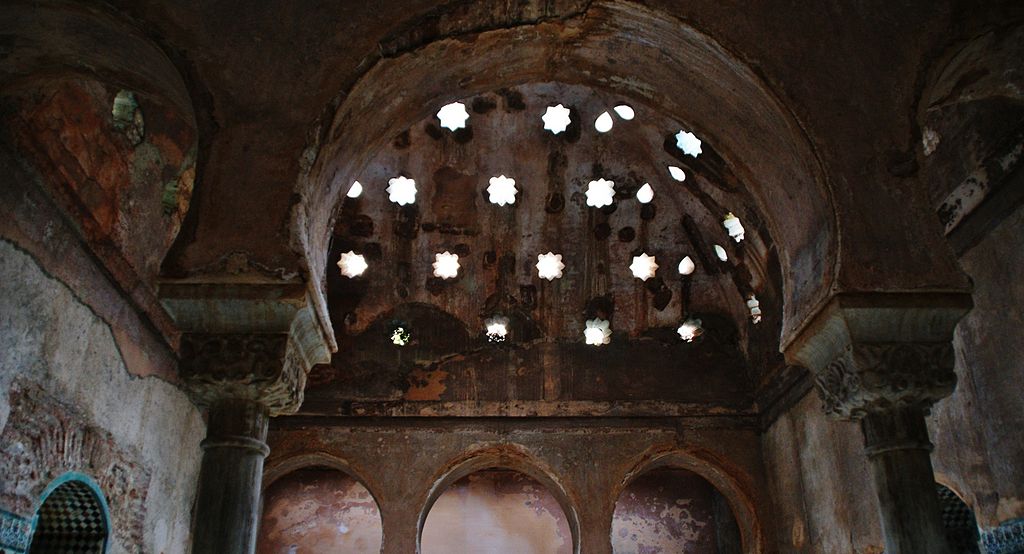
As you walk down the eastern side of the Court of the Myrtles try and get glimpses of the Moorish baths of the palace. Although not normally open to the public, unless it forms part of the ‘Space of the Month’, you can see parts of it as you walk around here and in the Palacio de los Leones. The baths are two story and from the Court of the Myrtles you would enter and descend to the steam rooms.  The whole steam area of the hammam is covered with vaults perforated with a multitude of star shaped skylights, which were used for lighting and vents.


| Hours: For opening times of the El Baño de Comares see Alhambra Opening Times. Entrance to this part of the Alhambra is usually restricted and cannot be visited during the ordinary visit of the Alhambra Complex. It may also be included in the "Space of the Month" program, where it will be open one month of the year. | Price: The El Baño de Comares is part of the Alhambra Complex and access it you need to purchase Alhambra Tickets or a Alhambra Guided Tour. | Website

Click here to read our blog about The Nasrid Palaces 2026: The Heart of the Alhambra

Powered by GetYourGuide
Moira & Andy
Moira & Andy

Hey! We're Moira & Andy. From hiking the Camino to trips around Europe in Bert our campervan — we've been traveling together since retirement in 2020!

Read our full story here

This website uses affiliate links which earn a small commission at no additional cost to you.

Walking Tour Map
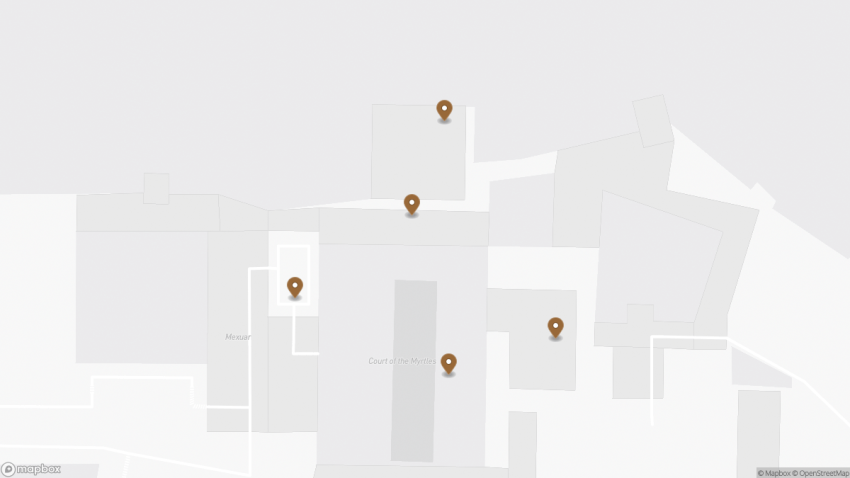
Map of the The Nasrid Palaces | The Comres Palace walking route with 5 stops in Granada.
Preview map of the The Nasrid Palaces | The Comres Palace route in Granada, showing 5 stops. Use the interactive map to zoom and tap markers.

Similar Blogs

The Nasrid Palaces 2026 | The Mexuar

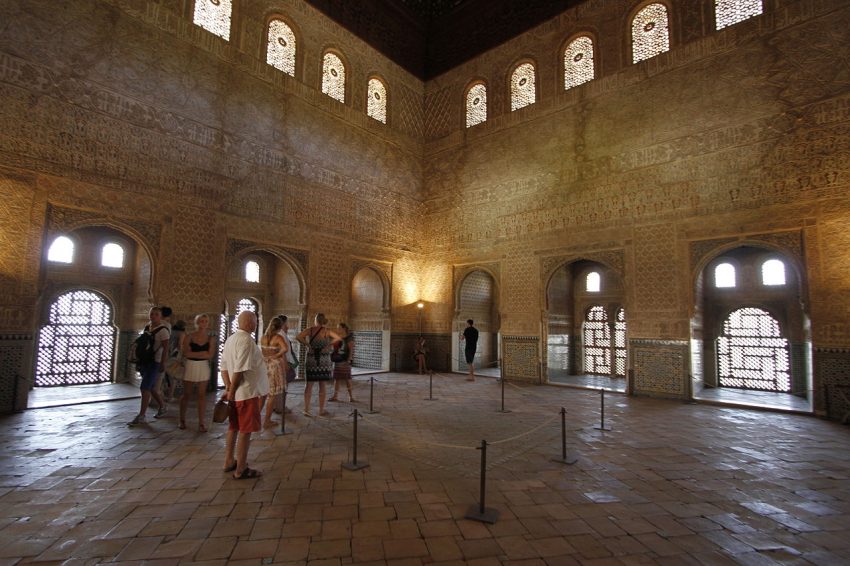
Sala del Mexuar, Alhambra
© Andrew Ashton

This website uses affiliate links which earn a small commission at no additional cost to you.

The Mexuar was the first palace to be built by Ismail I at the start of the 14th Century. This became the semi public part of the palaces administering justice and controlling state affairs. It was partially destroyed by Yusuf II when he built the Comares Palace behind it in the mid 14th Century. This became the official residence of the ruler. The Palace of the Lions was added to this at the end of the 14th Century by Muhammad V and was the private area where the harem was and included the Royal baths.

1. Madrasa de los Principes

Torre de Mohamed Alhambra Grenada
CC BY-SA 4.0 / Øyvind Holmstad

While waiting to enter the Nasrid Palaces you will see stone walls in a garden. This was the Madrasa de los Principes, and at one time the main entrance to the Mexuar.

La Madraza was a school for studying science and philosophy. The Madrasa de los Principes or Madrasa of the Princes was exclusive for the children of the family of the Kings. There are only remnants of the Madraza left, but it probably contained a study hall, an oratory, and rooms for those who worked there. You can see one room that is at an angle, this would have been the minaret which points to the rising sun in a south easterly direction.

In Granada books and study were very important. Many manuscripts were translated to disseminate knowledge and information. Unfortunately not many of the manuscripts have survived because when the Christians conquered it, they burned many of them.


| Hours: For opening times of the Madrasa de los Príncipes see Alhambra Opening Times. | Price: The Madrasa de los Príncipes is part of the Alhambra Complex and access it you need to purchase Alhambra Tickets or a Alhambra Guided Tour.

We recommend to rent a car in Spain through Discover Cars, they compare prices and review multiple car rental agencies. Book your rental car here.

2. The Patio of Machura

Patio de Machuca , Palace of Mexuar, Palacio Nazaries, Alhambra
CC BY-SA 4.0 / Rumomo

The next part of the Mexuar we come to is the Patio of Machuca, at the moment this has a portico to the north and hedge to the south and west.

The Patio of Machuca would have been a courtyard with buildings or Porticos built around it. In the center, would have been a pool shaped like the Roman nymphaea. Water would flow into it from the various round fountains flowed into the pool. The cypress trees to the south were planted at the beginning of the last century to simulate the portico that would have stood there, miroring the portico to the north.

It is called the Patio of Machuca as this the architect of the Palace of Charles V, Pedro Machuca lived in the small tower to the North. You can see the Patio of Machuca from just before entering the the main entrance to the Mexuar, of from the windows in the Sala de Mexuar.


| Hours: Patio de Machucais normally restricted. However if you access the Nasrid Palaces in a group you pass close by it. For opening times of the Patio de Machuca see Alhambra Opening Times. | Price: The Patio de Machuca is part of the Alhambra Complex and access it you need to purchase Alhambra Tickets or a Alhambra Guided Tour. | Website

Here is a complete selection of hotel options in Granada. Feel free to review each one and choose the stay that best suits your needs.

3. Torre de Manchura

alhambra 967024
alhambra 967024

Behind the northern portico of the  Patio of Machura you can see the roof of the Torre de Manchura. This is where Pedro Machuca, and his son Luis Machuca lived.


| Hours: For opening times of the Torre de Machuca see Alhambra Opening Times. | Price: The Torre de Machuca is part of the Alhambra Complex and access it you need to purchase Alhambra Tickets or a Alhambra Guided Tour. | Website

Traveling to a country with a different currency? Avoid ATM transaction fees and pay in local currency with a Wise Card. Having used it for over 5 years, we've saved loads on fees!

4. Sala del Mexuar

Sala del Mexuar, Alhambra
© Andrew Ashton

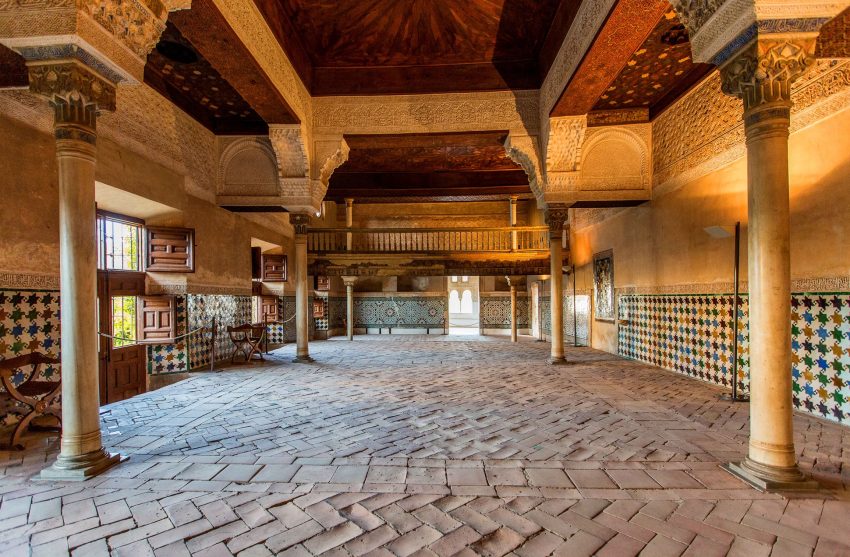
At the normal entrance a passage leads directly into the Sala del Mexuar.

This room is the first one that you will enter in the palace. It was used as a council chamber and as a waiting room for the people who wanted to see the Sultan after climbing up  from the Albaicin through the Gate of Arms. Most of the public would not have been allowed beyond this point. The chamber has been altered considerably since the time it was built.

In the 16th century it was converted into a baroque chapel to celebrate the visit of King Philip IV. A second story was added behind the wooden balustrade, for the choir to be sat. Two coats of arms were added to the south wall which would have formed twin Hercules Columns on them with the missive “Plus Ultra”, with a crown above them. One has now been moved to the east wall, as it was moved when the entrance way was added. You can see its crown carved into the stone, above the doorway.  The alter would have been positioned between the two.

Look out for:

  • You can look out of the windows on the west wall for a closer look at the The Patio of Machura.
  • Look at the repeating Islamic tiles of the dado, probably dating from the sixteenth century, and the work of a Sevillian potter, Juan Pulido.
  • At the top of the dado the repeated inscription “al-milk li-l-lah, al qudra li-l-lah, al-´iza li-l-lah”, which means “The kingdom of god, the greatness of God, the glory of God”.
  • The crown above the doorway.

Location: Mexuar room s/n Calle Real de la Alhambra 18009 Granada Spain | Website

Click here to read our blog about 15 Best Things to See and Do in Granada, Spain (2026)

5. Oratorio de Mexuar

Oratorio de Mexuar La Alhambra Granada
CC BY-SA 3.0 / AdriPozuelo

At the far end of the Mexuar a new entrance leads into the Oratory, a small, narrow room whose outer wall is in effect one long balcony, though divided into twin windows. The mihrab is accurately placed and points ESE; it is built as a horseshoe arch, richly ornamented, and bears Arabic inscriptions, of which the aptest is that which says, ‘Don’t be one of the remiss. Come to prayer.’ This is only one of the spots from which a glorious view of the Albaicín and the mountains can be enjoyed, though a wider panorama will present itself later.


| Hours: For opening times of the Oratorio de Mexuar see Alhambra Opening Times. | Price: The Oratorio de Mexuar is part of the Alhambra Complex and access it you need to purchase Alhambra Tickets or a Alhambra Guided Tour. | Website

Click here to read our blog about The Nasrid Palaces 2026: The Heart of the Alhambra

6. Patio del Cuarto Dorado

Patio Cuarto Dorado, Palacio Del Mexuar, Alhambra
CC BY-SA 4.0 / Øyvind Holmstad

The Patio del Cuarto Dorado or Patio of the Golden Room is small and plain. During the Christian period wooden gallereies connected the higher chambers. The floor is laid with white marble slabs and a low, shallow fountain of darker marble in the form of a scalloped bowl plays in the center. The fountain is a reproduction with the original being moved to the Jardín de Daraxa.

Geometric tile mosaics adorn the lower walls and patterned ones surround the rectangular doorways. The one leading north into the Patio del Cuarto Dorado is a horseshoe, on slender columns with mocárabe or stalactite imposts. The upper windows are once more partly ajimez, with wooden jalousies.


| Hours: For opening times of the Patio del Cuarto Dorado see Alhambra Opening Times. | Price: The Patio del Cuarto Dorado is part of the Alhambra Complex and access it you need to purchase Alhambra Tickets or a Alhambra Guided Tour. | Website

Click here to read our blog about Generalife, Alhambra 2026: The Architect’s Garden

7. Cuarto Dorado

arabesque Cuarto Dorado La Alhambra Granada
CC BY-SA 3.0 / Javierbl 90

The Cuarto Dorado or Gilded Room is so called because of the beautiful coffered wooden ceiling, which was gilded and redecorated in the time of the Reyes Católicos (Catholic Monarchs. It is a small room entered through a series of three arches; it is in line with the Oratory, at the back of the mihrab, and has the same glorious view from its windows. It was decorated in the Mudéjar style by the Catholic Sovereigns.


| Website

Click here to read our blog about Alcazaba, Alhambra 2026: The Fortress of the Alhambra

Powered by GetYourGuide
Moira & Andy
Moira & Andy

Hey! We're Moira & Andy. From hiking the Camino to trips around Europe in Bert our campervan — we've been traveling together since retirement in 2020!

Read our full story here

This website uses affiliate links which earn a small commission at no additional cost to you.

Walking Tour Map
Map of the The Nasrid Palaces | The Mexuar walking route with 7 stops in Granada.
Preview map of the The Nasrid Palaces | The Mexuar route in Granada, showing 7 stops. Use the interactive map to zoom and tap markers.
Similar Blogs

Boabdil, the Kast King of Granada

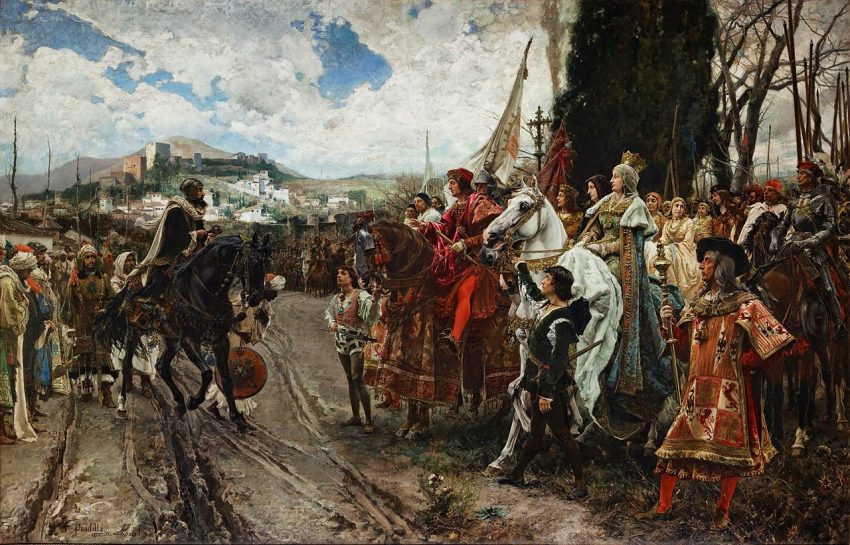
The Fall of Granada 1492
Public Domain / Francisco Pradilla y Ortiz: La rendición de Granada wikidata:Q19032360 Artist Francisco Pradilla y Ortiz

This website uses affiliate links which earn a small commission at no additional cost to you.

Abu Abdullah was the twenty-second and last Nasrid ruler of Granada in Iberia. Boabdil is a Spanish rendering of the name Abu Abdullah. Boabdil was born in the Alhambra Palace his father was Abul Hassan Ali, who was also known as Muley Hacén and his mother the Sultana Aixa.

From the start, a shadow lay over him, as court astrologers predicted that he would suffer great misfortune, to the extent that he became known by the nickname El Zogoibi or the Unlucky One. 

Later his nickname would begome “el rey chico” or “the small king” which did not have anything to do with his stature but referred to the size of his ever-diminishing kingdom!

If you've seen paintings like “La rendición de Granada” by Francisco Pradilla; or a series like “Isabel” or “Réquiem por Granada” you'll already have an image of what this king looked like: brown skin, jet black hair… but it seems that Boabdil was blond, tall, and pale.

Alhambra – a Palace of Treachery

When he was born the Alhambra was under the rule of his Grandfather the Sultan Abu Nasr Sad, and was a Palace of violence and treachery. In 1461 the his grandfather wanted to rid himself of the powerful Abencerrajes family, who had always been his supporters and promoters. The terrible story goes that he invited them all to a banquet at the Alhambra and had nearly the entire clan slaughtered there, including his own minister Mufarrij. Only a few escaped and fled to Malaga.

In 1464 Boabdil would have been about five when his grandfather was overthrown by his father, in a Palace coup. His grandfather was placed under house arrest in Salobreña castle, and died a year later.

His father, Abul Hassan Ali, known by the Spaniards as Muley Hacén, He was known to them as Muley Hacén, ‘Muley’ being the Castilian version of the Arabic for ‘My Lord’ and ‘Hacén’ the Christian version of his own name, Hasan.

He gave his name to the highest mountain peak on the Iberian Peninsula, Mulhacén, where it is said he was buried.

Amidst this treachery and treason Boabdil’s early education would have begun at the age of five, sometimes at the mosque of the Alhambra but also with private tutors in the Madrasa de los Príncipes. He would have studied the Koran thoroughly, and learned not only arithmetic, Arabic grammar, poetry, logic, algebra, science, history, law and theology, but also how to ride, and to use a lance and sword.

His father was supposed to be a cruel and aggressive character and started his reign by trying to eradicate the surviving members of the Abencerrajes family. The Abencerrajes in turn through their support behind the king’s brother, Abu Abdallah Muhammad, known as El Zagal – the Valiant, and proclaimed him as their Sultan.

His father turned his attentions on constant attacks on the Christians. These raiding parties forced the enemy to sign a series of truces, leading to a relatively long period of peace from 1465 until about 1481. The peace was helped by the War of the Castilian Succession (1475 – 1479) between Isabella, who was married to Ferdinand, heir to the Crown of Aragon, and Portugal. By 1479 there was peace with Portugal and Castilian and Aragon united under the Catholic Monarchs.

At the same time the Sultan seemed to undergo a breakdown, devoting his time to pleasure and dancing girls, growing more confused and began to decline. This may have been brought on by a series of portends from the Kings Astrologers, from the appearance of a comet, horrific flooding of the River Daro, and predictions of an ancient weathercock.

A Woman Scorned

Boabdil’s mother was a powerful Nasrid princess, said to have been descended in a direct line from the Prophet Muhammad. She was the daughter of Muhammad IX (1396-1454), and the widow of Muhammad X (1415-1454), who was the eighteenth Nasrid Sultan who had been executed by Abul-Hasan on behalf of his father, Sa’d.

For the first twenty years of marriage war peaceful and Boabdil had a younger brother and sister.

The sultan had organised an attack on the small Christian town of Aguilar in 1471, and the raiding party captured Isabel de Solís, the daughter of the knight commander of the town. The young girl was very beautiful and of good appearance and they called her Zoraya, which means ‘lamp’ in Hebrew. At first she was a slave but caught the eye of the king. Abul-Hasan, fell in love and married Zoraya. He gave her land, houses and a privileged position at court. He lived with her in the Comares tower.

Aixa on the other hand had been banished to the rooms surrounding the Patio of the Lions with her children and loyal servants and advisers and the king never spoke to her or saw her.

When Zoraya gave birth to two sons, the Royal Princes Sa'd and Nasr there was a threat posed to Boabdil, and the position for Aixa became intolerable.

A Desperate Escape to Guadix

In 1482 it is thought that two Abencerrajes knights had heard of a threat to the life of Boabdil and his brother Yusef. They conceived a dramatic plot to remove the reigning sultan and replace him with Boabdil. They arranged a time for men to wait with horses next to an irrigation channel on the outskirts of the Generalife gardens. The two princes, using rope, climbed down the side of the tower that they were imprisoned in. They made their way to Guadix, where Boabdil was declared Sultan and they gathered their troops and waited for an opportunity to strike.

After an escalation of raids the Christians lead a successful surprise attack on Alhama and then an unsuccessful one on Loja. Abul-Hasan took his troops and defended Loja. While Abul-Hasan was celebrating the victory at Loja, the news reached him that, with the help of the Abencerrajes, his son had arrived in Granada, and occupied the Alhambra. Boabdil's father retreated, for the next year he governed Malaga and Ronda which Boabdil controlled Granada and Almeria.

In 1483 Abul-Hasan enjoyed a great victory against the Christians, who had tried to capture Ajarquía, in Malaga. He also retaliated by seeking a proclamation from the clerics that Boabdil's claim to the throne was not legitimate. The clerics agreed that Boabdil had broken his oath of fealty and had been consorting with Christians.

Boabdil Caputured

Not to be outdone and to gain more prestige, Boabdil endeavored to invade the region of Castile, unfortunately things did not go as planned and he was captured and imprisoned in the castle at Lucena for three years.

Boabdil's father took back Granada in 1483 and Yusef retreated to Almeria. However his father began to suffer bouts of illness, to the extent that in September 1484 he was unable to take part in a battle due to a form of epilepsy which gave him seizures and bouts of blindness.

Seizing the advantage Boabdil’s brother El Zagal declares himself Sultan and the country erupts into Civil War. El Zagal is victorious and sends his brother like his father before him to Salobreña castle, where he soon died.

The Fall of Granada

In 1487, three years after his capture, in exchange for his freedom, Boabdil agreed to govern Granada under the Catholic kings, to released 400 Christian slaves and to pay them 12,000 gold doubloons.

The next six years saw more frequent civil wars and internecine strife, greatly favoring the ever-stronger Christian forces who took the Moorish cities one by one and eventually laid siege to Granada. The city fell on 2 January 1492 and, four days later, after total capitulation by its inhabitants, the reconquista came to an end.

Departure of the Boabdil family from the Alhambra

From this magnificent center of culture, of science and learning, of glorious art and architecture, Boabdil was expelled and the armies of Fernando and Isabel, the Reyes Católicos, or Catholic Kings, raised the Christian cross on the Alcazaba alongside their royal standards of Castile and Aragón.

Boabdil was granted a fiefdom in the region of Las Alpujarras and left Granada by the southern route to La Zubia. About 12 kilometres from the city he paused at a mountain pass and looked back at Alhambra and sighed for what he had lost. His mother travelling with him is said to have been somewhat unsympathetic, telling him: “You do well to weep like a woman for what you could not defend like a man.

Farewell from King Boabdil to Granada - Alfred Dehodencq
Farewell from King Boabdil to Granada – Alfred Dehodencq

They moved to Andarax and there they remained until the Castilians, recanting once again on their agreements, decided to expel them from Spain.

Thus, in October, boabdil, his mother Fátima, his sister, his son Ahmed and Yusef together with a small retinue, left from the harbour at Adra towards Africa. Morayma “the only woman Boabdil was Known to have loved”, says one chronicler, “the only being who could have made the suffering of his exile bearable”, died a few days before leaving the Alpujarras.

Boadbil lived in exile for less than a year in the Alpujarras before travelling to Fez in Morocco where he died fighting other battles in 1527.

Powered by GetYourGuide
Moira & Andy
Moira & Andy

Hey! We're Moira & Andy. From hiking the Camino to trips around Europe in Bert our campervan — we've been traveling together since retirement in 2020!

Read our full story here

This website uses affiliate links which earn a small commission at no additional cost to you.

Similar Blogs

The Nasrid Dynasty: Rulers of Granada, the Alhambra, and Their Lasting Legacy

Paintings of the 10 Kings, Sala de los Reyes, Alhambra
CC BY-SA 4.0 / Rumomo

This website uses affiliate links which earn a small commission at no additional cost to you.

The Nasrid dynasty was the last Moorish and Muslim dynasty in Spain. The dynasty rose to power after the defeat of the Almohad Caliphate in 1212 at the Battle of Las Navas de Tolosa. Twenty-three different emirs ruled Granada from the founding of the dynasty in 1232 by Mohammed I ibn Nasr until January 2, 1492, when Muhammad XII surrendered to the Christian Spanish kingdoms of Aragon and Castile.

Muhammad I (1195 - 1273)

Muhammad I was the first Nasrid Sultan and ruled between 1232 and 1273. In 1232 Muhammad ibn al-Ahmar the ruler of Jaen rebelled against the leader of Al-Andalus, Ibn Hud. While he did briefly take control of Córdoba and Seville, he lost both cities to Ibn Hud and was forced to acknowledge Ibn Hud's suzerainty. In 1236, Muhammad I switched sides and joined forces with the Catholic monarch Fernando III to conquer Cordoba in exchange for the city of Granada. He became a tributary vassal of the Christian king Ferdinand III of Castile and later of Alfonso X.

He installed his capital in Granada from 1237 and lived in the Alcazaba, built by the Zirids in the 11th century. He began extending this and building the Alhambra. He added three new towers to the Alcazaba, which were the Torre Quebrada, Torre del Homenaje and the Torre de la Vela.

He concentrated on protecting his modest territories, which included the cities of Malaga and Almeria. The emirate spanned 240 miles between Tarifa in the west to Almería in the east, and was around 60 to 70 miles wide from the sea to its northern frontiers. In 1248 he helped the Christian kingdom take Seville from the Moors. He died in 1273 after falling off his horse and was succeeded by his son, Muhammad II.

Muhammad II – The Wise (1235 - 1302)

Muhammad II was the second Nasrid Sultan and ruled between 1273 and 1302. He was caught between Castile to the north and the Muslim Marinid state to the south. He survived through diplomacy and battle.

Muhammad III (1257 - 1314)

Muhammad III was the third Nasrid Sultan and ruled between 1302 and 1309. Succeeded his father possibly after poisoning him. Initial military successes allowed him to control Ceuta in North Africa. This worried Castile, the Marinids, and Aragon who allied against him.

El Palacio Del Partal, Alhambra

He was responsible for the construction of the Great Mosque of the Alhambra as well as the Palacio de Partal within the Alhambra. He also oversaw construction of a nearby public bathhouse, the income from which paid for the mosque. He resided in the Alcazaba, while the palaces were being built and was the last Nasrid to do so. From then on, the Alcazaba was only used as a fortress for military purposes.

Later in his life, he became visually handicapped and his Vizier grew in power. Muhammad was replaced by his half-brother Nasr in 1309 after a palace revolution.

Nasr (1287 - 1322)

Nasr was the fourth Nasrid Sultan and ruled between 1309 and 1314. Despite gaining peace with Castile, he was deposed in 1314 by Ismail I.

Ismail I (1279 - 1325)

Ismail I was the fifth Nasrid Sultan and ruled between 1314 and 1325. He was assassinated on 8 July 1325. It is thought that Ismail I built the Mexuar and the Puerta de las Armas. He was the grandson of Sultan Muhammad II, the second Nasrid king.

Torre De La Vela, Alhambra
Torre De La Vela & Puerta de las Armas, Alhambra

Muhammad IV (1315 - 1333 )

Muhammad IV was the sixth Nasrid Sultan and ruled between 1325  and 1333 and was Ismail I’s son. He succeeded his father at ten years old. Like his father Ismail I, he was assassinated and succeeded by his younger brother.

Yusuf I – He who is aided by God (1318 - 1354)

Yusuf I was the seventh Nasrid Sultan and ruled between 1333 and 1354. He established peace with Alfonso XI of Castile for four years and then allied with the Marinid dynasty to attack him. Yusuf I was assassinated whilst praying in a mosque in Granada at the age of thirty-six and was succeed by his son Muhammad V.

Yusuf constructed the Puerta de la Justicia, forming the grand entrance to the Alhambra in 1348. There was a palace by the Great Mosque which Yusuf I destroyed completely. He started some improvements in the Torre de Comares‎, the Patio de los Arrayanes and the El Baño de Comares.

Bano De Comares, Palacio De Comares,Alhambra 5
Bano De Comares, Palacio De Comares, Alhambra

Muhammad V – He who is contented with God (1338 - 1391)

Muhammad V was the eighth Nasrid Sultan and ruled between 1354 and 1359, temporarily deposed then ruled between 1362 and 1391. He was overthrown in 1359 his half-brother Ismail II and sought protection with the Marinid sultan of Fez. Ismail II himself was was overthrown and murdered within a year by his half brother Muhammad VI in 1360. Muhammad V plotted his return to power for three years. He was assisted by King Peter I of Castile (Pedro el Cruel) who lured Muhammad VI to Seville, and cut his head off. Muhammad VI returned and sat on the throne for another 29 years.

Patio De Los Arrayanes With Torre De Comres Behind, Palcio De Comres 3
Patio De Los Arrayanes With Torre De Comres Behind, Palcio De Comres

Muhammad V is best known for completing the many changes to the royal palace started by his father like the Torre de Comares, the Patio de los Arrayanes and the Comares Baños. He then extended the gallery that would later be called Machuca and constructed the Palacio de los Leones and the Cuarto Dorado.

David Roberts Patio Of The Lions

Ismail II (1338 - 1360)

Ismail II was the ninth Nasrid Sultan and ruled between 1359 and 1360. He conspired with his mother, his full blood sister and her husband Muhammad VI to take control of the kingdom and depose Muhammad V, who escaped.

The Black Death, which reached Spain in 1348, and together with the internal wars that weakened Christian Castile, there was relative peace between Granada and Castile.

Muhammad VI – Victor by the grace of God or The Red King (1332 - 1362)

Muhammad VI was the tenth Nasrid Sultan and ruled between 1360 and 1362. After helping his brother in-law Ismail II depose the king he then deposed Ismail II. He was known in Spanish as El Bermejo for his red hair.

Yusuf II (1376-1417) 

Yusuf II was the eleventh Nasrid Sultan and ruled between 1391 and 1392. He was the eldest son of Muhammad V.

Muhammad VII (c. 1370-1408)

Muhammad VII was the twelfth Nasrid Sultan and ruled between 1392 and 1408 and was the was the son of Yusuf II. In 1394, he defeated an invasion by the Order of Alcántara. He signed peace treaties with Aragon and Navarre.

Yusuf III (1376-1417)

Yusuf III was the thirteenth  Nasrid Sultan and ruled between 1408 and 1417 and was the was the older brother of Muhammad VII. When his father died Yusuf was imprisoned in Salobreña, as a result of involvement in a conspiracy so did not initially inherit the throne.

Palacio De Yusuf III, Alhambra 5
Palacio De Yusuf III, Alhambra

Yusuf had constructed the northernmost of the Nasrid dynasty palaces on the hill of the Alhambra. Unfortunately the Palacio de Yusuf III was destroyed in the Christian period.

The Nasrid Civil Wars – the Bannigas and Abencerrajes

There was a rivalry between the two rival families, Bannigas and Abencerrajes. They would each support an opposing kings in a series of rebellions.

In 1431, there were several claimants to the throne of Granada.

The Castilian Catholic King John II, would also lend support to different sultans. He supported Muhammad IX in overthrowing Muhammad VIII, he then supported Yusuf IV in overthrowing Muhammad IX.

Muhammad VIII – The Left Handed (1411-1431)

Muhammad VIII was the fourteenth Nasrid Sultan and ruled between 1417 and 1419, then 1427 to 1429 and was son of Yusuf III. In 1418 he aided the Marinid Sultanate in the Seige of Ceuta, which was held by the Portuguese. He was deposed twice by Muhammed IX, and saw the start of the decline of Granada.

Muhammad IX (1396-1454) 

Muhammad IX was the fifteenth Nasrid Sultan. He held Granada 4 different times over a period of thirty five years.

He was supported by the Abencerrajes family who wished to oppose Muhammad VIII. He held the throne for eight years between 1419 - 1427 before his high taxes caused a rebellion, and his exile to Tunisia and Muhammad VIII's return to rule. He returned 2 years later and successfully besieged and then executed Muhammad VIII.

He ruled from 1430 - 1431, but after loosing the Battle of Higueruela in 1431, he lost popular support and the aid of the Abencerrajes family, when rebellion broke out he retreated to the city of Malaga.

The usurper Yusuf IV, became the sixteenth Nasrid Sultan in 1432. He was supported by the Abencerrajes family and King Juan II. His sultanate did not last long due to his unpopular treaties with Castile. Muhammad IX returned, acclaimed as liberator and Yusuf IV was executed.

Muhammad IX fought the Christians for seven years before a truce was declared in 1439.

In 1445 Muhammad IX had to fight against his nephew Yusuf V. Muhammad IX abdicated and retreated to Malaga. Yusuf V became the seventeenth Nasrid Sultan when he took over Granada in 1445.

Yusuf V ruled for a year before being replaced by Muhammad X who was the the eighteenth Nasrid Sultan and reigned between 1446-1448. He was dethroned Muhammad IX after a couple of years.

Muhammad IX remained Sultan for the next seven years before dying of natural causes in 1453.

Muhammad XI- The little (1420 - 1455)

Muhammad XI was the nineteenth Nasrid Sultan and ruled between 1451-1455. He was the son of Muhammed VIII. His ascension to the throne was supported by Muhammad IX. He vigorously attacked the powerful Abencerrages family. He ruled the eastern part of the Nasrid Kingdom with his rival and successor in the west. He was strangled by order of the new sultan Abu Nasr Said.

Abu Nasr Sad –  Zaid Muley (C1450 - 1465)

Sad was the twentieth Nasrid Sultan and ruled between 1455- 1462 and again from 1462 to 1464. He rose to power with the aid of the Abencerrages family. He had spent much of his life at the Court of Castile-León, protected by King Enrique IV. Although a promoter of peace he had a number of clashes with Enrique IV, and lost Gibraltar in August 1462.

Earlier in the year in July 1462, the Emir of Granada, Abu Nasr Sad, had opposed the Abenseragi clan and killed members of the clan in the Alhambra, with other family members fleeing to Malaga. In September they proclaimed the new Emir of Yusuf V. In November they had occupied the throne of Granada and Yusuf V was Sultan for a second time. Unfortunately he dies one month later.

In August 1464, Abu Nasr Sad, was removed from the throne by his eldest son and heir, Abul al-Hassan Ali, who was supported by the Abenseragi clan.

Ali Abu’l-Hasan – Muley Hacén (c 1430 - 1485)

Ali Abu’l-Hasan was the twenty-first Nasrid Sultan and ruled between 1464-1482 and 1483 - 1485 and was the son of Sa’d. Muley being derived from Arabic Mawlay and meant “My Lord“. In 1462, he defeated the Castilians in the battle of Madrono. In 1477 he refused to pay tribute to the Crown of Castile.

In 1481 Ali Abu’l-Hasan ordered an invasion to the city of Zahara de la Sierra by surprise, killing and enslaving the unarmed Christian Zaharans. This action was taken by Isabella I of Castile as a reason to start the war against Granada War (1482 - 1491). The ten-year war was not a continuous effort but a series of seasonal campaigns launched in spring and broken off in winter.

He fell in love with a Christian slave named Isabel de Solís, she converted to Islam and became his wife Zoraida or Soraya.

Muhammad XII – Boabdil (c. 1460 - 1533)

Muhammad XII Abu Abdallah was the 22nd and last Nasrid Sultan he ruled between 1482-1483 and 1487 - 1492.  

His nickname of ‘el rey chico’ (the small king) did not in fact have anything to do with his stature but referred to the size of his ever-diminishing kingdom.  He was also called el zogoybi, the unfortunate.

In 1482 there was an uprising by the population against the extraordinarily high taxes.

Following this, instigated by his mother, Aixa, a jealous wife, Boabdil rebelled against his father, Muley Hacén, with the aid of the Abencerrajes family seized the Alhambra in 1482 and was recognized as sultan. Muley Hacén was driven from the land and took refuge with his brother in Malaga.

After a failed invasion of Castile he was taken prisoner and Boabdil father retook the throne in 1483 until 1485. His father was deposed his brother, Boabdil’s uncle, Muhammad XIII.

Boabdil gained his freedom and Christian support to recover his throne, if he held Granada as a vassal state to the Catholic monarchs.

Muhammad XIII – The Brave – El Zagal

Muhammad XIII Abu Abdallah was the twenty-third Nasrid Sultan and ruled between 1485 - 1486. He was Muley Hacén's brother and the governor of Malaga. In 1482 he fought with his older brother against the forces of his nephew, Boabdil. In 1483 when his nephew is captured his brother retook the throne. His brother suffered from epilepsy and possibly went insane, so Muhammad XIII with the assistance of the vizier took the throne in 1485. A year later in 1486 Boabdil had been released and in 1487 El Zagal, retreated from Granada to his lands of Malaga , Almeria and Guadis. By 1490 he had lost his lands to the Castilians and fled to North Africa to raise more troops. In 1491 he was captured by king Fez of Morroco, a friend of Boabdil and blinded, dying three years later.

The Fall of Granada

By the end of 1491, the armies of Ferdinand and Isabella were at the gates of Granada itself. Muhammad XI secretly agreed to hand over the city to the Christians. He reunited with his eldest son Ahmad.

The Fall Of Granada 1492

On January 2, 1492, as he left the city with his wife Moraima, the rest of his family and retainers, he paused to look back at the Alhambra palace, which his ancestors built two hundred and fifty years before, and the whole of Granada. “Allahu akbar!” he said, “God is most great,” and burst into tears. His mother Aisha chided him: “You do well to weep like a woman, for what you could not defend like a man.” The spot where Muhammad XI took his farewell bears the name “el ultimo sospiro del Moro” which translates as “the last sigh of the Moor.”

Gustave Dore Crusades An Enemy Of The Crusaders
Boabdil – The Moors Last Sigh

The family retired to an estate in the Alpujarras Mountains. Moraima died soon afterward, and was buried in Monjudar. Muhammad XI crossed over to Morocco. He never returned to Spain.

Powered by GetYourGuide
Moira & Andy
Moira & Andy

Hey! We're Moira & Andy. From hiking the Camino to trips around Europe in Bert our campervan — we've been traveling together since retirement in 2020!

Read our full story here

This website uses affiliate links which earn a small commission at no additional cost to you.

Similar Blogs

History of the Alhambra

The Hill of the Alhambra, Granada
Public Domain / Metropolitan Museum of Art

This website uses affiliate links which earn a small commission at no additional cost to you.

The Alhambra is one of the most popular tourist sites in Spain. It is an ancient palace and fortress situated on the outskirts of the town of Granada in Andalusia. It was constructed by the Moors who invaded the country in the 8th century, and is a fine example of the hybrid style known as mudéjar art and a powerful symbol of Spain's multicultural past.

The Alhambra was so called because of its reddish walls, in Arabic it was called “qa’lat al-Hamra” which means Red Castle. It is located on top of the hill al-Sabika, on the left bank of the river Darro, to the west of the city of Granada and in front of the neighborhoods of the Albaicin and of the Alcazaba

Early History of the Alhambra

The first signs of construction date back to at least the Roman times and can be attributed to the site’s advantageous position with good visibility of the surrounding area. Overlooking the valley of the river Darro on its northern side and the  valley of al-Sabika on its southern side. 

In 711 Arab and Berber forces crossed the Strait of Gibraltar and within seven years rapidly established a measure of Muslim control and effectively conquered the Iberian peninsula.

The first historical documents known about the Alhambra date from the 9th century and they refer to Sawwar ben Hamdun who, in the year 889, had to seek refuge in the Alcazaba, a fortress, and had to repair it due to the civil fights that were destroying the Caliphate of Cordoba, to which Granada then belonged.

This site subsequently started to be extended and populated, and a Jewish grand vizier built a place on the hill of the Albaicin for his  Zirid sultan. 

Nasrid Dynasty and Alhambra

La Alhambra David Roberts in 1835

It was in 1237 that the first king of the Nasrid dynasty the Moorish emir Mohammed ben Al-Hamar (Mohammed I, 1238-1273) secured this region. He established the royal residence, the Alhambra, on Sabika hill the following year.

Mohammed first concern was to strengthen the defenses of Alcazaba protected by three great towers known and the Watch Tower, The Homage Tower and the Quebrada Tower.

Water was fed from the river Darro by canal, warehouses were built and the palace and the ramparts were started. These two elements were carried on by Mohammed II (1273-1302) and Mohammed III (1302-1309), who also built public baths and the Mezquita, on the site of which the current Church of Saint Mary was later built.

David Roberts Patio Of The Lions

It was started to be turned into a royal palace by Yusuf I (1318 - 1354), and finished by his son Muhammed V (1338 - 1391). They made improvements to the Alcazaba and the palaces, to the Patio de los Leones and its annexed rooms, including the extension of the area within the ramparts, the Justice Gate (Puerta de la Justicia), the extension and decoration of the towers, the building of the Baths (Baños), the Comares Room (Cuarto de Comares) and the Hall of the Boat (Sala de la Barca).

Hall Of The Kings David Roberts

The palace was designed in the typical fashion popular among Muslim rulers on the peninsula at the time, featuring the presence of horseshoe arches, arabesques and calligraphy.

Patio De La Alberca Tourist In Spain Granada 1835 David Roberts
Tower Of Comares, Fortress Of The Alhambra, 1837 David Roberts

Catholic Monarchs and Alhambra

From the time of the Catholic Monarchs until today we must underline that Charles V ordered the demolition of a part of the complex in order to build the palace which bears his name. We must also remember the construction of the Emperor’s Chambers (habitaciones del Emperador) and the Queen’s Dressing Room (Peinador de la Reina) and that from the 18th century the Alhambra was abandoned.

Charles V, who ruled in Spain as Charles I (1516-56), ordered the construction of the Emperor's Chambers (habitaciones del Emperador) and the Queen's Dressing Room (Peinador de la Reina ). He also destroyed part of the Alhambra in order to build an Italianate palace designed by Pedro Machuca in 1526.

Destruction and Restoration

During the years 1700’s and 1800’s the Alhambra was occupied by beggars and the homeless. In 1812 during the Peninsular War, Alhambra was used as a barracks. Some of the eastern towers were blown up by a French force under Horace-François-Bastien Sébastiani, during their retreat. The rest of the buildings narrowly escaped the same fate.

In 1821 an earthquake caused further damage to the complex. An extensive repair and rebuilding program was undertaken in 1828 by the architect José Contreras and endowed by Ferdinand VII in 1830. After the death of Contreras in 1847, his son Rafael continued his work for nearly four decades.

The Alhambra was declared a national monument in 1870. Upon Rafael’s death in 1890, he was succeeded by his son, Mariano Contreras Granja (died 1912). Additional restoration and conservation work continued through the 21st century.

Powered by GetYourGuide
Moira & Andy
Moira & Andy

Hey! We're Moira & Andy. From hiking the Camino to trips around Europe in Bert our campervan — we've been traveling together since retirement in 2020!

Read our full story here

This website uses affiliate links which earn a small commission at no additional cost to you.

Similar Blogs

The Land of Al-Andalus

Columns Patio de los Leones, Palacio de los Leones, Alhambra
CC BY-SA 1.0 / Jebulon

This website uses affiliate links which earn a small commission at no additional cost to you.

In the Middle ages al-Andalus referred to that part of the Iberian Peninsula that was under Muslim control, which was most of it. The Arabic word al-Andalus translated to Spanish means Andalucia.

Romans and Visigoths

Since the gradual retreat of the Roman empire in 409 Spain had been ruled by the Visigoths, a German gothic tribe who had invaded France, Italy, and Spain. It was ruled by a king in its capital was Toledo, and was split into five provinces ruled by Dukes. In 711 King Roderic was fighting a rebellion in the north by the Basques.

Who were the Moors? The word Moors derives from the Latin mauri, a name for the Berber tribes from the ancient Roman province Mauretania in modern day Algeria and Morocco. It has no ethnographic meaning but can be used to refer to all Muslims, Berber or Arab, who conquered the Iberian Peninsula. Beginning in the Renaissance, “Moor” and “blackamoor” were also used to describe any person with dark skin.

Moorish Conquest – 711

In May 711, Tariq, governor of Tangier, led a force of seven thousand Berbers across the straits and routed the Visigothic army of King Roderic; two years later, the Visigoths made a last desperate stand at Mérida, and within a decade the Moors had conquered all but the wild mountains of Asturias.

In May 711, Tariq ibn Ziyad led an army of around 7,000 Syrians, Yemenis, and Berbers north from Morocco. The Islamic invasion of Spain had begun with Tariq landing his forces at Gibraltar. He defeated king Roderic and the Battle of Guadalete in July 711.

When the Muslims first stepped foot in Spain, they came across a rock and called it Jab al Tariq in honor of their leader Tariq Ibn Ziyad. This rock is called Gibraltar today.

In 712, Musa ibn Nusayr - who was fresh from conquering the Maghreb for the Umayyads in Damascus - crossed from Morocco with another 18,000 men, and soon they had taken two thirds of Spain.

By 720 the Iberian Peninsula was under Islamic control. Although they still reported to the Caliph of Damascus in Syria. It became a part of the caliph of Damascus which was the capital of the Muslim world.

The Berber Revolts

The first 40 years of Moorish rule was volatile. Relations between Arabs and Berbers in al-Andalus had been tense in the years after the conquest. Berbers heavily outnumbered the Arabs in the province, had done the bulk of the fighting, and were assigned the harsher duties and as a consequence mutinies by Berber soldiers were frequent.

In 740, there was a successful Berber Revolt in the Maghreb, in North Africa, and Berbers of al-Andalus quickly raised their own revolt. The Arab forces of al-Andalus managed to put the revolt down with the assistance of a Syrian army, only for the two victorious armies to fall on each other.

The Rise of the Umayyad Dynasty – 755

Al-Andalus needed order and unity which came in the form of Abd-er-Rahman I who arrived in Almuñecar on the coast of Granada in 755. Within a year he became Emir of Al-Andalus and during his 32 year reign he would transform this land into an independent state which was the cultural light of Europe. He created an organized and prosperous state that reported to no one for 200 years.

At this time most of the Muslim world was goverened by an Arab dynasty of Caliphs known as the Umayyads, who claimed to rule as successors of the Prophet Muhammad.

In Cordoba Abd-er-Rahman I founded the Mezquita in 785 when he purchased the Christian section of the San Vicente Church, a place the two faiths had shared for 50 years. The Mosque was expanded to its final glory over the next two centuries. This became the second most important place of worship in the Muslim world after Mecca.

The Umayyad Caliphate – 929- 1013

Between 929- 1013 the Umayyad dynasty continued and was led by Abd-al Rahman III. He considered himself the caliph and prince of believers. Thereby establishing a caliphate. Cordoba was the highlight during his reign with Granada in the background, submissive to the caliphate.

Al-Mansur led the armies of al-Andalus against the Christians over a period of 20 years and in 997 his army captured Santiago de Compostela. They destroyed the shrine and prisoners took the basilica doors and bells to Cordoba where they would be placed in the Mezquita. He dies in 1002 and his children could not hold onto the kingdom. The Umayyad dynasty and the Cordoban Caliphate collapsed.

The Taifa Kingdoms – 1013 – 1090

Spain And Western North Africa 1030

Between 1013 and 1090 was the beginning of the decline of Islamic Spain. It was the beginning of the age of Ta’ifa or Petty Kings. Al-Andalus was divided into 20 kingdoms, each of which was called the Taifa Kingdom and unified rule came to an end. The Taifa Kingdoms were ruled by a single family or dynasty. These families often fought bitterly with each other.

Seville and Granada were the most powerful of these small kingdoms followed by Cordoba, Almeria, Zaragoza, Badajoz and Toledo.

The Zirids were the ruling dynasty of the Taifa of Granada at this time. They also ruled large areas of Algeria.

Almoravids dynasty 1090 – 1231

Spain And Western North Africa 1210

The Taifa Kingdoms were suffering from attacks from the Christian Kingdoms. In 1086 the Taifa leaders in southern Iberia asked the Berber Almoravids to aid in repelling the Christian armies of Northern Spain. Although they were victorious over Alfonso VI, king of Leon and Castile the Almoravids, decided not to leave and assumed control over Muslim Spain.

The tolerant society of the caliphate and the taifas disappeared as the Almoravids persecuted Christians and Jews.

Almohads Dynasty

In 1125 the Almohads, were natural enemies of the Almoravid desert tribe, began a rebellion in the Atlas Mountains and after 22 years of fighting emerged victorious. The Almohades were less tolerant than the Almoravids and ordered the destruction of all churches and synagogues forcing Christians and Jews to swarm to the north.

In spite of this fanaticism, a period of great cultural achievement occurred under the Almohades which was the brightest period between the caliphate and the glories of Granada centuries later.

The minaret of the Seville mosque, La Giralda, was built during this period with wide ramps all the way up the tower which allowed the sultan to ride his horse to the top.

The Reconquest

In 1212 a united army of Spanish and European soldiers utterly destroyed the Almohad army at Navas de Tolosa, an event which marked the beginning of the end for Moorish Spain.

Spain And Western North Africa 1360

The Balearics fell to King James I of Aragon in 1235. In 1236 Fernando III – The Saint captured Cordoba and reconsecrated the mosque as the cathedral of Cordoba. He then made captured Muslims carry the bells, stolen by Al-Mansur two centuries earlier, back to the cathedral in Santiago.

Golden age of al-Andalus

It was a brief golden age of Al- Andalus. Muhammad Al Ahmar knew that Islamic Spain was coming to an end. He wanted to make an ever lasting final impression. As a result, the Alhambra was created. Muhammad Al Ahmar started with its construction and his successors finished it.

The Hill Of The Alhambra, Granada MET

This was the great age of Muslim Spain: its scholarship, philosophy, architecture and craftsmanship were without rival and there was an unparalleled growth in urban life, in trade and in agriculture, aided by magnificent irrigation projects. These and other engineering feats were not, on the whole, instigated by the Moors, who instead took basic Roman models and adapted them to a new level of sophistication.

In architecture and the decorative arts, however, their contribution was original and unique - as may be seen in the fabulous monuments of Seville, Córdoba and Granada.

The Fall of Granada

In 1479 the merger of the kingdoms of Castile and Aragon under Los Reyes Católicos (Fernando and Isabella) would soon lead to the fall of the kingdom of Granada and the end of Moorish rule in Spain.

The kingdom of Granada included modern day Granada, Almeria and Malaga. Its rulers, the Nasrid dynasty, had retired to a pleasure seeking existence within the confines of the Alhambra palace. Jealousies stemming from the harem were the source of instability of Moorish Spain and would ultimately be influential in the fall of Granada.

Within the harem various sons could be born to different mothers each with equal rights to the throne. Granada was split between the supporters of Mulay's wife, Aixa, and her son Boabdil on one side and a beautiful Christian prisoner called Soraya on the other. Civil war ensued when the sultan chose Soraya over Aixa and her son. Los Reyes Católicos couldn't believe their luck as Granada slowly self-destructed. Aixa's followers gained the upper hand and Mulay fled to the protection of his brother who was governor of Malaga.

Boabdil was captured and made a deal with Fernando whereby he promised to surrender Granada once his father and uncle were vanquished. Malaga fell in 1487 and shortly after Almeria was captured but Boabdil refused to surrender Granada setting the stage for a final invasion.

Rather than attack, Fernando chose to blockade Granada. After months of stalemate and negotiations Boabdil surrendered, in return for 30,000 gold coins, part of the Alpujarras mountains to the south of Granada and political and religious freedom for his subjects.

The Fall Of Granada 1492

On January 2nd 1492 Los Reyes Católicos marched into Granada and the last stronghold of Moorish Spain came to an end.

Powered by GetYourGuide
Moira & Andy
Moira & Andy

Hey! We're Moira & Andy. From hiking the Camino to trips around Europe in Bert our campervan — we've been traveling together since retirement in 2020!

Read our full story here

This website uses affiliate links which earn a small commission at no additional cost to you.

Similar Blogs

Guided Tours of the Alhambra 2026: Which One to Choose?

View of Alhambra
View of Alhambra
CC BY-SA 1.0 / Jebulon

This website uses affiliate links which earn a small commission at no additional cost to you.

If you are having trouble getting hold of your Alhambra Tickets Direct then purchasing a tour is a simpler solution. Before you you purchase a Alhambra tour, find out all about the different types of guided tours available. This blog will help you pick the right tour out of our recommended Alhambra Guided Tours. Read on and pick the tour and explore this magnificent historical legacy.

Why should I choose an Alhambra Guided Tour?

The obvious question is that why should you choose a guided tour when you can simply buy an entry only ticket which is cheaper?

If you have read any of the articles above, you will know that the Alhambra Palace holds years of history, Moorish and Spanish that is probably best explained and pointed out by a guide. Having a real person you can ask, whatever questions you want, standing right in front of you, who knows the history, legends and facts that are not in the official guide books is invaluable.

As I mention in the article on tickets Alhambra Tickets - Everything you need to know! Alhambra allows only 6000 people into the Nasarid Palaces on a daily basis and general entry tickets can be sold out 3 months in advance.

If you were caught short the and were not thinking of getting your tickets ages ago, then chances of getting those entry only tickets now are slim. A guided tour is generally more available a few days in advance as it is slightly more expensive. However, it is worth every penny and you’ll see why.

How do I choose which Alhambra Tour that will suit me best?

Choosing which Alhambra tour that suits you best can be more challenging than it should. There are different sites, timing, and combinations, and many such things you must be aware of. Here are a few things you should bare in mind when choosing an Alhambra tour.

Skip the line or preferential access is a little disingenuous, if you enter with a tour group you wait in a slightly different place than people with general entry tickets. Although that said you do get a lightly better view of the Madrasa de los Príncipes and the Patio de Machuca as you enter.

While you can move around most of Alhambra in a wheelchair, the Alcazaba more difficult and not recommended for people with mobility issues.

Nasrid Palaces, Generalife and Alcazaba with a Guide

If you can, you will want a tour that includes the key complexes, which are the Nasrid Palaces, Generalife and Alcazaba, specifically look out for a tour that lets you into the Nasrid Palaces.  A tour guide is a plus if you speak English or Spanish, otherwise choose a tour that includes an audioguide. We also offer detailed guides to ,, and Generalife but sometimes it is easier if you can interact and ask questions of the guide.

English Speaking Guide

Guides who speak Additional Languages


Nasrid Palaces, Generalife and Alcazaba with an Audio Guide

Guides are usually only in Spanish or English, but audio guides are available in Spanish, Chinese, Dutch, English, French, German, Italian, Japanese, Arabic, Korean, Portuguese and Russian.

Nasrid Palaces, Generalife and Alcazaba with a small group

If budget less of a factor, it is worth choosing Private Tours, the Small Group Tours, or the Premium Tours. This will take you in the company of under 10-20 people, offering a more intimate experience. It is worth the extra money for the experience.


Generalife and Alcazaba only

Essentially you may not be able to get the tickets for Nasrid Palaces, whereupon you will just be visiting the Generalife and Alcazaba, which are still good, but not quite as special as the Nasrid Palaces. 

Generalife and Alcazaba Tours with Guides

Generalife and Alcazaba Tours with Audio Guides

Generalife and Alcazaba Tours without Guide or Audio Guides

Night Tour of the Alhambra

The Night Tours of Alhambra are a great choice for a more intimate experience. Numbers for these tours are even more restricted than daytime visits, with only a 150 people being allowed to visit after the closing of the Alhambra to the daytime public. This will allow you to steer clear of the crowds and enjoy the Alhambra Palace in twilight.

You can either choose tickets for the Nasrid Palace Night Visit or the Generalife Garden Night Visit.

Nasrid Palace Night Visit

Generalife Garden Night Visit


There is a lot to see in and around Alhambra that you don’t need a ticket to see. If you want to explore for free then have a look at my article on 21 Things to See in the Alhambra for Free 2026.
Powered by GetYourGuide
Moira & Andy
Moira & Andy

Hey! We're Moira & Andy. From hiking the Camino to trips around Europe in Bert our campervan — we've been traveling together since retirement in 2020!

Read our full story here

This website uses affiliate links which earn a small commission at no additional cost to you.

Similar Blogs

Your Complete Guide to Alhambra Tickets (2026)

Patio de los Arrayanes with Torre de Comres behind Palcio de Comres
CC BY-SA 3.0 / Tuxyso

This website uses affiliate links which earn a small commission at no additional cost to you.

Set in the snow-capped Sierra Nevada mountains the fortress of Alhambra is one of the most visited monuments in Spain. Its sandstone walls are carved with elaborate arabesques and Islamic calligraphy, gurgling fountains and windswept ramparts with sweeping views of the rolling hills of the Andalusian countryside; a visit to the Alhambra Palace is simply magical!

However, getting your tickets to see the Alhambra in Granada can be quite tricky as they allow only 6,600 people into the complex per day. They also limit the number of visitors to the Nasrid Palaces within Alhambra to 300 people every half an hour. While this may sound like a lot, you must know that Alhambra tickets sometimes sell out, over 90 days in advance. So, you’ll need a bit of planning to make sure you don’t miss out on seeing this attraction!

View Of Alhambra 2
View Of Alhambra

Types Of Alhambra Granada Tickets

You will need to purchase tickets to enter the three main sites of the Alhambra complex.

This area of the Alhambra is specially protected and the entry of visitors is strictly controlled. You must enter at the exact time indicated on your ticket. There are 22 time slots of 30 minute duration. Each time-slot sells between 100 and 175 tickets.

You can by tickets one year in advance until 23.59 hrs the day before. Tickets picked up at the ticket offices and dispenser machines need to be one hour in advance of the indicated time for access to the Nasrid Palaces.

When purchasing you need to supply identification which you also need to bring, with the bank card you made the purchase with, when you are picking up the tickets.

Tickets will allow you to access the following parts of the Alhambra:

Alcazaba

The Alcazaba is the oldest part of the Alhambra, fortified military enclosure with towers and surveillance posts where the soldiers lived. This contains the famous Torre (Tower) de la Vela which has stunning views of Granada, Torre Quebrada, Torre del Homenaje, Torre de la Polvora, Torre del Cubo etc.

Nasrid Palaces

The Nasrid Palaces was the residence of sultans of Granada, a set of palaces and courtyards built at different times. This contains the Patio de los Leones, Salón del Trono, Patio y Cuarto Dorado, Palacio de Comares, Patio de los Arrayanes, The Mexuar, Court of the Myrtles, the Ambassadors' Room etc.

Generalife

The Generalife is country estate with beautiful gardens used by the Sultans of Granada as a place of rest and summer residence. This contains the Jardines Bajos, Patio del Cipres de la Sultana, Escalera del Agua, Mirador Romántico, Patio de la Acequia, Viewpoint of Ismail etc.

What Tickets are Available to visit the Alhambra?

With the new online ticket system you can now purchase tickets up to a year in advance. You can purchase your tickets from https://tickets.alhambra-patronato.es/

  • Alhambra General Entrance – This costs 14 euros and is the most popular entrance and the most complete, includes everything: the Nasrid Palaces, Generalife and Alcazaba.
  • Generalife Gardens and Alcazaba – This entry costs 7 euros and includes access to the gardens and palaces of the Generalife, the Partal and its Palace, and the Alcazaba. It does not include access to the the Nasarid Palaces.
  • Night Visit to the Nasrid Palaces – This costs 14 euros and includes only the Nasrid Palaces, does not include the Generalife or the Alcazaba. So it may be worth purchasing this with a day ticket to the Generalife and Alcazaba, see the Alhambra experience below.
  • Night Visit to the Gardens and Generalife – This costs 5 euros and includes only a nighttime visit to the Generalife and its gardens includes the Access Pavilion, Paseo de los Nogales del Generalife, New Gardens or Low Gardens of the Generalife and the Generalife Palace.
  • Double Gold General – This costs 19.65 euros and is combination of a general daytime visit to the Alhambra and visits to the the following six Hispano-Muslim monuments: Corral del Carbon, Bañuelo, Dar al-Horra Palace Moorish House (C / Horno de Oro), Chapiz House and Zafra House.
  • Combined Visit Alhambra and Rodriguez-Acosta Foundation – This costs 17 euros and includes Alcazaba, Nasrid Palaces and Generalife, on the day and time indicated at the entrance. It also includes a visit to the Rodríguez-Acosta Foundation.

What to do if the Alhambra tickets are sold out?

If you have tried all the ticket options on the main website then you are down to a couple of options.

The Granada Card can be purchased which can include entrance to the Alhambra and the Nasarid Palaces, as well as other sites in Granada.

If they are also sold out then you can purchase an entry with a guided tour.

Alhambra Opening Hours

The Alhambra Monument is open every day except 25th December and 1st January. The general visiting hours for the Alhambra are as follows:

Visiting Alhambra between 15th October – 31st March 

Monday – Sunday: 8:30 AM to 6:00 PM
Nasrid Palaces – Night session: (Fri to Sat) 8.00 PM to 9.30 PM
Generalife Palace – Night session: (Fri to Sat) 8.00 PM to 9.30 PM

Visiting Alhambra between 1st April to 14th October

Monday – Sunday: 8:30 AM to 8.00 PM
Nasrid Palaces Night session: (Tuesday – Saturday) 10.00 PM to 11.30 PM
Generalife Palace and Gardens – Night session – 1st April – 31st May: (Tues to Sat) 10.00 PM to 11.30 PM
Generalife Palace – Night session – 1st Sept – 14th Oct: (Fri to Sat) 10.00 PM to 11.30 PM

10 essential tips for visiting The Alhambra

  1. The entry time on your ticket is for entering the Nasrid Palaces - not the Alhambra complex in general. This can be confusing since when you first enter the Alhambra you are in the garden area. Many people have missed the chance to visit the spectacular palaces because, by the time they arrive, their entry time has passed. Don't let this happen to you. So make sure you enter the Alhambra complex well in time to reach the Nasrid palace for your 30 minute entry slot. Once your slot has passed, they will not let you enter. It may be worth planning on visiting the Nasrid Palaces first, and then seeing the other parts of the Alhambra such as the Generalife gardens and the Alcazaba fortress at your leisure.
  2. If you have a purchased an Alhambra Granada Ticket online, it is recommended you access the complex through the Puerta de la Justicia. It is closer to Alcazaba, Nasrid Palaces and Palacio del Partal, and you the queue than the main entrance.
  3. Some buildings in the complex, such as the Alcazaba and parts of the Generalife have a single entry so make sure you have ample time in hand before entering these buildings. To visit everything at a leisurely pace will require about 4 hours and is a 3km walk.
  4. Do your research on the palaces – The Alhambra has a fascinating story full of sultans, emperors, kings, queens, uprisings, and rebellions. Read through our in-depth guides before you visit.
  5. You cannot buy food while in the Nasrid Palaces altough these is a snack bar at the Plaza de Los Aljibes.
  6. While card payments are accepted in the ticket line, cash payments are faster. Only VISA or MASTERCARD credit or debit cards are accepted.
  7. While many people trust official websites for purchasing attraction tickets, you must know that the Alhambra official website is a little risky and glitchy. There have been many instances where payment does not go through, and even if the payment does the tickets are not booked. To avoid such hassles, it’s best that you purchase from trusted third party vendors like Viator etc.
  8. It is imperative that you carry your passports or ID you used when you purchased your tickets with you. Acceptable ID’s are Passports or DNI / NIF or NIE.
  9. Skip the Line tickets are an absolute boon, especially during peak season ( April to June). Or else, you’ll spend a good part of your day standing in queue and trust me, the Spanish sun is harsh, very harsh.
  10. Selfie sticks, camera flashes, and tripods are prohibited in Nasrid Palaces and closed spaces.

Alhambra Tickets Frequently Asked Questions

What do I do if the tickets are sold out?

If the tickets you want are sold out, your best bet is buying a guided tour ticket or maybe a partial ticket that allows you entry to the Generalife and Alcazaba or maybe a Night Ticket to Nazrid Palaces and Generalife. While this may not suffice for an ideal experience, these are your best options. Among the above, a guided tour is the easiest option.

What is the cancellation policy of Alhambra tickets?

Yes, it is possible to cancel your General Alhambra tickets at least  72 hours in advance the time of your visit as long as you have not printed them out at the ticket machine. There is an 8 € fee for this.

Do I need to bring proof of identification with me?

Yes, you must have your passport or the ID you used when purchasing the ticket.

How many months or weeks in advance can I buy tickets for my Alhambra visit?

You can buy tickets to the Alhambra between two hours and one year in advance of the visit.

Can I change the date & time of my visit after booking?

No, you cannot change the day and time of entry once your booking is complete. However, you can return the ticket and buy a new one if there are tickets available. Also, tickets can be returned with a minimum 5-day notice period by writing to [email protected]

When is the best time to visit Alhambra?

Early fall and the late spring is an ideal time to visit. With pleasantly warm weather, limited rainfall, and smaller crowds, these months are best as compared to the harsh summer months. Winter sees less daylight, hence plan your visit well and the cold months make for a great time to visit as well. All in all, Alhambra is a great year-round destination and there’s no particular month that one should completely avoid visiting.

How much time should I plan for a relaxed visit?

I’d recommend keeping aside 4 hours for a leisure visit of Alhambra. Start early in the morning and hit up Nasrid Palace (depending on your slot) followed by the Alcazaba and the Generalife.
Definitely! Nothing beats an expert guide taking you through the rooms and passages of Alhambra, narrating the stories and lores that the walls of the palace have sealed for centuries. No audio-guide or book can do justice to this experience, and who would you ask questions if you want to know something more about the Moorish clan? A guided tour is recommended all the way!

I can’t make it for my visit. Can I transfer the booking to someone else?

Unfortunately, you cannot transfer your Alhambra Granada Tickets to another person’s name. Since the booking is in your name, the ID shown at the entrance must match the name of the booking. Hence, no. Transferring to another person is not allowed.

Is Alhambra a Child-Friendly Attraction & are there Reduced Prices for Children?

Children will definitely enjoy the gardens of Generalife and though they may not appreciate the architecture, they will have a good time. That said, you can’t bring a stroller/buggy into the Nasrid Palace or Generalife. There are special areas to keep the strollers while you’re visiting the Nasrid and there are free baby carriers where you can store the stroller. Children from 3 to 11 years have reduced ticket prices and kids below the age of 3 have free entry.
Powered by GetYourGuide
Moira & Andy
Moira & Andy

Hey! We're Moira & Andy. From hiking the Camino to trips around Europe in Bert our campervan — we've been traveling together since retirement in 2020!

Read our full story here

This website uses affiliate links which earn a small commission at no additional cost to you.

Similar Blogs