Self-Guided Walking Tour of Prague's Castle District (2026)
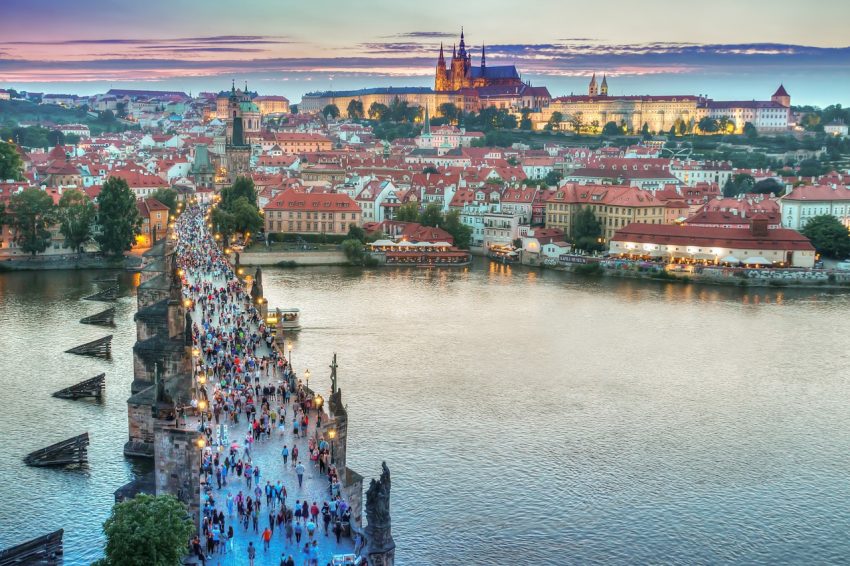
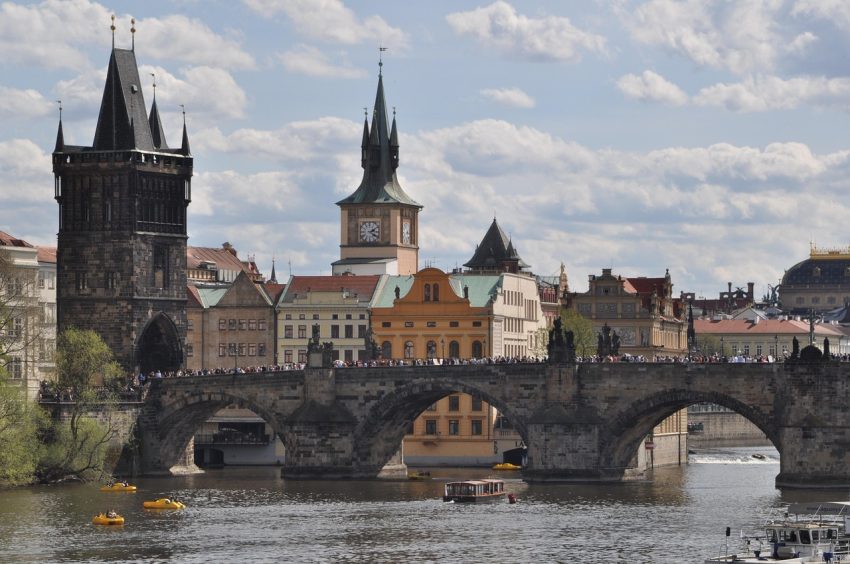
View over Charles Bridge and Prague Castle

This website uses affiliate links which earn a small commission at no additional cost to you.

Sitting high above the Vltava River, Hradčany-Prague's Castle District-offers sweeping city views, palatial grandeur, and an immersive experience into centuries of Czech history. This guide invites you to explore the area's highlights, from monasteries and royal palaces to quiet courtyards and garden terraces, all within walking distance.

Whether you're tracing the footsteps of emperors or monks, or simply soaking in the beauty of Baroque architecture, the Castle District rewards those who venture up its cobbled paths.

How to Get to Hradčany (Castle District), Prague

By Plane: To get to Prague by plane, fly directly into Václav Havel Airport Prague (PRG), which is the city's main international airport and well-connected to major cities across Europe, Asia, and North America. From the airport, it's about a 30-minute drive or a 45-minute public transport ride to the city center. For the best deals and a seamless booking experience, check out these flights to Prague on Booking.com.

By Tram: The Castle District is easily accessible via tram lines 22 and 23. Disembark at Pohořelec for the upper entrance near Strahov Monastery or at Pražský hrad for a more direct path to Prague Castle.

By Metro and Walk: Take Metro Line A to Malostranská, then walk uphill via the Old Castle Steps. This scenic approach gives you beautiful views and a gradual introduction to the area.

By Car: Driving is not recommended in the Castle District due to limited parking and narrow historic streets. However, parking is available at nearby facilities such as Malostranské náměstí.

Where to Stay in Hradčany

Staying in or near Hradčany offers a peaceful atmosphere and proximity to major attractions. For a luxurious stay, Golden Well Hotel provides elegant accommodations steps from Prague Castle. For mid-range comfort, Hotel Three Storks offers boutique charm in a former monastery building. Budget-minded travelers may prefer Little Quarter Hostel, centrally located with excellent amenities.

A Brief History of Hradčany (Castle District)

Hradčany, perched above the Vltava River, has long stood as the symbolic and political heart of Prague. Originally a fortified settlement, it gained prominence in the 9th century with the establishment of Prague Castle by Bořivoj I of the Přemyslid dynasty. Over the centuries, this area developed into a royal and religious center, home to monarchs, clergy, and aristocrats.

The district was officially founded as a town in 1320 by King Charles IV and gradually merged into greater Prague alongside the Old Town, New Town, and Lesser Town. As the seat of the Bohemian crown and later the Holy Roman Empire, Hradčany flourished during the reign of Charles IV and his successors. Magnificent structures such as St. Vitus Cathedral, the Old Royal Palace, and various noble palaces rose around the castle complex, forming the architectural backbone of the district.

Throughout the Baroque and Renaissance periods, Hradčany continued to expand with the construction of churches, cloisters, and palaces. The Thirty Years' War and subsequent Habsburg rule brought further embellishments to the district's skyline. Despite periods of war and upheaval, the Castle District has preserved its majesty, serving today as the seat of the Czech President and one of the most visited cultural sites in the country.

Walking through Hradčany is like turning the pages of a living history book-each facade and cobbled lane echoing stories of saints, emperors, scholars, and revolutionaries.

Your Self-Guided Walking Tour of Hradčany (Castle District)

This self-guided walking tour takes you through one of Prague’s most historically rich and visually stunning areas, and you can use our interactive walking tour map to track your current location and your next site as you go. From monastic serenity and scholarly treasures to royal grandeur and panoramic views, Hradčany offers a layered journey through Czech history. Whether you are here for the architecture, the legends, or simply to soak in the atmosphere, this walk promises a memorable exploration of the Castle District’s most iconic and hidden landmarks.

1. Strahov Monastery

Kloster Strahov
Kloster Strahov
CC BY-SA 4.0 / Falk2

Founded in 1143, Strahov Monastery is one of the oldest Premonstratensian monasteries in the world. Although it endured plunder and disrepair throughout its history, the site has remained a stronghold of faith, scholarship, and culture.

Today, the highlight is undoubtedly the Strahov Library, housing more than 200,000 volumes and featuring breathtaking Baroque halls. The Theological Hall, added in the late 17th century, dazzles with white stucco reliefs and ceiling murals celebrating knowledge and learning. The Philosophical Hall, constructed in the late 18th century, offers floor-to-ceiling bookshelves and a monumental ceiling fresco titled “The Intellectual Progress of Mankind.”

Together, these two grand halls showcase the evolution of human thought and make the Strahov Library one of the most beautiful in Europe. While you cannot walk between the shelves, the decorated interiors can be viewed from designated entrances. We’ve seen many famous libraries, and this one ranks among the top ten for sheer beauty and detail.

If time permits, explore the adjoining Church of the Assumption of Our Lady. Its interior features rich frescoes and a peaceful nave, echoing the quiet spiritual traditions that have lasted for centuries.


Location: Strahov Monastery, Strahovské nádvoří, Prague 1-Strahov, Czechia | Hours: Monday - Sunday: 9:00-17:00 | Price: 190.00 Kč | Website

Here is a complete selection of hotel options in Prague. Feel free to review each one and choose the stay that best suits your needs.

2. Strahov Monastic Brewery

Strahov Monastery BreweryPrague
CC BY-SA 4.0 / Mateusz Giełczyński

Just next to the monastery is the Strahov Monastic Brewery, where brewing traditions date back to the 13th century. Revived in modern times, the brewery now produces St. Norbert craft beers that honor the site’s heritage while catering to contemporary palates.

The brewery’s restaurant serves traditional Czech cuisine and features a sunlit terrace with breathtaking views over the city. A pint of amber or dark lager, enjoyed against a skyline backdrop, is a welcome reward after exploring the Castle District.

Beyond the well-loved house lagers, the brewery also produces small-batch seasonal beers. Visitors can sample a variety of styles, including IPA and wheat brews, in tasting sets. There are occasional behind-the-scenes tours available for those interested in the brewing process.

The relaxed atmosphere makes it a perfect rest stop for travelers, blending history with hearty fare and expertly brewed refreshment.


Location: Strahov Monastery Brewery, Strahovské nádvoří, Prague 1-Hradčany, Czechia | Hours: Opening hours: Mon. - Sun. 10.00 - 22.00 | Price: Free entry; pay for food and drinks. | Website

Traveling to a country with a different currency? Avoid ATM transaction fees and pay in local currency with a Wise Card. Having used it for over 5 years, we've saved loads on fees!

3. Czernin Palace

Czernin Palace
Czernin Palace
CC BY-SA 3.0 / Daniel Baránek

Constructed in the late 1600s, Czernin Palace is the largest Baroque palace in Prague. Commissioned by Count Humprecht Jan Czernin, it was designed to reflect both prestige and imperial loyalty.

Located near Loreta, its vast and austere exterior—150 meters in length—features thirty giant half-columns and an imposing rusticated façade. Although it now houses the Czech Ministry of Foreign Affairs and is generally closed to visitors, it remains a prominent visual anchor of the district.

Its turbulent 20th-century history includes occupation by the Nazi regime and the mysterious death of Jan Masaryk in 1948.


Location: Černín Palace, Loretánské náměstí, Prague 1-Hradčany, Czechia | Hours: Interiors are not open to the publicExterior: anytime. Interior access: limited and varies by public openings or events. | Price: Free to view from outside; interior access varies and may be restricted. | Website

Click here to read our blog about Prague’s Old Town Square 2026: Must-See Sights, History & Tips

4. Loreta

Hradčany Loreta
Hradčany Loreta
CC BY-SA 4.0 / VitVit

One of Prague’s most beloved pilgrimage sites, Loreta is an ornate Baroque complex centered around the Santa Casa—a replica of the Holy House of Nazareth. Built in the wake of the Battle of White Mountain, it was designed to reinforce Catholic devotion in Bohemia.

Every day, the chime of its carillon bells fills the square from 9am to 6pm, adding auditory charm to the historic setting. The carillon itself, composed of 27 bells, is a rare and delightful feature in Prague. It plays Marian hymns on the hour.

Inside the complex, you’ll find the Chapel of the Nativity of Our Lord, which is richly decorated with frescoes and religious iconography. A key attraction is the dazzling Prague Sun monstrance, encrusted with 6,222 diamonds and housed in the church treasury.

Perhaps the most unusual feature is the statue of Saint Wilgefortis—a bearded female saint who, according to legend, was crucified after miraculously growing facial hair to escape an unwanted marriage. The chapel also houses rare relics, and the peaceful cloisters make for a contemplative walking route.

Loreta remains a working religious institution and a moving testament to Prague’s enduring spiritual traditions. It continues to attract pilgrims, architecture lovers, and those seeking an oasis of calm above the city.


Location: Loreta, Loretánské náměstí, Prague 1-Hradčany, Czechia | Hours: Daily 10am. - 5pm. | Price: Museum CZK 260 | Website

Explore Prague at your own pace with our self-guided walking tour! Follow our curated route to discover must-see sights and local secrets that makes Prague one of the best places to visit in Czech Republic.

5. Schwarzenberg Palace

Schwarzenberg Palace
CC BY-SA 4.0 / Diego Delso

Located in Prague’s Lesser Town, the Schwarzenberg Palace is a former Renaissance masterpiece turned National Gallery Art Museum. Originally built in 1567, the palace was commissioned by Jan Popel of Lobkowicz, a wealthy nobleman who acquired the land after a devastating fire in 1541. The palace is renowned for its Italianate architectural style and features painted stretched canvas ceilings dating back to the late 1500s. Today, it offers visitors the opportunity to admire an unparalleled collection of Bohemian Renaissance, Mannerist, and Baroque art.

Just outside the palace, in the heart of Hradčany Square, stands the Marian Column, a beautifully crafted monument erected in 1736 to commemorate the Plague of 1713. This impressive statue is crowned with the figure of the Virgin Mary and surrounded by sculptures of notable saints, mirroring the Marian Column in Lesser Town Square seen earlier on this walking tour.


Location: Národní galerie Praha – Schwarzenberský palác, Hradčanské náměstí, Prague 1-Hradčany, Czechia | Hours: Museum Hours: Tuesday–Sunday, 10:00 AM–6:00 PM; Closed Mondays. | Price: Adults 300 CZK | Website

Explore Prague at your own pace with our self-guided walking tour! Follow our curated route to discover must-see sights and local secrets that makes Prague one of the best places to visit in Czech Republic.

6. Archbishop Palace

Archbishop Palace Prague
CC BY-SA 4.0 / Gampe

Since the 16th century, this has been the residence of the Archbishop of Prague. Its unassuming Rococo façade belies the ornate interiors, which are occasionally open during special events.

A notable feature is the private chapel of Saint John the Baptist, rumored to be linked to a historical murder and preserved in an evocative painting.

This palace remains a functioning ecclesiastical residence and plays host to important religious and diplomatic occasions.


Location: Archbishop Palace, Hradčanské náměstí, Prague 1-Hradčany, Czechia | Hours: No regular public hours; check for special open days or limited-access visits. | Price: No standard ticket; access is occasional and event-based (sometimes donation or reservation). | Website

Click here to read our blog about Prague’s Past in Stone 2026: A Journey Through Its Historic Buildings & Monuments

7. Prague Castle

Prague Castle
Prague Castle
CC BY-SA 4.0 / VitVit

Location: Prague Castle, Hradčany, Prague 1, Czechia | Hours: Castle Grounds Hours: 6.00 - 22.00; Historic Buildings Hours: 9.00 – 17.00 | Price: Adult tickets range from 250–350 CZK | Website

Explore Prague at your own pace with our self-guided walking tour! Follow our curated route to discover must-see sights and local secrets that makes Prague one of the best places to visit in Czech Republic.

8. St. Vitus Cathedral

St. Vitus Cathedral
St. Vitus Cathedral
CC BY-SA 4.0 / Maksym Kozlenko

Saint Vitus Cathedral: The Saint Vitus Cathedral is a Gothic wonder and the spiritual heart of Prague Castle. Its origins date back to 930, when Prince Wenceslas acquired the relic of Saint Vitus’s arm and built a small rotunda chapel in his honor. The site later grew into a two-steeple church in 1060 and began its transformation into the grand Gothic cathedral we see today in 1344. The construction spanned over 600 years, resulting in a masterpiece adorned with stunning statues and stained glass windows. The cathedral is home to priceless relics, treasures, and the Royal Crown, dating to 1347.

Among the highlights are the Saint Wenceslas Chapel, nearly unchanged since the Middle Ages and housing the tomb of Prince Wenceslas, who was martyred in 935, and the South Tower, which requires climbing 287 steps to reach its breathtaking viewpoint


Location: St. Vitus Cathedral, III. nádvoří, Prague 1-Hradčany, Czechia | Hours: Monday–Saturday: 9:00–16:00; Sunday: 12:00–16:00 | Price: Adults: 200 CZK (South Tower) | Website

Explore Prague at your own pace with our self-guided walking tour! Follow our curated route to discover must-see sights and local secrets that makes Prague one of the best places to visit in Czech Republic.

9. Old Royal Palace

Old Royal Palace, Prague
CC BY-SA 3.0 / Victor Belousov

Standing within the walls of Prague Castle, the Old Royal Palace is one of the most historically important buildings in the Czech Republic. Initially constructed in the 12th century as the seat of Bohemian princes, it was expanded and transformed over the centuries, notably during the reigns of Charles IV and Vladislav II.

The palace’s crowning feature is Vladislav Hall, completed in 1502. With its vast vaulted ceiling and intricate stone ribbing, this Gothic hall once hosted jousting tournaments, royal banquets, and coronation festivities. The hall’s architectural innovations, such as the Rider’s Staircase—designed to allow knights on horseback to enter—are both functional and symbolic of its grandeur.

During the turbulent events of the Thirty Years’ War, the palace witnessed the Second Defenestration of Prague in 1618, when Protestant nobles threw two Habsburg governors out of a window, igniting one of Europe’s most devastating conflicts. Today, a plaque commemorates the spot of this dramatic turning point in history.

The Old Royal Palace remains a ceremonial site and is used during presidential inaugurations. Visitors can explore its state rooms, admire the coats of arms adorning the walls, and enjoy sweeping views over Prague from the adjacent balcony. Rich in both architectural splendor and historical significance, the palace is a must-see for understanding the legacy of Czech royal power.


Location: Old Royal Palace, Třetí nádvoří Pražského hradu, Prague 1-Hradčany, Czechia | Hours: Daily: 9:00 - 16:00 (Winter); Daily: 9:00 - 17:00 (Summer) | Price: Adults: CZK 450 | Website

Explore Prague at your own pace with our self-guided walking tour! Follow our curated route to discover must-see sights and local secrets that makes Prague one of the best places to visit in Czech Republic.

10. St. George's Basilica at Prague Castle

St. George's Basilica at Prague Castle
St. George’s Basilica at Prague Castle
CC BY-SA 3.0 / Øyvind Holmstad

Saint George Basilica: Nestled within Prague Castle, the Saint George Basilica is a historic Romanesque church with timeless architectural charm. It was originally built in 920 by Prince Vratislav I, the third Duke of Bohemia, making it the second-oldest church within the castle complex after the Church of the Virgin Mary. Over the centuries, the basilica underwent significant changes, including its expansion in 973 when a Benedictine convent was established nearby. After being damaged by the fire of 1142, it was reconstructed in its current Romanesque form, showcasing bare stone walls and an ancient, almost Byzantine-like interior.

Among its standout features are the tomb of Vratislav I, the founder of the basilica, and the statue of Saint George. The statue portrays Saint George, a Christian martyr said to have been killed by the Romans in 303 AD, depicted as a ghastly skeleton with his abdomen gruesomely sliced open—an evocative display of faith and sacrifice. Saint George Basilica serves as a portal into Prague Castle’s layered history and architectural evolution.


Location: St. George's Basilica, Hradčany, Prague 1, Czechia | Hours: Daily: 9:00 - 16:00 (Winter); Daily: 9:00 - 17:00 (Summer) | Price: Adults: CZK 450 (Included with Prague Castle ticket circuits) | Website

11. Golden Lane

Golden Lane
Golden Lane
CC BY-SA 4.0 / Diego Delso

Golden Lane, a charming and colorful street within Prague Castle, dates back to the 1500s, when it housed guards and gunmen serving King Rudolph II. By the 17th century, the lane became home to royal alchemists and goldsmiths tasked with ambitious experiments, such as attempting to create gold, which gave the lane its name. The tiny, vibrant houses along Golden Lane are full of character, with notable structures such as #13, known as the Red Musket Guard House, and #22, where Franz Kafka lived briefly in the early 1900s.

From House #12, visitors can access the Daliborka Tower, once a cannon tower and prison during the 1400s and 1500s. At the eastern exit of Golden Lane, you’ll pass through a formidable castle portal next to the Black Tower and encounter the Parable with Skull, a haunting statue commemorating Kafka’s literary legacy. Inside the base of the Black Tower lies a dungeon that feels straight out of medieval lore. For breathtaking views of Prague, the nearby terrace offers stunning panoramic vistas, making Golden Lane a delightful mix of history and enchantment.


Location: Golden Lane, Prague 1-Hradčany, Czechia | Hours: Daily: 9:00—17:00 | Price: Included in Prague Castle ticket circuits | Website

12. Lobkowicz Palace

Prague Castle Gardens
CC BY-SA 3.0 / Mr. Kjetil Ree.
Powered by GetYourGuide

13. Villa Richter

Vila Richter
Vila Richter
CC BY-SA 3.0 / David Sedlecký

Nestled on the southeastern slope of Prague Castle lies the Royal Vineyard, the oldest vineyard in the Czech Republic, originally planted in 908 by Duke Wenceslas I—later canonized as Saint Wenceslas. As the beloved “Good King,” Wenceslas championed the Christianization of Bohemia and was posthumously named the patron saint of the Czech lands following his assassination by his brother in 935.

During medieval times, the Royal Vineyard served as a complement to the beers brewed by monks in nearby monasteries, although its wines were reserved exclusively for the royal family. While Riesling is prominent today, Pinot Noir was introduced by Emperor Charles IV in the 14th century, reflecting his admiration for French viticulture. Until the construction of the Queen’s Summer Palace in 1534, the vineyard also extended into what is now the Royal Garden to the north of the castle.

The vineyard was revitalized in 2007, reopening to the public on the 1100th anniversary of Wenceslas’s birth. Visitors can stroll among the vines, relax on benches with scenic views of Prague, and reflect on the vineyard’s long and storied heritage.

At its eastern edge stands Villa Richter, a neoclassical structure offering a wine bar, restaurant, and a small museum dedicated to the vineyard’s legacy. It’s the perfect spot to enjoy a glass of locally produced wine while taking in sweeping views of the city below—a tranquil and historically rich experience just steps from the grandeur of Prague Castle.


Location: Villa Richter, Staré zámecké schody, Prague 1-Hradčany, Czechia | Hours: Varies by restaurant, events, and season; check current hours before visiting. | Price: Varies by restaurant, events, and season; check current hours before visiting. | Website

14. Queen Anna Royal Summer Palace

Belvedere (Royal Summer Palace)
CC BY-SA 2.0 / Karen Blaha

Located at the edge of the Royal Garden north of Prague Castle, the Queen Anna Royal Summer Palace—also known as the Belvedere—is a jewel of Renaissance architecture in Bohemia. Commissioned by Emperor Ferdinand I for his beloved wife Anna Jagiellon, construction began in 1538 and was completed in the 1560s by Italian architects who introduced classical Italian design to the heart of Prague.

The palace is famed for its exquisite arcaded façade with 114 decorative reliefs that illustrate scenes from classical mythology, hunting expeditions, and historical allegories. Its distinctive copper roof, shaped like an inverted ship’s hull, adds a unique flair that distinguishes it from other Renaissance buildings.

Though originally built as a summer retreat and pleasure palace, the Belvedere later served various ceremonial and practical purposes, including as an observatory. Today, it hosts occasional art exhibitions and concerts within its halls.

In front of the palace, don’t miss the Singing Fountain—so named for the melodic sound its cascading water produces. Together, the palace and its gardens offer a peaceful and elegant conclusion (or starting point) for any visit to the Castle District.


Location: Summer Palace Čínská Restaurace, Celetná, Old Town, Czechia | Hours: May be ticketed separately or tied to exhibitions; prices vary depending on what is open. | Price: Seasonal and exhibition-dependent; confirm current access and garden entry before you go. | Website
Powered by GetYourGuide
Moira & Andy
Moira & Andy

Hey! We're Moira & Andy. From hiking the Camino to trips around Europe in Bert our campervan — we've been traveling together since retirement in 2020!

Read our full story here

This website uses affiliate links which earn a small commission at no additional cost to you.

Walking Tour Summary

Distance: 2.5 km
Sites: 14

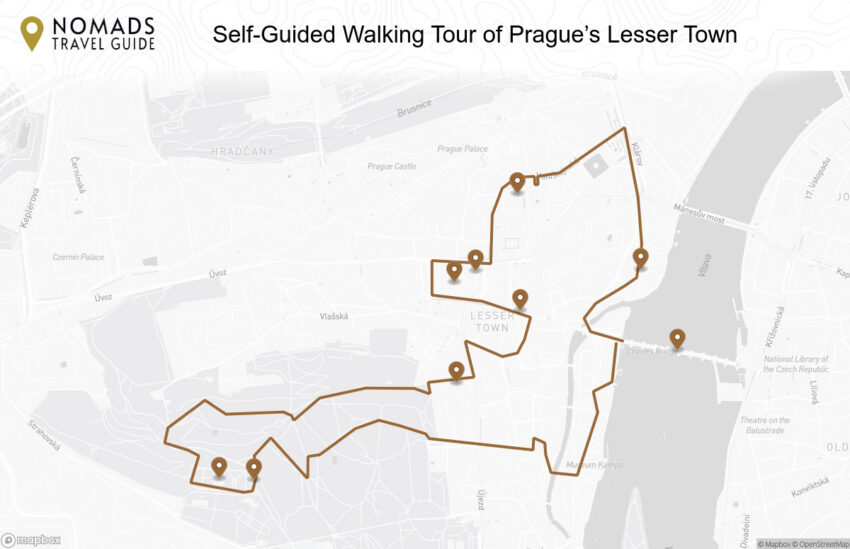
Walking Tour Map
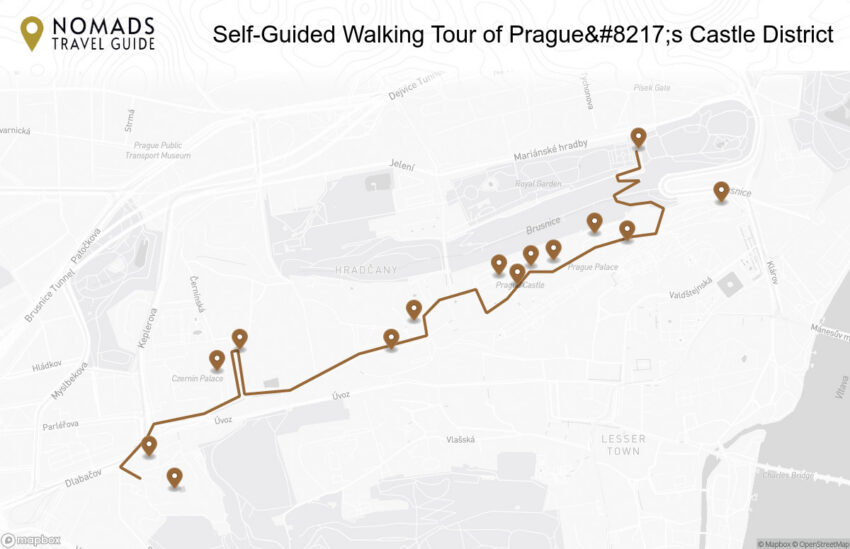
Map of the Self-Guided Walking Tour of Prague’s Castle District walking route with 14 stops in Prague.
Preview map of the Self-Guided Walking Tour of Prague’s Castle District route in Prague, showing 14 stops. Use the interactive map to zoom and tap markers.

More from this area

Prague’s Past in Stone 2026: A Journey Through Its Historic Buildings & Monuments

History of Prague Through its buiildings

This website uses affiliate links which earn a small commission at no additional cost to you.

From royal coronations to revolutions, Prague’s architecture has witnessed the rise and fall of empires, religious reformations, and artistic renaissances. With each cobbled street and centuries-old spire, the city invites visitors to experience history not from a book-but by walking through it.

Often called the “City of a Hundred Spires,” Prague is a city that lives and breathes its past. It's not just a place to admire Gothic cathedrals or Baroque façades; it's where the Middle Ages meet modernism, where legend and legacy intertwine in every courtyard, clocktower, and castle gate.

The region known as Bohemia gets its name from the Celtic Boii tribe, which lived there in pre-Roman times. Slavic tribes arrived in the 6th century, and by the 9th century, the Přemyslid dynasty had begun consolidating power.

How to Get to Prague

By Train: Prague is well-connected by international and regional rail, with Praha hlavní nádraží (main station) just a short distance from the city centre and well-served by trams and metro.

By Car: Prague is accessible via major European motorways, but navigating the historic centre by car can be difficult. Parking is available in designated garages near the centre.

Airport Express Bus: The Airport Express (AE) bus provides a direct connection between the airport and Prague Main Railway Station (Praha hlavní nádraží). Buses operate daily at regular 30-minute intervals from 5:30 a.m. to 10:00 p.m. Travel time is approximately 35-40 minutes. Stops are located directly in front of Terminals 1 and 2.

Medieval Foundations: The Rise of a Capital

The lands that would become Bohemia were originally home to the Celtic Boii tribe before being settled by Slavic peoples in the 6th century. By the 9th century, the Přemyslid dynasty began consolidating power in the region.

Duke Wenceslaus (c. 907-935)

A prominant ruler in this time was Wenceslaus, also known as Saint Wenceslas, Duke of Bohemia from the Přemyslid dynasty. Although not a king, he is often referred to as “Good King Wenceslas” thanks to the popular Christmas carol written centuries later. Wenceslaus was celebrated for his piety, support of the Christian Church, and peaceful relations with neighboring rulers such as Henry the Fowler of Germany. His policies created internal tensions, however, and he was ultimately assassinated by his brother Boleslav the Cruel. Following his death, Wenceslaus was venerated as a martyr and became the patron saint of Bohemia. His legacy was pivotal in legitimizing the Christian monarchy in Czech lands, and he remains a national symbol of justice and faith. His statue today overlooks Wenceslas Square, a site of both historic reverence and modern civil life in Prague.

Bohemia is recognized and gains Kings

In 1004, Bohemia was recognized as a duchy within the Holy Roman Empire-its rulers nominally vassals to the emperor, though they often acted with considerable independence. Bohemia’s status was elevated in 1198 when its ruler was granted the title of king. This royal dignity was confirmed in 1212 with the Golden Bull of Sicily, issued by Emperor Frederick II, which made the kingship hereditary and affirmed Bohemia’s special standing within the empire.

Prague itself emerged as a power center during this era. The city's foundation is linked to the establishment of Prague Castle by Bořivoj of the Přemyslid dynasty in the late 9th century. According to legend, Princess Libuše, a seer from the same dynasty, prophesied the rise of a magnificent city “whose glory would touch the stars.” Her vision resonates today in the spires of St. Vitus Cathedral, the architectural and spiritual crown of the Czech capital.

Prague & Emperor Charles IV

During the 13th and 14th centuries, the Kingdom of Bohemia expanded its influence far beyond the borders of what is now the Czech Republic. Bohemian kings exerted control over significant territories in modern-day Poland, Austria, and parts of Germany. Under King John of Bohemia (ruled 1310-1346), cities like Wrocław (known as Breslau at the time), previously under Polish Piast rule, came into Bohemian hands.

King Charles IV (1316-1378), son of King John of Bohemia, was one of the most significant figures in Prague's history. Born Wenceslaus of Luxembourg, he adopted the name Charles in honor of his uncle, the King of France, during his youth in Paris. After returning to Bohemia, he became King in 1346 and was crowned Holy Roman Emperor in 1355, the most powerful ruler in Europe at the time.

Charles IV was deeply intellectual, multilingual, and devoutly religious. Under his reign, Prague flourished as a cultural, political, and spiritual hub. He initiated the construction of the Charles Bridge, established Prague Castle as an imperial residence, and founded Charles University in 1348, the first of its kind in Central Europe.

Charles IV also founded Charles University and expanded the city by establishing the New Town. The Old Town Square became Prague’s civic heart, while the Astronomical Clock, installed in 1410, brought wonder and mechanical artistry to the cityscape. Its hourly show still draws crowds, who marvel at the rotating apostles and symbolic figures.

At this time Prague comprised three main areas: the Castle District (Hradčany), which housed royal and ecclesiastical power; the Lesser Town (Malá Strana), home to nobles and foreign envoys; and the Old Town (Staré Město), the bustling commercial and civic center. Charles redesigned Prague’s urban layout, founding the New Town (Nové Město), and envisioned Prague as the new capital of the Holy Roman Empire.

Prague: A Region of Reform and Resilience

Prague sits at the heart of Bohemia, a region shaped by independence and innovation. The early 15th-century teachings of Jan Hus (1372-1415) sparked religious reform that would culminate in the Hussite Wars (1419-434) after his execution. In the Old Town Square you’ll find the imposing Jan Hus Monument which shows Hus standing defiantly, with exiled Protestants and victorious Hussite warriors surrounding him.

During this era, the Clementinum emerged as a cultural and academic center. Initially a Jesuit college, it houses one of the most beautiful libraries in the world and reflects the Enlightenment spirit that took root in Prague long before modern nationalism swept Europe.

Renaissance and Baroque Brilliance

Post-medieval Prague blossomed with Baroque grandeur. After destructive fires in the 16th century, noble families helped rebuild the Lesser Town Square, commissioning opulent palaces and ornate churches. The Church of St. Nicholas, designed by the Dientzenhofer family, stands as a hallmark of this transformation, with a lavish interior that awed even Mozart.

Across the river, Wallenstein Palace & Gardens signaled the rise of military aristocracy during the Thirty Years’ War. Its lavish garden grotto and statue-lined paths made it one of the city’s grandest estates-now home to the Czech Senate.

The Thirty Years’ War (1618-1648)

The Thirty Years' War was one of Europe's most devastating conflicts, and Prague played a pivotal role in its outbreak. It began with the Second Defenestration of Prague in 1618, when Protestant nobles hurled two Catholic imperial governors and their secretary out a window of Prague Castle-a symbolic act of rebellion against Habsburg authority.

Although the men survived the fall, the act ignited a broader religious and political conflict. The war soon expanded beyond Bohemia, drawing in major European powers such as Spain, France, Sweden, and the Holy Roman Empire. It devastated much of Central Europe, leading to widespread famine, population loss, and social upheaval.

The Protestant Bohemians were quickly defeated at the 1620 Battle of White Mountain near Prague. The aftermath was brutal: twenty-seven leaders of the revolt were executed in Old Town Square, and the city was subjected to intense Catholic re-Catholicization.

Today, white crosses embedded in the cobblestones outside the Old Town Hall commemorate those executed leaders, symbolizing both tragedy and resistance. Although Prague’s cultural importance declined in favor of Vienna after the war, the city’s baroque architectural boom in the following decades was, in part, funded by confiscated Protestant estates-highlighting how the war left both scars and splendor on the Czech capital.

Modern Movements and National Revival

As national identity surged in the 19th century, architecture became a patriotic act. The neo-Renaissance Prague National Museum was erected in 1891 atop Wenceslas Square, affirming the Czech people’s cultural ambition.

Meanwhile, National Theatre (Národní divadlo) became a rallying point for artistic independence, supported by public donations. It remains a proud symbol of Czech resilience and artistic excellence.

Art Nouveau left its mark with Municipal House, where the declaration of Czechoslovakia’s independence in 1918 took place beneath its gilded domes and stained glass windows.

A Twentieth Century of Turmoil and Triumph

The Nazi occupation and decades of Communist rule left emotional scars, but the built environment of Prague survived remarkably intact. Wenceslas Square became a place of protest and hope-witnessing both tanks in 1968 and freedom in 1989 with the Velvet Revolution.

The city’s modern chapter is represented by Dancing House, completed in 1996 and designed by Frank Gehry. Nicknamed “Fred and Ginger,” it symbolizes movement, balance, and Prague’s ongoing evolution.

Every Building Tells a Story

Whether strolling Karlova Street, passing through Old Town Bridge Tower, or discovering hidden courtyards near Little Square (Malé Náměstí), the story of Prague is one you walk through-stone by stone, spire by spire.

Even newer additions like New City Hall (Nová radnice) reveal how governance, architecture, and history continue to intersect in this storied capital.

Final Thoughts

Prague is more than a city of monuments-it's a living manuscript written in stone, brick, and stained glass. From the early fortresses of Bořivoj to the Art Nouveau curves of the early 20th century, every building reflects not only a style but an era, a purpose, and a people.

Powered by GetYourGuide
Moira & Andy
Moira & Andy

Hey! We're Moira & Andy. From hiking the Camino to trips around Europe in Bert our campervan — we've been traveling together since retirement in 2020!

Read our full story here

This website uses affiliate links which earn a small commission at no additional cost to you.

Self-Guided Walking Tour of Prague’s Old Town (2026)

Self Guided Walking Tour Of Pragues Old Town

This website uses affiliate links which earn a small commission at no additional cost to you.

The Old Town (Staré Město) is the historic soul of Prague. From the winding lanes and timeworn façades to the majestic churches and animated squares, this area encapsulates the city's medieval charm and cultural depth. A self-guided tour lets you soak in the atmosphere at your own pace, with each street revealing centuries of architectural splendor and layered history.

Whether you’re marveling at astronomical wonders or strolling along cobbled streets lined with colorful facades, the Old Town invites exploration and curiosity. This walk through Prague’s most iconic quarter reveals not only some of its most famous sights, but also quiet corners and historical surprises.

How to Get to Old Town, Prague

By Train: Prague’s main train station, Praha hlavní nádraží, is about a 15-minute walk from the Old Town Square. Alternatively, take Metro Line C to Muzeum, then transfer to Line A and exit at Staroměstská.

By Car: Driving in the Old Town is not recommended due to pedestrian zones and limited parking. However, nearby garages include Palladium and Rudolfinum.

Where to Stay in Old Town, Prague

Stay in the heart of the Old Town to enjoy easy access to key landmarks. For luxury, Hotel Paris Prague offers Art Nouveau splendor near the Municipal House. Hotel Metamorphis is a boutique mid-range option close to Týn Church. For budget travelers, Czech Inn Hostel is a stylish and affordable alternative just outside the Old Town.

A Brief History of Prague’s Old Town

Early Foundations

The roots of Prague's Old Town trace back to the 9th century, when a settlement began forming along the Vltava River's right bank. This modest marketplace steadily grew into a flourishing trading hub thanks to its location on key European trade routes. By the 12th century, it had become a dynamic community surrounded by protective walls and gates. The area prospered, eventually receiving its charter as a town in 1230 from King Wenceslas I.

Medieval Growth

The 14th century brought a golden age under the rule of Emperor Charles IV. Old Town flourished as part of his vision to make Prague the capital of the Holy Roman Empire. Religious and academic life bloomed, and landmarks such as the Charles Bridge and Old Town Hall began taking shape. The Astronomical Clock was installed in 1410 and remains one of the world's oldest still-operating clocks. Commerce, guilds, and civic institutions thrived, and the district became an epicenter of Gothic architecture and public life.

Turmoil and Transformation

The 15th through 17th centuries saw religious upheaval, including the Hussite Wars and later conflicts during the Reformation. Despite fires and invasions, Old Town survived and was eventually rejuvenated by the Baroque wave. Many Gothic buildings were renovated or reconstructed with Baroque flourishes. By the 18th century, the district had settled into a more residential and cultural character.

Modern Legacy

In the 19th and 20th centuries, the Old Town faced new pressures, from urban redevelopment to the devastations of war. While some medieval quarters were lost to modernization, others were preserved through early conservation efforts. Today, the Old Town is a living museum and UNESCO-recognized cultural site. Its blend of architectural styles, layered history, and modern vibrancy makes it a compelling destination for travelers from around the world.

Guided or Self-Guided Tour of Old Town?

While guided tours add rich context, a self-guided walk through the Old Town allows you to linger at your own pace, explore side alleys, and revisit favorite spots. Many of the landmarks are clustered close together, making the area especially rewarding for walkers.

For those who prefer expert storytelling and hidden insights, the Prague Old Town, Astronomical Clock and Underground Tour offers a compelling experience. Led by a knowledgeable local guide, this tour not only uncovers the famous highlights but also delves beneath the surface-literally-into Prague’s underground chambers, cellars, and medieval alleyways.

Your Self-Guided Walking Tour of Prague’s Old Town

Before diving into the landmarks, this walking tour offers a curated route through the Old Town’s most significant and atmospheric sites, and you can use our interactive walking tour map to track your current location and your next site as you go. From soaring Gothic towers to bustling markets and storied streets, each stop highlights a different aspect of the district’s character. This route is easy to navigate on foot, and can be completed at your own pace over a few hours or savored across a full day.

1. Old Town Square

Praha Old Town sq from Minuta
CC BY-SA 3.0 / Sokoljan

One of Europe’s most beautiful public spaces, the Old Town Square is the heart of historic Prague. It has served as a bustling marketplace, civic center, and social gathering space for over 1,000 years. The square is flanked by striking architectural landmarks including the Týn Church, St. Nicholas Church, and the Old Town Hall. Horse-drawn carriages, street musicians, and seasonal markets bring the square to life throughout the year. It’s also the location of historic events such as the execution of 27 Czech leaders following the Battle of White Mountain in 1621, an event that dramatically marked the end of Bohemian independence. The square was also where Jan Hus’s reformist ideals gained public traction, memorialized by the Jan Hus Monument at its center, and it has witnessed moments of political resistance, including mass protests during the Velvet Revolution in 1989. Whether lit by the sun or glowing under lantern light, the square exudes atmosphere and history.


Location: Old Town Square, Old Town, Prague 1, Czechia | Hours: Always open; individual buildings and churches have their own visiting hours. | Price: Free (public square).

Here is a complete selection of hotel options in Prague. Feel free to review each one and choose the stay that best suits your needs.

2. Church of Our Lady before Týn

Church of Our Lady before Týn
CC BY-SA 2.0 / Pedro Szekely

Dominating the square with its twin Gothic spires, this 14th-century church is a masterpiece of medieval architecture. Its towers, each over 80 meters high, are intentionally asymmetrical—a symbolic representation of male and female balance, and a reminder that imperfection reflects divine creation. The richly decorated interior includes ornate altarpieces, vaulted ceilings, and the tomb of astronomer Tycho Brahe. During the Hussite movement, the church became a bastion of reformist ideals, serving as the main Hussite place of worship and a powerful symbol of Czech religious identity. After the movement was suppressed, the church was re-Catholicized and richly re-decorated, yet its layered past remains visible in its art and architecture. Despite its commanding exterior, the entrance is tucked away through a small arch at the base of surrounding buildings, making the discovery feel all the more special.


Location: Church of Our Lady before Týn, Old Town Square, Old Town, Czechia | Hours: Monday Closed; Tuesday - Saturday: 10:00 - 12:00 and 15:00 - 17:00; Sunday 11:00 - 12:00 | Price: Free (€2.00 donation appreciated).

Traveling to a country with a different currency? Avoid ATM transaction fees and pay in local currency with a Wise Card. Having used it for over 5 years, we've saved loads on fees!

3. Church of St. Nicholas (Old Town)

Church of St. Nicholas in Prague's Old Town
Church of St. Nicholas in Prague’s Old Town
CC BY-SA 3.0 / Hans Peter Schaefer

Often confused with its namesake in Lesser Town, this Baroque gem stands on the northwestern edge of Old Town Square. Built in the early 18th century by architect Kilián Ignác Dientzenhofer, the church is admired for its majestic dome and stucco interior. Inside, visitors can admire the grand organ and ornate frescoes that reflect the grandeur of Prague’s Baroque period. The church also functions as a concert venue, renowned for its acoustics and regular classical music performances. Its white façade gleams in the afternoon sun and contrasts beautifully with the Gothic elements nearby. This church remains a tranquil refuge in the bustling square.


Location: Chrám sv. Mikuláše, Old Town Square, Old Town, Czechia | Hours: Daily: 10:00 - 17:00 | Price: Adults: 150 CZK | Website

Click here to read our blog about Prague’s Old Town Square 2026: Must-See Sights, History & Tips

4. Astronomical Clock

Astronomical Clock Prague
CC BY-SA 2.0 / Davis Staedtler.

Set on the wall of the Old Town Hall, the 15th-century Astronomical Clock is one of Prague’s most treasured landmarks. Every hour from 9 AM to 11 PM, crowds gather to watch the parade of the Twelve Apostles appear from behind two small windows. The lower dial serves as a calendar, while the upper shows the position of celestial bodies and time in multiple systems. The clock’s intricate mechanism reflects medieval Europe’s scientific ambition and fascination with the cosmos. Four allegorical figures flank the clock: Vanity, Greed, Death, and the Turk. According to legend, its creator, Master Hanuš, was blinded after completing the mechanism to prevent him from replicating it elsewhere—a grim tale that underscores the clock’s mystique. Over the centuries, the clock has been meticulously restored several times, most notably after damage sustained during World War II. Today, it remains a marvel of engineering and storytelling, offering not just the time, but a performance rich in symbolism and history.


Location: Prague Astronomical Clock, Old Town Square, Old Town, Czechia | Hours: Winter (October —March) Daily: 9:00—19:00; Summer (April—September) Daily: 9:00—20:00 | Price: Clock show: free. Old Town Hall tower and interiors: 380.00 Kč | Website

Explore Prague at your own pace with our self-guided walking tour! Follow our curated route to discover must-see sights and local secrets that makes Prague one of the best places to visit in Czech Republic.

Powered by GetYourGuide

5. Old Town Hall

Old Town Hall in Prague
CC BY-SA 2.0 / Pedro Szekely

Founded in 1338, the Old Town Hall has long been the seat of civic power. Over the centuries, it expanded to include adjoining buildings, giving it a slightly irregular appearance. Its iconic Gothic tower offers sweeping views over the Old Town and beyond. Beneath the structure, a network of Romanesque and Gothic cellars reveals layers of medieval life. Inside, you can explore ceremonial halls and the historic council chamber. The hall has played a central role in key political moments, from medieval councils to uprisings during Nazi occupation, and even as a rallying point during the Velvet Revolution of 1989. A visit to the Old Town Hall is essential to understanding the city’s political, architectural, and social evolution.


Location: Staroměstská radnice, Old Town Square, Old Town, Czechia | Hours: From April to December, it is open daily from 9:00 AM to 8:00 PM, January to March, it operates from 10:00 AM to 7:00 PM | Price: 450.00 Kč | Website | Skip the Line Tickets

Explore Prague at your own pace with our self-guided walking tour! Follow our curated route to discover must-see sights and local secrets that makes Prague one of the best places to visit in Czech Republic.

Powered by GetYourGuide

6. Celetná Street

Celetná street
Celetná street
CC BY-SA 3.0 / Mister No

This historic route once formed part of the Royal Way, connecting Old Town Square to Prague Castle. Today, it’s lined with pastel-colored buildings, souvenir shops, and hidden arcades that still echo the footsteps of coronation processions. The street derives its name from “calty,” a type of twisted pastry that was once baked here in medieval times. It’s also home to the House at the Black Madonna, an early Cubist building that now houses a design museum and café. As you stroll along, you’ll notice elaborate signage on buildings, including golden eagles, red lions, and mythological creatures—these signs once helped identify homes before the advent of street numbers. Over the centuries, notable residents such as writer Franz Kafka lived just off Celetná, and the route was frequently traversed by royal entourages heading to Prague Castle, making it both a cultural and ceremonial artery of the city.


Location: Celetná, Old Town, Czechia | Hours: Open 24/7 (public street); shops, cafés, and attractions keep their own hours. | Price: Free (public street); individual attractions along the street may charge admission.

Explore Prague at your own pace with our self-guided walking tour! Follow our curated route to discover must-see sights and local secrets that makes Prague one of the best places to visit in Czech Republic.

7. Republic Square

Republic Square Prague
CC BY-SA 2.5 / Marjikal

Just outside the medieval walls, this square bridges the Old and New Towns. Known locally as Náměstí Republiky, it’s a dynamic crossroads of history and modern life. It’s home to the magnificent Art Nouveau Municipal House and the Gothic Powder Tower, both architectural highlights. The Palladium shopping mall introduces a contemporary dimension with shops and eateries. Republic Square also hosts seasonal markets and public events, keeping the area lively throughout the year. With major tram stops and metro access, it’s also a vital transportation hub for locals and tourists alike.


Location: Náměstí Republiky, New Town, Czechia | Hours: Open 24/7 (public space); attractions and shops keep their own hours. | Price: Free (public square); Powder Gate and Municipal House interiors require tickets if you go inside.

Click here to read our blog about Prague’s Past in Stone 2026: A Journey Through Its Historic Buildings & Monuments

8. Municipal House

Municipal House,Prague
CC BY-SA 4.0 / Diego Delso

One of Prague’s Art Nouveau masterpieces, this cultural palace was built in the early 20th century. It stands on the former site of the Royal Court palace, where Bohemian kings once resided before Prague Castle became the main seat of power. Most notably, the Municipal House played a pivotal role in Czech history as the site where the independence of Czechoslovakia was officially declared on October 28, 1918. Today, the building houses the Smetana Hall, known for its splendid acoustics and frequent concerts. Lavish murals, stained glass, and mosaic details make the interior a visual feast. Guided tours reveal richly decorated salons and the history of the building’s civic role. Don’t miss the elegant cafés and restaurants tucked inside its halls.


Location: Municipal House, Náměstí Republiky, Old Town, Czechia | Hours: Daily: 10:00 – 19:00 | Price: Adults: 320 CZK | Website

Explore Prague at your own pace with our self-guided walking tour! Follow our curated route to discover must-see sights and local secrets that makes Prague one of the best places to visit in Czech Republic.

9. Powder Gate / Powder Tower

Powder Gate Tower
Powder Gate Tower
CC BY-SA 4.0 / Falk2

This imposing Gothic tower once formed part of Prague’s medieval fortifications. It was originally built in 1475 and intended to serve as a ceremonial entrance to the city for Bohemian kings. Later, it was used to store gunpowder, which gave the tower its current name. Visitors can climb a winding staircase to reach a gallery with panoramic views of the city’s rooftops. Inside, you’ll also find a small exhibit on the tower’s history and role in Prague’s defenses. Its dark stone façade and decorative carvings make it a favorite photo stop on any walking tour.


Location: Powder Gate, Náměstí Republiky, Old Town, Czechia | Hours: January–March: Daily, 10:00–18:00 April–May: Daily, 10:00–19:00 June–September: Daily, 9:00–20:30 October–November: Daily, 10:00–18:00 December: Daily, 10:00–19:30​ | Price: Adults: CZK 200 | Website

Explore Prague at your own pace with our self-guided walking tour! Follow our curated route to discover must-see sights and local secrets that makes Prague one of the best places to visit in Czech Republic.

Powered by GetYourGuide

10. Na Příkopě Street

Na prikope, Prague
Na prikope, Prague
CC BY-SA 1.0 / Mx. Granger

A former moat turned boulevard, Na Příkopě now serves as a bustling commercial corridor separating the Old and New Towns. It stretches between Republic Square and Wenceslas Square, making it one of the busiest and most prominent streets in the city. Along this avenue, you’ll find elegant 19th-century façades housing department stores, international retailers, and elegant arcades. The street has retained its importance since medieval times, once serving as part of the city’s fortification system. Today, it’s also a favorite for window shopping, people-watching, and admiring Prague’s urban evolution. Whether you’re seeking luxury fashion or a quiet café tucked inside a historic passageway, Na Příkopě offers something for everyone.


Location: Street Trdlo, Na Příkopě, Prague 1-Můstek, Czechia | Hours: Open 24/7 (public street); shops and cafés keep their own hours. | Price: Free (public street).

11. Havel’s Market (Havelská Street)

Havelska trznice
Havelska trznice
Public Domain / Diligent

One of the oldest continuously operating markets in Prague, Havel’s Market dates back to 1232. Located between Wenceslas Square and the Old Town Square, it’s a vibrant place where locals and tourists mingle. The stalls are filled with fresh fruit, flowers, handmade crafts, wooden toys, and traditional souvenirs. Some of the vendors have been in the market for generations, preserving its authentic character. The market is open daily and offers a cheerful, colorful atmosphere year-round. Just behind the market, Havelská Street invites further exploration with its mix of cozy shops, arcaded buildings, and historic signage.


Location: Havelské tržiště, Havelská, Old Town, Czechia | Hours: Monday - Saturday: 7:00 - 19:00; Sunday: 8:00 - 18:30 | Price: Free. | Website

12. Old Town Bridge Tower

Charles Bridge before sunrise 1
CC BY-SA 4.0 / Michael Brezocnik

This majestic Gothic tower marks the entrance to Charles Bridge from the Old Town side. Commissioned by Emperor Charles IV in the 14th century, it served both ceremonial and defensive purposes. The tower is richly decorated with statues of saints and the emperor himself, watching over the entrance like a stone guardian. Visitors can climb to the top for sweeping views of the bridge, river, and Lesser Town beyond. Inside, small exhibits detail the tower’s architectural history and role in royal processions. It remains one of the finest examples of Gothic civil architecture in the world.


Location: Old Town Bridge Tower, Old Town, Prague 1, Czechia | Hours: Daily: 10:00 - 18:00. | Price: Adults: 250 CZK | Website

13. Charles Bridge

Prague Charles Bridge from Petrinska Tower
Free Art License / A.Savin

One of the most beloved bridges in the world, Charles Bridge connects the Old Town with Lesser Town across the Vltava River. Construction began in 1357 under the reign of Charles IV and took several decades to complete. According to legend, Charles chose to lay the foundation stone at precisely 5:31 AM on July 9th—a moment chosen for its alignment with a numeric palindrome thought to bring strength and harmony. The bridge is lined with 30 statues, most of which are Baroque-era replicas of earlier originals. Over the centuries, it has served as the ceremonial route for royal coronation processions heading to Prague Castle, and it has also seen its share of military action and flood damage. Among the statues, the most famous is that of Saint John of Nepomuk—touching the plaque beneath is said to bring good luck and ensure your return to Prague. With its solid stone construction, romantic views, and layers of history and superstition, Charles Bridge remains a must-visit landmark in the heart of the city.


Location: Charles Bridge, Prague 1, Czechia | Hours: Always open (pedestrian bridge). | Price: Free. | Website
Powered by GetYourGuide

14. Clementinum

Clementinum baroque library
CC BY-SA 4.0 / Skot

Located just steps from Charles Bridge, the Clementinum is one of the largest and most historic building complexes in Prague. Originally founded by Jesuits in the 16th century, it evolved into a hub of education, science, and spirituality. Its most remarkable feature is the Baroque Library Hall, often cited among the most beautiful libraries in the world, with ceiling frescoes celebrating knowledge and learning. The complex also includes the Mirror Chapel, known for its ornate interior and classical concerts, and the Astronomical Tower, offering panoramic views of the city. Historically, the Clementinum housed the National Library of the Czech Republic and served as a major center of Jesuit scholarship. A visit offers a rich tapestry of art, architecture, and intellectual heritage in the very heart of Prague.


Location: Clementinum, Mariánské náměstí, Old Town, Czechia | Hours: January—March Mon, Tue, Wed, Thu, Fri, Sat, Sun 9:00—19:00 April—September Mon, Tue, Wed, Thu, Fri, Sat, Sun 9:00—20:00 October—December Mon, Tue, Wed, Thu, Fri, Sat, Sun 9:00—19:00 | Price: 380 CZK | Website

15. New City Hall (Nová radnice)

New City Hall, Prague
CC BY-SA 4.0 / VitVit

Not to be confused with the historic New Town Hall in Karlovo náměstí, Prague’s New City Hall (Nová radnice) stands on Mariánské náměstí near the Klementinum and serves as the current seat of the Prague City Council and Mayor. Built between 1908 and 1911 in the Art Nouveau style, the structure is known for its ornate façade, decorative ironwork, and elegant interior details. Visitors may enter on select days to see its grand staircase, ceremonial halls, and rooftop terrace offering a rare panoramic view over the Old Town. The building plays a key administrative role in the city’s governance today, continuing Prague’s long tradition of civic representation. Its understated presence masks the importance of the work carried out inside and connects the capital’s political life to its architectural heritage.


Location: Nová radnice, Mariánské náměstí, Old Town, Czechia | Hours: Exterior always accessible; interior access varies with municipal operations and any public programs. | Price: Free to view from outside; interior access depends on public areas, events, or guided opportunities. | Website

16. House At The Minute

The House at the Minute
CC BY-SA 3.0 / cowbridgeguide

The House At The Minute, located near Old Town Square in Prague, is an architectural and historical treasure. Dating back to the early 1400s, it underwent a Renaissance transformation in 1564, adding a third floor and intricate Sgraffito etchings. These designs showcase a mix of Biblical tales, Roman mythology, and figures like Ottoman Sultan Selim and Habsburg rulers. The building, once known as the White Lion House, also housed a pharmacy until 1712, and its corner is adorned with a Lion statue, a relic from the late 18th century.

Renamed At The Minute when it became a tobacco shop, the title refers to the small tobacco packs sold there—minute as in “my-nute.” Its historic facade, once hidden under plaster, was rediscovered in 1919. The house also holds literary significance as Franz Kafka’s childhood home from 1889 to 1896. Today, it combines history and modernity, with Ristorante Italiano Al Minuto occupying its ground floor.


Location: The House at the Minute, Old Town Square, Old Town, Czechia | Hours: Always accessible from the square (public exterior). | Price: Free to view from outside.

17. Little Square (Malé náměstí)

Little Square Prague
CC BY-SA 4.0 / Palickap

Tucked just behind the Astronomical Clock and adjacent to Old Town Square, Little Square (Malé náměstí) offers a quieter, more intimate slice of Prague’s historic center. Once a vibrant market space, the square is now a scenic stop surrounded by Renaissance and Baroque townhouses with beautifully decorated façades. At its center stands an ornate wrought-iron fountain dating to the 16th century, originally used as a source of drinking water. Look up to spot colorful murals and gables that add visual charm to this compact square. Today, it hosts several cafés, galleries, and small shops—ideal for a relaxed break away from the busy main square. It’s also a great spot to admire architectural details and enjoy people-watching in one of Prague’s coziest pockets.


Location: Malé Náměstí, Old Town, Czechia | Hours: Always accessible (public square). | Price: Free.
Powered by GetYourGuide
Moira & Andy
Moira & Andy

Hey! We're Moira & Andy. From hiking the Camino to trips around Europe in Bert our campervan — we've been traveling together since retirement in 2020!

Read our full story here

This website uses affiliate links which earn a small commission at no additional cost to you.

Walking Tour Summary

Distance: 3 km
Sites: 17

Walking Tour Map
Map of the Self-Guided Walking Tour of Prague’s Old Town walking route with 17 stops in Prague.
Preview map of the Self-Guided Walking Tour of Prague’s Old Town route in Prague, showing 17 stops. Use the interactive map to zoom and tap markers.

More from this area

Self-Guided Walking Tour of Prague’s New Town (2026)

Self Guided Walking Tour of Pragues New Town

This website uses affiliate links which earn a small commission at no additional cost to you.

Prague is a city steeped in centuries of layered history, from its Gothic churches to revolutionary boulevards. While its Old Town captures the medieval imagination and Lesser Town charms with Baroque elegance, the New Town (Nové Město) reveals a different side-one of dynamic civic life, 19th-century grandeur, and bold modern statements. Founded in 1348 by Charles IV as a model urban district, New Town was designed with broad avenues, large squares, and visionary planning far ahead of its time.

Today, it's where Prague pulses with energy: from the political resonance of Wenceslas Square to striking architectural contrasts like the Dancing House, from solemn World War II memorials to lively cafés and shops. Whether you're strolling grand boulevards or exploring tucked-away chapels, New Town offers a captivating blend of history and vitality.

A guided or self-guided walking tour is the best way to experience this multifaceted quarter-where revolutionary change, artistic expression, and modern life converge.

How to Get to New Town, Prague

By Plane: To get to Prague by plane, fly directly into Václav Havel Airport Prague (PRG), which is the city's main international airport and well-connected to major cities across Europe, Asia, and North America. From the airport, it's about a 30-minute drive or a 45-minute public transport ride to the city center. For the best deals and a seamless booking experience, check out these flights to Prague on Booking.com.

By Train: Prague’s main station, Praha hlavní nádraží, is located on the edge of New Town and offers easy walking access to most of the district. International and regional trains arrive here regularly. Train schedules and bookings can be found on Omio.

By Car: Though Prague is accessible via major highways, driving in New Town can be tricky due to traffic and parking restrictions. Underground parking facilities are available near Wenceslas Square and Karlovo náměstí.

Where to Stay in New Town, Prague

For comfort and access to Prague’s cultural pulse, staying in New Town is a great choice. For upscale elegance, NYX Hotel Prague by Leonardo Hotels blends sleek design with proximity to Wenceslas Square. A reliable mid-range option is Hotel Majestic Plaza. Budget travellers will enjoy Sophie’s Hostel, known for its creative style and social atmosphere.

A Brief History of New Town (Nové Město)

Founding and Urban Vision

New Town isn’t “new” by any modern definition-it was founded in 1348 by Charles IV as one of Europe’s earliest examples of urban planning. Unlike the haphazard medieval layouts of older neighborhoods, Nové Město was designed with wide streets, grand squares, and a network of churches and marketplaces.

Charles IV envisioned the district not only as an urban improvement but as a symbolic renewal of the Holy Roman Empire. Major thoroughfares aligned with religious sites and coronation routes, while Charles Square-the largest of the new plazas-was intended as the center of civic and spiritual life. Religious institutions like the Church of St. Apollinaire and the Emmaus Monastery were strategically placed to reinforce Prague’s stature as a holy imperial capital.

Reformation and Conflict

By the 15th century, the area had become a melting pot of merchants, craftsmen, scholars, and reformers. It played a central role in the Hussite Wars, especially with the First Defenestration of Prague at New Town Hall in 1419, an act that helped ignite the Bohemian Reformation. The district grew rapidly over the following centuries, adapting to Renaissance, Baroque, and later architectural styles while preserving its original urban blueprint.

Modern Growth and 20th-Century Turmoil

In the 19th and early 20th centuries, New Town blossomed as Prague's commercial and cultural core. Grand buildings like the National Museum and Art Nouveau gems such as the Jubilee Synagogue rose along new boulevards. During the Nazi and Communist periods, the district was a center for political expression and protest. It became globally known during the Prague Spring of 1968 and again in 1989, when hundreds of thousands gathered in Wenceslas Square to help bring down the Communist regime.

Present Day Legacy

In the modern era, New Town remains a lively business and cultural district. Its mix of neo-Gothic landmarks, early modernist innovations, and vibrant public spaces make it a window into Prague’s continual reinvention.

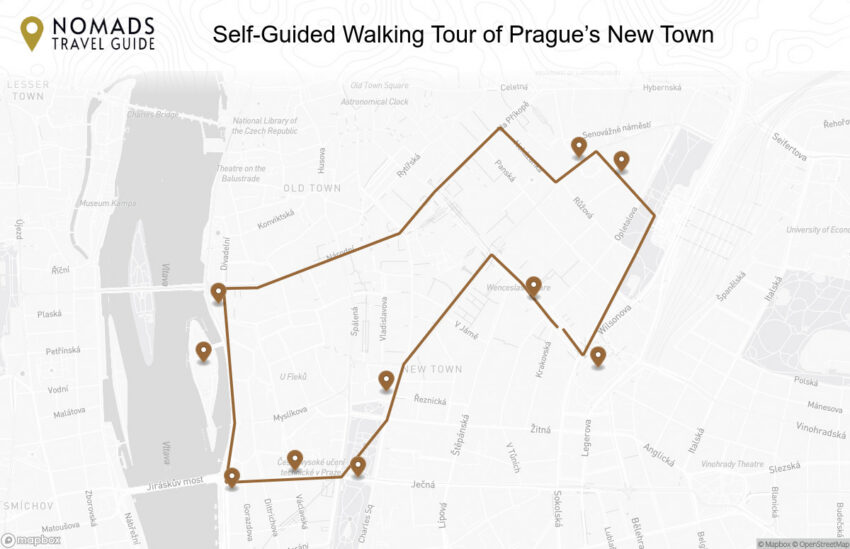
Your Self-Guided Walking Tour of Prague’s New Town

Your self-guided walking tour of Prague's New Town is a practical way to explore the city's more modern layers, where wide boulevards, grand civic buildings, and elegant facades frame the story of Prague from the 19th century through the upheavals of the 20th. With our interactive walking tour map, you can track your current location and your next site as you go, linking highlights such as Wenceslas Square, key theatres and galleries, and landmark churches with quieter streets that reveal Art Nouveau and functionalist details. Plan to pause for a museum, a coffee, or a short detour into a passageway or courtyard, because New Town rewards travellers who balance the headline sights with the smaller architectural moments in between.

1. Wenceslas Square

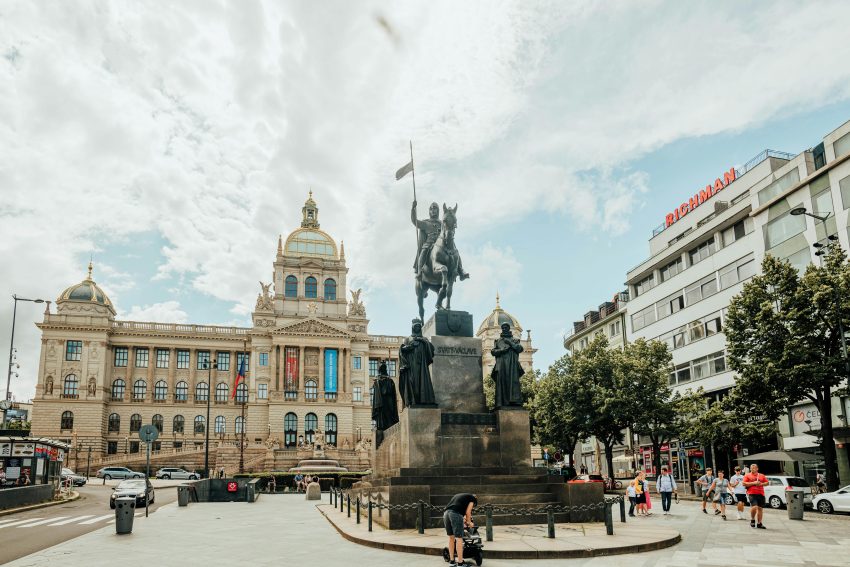
Wenceslas Square, Prague
CC BY-SA 3.0 / Валерий Дед

Wenceslas Square is one of the most iconic locations in Prague. Originally laid out in the 14th century as a horse market, the square evolved over time into the city’s primary commercial and political artery. Though it still retains the proportions of a long, gently sloping boulevard, it pulses with energy thanks to its surrounding shops, hotels, restaurants, and public institutions.

Over the years, Wenceslas Square has been the stage for several pivotal events in Czech history. From the declaration of Czechoslovak independence in 1918 to the 1989 Velvet Revolution, it remains a symbol of national identity and democratic struggle. At the top of the square stands a statue of Saint Wenceslas on horseback—an enduring patriotic icon.

The square’s architectural mix is just as fascinating as its history. Neo-Renaissance, Art Nouveau, and Communist-era buildings stand shoulder-to-shoulder, representing the district’s ever-changing face. At night, the street glows with vibrant lights, while during the day it’s a crossroads for tourists and locals alike.

Whether you’re pausing by the fountains, admiring the facades, or reflecting at the site of Jan Palach’s self-immolation, Wenceslas Square is the emotional heart of New Town and a must-see on any visit.


Location: Wenceslas Square, Prague 1, Czechia | Hours: Open 24/7 (public space). | Price: Free (public boulevard). | Website

Here is a complete selection of hotel options in Prague. Feel free to review each one and choose the stay that best suits your needs.

2. National Museum

Prague National Museum
CC BY-SA 4.0 / VitVit

Presiding over Wenceslas Square is the monumental National Museum, a crown jewel of Czech culture and learning. Built between 1885 and 1891 in neo-Renaissance style, its grand staircase and ornate dome have made it a defining feature of Prague’s skyline.

The museum’s collections span a vast array of topics—from archaeology, anthropology, and zoology to music and Czech history. Inside, exhibitions are staged within grand halls adorned with marble pillars, stained glass, and gilded decoration. It’s a place to linger, learn, and marvel.

The building itself has played a role in more recent history too. During the 1968 Warsaw Pact invasion, Soviet troops mistakenly fired on the museum, believing it to be the parliament. Damage to the sandstone facade remains partially visible despite restorations.

Climbing the dome or pausing on the upper balconies gives visitors commanding views over the entire square. Whether you’re passionate about natural history or simply love opulent architecture, the National Museum is a rewarding stop.


Location: National Museum, Wenceslas Square, New Town, Prague, Czechia | Hours: Daily: 10:00 - 18:00 | Price: Adults: 360 CZK | Website | Tickets with Audio Guide

Traveling to a country with a different currency? Avoid ATM transaction fees and pay in local currency with a Wise Card. Having used it for over 5 years, we've saved loads on fees!

Powered by GetYourGuide

3. Jubilee Synagogue

Jubilee Synagogue
Jubilee Synagogue
CC BY-SA 4.0 / Adámoz

Just a short walk from the bustle of Wenceslas Square stands the Jubilee Synagogue, also known as the Jerusalem Synagogue due to its location. Built in 1906 to mark the silver jubilee of Emperor Franz Joseph I, it blends Moorish Revival and Art Nouveau styles in a brilliant explosion of color and ornamentation.

Its bold striped facade and horseshoe-arched windows are unique within Prague, and the interior is just as striking. Golden stars twinkle against deep blue ceilings, while intricate floral patterns and elegant stained-glass windows frame the sanctuary. The ark and bimah reflect a mix of Jewish symbolism and decorative panache.

The synagogue still functions as a place of worship, but it also welcomes visitors throughout the week. Occasional concerts and exhibitions are held within, making the space both spiritually and culturally significant.

Of all the city’s synagogues, the Jubilee is the most decorative and dramatic. It’s an essential visit for lovers of design, religious history, and hidden architectural gems.


Location: Jerusalem Synagogue, Jeruzalémská, New Town, Czechia | Hours: Daily: 10:00-17:00. Closed Saturdays. | Price: Adults: 135.00 Kč | Website

Click here to read our blog about Prague’s Old Town Square 2026: Must-See Sights, History & Tips

4. St. Henry’s Tower (Jindřišská Věž)

St. Henry’s Tower
St. Henry’s Tower
CC BY-SA 1.0 / VANOCE2022

A soaring Gothic spire tucked into a side street near Wenceslas Square, St. Henry’s Tower is the tallest freestanding bell tower in Prague. Constructed in the late 15th century, the tower originally served as the campanile for the nearby Church of St. Henry and St. Kunhuta.

After centuries of storms, fires, and even war damage, the tower was restored and transformed into a multi-level cultural venue. Today, it houses a café, a restaurant, a small museum, and an observation platform that offers panoramic views of the New Town rooftops.

One of the most delightful surprises inside is the functioning carillon—a set of ten digitally-operated bells that ring melodies every quarter hour. It adds an atmospheric soundtrack to the surrounding neighborhood.

Visitors can take an elevator or stairs to the viewing deck. The museum within the tower also details Prague’s other towers and spires, making it an ideal stop for anyone interested in city planning, skyline history, or off-the-beaten-path sightseeing.


Location: Jindřišská věž, Jindřišská, New Town, Czechia | Hours: Monday—Sunday: 10:00—19:00 | Price: Adults: 190 CZK | Website

Explore Prague at your own pace with our self-guided walking tour! Follow our curated route to discover must-see sights and local secrets that makes Prague one of the best places to visit in Czech Republic.

5. New Town Hall

Prague Town Hall Charles Square
CC BY-SA 3.0 / Mister No

Standing over Charles Square, New Town Hall (Novoměstská radnice) has long been at the administrative and symbolic core of the district. Built in the late 14th century, it originally served as the town hall for the independent borough of New Town before the unification of Prague’s municipalities.

Its place in history was sealed in 1419 when radical Hussite followers threw Catholic councillors from the windows—a dramatic act known as the First Defenestration of Prague, which helped spark the Hussite Wars.

The hall’s Gothic tower is open to visitors, offering expansive views of Charles Square and beyond. Inside, exhibitions cover topics from civic governance to local culture, and concerts are occasionally held in its impressive vaulted halls.

New Town Hall is not just a historical relic—it’s a living part of Prague’s civic life. For those interested in revolutionary history or medieval architecture, it’s a rewarding stop.


Location: New Town Hall, Charles Square, New Town, Prague, Czechia | Hours: Daily: 10:00—18:00; Monday closed. | Price: Adults: 100 CZK | Website

Explore Prague at your own pace with our self-guided walking tour! Follow our curated route to discover must-see sights and local secrets that makes Prague one of the best places to visit in Czech Republic.

6. Charles Square

Charles Square Prague
CC BY-SA 3.0 / Ondřej Kořínek

Among the largest squares in Europe, Charles Square (Karlovo náměstí) was also established by Charles IV in 1348 as a centerpiece of his planned New Town. Originally a vibrant market square, it became home to monasteries, hospitals, and administrative centers, balancing both spiritual and civil needs.

Today, the square functions more like a park, offering locals a place to stroll among trees and fountains while surrounded by heavy traffic and important buildings. It’s home to the New Town Hall, the Church of St. Ignatius, and the Faust House, wrapped in legend and mystery.

The Faust House is particularly famous for its Gothic roots and apocryphal stories about alchemists and otherworldly experiments. Though not generally open to the public, it remains one of the most photographed buildings in the square.

With its blend of civic, religious, and mythological significance, Charles Square serves as a fitting anchor to Prague’s urban planning and cultural imagination.


Location: Karlovo náměstí - Hvězda spásy, Charles Square, New Town, Czechia | Hours: Free (public square and park). | Price: Open 24/7 (public space). | Website

Explore Prague at your own pace with our self-guided walking tour! Follow our curated route to discover must-see sights and local secrets that makes Prague one of the best places to visit in Czech Republic.

7. Ss. Cyril and Methodius Cathedral

Ss Cyril and Methodius Cathedral
CC BY-SA 3.0 / Ludek

This Baroque church, built in the 1730s, may appear unassuming from the outside, but it holds one of the most poignant memorials in Prague. Beneath the main sanctuary lies the crypt where Czech paratroopers made their final stand in 1942 after assassinating Reinhard Heydrich, a high-ranking Nazi official.

Known as Operation Anthropoid, the mission is one of the most celebrated acts of resistance during World War II. After being betrayed, the men took refuge in the church, where they were ultimately surrounded by Nazi troops. Rather than surrender, they chose to die in the crypt.

Today, that space serves as a deeply moving memorial, with photographs, documents, and artifacts chronicling their bravery and sacrifice. The exhibit is compact but powerfully curated.

Visiting the church and memorial is a sobering but important stop on any tour of New Town—offering a reminder of Prague’s courage in the face of tyranny.


Location: Ss. Cyril and Methodius Cathedral, Resslova, New Town, Czechia | Hours: Daily: 8:00—17:00. Closed Mondays | Price: Free | Website

Click here to read our blog about Prague’s Past in Stone 2026: A Journey Through Its Historic Buildings & Monuments

8. National Theatre (Národní divadlo)

National Theatre Prague
Free Art License / A.Savin

The National Theatre is one of Prague’s most treasured cultural institutions and a symbol of Czech national identity. Opened in 1881 and then reopened in 1883 after a fire, the theatre was funded entirely by public donations—an extraordinary act of civic pride and unity during the Czech National Revival.

Designed in neo-Renaissance style by architect Josef Zítek, the theatre’s opulent facade and richly decorated interior continue to inspire awe. The golden-crowned rooftop and allegorical sculptures make it one of the city’s architectural highlights, especially when viewed from across the Vltava River.

Inside, the theatre hosts performances of opera, ballet, and drama, featuring both Czech classics and international works. It remains a working house with a rotating schedule of productions in three venues: the historic National Theatre building, the Estates Theatre, and the New Stage.

Whether you’re attending a show or admiring the building from the nearby Legion Bridge, the National Theatre is a cornerstone of Czech artistic heritage—and a striking visual and cultural highlight along any walking tour of New Town.


Location: National Theatre, Národní, New Town, Czechia | Hours: Public access depends on performance schedules, tours, and events; check the official site for current listings. | Price: Varies widely by performance and seating; exterior viewing is free. | Website

Explore Prague at your own pace with our self-guided walking tour! Follow our curated route to discover must-see sights and local secrets that makes Prague one of the best places to visit in Czech Republic.

9. Žofín Palace

Žofín Palace
Žofín Palace
CC BY-SA 3.0 / PatrikPaprika

Nestled on Slovanský Island in the middle of the Vltava River, Žofín Palace is one of Prague’s most elegant Neo-Renaissance landmarks. Built in 1837 and named in honor of Princess Sophie (Žofie), the mother of Emperor Franz Joseph I, the palace has long been associated with music, art, and politics.

Originally used for social and cultural gatherings, it hosted performances by luminaries such as Bedřich Smetana, Antonín Dvořák, and Franz Liszt. Its majestic grand hall with crystal chandeliers and lavish detailing remains a popular venue for concerts, balls, and galas to this day.

Set amid landscaped gardens and riverside walkways, Žofín Palace offers a peaceful retreat from the urban bustle. The surrounding park and café terraces provide a relaxed space for a break during your walking tour, while offering beautiful views of the National Theatre and Old Town skyline.

Today, Žofín also serves as a hub for political events, conferences, and civic receptions. Whether you’re admiring it from the riverbank or attending a live performance inside, the palace represents a bridge between historic charm and living tradition.


Location: Žofín Palace, Slovanský ostrov, Prague 1, Czechia | Hours: The island is accessible daily; the palace interior is generally open for scheduled events and exhibitions rather than standard touring hours. | Price: Free to visit the island and view the palace exterior; interior access varies by event (typically ticketed). | Website

Explore Prague at your own pace with our self-guided walking tour! Follow our curated route to discover must-see sights and local secrets that makes Prague one of the best places to visit in Czech Republic.

10. Dancing House

Dancing House
Dancing House
CC BY-SA 2.5 / Chosovi

Nicknamed “Fred and Ginger,” the Dancing House is one of Prague’s most distinctive modern buildings. Designed by Vlado Milunić and Frank Gehry, it was completed in 1996 on a site left vacant after bombing in World War II.

The structure’s two towers appear to sway together like dancers—the stone tower upright and rigid, while the glass tower curves inward. This visual metaphor makes it a striking symbol of creativity and post-Communist architectural freedom.

Inside, the building houses offices, a restaurant, and a rooftop bar with panoramic views of the Vltava River and Prague Castle. Exhibitions and art installations are also occasionally staged in its gallery space.

Whether viewed from the riverbank or climbed for its skyline perspective, the Dancing House captures the spirit of a city that’s unafraid to blend tradition with bold innovation.


Location: Dancing House, Jiráskovo náměstí, New Town, Czechia | Hours: Rooftop bar and terrace hours vary by season and private events; check ahead if you’re planning around sunset. | Price: Viewing terrace access is typically included with a purchase at the rooftop bar. | Website
Powered by GetYourGuide
Moira & Andy
Moira & Andy

Hey! We're Moira & Andy. From hiking the Camino to trips around Europe in Bert our campervan — we've been traveling together since retirement in 2020!

Read our full story here

This website uses affiliate links which earn a small commission at no additional cost to you.

Walking Tour Summary

Distance: 4.5 km
Sites: 10

Walking Tour Map
Map of the Self-Guided Walking Tour of Prague’s New Town walking route with 10 stops in Prague.
Preview map of the Self-Guided Walking Tour of Prague’s New Town route in Prague, showing 10 stops. Use the interactive map to zoom and tap markers.

More from this area

Self-Guided Walking Tour of Prague’s Lesser Town (2026)

Wallenstein Palace & Gardens
CC BY-SA 4.0 / VitVit

This website uses affiliate links which earn a small commission at no additional cost to you.

Prague, a city layered in centuries of history and culture, offers an irresistible mix of medieval architecture, vibrant neighborhoods, and a timeless riverfront. Its districts each bring their own personality: the Old Town (Staré Město) is the historic heart with its astronomical clock and Gothic towers; the New Town (Nové Město) bustles with modern life and grand 19th-century boulevards; and the Castle District (Hradčany) rises with regal views.

Across the Vltava River lies Lesser Town (Malá Strana), a peaceful quarter known for its Baroque beauty, narrow alleys, embassies, and tranquil gardens nestled beneath Prague Castle. From the spires of Gothic churches to lively cobblestone squares and world-class art, this storied capital is best experienced on foot. A guided or self-guided walking tour offers the ideal way to engage with its architectural wonders, literary legacy, and shifting political past.

Whether you're crossing Charles Bridge at dawn or exploring the tucked-away courtyards of Malá Strana, Prague rewards those who explore it on foot.

How to Get to Lesser Town, Prague

By Plane: To get to Prague by plane, fly directly into Václav Havel Airport Prague (PRG), which is the city's main international airport and well-connected to major cities across Europe, Asia, and North America. From the airport, it's about a 30-minute drive or a 45-minute public transport ride to the city center. For the best deals and a seamless booking experience, check out these flights to Prague on Booking.com.

By Train: Prague is well-connected by rail to other major cities in Europe, with the main station, Praha hlavní nádraží, offering easy access to the city's districts. From the station, Malá Strana is reachable by tram or metro in under 15 minutes. Train schedules and bookings can be found on Omio.

By Car: Prague is accessible via major European highways, but driving in the city center is not recommended due to narrow streets and limited parking. Nearby parking facilities are available near Újezd or Letná.

Where to Stay in Lesser Town, Prague

To make the most of your walking tour, stay within Malá Strana or the surrounding districts. For a refined experience, Hotel Pod Věží offers elegance just steps from Charles Bridge. For comfort and charm at a mid-range price, Hotel U Páva is a picturesque choice. Budget travelers may enjoy Little Quarter Hostel, conveniently located along the historic Royal Route.

A Brief History of Lesser Town (Malá Strana)

Early Settlements

Malá Strana means “Little Side,” but its original name was Nova Civitas, or New Town. This designation predated the more famous Nové Město, established by Charles IV south of the Old Town in the 14th century. Once the new royal development began, the older name became confusing, and so the area came to be known as the “Smaller Side” of the river, or Kleinseite in the German dialect spoken by many of its medieval inhabitants.

The Lesser Town, located on the left bank of the Vltava River, originated as a tiny market settlement in the shadow of Prague Castle. Early references to the area date back to the 8th century, though it wasn't formally founded as a town until 1257, when King Přemysl Otakar II granted it official status. From then, it grew into a fortified district and a key part of royal and civic life in Prague.

Middle Ages

In the Middle Ages, the Lesser Town became a thriving hub of trade, heavily fortified with defensive walls to protect its strategic location. A major contribution during the 14th century was the construction of the Hunger Wall, a defensive project initiated by Charles IV not just for protection but as a form of employment during times of famine. The wall still exists along the slopes of Petřín Hill.

Baroque Era

The Baroque era left a powerful imprint on the area. After multiple devastating fires in the 16th and 17th centuries, Malá Strana was largely rebuilt by the nobility and became a showcase of Baroque architecture. Architects such as Christoph and Kilian Ignaz Dientzenhofer designed some of the district's most spectacular buildings, including the magnificent Church of St. Nicholas.

Modern Era

In the modern era, Malá Strana has evolved into one of Prague's most charming and popular tourist districts. It continues to draw visitors with its palaces, churches, and atmospheric lanes. Attractions such as the Franz Kafka Museum, Wallenstein Gardens, and the views from Charles Bridge all contribute to the area's timeless appeal.

Your Self-Guided Walking Tour of Lesser Town, Prague

This guide highlights many of Malá Strana’s main attractions, but be sure to follow your curiosity into quiet corners or unexpected stairways. Whether you are enjoying a riverside view, discovering a secret garden, or hearing the bells from St. Nicholas Church, every step offers a new facet of Prague’s timeless charm. From the spires of Gothic churches to lively cobblestone squares and world-class art, this storied capital is best experienced on foot, and you can use our interactive walking tour map to track your current location and your next site as you go.

1. Charles Bridge

Prague Charles Bridge from Petrinska Tower
Free Art License / A.Savin

Charles Bridge is the most iconic and atmospheric of Prague’s crossings over the Vltava River. Commissioned by Emperor Charles IV in 1357, this Gothic stone bridge stretches over 500 meters and is lined with 30 Baroque statues of saints, making it an open-air gallery as well as a thoroughfare. Originally built to replace the Judith Bridge, which was destroyed in a flood, Charles Bridge connects the Old Town with Lesser Town and remains one of the city’s most photographed sights. Walking across it at dawn reveals a quieter, more meditative experience, with mists rising over the river and the silhouettes of spires looming in the distance. By day, it becomes a vibrant cultural corridor filled with artists, street musicians, and vendors. The statues, though weatherworn, each tell a unique story, with the statue of St. John of Nepomuk being the most famous. Touching its base is said to ensure your return to Prague. The two Gothic towers anchoring each end of the bridge—the Old Town Bridge Tower and the Lesser Town Bridge Tower—offer panoramic views and insight into Prague’s fortifications. Climbing these towers is well worth the effort. The Charles Bridge isn’t just a beautiful structure; it’s a living part of Prague’s identity—rich with history, art, and the flow of daily life.


Location: Charles Bridge, Prague 1, Czechia | Hours: Always open (pedestrian bridge). | Price: Free. | Website

Here is a complete selection of hotel options in Prague. Feel free to review each one and choose the stay that best suits your needs.

Powered by GetYourGuide

2. Franz Kafka Museum

Kafka Museum Prague
Kafka Museum Prague
CC BY-SA 1.0 / Perituss

Located near the western end of Charles Bridge, the Franz Kafka Museum offers an immersive look into the life and mind of one of Prague’s most influential writers. Housed in a former brickworks, the museum is a carefully curated blend of Kafka’s biography, manuscripts, photographs, and audiovisual installations that echo the dark, surreal tone of his work. The exhibition space is divided between the thematic areas of Kafka’s Prague and Kafka’s Writings, which explore his relationships, daily routines, and literary influences. Letters, early editions, and even his school reports provide deeply personal glimpses into his world. A highlight is the unsettling basement installation featuring interpretations of Kafka’s works, including a life-sized model of the torture machine from “In the Penal Colony.” It’s a deliberately disorienting environment—part museum, part psychological maze. In the courtyard outside, David Černý’s provocative sculpture of two male figures urinating into a Czech-shaped basin adds a sharp dose of irony to this otherwise introspective site.


Location: Kafka Museum, Cihelná, Malá Strana, Czechia | Hours: Daily: 10:00 - 18:00 | Price: 220,00 Kč | Website | Tickets

Traveling to a country with a different currency? Avoid ATM transaction fees and pay in local currency with a Wise Card. Having used it for over 5 years, we've saved loads on fees!

Powered by GetYourGuide

3. Wallenstein Palace & Gardens

Wallenstein Palace & Gardens
CC BY-SA 4.0 / VitVit

Built between 1623 and 1630 by the powerful military commander Albrecht von Wallenstein, this enormous Baroque complex was designed to rival Prague Castle. Today, Wallenstein Palace houses the Czech Senate, but its ornate gardens remain open to the public and offer a tranquil oasis amid the urban landscape. The palace’s Sala Terrena, an open-air hall with massive arches and vivid frescoes, overlooks a neatly manicured French-style garden. Peacocks roam freely among the fountains and hedges, adding a touch of whimsy to the historic setting. The artificial dripstone wall known as the “Grotto” is a unique feature of the gardens. Resembling a curtain of stone, it includes sculpted faces and figures hidden among the formations. It reflects the 17th-century fascination with illusion and theatrical design. Whether attending a summer concert, pausing for reflection near the koi pond, or simply enjoying the symmetry and serenity of the grounds, a visit to Wallenstein Palace offers a refreshing contrast to the busier nearby attractions.


Location: Waldstein Palace (Wallenstein Palace), Valdštejnské náměstí, Malá Strana, Czechia | Hours: April—October Mon-Fri 7:00—19:00 Sat & Sun 9:00—19:00 | Price: Free | Website

Click here to read our blog about Prague’s Old Town Square 2026: Must-See Sights, History & Tips

4. Lesser Town Square (Malostranské náměstí)

View from Lesser Town Nicholas Church
Free Art License. / A.Savin

Lesser Town Square is the vibrant heart of Malá Strana, flanked by historic palaces, cafés, and the imposing Church of St. Nicholas. It originated as a market square in the Middle Ages and became the center of political, cultural, and social life in the district. The square consists of an upper and lower portion, separated by a tram line. Here you’ll find ornate buildings in Renaissance and Baroque styles, many of which served as residences for noble families and foreign dignitaries. Look up to see coats of arms and decorative facades that speak to the area’s prestigious past. A statue of Holy Roman Emperor Charles IV stands at the square’s center, while horse-drawn carriages still operate here, adding to the timeless atmosphere. Outdoor cafés make it a great place to pause and soak in the surroundings. The square also serves as a crossroads—connecting routes to the Castle, Charles Bridge, and the winding lanes of Lesser Town.


Location: Old Town Square, Old Town, Czechia | Hours: Always accessible; church and venue opening hours vary, and services can affect interior visiting times. | Price: Free to visit the square. Individual sites (churches, galleries, concerts) may charge separate admission.

Explore Prague at your own pace with our self-guided walking tour! Follow our curated route to discover must-see sights and local secrets that makes Prague one of the best places to visit in Czech Republic.

5. Church of St. Nicholas (Lesser Town)

 Church of St. Nicholas, Prague
 Church of St. Nicholas, Prague
CC BY-SA 3.0 / Edgar El

One of the grandest churches in Prague, the Church of St. Nicholas is a Baroque masterpiece that dominates Lesser Town Square. Constructed in the 18th century, the church replaced a Gothic structure on the same site and was designed by Christoph and Kilian Ignaz Dientzenhofer, two of Bohemia’s most celebrated Baroque architects. Its opulent façade and magnificent dome are visible from across the Vltava River. Inside, visitors are met with a breathtaking interior adorned with intricate stucco, marble columns, and ceiling frescoes, including a massive depiction of the Apotheosis of St. Nicholas. The church’s impressive organ, played by Mozart in 1787, remains a central attraction, and classical concerts are still held here, drawing music lovers from around the world. The bell tower, which can be visited separately, offers panoramic views of Malá Strana and Prague Castle. Originally used by secret police during the Communist era for surveillance, it now provides a peaceful perspective over the red rooftops of the district. This church is not just a place of worship—it’s a monumental statement of power, faith, and artistic excellence that defines the architectural spirit of Baroque Prague.


Location: Chrám sv. Mikuláše, Old Town Square, Old Town, Czechia | Hours: Daily: 9.00 – 17.00 | Price: Adults: 150 CZK | Website

Explore Prague at your own pace with our self-guided walking tour! Follow our curated route to discover must-see sights and local secrets that makes Prague one of the best places to visit in Czech Republic.

6. Bridge Street (Mostecká)

Mostecká, Praha
Mostecká, Praha
CC BY-SA 4.0 / Maksym Kozlenko

Connecting Charles Bridge to the heart of Lesser Town, Mostecká (Bridge Street) is one of the most picturesque and historic thoroughfares in Prague. Its cobblestone path is lined with colorful façades, decorative house signs, and charming shops that cater to tourists and locals alike. The street’s significance dates back to the medieval era, when it formed part of the Royal Route taken by kings on their way to coronation at Prague Castle. Today, the path still carries echoes of pomp and ceremony, though the modern rhythm is driven by cafés, souvenir shops, and the steady flow of foot traffic. A notable building on this route is the former Jesuit College, now housing the city’s music school. Keep an eye out for symbolic house signs like “At the Red Lion” or “At the Golden Wheel,” reminders of a time when Prague had no house numbers. Bridge Street offers a delightful way to transition between iconic attractions while soaking up the unique ambiance of Malá Strana.


Location: Mostecká 18, 118 00 Praha 1-Malá Strana, Czechia | Hours: Always open; courtyards, galleries, and cafés have their own opening hours. | Price: Free (public street).

Explore Prague at your own pace with our self-guided walking tour! Follow our curated route to discover must-see sights and local secrets that makes Prague one of the best places to visit in Czech Republic.

7. Church of Our Lady Victorious and of the Infant Jesus of Prague

Church of Our Lady Victorious and The Infant Jesus of Prague
CC BY-SA 4.0 / VitVit

Known worldwide for the wax statue of the Infant Jesus of Prague, this Carmelite church holds a special place in Catholic devotion. Originally built by the Lutherans in the early 17th century, the Church of Our Lady Victorious was handed over to the Catholic Carmelites during the Counter-Reformation. The famed statue, brought from Spain, is said to have miraculous powers. It is housed in an ornate side chapel and dressed in elaborately embroidered robes that are changed according to the liturgical calendar. A small museum within the church displays a fascinating collection of these garments. Despite its relatively plain exterior, the church’s interior dazzles with Baroque flourishes, gilded altars, and devotional artwork. The faithful flock here not only for prayer but also to experience the rich spiritual heritage it represents. This church is a deeply moving stop on any walking tour—especially for those interested in Prague’s religious history and enduring Catholic traditions.


Location: Church of Our Lady Victorious and The Infant Jesus of Prague, Malá Strana, Prague 1, Czechia | Hours: Monday-Saturday 9:30 – 17:00; Sunday: 13:00 – 18:00 | Price: Free. | Website

Click here to read our blog about Prague’s Past in Stone 2026: A Journey Through Its Historic Buildings & Monuments

8. Mirror Maze

Mirror Maze Prague
Mirror Maze Prague
CC BY-SA 2.0 / Gary Bembridge

The Mirror Maze on Petřín Hill is a whimsical, family-friendly attraction that offers both laughter and a bit of disorientation. Housed in a miniature neo-Gothic castle resembling a medieval fortress, the maze was originally built for the Jubilee Exhibition of 1891 and later moved to its current location. The experience begins with a mirrored labyrinth that challenges your sense of direction as you encounter countless reflections of yourself at every turn. Beyond the maze lies a diorama hall featuring a massive painted scene of Prague’s defense against the Swedes in 1648—a surprisingly educational twist amid the fun. The real showstopper is the Hall of Laughter, where distorted mirrors stretch, shrink, and twist your reflection into hilarious shapes. It’s particularly popular with children, but adults can’t help but laugh too. The Mirror Maze is a light-hearted detour from the more historical stops on this tour, making it perfect for groups, families, or anyone in need of a cheerful break.


Location: Mirror Maze in Petrin Park, Petřínské sady, Prague 1, Czechia | Hours: September—May: Mon, Tue, Wed, Thu, Fri, Sat, Sun 10:00—18:00 June—August: Mon, Tue, Wed, Thu, Fri, Sat, Sun 10:00—19:00 | Price: 150 CZK

Explore Prague at your own pace with our self-guided walking tour! Follow our curated route to discover must-see sights and local secrets that makes Prague one of the best places to visit in Czech Republic.

Powered by GetYourGuide

9. Petřín Lookout Tower

Tour Petřín Prague
Tour Petřín Prague
CC BY-SA 4.0 / Chabe01

Towering over Prague on Petřín Hill, the Petřín Lookout Tower is often described as the city’s own Eiffel Tower. Built in 1891 by the Czech Tourist Club, the 60-meter structure may be smaller than its Parisian cousin, but thanks to its elevated location, the views are just as breathtaking. The tower can be reached by a funicular railway or a scenic uphill walk through landscaped gardens. Once at the base, visitors can climb the 299 steps to the observation decks, where sweeping panoramic views extend across Prague’s skyline, from the Castle District to the distant Žižkov Tower. The design features an octagonal base and iron framework, giving it a light, airy profile that complements the surrounding greenery. A small exhibition inside the tower offers insight into its history and construction.

Ideal for photography and a quiet moment above the bustling city, Petřín Lookout Tower is a fitting finale to any walking tour through Lesser Town.


Location: Petrin Tower, Petřínské sady, Malá Strana, Czechia | Hours: Daily: 10:00—18:00 | Price: Adults: 250 CZK | Website

Explore Prague at your own pace with our self-guided walking tour! Follow our curated route to discover must-see sights and local secrets that makes Prague one of the best places to visit in Czech Republic.

Powered by GetYourGuide
Moira & Andy
Moira & Andy

Hey! We're Moira & Andy. From hiking the Camino to trips around Europe in Bert our campervan — we've been traveling together since retirement in 2020!

Read our full story here

This website uses affiliate links which earn a small commission at no additional cost to you.

Walking Tour Summary

Distance: 5 km
Sites: 9

Walking Tour Map
Map of the Self-Guided Walking Tour of Prague’s Lesser Town walking route with 9 stops in Prague.
Preview map of the Self-Guided Walking Tour of Prague’s Lesser Town route in Prague, showing 9 stops. Use the interactive map to zoom and tap markers.

More from this area

Self-Guided Walking Tour of Angers, France (2026)

Walking tour of Angers

This website uses affiliate links which earn a small commission at no additional cost to you.

Angers, a historic city in the heart of the Loire Valley, is known for its exceptional architectural heritage, vibrant cultural scene, and centuries-old connection to French royalty. Once the seat of the powerful Plantagenet dynasty, Angers has retained its medieval charm while embracing a modern identity rooted in education, the arts, and environmental stewardship.

From its imposing castle and world-famous tapestry collections to its lively gardens and thriving creative districts, Angers offers a well-rounded experience that captivates history buffs, art lovers, and leisurely explorers alike.

How to Get to Angers

By Plane: To get to Angers by plane, the nearest airport is Nantes Atlantique Airport (NTE), about 1.5 hours away by car or train, offering flights to many European destinations. Alternatively, you can fly into Paris and take a high-speed TGV train to Angers in under 2 hours. For the best deals and a seamless booking experience, check out these flights to Angers on Booking.com.

By Train: Angers is served by the high-speed TGV network, with regular services from Paris (about 1.5 hours), Nantes, and Tours. Angers-Saint-Laud station is conveniently located just a short walk from the city center and well-connected by buses and trams. You can use SNCF Connect to check schedules, compare routes, and purchase tickets for National (SNCF ) and regional trains (TER). For a more streamlined experience, we recommend using Omio, which allows you to easily compare prices, schedules, and book tickets for both National and Regional travel across all of Europe, all in one place.

By Car: Angers is accessible via the A11 motorway from Paris and the A87 from the south. Central parking is available at Parking Molière and Parking Ralliement, both within walking distance of key landmarks. If you are looking to rent a car in France I recommend having a look at Discover Cars, first, as they compare prices and review multiple car rental agencies for you.

Where to Stay in Angers

To enjoy the full charm of Angers, consider staying in the city center. For historic elegance, Hôtel d'Anjou offers refined comfort close to the château. For a stylish and central stay, Hôtel 21 Foch is a boutique option with modern amenities. Budget travelers might prefer Ibis Angers Centre Château for its simplicity and prime location.

A Brief History of Angers

Angers has a long and storied past dating back to Roman times, when it was known as Juliomagus. It flourished in the Middle Ages under the Plantagenets, whose legacy is still visible in the massive fortress that dominates the city. As the capital of Anjou, Angers played a key role in regional politics, culture, and commerce.

In the 14th and 15th centuries, the city emerged as a center for tapestry-making, most famously producing the Apocalypse Tapestry, the largest of its kind in the world. Angers continued to prosper through the Renaissance and modern periods, becoming a hub for education, the arts, and horticulture.

Today, Angers balances its deep historical roots with a forward-thinking ethos. Its universities, cultural institutions, and green initiatives make it a dynamic and livable city with a strong sense of identity and pride.

Your Self-Guided Walking Tour of Angers

This walking route closely follows the blue line route recommended by the Angers Tourist Office, offering a comprehensive overview of the city's most important historic and cultural landmarks, and you can use our interactive walking tour map to track your current location and your next site as you go. You probably will not be able to visit every attraction mentioned in a single day, so use this guide to be selective, explore at your own pace, and focus on what interests you most, whether that is medieval architecture, modern art, or quiet green spaces.

1. Château d’Angers

Château d'Angers
Château d’Angers
CC BY-SA 4.0 / DXR

Begin your journey at the Château d’Angers, a formidable fortress with 17 massive towers, originally built in the 13th century. This medieval stronghold once served as a residence for the Dukes of Anjou and now houses the extraordinary Apocalypse Tapestry, a 14th-century masterpiece stretching over 100 meters in length.

Inside the château, you can explore beautifully landscaped gardens, a chapel, and ramparts offering panoramic views over the city and the Maine River. The museum offers detailed exhibits on the history of Anjou and the château’s strategic role through the ages.

Whether you’re captivated by medieval architecture, royal history, or intricate artwork, Château d’Angers is a compelling place to start your exploration of the city.


Location: Château d'Angers, Promenade du Bout du Monde, Angers, France | Hours: From May 2 to September 4: 10 a.m. - 6:30 p.m. From September 5 to April 30, 10 a.m. - 5:30 p.m. | Price: €11 | Website | Tickets

We recommend to rent a car in France through Discover Cars, they compare prices and review multiple car rental agencies. Book your rental car here.

Powered by GetYourGuide

2. Cathédrale Saint-Maurice d'Angers

Cathedral of Saint maurice
CC BY-SA 3.0 / Paolo Carnassale

Just uphill from the château stands the Cathédrale Saint-Maurice, a striking example of the Angevin Gothic style. Construction began in the 12th century, and its elegant twin spires now form one of Angers’ most recognizable landmarks.

Inside, the cathedral features a series of stained glass windows dating back to the 12th and 13th centuries, including scenes from the life of Saint Julian. The nave, choir, and altar blend Romanesque foundations with Gothic refinements, creating a harmonious and luminous interior.

Don’t miss the intricately carved pulpit and the crypt, which reveals the cathedral’s earlier Romanesque origins. As both a place of worship and historical monument, it offers spiritual serenity and artistic inspiration.


Location: Cathédrale Saint-Maurice d'Angers, Rue Saint-Christophe, Angers, France

Here is a complete selection of hotel options in Angers. Feel free to review each one and choose the stay that best suits your needs.

3. Adam's House and Place Saint-Croix

Maison d’Adam
Maison d’Adam
CC BY-SA 4.0 / Nataloche

Next, stroll to Place Saint-Croix to find the extraordinary Maison d’Adam, one of the finest surviving examples of half-timbered medieval architecture in France. Dating back to the late 15th century, its elaborately carved wooden façades are adorned with whimsical and mythological figures.

The building has housed merchants, an apothecary, and today hosts the Maison des Artisans, a boutique for local craftspeople. Inside, you can browse unique handmade items ranging from ceramics to jewelry.

Together with the surrounding Place Saint-Croix, this area offers a glimpse into medieval life and bustling contemporary culture—making it a lively, photogenic spot to pause and explore.


Location: La Maison d'Adam - La Maison des Artisans, Place Sainte-Croix, Angers, France

Traveling to a country with a different currency? Avoid ATM transaction fees and pay in local currency with a Wise Card. Having used it for over 5 years, we've saved loads on fees!

4. Grand Théâtre and Place du Ralliement

Grand Théâtre Angers
CC BY-SA 4.0 / Chabe01

Angers’ cultural heart beats at Place du Ralliement, where the Grand Théâtre stands as a beacon of the city’s dedication to the arts. Originally opened in 1794 and rebuilt after a fire, the current building dates to the 1870s.

Its richly decorated auditorium regularly hosts opera, theater, and dance, and it is home to the Angers-Nantes Opéra company. The elegant square outside is the perfect spot for coffee or lunch amid historic façades and modern vibrancy.

Whether you’re taking in a performance or just enjoying the ambiance, this is one of Angers’ most iconic urban scenes.


Location: Grand Théâtre, Place du Ralliement, Angers, France

5. Pincé Museum

agence immobiliere angers centre ville : vue du logis du Pincé à Angers
CC BY-SA 4.0 / Loic Le Bris

A few steps away lies the Pincé Museum, a rare Renaissance hôtel particulier built between 1525 and 1535. This elegant mansion now houses collections of Greek, Roman, Egyptian, and Asian art.

The building itself is a jewel of early Renaissance architecture, with its classical symmetry, decorative details, and peaceful courtyard.

Inside, themed exhibits transport you through time and across civilizations, with artifacts that include busts, ceramics, sarcophagi, and ancient manuscripts.


Location: Musée Pincé, Rue Lenepveu, Angers, France | Hours: Saturday and Sunday • 10 AM - 6 PM Closed May 1, Nov. 1 and 11, Dec. 25 and Jan. 1 | Price: €4 | Website

6. Museum of Natural Sciences, Angers

Angers Museum of Natural Sciences
CC BY-SA 4.0 / Okapie49

The Muséum des Sciences Naturelles d’Angers is a captivating destination for those interested in natural history. Established in 1801, it houses an extensive collection of approximately 830,000 items, including taxidermied animals, fossils, minerals, and botanical specimens. The museum’s exhibits span various disciplines such as botany, zoology, earth sciences, and prehistory, offering visitors a comprehensive understanding of the natural world. Notable highlights include a 500-million-year-old trilobite fossil, Neanderthal remains from the Roc-en-Pail site, and a diverse array of preserved flora and fauna. The museum is located at 43 rue Jules Guitton, with additional botanical collections housed at the Arboretum Gaston-Allard on 9 rue du Château d’Orgemont. For more information, visit the official website: angers.fr/museum.​


Location: The Museum of Natural Science, Rue Jules Guitton, Angers, France | Hours: Tuesday to Sunday • 10 AM - 6 PM Closed May 1, Nov. 1 and 11, Dec. 25 and Jan. 1 | Price: €2 | Website

7. Jardin des Plantes d'Angers

Angers Jardin des Plante
CC BY-SA 4.0 / GO69

Located in the heart of Angers, the Jardin des Plantes is a serene 4-hectare botanical garden that offers a delightful escape into nature. Established in 1777 by Doctor Luthier de La Richerie, the garden has evolved over the centuries, with significant redesigns by renowned landscape architect Édouard André between 1901 and 1905. The garden features winding paths, cascading streams, and a diverse collection of plant species, including exotic trees like Paulownia, Siberian elm, and Ginkgo biloba. Visitors can also enjoy various themed sections, such as the rock garden added in 1967, and observe local wildlife like ducks and swans in the tranquil ponds. Open daily without charge, it’s an ideal spot for relaxation and botanical appreciation.


Location: Le Jardin des Plantes, Rue Boreau, Angers, France

8. Hôtel de Ville d'Angers

Hôtel ville Angers
Hôtel ville Angers
CC BY-SA 4.0 / Chabe01

The Hôtel de Ville d’Angers, or Angers City Hall, stands as a prominent example of neoclassical architecture. Completed in 1823 and designed by architect Adolphe Lenoir, the building features a symmetrical façade with Doric columns and a central pediment adorned with intricate carvings. Historically, the site has been central to the city’s administration, with previous municipal buildings dating back to the 15th century. The current structure not only serves as the administrative heart of Angers but also holds historical significance, having hosted events like a recital by pianist Franz Liszt in 1845 and the proclamation of the city’s liberation in 1944. A major extension in 1980 added a modern council chamber, blending historical and contemporary architectural elements.


Location: Hôtel de ville d'Angers, Boulevard Résistance et Déportation, Angers, France | Hours: Free (exterior view); free entry during open house events | Price: Offices open Monday to Friday, 8:30–17:30; access varies for visitors | Website

9. La Maison Bleue

Angers Maison bleue
Angers Maison bleue
CC BY-SA 3.0 / Selbymay

Nearby on Rue d’Alsace, discover La Maison Bleue, an Art Deco masterpiece designed in the early 20th century by architect Roger Jusserand. Covered in dazzling blue ceramic tiles and featuring intricate geometric patterns, it’s a unique example of modernist architecture in a predominantly medieval town.

This six-story apartment building catches the eye with its bold colors, stylized figures, and luxurious design, reflecting the optimism and style of the interwar years.

While not open to the public, the façade alone is worth admiring—and a vivid contrast to the timbered houses of the old town.


Location: La Maison Bleue, Boulevard du Maréchal Foch, Angers, France

10. Saint-Martin Collegiate Church

Angers collegiale St Martin rwk
CC BY-SA 4.0 / Mbzt

One of the oldest religious sites in Angers, the Collégiale Saint-Martin combines Carolingian origins with Romanesque and Gothic transformations. The present building reflects centuries of spiritual life and architectural evolution.

Now restored as a cultural venue, it houses an impressive sculpture collection and temporary exhibitions. Vaulted ceilings, delicate capitals, and archaeological remains add layers of depth to every visit.

Its serene atmosphere and historic resonance make it a quiet treasure in the heart of the city.


Location: Collégiale Saint-Martin, Rue Saint-Martin, Angers, France

11. Saint-Aubin Tower

Tour saint aubin angers
CC BY-SA 2.0 / Romainberth

Continue through the Doutre district to the Tour Saint-Aubin, a striking vestige of the once-vast Abbey of Saint-Aubin. Built in the 12th century, the tower is now used as a gallery for art exhibitions and cultural events.

Climb the interior spiral staircase for sweeping views across the rooftops of Angers.

A blend of heritage and creativity, this medieval monument invites reflection on how the city continues to reinterpret its historic spaces.


Location: Tour Saint Aubin, Rue des Lices, Angers, France | Hours: Vary by exhibition; generally 10:00–18:00 Tuesday to Sunday | Price: Free or modest (€2–€4) depending on the exhibition | Website

12. Musée des Beaux-Arts d'Angers

Beaux arts angers
Beaux arts angers
CC BY-SA 2.0 / Romainberth

The Musée des Beaux-Arts, located in the elegant 15th-century Logis Barrault. The museum’s extensive collection spans paintings, sculptures, and decorative arts from the 14th century to the present. Highlights include works by Fragonard, Watteau, and Chardin, alongside modern and contemporary pieces. The museum also hosts a compelling exhibition on the history of Angers itself, with archaeological finds and city archives. Its carefully curated spaces and rotating exhibitions make it one of the most engaging art museums in the region, perfect for both seasoned art lovers and curious visitors alike.

Step into the museum’s peaceful garden and cloister, which blends nature and architectural harmony. Once part of a convent, this space has been transformed into a quiet retreat surrounded by sculpture and shaded walkways. The garden provides a pause from the bustling city streets, where one can appreciate seasonal blooms and reflective calm. It’s an ideal spot to relax, sketch, or enjoy a quiet conversation amid centuries-old stonework.


Location: Musée des Beaux-Arts d'Angers, Rue du Musée, Angers, France | Hours: Tuesday to Sunday • 10:00-18:00 Closed May 1, Nov. 1 and 11, Dec. 25 and Jan. 1 | Price: €6 | Website

13. The David d’Angers Gallery

Galerie David d'Angers
Galerie David d’Angers
CC BY-SA 3.0 / Selbymay

End your tour at the Galerie David d’Angers, set within the former Toussaint Abbey. Beneath a luminous glass roof, you’ll find hundreds of works by the 19th-century sculptor Pierre-Jean David. The space is as impressive as the art, featuring monumental pieces such as the pediment model for the Panthéon in Paris. From classical busts to revolutionary monuments, this gallery tells the story of one artist’s devotion to form, justice, and French identity.


Location: Galerie David d'Angers, Rue Toussaint, Angers, France | Hours: Tuesday to Sunday • 10:00-18:00 Closed May 1, Nov. 1 and 11, Dec. 25 and Jan. 1 | Price: €4 | Website
Powered by GetYourGuide
Moira & Andy
Moira & Andy

Hey! We're Moira & Andy. From hiking the Camino to trips around Europe in Bert our campervan — we've been traveling together since retirement in 2020!

Read our full story here

This website uses affiliate links which earn a small commission at no additional cost to you.

Walking Tour Summary

Distance: 3 km
Sites: 13

Walking Tour Map
Map of the Self-Guided Walking Tour of Angers, France walking route with 13 stops in Angers.
Preview map of the Self-Guided Walking Tour of Angers, France route in Angers, showing 13 stops. Use the interactive map to zoom and tap markers.

More from this area

Self-Guided Walking Tour of Nantes, France 2026

Nantes Walking Tour
Nantes Walking Tour

This website uses affiliate links which earn a small commission at no additional cost to you.

Nantes, a dynamic city on the banks of the Loire River in western France, is celebrated for its rich history, innovative spirit, and artistic flair. Once the capital of the Duchy of Brittany and a major Atlantic port, Nantes has transformed from an industrial hub into a vibrant cultural destination. Its beautifully restored historic core, expansive green spaces, and bold urban projects reflect a city that honors its past while embracing the future.

Whether you're strolling through medieval lanes, marveling at mechanical marvels, or discovering public art installations, Nantes offers a fascinating blend of heritage and creativity best appreciated on foot.

How to Get to Nantes

By Plane: To get to Nantes by plane, fly into Nantes Atlantique Airport (NTE), the main airport serving the city with regular domestic and international flights across Europe. The airport is located about 20 minutes from the city center by shuttle, taxi, or public transport. For the best deals and a seamless booking experience, check out these flights to Nantes on Booking.com.

By Train: Nantes is a major rail hub in western France, with high-speed TGV connections from Paris (just over two hours), Lyon, and Bordeaux. The Nantes train station is located just northeast of the city center and is connected to public trams and buses. You can use SNCF Connect to check schedules, compare routes, and purchase tickets for National (SNCF ) and regional trains (TER). For a more streamlined experience, we recommend using Omio, which allows you to easily compare prices, schedules, and book tickets for both National and Regional travel across all of Europe, all in one place.

By Car: Nantes is easily reached via the A11 from Paris, A83 from Niort, or N165 from Brittany. Central parking is available at Parking Graslin and Parking Feydeau, both within walking distance of main attractions. If you are looking to rent a car in France I recommend having a look at Discover Cars, first, as they compare prices and review multiple car rental agencies for you.

Where to Stay in Nantes

To immerse yourself in the city's culture and attractions, stay in the heart of Nantes. For elegant comfort, Oceania Hôtel de France offers 18th-century charm near Place Graslin. For a stylish mid-range option, OKKO Hotels Nantes Château places you right next to the château. Budget-conscious travelers may enjoy ibis Styles Nantes Centre Place Graslin for its value and central location.

A Brief History of Nantes

Nantes has a deep and complex history, from its origins as a Gallic settlement to its prominence as a medieval capital and seafaring powerhouse. As the capital of the Duchy of Brittany, it played a pivotal role in regional politics until Brittany's union with France in the 16th century. During the 17th and 18th centuries, Nantes became France's busiest port, profiting heavily from the transatlantic slave trade-an era acknowledged today through public memorials and museums.

The city's fortunes shifted during industrialization, and it became a hub for shipbuilding and trade along the Loire. In recent decades, Nantes has reinvented itself as a center of art, innovation, and sustainable living. Its forward-thinking urban planning and cultural investments, such as Le Voyage à Nantes and Les Machines de l'Île, have earned it a reputation as one of Europe's most livable cities.

Guided or Self-Guided Walking Tour of Nantes?

Nantes is ideal for exploring on foot or by tram, with many attractions clustered in the city center. While self-guided discovery is easy, a walking tour-such as the Private Tour with a Local-can offer deeper insights into the city's layered history, architecture, and cultural evolution. Tours often include stops at the Château, cathedral, Place Royale, and the île de Nantes, with commentary linking historical episodes to modern transformations.

Your Self-Guided Walking Tour of Nantes

This self-guided walking tour of Nantes is an easy way to explore the city's most characterful districts, from medieval lanes and riverside quays to bold contemporary cultural sites, and you can use our interactive walking tour map to track your current location and your next site as you go. The route links key highlights such as the Château des Ducs de Bretagne, the Cathedral, and the lively squares and passages of the city centre, with time for detours to museums, cafés, or the creative waterfront zones that give Nantes its modern edge. There is a lot to fit into one day, so feel free to skip any attractions that do not take your fancy and focus on the landmarks, neighbourhood atmosphere, and riverside viewpoints that interest you most.

1. Jardin des Plantes, Nantes

Lille jardin des plantes entree
CC BY-SA 4.0 / Velvet

Start your day at the Jardin des Plantes, a peaceful botanical garden spanning over seven hectares. Established in the 19th century, the garden is home to more than 10,000 plant species, as well as whimsical sculptures and themed flowerbeds. It’s a refreshing green escape within the urban fabric of Nantes.

Highlights include the 19th-century palm house and seasonal art installations by artists like Claude Ponti, which bring playful fantasy to the natural surroundings. It’s also a great place to pause at the Café de l’Orangerie and enjoy a drink amidst the foliage before continuing your walk.


Location: Jardin des Plantes, Rue Stanislas Baudry, Nantes, France | Hours: Open daily, with hours varying by season—typically from early morning to early evening. | Price: Free entry to the garden and many areas.

We recommend to rent a car in France through Discover Cars, they compare prices and review multiple car rental agencies. Book your rental car here.

2. Musée d'Arts de Nantes

Musée d'Arts de Nantes
Musée d’Arts de Nantes
CC BY-SA 4.0 / Chatsam

From the Jardin des Plantes, head west to the Musée d’Arts de Nantes, one of France’s finest regional art museums. Housed in a striking 19th-century palais with a contemporary glass extension known as “The Cube,” the museum offers an impressive chronological journey through European art from the 13th to the 21st centuries.

Visitors will find masterpieces by artists such as Delacroix, Ingres, Monet, Kandinsky, and Soulages. The museum’s layout weaves between classical galleries and avant-garde installations, offering rich contrasts and a dynamic visual experience. The natural light pouring through skylights enhances the dramatic presentation of the works.

The museum is also a cultural hub, offering frequent temporary exhibitions and educational programs. With its on-site café and bookstore, it makes for a relaxing and enriching stop, whether you’re an art aficionado or a curious traveler.


Location: Musée d’arts de Nantes, Rue Georges Clemenceau, Nantes, France | Hours: Every day, from 11am to 7pm, except Tuesday, open until 9pm on Thursday. | Price: Adults: €9.00. Museum Pass: €15 (Jules Verne Museum, the Natural History Museum, the Museum of Fine Arts, the History Museum (Château des Ducs de Bretagne), and the Chronograph. | Website

Here is a complete selection of hotel options in Nantes. Feel free to review each one and choose the stay that best suits your needs.

3. Porte Saint-Pierre

Porte Saint Pierre,Nantes
CC BY-SA 3.0 / Selbymay

Porte Saint-Pierre is one of the few remaining gates from Nantes medieval fortifications and serves as a quiet yet evocative reminder of the city’s defensive past. Situated near the cathedral, this stone arch once marked the eastern entrance to the fortified town and dates back to the 15th century.

Today, the gate stands nestled among more modern buildings but retains its historic character. Visitors passing beneath its arch experience a tangible link to the city’s Middle Ages and the daily life of centuries past. Interpretive signage nearby explains its significance, making it a rewarding find for history enthusiasts.

Its position next to key landmarks like the Cathedral of Saint-Pierre-et-Saint-Paul makes it an easy and worthwhile stop on your walk. It is particularly atmospheric in the early morning or at dusk, when shadows play on the worn stones and echo the rhythms of old Nantes.


Location: Porte Saint-Pierre, Place Maréchal-Foch, Nantes, France | Hours: Accessible at all times as an open thoroughfare, though it is most enjoyable during daylight and early evening. | Price: Free; Porte Saint-Pierre is a public city gate that forms part of the streetscape.

Traveling to a country with a different currency? Avoid ATM transaction fees and pay in local currency with a Wise Card. Having used it for over 5 years, we've saved loads on fees!

4. Cathédrale Saint-Pierre-et-Saint-Paul de Nantes

Cathédrale Saint Pierre et Saint Paul de Nantes
CC BY-SA 3.0 / Wolfgang Pehlemann

The Cathedral of Saint-Pierre-et-Saint-Paul, an awe-inspiring example of Gothic architecture. Begun in the 15th century, it took over 400 years to complete. Inside, the cathedral is filled with light from expansive stained glass windows, many of which were restored after wartime damage.

The highlight of the cathedral is the tomb of François II and Marguerite de Foix, a Renaissance masterpiece of white marble sculpted in the early 16th century. The space also features a remarkable crypt and the remains of earlier Romanesque structures, providing insight into centuries of religious devotion and architectural change.


Location: Cathédrale Saint-Pierre-et-Saint-Paul de Nantes, Impasse Saint-Laurent, Nantes, France | Hours: Daily: 9:00 to 19:00. | Price: Free | Website

5. Château des Ducs de Bretagne

Château des ducs de Bretagne Nantes
CC BY-SA 42.0 / John Samuel

The Château des Ducs de Bretagne, a fortified palace that once housed the Dukes of Brittany. The castle’s ramparts offer sweeping views of the old town, and its moat and inner courtyard provide a beautiful introduction to Nantes’ medieval past. Inside, the Nantes History Museum spans 32 rooms and delves into topics from the city’s early days through to its role in the transatlantic slave trade and beyond.

The museum’s modern multimedia installations bring historical narratives to life, from industrial development to World War II. Special attention is given to Nantes’ maritime legacy, and visitors gain a fuller understanding of how the city evolved into a regional powerhouse. Temporary exhibitions and interactive displays make it an engaging stop for all ages.


Location: Château des ducs de Bretagne, Place Marc Elder, Nantes, France | Hours: Tuesday to Sunday: 10:00 to 18:00, closed Mondays | Price: Adults: €9.00. Museum Pass: €15 (Jules Verne Museum, the Natural History Museum, the Museum of Fine Arts, the History Museum (Château des Ducs de Bretagne), and the Chronograph. | Website

6. Jungle Intérieure

Jungle Intérieure
Jungle Intérieure
CC BY-SA 2.0 / Jean-Pierre Dalbéra

Jungle Intérieure, is a lush urban garden hidden in the courtyard of Passage Bouchaud. Created by artist Evor, this installation is part of Le Voyage à Nantes and showcases more than 2,300 exotic plants arranged in pots, balconies, and rooftops.

This miniature jungle thrives without fertilizers, sustained by a drip irrigation system and the artist’s daily attention. Wooden walkways and staircases provide multiple perspectives of the garden’s rich foliage and sculptural arrangements.

Jungle Intérieure is not just a botanical curiosity but also a work of living art. It transforms an ordinary space into a haven of tranquility, connecting visitors to both nature and creativity in the heart of the city.


Location: Jungle interieure, Voyage à Nantes, Passage Bouchaud, Nantes, France | Hours: Monday to Saturday, 10:00 to 19:00. Closed Sundays and public holidays | Price: Free to visit as part of the public Le Voyage à Nantes route | Website

7. Église Sainte-Croix

Eglise Sainte Croix Nantes
CC BY-SA 2.0 / Gilles Messian

Situated in the heart of the Bouffay district, Église Sainte-Croix is a remarkable blend of classical and Gothic architecture, reflecting Nantes’ rich historical tapestry. The church’s origins trace back to the 11th century, initially serving as a Benedictine priory. The current structure began construction in 1669, featuring a classical façade adorned with columns and an antique-style pediment. In 1860, architect Henri-Théodore Driollet added a distinctive bell tower, incorporating the clock from the former Bouffay Tower, a nod to the city’s medieval past.

Inside, visitors are greeted by a harmonious blend of artistic elements from various periods. The nave’s right altar, a relic from the 17th century, stands as a testament to the church’s enduring legacy. A Louis XV-style pulpit, crafted from solid mahogany, showcases intricate design, while the wrought iron railing is recognized as a historic monument. The stained glass windows, some restored after World War II bombings, cast colorful patterns across the stone floors, creating an ethereal atmosphere.

Église Sainte-Croix is not only a place of worship but also a sanctuary of peace amidst the bustling city. The church’s connection to the Benedictine tradition is still evident, with the Fraternity of Apostolic Benedictines having been based here until recently. Visitors can take a moment to reflect in the tranquil interior, where the play of light and shadow creates a serene ambiance. Its central location makes it an excellent addition to any itinerary, easily accessible for those exploring nearby attractions.


Location: Église Sainte-Croix, Nantes, France | Hours: Generally open during daytime hours. | Price: Free | Website

8. Place Royale

Place Royale, Nantes
CC BY-SA 4.0 / Chabe01

A short walk from the art museum brings you to Place Royale, a prominent square in central Nantes. Designed by Mathurin Crucy in the late 18th century, this elegant plaza is a showcase of classical architecture, with harmonious facades and symmetrical proportions. At the center stands a grand fountain inaugurated in 1865, featuring allegorical statues representing the city and its surrounding rivers.

Historically, Place Royale symbolized the city’s economic ambitions during its expansion in the 1700s. It was not dedicated to a monarch but rather intended as a civic space for public life and commerce. Despite damage during World War II, the square was restored and today remains a popular gathering spot surrounded by shops, cafés, and bustling pedestrian zones.

The square’s lively atmosphere makes it a perfect place to pause and soak in the rhythm of the city. Sit at a café terrace, admire the neoclassical backdrop, and observe the dynamic flow of locals and visitors that pass through this elegant urban stage.


Location: Place Royale, Pl. Félix Fournier, Nantes, France | Hours: Accessible at all times as an open public space, though shops and cafés follow their own business hours. | Price: Free; Place Royale is a public square open to everyone.

9. Passage Pommeraye

Passage Pommeraye
Passage Pommeraye
CC BY-SA 4.0 / GO69

Just steps away lies the Passage Pommeraye, a 19th-century shopping arcade that is widely considered one of the most beautiful in Europe. Built between 1840 and 1843, this covered gallery spans three levels connected by a majestic central staircase. The interior features marble columns, wrought-iron railings, and skylights that bathe the space in natural light.

The arcade was an innovative architectural response to the sloped terrain between Rue Santeuil and Rue de la Fosse. Today, its timeless design still inspires wonder. Boutiques lining the passage range from high-end fashion to fine chocolate shops, offering a luxurious shopping experience in a museum-like setting.

Beyond its commercial appeal, Passage Pommeraye has been a backdrop for films and a symbol of Nantes’ bourgeois refinement. It provides a smooth transition between historic Nantes and its stylish, contemporary identity.


Location: Passage Pommeraye, Passage Pommeraye, Nantes, France | Hours: Monday to Saturday 8:00 to 20:00; Sunday 9:00 to 20:00 | Price: Free | Website

10. Place Graslin

Place Graslin
Place Graslin
CC BY-SA 4.0 / Avi1111

Continue to Place Graslin, an 18th-century square anchored by the neoclassical Théâtre Graslin. This cultural venue has hosted generations of opera lovers and continues to serve as one of Nantes’ premier performance spaces. Its Corinthian columns, statues of muses, and elegant facade make it a striking architectural highlight.

Adjacent to the theater, La Cigale brasserie is a local institution known for its ornate Art Nouveau interiors and celebrated history. The entire square exudes a refined ambiance, with symmetrical buildings and open space inviting visitors to linger.

Place Graslin is not just for culture lovers. It’s a social hub where people gather for concerts, screenings, and casual strolls. Whether you’re catching a performance or enjoying a drink at a terrace café, it encapsulates the graceful charm of historic Nantes.


Location: Place Graslin, Nantes, France | Hours: Free to enjoy the square itself. | Price: The square is accessible at all times as a public space; theatre and restaurant hours vary by programme and season.

11. Natural History Museum of Nantes

Basilosaurus isis fossil, Nantes History Museum
CC BY-SA 4.0 / Asmoth

​The Natural History Museum of Nantes (Muséum d’Histoire Naturelle de Nantes) is a captivating destination for science enthusiasts and curious minds alike. Established in 1793, it stands as one of France’s oldest natural history museums. Located at 12 Rue Voltaire, the museum has evolved over centuries, expanding its collections and facilities to offer a comprehensive exploration of the natural world. Its galleries encompass zoology, earth sciences, and a vivarium, providing visitors with a diverse and immersive experience.

One of the museum’s highlights is the grand zoology gallery, which showcases over a thousand specimens, including an impressive 18-meter-long fin whale skeleton suspended from the ceiling. The earth sciences section features an extensive collection of minerals, rocks, and fossils, offering insights into the planet’s geological history. The vivarium houses a variety of live reptiles and amphibians, allowing visitors to observe these creatures up close and learn about their habitats and behaviors.​

Beyond its permanent exhibits, the museum hosts temporary exhibitions and educational programs aimed at fostering a deeper understanding of natural sciences. Its commitment to accessibility and engagement makes it a valuable resource for both locals and tourists seeking to explore the wonders of the natural world.


Location: Natural History Museum, Rue Voltaire, Nantes, France | Hours: Reopening 2029 | Website

12. Musée Thomas Dobrée​

Musée Thomas Dobrée Nantes
CC BY-SA 4.0 / ThimGui

The Musée Thomas Dobrée, located in the Graslin district of Nantes, is a testament to one man’s passion for art and history. Thomas Dobrée, a 19th-century collector and heir to a shipowning family, dedicated his life to amassing a vast array of artifacts spanning from the Middle Ages to the 19th century. His vision culminated in the construction of a neo-Romanesque palace designed to house his collections, which he bequeathed to the Department of Loire-Atlantique upon his death in 1895.​

The museum complex comprises three main buildings: the Palais Dobrée, the Manoir de la Touche, and the Voltaire building. The Palais Dobrée serves as the primary exhibition space for Dobrée’s personal collection, featuring rare manuscripts, coins, sculptures, and decorative arts. The Manoir de la Touche hosts temporary exhibitions, while the Voltaire building accommodates visitor services and administrative offices. The museum’s extensive gardens provide a serene backdrop, enhancing the overall visitor experience.​

After a comprehensive renovation, the Musée Thomas Dobrée reopened on May 18, 2024, unveiling modernized facilities and refreshed exhibits that honor Dobrée’s legacy while embracing contemporary museography. Among its most renowned artifacts is the reliquary containing the heart of Anne of Brittany, a symbol of the region’s rich heritage. The museum continues to serve as a cultural beacon, inviting visitors to delve into centuries of art and history.


Location: Musée Thomas Dobrée, Place Jean V, Nantes, France | Hours: Open Wednesday to Sunday: 10:00 am – 6:00 pm; July/August, 10:00 am – 7:00 pm | Price: Adults: €9.00 | Website

13. Mémorial de l’Abolition de l’Esclavage

Mémorial Abolition Esclavage Nantes
CC BY-SA 4.0 / Chabe01

Not far from the Île de Nantes, along the Quai de la Fosse, lies the Mémorial de l’Abolition de l’Esclavage—a deeply moving site that acknowledges Nantes’ central role in the transatlantic slave trade. Designed by architect Julian Bonder and artist Krzysztof Wodiczko, the memorial features 2,000 glass plaques bearing the names of ships and ports involved in the slave trade.

Descending beneath the riverwalk, visitors enter a contemplative corridor lined with texts from abolitionists, human rights documents, and historical accounts. The experience is sobering, reflective, and powerfully designed to encourage remembrance and vigilance.

The memorial stands as a model for how cities can confront painful histories with honesty and dignity. It invites both locals and international visitors to reflect on human rights and the ongoing struggle for justice and equality.


Location: Mémorial de l'abolition de l'esclavage, Quai de la Fosse, Nantes, France | Hours: Winter: 9:00 to 18:00; Summer: 9:00 to 20:00 | Price: Free | Website

14. Musée Jules Verne

Jules Verne Museum, Nantes
CC BY-SA 3.0 / Adam Bishop

Perched on the hillside overlooking the Loire River, the Musée Jules Verne offers a fascinating glimpse into the life and imagination of one of Nantes’ most celebrated literary figures. Although Verne never lived in the building itself, the 19th-century mansion closely resembles his childhood home and houses an extensive collection dedicated to his works. Its location provides an inspiring backdrop, with river views that echo the maritime adventures depicted in Verne’s novels.

The museum’s exhibits are organized thematically, allowing visitors to journey through Verne’s life, from his youth in Nantes to his literary success. Original manuscripts, letters, first editions, and personal items are displayed alongside models of the fantastical machines and vehicles that populate his stories. These artifacts offer insight into the scientific curiosity and storytelling genius that defined Verne’s work.

Beyond its collections, the museum celebrates Verne’s legacy with multimedia presentations and artistic interpretations of his most famous tales. Whether you’re a lifelong fan of Twenty Thousand Leagues Under the Sea or discovering his visionary worlds for the first time, the Musée Jules Verne invites you into a realm of imagination deeply rooted in the city’s history.

N.B. To Return you can take the Navibus N2


Location: Musée Jules Verne, Rue de l'Hermitage, Nantes, France | Hours: Daily: 2pm-6pm; Saturday: 10am-12pm / 2pm-6pm; Tuesday: Closed | Price: Adults: €4.00. Museum Pass: €15 (Jules Verne Museum, the Natural History Museum, the Museum of Fine Arts, the History Museum (Château des Ducs de Bretagne), and the Chronograph. | Website

15. Les Machines de l’Île

Les Machines de l'Île in Nantes
Les Machines de l’Île in Nantes
CC BY-SA 2.0 / Guilhem Vellut

Cross the Loire to reach Les Machines de l’Île, a groundbreaking artistic and mechanical project located on the former shipyards of the Île de Nantes. Inspired by the worlds of Jules Verne and Leonardo da Vinci, this interactive installation features massive moving sculptures, most famously the Grand Éléphant—a 12-meter-tall mechanical creature that carries visitors on a lumbering walk along the riverfront.

The project was developed by François Delarozière and Pierre Orefice as part of the city’s creative renewal strategy. The Galerie des Machines showcases prototypes and creatures from the imagined marine worlds, while the Carrousel des Mondes Marins brings three tiers of sea-themed mechanical rides to life.

More than an attraction, Les Machines de l’Île is a symbol of Nantes’ inventive spirit and cultural rebirth. It draws families, artists, and tourists alike, offering a fusion of engineering, imagination, and playful wonder.


Location: Les Machines de l'Île, Boulevard Léon Bureau, Nantes, France | Hours: Winter: 2pm to 6pm Summer: 10am to 7pm | Price: Adults: €12.00; Reduced: €8.00 | Website
Powered by GetYourGuide
Moira & Andy
Moira & Andy

Hey! We're Moira & Andy. From hiking the Camino to trips around Europe in Bert our campervan — we've been traveling together since retirement in 2020!

Read our full story here

This website uses affiliate links which earn a small commission at no additional cost to you.

Walking Tour Summary

Distance: 7 km
Sites: 15

Walking Tour Map
Map of the Self-Guided Walking Tour of Nantes, France walking route with 15 stops in Nantes.
Preview map of the Self-Guided Walking Tour of Nantes, France route in Nantes, showing 15 stops. Use the interactive map to zoom and tap markers.

More from this area

Self-Guided Walking Tour of Bayeux, France (2026)

Walking Tour of Bayeux
walking tour of bayeux

This website uses affiliate links which earn a small commission at no additional cost to you.

Bayeux, a historic gem in Normandy, is renowned for its remarkably preserved medieval core, centuries-old architecture, and close ties to pivotal moments in European history. From Romanesque churches to grand episcopal residences, the city's heritage reflects its long-standing cultural and political significance. A visit to Bayeux is as much a journey through time as it is a visual delight, with its quiet cobbled lanes, half-timbered houses, and monuments bearing witness to both conquest and liberation.

Whether you're admiring the soaring nave of Bayeux Cathedral or discovering the intricacies of lace-making traditions, the city is best explored at a relaxed pace.

How to Get to Bayeux

By Plane: To get to Bayeux by plane, the closest airport is Caen-Carpiquet Airport (CFR), about 30 minutes away by car, with limited regional flights. For international travel, fly into Paris Charles de Gaulle (CDG) and take a train to Bayeux, which takes around 2.5 to 3 hours. For the best deals and a seamless booking experience, check out these flights to Bayeux on Booking.com.

By Train: Bayeux is easily accessible by train from Caen, Paris, and other cities in Normandy. The Bayeux train station is a 10-minute walk from the town center. You can use SNCF Connect to check schedules, compare routes, and purchase tickets for National (SNCF ) and regional trains (TER). For a more streamlined experience, we recommend using Omio, which allows you to easily compare prices, schedules, and book tickets for both National and Regional travel across all of Europe, all in one place.

By Car: Bayeux lies just off the N13, a major route connecting Caen and Cherbourg. Parking is available at Parking Québec-Orangerie or Parking Place St-Patrice. There is also parking available at the Museum of the Battle of Normandy. If you are looking to rent a car in France I recommend having a look at Discover Cars, first, as they compare prices and review multiple car rental agencies for you.

How Long to Stay in Bayeux?

A stay of 1 to 2 days in Bayeux is ideal for most travelers, offering enough time to explore its key attractions without feeling rushed. One full day allows you to visit the iconic Bayeux Tapestry Museum, admire the stunning Bayeux Cathedral, and stroll through the charming medieval town center. If you're interested in World War II history, adding a second day gives you time for a guided tour of the nearby D-Day landing beaches, the Normandy American Cemetery, and the Battle of Normandy Museum. Overall, Bayeux makes for a compact yet rich cultural stop on a Normandy itinerary.

Where to Stay in Bayeux

If you do decide to stay overnight, consider staying in the town center. For classic elegance, Hotel Villa Lara offers luxurious rooms just steps from the cathedral. For a mid-range stay, Hotel Reine Mathilde blends comfort with excellent location. Budget-minded travellers can enjoy Hotel de Brunville for its value and proximity to main sights.

A Brief History of Bayeux

Bayeux traces its roots to Roman times, though its golden age began in the Middle Ages. It was one of the first towns liberated by Allied forces after D-Day, yet it suffered almost no damage, preserving its extraordinary architectural heritage. Its 11th-century cathedral and numerous half-timbered homes are living testaments to the city's resilience and status as a historical and religious center.

Bayeux is perhaps most famous for the Bayeux Tapestry, a stunning embroidered chronicle of the Norman conquest of England. The town continued to thrive through the centuries as a cultural hub, and during World War II, it served briefly as the capital of Free France. Today, its museums, preserved old town, and reverence for history make it an essential destination in Normandy.

Guided or Self-Guided Walking Tour of Bayeux?

Bayeux is compact and easily walkable, making it ideal for a self-guided discovery. However, a guided tour can deepen your understanding of its layered history. This expert-led tours often stops at the cathedral, the Tapestry Museum, and key streets like Rue Saint-Jean. Insights into medieval life, lace-making traditions, and World War II connections add richness to any visit.

Your Self-Guided Walking Tour of Bayeux

This self-guided walking tour of Bayeux is a straightforward way to experience the town's medieval character and Normandy heritage, and you can use our interactive walking tour map to track your current location and your next site as you go. The route brings together the Bayeux Cathedral, the historic lanes around the old centre, and the key museums that tell the story of the Bayeux Tapestry and the town's World War II connections, with gentle riverside stretches along the Aure adding quieter moments between sights. Bayeux is compact and easy to navigate, so you can take your time, pause in small squares and cafés, and simply pick and choose the museums or stops that suit your interests and schedule.

1. Bayeux Tapestry Museum

Musée de la Tapisserie de Bayeux
CC BY-SA 4.0 / Avi1111

Just a short stroll away is the Bayeux Tapestry Museum, home to the world-famous 70-meter embroidery depicting the events leading up to the Norman conquest of England in 1066. The museum’s galleries allow visitors to view the tapestry in its entirety, accompanied by detailed interpretations and a multimedia presentation that brings the story vividly to life.

The tapestry’s artistry and storytelling offer insight not only into military history but also into medieval beliefs, daily life, and political dynamics. As one of the few surviving examples of narrative embroidery from the period, it’s a cultural treasure that draws historians and travelers alike.


Location: Bayeux Tapestry Museum, Rue de Nesmond, Bayeux, France | Hours: 01/03 to 31/10 9 a.m. > 6:30 p.m. (7 p.m. from May to August) 01/11 to 28/02 9:30 a.m. > 12:30 p.m. / 2 p.m. > 6 p.m. | Price: Adults €12 or €16 Bayeux Tapestry + Battle of Normandy Museum + MAHB | Website

We recommend to rent a car in France through Discover Cars, they compare prices and review multiple car rental agencies. Book your rental car here.

2. Hôtel du Doyen

Hôtel du Doyen, Bayeux
CC BY-SA 4.0 / Bayeux

The Hôtel du Doyen, once the residence of the cathedral’s dean, stands as an architectural landmark near the cathedral. It played an important role during World War II, safeguarding the Bayeux Tapestry from potential wartime destruction. Today, it is home to exhibitions and the Lace Conservatory, offering visitors a layered experience of art, history, and craftsmanship.

Its elegant façade and interior details, including period fireplaces and carved staircases, offer a glimpse into the domestic life of Bayeux’s clerical elite. The building is a quiet yet powerful reminder of how heritage buildings can evolve in purpose while maintaining their cultural soul.


Location: Hôtel du Doyen, Rue Léonard Lambert Leforestier, Bayeux, France | Hours: 24 Hours | Price: Free.

Here is a complete selection of hotel options in Bayeux. Feel free to review each one and choose the stay that best suits your needs.

3. Notre-Dame Cathedral

Bayeux Notre Dame
Bayeux Notre Dame
CC BY-SA 4.0 / LeCardinal

Begin your exploration at the majestic Notre-Dame Cathedral, a masterpiece of Norman Gothic architecture built on Romanesque foundations. Consecrated in 1077 in the presence of William the Conqueror, the cathedral boasts a soaring nave, intricate stone carvings, and beautifully preserved medieval frescoes in the crypt. It was once the home of the Bayeux Tapestry, believed to have been displayed in the nave to educate the public about the Norman conquest.

In addition to its religious significance, the cathedral is notable for its remarkable acoustics and striking stained-glass windows, some of which date back to the 13th century. The site also provides a panoramic view of the city from its towers, rewarding those who climb its steps with a stunning vista of Bayeux’s rooftops and countryside beyond.


Location: Bayeux Cathedral, Rue du Bienvenu, Bayeux, France

Traveling to a country with a different currency? Avoid ATM transaction fees and pay in local currency with a Wise Card. Having used it for over 5 years, we've saved loads on fees!

4. Museum of the Battle of Normandy

The Battle of Normandy Memorial Museum
CC BY-SA 2.0 / uwebrodrecht

The Memorial Museum of the Battle of Normandy in Bayeux offers a comprehensive and immersive exploration of the pivotal military operations that unfolded in Normandy during the summer of 1944. Spanning from the D-Day landings on June 6 to the liberation of Paris in late August, the museum presents a chronological narrative of the Allied campaign. Visitors can delve into detailed exhibits featuring authentic artifacts such as artillery, tanks, uniforms, and military vehicles, providing tangible connections to the past. The museum also showcases maps illustrating the progression of Allied forces, complemented by films and archival photographs that bring the history to life.

Beyond the battlefield, the museum sheds light on the logistical and human aspects of the war effort, including the roles of engineering, medical care, and communication. A notable feature is the 25-minute documentary film “Normandy ’44, Decisive Victory in the West,” which offers an engaging overview of the campaign. Located adjacent to the Bayeux War Cemetery, the museum provides a poignant context for understanding the sacrifices made during the Battle of Normandy. Its extensive exhibits and thoughtful presentations make it an essential destination for those seeking to comprehend the complexities and significance of this critical period in World War II history.


Location: Museum of the Battle of Normandy, Boulevard Fabian Ware, Bayeux, France | Hours: 01/02 to 30/04 10am > 12:30pm / 2pm > 6pm 01/05 to 30/09 9:30am > 6:30pm 01/10 to 31/12 10am > 12:30pm / 2pm > 6pm | Price: Adults €7.50 or €16 Battle of Normandy Museum + Bayeux Tapestry + MAHB | Website

5. Place Charles de Gaulle

Place Charles de Gaulle Bayeux
CC BY-SA 4.0 / Mairie de Bayeux

Visit Place Charles de Gaulle, one of Bayeux’s most significant and spacious public squares. Named after the French general and statesman, the square marks the spot where Charles de Gaulle gave a historic speech on June 14, 1944—just days after the town’s liberation from German occupation. A statue of de Gaulle and informative plaques commemorate this momentous occasion and highlight Bayeux’s role in the early days of post-war France.

The square today is a peaceful, tree-lined space ideal for a quiet stroll or a midday pause. Surrounded by cafés, shops, and elegant buildings, it reflects the intersection of everyday life and historical memory. With easy access to the Bayeux Tapestry Museum and other key sites, Place Charles de Gaulle serves both as a place of remembrance and a gateway to further exploration of the city.


Location: Place Charles de Gaulle, Place Charles de Gaulle, Bayeux, France

6. Conservatoire de la Dentelle

Conservatoire de la Dentelle de Bayeux
CC BY-SA 4.0 / Kev22

Next, stop at the Conservatoire de la Dentelle, where Bayeux’s centuries-old tradition of bobbin lace-making is kept alive. Visitors can observe expert artisans at work and learn about the techniques that made Bayeux lace highly prized across Europe. Workshops and displays highlight the enduring artistry and cultural importance of this local craft.

The conservatory is also dedicated to innovation, often collaborating with contemporary designers and artists to reinterpret lace in modern forms. Its commitment to both tradition and creativity ensures that Bayeux’s lace heritage remains dynamic and relevant.


Location: Conservatoire de la Dentelle de Bayeux, Rue du Bienvenu, Bayeux, France | Hours: Typically Tuesday to Saturday, 10 AM–12:30 PM and 2 PM–6 PM | Price: Around €5 for adults, discounts available for students and groups | Website

7. Baron Gérard Museum of Art and History (MAHB)

Musée de la Tapisserie de Bayeux
CC BY-SA 3.0 / Chatsam

Visit the Baron Gérard Museum of Art and History (MAHB), housed in the former bishop’s palace adjacent to the cathedral. The museum features a diverse collection spanning archaeology, fine arts, and Bayeux’s famous lace and porcelain production. Highlights include paintings by European masters and a fascinating exhibit on the town’s evolution from antiquity to the 20th century.

The building itself is a masterpiece, with Renaissance halls and vaulted chambers that enhance the museum experience. Temporary exhibitions are frequently held here, showcasing local artists and broader European themes, making each visit a fresh opportunity to engage with the arts.


Location: MAHB | Musée d’Art et d’Histoire Baron Gérard, Rue du Bienvenu, Bayeux, France | Hours: 01/02 to 30/04 10am > 12:30pm / 2pm > 6pm 01/05 to 30/09 9:30am > 6:30pm 01/10 to 31/12 10am > 12:30pm / 2pm > 6pm | Price: Adults €7.50 or €16 Battle of Normandy Museum + Bayeux Tapestry + MAHB

8. Rue Saint-Jean

Bayeux Rue Saint Jean
CC BY-SA 4.0 / Zairon

Continue along Rue Saint-Jean, one of Bayeux’s most atmospheric streets, lined with timber-framed houses, artisan shops, and traditional Norman eateries. Pause at the Pont Saint-Jean to enjoy the view of the River Aure and the flower-filled banks. This charming thoroughfare offers both a picturesque walk and a glimpse into the rhythm of daily life in historic Bayeux.

As one of the oldest streets in the city, Rue Saint-Jean has long been a central artery for trade and commerce. Today, its blend of boutiques, bakeries, and art galleries makes it ideal for a leisurely stroll or a casual meal, giving visitors a true taste of Bayeux’s vibrant community spirit.


Location: Rue Saint-Jean, Bayeux, France

9. Mairie de Bayeux

Mairie de Bayeux
Mairie de Bayeux
CC BY-SA 4.0 / W. Bulach

Stop by the Mairie de Bayeux, the city’s elegant town hall that once served as the bishop’s palace. With its Renaissance architecture and ornate interiors, the building reflects the wealth and religious significance of Bayeux’s past. It continues to function as the administrative heart of the city while preserving centuries of civic heritage.

The town hall also serves as a venue for cultural events and exhibitions, welcoming residents and visitors alike into one of the city’s most important civic spaces. Its manicured courtyard and grand entrance underscore its historical gravitas.


Location: Bayeux City Hall, Rue Laitière, Bayeux, France

10. British War Cemetery

Bayeux War Cemetery
Bayeux War Cemetery
CC BY-SA 4.0 / Wernervc

Finally, make your way to the British War Cemetery, the largest Commonwealth military cemetery in France. With over 4,000 graves and a memorial to the missing, the site offers a solemn and beautifully maintained space for remembrance. It stands across from the Memorial Museum of the Battle of Normandy, reinforcing Bayeux’s role in the liberation of France and the human cost of war.

The symmetry of the headstones, the serenity of the gardens, and the poignant inscriptions create a powerful atmosphere of reflection. Visiting the cemetery offers a profound reminder of the sacrifices made during World War II and underscores Bayeux’s enduring place in the collective memory of peace and freedom.


Location: Bayeux War Cemetery, Boulevard Fabian Ware, Bayeux, France
Powered by GetYourGuide
Moira & Andy
Moira & Andy

Hey! We're Moira & Andy. From hiking the Camino to trips around Europe in Bert our campervan — we've been traveling together since retirement in 2020!

Read our full story here

This website uses affiliate links which earn a small commission at no additional cost to you.

Walking Tour Summary

Distance: 2.5 km
Sites: 10

Walking Tour Map
Map of the Self-Guided Walking Tour of Bayeux, France walking route with 10 stops in Bayeux.
Preview map of the Self-Guided Walking Tour of Bayeux, France route in Bayeux, showing 10 stops. Use the interactive map to zoom and tap markers.

More from this area

Self-Guided Walking Tour of Rouen, France (2026)

Self Guided Walking Tour of Rouen

This website uses affiliate links which earn a small commission at no additional cost to you.

Rouen is a city where centuries of history unfold along cobbled streets and half-timbered facades, offering a journey through time from the medieval past to the present day. Once a powerful capital of the Duchy of Normandy, Rouen bears the architectural and cultural imprint of its rich and sometimes turbulent history. From soaring Gothic churches to Renaissance mansions, from the memory of Joan of Arc to the footsteps of Monet, the city invites visitors to explore its layered identity with every turn.

How to get to Rouen

By Plane: To get to Rouen by plane, the nearest major airport is Paris Charles de Gaulle (CDG), about 1.5 to 2 hours away by car or train. From the airport, you can take a direct train or drive to reach Rouen comfortably. For the best deals and a seamless booking experience, check out these flights to Rouen on Booking.com.

By Train: Rouen is well connected by train, with regular services from Paris Saint-Lazare taking just over an hour. Trains also run from Caen, Le Havre, and Amiens. The main station, Rouen Rive Droite, is a short walk from the historic centre, or a quick ride by local bus or taxi. From the station, it’s easy to reach key sights like the Gros-Horloge or Rouen Cathedral on foot. You can use SNCF Connect to check schedules, compare routes, and purchase tickets for National (SNCF ) and regional trains (TER). For a more streamlined experience, we recommend using Omio, which allows you to easily compare prices, schedules, and book tickets for both National and Regional travel across all of Europe, all in one place.

By Car: Rouen sits at the crossroads of several major highways, making it easily accessible from Paris, the Normandy coast, or northern France. Parking in the old town can be limited, so using a Park-and-Ride (Relais Astuce) is a smart option. Facilities like Parc Relais Boulingrin (2.1m max) offer direct access to the city centre via tram or TEOR bus lines. Alternatively, you can park in the Vieux-Marché car park and walk straight into the heart of the old city. If you are looking to rent a car in France I recommend having a look at Discover Cars, first, as they compare prices and review multiple car rental agencies for you.

Where to Stay in Rouen

For a city centre walking tour of Rouen, staying within the historic core places you steps away from the city's main attractions, including the cathedral, Gros Horloge, and Place du Vieux-Marché. Look for accommodation in the vicinity of Rue du Gros-Horloge or Place de la Cathédrale for the most convenient access. A top choice for comfort and location is Hôtel de Bourgtheroulde, Autograph Collection, a luxurious five-star hotel housed in a beautifully restored Renaissance building. For a more boutique feel, Hôtel Littéraire Gustave Flaubert offers literary-themed rooms just minutes from the old market square. Travellers seeking a modern, budget-friendly option might consider Ibis Styles Rouen Centre Cathédrale, which offers basic amenities in a prime location. All these options allow you to explore the city comfortably on foot, with historic sites, restaurants, and cafés right at your doorstep.

A Short History of Rouen

Rouen, the historic capital of Normandy, has a rich and storied past that dates back to Roman times. Originally known as Rotomagus, it became an important settlement in the Roman province of Gallia Lugdunensis. During the Middle Ages, Rouen flourished as a major port and trade center, earning the nickname “City of a Hundred Spires” for its stunning Gothic churches. The city played a pivotal role in the Hundred Years' War and is famously associated with Joan of Arc, who was tried and executed here in 1431. Rouen later became a hub for Impressionist painters, including Claude Monet, who immortalized its Notre-Dame Cathedral in his works.

Guided of Self-Guided Walking Tour of Rouen

If you're spending a day in Rouen and want to make the most of your time in the historic centre, consider joining a guided walking tour with a local expert. This 1.5-hour Old Rouen walking tour is a great way to get your bearings, offering fascinating insights into the city’s medieval architecture, hidden courtyards, timber-framed houses, and the powerful stories tied to Joan of Arc.

Your Self-Guided Walking Tour of Rouen

This walking tour begins in the heart of Rouen's historic centre and winds its way through its most iconic landmarks, hidden courtyards, and atmospheric streets, and you can use our interactive walking tour map to track your current location and your next site as you go. As you follow the route, you will encounter a mix of grandeur and intimacy, from majestic churches and timber-framed lanes to lively market squares, evocative museums, and quiet corners steeped in legend. Whether it is your first visit or a return trip, the streets of Rouen promise a vivid and memorable experience of Norman heritage and French charm.

1. Cathedrale Notre-Dame de Rouen (Rouen Cathedral)

Rouen Cathedral
Rouen Cathedral

A highlight of any walk through Rouen is the awe-inspiring Cathédrale Notre-Dame, one of the most iconic Gothic structures in France. Its layered façade, famously painted by Claude Monet in a series of impressionist studies, showcases centuries of architectural evolution. From the intricate rose windows and delicate spires to the towering lantern tower—the tallest church spire in France—the cathedral rewards visitors with both grandeur and detail. Inside, you’ll find the tombs of Norman dukes including Richard the Lionheart, whose heart rests here, as well as stunning stained glass and chapels filled with history.

Don’t miss the nightly sound and light show projected onto the cathedral’s façade during the summer months. This spectacular event animates the building with colour and storytelling, transforming its ancient stones into a dynamic canvas. Whether visited during the day or night, the cathedral remains the spiritual and visual heart of Rouen.


Location: Cathédrale Notre-Dame de Rouen, Place de la Cathédrale, Rouen, France | Hours: Monday: 14:00-19:00; Tuesday - Saturday: 9:00 - 19:00; Sundays and holidays : 08:00 - 18:00; Public holidays : 09:00 - 18:00 | Price: Free | Website

We recommend to rent a car in France through Discover Cars, they compare prices and review multiple car rental agencies. Book your rental car here.

2. Rue du Gros-Horloge (Street of the Big Clock)

Rue Gros Horloge Rouen
CC BY-SA 4.0 / Rouen

Rue du Gros-Horloge is one of Rouen’s most charming and iconic streets, named after the remarkable medieval clock that arches above it. While the Gros Horloge itself draws immediate attention, the street’s own allure lies in its blend of historical character and lively urban energy. As you walk beneath the ornate Renaissance arch housing the clock, you’re flanked by half-timbered buildings and elegant façades that reflect centuries of architectural evolution. The street is a perfect showcase of Rouen’s blend of medieval charm and modern vibrancy.

The atmosphere along Rue du Gros-Horloge is warm and bustling. The street is lined with independent boutiques, traditional boulangeries, artisan chocolatiers, and inviting cafés with outdoor seating. Whether you’re window-shopping or enjoying a coffee, the surroundings invite you to slow down and take in the details—from carved wooden beams to decorative shop signs. The area frequently hosts pop-up markets, small concerts, and cultural events, making it not just a route but a destination in itself.

This pedestrian thoroughfare also holds strategic importance in the layout of the city. It forms a direct link between two of Rouen’s most significant landmarks: the towering Cathédrale Notre-Dame and the Place du Vieux-Marché, the historic square where Joan of Arc met her fate. For visitors exploring Rouen on foot, Rue du Gros-Horloge is both a scenic connector and a vital artery of the city’s historical centre.


Location: Rue du Gros Horloge, Rouen, France | Hours: 24 Hours | Price: Free

Here is a complete selection of hotel options in Rouen. Feel free to review each one and choose the stay that best suits your needs.

3. Gros Horloge (Great Clock)

Gros Horloge, Rouen
Gros Horloge, Rouen
CC BY-SA 2.0 / Claudia Schillinger

The Gros Horloge is one of Rouen’s most treasured monuments, a masterpiece of both artistry and engineering. Dating back to the 14th century, the clock is mounted on a Renaissance archway that spans the Rue du Gros-Horloge. Its elaborate face features a single golden hand over a richly decorated dial adorned with sun motifs, Roman numerals, and a weekly lunar phase indicator. Above and below the arch, the surrounding structures—formerly a bell tower and clockmaker’s residence—complete the ensemble, making it as much a historical complex as a timepiece.

Visitors can explore inside the Gros Horloge by ascending the clock tower, where an immersive exhibition reveals the history of timekeeping and the significance of this civic monument. The original Gothic mechanism, long since retired, is still on display, alongside the restored 16th-century movement. At the top, a lookout offers one of the best panoramic views over the rooftops and spires of Rouen’s old town, rewarding those who make the climb.

More than just a clock, the Gros Horloge has been a silent witness to centuries of Rouen’s history—from medieval festivals and royal visits to wartime upheavals. Its regular chimes and enduring presence give rhythm to the city’s daily life and stand as a symbol of Rouen’s resilience and continuity.


Location: Gros-Horloge, Rue du Gros Horloge, Rouen, France | Hours: High season hours (from April 1st to September 30th): open Tuesday to Sunday from 10 a.m. to 1 p.m. (last entry 12 p.m.) and from 2 p.m. to 7 p.m. (last entry 6 p.m.). Low season hours (from October 1st to March 31st): open Tuesday, Thursday, Friday, Saturday and Sunday from 2 p.m. to 6 p.m. (last entry 5 p.m.). | Price: €7.70 | Website

Traveling to a country with a different currency? Avoid ATM transaction fees and pay in local currency with a Wise Card. Having used it for over 5 years, we've saved loads on fees!

4. La Couronne Restaurant

Restaurant La Couronne
CC BY-SA 3.0 / mayatomo

Just off the square is La Couronne, a Rouen institution and the oldest inn in France, with a history dating back to 1345. This renowned restaurant is deeply embedded in the city’s culinary and cultural heritage, famously visited by Julia Child in the 20th century. Housed in a beautiful timber-framed building, La Couronne specializes in traditional Norman fare—expect rich sauces, local cheeses, butter-laden dishes, and regional specialties like duck à la Rouennaise or tarte Tatin.

Dining here is as much a historic experience as a gastronomic one. The interior, with its period décor and vintage photos of famous guests, evokes centuries of hospitality and old-world elegance. For those wanting to immerse themselves in Normandy’s culinary traditions within a truly historic setting, La Couronne offers an unforgettable stop on any Rouen itinerary.


Location: La Couronne, Place du Vieux Marché, Rouen, France | Website

5. Place du Vieux-Marché (Old Market Square)

Rouen Place du Vieux Marché
CC BY-SA 4.0 / Zairon

Place du Vieux-Marché is one of the most historically charged locations in Rouen. It was here, in 1431, that Joan of Arc was executed by burning at the stake, an event now commemorated by a large modern cross and the nearby Church of Saint Joan of Arc. Despite its somber past, the square today is a lively public space, surrounded by restaurants, cafés, and shops, blending the weight of history with the energy of daily life. The architectural mix—half-timbered buildings, modern structures, and remnants of medieval walls—adds to the visual interest and layered story of the area.

The square also plays host to regular markets and cultural events, continuing its legacy as a central gathering place for the people of Rouen. Whether you’re passing through on a walking tour or pausing to reflect on the site’s historical significance, Place du Vieux-Marché offers both atmosphere and meaning. It’s a key stop for understanding the soul of the city and the enduring legacy of its most famous heroine.


Location: Place du Vieux-Marché, Place du Vieux Marché, Rouen, France | Hours: 24 Hours | Price: Free

6. Musée des Beaux-Arts de Rouen (Museum of Fine Arts)

Rouen, Musée des Beaux Arts
CC BY-SA 2.0 / Allie_Caulfield

A short walk from the market square brings you to the Musée des Beaux-Arts, one of France’s premier provincial museums. It houses an outstanding collection spanning from the Renaissance to the 20th century, with works by masters such as Caravaggio, Rubens, Monet, and Modigliani. The museum’s elegant galleries offer a quiet and reflective contrast to the city streets, and admission is free, making it an ideal cultural stop during your tour.
Temporary exhibitions rotate throughout the year, often showcasing themed collections or spotlighting individual artists. Whether you’re a seasoned art lover or a casual browser, the museum’s balance of major names and lesser-known gems offers something to discover and appreciate in every visit.


Location: Musée des Beaux-Arts de Rouen - Réunion des Musées Métropolitains (RMM), Esplanade Marcel Duchamp, Rouen, France | Hours: Daily: 10:00 – 18:00; Closed on Tuesdays | Price: Free admission to the permanent collections. | Website

7. Musée Le Secq des Tournelles (Museum of Wrought Ironwork)

Enseigne Musée Le Secq des Tournelles
CC BY-SA 4.0 / Ji-Elle

Tucked into a former Gothic church, the Musée Le Secq des Tournelles is a unique museum devoted entirely to wrought iron. Its collection is the largest of its kind in the world, featuring everything from delicate keys and tools to weather vanes, signs, and ornate locks. The contrast between the utilitarian nature of the objects and the beauty of their craftsmanship is striking, and the atmospheric setting of the church adds to the experience.

It’s a lesser-known stop that rewards curiosity, with quiet corners and remarkable details to spot. For visitors who enjoy unusual collections and craftsmanship, it offers a distinct and surprisingly artistic view of an often-overlooked material.


Location: Musée Le Secq des Tournelles, Rue Jacques Villon, Rouen, France | Hours: Wednesday to Monday: 10:00 – 18:00; Closed on Tuesdays. | Price: Free | Website

8. Place du Général-de-Gaulle (General de Gaulle Square)

Place du Général de Gaulle, Rouen
CC BY-SA 3.0 / Валерий Дед

Bordering the cathedral’s western façade, Place du Général-de-Gaulle is a broad open space that frames one of the most breathtaking views in Rouen. It’s a popular gathering point for locals and a perfect spot to admire the cathedral’s monumental architecture. The square also offers benches, shaded trees, and a peaceful setting for pausing on your walk, surrounded by classical buildings and a sense of grandeur.
It’s also the perfect vantage point for photography, especially in the early morning or golden hour. The play of light on the cathedral’s intricate stonework is especially beautiful here, and the atmosphere is calmer than in the main tourist corridors.


Location: Place du Général de Gaulle, Rouen, France | Hours: 24 Hours | Price: Free

9. Abbaye Saint-Ouen (Saint-Ouen Abbey)

Abbaye Saint Ouen de Rouen
CC BY-SA 3.0 / DXR

Continue through the city to discover the majestic Abbaye Saint-Ouen, a lesser-known but equally stunning Gothic church. Once a powerful Benedictine abbey, it rivals the cathedral in scale and beauty. The abbey’s soaring vaults, intricate stained glass, and the remarkable Cavaillé-Coll organ—one of the finest in France—make it a serene and impressive stop. Its lantern tower, dubbed the “Crown of Normandy,” dominates the skyline and speaks to the abbey’s historic importance.

Though no longer in active religious use, the building now hosts concerts and cultural events, making it a living monument that connects Rouen’s sacred past to its present-day creative life. The spacious grounds also offer a quiet place to rest during your walking tour.


Location: Abbaye Saint-Ouen de Rouen, Place du Général de Gaulle, Rouen, France | Hours: Tuesday to Sunday: 10:00 AM – 12:00 PM and 2:00 PM – 6:00 PM; Closed on Mondays | Price: Free

10. Église Saint-Maclou (Church of Saint-Maclou)

Aître Saint Maclou Rouen
CC BY-SA 4.0 / Chabe01

A short walk from the abbey brings you to the Église Saint-Maclou, a gem of the Flamboyant Gothic style. Despite its smaller size, it boasts some of the most elaborate stonework in Rouen. The church was heavily restored after World War II, and its richly carved portals and twisted spire are especially worth seeing. It’s often quieter than the cathedral, offering a more intimate atmosphere to reflect on the city’s spiritual heritage.

The church is also part of the Quartier Saint-Maclou, one of Rouen’s most picturesque areas, where timeworn buildings, artisan shops, and quiet streets preserve the spirit of medieval Normandy. It’s an excellent spot to pause and absorb the charm of the old town.


Location: Aitre Saint Maclou, Rue Martainville, Rouen, France | Hours: 24 Hours. | Price: Free

11. Rue Saint-Romain (Saint-Romain Street)

Historial Jeanne d’Arc in Rouen
CC BY-SA 4.0 / Giogo

Connecting the cathedral to Saint-Maclou, Rue Saint-Romain is one of Rouen’s most picturesque streets. Lined with half-timbered houses and historic façades, it retains a medieval charm that invites slow wandering. The street is named after Saint Romanus, a 7th-century bishop of Rouen, and walking along it offers a glimpse into the city’s past, with hidden courtyards, artisan shops, and preserved details that speak to Rouen’s long and layered history.

It’s also home to the Historial Jeanne d’Arc, a multimedia museum that explores the life and trial of Joan of Arc. That makes Rue Saint-Romain not only a scenic thoroughfare but a historically rich part of any walking tour, linking sites of beauty with powerful stories.


Location: Historial Jeanne d’Arc, Rue Saint Romain, Rouen, France | Hours: Daily: 10:00-19:00. Closed Mondays | Price: Adults: €12.00 | Website
Powered by GetYourGuide
Moira & Andy
Moira & Andy

Hey! We're Moira & Andy. From hiking the Camino to trips around Europe in Bert our campervan — we've been traveling together since retirement in 2020!

Read our full story here

This website uses affiliate links which earn a small commission at no additional cost to you.

Walking Tour Summary

Distance: 2.5 km
Sites: 11

Walking Tour Map
Map of the Self-Guided Walking Tour of Rouen, France walking route with 11 stops in Rouen.
Preview map of the Self-Guided Walking Tour of Rouen, France route in Rouen, showing 11 stops. Use the interactive map to zoom and tap markers.

More from this area

Self-Guided Walking Tour of Rennes, France (2026)

Walking Tour of Rennes

This website uses affiliate links which earn a small commission at no additional cost to you.

Rennes is a city where layers of history, culture, and architecture unfold at every corner. From its medieval gates to neoclassical façades, each site tells a part of the city's story-whether shaped by fire, revolution, or artistic reinvention. This walking tour offers a curated journey through Rennes' most significant landmarks, each one revealing something unique about the city's past and present.

The route takes you through bustling squares, serene gardens, market halls, and centuries-old civic buildings, with stops that capture the city's evolving identity. Whether you're drawn to Renaissance art, Gothic spires, or vibrant local markets, this walk through Rennes promises an experience rich in character, with each step inviting you deeper into its historical heart.

TIP: If you're visiting Rennes for just a day and want to make the most of your time in the historic centre, consider joining a guided walking tour with a local expert. This private walking tour offer a relaxed, informative introduction to the city’s remarkable architecture, medieval landmarks, and vibrant cultural life-including sites like the Parlement of Brittany, Marché des Lices, and Rennes Cathedral. It’s one of the best ways to immerse yourself in Rennes’ rich history without missing its most atmospheric corners.

Getting to Rennes

By Plane: To get to Rennes by plane, fly directly into Rennes-Saint-Jacques Airport (RNS), which offers regular domestic and European flights. The airport is located just 15 minutes from the city center by taxi or local bus. For the best deals and a seamless booking experience, check out these flights to Rennes on Booking.com.

By Train: Rennes is well connected by high-speed rail, with direct TGV services from Paris Montparnasse taking just under 1 hour and 30 minutes. The Gare de Rennes is located just a short walk or quick metro ride from the city centre, making it a convenient starting point for your tour. You can use SNCF Connect to check schedules, compare routes, and purchase tickets for National (SNCF ) and regional trains (TER). For a more streamlined experience, we recommend using Omio, which allows you to easily compare prices, schedules, and book tickets for both National and Regional travel across all of Europe, all in one place.

By Car: Rennes is easily accessible via the A81 and A84 motorways from all parts of Brittany and beyond. If you're arriving by car, there are several central parking options. For a free alternative, consider using a Park-and-Ride (P+R) facility like Parc relais J.F. Kennedy, and take the metro into the city centre. You may get lucky with the free Canal Saint-Martin Parking close to the city center. If you are looking to rent a car in France I recommend having a look at Discover Cars, first, as they compare prices and review multiple car rental agencies for you.

Where to Stay in Rennes

For a city centre walking tour of Rennes, staying in the heart of the historic district offers convenient access to major attractions like the Parlement de Bretagne, Place des Lices, and Parc du Thabor. A luxurious option is Balthazar Hôtel & Spa - MGallery, renowned for its elegant design and top-tier spa facilities. For a boutique experience, Le Magic Hall provides artistically themed rooms just steps from the old town. Travellers seeking proximity to the train station might consider Novotel Spa Rennes Centre Gare, which combines modern comfort with easy access to both transport links and the city’s main sights. These accommodations place you within walking distance of Rennes’ vibrant streets, historic landmarks, and charming cafés.

A Short History of Rennes

Rennes, the capital of Brittany in northwestern France, boasts a history spanning over 2,000 years. Originally founded by the Riedones, a Celtic tribe, the settlement was known as Condate, meaning “confluence,” due to its location at the meeting point of the Ille and Vilaine rivers. Under Roman rule, Rennes became a key administrative center in the province of Armorica. During the Middle Ages, it vied with Nantes as the capital of the Duchy of Brittany, solidifying its importance in the region.

In 1720, a devastating fire destroyed much of Rennes' medieval wooden center, prompting a reconstruction plan that introduced wide, regular streets and stone buildings. The city played a significant role during the French Revolution, serving as a base for the republican army in conflicts with royalist insurgents. Rennes also endured heavy bombing during World War II but emerged as a modern urban hub in the post-war era.

Today, Rennes is celebrated for its blend of historical landmarks, such as the Parliament of Brittany and its half-timbered houses, alongside its vibrant cultural and technological advancements. Let me know if you'd like to explore more about its historical events or landmarks!

Your Self-Guided Walking Tour of Rennes

Embark on a self-guided walking tour of Rennes, where history, culture, and everyday Breton life come together, and you can use our interactive walking tour map to track your current location and your next site as you go. Begin at the Parliament of Brittany, a landmark of 17th-century civic architecture, then wander through the Old Town's cobbled streets lined with half-timbered houses and small squares that still feel distinctly medieval in scale. Continue via Place Sainte-Anne for a café pause before heading to Thabor Park for a quieter stretch among formal gardens and shady paths, then finish around Marché des Lices to soak up the city's market energy and local flavours at your own pace.

1. Couvent des Jacobins

Rennes Couvent des Jacobins
CC BY-SA 4.0 / Pymouss

The Couvent des Jacobins, once a Dominican monastery founded in the 14th century, now stands as one of Rennes’ most impressive examples of adaptive reuse. Originally built to house a religious order, it played a central role in the city’s spiritual and scholarly life. Over the centuries, it was expanded with a large cloister, refectory, and church. The convent was later suppressed during the French Revolution and repurposed for military and administrative use.

In recent years, the site underwent a remarkable transformation into the Rennes Convention Centre. Reopened in 2018, the new complex preserves the Gothic architecture of the original buildings while adding modern amenities and event spaces. The blending of historical stonework with contemporary design has made it a landmark of modern Rennes. Today, the Couvent des Jacobins is a vibrant venue for cultural and business gatherings, breathing new life into a once-sacred space.

Its location near Place Sainte-Anne makes it an ideal stop along a walking tour. The convent’s architecture, both preserved and reimagined, offers insight into Rennes’ capacity to honour the past while shaping the future. As you walk through its cloisters or admire the exterior from the square, you experience centuries of Breton history brought into the present.


Location: Couvent des Jacobins, Place Sainte-Anne, Rennes, France | Hours: Daily: 9:00 - 18:00 | Price: Free access to Church and Courtyard | Website

We recommend to rent a car in France through Discover Cars, they compare prices and review multiple car rental agencies. Book your rental car here.

2. Place Sainte-Anne

Place Saint Anne Rennes
CC BY-SA 2.0 / TouN

Place Sainte-Anne is a lively and historic square that has evolved over centuries, reflecting the changing character of Rennes. Once part of a medieval suburb outside the city’s original fortifications, the area later became integrated into the growing urban core. Today, it’s a popular gathering place for locals, students, and visitors thanks to its central location and wealth of surrounding cafés.

Architecturally, the square offers a picturesque mix of old and new. Timber-framed houses, some dating back to the 16th century, stand alongside more modern structures. The square is anchored by two important buildings: the Couvent des Jacobins and the Basilique Notre-Dame-de-Bonne-Nouvelle. The addition of the Sainte-Anne metro station has made it a key transit point, keeping the square lively throughout the day and into the evening.

During your walking tour, Place Sainte-Anne offers a perfect moment to rest and observe Rennes in motion. The mix of casual energy and historical depth makes it one of the city’s most endearing public spaces. Whether you’re sipping coffee or taking in the surrounding facades, the square offers an authentic taste of everyday life in Rennes.


Location: Place Sainte-Anne, Rennes, France | Hours: 24 Hours | Price: Free, publically accessible square.

Here is a complete selection of hotel options in Rennes. Feel free to review each one and choose the stay that best suits your needs.

3. Place Rallier du Baty

Place Rallier du Baty
CC BY-SA 4.0 / Luistxo

Place Rallier du Baty is one of the most atmospheric squares in Rennes, offering a vivid blend of medieval charm and modern-day liveliness. Surrounded by 16th- and 17th-century half-timbered houses, the square showcases the architectural heritage that defines much of the old town. It’s a popular spot for cafés and restaurants, making it a natural pause point on a walking tour—whether for a coffee break or simply to admire the surroundings. The square is named after Toussaint-François Rallier du Baty, a former mayor of Rennes who oversaw significant reconstruction efforts after the devastating Great Fire of 1720.

At the centre of the square stands “Chrysalide,” a poetic bronze sculpture and fountain by Sylvain Dubuisson, created in 1994. The work draws inspiration from the legend of Tristan and Iseult, a tale closely tied to Brittany’s cultural identity. Peer into the sculpture and you’ll see a misty embrace representing the doomed lovers, accompanied by lines from the legend inscribed in both text and Braille. This evocative piece connects Rennes to its Breton storytelling tradition, turning the square into a site not only of social gathering but also of myth and memory.


Location: Rue Rallier du Baty, Rennes, France | Hours: 24 Hours | Price: Free

Traveling to a country with a different currency? Avoid ATM transaction fees and pay in local currency with a Wise Card. Having used it for over 5 years, we've saved loads on fees!

4. Marché des Lices

Marche des Lices mise en place
CC BY-SA 2.0 / Trizek

Marché des Lices is one of the largest and oldest markets in France, held every Saturday morning on the historic site of medieval tournament grounds. The word “Lices” refers to the lists, or barriers, that once enclosed jousting matches. In 1337, young Bertrand du Guesclin famously unhorsed twelve knights here. By the 17th century, the area had transformed into a commercial square. Wealthy families built fine residences nearby, some of which still stand today.

The market began officially in 1622 and evolved into a vibrant open-air and covered marketplace offering local produce, meats, cheeses, and seafood. In the 19th century, architect Jean-Baptiste Martenot added two covered halls—Les Halles Martenot—made of brick and metal, inspired by Paris’ Baltard Halls. The market is a sensory delight, with over 300 vendors offering seasonal fruits, fish, charcuterie, flowers, and Breton specialities like galette-saucisse. It attracts not only locals doing their weekly shopping but also chefs, foodies, and tourists drawn to its authentic and lively atmosphere. Musicians and street performers add to the ambiance, making it as much a cultural experience as a practical one.


Location: Place des Lices, Rennes, France | Hours: Saturday: 8:30 AM to 1:30 PM | Price: Free.

5. Porte Mordelaise

Porte mordelaise Rennes
CC BY-SA 3.0 / Thomas Bresson.

Porte Mordelaise is the last surviving gate from Rennes’ medieval fortifications and served as the city’s main entrance for centuries. Built in the 15th century on earlier foundations, it features two round towers and a central arch with traces of a drawbridge mechanism still visible. The gate derives its name from the road that leads toward the nearby town of Mordelles. Historically, it held ceremonial significance: new Dukes of Brittany had to swear an oath here before officially entering the city.

It was both a defensive structure and a symbol of civic authority, with its towers once housing guards and its upper rooms used for administrative purposes. Though much of Rennes’ medieval wall has vanished, Porte Mordelaise has been preserved and restored, offering a window into the city’s fortified past. Today, the gate is a popular stop for walking tours and a favourite photo spot, especially when framed by the greenery surrounding it. Standing here, it’s easy to imagine the processions, proclamations, and daily life that once passed beneath its stone archway.


Location: Portes Mordelaises - Site historique Rennes centre, Rue des Portes Mordelaises, Rennes, France | Hours: 24 Hours | Price: Free (exterior viewing).

6. Rennes Cathedral

Rennes cathdérale Saint Pierre
CC BY-SA 4.0 / Fab5669

Rennes Cathedral, officially known as Cathédrale Saint-Pierre de Rennes, has been a focal point of religious life in the city for centuries. Though originally founded as a Romanesque church, the current structure is the result of several reconstructions, most notably in the 17th and 18th centuries. Its neoclassical façade, completed in 1704, sets it apart from many French cathedrals, exuding a sense of solemn grandeur with its paired towers and restrained elegance.

The interior of the cathedral is equally impressive, with a coffered ceiling, monumental granite columns, and a richly adorned choir area. Among its highlights are the ornate high altar, exquisite 19th-century stained glass windows, and the organ, one of the largest in the region. The cathedral also features an episcopal throne and several chapels that reflect the changing artistic and devotional tastes of different periods.

Rennes Cathedral continues to serve both as an active place of worship and a cultural monument. Its layered history, architectural evolution, and spiritual significance make it an essential stop for anyone interested in the religious and historical identity of Rennes. Visitors can attend services, concerts, or simply enjoy the quiet majesty of the space.


Location: Cathédrale Saint-Pierre, Rue de la Monnaie, Rennes, France | Hours: 9:30am to 6pm Monday to Saturday and 2pm to 6pm on Sunday. | Price: Free. | Website

7. Saint-Yves Chapel

Rennes Office du Tourisme Saint Yves
CC BY-SA 2.0 / Sémhur

The Saint-Yves Chapel is a gem of late Gothic architecture tucked away in the historic heart of Rennes. Built in 1494, it originally served as the chapel of the Saint-Yves Hospital, which had been established in the 14th century to care for the city’s poor and sick. Its flamboyant Gothic façade is decorated with detailed stone carvings—faces, animals, and fantastical creatures—that bring a touch of whimsy to the building’s solemn religious past.

After falling into disuse and being repurposed for various commercial activities over the centuries, the chapel was acquired by the city of Rennes in the 1980s. Following a careful restoration, it reopened in 1998 and now serves as a cultural space and the home of the Rennes Métropole Tourist Office. Inside, visitors can enjoy exhibitions about the city’s history, architecture, and notable figures.

The chapel’s artistic heritage continues through its modern stained-glass windows by artist Gérard Lardeur, adding a contemporary layer to its medieval foundations. Today, the Saint-Yves Chapel stands as a testament to the city’s commitment to preserving and reimagining its historic spaces. Whether you’re stepping inside to admire its design or gathering information for the rest of your tour, it’s an essential stop that blends beauty, history, and purpose.


Location: Chapelle Saint-Yves, Rue Saint-Yves, Rennes, France | Hours: Daily: 10:00–17:00, Closed Mondays. | Price: Free admission. | Website

8. Place de la Mairie

Rennes hôtel de ville
CC BY-SA 4.0 / Fab5669

Place de la Mairie is one of the most emblematic squares in Rennes and a natural starting point for exploring the city. Located at the heart of the historic centre, it captures the classical elegance of 18th-century urban design. The square emerged from the ashes of the Great Fire of 1720, which destroyed much of the city north of the Vilaine. Architect Jacques Gabriel was commissioned to rebuild, favouring symmetry and open space.

The Town Hall itself, completed in the 1730s, dominates the square with its Baroque curves and Louis XV-style façade. It features two wings flanking a central clock tower. The right wing of the building houses the civil court, while the left contains the mayor’s office. The central alcove supports a belfry with an onion-shaped dome—a distinctive and elegant touch. Facing the Town Hall is the Rennes Opera House, a more recent addition from the 19th century. Its curved façade perfectly mirrors the opposite side, creating harmony in the space.

The square has long served as a focal point for public events, celebrations, and civic gatherings. It remains a dynamic cultural hub to this day. On sunny days, locals and tourists alike relax on the steps or gather at the cafes and restaurants nearby to enjoy the square’s lively ambiance. Place de la Mairie stands as a symbol of Rennes’ resilience and its ability to reinvent itself while preserving a deep respect for its historical roots.


Location: Place de la Mairie, Rennes, France | Hours: Open access at all times; nearby Town Hall and Opera have their own opening times. | Price: Free. | Website

9. Rennes City Hall

Rennes hôtel de ville
CC BY-SA 4.0 / Fab5669

Rennes City Hall is a striking symbol of the city’s post-fire resilience and classical urban planning. After the devastating fire of 1720 destroyed much of the medieval northern quarter, royal architect Jacques Gabriel was tasked with rebuilding the area. Completed in the 1730s, the Hôtel de Ville features an elegant curved façade that harmoniously unites the clock tower with its two flanking wings, housing the civil court on one side and the mayor’s offices on the other.

The architecture reflects the taste and political ideals of the time—balance, order, and grandeur—hallmarks of Louis XV-era design. The central clock tower is topped with an onion dome and adorned with a belfry that remains one of Rennes’ most recognisable landmarks. Facing the Town Hall is the Rennes Opera House, and together the two buildings form one of the most refined neoclassical ensembles in Brittany.

City Hall continues to serve as the seat of Rennes’ local government and is frequently the site of public ceremonies and cultural events. Its central location and architectural elegance make it a key stop on any walking tour, offering not only aesthetic appeal but also a strong sense of civic identity.


Location: Place de la Mairie, Rennes, France | Hours: Open access at all times; nearby Town Hall and Opera have their own opening times. | Price: Free. | Website

10. Palace of Commerce

Rennes Palais du Commerce
CC BY-SA 4.0 / Jordiferrer

The Palace of Commerce (Palais du Commerce) is a striking example of late 19th-century architecture in Rennes, occupying a commanding position on Place de la République. Designed by Jean-Baptiste Martenot and Emmanuel Le Ray, the building was constructed between 1885 and 1929. It originally housed the city’s post office, the School of Fine Arts, and the public library, symbolising Rennes’ civic and cultural ambitions during the Third Republic.

The palace’s façade is a classic example of Beaux-Arts design, with symmetrical stonework, arched windows, and a central clock above the main entrance. The interior once featured grand public spaces that echoed the opulence of its exterior. The Passage de la Légion-d’Honneur, running through the building, provides a pedestrian link between different parts of the city and enhances its accessibility.

Today, the Palace of Commerce remains a functional part of Rennes’ civic landscape, accommodating a mix of commercial and administrative spaces. Recent redevelopment plans aim to revitalise the structure while preserving its historic elements. For visitors, it serves as a visual landmark and a bridge between the city’s administrative past and its contemporary urban life.


Location: Palais du Commerce, Place de la République, Rennes, France | Hours: Public access for the square and passage; any interior access depends on current uses and events. | Price: Free to see from outside.

11. Place de la Parcheminerie

La parcheminerie
La parcheminerie
CC BY-SA 3.0 / chisloup

Place de la Parcheminerie is a small yet atmospheric square tucked into the heart of Rennes’ medieval quarter. Its name recalls the parchment vendors and leather workers who once operated here during the 17th and 18th centuries, giving the area a strong artisanal identity. Today, the square retains that sense of craftsmanship through its preserved architecture and the Théâtre de la Parcheminerie—a small theatre created in a former tannery, which now hosts local productions and performances that reflect the city’s cultural energy.

Recent renovations have transformed the square into a more pedestrian-friendly and welcoming environment. Completed in 2023 as part of Rennes’ ongoing urban development efforts, the redesign replaced parking spaces with landscaped zones, increasing green space and accessibility. Stone pathways, shade trees, and planted beds now create a calm, intimate space that invites passersby to pause. It’s a quiet yet vibrant spot that connects the city’s artisan past with its sustainable urban future.


Location: Place de la Parchemanerie Mi, Rennes, France | Hours: 24 Hours | Price: Free

12. Place Honoré Commeurec

Rennes place Honoré Commeurec
CC BY-SA 4.0 / Pymouss

Place Honoré Commeurec is a lively and historically significant square in central Rennes, named after a local resistance hero and printer who was active during World War II. Formerly known as Place de la Halle-aux-Blés, it was renamed in 1949 in his honour, marking the city’s appreciation for civic courage and remembrance. The square is best known today for hosting the Halles Centrales, Rennes’ covered market hall designed by Emmanuel Le Ray in the early 20th century.

Alongside the bustling market, the square is also home to La Criée Centre for Contemporary Art, located in the former fish market. Opened in 1986, it now serves as a vibrant cultural hub, offering exhibitions, residencies, and events that highlight the city’s dedication to modern art. Place Honoré Commeurec thus bridges Rennes’ culinary, artistic, and historical life—making it a compelling and varied stop on any walking tour of the city.


Location: Place Honoré Commeurec, Rennes, France | Hours: 24 Hours | Price: Free

13. Museum of Fine Arts of Rennes

Museum of Fine Arts of Rennes
CC BY-SA 3.0 / GO69

The Museum of Fine Arts of Rennes (Musée des Beaux-Arts) is one of the city’s cultural highlights, housing an exceptional collection of art from antiquity to the modern era. Founded in 1794, its initial collection was built around works seized during the Revolution and those donated by Christophe-Paul de Robien, a local magistrate and avid collector.

The museum’s holdings span ancient Egyptian, Greek, and Roman artefacts, as well as an impressive selection of European paintings. Highlights include works by Rubens, Veronese, Georges de La Tour, and Picasso. Its drawing collection is particularly remarkable, featuring pieces by Michelangelo, Dürer, and Rembrandt.

Located on Quai Émile Zola, the museum continues to expand its role through rotating exhibitions and cultural events. Whether you’re a devoted art lover or a curious visitor, the Musée des Beaux-Arts offers a rewarding experience that enriches any exploration of Rennes.


Location: Musée des Beaux-Arts de Rennes, Quai Emile Zola, Rennes, France

14. Parliament of Brittany

Parlement of Brittany
CC BY-SA 3.0 / chisloup

The Palais du Parlement de Bretagne is one of Rennes’ most iconic and historically rich buildings, representing the judicial power of Brittany under the Ancien Régime. Built between 1618 and 1655, it was designed by Salomon de Brosse, who also contributed to the Luxembourg Palace in Paris. Its façade is a blend of classical and regional styles. The palace served as the seat of the sovereign court for Brittany, settling major legal cases and asserting regional autonomy in a centralised monarchy.

The Grand Chamber is particularly renowned for its lavish decor, with gilded woodwork, painted ceilings, and portraits that reflect the power and prestige of the institution. The building played a pivotal role in Breton identity and politics until the Revolution, when the regional parlements were abolished in 1790. In 1994, the building was severely damaged by fire during a protest. Its painstaking restoration has since returned it to its former grandeur. Today, it houses the Rennes Court of Appeal and serves as both a functioning legal institution and a historic monument open to the public. The Parlement stands as a proud emblem of Brittany’s legal heritage and architectural refinement.


Location: Place du Parlement de Bretagne, Rennes, France | Hours: Daily: 08:45 – 12:00, 13:45 – 17:00. Closed Sat and Sun. | Price: Free | Website

15. Saint George Palace

Rennes Palais Saint Georges
CC BY-SA 2.0 / Patrick

The Saint George Palace (Palais Saint-Georges) is a striking architectural landmark in Rennes with deep historical roots. Originally established in 1032 as a Benedictine abbey by Duke Alain III of Brittany for his sister Adèle, the site was transformed in the 17th century under Abbess Magdelaine de la Fayette. Architect Pierre Corbineau redesigned the building in 1670, giving it the appearance we see today.

The façade is remarkable for its 19 arches and the distinctive inscription of the abbess’s name in wrought iron above the central arcade. The roof features dormer windows and a central pediment adorned with a stone cross and the arms of the abbey. Despite its religious origins, the palace underwent major functional changes following the French Revolution.

In the 20th century, after a fire in 1921, the palace was restored and repurposed for municipal uses. Today, it houses administrative offices and overlooks the Saint George Garden, a beautifully manicured public park. The site offers a peaceful retreat just steps from the city centre and remains a cherished element of Rennes’ heritage.


Location: Palais Saint-Georges, Rue Gambetta, Rennes, France | Hours: May 1 – August 31: 8:00 AM – 8:00 PM September & March – April: 8:00 AM – 7:30 PM October 1 – February 29: 8:00 AM – 6:00 PM | Price: Free
Powered by GetYourGuide
Moira & Andy
Moira & Andy

Hey! We're Moira & Andy. From hiking the Camino to trips around Europe in Bert our campervan — we've been traveling together since retirement in 2020!

Read our full story here

This website uses affiliate links which earn a small commission at no additional cost to you.

Walking Tour Summary

Distance: 3.5 km
Sites: 15

Walking Tour Map
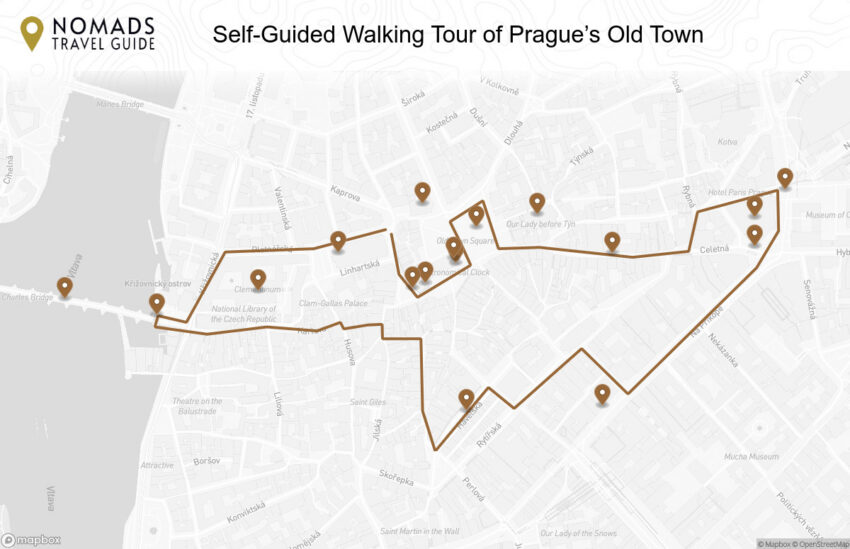
Map of the Self-Guided Walking Tour of Rennes, France walking route with 15 stops in Rennes.
Preview map of the Self-Guided Walking Tour of Rennes, France route in Rennes, showing 15 stops. Use the interactive map to zoom and tap markers.
More from this area