Château d’Angers
Castle in Angers
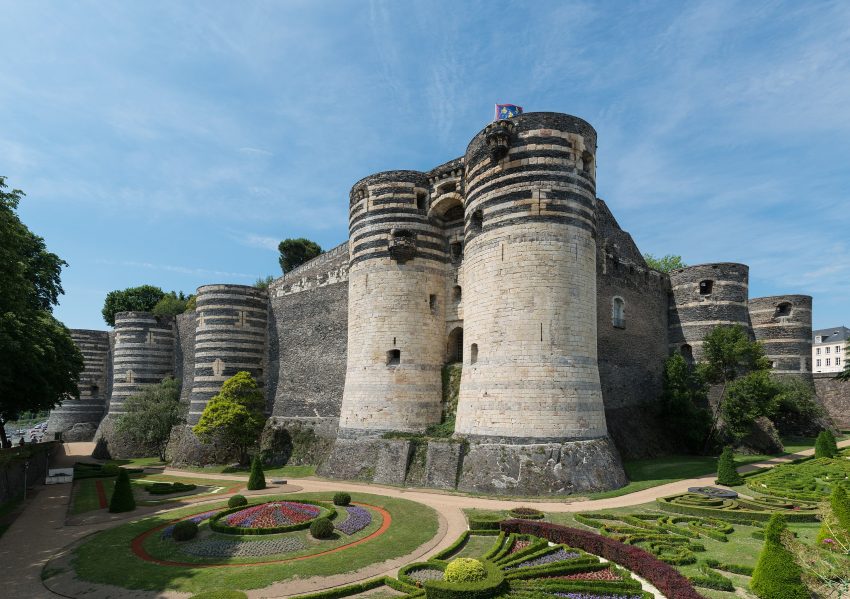
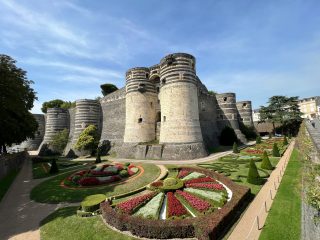
Château d'Angers is a large medieval fortress in Angers, set above the River Maine near the city's historic centre. Its dark schist walls, pale limestone bands, and seventeen round towers make it one of the most recognisable landmarks in the city.
Inside, the mood changes from military weight to gardens, courtyards, royal buildings, and the long gallery of the Apocalypse Tapestry. It matters most for visitors who want medieval architecture with a major artwork attached, not just another castle exterior.
History and Significance
Early stronghold and Angevin power
The site of the Château d'Angers was fortified long before the present castle took shape. Its position above the River Maine gave the Counts of Anjou control over a strategic crossing and a clear view of movement through the city.
The 13th-century fortress
The castle's present defensive form belongs largely to the 13th century, when the French crown reinforced Angers as a frontier stronghold. The massive curtain walls, round towers, and banded stonework were designed to project authority as much as to resist attack.
The Dukes of Anjou and the Apocalypse Tapestry
Later, under the Dukes of Anjou, the fortress became more than a military site. Residential buildings, gardens, and refined court spaces softened the interior, while the Apocalypse Tapestry became its defining artistic treasure.
Commissioned by Louis I, Duke of Anjou, in the late 14th century, the tapestry once stretched far longer than the surviving display. Its scenes from the Book of Revelation remain unusually vivid, combining royal patronage, religious storytelling, and medieval textile skill on a rare scale.
Things to See and Do
The main event is the Apocalypse Tapestry gallery. Give it time rather than treating it as a single room to pass through; the scale, repeated figures, beasts, angels, and narrative panels make more sense when viewed slowly.
After the tapestry, walk the ramparts for views over Angers, the River Maine, the cathedral, and the rooftops of the old centre. The height also helps explain why the fortress dominates this part of the city.
I would also leave time for the gardens and moat planting, which make the interior feel less severe than the outer walls suggest. Look for the contrast between the defensive stonework outside and the more domestic spaces within the walls.
How to Get to the Château d’Angers
Angers Loire Airport is the closest airport, though most long-distance visitors use Nantes Atlantique or the Paris airports before continuing to Angers by train or car. For the best deals and a seamless booking experience, check out these flights to Angers on Booking.com.
Angers-Saint-Laud station is the city's main rail hub, with TGV and regional services, and the château is about a 10 to 15-minute walk from the station. You can use SNCF Connect to check schedules, compare routes, and purchase tickets for National (SNCF ) and regional trains (TER). For a more streamlined experience, we recommend using Omio, which allows you to easily compare prices, schedules, and book tickets for both National and Regional travel across all of Europe, all in one place.
If arriving by car, use central paid parking such as Parking du Château or other city-centre car parks, then continue on foot because the area around the fortress is easiest to explore without driving. If you are looking to rent a car in France I recommend having a look at Discover Cars, first, as they compare prices and review multiple car rental agencies for you.
Where to Stay Close
The best base for a culture-heavy visit is the central area between Angers-Saint-Laud station, Place du Ralliement, and the château, since it keeps the fortress, cathedral, museums, restaurants, and tram links within easy walking distance.
Hotel de Champagne works well if you want to be beside the station and still close enough to walk to the château. Mercure Angers Centre Gare suits travelers who prefer a central business-style hotel on Boulevard Foch, with easy access to shops, restaurants, and the tram. Hotel Saint Julien is better for staying in the pedestrian heart of the city, especially if cafés, evening strolls, and quick access to the old centre matter more than immediate station access.
Is the Château d’Angers Worth Visiting?
Yes, the Château d'Angers is worth visiting, especially if you are interested in medieval fortifications, city views, or the Apocalypse Tapestry. It is less essential if you only want furnished royal rooms or ornate Loire château interiors, because much of its appeal comes from the fortress structure, ramparts, gardens, and tapestry display. If you are short on time, treat it as a focused two-hour stop; if tapestries and medieval art do not interest you, seeing the exterior and river views may be enough.
What Other Travellers Say...

Château d'Angers, at 2 Prom. du Bout du Monde in Angers, is a large 13th-century fortress where you can walk the battlements and explore royal apartments, extensive gardens and a moat; highlights include the famous Tapestry of the Apocalypse, a well-regarded multilingual audio guide that enriches the visit, herb and flower gardens and even a small vineyard, plus good views over the river and city and a pleasant on-site restaurant.


Practical Tips on Visiting the Château d’Angers
- Best time to visit: Spring through early autumn is best for the gardens and rampart views, while winter is quieter and still works well for the tapestry gallery. Arrive earlier in the day if you want calmer interior spaces.
- How long to spend: Plan on about 2 hours for the tapestry, ramparts, gardens, and main buildings. A quick exterior look takes far less time, but it misses the castle’s main artwork.
- Accessibility: Some areas are easier than others, with interior paths and adapted visitor support available, but towers and rampart sections include stairs and uneven surfaces. Travelers with limited mobility should check the accessible route before committing to the full circuit.
- Facilities: The site has restrooms, a bookshop-gift shop, visitor information, and places to pause inside the grounds. Food options are also available close by in the city centre.
FAQs for Visiting the Château d’Angers
Getting There
Tickets & Entry
Visiting Experience
Tours, Context & Itineraries
Photography
Accessibility & Facilities
Food & Breaks Nearby
Safety & Timing
The Château d’Angers appears in our Complete Guide to Visiting Angers!

Moira & Andy
Hey! We're Moira & Andy. From hiking the Camino to trips around Europe in Bert our campervan — we've been traveling together since retirement in 2020!
This website uses affiliate links which may earn a commission at no additional cost to you!
Planning Your Visit
From May 2 to September 4: 10 a.m. – 6:30 p.m.
From September 5 to April 30, 10 a.m. – 5:30 p.m.
€11
Nearby Attractions
- Galerie David d'Angers (0.3) km
Museum - Cathédrale Saint-Maurice d'Angers (0.4) km
Cathedral - Palacio del Tau (0.4) km
Palace - Musée des Beaux-Arts (0.4) km
Museum - Maison d’Adam (0.4) km
Historic Building - Tour Saint-Aubin (0.5) km
Tower - Collégiale Saint-Martin (0.6) km
Church - Grand Théâtre (0.6) km
Theatre - Pincé Museum (0.6) km
Museum - La Maison Bleue (0.8) km
Historic Building