Self-Guided Walking Tour of Ephesus
This website uses affiliate links which earn a small commission at no additional cost to you.
Ephesus is one of the great archaeological sites of the eastern Mediterranean, a place where the scale and confidence of the ancient city are still easy to grasp. Its best-known remains belong largely to the Hellenistic and Roman periods, when Ephesus became a major port, commercial centre, and later the capital of the Roman province of Asia. Visitors can still follow the marble streets past the Library of Celsus, the Great Theatre, public fountains, baths, temples, and terrace houses, giving the site a strong sense of urban life rather than just scattered ruins. UNESCO notes that the wider Ephesus area also includes the Temple of Artemis, once one of the Seven Wonders of the ancient world, although only limited remains survive today.
The site is also important because it reflects several overlapping religious and cultural traditions. The cult of Artemis shaped Ephesus for centuries, while later Christian associations connected the area with the Church of Mary and the Basilica of St. John. This long continuity makes Ephesus more than a Roman ruin: it is a landscape of changing shorelines, shifting power, pilgrimage, trade, and memory. For visitors staying in Selçuk, it is close enough to explore slowly, ideally allowing time for both the main archaeological site and the nearby museum, where finds from Ephesus help put the ruined city back into context.
Table of Contents
- How to get to Ephesus
- A Short History of Ephesus
- Where to Stay near Ephesus
- Your Self-Guided Walking Tour of Ephesus
- Harbor Street
- Theater Gymnasium
- Ephesus Experience Museum
- Commercial Agora
- Ancient Greek Theater
- Library of Celsus
- Gate of Mazaeus and Mithridates
- House of Pleasure
- Temple of Hadrian
- Terrace Houses of Ephesus
- Public Roman Latrines
- Trajan Fountain
- Curetes Street
- Heracles Gate
- Temple of Domitian
- Memmius Monument
- State Agora
- Prytaneion
- Odeon
- Baths of Varius
- Ephesus Archaeological Museum
- Temple of Artemis
- Grotto of the Seven Sleepers
How to get to Ephesus
By Air: Fly into İzmir Adnan Menderes Airport (ADB), the main gateway for Ephesus, then continue to Selçuk (the nearest town for visiting the ruins). From the airport you can go by train, transfer service, taxi, or rental car depending on your schedule and luggage. For the best deals and a seamless booking experience, check out these flights to Ephesus on Booking.com.
By Train: The practical rail target is Selçuk Station. İzmir has regional train options to Selçuk, and it's also possible to connect via the airport rail/commuter network before finishing on the line that reaches Selçuk. From Selçuk, you can taxi or take local minibuses toward the Ephesus entrances. You can use the official TCDD Taşımacılık website to check schedules, compare routes, and purchase tickets for Türkiye’s national and regional trains operated by TCDD. For a more streamlined experience (especially if you prefer an English interface or want to compare across countries), we recommend using Omio, which allows you to easily compare prices, schedules, and book train tickets across Türkiye and the rest of Europe — all in one place.
By Car: Driving is straightforward and gives you flexibility for add-ons like the House of the Virgin Mary, Şirince, or a sunset stop on the coast. Parking is available near the site entrances, and a car is especially useful if you want to combine Ephesus with Selçuk sights (like the Basilica of St. John and the Temple of Artemis) without watching the clock. If you are looking to rent a car in Türkiye I recommend having a look at Discover Cars, first, as they compare prices and review multiple car rental agencies for you.
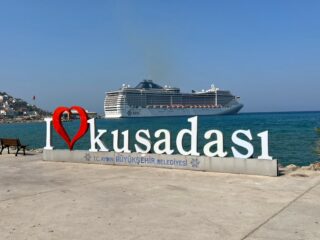
By Bus: Long-distance buses and regional coaches run to Selçuk (and also to Kuşadası and İzmir), which can work well if you're coming from other Aegean towns. Once you're in Selçuk, getting around is easy: the archaeological zone is close enough for a quick taxi ride, and local minibuses (dolmuş) run toward the site in peak seasons; within Ephesus itself, you'll be on foot the entire time, so bring water, sun protection, and shoes that handle polished marble.
A Short History of Ephesus
Origins: Greeks, Persians, and Alexander the Great
Founded by Greek settlers in the 10th century BCE on the footprint of an even older settlement, Ephesus became one of the great cities of the ancient world. Its most celebrated monument was the Temple of Artemis-counted among the Seven Wonders-so renowned that the poet Antipater of Sidon ranked it above the other marvels he had seen.
The temple's story, like the city's, was marked by repeated destruction and rebuilding. An early sanctuary was ruined by flooding in the 7th century BCE. In the 6th century BCE the Ephesians rebuilt it on a far grander scale, only for it to be destroyed again-this time by arson. While plans for a third rebuilding were underway, Ephesus came under Persian control, before the city was taken by Alexander the Great.
According to tradition, Alexander admired the temple’s fame so much that he offered to pay for its reconstruction. The Ephesians declined, arguing that it would be improper for a godlike ruler to dedicate a temple to another deity-an answer that flattered Alexander while preserving the city’s religious autonomy.
Roman rule and Christian significance
Under Roman rule Ephesus entered another building boom, with emperors and wealthy patrons financing major projects and monumental architecture. Many of the structures that define the site today date from this period, including the Library of Celsus, one of the largest libraries of the ancient world. Ephesus was also prominent enough to attract elite visitors, with later tradition linking figures such as Mark Antony and Cleopatra to the city's story.
Ephesus also gained a lasting place in early Christian history. As Roman power shifted and the city faced new threats, the Artemis sanctuary was damaged again-most notably during raids in the 3rd century CE. In the centuries that followed, Christian communities grew in importance across the region, sometimes practising discreetly during periods of persecution and using shared symbols to identify one another. Local tradition also holds that Mary, the mother of Jesus, spent her final years nearby, adding another layer of pilgrimage interest to the landscape.
Downfall of the city of Ephesus
In late antiquity a combination of earthquakes, insecurity, and environmental change steadily undermined Ephesus. A major earthquake in 614 CE caused severe damage, and by this stage the great temple was no longer restored; its stone was gradually reused in later buildings. Over time the harbour silted up, trade routes shifted, and the urban centre lost its economic lifeline.
By the later medieval period the population had largely moved away, and Ephesus slipped into ruin, slowly buried under mud and silt from floods and landslides. The site's “rediscovery” in the 19th century reignited global interest, and systematic excavations have continued for well over a century, gradually revealing streets, houses, baths, and monuments.
What makes Ephesus so striking today is the way its layers are still visible: later structures and Christian traces sitting above Roman-era streets and civic buildings, which in turn rest on older Greek foundations. Walking here means stepping across centuries-on pavements worn smooth by ancient crowds-and standing close enough to touch stonework shaped by hands nearly 3,000 years ago.
Where to Stay near Ephesus
To make the most of visiting Ephesus and this walking tour then you consider stay overnight at the centre. The most convenient base is Selçuk, which keeps you close to the gates of Ephesus and also puts you within easy reach of evening meals, museums, and early starts. For a boutique-style stay with a prime location for both Selçuk sights and day trips, consider Ayasoluk Hotel & Restaurant or Akanthus Hotel Ephesus. If you want something relaxed with a classic local feel, Hotel Kalehan is a well-known option in town.
If you'd like a more resort-like base with extra facilities after long days on stone streets, Kuşadası is a common alternative. It's farther from the ruins than Selçuk, but it works well if you want a coastal atmosphere and plenty of dining choices at night. Two reliable choices there are Ilayda Avantgarde Hotel for a central, walkable stay and Charisma De Luxe Hotel if you want a full-service hotel feel by the water.
If you prefer a bigger-city base with the widest transport links and nightlife, İzmir can work, especially if you're stitching Ephesus into a longer Aegean route. The trade-off is a longer day trip and a stricter start time if you want to beat the crowds and the heat, but the rail and road connections make it manageable if you plan well.
Your Self-Guided Walking Tour of Ephesus
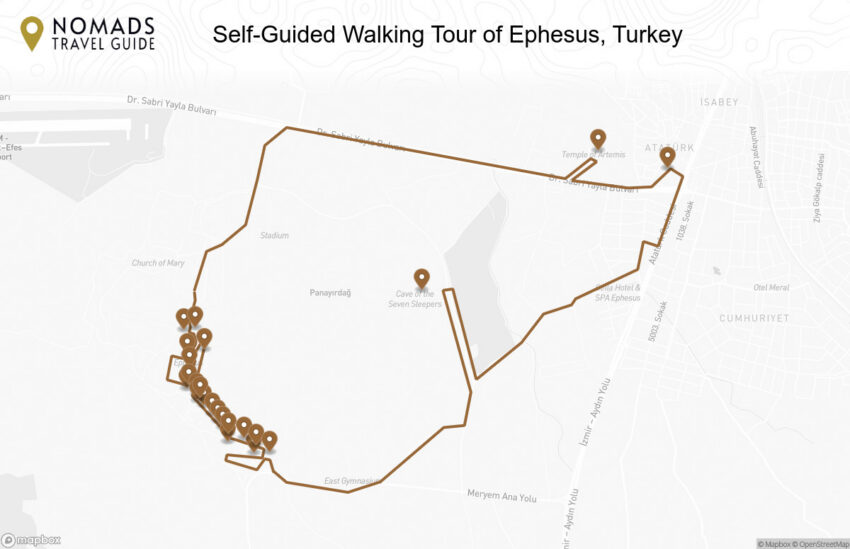
Discover Ephesus on foot with a walking tour map that guides you between each stop as you explore its grand civic spaces, temple precincts, and showpiece monuments. The ancient city of Ephesus has a downward-sloping structure from south to north. You can take a more comfortable and less tiring tour by entering from the Upper (South) gate and exiting from the Lower (North) gate. Often taxis and tours will drop you off at the top and pick you up at the bottom. The optional route, takes you from Selçuk and includes additional stops like the Ancient Wonder of the World Temple of Artemis!
1. Harbor Street
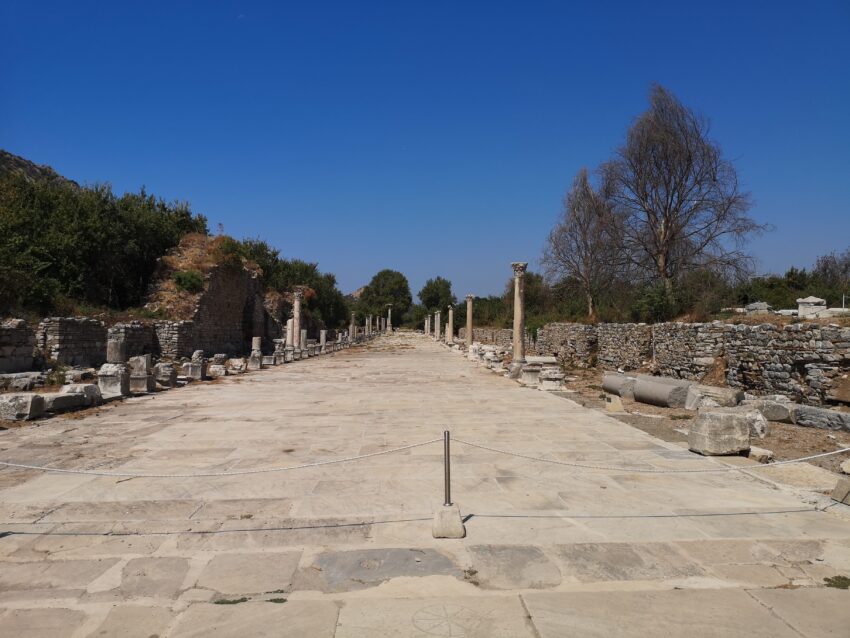
Harbour Street, also known as the Arcadiane, was one of the most impressive ceremonial roads in ancient Ephesus. Running for about 500 meters between the Great Theatre and the city’s former harbour, it formed the main processional approach for visitors arriving by sea. The street was first laid out in the 1st century BCE during the Hellenistic era and was later rebuilt and broadened in the 5th century CE under the Eastern Roman Emperor Arcadius, from whom it takes its later name. For merchants, officials, and other distinguished arrivals, this avenue would have provided a grand entrance into the city.
At both ends of the Arcadiane stood monumental triple-arched gateways inspired by Roman triumphal arches. Although the gate near the theatre has not survived, the remains at the harbour end still suggest the scale and splendor the street once possessed. The avenue itself was around eleven meters wide and was bordered by pedestrian porticoes roughly five meters across on each side. Corinthian columns lined these covered walkways, and beneath the paving ran drainage and sewage channels. Behind the porticoes stood rows of shops, while the northern side also included areas associated with athletic use.
One of the most remarkable features of Harbour Street was its lighting, which was highly unusual in the Roman world. Ancient written sources and inscriptions found during excavation indicate that the Arcadiane was illuminated at night by fifty lamps, creating a brightness said to resemble daylight. In the middle of the avenue stood four notable columns, probably erected during the reign of Emperor Justinian in the 6th century CE, which are thought to have supported statues of the Four Evangelists. Their presence emphasized the Christian identity of Ephesus at a time when this part of the city lay beyond the Byzantine walls.
Location: Atatürk, 35920 Selçuk/İzmir, Türkiye | Hours: Monday – Sunday: 08:00–18:00. | Price: Included with Ephesus with Ephesus Experience Museum (40 Euro per person); Ephesus with Ephesus Experience Museum + Terrace Houses: 52 Euro p.p. | Website

2. Theater Gymnasium
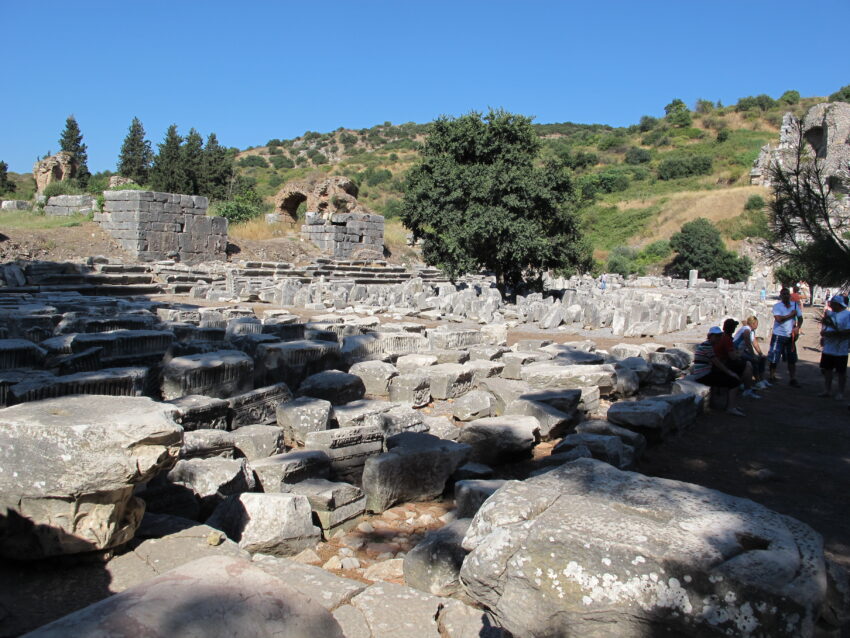
The Theater Gymnasium, standing near the entrance to Harbor Street in ancient Ephesus, was an impressive Roman bath and gymnasium complex dating from the 2nd century AD. It was dedicated to both the goddess Artemis and Emperor Antoninus Pius. The building is known by several names, including the Harbor Gymnasium and the Gymnasium of Vedius, after its benefactors Publius Vedius Antoninus and Flavia Pappiana, but it is most often called the Theater Gymnasium because of its position beside the Great Theatre. As one of the four principal gymnasiums of Ephesus, it was an important center for the education and development of the city’s young men.
In the Roman world, gymnasiums were far more than athletic facilities. At the Theater Gymnasium, young Ephesians would have received training not only in physical exercise but also in subjects such as literature, rhetoric, philosophy, and drama. Because of its location next to the theatre, it is often thought that the complex may also have been used by performers preparing for public appearances. At its core was a large palaestra, or exercise court, measuring about 30 by 70 meters and enclosed on three sides by colonnades. These marble-fronted porticoes provided sheltered space for training, while a tribune with tiered seating on the northern side, along with an area for standing spectators, suggests that displays, contests, or performances may also have taken place there.
The complex also included an extensive bath suite, entrance halls, lecture spaces, and rooms intended for recreation and instruction. One of its most interesting features is the frigidarium, where a cold-water pool was decorated with a statue of the river god Kaistros. Water once flowed from an amphora beneath the arm of the reclining figure into the basin, linking the bathing space symbolically to the natural landscape. Another important part of the complex was the Hall of Emperors, which was decorated with mosaic floors and statues of Roman rulers, many of which are now preserved in the Izmir Archaeological Museum.
Although excavation of the site is still incomplete, parts of the palaestra and sections of the bath walls remain visible today. The Theater Gymnasium is generally regarded as the best-preserved of the gymnasiums in Ephesus and offers valuable insight into the physical training, education, and social life of the city’s elite youth.
Location: Atatürk, 35920 Selçuk/İzmir, Türkiye | Hours: Daily: 08:00–18:00. | Price: Included with Ephesus with Ephesus Experience Museum (40 Euro per person); Ephesus with Ephesus Experience Museum + Terrace Houses: 52 Euro p.p. | Website

3. Ephesus Experience Museum
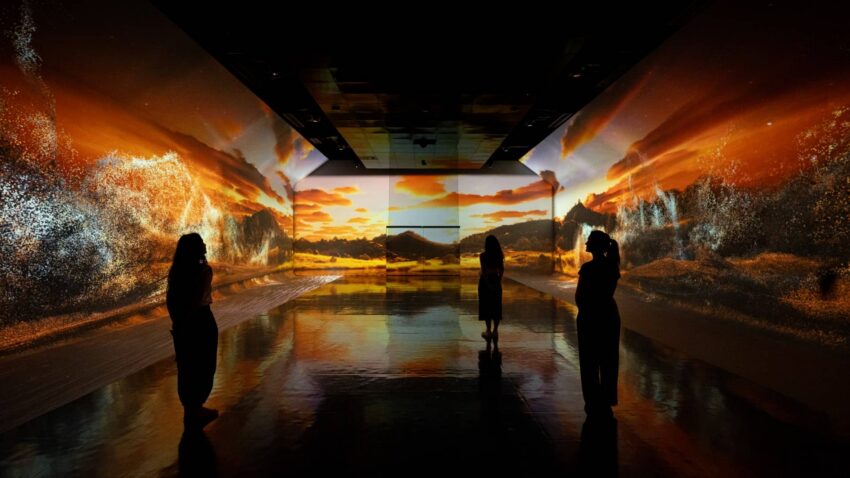
The Ephesus Experience Museum presents a highly immersive introduction to the ancient city, using contemporary technology to recreate its stories, atmosphere, and cultural memory. Covering around 2,400 square meters and designed to accommodate large visitor numbers each day, the museum combines holographic imagery, multisensory effects, and advanced audio-visual systems to make the world of Ephesus feel immediate and vivid. A narrated guide leads visitors through the exhibition, with audio offered in multiple languages, while sound, light, scent, and mist are used to deepen the sense of immersion.
The visit is structured in three main sections. The first explores the legendary beginnings of Ephesus through the figures of the Oracle of Delphi, the Athenian prince Androclos, and the goddess Artemis. It traces the city’s sacred origins through the succession of temples associated with Artemis, from the earliest sanctuary to the great Artemision, emphasizing her central place in Ephesian identity. Rich visual effects and layered soundscapes help create an atmosphere that evokes the mythic world in which the city’s story began.
The second section shifts to Ephesus at the height of its power and prosperity. Visitors are carried from the coastline into the urban heart of the city, where major spaces such as Arcadian Way, the markets, the terraced houses, and the great theatre are brought back to life. Historical figures including Cleopatra and Mark Antony appear within this narrative, while the city’s evolution under Roman rule is also highlighted. The experience then moves forward into the early Christian era, touching on the influence of St. Paul and the later importance of the Basilica of St. John.
The final space is devoted to Artemis in a more symbolic and emotional way. Surrounded by towering screens and dramatic lighting effects, visitors are brought face to face with a full-scale representation of the goddess, presented as the lasting guardian of Ephesus. This concluding section is designed to leave a strong emotional impression, reinforcing the enduring spiritual and cultural legacy of the city. By combining historical storytelling with immersive design, the Ephesus Experience Museum offers a modern and compelling way to engage with one of the ancient world’s most celebrated places.
Location: Efes Antik Kenti, Antik Tiyatro Karşısı, Atatürk, 35920 Selçuk/İzmir, Türkiye | Hours: (Summer) April 1 – October 31; Daily: 08:00–19:30. (Winter) October 31 – April 1; Daily: 08:30–17:00. | Price: Check official website.
4. Commercial Agora
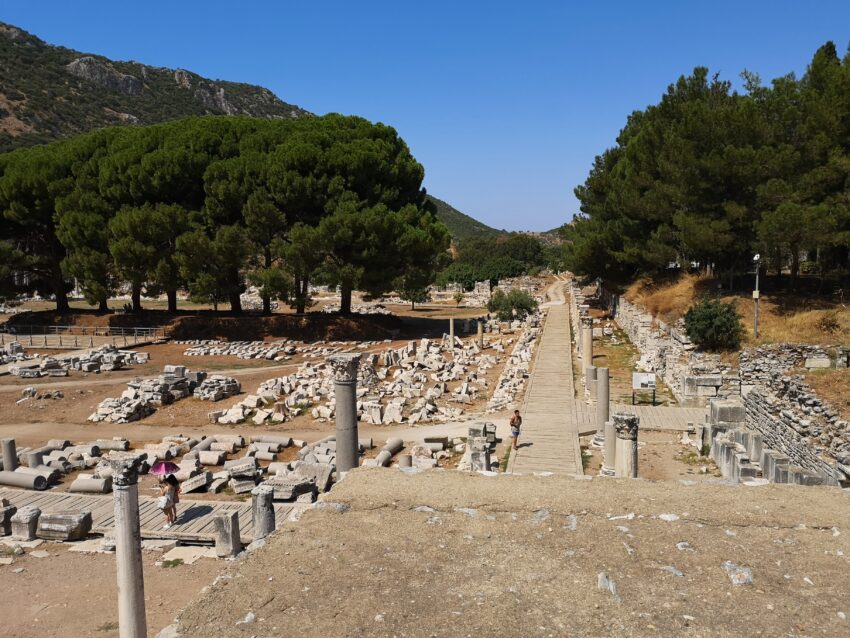
The Commercial Agora of Ephesus, also known as the Tetragonos Agora or Lower Agora, was the city’s main center of commerce and one of its busiest public spaces. Set close to the harbor, it occupied a nearly square area measuring about 111 meters on each side. First laid out in the Hellenistic period in the 3rd century BCE, it was repeatedly altered and enlarged over the centuries, especially under Augustus. With three principal entrances, including the monumental Gate of Mazaeus and Mithridates, the agora was easily reached from different parts of the city and stood near major landmarks such as the Library of Celsus and the theater.
The square was enclosed by double-story colonnaded porticoes behind which lay around one hundred rooms used as shops, workshops, storage areas, and meeting places for trade guilds. The porticoes were decorated with statues of speakers, philosophers, and notable citizens, giving the market an atmosphere that was both commercial and civic. Excavations have shown that the site had a much longer history even before the agora was built, with remains of early houses and kilns dating from the 8th to the 4th centuries BCE found underneath it. These discoveries suggest that this part of Ephesus had been active for centuries and may even connect to the city’s earliest traditions.
The Commercial Agora also has a place in early Christian history. It is often linked with the Apostle Paul, who is thought to have worked there as a tentmaker alongside Aquila and Priscilla between about AD 53 and 56. Its location near the harbor may also help explain why Paul later chose not to return to Ephesus, given the tensions that arose after his criticism of the trade in silver shrines of Artemis. Among the agora’s notable features was a horologion, a combined sundial and water clock that served not only to measure time but also to regulate speaking time in legal settings.
The agora was restored and modified during the reigns of Nero, Caracalla, and Theodosius I, surviving repeated earthquakes and remaining in use until the 7th century CE. Even after its role as a major marketplace declined, it continued to host workshops, including glass production. One inscription found there commemorates a market official who stopped an increase in bread prices, a reminder of how central the agora was to the daily life of the city. Once also known for housing one of the largest slave markets in the ancient world, the Commercial Agora remains a powerful reflection of the economic, social, and religious history of Ephesus.
Location: Atatürk, Efes Harabeleri, 35920 Selçuk/İzmir, Türkiye | Hours: Check official website. | Price: Included with Ephesus with Ephesus Experience Museum (40 Euro per person); Ephesus with Ephesus Experience Museum + Terrace Houses: 52 Euro p.p. | Website
5. Ancient Greek Theater
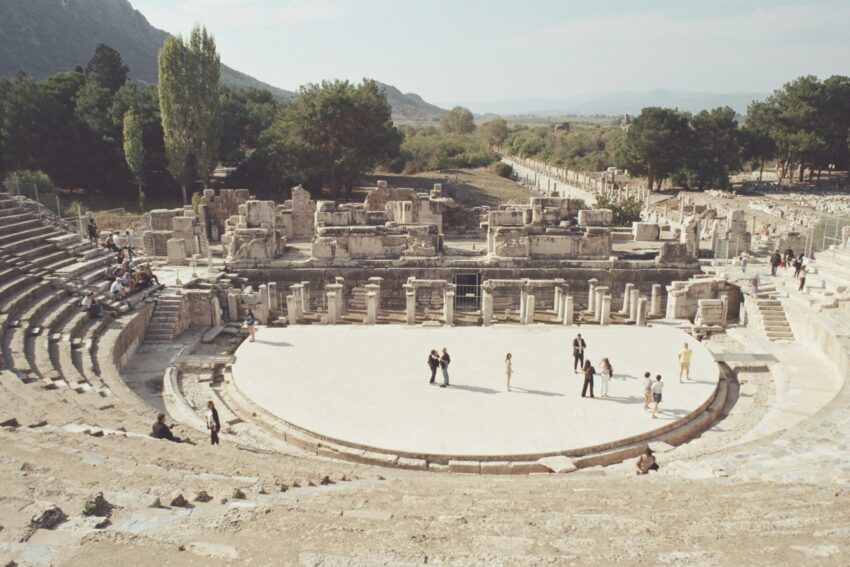
The Ancient Greek Theatre of Ephesus, usually known as the Great Theatre, is one of the largest and most striking monuments in the ancient city. Cut into the western slope of Mount Pion above Harbor Street, it was first constructed in the Hellenistic period around 250 BCE during the reign of Lysimachos. It was later enlarged and reshaped by the Romans, especially under Claudius, Nero, and Trajan, giving it the monumental form seen today. With a diameter of about 145 meters and room for as many as 25,000 spectators, the theatre reflects the scale, wealth, and prestige of Ephesus in antiquity.
Its design combines Greek planning with Roman architectural development. The auditorium is semi-circular with steep rows of seats that provided excellent sightlines and impressive acoustics, so effective that even a quiet voice from the stage can still carry upward. The stage building, or skene, was originally built with two stories under Nero and later expanded to three in the 2nd century AD. The Romans also added an awning system to shield audiences from sun and weather. Although the theatre itself was open to the sky, its layout was carefully planned to ensure both comfort and visibility.
Over the centuries, the Great Theatre served many functions and was one of the main public venues in Ephesus. It hosted dramatic performances, concerts, political assemblies, religious ceremonies, and gladiatorial shows, making it a focal point of both entertainment and civic life. In this way, the theatre was far more than a performance space; it was one of the places where the social and public identity of the city was expressed most clearly.
Although it was damaged by earthquakes in the 4th century and later partly incorporated into the city’s Byzantine defenses, the theatre still survives as one of the most impressive remains of ancient Ephesus. Excavation and study have revealed both its Hellenistic foundations and its later Roman additions, making it an important monument for understanding how the city evolved over time.
Location: Acarlar, Atatürk, 35920 Selçuk/İzmir, Türkiye | Hours: (Summer) April 1 – October 31; Daily: 08:00–19:30. (Winter) October 31 – April 1; Daily: 08:30–17:00. | Price: Included with Ephesus with Ephesus Experience Museum (40 Euro per person); Ephesus with Ephesus Experience Museum + Terrace Houses: 52 Euro p.p. | Website
6. Library of Celsus
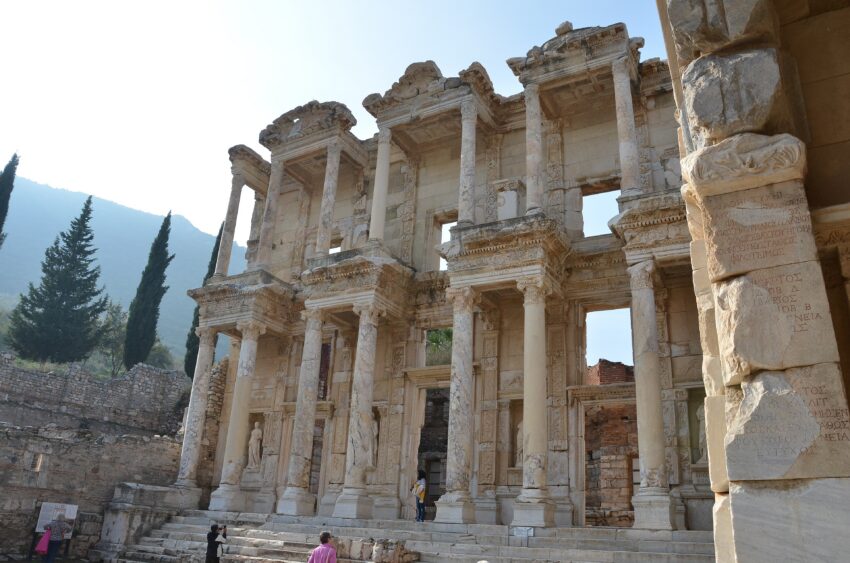
The Library of Celsus was built in the early 2nd century AD by the consul Gaius Julius Aquila in memory of his father, Gaius Julius Celsus Polemaeanus, a former governor of Asia Minor. It was conceived not only as a library but also as a monumental tomb, with Celsus buried in a white marble sarcophagus placed in a crypt beneath the structure. This unusual combination of memorial and cultural institution made the building one of the most distinctive monuments in Ephesus.
Its two-story façade, richly decorated with carved marble and soaring columns, remains one of the most celebrated architectural features of the ancient city. The design uses a subtle visual trick to heighten its impact: the central columns are slightly larger than those at the ends, creating the illusion that the building is taller and more imposing than it really is. This careful manipulation of proportion added to the sense of grandeur that visitors would have experienced on approach.
The façade was decorated with four statues symbolizing the virtues of Wisdom, Goodness, Thought, and Knowledge. These figures, now preserved in the Ephesus Museum in Vienna, reflected both the qualities associated with Celsus and the moral ideals expected of Roman officials. Visitors climbing the nine-step staircase would have encountered richly ornamented columns and finely carved marble details, including decorative scenes drawn from mythology such as Bellerophon on Pegasus and episodes connected with Apollo.
Inside, the library once housed around 12,000 scrolls, making it one of the largest libraries of the ancient world after Alexandria and Pergamum. Its design was also highly practical, with a gap of about one meter between the inner and outer walls to help protect the scrolls from moisture and changes in temperature. Although the building suffered extensive damage over the centuries, its famous façade was carefully reconstructed in the 1970s by the Austrian Archaeological Institute, restoring one of Ephesus’s greatest landmarks.
Location: Atatürk, 35920 Selçuk/İzmir, Türkiye | Hours: Daily: 08:00–18:00. | Price: Adults: ₺150.
7. Gate of Mazaeus and Mithridates
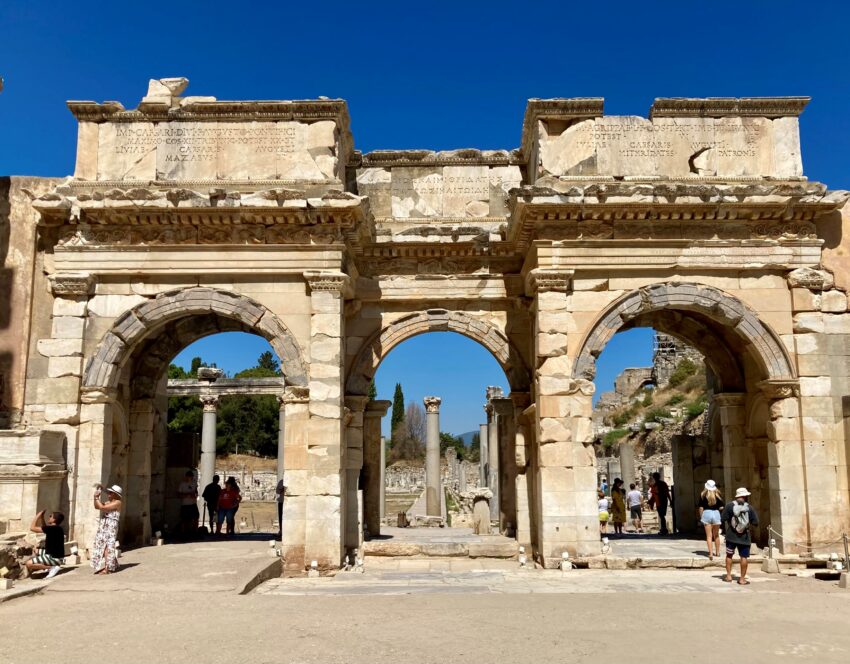
The Gate of Mazaeus and Mithridates, sometimes called the Gate of Augustus, is one of the finest surviving examples of Roman monumental architecture in Ephesus, near modern Selçuk in Türkiye. Built in AD 40 by two freedmen, Mazaeus and Mithridates, it was dedicated to Emperor Augustus, Livia, Julia, and Marcus Agrippa. Both men had been slaves who were later freed by Augustus and assigned to oversee imperial estates in Ephesus, and the gate appears to have been their public expression of gratitude and loyalty. Standing at the southeastern corner of the Commercial Agora, beside the Library of Celsus, it formed an important entrance into one of the busiest parts of the city.
The structure is notable for both its scale and its refined decoration. It consists of three arched openings with vaulted ceilings and is embellished with details such as ivy-scroll friezes and sharply cut cornices. The side facing the Library of Celsus is made of dark marble, which creates a dramatic contrast with the white marble used on the opposite face. Above, an ornate attic level crowns the monument, while the slightly recessed central arch gives the façade a greater sense of depth. A partly preserved Latin inscription, once highlighted with bronze letters, records the dedication to Augustus and his family and emphasizes the devotion of its donors.
Beyond its architectural and symbolic importance, the gate also had a practical place in the public life of Ephesus. The open area before it functioned as a kind of gathering space where speeches, notices, and public addresses could be delivered. The steps of the nearby Celsus Library likely served as seating for those attending such events, turning the area into a lively civic setting. The gate is especially remarkable for having survived the major earthquake of 23 CE, which helps explain why it remains one of the best-preserved monuments associated with the Augustan transformation of the city.
Location: Atatürk, Efes Harabeleri, 35920 Selçuk/İzmir, Türkiye | Hours: (Summer) April 1 – October 31: 08:00–19:30; Ticket office closes 19:00. (Winter) November 1 – March 31: 08:30–17:00; Ticket office closes 16:30. | Price: Included with Ephesus with Ephesus Experience Museum (40 Euro per person); Ephesus with Ephesus Experience Museum + Terrace Houses: 52 Euro p.p. | Website
8. House of Pleasure
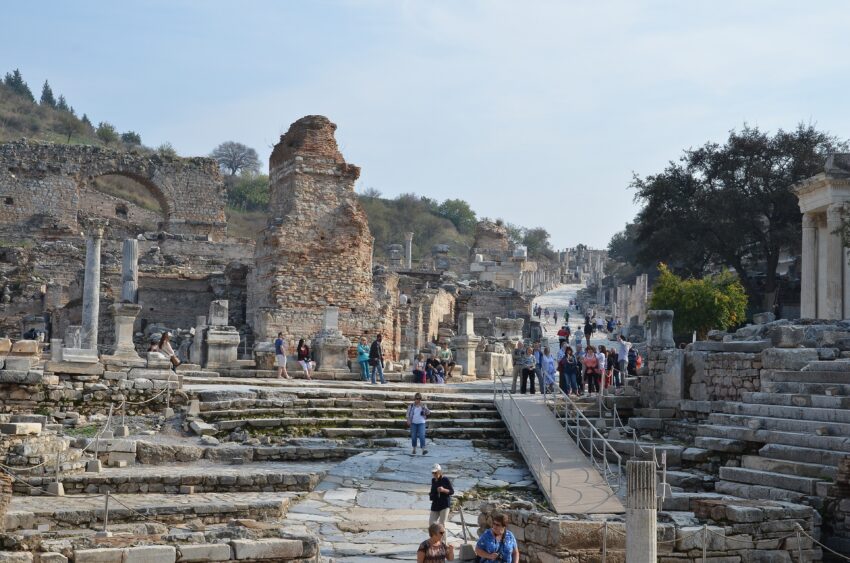
The House of Pleasure, often called the Love House or brothel, is one of the most talked-about stops for visitors exploring ancient Ephesus. Built in the first century AD, it stood in a prime position near Curetes Street, close to major public landmarks such as the Baths and the Celsus Library. The structure included a central hall with a series of surrounding rooms, which are thought to have been used for different forms of leisure, companionship, and entertainment. Its sophisticated heating and cooling system, sometimes described as an early form of air conditioning, reflects the comfort and refinement that characterized Roman urban design.
Part of the site’s enduring appeal comes from the well-known marble carving nearby, often described as one of the earliest examples of advertising. Showing a foot, a woman’s head, and a heart, it is widely interpreted as a sign directing potential clients toward the establishment. Inside, mosaics linked to Dionysian celebrations have strengthened the argument that the building functioned as a brothel. Although such imagery was common in Roman decorative art and does not provide absolute proof, the sensual themes and depictions of female figures have helped support that view.
Prostitution was common across the Roman Empire and was generally accepted as part of everyday city life, even if it was associated with the lower ranks of society. Many prostitutes were enslaved women, freedwomen, or poor women with few alternatives. Rather than being hidden away, brothels were often placed near busy public spaces such as baths and theaters and could be openly promoted.
The Love House appears to have been more than a simple brothel. Archaeological evidence suggests it may also have included wine storage, ovens, bedrooms, pools, and possibly rooms used for social gatherings. This points to a broader role as a place of leisure and social interaction. Its location near the Celsus Library has also invited the idea that it represented a Roman blend of intellectual and physical pleasure.
Location: Atatürk, 35920 Selçuk/İzmir, Türkiye | Hours: (Summer) Daily: 08:00–19:00. (Winter) Daily: 08:00–18:00. | Price: Included with Ephesus with Ephesus Experience Museum (40 Euro per person); Ephesus with Ephesus Experience Museum + Terrace Houses: 52 Euro p.p. | Website
9. Temple of Hadrian
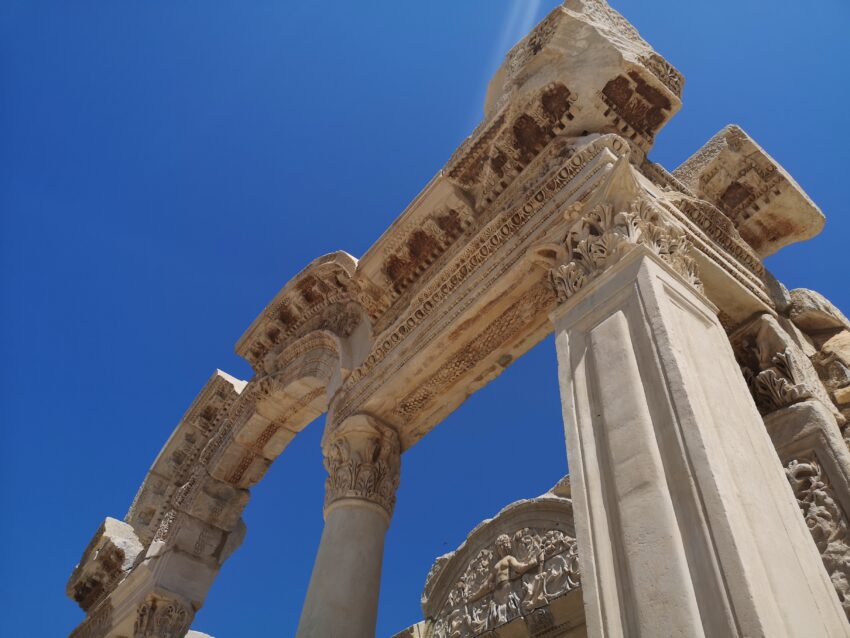
The Temple of Hadrian is one of the most recognizable and elegant monuments in ancient Ephesus. Excavated in 1956 by the Austrian Archaeological Institute and reconstructed soon afterward in 1957–1958, it was reassembled largely from its surviving original pieces, with modern materials added where needed to complete the structure. A further conservation campaign, funded in part by the J. M. Kaplan Fund, was completed in 2014 and helped restore the temple’s appearance while securing its long-term preservation. Although relatively small at roughly 10 by 10 meters, the monument’s rich decoration and graceful design have made it one of the standout sights on Curetes Street, directly opposite the Scholastica Baths.
The building was long identified as a neocorate temple dedicated to Emperor Hadrian, but its exact purpose has become the subject of debate. Its inscription states that P. Vedius Antoninus Sabinus dedicated it to Artemis Ephesia, Emperor Hadrian, and the people of Ephesus. More recent scholarship, particularly the work of Ursula Quatember, has questioned whether it was ever an official imperial cult temple in the strict sense. On the basis of its architecture and inscriptional evidence, the structure may date slightly earlier than once believed, around 117–119 CE, and may have been planned as part of the neighboring Varius Baths rather than as an entirely separate shrine devoted to emperor worship.
Architecturally, it is a finely executed tetrastyle prostyle building, with two Corinthian columns and two side piers supporting an ornate architrave and a curved Syrian-style pediment. The pediment is decorated with floral motifs and a relief of Tyche, the goddess of fortune, shown with a mural crown symbolizing the city. Beyond the entrance lies the pronaos, whose doorway is framed by a tympanum carved with a Medusa head set among acanthus scrolls. The cella behind it is relatively simple and may once have housed a statue of Hadrian. After suffering earthquake damage in the 4th century, the monument was altered with additional decorative elements, including four relief panels in the pronaos showing mythological and historical scenes, as well as four statues often thought to have represented the tetrarchs, though the originals no longer survive.
In later centuries, the Temple of Hadrian was dismantled and many of its stones were reused in a retaining wall along Curetes Street. Its present form is the result of careful archaeological reconstruction in the 20th century, followed by modern conservation work. Today it remains one of the most admired buildings in Ephesus, valued not only for its beauty but also for the questions it raises about religion, architecture, and public patronage in the Roman city.
Location: Atatürk, 35920 Selçuk/İzmir, Türkiye | Hours: (Summer) April 1 – October 31; Daily: 08:00–19:30. (Winter) October 31 – April 1; Daily: 08:30–17:00. | Price: Included with Ephesus with Ephesus Experience Museum (40 Euro per person); Ephesus with Ephesus Experience Museum + Terrace Houses: 52 Euro p.p. | Website
10. Terrace Houses of Ephesus
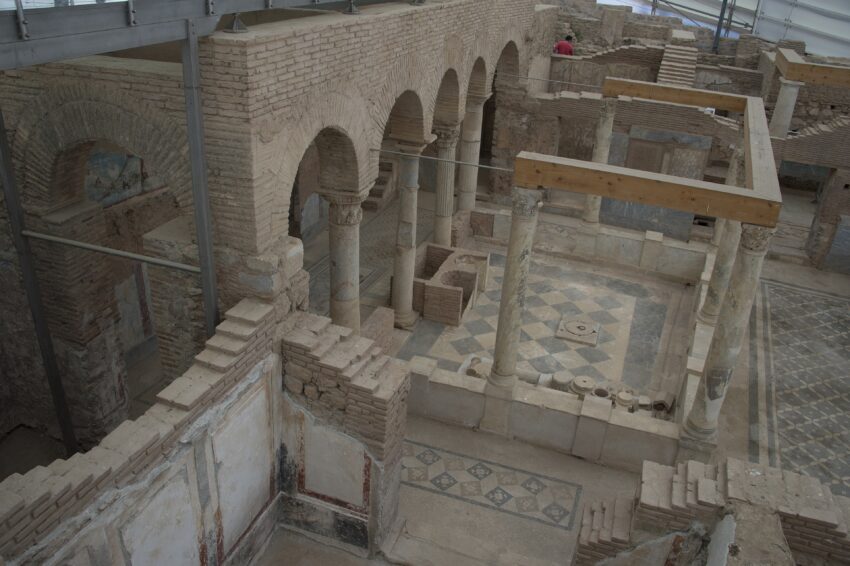
The Terrace Houses of Ephesus, often called the Slope Houses, provide one of the clearest and most personal views into the lives of the city’s Roman elite. Set close to Curetes Street and opposite the Temple of Hadrian, these richly appointed homes were occupied between the 1st and 7th centuries AD. Built according to the city’s grid-based Hippodamian plan, they had private entrances, access to running water, and highly refined interiors. Since the 1960s, archaeologists have been excavating seven of these residences, which once belonged to senior officials, governors, and wealthy merchants. The site was opened to visitors relatively recently and remains an active excavation zone, so it is still possible to see conservation and archaeological work in progress.
The complex is arranged in two main parts, known as the Eastern and Western Complexes. The Eastern Complex covers roughly 2,500 square meters and includes houses spread over three terraces, among them an especially grand domus on the second terrace. This substantial two-story residence contains a peristyle courtyard framed by Ionic columns, a reception hall with a marble fountain niche, and even a private basilica. The Western Complex includes at least five luxurious villas, many of which preserve impressive frescoes and detailed mosaic pavements. These homes were made up of vestibules, kitchens, reception rooms, and private bathing spaces, and they were decorated with imagery drawn from mythology, including figures such as Herakles, Ariadne, and Dionysos.
What makes the Terrace Houses especially remarkable is the quality of their interior decoration. Frescoes showing Apollo and the Muses, Socrates, Eros, animals, and floral designs have survived in striking condition, giving a vivid sense of Roman taste and domestic display. The site also contains the richest group of Roman mosaic floors in western Türkiye, many of them formed from black and white stones in a Roman-Italian style with geometric designs. Among the most notable finds is a shattered glass mosaic from a villa niche that has been carefully restored, adding another layer to the artistic richness of the complex.
Location: Atatürk, Efes Harabileri, 35920 Selçuk/İzmir, Türkiye | Hours: (Summer) April 1 – October 31; Daily: 08:00–19:30. (Winter) October 31 – April 1; Daily: 08:30–17:00. | Price: Included with Ephesus with Ephesus Experience Museum (40 Euro per person); Ephesus with Ephesus Experience Museum + Terrace Houses: 52 Euro p.p. | Website
11. Public Roman Latrines
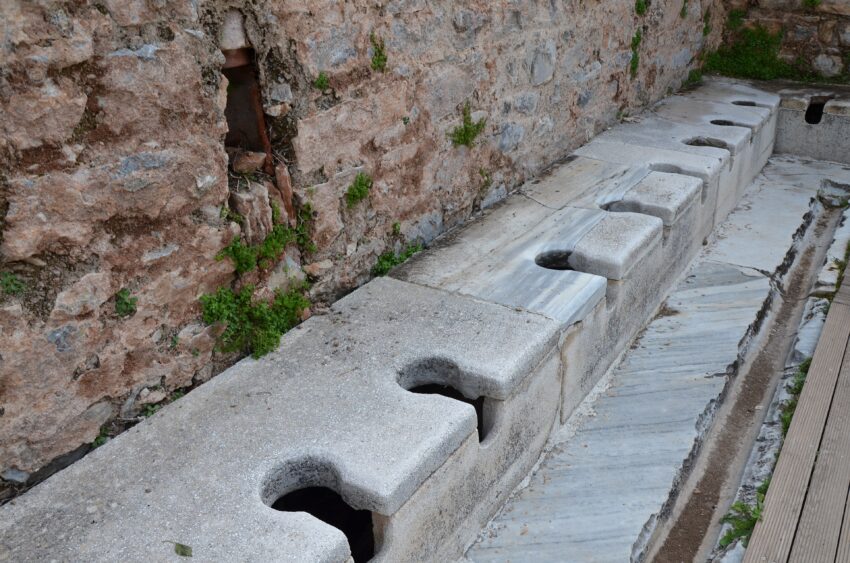
The Public Roman Latrines of Ephesus provide an unexpectedly vivid window into daily life in the Roman city. Built in the 1st century CE, they formed part of a broader architectural complex linked to the nearby Scholastica Baths. The facility was set above a channel of continuously running water, while forty-eight marble toilet seats, each formed by a simple opening cut into long benches, lined three sides of the room. At the center was an open pool that gathered rainwater and helped cool the space in summer, while a wooden roof supported by columns protected users from the weather. Mosaic floors added an element of decoration, showing that even practical public spaces could be given an elegant finish.
For most Romans, public latrines were an everyday necessity, since private toilets were generally limited to the wealthy. Although communal use may seem unusual from a modern perspective, in the Roman world these places often doubled as social spaces where men talked, exchanged news, discussed business, and sometimes even recited poetry. In winter, the latrines were warmed by an underfloor heating system connected to the baths, making them more comfortable than might be expected. Ancient sources and later accounts even suggest that servants could be sent ahead to warm the marble seats for richer visitors.
Instead of toilet paper, users cleaned themselves with a sponge fixed to a stick, known as a tersorium, which was washed in running water or vinegar water after use. While this system was practical for its time, it was far from hygienic by modern standards. Studies of mineralized waste from Ephesus have revealed the presence of intestinal parasites such as roundworm and whipworm, pointing to wider problems of sanitation, hand hygiene, and food contamination, even in a city as advanced and prosperous as Ephesus, the capital of the Roman province of Asia.
Even so, the public latrines remain an impressive example of Roman engineering and urban organization. Deep waste channels carried refuse away from the city, demonstrating a high level of planning and technical skill. Use of the facility required payment, but in return visitors had access not only to running water and heating but also to a setting that was architecturally refined and socially active. Today, the original marble benches still survive, offering visitors a direct and memorable link to one of the most ordinary yet revealing aspects of life in ancient Ephesus.
Location: Atatürk, 35920 Selçuk/İzmir, Türkiye | Hours: (Summer) April 1 – October 1; Daily: 08:00–19:00. (Winter) October 1 – April 1; Daily: 08:00–18:00. | Price: Included with Ephesus with Ephesus Experience Museum (40 Euro per person); Ephesus with Ephesus Experience Museum + Terrace Houses: 52 Euro p.p. | Website
12. Trajan Fountain
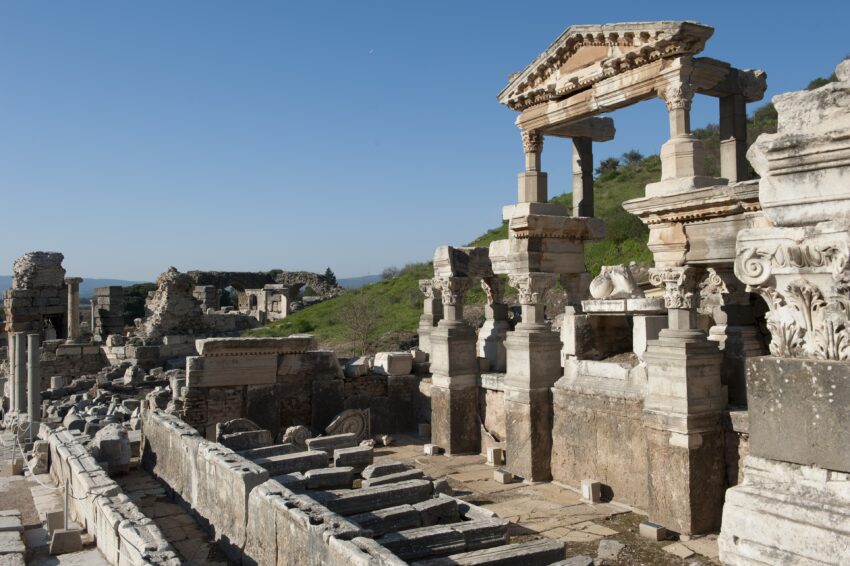
The Trajan Fountain was one of the most impressive monuments on Curetes Street and combined practical engineering with a clear message of imperial power. Built in the early 2nd century AD in honor of Emperor Trajan, who ruled from AD 98 to 117, it stood near the Temple of Hadrian at the northern end of the street. The fountain was once crowned by a colossal statue of the emperor, shown holding a staff or pennant and standing over a globe to symbolize Roman dominion and military success. Of that statue, only one foot and the globe survive today.
This was among the most elaborate fountains in Ephesus and was designed with two decorative basins. In the upper basin, framed by Corinthian columns, stood the main statue of Trajan. Water flowed from beneath the statue’s base and then descended into a lower, narrower pool bordered by Composite columns. Beyond its visual effect, the fountain also played a practical role by supplying water and helping keep the marble-paved street clean, demonstrating the efficiency and sophistication of Roman urban planning.
The lower basin was richly decorated with statues drawn from mythology, local tradition, and the imperial household. These included figures of Aphrodite, Dionysos in both draped and nude form, Androklos, the legendary founder of Ephesus, portrayed as a young hunter, as well as members of Emperor Nerva’s family and a satyr. Although these sculptures no longer stand at the fountain itself, many have been preserved and transferred to the Archaeological Museum of Ephesus.
The monument originally measured about 20 meters long and 10 meters wide, making it a major landmark in the cityscape of ancient Ephesus. What visitors see today is a partial reconstruction on a reduced scale, and restoration work has continued to improve understanding of its original appearance.
Location: Atatürk, 35920 Selçuk/İzmir, Türkiye | Hours: (Summer) April 1 – October 31; Daily: 08:00–19:30. (Winter) November 1 – March 31; Daily: 08:30–17:00. | Price: Included with Ephesus with Ephesus Experience Museum (40 Euro per person); Ephesus with Ephesus Experience Museum + Terrace Houses: 52 Euro p.p. | Website
13. Curetes Street
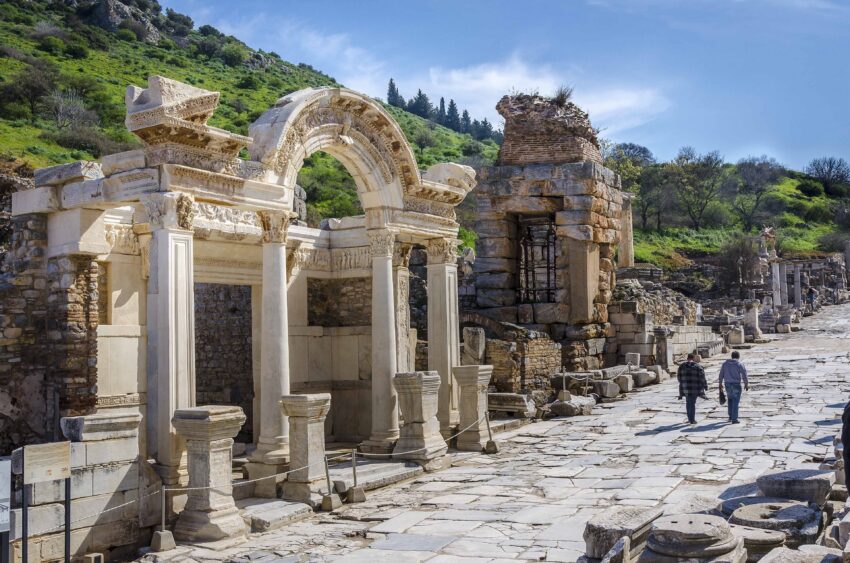
Curetes Street was one of the three principal streets of ancient Ephesus and ran between the Library of Celsus and the Heracles Gate. Its importance lay not only in its impressive architecture but also in its religious significance. The street originally formed part of a ceremonial route leading toward the Temple of Artemis and was named after the Curetes, a body of priests and priestesses associated with sacred rituals in the city. Their duties included tending the eternal flame at the Prytaneion and performing ceremonies linked to the birth of Artemis. Though the Curetes were rooted in myth as semi-divine figures, they later became an established religious order closely tied to the spiritual life of Ephesus.
The street dates back to the Hellenistic period and stood out from the usual grid plan of the city by cutting diagonally through the urban layout. It followed the valley between Panayir Hill and Bülbül Hill, linking the political center of the Upper Agora with the commercial hub of the Lower Agora. In antiquity it was probably known as the Embolos, meaning “wedge,” a name supported by inscriptions and by its position between the hills. Over time, repeated earthquakes caused heavy damage, and the street was rebuilt several times, especially after the 4th century. Many of these restorations reused pieces from earlier ruined buildings, which explains the visible differences in style among some of the columns today.
Curetes Street was lined with monuments, fountains, statues, shops, and elegant homes belonging to the wealthier residents of Ephesus. Along the slopes, these grand houses overlooked colonnaded galleries decorated with mosaics, while the covered shopfronts below offered shelter for people walking through the city. Some of the shops, especially on the south side, even rose to a second story, showing both the prosperity of the area and the ambitious character of Ephesian urban design.
Location: Éphèse, Ancient City of Ephesus,, Atatürk, 35920 Selçuk/İzmir, Türkiye | Hours: (Summer) April 1 – October 31: 08:00–19:30. (Winter) October 31 – April 1: 08:30–17:00. | Price: Included with Ephesus with Ephesus Experience Museum (40 Euro per person); Ephesus with Ephesus Experience Museum + Terrace Houses: 52 Euro p.p. | Website
14. Heracles Gate
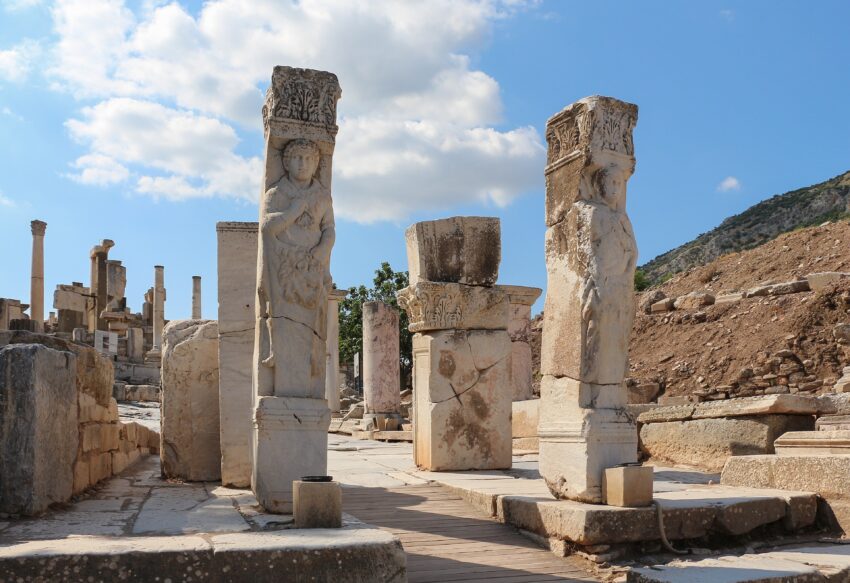
The Heracles Gate on Curetes Street marked both a physical and symbolic boundary between the upper and lower parts of Ephesus. It takes its name from the hero Heracles, known in Roman tradition as Hercules, whose image appears on the two surviving columns. These reliefs, showing Heracles wearing the skin of the Nemean lion, are generally dated to the 2nd century AD, while the gate itself is thought to have been rebuilt in the 4th century AD using reused material from older structures. This later reconstruction seems to have coincided with changes in the street’s function, as the narrowed passage would have restricted wheeled vehicles and helped turn this section of Curetes Street into a more pedestrian space.
In mythology, Heracles was celebrated for extraordinary strength and for the series of heroic labors he completed. The lion skin shown in the reliefs refers to his defeat of the Nemean lion, a creature said to have an impenetrable hide. According to the myth, he overcame it through sheer force and wore its skin as a sign of triumph. Placing his image on the gate gave the monument a strong association with power, endurance, and protection, all qualities that carried deep meaning in the Greco-Roman world.
The gate was originally far more elaborate than what survives today. It is thought to have been a two-story structure with six columns on each level, creating an impressive entrance along the street. Now only the two side columns remain standing, while other elements, including the central arch, have disappeared. Some sculptural fragments believed to belong to the monument, including the famous relief of the winged goddess Nike, are now displayed in Domitian Square.
Location: Atatürk, Efes Harabeleri, 35920 Selçuk/İzmir, Türkiye | Hours: (Summer) April 1 – October 31; Daily: 08:00–19:30. (Winter) November 1 – March 31; Daily: 08:30–17:00. | Price: Included with Ephesus with Ephesus Experience Museum (40 Euro per person); Ephesus with Ephesus Experience Museum + Terrace Houses: 52 Euro p.p. | Website
15. Temple of Domitian
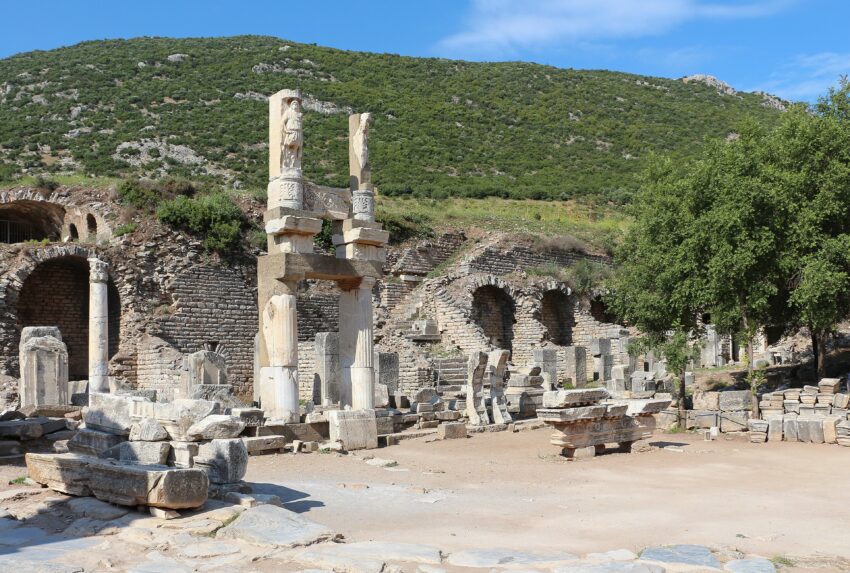
The Temple of Domitian in Ephesus, dating from the 1st century AD, was among the city’s earliest temples associated with the imperial cult. Although it was long identified as a temple dedicated to Emperor Domitian, more recent research has suggested that it may instead have honored his brother Titus. Whatever its original dedication, the temple represented an important distinction for Ephesus, since permission to build a monument of this kind signaled close ties with Rome and elevated civic standing. In the Roman world, cities often dedicated grand buildings to emperors as a way of expressing loyalty and gaining political advantage.
The temple stood at the southern end of Domitian Square on a massive vaulted platform that created a terrace roughly 50 by 100 meters in size. On the northern side, the terrace rose to a height that appears almost two stories tall, and it was approached by an imposing staircase that can still be seen today. The building followed a prostyle plan, with thirteen columns along the longer sides, eight on the shorter sides, and four columns at the front of the cella. Beneath the raised terrace were practical rooms that likely served as shops or storage spaces. A large U-shaped altar once stood on the northern side of the complex and is now preserved in the Izmir Museum.
Domitian’s rule later became notorious for its authoritarian character and for persecution associated in later tradition with early Christians, including the exile of John the Apostle to Patmos. After Domitian was assassinated, his memory was publicly condemned, and the people of Ephesus removed his name from inscriptions throughout the city. At the same time, they were careful not to lose the prestige attached to the sanctuary, so the temple was rededicated to his father Vespasian. In doing so, Ephesus retained its position as a neocoros, an officially recognized center of emperor worship.
Location: Atatürk, 35920 Selçuk/İzmir, Türkiye | Hours: (Winter) Monday – Sunday: 08:00–18:00. | Price: Included with Ephesus with Ephesus Experience Museum (40 Euro per person); Ephesus with Ephesus Experience Museum + Terrace Houses: 52 Euro p.p. | Website
16. Memmius Monument
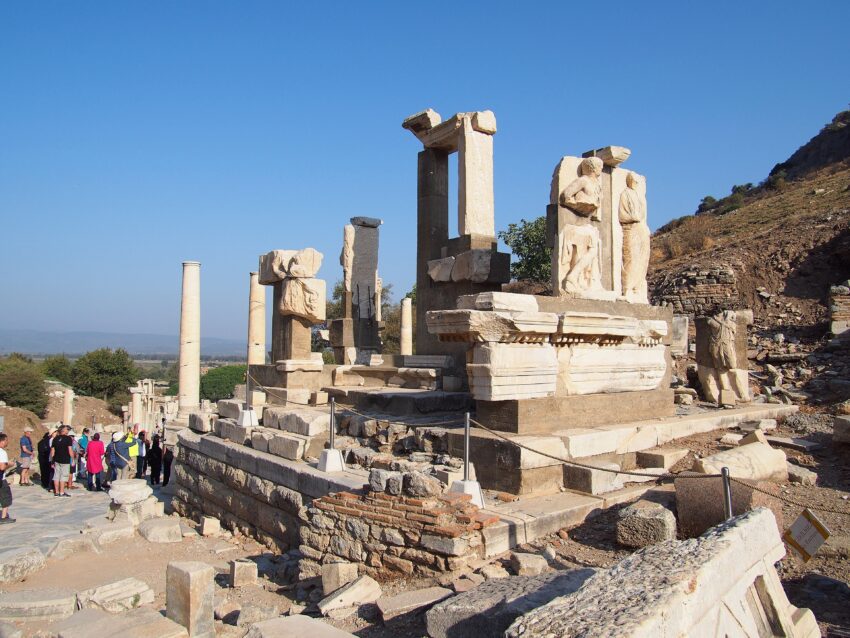
The Memmius Monument, on the north side of Domitian Square, is one of the most distinctive Roman-era structures in Ephesus and reflects the city’s connection to imperial power. Built in the 1st century AD during the reign of Augustus, it was commissioned by Memmius, an important Ephesian citizen who was also the grandson of the Roman dictator Lucius Cornelius Sulla. The monument was designed to celebrate Sulla’s role in freeing Ephesus from Pontic control during the Mithridatic Wars and to underline the city’s renewed loyalty to Rome.
In 87 BCE, Mithridates VI of Pontus led a major revolt against Roman domination, presenting himself as a champion against heavy Roman taxation under the slogan “Asia for the Asiatic.” During this uprising, large numbers of Romans were killed and Ephesus fell under Pontic rule. Rome responded through Sulla, who reconquered the city and restored Roman authority. His victory was remembered as a turning point for Ephesus, and communities that had remained loyal to Rome were rewarded afterward. The Memmius Monument was erected to preserve the memory of that restoration and to honor the Roman leader who made it possible.
The monument itself took the form of a four-sided triumphal arch decorated with relief sculpture and statuary celebrating military success and Roman virtue. Although many of its inscriptions and carved elements have disappeared over time, partly because stones were reused in later buildings, surviving blocks still show figures identified as Sulla and his son Caius, who was the father of Memmius. The design also included three stairways set between the supporting columns, and its sculptural program once appears to have featured Roman soldiers and scenes of victory.
Several centuries later, in the 4th century AD, the monument was adapted again when a square fountain was added to its northwest side. This later feature included four Corinthian columns and a narrow basin bordered by statue bases. These once supported statues of the emperors Diocletian, Maximian, Constantius Chlorus, and Galerius, which help date the fountain addition and show how the monument continued to be incorporated into the changing urban life of Ephesus.
Location: Atatürk, 35920 Selçuk/İzmir, Türkiye | Hours: (Summer) April 1 – October 31; Daily: 08:00–19:30. (Winter) November 1 – March 31; Daily: 08:30–17:00. | Price: Included with Ephesus with Ephesus Experience Museum (40 Euro per person); Ephesus with Ephesus Experience Museum + Terrace Houses: 52 Euro p.p. | Website
17. State Agora
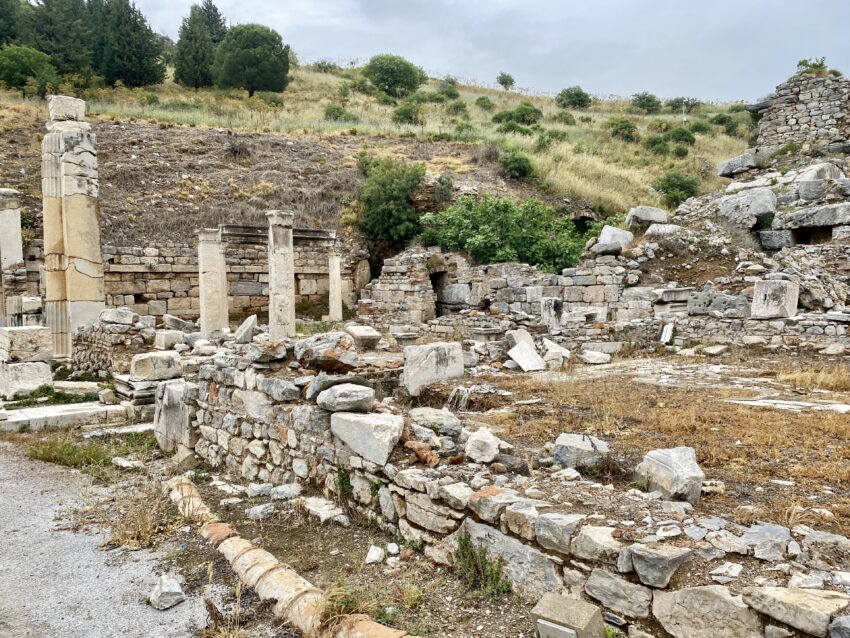
The State Agora in Ephesus, often called the Upper Agora, was one of the city’s most important public spaces and served as its main political center. It stood in the southeastern part of Ephesus, separate from the Commercial Agora in the northwest. The site was first laid out in the 4th century BCE over an earlier necropolis, showing how the city expanded beyond its older limits. Excavations in the northeastern section uncovered burials from the 7th and 6th centuries BCE, as well as an archaic terracotta sarcophagus, confirming its earlier use as a cemetery. During the Hellenistic and early Roman eras, the area took on a more formal urban layout, including major paving works around 65 BCE carried out by Timon, the agoranomos, or market official. Additional rebuilding at the beginning of the 1st century CE reinforced its importance as a place for government, ceremony, and public life.
Measuring about 160 by 73 meters, the State Agora was enclosed on three sides by stoas, covered colonnades that provided shade and shelter for civic discussion, philosophical teaching, and official business. The western side was defined by a finely built ashlar wall lined with monuments. One of the most notable buildings here was the Stoa Basilica, a two-story structure with Ionic columns decorated with bull-head carvings. These ornaments symbolized power and sacred meaning, but they were also practical, helping support the architrave while allowing wider gaps between the columns. The basilica may also have had a religious function, which reflects the way civic and sacred life often overlapped in ancient Ephesus.
At the center of the State Agora stood a temple devoted to the Egyptian goddess Isis, built in the 1st century CE. With ten columns along its longer sides and six along the shorter ones, it was an impressive monument that reflected the cultural links between Ephesus and Egypt. Its pink granite columns were especially striking, since that stone had to be imported rather than quarried locally in Anatolia. The temple was later torn down during the rule of Emperor Augustus because of its Egyptian associations and was not rebuilt. Sculptures from its façade, including scenes from the story of Odysseus and Polyphemos, survived and are now kept in the Ephesus Museum.
Location: Atatürk, Efes Harabeleri, 35920 Selçuk/İzmir, Türkiye | Hours: (Summer) April 1 – October 31: 08:00–19:30. (Winter) November 1 – March 31: 08:30–17:00. | Price: Included with Ephesus with Ephesus Experience Museum (40 Euro per person); Ephesus with Ephesus Experience Museum + Terrace Houses: 52 Euro p.p. | Website
18. Prytaneion
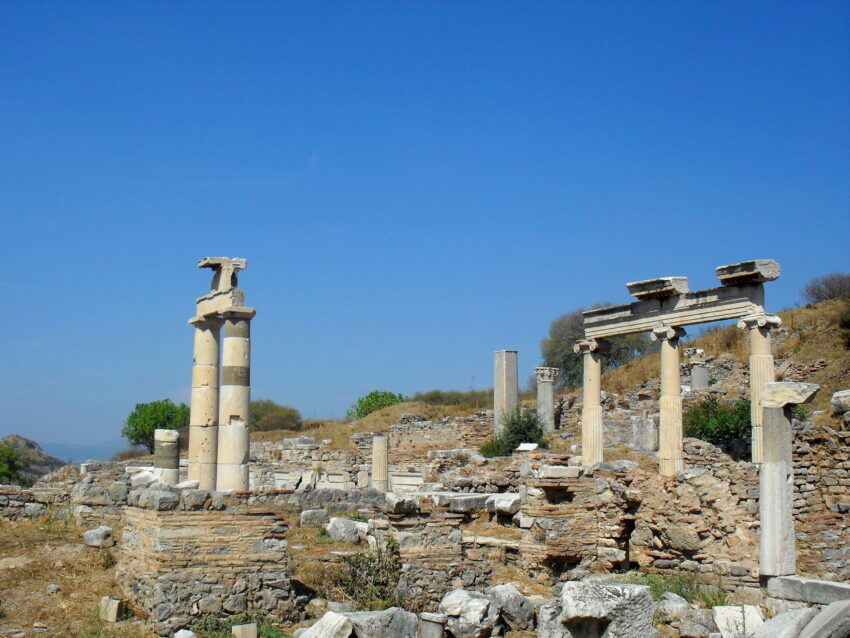
The Prytaneion of Ephesus was one of the city’s most important civic and sacred buildings, serving as both an administrative center and a place of worship. Built in the 3rd century BCE during the rule of Lysimachos, it operated as a kind of city hall where official meetings, banquets, and ceremonial receptions were held. At its spiritual center burned the eternal flame of Hestia, goddess of the hearth, which symbolized the life and continuity of the city. This sacred fire was maintained by the Curetes, priestly attendants associated with her cult.
In appearance, the Prytaneion was designed much like a large house, but its functions were distinctly public. It contained rooms for administration, an assembly space, dining areas, and the city archives. The front of the building was framed by plain Doric columns inscribed with the names of the Curetes. Behind them lay a courtyard decorated with mosaic flooring, while to the northeast was the shrine of Hestia Boulaia. This cult area included distinctive double columns with heart-shaped forms at the corners and a ceremonial hearth, still traceable today through red floor markings and the remains of an altar base. The eastern part of the complex was aligned with this altar, underlining the importance of the sacred space within the building.
The Prytaneion was altered several times over the centuries. In the 1st century BCE, a southern courtyard with three façades was added, and in the 3rd century CE the cult room received its decorative double columns. By the 4th century CE, however, the building had fallen out of use, and some of its materials were later reused in other monuments, including the Scholastica Baths. During 20th-century excavations, two statues of Artemis were found in the sanctuary, one of them apparently buried for protection during the Christian period. These statues are now preserved in the Ephesus Museum.
Location: Atatürk, 35920 Selçuk/İzmir, Türkiye | Hours: (Summer) April 1 – October 31; Daily: 08:00–19:30. (Winter) October 31 – April 1; Daily: 08:30–17:00. | Price: Included with Ephesus with Ephesus Experience Museum (40 Euro per person); Ephesus with Ephesus Experience Museum + Terrace Houses: 52 Euro p.p. | Website
19. Odeon
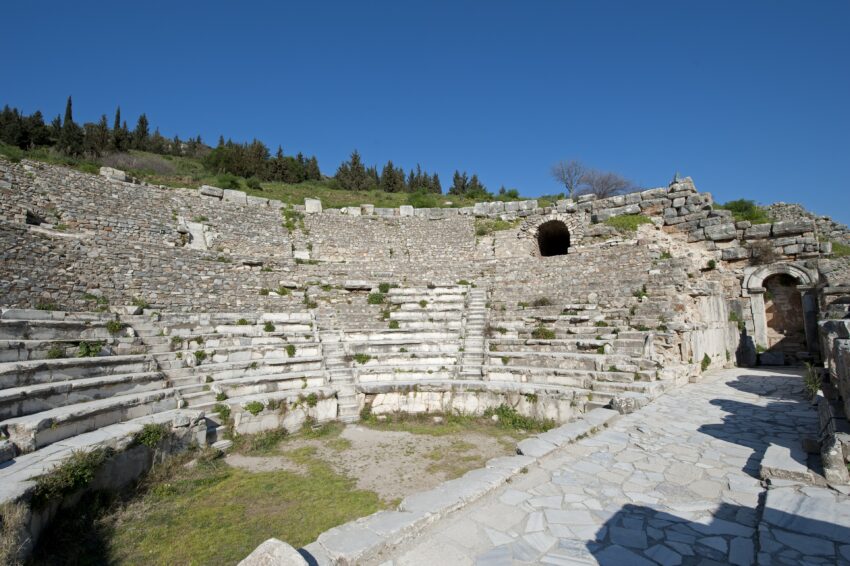
The Odeon of Ephesus is a relatively small semi-circular building from the 2nd century AD that played an important role in both the political and cultural life of the city. It was commissioned by the wealthy Publius Vedius Antonius and his wife Flavia Paiana, and served not only as a performance venue but also as the Bouleuterion, or council chamber. With space for around 1,500 people, it functioned as a gathering place for members of the elite as well as an intimate setting for concerts, recitals, and other public events.
Ephesus was administered through two principal political bodies. The larger assembly, known as the Demos, met in the great theater and represented the wider citizen body, while the Bouleia, or senate, gathered in the Odeon. This council was made up of influential upper-class citizens who were responsible for many of the city’s most important affairs, including taxation, public works, religion, justice, and administration. Decisions made within the Odeon would have had a direct impact on the running and development of Ephesus.
In architectural terms, the Odeon included a two-story stage building that was once sheltered by a wooden roof. A narrow podium rose about a meter above the orchestra and was linked to the stage by three doorways. The seating area was arranged in a semi-circle and divided into upper and lower sections by a diazoma, or horizontal walkway. The seats nearest the front were broader and intended for high-ranking citizens, making the building’s social hierarchy visible in its design. Some of these areas, including parts of the seating and podium, have been restored and help visitors understand the original arrangement.
Access to the upper seating tiers was provided by two side corridors, which led into arched passageways known as vomitoria, a term derived from the Greek word for “mouth.” These entrances allowed people to move efficiently into the auditorium while preserving order within the space. Although it was far smaller than the city’s main theater, the Odeon was one of the most significant buildings in Ephesus, reflecting how closely civic life and public entertainment were connected in the Roman world.
Location: Atatürk, Efes Harabeleri, 35920 Selçuk/İzmir, Türkiye | Hours: (Summer) April 1 – October 1; Daily: 08:00–19:00. (Winter) October 1 – April 1; Daily: 08:00–18:00. | Price: Included with Ephesus with Ephesus Experience Museum (40 Euro per person); Ephesus with Ephesus Experience Museum + Terrace Houses: 52 Euro p.p. | Website
20. Baths of Varius
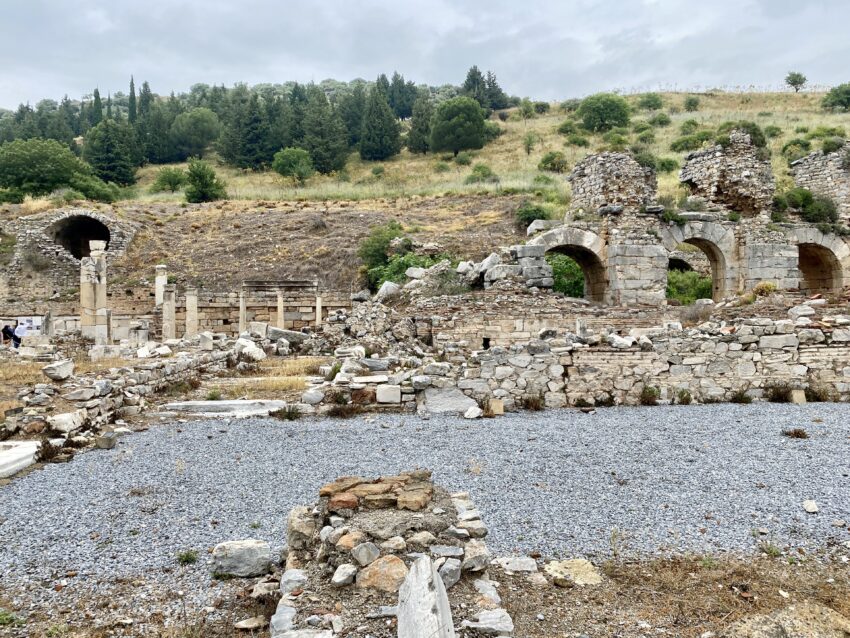
The Baths of Varius is one of the most impressive surviving monuments in Ephesus, dating to the 2nd century AD. Built mainly from carefully cut marble blocks, the complex stands as a strong example of Roman skill in engineering and public design. Although its origins go back to the Hellenistic period, the baths were restored and altered several times over the centuries. Like many Roman bathhouses, it was arranged around three main sections: the frigidarium for cold bathing, the tepidarium for warm bathing, and the caldarium for hot bathing. Moving through these rooms formed part of the bathing routine and reflects the Roman concern for cleanliness, comfort, and communal life.
The baths are closely associated with the sophist Flavius Damianus, who is said to have financed the building and even included a private chamber for himself and his wife. Later, the wealthy Ephesian family of Vedius Antonius and Vedia Faedrina sponsored further additions, reinforcing the connection between grand public buildings and elite prestige. In the 4th century, a Christian woman named Scholastica paid for major restoration work, and the structure was modified again during the Byzantine period in the 5th century. Among the most striking features from these later phases is a mosaic-lined corridor about 40 meters long, which remains one of the site’s most memorable elements.
Even after centuries of decay, the Baths of Varius survives in relatively strong condition, particularly in its vaulted areas. The complex also preserves evidence of a hypocaust system, the Roman underfloor heating method that circulated hot air beneath the floors and through the walls to warm both rooms and water. In addition to the bathing chambers, the site included areas for sitting, resting, and reading, showing that it functioned as more than just a place to wash. It was also a lively social space where people met, talked, and spent time together. Ongoing excavations continue to reveal more about the complex and the everyday life of Roman Ephesus.
Location: Atatürk, 35920 Selçuk/İzmir, Türkiye | Hours: (Summer) April 1 – October 31; Daily: 08:00–19:30. (Winter) November 1 – March 31; Daily: 08:30–17:00. | Price: Included with Ephesus with Ephesus Experience Museum (40 Euro per person); Ephesus with Ephesus Experience Museum + Terrace Houses: 52 Euro p.p. | Website
21. Ephesus Archaeological Museum
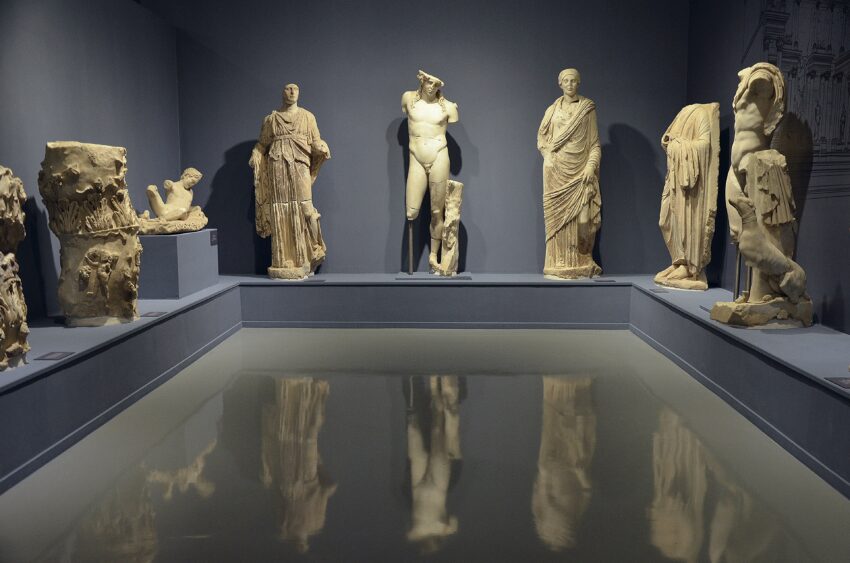
The Ephesus Archaeological Museum in Selçuk brings together objects excavated from Ephesus and nearby sites, helping explain what the ruins once looked like in daily life. It opened in 1964, at a time when Türkiye’s heritage policies increasingly emphasized keeping antiquities in the country and building local museums to house major finds. As a result, the museum became the main home for many important pieces that remained in Türkiye after earlier excavation eras.
The displays are arranged by theme rather than strict chronology, which makes it easy to connect objects to places you’ll recognise from the site. Galleries focus on topics such as Ephesus through different periods, the imperial cult, and local religious traditions, alongside finds from areas like the Terrace Houses and monumental fountains. There is also an outdoor courtyard where architectural fragments and tomb-related pieces help round out the picture of the ancient city.
The standout works are the large statues of Artemis of Ephesus, which capture the distinctive local form of the goddess and the city’s identity around her cult. You’ll also see a varied mix of sculpture, small finds, and coins that reflect Ephesus as a wealthy port city with long-running civic and religious life. One of the oldest items on display is a stamp from the Çukuriçi Mound, dated to around 6200 BC, which pushes the story far earlier than the classical city.
Location: Atatürk, Uğur Mumcu Sevgi Yolu No: 26, 35920 Selçuk/İzmir, Türkiye | Hours: Daily: 08:00–17:30. | Price: Adults: 10 Euro | Website
22. Temple of Artemis
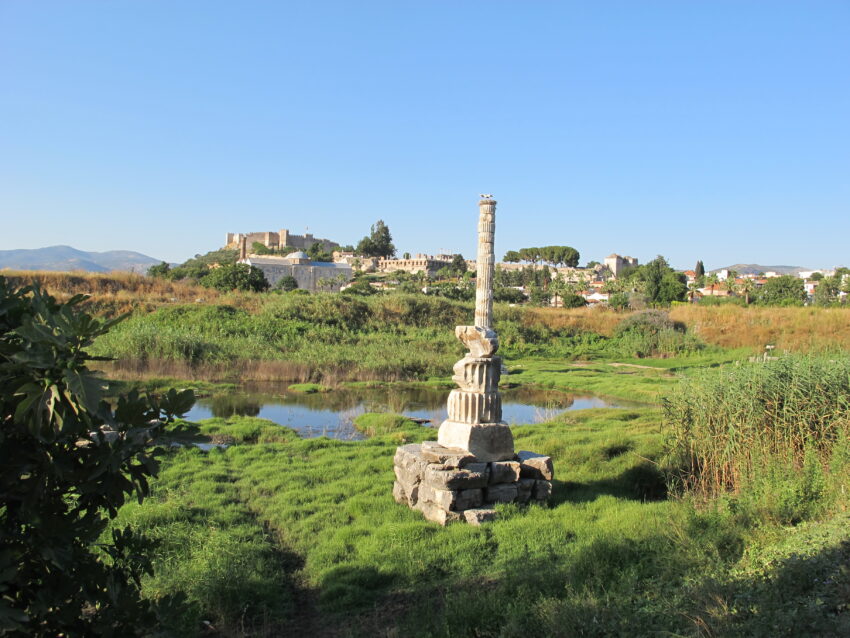
The Temple of Artemis, or Artemision, was one of the Seven Wonders of the ancient world and the most famous sanctuary of Ephesus. A major version of the temple was commissioned around 550 BCE by Croesus of Lydia, and it became celebrated for its scale and rich decoration. More than a single building, it was a long-lived sacred complex that anchored Ephesian identity around Artemis as the city’s protector.
Its history is marked by destruction and rebuilding. In 356 BCE, the temple was burned in an act of arson associated with Herostratus, and the Ephesians rebuilt it on an even grander plan with a forest of Ionic columns. The sanctuary suffered its final major ruin in 262 CE during a Gothic raid and was not rebuilt afterward.
What you see today is the low, waterlogged outline of foundations and scattered architectural fragments, but the emptiness itself helps you grasp how vast the precinct once was. Excavations have identified remains of multiple phases, including earlier, smaller temples beneath later construction. Many sculpted fragments, especially from columns, ended up in collections such as the British Museum, while the site at Selçuk offers a quiet, sobering contrast to the sanctuary’s former reputation.
Location: Atatürk, Park İçi Yolu No:12, 35920 Selçuk/İzmir, Türkiye | Hours: Daily: 08:00–19:30. | Price: Free.
23. Grotto of the Seven Sleepers
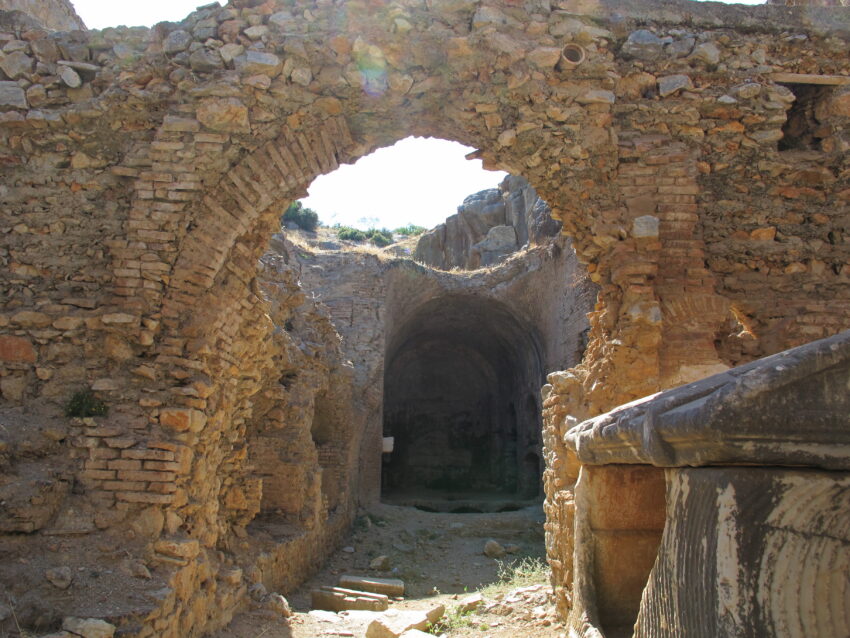
The Grotto of the Seven Sleepers sits near Ephesus on the slopes of Pion Mountain and is tied to a legend honoured in both Christian and Islamic tradition. In the Christian story, seven young men flee persecution under Emperor Decius (249–251 CE) and hide in a cave, where they fall into a miraculous sleep. They are said to awaken in the time of Theodosius II, discovering that Christianity has become dominant.
Over time, the place became a pilgrimage site and a burial ground. The surrounding area developed into a Byzantine necropolis with rock-cut tombs and later additions, reflecting the desire to be buried close to a location believed to be holy. Architectural traces suggest the cave was adapted for Christian use, with elements that indicate a small rock-cut church or chapel form.
The Qur’anic version, told in Sura 18, shares key themes while leaving some details open and adding the motif of a dog guarding the entrance. The Ephesus grotto is one of several claimed locations, but it remains one of the best known because of its proximity to a major late antique city and the dense burial landscape around it. Among notable finds are terracotta oil lamps from the 4th and 5th centuries CE, some showing a mix of Christian and pagan imagery that hints at the complexity of religious life in the period.

Moira & Andy
Hey! We're Moira & Andy. From hiking the Camino to trips around Europe in Bert our campervan — we've been traveling together since retirement in 2020!
This website uses affiliate links which earn a small commission at no additional cost to you.
Walking Tour Summary
Distance: 2.5 km
Sites: 23
Walking Tour Map