Puerta de Sevilla, Córdoba
City Gate in Córdoba
The Puerta de Sevilla is one of the must-see places in Córdoba for travellers exploring the quieter, flower-filled neighbourhood of San Basilio. Though modest in size, this reconstructed gateway marks an important historical entrance to the city, once guiding travellers toward Seville and providing access to markets and residential quarters outside the medieval walls. Its setting beside restored stretches of wall and a small watchtower makes it a charming stop for anyone wandering between the Alcázar and San Basilio.
Today, the gate is often visited on walking tours of Córdoba, thanks to its atmospheric stonework, Islamic-era origins, and the nearby statue of Ibn Hazam, one of the city's most celebrated medieval scholars.
Table of Contents
- History and Significance of Puerta de Sevilla
- Things to See and Do in Puerta de Sevilla
- How to Get to Puerta de Sevilla
- Practical Tips on Visiting Puerta de Sevilla
- Where to Stay close to Puerta de Sevilla
- Is Puerta de Sevilla Worth Visiting?
- FAQs for Visiting Puerta de Sevilla
- Nearby Attractions to Puerta de Sevilla
History and Significance of Puerta de Sevilla
The origins of the Puerta de Sevilla lie in the Islamic era, with fragments dating back to the 10th century when Córdoba was the vibrant capital of the Caliphate. Medieval historian Ibn Baskuwal recorded up to seven gates along the walls of the Medina, including this one, then known as Bab al-Ishbiliya or Bab al-Attarin, meaning Gate of the Shopkeepers. Its connection to nearby markets helps explain why it became a gathering point for local women accessing the souk located in what is now the Alcázar Viejo.
Following the Christian conquest of Córdoba in 1236, the gate retained its name, becoming the starting point for travellers heading toward Seville. Over the centuries it remained a functional part of the city's defences and circulation routes, though its form evolved. By the mid-19th century, complaints from residents about the gate obstructing carriage traffic led to its demolition in 1865.
The structure visible today is a 20th-century reconstruction. In the 1950s, Mayor Antonio Cruz Conde ordered the rebuilding of portions of the wall and the gate, executed by architect José Rebollo. This reconstruction helps preserve the memory of the original gateway while fitting harmoniously into the surrounding historic district.
Things to See and Do in Puerta de Sevilla
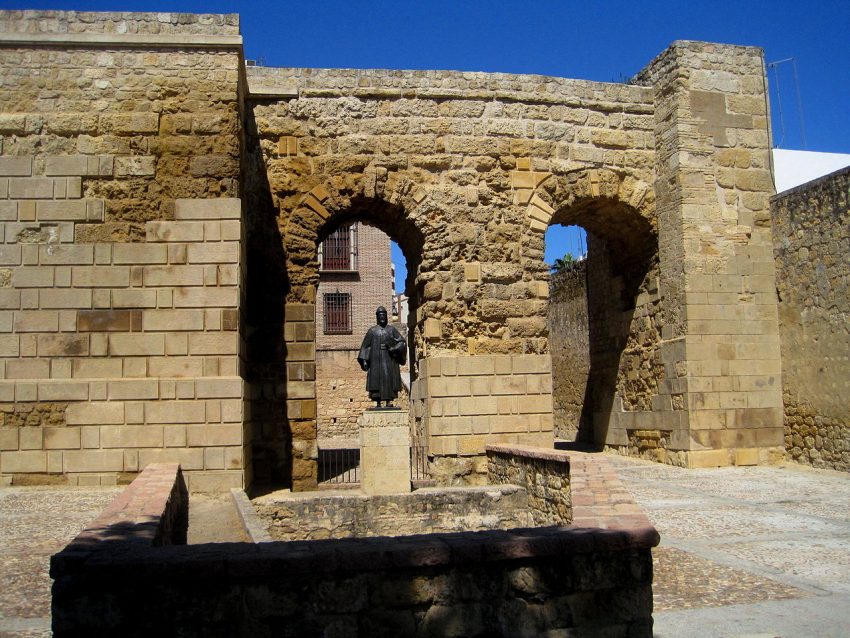
Although small, the Puerta de Sevilla offers several interesting details. The gateway consists of a single sandstone entrance crowned with a lintel and bordered with granite. Above it, the emblem of Córdoba adds a decorative civic touch. To one side, a short stretch of wall is attached to the gate at a right angle, ending at a square watchtower. Two small twin arches along this wall create one of the gate's most distinctive features.
Scholars still debate whether these arches were part of a defensive structure or the remains of an old aqueduct, making this a fascinating spot for visitors interested in archaeological puzzles. The restored stonework also provides a sense of how Córdoba’s medieval walls once looked and functioned.
Just outside the gateway stands a modern statue of Ibn Hazam, crafted by sculptor Ruiz Olmos. Ibn Hazam was a prolific medieval writer whose works ranged from theology to politics, but he is most famous for The Collar of the Dove, a foundational text in the tradition of courtly love. The statue adds a thoughtful cultural dimension to the visit and offers a pleasant spot for photos.
How to Get to Puerta de Sevilla
Córdoba is served by nearby airports, including Málaga-Costa del Sol Airport and Seville Airport, both offering regular international flights. For the best deals and a seamless booking experience, check out these flights to Córdoba on Booking.com.
The city is easily reached by train, with high-speed AVE services connecting Córdoba to Madrid, Málaga, and Seville in under two hours. Train schedules and bookings can be found on Omio.
If travelling by car, Córdoba is linked by major highways, and parking areas around the Alcázar and San Basilio make it easy to explore the area on foot once you arrive. If you are looking to rent a car in Spain I recommend having a look at Discover Cars, first, as they compare prices and review multiple car rental agencies for you.
Practical Tips on Visiting Puerta de Sevilla
- Best time to visit Puerta de Sevilla: Early morning or late afternoon for softer light on the stonework.
- Entrance fee in Euros: Free to visit, as it is an open public space.
- Opening hours: Accessible at all times.
- Official website: Information can be found on Córdoba’s municipal tourism site.
- How long to spend: 10-15 minutes, longer if exploring San Basilio.
- Accessibility: Flat and easy to access, though nearby lanes are narrow.
- Facilities: Limited in the immediate area; cafés and shops are available in San Basilio.
- Photography tip: Frame the watchtower and arches together for an atmospheric shot.
- Guided tours: Many walking tours through the Alcázar and San Basilio include this stop.
- Nearby food options: Several tapas bars and traditional restaurants are nearby.
Where to Stay close to Puerta de Sevilla
For travellers wanting to stay close to San Basilio and the city walls, several excellent options are nearby. Hotel Eurostars Conquistador offers comfortable rooms near the Mosque-Cathedral. A charming traditional choice is Las Casas de la Judería, with Andalusian patios and a peaceful atmosphere. For a boutique stay within walking distance of the gate, consider Hotel Boutique Patio del Posadero.
Is Puerta de Sevilla Worth Visiting?
Yes, Puerta de Sevilla is worth visiting for travellers seeking quieter historic corners of Córdoba. Though small, it offers meaningful insight into the city's Islamic roots, medieval layout, and later reconstruction efforts. Its proximity to San Basilio and the Alcázar area makes it an easy and enjoyable addition to a walking itinerary.
What Other Travellers Say...

Puerta de Sevilla sits on Calle Puerta Sevilla in Córdoba and forms one of the three preserved medieval gates giving access to the western section of the old city walls; visitors note it dates from the 14th century, is relatively small and simpler than some other gates (lacking crenellations) yet retains original defensive features and a coat of arms above the opening, and it provides direct access to the popular, flowered San Basilio neighborhood with a projecting section of wall to the left that may once have been an attached aqueduct.


FAQs for Visiting Puerta de Sevilla
Nearby Attractions to Puerta de Sevilla
- Alcázar de los Reyes Cristianos: A fortified palace with gardens and Roman mosaics.
- San Basilio Patios: Famous flower-filled courtyards in a picturesque neighbourhood.
- Torre de la Calahorra: A defensive tower and museum at the end of the Roman Bridge.
- Puerta de Almodóvar: Another reconstructed medieval gate close to La Judería.
- Mosque-Cathedral of Córdoba: The city's most iconic monument, a short walk away.
The Puerta de Sevilla appears in our Complete Guide to Visiting Córdoba!

Moira & Andy
Hey! We're Moira & Andy. From hiking the Camino to trips around Europe in Bert our campervan — we've been traveling together since retirement in 2020!
This website uses affiliate links which may earn a commission at no additional cost to you!
Planning Your Visit
Nearby Attractions
- Torre de Belén de Córdoba (0.3) km
City Walls and Tower - Caballerizas Reales de Córdoba (0.3) km
Historic Building - Alcázar de los Reyes Cristianos (0.3) km
Palace - Baños del Alcázar Califal (0.4) km
Baths - Statue of Maimónides (0.5) km
Statue - Mills of the Guadalquivir (0.5) km
Historic Building - Museo Taurino (0.5) km
Museum - Plaza Maimónides (0.5) km
Square and Statue - Sinagoga (0.5) km
Synagogue - El Zoco (0.5) km
Market