Best Places to See in Toledo, Spain (2026)

This website uses affiliate links which earn a small commission at no additional cost to you.
Spain is abundant with remarkable cities to explore, and while Madrid, Barcelona, and Valencia garner much attention, I have a special fondness for the culturally rich smaller Spanish cities. Among these, the captivating city of Toledo holds a top spot in my heart. Being one of the oldest and most unique cities in Spain, it was once the country's capital and remains esteemed as its cultural centre. Toledo is a treasure trove of historical landmarks and hosts captivating centuries-old festivals. For travellers seeking an authentic Spanish cultural experience, few cities compare to the incredible Toledo. To help others fully enjoy their visit, I've crafted this Toledo Spain travel guide.
Table of Contents
- Getting to Toledo from Madrid
- Best Time To Visit Toledo
- Where to Stay in Toledo
- History of Toldeo
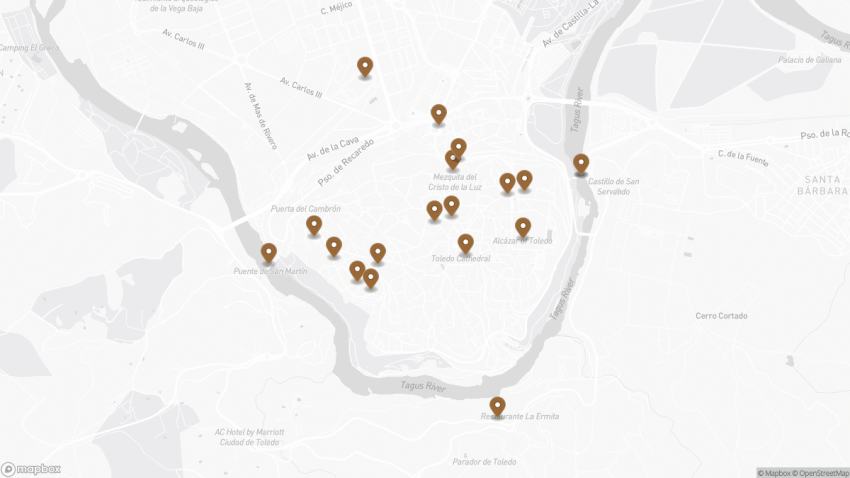
- What to See in Toledo
- Toledo Cathedral
- Alcázar of Toledo
- Monastery of San Juan de los Reyes
- Synagogue of El Tránsito and the Sephardic Museum
- Synagogue of Santa María la Blanca
- Mosque of Cristo de la Luz
- Puente de San Martín
- Puente de Alcántara
- Plaza de Zocodover
- Mirador del Valle
- Museo de Santa Cruz
- El Greco Museum
- Puerta de Bisagra
- Puerta del Sol
- Roman Baths of Toledo
- Roman Circus of Toledo
- Iglesia de Santo Tomé
- Cueva de Hércules
- Puente y Mirador de San Servando
Getting to Toledo from Madrid
By Train: The high-speed train from Toledo to Madrid takes about 30 minutes and costs about 14 euros, so if you are staying near Atocha train station, this is the best way to get to the tourist city. Train schedules and bookings can be found on Omio.
By Bus: The bus is the cheapest method of getting to Toledo with tickets starting at 6 euros costs just about 5 euros each way and takes an hour and a half to get between Madrid and Toledo. Buses leave every half an hour and depart from Plaza Eliptica to the south of Madrid.
By Tour: The easiest way to visit Toledo from Madrid is by guided tour. There are a number of tour companies that operate trips to Toledo from Madrid. We went on the From Madrid: Toledo Full Day Trip which also included a short walking tour.
By Car: Driving from Madrid to Toledo covers a distance of about 75 kilometers (47 miles) and takes approximately 50 minutes to 1 hour via the A-42 motorway. The road is a major, well-maintained highway with clear signage, making the trip easy and direct. If you are looking to rent a car in Spain I recommend having a look at Discover Cars, first, as they compare prices and review multiple car rental agencies for you.
Parking is available outside Toledo’s historic center, with options like Parking Safont offering convenient access via escalators to the old town. It’s recommended to avoid driving inside the medieval core due to very narrow streets and limited parking. If you are looking to rent a car in Spain I recommend having a look at Discover Cars, first, as they compare prices and review multiple car rental agencies for you.
Best Time To Visit Toledo
June is our top recommendation for visiting Toledo, especially during the Corpus Cristi Fiesta when the city is adorned with stunning flower decorations in the streets. However, be prepared for larger crowds during this festive time. Other excellent months to explore Toledo are March, April, May, September, and October.
Keep in mind that many restaurants in Toledo are closed on Sunday nights and Mondays, so plan your dining accordingly.
Where to Stay in Toledo
To fully appreciate the city’s historic ambiance, choose a hotel in or near the old town. For luxury, Eugenia de Montijo, Autograph Collection offers elegant comfort in a former palace. Mid-range travellers may enjoy Hotel San Juan de los Reyes, ideally located within the Jewish Quarter. For budget options, Albergue Juvenil Los Pascuales provides affordable stays inside the historic walls.
History of Toldeo
Toledo’s history dates back to around the 5th century BC when it was settled by Jewish travelers, known to the Romans as Toletum. It fell under Roman rule in 193 BC, becoming the capital of the province of Carpentia. During the Visigoth era, it served as an essential civic center under leader Leovigild, and later, the Moors conquered the city in 711.
Toledo, however, resisted the Moorish conquest and witnessed several rebellions against their rule. Eventually, Christian leaders recaptured the city, with Alfonso VI of Castile taking control in 1085. Under Christian rule, Toledo flourished as a center for Christian learning, while its Arab library remained intact. Sadly, the city's Jewish residents faced persecution, with mass burnings carried out by the Archdiocese of Toledo in various years.
As the Spanish court moved to Madrid in 1560, Toledo experienced a period of decline, becoming a political and economic backwater. Despite its medieval ambiance, the 20th century brought challenges, including the Spanish Civil War in 1936 when the citizens sought refuge within the sturdy walls of the Alcazar castle.
After the war, Toledo experienced a resurgence with its historic center being declared a UNESCO World Heritage Site, attracting tourists and gaining recognition as the capital of Castile-La Mancha. In recent years, the city has enjoyed a revival, embracing its rich history and cultural heritage.
What to See in Toledo
Toledo’s rich history is a testament to the coexistence of Christians, Jews, and Arabs within its ancient walls, leaving behind an extraordinary cultural, historical, and artistic legacy that endures to this day.
1. Toledo Cathedral

Few buildings in Spain deliver the same jaw-drop as Toledo Cathedral. Begun in 1226 and completed in the late 15th century, it fuses French High Gothic ambition with local Mudéjar finesse: five soaring naves, a forest of clustered columns, and stained glass that washes the interior in honeyed light. Step into the main chapel to see the gilded retablo glittering like a jeweled storyboard of the life of Christ; turn to the choir for some of Europe’s most intricate late-medieval woodcarving. In the sacristy, El Greco, Velázquez, Titian, and Goya hang shoulder to shoulder, a compact primer in Spanish art.
What makes the cathedral unforgettable is how it reveals itself in layers. One moment you’re craning up at flying buttresses; the next, you’re in the cloister, where multifoil arches nod to the city’s Islamic past. Don’t miss the Treasury’s monumental Corpus Christi monstrance or the playful Baroque skylight of the Transparente. Outside, approach along Calle del Cardenal Cisneros for the classic spire-framed view, then circle to the understated Puerta del Reloj to feel the building’s medieval weight. You’ll leave with memory cards full and a vivid sense that Toledo’s soul is written in limestone, light, and gold.
| Hours: 10am-6.30pm Mon-Sat, 2-6.30pm Sun | Price: €10, incl Torre de las Campanas €12.50 | Website

2. Alcázar of Toledo

Commanding the skyline from the city’s highest point, the Alcázar is a square, four-towered statement piece whose symmetry is half Roman authority, half Renaissance polish. A Roman palace once stood here; Charles I and Philip II later gave the fortress its clean, monumental lines. Inside today, the Army Museum threads Spain’s military story from mailed knights to modern regiments, using models, uniforms, maps, and clever dioramas to animate centuries of conflict and invention.
Yet the Alcázar is more than exhibits. Its courtyards and arcades frame cinematic views over the Tagus, and its war-scarred 20th-century past—rebuilt after the Civil War siege—adds gravitas to every stone. Start at Plaza de Zocodover and climb the short, steady slope; when you reach the terrace, pause and pan slowly: cathedral spire, rooftops, encircling river, hazy plains beyond. Visit late afternoon, when the fortress warms to bronze and the city glows below. Whether you love military history or simply crave Toledo’s finest panorama, the Alcázar delivers scale, story, and spectacle in one visit.
Location: Alcázar de Toledo C. de la Union, s/n 45001 Toledo Spain | Hours: 10am-5pm Tue-Sun | Price: adult/child €5/free, Sun free | Website
3. Monastery of San Juan de los Reyes

Raised by the Catholic Monarchs to celebrate victory and dynasty, San Juan de los Reyes is Gothic at its most lyrical. Step through the portal and the city’s bustle falls away; ahead, a lantern of stone ribbing unfolds into a church of poised verticals and soft light. The cloister is the showstopper—two levels of filigreed arches, botanical carvings, and a quiet garden that seems to hold the breeze. Look up to spot the delicate wooden artesonado ceilings, a Mudéjar flourish that sweetens the Gothic spine.
Outside, chains hang on the walls—tradition says they belonged to Christian captives freed from Granada. Inside, royal symbols repeat with almost meditative rhythm, imprinting the founders’ presence on every surface. Come mid-morning when rays slant through the windows and the cloister’s shade is cool; then stroll a few minutes to the Puente de San Martín for river views that pair perfectly with the monastery’s calm. If the cathedral is Toledo’s roar, San Juan de los Reyes is its exhale—intimate, contemplative, and deeply beautiful.
Location: Monasterio de San Juan de los Reyes, Calle de los Reyes Católicos, Toledo, Spain | Hours: 10am-6.45pm Mar-Oct, to 5.45pm Nov-Feb | Price: €3 | Website
4. Synagogue of El Tránsito and the Sephardic Museum

Built in 1357 for Samuel ha-Levi, treasurer to King Peter of Castile, El Tránsito is a masterclass in Mudéjar stucco: lace-fine Arabic calligraphy, Hebrew inscriptions, and geometric bands that flutter across the walls like woven silk. Sunlight drifts through high windows, and the women’s gallery floats above on wooden beams—elegant, spare, and human in scale. The space later became a church; today it houses the Sephardic Museum, where ritual objects, documents, and multimedia restore the music of a community once central to Toledo’s life.
Take your time with the small details: a carved pomegranate here, a six-pointed star there, the sheen of old timber under your fingertips. Displays explain festivals, crafts, and daily rhythms, grounding the poetry of the hall in real lives. Finish in the garden, breathing cypress and stone, before exploring the Jewish Quarter’s lanes. El Tránsito is not just an aesthetic marvel; it’s a bridge—between faiths, centuries, and stories that still resonate in the city’s bricks and breath.
Location: Sephardic Museum C. Samuel Levi, 2 45002 Toledo Spain | Hours: 9.30am-7.30pm Tue-Sat Mar-Oct, to 6pm Tue-Sat Nov-Feb, 10am-3pm Sun year-round | Price: adult/child €3/1.50, after 2pm Sat & all day Sun free | Website
5. Synagogue of Santa María la Blanca

White, serene, and startlingly modern to the eye, Santa María la Blanca predates El Tránsito and feels like a grove turned to stone. Rows of palm-like columns lift horseshoe arches toward simple timber roofs; light pools on limewashed walls. Built by Jewish patrons in the late 12th/early 13th century and later converted to a church, it distills Toledo’s “Three Cultures” into a single, luminous room where Islamic forms, Jewish heritage, and Christian history intersect without noise.
Stand at the center and rotate slowly—the repetition of arches is calming, the proportions humane. Beyond its beauty, the building’s biography is compelling: prayer hall, church, barracks, warehouse, monument, museum. Each chapter left traces, but the essence endures: a place designed for gathering and quiet, where minimal ornament lets geometry sing. Pair your visit with El Tránsito to feel the dialogue between the two synagogues; together they sketch a civilization’s highs and heartbreaks with extraordinary grace.
Location: Sinagoga de Santa María La Blanca, Calle de los Reyes Católicos, Toledo, Spain | Hours: 1 March – 15 October 10:00 – 18:45 * 16 October – 28 February 10:00 – 17:45 * | Price: Adults €4,00, Children €3,00 | Website
6. Mosque of Cristo de la Luz (Mezquita Bab al-Mardum)

Tiny by cathedral standards but mighty in presence, this 10th-century mosque is one of Spain’s oldest standing Islamic monuments. Nine bays, nine little domes, and a grid of horseshoe arches create an intimate, harmonious volume that invites you to look up. After 1085 it became a Christian chapel; a Romanesque apse was grafted on, making the building a literal hinge between faiths. Outside, Kufic-style brickwork patterns the façade; inside, light and shadow play across simple plaster and brick.
The setting enhances the experience: just steps from Puerta del Sol and fragments of the old walls, in a neighborhood once called Medina. Linger in the garden to frame the mosque against battlements and sky, then slip back in to study each bay—the domes differ subtly, like variations on a theme. Cristo de la Luz proves that architecture doesn’t need size to be sublime; it needs clarity, proportion, and a story. Here, you get all three in a jewel box of stone.
Location: Ermita "Mezquita" del Cristo de la Luz C. Cristo de la Luz, 22 45002 Toledo Spain | Hours: 10am-2pm & 3.30-5.45pm Mon-Fri, 10am-5.45pm Sat & Sun | Price: adult/child €2.80/free
7. Puente de San Martín

West of the old town, the Tagus tightens into a bend and the Puente de San Martín leaps it in five handsome arches. Built in the late 14th century, the bridge pairs rugged masonry with a central span that was a medieval engineering flex. Fortified towers anchor each end, and from mid-span you’re rewarded with a sweep of river, monastery, and terraced houses stacked like a Roman theater. It’s a superb place to feel the city’s relationship with its landscape.
Walk it both ways. From the monastery side you get the bridge against Toledo’s ochre cascade; from the town side you see water and sky widen. Early evening is magic: swallows stitch the air, the stone warms to amber, and the current riffles below. If you have more time, follow the riverside path for alternate views and quieter moments. San Martín isn’t just a crossing; it’s a balcony—a place to pause and let the city arrange itself into a perfect composition.
Location: San Martin's Bridge Bajada San Martín 45004 Toledo Spain
8. Puente de Alcántara
Toledo’s eastern gatehouse to the world, Puente de Alcántara began as a Roman arch, was reworked by Umayyads, and later crowned with Christian towers—each era leaving a signature on this muscular span over the Tagus. Today two principal arches carry you between the Castillo de San Servando and the lower town; carved coats of arms, inscriptions, and battlements provide texture for the eye and clues for the imagination.
Come at sunrise when mist sometimes clings to the river, or at dusk when the Alcázar ignites above the rooftops. From mid-bridge, pivot slowly: the fortress to one side, the mosque-turned-chapel and city walls to the other, water threading it all together. Alcántara feels like a prologue to Toledo—step across and you’ve entered the book. It’s practical, photogenic, and storied, the rare landmark that’s as satisfying to use as it is to admire.
Location: Puente de Alcántara, Toledo, Spain
9. Plaza de Zocodover

Every great city needs a living room; Zocodover is Toledo’s. Once the souq of beasts (its Arabic name says so), later a Renaissance-rationalized square by Juan de Herrera, it’s now a sociable stage ringed by arcades, cafés, and confectioners. People-watch over a coffee, try a slice of marzipan, overhear the logistics of families and tour guides orchestrating the day. From here, streets radiate like threads into the old town’s tapestry.
History lingers in the corners—markets, proclamations, festivals, and harder stories, too—but today the square hums with an easy civic pulse. Use it as your compass: cathedral one way, Alcázar another, Museo de Santa Cruz down the slope. Come early for photographs with long shadows and empty benches; swing back at blue hour when façades glow and conversations stretch. Zocodover doesn’t demand; it invites—rest, regroup, and let the city gather around you.
10. Mirador del Valle

For the postcard you’ll frame later, make the gentle trek (or hop the tourist road train) to Mirador del Valle, a string of lookouts along the ridge opposite Toledo. From here the city reveals itself completely: the cathedral’s needle, the Alcázar’s four sentries, the tight spiral of streets, and the Tagus cinching a silver belt around the whole. Morning delivers clarity; sunset paints the stone rose and the water copper. Either way, the viewpoint locks the city’s complexity into a single, graspable image.
Bring a light jacket and time to linger. Trace your day’s path with a finger, pick out bridges, gates, and domes, and plan tomorrow’s wander. Photographers: a moderate telephoto compresses skyline layers beautifully; a wide angle captures river curves and foreground rock. Couples linger, sketchers sketch, and locals pause on evening jogs. You’ll understand why El Greco obsessed over this city’s profile—the view at Mirador del Valle is both geography and theater, a perfect finale or overture.
Location: Mirador del Valle Ctra. Circunvalación, s/n 45004 Toledo Spain
11. Museo de Santa Cruz

Housed in a 16th-century hospital designed with Renaissance elegance, the Museo de Santa Cruz blends art, archaeology, and ethnography under one honey-stoned roof. The Plateresque façade is a sculpture in itself; inside, a grand staircase and cross-shaped plan ease you among galleries where El Greco’s brushwork shares space with Roman mosaics and Talavera ceramics. It’s a Toledo sampler—epochs and materials conversing without fuss.
Don’t rush the cloister; it’s a place to breathe between masterpieces. Temporary exhibitions are often thoughtful, and the archaeology wing grounds the city’s story with amphorae, coins, and everyday objects that humanize centuries. If the cathedral is Toledo’s choir, Santa Cruz is its cabinet of curiosities—intimate scale, impeccable setting, and a knack for connecting the dots between the monumental and the domestic.
Location: Museo de Santa Cruz, Calle Miguel de Cervantes, Toledo, Spain
12. El Greco Museum

In the Jewish Quarter, a 16th-century house and early 20th-century annex embrace a shaded garden where the air seems to cool. Within, the El Greco Museum stages the great Cretan’s elongated saints and storm-lit skies with just enough context to make the work sing without smothering it. The Apostles series gathers like a murmuring chorus; portraits pierce with almond eyes and strange grace.
Beyond canvases, period furniture and Talavera ceramics root the art in place and time. Step into the garden to clear your head between rooms; framed views through arcades feel like paintings themselves. Even if you’ve seen El Greco elsewhere, encountering him here, where he lived and worked, lands differently. It’s less a museum and more a conversation with a voice that still shapes how many see Toledo’s light.
Location: El Greco Museum, Paseo Tránsito, s/n, 45002 Toledo, Castilla-La Mancha, Spain | Hours: 9.30am-7.30pm Tue-Sat Mar-Oct, to 6pm Nov-Feb, 10am-3pm Sun year-round | Price: adult/child €3/1.50, from 2pm Sat & all day Sun free | Website
13. Puerta de Bisagra

Grand, martial, and theatrical, Puerta de Bisagra Nueva is the city’s triumphal hello. Moorish in origin, then reborn in the 16th century, it’s actually a sequence: outer bastion with a Habsburg double-headed eagle, inner courtyard, inner gate—stone choreography drawing you from road to realm. Pause beneath the coats of arms to feel the intention: to impress, to protect, to proclaim.
Photograph from the roundabout island for the full frontal, then slip inside to notice carved details and proportions that feel more palace than mere fortification. Nearby, the older Bisagra (Antigua) whispers of earlier lines of defense. Taken together, they stage Toledo’s threshold drama—one foot in Castilla-La Mancha, the other in a fortified dream.
Location: Puerta de Bisagra C. Real del Arrabal, 26 45003 Toledo Spain
14. Puerta del Sol

A more intimate counterpoint to Bisagra’s pomp, Puerta del Sol is a 14th-century confection by the Knights Hospitaller: horseshoe arch, crenellations, blind arcades, and a medallion of Saint Ildephonsus. The name nods to the gate’s eastward orientation; at morning, the stone catches first light and earns it. Stand back to admire the mixed Islamic-Gothic vocabulary; step close to read the carving’s rhythm.
From here, lanes wind quickly into the old town, and the Mosque of Cristo de la Luz sits just minutes away—pair them for a compact lesson in Toledo’s stylistic braid. Puerta del Sol doesn’t overwhelm; it charms, proving that defense can be as graceful as it is stout. Come early, catch the quiet, and let the day unfurl through the arch.
Location: Puerta del Sol, Callejón San José, Toledo, Spain
15. Roman Baths of Toledo

Beneath modern streets, Toledo’s Roman bones run strong. The baths—hypocaust pillars, channels, and vaulted rooms—make the empire’s infrastructure tangible. Stand over the glass walkways and imagine steam, chatter, and the daily reset of hot-warm-cold rituals. It’s a fragment, yes, but fragments sharpen the imagination in ways grand ruins sometimes can’t.
Interpretive panels help decode what’s what, and the subterranean cool offers a welcome pause on a summer day. Pair the baths with a stroll to nearby Roman remains (or the circus site) to widen the lens. You’ll leave with a keener eye for patterns in masonry and a renewed sense that Toledo isn’t just medieval spectacle but a palimpsest written by many hands.
Location: Termas Romanas, Plaza Amador de los Ríos, Toledo, Spain | Hours: 10am-2pm & 5-9pm Tue-Sat Jun-Sep, 10am-2pm & 4-8pm Tue-Sat Oct-May, 10am-2pm Sun year-round
16. Roman Circus of Toledo

North of the old core, the Roman circus sprawled outside ancient Toletum’s walls, as most did, leaving long embankments and masonry stubs that still sketch its outline. Chariot races once thundered here; now the site is a green, lightly landscaped park where you can pace out the track, breathe, and trade tight alleys for open sky.
Bring a bit of imagination and let the scale land—circuses were social engines as much as sport. Nearby traces of a Roman theater likely linger below ground; together with the baths, they round out a picture of a town woven into the empire’s civic network. It’s not flashy, but it deepens the story, which is often what makes a good trip great.
Location: Roman circus of Toledo, Av. de Carlos III, 9, 45004 Toledo, Spain
17. Iglesia de Santo Tomé (The Burial of the Count of Orgaz)

From the street, Santo Tomé is modest; inside a side chapel, thunder waits. El Greco’s “Burial of the Count of Orgaz” is a vertical symphony—earthly funeral below, celestial reception above—where elongated saints, rippling fabrics, and Toledo’s skyline fuse into visionary theater. The painting alone would justify the stop; the Mudéjar tower and church’s layered history sweeten the visit.
Crowds can swell; come early or late and give the canvas time. Trace individual faces (El Greco inserted contemporaries), then step back to feel the whole lift. It’s art as portal, local legend as universal meditation. When you emerge to sunlight and chatter, you’ll carry a sliver of that charged hush with you.
Location: Iglesia de Santo Tomé Pl. del Conde, 4 45002 Toledo Spain
18. Cueva de Hércules

Tucked off a narrow lane, the “Cave of Hercules” is a Roman cistern turned urban palimpsest: opus signinum linings, barrel vaults, later arches, and whispers of Visigothic and Islamic phases layered into one compact underworld. Descend and you’re in Toledo’s infrastructure—water gathered, directed, stored—made visible as sculptural space.
It’s a short visit that rewards those who like the backstage tour of cities. Combine it with nearby gates and the mosque for a micro-crawl of early Toledo. Emerging back into bright alleys, you’ll feel oriented differently, tuned to the service corridors beneath the show.
Location: Cuevas de Hércules, Callejón San Ginés, Toledo, Spain
19. Puente y Mirador de San Servando (Castillo de San Servando)
Across the Tagus from Puente de Alcántara, the stout bulk of Castillo de San Servando perches above the road—Templar origins, later uses, and today a scout’s-honor severity that contrasts with the Alcázar’s polish. Walk up for angles on the bridge and river few capture; the castle’s silhouette adds medieval bite to photographs of the eastern approach.
Even if interiors aren’t open, the circuit here—bridge to castle terrace and back—delivers a tight loop of views and textures: rusticated towers, river shine, city wall teeth. It’s Toledo’s martial face, less ornament, more posture, and a fine companion to the city’s ecclesiastical jewels.
Location: Puente de Alcántara, Toledo, Spain

Moira & Andy
Hey! We're Moira & Andy. From hiking the Camino to trips around Europe in Bert our campervan — we've been traveling together since retirement in 2020!
This website uses affiliate links which earn a small commission at no additional cost to you.
Walking Tour Map