Porto, Portugal: The Ultimate Travel Guide 2026
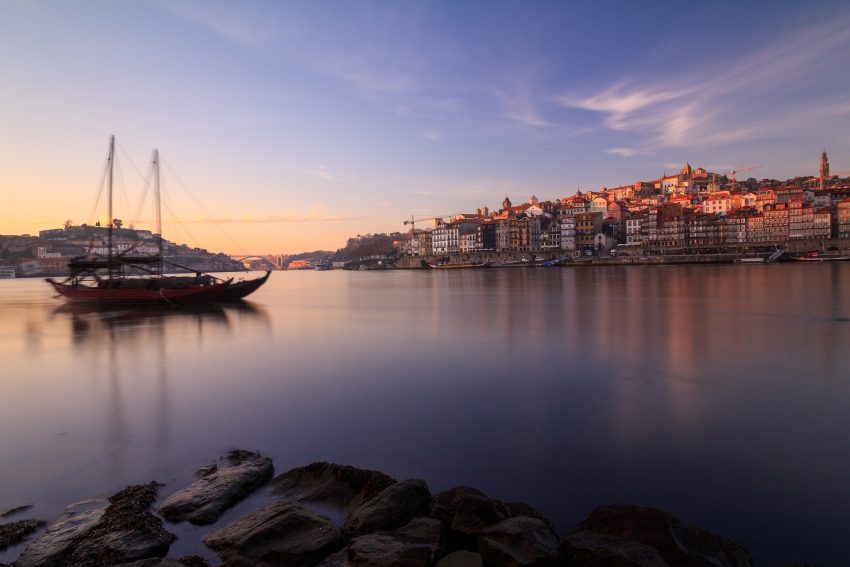
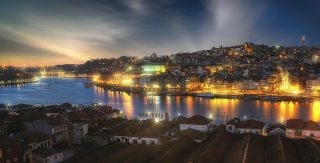
View of Porto from Vila Nova de Gaia

Porto sits in northern Portugal, straddling the Douro River near the Atlantic coast, and it's a compact, walkable city that rewards slow exploration. The headline experience is the riverside: you can spend hours moving between viewpoints, tiled streets, and cafés with Douro-front terraces, with ever-changing angles of the bridges and waterfront. Porto is one of the best places to visit in Portugal

For first-time visitors, it helps to think of Porto in layers: the historic core around São Bento and Clérigos for classic sights and easy wandering, the Ribeira waterfront for postcard scenery, and Vila Nova de Gaia (across the river) for cellar visits and tastings. Porto is also a strong “neighbourhood city” where the highlights are often simple: a market lunch, a sunset miradouro, a short cruise on the Douro, and a long evening of petiscos and local wine.

Logistically, Porto is straightforward to plan: two to three full days covers the essentials, and you can add time for beach breaks in Foz do Douro or a day trip into the Douro Valley. Expect hills and cobbles, so comfortable shoes matter, and using the metro/trams or ride-hails can save energy between viewpoints. Spring and early autumn are typically the easiest seasons for weather and crowds, while summer brings the liveliest atmosphere and the busiest riverfront.

TIP: If you are visiting Porto for just a day and want to make the most of your visit, you may want to consider taking a walking tour with a local guide. This is one of the most complete and best-rated city tours that covers the main, must-see attractions in about 3 hours. If you prefer exploring at your own pace read our Self Guided Walking Tour of Porto (with Maps!).

History of Porto

Early Origins of Porto

The history of Porto stretches back more than two millennia, with its roots entwined in the earliest settlements of the Iberian Peninsula. The area was first inhabited by the Celtic tribe known as the Bracari, and later became an important Roman outpost known as Portus Cale. This name would eventually inspire the name of the entire country — Portugal. During the Roman era, Porto flourished as a strategic trading port along the Douro River, serving as a key stop for merchants transporting goods inland and to the Atlantic. Remnants of ancient Roman roads and fortifications still whisper the city’s beginnings as a bustling commercial hub.

Following the collapse of the Roman Empire, Porto passed through the hands of various powers, including the Suebi and the Visigoths. Each left their mark on the settlement’s structure and governance, establishing Porto’s enduring reputation as a resilient, autonomous city that thrived even in uncertain times.

Porto in the Middle Ages

The medieval era marked Porto’s rise as one of the most influential cities in the region. In the 8th century, the Moors conquered the area, though Christian forces would soon reclaim it as part of the broader Reconquista. In 868, Count Vímara Peres — a nobleman under the Kingdom of Asturias — reconquered and refounded the city, establishing the County of Portucale, which would later form the nucleus of the Kingdom of Portugal.

By the 12th century, Porto had become a thriving urban center, its economy bolstered by shipbuilding, trade, and agriculture. The construction of the Sé Cathedral began during this period, symbolizing both religious devotion and political strength. The citizens of Porto, known for their independence and enterprise, supported Portugal’s first king, Afonso I, in the struggle for national sovereignty. Their loyalty to the crown would earn them a reputation for courage and patriotism — a defining characteristic that endures in local identity.

Porto in the Age of Discovery

The 15th and 16th centuries heralded an era of expansion and maritime glory. Porto played a crucial role in the Age of Discovery, contributing ships, supplies, and sailors to Portugal’s global expeditions. The shipyards of Ribeira were among the busiest in the country, building vessels that ventured to Africa, Asia, and the Americas.

Porto’s residents developed a strong mercantile spirit, trading in wine, textiles, and salted cod (bacalhau), which became key exports. During this period, the city also earned its nickname “Cidade Invicta” — the Unvanquished City — for its resilience in the face of political and military upheaval. The wealth generated from overseas trade funded magnificent churches and monasteries, such as São Francisco Church and the Clérigos Tower, both of which remain architectural jewels.

Porto in the 18th and 19th Centuries

By the 18th century, Porto had transformed into the heart of the Port wine trade. The vineyards of the Douro Valley sent their barrels downriver to be aged and shipped from Porto’s cellars, particularly in Vila Nova de Gaia, just across the river. British merchants, attracted by trade agreements such as the Methuen Treaty (1703), established long-lasting partnerships with local producers. This Anglo-Portuguese collaboration gave birth to the global fame of Port wine, cementing Porto’s identity as a city of craftsmanship and commerce.

The 19th century was a time of revolution and modernization. Porto became a center of liberal thought during the Liberal Wars (1828–1834), standing firmly against absolutist forces. The people of Porto endured a year-long siege but ultimately triumphed, reinforcing their city’s “unvanquished” reputation. The industrial age brought new infrastructure — including the Dom Luís I Bridge, designed by a disciple of Gustave Eiffel — linking Porto and Gaia with both engineering brilliance and symbolic unity.

Modern Porto and the 20th Century

The 20th century ushered in rapid urbanization, political change, and cultural revival. Porto became known not only as an economic powerhouse but also as a center of art, literature, and architecture. Despite hardships during the dictatorship years, the city retained its spirit of independence and innovation. After the Carnation Revolution of 1974, Porto flourished anew, embracing democratic freedoms and reinvesting in its urban landscape.

The historic center of Porto, with its winding medieval streets and colorful riverfront façades, was declared a UNESCO World Heritage Site in 1996, recognizing its cultural and architectural importance. In the decades since, Porto has evolved into a vibrant modern city while preserving its deep historical soul — a rare balance between progress and preservation that continues to define it today.

Porto in the 21st Century

In the 21st century, Porto has emerged as one of Europe’s most dynamic and creative cities. Once known primarily for its wine, it is now celebrated for its design, gastronomy, and contemporary art. Major restoration projects have revitalized the Ribeira District, while modern architecture — such as the Casa da Música — stands alongside Romanesque cathedrals and Baroque towers.

Porto’s commitment to innovation and culture earned it the title of European Best Destination multiple times, yet it remains distinctly authentic. Its history — shaped by trade, resilience, and a deep sense of identity — continues to inform the character of its people and the beauty of its streets. From its ancient origins to its modern vibrancy, Porto’s story is one of continuity and pride — a city forever unvanquished, and always alive.

Moira & Andy
Moira & Andy

Hey! We're Moira & Andy. From hiking the Camino to trips around Europe in Bert our campervan — we've been traveling together since retirement in 2020!

Read our full story here

Visiting Porto for the first time and wondering what are the top places to see in the city? In this complete guide, I share the best things to do in Porto on the first visit. To help you plan your trip, I have also included an interactive map and practical tips for visiting!

This website uses affiliate links which earn a small commission at no additional cost to you.

Powered by GetYourGuide

37 Best places to See in Porto

This complete guide to Porto not only tells you about the very best sights and tourist attractions for first-time visitors to the city but also provide insights into a few of our personal favorite things to do.

This is a practical guide to visiting the best places to see in Porto and is filled with tips and info that should answer all your questions!

1. Praça da Liberdade
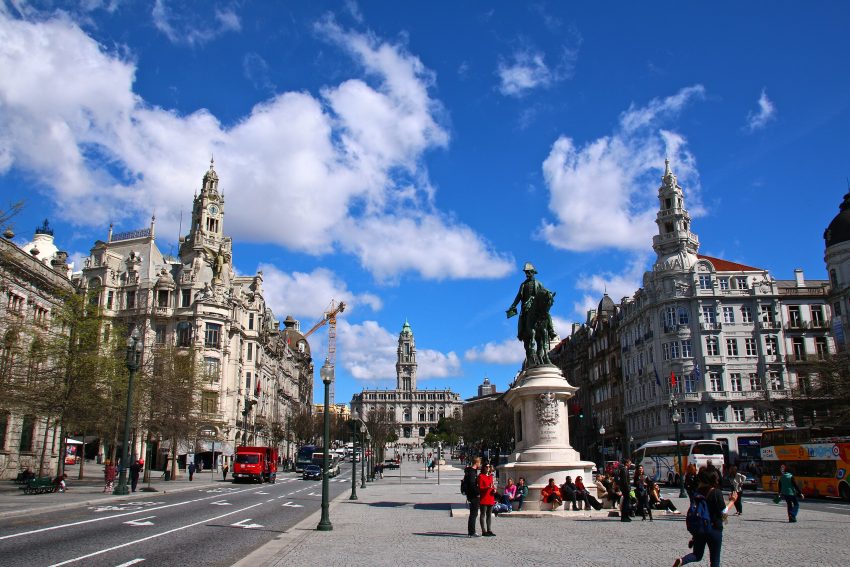
Praca da Liberdade Porto
CC BY-SA 2.0 / Alain Rouiller
Praça da Liberdade is Porto’s central downtown square, a broad open space that works like a crossroads between the older core and the newer avenues. Its present form grew from plans in the late 1600s and early 1700s, taking shape after land outside the Fernandine Walls was granted in 1718 as new streets reorganized movement through the city. The name “Liberdade” was adopted in the early 20th century, tied to the republican era, and the square long served as a civic stage—Porto’s Town Hall operated here in the 19th and early 20th centuries. Visitors mostly remember the sense of scale, the formal façades and balconies around the edges, and the steady flow of commuters, shoppers, and café-goers cutting across it.
Location: Praça da Liberdade, Porto, Portugal | Hours: Always open. | Price: Free. | Distance: 0.1km

We recommend to rent a car in Portugal through Discover Cars, they compare prices and review multiple car rental agencies. Book your rental car here.

2. São Bento Railway Station

Sao Bento Station
Sao Bento Station
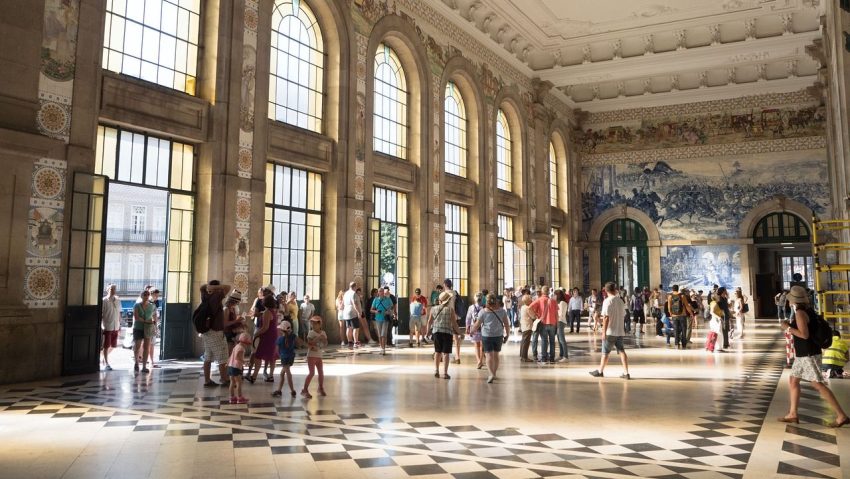
São Bento Railway Station is Porto’s early-20th-century terminus, built on the site of a former Benedictine convent and inaugurated in 1916. The restrained façade gives little warning of the main hall, where vast azulejo murals wrap the walls like a tiled panorama. Designed by architect José Marques da Silva and painted by Jorge Colaço, the panels—around 20,000 tiles—mix blue-and-white scenes of battles and royal moments with lower bands in colour showing markets, processions, and harvest work. Under the big clock and high windows, announcements echo as commuters and travelers pause to read the images, turning a busy station into an everyday gallery.
Location: São Bento Station, Praça de Almeida Garrett, Porto, Portugal | Hours: The station operates daily with long hours aligned to train timetables; the main hall is generally accessible from early morning until late evening. | Price: Free entry; São Bento is a working station and you do not need a ticket to enjoy the main hall. | Distance: 0.2km

Here is a complete selection of hotel options in Porto. Feel free to review each one and choose the stay that best suits your needs.

3. Livraria Lello & Irmão

The Livraria Lello
The Livraria Lello
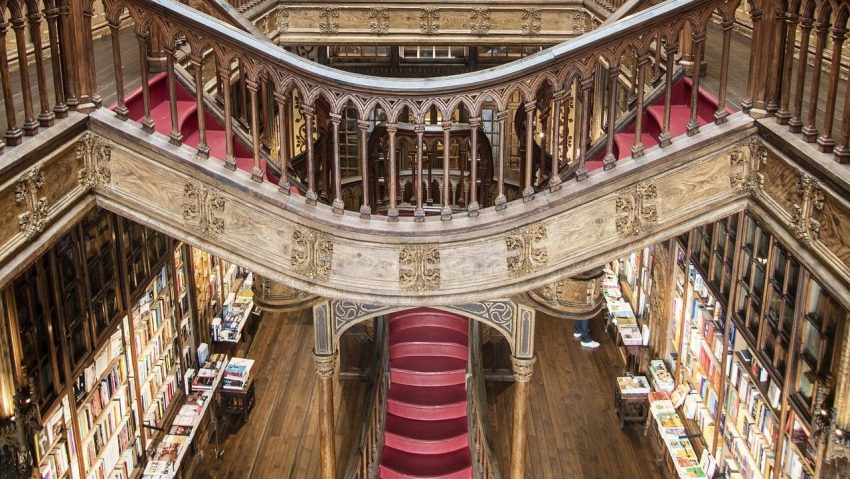
Livraria Lello & Irmão is a historic bookshop in central Porto that now functions as much as an interior experience as a place to buy books. Inside, visitors remember the theatrical, vertically layered space: carved woodwork, a stained-glass ceiling, and a sweeping red staircase that pulls the eye upward. The rooms are narrow and the flow is choreographed by timed entry, so it can feel closer to a museum visit than quiet browsing, with many people pausing for photos. A loop upstairs along the balconies changes the perspective and reveals details you miss at ground level. The shelves lean toward popular and souvenir-friendly titles, but the architecture is the real takeaway.
Location: Livraria Lello, Rua das Carmelitas, Porto, Portugal | Hours: Daily 09:00–19:00 | Price: Entrance fee: €10.00 | Website | Distance: 0.3km

Traveling to a country with a different currency? Avoid ATM transaction fees and pay in local currency with a Wise Card. Having used it for over 5 years, we've saved loads on fees!

Powered by GetYourGuide

4. Mercado do Bolhão

Mercado do Bolhao
Mercado do Bolhao
CC BY-SA 3.0 / António Amen
Mercado do Bolhão is Porto’s central, working market hall, where the city’s daily rhythms play out amid food, voices, and clattering deliveries. The neoclassical building wraps two airy levels around an open courtyard, with cast-iron details, tall arcades, and galleries that let you look down over the stalls. Downstairs you’ll find fruit and vegetables, fishmongers, butchers, and florists; upstairs, small shops lean into cheeses, spices, tinned fish, wines, and traditional sweets. Four main entrances spill directly onto surrounding shopping streets, so it’s easy to drift in, loop the balconies, and re-emerge. Reviews often mention the spotless restoration and the temptation of samples.
Location: Mercado do Bolhão, Rua Formosa, Porto, Portugal | Hours: Monday to Friday: 8 am to 8 pm; Saturdays: 8 am to 6 pm; Sundays: Closed | Price: Free | Website | Distance: 0.3km

Where to Stay in Porto: An Area by Area Guide!

5. Church of Saint Ildefonso

Church of Saint Ildefonso
CC BY-SA 2.0 / Nicolas Vollmer
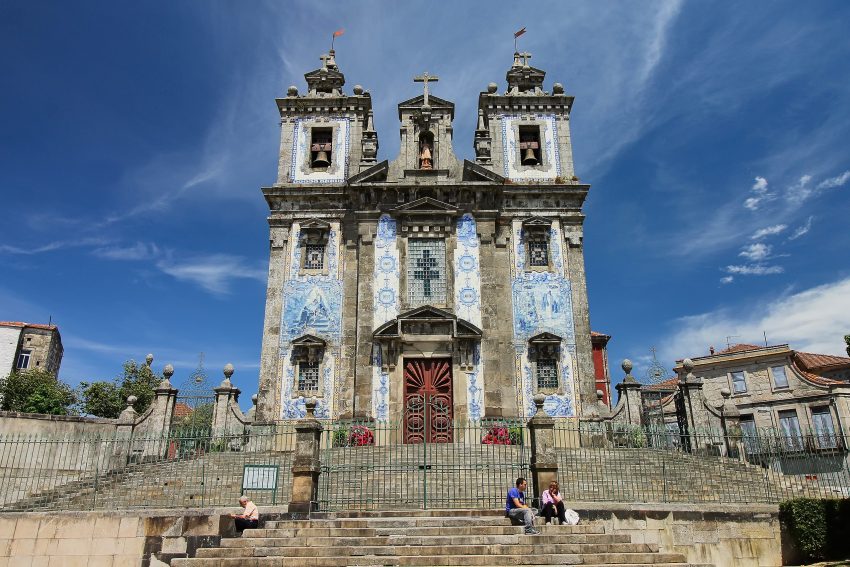
The Church of Saint Ildefonso in Porto is an 18th-century Baroque parish church on Praça da Batalha, best known for a façade wrapped in blue-and-white azulejo panels that read like a street-scale mural. Twin bell towers, carved stonework, and a broad staircase give the entrance a slightly theatrical presence in the middle of everyday city bustle. Step inside and the mood turns quieter and warmer, with gilded altar details and devotional imagery in a relatively compact space. Travelers often linger outside to study the tile scenes from different angles, then pop in briefly—entry is typically about €1, and the interior feels peaceful compared with the lively square.
Location: Church of Saint Ildefonso, Batalha Square, Porto, Portugal | Hours: Varies due to services and church activities. | Price: Free (donations appreciated) | Distance: 0.4km

Click here to read our blog about Which Six Bridges Cruise in Porto Should You Take in 2026?

6. Carmo Church and Carmelitas Church

Carmo and Carmelitas churches
CC BY-SA 4.0 / Krzysztof Golik
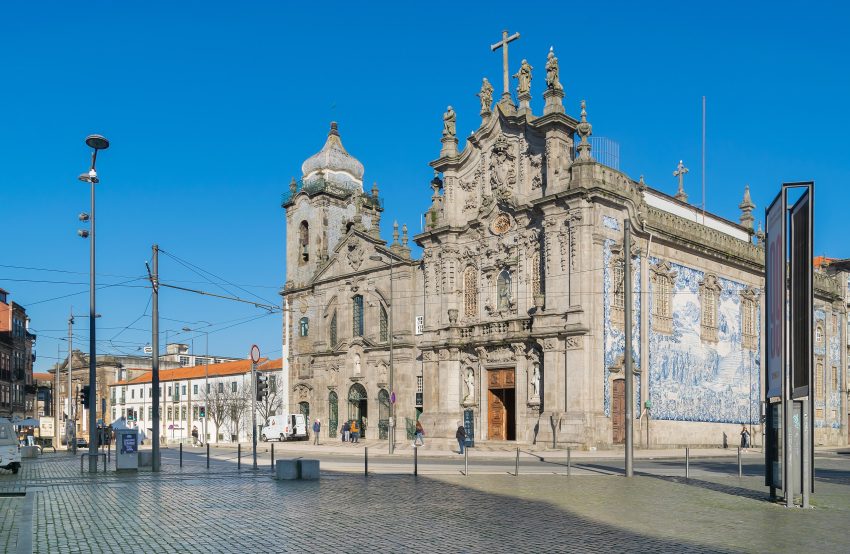
Carmo Church and the adjacent Carmelitas Church form a distinctive pair in central Porto, separated by a famously thin house that you notice only once you’re right in front of it. Carmo delivers the full 18th‑century Baroque effect—carved altarpieces, heavy gilding, and a theatrical interior—while Carmelitas feels calmer and more restrained, making the contrast immediate as you step between them. Outside, Carmo’s large blue-and-white azulejo panel reads like a narrative scene rather than simple patterning. Visitors also remember the unusual interior viewpoints, including balcony levels and, with a ticket, access up to narrow upper passages and roof areas.
Location: Igreja do Carmo, Rua do Carmo, Porto, Portugal | Hours: Monday to Friday: 07:15 to 19:00; Saturdays, sundays and holidays from 9:00 to 18:45. | Price: Adults: €5.00 | Distance: 0.4km

Click here to read our blog about Guide to Port Wine Cellars in Porto 2026: Tours, Tastings & Tips

7. Clérigos Church and Clérigos Tower

Torre dos Clerigos
Torre dos Clerigos
CC BY-SA 2.0 / jfcfar
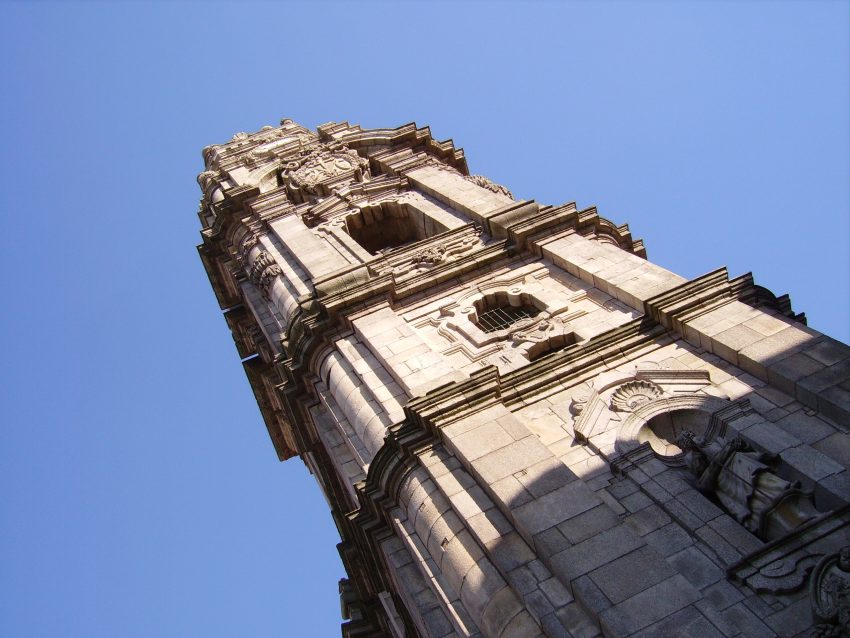
Clérigos Church and Clérigos Tower are an 18th-century Baroque church-and-bell-tower ensemble in Porto, designed by Italian architect Nicolau Nasoni for the Clergy Brotherhood and still defining the city’s skyline. The church’s unusual elliptical nave leads your eye to a polychromed marble altarpiece, with ornate side chapels and dramatic stonework. Behind it rises the 75-metre Torre dos Clérigos, once among Portugal’s tallest structures and a landmark for arrivals along the Douro. Entry typically routes you through small museum floors of religious objects before a tight climb of about 240 steps to the viewing platform, where terracotta roofs and the river spread out below. Expect narrow stair passages and big views even on grey days.
Location: Torre dos Clérigos, Rua de São Filipe de Nery, Porto, Portugal | Hours: Daily: 09:00 to 19:00 | Price: Church: Free entrance. Tower and Museum of the Brotherhood: Tower €5.00; Tower and Museum €10.00 | Website | Torre dos Clerigos Entrance Ticket | Distance: 0.4km

Explore Porto at your own pace with our self-guided walking tour! Follow our curated route to discover must-see sights and local secrets that makes Porto one of the best places to visit in Portugal.

Powered by GetYourGuide

8. Capela das Almas

Capela das Almas Porto
CC BY-SA 3.0 / Petr Adam Dohnálek
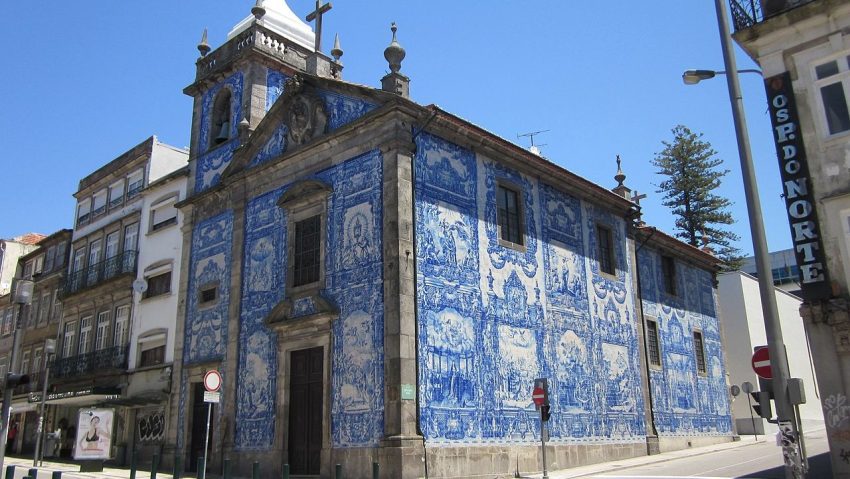
Capela das Almas (Chapel of Souls) is a small downtown chapel on Rua de Santa Catarina in Porto, known less for its late-18th-century structure than for the azulejo skin added in 1929. Thousands of blue-and-white tiles wrap two exterior walls, turning the street corner into a readable sequence of scenes from Saint Francis of Assisi and Saint Catherine. Up close, visitors notice the crisp borders and figure work; from across the street, the full façade clicks into view against the bustle of shoppers and cafés. When open, the interior feels surprisingly intimate and quiet compared with the busy sidewalk outside, making a brief stop feel genuinely devotional rather than staged.
Location: Capela das Almas, Rua de Santa Catarina, Porto, Portugal | Hours: Monday to Friday: 07:30 – 17:30; Saturday and Sunday 07:30 – 12:30 | Price: Free | Website | Distance: 0.5km

Click here to read our blog about Exploring the Douro Valley 2026: All You Need to Know

9. Porto Cathedral

Porto Cathedral
Porto Cathedral
CC BY-SA 4.0 / Alvesgaspar
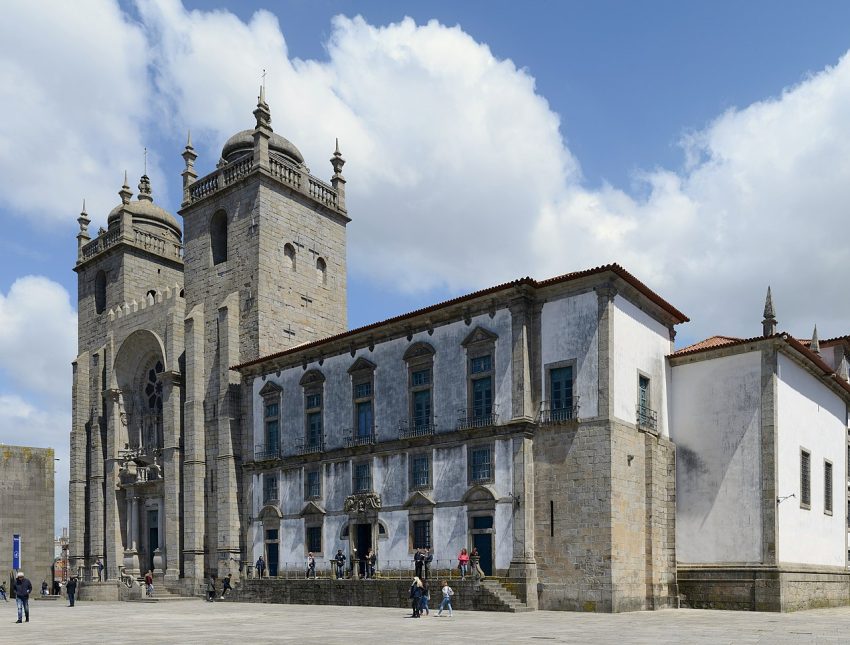
Porto Cathedral (Sé do Porto) crowns the highest ground of Porto’s old town, its crenellated granite façade and twin towers reading more like a fortress than a church—an echo of its 12th-century defensive role. From Terreiro da Sé, the city drops away in a wide view of orange rooftops and the Douro below. Inside, the mood shifts between a spare Romanesque nave with barrel vaults and later chapels and altars that gleam with Baroque gilding. A doorway leads to the 14th-century Gothic cloister, where pointed arches frame blue-and-white azulejo panels illustrating biblical scenes. Many visitors linger here and on the terrace, where the quiet and the panorama stay with you.
Location: Porto Cathedral, Terreiro da Sé, Porto, Portugal | Hours: Summer: 9:00- 18:30; Winter: 9:00- 17:30 | Price: Cathedral: Free entrance. Cloisters €3 | Website | Distance: 0.6km

10. Muralhas de D. Fernando
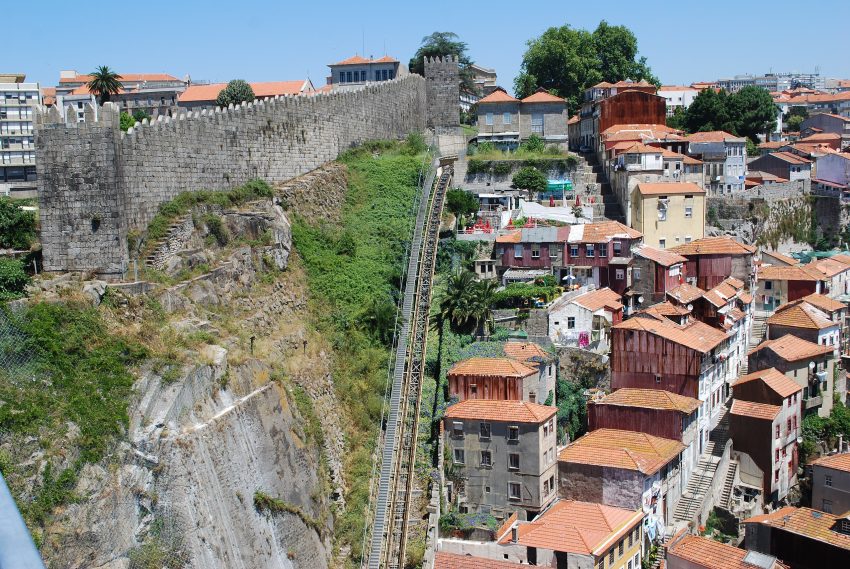
Porto   Muralhas Fernandinas e funicular
Porto Muralhas Fernandinas e funicular
CC BY-SA 3.0 / Concierge.2C
Muralhas de D. Fernando are surviving fragments of Porto’s 14th‑century defensive ring, built as the city expanded beyond earlier Roman-era walls and completed under King Fernando I. Rather than one continuous monument, you encounter the fortifications in sudden bursts—an old gate, a tower, a long run of stone—woven into today’s streets near the historic center. Look for the Postigo do Carvão, the last remaining city gate, once used for supplies like coal, and the Torre do Barredo, which still feels embedded in the riverside neighborhood. The most dramatic stretch is the Trecho dos Guindais, running near Santa Clara toward the Dom Luís I Bridge, where the walls read clearly against steep slopes and river views.
Location: Muralha Fernandina, Escadas do Caminho Novo, Porto, Portugal | Hours: Always open (outdoor public areas). | Price: Free. | Distance: 0.7km

11. Casa do Infante
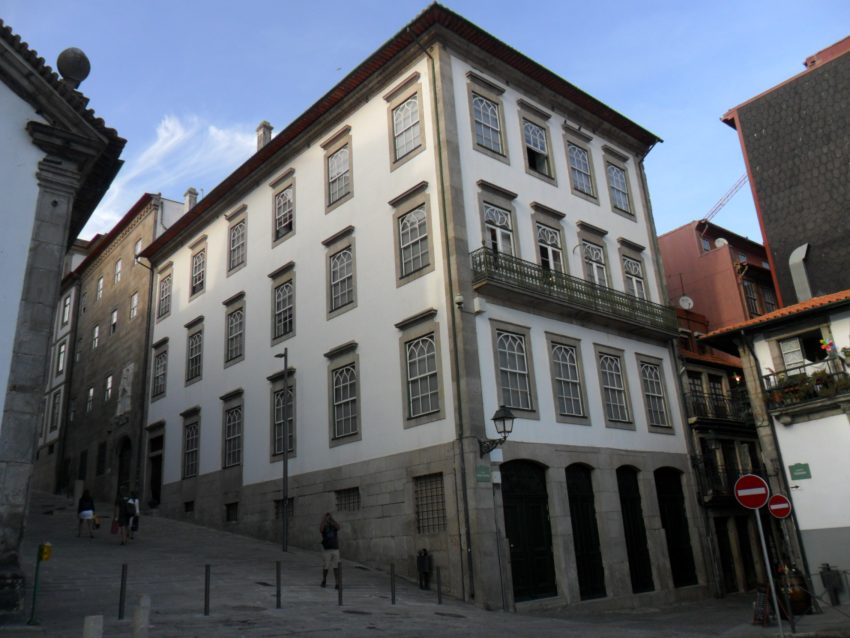
Casa do Infante
Casa do Infante
CC BY-SA 3.0 / Dafema
Casa do Infante in Porto, Portugal is a small museum and municipal archive set in a riverside building long tied to the city’s working relationship with the Douro. Traditionally associated with the birth of Prince Henry the Navigator, it’s more memorable for how it traces Porto through trade and administration, including the site’s past as a customs house. Inside, visitors move through layered spaces where maps, records, and archaeology sit alongside earlier remains—some displays even reach back to Roman-era traces noted by visitors. The experience feels compact and tactile: you notice changes in floor levels, stonework, and the way the building itself becomes part of the story.
Location: Casa do Infante, Rua da Alfândega, Porto, Portugal | Hours: Tuesday–Sunday 10:00–17:30 (closed Mondays). | Price: Adults: €4.00 (free entry on Sundays). | Website | Distance: 0.8km

12. Funicular dos Guindais
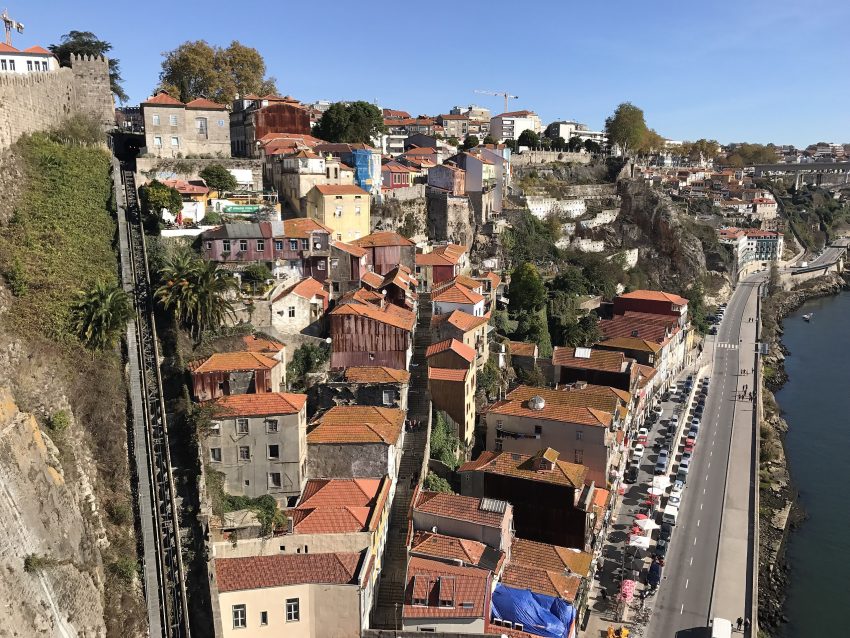
Funicular dos Guindais
CC BY-SA 4.0 / -wuppertaler
Funicular dos Guindais is a short hillside railway in Porto that links the Ribeira riverfront with the higher streets near the cathedral side, turning a tough climb into a quick transition. The line runs on a 281‑meter track that rises about 61 meters, with a steep maximum gradient around 36%, so the sensation of tilting up above the rooftops is part of the fun. Through the front windows you catch shifting views of the Douro and the Dom Luís I Bridge as the angle opens mid-ride. Rebuilt and reopened in the early 2000s along a 19th‑century route, it’s both practical transport and a small, memorable viewpoint on rails.
Location: Funicular dos Guindais, Rua da Ribeira Negra, Porto, Portugal | Hours: Winter: Monday to Friday: 08:00 - 20:00; Saturday to Sundey 08:00 - 00:00; Summer: Monday to Friday: 08:00 - 22:00; Saturday to Sundey 08:00 - 00:00 | Price: Adults: €3.50 | Distance: 0.8km

13. Praça da Ribeira
Porto Praca da Ribeira
CC BY-SA 2.0 / Marco Varisco
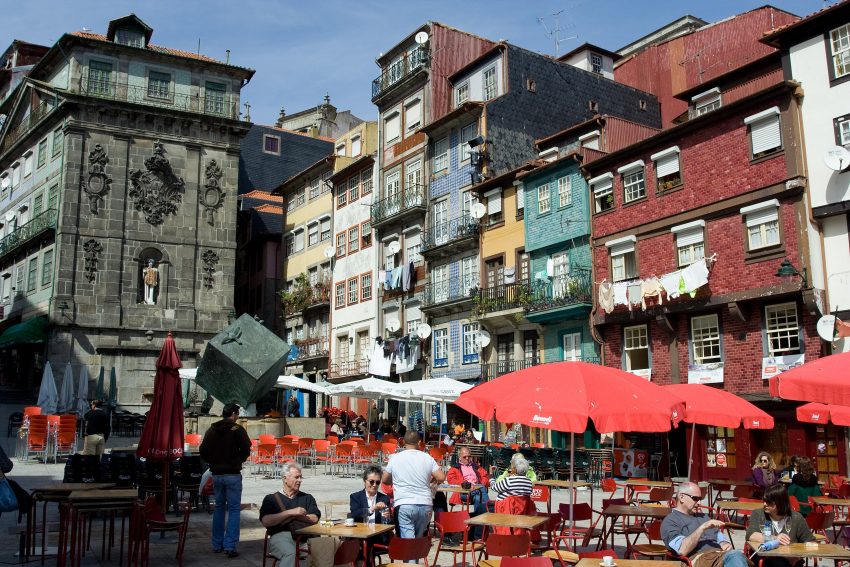
Praça da Ribeira is Porto’s riverside square where the city’s old lanes spill out to the Douro, framed by stacked stone buildings and colorful façades. Once a working gateway for river trade, it became more open to the water after the medieval walls along the river edge were removed in the early 19th century, giving it today’s broad, river-facing feel. Arcaded buildings still shape the space, and a cube sculpture sits at its center as people drift between terraces and the promenade. What visitors remember is the constant hum—street performers, café chatter, and the shifting light on stone and water from bright daytime bustle to evening glow.
Location: Praça da Ribeira, Porto, Portugal | Hours: 24 hours | Price: Free entry. | Distance: 0.8km

14. Casa do Infante
Casa do InfantePorto
CC BY-SA 3.0 / Dafema
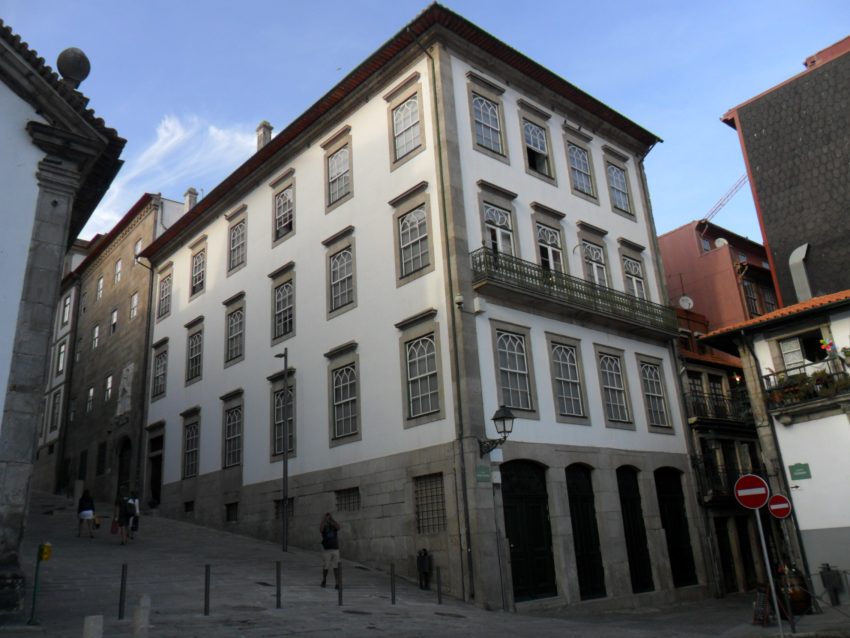
Casa do Infante is a small archaeological museum in Porto’s Ribeira, set inside a former medieval customs house and mint tied to the city’s river trade. Tradition places the birth of Prince Henry the Navigator here in 1394, linking the building to Portugal’s age of Atlantic expansion. What visitors remember is the layered, below-street feel: you walk through structural traces from different rebuilds and pause over preserved details such as mosaic floors. The displays focus on the practical mechanics of port life—taxation, goods, and administration—rather than grand rooms, so it reads like a compact time capsule. Reviews often describe it as a “nice little museum,” rewarding if you slow down and read.
Location: Casa do Infante, Rua da Alfândega, Porto, Portugal | Hours: Tuesday - Sunday: 10:00 – 17:30 | Price: Adults: €4.00 | Website | Distance: 0.8km

15. Church of São Francisco

Church of Sao Francisco Porto
CC BY-SA 2.0 / Marcello Saponaro
Church of São Francisco is a medieval Franciscan church in Porto, whose plain Gothic exterior hides an interior that feels startlingly different once you step through the doors. Built on foundations tied to a Franciscan community established around 1223 and completed in its larger form by about 1425, it later gained an 18th-century Baroque skin of Portuguese gilt woodwork that covers columns, altarpieces, and chapels in dense, gold-lit carving. Visitors tend to remember the near-immersive effect—like walking into a glittering box—especially as the light catches the relief details. Below, the museum areas and catacombs add a darker counterpoint to all that gold.
Location: Church of São Francisco, Rua do Infante Dom Henrique, Porto, Portugal | Hours: Summer: 9:00 to 20:00; Winter: 9:00 to 19:00 | Price: Adults: €7.50 | Website | Distance: 0.8km

16. Palácio da Bolsa

Palacio da Bolsa in Porto
CC BY-SA 2.0 / Chris Amies
Palácio da Bolsa in Porto, Portugal is a 19th-century neoclassical Stock Exchange Palace built by the city’s Commercial Association on the site of a former convent, a statement of Porto’s trading power. Its restrained façade opens into an unexpectedly opulent sequence of interiors where marble, gilding, sculpture, and stained glass take over. Visitors tend to remember the glass-roofed Pátio das Nações, ringed with coats of arms of trading partners, and the monumental twin-flight staircase that glows in soft natural light. The finale is the Salão Árabe, a Moorish-inspired hall dense with geometric ornament and gold-toned stucco, still used for formal receptions. The building remains the Commercial Association’s headquarters and has been a National Monument since 1982.
Location: Palácio da Bolsa, Rua de Ferreira Borges, Porto, Portugal | Hours: Daily: 9:00 – 18:30 | Price: Adults: €14.00 | Website | Distance: 0.8km

17. Soares dos Reis National Museum
Museu Nacional de Soares dos Reis
CC BY-SA 3.0 / António Amen
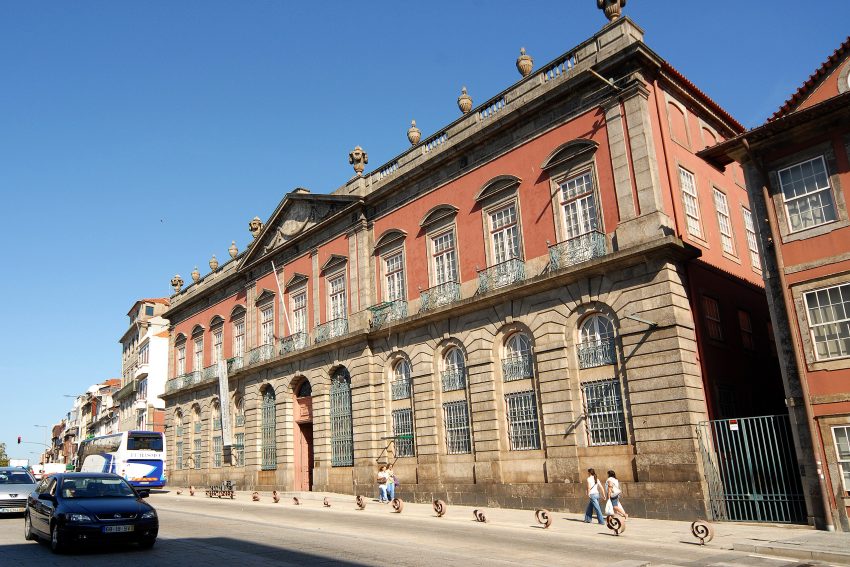
Soares dos Reis National Museum is Porto’s main fine-arts museum, set inside the Carrancas Palace, where period rooms lend the collection a quiet, domestic scale. Founded in 1833 as the Museu Portuense, it began by preserving works displaced by political and religious upheavals, then expanded through 19th-century acquisitions and donations. In 1911, a major group tied to sculptor António Soares dos Reis reshaped the museum’s identity, and the move to this palace in 1942 added a sense of continuity between art and architecture. Visitors tend to remember the flow between Portuguese painting, sculpture, and decorative arts, and the way the calmer galleries invite lingering with individual pieces.
Location: Soares dos Reis National Museum, Rua de Dom Manuel II, Porto, Portugal | Hours: Tuesday to Sunday: 10:00 to 18:00 | Price: Adults: €10.00 | Website | Distance: 0.9km

18. Dom Luís I Bridge
Dom Luis I Bridge Porto
CC BY-SA 2.0 / Travelholic Path
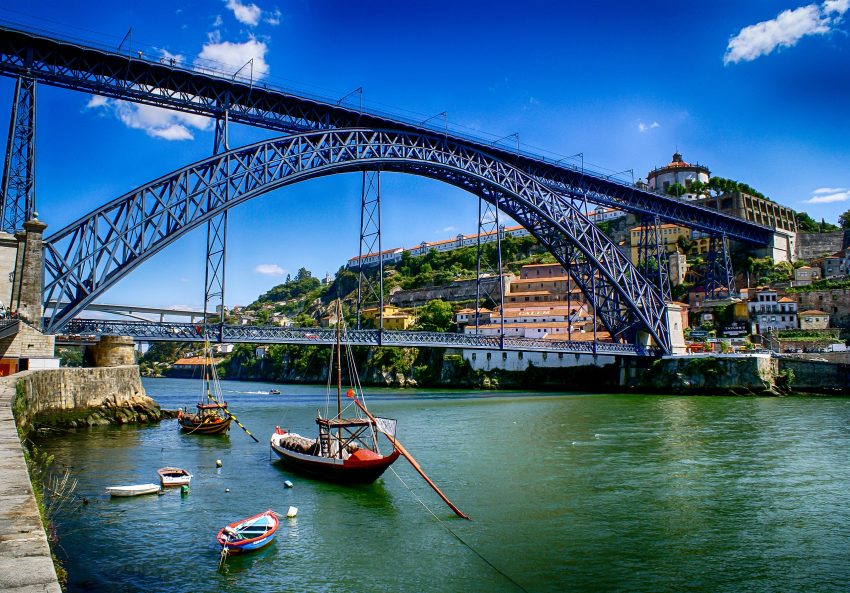
Dom Luís I Bridge is a late-19th-century double-deck iron arch spanning the Douro River between Porto and Vila Nova de Gaia, built from 1881 to 1886 to strengthen the city’s cross-river link. Designed by Belgian engineer Théophile Seyrig, its latticework frames a steep, layered skyline: Ribeira’s rooftops climbing toward the cathedral ridge on one side, Gaia’s slopes on the other. Walking the upper level feels airy and panoramic, while the lower deck keeps you close to the river’s noise and movement, making the same crossing feel like two different scenes. From mid-span, the water opens wide beneath your feet, and the bridge’s silhouette reads as pure engineering confidence—still used day and night, often crowded with cameras and passing trains.
Location: Luís I Bridge, Ponte Luiz I, Porto, Portugal | Hours: 24 hours | Price: Free | Distance: 0.9km

19. Museu dos Transportes e Comunicações

Alfandega Nova
Alfandega Nova
CC BY-SA 3.0 / Mister No
Housed in Porto’s 19th-century Alfândega Nova customs house on the Douro’s right bank, the Museu dos Transportes e Comunicações links the city’s river trade past with stories of movement and state life. The building’s grand neoclassical scale still reads like a working port facility, and exhibits often explain how customs once operated in these rooms. Many visitors remember the collection of Portuguese presidential cars—meticulously restored, with imposing limousines and small design details that signal changing ideas of power and security. Look, too, for the Ribeira Negra panel by Júlio Resende, which pulls the experience back toward Porto’s riverside labor memory. Reviews often note the low entry price and the pleasure of simply lingering among the vehicles.
Location: Museu dos Transportes e Comunicações, Rua Nova da Alfândega, Porto, Portugal | Hours: Tue–Fri 10:00–13:00 and 14:00–18:00 (last entry 17:00). Sat, Sun & public holidays 15:00–19:00 (last entry 18:00). Closed Mondays and on select holidays. | Price: Adults: €7.50 (full museum ticket). | Website | Distance: 1km

20. Ponte do Infante

Ponte do Infante   Porto
Ponte do Infante Porto
Public Domain / Joseolgon
Ponte do Infante is a modern cable-stayed bridge spanning the Douro between Porto and Vila Nova de Gaia, opened in 2003 to ease pressure on older crossings. Its pared-back, contemporary line stands out among the nearby iron bridges, adding a newer layer to the riverfront skyline. Walking across feels noticeably calmer than the busiest bridges, and the midspan pause delivers wide views of Porto’s stacked riverside buildings and Gaia’s sloping terraces. The bridge is named for Infante Dom Henrique (Henry the Navigator), linking its 21st-century engineering to Portugal’s Age of Discovery. From the water, its clean profile is a distinctive note on Six Bridges cruises.
Location: Ponte do Infante, Porto, Portugal | Hours: 24 Hours | Price: Free. | Distance: 1.1km

21. Espaço Porto Cruz
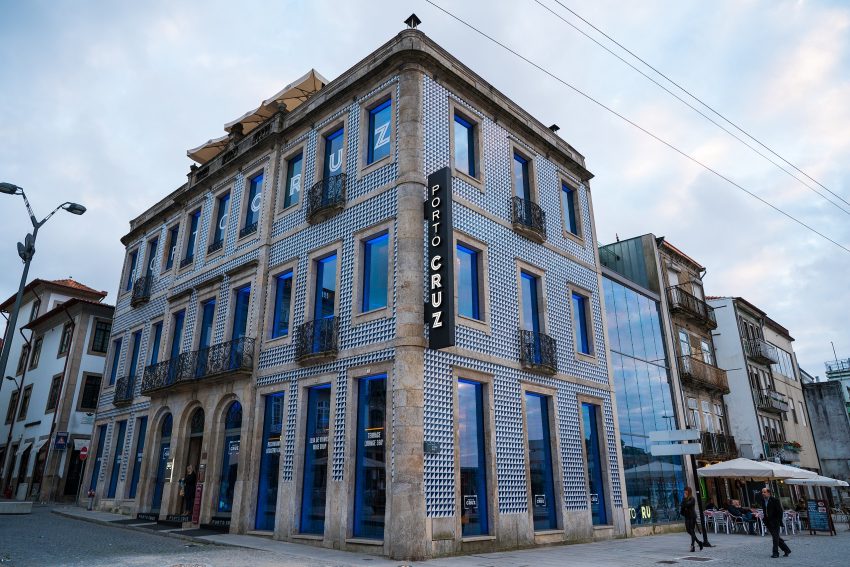
Visitng Espaco Porto Cruz
CC BY-SA 2.0 / Nan Palmero
Espaço Porto Cruz in Porto, Portugal is a contemporary Port-wine venue on the Vila Nova de Gaia riverfront that treats tasting as a cultural experience, mixing design-led spaces with multimedia, interactive exhibits. Instead of a barrel-focused cellar visit, you move through modern displays and can book themed tastings that pair Port with chocolate or cheese to sharpen what you notice in the glass. Many visitors remember the rooftop terrace most: take your drink upstairs and watch the Douro bend below, with Ribeira’s stacked façades and bridge lines filling the view. Reviews often mention sunset atmosphere, Port-based cocktails, and small complimentary snacks served with drinks.
Location: Espaço Porto Cruz, Largo Miguel Bombarda, Vila Nova de Gaia, Portugal | Hours: Tuesday to Saturday – 12:30 PM to 12:00 AM Sunday – 12:30 PM to 7:00 PM | Price: Varies by experience (exhibition access, tastings, and workshops); check the official website for current prices in euros. | Website | Distance: 1.1km

22. Sandeman Wine Cellar
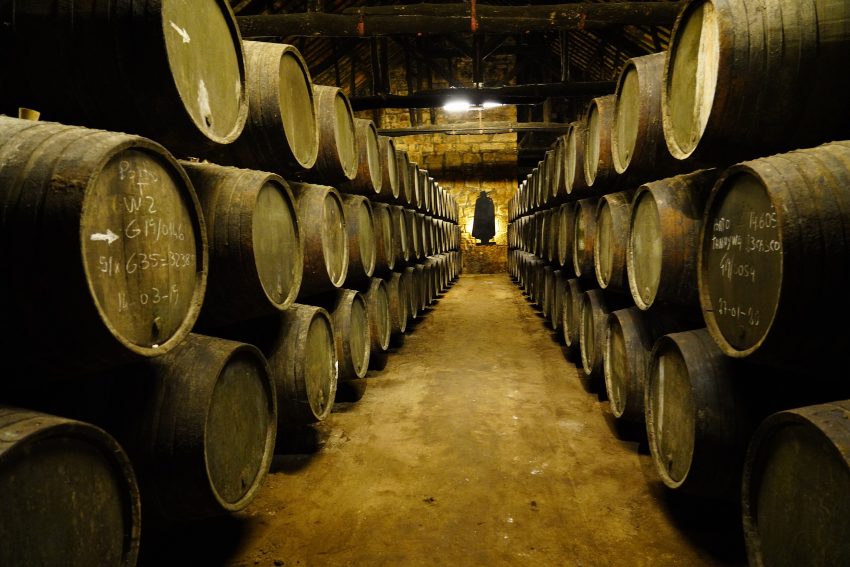
Sandeman Wine cellar
CC BY-SA 2.0 / Ray Swi-hymn
Sandeman Wine Cellar is a port lodge in Vila Nova de Gaia where you walk through cool, dim maturation rooms lined with long rows of barrels, making the scale of aging and blending feel tangible. Founded in the late 18th century, it reflects the era when port houses built international reputations, and its black-caped “Don” emblem shows how strongly branding shaped that trade. The visit focuses on the basics of what makes port distinct and how wood time changes color and flavor, especially the contrast between ruby fruitiness and tawny nut-and-caramel notes. Visitors often remember the atmospheric cellar interiors and a structured tasting that makes the main styles easy to compare.
Location: Sandeman, Largo Miguel Bombarda, Vila Nova de Gaia, Portugal | Hours: Offered daily, 10:00 am – 6:00 pm in multiple languages. | Price: Tours and port tastings start at €22 and range from 3 to 5 port wines. | Website | Distance: 1.1km

23. Calém Wine Cellars

Calem Wine Cellars
Calem Wine Cellars
CC BY-SA 4.0 / Daniel VILLAFRUELA.
Calém Wine Cellars is a port wine lodge on the Vila Nova de Gaia riverfront, where barrels age in the cool, dim spaces that made the south bank central to the trade. Founded in the 19th century, it makes the idea of time in port tangible: long rows of casks, a steady cellar atmosphere, and the practical scale behind blending and consistency. The visit moves between traditional barrel rooms and brighter, museum-like sections that explain production in plain terms. Tastings are designed for comparison—notice how tawny shows more oak and oxidation while ruby reads fresher and fruit-driven. Stepping back outside, the Douro and Porto’s skyline keep the experience rooted in place.
Location: Caves Cálem, Avenida de Diogo Leite, Vila Nova de Gaia, Portugal | Hours: Daily from 10:00 - 17:30 | Price: Adults: From €20 | Website | Distance: 1.1km
Powered by GetYourGuide

24. Jardim do Morro

Jardim do Morro and Monastery of Serra do Pilar
CC BY-SA 4.0 / CivArmy
Jardim do Morro is a hillside garden viewpoint on the Vila Nova de Gaia side of the Douro, looking straight across to Porto’s Ribeira rooftops and the steel span of the Dom Luís I Bridge. The experience is all about the wide, cinematic sweep: the river curve below, the old city rising behind it, and the bridge stitching both banks together in one frame. At golden hour the grass slope fills with people who come to linger, often with music in the background, as the light shifts from warm tones to dusk and the first city lights flicker on. It’s easy to reach via the D-line metro stop named Jardim do Morro, which helps explain the lively sunset crowds.
Location: R. Rocha Leão 10 70, 4430-999 Vila Nova de Gaia, Portugal | Hours: 24 Hours | Price: Free | Distance: 1.1km

25. Serra do Pilar Monastery
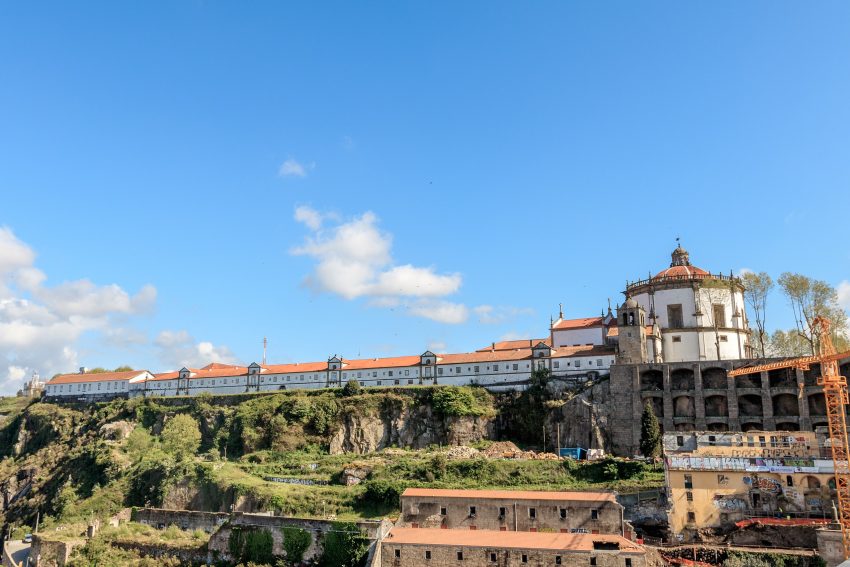
Serra do Pilar MonasteryPorto
CC BY-SA 4.0 / Rodrigo Tetsuo Argenton
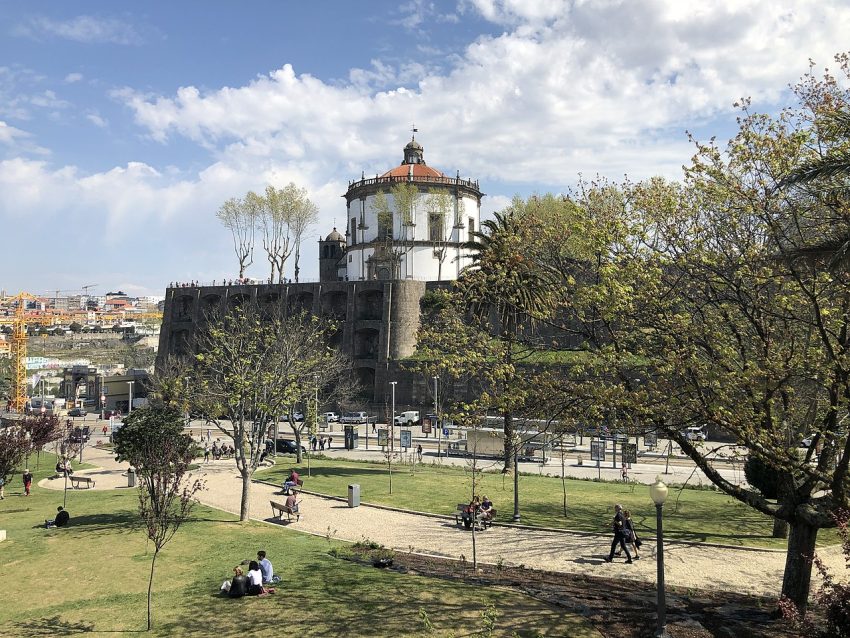
Serra do Pilar Monastery is a 16th-century complex on the Vila Nova de Gaia ridge, where a broad terrace looks straight across the Douro to Porto’s old skyline. The view is the point: the Dom Luís I Bridge cuts through the frame, with Ribeira’s stacked rooftops and the river’s bend laid out in a single sweep. Step inside to notice the monastery’s unusual circular rotunda plan, a rare Renaissance choice in Portugal that makes the interior feel centralized and symmetrical rather than long and processional. Its hilltop position also hints at its past strategic role, built for visibility as much as devotion. Around sunset the terrace often fills with people lingering for the changing light.
Location: Mosteiro da Serra do Pilar, Largo Aviz, Vila Nova de Gaia, Portugal | Distance: 1.1km

26. Jardins do Palácio de Cristal

Porto Jardins Palacio Cristal
CC BY-SA 4.0 / wuppertaler
Jardins do Palácio de Cristal is a 19th-century public garden in Porto’s Massarelos district, created as the landscaped setting for the city’s former Crystal Palace. Its broad promenades and shaded “rooms” of greenery are laid out with a romantic, winding logic that repeatedly steers you toward terraces above the Douro River, with occasional clear-day glimpses out to the Atlantic. The palace itself was replaced in the 1950s by the Rosa Mota Pavilion, but the park retains its composed mix of formal statues and fountains alongside more woodland-like stretches. Visitors tend to remember the contrast between quiet corners—some planted with aromatic and medicinal species—and the sudden, open panoramas over water and rooftops.
Location: Jardins do Palácio de Cristal, Rua de Dom Manuel II, Porto, Portugal | Hours: 8am-9pm Apr-Sep, to 7pm Oct-Mar | Price: Free entry. | Website | Distance: 1.2km

27. Churchill's Wine Cellar
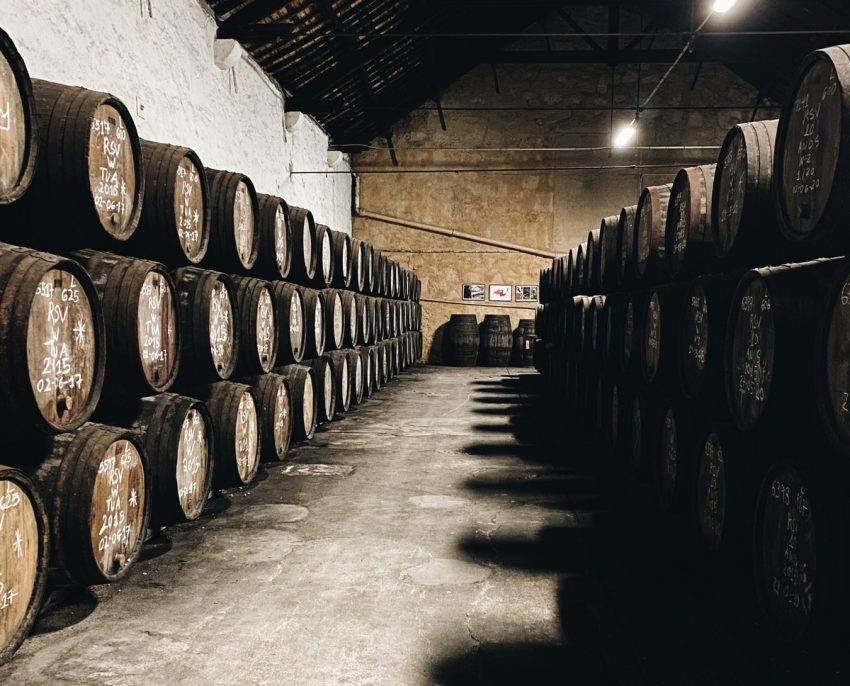
Churchills Lodge
Churchills Lodge
© CHURCHILL’S
Churchill’s Wine Cellar is a boutique Port lodge in Vila Nova de Gaia, known for a contemporary, craftsmanship-first approach rather than a big-brand production line. Founded in 1981 by Johnny Graham, it shows how newer houses can still take barrel aging seriously while shaping drier, more structured styles. Visits center on seeing casks and barrels at work and, more memorably, a guided tasting designed to compare categories side by side—useful for understanding how tawny turns nutty and layered while vintage-led Ports feel deeper and firmer. The atmosphere is relaxed and unpretentious, and reviewers often single out the staff’s enthusiasm and clear explanations.
Location: Churchill's Lodge, Rua da Fonte Nova, Vila Nova de Gaia, Porto, Portugal | Hours: Monday to Saturday: 10:00 am to 6 pm | Price: From €15.00–€35.00 depending on the tasting and options selected. | Website | Distance: 1.4km

28. Maria Pia Bridge

Porto Ponte Maria Pia
CC BY-SA 2.0 / Turismo En Portugal
Maria Pia Bridge is a 19th-century iron railway bridge spanning the Douro in Porto, a reminder of the city’s railway-age leap in engineering. Opened in 1877 and named for Queen Maria Pia, its slender arch and lattice trusswork are often linked to Gustave Eiffel—some visitors even note the “G. Eiffel” marking. The bridge no longer carries trains and has no pedestrian access, so the experience is about stopping at river viewpoints to read the full curve of the arch against sky and water. It sits a little outside the busiest riverfront, which keeps the atmosphere quieter and the views more open.
Location: Ponte Dona Maria Pia, Oliveira do Douro, Portugal | Hours: 24 Hours | Price: Free | Distance: 1.5km

29. Ferreira Wine Cellars
Ferreira wine cellar buildings
CC BY-SA 2.0 / Matt Kieffer
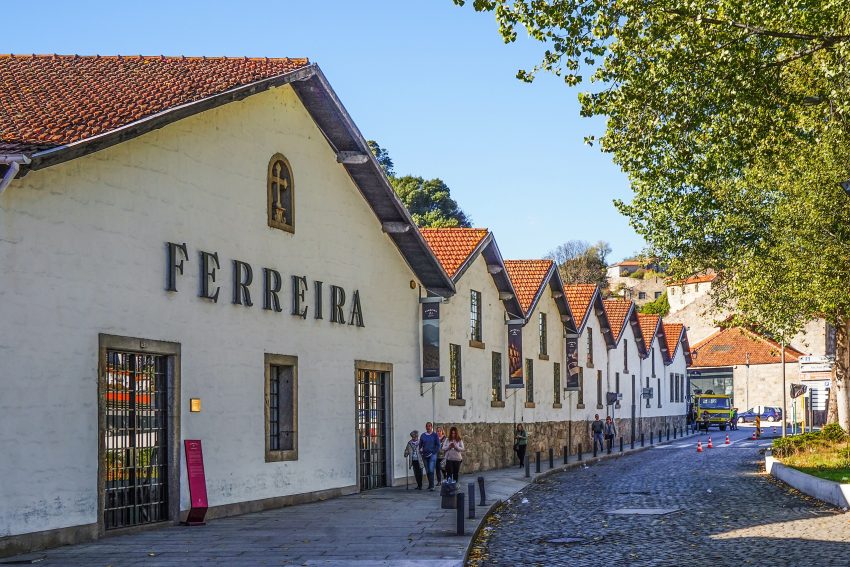
Ferreira Wine Cellars in Vila Nova de Gaia is a historic port lodge founded in 1751, closely linked to the early shaping of the Douro wine region. The visit leans on the story of Dona Antónia Adelaide Ferreira (“Ferreirinha”), whose leadership still defines the house’s identity and ties to growers. You begin with rooms connected to her life before stepping into a long, dim warehouse where large vats and casks sit aging in cool, controlled air. A small vintage-focused museum section helps connect cellar choices to port styles, and the tasting typically compares white, ruby, and tawny—bright aromatics against fruit depth and the tawny’s nutty, caramel finish.
Location: A.A. Ferreira, Rua Carvalhosa, Vila Nova de Gaia, Portugal | Hours: Daily 10:00–12:30 and 14:00–18:00 (last visit 12:15 and 17:15). | Price: Adults: €22.00 (Porto Ferreira Visit, tasting of 3 ports). | Website | Distance: 1.5km

30. Graham’s Port Cellar
Grahams Port Cellar
Grahams Port Cellar
CC BY-SA 4.0 / Herpoel
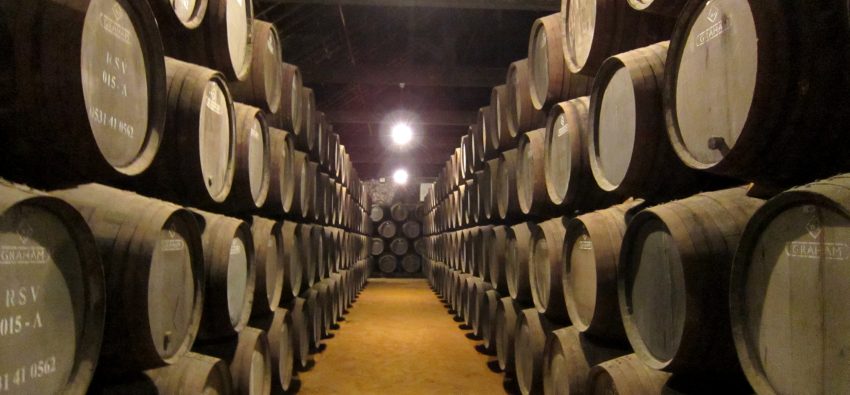
Graham’s Port Cellar is a historic port-wine lodge on the Vila Nova de Gaia hillside, where you can see how time in wood shapes the city’s signature drink. Inside, the air is cool and resinous, and long lines of casks sit in quiet, stable rooms built for slow aging and careful blending. The visit makes the difference between styles tangible—tawny’s oxidative, nutty depth versus the darker fruit of ruby and vintage pours—especially when tasted side by side. Many visitors also notice a small museum and the traditional, hands-on feel of parts of the process. Step outside and the terrace frames a sweeping view across the Douro to Porto’s skyline.
Location: Graham's Port Lodge, Rua do Agro, Vila Nova de Gaia, Portugal | Hours: Summer: Visits: 10:00 – 17:30 (reservation required); Tastings: 10:00 – 17:30; Shop: 10:00 – 19:30; Winter: Visits: 10:00 – 17:00 (reservation required) Tastings: 11:00 – 17:30 | Price: Starting from €30.00 | Website | Distance: 1.5km
Powered by GetYourGuide

31. Igreja Matriz do Bonfim

Porto Igreja Bonfim
Porto Igreja Bonfim
CC BY-SA 4.0 / wuppertaler
Igreja Matriz do Bonfim is a late-19th-century parish church in Porto’s Bonfim district, built between 1874 and 1894 as the neighbourhood grew beyond an earlier chapel. Its restrained neoclassical façade—triangular pediment centered between two square bell towers—stands out on everyday streets without the constant tour-group flow. Inside, visitors notice the single-nave space with a barrel-vaulted ceiling and delicate stucco work, where the light feels softer and the pace quieter than in central churches. Look for Júlio Costa’s Calvary painting at the main altar and the pipe organ salvaged from a church demolished for São Bento Station. Many travelers describe it as peaceful and uncrowded.
Location: Igreja Matriz do Bonfim, Rua do Monte do Bonfim, Porto, Portugal | Hours: Monday - Saturday: 08:00 - 20:00; Sunday 08:00 - 12:00 & 14:00 - 20:00 | Price: Free (donations welcomed). | Website | Distance: 1.5km

32. São João Bridge

Sao Joao Bridge
Sao Joao Bridge
CC BY-SA 2.0 / Sergei Gussev
São João Bridge (Ponte de São João) is Porto’s modern railway crossing over the Douro, built to take over heavy train traffic from the older Maria Pia line. Completed in 1991 and engineered by Edgar Cardoso, it’s defined by a single, muscular concrete arch and a clean profile that reads very differently from the city’s 19th‑century iron bridges. Most visitors remember it from the water—its curve frames the river neatly on boat trips—or from the banks where the deck sits high above the Douro. Wait a moment and a train will slide across, making the structure feel alive and giving instant scale to the span.
Location: Ponte de São João, Porto, Portugal | Hours: Always visible; train crossings depend on rail schedules. | Price: Free. | Distance: 1.6km

33. Taylor’s Port Wine Cellar
Taylors port cellar Porto
CC BY-SA 2.0 / Véronique Mergaux
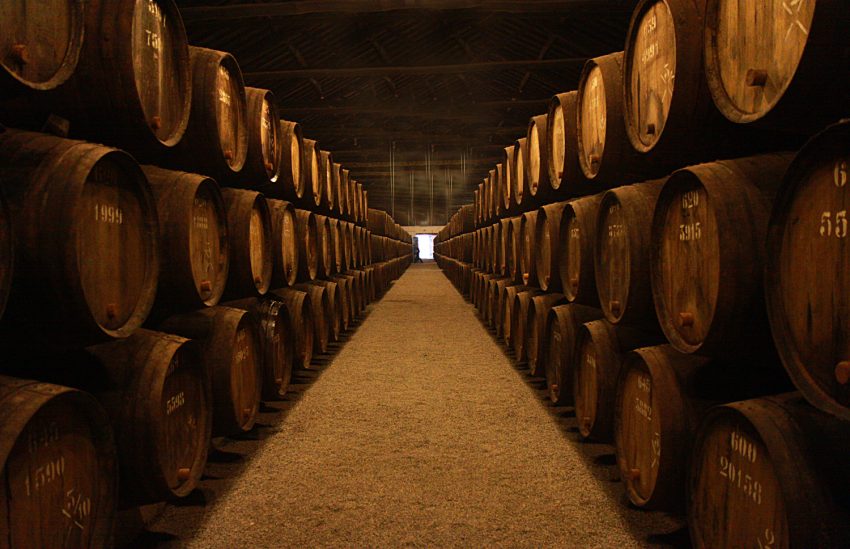
Taylor’s Port Wine Cellar is a port lodge in Vila Nova de Gaia, where the city’s wine trade traditionally matured barrels above the Douro, and it’s a clear window into how fortified wine is aged and blended. The visit moves through cool cellar rooms lined with large wooden casks, making the differences between ruby and tawny styles feel tangible rather than abstract. Many tours are self-guided with headphones, then end in a tasting area set in a well-kept garden with terraces. Travelers often mention the calm, polished grounds and an informative run-through of the house’s origins and winemaking choices. The tasting—often the part people linger over—turns the aromas, sweetness, and finish into something you remember.
Location: Taylor's Port, Rua do Choupelo, Vila Nova de Gaia, Portugal | Hours: Cellars (mon-sun): 11:00 – 18:00 Tasting Room and Shop (mon-sun): 11:00 - 19:00 Restaurant: 12.30-15.00 // 19.00-22.00 | Price: Adults: From €25.00 | Website | Distance: 1.6km
Powered by GetYourGuide

34. Museu do Carro Eléctrico

Museu do Carro Electrico Porto
CC BY-SA 2.0 / Hugo Cadavez
Museu do Carro Eléctrico in Porto is a tram museum set inside the former Massarelos thermoelectric power station on the Douro riverfront, where the city once generated power for its electric network. The industrial hall still feels like a depot, with full-size vintage cars lined up so you can study driver controls, ticket boxes, and the gleam of restored woodwork and brass. The collection traces Porto’s shift from early 20th-century street transport to later systems, with exhibits on overhead lines, substations, and the machinery that kept trams running. Visitors often remember the contrast between the atmospheric powerhouse architecture and the intimate, everyday details inside the carriages.
Location: Tram Museum, Alameda de Basílio Teles, Porto, Portugal | Hours: Monday: 2 pm – 6 pm. Tuesday – Sunday: 10 am – 6 pm. | Price: Adults: €8.00 | Website | Distance: 1.8km

35. Casa da Música
Casa Da Musica Porto
CC BY-SA 2.0 / Filipe Fortes
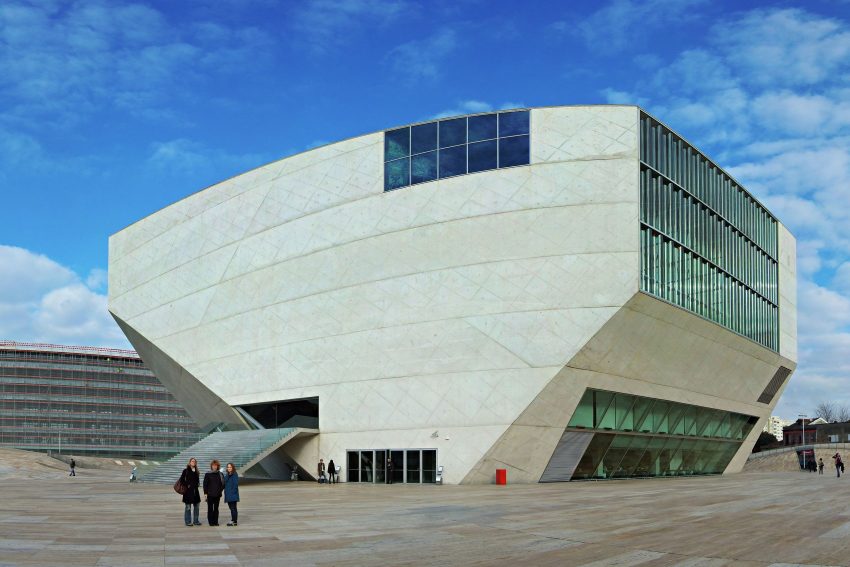
Casa da Música is Porto’s contemporary concert hall beside the Boavista roundabout, a sharp-edged, sculptural building that announces itself from afar and keeps changing as you circle it. Conceived during the city’s European Capital of Culture momentum and opened in 2005, it gave Porto a modern cultural anchor beyond the riverside center, with a design by Rem Koolhaas/OMA chosen through an international competition. Visitors tend to remember the angular geometry, clean surfaces, and big glass planes that pull in daylight and frame views of the city. Inside, the public spaces feel carefully engineered around acoustics and sightlines, and even a brief look can be striking. Reviews often mention how the details of each performance room fit together into distinct atmospheres.
Location: Casa da Música, Avenida da Boavista, Porto, Portugal | Hours: Daily from 9:30 to 18:00 | Price: Adults: €12 | Website | Distance: 2km

36. Arrábida Bridge

6 bridges cruise in Porto Ponte da Arrabida Douro River Porto
CC BY-SA 2.0 / Matt Kieffer
Arrábida Bridge (Ponte da Arrábida) is a late‑1950s/early‑1960s reinforced‑concrete road bridge spanning the Douro west of Porto’s historic center, engineered by Edgar Cardoso. Its defining feature is a single sweeping arch that lifts the deck high above the water, a clean mid‑century counterpoint to the city’s older iron crossings. From the riverbanks or on a Six Bridges Cruise, the full curve reads best against open sky, especially when the light softens toward sunset and the river reflects the structure. Many visitors remember the sense of scale from the Gaia side and the long, airy views up and down the Douro.
Location: Ponte da Arrábida, Via de Cintura Interna, Porto, Portugal | Hours: Always accessible to view; road crossing operates continuously. | Price: Free. | Distance: 2.4km

37. Freixo Bridge

Freixo Bridge
Freixo Bridge
CC BY-SA 2.0 / José Moutinho
Freixo Bridge (Ponte do Freixo) is a modern cable‑stayed crossing on Porto’s eastern Douro, linking the city toward Campanhã and the A3 corridor and showing how Porto actually moves day to day. Built from 1999 to 2003 to ease congestion, it carries heavy traffic—locals cite around 120,000 vehicles daily—yet it’s most rewarding from the riverbanks where the deck, taut cables, and sail-like pylons read as crisp geometry against wide water. Its contemporary profile stands apart from the older iron and stone bridges downstream, which is especially noticeable from the river. Some visitors walk across and pick up riverside paths on the far side, where the mood shifts to quieter, more industrial-urban edges.
Location: Freixo Bridge, Circular Regional Interna do Porto, Porto, Portugal | Hours: Open 24/7 (public bridge and surrounding outdoor viewpoints). | Price: Free. | Distance: 2.6km
Powered by GetYourGuide

Best Day Trips from Porto

A day trip from Porto offers the perfect opportunity to escape the urban rhythm and discover the surrounding region's charm. Whether you're drawn to scenic countryside, historic villages, or cultural landmarks, the area around Porto provides a variety of easy-to-reach destinations ideal for a one-day itinerary. If you are looking to rent a car in Portugal I recommend having a look at Discover Cars, first, as they compare prices and review multiple car rental agencies for you.

1. Forte de São Francisco Xavier
Castelo do Queijo
Castelo do Queijo
CC BY-SA 4.0 / Joseolgon
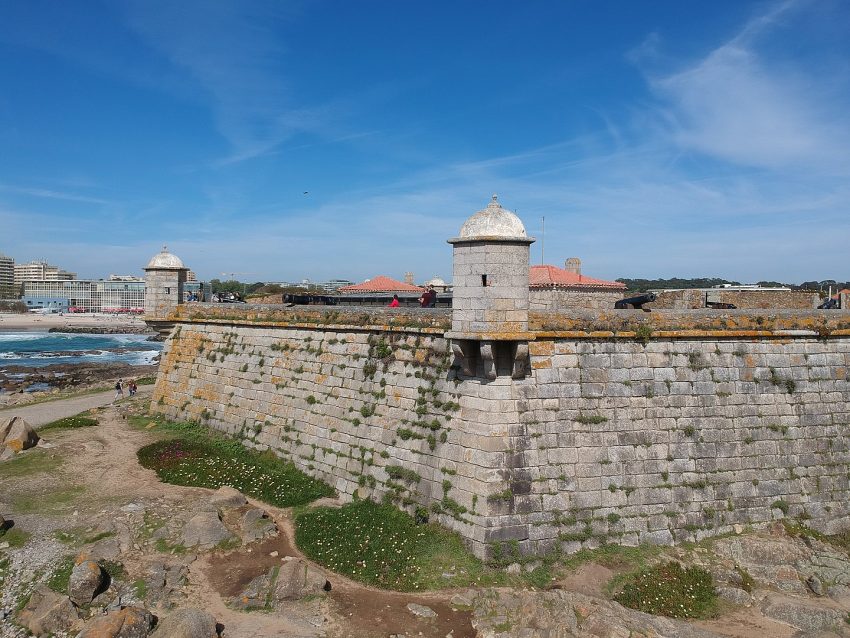
Forte de São Francisco Xavier, in Porto’s Nevogilde and Foz area, is a small coastal fort on the Atlantic edge of the city. Known locally as the “Cheese Castle,” it is a historical attraction with a strong seafront setting.The fort matters as a reminder of Porto’s coastal defence role, and visitors usually notice its compact layout, stonework, and open views…
Location: Forte de São Francisco Xavier, Praça de Gonçalves Zarco, Porto, Portugal | Hours: Tuesday - Sunday: 10:30 - 17:00 | Price: Adults: €1.00 | Distance: 7km
Visiting Forte de São Francisco Xavier

2. Espinho
Espinho
Espinho
CC BY-SA 4.0 / Ricardo Saraiva de Almeida
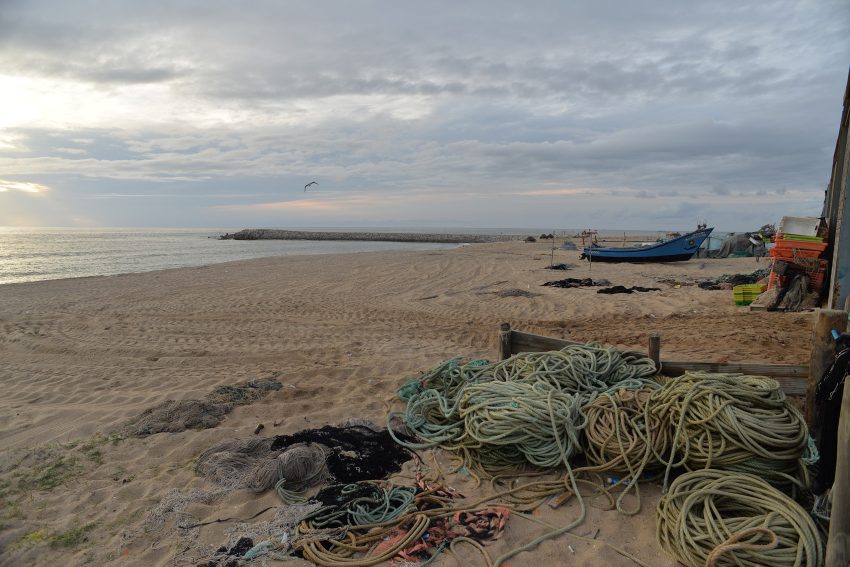
Espinho, located in northern Portugal, is a charming coastal town known for its beautiful beaches, seafood delicacies, and relaxed atmosphere. The town’s golden sands and rolling Atlantic waves make it a popular destination for beach lovers and surfers alike. Praia de Espinho, one of the main beaches, offers stunning sea views and a lively boardwalk lined with restaurants and cafés,…
Visiting Espinho

3. Guimarães

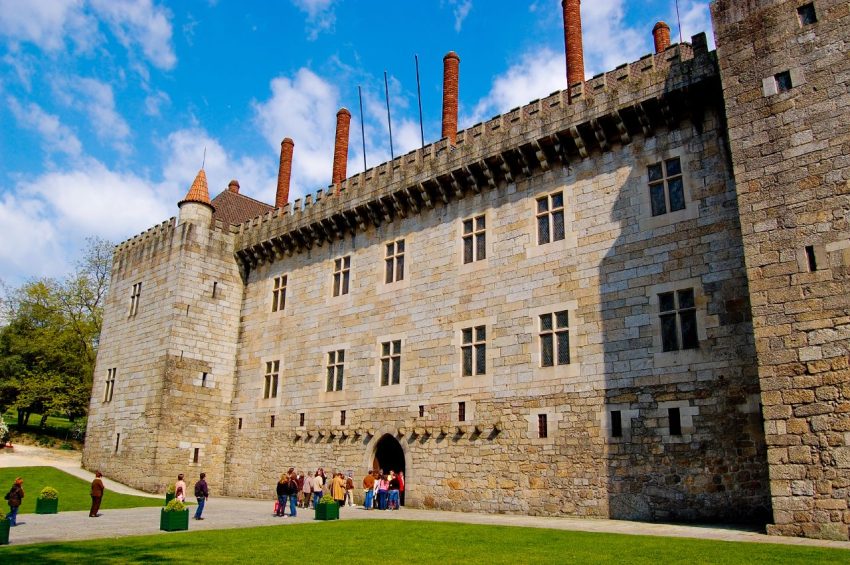
Hall of the Dukes of Braganca in Guimaraes Portugal
CC BY-SA 2.0 / Feliciano Guimarães
Visiting Guimarães offers a wonderfully atmospheric introduction to northern Portugal, set within the lush landscapes of the Minho region. Its compact layout makes it ideal for slow wandering, where charming squares, inviting cafés, and handsome granite buildings unfold one after another. With its beautifully preserved centre and relaxed pace, Guimarães feels both intimate and quietly grand, giving you plenty of…
Visiting Guimarães
Powered by GetYourGuide

4. Barcelos

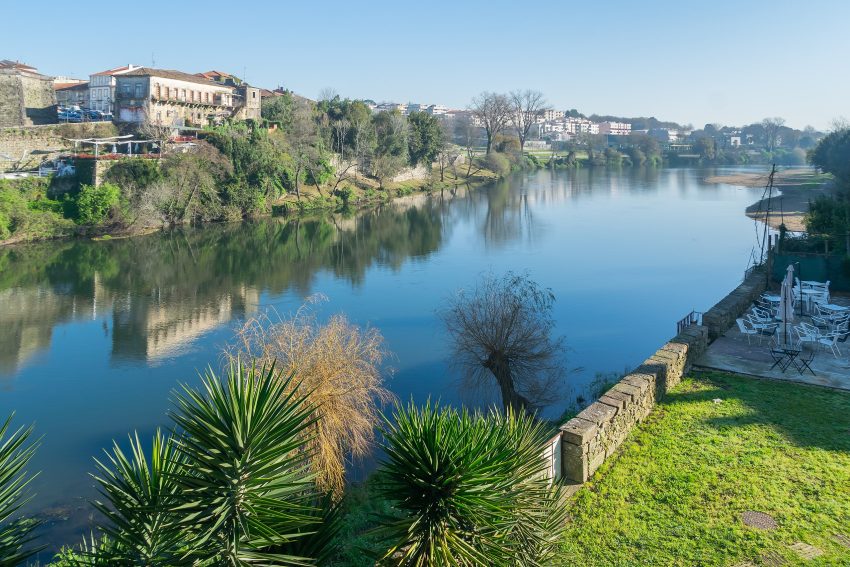
Cavado River in Barcelos
CC BY-SA 4.0 / Krzysztof Golik
Barcelos is a picturesque town in Northern Portugal, celebrated for its vibrant markets, artisanal craftsmanship, and traditional Portuguese charm. One of the main attractions for visitors is the weekly market, one of the largest and most historic in the country. This bustling event offers a mix of fresh produce, hand-painted ceramics, textiles, and regional delicacies, creating a colorful and lively…
Visiting Barcelos
Powered by GetYourGuide

5. Esposende

Esposende
Esposende
CC BY-SA 2.0 / Otávio Nogueira
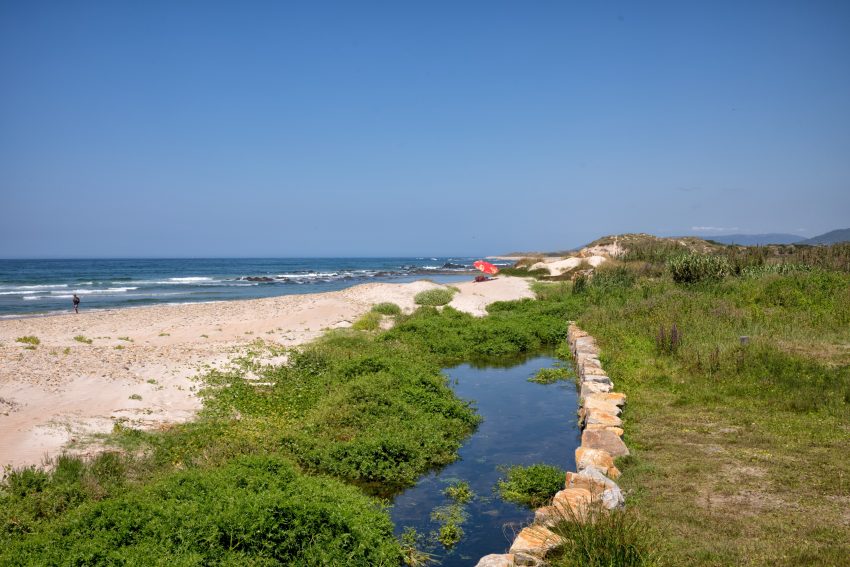
Esposende, a coastal gem in northern Portugal, offers visitors a relaxed atmosphere and a beautiful mix of sea, river, and countryside. Located between Porto and Viana do Castelo, it sits at the mouth of the Cávado River and is part of the Green Coast (Costa Verde), a region known for its natural beauty and temperate climate. The town is ideal…
Visiting Esposende

6. Braga

Braga
Braga
CC BY-SA 2.0 / Feliciano Guimarães
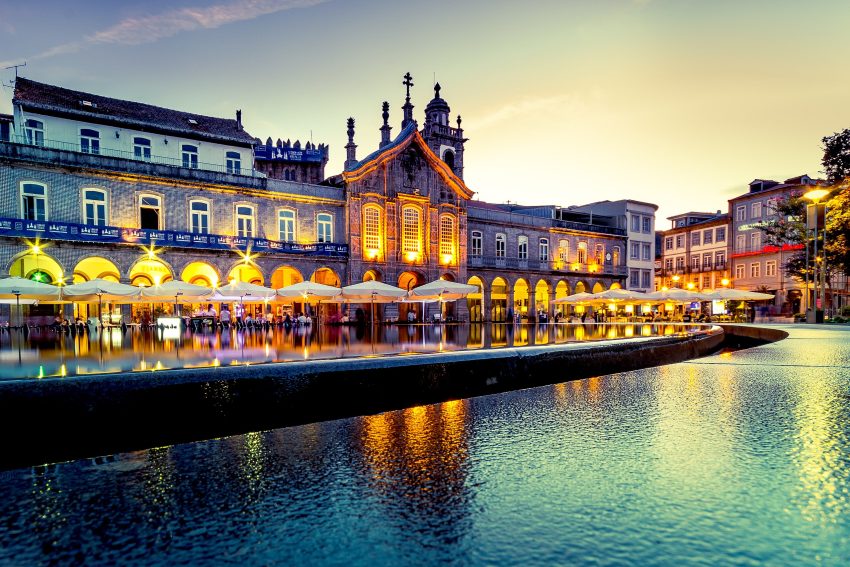
Braga is a town steeped in history, with a plethora of churches, palaces, gardens, and fountains visible almost everywhere you turn. The Romans knew it as Bracara Augusta, and it has been inhabited by various conquerors, including the Suevi, Visigoths, and Moors. For centuries, it has served as an archiepiscopal seat and pilgrimage site, with the Visigoths reputed to have…
Visiting Braga
Powered by GetYourGuide

7. Aveiro

aveiro
aveiro
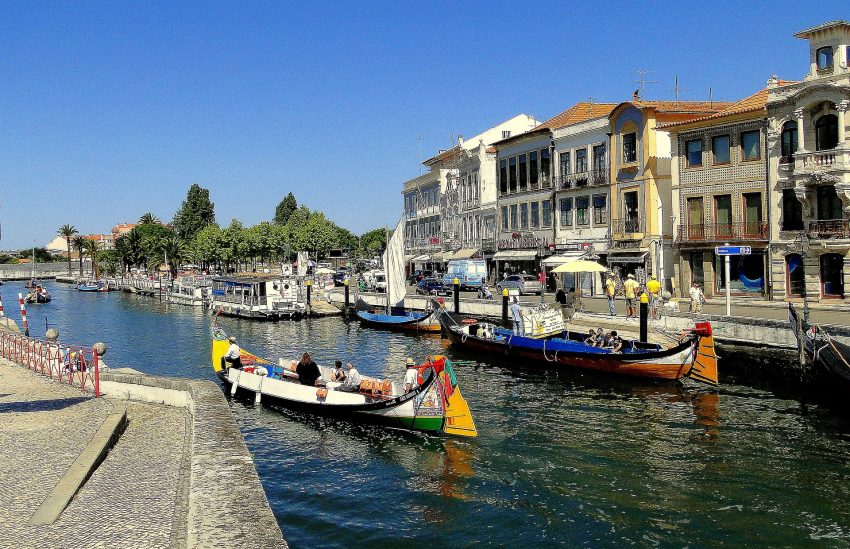
Aveiro is a picturesque town characterized by a network of numerous canals that are spanned by low-arched bridges. It is situated in Central Portugal at the mouth of the Vouga River and separated from the sea by a long sandbar, which protects clusters of islets. The architecture in Aveiro is reminiscent of Flemish style, which contrasts beautifully with the natural…
Visiting Aveiro
Powered by GetYourGuide

8. Viana do Castelo

Viana do Castelo
Viana do Castelo
CC BY-SA 2.0 / Sergei Gussev
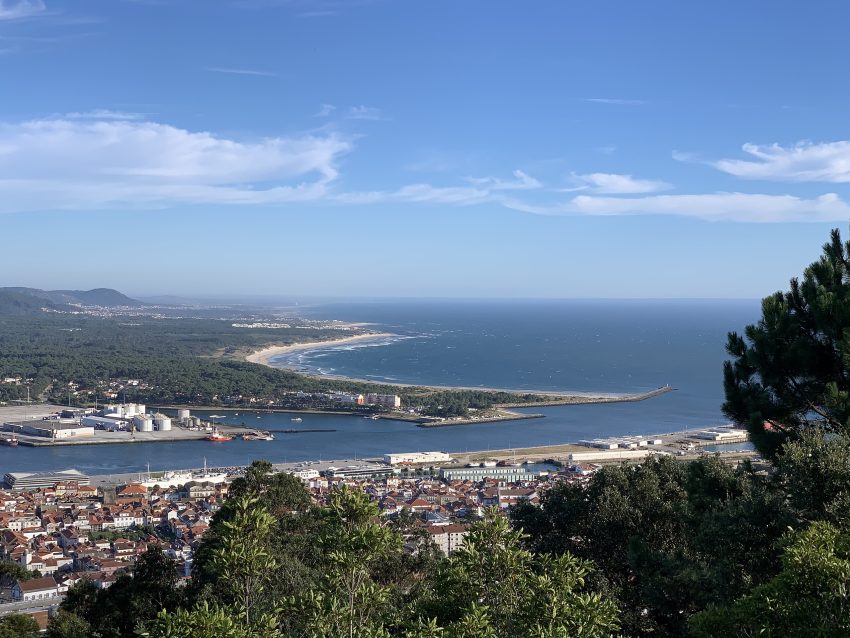
Viana do Castelo, situated amidst an estuary of the Lima River and rolling hills, is a charming city in northern Portugal that is renowned for its traditional character. Despite being a significant hub for deep-sea fishing, as well as housing industries such as pyrotechnics, wood manufacturing, ceramics, and boat building (which have experienced a resurgence after years of decline), the…
Visiting Viana do Castelo

9. Lamego

Lamego   Portugal
Lamego Portugal
CC BY-SA 2.0 / Vitor Oliveira
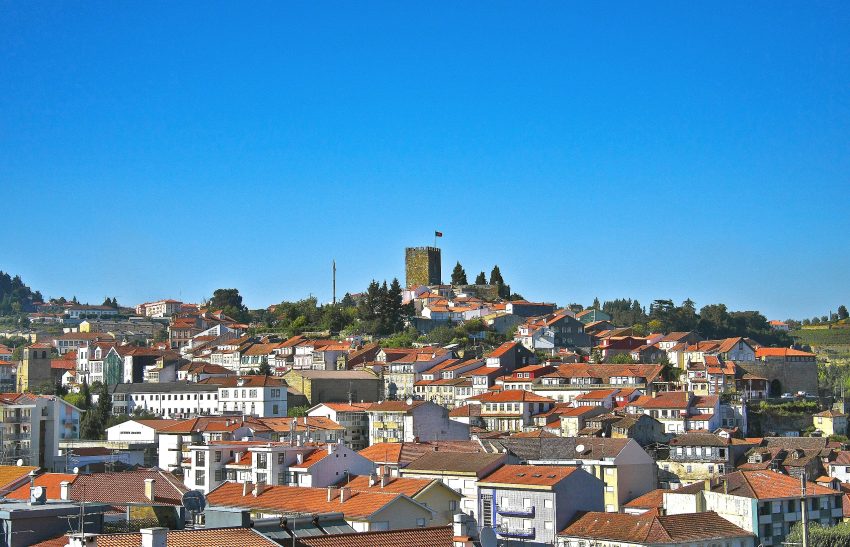
Lamego is a city located in the Viseu District in Northern Portugal. It is situated in the Douro Valley region, known for its picturesque landscapes and world-renowned wine production. Lamego has a rich history, with evidence of human settlement dating back to prehistoric times. In the Roman period, the city was an important center for trade and agriculture, and later…
Visiting Lamego
Powered by GetYourGuide

10. Peso da Régua

Peso da Regua
Peso da Regua
CC BY-SA 2.0 / Vitor Oliveira
Peso da Régua is a town located in the Alto Douro wine region in Northern Portugal, and it is considered the capital of the Upper Douro province. The town is situated on the banks of the Douro River, and it is an important center for the production and trade of port wine, which has been the main economic activity in…
Visiting Peso da Régua
Powered by GetYourGuide

11. Vila Real

Vila Real Square
Vila Real Square
CC BY-SA 2.0 / Varun Shiv Kapur
Vila Real, the capital of Trás-os-Montes in Northern Portugal, is a bustling town located on a plateau in the foothills of the Serra do Marão. The town is connected by bridges that span the deep ravines created by the Corgo and Cabril rivers, which converge here. From a terrace high above, once the site of a castle, visitors can enjoy…
Visiting Vila Real
Powered by GetYourGuide

Where to Stay in Porto

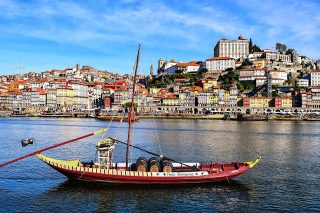
Porto offers a variety of neighborhoods that suit different travel styles, from historical immersion to riverside relaxation. One of the most popular areas for visitors is the Ribeira district, the city’s oldest and most picturesque quarter. Nestled along the Douro River, Ribeira is full of narrow cobbled streets, colorful facades, and lively restaurants with outdoor terraces. Staying here means waking up to views of traditional rabelo boats and the Dom Luís I Bridge. A perfect hotel in this charming area is Pestana Vintage Porto, located in a renovated 16th-century building right on the waterfront.

For those who prefer a mix of culture, shopping, and dining, the Baixa (Downtown) area is ideal. This central district includes landmarks like Avenida dos Aliados, the São Bento train station with its famous azulejos, and the bustling Mercado do Bolhão. It’s a great place for exploring on foot, and there’s a constant buzz of local life. A stylish option here is Maison Albar Hotels Le Monumental Palace, a five-star hotel offering luxury with easy access to Porto’s main sights.

If you’re looking for a quieter, more refined atmosphere, the Cedofeita and Boavista neighborhoods offer a sophisticated alternative. Cedofeita is known for its art galleries, independent shops, and creative vibe, while Boavista has wide avenues and cultural institutions like Casa da Música. Both areas provide a more residential feel while still being within easy reach of the historic center. For a peaceful yet polished stay, consider PortoBay Flores, which combines historic architecture with modern comfort in one of the city’s most elegant streets.

Using the our Hotel and Accomodation map, you can compare hotels and short-term rental accommodations in Porto. Simply insert your travel dates and group size, and you’ll see the best deals for your stay.

Porto Accommodation Map

Best Time to Visit Porto

Visiting Porto in Spring (Best)

Spring is arguably the best time to visit Porto, when the city bursts into color and energy after the winter rains. From March to May, mild temperatures ranging between 15°C and 22°C make it perfect for exploring Porto’s cobbled streets, terraced gardens, and riverside promenades. The Douro’s vineyards begin to awaken, painting the surrounding hills in lush green, while outdoor cafés fill with locals enjoying sunshine and freshly baked pastries.

This is also festival season in Porto. The Essência do Vinho, held each March at the Palácio da Bolsa, celebrates the region’s legendary wine culture with tastings from hundreds of producers. By late May, the Queima das Fitas student festival floods the city with parades, music, and color as university students mark the end of the academic year. The weather, energy, and vibrant calendar make spring an ideal blend of culture, comfort, and charm.

Visiting Porto in Summer

From June to August, Porto is alive with sunshine, long days, and celebration. Temperatures average 25°C but can climb higher during heatwaves, making it a great time to enjoy the nearby beaches at Foz do Douro or along the Matosinhos coast. The city’s evenings are warm and lively, with outdoor concerts, terrace bars, and riverfront dining all in full swing.

The highlight of summer in Porto is the Festa de São João on June 23rd, one of Europe’s most joyful and unique street festivals. Locals and visitors take to the streets to dance, release illuminated lanterns, and gently tap each other on the head with plastic hammers — a quirky tradition symbolizing good luck. Throughout the summer, the NOS Primavera Sound music festival also attracts international artists to the Parque da Cidade, adding to Porto’s cultural buzz.

Visiting Porto in Autumn

September to November brings cooler air, golden light, and fewer crowds — a wonderful time for travelers who prefer a slower, more atmospheric Porto. The vineyards of the Douro Valley are at their most beautiful during the grape harvest (vindima), making autumn perfect for wine tours and river cruises. Back in the city, the heat softens, and temperatures settle around 18°C to 22°C, ideal for exploring without the summer bustle.

Autumn also brings a calendar rich in culture. The Festival Internacional de Cinema do Porto (Fantasporto), held in early autumn, celebrates international cinema and creativity. The streets are quieter, accommodations more affordable, and the golden sunsets over the Douro lend the city a deeply romantic feel.

Visiting Porto in Winter

Winter in Porto, from December to February, is mild compared to most of Europe, with average highs of 12°C to 15°C and plenty of cozy charm. Occasional rain showers give the granite streets a shimmering look, and the scent of roasting chestnuts fills the air. This is the perfect season for slow travel — lingering in cafés, visiting museums, and sampling hearty northern Portuguese cuisine like francesinha or caldo verde.

The festive spirit is strong in winter, especially during Christmas, when the city lights up with decorations, markets, and music. The New Year’s Eve fireworks over the Douro River are spectacular, and by February, the Essência do Vinho festival returns to toast another year of Porto’s winemaking excellence. While quieter and cooler, winter reveals a gentler, more reflective side of Porto — one full of warmth, tradition, and soul.

Annual Weather Overview

  • January 13°C
  • February 15°C
  • March 17°C
  • April 20°C
  • May 21°C
  • June 22°C
  • July 26°C
  • August 28°C
  • September 26°C
  • October 23°C
  • November 16°C
  • December 14°C

How to get to Porto

Getting to Porto by Air

Porto is served by Francisco Sá Carneiro Airport (OPO), one of Portugal’s busiest and most efficient airports, located about 11 kilometers northwest of the city center. The airport welcomes numerous international and domestic flights daily, connecting Porto to major European cities such as London, Paris, Madrid, Amsterdam, and Frankfurt, as well as long-haul destinations.

Nearest airports:

  • Francisco Sá Carneiro Airport (OPO): The main international gateway to northern Portugal, offering direct metro and bus links to downtown Porto.
  • Lisbon Humberto Delgado Airport (LIS): Roughly three hours away by train or car, convenient for travelers combining Lisbon and Porto in one trip.
  • Vigo Airport (VGO), Spain: Located just across the border, about 150 kilometers north, suitable for travelers exploring northern Portugal and Galicia.

Reaching the city from Francisco Sá Carneiro Airport is simple: the Metro Line E (purple line) runs directly to Trindade Station in central Porto in about 25 minutes, and taxis or airport shuttles are readily available. For the best deals and a seamless booking experience, check out these flights to Porto on Booking.com.

Getting to Porto by Train

Porto sits on one of Portugal’s main railway routes and is exceptionally well-connected to the rest of the country. The city is served by two principal train stations: Campanhã Station, which handles long-distance and high-speed trains, and São Bento Station, a beautiful 19th-century terminus famous for its azulejo tile murals and central location.

High-speed Alfa Pendular and Intercidades trains run frequently between Lisbon and Porto, with a journey time of around 3 to 3.5 hours. Regular services also connect Porto with Coimbra, Braga, Guimarães, and the Douro Valley, making it an excellent base for rail travel across northern Portugal. Campanhã Station is connected to the metro network and offers seamless transfers to São Bento and other local stations, ensuring convenient onward travel within the city. Train schedules and bookings can be found on Omio.

Getting to Porto by Car

Driving to Porto is straightforward, with a well-maintained motorway network linking it to the rest of Portugal and neighboring Spain. The A1 motorway connects Porto directly with Lisbon, taking about three hours, while the A3 heads north to Braga and the Spanish border, and the A4 links the city to Vila Real and the Trás-os-Montes region.

Motorways in Portugal charge tolls, payable via electronic devices (Via Verde) or at manual booths. Driving into Porto’s city center can be challenging due to narrow streets and limited parking, but there are several park-and-ride facilities around the city, allowing easy metro or bus connections downtown. For those renting a car, all major companies operate at Francisco Sá Carneiro Airport and in the city center. If you are looking to rent a car in Portugal I recommend having a look at Discover Cars, first, as they compare prices and review multiple car rental agencies for you.

Travelling Around Porto

Getting around Porto is easy thanks to its excellent and affordable public transport system. The Metro do Porto covers much of the metropolitan area with six color-coded lines connecting the airport, downtown, and outlying suburbs. Trains run frequently from early morning until midnight, and tickets can be purchased at machines using rechargeable Andante cards.

The city’s STCP bus network and historic trams complement the metro system, providing access to areas not served by rail — including scenic rides along the riverfront and out to the coastal district of Foz do Douro. For short distances, walking is often the best way to experience Porto’s charm, though hilly streets can be steep.

For regional travel, Comboios de Portugal (CP) operates frequent train services from São Bento and Campanhã to nearby destinations like Braga, Aveiro, and the Douro Valley. Ferries also cross the Douro River between Porto and Vila Nova de Gaia, offering a picturesque way to reach the famous Port wine cellars.

Powered by GetYourGuide

More from this area