Tomb of Christopher Columbus, Seville
Cathedral and Tomb in Seville
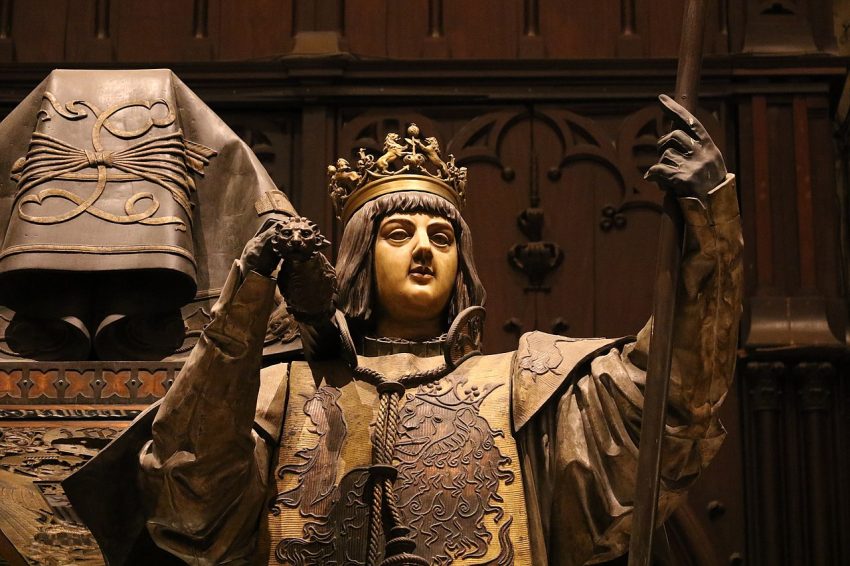
Situated near the entrance of Seville's massive cathedral, the Tomb of Christopher Columbus is a surprisingly theatrical monument that stops most visitors in their tracks. The coffin is carried aloft on the shoulders of four larger-than-life figures symbolizing Castile, Aragon, Navarre, and León, turning a tomb into a statement about Spain's kingdoms and Columbus' outsized place in their story.
It's one of the top attractions in Seville because it's easy to locate, visually unforgettable, and packed with symbolism once you know what to look for. If you're doing a walking tour of Seville, it's also a simple “high-impact” stop you can build into the Cathedral visit without needing extra detours or planning.
Table of Contents
- History and Significance of the Tomb of Christopher Columbus
- Things to See and Do in the Tomb of Christopher Columbus
- How to Get to the Tomb of Christopher Columbus
- Practical Tips on Visiting the Tomb of Christopher Columbus
- Where to Stay Close to the Tomb of Christopher Columbus
- Is the Tomb of Christopher Columbus Worth Visiting?
- For Different Travelers
- FAQs for Visiting Tomb of Christopher Columbus
- Nearby Attractions to the Tomb of Christopher Columbus
History and Significance of the Tomb of Christopher Columbus
Columbus died in Valladolid in 1506 after his fourth voyage, but his remains did not stay in one place for long. Shortly after his death, he was moved to Seville to be buried in a Carthusian monastery, and later his remains (along with those of his son Diego) were transferred across the Atlantic to Santo Domingo at the request of María de Toledo, Diego's widow, in a period when the family's relationship with the Spanish crown had become complicated.
Centuries later, shifting empires moved him again. When Spain lost control of Santo Domingo in 1795, the remains believed to be Columbus' were taken to Havana, and after Spain was expelled from Cuba in 1898, they were finally returned to Seville, bringing the long journey back to the cathedral that now frames his legacy.
The tomb's catafalque was designed by sculptor Arturo Mélida and was originally intended for Havana, but history redirected it to Seville at the last moment. Installed in Seville in 1899, it became one of the cathedral's later additions, and it still reads like a final imperial-era gesture: grand, symbolic, and designed to be seen.
There is also a long-running dispute over where Columbus truly lies. In 1877, while Spain still believed his remains were in Havana, a lead box was discovered in Santo Domingo Cathedral with an inscription naming “Don Cristóbal Colón,” and it is now associated with the Faro a Colón lighthouse site in Santo Domingo. Modern forensic work carried out in 2006 supports that the remains in Seville belong to either Columbus or his brother, which is why the story continues to carry a small, enduring shadow of uncertainty.
Things to See and Do in the Tomb of Christopher Columbus
First, give yourself a full slow circle around the monument so you can read it as a set-piece rather than a single photo. The four bearers are not generic figures; they are heraldic personifications of the Spanish kingdoms, and the monument is designed so your eye keeps finding new details as you move.
Look closely at the symbolism and treat it like a visual puzzle. León is the easiest to spot thanks to the prominent lion motif; Navarre is marked by linked chains; Aragon is associated with striped elements and bat motifs that echo heraldic traditions tied to Aragonese cities; and Castile carries unmistakable castle imagery, with maritime references that nod toward the voyages supported by Castilian power.
Finally, take a moment to read the base and its civic tone. The inscription frames the return of the remains to Seville in the language of national loss and recovery, and it helps explain why the monument feels less like a private tomb and more like a public statement, erected to anchor Columbus' story back in Spanish soil after the empire's Atlantic retreat.
How to Get to the Tomb of Christopher Columbus
The tomb is inside Seville Cathedral in the historic centre, so your practical goal is simply getting to the Cathedral and entering with your ticket, then heading toward the area near the Puerta de los Príncipes (Door of the Princes) once you are inside.
The nearest airport is Seville Airport (SVQ), with straightforward transfers into the city centre by taxi or airport bus, then a short walk into the Cathedral zone. For the best deals and a seamless booking experience, check out these flights to Seville on Booking.com.
If you arrive by train, Seville-Santa Justa station connects well to the centre by taxi or city bus, and the cathedral is then best reached on foot through the historic streets. Train schedules and bookings can be found on Omio.
If you’re driving, park outside the tightest historic core and walk in, because the Cathedral area is busy, pedestrian-heavy, and not suited to door-to-door access. If you are looking to rent a car in Spain I recommend having a look at Discover Cars, first, as they compare prices and review multiple car rental agencies for you.
Practical Tips on Visiting the Tomb of Christopher Columbus
- Entrance fee: Included with Seville Cathedral ticket (general admission: €13 online / €14 at the ticket office).
- Opening hours: Monday – Saturday: 11:00–18:00. Sunday: 14:30–19:00.
- Official website: http://www.catedraldesevilla.es/
- Best time to visit: Aim for the first entry window of the day or a late-afternoon slot so you can linger at the tomb before the interior feels at its busiest.
- How long to spend: 10-20 minutes is enough for photos and details, but allow longer if you want to decode the heraldic symbols and read the monument carefully.
- Accessibility: The tomb area is generally easy to reach within the cathedral’s main visitor routes, though crowds can make movement slower at peak times.
- Facilities: Plan your breaks outside the cathedral in the surrounding streets, where cafés and rest stops are plentiful before or after your visit.
Where to Stay Close to the Tomb of Christopher Columbus
For a culture-heavy itinerary, base yourself in Santa Cruz so the cathedral, Alcázar, and the historic lanes are walkable at quieter hours; if your trip leans more toward nightlife and easy evening dining, base yourself in El Arenal or near Alameda de Hércules and commute into the sights when you want monuments.
For an ultra-central stay within easy walking distance of the cathedral entrances, EME Catedral Mercer Hotel puts you right in the heart of the action. If you prefer a charming, traditional base tucked into Santa Cruz’s lanes, Las Casas de la Judería is ideal for early starts and late strolls. For a polished boutique option that still feels local and walkable, Hotel Rey Alfonso X sits in a convenient spot for monuments, cafés, and evening wanderings.
Is the Tomb of Christopher Columbus Worth Visiting?
Yes, because it’s one of the cathedral’s most immediate “wow” moments and also one of its most readable historical objects once you understand the symbolism. You don’t need specialist knowledge to appreciate it, but a few minutes of context turns it from a photo stop into a compact lesson in Spain’s kingdoms, empire, and memory-making.
It’s also a rare kind of monument that rewards both quick and slow visits. If you only have time to pause briefly, the spectacle delivers; if you linger, the heraldry and inscription reveal the political story beneath the sculpture.
What Other Travellers Say...

Tomb of Christopher Columbus, located inside Seville's cathedral in Casco Antiguo, is an elaborate, highly detailed memorial that visitors describe as a masterpiece worth seeing; guides and audio guides add context about the remains, crowds can gather so expect to wait a few minutes for photos, and many recommend allowing plenty of time (and buying tickets in advance) and bringing your passport for entry.


For Different Travelers
Families with Kids
This is a strong stop for families because it’s visual and easy to turn into a quick game of spotting symbols, rather than relying on long explanations. Keep it short, focus on the “four kingdoms carrying the coffin” story, and let the details do the teaching.
If you want to add one extra hook, ask kids to pick their “favorite” figure based on costume and symbols, then take a photo from a slightly different angle so they feel part of the discovery.
Couples & Romantic Getaways
For couples, it works best as a meaningful pause inside a much larger visit, especially if you like travel moments that mix beauty with real historical weight. It’s a natural place to slow down, take a photo, and then drift onward through the cathedral without feeling like you’re rushing from highlight to highlight.
If you enjoy context, reading the monument together and decoding the kingdoms adds a quiet, shared “museum-style” moment without needing a guided tour.
Budget Travelers
It’s excellent value because it’s included with the cathedral ticket and delivers a major highlight without extra add-ons. If you’re trying to maximize one paid monument, this is one of the internal sights that helps the cathedral feel fully worth the cost.
To keep the day efficient, pair it with nearby free wandering afterward in Santa Cruz and along the cathedral’s exterior viewpoints.
History Buffs
This is a must, not just for Columbus, but for what the monument says about Spain’s late-19th-century relationship with empire and national narrative. The inscription and the timing of installation turn it into a historical document as much as a sculpture.
If you want to go deeper, treat the tomb as the starting point, then connect it with Seville’s Archivo de Indias and the riverfront story of trade and exploration.
FAQs for Visiting Tomb of Christopher Columbus
Getting There
Tickets & Entry
Visiting Experience
Photography
Safety & Timing
Nearby Attractions to the Tomb of Christopher Columbus
- Torre del Oro: A riverside landmark that connects well with Seville's maritime and exploration-era narratives.
- La Giralda: The cathedral's bell tower offers one of the city's best panoramic viewpoints and pairs naturally with the tomb stop.
- Real Alcázar of Seville: A nearby palace complex of courtyards and gardens that completes a classic historic-centre loop.
- Archivo General de Indias: A major building of imperial history that adds depth to the Columbus story beyond the monument itself.
- Barrio Santa Cruz: The historic quarter next door is ideal for slow wandering and post-cathedral decompression.
The Tomb of Christopher Columbus appears in our Complete Guide to Visiting Seville!

Moira & Andy
Hey! We're Moira & Andy. From hiking the Camino to trips around Europe in Bert our campervan — we've been traveling together since retirement in 2020!
This website uses affiliate links which may earn a commission at no additional cost to you!
Planning Your Visit
Monday - Saturday: 11:00-18:00.
Sunday: 14:30-19:00.
Included with Seville Cathedral ticket (general admission: €13 online / €14 at the ticket office).
Nearby Attractions
- Seville Cathedral (0.0) km
Cathedral, Historic Building and Mosque - La Giralda (0.1) km
Tower - Archivo General de Indias (0.1) km
Historic Building and Museum - Royal Shipyards of Seville (0.2) km
Historic Building and Shipyard - Barrio Santa Cruz (0.3) km
Area - Hospital de los Venerables Sacerdotes (0.3) km
Gallery, Historic Building and Museum - Casa de los Pinelo (0.3) km
Palace - Casa Salinas de Seville (0.3) km
Palace - Torre de la Plata (0.3) km
Tower - Royal Alcázars of Seville (0.4) km
Historic Building and Palace