Ljubljana, Slovenia: The Ultimate Travel Guide 2026

complete guide to ljubljana

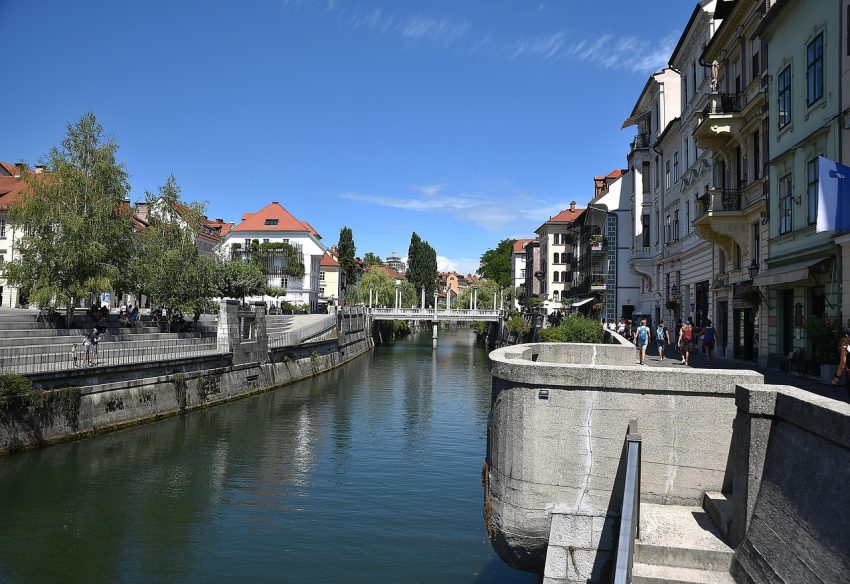
Ljubljana, the vibrant capital of Slovenia, is located in the central part of the country, surrounded by scenic hills and the Ljubljanica River. The compact city center makes it perfect for exploring on foot, with charming pedestrian streets, lively squares, and a mix of modern cafés and traditional eateries. Its central location also makes it a convenient base for day trips to nearby natural and cultural attractions.

Visitors can enjoy strolling along the riverbanks, crossing the iconic Triple Bridge, or relaxing in the many green spaces like Tivoli Park. The city is known for its vibrant cultural scene, including open-air markets, street performances, and regular festivals that showcase local music, food, and art. Walking around the old town, visitors can easily experience the city’s lively atmosphere while admiring its architecture and public spaces.

Ljubljana also offers plenty of opportunities for sampling Slovenian cuisine in its many restaurants and cafés, with dishes featuring locally sourced ingredients. Whether enjoying a riverside meal, browsing boutique shops, or joining a guided walking tour, visitors will find Ljubljana's combination of relaxed charm and central location makes it an ideal stop for exploring the heart of Slovenia.

History of Ljubljana

Ljubljana in Roman Times

Ljubljana began as a Roman settlement called Emona around 1st century AD. Emona was a fortified town with streets laid out in a grid pattern, public buildings, and defensive walls. Roman life in the city included trade, crafts, and administration, and remnants of this period, such as foundations and artifacts, can still be seen in the modern city center.

Ljubljana in the Middle Ages

During the medieval period, Ljubljana developed as a trading hub under the influence of regional nobility. Castles and fortifications were built to protect the town from invasions, and the city grew around its central market and river crossings. Guilds and local merchants flourished, shaping the city’s economy and social structure, while churches and monasteries became prominent landmarks.

Ljubljana under Habsburg Rule

From the 14th century onwards, Ljubljana came under Habsburg control, which brought stability, administrative reforms, and new architectural styles. Baroque churches and civic buildings began to appear, reflecting the wealth and cultural influence of the city. This period also saw the development of educational institutions and a growing urban middle class.

Ljubljana in the 19th Century

The 19th century marked a period of modernization and expansion for Ljubljana. The city saw new roads, bridges, and cultural institutions, alongside the rise of nationalism and intellectual movements. Public buildings, theatres, and parks were developed, transforming the cityscape and fostering a vibrant civic life.

Ljubljana in the 20th Century and Beyond

The 20th century brought both challenges and growth to Ljubljana, including occupation during World War II and post-war reconstruction. Urban planning, modern architecture, and cultural development reshaped the city. Today, Ljubljana is a lively, modern capital that preserves its historic heart while embracing contemporary culture, arts, and sustainable urban living.

Moira & Andy
Moira & Andy

Hey! We're Moira & Andy. From hiking the Camino to trips around Europe in Bert our campervan — we've been traveling together since retirement in 2020!

Read our full story here

Visiting Ljubljana for the first time and wondering what are the top places to see in the city? In this complete guide, I share the best things to do in Ljubljana on the first visit. To help you plan your trip, I have also included an interactive map and practical tips for visiting!

This website uses affiliate links which earn a small commission at no additional cost to you.
Powered by GetYourGuide

13 Best places to See in Ljubljana

This complete guide to Ljubljana not only tells you about the very best sights and tourist attractions for first-time visitors to the city but also provide insights into a few of our personal favorite things to do.

This is a practical guide to visiting the best places to see in Ljubljana and is filled with tips and info that should answer all your questions!

1. Dragon Bridge
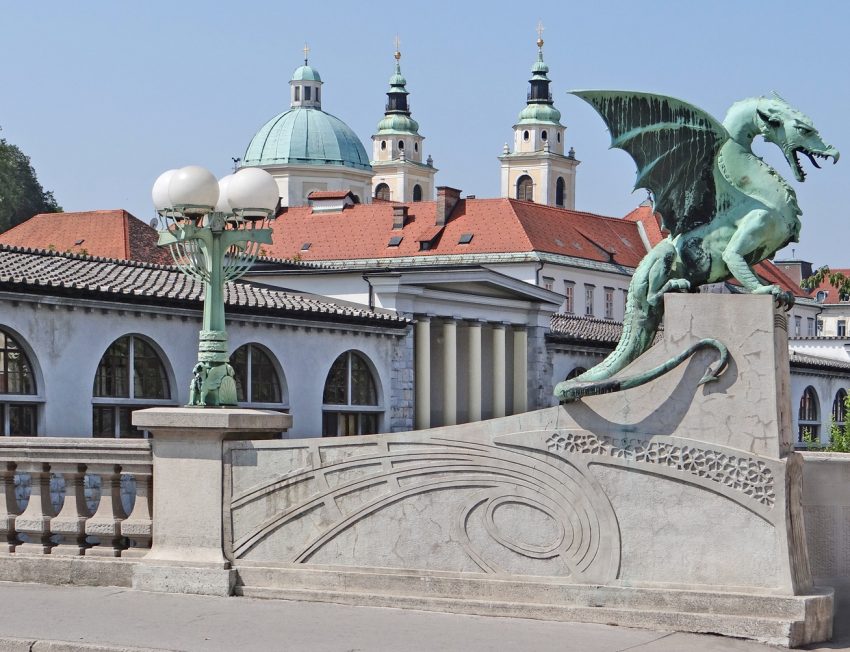
Dragon Bridge Ljubljana
CC BY-SA 2.0 / Jean-Pierre Dalbéra
Dragon Bridge (Zmajski most) is a Viennese Secession–style river crossing that doubles as a piece of sculpture. Built in 1900–1901 under the Austro-Hungarian Empire, it was an early showpiece for reinforced concrete: a three-hinged, single-span arch of just over 33 metres, among Europe’s largest of its type at the time. What visitors remember are the guardians—four large copper dragons crouched on the corner pedestals with wings lifted and jaws set—plus a line of smaller dragons worked into the railings. The statues’ green patina and fierce expressions make close-up photos irresistible, even when the bridge is busy.
Location: Zmajski most, Ljubljana, Slovenia | Hours: Open 24 hours a day; surrounding stalls, shops, and cafés keep their own schedules. | Price: Free – Dragon Bridge is a public bridge open to everyone at all times. | Website | Distance: 0.6km

Here is a complete selection of hotel options in Ljubljana. Feel free to review each one and choose the stay that best suits your needs.

2. Franciscan Church of the Annunciation
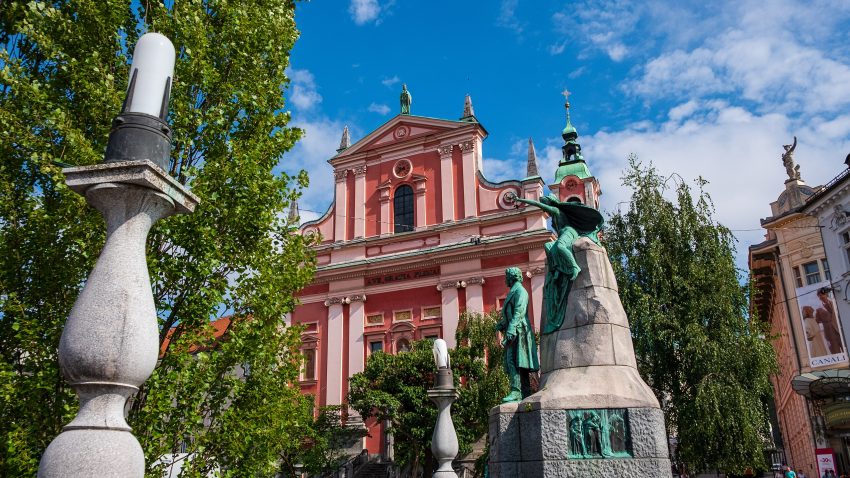
Franciscan Church of the Annunciation Ljubljana
Public Domain / Julien Maury
Facing Prešeren Square in a warm salmon-pink, the Franciscan Church of the Annunciation is a 17th-century Baroque landmark built between 1646 and 1660, with a façade reworked around 1700. From across the square, you notice the stacked Corinthian and Ionic details, sculpted figures in niches, and a copper statue of Our Lady of Loretto crowning the roofline. Inside, the street bustle drops away into a dense Baroque interior of side chapels, paintings, and carved ornament. The main altar by sculptor Francesco Robba draws the eye, while ceiling frescoes repainted in the 1930s by Matej Sternen after the 1895 earthquake add a luminous finish. Look, too, for the glass coffin of Saint Deodatus.
Location: Frančiškanska cerkev Marijinega oznanjenja, Prešernov trg, Ljubljana, Slovenia | Hours: Generally open daily during daytime hours, with access limited during Mass; check locally for current schedules. | Price: Free entry; donations for the upkeep of the church are appreciated. | Website | Distance: 0.6km

Traveling to a country with a different currency? Avoid ATM transaction fees and pay in local currency with a Wise Card. Having used it for over 5 years, we've saved loads on fees!

3. Preseren Square

Prešeren Square Ljubljana
CC BY-SA 2.0 / biosynthesis24
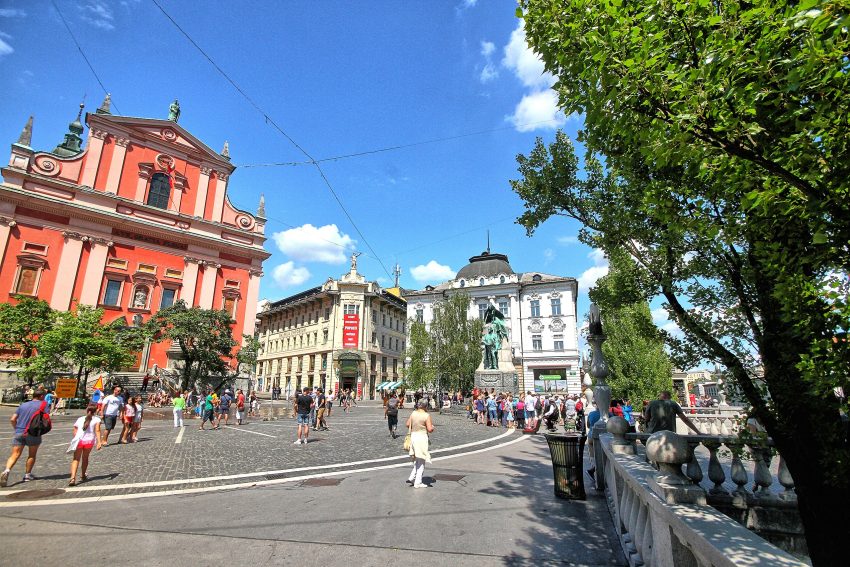
Prešeren Square is a broad, car-free plaza where the old town’s foot traffic and the Triple Bridge’s crossings spill into one another, making it a natural meeting point “under the statue.” At its centre stands the 1905 bronze monument to France Prešeren, Slovenia’s national poet, posed as if looking across the river toward his muse. The square’s most striking backdrop is the Franciscan Church of the Annunciation, its vivid pink façade and twin towers facing the open space like a stage set. Around the edges, ornate townhouses and Secession-era details frame buskers, flower stalls, and the constant flow of cyclists and pedestrians. A bronze scale model of the city helps you get your bearings before drifting into the surrounding streets.
Location: Prešeren Square, Prešernov trg, Ljubljana, Slovenia | Hours: Free – Prešeren Square is a public space open to everyone. | Price: Free – Prešeren Square is a public space open to everyone. | Website | Distance: 0.6km

Explore Ljubljana at your own pace with our self-guided walking tour! Follow our curated route to discover must-see sights and local secrets that makes Ljubljana one of the best places to visit in Slovenia.

4. Triple Bridge (Tromostovje)

Tromostovje
Tromostovje
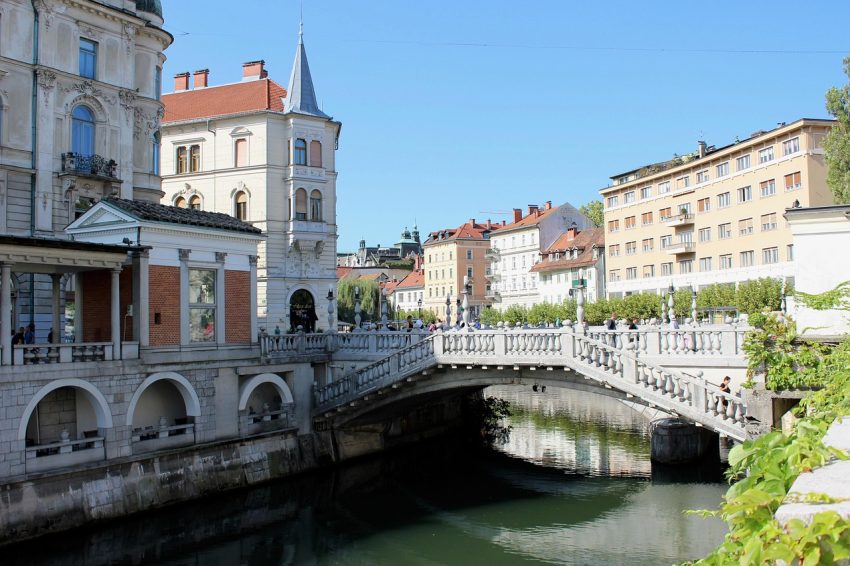
Triple Bridge (Tromostovje) is a three-pronged crossing over the Ljubljanica that fans out between Prešeren Square and the old town, reading as one bridge until you step onto it. Jože Plečnik’s 1930s design kept the original central span and added two pedestrian side bridges, turning a traffic pinch point into a broad public terrace. Stone balustrades, stout columns, and distinctive lamps frame views along the river and up toward the castle-topped hill. What visitors remember is the constant choreography—street musicians, meet-ups, and people pausing mid-bridge for photos as the water and pastel façades reflect below.
Location: Tromostovje, Ljubljana, Slovenia | Hours: Open 24 hours a day; nearby cafés, shops, and restaurants follow their own schedules. | Price: Free – Tromostovje is a public bridge open to everyone at all times. | Website | Distance: 0.6km

5. Kresija Palace
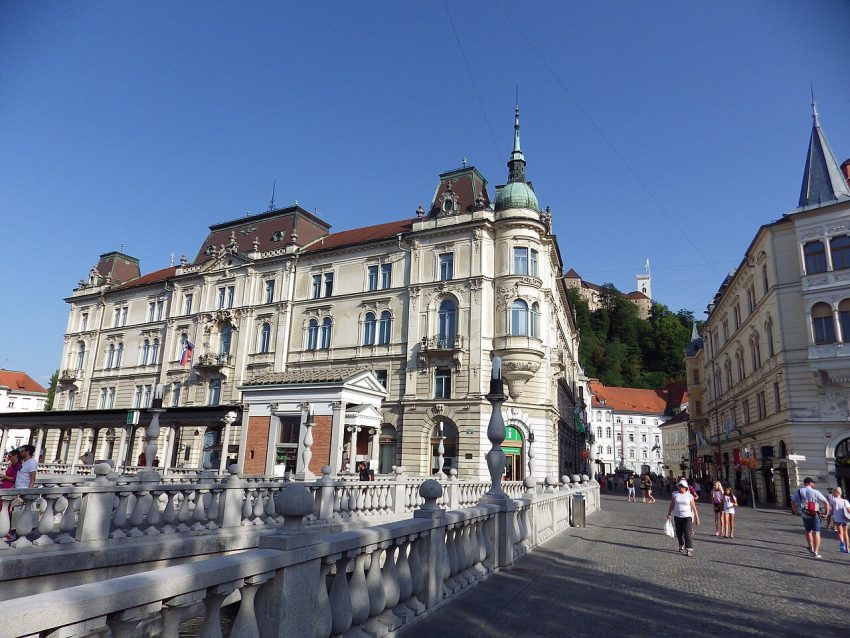
Kresija Building Ljubljana
CC BY-SA 1.0 / puffin11k
Kresija Palace is a Neo-Renaissance civic building that forms a stately gateway from Ljubljana’s riverfront into the Old Town, paired with Filipov Palace and topped by a small turret. Rebuilt after the 1895 earthquake as the administrative seat of the Duchy of Carniola, its orderly rows of windows and ornament still read as official, even in the bustle of everyday streets. Look for the commemorative busts of Protestant grammarian Adam Bohorič and physician Marko Gerbec on the southwestern façade, and plaques near the turret honoring 1991 independence-era defense groups. Inside, the building remains in public use, housing municipal offices, the Kresija Gallery, and the city’s Tourist Information Center, where travelers often note the helpful English-speaking staff.
Location: Ljubljana Tourist Information Center (TIC) Adamič-Lundrovo nabrežje 2 1000 Ljubljana Slovenia | Hours: Ljubljana Tourist Information Center: Monday to Friday: 09:00–19:00; Saturday: 09:00–18:00; Sunday and public holidays: 10:00–16:00 | Price: Free – access to the Tourist Information Center and many exhibitions in the Kresija Gallery is typically free; some special shows may have a small fee. | Distance: 0.7km

6. Cankarjevo Riverside
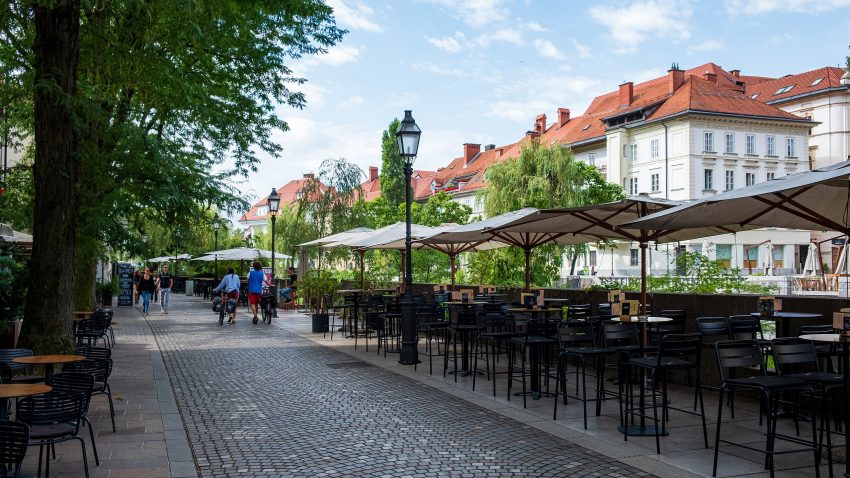
Cankarjevo Riverside in Ljubljana
Public Domain / Julien Maury
Cankarjevo Riverside (Cankarjevo nabrežje) is a cobbled promenade on the Ljubljanica River in central Ljubljana, where the city’s social life gathers at the waterline. Café, bar, and restaurant terraces crowd the edge, and you can linger on benches or low walls watching boats slide past and reflections ripple under Baroque façades mixed with newer buildings. Named for writer and social critic Ivan Cankar, it adds a quiet cultural note to an otherwise easygoing scene of coffee cups and evening drinks. Around dusk, bridge and terrace lights shimmer on the river, turning the walkway into one of the city’s most photogenic stretches. Ribji Square punctuates the riverside with a small fountain and frequent street musicians.
Location: Cankarjevo nabrežje, 1000 Ljubljana, Slovenia | Hours: Open 24 hours a day as a public riverside; individual cafés, bars, and restaurants keep their own hours, generally from late morning until late evening. | Price: Free – Cankarjevo Nabrezje is a public riverside promenade; you only pay for food and drinks in cafés and restaurants. | Distance: 0.7km

7. Ljubljana Cathedral
Stolnica Sv. Nikolaja
CC BY-SA 3.0 / Mihael Grmek
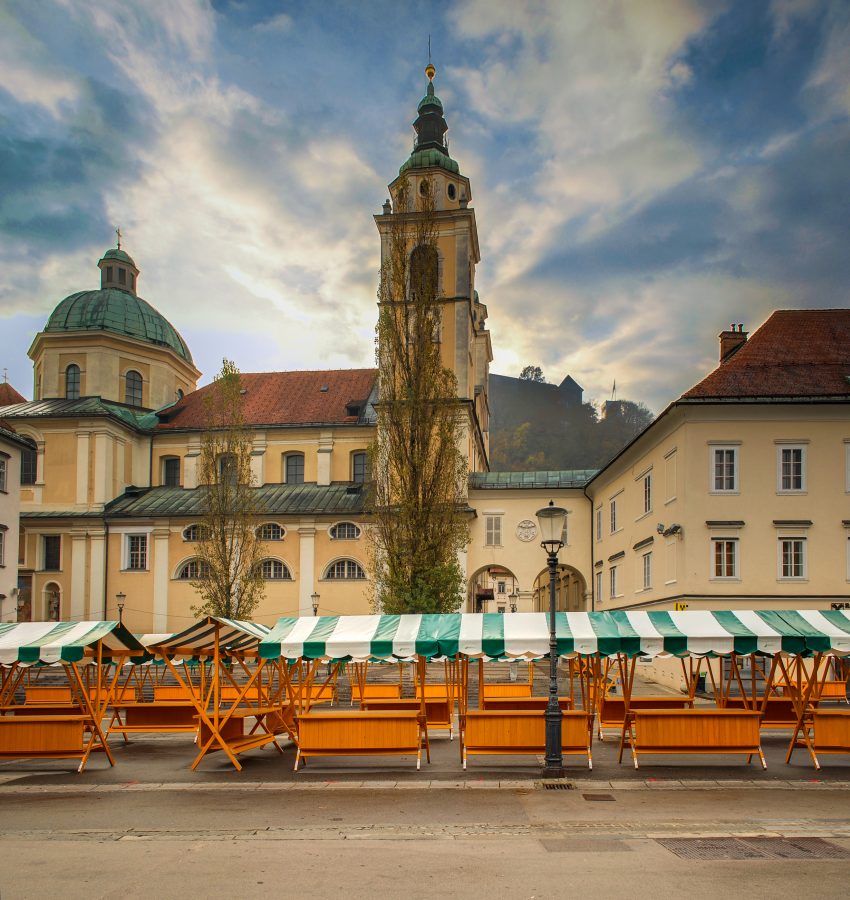
St. Nicholas’s Cathedral is a Baroque church whose octagonal dome and twin western towers (topped with gilded “apples”) dominate the old-town skyline. Built on the site of a 13th-century Romanesque predecessor, its early-18th-century rebuild turned the interior into a theatrical sweep of Giulio Quaglio’s frescoes, stucco, and gold, with sculptural altars including an angel-filled work by Francesco Robba. Outside, look for bishops and saints in façade niches, ancient Roman tombstones reused in the walls, and a Gothic pietà by a side entrance. The modern bronze doors from 1996 add a striking contemporary layer, narrating Slovenia’s Christian story in relief.
Location: Ljubljana Cathedral, Dolničarjeva ulica, Ljubljana, Slovenia | Hours: Typically open daily during daytime hours, with access restricted during services or special ceremonies; check local notices for current times. | Price: Free entry for general visits; donations for the upkeep of the cathedral are appreciated. | Website | Distance: 0.7km

8. Congress Square
Ljubljana Castle from the Congress Square
CC BY-SA 2.0 / Med Cruise Guide
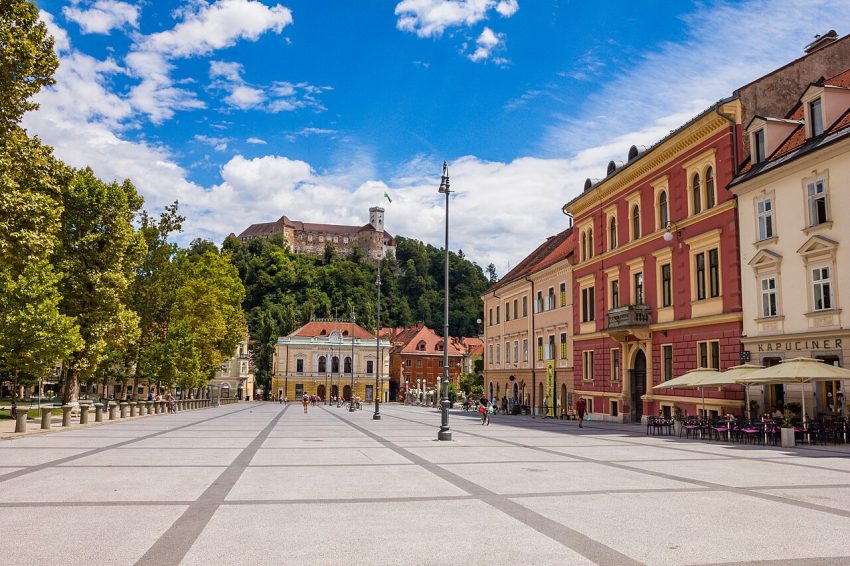
Kongresni Trg (Congress Square) is a broad civic square that feels both formal and lived-in, framed by the Ursuline Church, the Philharmonic, and university buildings, with leafy Park Zvezda opening off one side. Jože Plečnik’s 20th-century redesign gives it a calm order: pale paving slabs traced with dark lines, a measured row of slim lamps, and a precise axis that lines the Trinity Column with the church façade. It has also served as a public stage—independence was proclaimed here in 1918, and major rallies followed in 1945 and 1988. Today you’ll notice students cutting across the grid, and people lingering on benches facing the park’s star-shaped paths and fountain.
Location: Kongresni Trg, Congress Square, Ljubljana, Slovenia | Hours: Open 24 hours a day as an outdoor public space; nearby churches, institutions, and cafés have their own schedules. | Price: Free – Kongresni Trg is a public square open to everyone. | Distance: 0.8km

9. Ljubljana Town Hall
Ljubljana Town Hall
Ljubljana Town Hall
CC BY-SA 2.0 / Ramón
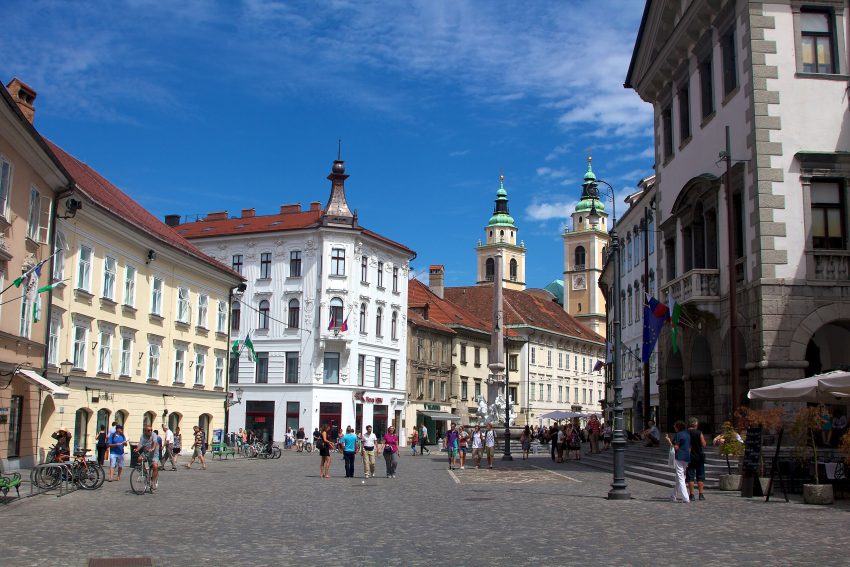
Facing Town Square, the Town Hall is a working civic building whose late-15th-century Gothic origins were refashioned in the early 1700s into a Baroque façade by Carlo Martinuzzi. Visitors linger over the curved gable, arched loggia, and Venetian-style balcony reached by a graceful three-part staircase, with a colourful clock tower marking the skyline. Step inside for plaques and coats of arms that trace shifting regimes, then slip into the courtyard where a replica of Francesco Robba’s Narcissus Fountain is ringed by calm Baroque arches. Many travelers remember it as a surprisingly quiet, photogenic pause amid the old town’s bustle.
Location: Town Hall, Stritarjeva ulica, Ljubljana, Slovenia | Distance: 0.8km

10. Vodnik Square
Vodnikov trg Ljubljana
CC BY-SA 2.0 / Marie Thérèse
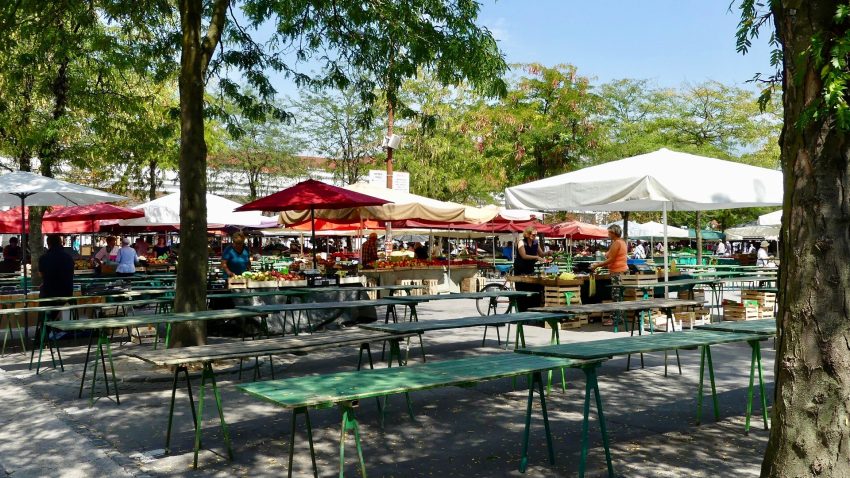
Vodnik Square (Vodnikov trg) is an open space at the edge of the Central Market where a bronze statue of Valentin Vodnik anchors the bustle. Unveiled in 1889 and sculpted by Alojzij Gangl, it was the city’s first public monument dedicated to a Slovene cultural figure—a poet, priest, journalist, and early champion of the Slovene language (and, as locals like to note, a newspaper founder). After the 1895 earthquake cleared the former Capuchin monastery and school, the square evolved into a daily market of seasonal fruit, vegetables, herbs, cheeses, and baked goods. Plečnik’s riverside colonnades frame the stalls, making the mix of monument and morning commerce especially memorable.
Location: Vodnikov trg, Ljubljana, Slovenia | Hours: The square is accessible at all times, but market activity is typically concentrated in the morning and early afternoon, with fewer stalls on Sundays and public holidays. | Price: Free – Vodnikov trg and the outdoor sections of the market are public spaces; you only pay for what you buy. | Distance: 0.8km

11. Ljubljana Castle
Ljubljana Castle
Ljubljana Castle
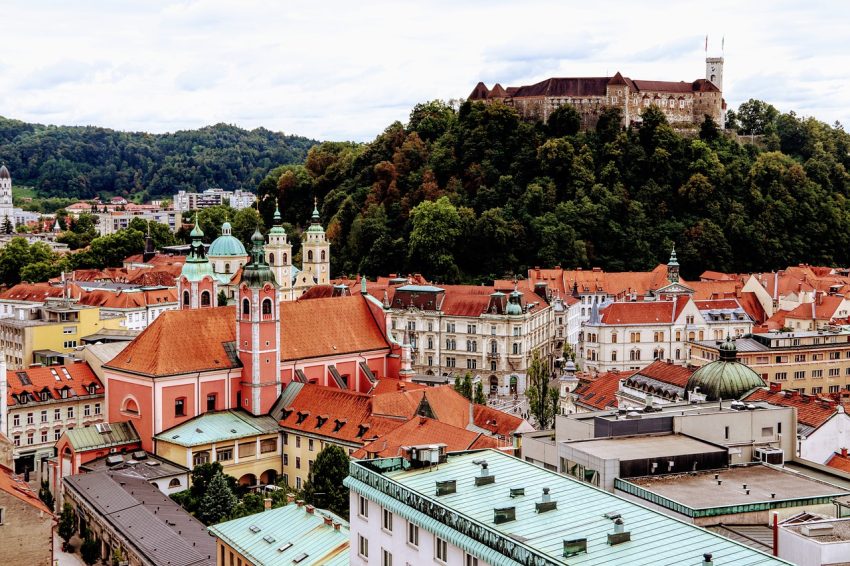
Perched on Castle Hill, this medieval fortress dominates the skyline and explains itself the moment you spot its ramparts and irregular profile from the lanes below. Fortified from the 11th–12th centuries and reshaped with major 15th-century defenses, it served rulers from King Ottokar II to the Habsburgs, later becoming a prison and even a poorhouse before its modern revival. Climb the 1848 Outlook Tower for a near-360° panorama—on clear days stretching toward the Alps—then step into the Chapel of Saint George with its heraldic decoration. Former cells and small museums add a darker, tactile counterpoint to the café-and-courtyard atmosphere.
Location: Ljubljanski grad, Grajska planota, Ljubljana, Slovenia | Hours: Castle and Funicular Railway: January to April & October to December: 09:00 – 19:00; May to September: 09:00 – 22:00 | Price: Adults: Castle €19.00 (+€4.00 for audio guide),Funicular Railway (return ticket): €6.00 | Website | Castle Ticket with Optional Funicular Ride | Distance: 0.9km
Powered by GetYourGuide

12. Cobblers' Bridge

Cevljarski most Cobblers Bridge
Cobblers’ Bridge (Cevljarski Most) is a stone pedestrian bridge over the Ljubljanica in central Ljubljana, linking two old-town streets where daily foot traffic still feels like part of the scenery. The crossing began as a medieval wooden “Upper Bridge” lined with trade stalls; after butchers were moved away, shoemakers took over and left it its lasting name. In 1931 architect Jože Plečnik rebuilt it as a kind of open-air colonnade, with Corinthian pillars defining the edges and Ionic columns holding lamps like a suspended hall above the water. Pause mid-span for river reflections, pastel façades, and a castle-on-the-hill view, then spot the nearby monument to mayor Ivan Hribar.
Location: Čevljarski most, Cobblers' Bridge, Ljubljana, Slovenia | Hours: Accessible 24 hours a day; nearby cafés and shops keep their own schedules. | Price: Free – Cobblers' Bridge is a public pedestrian bridge open to everyone. | Website | Distance: 0.9km

13. Old Square
Stari trg Ljubljana
Stari trg Ljubljana
CC BY-SA 2.0 / Leon Yaakov
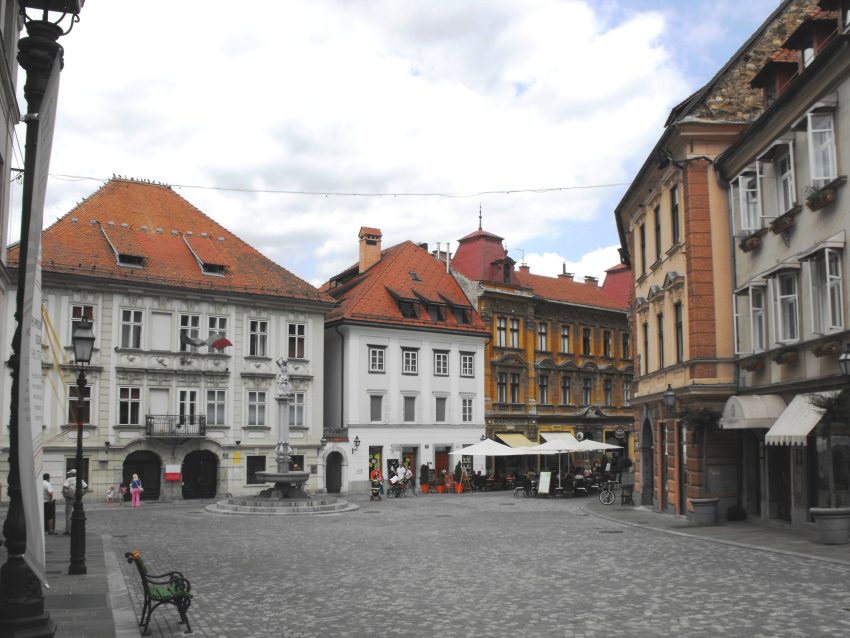
Old Square (Stari Trg) is a gently curving, stone-paved stretch of the old town where the medieval street line still dictates the pace and scale. Baroque townhouses sit beside later historicist and Vienna Secession façades added after the 1895 earthquake, creating a layered streetscape that rewards looking up at carved portals, coats of arms, and ornate window frames. Near the Town Hall end, the Thalnitscher (Dolničar) House sets the tone for a run of Baroque residences, while No. 4 is linked to Johann Weichard von Valvasor. Seek out the Schweiger House (No. 11a), designed by Candido Zulliani in 1748–49, then follow the street toward Levstik Square and the replica of Robba’s Hercules Fountain.
Location: Stari trg, Ljubljana, Slovenia | Hours: Accessible 24 hours a day as part of the pedestrian old town; individual shops, galleries, and cafés have their own opening times. | Price: Free – Old Square is a public street in the old town; you only pay for any cafés, shops, or attractions you choose to visit. | Distance: 1km

Best Day Trips from Ljubljana

A day trip from Ljubljana offers the perfect opportunity to escape the urban rhythm and discover the surrounding region's charm. Whether you're drawn to scenic countryside, historic villages, or cultural landmarks, the area around Ljubljana provides a variety of easy-to-reach destinations ideal for a one-day itinerary.

1. Skofja Loka
Cappuchin Bridge Škofja Loka, Slovenia
CC BY-SA 2.0 / Bernd Thaller
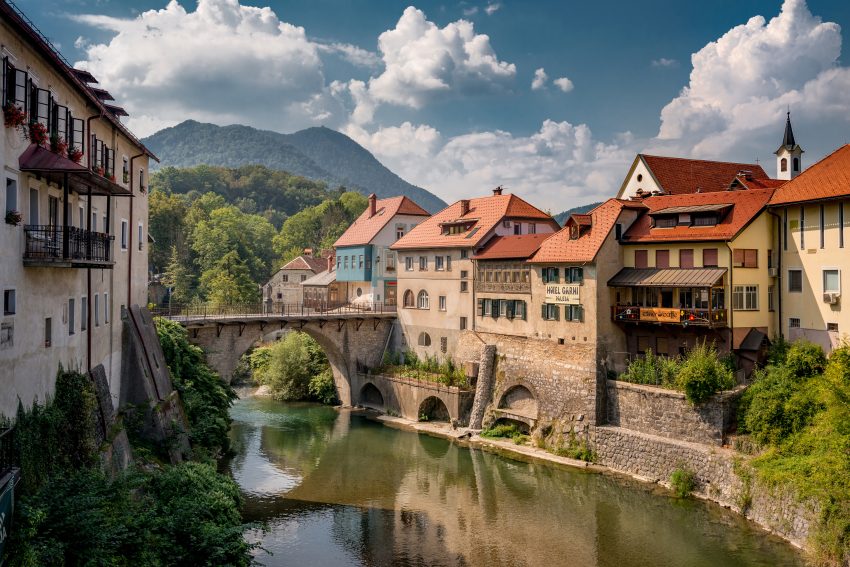
Škofja Loka is the kind of small town that makes you slow down. Tucked where the Poljanska and Selška rivers meet, about 25 kilometres northwest of Ljubljana, it feels like a perfectly framed medieval painting: pastel façades, cobbled streets, a stone bridge, and a castle watching over it all from a wooded hill. First mentioned in 973 AD, it has…
Location: Škofja Loka, Slovenia | Hours: The Old Town is accessible at all times; the castle and museum keep regular daytime hours, typically closing in the late afternoon. | Price: Entry to the Old Town is free; expect a modest fee (often under €10) for Škofja Loka Castle and the Loka Museum, with discounts for children, students, and families. | Distance: 19.7km
Visiting Skofja Loka

2. Škofja Loka
Skofja Loka in Winter from hill
Skofja Loka in Winter
CC BY-SA 3.0 / Mihael Grmek
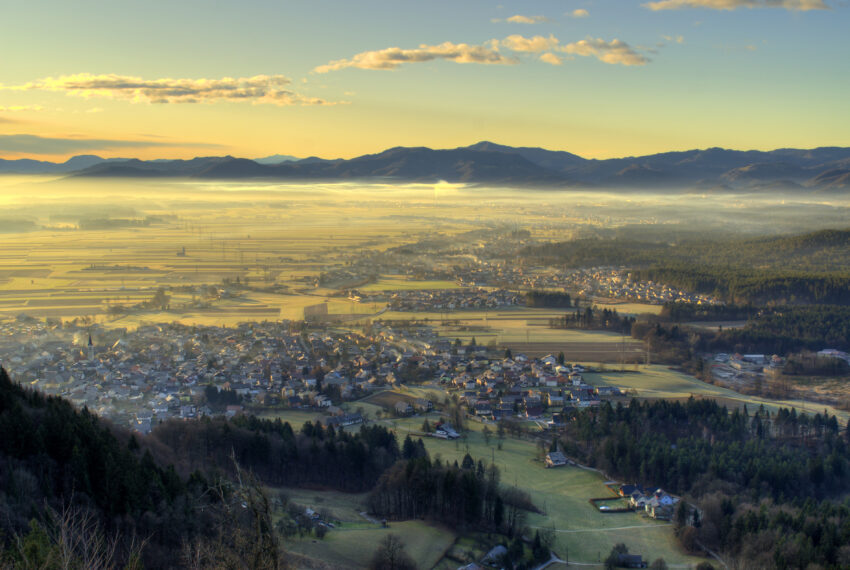
Škofja Loka is one of Slovenia’s most atmospheric small towns, with a compact old centre, river views, painted façades and a castle rising above the rooftops. It sits in the Upper Carniola area, close to Ljubljana, and works especially well for visitors who want a historic town that feels rich in detail without being overwhelming. The old streets are easy…
Visiting Škofja Loka

3. Predjama Castle
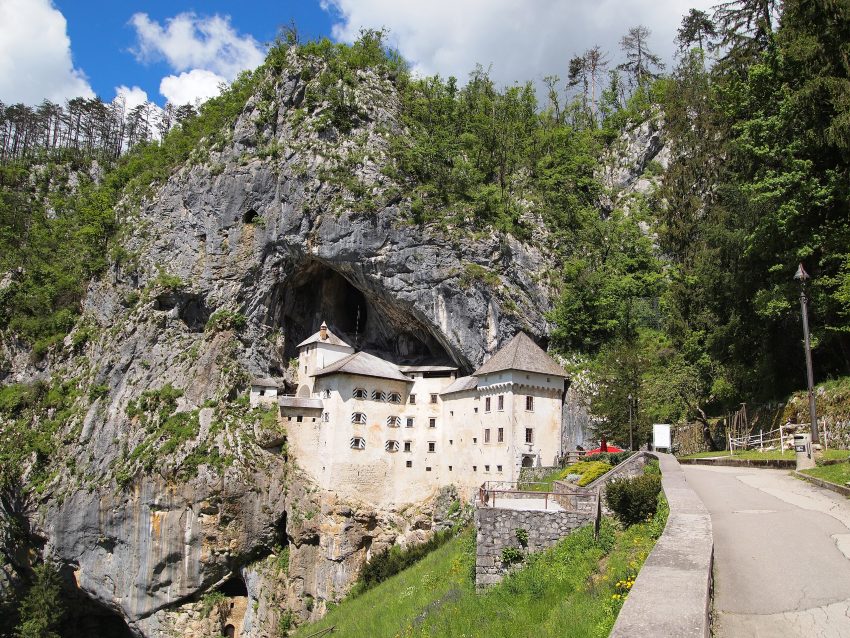
Predjama Castle
Predjama Castle
CC BY-SA 3.0 / Tiia Monto
Predjama Castle is one of those places that looks almost too dramatic to be real. Wedged into a 123-metre-high cliff, it seems to grow straight out of the rock, with its walls merging into the cave mouth behind. Its name literally means “in front of the cave,” and that unusual setting once gave it a huge defensive advantage: attackers could…
Location: Predjama Castle, Predjama, Slovenia | Hours: January – March: 10:00 – 16:00 April & October: 10:00 – 17:00 May, June, September: 09:00 – 18:00 July & August: 09:00 – 19:00 November – December: 10:00 – 16:00 | Price: Adult: €21.00 | Website | Distance: 39.7km
Visiting Predjama Castle
Powered by GetYourGuide

4. Bled

The Complete Guide to Bled
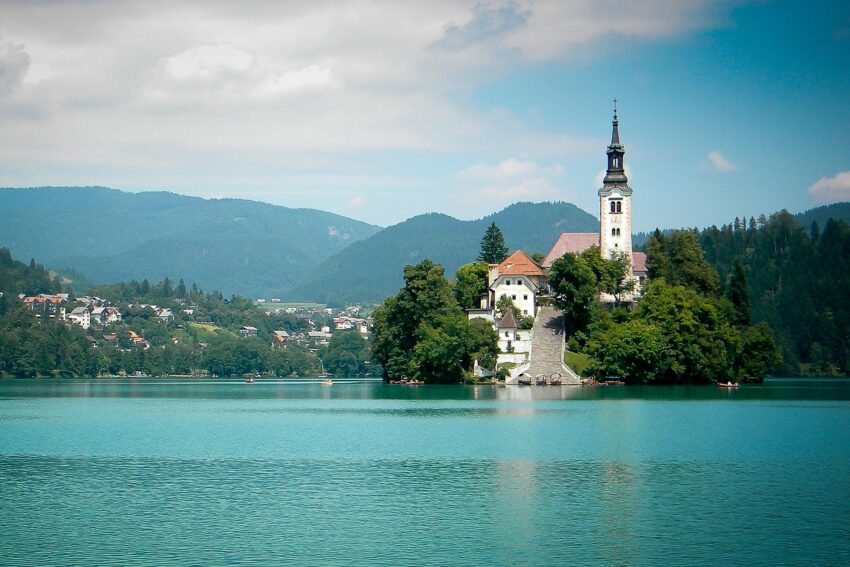
Bled is Slovenia’s postcard-perfect lakeside resort in the Upper Carniola region, on the edge of Triglav National Park and the Julian Alps. The town wraps around Lake Bled, where a turquoise shoreline path, rowing boats, and mountain backdrops make it easy to fill a day with simple, scenic pleasures.Most visits revolve around three icons: the lake loop for views and…
Visiting Bled

5. Triglav National Park
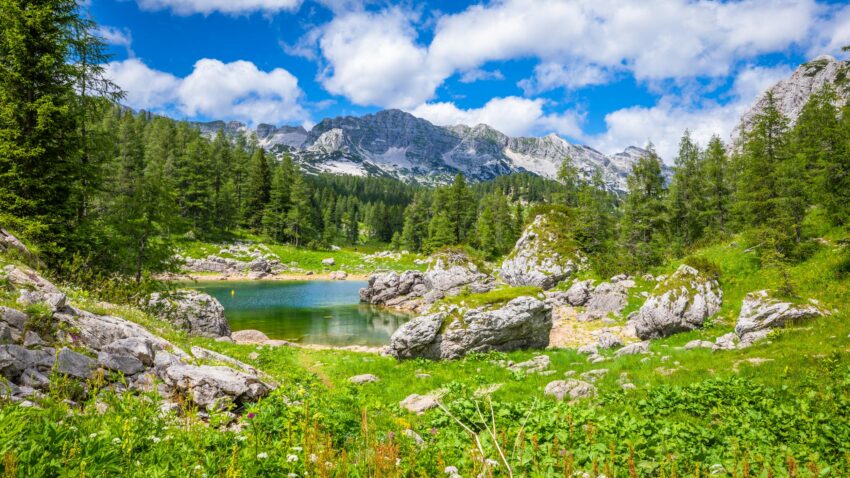
Triglav National Park
Triglav National Park is Slovenia at its most dramatic and elemental. Spreading across a vast area of the Julian Alps, it is the country’s only national park and one of those destinations that feels bigger than any single viewpoint, lake, or mountain hut. You come here for the scale of the landscape: jagged limestone peaks, deep valleys, cold clear rivers,…
Location: Triglav National Park, Bohinjsko jezero, Slovenia | Hours: Daily: Open 24 hours. Visitor centres, mountain huts, and individual attractions inside the park operate on separate seasonal schedules. | Price: Free. The park itself has no general entrance fee, although some specific attractions, gorges, guided visits, parking areas, and services within or at the edges of the park may charge separately. | Website | Distance: 63km
Visiting Triglav National Park

6. Trieste

trieste
trieste
Visiting Trieste offers a unique blend of Italian charm and Central European influence, making it a fascinating destination for travelers. Located at the crossroads of Italy, Slovenia, and Austria, Trieste boasts a rich history and diverse cultural heritage. The city’s stunning architecture reflects its past under the Austro-Hungarian Empire, with grand neoclassical buildings, elegant squares, and a beautiful waterfront promenade.…
Visiting Trieste
Powered by GetYourGuide

7. Villach

The Complete Guide to Villach
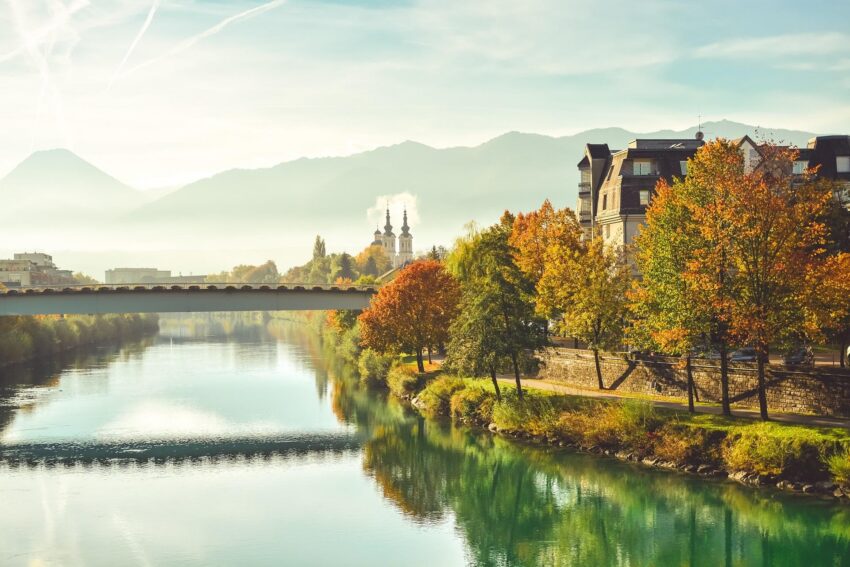
Villach is a relaxed, outdoorsy city in southern Austria, set in the state of Carinthia near the borders with Italy and Slovenia. It makes an excellent base for combining a walkable old town with quick access to lakes, mountains, and cross-border day trips. The River Drau runs through the center, and the surrounding landscape gives the city a bright, open…
Visiting Villach

8. Cividale del Friuli

Cividale del Friuli veduta
CC BY-SA 4.0 / Sirleonidas
Cividale del Friuli, a picturesque town in Italy's northeastern region, offers a captivating blend of history, culture, and natural beauty. Founded by Julius Caesar as a Roman colony in 50 BC, the town's historic center, now a UNESCO World Heritage site, showcases a remarkable array of medieval and Renaissance architecture. Key landmarks such as the Tempietto Longobardo, an exquisite example…
Visiting Cividale del Friuli

9. Portoroz
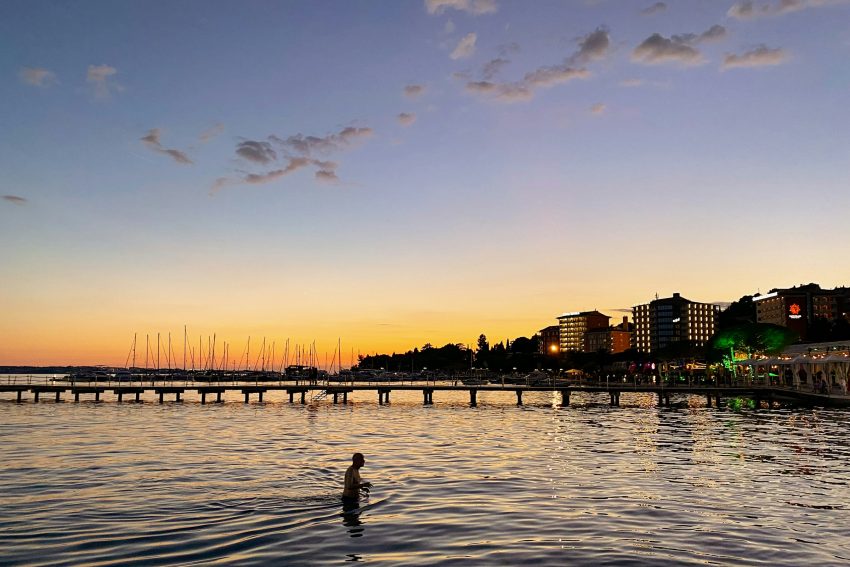
The Complete Guide to Portoroz
Portorož is Slovenia’s best-known seaside resort, set on the Adriatic coast in the Istrian peninsula, where a long promenade, palm-lined streets, and a sheltered bay create an easy, holiday-first atmosphere. Come for the classic beach days—sun loungers, swimming platforms, and calm water—then stay for the mix of spa culture, marina life, and evening strolls that make the town feel lively…
Visiting Portoroz

10. Piran

The Complete Guide to Piran
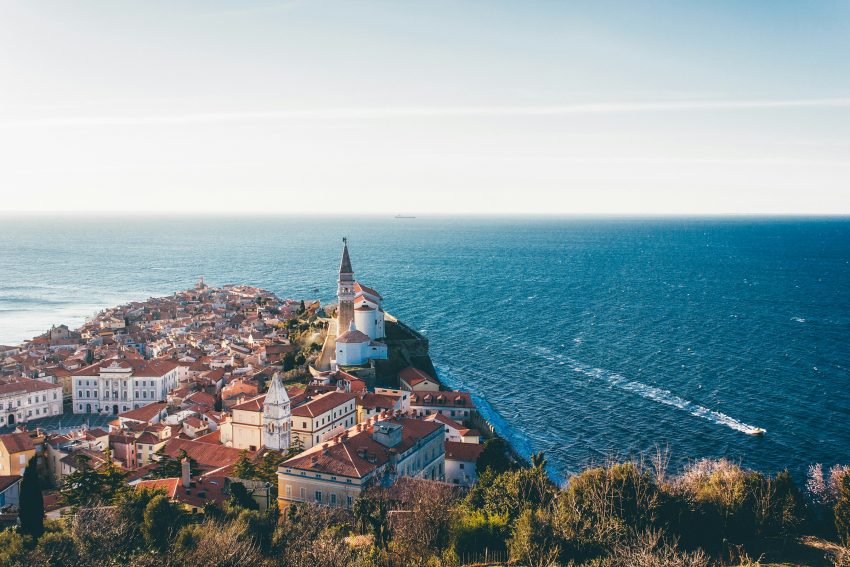
Piran is a postcard-pretty coastal town on Slovenia’s short Adriatic shoreline, set on a narrow peninsula where Venetian-style facades, sea-facing cafés, and stone lanes create an easy, walkable escape. The heart of the experience is simply wandering: you move from sunlit squares to shaded alleys in minutes, with salty breezes and bell chimes as a constant soundtrack. It’s compact enough…
Visiting Piran
Powered by GetYourGuide

11. Udine

udine italy
udine italy
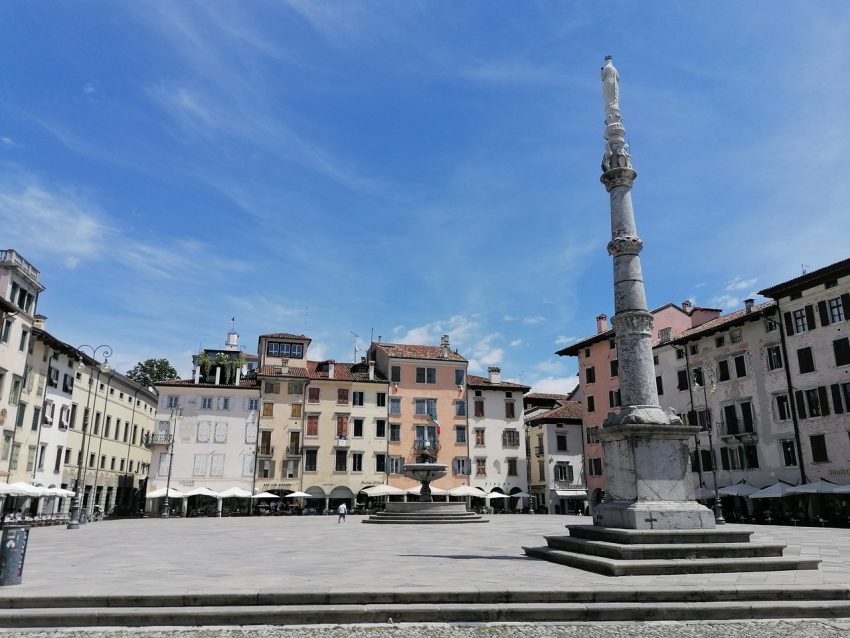
Visiting Udine, located in the northeastern region of Friuli Venezia Giulia, Italy, offers a journey through a city rich in history, art, and culture. Udine is known for its charming old town, where Venetian influence is evident in its architecture and layout. The city’s centerpiece is the stunning Piazza della Libertà, often referred to as the most beautiful square in…
Visiting Udine
Powered by GetYourGuide

12. Maribor

Complete guide to Maribor
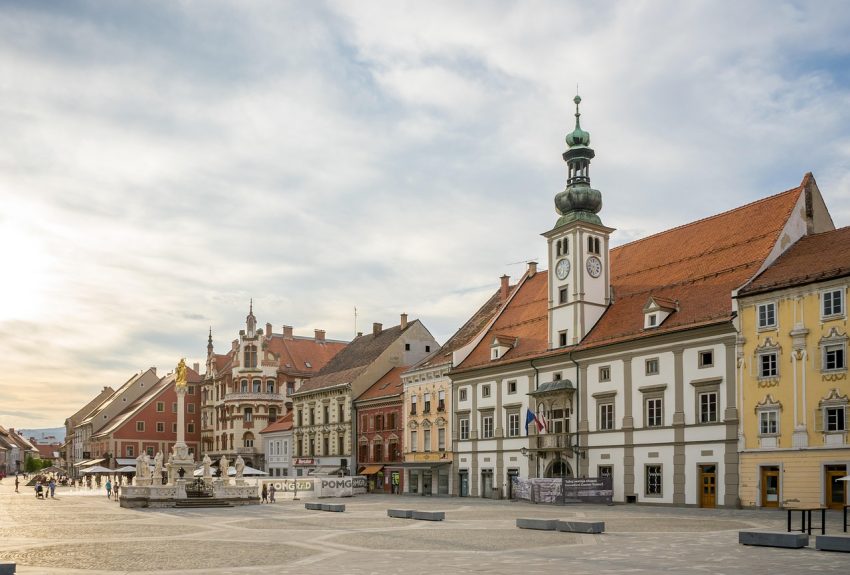
Maribor, the second-largest city in Slovenia, sits in the northeast of the country within the lush wine-growing region of Styria. Nestled along the Drava River and surrounded by rolling hills, vineyards, and the nearby Pohorje Mountains, it offers visitors a perfect balance between urban charm and natural beauty. Its location makes it an appealing stop for those exploring Slovenia beyond…
Visiting Maribor
Powered by GetYourGuide

13. Zagreb

The Complete Guide to Zagreb
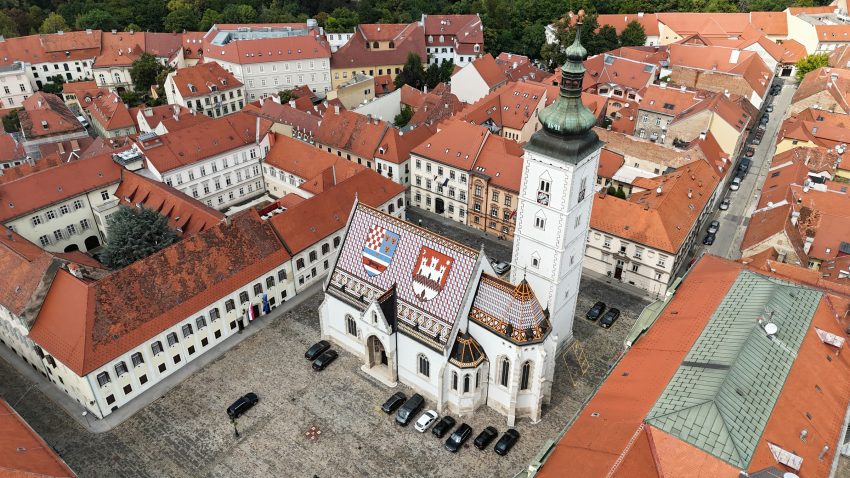
Zagreb is a lively, walkable capital in northwestern Croatia, set between the slopes of Medvednica Mountain and the lowlands of the Sava River. It’s a city of café terraces, leafy parks, and neighborhoods that shift quickly from grand Austro-Hungarian boulevards to intimate lanes and stairways. A visit here feels both relaxed and urban: you can spend a morning browsing markets…
Visiting Zagreb
Powered by GetYourGuide

Where to Stay in Ljubljana

To make the most of visiting Ljubljana and exploring its historic center, staying overnight near the old town is ideal. In the heart of the city, you can find a mix of boutique and luxury hotels that put you within walking distance of landmarks such as Ljubljana Castle, Triple Bridge, and Prešeren Square. For example, Grand Hotel Union offers elegant rooms, a rooftop terrace, and easy access to the pedestrian streets of the old town. Another central option is Hotel Cubo, known for its modern design, spacious rooms, and proximity to cafés and shops.

For travelers looking for a charming, boutique experience, the area around the Ljubljanica River is perfect. Vander Urbani Resort is a stylish hotel with a rooftop pool and riverside dining, giving visitors a blend of relaxation and city access. Nearby, City Hotel Ljubljana offers comfortable accommodations and convenient proximity to cultural sites, markets, and walking routes along the river.

For those preferring a quieter stay while still being close to the center, the district of Bežigrad or further south toward Tivoli Park provides excellent options. Staying slightly outside the old town often offers a more peaceful environment while still keeping the city’s main attractions within easy reach by a short tram, bike, or walking trip. These areas combine urban convenience with calm streets and greenery, ideal for enjoying Ljubljana at a relaxed pace.

Using the our Hotel and Accomodation map, you can compare hotels and short-term rental accommodations in Ljubljana. Simply insert your travel dates and group size, and you’ll see the best deals for your stay.

Ljubljana Accommodation Map

Best Time to Visit Ljubljana

Visiting Ljubljana in Winter

Winter in Ljubljana is relatively mild, with occasional snow that adds a picturesque charm to the old town and riverfront. This is a quieter time for sightseeing, making it ideal for exploring museums, cafés, and historic streets without the crowds. The festive season is particularly appealing, with Christmas markets, lights along the Ljubljanica River, and cultural events creating a cozy atmosphere.

Visiting Ljubljana in Spring (Best)

Spring is considered the best time to visit Ljubljana, as the weather is mild and the city’s parks and riverbanks burst into bloom. Outdoor cafés reopen, and events like the Ljubljana Festival kick off with concerts, theatre, and cultural performances. Spring is perfect for walking tours, cycling along the Ljubljanica, or enjoying boat rides through the historic center while avoiding peak tourist crowds.

Visiting Ljubljana in Summer

Summer brings warmer temperatures and longer daylight hours, ideal for festivals, open-air concerts, and riverside dining. The city comes alive with music, theatre, and cultural events, including the popular Ljubljana Jazz Festival. While it is busier with tourists, summer offers a lively urban vibe, outdoor markets, and opportunities for day trips to nearby natural attractions.

Visiting Ljubljana in Autumn

Autumn in Ljubljana is marked by cooler temperatures and vibrant foliage along the river and in city parks. Wine festivals, food fairs, and cultural exhibitions provide an opportunity to experience local traditions and cuisine. It is also a great time for photography and strolling through the old town, as the tourist crowds thin out and the city takes on a warm, colorful ambiance.

Annual Weather Overview

  • January 5°C
  • February 7°C
  • March 11°C
  • April 17°C
  • May 20°C
  • June 25°C
  • July 27°C
  • August 27°C
  • September 21°C
  • October 16°C
  • November 10°C
  • December 5°C

How to get to Ljubljana

Getting to Ljubljana by Air

Nearest airports: Ljubljana Jože Pučnik Airport (LJU) is the main international gateway, located about 26 km north of the city center. Regular flights connect Ljubljana with major European hubs such as Frankfurt, Vienna, Munich, London, and Paris. From the airport, travelers can reach the city via shuttle buses, taxis, or car hire services, making it convenient for both short stays and longer visits. For the best deals and a seamless booking experience, check out these flights to Ljubljana on Booking.com.

Getting to Ljubljana by Train

Ljubljana is well connected to the European rail network and sits on major lines linking it to cities like Vienna, Zagreb, and Venice. Frequent domestic services run to towns such as Maribor, Koper, and Bled. The central station, Ljubljana Railway Station, is within easy reach of the old town and offers connections to both high-speed and regional trains, making it a practical choice for rail travelers. You can easily check schedules and book tickets through the Slovenian Railways. However, for a smoother experience, we recommend using Omio, which simplifies the booking process and lets you compare prices and schedules all in one place.

Getting to Ljubljana by Car

Driving routes: Ljubljana is accessible via Slovenia's motorway network, with the A1 connecting north to Maribor and south to the Croatian border, and the A2 linking the city to Austria and Italy. Parking in the city center is available in designated lots, underground garages, and on-street zones, though traffic and limited spaces in the old town may require planning.

Travelling Around Ljubljana

Ljubljana’s compact city center is highly walkable, with most landmarks, restaurants, and cafés within easy distance. For longer trips, the city has a reliable bus network, taxis, and bike-sharing schemes, which make it easy to explore neighborhoods beyond the old town. Walking and cycling are particularly enjoyable along the Ljubljanica River and the tree-lined streets of the pedestrian-friendly old town.

More from this area