Self-Guided Walking Tour of Piran, Slovenia (+ Maps)
This website uses affiliate links which earn a small commission at no additional cost to you.
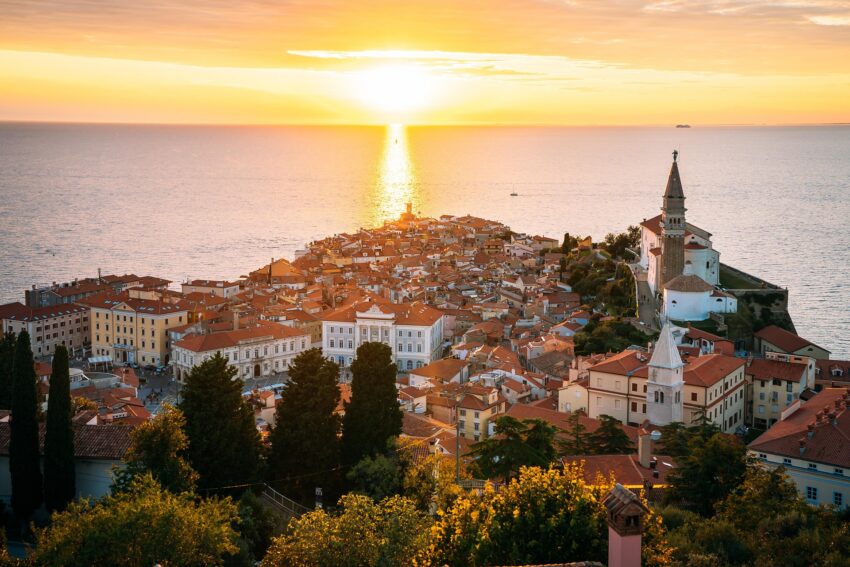
Even though Slovenia's Adriatic coastline is short (around 47 km), it packs in a surprising number of worthwhile stops. The standout and easily one of the most beautiful places to visit in Slovenia is Piran, a charming town perched at the tip of a scenic peninsula. It's the kind of place where Venetian-style facades frame a sunlit main square, narrow stone lanes tumble downhill toward the water, and the salty air follows you from the port to the waterfront promenade.
We came here while travelling up from Croatia in the campervan. It was just going to be a quick stop but we ended up lingering for hours, because almost every lane leads to a postcard view. This is a modified version of the route we took. It is the easiest way to soak up the atmosphere without rushing, and it strings together the best things to see in Piran in a natural loop that feels like you're simply wandering, but with a plan!
How to get to Piran
By Air: The most practical way to reach Piran by air is usually to fly into Slovenia or a nearby airport and continue overland. Slovenia's official tourism guidance notes that travelers can arrive via Ljubljana Jože Pučnik Airport or airports in neighboring countries, which is useful because Piran sits close enough to several cross-border gateways for multi-leg journeys to make sense. From the airport, the final stage is typically by shuttle, bus, hire car or a combination of rail and road transport. For the best deals and a seamless booking experience, check out these flights to Piran on Booking.com.
By Train: Piran does not have its own railway station, so train travel involves arriving elsewhere in Slovenia or in a nearby city and then completing the journey by road. You can easily check schedules and book tickets through the Slovenian Railways. However, for a smoother experience, we recommend using Omio, which simplifies the booking process and lets you compare prices and schedules all in one place.
By Car: The most convenient way to experience Slovenia with this itinerary is by rental car. Driving gives you the greatest flexibility, especially if you want to combine Piran with other stops on the Slovenian coast or nearby parts of Italy and Croatia. Slovenia's tourism guidance highlights that the country is well connected by road and is only a few hours' drive from major regional cities, which makes Piran an easy addition to a broader road trip. Parking is available at the start of the walk.
By Bus: The first time we visited Slovenia, I solely relied on public transportation to get around the country. Bus travel can be a very practical option, particularly if you are arriving from Ljubljana or from nearby airports and regional cities. Official tourism guidance for Slovenia points to a broad coach network, including links with major nearby airports, so buses are often the simplest public transport choice for the final approach to the coast. For many visitors, coach connections are more straightforward than trying to stitch together rail segments for the same journey.
A Short History of Piran
Medieval Piran and the rise of the walled town
Piran’s medieval development can still be read directly in its streets. The town grew as a compact coastal settlement with defensive walls, gates and a religious core on higher ground, and that layered structure remains one of the reasons it is so satisfying to explore on foot today. The preserved walls are not just a surviving monument; they explain why the town feels enclosed, vertical and intimate, with views opening suddenly after narrow, twisting lanes.
One of the key landmarks tied to this early period is the Church of St. George, dedicated to the town's patron saint. The official local tourism material notes that the church was originally built in the 14th century, and its commanding position above the town makes clear how religion, identity and civic pride were closely linked. Even now, climbing toward the church gives you a sense of how medieval Piran would have presented itself: protected, watchful and oriented toward the sea.
Venetian Piran and the shaping of its character
The centuries of Venetian rule left perhaps the strongest visual mark on Piran. The bell tower of St. George's, completed in the 17th century, is described by the local tourism authority as a smaller replica of St. Mark's Campanile in Venice, and that single detail says a great deal about the cultural ambitions of the town during this era. Piran's facades, public spaces and maritime outlook all reflect a period when Venetian style was not an influence at the margins but part of daily civic life.
This is also the period that gives the town much of its romantic appeal for visitors today. The architecture around the central square, the rhythm of the lanes and the visual harmony of stone, shutters and church towers all feel shaped by that long Adriatic connection. When you stand in the main square or look back from the waterfront, you are not seeing isolated historic buildings but the result of a political and commercial world that tied Piran closely to Venice for generations.
Baroque Piran and its landmark skyline
Although medieval foundations remain crucial, some of Piran’s most memorable monuments took on their present form later. The Church of St. George received its Baroque renovation in the 17th century, which gave it much of the appearance visitors see now, including the richly developed interior and the strong visual presence it has above the old town. That renovation shows how the town continued to reshape important buildings rather than simply preserving them unchanged.
The skyline that defines so many views of Piran is therefore not the product of a single age but of adaptation across centuries. The church, the bell tower and the city walls together tell the story of a place that balanced devotion, defense and display. For modern visitors, these are not just beautiful landmarks to photograph; they are the reason the walking tour has such a strong sense of narrative, with each climb and viewpoint connecting architecture to history.
Cultural Piran and the town visitors experience today
Piran’s later identity has also been shaped by culture and memory, not only by trade and defense. Local tourism material emphasizes museums, galleries and the legacy of Giuseppe Tartini, whose name lives on in the town’s main square and broader cultural atmosphere. That means the town’s history is experienced not as something locked behind museum doors, but as something still active in public spaces, names and local storytelling.
For a walking tour, that matters because the most rewarding stops are often the ones where architecture and memory overlap. The central square, the seafront, the church and the walls are attractive in their own right, but they are even more compelling when understood as pieces of a town shaped by religion, Venetian rule, seafaring and cultural self-confidence. Piran feels coherent because its landmarks were not created at random; each one was influenced by the town's changing role over time.
Where to Stay in Piran
To make the most of visiting Piran and this walking tour then you consider stay overnight at the centre. Staying in or close to the old town means you can start early, enjoy the atmosphere after day-trippers leave, and return easily to your room after climbing the lanes and viewpoints. For the most convenient base, the area around Tartini Square is ideal, with central options such as Art Hotel Tartini and Hostel Piran, both of which place you within easy walking distance of the square, the waterfront and the church approach.
If being right by the sea matters more than being directly on the square, the waterfront is an excellent choice for this walking tour. Hotel Piran is particularly well placed for travelers who want sea views and immediate access to the historic core without sacrificing comfort. It works especially well if you want the old town at your doorstep but also like the idea of ending the day with an open seafront setting rather than a room deeper in the lanes.
For a quieter overnight stay, consider the edge-of-town area around Fiesa, which gives you a little more breathing room while still keeping Piran within walking distance. Barbara Piran Beach Hotel suits travelers who want a calmer base and do not mind approaching the old town from outside the densest historic streets. That can be a smart compromise if your priority is a slower seaside stay first and a walking tour second.
Your Self-Guided Walking Tour of Piran
Discover Piran on foot with our walking tour map guiding you between each stop as you explore its Venetian squares, narrow lanes, hilltop church, old defensive walls and atmospheric seafront corners. As this is a self guided walking tour, you are free to skip places, and take coffee stops when ever you want.
1. Walls of Piran
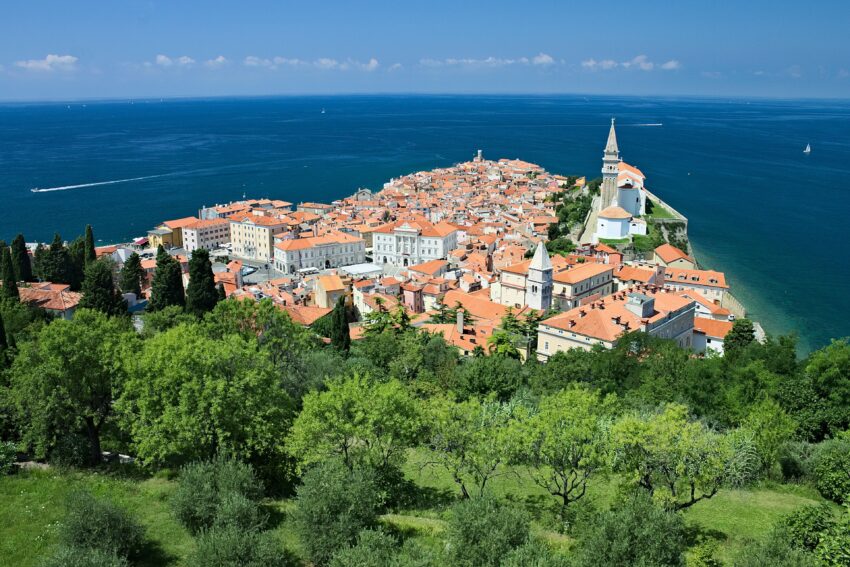
The Walls of Piran ae an obvious start as they are next to the car park and from them you can see the town’s whole shape in one glance. The original fortifications date back as early as the 7th century, and they were repeatedly renovated and strengthened right through to the 16th century, which makes sense when you see how exposed this little peninsula can feel.
Up close, you can see that parts of the walls are ruined, but the accessible sections are well maintained and easy to appreciate as real defensive architecture rather than just a leftover fragment. I tend to slow down here and look for the old towers and the way the stonework changes, because that’s usually where you can feel the “built over centuries” story most clearly.
The best thing to do is climb up to one of the towers and take in the views over the red roofs, the curve of the waterfront, and the sea on both sides of the peninsula. It’s one of those places where you get your bearings fast, and the whole day feels easier after that.
Location: Walls of Piran, Ulica IX. korpusa, Piran, Slovenia | Hours: (Summer) Every day: 08:00–21:00. (Winter) Every day: 08:00–18:30. | Price: 2 € per person | Website


2. Tartini Square
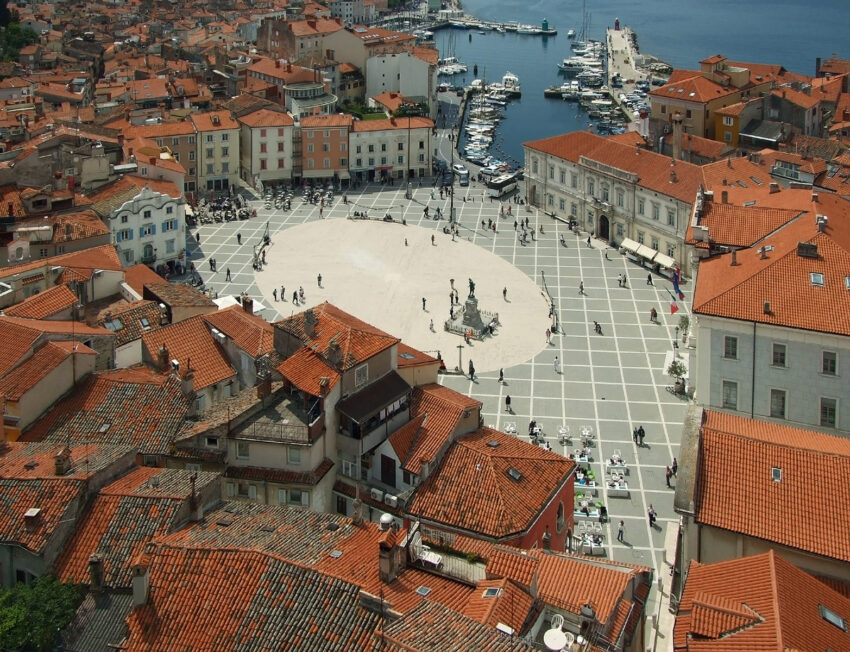
When I step into Tartini Square, it feels like Piran opens up all at once. It’s the town’s main square, unusually broad for such a tight old centre, and it sits right by the waterfront, so you get that mix of grand facades and salty air in the same moment.
Historically, this is where Piran’s public life concentrates—today you can still read that in the layout, with the largest civic buildings facing the open space and cafés and restaurants filling in the edges. I like taking a few minutes just to look up at the colourful fronts and details, because they give the square its distinctly Adriatic, old-town character.
If I have time, I pop into Casa Tartini, the small heritage museum connected with Giuseppe Tartini, the town’s famous composer and violinist. Even if you don’t go inside, this is still the best spot to pause with a coffee, watch the square’s rhythm, and take photos when the light hits the buildings.
Location: Tartini Square, Piran, Slovenia | Hours: 24 Hours. | Price: Free.
3. Town Hall
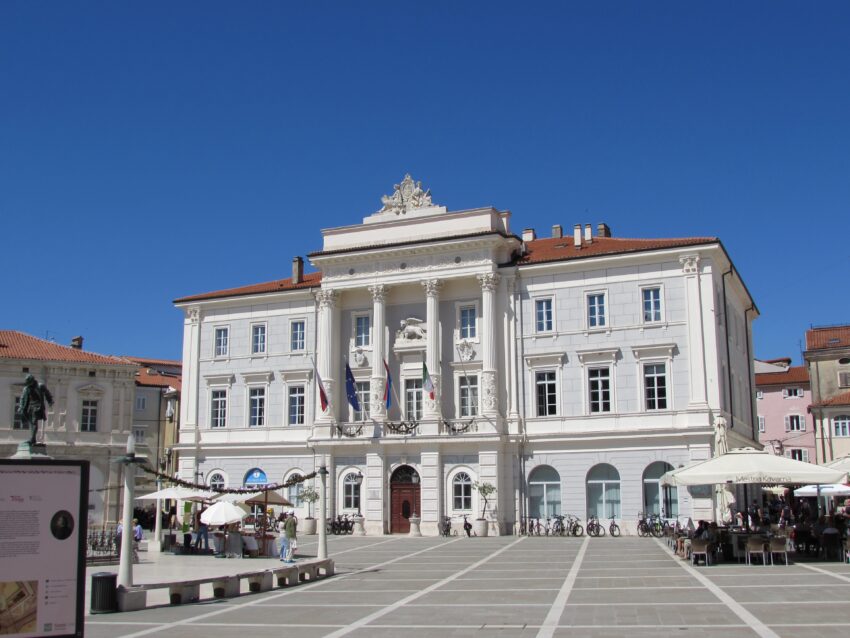
The Town Hall is one of the buildings in Piran that makes the square feel properly civic and historic, not just pretty. It’s described as one of the grandest buildings on Tartini Square, and standing in front of it you get that sense of old authority—this is where administration and daily town life would have intersected for generations.
I find it’s worth looking closely at the façade, because public buildings like this are often where a town “shows” its identity. Even without going inside, the positioning on the square tells you a lot: the most prominent civic architecture faces the main public space, exactly where people naturally gather.
Walk a slow loop of the square, then come back to the Town Hall side to decide what’s next. It’s also a useful point to orient yourself before heading down to the port and promenade.
| Hours: Exterior: 24 Hours. Interior: Administrative building; access is limited. | Price: Free to view from outside.
4. Piran Port
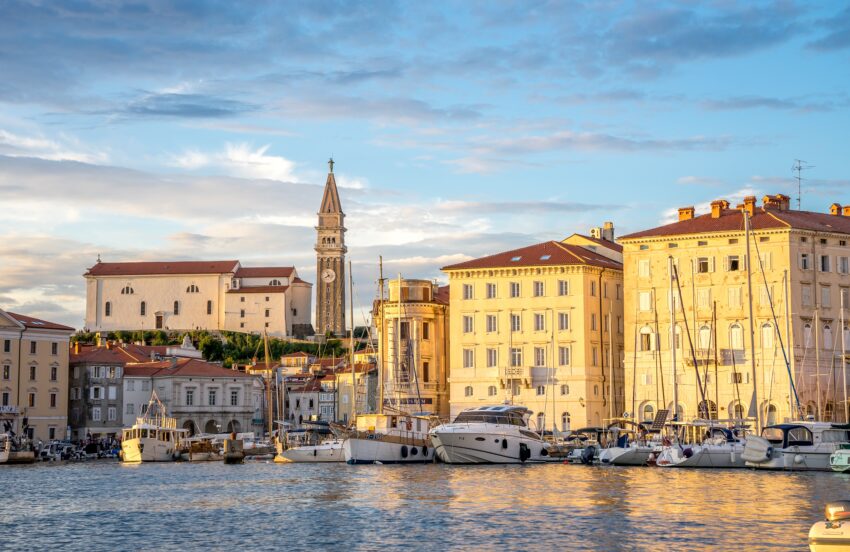
Piran Port is where the town feels most immediately maritime to me, but in a gentle, everyday way rather than anything industrial. It’s described as charming and filled with smaller boats and yachts, and that’s exactly the mood—water, masts, and a relaxed bustle that suits Piran.
I like wandering along the edge and watching the boats shift and creak, then turning into the nearby streets, which are lined with shops and restaurants. This area has a slightly more touristy energy, but it still feels tied to the sea, and it’s a good place to pick up snacks or linger over something cold if the day’s warm.
For sightseeing, it’s less about “one big monument” and more about the atmosphere and viewpoints back toward the old town. I usually pause for photos looking along the curve of the waterfront, because you can see how tightly the town is built right up to the waterline.
Location: Port Piran Tartinijev trg 1 6330 Piran Slovenia | Hours: 24 Hours | Price: Free
5. Sergej Mašera Maritime Museum
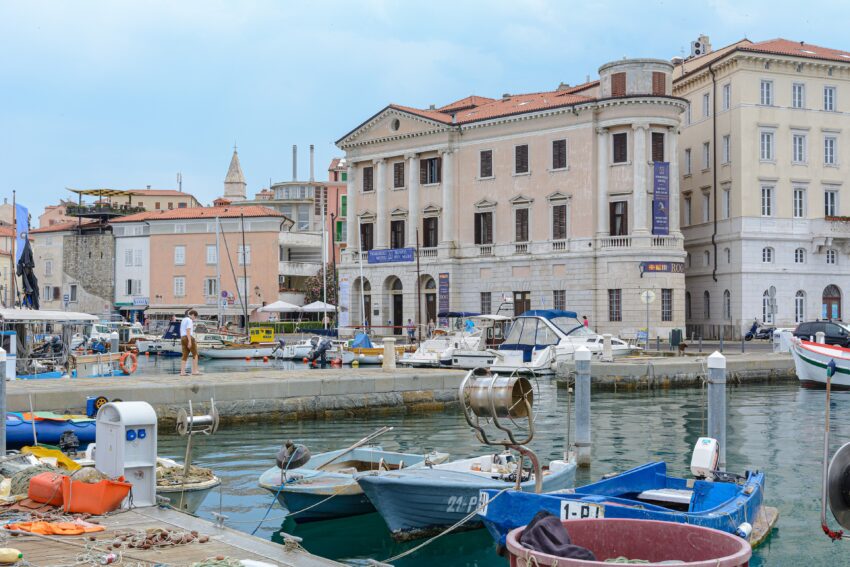
I see the Sergej Mašera Maritime Museum as the best way to connect Piran’s pretty coastal scenery to the deeper story of life on the Adriatic. Even before you go in, the fact that Piran has a dedicated maritime museum tells you how central seafaring identity has been to the town.
Inside, I approach it as a place to slow down and add context to everything I’ve just seen outside—the port, the boats, the waterfront edges. Museums like this tend to make you notice details you’d otherwise walk past, like why the harbour matters, how coastal towns were defended and supplied, and how maritime routes shaped local culture.
Focus on anything that links directly back to what you can see in the streets: coastal navigation, ship life, and how the sea influenced the town’s economy and everyday routine. It’s a practical stop that deepens the experience without taking over the whole day.
| Hours: (September – June) Tuesday – Sunday: 09:00–17:00. (July – August) Tuesday – Sunday: 09:00–12:00 & 17:00–21:00. Closed on Monday. | Price: Adults 5.00 €; students and pensioners 4.00 €; children 3.00 €; family ticket 12.00 €. | Website
6. Piran Waterfront Promenade
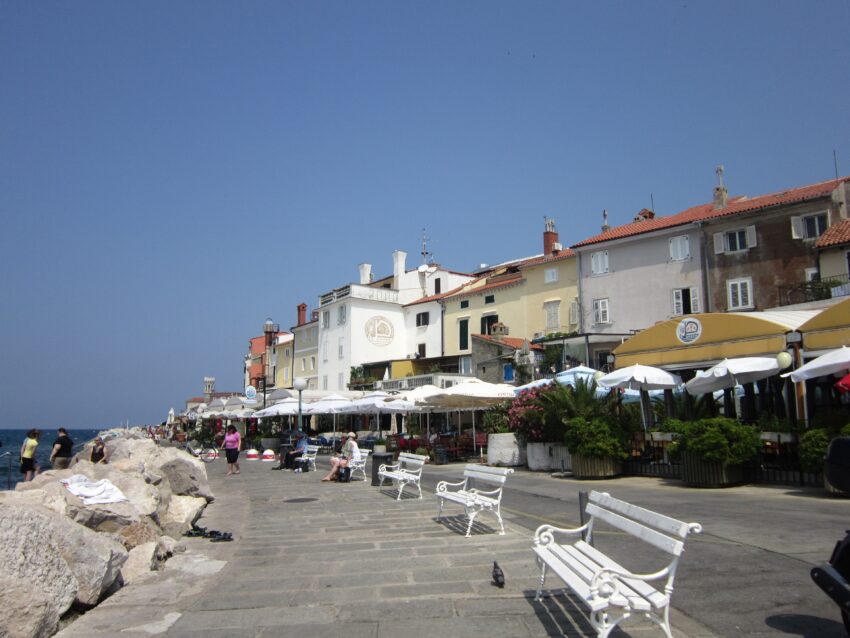
The Piran Waterfront Promenade is the stretch I naturally return to again and again because it’s simply easy to enjoy. With the sea on one side and restaurants on the other, it’s described as relaxing, and it really is—the kind of place where you can walk slowly without feeling like you’re “missing” anything.
Historically, promenades like this are where a coastal town’s working edge gradually becomes a social one, and you can feel that transition here. The waterfront is still part of Piran’s identity, but it’s also a stage for modern life: lunch terraces, evening strolls, and the steady pull of the view.
Have a look at the changing colour of the water, the perspective back toward the old town, and the way the peninsula narrows as you continue. I like timing this for later in the day if I can, when the light softens and the whole waterfront starts to glow.
| Hours: 24 Hours. | Price: Free.
7. Piran Lighthouse
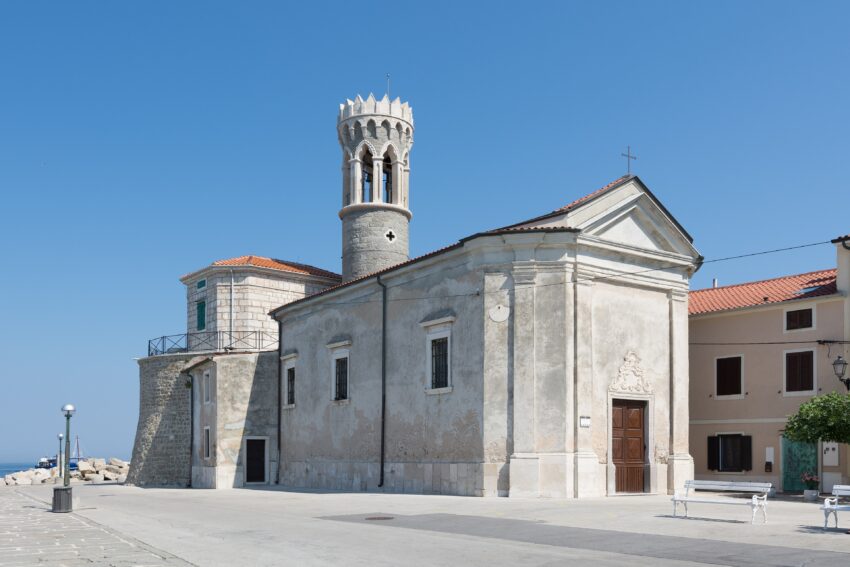
The Piran Lighthouse is one of my favourite “end-of-the-peninsula” sights because it feels both scenic and historically grounded. It’s described as architecturally significant, and the detail that it’s built on a defensive sandstone tower from around the 16th or 17th century makes it more than just a pretty viewpoint.
When I get there, I like circling the area first and taking in the sea on either side—this is where you really feel Piran’s geography, with water wrapping the town and the horizon opening up. It’s a strong contrast to the tight lanes back in the centre, and that shift is part of the appeal.
If it’s open, you can go inside for a small fee, but even without that, the lighthouse is worth it for the views and the sense of standing on a historic defensive point that later took on a navigational role. It’s a simple stop, but it sticks in my memory.
Location: Piranski svetilnik, Prešernovo nabrežje, Piran, Slovenia | Hours: April: Friday, Saturday, Sunday 11:00 - 17:00 May: Friday, Saturday, Sunday 11:00 - 17:00 June: Friday, Saturday, Sunday 10:00 - 17:00 July: 9:00 - 12:00 and 17:00 - 21:00 August: 9:00 - 12:00 and 16:00 - 20:00 September: 10:00 - 18:00 October: 10:00 - 17:00 | Price: Adults: €3 | Website
8. St. George’s Cathedral
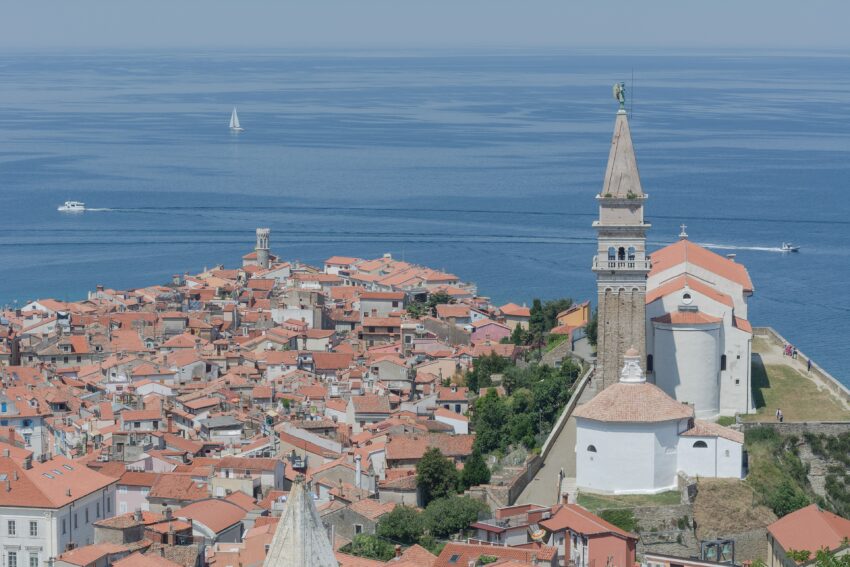
St. George’s Cathedral sits at the top of the hill, and for me it’s the place where Piran’s beauty becomes panoramic. The best thing about it is the view over the town and out toward the Mediterranean, and that elevated position is exactly why it’s such a defining landmark.
I like approaching it from below because the climb builds anticipation—rooftops drop away behind you, and the sea keeps appearing between buildings. Once you’re up there, you get a clear sense of how the cathedral influences the town’s “map in your head”: it’s a visual reference point you keep spotting from streets and waterfront corners.
If you want the best viewpoint, you can climb the bell tower for an even higher perspective. I usually spend a while here, because it’s the kind of place where you naturally review everything you’ve seen—square, port, promenade, walls—and understand how all of it fits together on the peninsula.
Location: Cerkev svetega Jurija, Adamičeva ulica, Piran, Slovenia | Price: Free; donations appreciated.

Moira & Andy
Hey! We're Moira & Andy. From hiking the Camino to trips around Europe in Bert our campervan — we've been traveling together since retirement in 2020!
This website uses affiliate links which earn a small commission at no additional cost to you.
Walking Tour Summary
Distance: 2 km
Sites: 8