Self-Guided Walking Tour of Nîmes (2026)
This website uses affiliate links which earn a small commission at no additional cost to you.
Nîmes is one of those cities where a short walk can cover two thousand years of history, from monumental Roman engineering to grand 19th-century boulevards and café-lined squares. A self-guided route works particularly well here because the centre is compact, the major sights sit close together, and you can linger where you like-whether that’s inside an ancient arena, in a museum, or on a terrace with a coffee.
This Self-Guided Walking Tour of Nîmes is designed to keep the pace relaxed while still capturing the best things to see in Nîmes in a single outing. Expect a mix of headline Roman sites, smaller architectural details you might otherwise miss, and the everyday atmosphere that gives the city its character-markets, fountains, shaded lanes, and open plazas that naturally break up the walk.
Because you’re doing it independently, you can shape the day around your interests: start early for quieter streets and cooler temperatures, build in longer stops for interior visits, or time it so you finish near the best spots for apéritifs and dinner. It’s an easy, satisfying way to understand Nîmes beyond a checklist-moving through the city in a way that lets its layers reveal themselves naturally.
Table of Contents
- How to Get to Nîmes
- A Short History of Nîmes
- Roman Nîmes: Foundation, Empire, and Monument-Building
- Medieval Nîmes: Continuity, Christianity, and a Changing City
- Early Modern Nîmes: Trade, Town Life, and the Rise of Public Spaces
- 19th-Century Nîmes: Boulevards, Civic Confidence, and the Modern City
- Contemporary Nîmes: Heritage Reimagined and Culture on Display
- Where to Stay in Nîmes
- Your Self-Guided Walking Tour of Nîmes
How to Get to Nîmes
By Air: The most convenient airports for Nîmes are Montpellier-Méditerranée (MPL) and Marseille Provence (MRS), both with broad domestic and international coverage; from either, you can continue by train (often via Montpellier Saint-Roch/Sud de France or Marseille Saint-Charles) or by pre-booked shuttle, taxi, or car hire depending on arrival time and budget. Nîmes also has Nîmes Alès Camargue Cévennes Airport (FNI), but services there are limited and seasonal, so it's usually a “nice if it lines up” option rather than the default. If you're landing in Paris or Lyon, it can still be efficient to connect straight onto the rail network rather than driving the whole way. For the best deals and a seamless booking experience, check out these flights to Nimes on Booking.com.
By Train: Nîmes is well connected on the French rail network, with frequent services from major cities in the south and straightforward links onward via regional TER trains. You'll typically arrive at Nîmes station (Gare de Nîmes Centre), which is walkable to the historic core and well placed for hotels and sightseeing, making rail the easiest choice if you want to avoid parking and traffic. If you're coming from Paris, high-speed services can make the journey time-competitive with flying once you factor in airport transfers, and if you're touring nearby places like Avignon, Montpellier, Arles, or the Camargue gateways, regional trains are a practical way to stitch the area together. You can use SNCF Connect to check schedules, compare routes, and purchase tickets for National (SNCF ) and regional trains (TER). For a more streamlined experience, we recommend using Omio, which allows you to easily compare prices, schedules, and book tickets for both National and Regional travel across all of Europe, all in one place.
By Car: Driving to Nîmes is straightforward thanks to the A9 motorway (a key east-west corridor in the south of France) and the A54 connection toward Arles, which makes the city a handy base if you're combining it with day trips. The main consideration is parking: the centre is compact and best explored on foot, so it's usually smarter to park once (in a public car park or at your accommodation) and leave the car there rather than trying to hop between sights. If you're arriving during summer weekends or around major events, allow extra time for traffic around the ring roads and plan where you'll park in advance. If you are looking to rent a car in France I recommend having a look at Discover Cars, first, as they compare prices and review multiple car rental agencies for you.
By Bus: Long-distance coaches can be a good-value option for reaching Nîmes from other French cities and nearby hubs, often with direct routes that avoid the cost of high-speed rail. The trade-off is journey time, which can be longer and more variable with traffic, but it can work well if you’re travelling on a budget or arriving from a place without an easy train connection. Check where the coach sets down in relation to the centre and your accommodation, as it may be a short walk or a quick local bus ride to reach the historic core.
How to get around the city: The historic centre of Nîmes is highly walkable, and most major sights sit within an easy strolling radius, making walking the default for a self-guided visit. For longer hops-such as to outer neighbourhoods, parks, or specific museums-local buses are simple to use, and taxis or ride-hailing can help if you’re short on time or travelling late. If you have mobility concerns, consider planning your route to minimise gradients and steps around older streets, and build in breaks at the many squares and café terraces that naturally punctuate the city.
A Short History of Nîmes
Roman Nîmes: Foundation, Empire, and Monument-Building
Nîmes’ identity is inseparable from its Roman era, when the city expanded into a prosperous regional centre shaped by imperial planning, civic pride, and monumental architecture. The Arena of Nîmes remains the most immediate symbol of that period: a vast amphitheatre built for spectacles that also signalled status, organisation, and Roman cultural life. Nearby, the Maison Carrée reflects the same ambition in a different register-a remarkably preserved temple form that points to the importance of religious and civic ceremony in the urban fabric.
The scale and coherence of Roman Nîmes can still be felt in the way major sites relate to one another, as if the ancient city’s “public rooms” never quite stopped functioning. Modern interpretation has sharpened that understanding, particularly through the Musée de la Romanité, which frames the Roman story through archaeology, daily-life objects, and the long afterlife of Roman structures. Together, the amphitheatre, the temple, and the museum make it easy to read Nîmes as a place where the Roman past is not just an episode but an organising principle.
Medieval Nîmes: Continuity, Christianity, and a Changing City
After antiquity, Nîmes entered a period of adaptation rather than disappearance, with older monuments reused and new religious and civic structures reshaping the centre. The city’s Christian life became increasingly visible in its churches, with Nîmes Cathedral acting as a key marker of medieval continuity and later rebuilding. In this era, the rhythm of urban life shifted toward neighbourhoods, markets, and parish spaces, while older Roman remains became part of the everyday landscape-stone, walls, and spaces repurposed to meet new needs.
The medieval centuries also set patterns that still define how Nîmes feels to walk through today: tighter streets, shaded lanes, and small squares that open suddenly from narrow approaches. Routes like Rue de l’Aspic capture that lived-in continuity-commercial energy layered over older street lines-while the historic centre’s mixture of stonework and irregular planning hints at the city’s long habit of rebuilding on its own foundations.
Early Modern Nîmes: Trade, Town Life, and the Rise of Public Spaces
In the early modern period, Nîmes’ fortunes were increasingly tied to commerce and crafts, with the city’s public life expressed through markets, civic administration, and the refinement of central gathering points. Places that function as social anchors today-such as Place de l’Horloge-echo that evolution, where timekeeping, trade, and public meeting became part of a recognisably “modern” city routine. The steady growth of market culture also laid groundwork for enduring institutions like Les Halles de Nîmes, reinforcing the idea of Nîmes as a city that has always organised itself around what people buy, sell, eat, and share.
This was also the era when the city’s identity became less exclusively “monumental” and more about movement and everyday life: streets connecting workshops and shops, squares that hosted events, and promenades that made urban space feel social rather than purely functional. Those habits-strolling, shopping, meeting-remain central to experiencing Nîmes on foot.
19th-Century Nîmes: Boulevards, Civic Confidence, and the Modern City
The 19th century brought a new kind of city-making to Nîmes: broader avenues, formal promenades, and landscaped spaces designed for leisure as much as movement. The Esplanade Charles-de-Gaulle reflects that civic confidence, offering a sense of openness and ceremony that contrasts with the tighter grain of the older streets. This period also reinforced the practice of presenting the city as an attractive public stage-places to see and be seen, to attend events, and to enjoy shaded walks.
At the same time, modernisation sharpened the contrast between Nîmes’ Roman inheritance and its contemporary ambitions. Rather than replacing the ancient landmarks, the city increasingly learned to frame them-integrating them into a modern streetscape and public life, so that the Arena of Nîmes and the Maison Carrée became not ruins on the edge, but centrepieces in a living city.
Contemporary Nîmes: Heritage Reimagined and Culture on Display
In recent decades, Nîmes has leaned into a dual identity: rigorous preservation of its ancient core alongside confident contemporary design and cultural programming. The pairing of the Maison Carrée with the Carré d’Art is the clearest expression of that approach-classical lines and modern architecture facing each other in an intentional conversation about continuity and change. The Musée de la Romanité extends the same idea, using a modern museum setting to deepen the Roman story while keeping it accessible, walkable, and part of everyday urban experience.
Today’s Nîmes is also defined by how its historic centre functions as a lived space rather than a static backdrop: markets at Les Halles, the steady flow through the old streets, and public squares that remain busy from morning to late evening. The result is a city where history is not confined to plaques and monuments, but felt in how people move, gather, and use the same central spaces-layer by layer, century by century.
Where to Stay in Nîmes
To make the most of visitng Nîmes and this walking tour then you consider stay overnight at the centre. The historic centre is the most convenient base because you can walk to the Arena, Maison Carrée, Place de l’Horloge, and the museum district in minutes, and you’ll have cafés and restaurants on your doorstep for early starts or late evenings. Good, well-located options here include Margaret - Hôtel Chouleur, Hôtel Imperator Maison Albar, Best Western Le Marquis de La Baume, and Appart’City Collection Nîmes Arènes.
If you want to be close to the Arena and the station for easy arrivals, departures, and day trips, the Arènes and Gare area is practical while still keeping the walking route effortless. This is a good choice if you’re arriving by train, travelling light, or prefer a modern hotel set-up with straightforward access and late check-in. Consider Hôtel Kyriad Nîmes Centre, Novotel Atria Nîmes Centre, Ibis Nîmes Centre, and Hôtel C Suites.
For a calmer feel with green space nearby, look around the Jardins de la Fontaine and Tour Magne side of the city, where you can start the day with a quieter stroll and still reach the historic core quickly. This area suits travellers who like a more residential atmosphere, easy morning walks, and a slightly slower pace while staying close enough to dip into the centre whenever you want. Strong choices in and around this side include Logis Hôtel Jardins Secrets, Hôtel des Tuileries, Hôtel Vatel, and Odalys City Nîmes Arènes.
Your Self-Guided Walking Tour of Nîmes
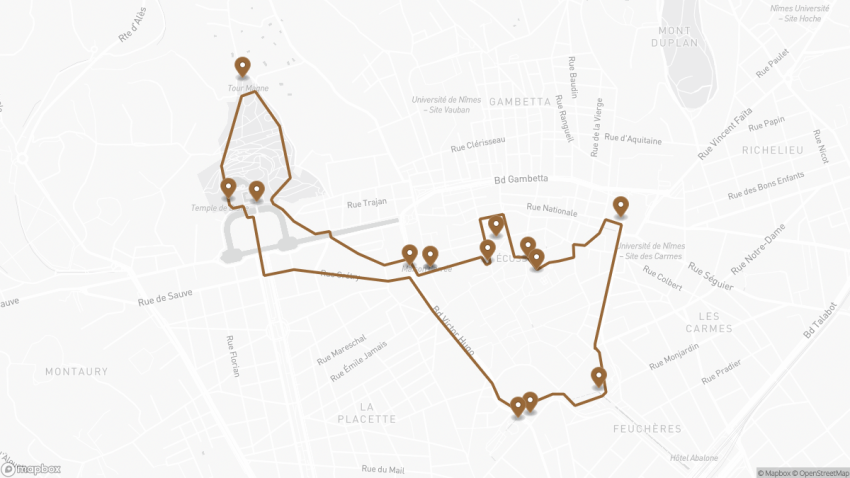
Discover Nîmes on foot with a walking tour map that guides you from stop to stop as you explore the city’s standout sights. Because it’s self-guided, you can set your own pace-skip anything that doesn’t interest you, linger where you want, and build in as many coffee breaks as you like along the way.
Your main decision is simply which direction to follow the loop-clockwise or anti-clockwise-and that mostly comes down to whether you want to visit the indoor market. Les Halles de Nîmes is best earlier in the day, opening at 7am and closing at 1pm, so if it’s on your list, plan to reach it in the morning and shape the rest of the route around that.
1. Esplanade Charles-de-Gaulle
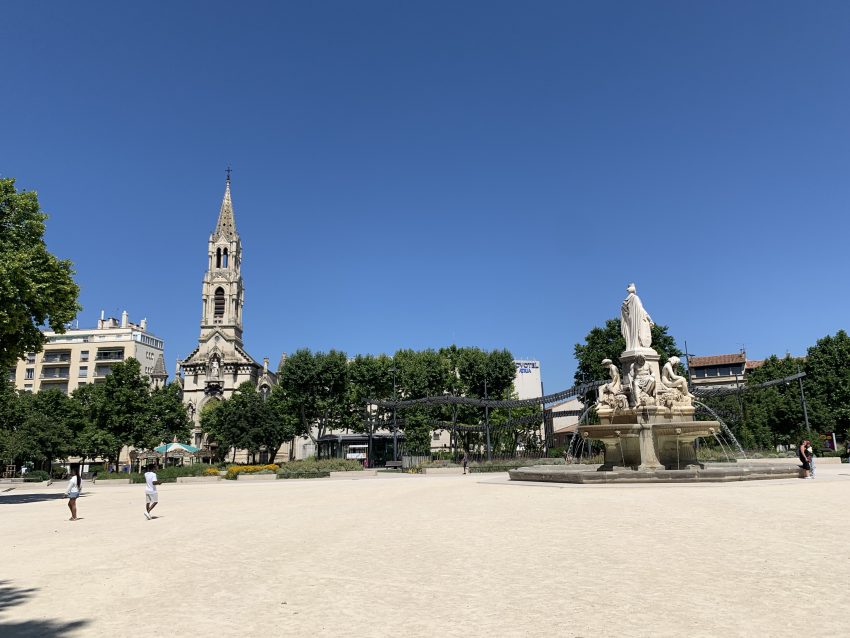
Laid out as part of Nîmes’ 19th-century urban expansion, the Esplanade Charles-de-Gaulle became the city’s “front lawn” between the railway station and the historic core. Like many French esplanades of the period, it was designed for promenading, civic events, and creating a grand approach into town. Its name reflects the post-war era, when public spaces across France were rededicated to national figures.
Today it’s a broad, leafy space that works as a buffer between modern Nîmes and the older streets beyond. The layout is deliberately open, with long sightlines, shaded walks, and areas that host seasonal installations and public gatherings. It’s also a good place to get your bearings before heading toward the Roman monuments.
Look for the fountains, formal plantings, and the way the Esplanade frames views toward central landmarks. Depending on the time of year, you may find markets, temporary exhibitions, or festivals using the space. Even on quiet days, it’s a useful pause point: benches, shade, and a steady flow of local life.
Location: 3 Bd de Prague, 30000 Nîmes, France | Hours: 24 Hours. | Price: Free.

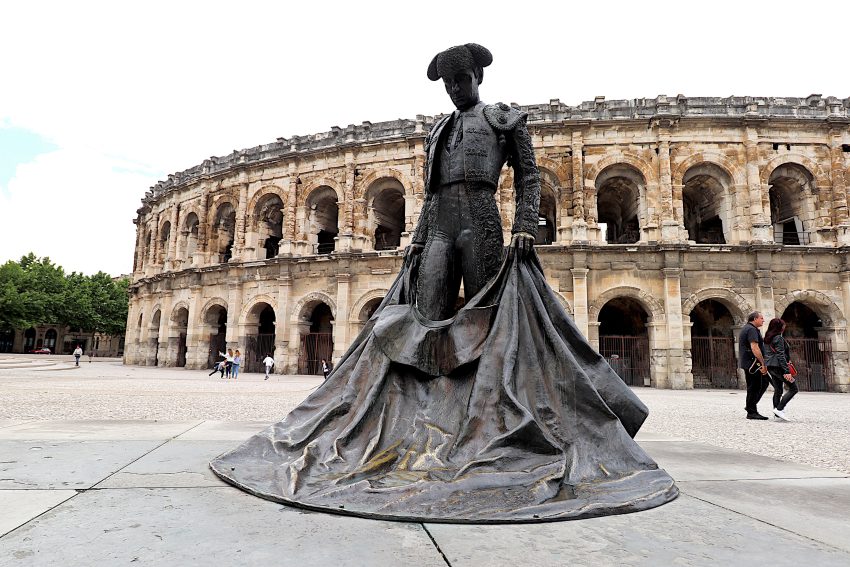
2. Arènes de Nîmes (Nîmes Amphitheatre)
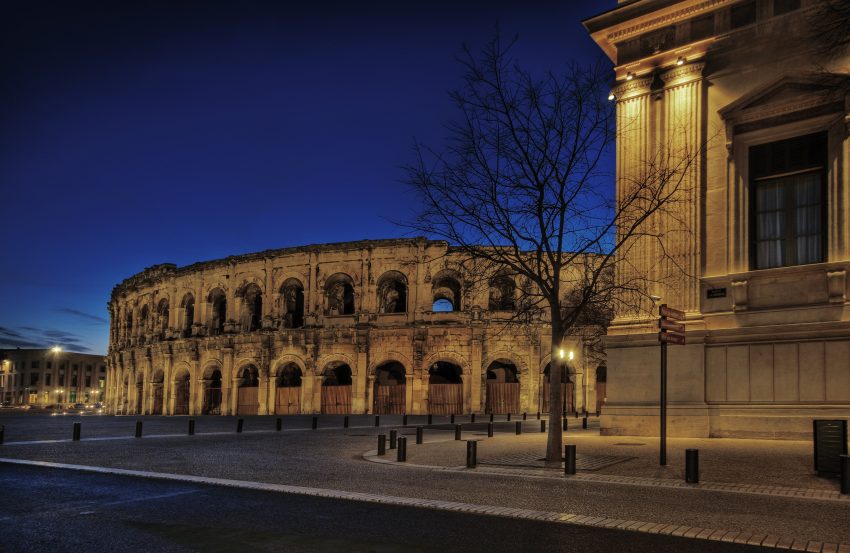
Built in the late 1st century CE, the Arènes de Nîmes is one of the best-preserved Roman amphitheatres in the former empire. It was constructed when Nemausus (Nîmes) was flourishing under Roman rule, and it staged the mass spectacles that defined Roman public entertainment. Over centuries, it was repurposed as a fortified neighborhood—people lived inside its walls until the modern era.
The structure is a lesson in Roman engineering: an oval arena ringed by arcades, with a carefully planned system of stairways and corridors that could move large crowds efficiently. The outer façade still reads as unmistakably Roman, while the interior reveals the tiered seating and the arena floor where events took place. Restoration and adaptation have kept it in active use rather than turning it into a static ruin.
When you visit, focus on the circulation routes and viewpoints from different levels to understand how the building worked. The arena often hosts performances and events, which can change what you can access, but even without a show you can read the monument’s scale and craftsmanship up close. Also take time to step outside and walk the perimeter to appreciate the façade and its setting in the city.
Location: Bd des Arènes, 30000 Nîmes, France | Hours: January 1 – February 28: Daily: 09:30–17:00. March 1 – March 31: Daily: 09:00–18:00. April 1 – May 31: Daily: 09:00–18:30. June 1 – June 30: Daily: 09:00–19:00. July 1 – August 31: Daily: 08:00–21:00. September 1 – September 30: Daily: 09:00–19:00. October 1 – October 31: Daily: 09:00–18:00. November 1 – December 31: Daily: 09:30–17:00. | Price: Adults: €11; Reduced: €9; Child (7–17): €5.50; Under 7: free; Family pass: €23. | Website
3. Musée de la Romanité
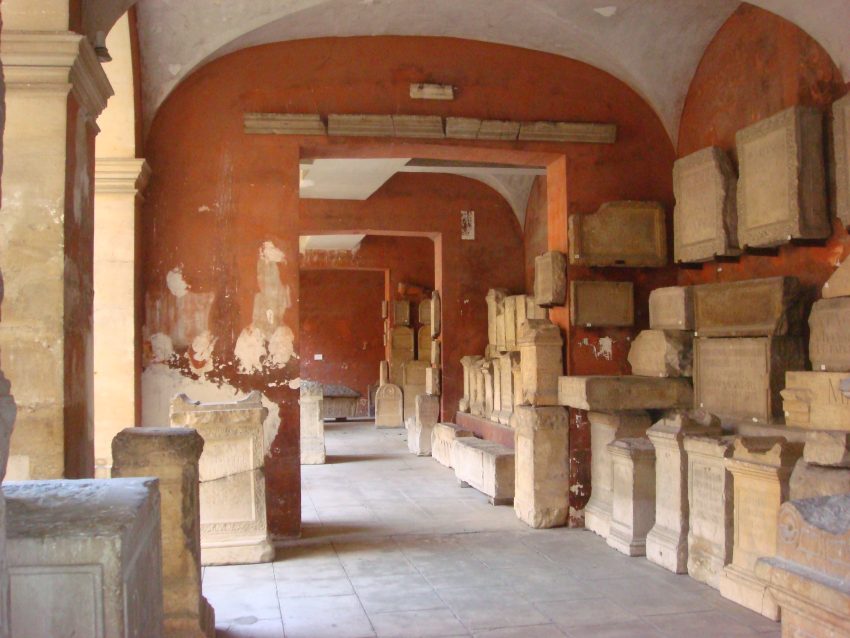
Opened in the 21st century to face the amphitheatre, the Musée de la Romanité was created to give Nîmes’ Roman heritage a modern, coherent home. Its collections pull together archaeology from the city and region, reflecting Nemausus’ role as a major Roman settlement with public buildings, rich domestic life, and strong links across the Mediterranean. The museum’s very existence is part of a broader European trend: pairing world-class ancient sites with contemporary interpretation.
Inside, the narrative is structured around everyday life as well as monumental history—religion, trade, housing, public entertainment, and the city’s long transition beyond antiquity. The displays tend to emphasize context: how objects were used, what they signified, and what they reveal about social status and local identity. This is where the “small” finds become as important as the headline monuments.
Prioritize mosaics, sculptural fragments, inscriptions, and the sections that connect the city’s monuments to the people who built and used them. If you enjoy architectural detail, pay attention to how the museum frames views back toward the amphitheatre and uses light and materials to contrast old and new. Allow time for the upper levels as well as the main galleries, as the interpretation is layered rather than a single linear room-by-room experience.
Location: 16 Bd des Arènes, 30000 Nîmes, France | Hours: (Summer) April 1 – October 31; Daily: 10:00–19:00. (Winter) November 1 – March 31; Monday, Wednesday, Thursday, Friday, Saturday, Sunday: 10:00–18:00. Closed on Tuesday. | Price: Adults: €9; Reduced rate: €6; Ages 7–17: €3; Under 7: free; Family ticket: €21 (2 adults + 2 children 7–17). | Website
4. Jardins de la Fontaine
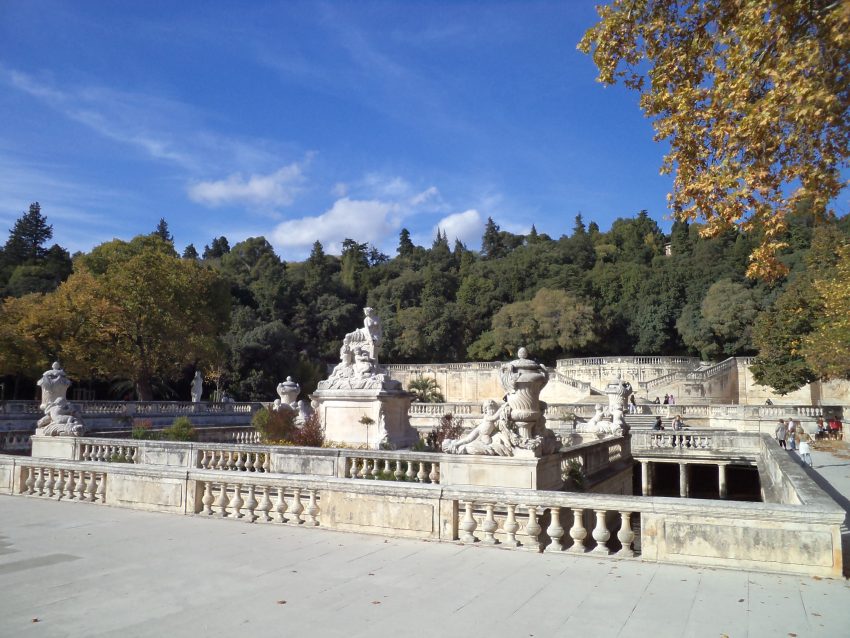
Created in the 18th century, Les Jardins de la Fontaine is often described as one of Europe’s earliest public gardens, laid out around the ancient spring that gave Nîmes its origins. The site connects directly to Roman Nemausus: the sacred source, Roman engineering, and the later desire to formalize nature into an Enlightenment-era public space. It’s a place where antiquity and 18th-century landscape design are literally layered on top of one another.
The gardens combine formal terraces, balustrades, shaded paths, and water features that make the spring feel both natural and curated. Within and above the gardens are significant Roman remains, most notably the Temple of Diana and the route up toward Tour Magne. The result is a site that isn’t just “pretty”—it’s historically legible, with the city’s origins and later civic ambitions expressed in stone, water, and planting.
When you visit, explore the lower water areas first, then work upward through terraces to catch different views and atmospheres. Look closely at how Roman masonry sits within later landscaping, and how the garden’s geometry frames ruins and viewpoints. It’s also one of the best places in Nîmes for shade and a slower pace, especially in warmer months.
Location: 26 Quai de la Fontaine, 30000 Nîmes, France | Hours: (Summer) April 1 – September 15; Daily: 07:30–22:00. (Winter) September 16 – March 31; Daily: 07:30–18:30. | Price: Free. | Website
5. Temple of Diana
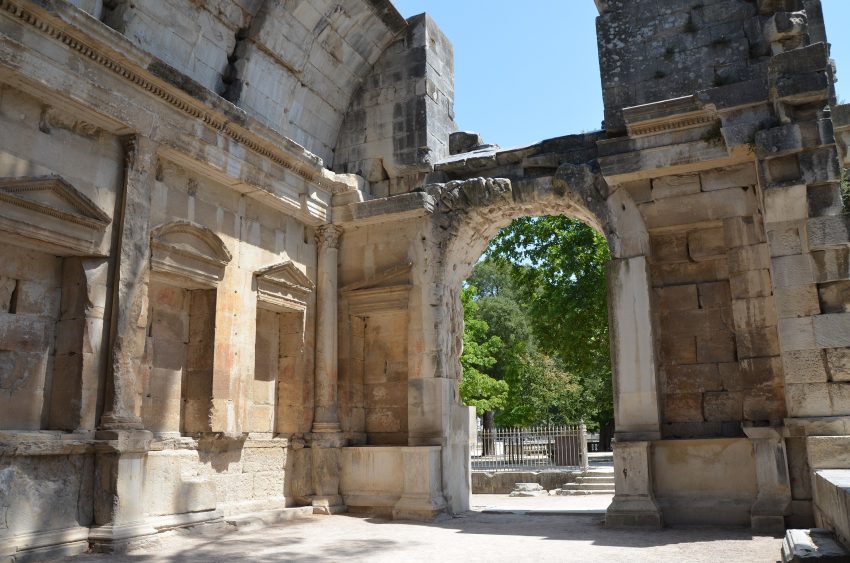
The so-called Temple of Diana is a Roman-era structure in the Fontaine sanctuary complex, though its exact original function remains debated; it may not have been a temple in the strict sense. What is clear is that it belonged to a major sacred landscape centred on the spring, one of the most important loci of Roman Nîmes. Its survival provides a rare, atmospheric interior ruin within a broader landscaped setting.
The building’s masonry and surviving vaults give you a strong sense of Roman spatial engineering. Unlike the clean lines of the Maison Carrée, this site feels more enigmatic—partly open, partly enclosed, and marked by time. It evokes the religious and ritual life of the ancient city rather than its civic showpieces.
When you visit, focus on the volume of the space and the textures of the stonework: vaulting, niches, and the way light enters. Walk around the exterior as well, because the context within the gardens is part of the experience. If you’re interested in interpretation, this is a good place to think about how archaeologists infer function from partial remains and setting.
Location: Quai Georges Clemenceau, 30000 Nîmes, France | Hours: (Summer) April 1 – August 31: Daily: 07:30–22:00. (Winter) October 1 – March 31: Daily: 07:30–18:30. | Price: Free. | Website
6. Tour Magne
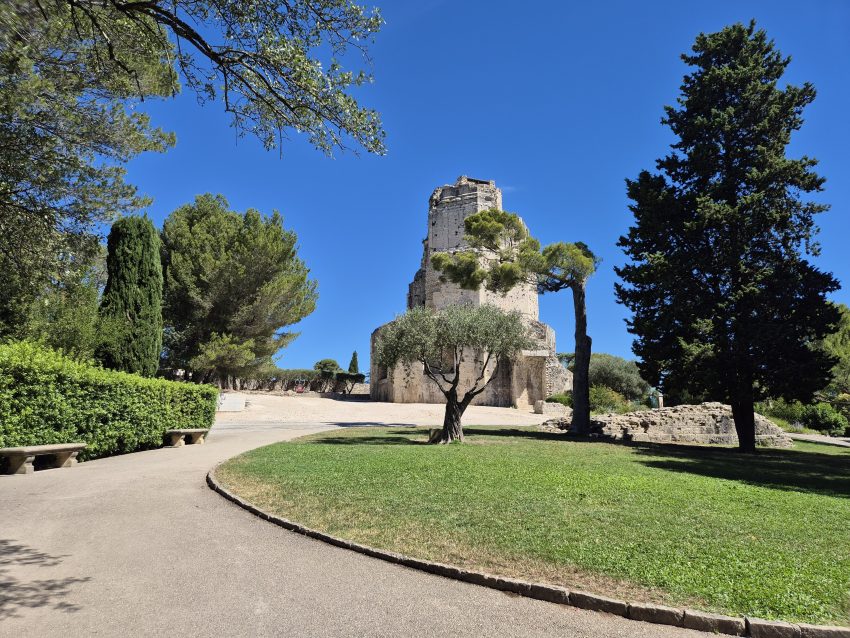
Tour Magne is a Roman tower integrated into the ancient fortifications of Nemausus, later reinforced and modified over time. It stands on the hill above the Jardins de la Fontaine, marking a strategic high point that would have been important for surveillance and signaling. Its survival, like much of Nîmes’ Roman legacy, reflects continuous reuse and the city’s enduring footprint on the same terrain.
What you see today is a substantial, rugged monument rather than a delicate ruin—thick walls, commanding presence, and a sense of the defensive logic of Roman urban planning. The tower also helps explain the scale of Roman Nîmes beyond individual showpieces like the temple and amphitheatre. It’s part of a broader system, tying topography to security and status.
The main “thing to see” is the panorama: from the top (when access is open), the city spreads out in a way that makes the Roman layout and later growth easier to grasp. On the climb, watch how the landscape shifts from garden formality to more open hilltop terrain. Even if you don’t go inside, the tower’s silhouette and setting are worth seeing for how they anchor the city’s geography.
Location: Les Jardins de la Fontaine, Place Guillaume Apollinaire, 30000 Nîmes, France | Hours: (January 1 – February 28) Daily: 09:30–13:00 & 14:00–16:30. (March 1 – March 31) Daily: 09:30–13:00 & 14:00–18:00. (April 1 – May 31) Daily: 09:30–18:00. (June 1 – June 30) Daily: 09:00–19:00. (July 1 – August 31) Daily: 09:00–20:00. (September 1 – September 30) Daily: 09:30–13:00 & 14:00–19:00. (October 1 – October 31) Daily: 09:30–13:00 & 14:00–18:00. (November 1 – December 31) Daily: 09:30–13:00 & 14:00–16:30. | Price: Adults: €4; Reduced: €3.50; Ages 7–17: €1.50; Under 7: free. | Website
7. Carré d’Art
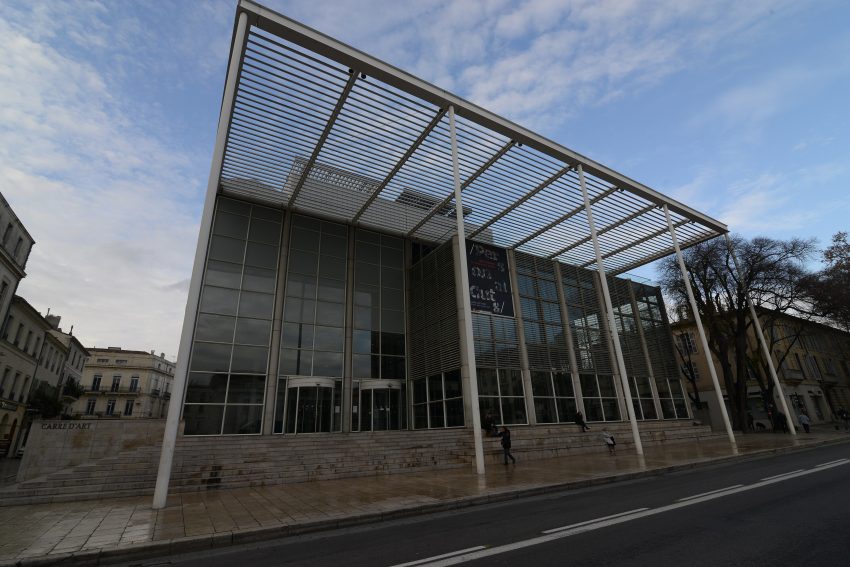
Carré d’Art is a defining project of late-20th-century Nîmes, designed by Norman Foster and opened in the early 1990s. It was conceived as a civic counterpoint to the Maison Carrée opposite—an explicit dialogue between Roman classicism and modernist transparency. The building’s placement and proportions are deliberate: contemporary architecture that respects a monumental ancient neighbor without imitating it.
The building houses a contemporary art museum and also incorporates a public library function, reinforcing it as a living cultural hub rather than a one-purpose institution. Its glass-and-steel language, open interiors, and terraces create a sense of permeability between street, gallery, and sky. As a piece of design, it’s as much about the city as it is about the collection.
When you visit, look at the building first: the façade rhythm, the internal vistas, and how the structure frames the Maison Carrée from different angles. Inside, expect rotating exhibitions alongside a modern and contemporary focus, with an emphasis on how art is displayed in flexible spaces. If you have time, go up to higher levels for views and to understand how the museum is anchored into the surrounding square.
Location: 16 Pl. de la Maison Carrée, 30000 Nîmes, France | Hours: Monday: Closed Tuesday: 10:00 AM – 6:00 PM Wednesday: 10:00 AM – 6:00 PM Thursday: 10:00 AM – 6:00 PM Friday: 10:00 AM – 6:00 PM Saturday: 10:00 AM – 6:00 PM Sunday: 10:00 AM – 6:30 PM | Price: €8 (full price); €6 (reduced). Free on the first Sunday of the month; free entry for under-18s (and other eligible categories with valid proof). | Website
8. Maison Carrée
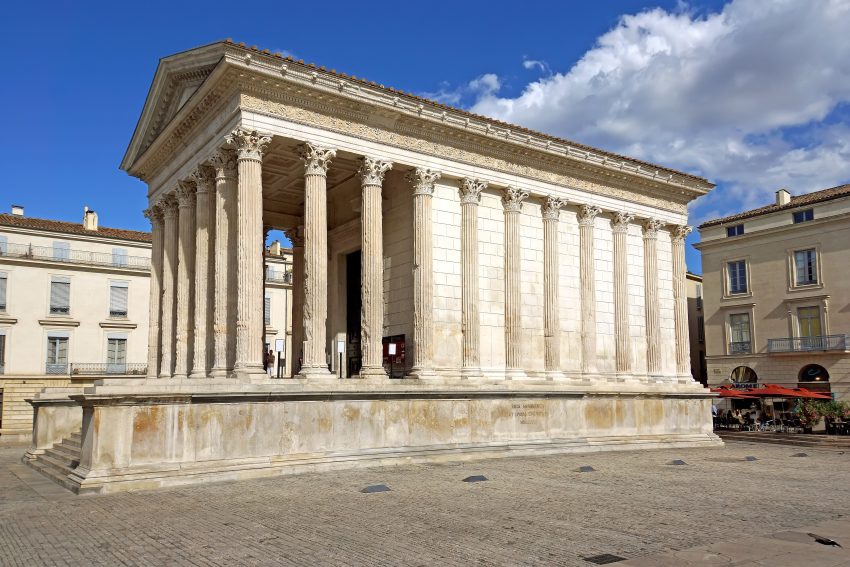
The Maison Carrée is an early 1st-century CE Roman temple, built as an expression of imperial loyalty and local prestige. Nîmes was developed as a showpiece provincial city, and this temple formed part of the monumental programme that showcased Rome’s power and cultural order. Its exceptional preservation owes a lot to continuous reuse over the centuries, which kept the structure relevant and maintained.
Architecturally, it’s a standout example of Corinthian temple design: an elevated podium, deep portico, and a façade whose proportions feel almost mathematically composed. The crispness of its detailing—capitals, entablature, and the overall silhouette—has made it an enduring reference for later architects. It’s one of those rare ancient buildings that reads as complete rather than fragmentary.
When you’re there, take time to look closely at the carving and then step back to view the temple as a whole composition in the square. Walking around it helps you appreciate the podium and how the structure was meant to be approached. If entry is available, the interior is more restrained, which reinforces how Roman temple architecture often concentrated its public message on the exterior.
Location: Pl. de la Maison Carrée, 30000 Nîmes, France | Hours: January: Daily: 10:00–16:30. February: Daily: 10:00–16:30. March: Daily: 09:30–18:00. April – May: Daily: 09:30–18:30. June: Daily: 09:30–19:00. July – August: Daily: 08:00–21:00. September: Daily: 09:30–19:00. October: Daily: 09:30–18:00. November: Daily: 10:00–16:30. December: Daily: 10:00–16:30. | Price: Adults: €6.50; Reduced: €5.50; Children (7–17): €3.50; Under 7: free; Family pass (2 adults + 1 or 2 children 7–17): €14. | Website
9. Maison Carrée
The Maison Carrée is a Roman temple dating to the early 1st century CE, built when Nîmes was being monumentalized as a model provincial city. Dedicated to members of the imperial family, it expressed loyalty to Rome and the emperor while also signaling local prosperity. Its survival is exceptional: many Roman temples elsewhere are partial, but here the structure remained continuously useful, which helped preserve it.
Architecturally it’s a near-textbook example of a Corinthian temple: elevated podium, deep portico, and a finely proportioned façade with crisp classical detailing. The harmony of its columns and entablature made it an important reference point for later neoclassical architecture, influencing designers far beyond France. Standing in front of it, you can see why it became an icon of Roman elegance.
On site, focus on the carving quality—capitals, friezes, and the overall geometry from close and far viewpoints. Step back into the square to appreciate the full composition, then circle to see how the temple sits on its podium. If entry is available, the interior is comparatively austere, which reinforces how the exterior architecture carried much of the temple’s visual and political message.
Location: Pl. de la Maison Carrée, 30000 Nîmes, France | Hours: January: Daily: 10:00–16:30. February: Daily: 10:00–16:30. March: Daily: 09:30–18:00. April – May: Daily: 09:30–18:30. June: Daily: 09:30–19:00. July – August: Daily: 08:00–21:00. September: Daily: 09:30–19:00. October: Daily: 09:30–18:00. November: Daily: 10:00–16:30. December: Daily: 10:00–16:30. | Price: Adults: €6.50; Reduced: €5.50; Children (7–17): €3.50; Under 7: free; Family pass (2 adults + 1 or 2 children 7–17): €14. | Website
10. Place de l’Horloge
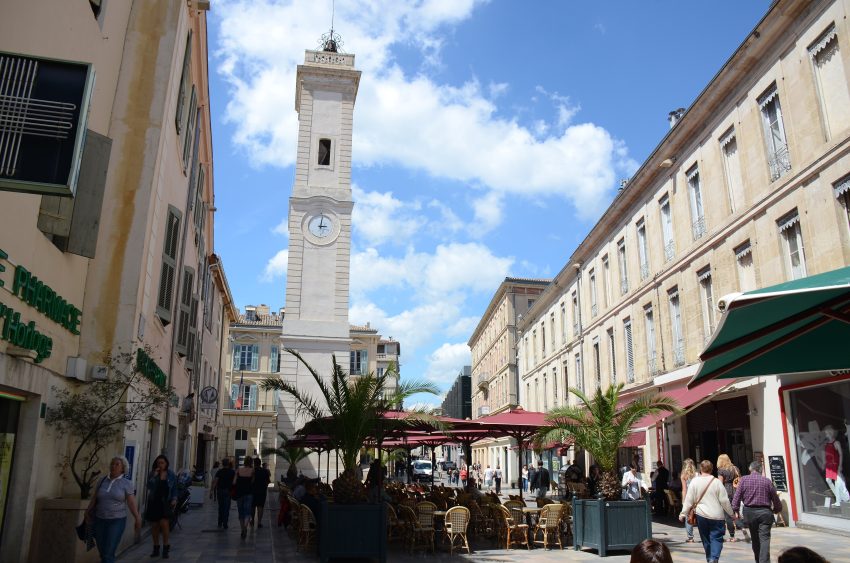
Place de l’Horloge is a traditional civic square whose identity is tied to the rhythm of municipal life—meeting points, cafés, and the kind of public space that has evolved over centuries rather than being built in a single moment. In Nîmes, such squares reflect the city’s layers: medieval street patterns, early modern renovations, and 19th-century embellishments. The “clock” element signals its role as a time-and-place reference in the everyday geography of the center.
The square’s appeal is less about a single monument and more about atmosphere and urban texture. It typically functions as a social hinge between shopping streets, older lanes, and administrative or religious buildings nearby. Like many French city squares, it becomes a stage for seasonal events without losing its day-to-day purpose.
When you’re there, take in the façades, the café terraces, and the way the square opens and narrows into adjoining streets. It’s a good spot to observe local routines—morning errands, lunchtime crowds, evening meet-ups. If you’re interested in photography or urban detail, the interplay of shade, signage, and stonework often reveals more than the headline attractions do.
Location: Pl. de l'Horloge, 30000 Nîmes, France | Hours: 24 Hours. | Price: Free.
11. Les Halles de Nîmes
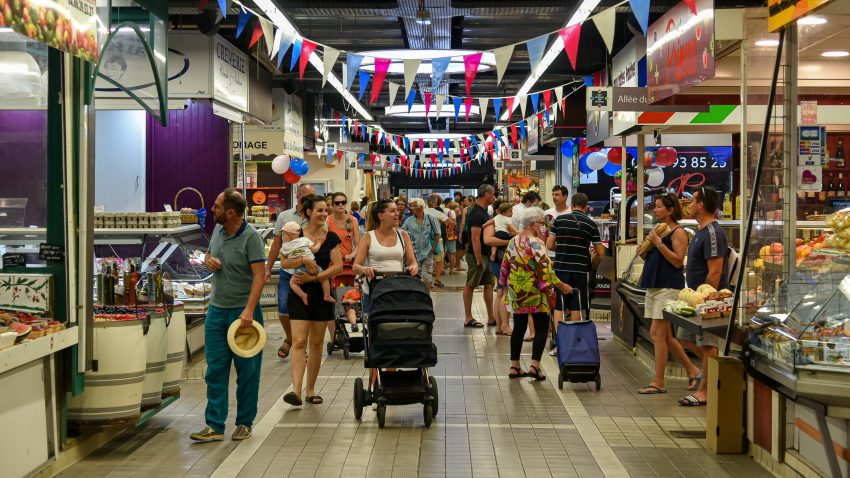
Les Halles reflects the European tradition of covered market halls that expanded in the 19th and early 20th centuries, combining sanitation, regular trading hours, and civic pride in a purpose-built structure. In Nîmes, it embodies the continuity between the region’s agricultural richness and the city’s commercial life. Even when the building has been updated, the function remains recognizably traditional: a concentrated map of local produce and specialties.
Inside, the hall is typically organized into specialist stalls—butchers, fishmongers, cheese counters, bakers, and prepared foods—creating a sensory snapshot of the Gard and wider Occitanie. This is where local identity becomes edible: olives, brandades, charcuterie, seasonal fruit, and wines all sit alongside everyday staples. It’s also a social space, with quick bites and informal conversations that make it more than a shopping stop.
What to see is essentially the market in motion: the busiest hours, the displays, and the regional products you don’t always find in supermarkets. Walk the full circuit before buying so you can compare stalls and spot seasonal highlights. If you’re curious about local food culture, this is one of the best places in town to understand it quickly, without needing any formal “museum” framing.
Location: 5 Rue des Halles, 30000 Nîmes, France | Hours: Monday – Friday: 07:00–13:00. Saturday: 07:00–19:00. Sunday: 07:00–13:30. | Price: Free. | Website
12. Nîmes Cathedral
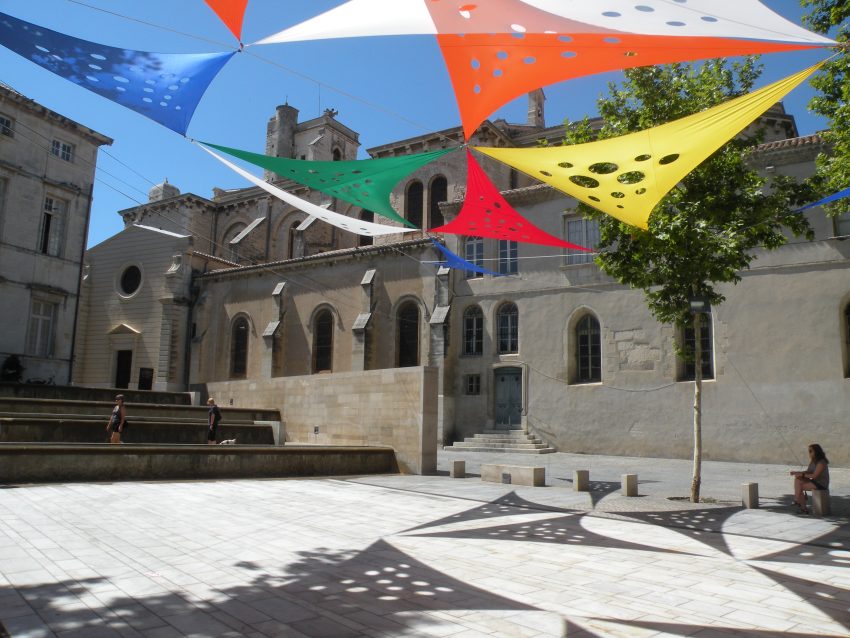
Nîmes Cathedral (Cathédrale Notre-Dame-et-Saint-Castor) reflects the city’s long Christian history and its shifts in power, style, and religious life. Built and rebuilt across the medieval and early modern periods, it bears the marks of Romanesque foundations, later modifications, and restorations shaped by conflicts and changing tastes. Like many cathedrals in southern France, it also carries the memory of the Wars of Religion, when churches were often damaged and reconfigured.
The exterior can feel relatively restrained compared with more flamboyant Gothic cathedrals elsewhere, but the interior often reveals richer surprises: chapels, altarpieces, and a sense of layered craftsmanship. The building’s atmosphere is shaped by stone, light, and the quiet continuity of worship. It’s a counterpoint to Nîmes’ Roman monuments—less about imperial spectacle, more about community and endurance.
When you visit, look for architectural transitions between older and newer sections, and spend time in side chapels where detail tends to concentrate. Pay attention to how the space is organized for ceremony and procession, and how artworks or liturgical furnishings reflect different eras. Even a short visit can be worthwhile for the shift in tone it offers within a city so dominated by antiquity.
Location: Pl. aux Herbes, 30000 Nîmes, France | Hours: Monday: 10:00–12:00 & 15:00–19:00. Tuesday: Closed. Wednesday: 10:00–13:00 & 15:00–18:00. Thursday: 10:00–12:00 & 15:00–18:00. Friday: 10:00–12:00 & 15:00–18:00. Saturday: 08:30–12:00 & 14:00–18:00. Sunday: 09:00–13:00 & 15:00–18:00. | Price: Free; donations appreciated. | Website
13. Musée du Vieux Nîmes
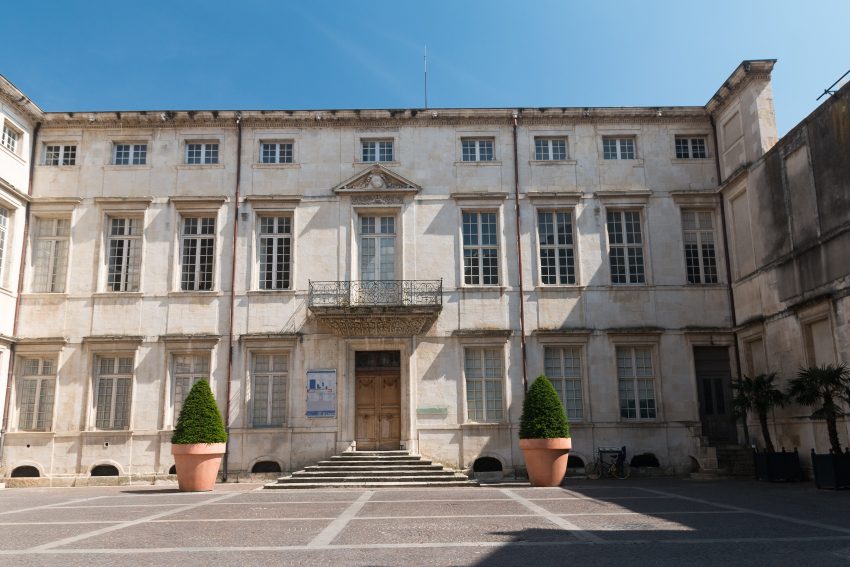
The Musée du Vieux Nîmes focuses on the city’s later history and identity beyond the Roman period, typically exploring social life, crafts, textiles, and the evolution of Nîmes as a working city. It helps explain how Nîmes developed through medieval, early modern, and industrial eras, including the kinds of local production and commerce that shaped daily life. In a city famed for antiquity, this museum fills an important interpretive gap.
Exhibits often highlight local material culture—objects, documents, and displays that connect the city’s streets and buildings to the people who lived and worked there. You get a sense of continuity and change: what persisted, what modernised, and how regional traditions interacted with national currents. It’s also where you can understand Nîmes’ identity as something broader than its Roman monuments.
What to see depends on the current displays, but look for sections that tie crafts and trade to specific parts of the city. If textiles are featured, they’re particularly relevant to Nîmes’ wider reputation in industrial history. The museum is best approached as context-building: it helps you read the city outside of the Roman frame.
Location: Pl. aux Herbes, 30000 Nîmes, France | Hours: Tuesday – Friday: 10:00–18:00. Saturday – Sunday: 10:00–18:30. Closed on Monday. | Price: Adults: €5; Reduced: €3; Under 18: free. | Website
14. Porte d’Auguste
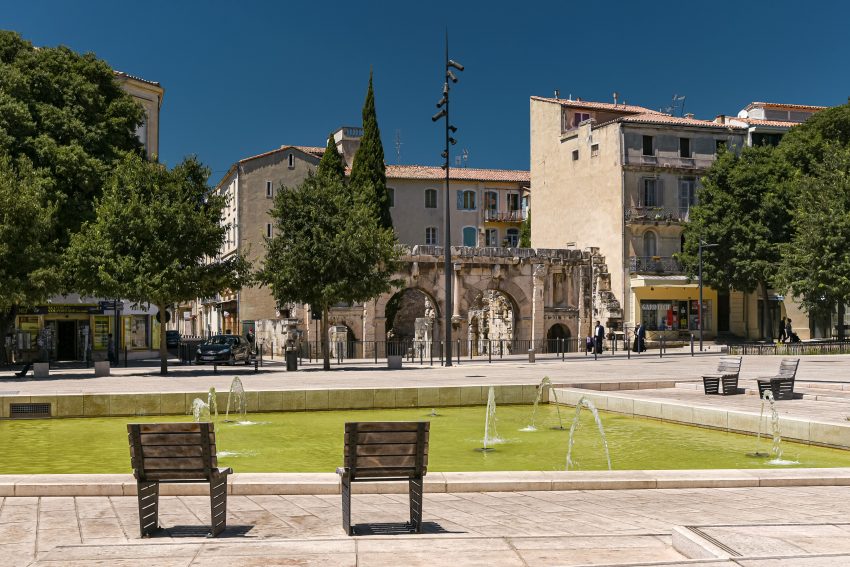
Porte d’Auguste is a surviving Roman city gate, part of the ancient fortifications that defined and protected Nemausus. Gates like this were both practical and symbolic: they controlled movement and trade, but they also announced Rome’s order and authority through monumental architecture. The survival of such a gate in an urban setting is significant because many were dismantled or absorbed into later building phases.
The monument gives you a sense of the Roman city’s perimeter logic and how roads and entrances were structured. You can read the scale of Roman masonry and the way openings were designed for different types of movement. It also helps correct a common misconception that Roman remains are only about entertainment and temples—defensive and administrative infrastructure was equally central.
When you visit, study the stonework and the arrangement of arches/openings, then step back to see how the gate sits within modern streets. Look for traces of later adaptation or restoration, because these monuments often have complicated afterlives. It’s also a strong place to imagine the ancient approach into the city, even if the surrounding environment has changed dramatically.
Location: 25B Bd Amiral Courbet, 30000 Nîmes, France | Hours: 24 Hours. | Price: Free. | Website

Moira & Andy
Hey! We're Moira & Andy. From hiking the Camino to trips around Europe in Bert our campervan — we've been traveling together since retirement in 2020!
This website uses affiliate links which earn a small commission at no additional cost to you.
Walking Tour Map