Nimes, France: The Ultimate Travel Guide 2026
Nimes France
Nimes France

Nîmes, in the Occitanie region, is a city where Roman grandeur meets southern French charm. Its sun-drenched streets, leafy boulevards, and relaxed pace make it a pleasant place to explore on foot. The architecture is striking, blending ancient stone with classical French facades, and there’s a strong local culture centered around food, markets, and outdoor living.

The city is also a great base for exploring the surrounding countryside, including vineyards, garrigue landscapes, and nearby villages. Nîmes hosts festivals and cultural events year-round, giving visitors a chance to experience its lively spirit. Whether you’re strolling through a shaded square or enjoying a glass of wine at a terrace café, Nîmes offers a warm and memorable experience.

History of Nimes

Nîmes in Ancient Times (Before 5th Century AD)

Nîmes began as a settlement around a sacred spring, later becoming a major Roman colony known as Nemausus. The city flourished under Roman rule, with grand structures like the Arena, the Maison Carrée, and the aqueduct known as the Pont du Gard. These monuments reflect a time when Nîmes was a prosperous and strategically important Roman city.

Nîmes in the Early Middle Ages (5th – 10th Century)

With the decline of the Roman Empire, Nîmes experienced a period of instability marked by invasions and changing rulers. Though many ancient buildings fell into disuse or were repurposed, the city maintained some of its population and influence. Christianity became more prominent during this time, leading to the construction of early churches.

Nîmes in the High Middle Ages (11th – 14th Century)

Nîmes began to recover in the medieval period, rebuilding its civic and religious institutions. The city developed around its Roman core, with new walls and residential neighborhoods emerging. It remained a regional center for trade and agriculture, even as its role on the broader European stage diminished.

Nîmes in the Renaissance and Early Modern Period (15th – 18th Century)

During this era, Nîmes saw a mix of revival and unrest. The city prospered through textile production, particularly in wool and silk, but also experienced conflict during the French Wars of Religion. Despite tension between Protestant and Catholic communities, Nîmes continued to grow and modernize.

Nîmes in the 19th Century

Nîmes enjoyed a period of renewed prosperity in the 19th century, driven by industrialization and improved infrastructure. Interest in Roman history surged, leading to restoration efforts for many ancient monuments. Public squares, gardens, and civic buildings were added, giving the city much of its current appearance.

Nîmes in the 20th Century to Present

Throughout the 20th century, Nîmes developed as a modern city while preserving its historic core. It played roles in both World Wars, later experiencing urban expansion and cultural revitalization. Today, Nîmes is known for its unique blend of antiquity and contemporary life, attracting visitors with its heritage, festivals, and southern French spirit.

Moira & Andy
Moira & Andy

Hey! We're Moira & Andy. From hiking the Camino to trips around Europe in Bert our campervan — we've been traveling together since retirement in 2020!

Read our full story here

Visiting Nimes for the first time and wondering what are the top places to see in the city? In this complete guide, I share the best things to do in Nimes on the first visit. To help you plan your trip, I have also included an interactive map and practical tips for visiting!

This website uses affiliate links which earn a small commission at no additional cost to you.
Powered by GetYourGuide

20 Best places to See in Nimes

This complete guide to Nimes not only tells you about the very best sights and tourist attractions for first-time visitors to the city but also provide insights into a few of our personal favorite things to do.

This is a practical guide to visiting the best places to see in Nimes and is filled with tips and info that should answer all your questions!

1. Arenes de Nimes
Arenes de Nimes
Arenes de Nimes
CC BY-SA 2.0 / Wolfgang Staudt
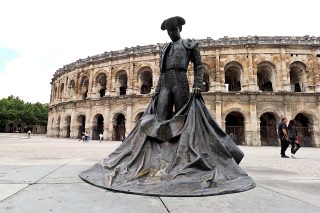
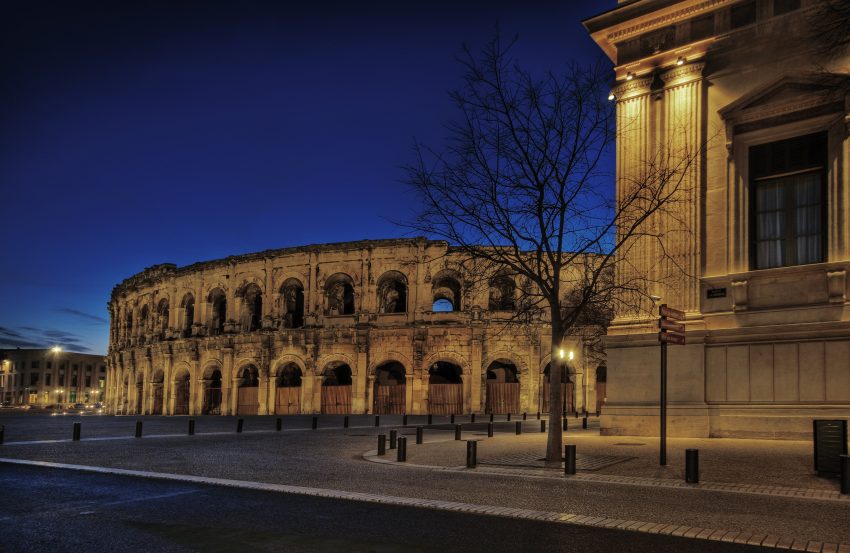
The Arènes de Nîmes is a Roman amphitheatre built around 100 CE, and it remains one of the best-preserved arenas of its kind. Its oval shell is 133 by 101 meters, with a 21-meter-high façade of two levels and 60 arcades that still reads like a working machine for moving crowds. Inside, you climb through stone corridors to steep seating tiers—34 rows in all—once arranged to hold about 24,000 spectators, and the upper seats open to wide views over central Nîmes. The building never became a silent relic: it still hosts concerts, Roman-game reenactments, and two bullfights during the Feria de Nîmes.
Location: Bd des Arènes, 30000 Nîmes, France | Hours: January 1 – February 28: Daily: 09:30–17:00. March 1 – March 31: Daily: 09:00–18:00. April 1 – May 31: Daily: 09:00–18:30. June 1 – June 30: Daily: 09:00–19:00. July 1 – August 31: Daily: 08:00–21:00. September 1 – September 30: Daily: 09:00–19:00. October 1 – October 31: Daily: 09:00–18:00. November 1 – December 31: Daily: 09:30–17:00. | Price: Adults: €11; Reduced: €9; Child (7–17): €5.50; Under 7: free; Family pass: €23. | Website | Distance: 0km

We recommend to rent a car in France through Discover Cars, they compare prices and review multiple car rental agencies. Book your rental car here.

2. Musee de la Romanite

Musee de la Romanite
CC BY-SA 3.0 / Underwaterbuffalo
Musée de la Romanité is Nîmes’ flagship archaeology museum, a contemporary “folded glass toga” set opposite the 2,000-year-old Arènes on the line of the former Roman ramparts. Opened in 2018 after major digs at the Allées Jaurès uncovered a domus and two exceptional mosaics (with comparisons drawn to Pompeii), it reunites older collections with these newer finds. Inside, the route moves from Iron Age beginnings through Gallo-Roman daily life—ceramics, bronze tableware, lamps, toiletry items, clothing accessories—alongside a strong coin collection and near-pristine mosaics visitors often linger over. Outside, an archaeological garden steps through pre-Roman, Roman, and post-Roman layers amid Mediterranean planting, and the rooftop terrace frames sweeping city views.
Location: 16 Bd des Arènes, 30000 Nîmes, France | Hours: (Summer) April 1 – October 31; Daily: 10:00–19:00. (Winter) November 1 – March 31; Monday, Wednesday, Thursday, Friday, Saturday, Sunday: 10:00–18:00. Closed on Tuesday. | Price: Adults: €9; Reduced rate: €6; Ages 7–17: €3; Under 7: free; Family ticket: €21 (2 adults + 2 children 7–17). | Website | Distance: 0km

Here is a complete selection of hotel options in Nimes. Feel free to review each one and choose the stay that best suits your needs.

3. Porte de France

Porte de France
Porte de France
CC BY-SA 3.0 / Daniel Villafruela.
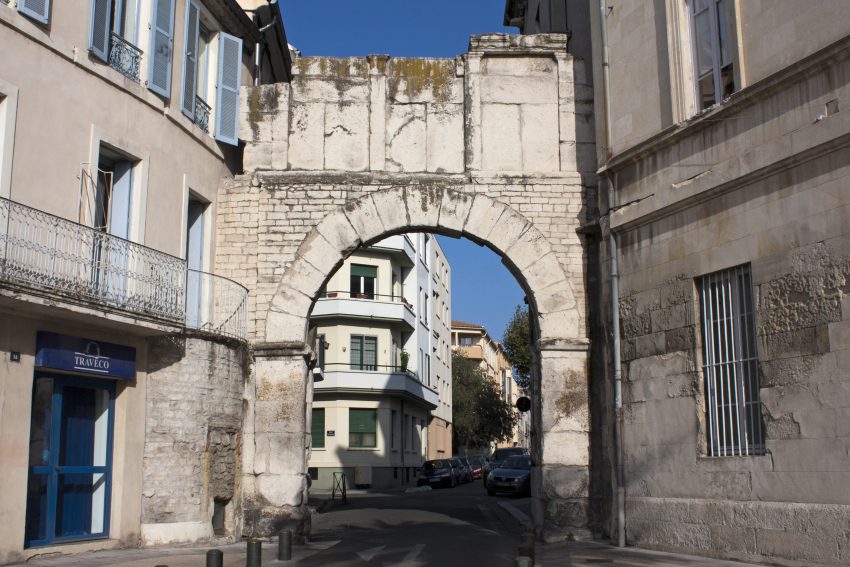
Porte de France in Nîmes, France is a surviving Roman city gate from around 16–15 BC, once part of a vast 7 km fortification that enclosed roughly 220 hectares. Unlike the busier Augustus Gate, it served a secondary route rather than the Via Domitia, which helps explain its quiet, neighborhood setting on Rue Porte de France. What you see today is a single semicircular arch with traces of pilasters and a cornice above, plus hints of the blind gallery that once carried Tuscan-style decoration. It was listed as a historic monument in 1840, and walking through the opening makes the former boundary of the Roman town feel surprisingly tangible. Visitors often remember how the ancient stone sits tightly between everyday houses.
Location: 31 Rue Prte de France, 30900 Nîmes, France | Hours: 24 Hours. | Price: Free. | Distance: 0.2km

Traveling to a country with a different currency? Avoid ATM transaction fees and pay in local currency with a Wise Card. Having used it for over 5 years, we've saved loads on fees!

4. Esplanade Charles-de-Gaulle

Esplanade Charles-de-Gaulle
CC BY-SA 4.0 / Chabe01
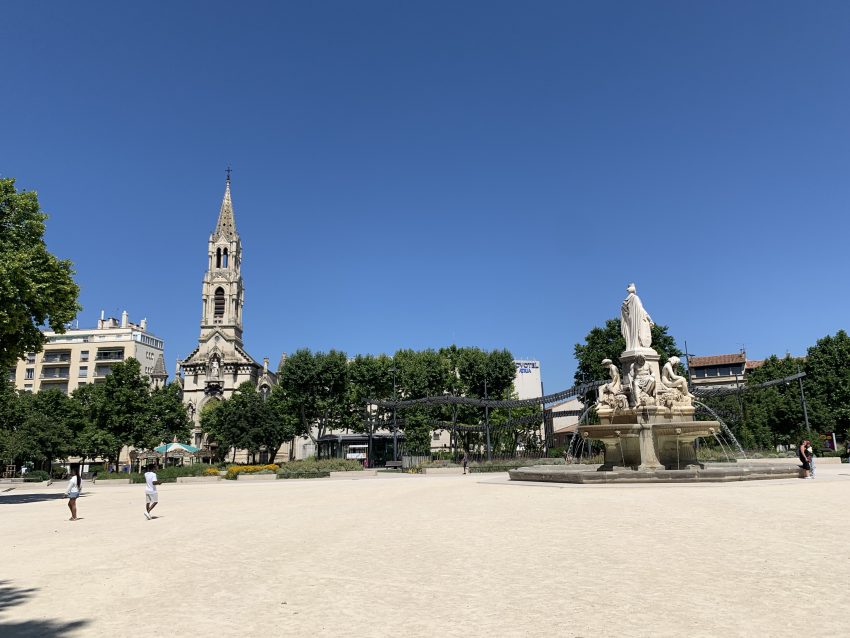
Esplanade Charles-de-Gaulle is Nîmes’ broad garden-square promenade, set beside the Arènes and shaped into a strolling space during 19th-century redevelopment. Its focal point is the 1851 Pradier fountain, an allegorical figure for Nîmes encircled by four regional rivers, with a wide triangular forecourt around the basin. Semi-circular paths, tree clusters, lawns, and bamboo-draped pergolas create alternating shade and open views, with benches that invite a pause. A narrow canal runs from the esplanade toward Avenue Feuchères and on toward the train-station axis, reinforcing its role as the city’s airy connector. Locals often just call it “L’Esplanade,” and it’s a prime spot for people-watching.
Location: 3 Bd de Prague, 30000 Nîmes, France | Hours: 24 Hours. | Price: Free. | Distance: 0.2km

Explore Nimes at your own pace with our self-guided walking tour! Follow our curated route to discover must-see sights and local secrets that makes Nimes one of the best places to visit in France.

5. Musee des Beaux-Arts

Musee des Beaux-Arts
CC BY-SA 2.0 / Herbert Frank
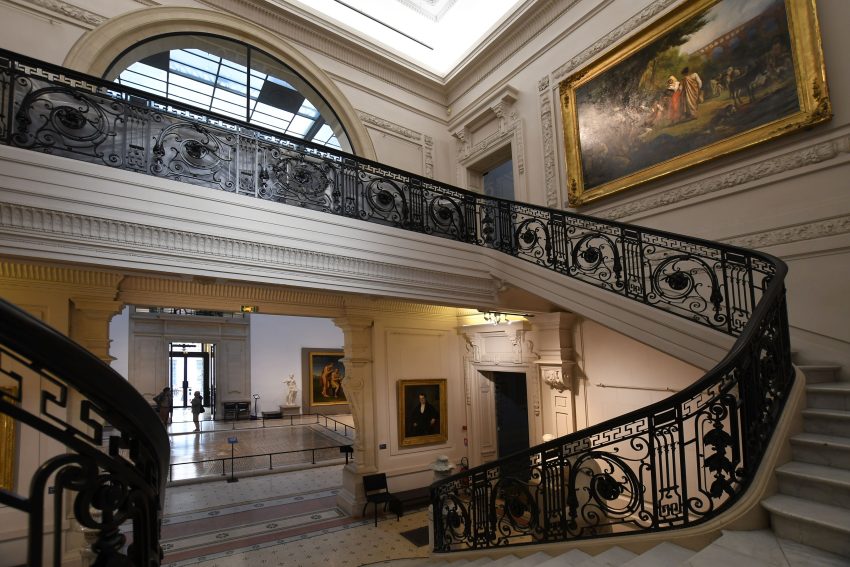
Musée des Beaux-Arts in Nîmes is a compact fine-arts museum that traces European painting and sculpture across centuries, set in an early-20th-century building later reworked by architect Jean‑Michel Wilmotte with a modernized interior. The visit pivots around a Roman mosaic in the atrium—found in Nîmes in 1883—showing the myth of Admetus’s marriage, and it’s often the image people remember most. Galleries move chronologically through Italian works from the 14th–18th centuries and Northern schools from the 16th–18th, with names such as Rubens and Jan de Heem appearing along the way. You’ll also spot a small treasure in the 15th‑century Foulc tondo, a faience Madonna by Andrea della Robbia. Visitors often note the manageable scale and occasional temporary exhibitions, sometimes alongside renovation closures.
Location: Rue de la Cité Foulc, 30000 Nîmes, France | Hours: Tuesday – Friday: 10:00–18:00. Saturday – Sunday: 10:00–18:30. Closed on Monday. | Price: Adults: €5; Reduced: €3; Under 18: free. | Website | Distance: 0.2km

6. Place du Marche
Place du Marche
Place du Marche
CC BY-SA 2.0 / Jorge Franganillo
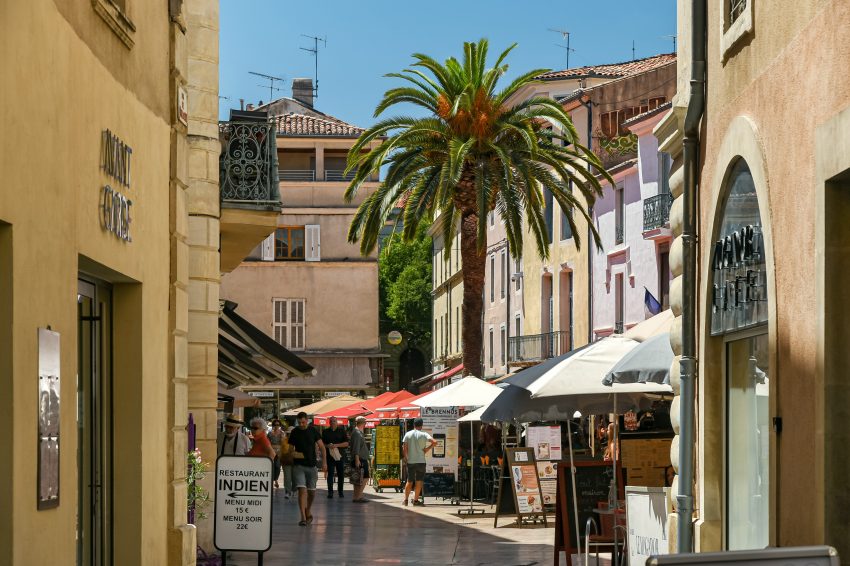
Place du Marche is a compact square in Nîmes’ old center, shaped by centuries of buying and selling—once known as Place du Marché au Bled when wheat was traded here in the 16th century. Its name recalls the stone covered market that stood on the site until it was demolished in 1846, surrounded by tight, shadowy lanes once tied to specific trades. Today, most people remember the fountain by sculptor Martial Raysse: Nîmes’ crocodile-and-palm emblem reimagined so the crocodile stands apart from the palm, a playful twist on the city’s Egypt-linked symbolism after Caesar’s conquest. Café terraces and sunlit façades make it an easy place to pause and watch local life.
Location: Pl. du Marché, 30000 Nîmes, France | Hours: 24 Hours. | Price: Free. | Website | Distance: 0.3km

7. Rue de l'Aspic
Rue de l’Aspic
Rue de l’Aspic
CC BY-SA 4.0 / Krzysztof Golik
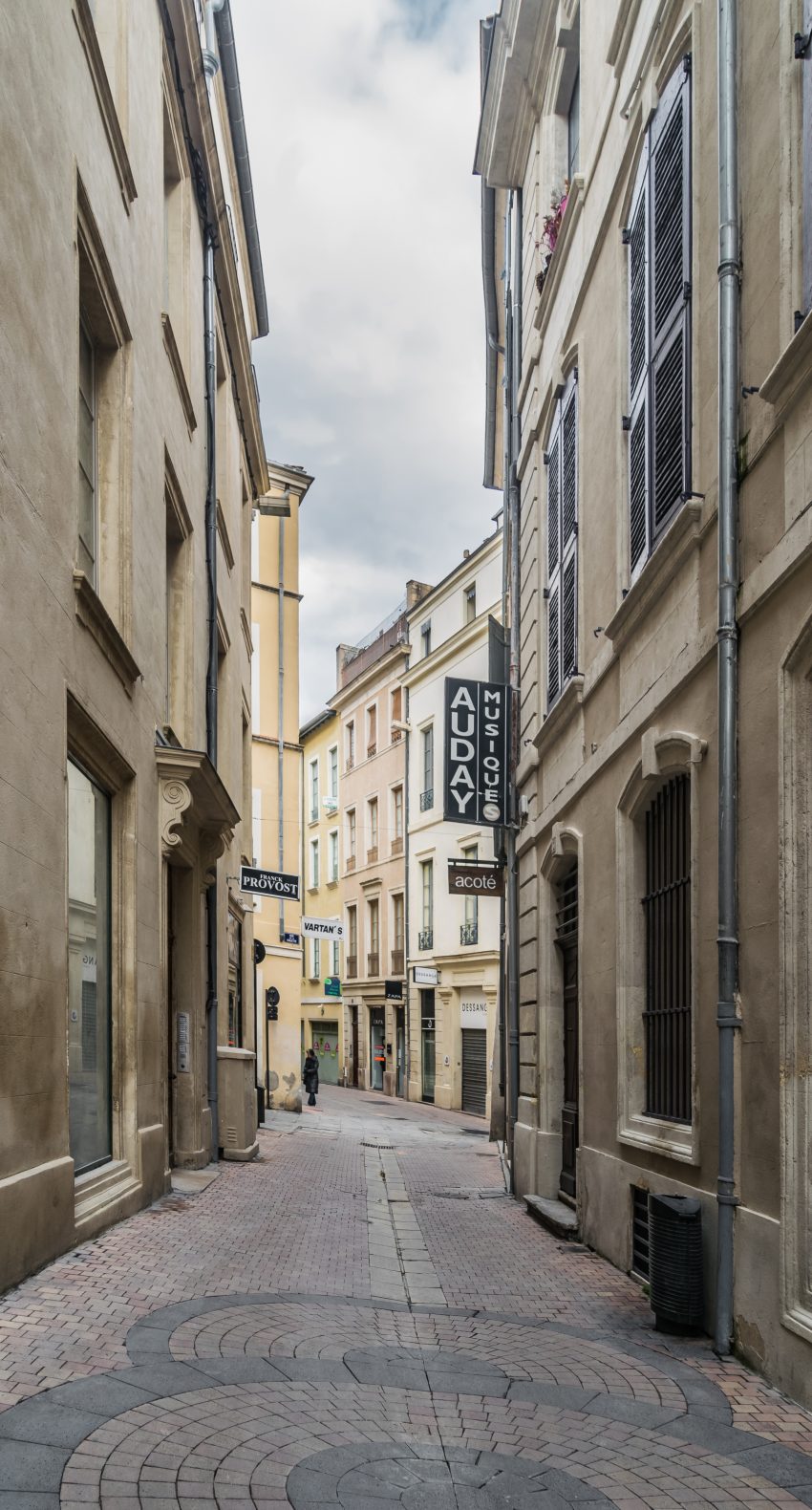
Rue de l’Aspic is a pedestrian-friendly shopping street in Nîmes’ old center, remembered for its mix of polished high-street names and offbeat boutiques. Visitors tend to notice the concentration of fashion, accessories, jewelry, and souvenir-style finds—often on the pricier side—set into a tight, walkable lane of storefronts and window displays. Its appeal isn’t a single monument so much as the lived-in texture of the Écusson: narrow passages, small businesses, and the steady flow of locals running errands. The street also carries a curious name story, shifting from “rue des Epis” to “rue de l’Espic” before settling into today’s “Aspic,” with old engravings still cited at a corner house. A 1480 resident, notary Jean Nicot, links the address to the later diplomat associated with tobacco’s arrival in France.
Location: Rue de l'Aspic, 30000 Nîmes, France | Hours: 24 Hours. | Price: Free. | Distance: 0.4km

8. Musee du Vieux Nimes
Musee du Vieux Nimes
CC BY-SA 4.0 / Daniel VILLAFRUELA.
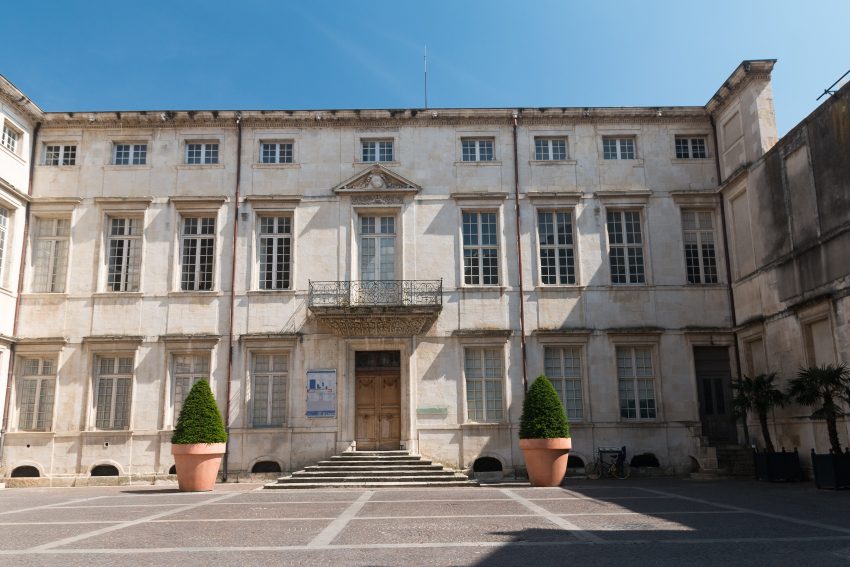
Musée du Vieux Nîmes is a compact city museum in Nîmes, set inside a late-17th-century former episcopal palace on Place aux Herbes, steps from the cathedral. Founded in 1920 by local scholar Henry Bauquier, it traces everyday life from the end of the Middle Ages onward through objects that feel domestic and specific rather than monumental. Visitors often remember the rooms devoted to the 18th–19th century textile trade, including a focused display on Nîmes serge—“denim”—with looms and early garments that tie the fabric’s name to the city. The building’s courtyards-and-garden layout and period interiors can be as striking as the cases, and temporary contemporary works sometimes interrupt the historical flow in a way some travelers find surprisingly fun.
Location: Pl. aux Herbes, 30000 Nîmes, France | Hours: Tuesday – Friday: 10:00–18:00. Saturday – Sunday: 10:00–18:30. Closed on Monday. | Price: Adults: €5; Reduced: €3; Under 18: free. | Website | Distance: 0.5km

9. Place de l'Horloge
Place de l’Horloge
Place de l’Horloge
CC BY-SA 3.0 / Henk Monster
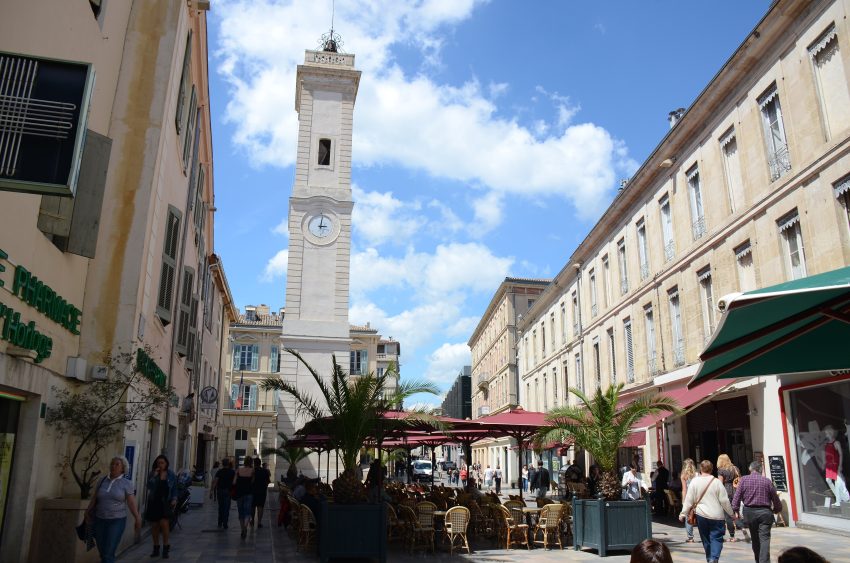
Place de l’Horloge is a compact, café-lined square in central Nîmes, organized around the city’s clock tower and used as an easy “meet-up” point. The 31‑meter campanile traces back to 1410, when residents won royal permission for a public bell after disputes over relying on the cathedral for timekeeping and alarms. An unusual compromise helped settle it: the city restricted foreign wines, while church canons supplied the bell and secured entry for wine from their own vineyards outside Nîmes. Rebuilt in 1752, the tower is topped by an octagonal wrought-iron belfry that still defines the square’s skyline. Today you’ll notice the pedestrian bustle, terrace tables, and the chime overhead.
Location: Pl. de l'Horloge, 30000 Nîmes, France | Hours: 24 Hours. | Price: Free. | Distance: 0.5km

10. Nimes Cathedral
Nimes Cathedral
Nimes Cathedral
CC BY-SA 3.0 / Chatsam
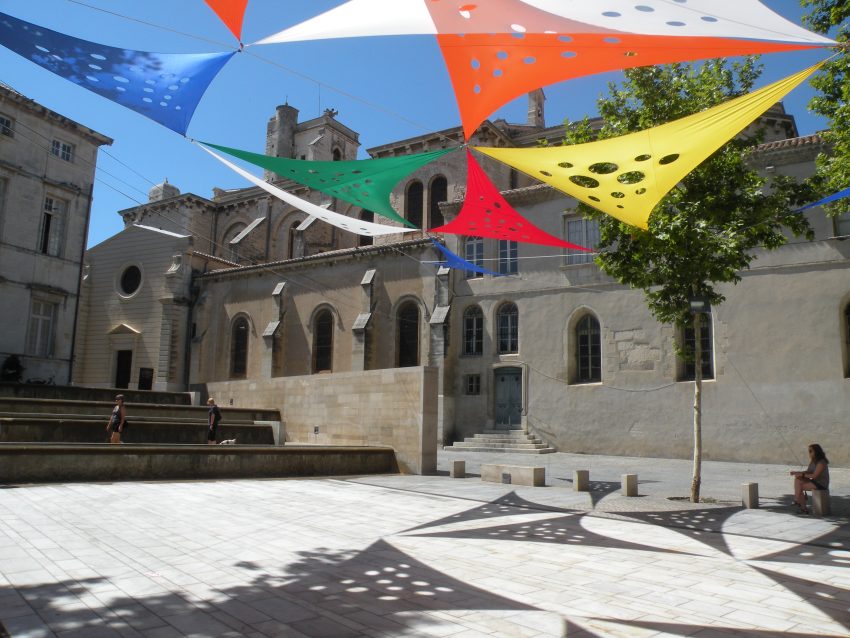
Nîmes Cathedral (Cathédrale Notre-Dame-et-Saint-Castor) is the city’s Roman Catholic cathedral, long tied to the bishops of Nîmes and still an ecclesiastical seat today. It stands on ground associated with a former Roman temple of Augustus, and its fabric reads as a patchwork of survival and rebuilding: Romanesque work from the 1100s remains in the northwest tower and parts of the façade, which still shows scars from the Wars of Religion. Much of what you see inside reflects 19th-century reconstruction, mixing neo-Gothic structure with a neo-Byzantine interior treatment. Visitors tend to remember the cool, quiet nave, carved reliefs on the exterior, stained glass, and the 1643 pipe organ with its elaborately carved case.
Location: Pl. aux Herbes, 30000 Nîmes, France | Hours: Monday: 10:00–12:00 & 15:00–19:00. Tuesday: Closed. Wednesday: 10:00–13:00 & 15:00–18:00. Thursday: 10:00–12:00 & 15:00–18:00. Friday: 10:00–12:00 & 15:00–18:00. Saturday: 08:30–12:00 & 14:00–18:00. Sunday: 09:00–13:00 & 15:00–18:00. | Price: Free; donations appreciated. | Website | Distance: 0.5km

11. Maison Carree
Maison Carree
Maison Carree
CC BY-SA 2.0 / Dennis G. Jarvis
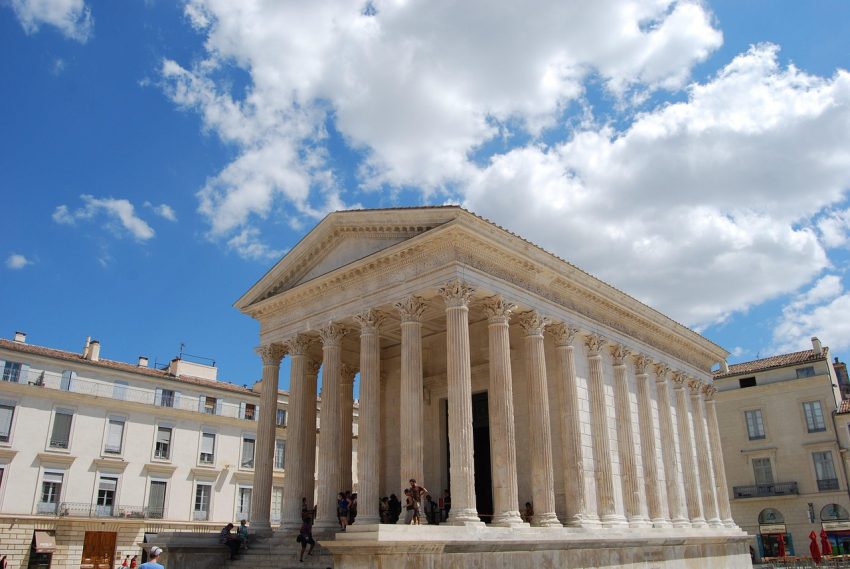
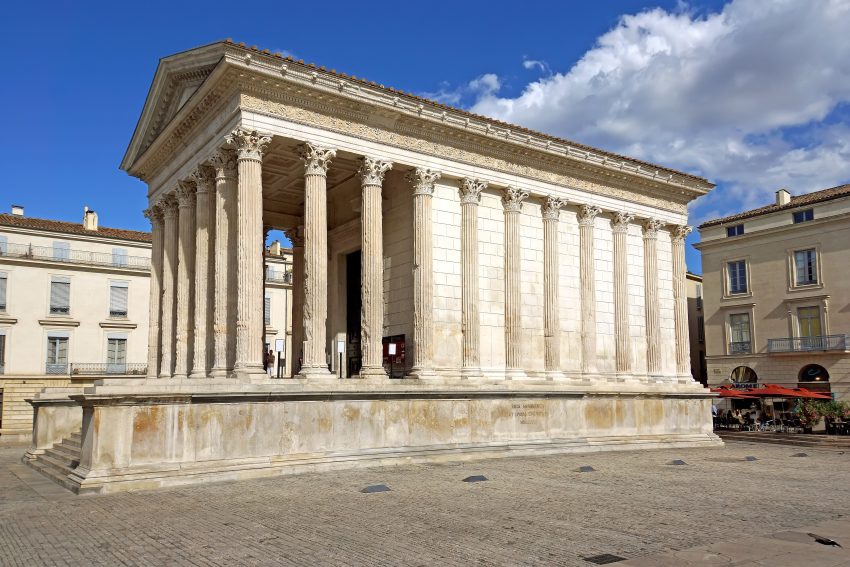
Maison Carrée is a remarkably intact Roman temple in the heart of Nîmes, built around 4–7 AD as an Augustan-era caesareum dedicated to Gaius and Lucius Caesar. Set on a tall podium, its deep front porch and Corinthian columns create a strongly theatrical, head-on façade that still dominates the square, especially when you circle close to study the carved capitals. Inside, the cella is small and windowless, now used for a short film rather than a room-by-room visit, so many travelers are happy lingering outside for photos. Its afterlife is part of the story: reuse over centuries helped preserve it, and its proportions later inspired buildings as far away as Jefferson’s Virginia State Capitol.
Location: Pl. de la Maison Carrée, 30000 Nîmes, France | Hours: January: Daily: 10:00–16:30. February: Daily: 10:00–16:30. March: Daily: 09:30–18:00. April – May: Daily: 09:30–18:30. June: Daily: 09:30–19:00. July – August: Daily: 08:00–21:00. September: Daily: 09:30–19:00. October: Daily: 09:30–18:00. November: Daily: 10:00–16:30. December: Daily: 10:00–16:30. | Price: Adults: €6.50; Reduced: €5.50; Children (7–17): €3.50; Under 7: free; Family pass (2 adults + 1 or 2 children 7–17): €14. | Website | Distance: 0.6km

12. Carre d'Art
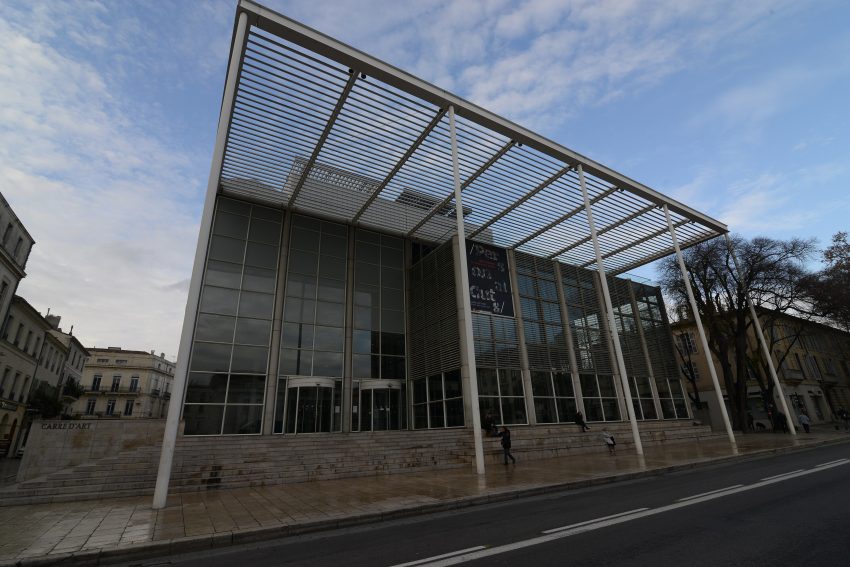
Carre d’Art
Carre d’Art
CC BY-SA 2.0 / Jorge Láscar
Carré d’Art in Nîmes is a Norman Foster–designed contemporary art museum and cultural center that deliberately faces the Roman Maison Carrée across the square, letting glass-and-steel modernism spar with ancient stone. Its permanent holdings run to around 600 works from the 1960s to today, arranged in themed strands such as French and Mediterranean art, so browsing feels structured rather than overwhelming. A partnership with Paris’s Centre Pompidou feeds the program, and the galleries are regularly reshaped by temporary shows, including photography. The building also houses a multimedia library and bookshop, and visitors often remember the civic, lived-in feel—part museum, part everyday public space.
Location: 16 Pl. de la Maison Carrée, 30000 Nîmes, France | Hours: Monday: Closed Tuesday: 10:00 AM – 6:00 PM Wednesday: 10:00 AM – 6:00 PM Thursday: 10:00 AM – 6:00 PM Friday: 10:00 AM – 6:00 PM Saturday: 10:00 AM – 6:00 PM Sunday: 10:00 AM – 6:30 PM | Price: €8 (full price); €6 (reduced). Free on the first Sunday of the month; free entry for under-18s (and other eligible categories with valid proof). | Website | Distance: 0.6km

13. Les Halles de Nimes
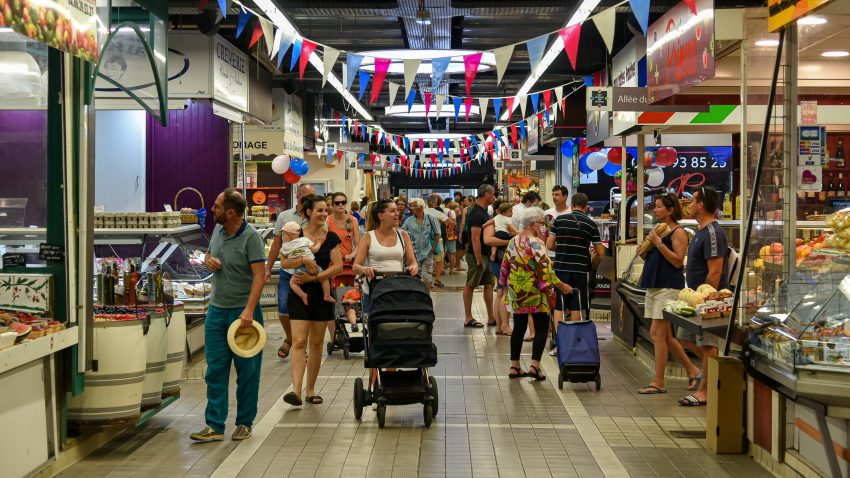
Les Halles de Nimes
Les Halles de Nimes
CC BY-SA 2.0 / Jorge Franganillo
Les Halles de Nîmes is a covered food market in the city center where daily shopping doubles as a social ritual, with conversations flowing as easily as the tastings. Inside, roughly a hundred artisans and traders fill the aisles with vivid, market-day essentials: fruit and vegetables, bread, cheeses, charcuterie, and fish laid out on ice. Look for local specifics such as picholine olives, creamy Pélardon goat cheese, and seafood like sea bream, alongside Provençal-style prepared foods. The hall has served Nîmes since the late 19th century, and today it still feels like a working pantry for the Gard and Camargue, not a staged attraction.
Location: 5 Rue des Halles, 30000 Nîmes, France | Hours: Monday – Friday: 07:00–13:00. Saturday: 07:00–19:00. Sunday: 07:00–13:30. | Price: Free. | Website | Distance: 0.6km

14. Eglise Sainte-Baudile
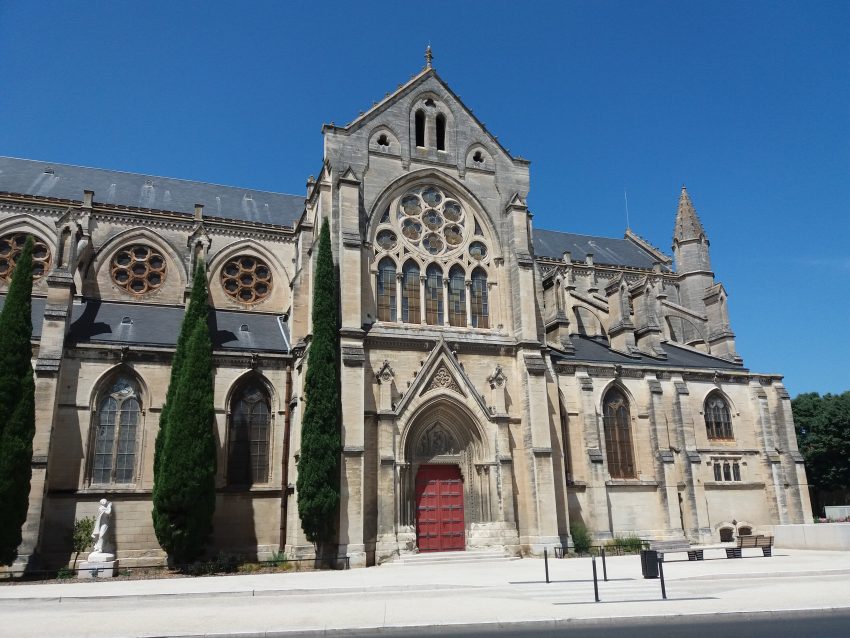
Eglise Sainte-Baudile
CC BY-SA 1.0 / Romainbehar
Eglise Sainte-Baudile is a vast neo-Gothic Roman Catholic church in Nîmes, built from 1867 to 1877 to honor Saint Baudile, a 3rd-century local martyr. Its façade is defined by two bell towers crowned with slender spires rising about 70 meters, a scale that makes many visitors mistake it for the city’s cathedral. Step inside and the space opens into a Latin-cross plan, with ribbed vaults reaching roughly 20 meters high and stained glass by Joseph Villiet that throws saturated color across the nave on bright days. Look for the Cavaillé-Coll organ and the sculpted angels by Léopold Morice, plus Saint Baudile’s statue above the entrance. Hours can be unpredictable, so it’s worth trying again if doors are shut.
Location: 30000 Nîmes, France | Hours: Tuesday: 10:30–19:00. Wednesday: 12:30–19:00. Thursday: 14:00–19:00. Friday: 12:30–19:00. Saturday: 12:30–19:00. Sunday: 15:00–19:00. Closed on Monday. | Price: Free; donations appreciated. | Distance: 0.7km

15. Antonin Square
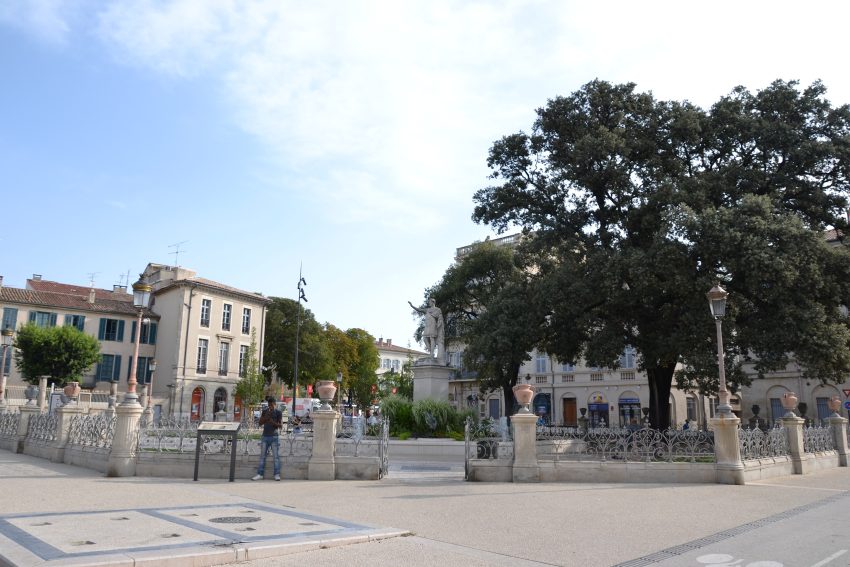
Antonin Square
Antonin Square
CC BY-SA 4.0 / Marianne Casamance
Antonin Square (Square Antonin) is a small 19th-century public square in central Nîmes, created in 1862 to honor Emperor Antoninus Pius, whose family roots trace back to ancient Nemausus. Designed by architect Henri Révoil on the former terminal basin of the Canal de la Fontaine, it feels like a calm, green pause point beside the water. At its center stands a monumental Carrara-marble statue of Antoninus by sculptor Auguste Bosc, unveiled in 1874, set on a pedestal with Latin inscriptions including “Senatvs Popvlvsqve Nemavsensis.” A wrought-iron gate by local craftsman Marius Nicolas encloses the core space, and visitors tend to linger on benches around the fountain and flowerbeds.
Location: Sq. Antonin, 30000 Nîmes, France | Hours: 24 Hours. | Price: Free. | Distance: 0.7km

16. Porte d'Auguste
Porte d’Auguste
Porte d’Auguste
CC BY-SA 2.0 / Jorge Franganill
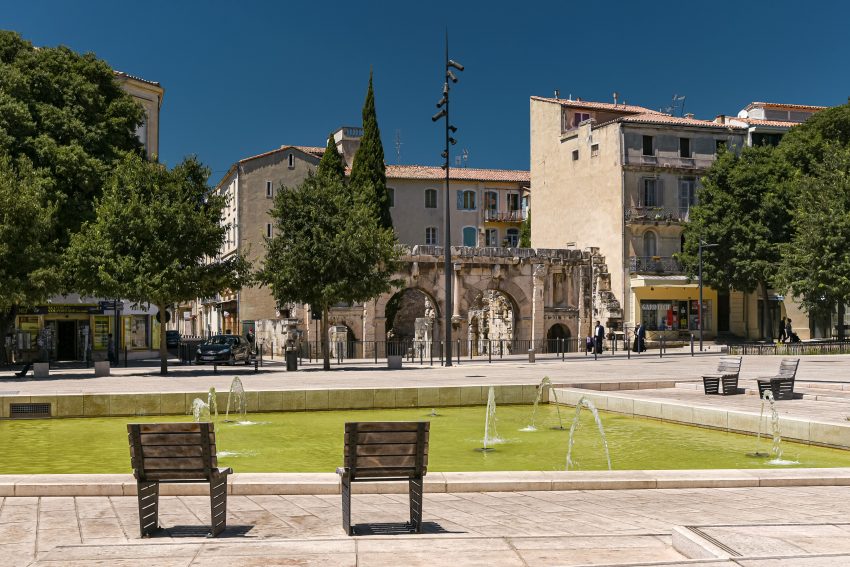
Porte d’Auguste in Nîmes is a Roman city gate (also called Porte d’Arles) that once formed a main entrance through the colony’s defensive wall, where the Via Domitia/Domitian Way entered town. You’ll notice four semicircular passages: two broad central arches built for carts and vehicles, and two narrower side openings for pedestrians. The gate originally had twin semicircular towers, and their footprints are still traced on the pavement by circles of large flat stones. Dating to the 1st century BCE and later absorbed into a medieval fortress, it was only fully revealed again after damage in 1752. A modern statue copy of Augustus nearby underscores the gate’s imperial connection.
Location: 25B Bd Amiral Courbet, 30000 Nîmes, France | Hours: 24 Hours. | Price: Free. | Website | Distance: 0.7km

17. Castellum Aquae
Castellum Aquae
Castellum Aquae
CC BY-SA 4.0 / Chabe01
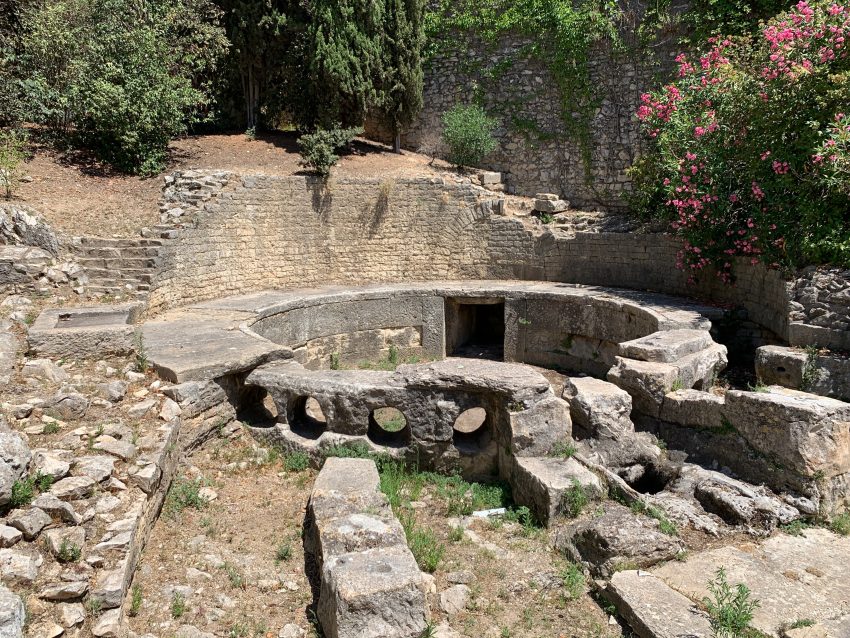
Castellum Aquae (Castellum Divisorium) in Nîmes is a compact Roman distribution basin where water arriving from the aqueduct system was gathered and split across the city. Built in the mid-1st century CE and linked to the same network as the Pont du Gard, it marked the end of a roughly 50 km water journey before supply was sent onward to fountains and public baths. Visitors can still trace the engineering in the ring of circular openings where lead pipes once connected, and in the remains of a sluice gate used to regulate flow. Buried under rubble during citadel works in 1688, it resurfaced after excavation in 1844, turning forgotten infrastructure into a readable ruin.
Location: 16 Rue de la Lampeze 14, 30000 Nîmes, France | Hours: 24 Hours. | Price: Free. | Website | Distance: 1km

18. Temple de Diane
Temple de Diane
Temple de Diane
CC BY-SA 2.0 / Carole Raddato
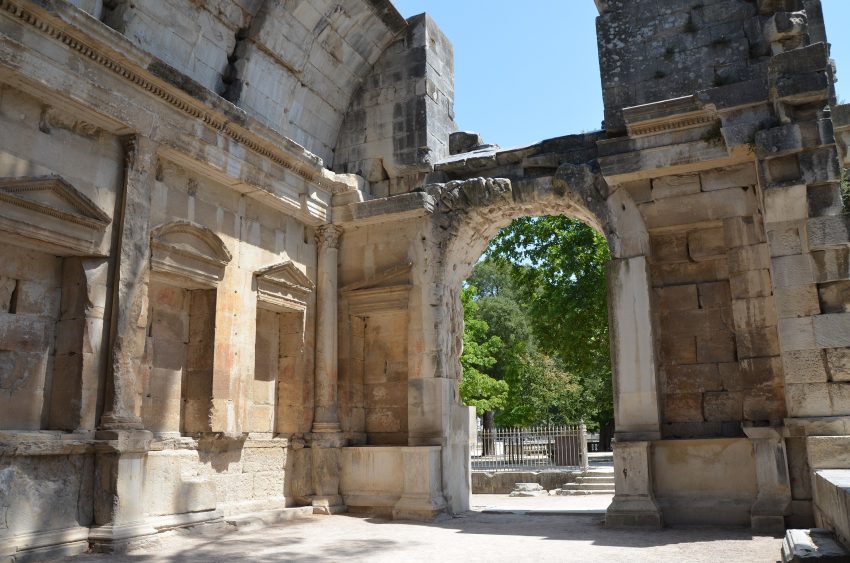
Set in Nîmes’ Jardins de la Fontaine beside the sacred La Fontaine spring, the Temple de Diane is a 1st‑century Roman building from the Augustan era, linked to the imperial-cult sanctuary known as the Augusteum. Despite its name, its basilica-like plan and lack of evidence for a Diana dedication have led many to think it functioned as a library or cultural space. Visitors step into a cool, dim vaulted hall framed by three large façade arches, with a north wall lined by five niches topped with alternating triangular and curved pediments. Look for the thick barrel-vaulted rooms, traces of carved coffered ceilings, and the way the ruin is partly cut into Mount Cavalier’s slope.
Location: Quai Georges Clemenceau, 30000 Nîmes, France | Hours: (Summer) April 1 – August 31: Daily: 07:30–22:00. (Winter) October 1 – March 31: Daily: 07:30–18:30. | Price: Free. | Website | Distance: 1.1km

19. Jardins de la Fontaine
Jardins de la Fontaine
CC BY-SA 3.0 / Драган Сандић
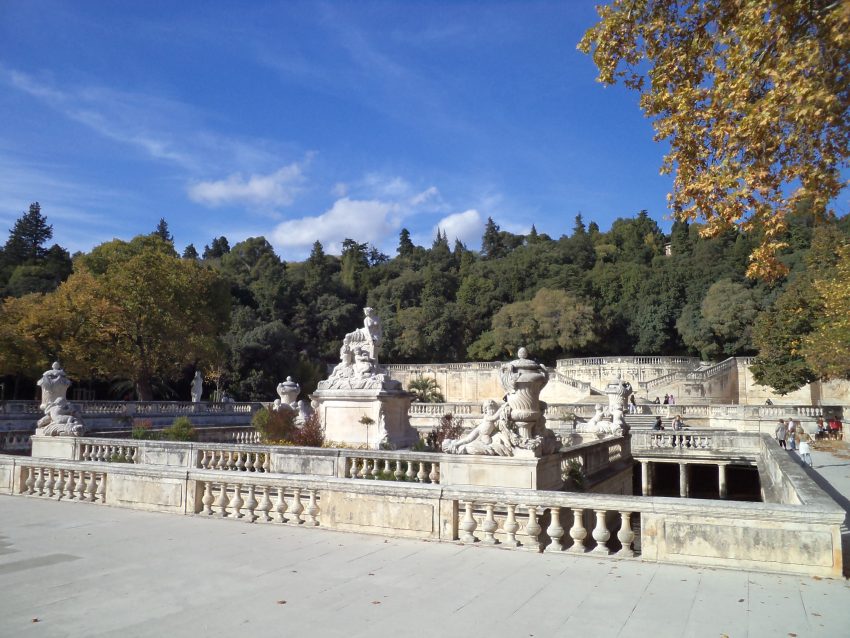
Jardins de la Fontaine is a landscaped public park in Nîmes built around a natural spring that was revered long before the Romans, shaping the city’s earliest sacred center. Created as part of an 18th-century beautification project, it mixes formal terraces, reflective water basins, monumental vases, and Baroque-style statues with fragments of ancient walls. As you follow the ponds and channels, the mood shifts from manicured promenades to weathered Roman remains, including the enigmatic Temple de Diane, thought to have been linked to the spring or an early bathing complex. Visitors remember the sound of water, koi gliding in the pools, and the climb up stairways for a broader view over the city.
Location: 26 Quai de la Fontaine, 30000 Nîmes, France | Hours: (Summer) April 1 – September 15; Daily: 07:30–22:00. (Winter) September 16 – March 31; Daily: 07:30–18:30. | Price: Free. | Website | Distance: 1.1km

20. Tour Magne
Tour Magne
Tour Magne
CC BY-SA 4.0 / Hypercrate
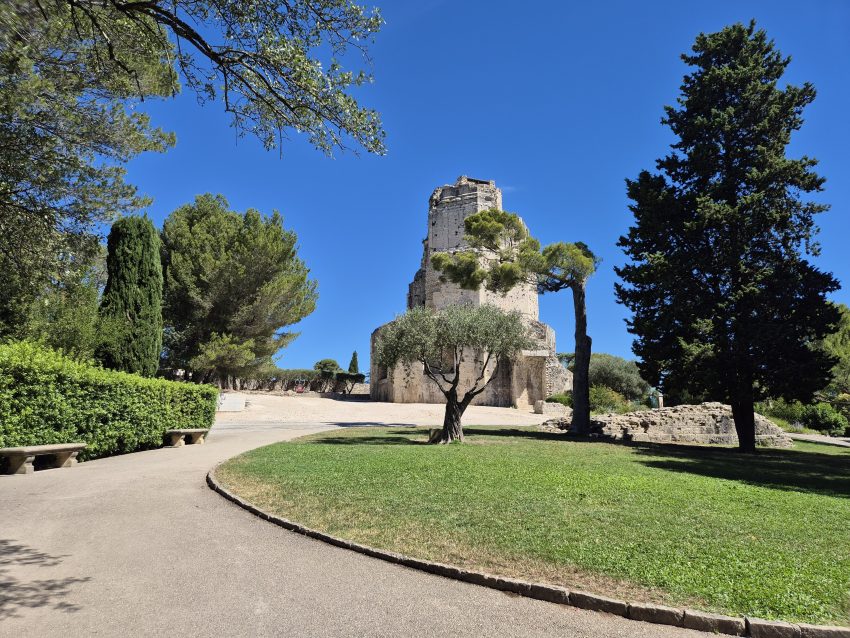
Tour Magne is a Gallo-Roman tower on Mont Cavalier, rising above the Jardins de la Fontaine as the most imposing surviving piece of Nîmes’ ancient city wall. Reworked under Augustus, it grew from an earlier structure into a tall statement of power—once about 36 meters in Roman times, and still around 32.5 meters today—with an irregular octagonal base that hints at the dry-stone tower it once enclosed. Inside, a tight spiral stair climbs to a small terrace where the city spreads out in every direction, making its hilltop position feel like Nîmes’ highest historic perch. Visitors notice the steep approach, the narrow steps, and even the sticky, rusty handrail on the way up.
Location: Les Jardins de la Fontaine, Place Guillaume Apollinaire, 30000 Nîmes, France | Hours: (January 1 – February 28) Daily: 09:30–13:00 & 14:00–16:30. (March 1 – March 31) Daily: 09:30–13:00 & 14:00–18:00. (April 1 – May 31) Daily: 09:30–18:00. (June 1 – June 30) Daily: 09:00–19:00. (July 1 – August 31) Daily: 09:00–20:00. (September 1 – September 30) Daily: 09:30–13:00 & 14:00–19:00. (October 1 – October 31) Daily: 09:30–13:00 & 14:00–18:00. (November 1 – December 31) Daily: 09:30–13:00 & 14:00–16:30. | Price: Adults: €4; Reduced: €3.50; Ages 7–17: €1.50; Under 7: free. | Website | Distance: 1.3km

Best Day Trips from Nimes

A day trip from Nimes offers the perfect opportunity to escape the urban rhythm and discover the surrounding region's charm. Whether you're drawn to scenic countryside, historic villages, or cultural landmarks, the area around Nimes provides a variety of easy-to-reach destinations ideal for a one-day itinerary. If you are looking to rent a car in France I recommend having a look at Discover Cars, first, as they compare prices and review multiple car rental agencies for you.

1. Uzes
Uzes France
Uzes France
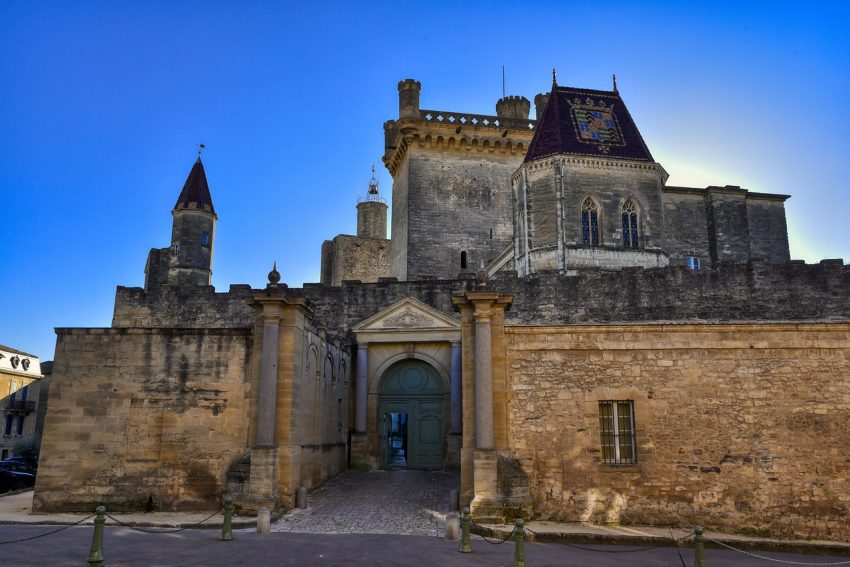
Uzès is a charming town in the Occitanie region, known for its beautiful medieval architecture, lively markets, and tranquil atmosphere. Visitors can explore the picturesque streets, lined with boutiques, cafés, and art galleries, all while soaking in the town’s relaxed, small-town feel. The town's central square, Place aux Herbes, hosts a popular market where you can sample local produce and…
Visiting Uzes
Powered by GetYourGuide

2. Arles

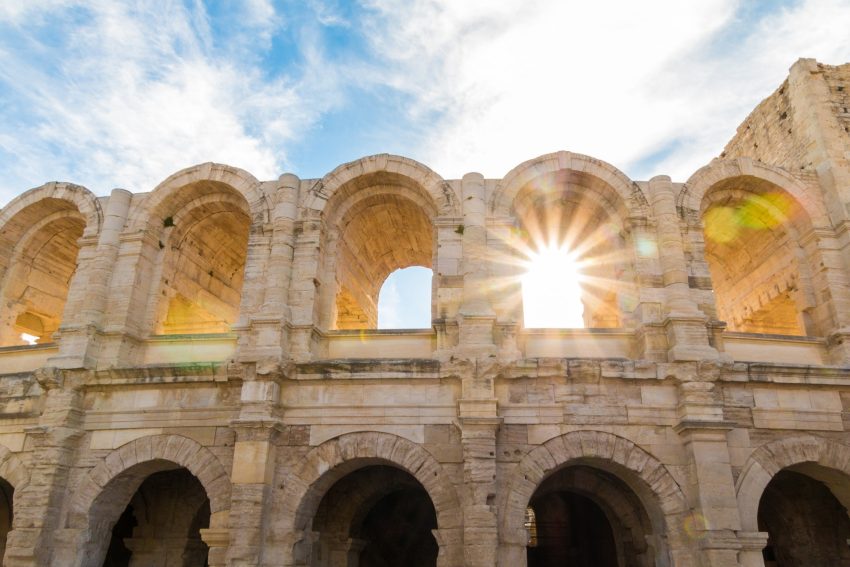
the amphitheatre of arles
Positioned along the River Rhône in the heart of Provence, Southern France, Arles captivates with its blend of elegant 18th and 19th-century mansions and ancient Roman architecture. Arles is one of the most underrated cities in France. Its fame was significantly heightened by Vincent van Gogh, whose time in Arles left behind an array of scenes that continue to draw…
Visiting Arles
Powered by GetYourGuide

3. Avignon

avignon
avignon
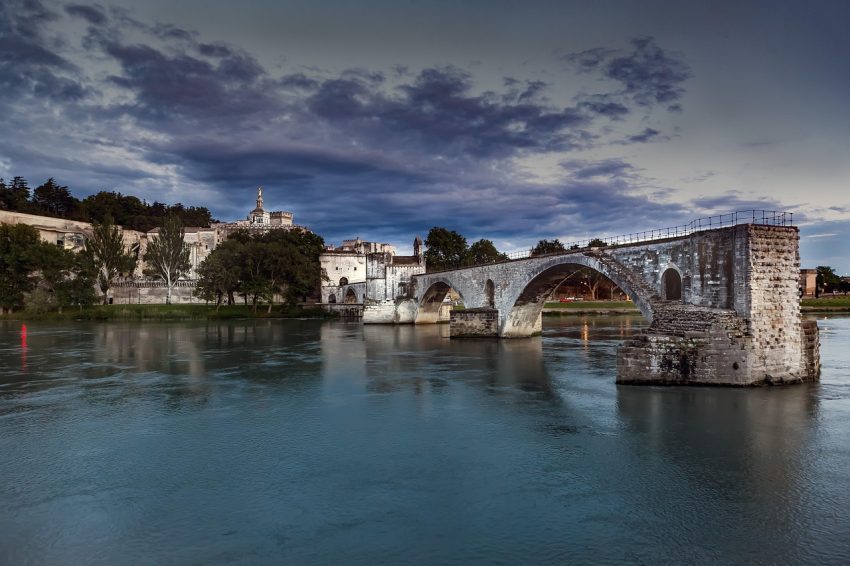
Avignon is one of those places that instantly makes you slow down and look around. The stone streets, shaded squares, and dramatic medieval architecture feel like something out of a film set. Walking through the old town is a joy in itself—cafés spill into plazas, musicians play under centuries-old archways, and the golden light bouncing off the Rhône makes everything…
Visiting Avignon
Powered by GetYourGuide

4. Saint-Rémy-de-Provence

france St Remy de Provence
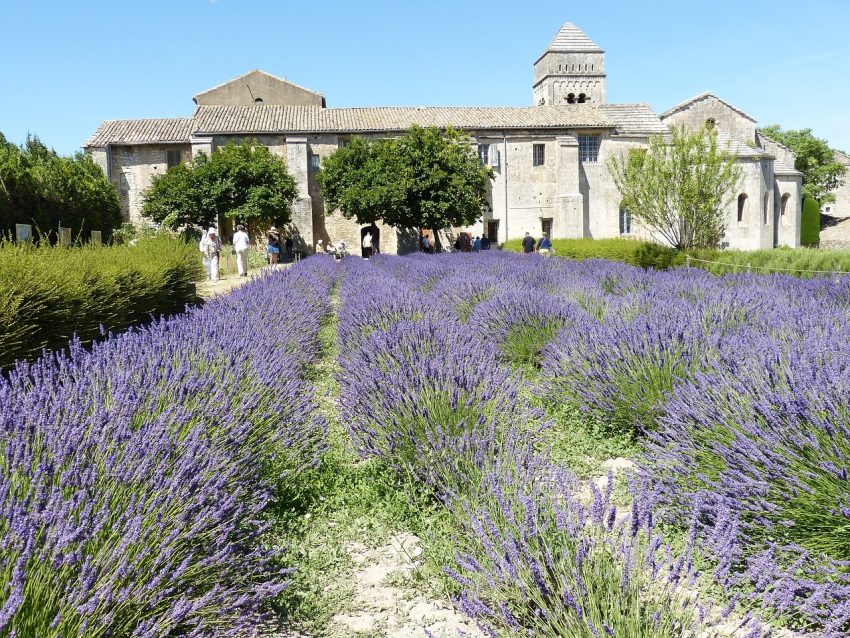
Saint-Rémy-de-Provence is a picturesque town in the Provence-Alpes-Côte d’Azur region of southern France, beloved for its sun-drenched charm, winding stone streets, and atmospheric markets. Surrounded by olive groves and vineyards at the foot of the Alpilles mountains, it's an ideal destination for those looking to experience the slower rhythms and sensory pleasures of Provençal life. Weekly markets fill the town…
Visiting Saint-Rémy-de-Provence
Powered by GetYourGuide

5. Montpellier

Montpellier France
Montpellier France
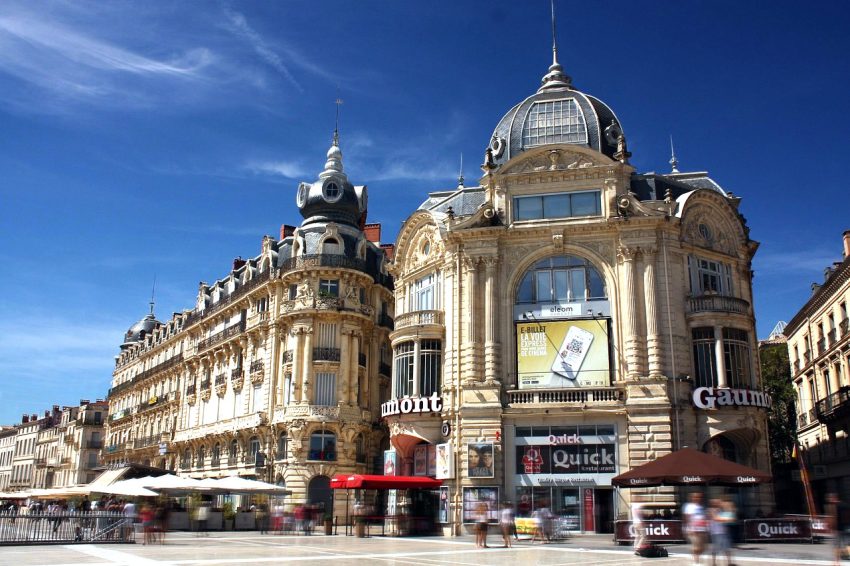
Montpellier, located in the Occitanie region of southern France, is a vibrant and youthful city with a unique blend of old-world charm and modern energy. Its sunny Mediterranean climate, bustling town squares, and lively street culture make it a perfect destination for both relaxation and exploration. The city feels alive with students, art, and music, giving it an effortlessly cool…
Visiting Montpellier
Powered by GetYourGuide

6. Cavaillon

Cavaillon
Cavaillon
CC BY-SA 4.0 / Julien Pelissier
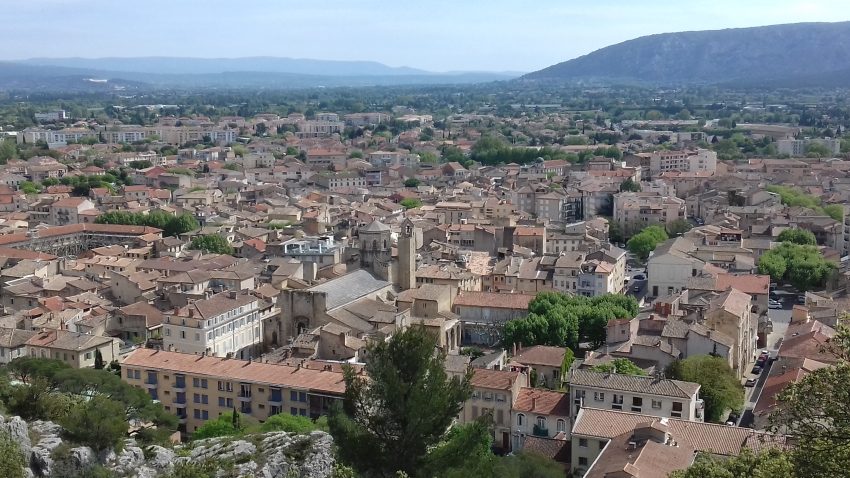
Visiting Cavaillon offers a delightful mix of small-town charm and access to the beautiful landscapes of the Provence-Alpes-Côte d'Azur region. The town is known for its stunning surroundings, including the nearby Luberon mountains and vast fields of fruit orchards, particularly its famous melons. With its warm Mediterranean climate, Cavaillon is an excellent spot for those who enjoy outdoor activities like…
Visiting Cavaillon
Powered by GetYourGuide

7. Sete

Sete France
Sete France
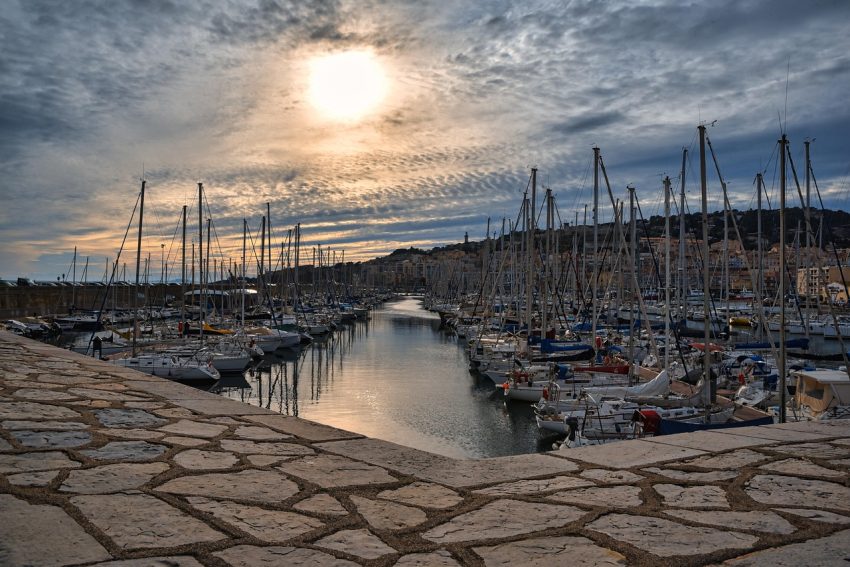
Sète is a charming coastal town in southern France, known for its picturesque canals, bustling fishing port, and vibrant markets. Visitors often enjoy wandering through its lively streets, sampling fresh seafood at waterfront restaurants, and exploring the local art scene in small galleries and boutiques. The town offers a laid-back atmosphere, perfect for leisurely strolls along the marina or relaxing…
Visiting Sete
Powered by GetYourGuide

8. Aix en Provence

Aix en Provence
Aix en Provence
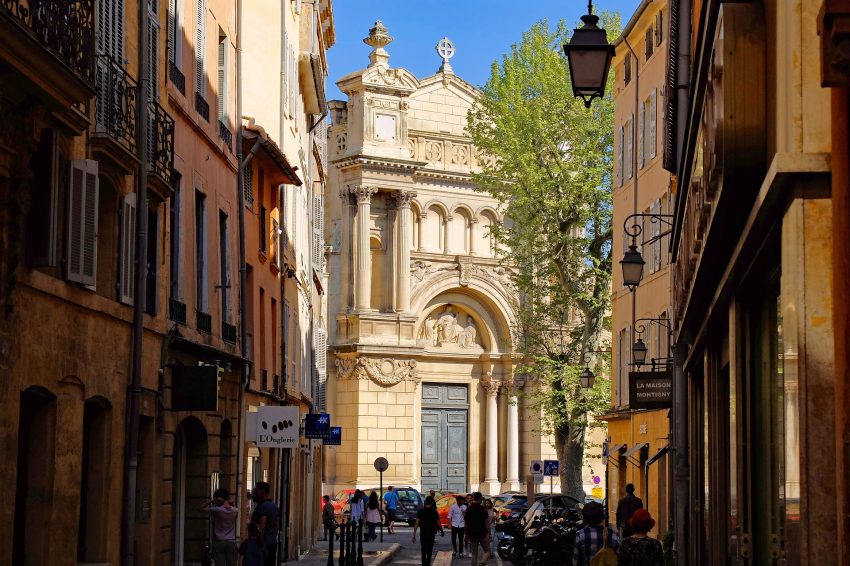
Aix-en-Provence, commonly pronounced as "X," is a stunning town in the far south of France, easily accessible by TGV high-speed train. It takes about three hours from downtown Paris and three and a half hours from Charles de Gaulle Airport. Located just 30km north of Marseille, Aix could well have been the central hub of Provence if not overshadowed by…
Visiting Aix en Provence
Powered by GetYourGuide

9. Marseille

visit marseille
visit marseille
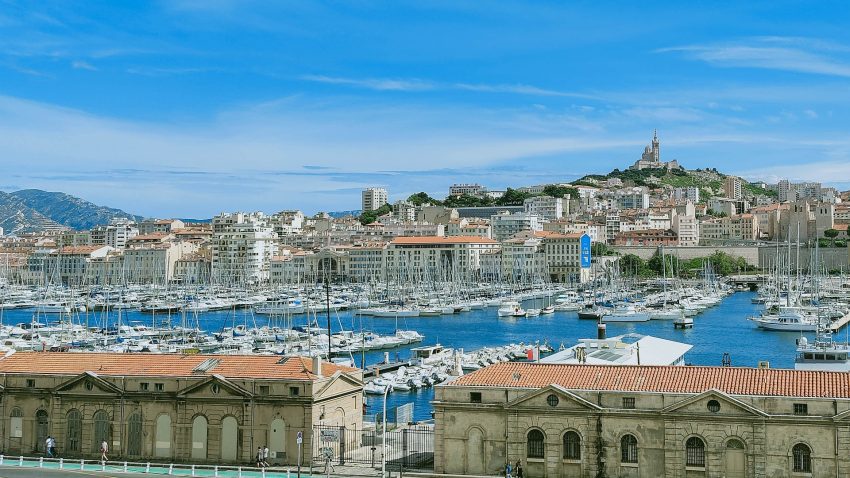
Marseille, located in the Provence-Alpes-Côte d’Azur region of southern France—not in Germany—is a dynamic port city known for its mix of cultures, sea views, and Mediterranean energy. It offers a completely different vibe from inland Provençal towns, with its bustling harbor, urban sprawl, and access to the sea. The Vieux-Port (Old Port) is the heart of the city, lined with…
Visiting Marseille
Powered by GetYourGuide

10. Béziers

beziers france
beziers france
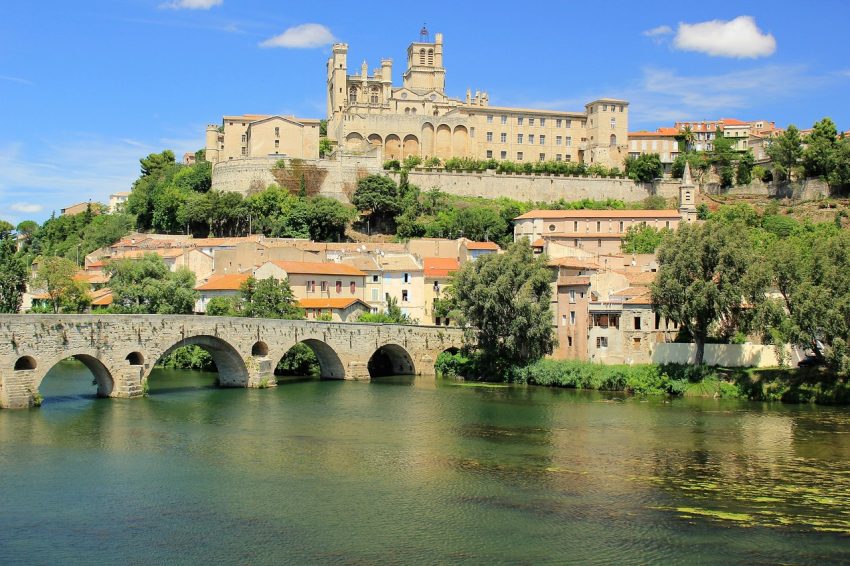
Béziers is a charming and authentic city located in the Occitanie region of southern France, offering travelers a delightful blend of cultural heritage, bustling markets, and Mediterranean warmth. Visiting Béziers provides the perfect opportunity to stroll leisurely through its picturesque old town, exploring narrow streets filled with local boutiques, cafés, and restaurants serving traditional Languedoc cuisine. The vibrant atmosphere around…
Visiting Béziers
Powered by GetYourGuide

Where to Stay in Nimes

In the historic Écusson district, where Roman monuments punctuate narrow, sun-baked lanes, you’ll find refined city-centre retreats that place you steps from the Arena and the Maison Carrée. Hôtel Imperator occupies an elegant Belle Époque building with a peaceful courtyard and classic rooms overlooking the amphitheatre. Just around the corner, De l’Amphithéâtre blends modern design with original stone walls and offers a rooftop terrace for sunset drinks framed by the Arena’s towers. A short stroll brings you to Hôtel Des Tuileries, set in a converted townhouse with vaulted ceilings and a shaded inner garden, and Hôtel Marquis, where pastel-hued rooms and wrought-iron balconies overlook a quiet square just off the Roman forum.

Around the train station and the Parc Expo, practical yet comfortable options suit both business and leisure travellers. Courtyard by Marriott Nîmes provides sleek, contemporary rooms, a fitness centre and an indoor pool, with easy tram access into the centre. Nearby, B&B Hôtel Nîmes Centre Arènes offers bright, functional studios and free parking, while ibis Styles Nîmes Centre Gare combines playful décor with hearty breakfasts and bike rental services for exploring the city’s greenways.

Venture into the surrounding countryside, where vineyards and olive groves frame country inns and estate guesthouses just beyond the city limits. Domaine de Massereau welcomes guests into spacious suites within a restored 19th-century mas, complete with guided wine tastings and a pool shaded by plane trees. Not far away, Mas de la Dame offers rustic-chic rooms in a stone farmhouse setting, plus walking trails through lavender fields. For a tranquil retreat, Mas de Boudan is tucked among olive terraces, providing simple yet elegant rooms and an on-site table d’hôtes showcasing Provençal specialties.

Using the our Hotel and Accomodation map, you can compare hotels and short-term rental accommodations in Nimes. Simply insert your travel dates and group size, and you’ll see the best deals for your stay.

Nimes Accommodation Map

Best Time to Visit Nimes

Visiting Nîmes in Spring (March to May)

Spring is a lovely time to visit Nîmes, with mild weather, blooming gardens, and fewer crowds. The city’s Roman sites and outdoor cafés are especially enjoyable in the pleasant temperatures. It’s also a good time for local events and open-air markets as the city shakes off winter.

Visiting Nîmes in Summer (June to August)

Summer in Nîmes is warm and lively, with long, sunny days perfect for exploring the city’s ancient monuments. This season also brings popular festivals, including music and traditional events held in the Roman Arena. While it can be hot, there’s a vibrant energy that makes the city feel alive.

Visiting Nîmes in Autumn (September to November)

Autumn offers cooler temperatures and a slower pace, ideal for sightseeing and enjoying the local lifestyle. The city is less crowded, and the changing colors add a warm glow to parks and historic streets. It’s a great season for food lovers, with harvests and seasonal dishes featured in many restaurants.

Visiting Nîmes in Winter (December to February)

Winter in Nîmes is generally mild, with crisp air and quieter streets. It’s a peaceful time to explore museums, Roman architecture, and cozy cafés without the tourist rush. Holiday markets and festive lights also give the city a charming atmosphere during December.

Annual Weather Overview

  • January 11°C
  • February 13°C
  • March 16°C
  • April 19°C
  • May 25°C
  • June 31°C
  • July 32°C
  • August 30°C
  • September 27°C
  • October 22°C
  • November 14°C
  • December 11°C

How to get to Nimes

How to Visit Nîmes by Air

Nîmes is served by a small airport with connections to select European cities. For more options, nearby airports in Montpellier and Marseille offer additional international flights. Renting a car at the airport is a convenient choice, especially if you plan to explore the surrounding countryside or nearby towns.

How to Visit Nîmes by Train

Nîmes is well-connected by train, with high-speed TGV services from major cities like Paris, Lyon, and Marseille. The main station is located close to the city center, making arrival and navigation easy. Trains are a quick and comfortable way to reach Nîmes from other parts of France. You can use SNCF Connect to check schedules, compare routes, and purchase tickets for National (SNCF ) and regional trains (TER). For a more streamlined experience, we recommend using Omio, which allows you to easily compare prices, schedules, and book tickets for both National and Regional travel across all of Europe, all in one place.

How to Visit Nîmes by Car

Driving to Nîmes offers flexibility and access to scenic routes and lesser-known destinations nearby. The city is connected by major highways, and parking is available in and around the center. Renting a car is ideal if you want to explore rural areas, vineyards, or historical sites in the region. If you are looking to rent a car in France I recommend having a look at Discover Cars, first, as they compare prices and review multiple car rental agencies for you.

How to Visit Nîmes by Bus

Long-distance buses run regularly to Nîmes from other French and European cities. It’s an affordable travel option and often includes stops at central locations. Bus travel can be slower than trains but is great for budget-conscious visitors.

Getting Around Nîmes

Nîmes is compact and easy to explore on foot, especially the historic center and main attractions. Local buses cover more distant neighborhoods and surrounding areas. For day trips or countryside exploration, renting a car is highly recommended.
More from this area