Self-Guided Walking Tour of Ghent
This website uses affiliate links which earn a small commission at no additional cost to you.
Ghent is one of Belgium's most historically dense cities: a medieval trading power that grew rich on cloth and river commerce, then carried that civic confidence into an urban core packed with guild architecture, churches, and civic monuments. Its rivers are not just scenic; they explain the city's layout and prosperity, with quays, bridges, and former warehouses still defining how the centre fits together today.
What makes Ghent work for visitors is how tightly the main sights cluster around the old heart of the city, so you can move quickly between big-ticket landmarks and smaller, atmospheric streets without losing the sense of continuity. Expect a mix of imposing stone skyline markers, intimate neighbourhood lanes, and waterfront viewpoints that keep re-framing the same historic core from different angles.
How to get to Ghent
By Air: Fly into Brussels Airport for the most straightforward onward connections, then continue to Ghent by train. Antwerp Airport and Brussels South Charleroi can work depending on routes and price, but they usually mean an extra change and more time overall. For the best deals and a seamless booking experience, check out these flights to Ghent on Booking.com.
By Train: Arriving by rail is one of the easiest ways to reach Ghent, with frequent services from Brussels and strong connections across Belgium and neighbouring countries. Ghent's main station is Gent-Sint-Pieters, and from there you can use a tram, bus, taxi, or a short onward train hop depending on where you're staying. Train tickets and schedules can be found directly on the SNCB/NMBS website for Belgian services. For a more convenient experience, consider using Omio, where you can easily compare prices, schedules, and book tickets in one place.
By Car: Driving is possible, but I treat Ghent as a city where planning matters more than the drive itself-traffic restrictions and parking zones can make central access awkward. If you do come by car, it's usually simpler to park outside the core (or at a hotel with parking) and rely on public transport or walking once you're in. If you are looking to rent a car in Belgium I recommend having a look at Discover Cars, first, as they compare prices and review multiple car rental agencies for you.
How to get around the city: The historic centre is very walkable, and I find that’s the best way to appreciate the details-facades, bridges, small courtyards, and waterside viewpoints. Trams and buses are useful for getting between Gent-Sint-Pieters and the centre, or for reaching neighbourhoods beyond the core, and cycling is common if you want to cover more ground quickly.
A Short History of Ghent
Early Ghent and the Origins of a Trading City
Ghent developed around waterways that made movement and trade practical long before the city looked “medieval” in the way visitors recognise today. Those rivers and canals became the city's economic engine, shaping where people built, traded, and gathered. Even now, the canalside streets and quays feel like the original spine of the city.
Medieval Ghent and the Age of Cloth Wealth
Ghent’s medieval rise was closely tied to the cloth trade, which fuelled the construction of the civic and religious landmarks that still define the skyline. The Belfry and Cloth Hall speak to the city’s commercial confidence and self-government, while major churches like St Bavo’s Cathedral reflect both faith and wealth concentrated into monumental stonework. When I’m in the centre, the density of big buildings in a small area makes this period feel especially tangible.
Fortress, Power, and Civic Identity in Ghent
The presence of Gravensteen Castle is a reminder that Ghent’s prosperity also brought power struggles and the need to project authority. Fortifications and imposing civic architecture weren’t just functional-they were statements about who controlled the city and how it was governed. The Town Hall, with its formal presence, also fits into this long tradition of civic identity and public life centred on prominent buildings.
Later Centuries and a City That Kept Reinventing Itself
As economies shifted, Ghent adapted, and the old mercantile core evolved into a city with multiple layers rather than a single “museum centre.” The canalside façades around the Graslei and Korenlei remain the most iconic face of Ghent, but they sit within a wider city that has kept changing its purpose and pace over time. That mix-medieval skyline with a modern rhythm-is part of what makes Ghent feel so easy to enjoy.
Where to Stay in Ghent
To make the most of visiting Ghent and this walking tour then you consider stay overnight at the centre. If you want the classic “step outside into the postcard” experience, base yourself in the historic core near the canals and main landmarks, where the Belfry area, St Bavo's Cathedral, and the prettiest quays are all close at hand; good, central options include 1898 The Post, Ghent Marriott Hotel, and NH Collection Gent.
If you prefer a slightly quieter, characterful feel while still being minutes from the centre, I like the Patershol and Prinsenhof side of town-historic streets, a calmer evening vibe, and easy access to Gravensteen and the canal edges; consider Pillows Grand Boutique Hotel Reylof as a comfortable base in that direction.
If you’d rather be on the edge of the centre for simpler transport links and a more “local city” feel, the area around Gent-Sint-Pieters is practical for early trains and day trips, while still being a quick tram ride from the sights; for a lively, food-and-bar atmosphere close to the centre, the Zuid/Brabantdam area works well too, with options like Yalo Urban Boutique Hotel Gent and Novotel Gent Centrum.
Your Self-Guided Walking Tour of Ghent
Discover Ghent on foot with our walking tour map guiding you between each stop as you explore its medieval skyline, canalside streets, and landmark squares. As this is a self guided walking tour, you are free to skip places, and take coffee stops when ever you want!
1. Sint-Baafskathedraal
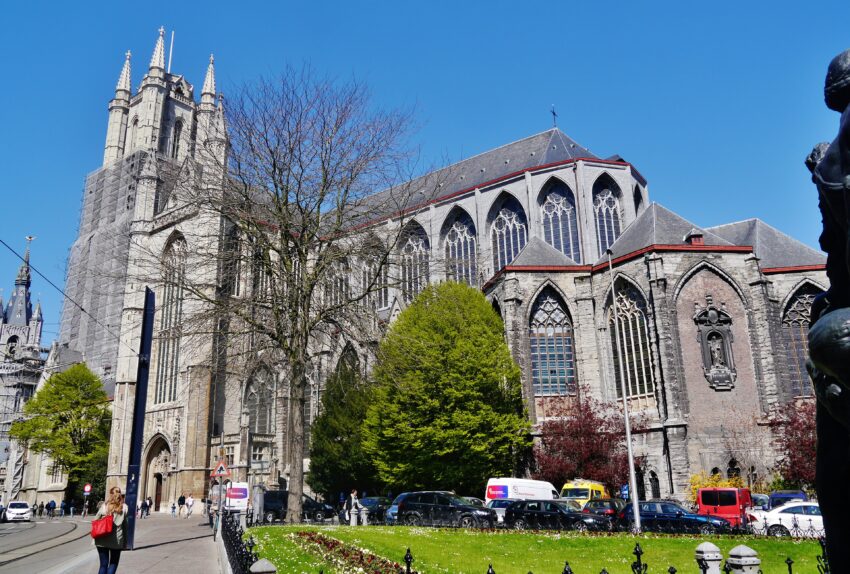
Sint-Baafskathedraal is Ghent’s cathedral best known for its association with the Ghent Altarpiece, one of the defining works of Early Netherlandish art. The polyptych was completed in 1432 by Hubert and Jan van Eyck and has a famously eventful history, including repeated thefts and wartime displacements.
Inside, the main priority is the Ghent Altarpiece (the Adoration of the Mystic Lamb): allow time to understand the panels and the detail work, which repays close viewing. Even if you focus on the altarpiece, it’s worth also looking at the cathedral’s broader interior as a layered record of civic wealth and ecclesiastical patronage.
For a first visit, pace it around three anchors: the altarpiece, the nave and choir as a single long vista, and the side chapels that hold smaller-scale artworks. If you care about technique, the altarpiece’s oil-paint handling and naturalism are central to why it is so celebrated.
Location: Sint-Baafsplein 1, 9000 Gent, Belgium | Hours: Mon - Sat: 8:30 am - 5.30 pm Sun: 1 pm - 5.30 pm | Price: Adults: €16:00 for AR tour | Website

2. Lakenhalle
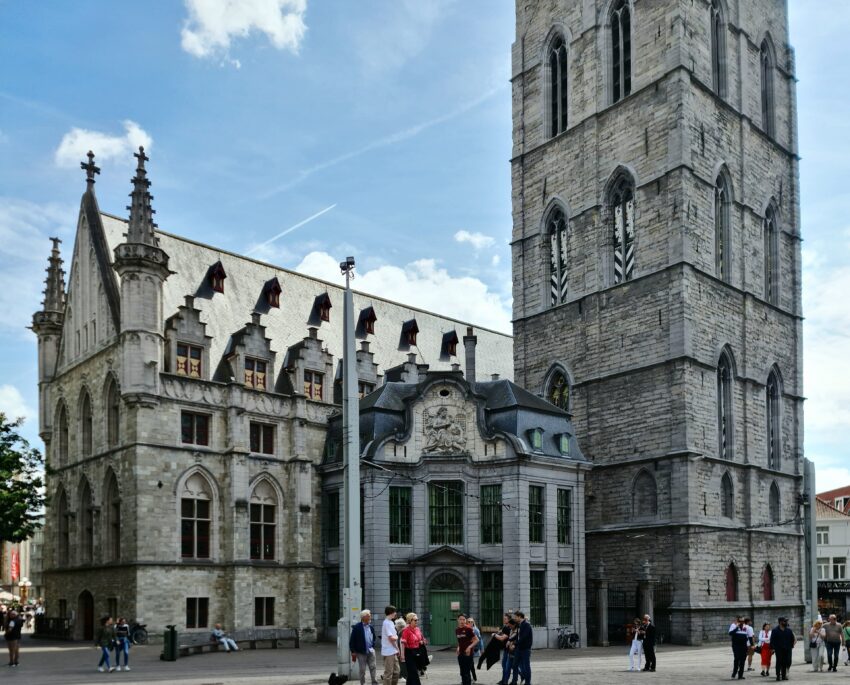
Lakenhalle is physically tied to Ghent’s belfry complex and reflects the city’s medieval-commercial identity. The Cloth Hall was built against the belfry in the 15th century and functioned as a centre where cloth—Ghent’s key export—was inspected, valued, and traded.
What you’re seeing is essentially the architectural footprint of a regulated economy: civic oversight, quality control, and merchant activity concentrated in one place. Its setting beside the belfry is not accidental; these buildings collectively express municipal authority as much as commerce.
When you visit, focus on the relationship between the hall and the belfry, then step back to take in how the ensemble reads as a single “civic statement” in stone. It’s especially rewarding to view it in context with the surrounding squares, where the trading city’s circulation routes still make sense on foot.
Location: Sint-Baafsplein 17, 9000 Gent, Belgium | Hours: 24 Hours. | Price: Free.
3. Belfort
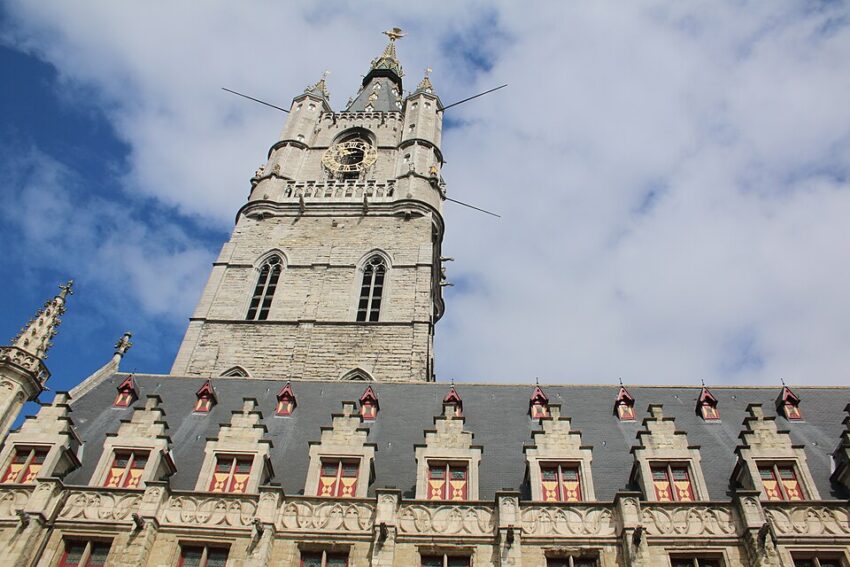
The Belfort is one of Ghent’s clearest symbols of medieval urban independence, and it is recognised as part of the UNESCO-listed belfry tradition. Historically, it was a secure place for safeguarding civic privileges and important documents, underlining that the tower wasn’t just a landmark but an instrument of city government.
A signature detail is the gilded dragon, associated with the belfry since the late 14th century, functioning as both emblem and guardian figure in local symbolism. The tower is also linked to civic warning and timekeeping through its bells and carillon tradition.
What to do on site: prioritise the climb or lift-assisted ascent for the city-wide perspective, then spend a minute with the belfry’s exterior details—the dragon and the tower’s changing silhouettes across building phases. If you time it well, hearing the bells or carillon adds a “living” layer to what can otherwise feel like static architecture.
Location: Belfort van Gent, Sint-Baafsplein, 9000 Gent, Belgium | Hours: Daily: 10am to 6pm | Price: Adults: €13.00 | Website

4. Stadhuis
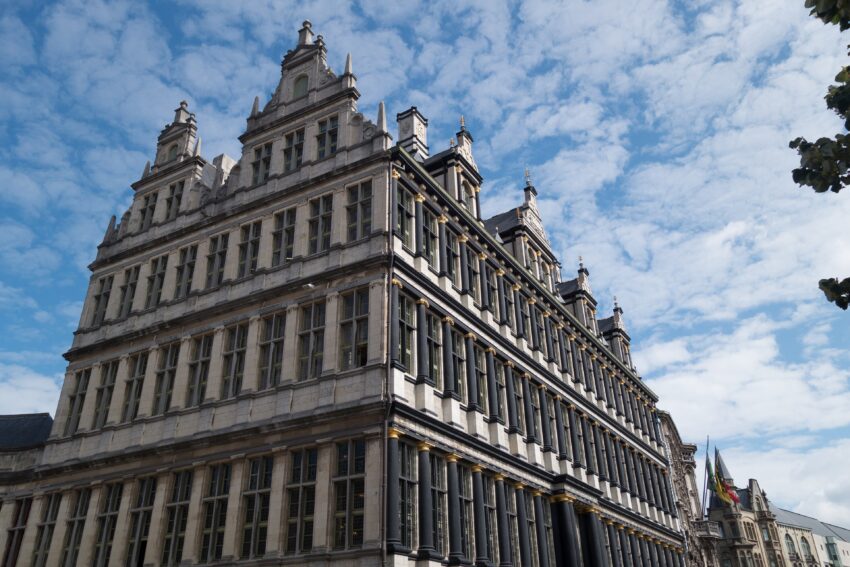
Ghent’s Stadhuis is compelling because it’s intentionally eclectic: the building reads like a timeline of changing taste and power. One façade is flamboyant Late Gothic from the early 16th century, while another wing shifts decisively into Renaissance language with classical columns and palazzo-like composition.
That stylistic contrast reflects how long civic buildings evolved—new administrations built onto old ones, and fashion changed faster than institutions. The result is a complex that’s less “one perfect design” and more an architectural record of how the city governed itself over centuries.
When you visit, look for the seam where the styles transition and treat it like a visual argument between eras. If the interiors are accessible during your visit, they deepen the story: the building was designed to impress not just locals, but visiting dignitaries and rival cities as well.
Location: Botermarkt 1, 9000 Gent, Belgium | Hours: Check official website. | Price: Free.
5. Vrijdagmarkt
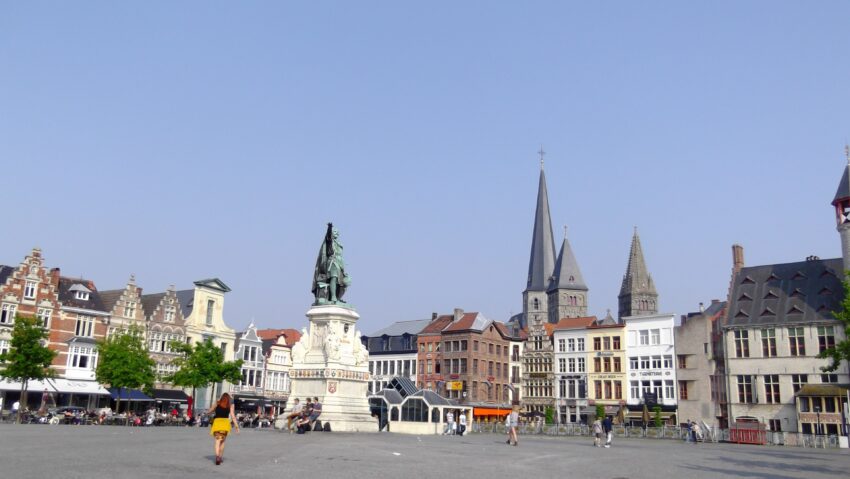
Vrijdagmarkt is one of Ghent’s oldest major squares, anchored by the weekly Friday market tradition and shaped by centuries of civic gathering. The square’s long history includes political theatre and unrest as well as trade, which is typical of major market places in medieval cities.
The central statue of Jacob van Artevelde makes the political dimension explicit: he is linked to Ghent’s 14th-century power struggles and the city’s economic reliance on English wool during the Hundred Years’ War era. The surrounding buildings reinforce the “guild” atmosphere—this is a square that historically belonged to organised trades and public life.
What to do there: visit when the market is active if you want continuity with the square’s original purpose, then return when it’s quieter to read the architecture and sightlines. Look for guild-related buildings and the square’s scale; it’s large enough to feel like an urban “room,” designed for crowds, proclamations, and collective energy.
Location: Vrijdagmarkt, 9000 Gent, Belgium | Hours: 24 Hours. | Price: Free.
6. Dulle Griet
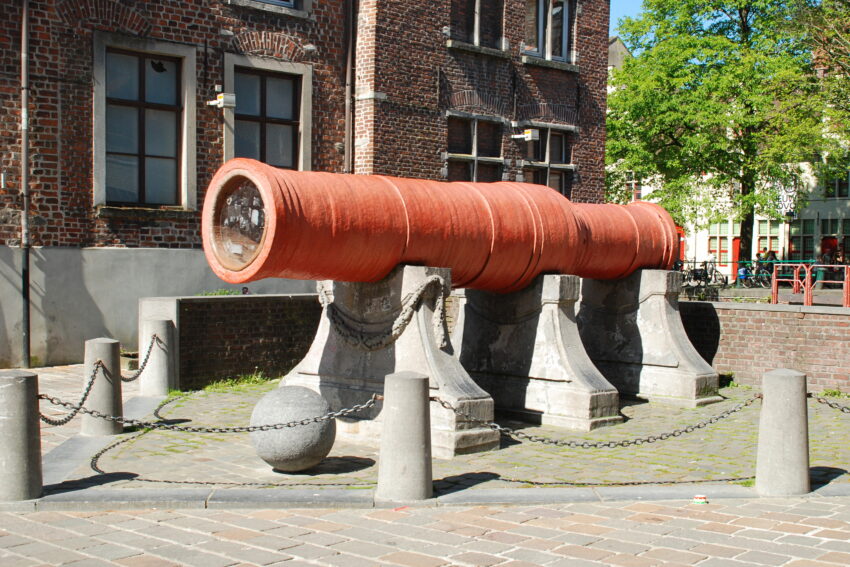
Dulle Griet is a medieval supergun (a large bombard) associated with Ghent, generally dated to the 15th century. It stands as a physical reminder of late-medieval siege warfare and the civic pride attached to military technology in an era when cities defended themselves as political actors.
Its story includes real movement and conflict: it was used in the mid-15th century during the Siege of Oudenaarde and later returned to Ghent in the late 16th century. Even without diving into every disputed detail, the key point is that this is not a decorative replica—it is a surviving artifact of extreme-scale artillery.
When you see it, look closely at the construction and sheer proportions: it’s meant to impress in the same way fortifications do. Place it mentally alongside Ghent’s walls, towers, and castle—Dulle Griet is another facet of the same historical system of civic defence and intimidation.
Location: Vrijdagmarkt 50, 9000 Gent, Belgium | Hours: 24 Hours. | Price: Free.
7. Kraanlei and Patershol Quarter
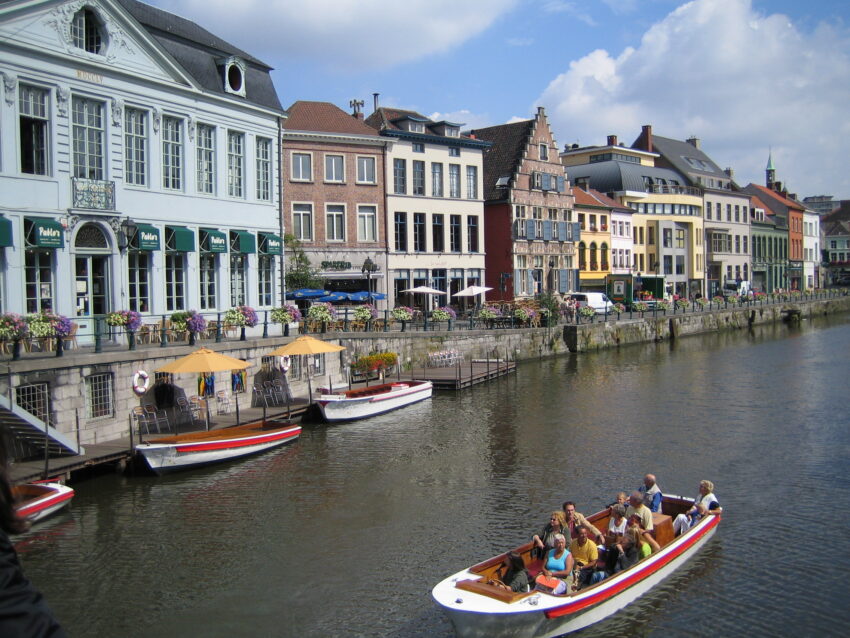
Kraanlei is a riverside street whose name points to its historic function: the “crane” quays where goods were lifted from barges and handled along the waterfront. That working-port history feeds directly into the character of the adjacent Patershol quarter, which preserves a dense, older street pattern close to Gravensteen.
Patershol is often described through its present-day food scene, but the underlying draw is the contrast between intimate medieval-scale streets and the heavier monumental architecture nearby. In other words, it’s a place where the city feels small again, even within a major historic centre.
When you visit, treat it as an “atmosphere” stop with substance: look for the way the river edge and narrow lanes knit together, then pick out surviving older façades and the rhythm of courtyards and corners. It’s also one of the best areas to slow down, because the reward is less a single monument and more the continuity of urban texture.
Location: Corduwaniersstraat 61, 9000 Gent, Belgium | Hours: 24 Hours. | Price: Free.
8. Gravensteen Castle
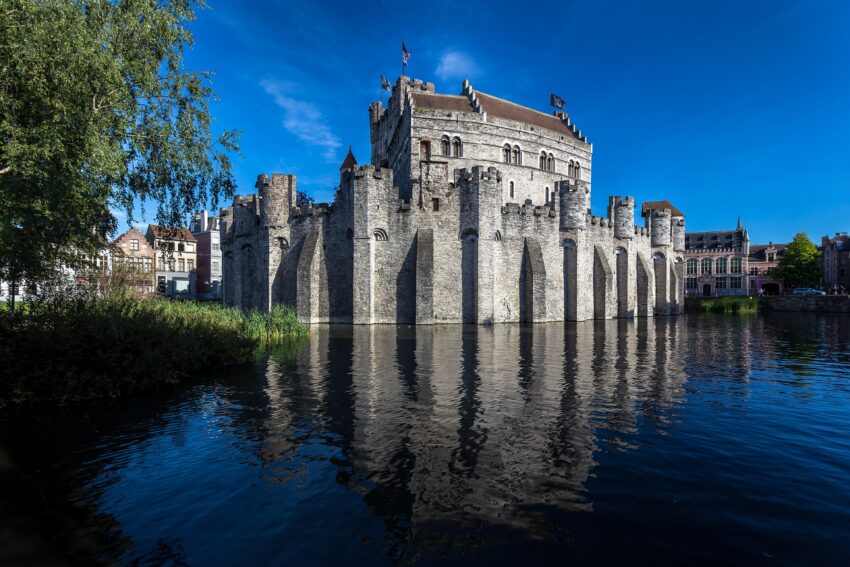
Gravensteen is Ghent’s medieval castle associated with the Counts of Flanders, and the current stone fortress dates to 1180. It was not only a residence but later served pragmatic civic functions over time, including roles as a court and prison, which is part of why it remains so central to the city’s public memory.
The castle’s narrative is overtly about authority: it was built to dominate the urban landscape and to make the count’s power unmissable. That message is still legible in the thick walls, the defensive perimeter, and the elevated viewpoints.
On site, prioritise the ramparts and higher walkways for perspective over the old centre, then work inward through the layered spaces that show how the building was reused across centuries. A good visit alternates between “big picture” (defence and dominance) and “close detail” (stonework, interiors, and the practical architecture of control).
Location: Sint-Veerleplein 11, 9000 Gent, Belgium | Hours: Daily: 10:00 - 18:00 | Price: Adults: €15 | Website
9. Korenlei
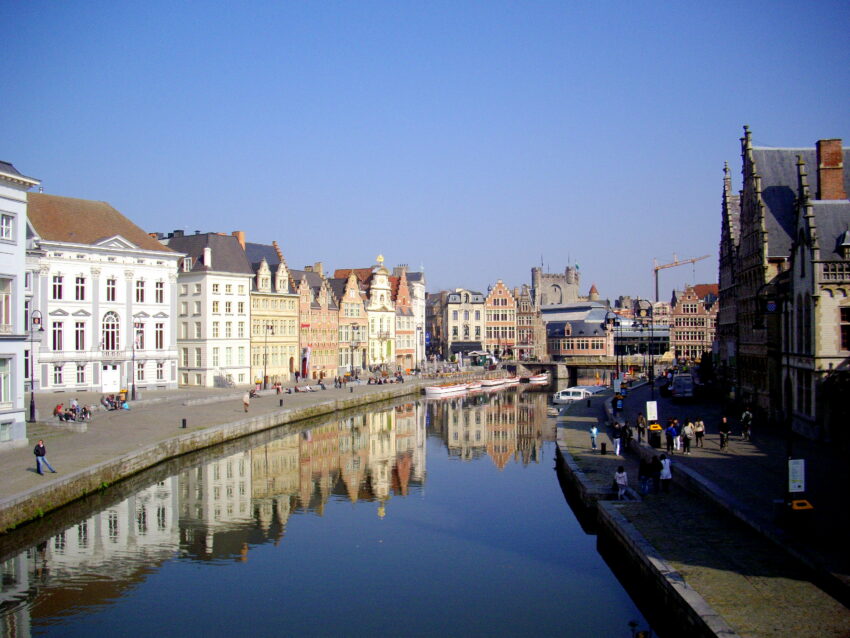
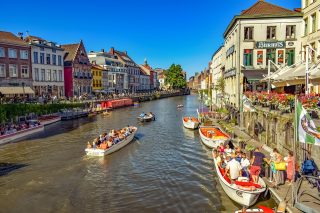
Korenlei is the quay running along the River Lys opposite Graslei, and together they form Ghent’s best-preserved medieval riverside frontage. Its name (“Wheat Quay”) reflects the area’s historical role in handling grain and other bulk goods brought into the city by water, when the river functioned as a working transport corridor rather than scenery.
What you see today is a tight sequence of historic façades facing the water, shaped by merchant wealth and guild influence rather than courtly architecture. The value is in the streetscape as a whole: the rhythm of gables and rooflines, how buildings meet the river edge, and how views open toward the bridge crossings and the three-tower skyline.
On site, do it in two passes: first from the Korenlei side to read the façades and river edge up close, then from across on Graslei to understand the full composition and how the quays mirror each other. It’s also worth lingering near the waterline to catch reflections and the changing angles as boats move through, because the river is part of what makes the architecture “work” visually.
Location: Graslei, 9000 Gent, Belgium | Hours: 24 Hours. | Price: Free.
10. St Michael's Bridge
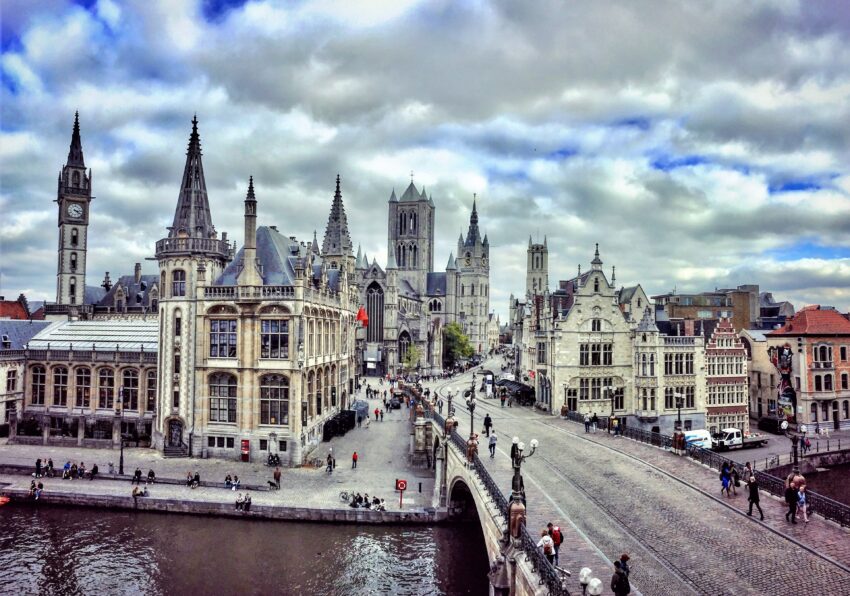
St Michael’s Bridge is best understood as a deliberately composed viewpoint, built in the early 20th century to create a monumental crossing and a theatrical city panorama. From here, the skyline aligns in a way that’s become iconic: Sint-Niklaaskerk, the Belfort, and Sint-Baafskathedraal can be framed together as “the three towers.”
Its appeal is partly structural but mostly optical: it’s a place where Ghent’s waterways, stone façades, and vertical landmarks lock into a single image. The bridge’s design and placement make it a civic “stage” as much as an item of infrastructure.
When you go, do two things: first, take the classic skyline view, then turn and read the river edges, where the old quays and guild houses line up. Early morning or late evening light is particularly effective for bringing out the texture in the stone and the reflection patterns on the water.
Location: St Michael's Bridge, Sint-Michielshelling, 9000 Gent, Belgium | Hours: 24 Hours. | Price: Free.
11. Korenmarkt
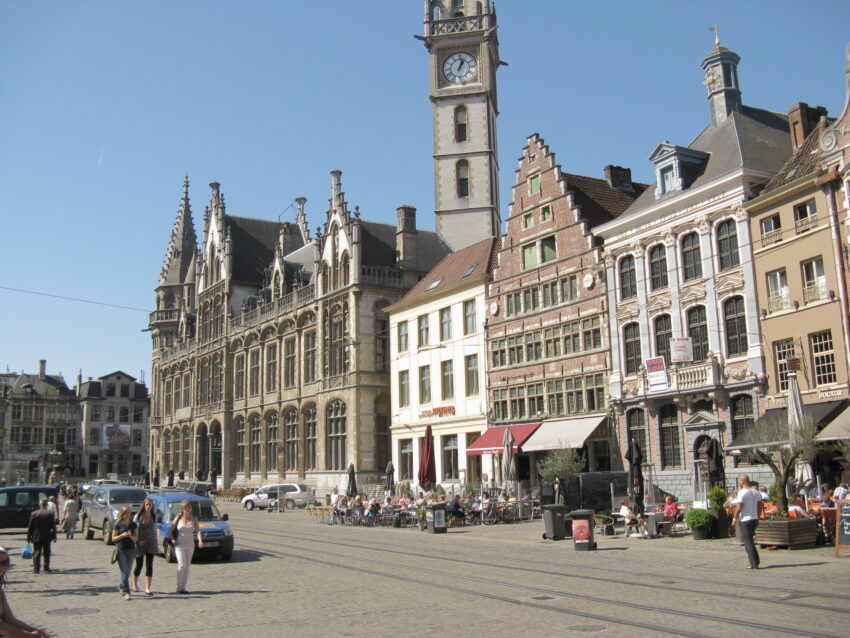
Korenmarkt is the city-centre square whose name (“Wheat Market”) points to its origins as a trading space, tied to Ghent’s role as a regional cereals hub from as early as the 10th–11th centuries. Its location—between the river and Sint-Niklaaskerk—explains why it became such a durable focal point for movement, commerce, and gathering.
The square is also historically “political” as well as commercial: public announcements and civic theatre have long gravitated to major market places. Today it remains one of the most active nodes in the historic core, surrounded by prominent façades that now host cafés and terraces.
What to do there is straightforward: treat it as a base for reading the city’s layout. Stand where you can see the church, the routes toward the river, and the flow into the main shopping streets; it’s one of the easiest places to understand how medieval trade geography still shapes modern Ghent.
Location: Korenmarkt, 9000 Gent, Belgium | Hours: 24 Hours. | Price: Free.
12. Sint-Niklaaskerk
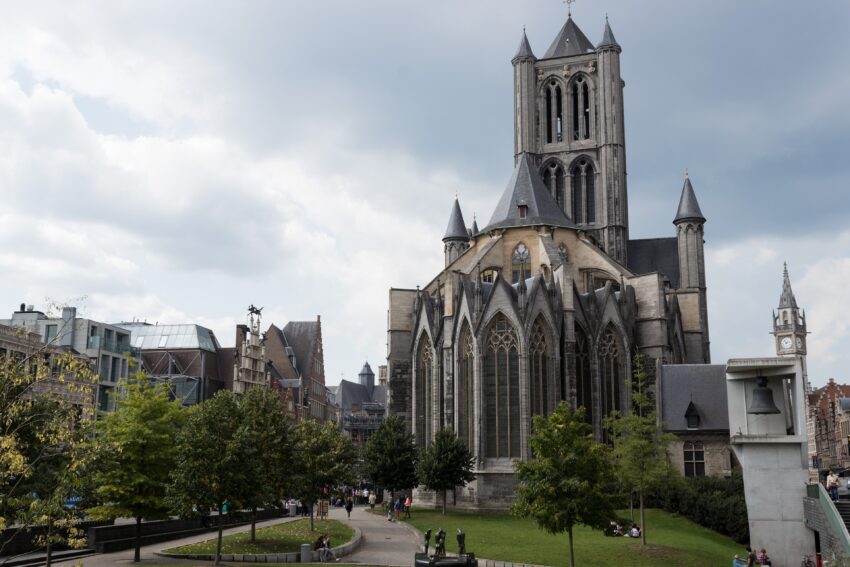
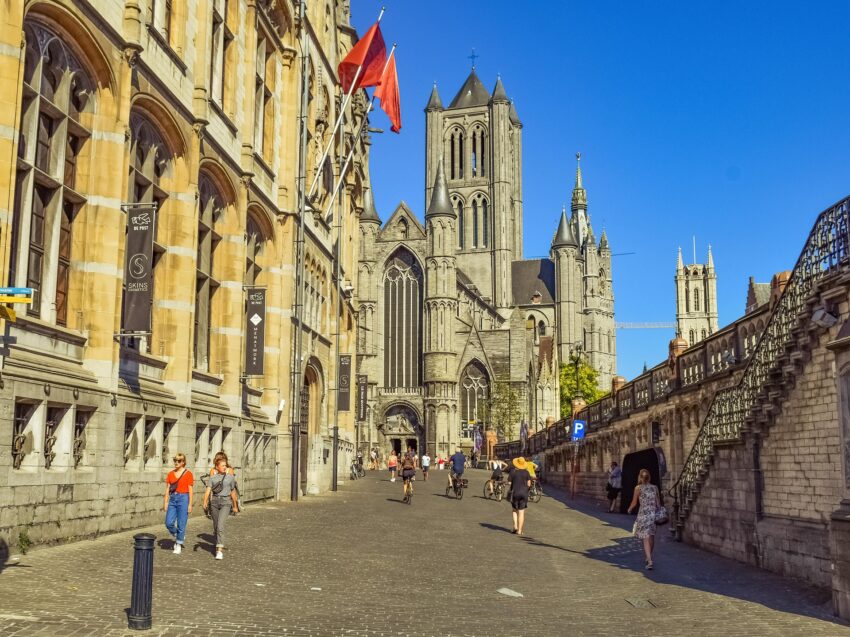
Sint-Niklaaskerk is one of Ghent’s oldest major churches and a flagship example of Scheldt Gothic, a regional Gothic style associated with the Scheldt basin. Construction began in the early 13th century, replacing an earlier Romanesque church, and its position beside the old commercial core signals its historic link to merchants and guild life.
Architecturally, the church’s massing is distinctive: a substantial tower above the crossing and corner turrets give it a compact, fortress-like skyline presence. The interior is also historically “guild-facing,” shaped by the chapels and devotional spaces tied to trades and civic groups.
On a visit, spend time both outside and in: outside for the stonework and silhouette, inside for how light plays through the crossing and down the nave. It’s a church that rewards slow looking—especially if you pay attention to how worship and commerce sat side by side in medieval Ghent.
Location: Cataloniëstraat, 9000 Gent, Belgium | Hours: 24 Hours. | Price: Free. | Website

Moira & Andy
Hey! We're Moira & Andy. From hiking the Camino to trips around Europe in Bert our campervan — we've been traveling together since retirement in 2020!
This website uses affiliate links which earn a small commission at no additional cost to you.
Walking Tour Summary
Distance: 2 km
Sites: 12