Dulle Griet, Ghent
Historic Site, Monument and Square in Ghent
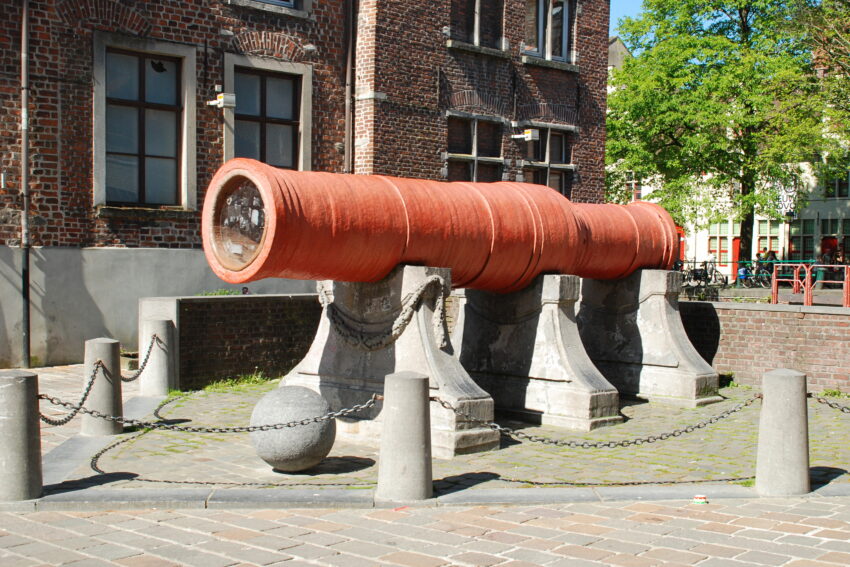
Dulle Griet in Ghent is a medieval bombard displayed outdoors on Grootkanonplein, where it stands as a large historic monument rather than a museum exhibit. The name also refers to a figure from Flemish folklore, which gives the site an extra layer of local character.
What visitors notice first is the gun’s size and red finish, then the fact that it is presented in the middle of the square instead of behind glass. It suits travelers who enjoy short, unusual stops, older military technology, or a quick detour between Ghent’s central sights.
History and Significance of the Dulle Griet
Dulle Griet belongs to the world of late medieval artillery, when bombards were built for siege warfare and could fire very large projectiles. The Ghent piece dates from the early 15th century and is associated with arms dealer Jean Cambier, who is often linked to its making.
The bombard in warfare
As a weapon, it was used in the siege of Oudenaarde in 1452. The attackers eventually withdrew and left the gun behind, after which it was later returned in 1578.
From weapon to monument
Today the bombard no longer functions as a weapon and is displayed as a historic object in the city. Its original nickname, the Red Devil, came from its color, and the current setting makes it easy to read as both a military relic and a civic landmark.
Things to See and Do in the Dulle Griet
The main thing to do here is simply stand back and take in the scale of the bombard. I found that its size is easiest to appreciate from a few steps away, where the body of the gun, the supports, and the open square all read together.
Look for the bluestone brackets and the way the red metal contrasts with the surrounding pavement. If you like small details, the object rewards a slower look than you might expect from a quick street-side stop.
This is not a place that needs a long visit, but it does work well as a pause while walking through central Ghent. It is especially useful if you want one memorable historic object rather than a full indoor attraction.
How to Get to the Dulle Griet
Ghent is typically reached through Brussels Airport or Antwerp Airport, then continued by rail or road into the city. For the best deals and a seamless booking experience, check out these flights to Ghent on Booking.com.
Ghent has strong train connections, with frequent services from Brussels and other Belgian cities making the city centre easy to reach. Train tickets and schedules can be found directly on the SNCB/NMBS website for Belgian services. For a more convenient experience, consider using Omio, where you can easily compare prices, schedules, and book tickets in one place.
If you are driving, it usually makes more sense to park outside the tightest historic core and continue on foot, since central streets can be awkward for short visits. If you are looking to rent a car in Belgium I recommend having a look at Discover Cars, first, as they compare prices and review multiple car rental agencies for you.
Is the Dulle Griet Worth Visiting?
Dulle Griet is worth a short stop if you like unusual artifacts and compact city sights, but it is not a priority for travelers who want interiors, major museums, or a long list of things to do. Treat it as a quick optional detour that fits naturally into a walk through Ghent's centre.
What Other Travellers Say...
Cozy bar with hundreds of varieties of Belgian brews, from rare Trappist beers to red ale & porter.


Practical Tips on Visiting the Dulle Griet
- Entrance fee: Free.
- Opening hours: 24 Hours.
- Best time to visit: Daylight makes it easier to study the bombard’s scale and details. Early morning or late afternoon is usually best if you want fewer people in the square.
- How long to spend: Plan 10 to 20 minutes for a quick look, or a little longer if you like photographing historic objects.
- Accessibility: It is an outdoor stop on a square, so the approach is generally straightforward, but surface conditions can vary and the area is best checked on foot if mobility is limited.
- Facilities: There are no dedicated visitor facilities at the monument itself. Cafés, restrooms, and other services are easier to find nearby in central Ghent.
Where to Stay Close to the Dulle Griet
The best base for this stop is Ghent's historic centre, since that keeps you close to the main sights and lets you combine Dulle Griet with a broader city walk. If you prefer easy walking access over driving convenience, staying central usually makes the most sense.
For travelers who want to stay right in the old town, Ghent Marriott Hotel works well for walkability and a polished, central base. NH Gent Belfort is a practical choice if you want to be close to major landmarks and don’t mind a busier setting. If you prefer a quieter, design-led stay a little away from the busiest squares, Pillows Grand Boutique Hotel Reylof Ghent suits travelers who want comfort and a calmer atmosphere.
FAQs for Visiting the Dulle Griet
Getting There
Tickets & Entry
Visiting Experience
Accessibility & Facilities
Food & Breaks Nearby
Safety & Timing
The Dulle Griet appears in our Complete Guide to Visiting Ghent!

Moira & Andy
Hey! We're Moira & Andy. From hiking the Camino to trips around Europe in Bert our campervan — we've been traveling together since retirement in 2020!
This website uses affiliate links which may earn a commission at no additional cost to you!
Planning Your Visit
24 Hours.
Free.
Nearby Attractions
- Vrijdagmarkt (0.1) km
Market, Monument and Square - Kraanlei and Patershol Quarter (0.1) km
Area, Historic Site and Walk - Gravensteen Castle (0.2) km
Castle - Stadhuis (0.4) km
Historic Building, Historic Room and Town Hall - Gaslei & Korenlei (0.4) km
Canal, Historic Building and Walk - Korenmarkt (0.4) km
Historic Site, Market and Square - Sint-Niklaaskerk (0.4) km
Church, Historic Building and Historic Site - Belfort (0.4) km
Historic Building, Monument and Tower - Lakenhalle (0.4) km
Historic Building, Historic Site and Monument - St Michael's Bridge (0.4) km
Bridge, Historic Building and Viewing Point