Priene Ancient City, Kusadasi
Ancient City near Kusadasi
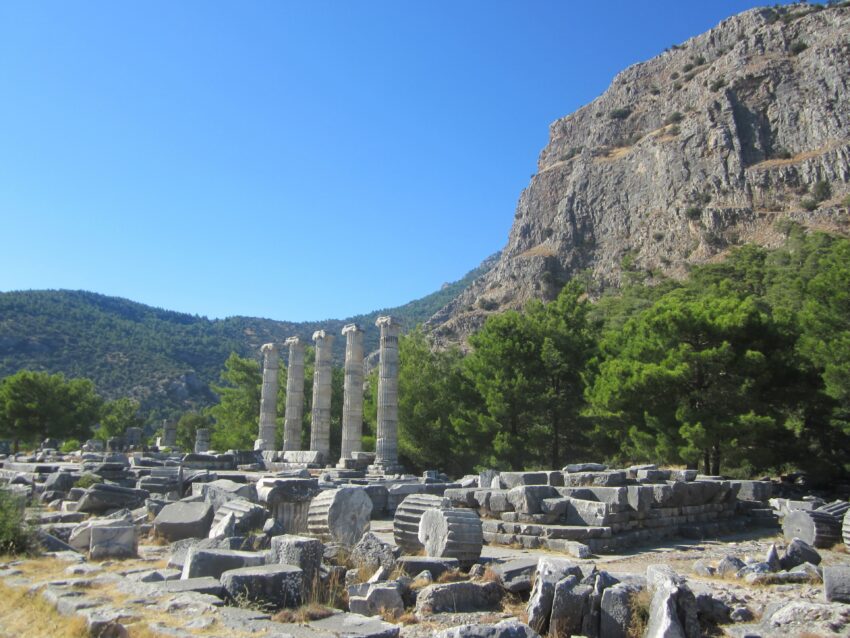
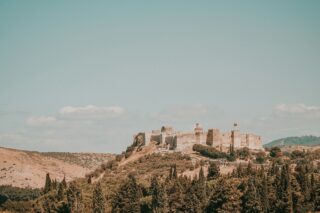
Priene Ancient City is one of the most rewarding archaeological sites on Türkiye's Aegean coast, yet it still feels refreshingly under the radar. Set near the village of Güllübahçe in the Söke district of Aydın Province, the ruins climb a pine-covered slope below Mount Mycale, giving the whole place a dramatic natural backdrop as well as a strong sense of isolation from the modern world.
What makes Priene especially memorable is the way it combines serious historical importance with a calm, almost contemplative visiting experience. Unlike larger sites that can feel overwhelming, this is a place where you can walk ancient streets, pause at the theatre, and take in the Temple of Athena at your own pace, making it an excellent stop on a self-guided route through the old cities of Ionia and one of the best places to visit if you want history without the biggest crowds.
Table of Contents
- History and Significance of the Priene Ancient City
- Things to See and Do in the Priene Ancient City
- How to Get to the Priene Ancient City
- Practical Tips on Visiting the Priene Ancient City
- Where to Stay Close to the Priene Ancient City
- Is the Priene Ancient City Worth Visiting?
- For Different Travelers
- FAQs for Visiting Priene Ancient City
History and Significance of the Priene Ancient City
Priene was an ancient Ionian Greek city and is now valued as one of the clearest surviving examples of a planned Hellenistic urban settlement. Its layout, arranged on a grid across steep terraces, still reveals how carefully the city was designed, with political, religious, commercial, and residential areas fitting together in a way that makes the ancient town easy to understand even today.
The city is particularly significant because it preserves the logic of Classical and Hellenistic city planning so well. Visitors can still identify major public spaces such as the theatre, agora, bouleuterion, and sanctuaries, while the Temple of Athena remains one of its signature monuments. That clarity is one reason Priene holds such appeal for travelers interested in archaeology, architecture, and the practical realities of ancient urban life.
Its setting also explains much of its story. Priene was once positioned near the coast, but over the centuries silting from the Maeander River changed the landscape and left the city inland. That shift, combined with wider political and economic changes, contributed to its decline, but it also helps explain why the site today feels so distinct from the sea-facing port world it once belonged to.
Things to See and Do in the Priene Ancient City
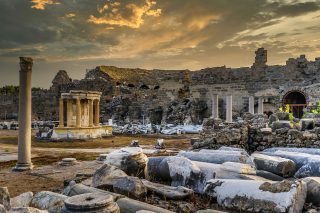
The Temple of Athena is the headline sight and the part of Priene many visitors remember most clearly. Even in partial ruin, it has real presence, and the open setting beneath the mountain gives it a grandeur that photographs do not fully capture. It is the place to pause, look across the site, and appreciate why Priene is often discussed as one of the most elegant ancient cities in western Anatolia.
The theatre is another highlight, both for its preservation and for its position within the city plan. It is easy to imagine public life unfolding here, and the stepped seating also offers a fine vantage point over the surrounding ruins. From there, walking through the agora and along the old streets gives you a much stronger sense of daily life than you get at sites where only isolated monuments survive.
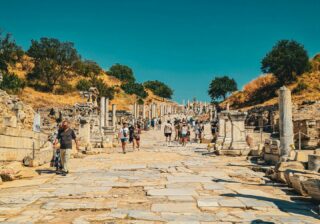
One of the best things to do here is simply walk slowly and let the city reveal itself. The terraces, retaining walls, and changing viewpoints make Priene feel more immersive than many archaeological sites, and because it is comparatively compact, you can see a great deal without rushing. It is also an excellent place for photography, especially when the angled light brings out the texture of the stone and the mountain backdrop frames the ruins.
How to Get to the Priene Ancient City
Reaching Priene is easiest by car, especially if you are exploring the Aegean coast independently. The site is located near Güllübahçe, around 15 km from Söke, and following the local signs is the most straightforward approach. If you are looking to rent a car in Türkiye I recommend having a look at Discover Cars, first, as they compare prices and review multiple car rental agencies for you.
If you are arriving from farther away, the nearest practical airport for most travelers is İzmir Adnan Menderes Airport, from where you can continue by road via Söke. This works particularly well if you are combining Priene with other western Türkiye sites such as Miletus, Didyma, or Ephesus. For the best deals and a seamless booking experience, check out these flights to Kusadasi on Booking.com.
Train travel can get you part of the way, with Söke serving as the nearest rail hub for onward road transport, but the final stretch is not as straightforward as visiting a city-center attraction. You can use the official TCDD Taşımacılık website to check schedules, compare routes, and purchase tickets for Türkiye’s national and regional trains operated by TCDD. For a more streamlined experience (especially if you prefer an English interface or want to compare across countries), we recommend using Omio, which allows you to easily compare prices, schedules, and book train tickets across Türkiye and the rest of Europe — all in one place.
Buses can also bring you to Söke from larger regional centers, after which you would usually continue by taxi or local transport toward Güllübahçe and the archaeological zone. Because the final approach is rural, Priene is best treated as a half-day or day-trip stop rather than a quick urban walk-between sight.
Practical Tips on Visiting the Priene Ancient City
- Entrance fee: Full: 50 TL. Reduced: 25 TL. Museum Card: Free.
- Opening hours: (Summer) Daily: 08:00–19:00; (Winter) Daily: 08:00–17:00.
- Official website: https://priene.soke.bel.tr/en/visit
- Best time to visit: Spring and autumn are the most comfortable seasons, when the site is pleasant for walking and the light is good for views and photography. Summer can still be rewarding, but earlier starts are better.
- How long to spend: Around 2 to 3 hours is ideal for most visitors. That gives you enough time to see the major ruins, walk the terraces, and enjoy the setting without rushing.
- Accessibility: This is a historic hillside site with uneven ground, stone paths, and changes in elevation, so it can be challenging for travelers with limited mobility. Good walking shoes are strongly recommended.
- Facilities: Expect basic visitor infrastructure rather than a large museum-style setup. It is wise to bring water, sun protection, and anything essential before you begin exploring.
Where to Stay Close to the Priene Ancient City
For a culture-heavy itinerary, the best base is Kuşadası if you want more hotel choice and easy access to multiple ancient sites, while Söke suits travelers who want to stay closer to Priene itself and keep driving times short.
Most visitors do not stay in Güllübahçe itself, so it makes more sense to choose a base that matches the rest of your trip. Söke is practical and relatively convenient for a route focused on Priene, Miletus, and Didyma, while Kuşadası is the stronger all-round option if you also want restaurants, seafront atmosphere, and straightforward day trips to bigger headline sights.
Good options include Keyf Konak Boutique Hotel, which is a useful base for travelers prioritising proximity and a quieter local feel; Ilayda Avantgarde Hotel, which works well if you want central Kuşadası and easy access to the waterfront; and Charisma De Luxe Hotel, a stronger choice for those who want a more comfortable resort-style stay while still using Kuşadası as a sightseeing base.
Is the Priene Ancient City Worth Visiting?
Yes, absolutely. Priene Ancient City is one of the most worthwhile archaeological stops in western Türkiye for travelers who value atmosphere, clarity, and the chance to understand how an ancient city actually worked rather than simply ticking off a famous monument. It feels scholarly without being dry, scenic without being overdeveloped, and manageable without seeming minor.
The honest pivot is that Priene may not be the best choice for travelers who only want the biggest, most famous ruins or who dislike uneven uphill walking. If your priority is a high-energy site with museums, crowds, and heavily curated visitor infrastructure, you may find Ephesus more immediately dramatic. But if you want a quieter, more thoughtful experience, Priene often leaves the stronger impression.
What Other Travellers Say...
Reviewers describe Priene as a quiet, uncrowded ancient site with striking hillside scenery, especially around the Temple of Athena and the theater, offering a strong sense of history and atmosphere. The walk involves steep climbs, stairs, and uneven paths, so it may be challenging for visitors with mobility or heart issues, and summer heat can be intense (early/late visits are recommended). Some note that signage and visitor paths could be better maintained, and practical tips include bringing water/coffee, wearing good shoes, and expecting limited facilities beyond toilets at the parking area and occasional weak mobile/internet service.





For Different Travelers
Families with Kids
Priene can work well for families with older children who enjoy open-air exploring and do not mind walking on uneven ground. The site has a sense of discovery to it, and the theatre, terraces, and mountain backdrop can make history feel more tangible than an indoor museum visit.
For families with very young children or strollers, it is less straightforward. The sloping terrain and rough surfaces mean this is better approached as a shorter, flexible visit with water, snacks, and realistic expectations about pace.
Couples & Romantic Getaways
For couples, Priene has a quieter and more atmospheric appeal than many of the region’s bigger archaeological sites. The views, pine-scented hillside setting, and relative lack of crowds make it a good stop if you enjoy places that feel reflective rather than overly staged for tourism.
It works especially well as part of a slower Aegean itinerary paired with village stops, coastal drives, or sunset dinners in Kuşadası. If your trip leans toward culture and scenery rather than nightlife, Priene is an excellent fit.
Budget Travelers
Priene is a strong choice for budget travelers because it is compact, rewarding, and easy to pair with other nearby ruins in the same area. If you are already moving through Aydın Province, it delivers a lot of historical depth without demanding a full day of spending.
The main budget consideration is transport rather than admission. Travelers relying entirely on public transport may find the final approach less convenient, so costs can rise if taxis are needed from Söke.
History Buffs
History buffs should place Priene high on their list. This is one of those rare sites where city planning, political life, religious architecture, and topography can all still be read together on the ground, which makes it unusually satisfying for anyone interested in how ancient urban space functioned.
It is also a valuable counterpoint to larger sites in the region. Rather than overwhelming you with scale, Priene gives you coherence, and that makes it one of the most intellectually rewarding ruins on the Turkish Aegean coast.
FAQs for Visiting Priene Ancient City
Getting There
Tickets & Entry
Visiting Experience
Tours, Context & Itineraries
Photography
Accessibility & Facilities
Food & Breaks Nearby
Safety & Timing
The Priene Ancient City appears in our Complete Guide to Visiting Kusadasi!

Moira & Andy
Hey! We're Moira & Andy. From hiking the Camino to trips around Europe in Bert our campervan — we've been traveling together since retirement in 2020!
This website uses affiliate links which may earn a commission at no additional cost to you!
Planning Your Visit
(Summer) Daily: 08:00-19:00;
(Winter) Daily: 08:00-17:00.
Full: 50 TL. Reduced: 25 TL. Museum Card: Free.
Nearby Attractions
- Dilek Peninsula National Park (10.9) km
National Park - Değirmen Çiftlik (11.1) km
Animal Sanctury, Attraction and Museum - Oleatrium Museum (11.1) km
Attraction and Museum - Miletus (14.5) km
Ancient City - Ladies Beach (21.3) km
Beach - Ottoman Aqueduct (21.4) km
Aqueduct and Historic Site - Bafa Lake and Herakleia (21.8) km
Historic Site and Lake - Kuşadası (22.3) km
Town - Kaleici Camii (22.6) km
Historic Building, Mosque and Religious Building - Old Town Bazaar (22.6) km
Area, Bazaar and Market