Temple of Apollo, Didyma
Historic Site near Kusadasi
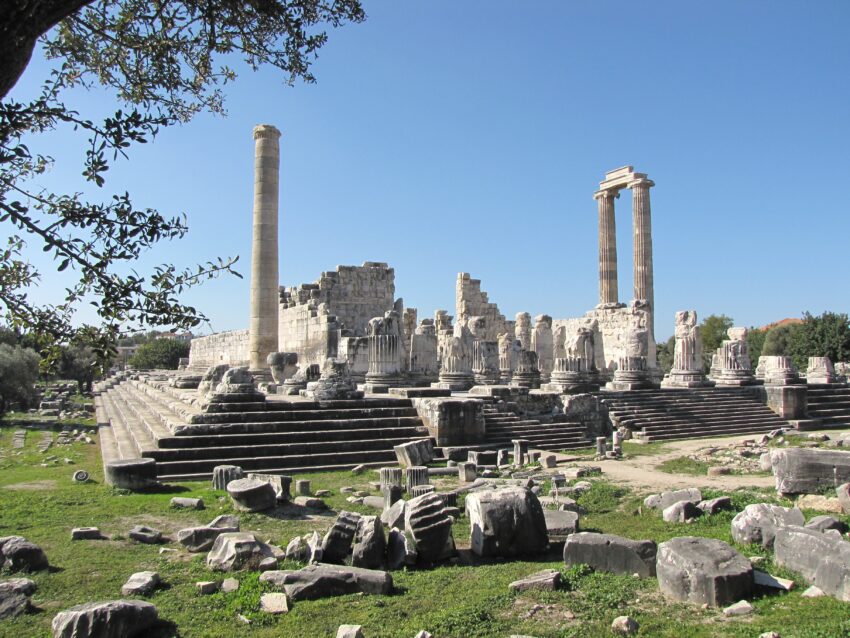
The Temple of Apollo at Didyma is one of the most impressive ancient sanctuaries on Türkiye's Aegean coast, rising dramatically from the modern town of Didim with huge surviving columns, monumental steps, and a scale that still feels almost overwhelming. Although people often refer to the site simply as Didyma, what you are really visiting is the great oracle sanctuary of Apollo, a sacred place tied to ancient Miletus rather than a full standalone city.
What makes the site so memorable is the contrast between its ruined state and its original ambition. Even incomplete, the temple remains vast, atmospheric, and deeply photogenic, with carved details, massive stone blocks, and a sunken inner court that gives the complex a different feel from many other classical ruins in Türkiye. It is an easy stop from central Didim, but it also rewards travelers who want more than a quick photo and are interested in ancient religion, architecture, and the wider story of Ionia.
Table of Contents
- History and Significance of the Temple of Apollo
- Things to See and Do in the Temple of Apollo
- How to Get to the Temple of Apollo
- Practical Tips on Visiting the Temple of Apollo
- Where to Stay Close to the Temple of Apollo
- Is the Temple of Apollo Worth Visiting?
- For Different Travelers
- FAQs for Visiting Temple of Apollo
History and Significance of the Temple of Apollo
The Temple of Apollo at Didyma was one of the most important prophecy centers of the ancient world, serving as the sacred sanctuary of Miletus and attracting pilgrims from across the Ionian world. Ancient writers mentioned Didyma as a holy place, and its prestige rested on the oracle of Apollo, which gave the sanctuary a religious importance far beyond its immediate region.
The sanctuary suffered major destruction after the Persian attack on Miletus in 494 BCE, but its revival began after Alexander the Great's campaigns in Asia Minor. The rebuilding that followed was extraordinarily ambitious, producing a colossal Hellenistic temple that ultimately remained unfinished, which is part of what gives the site its unusual character today. Rather than seeing a perfectly complete monument, visitors encounter a place that reveals both the grand scale of ancient planning and the reality of interrupted history.
Today, the temple’s significance lies in both its religious role and its architecture. Its huge platform, monumental stairways, towering columns, and famous Medusa relief have made it one of the signature ancient sites of the Turkish Aegean. Even in ruin, it conveys the prestige of a sanctuary that once stood at the spiritual heart of an entire region.
Things to See and Do in the Temple of Apollo
The first thing most visitors notice is the temple’s extraordinary scale. Walk slowly around the outer perimeter before heading inward, because the surviving columns and enormous stone blocks make the strongest impression when you take them in from different angles. The staircase, column drums, and elevated platform all help you appreciate just how monumental the original design was meant to be.
Inside the sanctuary, pay attention to the unusual layout, especially the inner sacred court that gives the complex a more enclosed and ceremonial atmosphere than many open archaeological sites. The carved Medusa head near the entrance is another highlight and has become one of the visual symbols of Didim, so it is worth pausing for a closer look rather than just passing it by on the way in.
This is also a very good site for photography, particularly in the softer light of the morning or late afternoon when the stone picks up warmer tones and the shadows define the structure more clearly. If you enjoy combining archaeology with a broader day trip, Didyma pairs especially well with Miletus and Priene, creating one of the best classical-history circuits in western Türkiye.
How to Get to the Temple of Apollo
The Temple of Apollo is in Didim, in Aydın Province, and the nearest airport is Milas-Bodrum Airport, while İzmir Adnan Menderes Airport is another common gateway for travelers heading to the area. From either airport, the usual onward journey is by transfer, rental car, or intercity bus toward Didim. For the best deals and a seamless booking experience, check out these flights to Kusadasi on Booking.com.
There is no direct rail station in Didim itself, so train travel is not usually the simplest option for reaching the temple. Most visitors who want to use public transport combine a train route elsewhere in western Türkiye with a bus connection onward to Didim, making the final leg road-based rather than rail-based. You can use the official TCDD Taşımacılık website to check schedules, compare routes, and purchase tickets for Türkiye’s national and regional trains operated by TCDD. For a more streamlined experience (especially if you prefer an English interface or want to compare across countries), we recommend using Omio, which allows you to easily compare prices, schedules, and book train tickets across Türkiye and the rest of Europe — all in one place.
Buses are a practical option, especially if you are already elsewhere on the Aegean coast. Didim’s bus connections make it possible to arrive by coach and then continue to the temple by local transport or taxi, which is often the easiest budget-friendly approach if you are not hiring a car.
Driving is the simplest choice if you want flexibility, especially if you plan to combine Didyma with Miletus, Priene, or the coast around Didim. A car gives you the easiest access to the wider region and makes the temple an easy half-day or full-day stop rather than a fixed excursion. If you are looking to rent a car in Türkiye I recommend having a look at Discover Cars, first, as they compare prices and review multiple car rental agencies for you.
Practical Tips on Visiting the Temple of Apollo
- Entrance fee: Adults: 50 TL.
- Opening hours: Daily: 08:30–17:00.
- Official website: https://muze.gov.tr/muze-detay?DistId=DDM&SectionId=DDM01
- Best time to visit: Spring and autumn are the most comfortable seasons, when the light is good and the heat is less intense. In summer, arrive early or later in the afternoon because the site is exposed and can feel very hot.
- How long to spend: Around 45 minutes to 1.5 hours works well for most travelers. Stay longer if you enjoy photography, ancient architecture, or are combining the visit with other classical sites nearby.
- Accessibility: Expect uneven ancient surfaces, steps, and areas that can be difficult for travelers with limited mobility. The site is manageable from the entrance area, but full exploration is not especially barrier-free.
- Facilities: Basic visitor services are limited compared with major museum complexes, so carry water, sun protection, and anything essential with you. In central Didim, cafés, shops, and taxis are easier to find before or after your visit than inside the archaeological zone itself.
Where to Stay Close to the Temple of Apollo
For a culture-heavy itinerary, base yourself in central Didim so you are close to the temple and within easy reach of local transport, while Altınkum makes more sense if your trip is focused on beach time, restaurants, and evening atmosphere.
If you want to stay near the archaeological site itself, central Didim is the practical choice. It keeps you close to the Temple of Apollo and makes it easy to head out early before the day gets too hot. Mavi Pansiyon & Restaurant is a useful option for travelers who want a smaller local stay near the historic heart of town, while The Lea Hotel gives you a more polished seaside base with straightforward access back to the site.
If you would rather combine sightseeing with a resort-style stay, Altınkum is the better fit. It has more of the classic holiday atmosphere, with beach access, restaurants, and a broader choice of accommodation. Aquasis De Luxe Resort & Spa suits travelers looking for a more upscale break, while Altinersan Hotel works well for visitors who want a central beach-area base without losing easy access to Didyma by taxi or local transport.
Is the Temple of Apollo Worth Visiting?
Yes, definitely. The Temple of Apollo is one of the most striking ancient sites on Türkiye's Aegean coast, and even travelers who think they have seen enough ruins often find its scale, atmosphere, and unusual layout genuinely memorable.
The honest pivot is that it is not for everyone. If you prefer highly curated museum-style visits, detailed interpretation panels, or a long list of on-site facilities, you may find Didyma more rewarding as part of a wider day trip with Miletus and Priene rather than as a standalone destination.
What Other Travellers Say...

Reviewers consistently describe the Temple of Apollo in Didim as an awe-inspiring, well-preserved ancient site, highlighting its immense scale, striking columns, and the powerful atmosphere around the inner sanctuary and oracle area. Many appreciate the ability to explore freely at their own pace, with helpful on-site information boards, and note that visiting in the evening or off-season can mean cooler temperatures and very few crowds. Practical notes include that it's a bit outside the city and may be easiest to reach by bus or taxi. A minor downside mentioned is that parts of the complex remain unfinished or incomplete, though this also adds to its historical character.


For Different Travelers
Families with Kids
The Temple of Apollo works surprisingly well for families if your children enjoy open spaces and big, dramatic ruins rather than glass-case museums. The huge columns and monumental steps create an immediate visual impact, and the visit is short enough that younger travelers are less likely to lose interest before you have seen the highlights.
That said, parents should be prepared for strong sun, uneven ground, and limited shade. Bring water, hats, and snacks, and aim for an earlier visit so the experience feels interesting rather than tiring.
Couples & Romantic Getaways
For couples, this is one of those places that feels more atmospheric than crowded, especially outside the peak midday window. The scale of the ruins, the golden light on the stone, and the sense of age all make it a very photogenic and memorable stop on an Aegean road trip.
It works particularly well when paired with a leisurely lunch in Didim or an evening by the sea in Altınkum. If you enjoy history with a cinematic setting rather than a checklist attraction, this is an easy one to recommend.
Budget Travelers
Budget travelers will find the Temple of Apollo a manageable and worthwhile stop, especially because Didim is easier on the wallet than some of Türkiye's more internationally famous coastal destinations. It is also possible to reach the area by bus and keep the visit fairly simple without committing to an expensive organized tour.
The best value comes from combining it with other nearby sites and making a full day of the region. That way, the transport effort feels more worthwhile and you get a stronger sense of the ancient landscape beyond a single monument.
History Buffs
For history lovers, Didyma is one of the most rewarding classical sites in western Türkiye. Its role as an oracle sanctuary, its relationship with Miletus, and its incomplete yet colossal Hellenistic design make it far more than just another ruined temple.
The site is especially compelling because it preserves the scale of ancient ambition so vividly. If you are interested in religion, architecture, and the political life of the Ionian world, this is exactly the kind of place that lingers in the memory long after the visit.
FAQs for Visiting Temple of Apollo
Getting There
Tickets & Entry
Visiting Experience
Tours, Context & Itineraries
Photography
Accessibility & Facilities
Food & Breaks Nearby
Safety & Timing
The Temple of Apollo, Didyma appears in our Complete Guide to Visiting Kusadasi!

Moira & Andy
Hey! We're Moira & Andy. From hiking the Camino to trips around Europe in Bert our campervan — we've been traveling together since retirement in 2020!
This website uses affiliate links which may earn a commission at no additional cost to you!
Planning Your Visit
Daily: 08:30-17:00.
Adults: 50 TL.
Nearby Attractions
- Miletus (16.2) km
Ancient City - Bafa Lake and Herakleia (20.8) km
Historic Site and Lake - Priene Ancient City (30.8) km
Ancient City - Dilek Peninsula National Park (35.3) km
National Park - Euromos Ancient City (36.9) km
Historic Site - Myndos Gate (41) km
City Gate and Historic Site - Bodrum Amphitheatre (41.1) km
Historic Site - Mausoleum at Halicarnassus (41.4) km
Historic Site - Bodrum Grand Bazaar (41.4) km
Bazaar - City Walls of Halicarnassus (41.6) km
City Walls