Miletus
Ancient City near Kusadasi
Miletus Ancient City sits near the village of Balat in the Didim district of Aydın, in a quiet stretch of western Türkiye where farmland now surrounds what was once one of the great port cities of the ancient Mediterranean. Today it feels spacious, open and slightly remote, which is part of its appeal: instead of a tightly packed ruin, you get a broad archaeological landscape where the scale of the old city still comes through clearly.
What makes Miletus so memorable is the sense of intellectual and urban ambition that lingers across the site. This was not just another ancient settlement but a major Greek city associated with early philosophy, trade and urban planning, and the surviving theatre, baths and scattered civic remains make it easy to imagine how significant it once was. It is one of those places that rewards travelers who like quieter ruins with a strong historical atmosphere rather than a polished, heavily staged visitor experience.
Table of Contents
- History and Significance of the Miletus Ancient City
- Things to See and Do in the Miletus Ancient City
- How to Get to the Miletus Ancient City
- Practical Tips on Visiting the Miletus Ancient City
- Where to Stay Close to the Miletus Ancient City
- Is the Miletus Ancient City Worth Visiting?
- For Different Travelers
- FAQs for Visiting Miletus Ancient City
History and Significance of the Miletus Ancient City
Miletus was one of the most important cities of ancient Ionia and became famous across the Greek world for trade, colonization and ideas. Its name is closely tied to the early Milesian thinkers, especially Thales, Anaximander and Anaximenes, which gives the site an intellectual weight that goes beyond architecture alone. Even if you arrive knowing little about ancient philosophy, standing here adds a different dimension to the story of how the ancient Mediterranean developed.
The city's long life is visible in layers. Miletus has roots deep in antiquity, but much of what visitors see today reflects the Hellenistic and Roman eras, when the city took on the monumental form that still defines the site. The ancient harbour that once made Miletus prosperous gradually silted up over time, changing the city's role and leaving the ruins inland today, which is one of the most striking reminders of how dramatically landscapes can shift over centuries.
That long arc of change is exactly why Miletus matters. It is not only a collection of handsome ruins but also a case study in how geography, trade, empire and environment shaped urban life. You are visiting a place that was once outward-looking and cosmopolitan, then slowly lost its maritime edge, yet still survives as one of the most atmospheric ancient sites in the Didim region.
Things to See and Do in the Miletus Ancient City
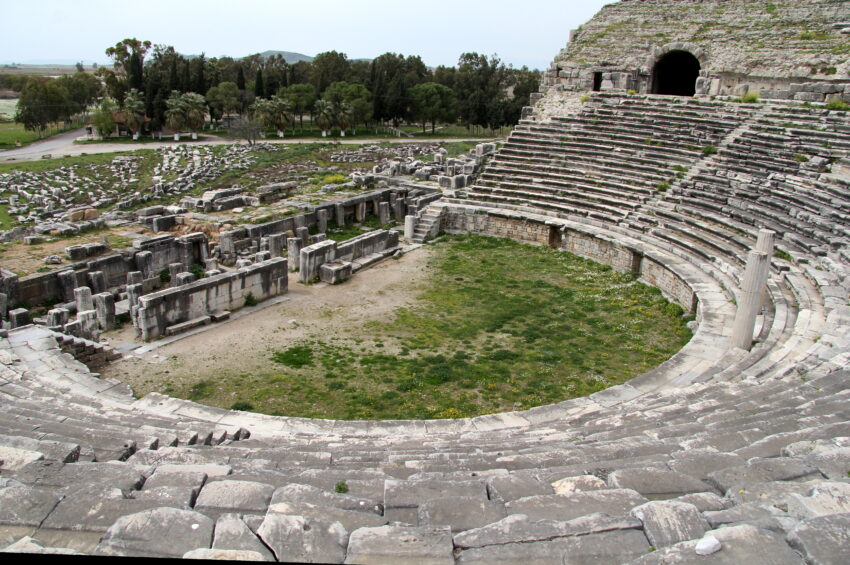
The first highlight for most visitors is the great theatre, which is easily the most commanding structure on the site. Its size immediately tells you how substantial Miletus once was, and from the seating area you get a strong sense of the city's scale and setting. It is the kind of monument that invites you to stop for a while rather than just photograph and move on.
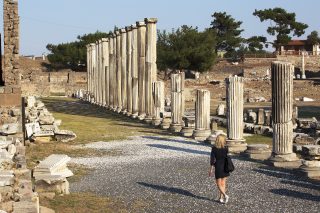
Beyond the theatre, the baths are among the most interesting remains because they help bring everyday Roman urban life into focus. As you move through the site, you also come across fragments of gates, harbour-related structures and other civic remains that make Miletus feel less like a single monument and more like the skeleton of an entire city. This is a place best explored slowly, with time to notice the spacing between ruins and imagine how the districts once connected.
It is also worth pairing the ruins with the nearby Milet Museum if it is open during your visit, since the site and museum are officially linked by the same ticket. The museum adds context with finds from Miletus and the wider area, which helps turn scattered stones into a more coherent story. If you enjoy archaeological sites most when they are anchored by real objects and interpretation, this extra stop is worth factoring into your visit.
How to Get to the Miletus Ancient City
Miletus Ancient City is not a difficult site to visit, but it is much easier with some advance planning because it sits outside the main beach areas and town centres. The ruins are near Balat in the Didim district, so most travelers reach them as part of a wider archaeological day that often includes Didyma and Priene rather than as a simple in-town walk.
For most international visitors, the practical flight choices are Milas-Bodrum Airport and İzmir Adnan Menderes Airport, both of which are commonly used for reaching Didim and the surrounding archaeological sites. From either airport, you will usually continue by transfer, rental car or a bus connection into Didim before heading onward to Miletus. For the best deals and a seamless booking experience, check out these flights to Bodrum on Booking.com.
There is no train station at Miletus itself, so rail is only part of the journey if you are coming from elsewhere in Türkiye. In practice, most visitors who include trains combine them with onward road transport through larger hubs rather than relying on rail for the final approach. You can use the official TCDD Taşımacılık website to check schedules, compare routes, and purchase tickets for Türkiye’s national and regional trains operated by TCDD. For a more streamlined experience (especially if you prefer an English interface or want to compare across countries), we recommend using Omio, which allows you to easily compare prices, schedules, and book train tickets across Türkiye and the rest of Europe — all in one place.
Buses and dolmuş connections can get you into Didim, and from there you may need a taxi or pre-arranged transfer depending on your timing. This is manageable, but it is not the kind of attraction where you simply step off a bus at the gate, so checking return options matters if you are not driving.
By car, Miletus is straightforward and flexible, and driving is usually the easiest way to combine it with other major ancient sites in the area on the same day. Parking and road access make self-driving especially appealing for travelers who want a more efficient archaeological circuit. If you are looking to rent a car in Türkiye I recommend having a look at Discover Cars, first, as they compare prices and review multiple car rental agencies for you.
Practical Tips on Visiting the Miletus Ancient City
- Entrance fee: Adults: : €6
- Opening hours: Daily: 09:00–17:00.
- Official website: muze.gov.tr/muze-detay?DistId=MLT&SectionId=MLT01
- Best time to visit: Spring and autumn are the most comfortable seasons, with milder temperatures and softer light for walking the site. In summer, aim for early morning or later afternoon because the ruins are exposed and the heat can become draining quite quickly.
- How long to spend: Allow around 1.5 to 3 hours for the ruins, depending on your pace and how much context you like to absorb. Add more time if you also want to visit the museum or combine Miletus with nearby ancient sites.
- Accessibility: Expect uneven ground, open archaeological terrain and areas that are not ideal for wheelchairs or anyone with limited mobility. Comfortable shoes, sun protection and a careful pace make a real difference here.
- Facilities: Visitor facilities are basic but the wider museum complex lists restrooms, a café and a shop. Bring water anyway, especially in warmer months, because this is a large and exposed site.
Where to Stay Close to the Miletus Ancient City
For most travelers, Didim is the best base if you want a convenient mix of restaurants, beach access and easy transport to Miletus, while quieter countryside stays around Doğanbey suit travelers whose main focus is archaeology and a slower rural atmosphere.
If you want a straightforward resort-style base with broader facilities, Didim gives you the most practical setup. TRYP by Wyndham Didim works well for travelers who want a familiar full-service stay within driving distance of Miletus, while Anda Barut Collection suits those turning the area into more of a relaxed Aegean holiday with archaeology added in between beach time and resort comforts.
If your trip is centered more firmly on heritage sites and landscape than on resort life, staying in or near Doğanbey can be a smarter choice. Bahab Guest House is a strong option for travelers exploring Miletus, Priene and Didyma in one sweep, especially if you prefer a quieter atmosphere and easier access to multiple ruins without the busier seaside setting of central Didim.
Is the Miletus Ancient City Worth Visiting?
Yes, especially if you enjoy ancient sites with real historical depth and a quieter, less commercial feel. Miletus does not overwhelm with flashy restoration, but that is exactly why it works so well: it feels spacious, serious and deeply rooted in the history of the eastern Mediterranean.
The honest pivot is that travelers looking for a highly polished attraction, a quick stop with lots of interpretation panels, or a city-centre sight may find it a little too remote or sparse. If your trip is mainly about beaches, nightlife or effortless sightseeing, you may prefer to prioritize Didyma or another easier-to-read site instead.
What Other Travellers Say...
Reviewers highlight a historically rich, atmospheric ancient city that can feel quiet and uncrowded, with standout sights including the impressive theater/amphitheater (noted for its acoustics) and a striking mix of Greek, Roman, and Ottoman elements such as a mosque, baths, and a church. Practical notes include a modest entrance fee that may include a small museum and free parking. Common drawbacks are limited excavation and restoration, overgrown or inaccessible areas, and poor accessibility for elderly visitors, children, and people with disabilities, leading some to feel the site has unfulfilled potential and may not merit a dedicated trip unless you are especially interested in antiquity.





For Different Travelers
Families with Kids
Miletus can work for families, but it is best for children who already enjoy climbing around ruins and open spaces rather than those who need a highly interactive museum-style experience. The theatre is the standout feature for younger visitors because it is visually dramatic and easier to grasp than scattered foundations.
Parents should come prepared for sun, limited shade and uneven ground. This is a better stop for a shorter, focused visit than for an all-morning roam unless your children are genuinely interested in history.
Couples & Romantic Getaways
For couples, Miletus has a quiet, reflective quality that feels very different from busier headline ruins. The open landscape, wide views and sense of faded grandeur make it especially appealing if you enjoy places that feel atmospheric rather than crowded.
It works particularly well as part of a day out that combines several sites and a leisurely lunch elsewhere in the region. If your trip mixes culture with coastal relaxation, Miletus adds a thoughtful historical counterpoint without demanding an entire day.
Budget Travelers
Miletus is a good choice for budget travelers who want substantial historical value without the intensity or higher-profile pricing of some of Türkiye's most famous archaeological sites. It is even better value if you are already exploring the Didim area and can combine several nearby ruins in one transport plan.
The main cost variable is not the ticket itself but how you get there. Travelers with a rental car or a well-planned day route will usually find the visit much better value than those relying on multiple taxis.
History Buffs
History lovers should absolutely put Miletus high on the list. Few sites combine such strong associations with early Greek thought, major urban development and Roman monumental architecture in such an accessible physical layout.
It is also the kind of place that rewards background reading before you arrive. Knowing even a little about the Milesian philosophers, Ionian cities and the environmental shift that stranded the old harbour inland makes the experience far richer.
FAQs for Visiting Miletus Ancient City
Getting There
Tickets & Entry
Visiting Experience
Tours, Context & Itineraries
Photography
Accessibility & Facilities
Food & Breaks Nearby
Safety & Timing
The Miletus appears in our Complete Guide to Visiting Bodrum!

Moira & Andy
Hey! We're Moira & Andy. From hiking the Camino to trips around Europe in Bert our campervan — we've been traveling together since retirement in 2020!
This website uses affiliate links which may earn a commission at no additional cost to you!
Planning Your Visit
Daily: 09:00-17:00.
Adults: : €6
Nearby Attractions
- Priene Ancient City (14.5) km
Ancient City - Bafa Lake and Herakleia (15.2) km
Historic Site and Lake - Temple of Apollo, Didyma (16.2) km
Historic Site - Dilek Peninsula National Park (20.2) km
National Park - Değirmen Çiftlik (25.4) km
Animal Sanctury, Attraction and Museum - Oleatrium Museum (25.5) km
Attraction and Museum - Ladies Beach (35.2) km
Beach - Ottoman Aqueduct (35.4) km
Aqueduct and Historic Site - Kuşadası (36.4) km
Town - Kaleici Camii (36.6) km
Historic Building, Mosque and Religious Building