Palma's Secret Synagogue, Palma de Mallorca
Historic Site in Palma de Mallorca
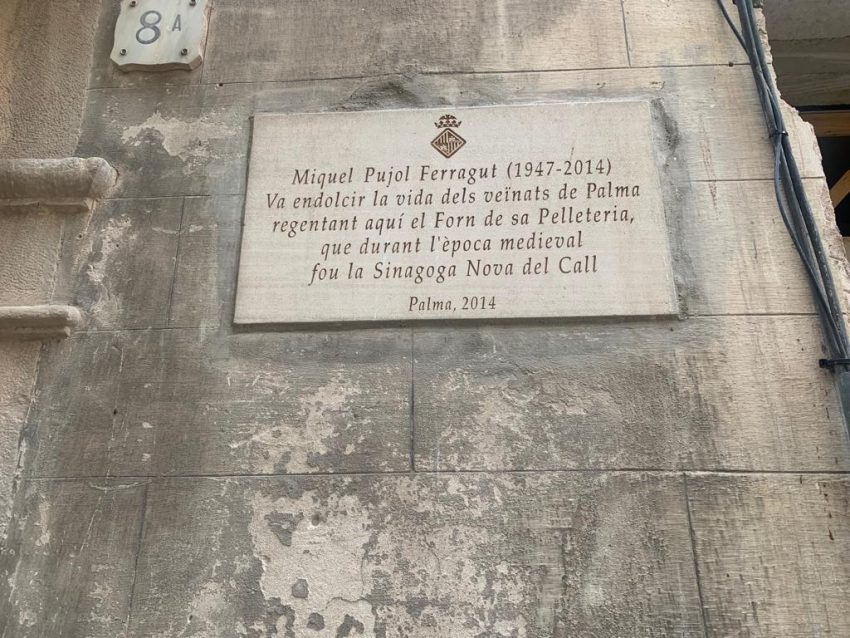
On the narrow Carrer de la Pelleteria, once the street of leather makers, you will find one of the most discreet but moving Jewish heritage sites in Palma's old town. Here, behind the everyday façades, stood a synagogue built in 1370 by Aaron Mani, later damaged in the violent assault of 1391 and rebuilt by Portuguese Jews encouraged by the king to resettle in the area. Today there is no visible synagogue building to enter, yet this corner remains one of the things to do in Palma de Mallorca for travellers who like to seek out places where history lies just beneath the surface.
You locate the spot by looking down rather than up. Embedded in the pavement is a golden SEFARAD symbol, part of a network of markers found in more than twenty cities across Spain that highlight key Jewish heritage sites. On the wall you will see a plaque to Miquel Pujol Ferragut, a much-loved baker who lived and worked here at Can Miquel until his death in 2014, while opposite, a curious cross carved into the stone hints at later layers of Christian presence. All together, it becomes a great place to visit on a walking tour of Palma de Mallorca that explores the former Jewish quarter, conversions and memory.
Table of Contents
- History and Significance of the Secret Synagogue on Carrer de la Pelleteria
- Things to See and Do in the Secret Synagogue on Carrer de la Pelleteria
- How to Get to the Secret Synagogue on Carrer de la Pelleteria
- Practical Tips on Visiting the Secret Synagogue on Carrer de la Pelleteria
- Where to Stay close to the Secret Synagogue on Carrer de la Pelleteria
- Is the Secret Synagogue on Carrer de la Pelleteria Worth Visiting
- FAQs for Visiting Secret Synagogue on Carrer de la Pelleteria
- Nearby Attractions to the Secret Synagogue on Carrer de la Pelleteria
History and Significance of the Secret Synagogue on Carrer de la Pelleteria
In the later 14th century, Carrer de la Pelleteria was part of Palma’s bustling Jewish quarter, and the synagogue constructed here by Aaron Mani in 1370 served as a key spiritual and communal centre. This house of worship would have been filled with the life of the community: prayers, study, family celebrations and the everyday business of a neighbourhood deeply woven into the city’s commercial networks. Its location on the leather makers street speaks to the trades and crafts that supported that community.
The violent assault of 1391 changed everything. Like other Jewish districts across Iberia, Palma’s Judería suffered attacks, looting and forced conversions, and the synagogue on Carrer de la Pelleteria sustained heavy damage in the unrest. Many Jews were killed, others fled, and those who stayed often had little choice but to convert. The physical damage to the building echoed the trauma inflicted on the community itself, and for centuries afterwards the memory of the synagogue was buried beneath new uses and new façades.
Later, Portuguese Jews, encouraged by the king to settle in the area, rebuilt the synagogue, adding another chapter to the story of resilience and adaptation. Today, the original structure is gone, yet the site is consciously marked and interpreted through the SEFARAD symbol and local plaques. The golden emblem on the ground depicts the Iberian Peninsula and incorporates Hebrew letters that spell “Sefarad” (Spain) and “Zojer” (To remember), making the pavement itself a quiet memorial and a call not to forget the Jewish presence that helped shape Palma’s history.
Things to See and Do in the Secret Synagogue on Carrer de la Pelleteria
This is not a conventional “visit a building” kind of stop; instead, it is about reading the street and its signs. Start by walking along Carrer de la Pelleteria and pausing where the golden SEFARAD symbol is set into the pavement. Take a moment to study the design and reflect on the fact that identical markers appear in other Spanish cities with significant Sephardic histories, linking Palma to a wider network of remembrance.
Look up to find the plaque dedicated to Miquel Pujol Ferragut, the baker who lived and worked here at Can Miquel until 2014. His presence anchors the site in very recent memory and reminds you that the same walls and doorways that once housed a synagogue later held a beloved local bakery. Opposite, notice the simple cross carved into the wall, another small but telling sign of how Christian symbols came to overwrite or obscure the older Jewish layers beneath.
After you have taken in these details, use the site as a springboard to explore more of the former Jewish quarter. Trace your way along nearby streets, paying attention to street names and the way the alleys twist and narrow, and imagine how the area might have felt in the 14th century when the synagogue was active. This spot is one of the best places to see in Secret Synagogue on Carrer de la Pelleteria if you want to turn an ordinary-looking lane into a doorway onto Palma’s deeper past.
How to Get to the Secret Synagogue on Carrer de la Pelleteria
Most travellers will arrive in Palma via Palma de Mallorca Airport, the island's main international gateway with regular flights from Spain and across Europe. For the best deals and a seamless booking experience, check out these flights to Palma de Mallorca on Booking.com. From the airport, airport buses and taxis run frequently into the city centre, giving you an easy starting point for walking into the old town.
If you are staying elsewhere on the island, regional trains connect towns such as Inca, Sa Pobla and Manacor with Palma's Estació Intermodal at Plaça d'Espanya.Train schedules and bookings can be found on Omio. From there, follow city maps or navigation apps through the historic quarter towards Carrer de la Pelleteria, which lies within the old Jewish area and can be reached on foot in a matter of minutes.
Those arriving by car can follow the main roads into Palma and park in one of the underground or multi-storey car parks around the edge of the old town.If you are looking to rent a car in Spain I recommend having a look at Discover Cars, first, as they compare prices and review multiple car rental agencies for you. Once you are on foot, head into the maze of narrow lanes and look for Carrer de la Pelleteria, then walk slowly until you spot the SEFARAD symbol in the pavement and the bakery plaque on the wall.
Practical Tips on Visiting the Secret Synagogue on Carrer de la Pelleteria
- Suggested tips: Bring a simple map or marked route of Palma’s Jewish heritage sites so you can slot this stop into a broader walk through the former Judería.
- Best time to visit: Any daylight hour works, but early morning or late afternoon are particularly pleasant for wandering the old streets without heavy crowds.
- Entrance fee: There is no entrance fee; the site is part of the public street and can be visited freely.
- Opening hours: Accessible at all times, as it is located in an open street rather than inside a building.
- How long to spend: Around 10-20 minutes is usually enough to find the SEFARAD symbol, read the plaque and take in the cross and surrounding street before continuing your walk.
- Accessibility: The narrow street is paved and generally manageable, though surfaces may be slightly uneven; visitors with mobility needs should still find it accessible with basic care.
- Facilities: There are no dedicated facilities at the site itself; cafés, shops and public toilets are available elsewhere in the old town.
- Photography tip: Focus on close-up shots of the SEFARAD symbol, the bakery plaque and the cross, and then pull back for a wider image that situates them within the narrow street.
- Guided tours: Consider joining a Jewish heritage or general historic-centre tour, as guides often stop here to explain the story of Aaron Mani, the 1391 assault and the later Portuguese community.
- Nearby food options: You are surrounded by cafés and small eateries in the old town, so it is easy to combine this stop with a coffee, pastry or tapas break nearby.
Where to Stay close to the Secret Synagogue on Carrer de la Pelleteria
Staying in Palma’s historic centre makes it very easy to include the Secret Synagogue on Carrer de la Pelleteria in your explorations. A central and comfortable option is Hotel Almudaina, which places you within walking distance of the old quarter and the waterfront. For a more intimate boutique stay in a restored historic building, Boutique Hotel Posada Terra Santa immerses you in the maze of lanes that once formed part of the medieval city fabric. If you prefer a stylish base near both the old town and the marina, Hotel Basilica offers a characterful setting that works well for history-focused walks and evening strolls alike.
Is the Secret Synagogue on Carrer de la Pelleteria Worth Visiting
If you appreciate quiet, evocative places rather than blockbuster monuments, the Secret Synagogue site on Carrer de la Pelleteria is definitely worth seeking out. There is no grand building to tour, but the SEFARAD symbol, the story of Aaron Mani’s 1370 synagogue, the scars of 1391 and the later Portuguese community all condense into a few square metres of street. Visiting here adds emotional depth and historical nuance to your time in Palma, especially when combined with other Jewish heritage stops and nearby churches.
FAQs for Visiting Secret Synagogue on Carrer de la Pelleteria
Nearby Attractions to the Secret Synagogue on Carrer de la Pelleteria
- Puerta de los Judios site: The former main gate to the Jewish quarter, marked by another SEFARAD symbol and an essential stop on any Jewish heritage route.
- Maimó ben Faraig Centre: A cultural and information centre that explains Palma's Jewish history and displays Roman walls linked to the old quarter.
- Iglesia de Montesión: A Baroque Jesuit church built on the former main synagogue site, closely tied to the story of the city's Jewish community.
- Església de Santa Eulàlia: Palma's oldest parish church, associated with the 1391 events and later conversions, adding context to what happened in the Judería.
- Museu de Mallorca: The island's main museum, housed in a historic mansion, where you can explore broader Mallorcan history that frames the story of the synagogue and its community.
The Palma's Secret Synagogue appears in our Complete Guide to Visiting Palma de Mallorca!

Moira & Andy
Hey! We're Moira & Andy. From hiking the Camino to trips around Europe in Bert our campervan — we've been traveling together since retirement in 2020!
This website uses affiliate links which may earn a commission at no additional cost to you!
Planning Your Visit
Accessible at all times, as it is located in an open street rather than inside a building.
There is no entrance fee; the site is part of the public street and can be visited freely.
Nearby Attractions
- Iglesia de Montesión (0.1) km
Church - Statue of Jehuda Cresques (0.1) km
Statue - Teatre Municipal Xesc Forteza (0.1) km
Theatre - Convent of San Francisco (0.2) km
Convent - Puerta de los Judios (0.2) km
City Gate - Banys Arabs (Arab Baths) (0.2) km
Baths - Museo de Mallorca (0.2) km
Museum - Església de Santa Eulàlia (0.3) km
Church - Centre Maimó ben Faraig (0.3) km
Museum - Bishop's Garden (0.3) km
Gardens