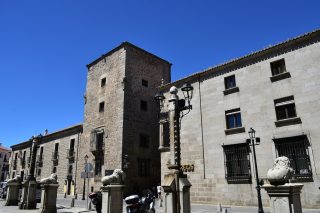
Palacio de los Verdugo, Ávila
Palace in Ávila

Tucked just inside Ávila's walls near the Puerta de San Vicente, the Palacio de los Verdugo is one of those buildings you can appreciate in two ways: as a quick “pause and admire” façade stop, or as a calmer, more atmospheric interior visit if it's open when you pass. It sits on Calle Lope Núñez, a short, direct street that naturally pulls you from the gate into the historic centre, which makes it an easy addition to almost any self-guided route.
What you’re looking at is a 16th-century noble residence with a restrained, fortress-like presence: broad granite masonry, low flanking towers, and a plateresque portal that rewards a closer look. Inside, the mood shifts to something quieter, with an unfinished central courtyard and architectural details that feel surprisingly intimate for such a solid exterior.
Table of Contents
- History and Significance of the Palacio de los Verdugo
- Things to See and Do in the Palacio de los Verdugo
- How to Get to the Palacio de los Verdugo
- Practical Tips on Visiting the Palacio de los Verdugo
- Where to Stay Close to the Palacio de los Verdugo
- Is the Palacio de los Verdugo Worth Visiting?
- For Different Travelers
- FAQs for Visiting Palacio de los Verdugo
- Nearby Attractions to the Palacio de los Verdugo
History and Significance of the Palacio de los Verdugo
The palace dates to the early 1500s and is closely associated with Don Suero de Águila, reflecting a moment when Ávila’s elite expressed status through Renaissance design while still nodding to older defensive instincts. That blend is part of its appeal: it looks like a refined residence, but the low towers and heavy stonework keep it visually anchored in a medieval city that always had security on its mind.
Architecturally, the building is best known for its plateresque façade, a style that favoured ornate carving and heraldic display without abandoning structural sobriety. The coats of arms on the entrance frontage do more than decorate; they signal lineage, alliances, and the social world that shaped Ávila’s urban identity in the post-medieval period, when power was increasingly expressed through civic presence as much as through land.
The palace's “second life” is also part of its story. Rather than becoming a static museum piece, it remains embedded in the city's working fabric, hosting institutional and cultural functions linked to heritage and public administration. That continuity matters when you visit: you are not only seeing a preserved shell, but a building that still participates in how Ávila presents, manages, and protects its historic character.
Things to See and Do in the Palacio de los Verdugo
Start outside and give the main frontage a deliberate look before you go in. The plateresque doorway, the heraldic details, and the overall proportions are designed to be read from the street, and the building’s austerity makes the decorative elements stand out more sharply. If you enjoy small details, look for the sculptural oddities on the façade, including the animal figure often linked to Ávila’s older, pre-Roman visual traditions.
If the palace is open, step inside for the central courtyard. It is unfinished, which paradoxically makes it more interesting: you can read the building process in its proportions and arcades, and you get a sense of how noble houses used inner patios as private “breathing spaces” away from the narrow streets. Even a short pause here can feel like a reset before you continue deeper into the old town.
Finally, keep an eye out for any temporary exhibitions or cultural displays that may be set up inside. Because the palace is used for civic and heritage-related functions, what you find can vary, but that variability is part of the charm: it’s a place where you might stumble into a small display, a quiet interior room, or a staircase detail that feels unexpectedly grand compared with the compact street outside.
How to Get to the Palacio de los Verdugo
Most visitors reach the palace on foot as part of a walled-city walk, since it sits just inside the Puerta de San Vicente and is naturally on the way between the gate area and the cathedral quarter. If you are staying inside the walls, it is typically a straightforward, low-effort stop that fits well into a 1-2 hour loop of nearby monuments.
For air travel, the most practical hub for international and frequent connections is Adolfo Suárez Madrid-Barajas Airport (MAD), then continue to Ávila by coach or rail. For the best deals and a seamless booking experience, check out these flights to Ávila on Booking.com. If you are already in central Spain, you may also see limited options via smaller regional airports, but they are usually less convenient than routing through Madrid and continuing overland.
Ávila is connected by Renfe services, and the station is close enough that many travellers walk or take a short taxi ride to the historic centre, then enter the walled city on foot.Train schedules and bookings can be found on Omio. From the station area, you can also use local taxis to avoid the incline and save time if you are trying to match opening hours.
Buses and coaches are a practical option from Madrid and nearby cities, often dropping you close to the town centre, from where you can walk to the walls and continue to Puerta de San Vicente. By car, it is generally easiest to park outside or near the walls and then walk in through a gate, keeping the narrow inner streets for pedestrians whenever possible.If you are looking to rent a car in Spain I recommend having a look at Discover Cars, first, as they compare prices and review multiple car rental agencies for you.
Practical Tips on Visiting the Palacio de los Verdugo
- Entrance fee: Free.
- Opening hours: Monday – Saturday & public holidays: 10:00–14:00 & 17:00–20:00. Sunday: 10:00–14:00. Closed Monday afternoon in November.
- Official website: Monday – Saturday & public holidays: 10:00–14:00 & 17:00–20:00. Sunday: 10:00–14:00. Closed Monday afternoon in November.
- Best time to visit: Aim for late morning or early evening when the old town feels liveliest, but step inside during the quieter midday window if you want the courtyard to feel calm.
- How long to spend: Plan 10-20 minutes for a simple look, or up to 30 minutes if you want to slow down and absorb the courtyard and architectural details.
- Accessibility: Expect typical old-town constraints such as uneven paving and possible steps inside; if mobility is a concern, treat the exterior as the “main experience” and consider calling ahead on the day.
- Facilities: This is not a full-scale museum setup, so assume limited on-site facilities and plan your restrooms and breaks at nearby cafés or visitor hubs.
Where to Stay Close to the Palacio de los Verdugo
For a culture-heavy visit, base yourself inside Ávila’s walled old town near the cathedral so you can walk to the main monuments early and late; for easier transport logistics, choose the station-side area and taxi in for concentrated sightseeing.
If you want a classic “sleep in a historic building” experience close to the walls, consider Sofraga Palacio, which places you in the thick of the old town with a more refined, special-occasion feel. For a highly central base that works well for a short stay and early starts, Hotel Palacio de Valderrábanos puts you beside the cathedral and within an easy walk of the palace.
For a characterful mid-range option with an old-town atmosphere, Hotel Las Leyendas is well placed for wandering the walls, churches, and quieter lanes without feeling removed from the sights.
Is the Palacio de los Verdugo Worth Visiting?
Yes, especially as part of a wider old-town walk: it is visually striking, takes almost no effort to reach, and offers that satisfying “Renaissance inside a medieval city” contrast that makes Ávila feel layered rather than one-note. Even if you only admire the façade, it adds texture to the route and helps you notice how noble architecture sits alongside churches and fortifications.
The honest pivot is that it may disappoint travellers who want a large, curated museum-style interior with extensive interpretation. If you are short on time or the building is not open when you pass, treat it as a quick exterior stop and prioritise bigger-ticket highlights like the walls, the cathedral, and the Basilica of San Vicente.
What Other Travellers Say...

Palacio de los Verdugo, at C. de López Núñez 4 in Ávila, is a neat, interesting building near one of the main gates with free admission; visitors note accessible upstairs artwork and a small collection of old artifacts, and many appreciate that entry is free.


For Different Travelers
Families with Kids
This works best as a short, low-pressure stop rather than a long visit: give kids a simple “spot the coats of arms” or “find the animal sculpture” challenge outside, then move on before attention fades. Pairing it with the walls soon after is usually the win, since the palace on its own is more about details than spectacle.
If you do go inside, keep the focus on the courtyard as the main payoff, because it is open, airy, and easier for children to engage with than quieter interior rooms. Bring a snack plan for immediately after, since facilities are not the core feature here and families typically do better with a predictable break.
Couples & Romantic Getaways
The palace is a good “soft moment” stop in a romantic itinerary: it is close to photogenic streets, it feels quieter than the headline monuments, and it lends itself to slow strolling rather than queueing. If you time it when the light is gentle, the stonework and doorway details photograph beautifully without needing much staging.
Use it as a connector between bigger emotional beats, such as the grandeur of the cathedral and the drama of the walls. The best romantic version of this visit is not rushing: stop, notice the carving, step into the courtyard if it’s open, and then continue to a nearby wine bar or café within the walls.
Budget Travelers
This is a strong budget stop because it is typically a “high impact, low cost” landmark: the exterior delivers a lot even if you spend nothing, and it sits on an efficient walking route between other major sights. If your goal is to maximise what you see on foot, this is exactly the kind of place that makes a self-guided day feel richer.
To keep costs down, build a compact loop that strings together the palace, the gate area, and nearby churches, then save paid entry for one or two must-do interiors elsewhere. Think of the palace as part of your free architectural “gallery,” with paid attractions reserved for where the interpretation and collections are most substantial.
History Buffs
For history-focused travellers, the palace is a useful lens on how Ávila’s elites lived and signalled status in the 16th century, especially when you compare it to the city’s more overtly defensive medieval fabric. The heraldic programme and plateresque styling tell you a lot about identity and power, even without long museum labels.
It also rewards contextual reading: notice how close it is to the gate and how it sits within the walled network, then compare that to later civic reuse of historic buildings across Spain. If you like “buildings with biographies,” this is a good one precisely because it is not frozen in time.
FAQs for Visiting Palacio de los Verdugo
Getting There
Tickets & Entry
Visiting Experience
Photography
Accessibility & Facilities
Food & Breaks Nearby
Safety & Timing
Nearby Attractions to the Palacio de los Verdugo
- Ávila Walls (Muralla de Ávila): Walk a preserved medieval circuit for sweeping views and the defining skyline of the city.
- Puerta de San Vicente: A dramatic historic gate and natural entry point to the old town, ideal for photos and route planning.
- Basilica of San Vicente: One of Ávila's most important Romanesque churches, known for its sculptural detail and atmospheric interior.
- Ávila Cathedral: A fortress-like Gothic cathedral that anchors the old town and rewards both exterior and interior visits.
- Convento de Santa Teresa: A major Teresian site that adds spiritual and historical depth to a day inside the walls.
The Palacio de los Verdugo appears in our Complete Guide to Visiting Ávila!

Moira & Andy
Hey! We're Moira & Andy. From hiking the Camino to trips around Europe in Bert our campervan — we've been traveling together since retirement in 2020!
This website uses affiliate links which may earn a commission at no additional cost to you!
Planning Your Visit
Monday - Saturday & public holidays: 10:00-14:00 & 17:00-20:00.
Sunday: 10:00-14:00.
Closed Monday afternoon in November.
Free.
Nearby Attractions
- Palacio de los Águila (0.1) km
Palace - Palacio de Sofraga (0.1) km
Palace - Puerta de San Vicente (0.1) km
City Gate - San Vicente Garden (0.1) km
City Walls, Gardens and Park - Palacio de Bracamonte (0.1) km
Palace - Los Velada Palace (0.1) km
Hotel and Palace - Palacio del Rey Niño (0.1) km
Palace - Marshal Gate (0.1) km
City Gate, City Walls and Historic Site - Casa de la Misericordia (0.2) km
Historic Building - Walls of Ávila (0.2) km
City Walls