Igreja de São João Evangelista, Funchal (Madeira)
Church and Historic Building in Funchal (Madeira)
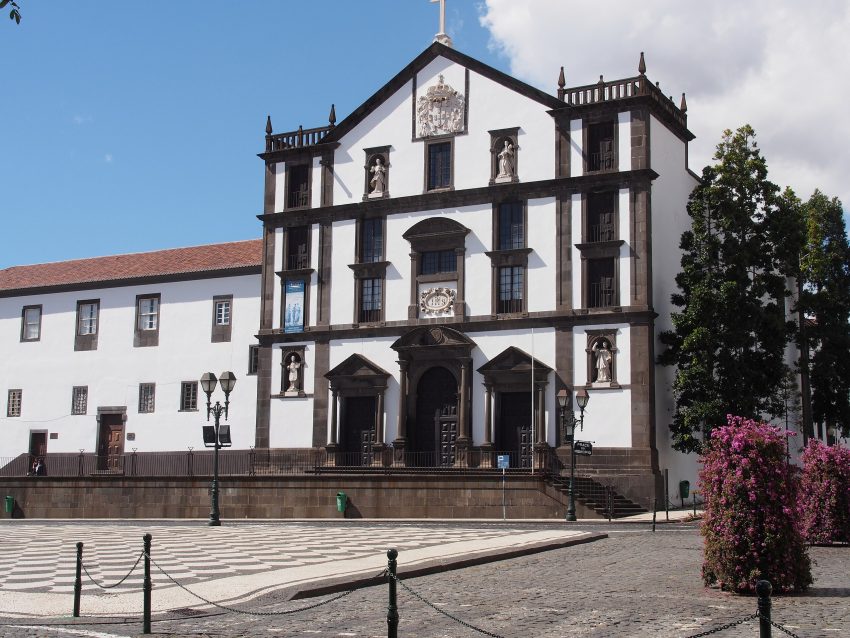
Known formally as the Igreja de São João Evangelista, the Igreja do Colégio sits at Largo do Colégio in the heart of Funchal, and it is one of those churches that immediately rewards curiosity. From the outside, the façade is strikingly ordered and “Jesuit” in character, with three portals, tall window openings, and dramatic black basalt framing that makes the whole front read crisp and architectural even at a quick glance.
Inside, the mood shifts into full Madeiran Baroque: a high nave, side chapels that invite slow wandering, and richly carved 17th-century altars that catch the light and pull your eye forward. The details are the point here-paintings from different periods, layered decoration, and a sacristy clad in blue-and-white tiles that feels like a quiet jewel box within the larger space.
Table of Contents
- History and Significance of the Igreja do Colégio
- Things to See and Do in the Igreja do Colégio
- How to Get to the Igreja do Colégio
- Practical Tips on Visiting the Igreja do Colégio
- Where to Stay Close to the Igreja do Colégio
- Is the Igreja do Colégio Worth Visiting?
- For Different Travelers
- FAQs for Visiting Igreja do Colégio
- Nearby Attractions to the Igreja do Colégio
History and Significance of the Igreja do Colégio
The Igreja do Colégio was built as part of the Jesuit presence in Madeira, with construction beginning in 1624 and completion traditionally dated to 1640. That timing places it in a key moment for religious architecture in Portugal, when Jesuit churches aimed for clarity, symmetry, and a strong didactic impact-an exterior designed to signal order, and an interior designed to inspire and instruct.
What makes this church particularly meaningful in Funchal is how closely it ties into the city's historic centre. It is not a hilltop sanctuary or a remote pilgrimage site; it is embedded in civic Funchal, close to the municipality spaces and the everyday pulse of the old town. That location helped it function not only as a place of worship but also as a marker of institutional power and education in the city's development.
Artistically, the Igreja do Colégio stands out because it concentrates several “Madeira signatures” in one visit: dark basalt accents, gilded woodcarving, and tilework that adds both colour and narrative texture. Even if you are not travelling specifically for churches, it is a strong example of how Atlantic Portugal interpreted Baroque language in a way that feels local rather than copied.
Things to See and Do in the Igreja do Colégio
Start outside and give the façade a proper look before you go in. The three-portal arrangement and the basalt framing are not just decorative; they set the tone for the Jesuit preference for symmetry and legibility. If you enjoy architectural details, take a moment to notice how the vertical rhythm of windows and the paired towers makes the church feel both monumental and balanced.
Inside, move slowly down the nave and treat the chapels as a sequence rather than quick side glances. The carved altars and layered decoration are designed to be read up close, and the differences between chapels can be subtle-one might pull you in for the carving, another for the paintings, another for the way light falls across the gilding.
Do not skip the sacristy if it is accessible during your visit. The blue-and-white tiles are often the element travellers remember most clearly, because they add a cooler, calmer counterpoint to the gold-heavy main space and create that classic Portuguese “azulejo moment” in a setting that still feels intimate.
How to Get to the Igreja do Colégio
The Igreja do Colégio is in central Funchal at Largo do Colégio, a short walk from the cathedral area, the main old-town streets, and the waterfront avenues, so it fits naturally into a self-guided walking day.
Most visitors arrive via Madeira Cristiano Ronaldo Airport (FNC), around 20-25 minutes by road from central Funchal. For the best deals and a seamless booking experience, check out these flights to Funchal (Madeira) on Booking.com. From the airport, you can use airport buses, taxis, or pre-booked transfers to reach the old town, then finish on foot to the square.
Madeira has no passenger rail network, so getting around is by bus, taxi, or on foot. Train schedules and bookings can be found on Omio. If you are driving, use a central car park around Avenida do Mar or near the Santa Catarina area, then walk into Largo do Colégio through the old-town streets. If you are looking to rent a car in Portugal I recommend having a look at Discover Cars, first, as they compare prices and review multiple car rental agencies for you.
Practical Tips on Visiting the Igreja do Colégio
- Entrance fee: Free; Tower access: €1 donation.
- Opening hours: Monday – Saturday: 10:00–18:30. Sunday: 09:00–13:00 & 18:30–22:00.
- Official website: https://www.igrejadocolegiofunchal.pt/
- Best time to visit: [content]
- How long to spend: [content]
- Accessibility: [content]
- Facilities: [content]
Where to Stay Close to the Igreja do Colégio
For a culture-heavy itinerary, base yourself in central Funchal around the cathedral and old-town streets so you can walk to churches, museums, and evening restaurants; choose the Lido area if your trip is more about resort facilities and pool time with easy taxi links into town.
For a stylish, walk-everywhere base in the historic centre, Castanheiro Boutique Hotel is well positioned for Largo do Colégio and the main old-town circuit. If you prefer a design-forward stay close to shops and an easy stroll to the historic core, The Vine Hotel is a strong option. For a simpler, good-location choice that keeps you close to the market and central streets, Hotel do Carmo works well for short stays.
Is the Igreja do Colégio Worth Visiting?
Yes. It is one of the most rewarding “quick stops” in central Funchal because the exterior is distinctive, the interior is genuinely rich, and you do not need specialist knowledge to appreciate the craft and atmosphere.
The honest pivot is that you can skip it if you are actively avoiding churches or you are rushing between outdoor viewpoints and gardens and do not want an indoor pause. In that case, you will get more immediate payoff from a waterfront walk or a cable-car-and-viewpoint plan, and you can treat the church as a “if I pass it” stop rather than a must.
What Other Travellers Say...

Igreja de São João Evangelista do Colégio do Funchal sits on Largo do Colégio and surprises visitors with an ornate, beautiful interior that contrasts with its modest exterior; entry to the church is free, several chapels include English dedications, and an ornate hall in the left wing is open to visitors. For a small fee you can climb what is called the tower or rooftop terrace for sweeping views over the city center, and reviewers note the church offers plentiful decoration and photo opportunities though it appears to need some funding.


For Different Travelers
Families with Kids
For families, this works best as a short, focused visit with a simple aim: spot the biggest altarpiece, count the side chapels, and look for the tilework details that feel like a visual puzzle. Keeping it interactive and time-bounded makes it more engaging than trying to absorb every caption or artwork.
If you are visiting with younger children, the location is a practical advantage because you can pair the stop with something lively immediately afterward, like the market area or a snack break in the old town. Treat it as a calm “reset moment” between more energetic activities rather than the main event of the day.
Couples & Romantic Getaways
For couples, the Igreja do Colégio is a strong atmospheric stop because it feels quietly dramatic without being crowded or time-intensive. It also pairs well with an unplanned old-town wander-step inside for 20 minutes, then continue into cafés and lanes with the sense you have “unlocked” a deeper layer of the city.
It is particularly effective if you like slow travel and small details: carved wood, light on gilding, and that sudden shift from street noise to interior hush. Combine it with a sunset walk along the waterfront for an easy day that mixes culture with mood.
Budget Travelers
Budget travellers should prioritise this because it delivers high impact for minimal cost, and it sits right on foot routes you are likely to walk anyway. It is also a good “weather-proof” option when you want something meaningful without spending on a tour or transport.
If you are planning a self-guided route, use it as a central anchor: church stop, market area, cathedral quarter, then a waterfront promenade. That structure gives you a full, satisfying day in Funchal without relying on paid attractions to create momentum.
History Buffs
For history-focused travellers, this is a valuable Jesuit-era reference point: you can read the Counter-Reformation preference for symmetry and clarity on the façade, then see how later Baroque taste fills the interior with spectacle and devotional craft. It is a compact case study in how institutional religion shaped urban space in Atlantic Portugal.
To get more from it, connect the church mentally to the wider “college” footprint in the area and the civic centre around it. The setting helps explain how religious orders operated as cultural and educational forces, not just spiritual ones, and why the church still feels so central to Funchal’s historic identity.
FAQs for Visiting Igreja do Colégio
Getting There
Visiting Experience
Etiquette and Rules
Photography
Tours, Context and Planning
Nearby Attractions to the Igreja do Colégio
- Sé Cathedral of Funchal: A landmark Gothic-era cathedral with distinctive wooden ceilings, ideal for a second “core heritage” stop nearby.
- Mercado dos Lavradores: Funchal's classic market for produce, flowers, and local snacks, best visited when you want energy and colour.
- Zona Velha (Old Town) and Rua de Santa Maria: A lively historic street area known for murals, small bars, and an easy evening stroll.
- Fortaleza de São Tiago: A coastal fort with strong views and an atmospheric setting that pairs well with the old town.
- CR7 Museum: A quick, modern contrast to historic Funchal, focused on Cristiano Ronaldo and popular for an easy, central visit.
The Igreja de São João Evangelista appears in our Complete Guide to Visiting Funchal (Madeira)!

Moira & Andy
Hey! We're Moira & Andy. From hiking the Camino to trips around Europe in Bert our campervan — we've been traveling together since retirement in 2020!
This website uses affiliate links which may earn a commission at no additional cost to you!
Planning Your Visit
Monday - Saturday: 10:00-18:30.
Sunday: 09:00-13:00 & 18:30-22:00.
Free; Tower access: €1 donation.
Nearby Attractions
- Sacred Art Museum (0.1) km
Museum - Capela de São Luís de Tolosa (Funchal) (0.1) km
Church - Adegas Pereira D'Oliveira (0.1) km
Wine Cellar - City Hall (0.1) km
Historic Building - Madeira Photography Museum (0.1) km
Museum - Sé Catedral do Funchal (0.2) km
Cathedral - Statue of Joao Goncalves Zarco (0.2) km
Statue - A Cidade do Açúcar Museum (0.2) km
Museum - Blandy's Wine Lodge (0.3) km
Wine Cellar - Madeira Military Museum (0.3) km
Museum


