Guinigi Tower, Lucca
Tower in Lucca
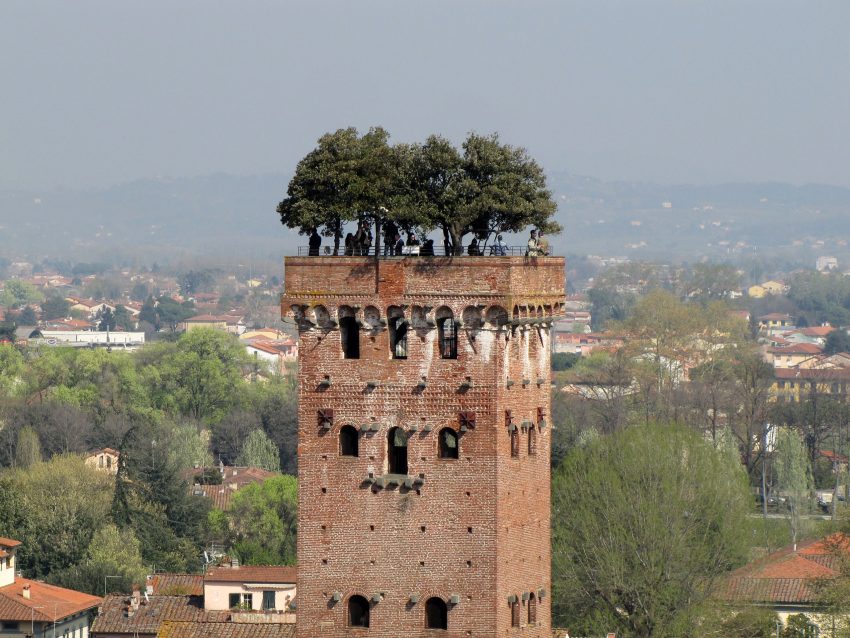
Rising above Lucca's terracotta rooftops, the Guinigi Tower is one of the city's most distinctive silhouettes. Built in the latter half of the fourteenth century by the wealthy Guinigi family, it harks back to a time when Lucca's skyline bristled with “medieval skyscrapers,” each one a declaration of power and prestige. The taller the tower, the more important the family, and the Guinigi made sure theirs stood out-both in height and in style. Its Romanesque-Gothic architecture, decorated with cornices and family coats of arms, still reflects the local Lucchese taste for solid elegance rather than flamboyance.
What truly sets the Guinigi Tower apart, however, is the small hanging garden at its summit. Here, a cluster of holm oaks grows in three flowerbeds, forming a tiny woodland terrace suspended above the city. The Guinigi family intended this garden as a symbol of rebirth and renewal, a living statement crowning their stone tower. Today, climbing up to this leafy rooftop and stepping out into the open air for a full 360-degree view of Lucca and the surrounding hills is a highlight of any walking tour of Lucca and one of the top attractions in Lucca for visitors.
History and Significance of Guinigi Tower
In fourteenth-century Lucca, towers were more than just practical structures; they were vertical status symbols. Wealthy families vied to outdo one another, adding height and bulk to their towers as a visible measure of influence. The Guinigi family, one of the city's leading dynasties, built several towers, but this one has survived as their most striking legacy. Its robust brick construction and Romanesque-Gothic detailing follow the local style of the period, blending defensive solidity with decorative touches.
As time passed, most of Lucca's other family towers were cut down, incorporated into later buildings, or demolished altogether, but the Guinigi Tower endured. The rooftop garden, likely added in the fifteenth century, gave it a unique character and ensured it wasn't just another vertical statement of power, but also a symbol of hope and renewal. The three flowerbeds and evergreen holm oaks create a small suspended landscape, making the tower instantly recognisable from the walls and surrounding viewpoints.
Legend adds another layer to its story. It is said that Paolo Guinigi, the most famous member of the family and lord of Lucca in the early fifteenth century, planted the tallest of the rooftop trees. Later captured and imprisoned by Francesco Sforza, he was condemned to death. On the day of his execution, so the tale goes, all the leaves fell from that tree at once, as if the tower itself were mourning his fate. Whether you take the story literally or not, it adds an air of mystery and melancholy to an already evocative monument.
Things to See and Do in Guinigi Tower
The experience of Guinigi Tower starts as soon as you step inside and begin to climb. The lower flights of stairs are wide and relatively shallow, with landings where large information boards introduce other Lucca attractions and bits of local history. This makes the ascent feel nicely punctuated, allowing you to catch your breath and learn as you go. About halfway up, you'll find a small seating area where you can pause before tackling the steeper section.
As you continue, the staircases narrow and shift to metal steps, adding a sense of vertical adventure as you approach the summit. Finally, you emerge into the open rooftop garden, where the holm oaks rustle in the breeze and the entire city stretches out below. From here, you can pick out the line of the city walls, the oval of Piazza dell'Anfiteatro, the dome and campanile of San Martino, and the patchwork of red-tiled roofs that make Lucca so photogenic.
Take your time to walk the perimeter of the rooftop terrace. Each side offers a different perspective: toward the north, the Apennine foothills; toward the south and west, the gentle Tuscan landscape; and all around, the compact beauty of the walled city. The combination of historic bricks underfoot, living trees overhead, and a 360-degree panorama around you makes this spot one of the best places to see in Guinigi Tower's part of Lucca.
How to Get to Guinigi Tower
Guinigi Tower stands within the historic centre of Lucca, just a short walk from Via Fillungo and not far from Piazza dell'Anfiteatro. Once inside the city walls, simply follow signs for “Torre Guinigi” or ask any local, and you'll find it tucked among the narrow medieval streets, its rooftop trees clearly visible above neighbouring houses.
If you are arriving by air, the most convenient airports are Pisa International Airport and Florence Airport, both offering regular flights and onward links into Tuscany. For the best deals and a seamless booking experience, check out these flights to Lucca on Booking.com. From either, you can continue to Lucca by train, bus, or hire car, then enter the walled city on foot.
By train, Lucca is well served by regional services from Pisa, Florence, and other Tuscan towns.Use Omnio to easily compare schedules, book train tickets, and find the best prices all in one place for a hassle-free journey across Italy. The station is just outside the southern walls near Porta San Pietro; from there, it's about a 15-20-minute walk through the old streets to Guinigi Tower, with plenty of cafés and shops along the way.
If you are driving, the A11 motorway and local roads connect Lucca with Pisa, Florence, and the surrounding countryside.If you are looking to rent a car in Italy I recommend having a look at Discover Cars, first, as they compare prices and review multiple car rental agencies for you. Park in one of the car parks outside or just inside the walls-vehicles are restricted in much of the historic centre-then stroll in; the tower’s tree-topped roof makes it easy to spot from various points around town.
Practical Tips on Visiting Guinigi Tower
- Suggested tips: Wear comfortable shoes for the climb and take advantage of the halfway seating area if you need a short rest before the final stairs.
- Best time to visit: Early morning or late afternoon often means fewer crowds and softer light over the rooftops; sunset visits can be especially memorable in good weather.
- Entrance fee: Adults € 6.00
- Opening hours: January 1 - March 20: 10.00 - 16.00 21 March - 31 May: 10.00 - 18.30* (* Saturday and Sunday closing 19:30) 1 June - 20 September: 10.00 - 19.30* (* June -Luglio: Saturday and Sunday closing at 8.30 pm; August: Saturday and Sunday closing at 20.00) 21 September - 30 September 10.00 - 18.30 1 October - 31 December: 10.00 - 16.00 (closed on 25 December)
- Official website: http://www.comune.lucca.it/flex/cm/pages/ServeBLOB.php/L/IT/IDPagina/131
- How long to spend: Allow around 45-60 minutes for the visit, including the climb, time at the top for photos and views, and the descent.
- Accessibility: The tower is not suitable for visitors with significant mobility issues, as access is via staircases only, including narrow metal steps near the top.
- Facilities: There are no facilities on the tower itself; restrooms, cafés, and shops are available nearby in the surrounding streets.
- Photography tip: For classic shots, frame the rooftop oaks against the skyline or look down toward Piazza dell'Anfiteatro and the city walls; a wider lens helps capture both trees and cityscape.
- Guided tours: Some guided city walks include the tower, providing context about Lucca’s tower-building families and the Guinigi legend before you climb.
- Nearby food options: After your visit, explore Via Fillungo and the nearby side streets for gelaterie, wine bars, and trattorie serving Lucchese dishes and local wines.
Where to Stay close to Guinigi Tower
Staying near Guinigi Tower gives you an ideal base for exploring Lucca's historic core on foot. Just a short walk away, Hotel Ilaria offers comfortable rooms close to both the eastern stretch of the walls and the medieval streets leading to the tower. For a more intimate atmosphere, Albergo San Martino places you near the cathedral yet still within an easy stroll of Guinigi Tower, Piazza dell'Anfiteatro, and Via Fillungo. If you like staying in a building with its own history, Palazzo Alexander provides characterful rooms in a restored palace, keeping you close to many of the city’s main sights and only a pleasant walk from the tree-topped tower.
Is Guinigi Tower Worth Visiting?
Guinigi Tower is absolutely worth visiting, especially if you want a clear, memorable overview of Lucca's layout and surroundings. The climb is manageable for most visitors, the interpretive boards make the ascent interesting, and the rooftop garden with its holm oaks adds a uniquely poetic touch you won't find on many other towers in Italy. Standing among the trees with a full-circle panorama of red roofs, church towers, and green hills, you understand at once why this tower has become one of the must-see places in Lucca and a symbol of the city itself.
What Other Travellers Say...

Guinigi Tower on Via Guinigi is a brick tower you can climb — roughly 230 steps — to reach an oak‑topped terrace offering sweeping views over Lucca and nearby hills; the ascent starts on wide stone steps, becomes a metal gantry with tighter twists near the top, and many visitors note the surprising trees providing summer shade and a family‑friendly feel, plus a small exhibition included with admission.


FAQs for Visiting Guinigi Tower
Nearby Attractions to Guinigi Tower
- Piazza dell'Anfiteatro - Oval piazza built on the footprint of a Roman amphitheatre, lined with cafés and pastel façades.
- Lucca's Historical Walls - Tree-lined Renaissance fortifications encircling the city, perfect for a walk or bike ride with great views of the tower.
- Basilica di San Frediano - Romanesque church known for its golden façade mosaic and peaceful interior, a short walk away.
- Cathedral of San Martino - Lucca's duomo, home to the Volto Santo and Ilaria del Carretto's exquisite tomb.
- San Michele in Foro - Striking church on the site of the Roman forum, with a richly decorated façade and lively surrounding square.
The Guinigi Tower appears in our Complete Guide to Visiting Lucca!

Moira & Andy
Hey! We're Moira & Andy. From hiking the Camino to trips around Europe in Bert our campervan — we've been traveling together since retirement in 2020!
This website uses affiliate links which may earn a commission at no additional cost to you!
Planning Your Visit
January 1 – March 20: 10.00 – 16.00
21 March – 31 May: 10.00 – 18.30* (* Saturday and Sunday closing 19:30)
1 June – 20 September: 10.00 – 19.30* (* June -Luglio: Saturday and Sunday closing at 8.30 pm; August: Saturday and Sunday closing at 20.00)
21 September – 30 September 10.00 – 18.30
1 October – 31 December: 10.00 – 16.00 (closed on 25 December)
Adults € 6.00
Nearby Attractions
- Piazza dell Anfiteatro (0.2) km
Amphitheatre - Torre delle Ore (0.2) km
Tower - Via Fillungo (0.3) km
Street - Villa Bottini (0.3) km
Historic Building - Basilica of San Frediano (0.3) km
Church - San Michele in Foro (0.3) km
Basilica - Domus Romana (0.3) km
Historic Site - Church and Baptistery of Santi Giovanni e Reparata (0.4) km
Church and Museum - Cathedral of San Martino (0.4) km
Cathedral - Church of St Maria della Rosa (0.4) km
Church