Warsaw, Poland: The Ultimate Travel Guide 2026
Poland Warsaw
Poland Warsaw

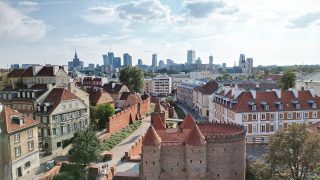
Visiting Warsaw, in the heart of the Masovian region, offers an exciting mix of tradition and innovation. The city is Poland's capital and largest urban center, buzzing with cultural energy, modern architecture, and a broad array of attractions. Its vibrant districts range from the business-heavy skyscrapers of Śródmieście to the atmospheric lanes of the Old Town, where cobbled streets and colorful townhouses invite hours of exploration.

The city is especially rewarding for lovers of art, music, and contemporary culture. Numerous galleries, concert halls, and theaters make up a thriving creative scene. Highlights include the Chopin Museum, the multimedia POLIN Museum of the History of Polish Jews, and the cutting-edge Museum of Modern Art. Warsaw also boasts lush green spaces like Łazienki Park and the Vistula boulevards, perfect for walks, picnics, or riverfront cycling.

Warsaw's culinary landscape is equally impressive, with everything from traditional milk bars and pierogi eateries to high-end dining and international cuisine. It's also a city that doesn't sleep early - its lively nightlife spans rooftop bars, jazz clubs, and riverside beer gardens. Whether you're drawn to history, culture, or just the rhythm of big-city life, Warsaw provides an endlessly engaging and well-connected base in central Poland.

History of Warsaw

History of Warsaw in the Medieval Period

Warsaw’s origins trace back to a small fishing settlement in the early Middle Ages. By the 13th century, it had developed into a fortified town. In 1413, it gained further importance when it became the seat of the Masovian Dukes. Over time, its central location allowed it to grow in economic and political stature within the region.

History of Warsaw in the Polish–Lithuanian Commonwealth

Warsaw rose to national prominence in 1596 when King Sigismund III Vasa moved the royal court from Kraków, making it the de facto capital of the Polish–Lithuanian Commonwealth. This era saw rapid growth in architecture, governance, and education. The city flourished as a political center and hosted important parliamentary sessions and royal ceremonies.

History of Warsaw in the 19th Century

Following the partitions of Poland, Warsaw fell under Russian rule and became a provincial capital in the Russian Empire. Despite oppression, the city became a hub of Polish nationalism and intellectual life. It also underwent significant industrialization, expanding rapidly and developing modern infrastructure and public institutions.

History of Warsaw in the 20th Century

Warsaw faced immense turmoil in the 20th century, especially during World War II. The city was heavily bombed and nearly razed following the 1944 Warsaw Uprising. After the war, massive efforts were made to rebuild, including the painstaking reconstruction of the Old Town. Under communist rule, Warsaw was reshaped with socialist realism but also became a center for resistance and reform.

History of Warsaw in the Modern Era

With the fall of communism in 1989, Warsaw entered a new era of transformation. The city rapidly modernized, becoming a financial and cultural powerhouse. Skyscrapers rose alongside historic churches, and Warsaw embraced both its heritage and a forward-looking identity. Today, it stands as one of Central Europe’s most dynamic and resilient capitals.

Moira & Andy
Moira & Andy

Hey! We're Moira & Andy. From hiking the Camino to trips around Europe in Bert our campervan — we've been traveling together since retirement in 2020!

Read our full story here

Visiting Warsaw for the first time and wondering what are the top places to see in the city? In this complete guide, I share the best things to do in Warsaw on the first visit. To help you plan your trip, I have also included an interactive map and practical tips for visiting!

This website uses affiliate links which earn a small commission at no additional cost to you.
Powered by GetYourGuide

36 Best places to See in Warsaw

This complete guide to Warsaw not only tells you about the very best sights and tourist attractions for first-time visitors to the city but also provide insights into a few of our personal favorite things to do.

This is a practical guide to visiting the best places to see in Warsaw and is filled with tips and info that should answer all your questions!

1. Royal Castle

Warsaw Royal Castle
Warsaw Royal Castle
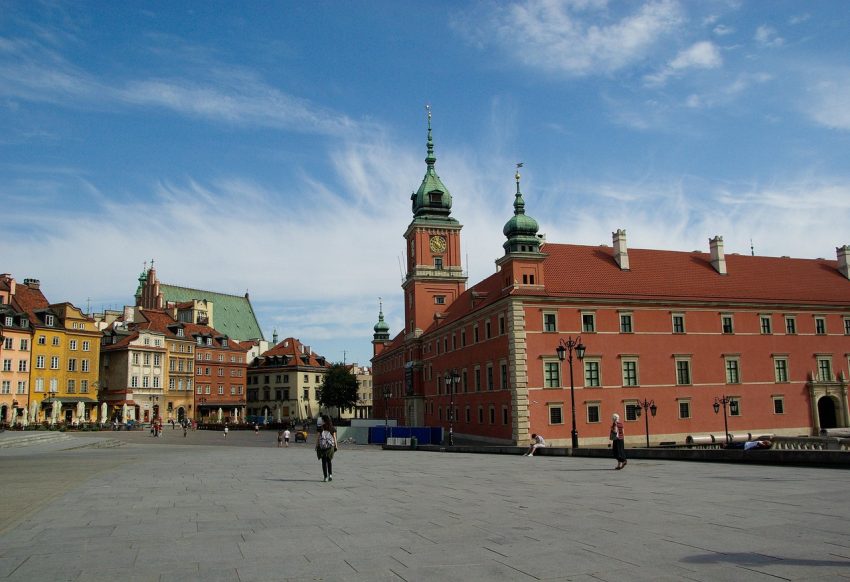
Warsaw’s Royal Castle is a reconstructed seat of Polish state power, standing on Castle Square at the edge of the Old Town where the city’s postcard skyline begins. Inside, the visit moves through a sequence of ceremonial interiors—Royal Apartments and grand state rooms—built to impress with symmetry, scale, and dense ornament, including the Throne Room. Its meaning is inseparable from its wartime destruction and the painstaking postwar rebuilding, pieced together from surviving fragments and archival records as an act of cultural recovery. Travelers often remember the calm, museum-like flow through rooms, practical touches like a cloakroom and lockers, and the free audio guide that helps decode what you’re seeing.
Location: The Royal Castle in Warsaw, plac Zamkowy, Warsaw, Poland | Hours: 10:00–17:00. Closed on Monday. | Price: Adults: 60 zł; Reduced: 45 zł; School (ages 7+): 1 zł; Under 7: free. Free entry to the Royal Apartments and Parliament Chambers on Wednesday (limited tickets, collected on the day). | Website | Guided Tour (Skip the Line) | Distance: 0km

We recommend to rent a car in Poland through Discover Cars, they compare prices and review multiple car rental agencies. Book your rental car here.

Powered by GetYourGuide

2. Castle Square

Castle Square, Warsaw
CC BY-SA 2.0 / Rhododendrites
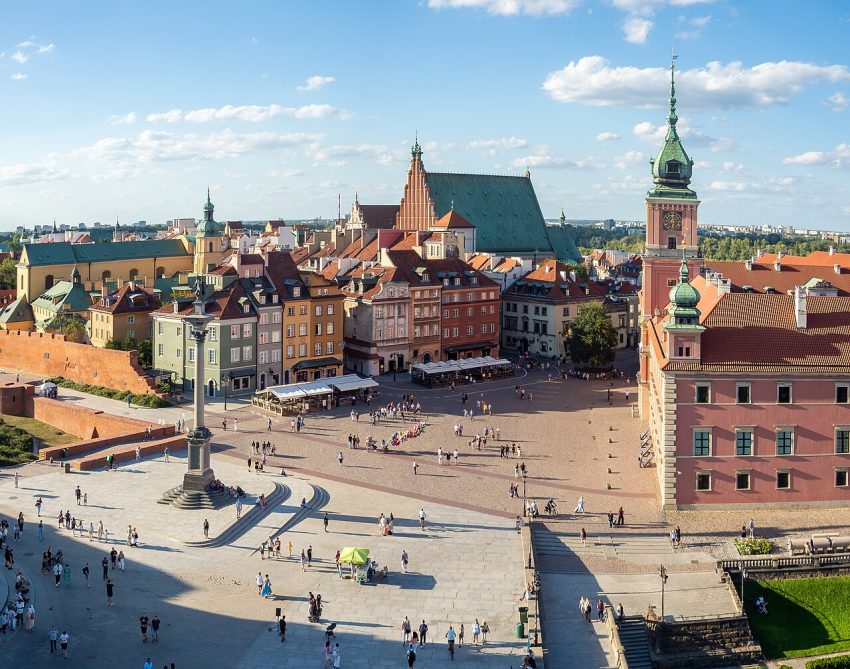
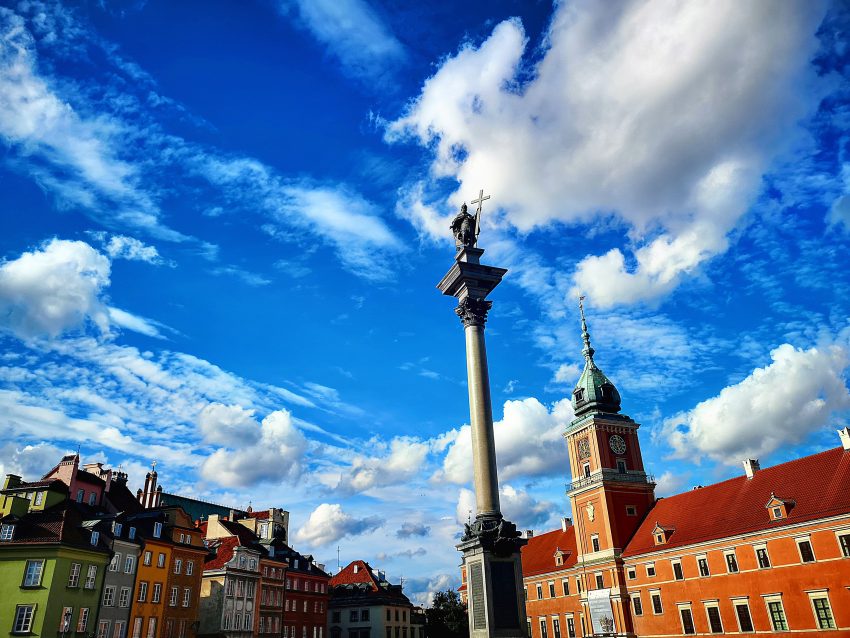
Castle Square (Plac Zamkowy) is the broad cobbled forecourt in front of Warsaw’s Royal Castle, marking the threshold between the Royal Route and the Old Town. The space feels like the city’s living lobby: musicians and artists set up around clusters of tour groups, and locals instinctively use Sigismund’s Column as the meet-up point. The 17th-century column honors King Sigismund III Vasa, who moved Poland’s capital from Kraków to Warsaw, and it still reads as a clear signal that you’re in the historic core. Look closely and the square also carries Warsaw’s post‑war story—its surroundings and the castle were rebuilt after WWII, giving the scene a carefully restored, resilient character. From almost any angle, the column neatly “stages” the castle behind it.
Location: Plac Zamkowy, Warsaw, Poland | Hours: 24 hours | Price: Free. | Distance: 0km

Here is a complete selection of hotel options in Warsaw. Feel free to review each one and choose the stay that best suits your needs.

3. St John's Archcathedral

St. John’s Archcathedral in Warsaw
CC BY-SA 2.0 / Logofag
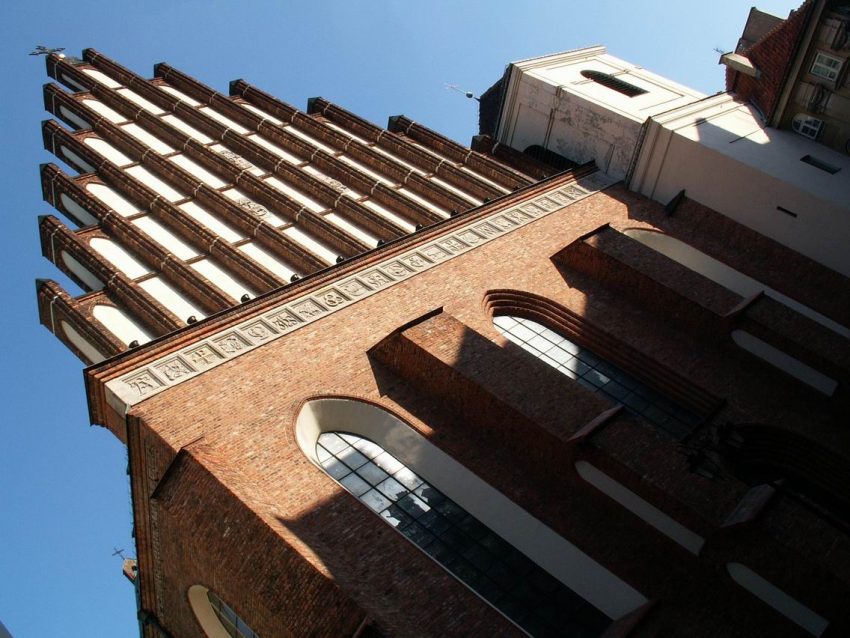
St John’s Archcathedral is a Brick Gothic cathedral on Świętojańska Street in Warsaw’s Old Town, a place where Poland’s political and religious story has repeatedly been written, erased, and rebuilt. Its restrained brick façade leads into a calm, vertical interior of vaults and dark masonry that feels notably hushed even when the surrounding lanes are busy. During the Warsaw Uprising it was devastated, and the post‑war reconstruction intentionally revived an earlier Mazovian Gothic character, making the building itself a statement of continuity. Don’t miss the crypts, where for a small fee you can descend among tombs of major Polish figures, with clear English explanations and a palpable sense of national remembrance.
Location: St. John's Archcathedral, Świętojańska, Warsaw, Poland | Hours: Monday – Saturday: 10:00–17:00. Sunday: 15:00–17:00. Closed during Masses and services. | Price: Cathedral: free entry. Cathedral Crypts (ticketed visitor route): Normal 5 zł; Reduced 3 zł; Family 11 zł. | Website | Distance: 0.1km

Traveling to a country with a different currency? Avoid ATM transaction fees and pay in local currency with a Wise Card. Having used it for over 5 years, we've saved loads on fees!

4. Royal Castle Gardens

Warsaw Royal Castle Gardens
CC BY-SA 1.0 / Аимаина хикари
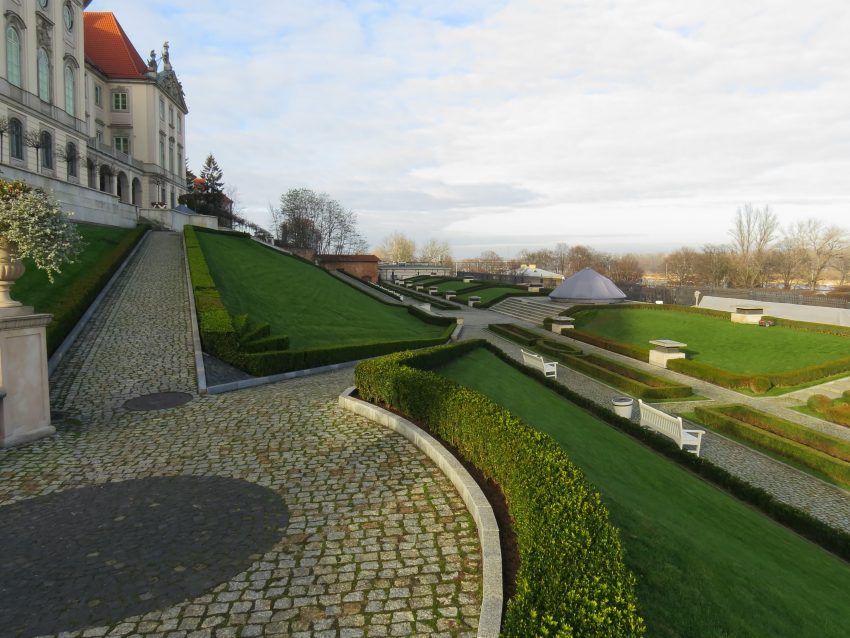
Royal Castle Gardens are the terraced gardens directly behind Warsaw’s Royal Castle, stepping down the escarpment toward the Vistula River and reopening the castle’s connection to the waterfront. Restored over a decade and completed in 2019, they feel both freshly made and historically grounded. The Upper Garden sits atop the Kubicki Arcades with a crisp, geometric plan and a fountain framed by clipped greenery, while the Lower Garden shifts into a more sheltered, English-style park with hedged “rooms” and ornamental trees. Visitors remember the long sightlines to the river, benches made for lingering, and the warm late-day light that draws photographers. Entry is free, and a relaxed loop takes about half an hour.
Location: Warsaw Royal Castle Gardens, Stare Miasto, Warsaw, Poland | Hours: (Summer) May–August: Upper Garden Daily 10:00–20:00; Lower Garden Daily 10:00–22:00; September: Upper Garden Daily 10:00–20:00; Lower Garden Daily 10:00–20:00. (Winter) October–April: Upper Garden Daily 10:00–18:00; Lower Garden Daily 10:00–18:00. | Price: Free. | Website | Distance: 0.1km

Explore Warsaw at your own pace with our self-guided walking tour! Follow our curated route to discover must-see sights and local secrets that makes Warsaw one of the best places to visit in Poland.

5. Sigismund’s Column

Kolumna Zygmunta, Warszawa
CC BY-SA 4.0 / Chichebombon
Sigismund’s Column stands in Castle Square at the threshold of Warsaw’s Old Town, a tall granite marker crowned with a bronze King Sigismund III Vasa. Raised in 1644 by his son Władysław IV, it commemorates the ruler who shifted Poland’s royal court from Kraków to Warsaw in 1596, helping define the city’s role as a capital. Look closely: the king holds a sword and a cross, a deliberate pairing of authority and faith, and the pedestal’s inscriptions and sculptural details reward a slow circuit. The column was knocked down during the Warsaw Uprising in 1944 and rebuilt after the war, a small, visible lesson in Warsaw’s destruction and repair. At sunset, the vertical line of the monument cuts cleanly against the Royal Castle skyline.
Location: Sigismund's Column, plac Zamkowy, Warsaw, Poland | Hours: 24 Hours | Price: Free. | Distance: 0.1km

Explore Warsaw at your own pace with our self-guided walking tour! Follow our curated route to discover must-see sights and local secrets that makes Warsaw one of the best places to visit in Poland.

6. Jan Kiliński Monument

Jan Kiliński Monument
CC BY-SA 2.0 / Lukas Plewnia
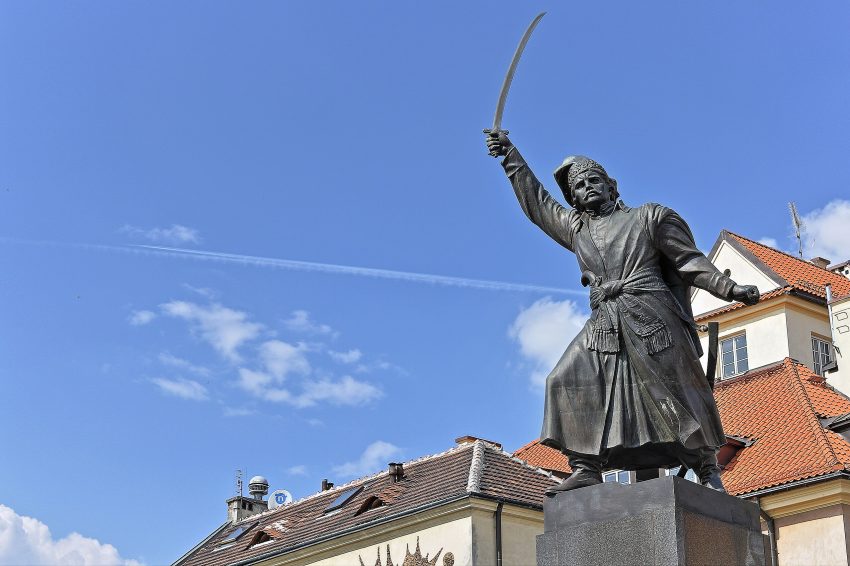
The Jan Kiliński Monument in Warsaw’s Old Town stands on Podwale Street beside the defensive walls, near the Piekarska Street corner. It depicts Kiliński—a shoemaker who became a leader in the 1794 Kościuszko Uprising—caught mid-stride with a sabre raised, giving the sculpture a sense of motion rather than a formal, static pose. Unveiled in 1936, it was removed by German occupiers during World War II and later returned, finally set in this spot in 1959, where the walls sharpen its themes of defence and endurance. Visitors tend to circle the pedestal, read the inscription, and frame photos against the brick fortifications; reviews often call it a “cool” and striking monument.
Location: Jan Kiliński Monument, Piekarska, Warsaw, Poland | Hours: 24 Hours | Price: Free | Distance: 0.2km

7. Old Town Wishing Bell
Warsaw Wishing Bell
Warsaw Wishing Bell
CC BY-SA 3.0 / Carlos Delgado
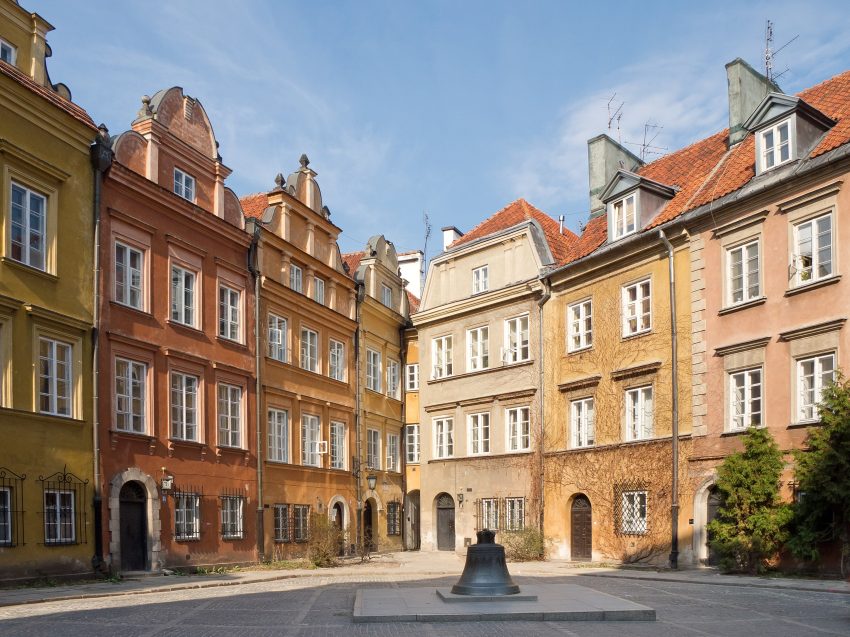
Old Town Wishing Bell (Dzwon na Kanonii) is a small 17th-century bronze bell tucked into the quiet Kanonia enclave just behind St John’s Archcathedral in Warsaw’s Old Town. Cast in 1646 and linked to craftsman Daniel Tym, it’s remembered as a bell that was never properly hung—often said to be flawed—so its meaning shifted from function to folklore. Visitors pause in the cobbled, close-walled courtyard to touch the metal, make a wish, and circle it three times, a simple ritual that turns a backstreet detour into a personal moment. Because it sits a minute from the busiest lanes, the calm feels like part of the experience.
Location: Dzwon na Kanonii, Kanonia, Warsaw, Poland | Hours: 24 Hours | Price: Free | Distance: 0.2km

8. St. Anne’s Church
St. Annes Church, Warsaw
CC BY-SA 3.0 / Adrian Grycuk
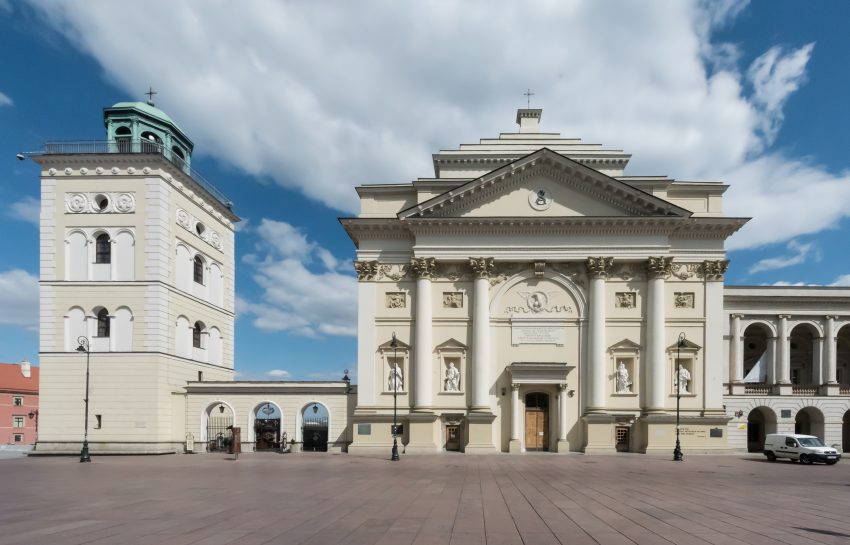
St. Anne’s Church (Kościół św. Anny) is a centuries-old Catholic church on Krakowskie Przedmieście at the edge of Castle Square, one of the first sacred spaces you encounter entering Warsaw’s historic center. Its confident neoclassical façade gives way to a dramatically different interior: a Baroque setting of gilded ornament, frescoed ceilings, side chapels, and theatrical altars where shifting light does much of the work. Founded in the mid-15th century and repeatedly rebuilt, it feels less like a single-era monument than a record of the city’s reinvention. Climb the bell tower for a rooftop-level panorama over Castle Square and the Old Town’s tight geometry, a view many visitors single out as the payoff.
Location: Kościół Akademicki św. Anny, Krakowskie Przedmieście, Warsaw, Poland | Hours: Monday – Friday: 07:00–19:00. Saturday: 09:00–19:00. Sunday: 09:00–22:00. Bell tower viewpoint May – September: Monday – Friday: 10:00–21:00; Saturday – Sunday: 11:00–22:00. October – April: Monday – Friday: 10:00–18:00; Saturday – Sunday: 11:00–21:00. | Price: Church: free entry; Bell tower viewpoint: 15 PLN (standard), 10 PLN (reduced). | Website | Distance: 0.2km

9. Mermaid of Warsaw
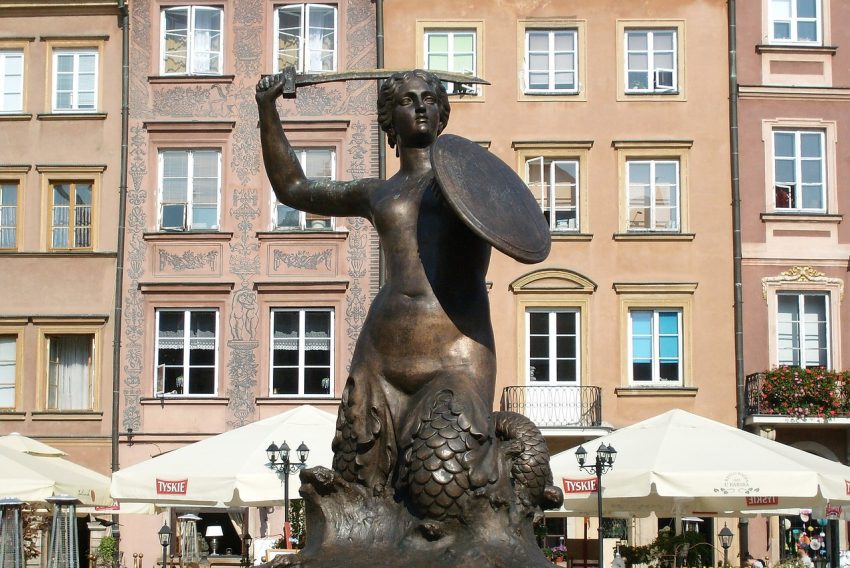
Mermaid of Warsaw
Mermaid of Warsaw
The Mermaid of Warsaw (Syrenka) is the city’s guardian emblem, shown with sword and shield on Warsaw’s coat of arms and echoed across plaques, bridges, and façades. Visitors most often meet her as a statue in the Old Town Market Square, where cobblestones and brightly painted townhouses frame an easy photo stop and a pause in the square’s bustle. A second major Syrenka stands by the Vistula River in Powiśle, where the setting feels more open and contemporary, especially as evening light catches the riverside. The legend behind the figure—rescued by locals and pledged to defend the city—helps explain why she’s always depicted alert and armed, a symbol of resilience you keep spotting as you roam.
Location: Mermaid Monument, Rynek Starego Miasta, Warsaw, Poland | Hours: 24 hours | Price: Free. | Distance: 0.3km

10. Mały Powstaniec, Little Insurgent Monument

Little Insurgents Memorial
CC BY-SA 3.0 / Mister No
Mały Powstaniec (the Little Insurgent Monument) is a small bronze memorial tucked against the medieval brick defensive walls on Podwale Street near Warsaw’s Barbican. The child-sized figure wears an oversized helmet and grips a weapon that looks too heavy, a deliberately unsettling contrast that many visitors remember long after the Old Town scenery fades. It commemorates the youngest participants of the 1944 Warsaw Uprising—children who served as couriers, scouts, and helpers in street-by-street fighting. A plaque behind the statue includes lines from the wartime song “Warszawskie Dzieci,” and the monument’s street-level placement keeps it close to daily life, where flowers or candles sometimes appear.
Location: Mały Powstaniec, Podwale, Warsaw, Poland | Hours: 24 Hours | Price: Free. | Distance: 0.3km

11. Royal Route
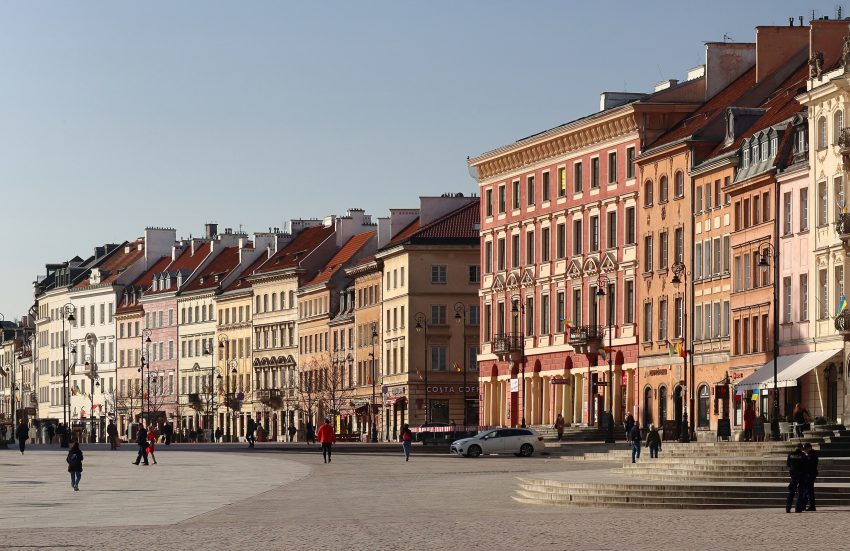
Royal Route Warsaw
Royal Route Warsaw
CC BY-SA 4.0 / Cybularny
Warsaw’s Royal Route (Trakt Królewski) is a connected run of ceremonial streets rather than a single monument, linking Castle Square and the Royal Castle with the city’s southern royal residences. Walking it feels like moving through changing chapters: the formal facades and churches of Krakowskie Przedmieście give way to the café-and-shop buzz of Nowy Świat, then the leafier, embassy-lined Aleje Ujazdowskie. Many visitors remember how easy it is to stroll, with long stretches that can feel almost car-free during holiday closures. The full line runs about 11 km toward Wilanów Palace, but even a short section delivers handsome buildings, lively pavements, and frequent courtyards and interiors to duck into.
Location: Royal Route, Krakowskie Przedmieście, Warsaw, Poland | Hours: 25 Hours | Price: Free. | Distance: 0.3km

12. Old Town Market Square

Warsaw Old Town Market Square
CC BY-SA 3.0 / Adrian Grycuk
Old Town Market Square (Rynek Starego Miasta) is the compact cobbled plaza at the centre of Warsaw’s Stare Miasto, framed by brightly painted townhouses and café terraces that keep the space buzzing from morning to evening. Shaped as a marketplace around the 13th–14th centuries, it still feels like a civic stage—street performers, clinking cups, and constant foot traffic. What visitors remember most is how deliberately “old” it looks: the square was largely destroyed in World War II and meticulously rebuilt, a feat tied to Warsaw’s UNESCO-listed Historic Centre. In the middle, the Warsaw Mermaid statue works as an easy meeting point and a city emblem made tangible among the restored façades.
Location: Rynek Starego Miasta, Warsaw, Poland | Hours: 24 Hours | Price: Free | Distance: 0.3km

13. Warsaw Barbican
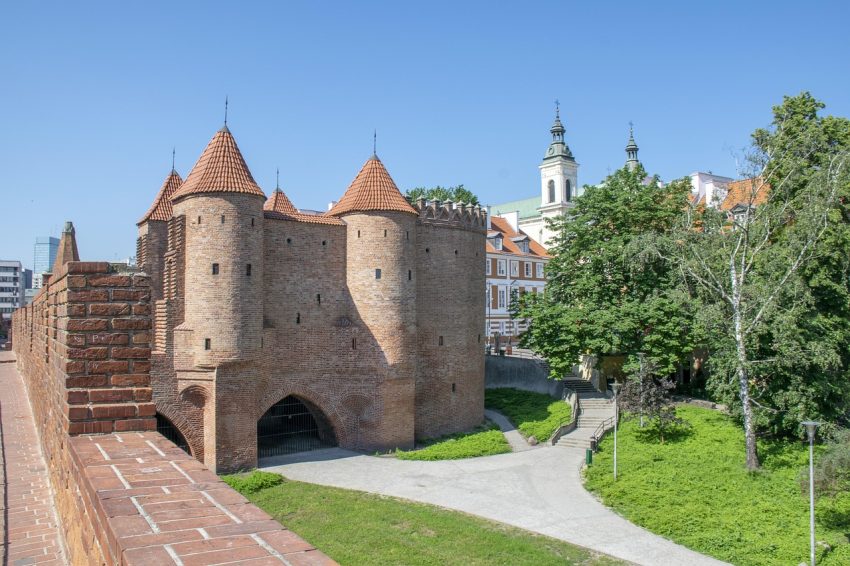
Warsaw Barbican
Warsaw Barbican
The Warsaw Barbican is a rounded red-brick bastion built into the city’s defensive walls, forming a natural pinch point between Warsaw’s Old Town and New Town near Nowomiejska Street. Added in the mid-16th century as a Renaissance-era outwork to protect the northern gate, its thick masonry and narrow firing slits still make the city’s former edge feel tangible. What visitors remember most is the curve of the walls and the way the archway funnels you through, with the best views coming from slightly below where the layered brickwork reads clearly. Reconstructed after World War II from salvaged material, it stands as a physical reminder of Warsaw’s postwar rebuilding. In warmer months, the space often feels lively with nearby street artists and small stalls.
Location: Warsaw Barbican, Nowomiejska, Warsaw, Poland | Hours: (Summer) 21 May – 30 September: Wednesday & Saturday: 13:00–17:00. Closed on Monday, Tuesday, Thursday, Friday & Sunday. (Winter) 01 October – 20 May: Closed. Outdoor passage through the gate and along the defensive walls is free and accessible year-round (weather permitting). | Price: Free for the outdoor passage; 12 PLN (regular) / 8 PLN (reduced) for the summer exhibition inside the Barbican. | Website | Distance: 0.4km

14. Field Cathedral of the Polish Army
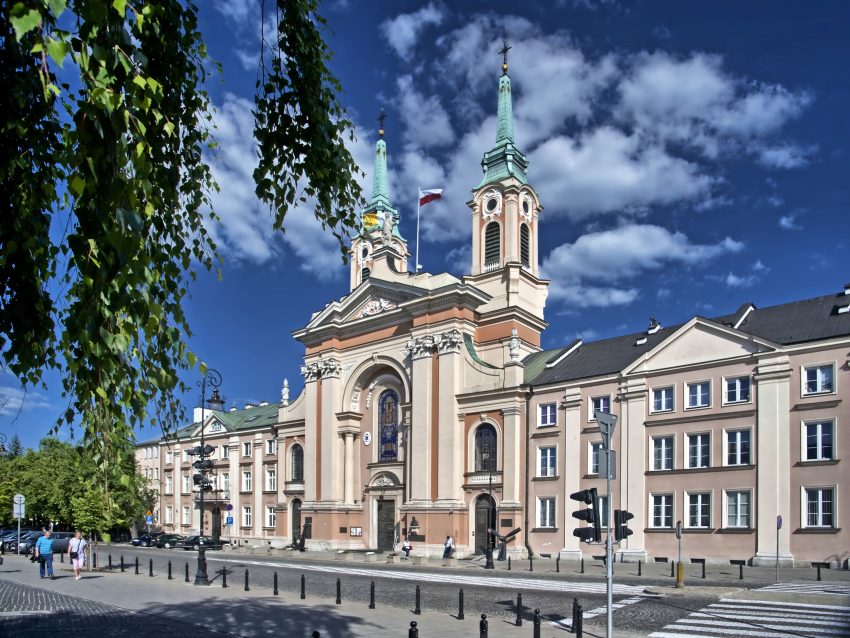
Field Cathedral of the Polish Army
CC BY-SA 3.0 / Cezary Piwowarski
The Field Cathedral of the Polish Army is Warsaw’s principal military church, set on Długa Street at the edge of the Old Town and New Town, with a façade so restrained you might miss it. Inside, the atmosphere turns formal and solemn: military standards, emblems, and dense memorial plaques line the space like a ledger of service. The building began as a late-17th-century Piarist church and, after heavy World War II damage, was rebuilt as part of Warsaw’s wider postwar restoration. The most affecting stop is the Katyń Chapel, dedicated to Polish officers murdered in 1940, designed for quiet reading and reflection. Even a short visit leaves a lingering sense of national remembrance.
Location: Field Cathedral of the Polish Army, Długa, Warsaw, Poland | Hours: Tuesday – Sunday: 10:00–18:00. Closed on Monday. | Price: Free. | Website | Distance: 0.5km

15. Presidential Palace (Pałac Prezydencki)

Pałac Prezydencki
Pałac Prezydencki
CC BY-SA 3.0 / Marcin Białek
Warsaw’s Presidential Palace (Pałac Prezydencki) is a working seat of Poland’s head of state, set behind a calm neoclassical façade on Krakowskie Przedmieście. Built in the 1640s as an aristocratic residence for Hetman Stanisław Koniecpolski and designed by Constantino Tencalla, it later became a stage for modern politics, including the 1955 signing of the Warsaw Pact and the 1989 Round Table talks. Visitors mostly experience it from the wide pavement, where formal guards and open sightlines create a ceremonial feel that shifts through the day. In front, the equestrian statue of Prince Józef Poniatowski anchors photos and changing light, and the building is striking when illuminated in the evening.
Location: Pałac Prezydencki, Krakowskie Przedmieście, Warsaw, Poland | Hours: 24 Hours (exterior viewing); Monday – Friday: 09:00–15:00 (pre-booked guided tours for organised groups). | Price: Free (exterior viewing; guided tours, when available, are free). | Distance: 0.5km

16. Maria Skłodowska-Curie Museum

Maria Skłodowska Curie Museum
CC BY-SA 3.0 / Adrian Grycuk
The Maria Skłodowska-Curie Museum is a small, intimate museum on Freta Street in Warsaw’s New Town, housed in the 18th-century tenement where she was born in 1867. Instead of grand galleries, you move through rooms of letters, photographs, and personal documents that trace her path from Warsaw to Paris and the work that led to discoveries like polonium and radium. Displays and replicas give a feel for early laboratory practice—practical, improvised, and far from modern equipment—making the science easier to picture. Visitors often remember how the exhibition frames her in everyday roles as well as a two-time Nobel laureate, and how much meaning the birthplace setting adds.
Location: Maria Skłodowska-Curie Museum, Freta, Warsaw, Poland | Hours: Tuesday – Friday: 12:00–18:00. Saturday – Sunday: 11:00–18:00. Closed on Monday. | Price: 15 zł (standard), 10 zł (reduced); free individual entry on Tuesdays. | Website | Distance: 0.6km

17. Warsaw Uprising Monument
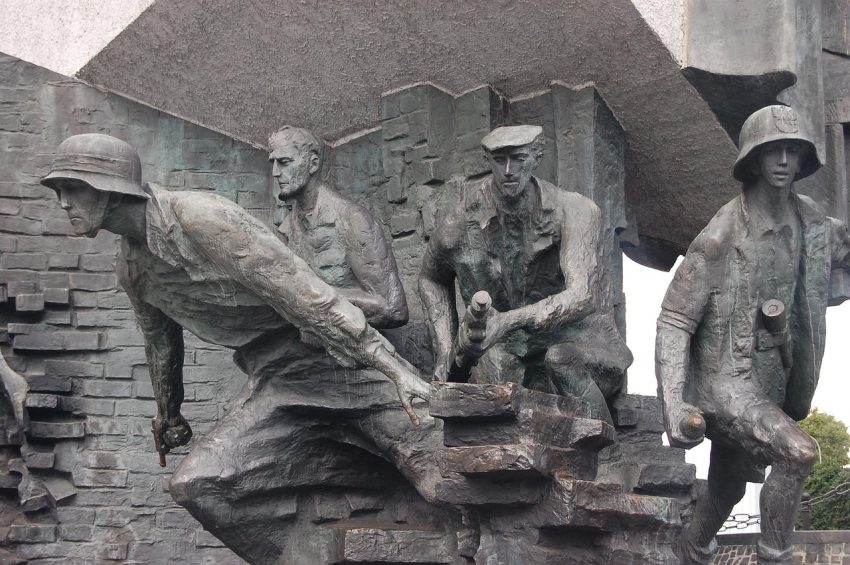
Monument to the Warsaw Insurgents
The Warsaw Uprising Monument in Krasiński Square is an open-air memorial to the 1944 uprising, set beside the Polish Supreme Court and shaped like a moment caught mid-battle. Two sculptural groups tell the story: one shows insurgents charging out of a crumbling façade, bodies pitched forward with urgency rather than triumph. The other, near a manhole, depicts fighters slipping into the sewers—an unsettling nod to the underground routes used to move and survive as the city burned. Unveiled on 1 August 1989, it also marks a late, public reclaiming of memory after decades of political discomfort. The realism and scale make it feel immediate and sobering.
Location: Warsaw Uprising Monument, plac Krasińskich, Warsaw, Poland | Hours: 24 Hours | Price: Free | Distance: 0.6km
Powered by GetYourGuide

18. New Town Market Square

New Town Market Square
CC BY-SA 3.0 / Adrian Grycuk
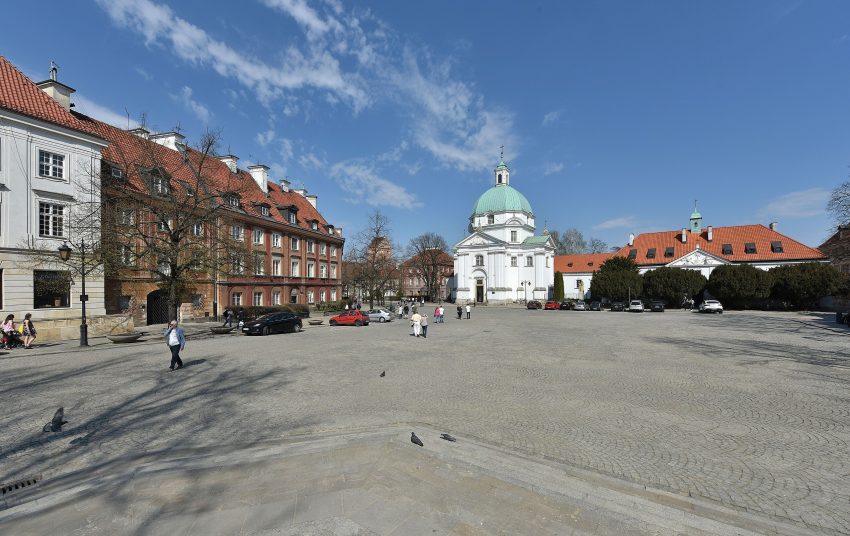
New Town Market Square (Rynek Nowego Miasta) is the central plaza of Warsaw’s New Town, just north of the Old Town, and it feels noticeably calmer and more residential than the busier main square nearby. Laid out as the market of “New Warsaw” before 1408, it was planned on a generous scale (about 140 by 120 metres) and has been repeatedly destroyed and rebuilt, most recently reconstructed after 1944 with façades that echo earlier centuries. Visitors tend to linger for the gentle slope underfoot, shifting light on the pastel-fronted buildings, and the Baroque bulk of the Church of St. Casimir anchoring one side. Near the middle, a relocated 19th-century cast-iron well provides a simple focal point, and benches make it easy to sit and watch the square’s quiet rhythm.
Location: rynek Nowego Miasta, Warsaw, Poland | Hours: 24 Hours | Price: Free. | Distance: 0.7km

19. Warsaw Ghetto Boundary Markers
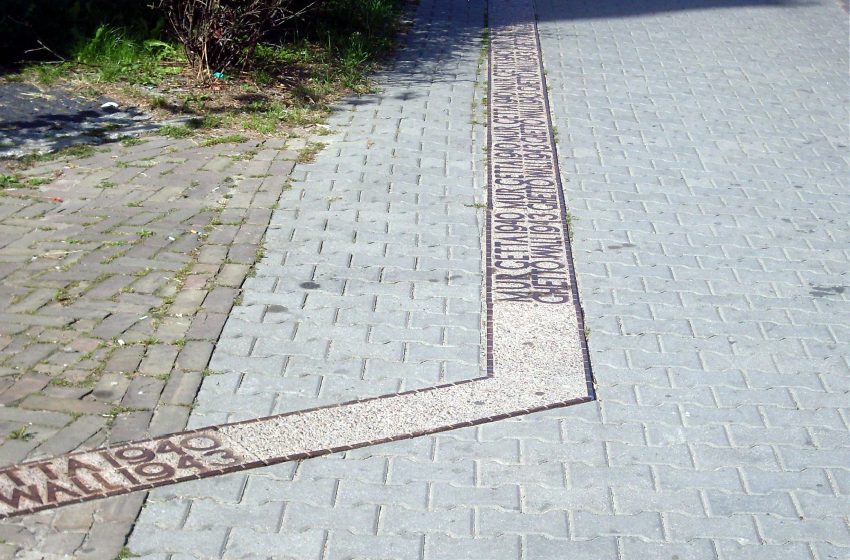
Warsaw Ghetto boundary markers
CC BY-SA 3.0 / Plaats
The Warsaw Ghetto Boundary Markers in Warsaw, Poland are a dispersed memorial system that traces where the Nazi-established ghetto’s walls, gates, bridges, and crossings once cut through everyday streets. You encounter them as bronze plaques fixed to walls or set near corners, each with a small map and pinpointed location, bilingual text, and archival photos that make the vanished district legible again. In some spots an iron strip embedded in the pavement marks the line itself, reading “MUR GETTA 1940 / GHETTO WALL 1943,” easy to miss until it stops you mid-step. Installed at 21 points in 2008 and expanded in 2010, the markers quietly restore a geography nearly erased after deportations and the 1943 uprising.
Location: Warsaw Ghetto boundary markers, Świętojerska, Warsaw, Poland | Hours: 24 Hours | Price: Free | Website | Distance: 0.7km

20. Krasiński Palace
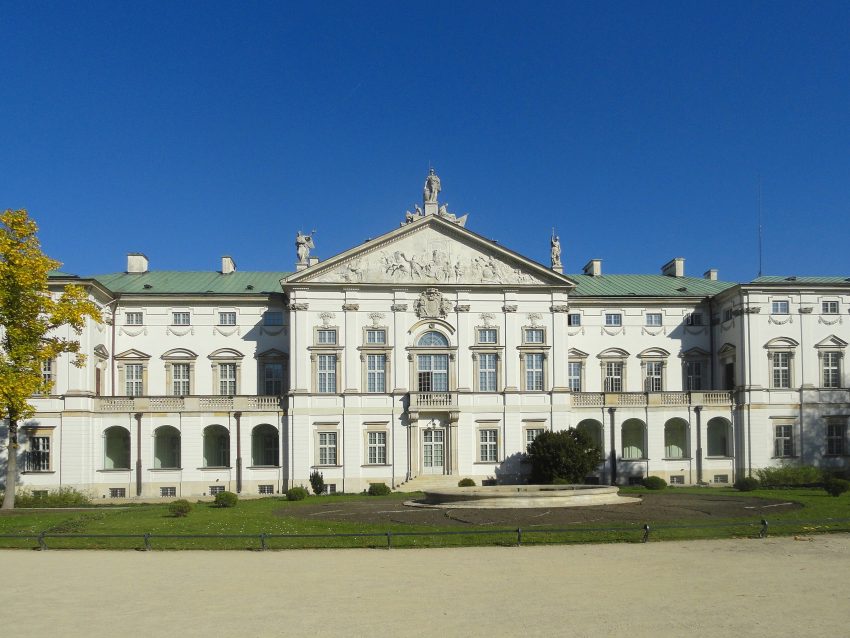
Krasiński Palace
Krasiński Palace
CC BY-SA 1.0 / Cybularny
Krasiński Palace (also known as the Palace of the Commonwealth) is a restored Baroque residence on Plac Krasińskich that now serves as a public “treasury” for the National Library of Poland. Built in the late 17th century for Jan Dobrogost Krasiński and designed by Tylman van Gameren, it was heavily damaged in World War II and later rebuilt, giving the building a quiet sense of Warsaw’s resilience. Inside, the permanent exhibition is deliberately spacious and calm, spotlighting rare manuscripts and early prints—visitors often remember the focused displays, large screens for close-up details, and audio that triggers as you move between rooms. Behind the palace, the garden adds a soft, green pause after the museum-like hush.
Location: Palace of the Commonwealth, plac Krasińskich, Warsaw, Poland | Hours: Wednesday - Monday: 11:00–19:00. Closed on Tuesdays. | Price: Free | Website | Distance: 0.7km

21. Krasiński Garden
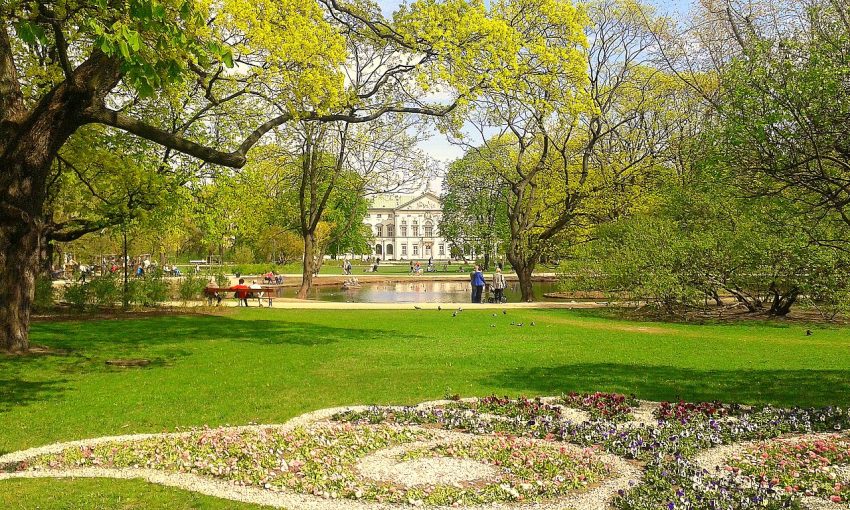
Krasiński Garden
Krasiński Garden
CC BY-SA 4.0 / Matpol222
Krasiński Garden is a historic public park in central Warsaw, laid out as the Baroque grounds of the Krasiński Palace in the late 17th century and later opened to everyday city life. Its design still reads in straight sightlines and geometric beds, but the experience is relaxed: curving paths, broad lawns, and mature trees that soften the formal plan. Visitors linger by the pond and fountains, where cascades and reflections create natural pause points, and families gravitate to the playground. In warmer months the flower plantings are fragrant and dense, and you may spot a pétanque court or a small bike café adding local texture. Even in winter, the stripped-back structure makes the garden feel quietly grand.
Location: Krasiński Garden, Generała Władysława Andersa, Warsaw, Poland | Hours: (Summer) 1 April – 31 October: Daily: 05:00–00:00. (Winter) 1 November – 31 March: Daily: 06:00–22:00. | Price: Free. | Distance: 0.8km

22. Tomb of the Unknown Soldier
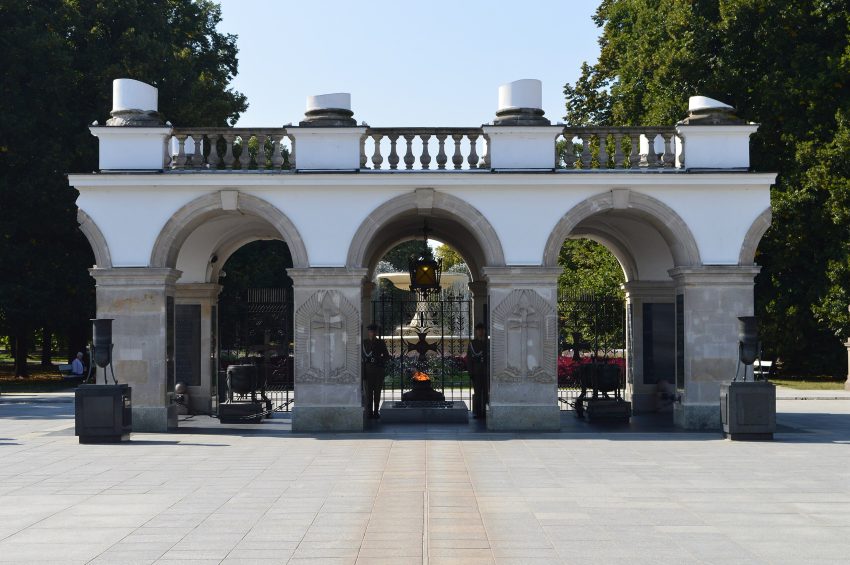
Warsaw Tomb of the Unknown Soldier
CC BY-SA 4.0 / Scotch Mist
Warsaw’s Tomb of the Unknown Soldier is a national war memorial on Piłsudski Square, sheltered beneath the three surviving arches of the former Saxon Palace colonnade—an architectural remnant that makes the city’s wartime loss feel tangible. Established in 1925, it honors unnamed Polish soldiers whose graves were never known, and it still anchors state commemorations today. Visitors tend to register the spare geometry first, then the eternal flame and the honor guard standing watch in near silence. If you time it to the hour, the changing of the guard brings crisp, measured movement to an otherwise hushed space, and people instinctively lower their voices and linger.
Location: Tomb of the Unknown Soldier, plac Marszałka Józefa Piłsudskiego, Warsaw, Poland | Hours: 24 Hours | Price: Free | Distance: 0.8km

23. Warsaw University Library Garden

Biblioteka Uniwersytecka
CC BY-SA 3.0 / Bromaski
Warsaw University Library Garden (BUW) is a multi-level roof park atop the University of Warsaw Library in Powiśle, turning a modern academic building into public green space. Winding paths thread through planted terraces, pergolas, and small ponds, and the upper level opens to wide views over the Vistula and the city skyline. As you move down, the garden feels more sheltered and quiet, with places to sit and watch the water and birds while street noise fades. One memorable touch is the way skylights and openings let you glimpse the library interior below, reinforcing the layered “city-on-a-roof” feeling. Locals treat it like a casual hangout—good for a slow stroll, photos, or reading on a bench.
Location: Biblioteka Uniwersytecka w Warszawie, Dobra, Warsaw, Poland | Hours: (Summer) 1 April – 30 April: 08:00–18:00; 1 May – 30 September: 08:00–20:00; 1 October – 31 October: 08:00–18:00. (Winter) 1 November – 31 March: 08:00–15:00. Closed: Rooftop (upper level) 1 November – 31 March. | Price: Free. | Website | Distance: 0.9km

24. Church of the Holy Cross
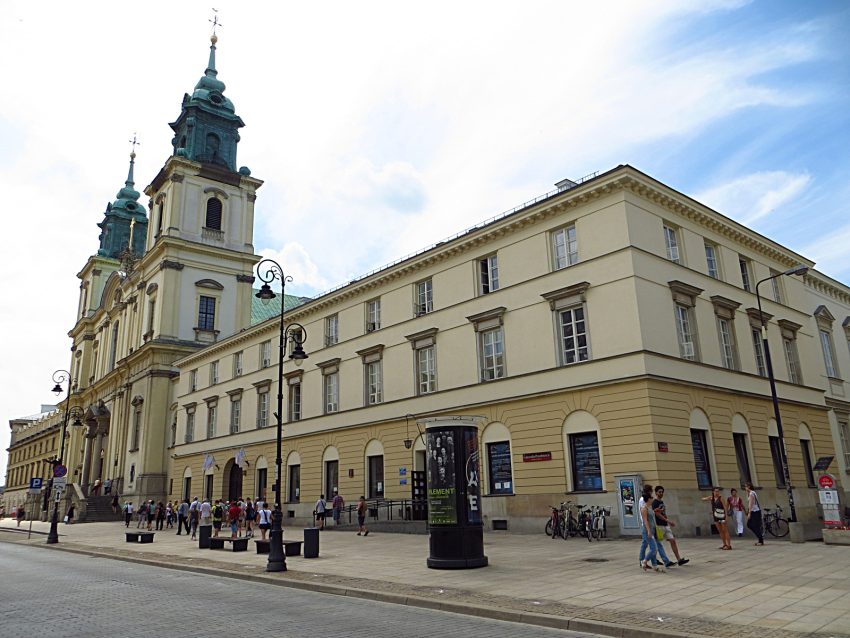
Church of the Holy Cross Kościół Świętego Krzyża
CC BY-SA 3.0 / Mister No
Church of the Holy Cross (Kościół Świętego Krzyża) is a Baroque Catholic church on Warsaw’s Krakowskie Przedmieście along the Royal Route, known for its twin towers and theatrical façade. Inside, the mood shifts from grand gilded altars to intimate remembrance: a pillar in the nave holds Frédéric Chopin’s heart, marked by an inscription where visitors instinctively pause in silence. The walls are dense with memorial tablets, giving the interior the feel of a lived civic archive rather than a pristine museum space. Nearly destroyed during the Second World War and carefully rebuilt, it’s a place where restoration and national memory are felt as much as seen.
Location: Church of the Holy Cross, Krakowskie Przedmieście, Warsaw, Poland | Hours: Daily: 06:00–21:00. | Price: Free. | Distance: 1km

25. Nicolaus Copernicus Monument
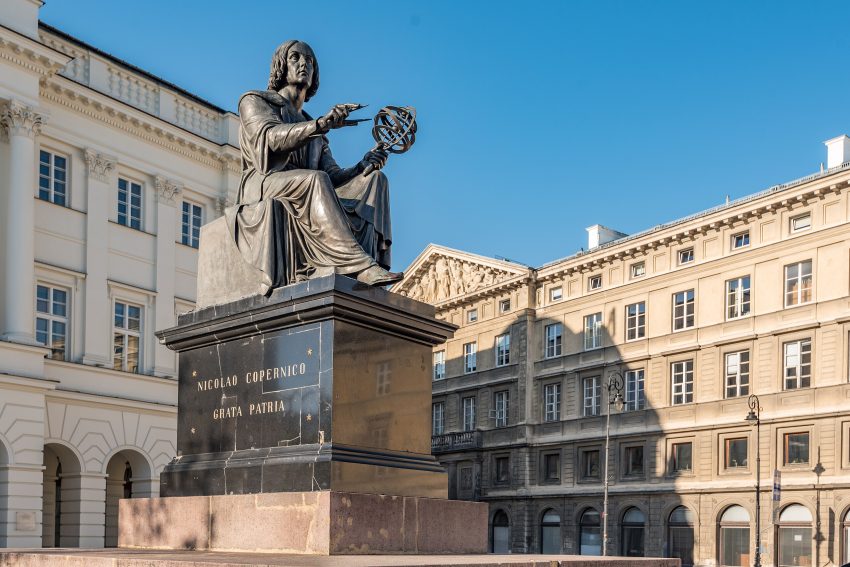
Nicolaus Copernicus Monument
CC BY-SA 4.0 / Tilman2007
The Nicolaus Copernicus Monument in Warsaw stands on Krakowskie Przedmieście directly before the Staszic Palace, placing the astronomer in a formal, scholarly setting. Unveiled in 1830 and designed by Danish sculptor Bertel Thorvaldsen, it shows Copernicus seated rather than triumphant, working with a compass and an armillary sphere. The pedestal’s Polish and Latin inscriptions add a quiet, civic tone that rewards a close look. During World War II it became a flashpoint: occupiers added a German plaque, later removed in a bold act by underground activist Maciej Aleksy Dawidowski. Visitors tend to remember the calm expression, the instruments, and how the statue anchors the street scene.
Location: Nicolaus Copernicus Monument, Krakowskie Przedmieście, Warsaw, Poland | Hours: 24 Hours | Price: Free | Distance: 1.1km

26. Copernicus Science Centre
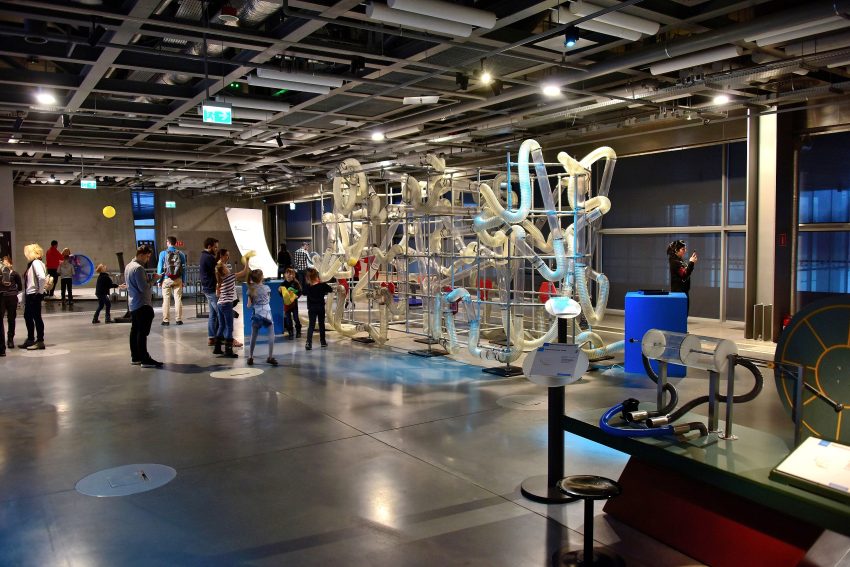
Copernicus Science Centre
CC BY-SA 3.0 / Adrian Grycuk
Copernicus Science Centre is Warsaw’s hands-on science museum on the Vistula River in Powiśle, built for experimenting rather than observing from behind glass. Opened in 2010 and named for Nicolaus Copernicus, it’s become Poland’s flagship venue for learning through trial and error, with interactive galleries on the human body, ecology, light, movement, and the logic behind everyday technology. The busiest areas are dense with stations where you balance, build, test perception, and trigger cause-and-effect—easy to lose track of time as you repeat experiments. For a change of pace, the Heavens of Copernicus planetarium adds an immersive, cinematic show (often with English audio options). Expect a lively, school-group energy, but adults tend to get pulled in too.
Location: Copernicus Science Centre, Wybrzeże Kościuszkowskie, Warsaw, Poland | Hours: Monday – Thursday: 09:00–18:00. Friday: 09:00–20:00. Saturday – Sunday: 09:00–19:00. | Price: Exhibition ticket (adult) 46 zł (weekdays) / 48 zł (weekends & holidays); reduced 32 zł (weekdays) / 34 zł (weekends & holidays). | Website | Distance: 1.2km

27. Monument to the Ghetto Heroes
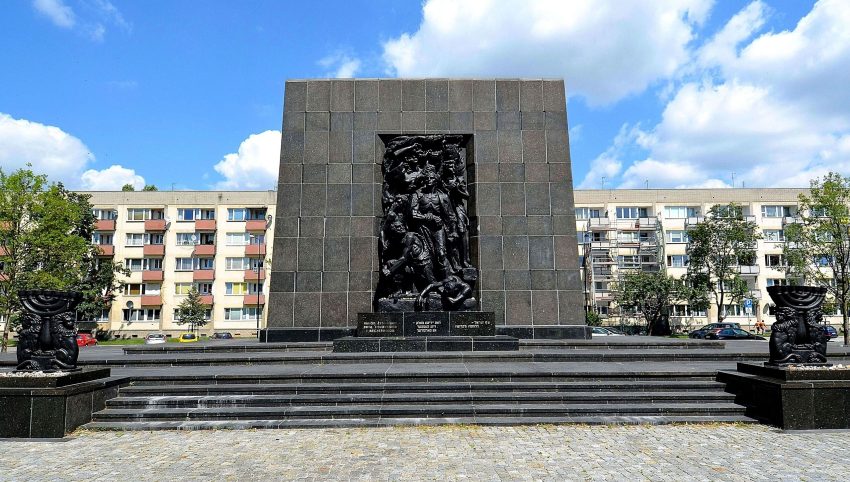
Monument to the Ghetto Heroes
CC BY-SA 3.0 / Adrian Grycuk
The Monument to the Ghetto Heroes in Warsaw’s Muranów district is an outdoor memorial on the open square facing the POLIN Museum, marking the Warsaw Ghetto Uprising of April–May 1943 and the Jewish victims and fighters of the ghetto. Its presence is physical and sobering: broad steps lead to a heavy stone wall and bronze reliefs that seem to slow the noise of the city. Walk around to read its two sides—one shows armed resistance in tense, clustered figures, while the other depicts civilians driven toward deportation with a quieter, crushing force. The site is also tied to postwar remembrance through the 1970 moment when German Chancellor Willy Brandt knelt here, an image many visitors still recall as they stand in the square.
Location: Monument to the Ghetto Heroes, Ludwika Zamenhofa, Warsaw, Poland | Hours: 24 hours | Price: Free | Distance: 1.4km

28. POLIN Museum of the History of Polish Jews
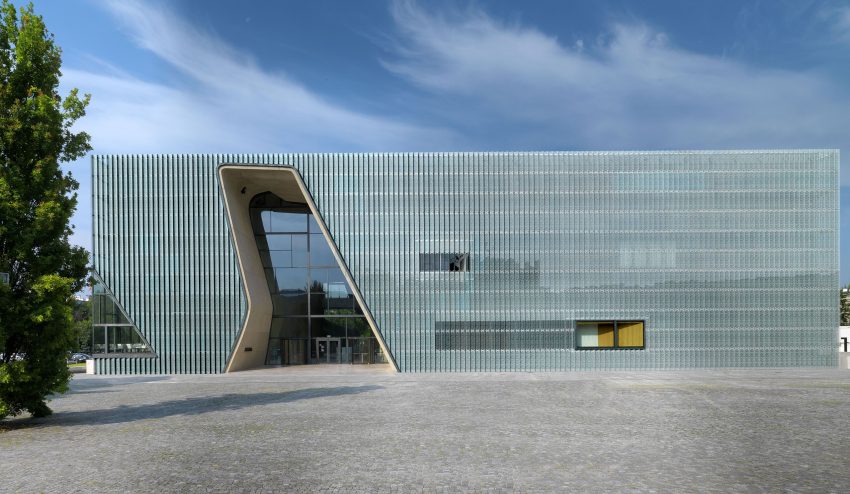
Museum of the History of Polish Jews in Warsaw
CC BY-SA 3.0 / Wojciech Kryński
POLIN Museum of the History of Polish Jews in Warsaw is a contemporary museum built in Muranów on the former Warsaw Ghetto site, beside the Monument to the Ghetto Heroes, and the setting gives the visit immediate weight. Its main draw is the Core Exhibition: eight story-driven galleries that trace roughly 1,000 years of Jewish life in Poland, deliberately placing the Holocaust within a longer continuum of culture, language, faith, and everyday community. Visitors tend to remember the immersive design—reconstructed spaces, soundscapes, and walk-through environments that feel closer to being inside a lived world than looking at display cases. Expect an information-dense, interactive experience where many people rely on the audio guide and appreciate the built-in places to sit and pause.
Location: POLIN Museum of the History of Polish Jews, Mordechaja Anielewicza, Warsaw, Poland | Hours: Monday & Wednesday – Friday & Sunday: 10:00–18:00. Saturday: 10:00–20:00. Closed on Tuesday. | Price: Regular: 45 PLN; Reduced: 35 PLN. Free admission to the Core & temporary exhibitions on Thursday. Website: https | Website | Distance: 1.4km
Powered by GetYourGuide

29. Frederic Chopin Museum

Frederic Chopin Museum
CC BY-SA 3.0 / Adrian Grycuk
The Frederic Chopin Museum in Warsaw explores the composer’s life through sound and story inside the elegant Ostrogski (Gniński) Palace on Okólnik Street. Spread across four floors in a handful of dim, intimate rooms, it’s built around multimedia pacing—listening stations, short texts, and atmospheric lighting that let you move chapter by chapter. Visitors linger over original manuscripts and personal letters that make Chopin feel less like a monument and more like a person shaped by Warsaw before his years abroad. Signage is in Polish and English, and many people find an hour enough for a brisk circuit, though the audio-led setup rewards a slower visit.
Location: Frédéric-Chopin-Museum in Warschau, Okólnik, Warsaw, Poland | Hours: Tuesday – Sunday: 10:00–18:00. Closed on Mondays. | Price: 35 zł; Reduced ticket: 25 zł. Free admission on Wednesdays. | Website | Skip the Line Tickets (Include Concert) | Distance: 1.4km
Powered by GetYourGuide

30. National Museum in Warsaw

National Museum in Warsaw
CC BY-SA 3.0 / Mister No
The National Museum in Warsaw is the city’s main art museum, a large, modernist building (completed in 1938) built for unhurried looking and for tracing Poland’s cultural narrative through images and objects. Its Polish painting rooms are the core experience, moving from grand historical canvases and Romantic symbolism to portraits and landscapes that explain how art and identity intertwine in a rebuilt city. A memorable detour is the Faras Gallery: early Christian Nubian wall paintings and finds rescued from the Nile Valley, rare to see in Europe and striking up close. Visitors also notice the mix of fine art with decorative pieces—furniture, pottery, textiles, and even Meissen and Sèvres porcelain—plus well-designed galleries that make a 2–3 hour visit feel dense rather than rushed.
Location: National Museum in Warsaw, Aleje Jerozolimskie, Warsaw, Poland | Hours: Tuesday – Thursday: 10:00–18:00. Friday: 10:00–20:00. Saturday – Sunday: 10:00–18:00. Closed on Monday. | Price: Regular: 30 PLN; Reduced: 15 PLN; Combined ticket (main building + selected branches): 50 PLN (reduced: 35 PLN). | Website | Distance: 1.9km

31. Palace of Culture and Science

Pałac Kultury i Nauki
CC BY-SA 4.0 / Maksym Kozlenko
Warsaw’s Palace of Culture and Science (Pałac Kultury i Nauki) is a mid-1950s Soviet “gift” that still dominates the city centre above Plac Defilad, carrying political baggage while functioning as a working cultural container. Most visitors come for the 30th-floor viewing terrace: one elevator ride and the city’s layout snaps into focus, from the river corridor to the newer high-rise clusters nearby. At ground level, the building’s monumental Socialist Realist massing and ornamental details feel more like a small district than a single monument, especially when events are on inside. Travelers often mention the sheer scale, the striking interior glimpsed on lower floors, and how different the tower looks by day versus lit up at night.
Location: Pałac Kultury i Nauki, plac Defilad, Warsaw, Poland | Hours: Observation Deck: Daily: 10:00–20:00. | Price: Standard: 28 PLN; Reduced: 23 PLN. | Website | Distance: 1.9km
Powered by GetYourGuide

32. Museum of Life Under Communism

Muzeum Życia w PRL
Muzeum Życia w PRL
CC BY-SA 4.0 / Qkiel
The Museum of Life Under Communism in Warsaw is a small, hands-on look at everyday life in Poland’s PRL era, set inside a socialist-realist Stalin-era building near Plac Konstytucji (ul. Piękna 28/34). Instead of timelines, you move through recreated rooms—an apartment, office-like corners, and classroom-style details—packed with period packaging, appliances, toys, posters, and slogans that show how ideology seeped into routine. The setting makes shortages and improvisation feel tangible, not abstract, while leaving space for the era’s odd design charm. Visitors often remember the dense displays of newspapers, books, and video snippets, plus the tiny milk-bar-style café where tea comes in classic glass mugs. Expect a compact, atmospheric circuit rather than a sprawling museum.
Location: Muzeum Życia w PRL, Piękna, Warsaw, Poland | Hours: Monday – Thursday: 10:00–18:00. Friday: 12:00–20:00. Saturday – Sunday: 10:00–18:00. | Price: Regular ticket 30 PLN; reduced ticket 20 PLN. | Website | Tickets | Distance: 2.7km
Powered by GetYourGuide

33. Warsaw Uprising Museum

Warsaw Uprising Museum
CC BY-SA 3.0 / Adrian Grycuk
The Warsaw Uprising Museum in Warsaw’s Wola district occupies a former power station, and its raw industrial setting suits an exhibition built for immersion rather than hushed display cases. It traces the 63 days of the 1944 uprising—fought by the underground resistance and civilians alike—an event whose defeat and the city’s subsequent destruction still shape how Warsaw understands itself. Visitors move through sound, film, artifacts, and staged environments, including a tense “heartbeat” pulse that seems to thrum through the building. A reconstructed sewer passage makes the insurgents’ routes feel claustrophobically real, and a large aircraft replica evokes Allied supply drops. Many people recommend using an audio guide, but expect darkness, loud effects, and a lot to take in.
Location: Warsaw Uprising Museum, Grzybowska, Warsaw, Poland | Hours: Monday: 08:00–18:00. Tuesday: Closed. Wednesday – Friday: 08:00–18:00. Saturday – Sunday: 10:00–18:00. | Price: Standard ticket 35 zł; reduced ticket 30 zł | Website | Distance: 2.8km

34. Ujazdów Castle
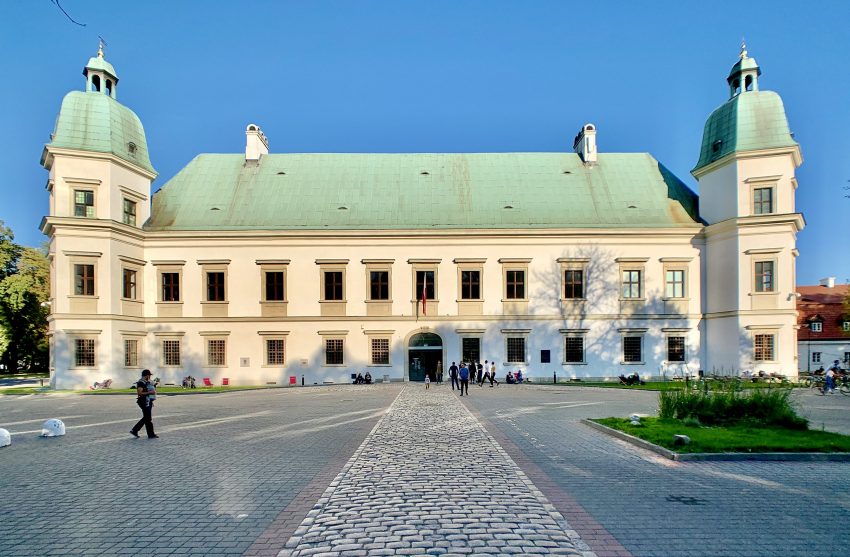
Front facade of the Ujazdów Castle, Warsaw
CC BY-SA 4.0 / Chris Olszewski
Ujazdów Castle in Warsaw, Poland is a rebuilt historic stronghold turned Centre for Contemporary Art, where a formal castle façade hides a distinctly modern interior. The experience starts with the approach through Ujazdów Park, an unhurried walk that makes the building feel set apart from the city’s traffic. Inside, skip expectations of period rooms and follow the rotating program of installations, photography, and experimental video in clean, flexible galleries—visits can feel completely different depending on what’s on. Travelers often mention the large exhibition spaces, friendly staff, and the mix of thought-provoking work with the occasional miss. It’s also known for affordable entry, with free admission on some Thursdays.
Location: Ujazdów Castle, Jazdów, Warsaw, Poland | Hours: Tuesday – Wednesday: 11:00–18:00. Thursday – Friday: 12:00–20:00. Saturday: 10:00–19:00. Sunday: 11:00–18:00. Closed on Mondays. | Price: From 15 zł (standard ticket for one exhibition); free admission on Thursdays. | Website | Distance: 3.3km

35. Chopin Monument

Chopin Monument in autumn colors
CC BY-SA 2.0 / Radek Kucharski
The Chopin Monument in Warsaw is a bronze Art Nouveau sculpture in Łazienki Park, showing Frédéric Chopin seated beneath a stylised weeping willow whose flowing lines seem to echo music. Designed by Wacław Szymanowski and unveiled in 1926, it was destroyed during World War II and later rebuilt, making it a quiet marker of the city’s loss and recovery. Visitors tend to linger on the benches nearby, watching light flicker through trees and across the metal, with a pond close by adding to the calm. In warmer months, free open-air Chopin recitals draw picnickers who spread blankets on the grass and listen as the sound carries through the park.
Location: Frédéric Chopin Monument, Ujazdów Avenue, Warsaw, Poland | Hours: Daily: 06:00–21:00. | Price: Free. | Website | Distance: 3.8km
Powered by GetYourGuide

36. Royal Baths Park

Lazienki Park
Lazienki Park
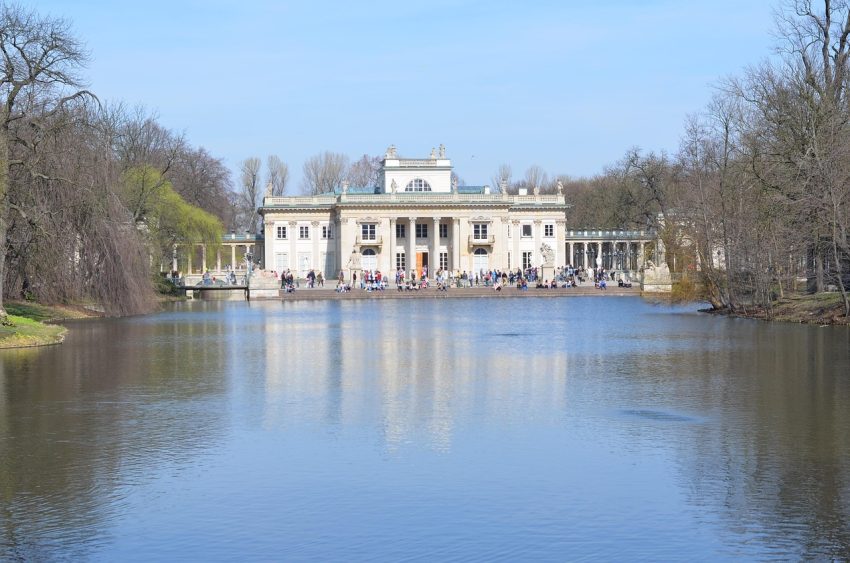
Royal Baths Park (Łazienki) is Warsaw’s grand 18th-century royal parkland, shaped under King Stanisław August Poniatowski as a summer residence where architecture is set directly into water and trees. The centrepiece is the Palace on the Isle, poised over reflective ponds and reached by small bridges that frame calm, symmetrical views. Paths lead to the Amphitheatre and the Old Orangery, with quieter corners like the Chinese Garden and the Sybil Temple tucked into greenery. What lingers is the park’s living, local feel—wide avenues, long benches, and the small wildlife moments visitors talk about, from peacocks strutting near lawns to squirrels darting between trunks.
Location: Łazienki park, Agrykola, Warsaw, Poland | Hours: Daily: 06:00–21:00. | Price: Free (park gardens). Museum interiors are ticketed (adult tickets from 50 PLN, depending on the buildings included). | Website | Distance: 3.9km

Best Day Trips from Warsaw

A day trip from Warsaw offers the perfect opportunity to escape the urban rhythm and discover the surrounding region's charm. Whether you're drawn to scenic countryside, historic villages, or cultural landmarks, the area around Warsaw provides a variety of easy-to-reach destinations ideal for a one-day itinerary. If you are looking to rent a car in Poland I recommend having a look at Discover Cars, first, as they compare prices and review multiple car rental agencies for you.

1. Wilanow Palace
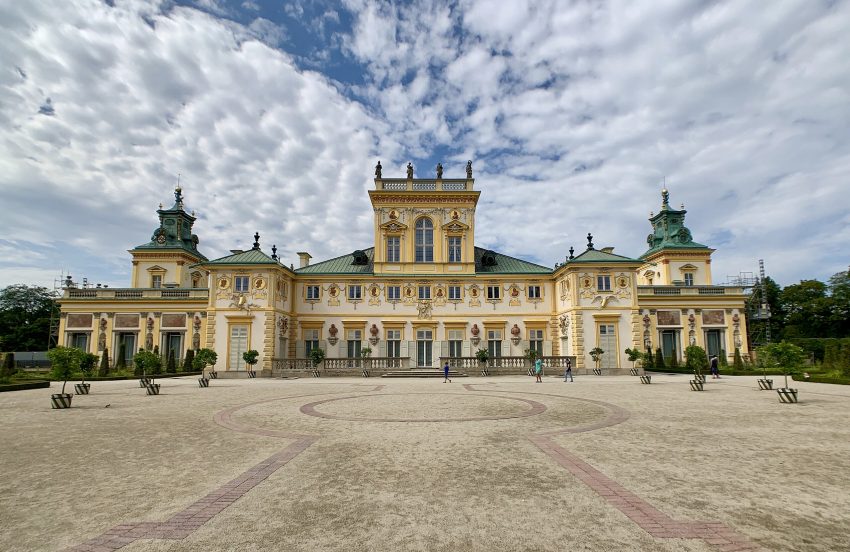
Garden facade of the Wilanów Palace
CC BY-SA 4.0 / Chris Olszewski
Wilanów Palace is Warsaw’s great royal day trip: a true Baroque residence with elegant rooms, curated museum galleries, and gardens that make the whole visit feel expansive and unhurried. Locals often describe it as a “city break inside the city break” because, although you’re still in Warsaw, the palace grounds and parkland create a calmer, greener rhythm than the centre.…
Location: Wilanów Palace, Stanisława Kostki Potockiego, Warsaw, Poland | Hours: Daily: 09:00–15:00 (Park & Palace courtyard; entrance until 15:00). Daily: 16:00–21:00 (Royal Garden of Light; last entry 20:30). | Price: 10 zł (Park & Palace courtyard); Palace museum from 60 zł; Royal Garden of Light from 35 zł. | Website | https://wilanow-palac.pl/en/tickets-1 | Distance: 10.6km
Visiting Wilanow Palace
Powered by GetYourGuide

2. Lowicz

Katedra w Lowiczu
Katedra w Lowiczu
CC BY-SA 4.0 / Pko
Łowicz, located in the Łódź Voivodeship of central Poland, is a charming town best known for its vibrant folk traditions and well-preserved architecture. It's an easy day trip from Łódź or Warsaw, sitting roughly halfway between the two, and offers a slower, more traditional atmosphere compared to the bustle of the larger cities. The town's compact layout makes it ideal…
Visiting Lowicz

3. Radom

Radom Katedra
Radom Katedra
CC BY-SA 3.0 / krysi@
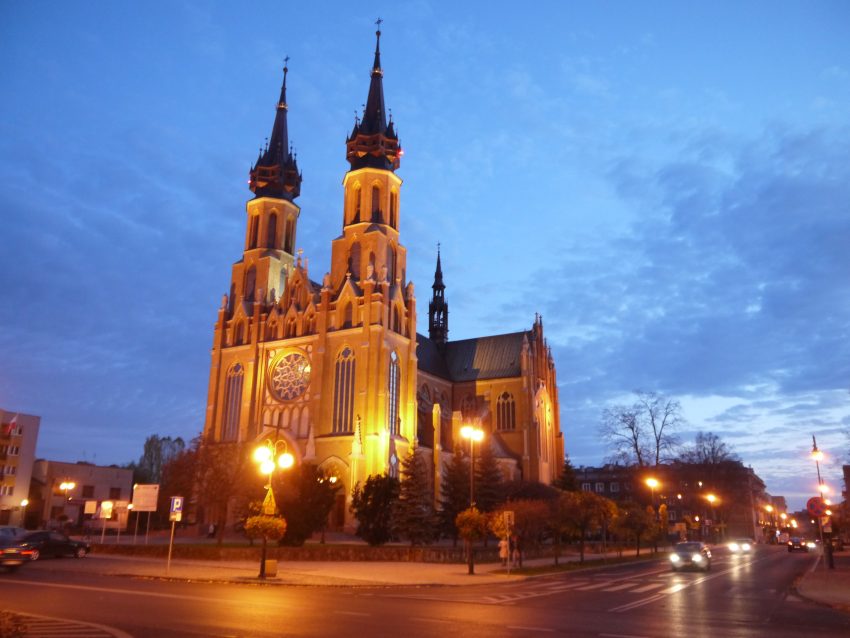
Visiting Radom, located in the Masovian region of Poland, offers a blend of urban energy and cultural charm. The city is known for its lively markets, especially the large and bustling Radom Market Square, where locals and visitors mingle amid shops, cafés, and historic buildings. Radom’s compact center makes it easy to explore on foot, with plenty of spots to…
Visiting Radom
Powered by GetYourGuide

4. Płock

plock
plock
Visiting Płock, located in the Masovian region, offers a rewarding experience for travelers seeking a mix of heritage, scenic views, and relaxed urban charm. The city is perched high above the Vistula River, with panoramic viewpoints along Tumskie Hill that provide some of the most striking river vistas in central Poland. The atmospheric Old Town invites leisurely exploration with its…
Visiting Płock

5. Łódź

Łódź
Łódź
CC BY-SA 4.0 / Michał Tomczak
Łódź is a vibrant city in central Poland known for its dynamic arts scene, unique architecture, and lively cultural events. The city center is filled with beautifully restored 19th-century industrial buildings that have been transformed into galleries, shops, and cafés, giving Łódź a creative and modern atmosphere. Walking along Piotrkowska Street, one of Europe’s longest commercial thoroughfares, offers a great…
Visiting Łódź
Powered by GetYourGuide

6. Piotrków Trybunalski

Market Square in Piotrkow
CC BY-SA 2.0 / Witia
Visiting Piotrków Trybunalski offers a delightful experience in the heart of Central Poland, where traditional Polish architecture and a relaxed urban atmosphere meet. The town’s compact historic center is ideal for walking, with cobbled streets, charming tenement houses, and old churches providing a picturesque backdrop. The main square is a great place to start exploring, offering a blend of local…
Visiting Piotrków Trybunalski

7. Uniejów
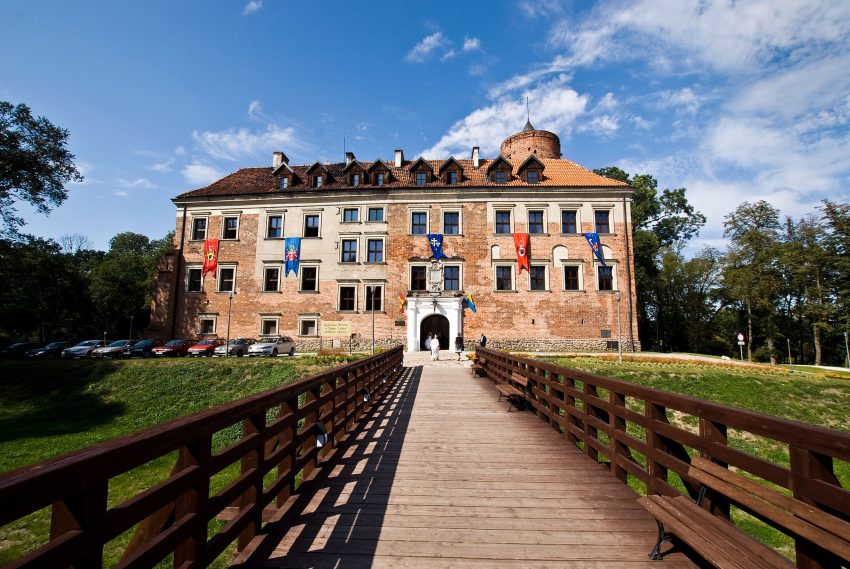
Uniejów Castle
Uniejów Castle
CC BY-SA 4.0 / Masandro
Uniejów is a popular destination in central Poland, best known for its thermal spa complex that attracts visitors looking for relaxation and wellness. The town’s thermal waters are naturally rich in minerals and have been developed into modern spa facilities offering a wide range of treatments, from healing baths and massages to therapeutic wellness programs. The spa’s pools, both indoor…
Visiting Uniejów

8. Tykocin

Tykocin
Tykocin
CC BY-SA 4.0 / Karol Rutkowski
Tykocin is a charming small town located in the Podlasie region, offering visitors a peaceful and picturesque experience away from the bustle of larger cities. Its compact size makes it easy to explore on foot, with quaint streets lined by traditional houses, local shops, and cozy cafés. The town’s atmosphere is relaxed, inviting visitors to take their time discovering its…
Visiting Tykocin
Powered by GetYourGuide

9. Wolf's Lair, Kętrzyn

Adolf Hitlers Bunker in Wolfsschanze
CC BY-SA 3.0 / dr. avishai teicher
Wolf’s Lair (Wilczy Szaniec) is a vast, overgrown bunker complex hidden in the Masurian forest near Gierłoż, a short drive from Kętrzyn. Visiting is less like stepping into a single “attraction” and more like walking through a fragmented landscape of concrete ruins, cracked blast walls, and moss-covered corridors where nature has slowly reclaimed what war once tried to make permanent.…
Location: Wilczy Szaniec, Gierłoż, Poland | Hours: March –March; 01 September – 30 September: Daily: 08:00–18:00. April: Daily: 08:00–19:00. May – August: Daily: 08:00–20:00. October – February: Daily: 08:00–16:00. | Price: High season (01 April – 31 October): Adult 25 PLN; Concession 20 PLN; Children under 6 free. Low season (01 November – 31 March): Adult 20 PLN; Concession 15 PLN; Children under 6 free. Parking (paid at the entrance gate): Car 15 PLN; Motorcycle 10 PLN; Camper/van 20 PLN; Coach 35 PLN; Bicycle free. | Website | Distance: 206.3km
Visiting Wolf's Lair, Kętrzyn
Powered by GetYourGuide

Where to Stay in Warsaw

For those wanting to stay in the heart of the action, Śródmieście (City Centre) is the most convenient and vibrant part of Warsaw. It’s close to key attractions like the Palace of Culture and Science, Warsaw Central Station, and the Old Town. Accommodation here ranges from luxury to stylish mid-range. A standout choice is Hotel Warszawa, housed in a sleek, restored pre-war skyscraper offering high-end amenities. Another excellent option nearby is PURO Warszawa Centrum, known for its design-forward interiors and rooftop bar.

If you’re looking for a quieter, more local feel with proximity to green spaces, consider staying in the Powiśle district. Located between the Vistula River and the university area, it’s popular with students, creatives, and café lovers. It also provides easy access to attractions like the Copernicus Science Centre and University Library. Here, Hotel Logos offers comfortable rooms with river views, and good value for money. Also in Powiśle, Hotel SixtySix provides a boutique experience right on one of Warsaw’s most iconic streets.

For modern business travelers or those arriving by car, the Wola district is a great alternative. Once industrial, it’s now full of glass towers, tech campuses, and luxury apartments. It’s also home to the Warsaw Uprising Museum and several major company headquarters. The Westin Warsaw combines business-class service with easy metro access, while NYX Hotel Warsaw offers a trendier experience, complete with rooftop views and vibrant decor.

Using the our Hotel and Accomodation map, you can compare hotels and short-term rental accommodations in Warsaw. Simply insert your travel dates and group size, and you’ll see the best deals for your stay.

Warsaw Accommodation Map

Best Time to Visit Warsaw

Visiting Warsaw in Winter

Warsaw in winter has a quiet, atmospheric charm, especially when dusted with snow. The Old Town’s historic streets and Christmas markets around Castle Square come alive with lights and seasonal cheer. Ice skating rinks, such as the one in the Old Town, add to the festive spirit. While temperatures can be cold, it’s a great time to explore museums, enjoy hearty Polish cuisine, and take in the city’s cultural life indoors.

Visiting Warsaw in Spring

Spring in Warsaw brings blooming parks, rising temperatures, and a noticeable increase in outdoor activity. It’s an ideal time to walk along the Vistula River, visit Łazienki Park, and attend open-air concerts. May brings the Night of Museums, when institutions across the city open their doors late into the evening, often for free. The city feels fresh, green, and full of anticipation for summer.

Visiting Warsaw in Summer (Best)

Summer is the best time to visit Warsaw, with long days, warm temperatures, and a packed calendar of festivals. The city comes alive with events like the Chopin Concerts in Łazienki Park, the Wianki midsummer celebration, and the Warsaw Summer Jazz Days. Riverside bars open along the Vistula, and public spaces fill with open-air cinemas and food trucks. It’s the season when locals and tourists alike enjoy Warsaw at its most vibrant.

Visiting Warsaw in Autumn

Autumn in Warsaw is marked by crisp air, colorful foliage, and a slower pace after the summer crowds. It’s a pleasant season for city walks, museum visits, and exploring cafés and galleries. The Warsaw Film Festival in October is a highlight, drawing cinephiles from around the world. As the days grow cooler, the city’s cultural offerings move indoors, creating a cozy and creative atmosphere.

Annual Weather Overview

  • January 3°C
  • February 6°C
  • March 10°C
  • April 17°C
  • May 21°C
  • June 25°C
  • July 26°C
  • August 27°C
  • September 24°C
  • October 14°C
  • November 8°C
  • December 4°C

How to get to Warsaw

Getting to Warsaw by air

Nearest airports: The main airport serving Warsaw is Warsaw Chopin Airport (WAW), located about 10 km from the city center. It handles most domestic and international flights. A secondary option is Warsaw Modlin Airport (WMI), about 40 km north of the city, mostly used by low-cost airlines. Both airports are well connected to the city via buses, trains, and taxis.

Airport transfers: From Chopin Airport, SKM suburban trains (S2 and S3 lines) run frequently to Warsaw Central Station. Buses 175 and 188 also connect directly to key parts of the city. From Modlin Airport, shuttle buses or ModlinBus services link to the city center.

Getting to Warsaw by train

From within Poland: Warsaw is a major railway hub with direct trains from Kraków, Gdańsk, Poznań, Wrocław, and other cities. The primary station is Warszawa Centralna, located in the heart of the city. High-speed Pendolino and InterCity trains operate regularly.

International routes: There are international rail connections from Berlin, Prague, Vienna, and Kyiv. Many arrive at or pass through Warszawa Wschodnia or Warszawa Zachodnia stations.

Train Tickets and Schedules

You can easily check schedules and book tickets through the PKP Intercity website. However, for a smoother experience, we recommend using Omio, which simplifies the booking process and lets you compare prices and schedules all in one place.

Getting to Warsaw by Car

Warsaw is easily accessible by a network of expressways and national roads, including the S8, S7, and A2 motorways. These link the capital to Łódź, Poznań, Gdańsk, and the German border. Roads into the city can be busy during peak hours, and parking in central areas may be limited or paid. However, driving is convenient for regional trips or multi-city itineraries. If you are looking to rent a car in Poland I recommend having a look at Discover Cars, first, as they compare prices and review multiple car rental agencies for you.

Travelling around Warsaw

Warsaw has a well-developed public transport network of buses, trams, and a two-line metro system. Tickets are unified across all forms of transport and available from machines or kiosks. The metro is the fastest way to cross the city, while trams and buses offer extensive local coverage.
More from this area