Innsbruck, Austria: The Ultimate Travel Guide 2026
The Complete Guide to Innsbruck

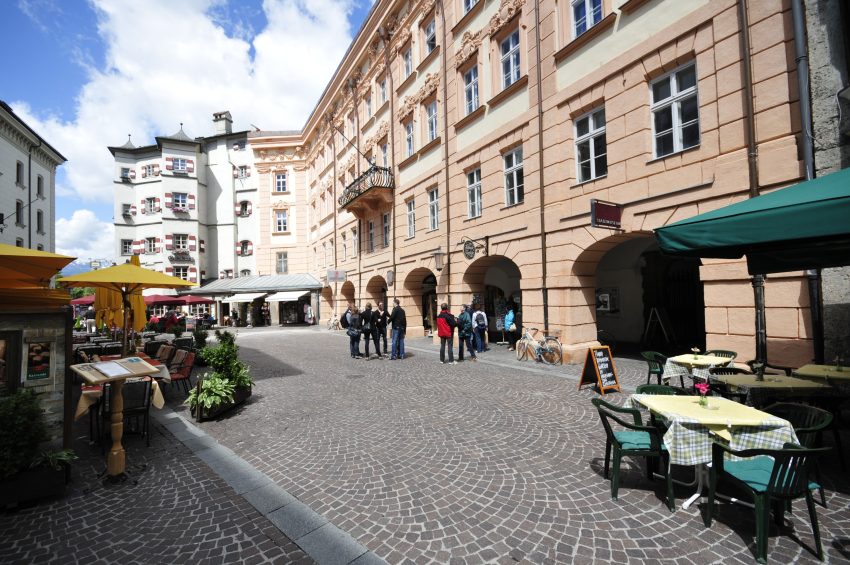
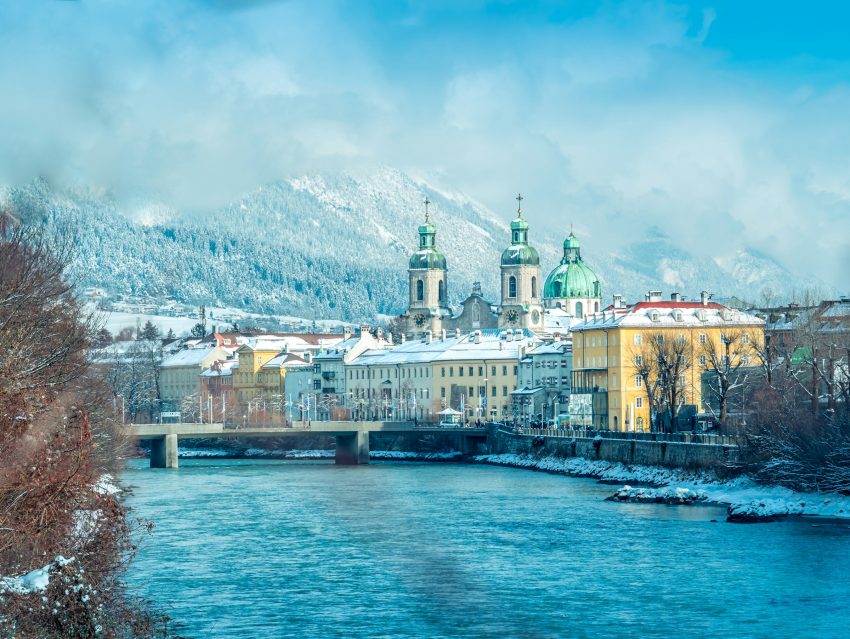
Innsbruck is a compact, mountain-framed city that makes it easy to combine culture, cafés, and alpine scenery in a single day. Set in the Inn Valley in the heart of Tyrol, it's the kind of place where you can stroll a historic old town in the morning, ride a cable car into high alpine views after lunch, and still be back in time for dinner and a riverside walk.

The city’s appeal is how quickly it shifts from urban to outdoors. You’ll find grand architecture and museums close to lively shopping streets, while trailheads, ski slopes, and panoramic viewpoints sit just minutes away. Even if you’re not here for winter sports, the surrounding peaks and the crisp mountain air give every season a sense of drama.

Innsbruck also works brilliantly as a base for day trips around Tyrol, thanks to strong rail connections and an efficient local transport network. Whether you're visiting for a weekend break, a longer alpine holiday, or as a stop on a wider Austria itinerary, it's easy to plan a trip that balances sightseeing with time in nature.

History of Innsbruck

Innsbruck in Roman and Early Medieval Times

The area around Innsbruck was shaped early by its role as a crossing point through the Alps, with routes that linked north and south Europe. Over time, small settlements and trading activity grew around river crossings and valley routes, laying the groundwork for a town that would later thrive on movement of goods and people.

Innsbruck in the High Middle Ages and the Rise of Trade

Innsbruck’s fortunes rose as Alpine transit became increasingly important for commerce. Markets, crafts, and toll rights helped the town develop into a regional hub, and its urban core began to take on the recognizable form of a medieval city with fortified elements, guild life, and a growing civic identity.

Innsbruck in the Habsburg Era and Imperial Influence

The city gained major prominence under Habsburg influence, when courtly life, administration, and patronage boosted Innsbruck’s status. This period left a lasting imprint on the city’s architecture and cultural life, with landmark buildings, ceremonial spaces, and artistic commissions that still define the city’s visual character.

Innsbruck in the Napoleonic Period and Tyrolean Upheaval

The early 19th century brought political turbulence and conflict that affected daily life and governance. Innsbruck became closely associated with Tyrolean resistance and shifting control, and the era remains a key chapter in local memory, reflected in monuments and commemorations.

Innsbruck in the 19th Century: Modernization and New Connections

As transport and industry advanced, Innsbruck modernized. Improved infrastructure and expanding education and civic institutions helped the city grow beyond its older boundaries. The arrival of faster connections strengthened its role as a gateway for travel and trade, while tourism began to develop alongside traditional economic life.

Innsbruck in the 20th Century: Winter Sports and International Spotlight

Innsbruck’s international profile expanded dramatically through winter sports and major events, which brought new venues, urban upgrades, and global attention. The city’s identity became closely tied to alpine recreation, while also maintaining a strong cultural and academic presence.

Innsbruck Today: A Contemporary Alpine City

In recent decades, Innsbruck has balanced heritage preservation with modern city life. It continues to evolve as a center for education, culture, and outdoor sport, with ongoing investment in public spaces, mobility, and tourism that supports year-round travel.

Moira & Andy
Moira & Andy

Hey! We're Moira & Andy. From hiking the Camino to trips around Europe in Bert our campervan — we've been traveling together since retirement in 2020!

Read our full story here

Visiting Innsbruck for the first time and wondering what are the top places to see in the city? In this complete guide, I share the best things to do in Innsbruck on the first visit. To help you plan your trip, I have also included an interactive map and practical tips for visiting!

This website uses affiliate links which earn a small commission at no additional cost to you.
Powered by GetYourGuide

21 Best places to See in Innsbruck

This complete guide to Innsbruck not only tells you about the very best sights and tourist attractions for first-time visitors to the city but also provide insights into a few of our personal favorite things to do.

This is a practical guide to visiting the best places to see in Innsbruck and is filled with tips and info that should answer all your questions!

1. Marktplatz Innsbruck
Marktplatz Innsbruck
CC BY-SA 2.0 / Markus Rauscher-Riedl
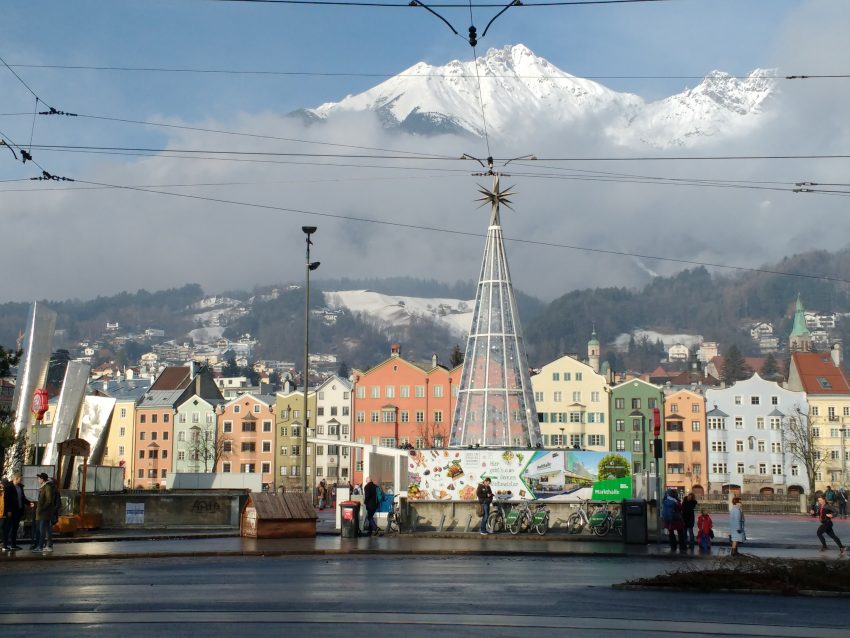
Marktplatz Innsbruck is a riverside square on the Inn that feels more like a working meeting point than a single monument. People come for the clear view across the water to the colourful Mariahilf façades, with the jagged Nordkette ridge stacked behind them like a backdrop. The square sits at a natural hinge between the river crossing and the historic centre, so you’ll notice a steady flow of locals cutting through on errands alongside visitors pausing at the river edge. Depending on the season it can turn into a small event space, especially around Advent, but even on quiet days it’s a good place to slow down, watch the city’s rhythm, and reset before heading back into the tighter streets.
Location: Marktplatz, Innsbruck, Austria | Hours: 24 Hours | Price: Free | Website | Distance: 0km

We recommend to rent a car in Austria through Discover Cars, they compare prices and review multiple car rental agencies. Book your rental car here.

2. Ottoburg

Ottoburg
Ottoburg
CC BY-SA 3.0 / Ralf Roletschek
Ottoburg is a late-medieval tower-house at the gateway to Innsbruck’s Old Town, built around 1494 in the era of Emperor Maximilian I and later reshaped from defensive outpost to residence and, today, a restaurant. What visitors remember is the building’s layered construction—thick river-stone walls at the base giving way to brickwork above—and the mix of Gothic bones with Renaissance-era additions upstairs. Inside, the atmosphere is deliberately old-world: antique wood, Tyrolean décor, and snug rooms that feel more like a fortified home than a dining hall. Many travelers come for hearty local plates such as dumplings, schnitzel, and venison, and some report gluten-free accommodation.
Location: Herzog-Friedrich-Straße 1, 6020 Innsbruck, Austria | Hours: Monday – Sunday: 11:30–15:00 & 18:00–22:30. | Price: Free (restaurant; pay for food and drinks). | Website | Distance: 0.1km

Here is a complete selection of hotel options in Innsbruck. Feel free to review each one and choose the stay that best suits your needs.

3. Stadtturm

Stadtturm
Stadtturm
CC BY-SA 3.0 / Ralf Roletschek
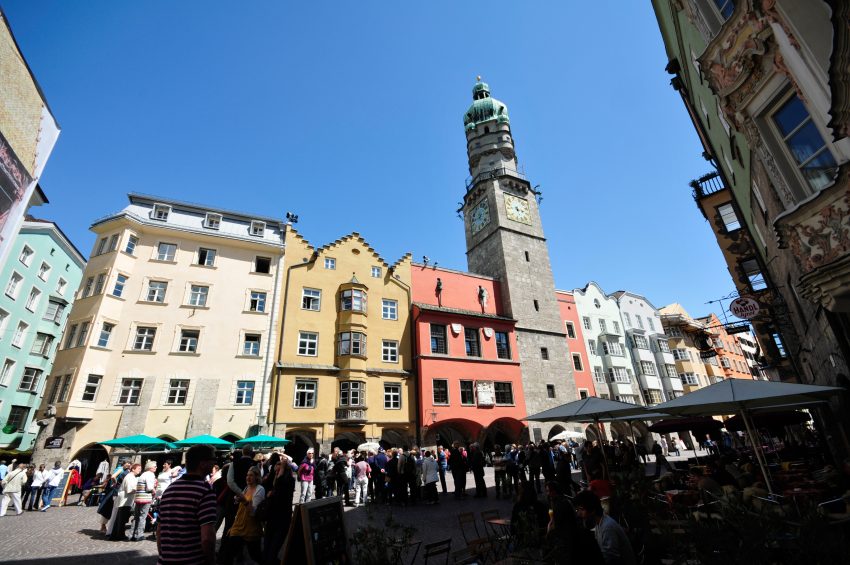
In Innsbruck, Austria, the Stadtturm (Town Tower) is a 17th‑century city watchtower built for the Old Town Hall, first recorded in 1444, that still frames how you read the city from above. The experience is the climb: about 131–133 narrow steps arranged like a DNA double helix, creating separate up and down stairways. The tower reaches roughly 51 m (166 ft), but the viewing deck sits lower at about 30 m (98 ft), where a tight wooden platform limits how many people can linger at once. Look for details such as the onion-domed roof added in 1560, wrought-iron gargoyles and an early clock installed in 1603, and a statue of Archduke Sigismund on the way up.
Location: Herzog-Friedrich-Straße 21, 6020 Innsbruck, Austria | Hours: (Summer) June 1 – September 30; Daily: 10:00–20:00. (Winter) October 1 – May 31; Daily: 10:00–17:00. | Price: Adults: €4.50; Students/School pupils/Youth (up to 17): €3.00; Seniors (60+): €3.00; Children (6–15): €2.00; Family ticket (2 adults + children 6–15): €18.80. | Website | Distance: 0.2km

Traveling to a country with a different currency? Avoid ATM transaction fees and pay in local currency with a Wise Card. Having used it for over 5 years, we've saved loads on fees!

Powered by GetYourGuide

4. Helblinghaus

Helblinghaus
Helblinghaus
CC BY-SA 4.0 / -wuppertaler
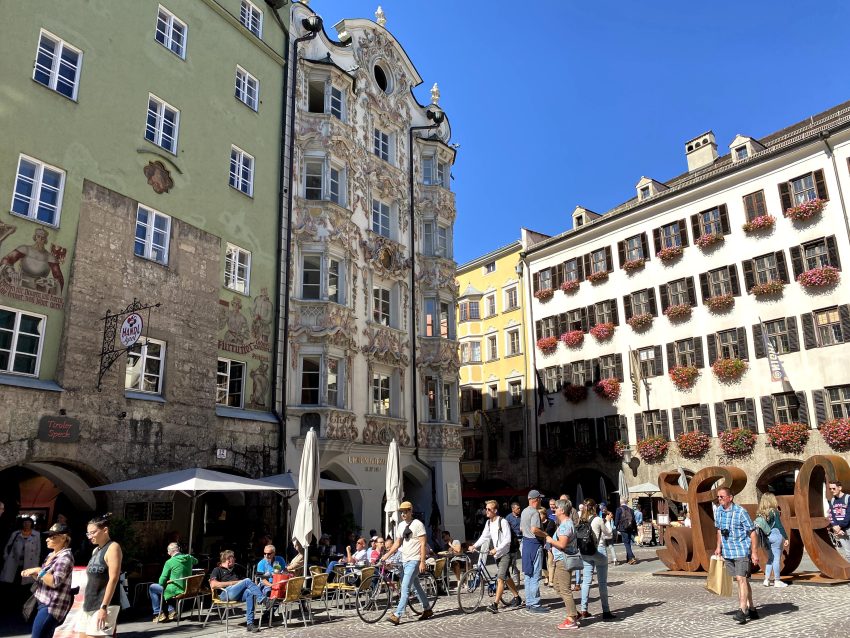
Helblinghaus is a 15th-century townhouse on Innsbruck’s Herzog-Friedrich-Straße, rebuilt into its current form in 1732 and best appreciated from the street. Architect Anton Gigl reshaped it with Rococo flair, adding ornate window bows and decorative moldings that make the façade pop against the Old Town streetscape. Up close, the stucco work reads like carved frosting—floral swirls, theatrical masks, and sculpted figures that shift in depth as light hits the relief. Visitors can’t tour the private apartments inside, but the ground floor has shops, so most people linger outside to study the details and take photos. The building takes its name from Sebastian Helbling, who owned it and ran a café here from 1800 to 1827.
Location: Herzog-Friedrich-Straße 10, 6020 Innsbruck, Austria | Hours: 24 Hours. | Price: Free. | Distance: 0.2km

Explore Innsbruck at your own pace with our self-guided walking tour! Follow our curated route to discover must-see sights and local secrets that makes Innsbruck one of the best places to visit in Austria.

5. Goldenes Dachl

Goldenes Dachl
Goldenes Dachl
CC BY-SA 2.0 / Oberau-Online
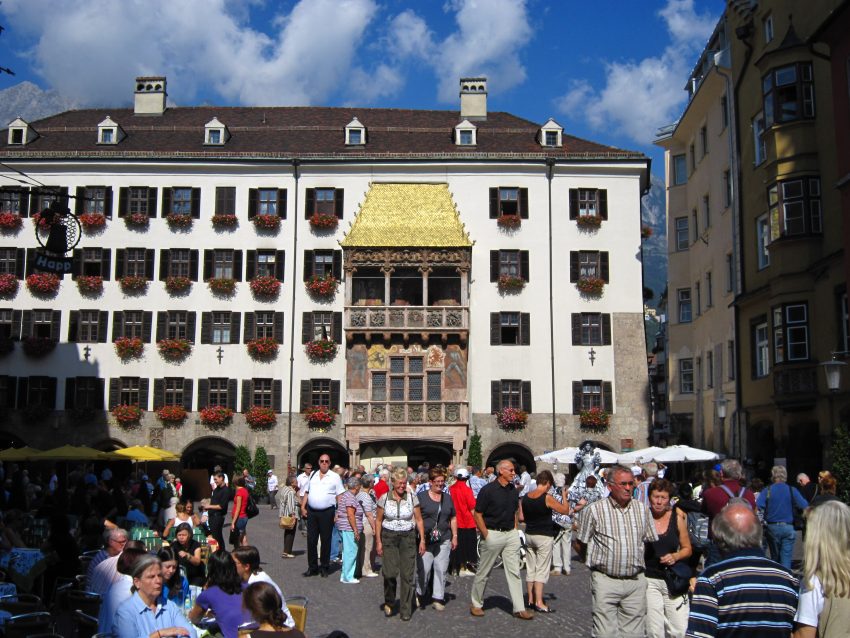
Goldenes Dachl (the Golden Roof) is a late-Gothic oriel balcony on Herzog-Friedrich-Straße in Innsbruck’s Old Town, created as a showpiece for Emperor Maximilian I’s court. The “gold” is actually 2,657 fire-gilded copper tiles, commissioned in 1493 from court builder Nikolas Turing the Elder and set atop a double-decker balcony that functioned like a royal box over the square. Look closely at the upper balustrade’s reliefs: Maximilian appears with Bianca Maria Sforza and Maria of Burgundy, while other panels depict Moorish dancers. Inside, a small museum (the Maximilianum) interprets the emperor’s life, with originals of some decorations preserved in the Tyrolean State Museum.
Location: Herzog-Friedrich-Straße 15, 6020 Innsbruck, Austria | Hours: (Summer) May – September; Daily: 10:00–17:00. (Winter) October – April; Tuesday – Sunday: 10:00–17:00. Closed on Monday. | Price: Standard: €6; Reduced: €3; Family ticket: €12.50; Children under 6: free. | Website | Distance: 0.2km
Powered by GetYourGuide

6. Dom zu St. Jakob

Dom zu St. Jakob
Dom zu St. Jakob
CC BY-SA 1.0 / Leonhard Lenz
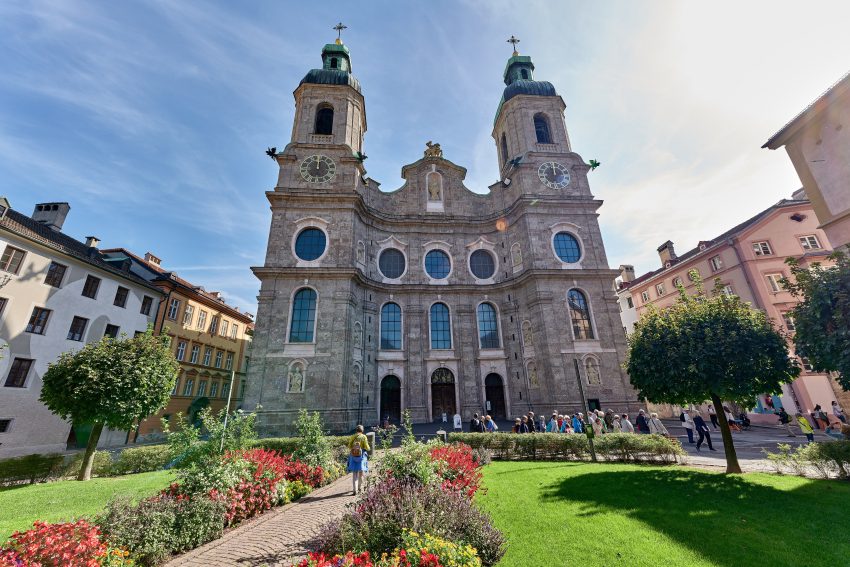
Dom zu St. Jakob is Innsbruck’s Roman Catholic cathedral, rebuilt in early-18th-century Baroque form and still the city’s central sacred landmark in the Old Town. The exterior’s concave limestone-and-marble façade is set with arched niches holding statues of Tyrolean saints, and it’s crowned by twin towers and an onion-shaped copper dome. Inside, the cruciform plan opens into a double-bayed nave and transept capped by frescoed domes, where massive columns and high rounded arches draw your gaze toward the light-filled choir. The marble high altar enshrines the cathedral’s prized Maria Hilf painting (1530) by Lucas Cranach the Elder, and you can also find the canopied tomb of Archduke Maximilian III. Visitors often remember the calm, bright atmosphere and lingering to light a candle.
Location: Dompl. 6, 6020 Innsbruck, Austria | Hours: Monday – Saturday: 10:15–18:30. Sunday: 12:30–18:30. | Price: Free; donations appreciated. | Website | Distance: 0.3km

7. Hofkirche
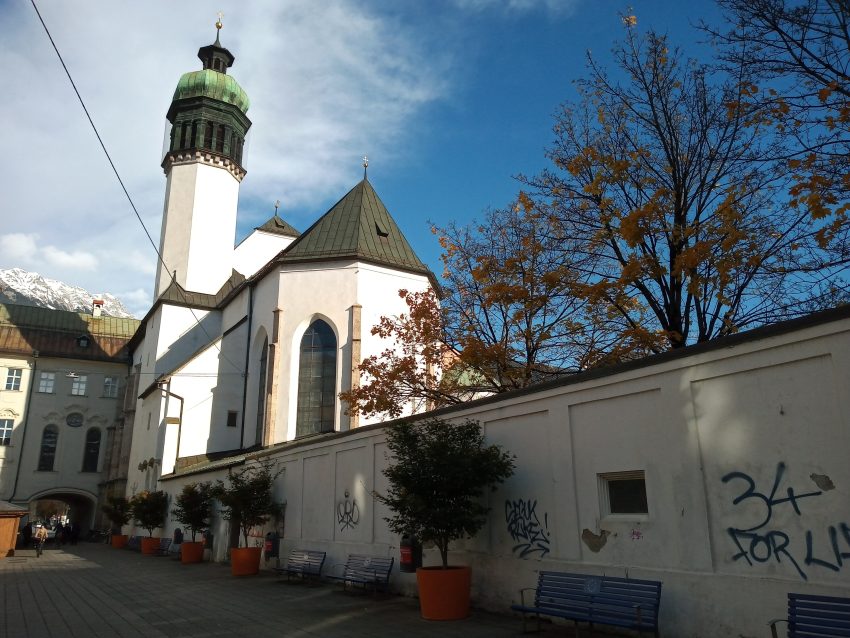
Hofkirche
Hofkirche
CC BY-SA 4.0 / Luftschiffhafen
The Hofkirche (Court Church) in Innsbruck is a 16th-century dynastic memorial built for Emperor Maximilian I, whose body remained in Vienna while his monumental cenotaph became the church’s center of gravity. Inside, visitors circle a black-marble Mannerist tomb ringed by 24 relief panels narrating his life, then come face to face with 28 life-size bronze “Black Men” standing like an honor guard. The building itself mixes a German hall-church plan with Renaissance and Gothic elements, and the nave leads to details many people miss at first glance. In the Silver Chapel, an altar to Mary combines silver with elephant tusks and heavy ebony, and the church also holds Tyrolean hero Andreas Hofer’s grave.
Location: Universitätsstraße 2, 6020 Innsbruck, Austria | Hours: Monday – Saturday: 09:00–17:00. Sunday: 12:30–17:00. | Price: Adults: €9; Reduced: €7; Under 19: free. | Website | Distance: 0.3km

8. Kaiserliche Hofburg
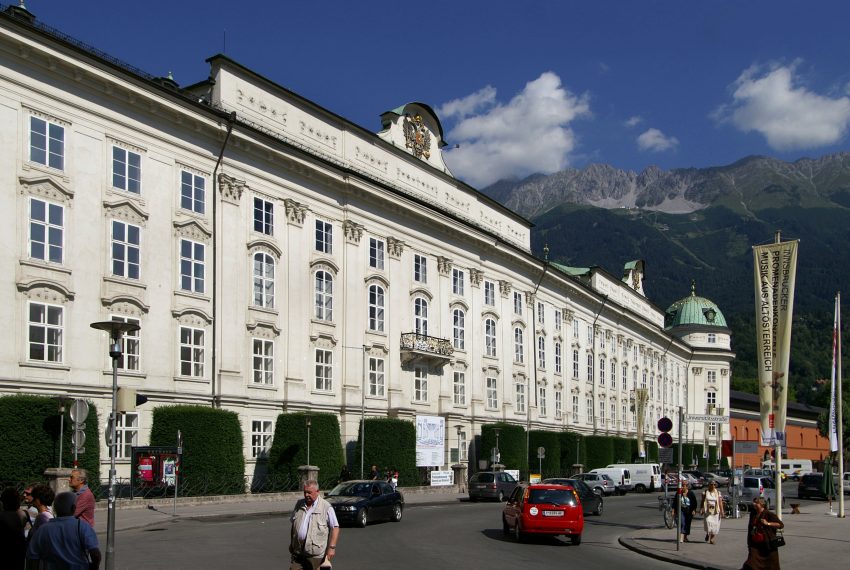
Kaiserliche Hofburg
Kaiserliche Hofburg
CC BY-SA 2.5 / böhringer friedrich
The Kaiserliche Hofburg (Innsbruck Imperial Palace) is a former Habsburg residence and one of Austria’s key imperial complexes, reshaped over centuries from medieval fortifications begun by Archduke Sigismund in 1460. Maria Theresa’s Baroque makeover still defines the experience, from the Rennweg façade to the Giants’ Hall ceiling frescoes and Rococo-style imperial apartments. Don’t miss the Gothic Hall, a 1494 five-nave space with cross-groined vaulting, and the cobblestoned inner courtyard, praised as one of the city’s prettiest. Two chapels—including the Imperial Chapel created in the room where Francis I died in 1765—add a solemn, ceremonial feel. Visitors often find the museum presentation unusually engaging, though photography restrictions can frustrate.
Location: Rennweg 1, 6020 Innsbruck, Austria | Hours: Daily: 09:00–17:00. | Price: Adults: €10.50; Concessions: €8.00; Under 19: free. Kombi ticket (Kaiserappartements + Maximilian1): €16.00. | Website | Distance: 0.3km

9. Maria-Theresien Strasse
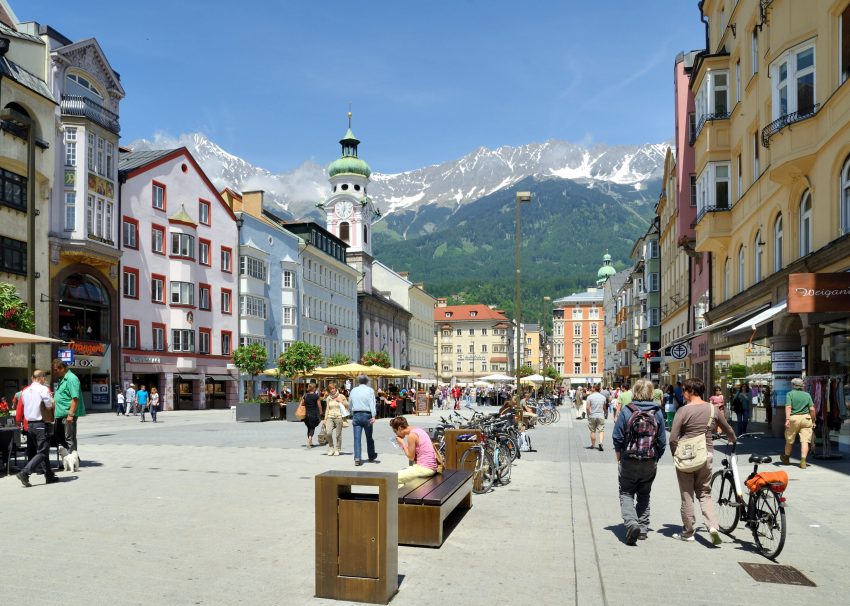
Maria-Theresien Strasse
Free Art License / Taxiarchos228
Maria-Theresien Strasse is Innsbruck, Austria’s main pedestrian boulevard, a gently curving promenade that doubles as the city’s ceremonial and shopping spine. It runs for about 500 yards, from the Triumphpforte (Triumphal Arch) at the south end to the Burggraben/Marktgraben junction in the north, with benches and ornate wood-and-brass streetlamps along the way. Look for Saint Anne’s Column (1706): the Virgin Mary stands on a crescent moon atop a red-marble Corinthian pillar, with saints grouped at the base. Grand Rococo, Baroque, and Renaissance façades recall when nobles built town palaces here, while modern retail clusters like Kaufhaus Tyrol add a contemporary edge. On clear days, the Nordkette mountains loom dramatically above the rooftops, and the street can feel especially festive during the Christmas market season.
Location: Maria-Theresien-Straße, 6020 Innsbruck, Austria | Hours: 24 Hours. | Price: Free. | Distance: 0.4km

10. Tiroler Volkskunstmuseum
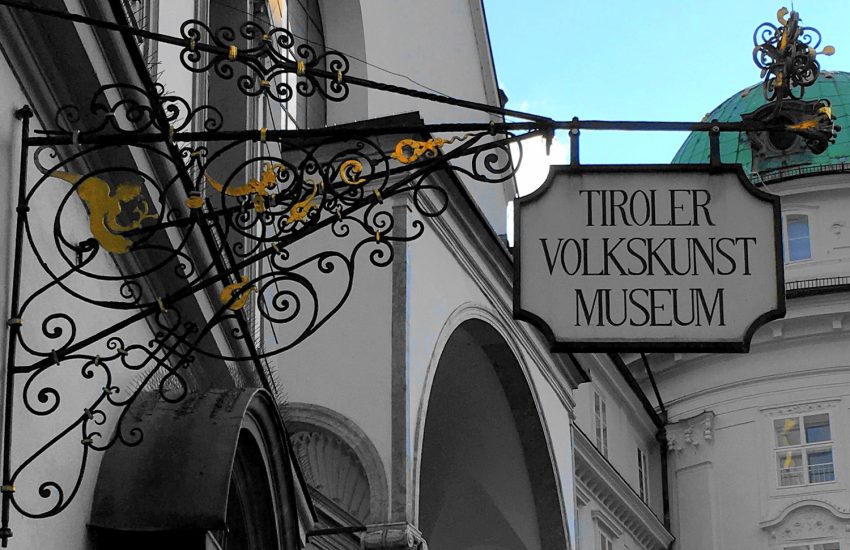
Tiroler Volkskunstmuseum
CC BY-SA 4.0 / Naturpuur
Tiroler Volkskunstmuseum in Innsbruck is a compact heritage museum devoted to everyday life and folk artistry in Tyrol, housed across three floors of the New Abbey beside the Hofkirche. Its strongest impressions come from meticulously reassembled Gothic, Renaissance, and Baroque rooms, lifted from peasant and noble homes and rebuilt with paneled “stube” interiors, ceilings, and built-in cupboards intact. Cases of regional material culture—costumes, tools, toys, pottery, glass, and household objects—sketch what ordinary life looked like from roughly the 16th to 18th centuries. A distinctive corner is the large nativity-scene collection, with mangers crafted in wood, wax, paper, and earthenware dating back to the 18th century. Visitors often note the calm, cloister-like atmosphere and plentiful benches.
Location: Universitätsstraße 2, 6020 Innsbruck, Austria | Hours: Daily: 09:00–17:00. | Price: Adults: €9; Reduced: €7; Under 19: free. | Website | Distance: 0.4km

11. Tiroler Landesmuseum Ferdinandeum
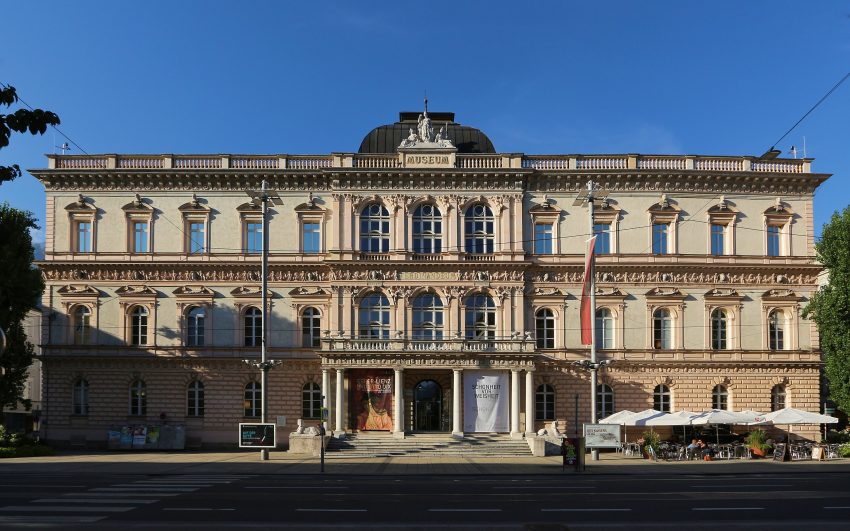
Tiroler Landesmuseum Ferdinandeum
CC BY-SA 4.0 / Simon Legner
Tiroler Landesmuseum Ferdinandeum is Innsbruck’s Tyrolean State Museum, founded in 1823 and named for Archduke Ferdinand, and it anchors the region’s art, science, and historical collections. Inside, galleries range from Romanesque and Gothic works to modern pieces, with standout names such as Michael Pacher, Lucas Cranach the Elder, and Rembrandt. More unusual corners include a music room with Jakob Stainer instruments and a Netherlands-focused collection. Beyond the display cases, the institution acts as a research hub, publishing the Tiroler Urkundenbuch, which makes medieval Tyrolean documents accessible. The main building is currently closed for major renovation, with programming continuing through partner venues under “Ferdinandeum unterwegs.”
Location: Museumstraße 15, 6020 Innsbruck, Austria | Hours: Check official website. | Price: Check official website. | Website | Distance: 0.5km

12. HofGarten
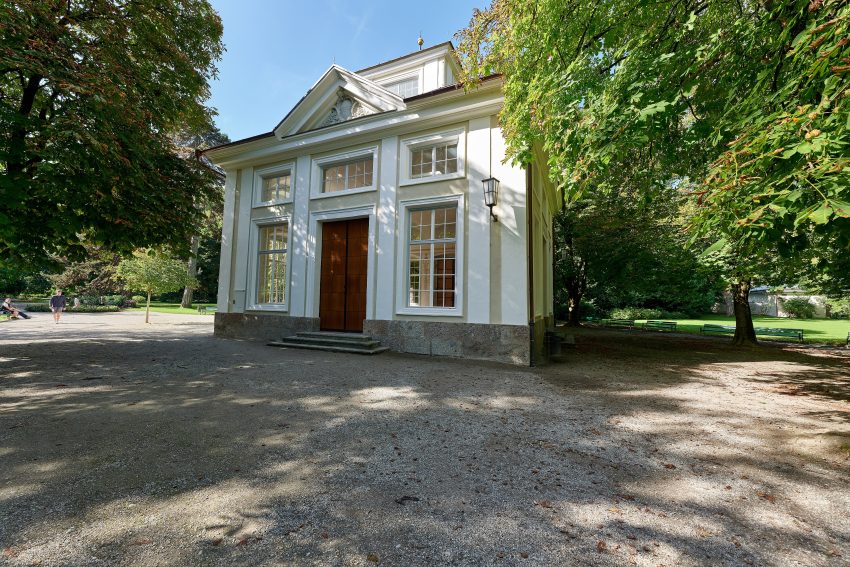
HofGarten
HofGarten
CC BY-SA 1.0 / Leonhard Lenz
HofGarten is Innsbruck’s 25‑acre former Habsburg court garden, now a protected public park at the edge of the Old Town. Laid out from the 15th–16th centuries on meadowland by the River Inn, it has cycled through Renaissance, formal French, and later English-style landscaping—an evolution you still feel in its ordered paths and long sightlines. Visitors remember the mix of mature trees, seasonal beds, and the calm pond-and-bench corners that make it an easy place to slow down. Look for the Palm House, a 1964 glass conservatory holding part of the Austrian Federal Gardens’ botanical collection, and the former imperial summer house repurposed as a music pavilion. Locals praise it as a quiet, central reset for a short walk.
Location: Kaiserjägerstraße, 6020 Innsbruck, Austria | Hours: 24 Hours. | Price: Free. | Website | Distance: 0.5km

13. Triumphpforte
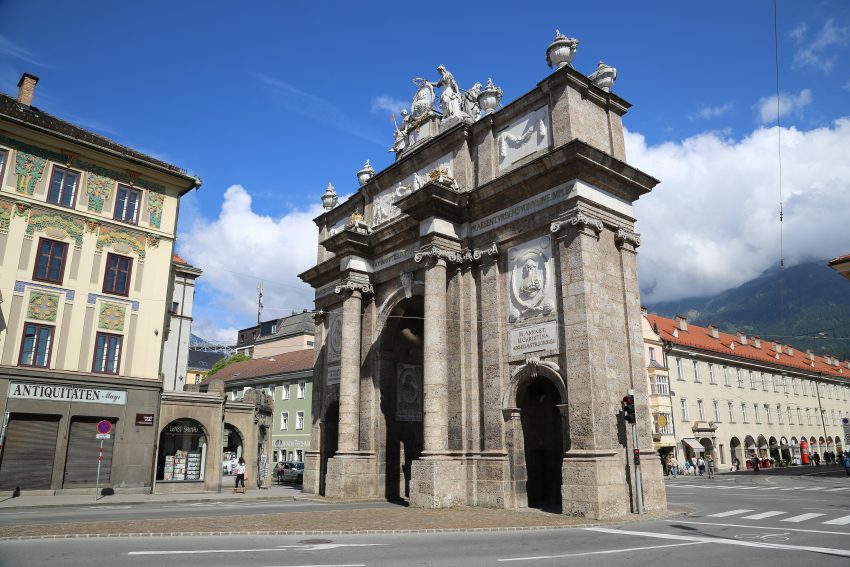
Triumphpforte
Triumphpforte
CC BY-SA 2.0 / Tobias Klenze
In Innsbruck, Austria, the Triumphpforte is a Baroque stone triumphal arch at the south end of Maria-Theresien-Straße, with modern traffic still passing beneath it. Built in 1765 for Archduke Leopold’s marriage to Spanish princess Maria Luisa, it unexpectedly became a double memorial when Emperor Francis Stephen died days later. That split mood is carved into the monument: celebratory motifs on the south face and a more funerary program on the north. Look closely for imperial symbols like the archducal hat with the Order of the Golden Fleece and the crown of the Hungarian Order of Saint Stephen. Step back along the boulevard to frame the arch against the Alps.
Location: Maria-Theresien-Straße, 6020 Innsbruck, Austria | Hours: 24 Hours. | Price: Free. | Distance: 0.6km

14. Eduard-Wallnöfer-Platz
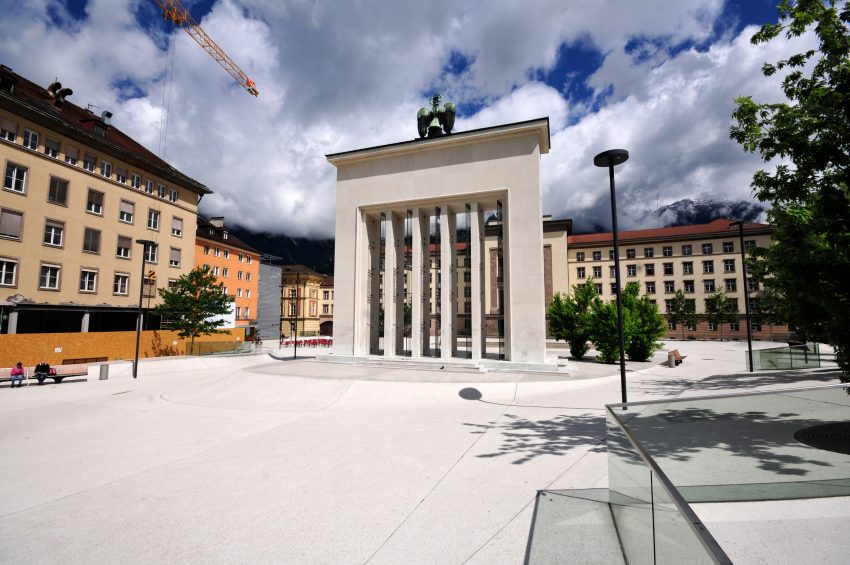
Eduard-Wallnöfer-Platz
CC BY-SA 3.0 / Ralf Roletschek
Eduard-Wallnöfer-Platz (still widely called Landhausplatz) is a broad, modern civic square beside Innsbruck’s Tiroler Landhaus, defined by sculpted concrete and long, open sightlines. Its story is tangled: the adjacent Gauhaus was built in 1938–39, and postwar French occupiers later commissioned a Liberation Monument by Major Jean Pascaud. That memorial echoes the Landhaus façade with flat columns and five openings, topped by a bronze Austrian eagle. Visitors also notice large fountains and scattered monuments that leave a wide central strip used for events and everyday hangouts. Renamed in 1994 for former Tyrolean governor Eduard Wallnöfer, the square still prompts debate after revelations of his Nazi Party membership.
Location: Eduard-Wallnöfer-Platz, 6020 Innsbruck, Austria | Hours: 24 Hours. | Price: Free. | Distance: 0.6km

15. Botanical Garden
Botanical Garden
Botanical Garden
CC BY-SA 4.0 / Luftschiffhafen
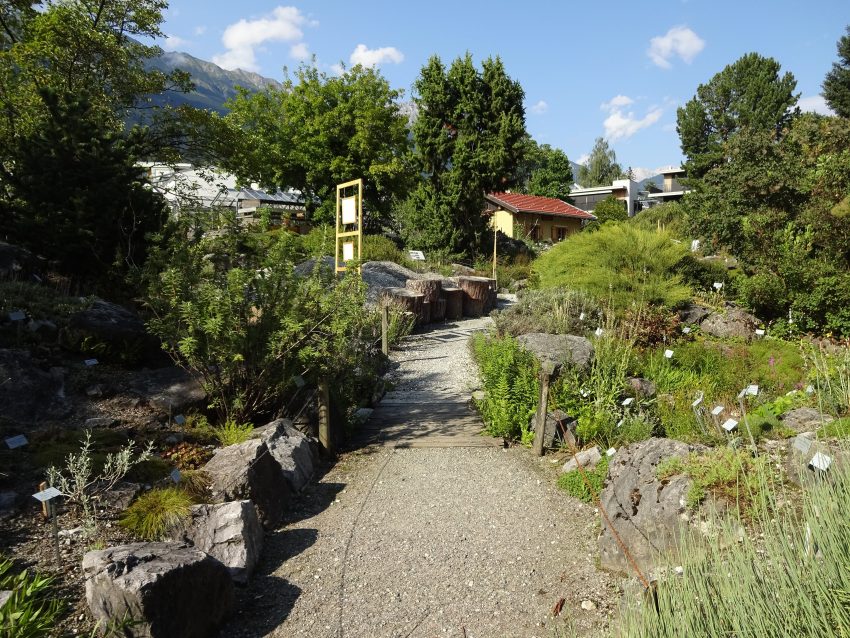
Innsbruck’s university-run Botanical Garden is a compact 2-hectare refuge in Hötting that doubles as a living teaching collection. It holds more than 5,000 species arranged to echo natural habitats, so a short loop can jump from ponds and moor-like plantings to fern areas and an arboretum of woody plants. The Alpinum alone covers over 2,000 square meters and displays around 1,000 non-tropical alpine plants from mountain regions worldwide, with rocky textures and big Tyrolean views. Under glass, a chain of greenhouses includes cactus houses (about 330 square meters) with roughly 500 cactus species, plus succulent and container-plant houses. Visitors often remember the calm, careful labeling, and the sudden climate shift inside the tropical rooms.
Location: Sternwartestraße 15, 6020 Innsbruck, Austria | Hours: Summer (April – October) Freiland: Monday – Friday: 07:30–19:00; Saturday – Sunday: 08:00–19:00. Winter (November – March) Freiland: Monday – Friday: 07:30–17:00; Saturday – Sunday: 08:00–17:00. Tropical Show Greenhouses: Tuesday & Thursday: 13:00–15:30; First Sunday of the month: 13:00–15:30. | Price: Outdoor garden: Free. Tropical show greenhouses: Adults: €4; Seniors: €2; Children, pupils/apprentices, and students (with ID): free. | Website | Distance: 0.8km

16. Alpine Zoo
Alpine Zoo
Alpine Zoo
CC BY-SA 3.0 / Hafelekar
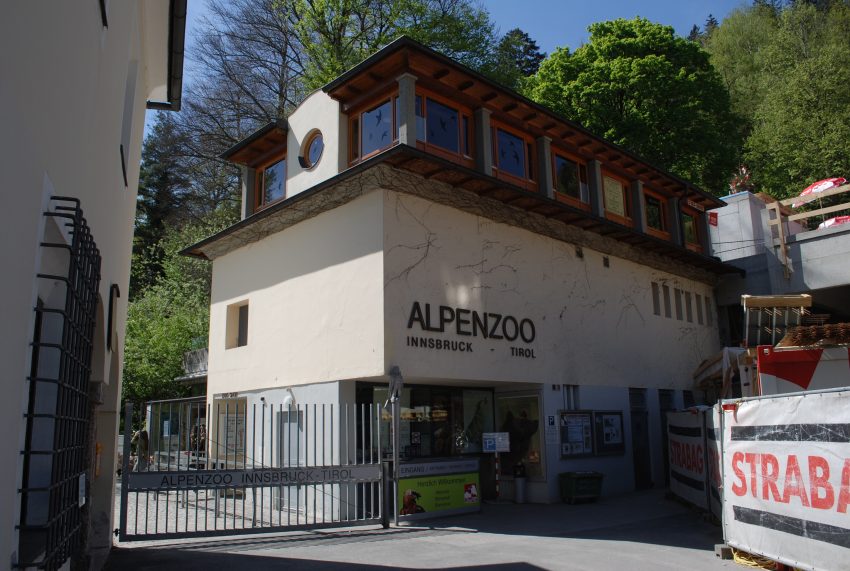
Alpine Zoo (Alpenzoo) is a hillside, open-air zoo above Innsbruck dedicated entirely to Alpine fauna, making it a focused window into mountain ecosystems rather than a globe-spanning menagerie. Founded in 1962 by zoologist Hans Psenner, it’s among Europe’s highest-elevation zoos and is closely tied to conservation work, including reintroduction efforts for species such as the bearded vulture, Alpine ibex, and northern bald ibis. The collection numbers around 2,000 animals across about 150 species, and it’s notably the only zoo to display the wallcreeper. Paths climb through the slope like a gentle hike, with frequent viewpoints over Innsbruck—though in winter some animals may be less visible.
Location: Weiherburggasse 37a, 6020 Innsbruck, Austria | Hours: (Summer) Daily: 09:00–18:00. (Winter) Daily: 09:00–17:00. | Price: Adults: €17; Youth (16–18): €15; Children (6–17): €11; Small children (4–5): €5; Under 4: free. | Website | Distance: 1.6km
Powered by GetYourGuide

17. Riesenrundgemälde

Riesenrundgemälde
Riesenrundgemälde
CC BY-SA 4.0 / Asurnipal
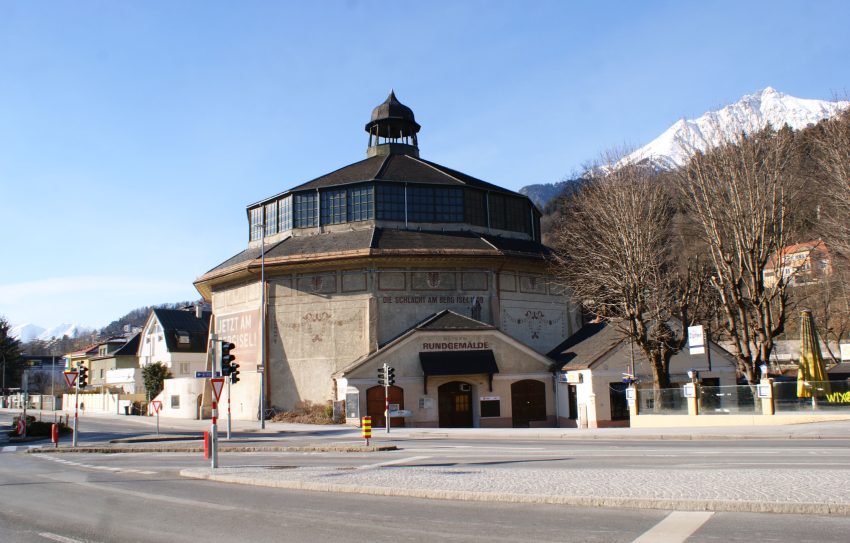
Riesenrundgemälde is a monumental circular panorama painting in Innsbruck that immerses you in the 1809 Battles of Bergisel, when Tyroleans fought Napoleon’s allies on the hill above town. Painted in 1896 by Michael Zeno Diemer with contributions from artists such as Franz von Defregger and Franz Burger, it centers on the third battle—shown as a Tyrolean victory over Bavarian, Saxon, and French troops, even if details like Andreas Hofer’s role are dramatized. Since 2011 it has been presented at the Tirol Panorama am Bergisel on a raised viewing platform, with a light-controlling velum and a sculpted “faux terrain” foreground that makes the scene feel three-dimensional. Some travelers note the old former building is now empty, since the work was moved.
Location: Tiroler Str. 39, 6020 Innsbruck, Austria | Distance: 1.6km

18. Kaiserjäger Museum
Kaiserjäger Museum
Kaiserjäger Museum
CC BY-SA 1.0 / Leonhard Lenz
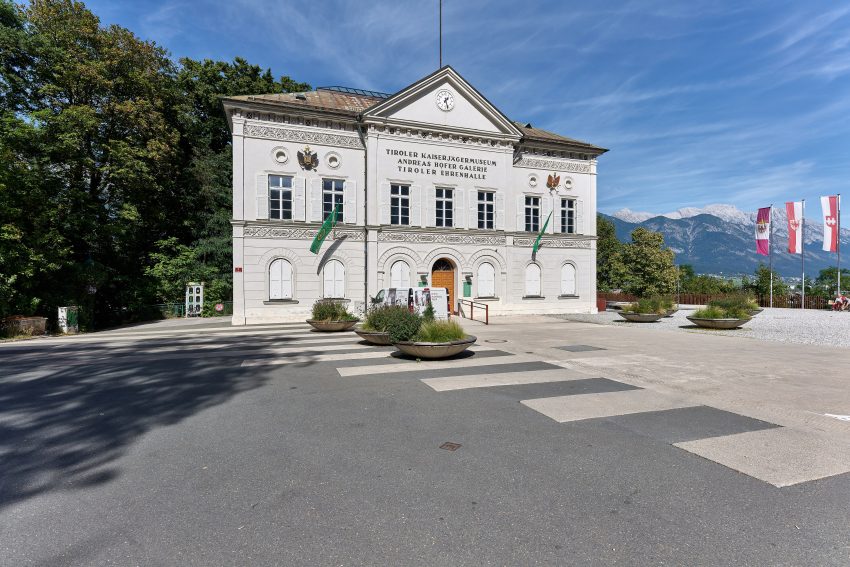
The Kaiserjäger Museum on Innsbruck’s Bergisel plateau is a focused state museum dedicated to the Tyrolean Kaiserjäger infantry and the region’s military past, tying local identity to the Habsburg era and World War I. Opened in 1880 and housed in a building from 1878, it displays uniforms, weapons, portraits, and unit insignia that make the regiment’s story feel personal rather than abstract. An underground passage connects it to the Tirol Panorama, where many visitors linger over the monumental circular painting. Outside, the honorary grave of the Unknown Kaiserjäger (1923) and the Tyrolean Book of Honour volumes memorialize war dead from 1796 to 1945, adding a solemn, reflective note.
Location: Bergisel 1-2, 6020 Innsbruck, Austria | Hours: Wednesday – Monday: 09:00–17:00. Closed on Tuesday. | Price: Adults: €9; Concessions: €7; Under 19: free. | Website | Distance: 2km

19. Innsbrucker Nordkettenbahnen
Innsbrucker Nordkettenbahnen
CC BY-SA 3.0 / Wiper Mexico
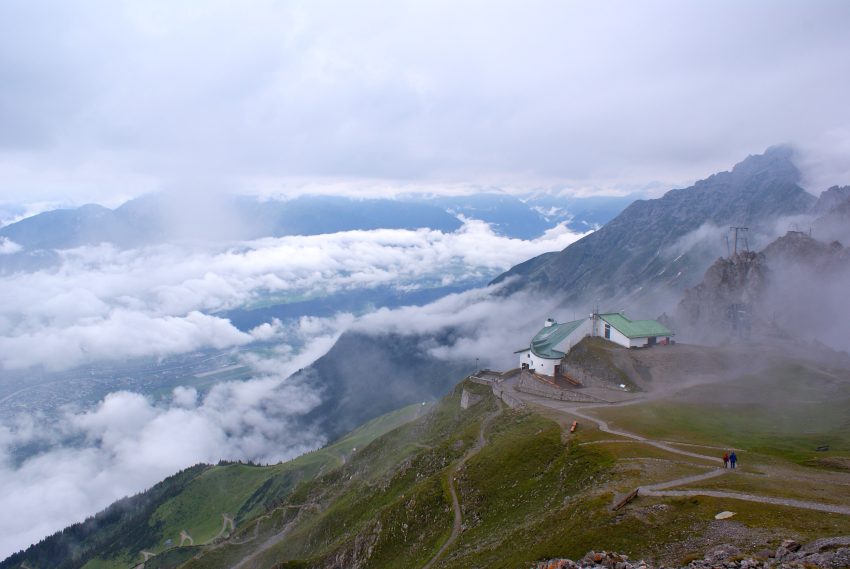
Innsbrucker Nordkettenbahnen is Innsbruck’s city-to-mountain funicular and cable-car system linking downtown to the Nordkette, the southern edge of the Karwendel range. It runs in three legs: the Hungerburgbahn up to Hungerburg, then cable cars to Seegrube (1,905 m) and on to Hafelekar (2,269 m), where the air turns sharp and the peaks look jagged and close. From Seegrube and especially near Hafelekarspitze, you get wide views over the Inn Valley and the city’s rooftops far below. In summer it’s a launch point for hikes like the Goetheweg, while winter turns the area into a compact ski zone with steep routes and a snow park—many visitors simply remember the sudden switch from streets to high-alpine scenery in minutes.
Location: Rennweg 3, 6020 Innsbruck, Austria | Hours: Monday – Friday: 07:15–19:15. Saturday – Sunday: 08:00–19:15. Monday – Sunday: 08:30–17:30. Monday – Sunday: 09:00–16:45. | Price: Top of Innsbruck (there and back): Adults: €56.00; Senior/Student: €51.50; Teen: €44.80; Child: €33.60. | Website | Distance: 2.1km

20. Schloss Ambras
Schloss Ambras
Schloss Ambras
CC BY-SA 4.0 / Zairon
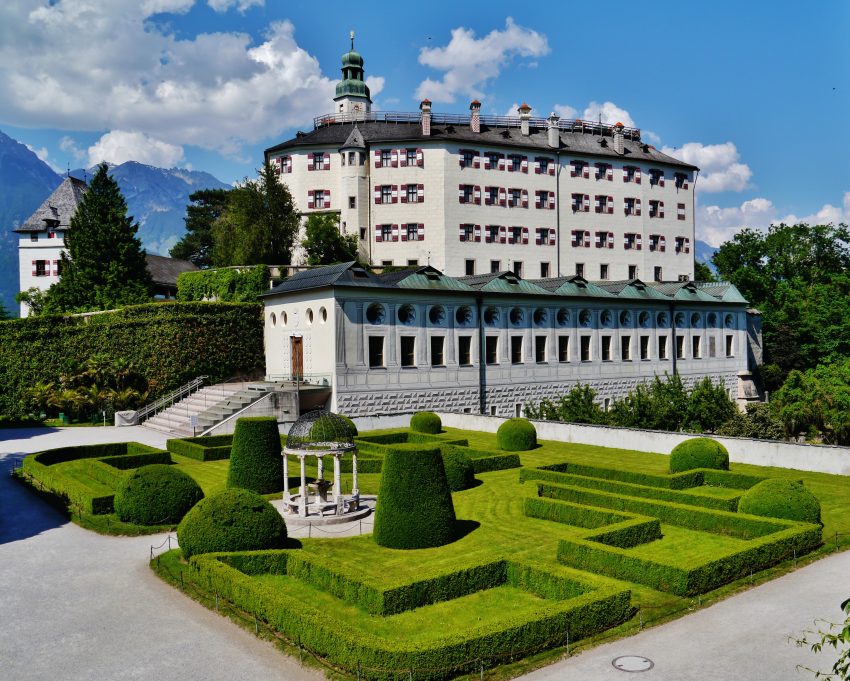
Schloss Ambras (Ambras Castle) is a 16th-century German Renaissance castle-museum on a wooded hillside above Innsbruck, created when Archduke Ferdinand II built around a much older medieval fortress as a residence for his wife, Philippine Welser. It matters because Ferdinand designed dedicated rooms for his collections, helping make Ambras one of Europe’s earliest purpose-built museum settings. Visitors remember the long, wood-paneled Spanish Hall, lined with 27 full-length portraits of Tyrolean rulers, and the armouries spanning Holy Roman Emperors from Maximilian I to Leopold I. The Chamber of Art and Curiosities mixes art with oddities like rhinoceros-horn goblets, bronze animals, and intricate measuring devices and clocks. Outside, paths cross the grounds to a Saint Nicholas chapel that predates the castle by about two centuries.
Location: Schloßstraße 20, 6020 Innsbruck, Austria | Hours: Daily: 10:00–17:00. Closed on Monday, Tuesday, Wednesday, Thursday, Friday, Saturday, Sunday. | Price: Adults: €14; Reduced: €12; Under 19: free. | Website | Distance: 3.5km
Powered by GetYourGuide

21. Patscherkofelbahn

Patscherkofelbahn
Patscherkofelbahn
CC BY-SA 2.0 / Mattes
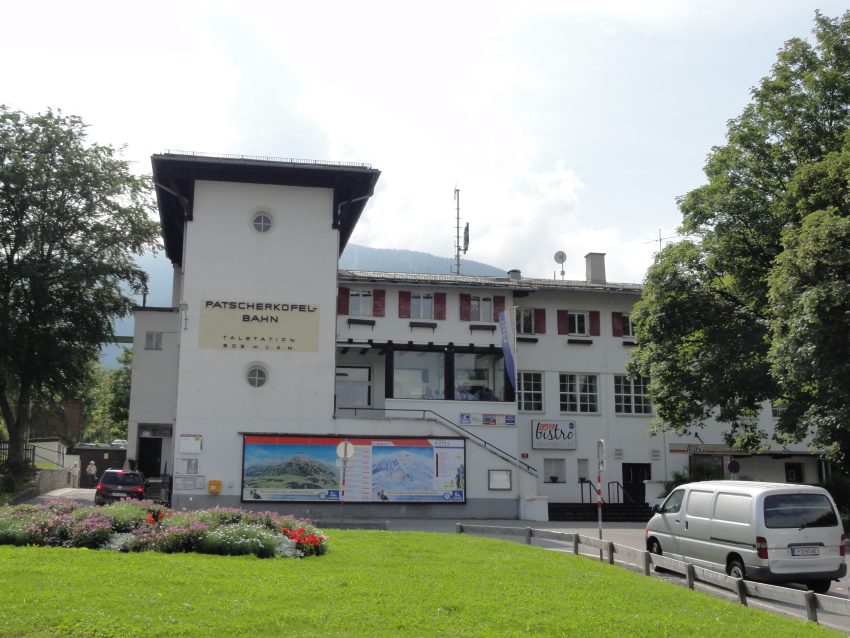
Patscherkofelbahn is Innsbruck’s cable car from the Igls district up to Patscherkofel, turning a serious climb into a quick ascent to alpine viewpoints above the Inn Valley. First opened in 1928 as an aerial tramway, it was rebuilt in 2017 as a modern monocable gondola with higher capacity and smoother operations. One memorable detail is the mid-station, designed as a technical hub and gondola garage, which keeps the system running reliably through busy ski days. At the top, visitors step into open panoramas, summer meadows, and access to routes like the Zirbenweg, with easy-to-moderate walks and a couple of mountain restaurants for a warm break.
Location: Römerstraße 81, 6080 Innsbruck-Igls, Austria | Hours: (Winter) December 6, 2025 – April 6, 2026; Daily: 08:30–16:00. | Price: Adults: €33 (two-way); €22.30 (one-way). | Website | Distance: 5.7km

Best Day Trips from Innsbruck

A day trip from Innsbruck offers the perfect opportunity to escape the urban rhythm and discover the surrounding region's charm. Whether you're drawn to scenic countryside, historic villages, or cultural landmarks, the area around Innsbruck provides a variety of easy-to-reach destinations ideal for a one-day itinerary. If you are looking to rent a car in Austria I recommend having a look at Discover Cars, first, as they compare prices and review multiple car rental agencies for you.

1. Füssen

Fussen
Fussen
CC BY-SA 3.0 / Wolkenkratzer
Füssen, nestled in the heart of Bavaria’s Allgäu region near the Austrian border, greets visitors with a picture-perfect Old Town framed by pastel-colored buildings and cobblestone lanes. Its compact pedestrian zone leads naturally from the baroque St. Mang’s Abbey to the Lech River, where shaded benches invite you to linger over a gelato or a stein of local beer. Quaint…
Visiting Füssen
Powered by GetYourGuide

2. Munich

Munich
Munich
Munich is one of the easiest German cities to enjoy on a first visit because it balances “big-city” culture with a relaxed, walkable core. You can spend the morning moving between grand squares, museums, and coffee houses, then switch to parks, river paths, and beer gardens without ever feeling like you need to plan every minute. It is a city…
Visiting Munich

3. Zell am See

The Complete Guide to Zell am See
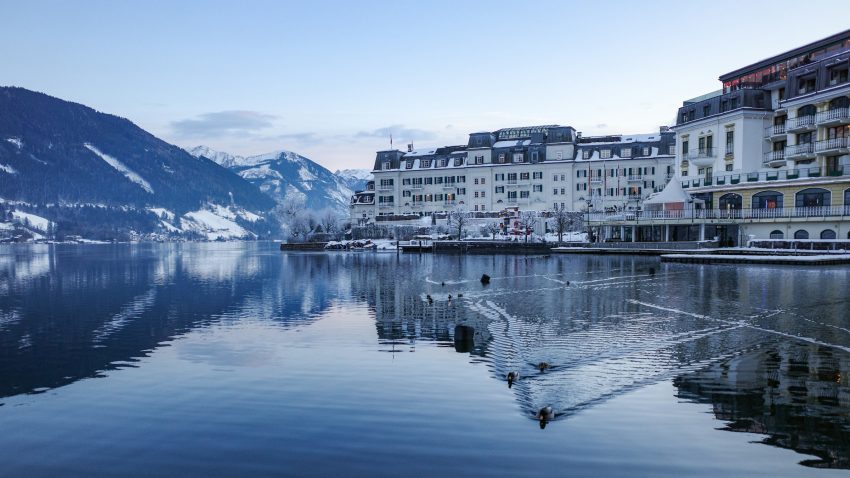
Zell am See is a classic Alpine lakeside town in the Pinzgau area of Salzburg Land, where a walkable old centre meets a broad waterfront promenade and mountain views in every direction. It’s the kind of place that works equally well for a relaxed weekend—coffee by the lake, a gentle cruise, a sunset stroll—or as a base for bigger mountain…
Visiting Zell am See
Powered by GetYourGuide

4. Bregenz

The Complete Guide to Bregenz
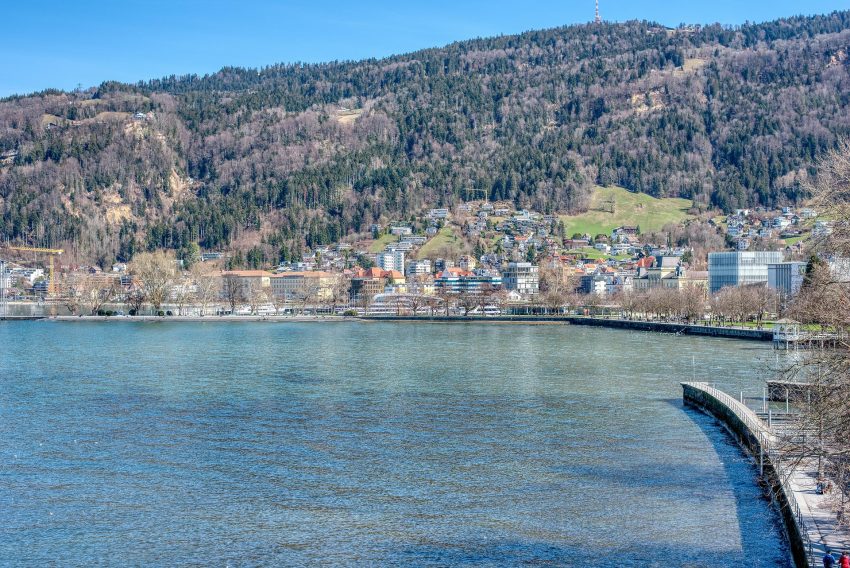
Bregenz is a lakeside city in Austria’s Vorarlberg region, set on the eastern shore of Lake Constance with the Alps rising close behind. It’s compact and easy to explore on foot, yet it feels expansive thanks to the water views, promenades, and the way the mountains frame nearly every street scene. The city’s mix of waterfront leisure, culture, and quick…
Visiting Bregenz
Powered by GetYourGuide

5. Berchtesgaden

The Complete Guide to Berchtesgaden
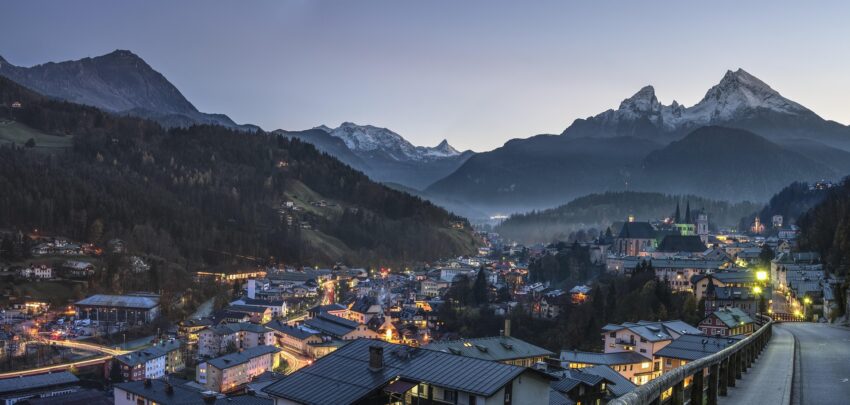
Berchtesgaden is a mountain town in southeastern Germany, set in the Bavarian Alps near the Austrian border. It makes an ideal base for exploring Berchtesgaden National Park, with dramatic limestone peaks, clear lakes, and well-marked trails that start close to town. The center is compact and easy to navigate, with cafés, bakeries, and practical services that make day trips simple.…
Visiting Berchtesgaden

6. Augsburg

Augsburg
Augsburg
CC BY-SA 3.0 / Guido Radig
Augsburg, nestled in the Swabian region of Bavaria in southern Germany, offers a delightful blend of urban charm and green retreats. Begin your visit at the bustling Rathausplatz, where the Renaissance Town Hall and Perlachturm tower over lively cafés and street musicians. Just a short stroll away, the historic Fuggerei—world’s oldest social housing complex—invites you to wander its peaceful courtyards…
Visiting Augsburg

7. Salzburg

The Complete Guide to Salzburg
Salzburg is a compact, walkable city that feels tailor-made for a long weekend: a riverfront Old Town of baroque streets and church domes, a fortress perched above the rooftops, and café culture that rewards slow afternoons. Set in Salzburg Land, it’s easy to pair city sightseeing with quick escapes to lakes, alpine viewpoints, and storybook villages—often within the same day.…
Visiting Salzburg
Powered by GetYourGuide

Where to Stay in Innsbruck

For Innsbruck, staying in the Old Town (Altstadt) or the adjacent city-center area is best if you want to walk to major sights, restaurants, and evening atmosphere with minimal transport planning; it’s ideal for short breaks and first-time visits. A strong central choice is Stage 12 Hotel by Penz, which suits travelers who want modern comfort right on the main boulevard with easy access to the Old Town. For a classic, high-comfort stay with a more traditional feel and a prime central location, Hotel Innsbruck works well, especially if you value being steps from riverside walks and historic lanes.

If you prefer a quieter base with quick links to the center and a more residential feel, the Wilten area is a smart pick; it’s close to Bergisel and well connected by public transport, often with better value than the core. In this zone, NALA Individuellhotel is a good option for travelers who like boutique style and a calmer street setting while still being walkable to central sights.

For visitors arriving by car or planning day trips into the surrounding valleys, choosing a hotel slightly outside the tight center can make parking and departures easier while keeping the city accessible by tram or bus. Austria Trend Hotel Congress Innsbruck is a practical choice in that sense, offering a comfortable base with straightforward access to both the center and onward routes.

Using the our Hotel and Accomodation map, you can compare hotels and short-term rental accommodations in Innsbruck. Simply insert your travel dates and group size, and you’ll see the best deals for your stay.

Innsbruck Accommodation Map

Best Time to Visit Innsbruck

Innsbruck in Spring

Spring brings longer days and a lively shift in atmosphere as terraces reopen and the mountains transition from snow to green. It’s a great time for city walks, lower-elevation hikes, and sightseeing without peak-season crowds. Conditions can change quickly, so layering is useful for cool mornings and sunnier afternoons.

Innsbruck in Summer (Best)

Summer is ideal for hiking, cable-car viewpoints, lakes and outdoor dining, with the city at its most vibrant. This is also when major events can be a highlight, including the Innsbruck Festival of Early Music (Innsbrucker Festwochen der Alten Musik), which draws international performers and audiences. Expect warm days in the valley and cooler temperatures at altitude.

Innsbruck in Autumn

Autumn is crisp and scenic, with clear mountain views and golden colors on surrounding slopes. It’s a strong season for hiking and photography, and the city feels calmer after summer. As temperatures drop, it’s also a comfortable time to focus on museums, cafés, and day trips.

Innsbruck in Winter

Winter is prime time for skiing and snow sports, with easy access to nearby slopes and a festive feel in town. Innsbruck’s Christmas markets and seasonal lights add atmosphere, and the mountains often look spectacular from the city. Shorter days and colder evenings make it a good season to mix outdoor time with warm indoor stops.

Annual Weather Overview

  • January 3°C
  • February 7°C
  • March 8°C
  • April 14°C
  • May 17°C
  • June 23°C
  • July 23°C
  • August 24°C
  • September 21°C
  • October 17°C
  • November 9°C
  • December 5°C

How to get to Innsbruck

Getting to Innsbruck by air

Nearest airports: Innsbruck Airport (INN) is the closest option, with seasonal and year-round routes depending on demand. For more flight choices, Munich Airport (MUC) is a common alternative, and Salzburg Airport (SZG) can also work for some itineraries.

Airport to city: From Innsbruck Airport, you can reach the center quickly by local bus or taxi. If arriving via Munich or Salzburg, onward travel is typically easiest by train.

Getting to Innsbruck by train

Main rail connections: Innsbruck Hauptbahnhof is well connected to Vienna, Salzburg, Munich, and onward routes through the Alps. Rail is often the most convenient way to arrive if you're combining Innsbruck with other Austrian or Bavarian cities.

Train operators (links): ÖBB (Austrian Federal Railways) https://www.oebb.at/en/ , DB (Deutsche Bahn) https://www.bahn.com/en , SBB (Swiss Federal Railways) https://www.sbb.ch/en

Getting to Innsbruck by Car

Driving routes: Innsbruck is reached via major Alpine motorways, and driving can be practical if you plan to explore multiple valleys or travel with ski gear. Be prepared for tolls on Austrian motorways (vignette) and possible winter driving conditions.

Parking notes: Central parking is available in garages, but spaces can be limited and pricier in the core. Consider accommodation with parking if you’re staying overnight, and use park-and-ride options when available. If you are looking to rent a car in Austria I recommend having a look at Discover Cars, first, as they compare prices and review multiple car rental agencies for you.

Travelling around Innsbruck

Public transport: The city is easy to navigate with buses and trams, and many central sights are walkable. Day tickets can be good value if you’re moving between neighborhoods and stations.

Cable cars and funiculars: Mountain lifts are a key part of getting around for viewpoints and hikes; check operating hours seasonally.

Bikes and walking: Innsbruck is very walkable, and cycling is a pleasant option along flatter riverside routes.
More from this area