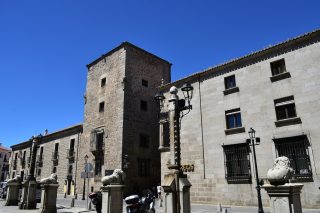
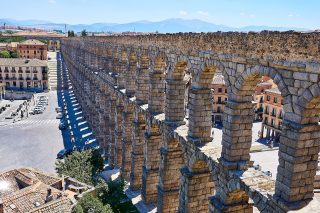
Jewish Quarter, Segovia
Area in Segovia
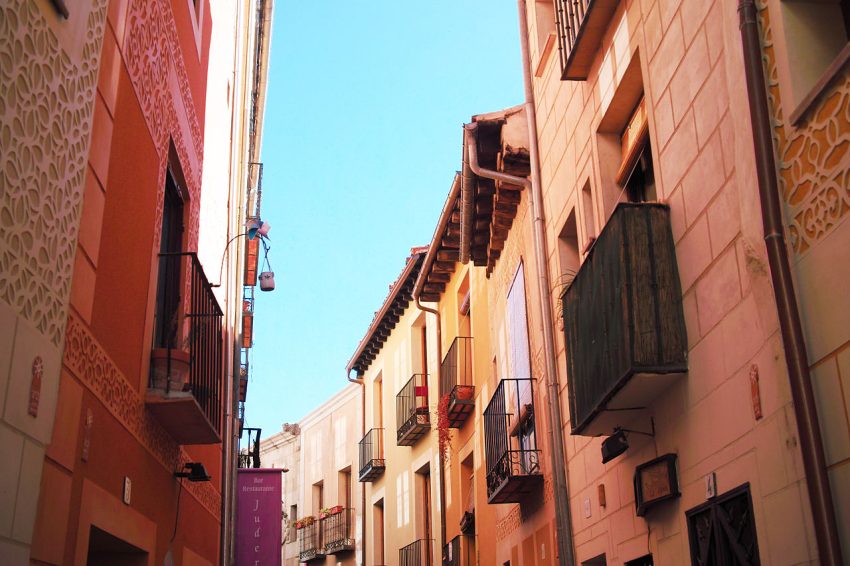
Segovia's Jewish Quarter, known locally as La Judería, is one of those places that changes the pace of your day without you really noticing at first. You step off the busier old-town routes and suddenly you're in a tighter, quieter network of lanes where stone walls lean inward, doorways open onto small patios, and the city feels older and more intimate. It sits on the southern side of the walled city, centred on Plaza del Corpus Christi and the streets around Judería Vieja, and it's an easy area to weave into your plans even if you're only in Segovia for a day.
This spot is one of the must-see places in Segovia because it isn't just “pretty streets”; it's a neighbourhood with a clear historical identity that still reads in the layout and landmarks. If you're doing a walking tour of Segovia, the Jewish Quarter is the perfect middle chapter: calmer than the aqueduct zone, richer in small details than the big plazas, and full of little moments where history feels close rather than museum-distant.
Table of Contents
- History and Significance of the Segovia Jewish Quarter
- Things to See and Do in the Segovia Jewish Quarter
- Practical Tips on Visiting the Segovia Jewish Quarter
- Where to Stay Close to the Segovia Jewish Quarter
- Is the Segovia Jewish Quarter
- For Different Travelers
- FAQs for Visiting Segovia Jewish Quarter
- Nearby Attractions to the Segovia Jewish Quarter
History and Significance of the Segovia Jewish Quarter (La Judería)
The Hebrew community lived here from at least the 12th century until the expulsion ordered in 1492, and at its height Segovia’s aljama was among the most prosperous and populous in Castile. The neighbourhood’s scale is a clue in itself: historically it included multiple synagogues, rabbinic schools, and the everyday infrastructure a large community needs, from butcher shops to communal services, all concentrated within a defensible section of the walled city.
After 1492, the area's identity shifted and the old Jewish Quarter began to be known as Barrionuevo, reflecting a new chapter layered over the existing medieval fabric. What makes the quarter compelling today is that you can still feel the original urban logic: narrow lanes running parallel to the wall, small internal courtyards, and a street pattern that has changed far less than you might expect.
One of the most meaningful anchors is Plaza del Corpus Christi, where the quarter’s main story and its later transformation meet. The surrounding streets make it easy to imagine how this was once a self-contained community within a larger Christian city, and how abruptly that balance changed at the end of the 15th century.
Things to See and Do in the Segovia Jewish Quarter (La Judería)
Begin at Plaza del Corpus Christi and let the quarter unfold slowly. Even if you don’t go inside anywhere, this is a place where the street-level details are the attraction: carved lintels, old stonework patched with brick, and quiet corners that feel a world away from the main tourist flow. From here, follow Judería Vieja at an unhurried pace, glancing down side lanes that often lead to small, unexpectedly photogenic spaces.
If you want a clearer narrative, look for the places that connect the quarter to the wider city story: the relationship with the walls, the gateways, and the edges where the neighbourhood meets the Canonjías area near the cathedral. These boundary zones are where you feel how the quarter was both part of Segovia and distinctly set apart within it.
For a simple, satisfying mini-route, combine the lanes of Judería Vieja with a gentle drift toward the wall-side viewpoints, then loop back via whichever street feels inviting rather than “correct.” The quarter rewards curiosity more than strict routes, and the best moments often come when you stop trying to optimise and simply follow the atmosphere.
Practical Tips on Visiting the Segovia Jewish Quarter (La Judería)
- Entrance fee: Free.
- Opening hours: 24 Hours
- Best time to visit: Early morning is ideal for empty lanes and a quieter mood, while late afternoon gives you warmer light and a more lived-in feel as the city returns to its evening rhythm.
- How long to spend: Allow 60-90 minutes for a relaxed wander, or 2 hours if you want to pause often and take the longer loops toward the walls and viewpoints.
- Accessibility: Expect steep old-town gradients, uneven paving, and occasional steps; keep your route simple and stick to the widest streets if mobility is a concern.
- Facilities: Treat it as a walking neighbourhood rather than a single “site,” and plan cafés and rest stops around Plaza Mayor or the Calle Real area where options are easiest.
Where to Stay Close to the Segovia Jewish Quarter (La Judería)
For a culture-heavy itinerary, the best base is Segovia Old Town around Plaza Mayor and the cathedral so you can walk to the quarter early and return easily for dinner without transport; if your priority is quick arrivals and transport links, staying near the Aqueduct is more practical while still being walkable to the historic centre.
For an old-town base that keeps you right in the evening atmosphere, Hotel Infanta Isabel is hard to beat. If you want to stay on one of the main historic streets with an easy walk to the Jewish Quarter lanes, Hotel Real Segovia is a strong option. For convenience near transport and an easy walk uphill into the old town, Eurostars Plaza Acueducto works well.
Is the Segovia Jewish Quarter (La Judería) Worth Visiting?
Yes, because it gives you a different Segovia than the headline monuments. The aqueduct and cathedral impress, but the Jewish Quarter is where you feel the city's texture: lived-in streets, layered identities, and history that sits quietly in the layout rather than shouting from a façade.
It’s also one of the best “low-effort, high-reward” parts of the old town. You can wander for fifteen minutes and still come away with a sense of place, or spend two hours and build a meaningful personal route through streets that still hold their medieval logic.
What Other Travellers Say...

Puerta de San Andrés (Arco del Socorro), on C. Martínez Campos in Segovia, is the most monumental preserved city gate and houses the Interpretation Center of the Wall; visitors can enter to access the adarve (walkway) for rewarding views of this side of the city and explanatory panels that describe what you're seeing. The gate has towers on either side with preserved battlements and Mudejar-style merlons, and inside there is a small chapel area venerating the Virgen del Socorro. It's conveniently located near Plaza Mayor and the Jewish quarter, tickets are required for wall access (a small fee noted by visitors) and many recommend the short detour to see it.


For Different Travelers
Families with Kids
This works best as a short, curiosity-led wander rather than a long history lesson. Pick a simple goal such as “find the quietest lane” or “spot the oldest doorway,” then build in a treat stop afterward so the walk feels like a game.
If you’re with a stroller, stick to the wider streets and be ready for uneven paving. A flexible route with frequent pauses will be more enjoyable than trying to cover the entire quarter in one push.
Couples & Romantic Getaways
The Jewish Quarter is ideal for couples because it naturally slows you down. Go early for near-silent lanes, or late afternoon for warm light and a more intimate atmosphere, then drift back toward Plaza Mayor for a drink or dinner.
It’s also a lovely place to do without a strict plan. Choose a lane, follow it until it ends, then pick the next turn that looks inviting; the quarter feels made for that kind of shared, unhurried discovery.
Budget Travelers
This is a perfect budget-friendly highlight because the experience is essentially free: walking, looking, and letting the neighbourhood tell its story through detail. Pair it with viewpoints and a picnic-style snack and you have a full, satisfying segment of the day without paid entry.
If you want to stretch value further, use the quarter as a connector route between major sights rather than a stand-alone detour. It turns simple walking time into sightseeing time.
FAQs for Visiting Segovia Jewish Quarter (La Judería)
Getting There
Tickets & Entry
Visiting Experience
Tours, Context & Itineraries
Photography
Accessibility & Facilities
Food & Breaks Nearby
Safety & Timing
Nearby Attractions to the Segovia Jewish Quarter (La Judería)
- Segovia Cathedral: A soaring Gothic landmark at the heart of the old town, ideal to pair with the quarter for a history-rich loop.
- Plaza Mayor: The city's central square for cafés and an easy pause after wandering the quieter lanes.
- Alcázar of Segovia: The dramatic fortress-palace at the old town's edge, rewarding even if you only admire it from outside.
- Puerta de San Andrés and the Walls: One of the most atmospheric gateways and a strong spot for understanding Segovia's defensive outline.
- Miradores over the Clamores Valley: Viewpoints that give you a different, greener perspective on the city beyond the stone streets.
The Jewish Quarter appears in our Complete Guide to Visiting Segovia!

Moira & Andy
Hey! We're Moira & Andy. From hiking the Camino to trips around Europe in Bert our campervan — we've been traveling together since retirement in 2020!
This website uses affiliate links which may earn a commission at no additional cost to you!
Planning Your Visit
24 Hours
Free.
Nearby Attractions
- Convento de Clarisas del Corpus Christi (0.1) km
Convent - Plaza Mayor (0.1) km
Square - Cathedral (0.1) km
Cathedral - Plaza de Medina del Campo (0.2) km
Square - Torreón de Lozoya (0.3) km
Tower - Casa de los Picos (0.4) km
Historic Building - Museo de Segovia (0.4) km
Museum - Murallas de Segovia (0.5) km
City Gate and City Walls - Plaza del Azoguejo (0.6) km
Square - Museo Zuloaga (0.6) km
Museum