Basilica of San Frediano, Lucca
Church in Lucca
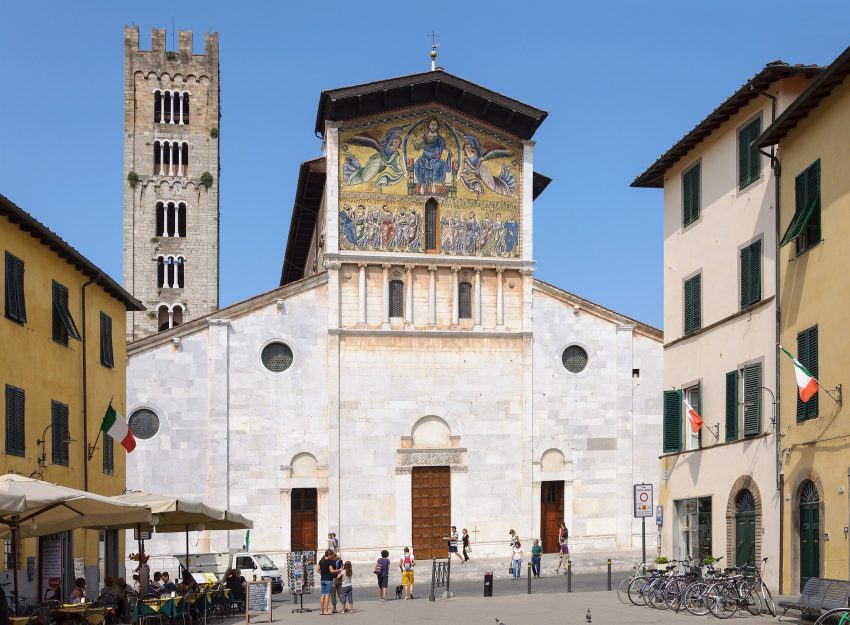
Standing just off Lucca's northern stretch of the historic centre, the Basilica of San Frediano feels both ancient and vividly alive. Tradition holds that it was founded by Saint Fridianus, bishop of Lucca from 560 to 588, making it one of the oldest places of worship in the region. A document from 685 already refers to it as a Lombard-era basilica, underlining its deep roots in the city's Christian history. Today, the church's plain stone walls conceal one of the most extraordinary façades in Tuscany: a vast, luminous mosaic from the late 13th century that catches the sun and seems to float above the piazza.
The façade mosaic is a rarity in the Romanesque world, matched in Tuscany only by that of San Miniato al Monte in Florence. It shows Christ the Redeemer ascending to heaven, enclosed in a mandorla carried by angels and once accompanied by the Virgin among the Apostles before a later window cut into the design. Attributed to the Lucca-based school of Berlinghieri, the mosaic glows in rich Byzantine tones that immediately set this church apart from its neighbours. Step inside and you find a grand three-aisled interior with matching arcades and magnificent colonnades, chapels painted and sculpted by masters, and an intricately carved baptismal font that anchors San Frediano as one of the top attractions in Lucca and a great place to visit on a walking tour of Lucca.
Table of Contents
- History and Significance of Basilica of San Frediano
- Things to See and Do in Basilica of San Frediano
- How to Get to Basilica of San Frediano
- Practical Tips on Visiting Basilica of San Frediano
- Where to Stay close to Basilica of San Frediano
- Add a Is Basilica of San Frediano Worth Visiting?
- FAQs for Visiting Basilica of San Frediano
- Nearby Attractions to Basilica of San Frediano
History and Significance of Basilica of San Frediano
The Basilica of San Frediano carries the name and legacy of Saint Fridianus (San Frediano), the Irish or British-born bishop who led Lucca's church from 560 to 588. He is traditionally credited with founding the original church on this site, which quickly became a focal point for early Christian worship in the region. By 685, documents already mention San Frediano as a Lombard-era basilica, confirming its importance during a time when Lucca was a key centre in the shifting political landscape of early medieval Italy.
Over the centuries, the structure evolved, but its Romanesque character remained strong. The decision in the late 13th century to cover the upper façade with a large mosaic was both artistic and theological: it visually proclaimed the basilica’s link to Eastern Christian imagery and the universal theme of Christ’s ascension. In a city already rich in churches, this golden, Byzantine-style façade gave San Frediano a unique identity, turning it into a landmark visible from surrounding streets and from the nearby city walls.
Inside, the basilica continued to gather layers of history. Families and confraternities commissioned chapels, frescoes, and sculptural works, using San Frediano as a canvas for devotional art and a place to honour local elites. The 12th-century baptismal font, carved with scenes from the life of Moses, the Apostles, and the cycle of the months, reflects both spiritual and everyday concerns, while later additions by artists like Amico Aspertini and Jacopo della Quercia connect Lucca's early Christian roots with the flowering of Renaissance art. As a result, the basilica is not only one of the things to do in Lucca for church lovers, but also a compact survey of almost 1,500 years of religious and artistic history.
Things to See and Do in Basilica of San Frediano
Begin your visit in the piazza, looking up at the façade. The mosaic of Christ the Redeemer ascending in glory is the star here, its gold and coloured tesserae shimmering in sunlight and standing out sharply against the stone below. Notice how the figures are framed within the architecture: the mandorla, the supporting angels, and the row of Apostles beneath (with the space where the Virgin once stood altered to accommodate the modern window). This single image links Lucca to the wider Mediterranean world, reflecting Byzantine influence filtered through a local workshop.
Inside, the basilica’s three naves are arranged with a pleasing regularity: identical arches resting on robust columns create a clear rhythm down the length of the church. The space feels at once monumental and manageable, drawing you toward the side chapels and the richly decorated font. Seek out the Chapel of Sant’Agostino, where Emilian painter Amico Aspertini’s 16th-century frescoes fill the walls with dynamic, sometimes eccentric scenes that contrast with the older Romanesque bones of the building.
Another key stop is the Tenta family chapel, home to a reredos and tombstones by Jacopo della Quercia, whose sculptural style bridges the Gothic and Renaissance worlds with elegance and emotional depth. Do not miss the 12th-century baptismal font, carved with reliefs showing the Stories of Moses, the Apostles, and the months of the year: it feels like a stone book, combining biblical narrative with the turning of the seasons. Taken together, these elements make the Basilica of San Frediano one of the must-see places in Lucca for anyone who enjoys art layered onto architecture.
How to Get to Basilica of San Frediano
The Basilica of San Frediano is located in the northern part of Lucca's walled historic centre, just a short walk from Piazza dell'Anfiteatro and Via Fillungo. Once inside the walls, you can follow signs toward “San Frediano” or simply head north along the main shopping street until you reach the square dominated by the basilica's mosaic-topped façade.
If you're flying into Tuscany, the closest major airports are Pisa International Airport and Florence Airport, both with regular connections into the region. For the best deals and a seamless booking experience, check out these flights to Lucca on Booking.com. From either airport you can continue to Lucca by train, bus, or hire car before walking into the old town.
Lucca's train station lies just outside the southern section of the city walls and is served by frequent regional trains from Pisa, Florence, and other Tuscan cities.Use Omnio to easily compare schedules, book train tickets, and find the best prices all in one place for a hassle-free journey across Italy. From the station, walk through Porta San Pietro and follow signs toward the centre and then north; reaching the Basilica of San Frediano usually takes around 15-20 minutes on foot.
For those arriving by car, the A11 motorway and local roads connect Lucca with Pisa, Florence, and the wider region.If you are looking to rent a car in Italy I recommend having a look at Discover Cars, first, as they compare prices and review multiple car rental agencies for you. Because the historic centre is largely a restricted traffic zone, it’s best to park in one of the designated lots outside or just inside the walls and then walk in; the basilica is easy to reach from most parking areas via a pleasant stroll through the old streets.
Practical Tips on Visiting Basilica of San Frediano
- Suggested tips: Spend a few extra minutes outside studying the mosaic from different angles and distances; small details and colour shifts become more apparent the longer you look.
- Best time to visit: Late morning and mid-afternoon offer good light on the façade mosaic, while early evening brings a quieter, more contemplative atmosphere inside.
- Entrance fee: Entry to the main basilica is often free or by small donation; a modest ticket may apply for access to specific areas or combined church itineraries.
- Opening hours: Typically open daily with a pause at mid-day and limited access during Mass; check the posted schedule at the entrance on the day of your visit.
- How long to spend: Allow 30-60 minutes to enjoy the façade, explore the interior, visit the chapels, and examine the baptismal font without rushing.
- Accessibility: There may be a small step at the entrance and some uneven flooring inside; visitors with reduced mobility should check access on arrival, but the main nave is generally straightforward to navigate.
- Facilities: The basilica itself has minimal visitor facilities; cafés, shops, and restrooms for customers are available in the surrounding streets and nearby squares.
- Photography tip: For the mosaic, step back to the far side of the piazza and aim slightly upward to capture the full scene; inside, focus on details of the font, frescoes, and sculpted tombstones rather than broad, darker views.
- Guided tours: Many guided walks around Lucca include San Frediano, weaving its early Christian history, mosaic, and chapels into a wider narrative of the city's churches.
- Nearby food options: Around the basilica and along nearby streets toward Piazza dell'Anfiteatro you'll find plenty of cafés, trattorie, and wine bars ideal for a coffee or meal before or after your visit.
Where to Stay close to Basilica of San Frediano
Staying near the Basilica of San Frediano puts you in a quieter yet very central part of Lucca's walled city, with easy access to both major sights and the tree-lined walls themselves. A comfortable and convenient option is Hotel Ilaria, which sits close to the eastern walls and a pleasant walk away from San Frediano, Piazza dell'Anfiteatro, and Via Fillungo. For travellers who prefer to be nearer the cathedral while remaining within a short stroll of the basilica, Albergo San Martino offers a cosy base in the heart of the historic centre. If you enjoy historic ambience in your accommodation as well as your sightseeing, Palazzo Alexander provides characterful rooms in a restored palace, conveniently located for exploring San Frediano, San Michele in Foro, and Lucca's city walls.
Add a Is Basilica of San Frediano Worth Visiting?
Basilica of San Frediano is absolutely worth visiting, particularly if you're interested in early Christian history and distinctive church façades. The combination of its ancient origins, the rare and resplendent 13th-century mosaic, the harmonious three-aisled interior, and the rich artistic details in its chapels and baptismal font makes it stand out even in a city as church-rich as Lucca. It offers a slightly quieter, more reflective experience than some of the more crowded sights, while still delivering a powerful visual and historical impact. For anyone tracing Lucca's story through its sacred spaces, this basilica is an essential stop.
What Other Travellers Say...

Basilica di San Frediano, on Piazza S. Frediano in Lucca, is a Romanesque church notable for its newly restored golden mosaic façade and an ornate 12th‑century font; visitors praise the interior art and frescoed side chapels and many recommend buying a ticket to enter and to climb the campanile for rewarding city views via a narrow, winding staircase. Many are drawn to the serene chapel housing Saint Zita's remains in a glass tomb, which visitors describe as a powerful, uplifting sight. Cafés line the small square outside, and entry to the church is paid.


FAQs for Visiting Basilica of San Frediano
Nearby Attractions to Basilica of San Frediano
- Piazza dell'Anfiteatro - An oval piazza built on the footprint of the Roman amphitheatre, ringed with cafés and shops.
- Guinigi Tower - Iconic brick tower topped with a rooftop garden of holm oaks, offering panoramic views over Lucca.
- San Michele in Foro - Angel-topped Romanesque church on the site of the Roman forum, rich in sculpture and Renaissance artworks.
- Cathedral of San Martino - Lucca's duomo, home to the Volto Santo, Nicola Pisano's Deposition, and Ilaria del Carretto's celebrated tomb.
- Lucca's Historical Walls - Complete Renaissance fortifications that now serve as a tree-lined promenade encircling the historic centre.
The Basilica of San Frediano appears in our Complete Guide to Visiting Lucca!

Moira & Andy
Hey! We're Moira & Andy. From hiking the Camino to trips around Europe in Bert our campervan — we've been traveling together since retirement in 2020!
This website uses affiliate links which may earn a commission at no additional cost to you!
Planning Your Visit
Typically open daily with a pause at mid-day and limited access during Mass; check the posted schedule at the entrance on the day of your visit.
Entry to the main basilica is often free or by small donation; a modest ticket may apply for access to specific areas or combined church itineraries.
Nearby Attractions
- Via Fillungo (0.1) km
Street - Piazza dell Anfiteatro (0.1) km
Amphitheatre - Palazzo Pfanner (0.2) km
Gardens and Historic Building - Domus Romana (0.2) km
Historic Site - Lucca City Walls (0.3) km
City Walls - Torre delle Ore (0.3) km
Tower - Guinigi Tower (0.3) km
Tower - San Michele in Foro (0.4) km
Basilica - Puccini Museum (0.4) km
Historic Building and Museum - Villa Bottini (0.5) km
Historic Building