Place Royale, Nantes
Historic Building in Nantes
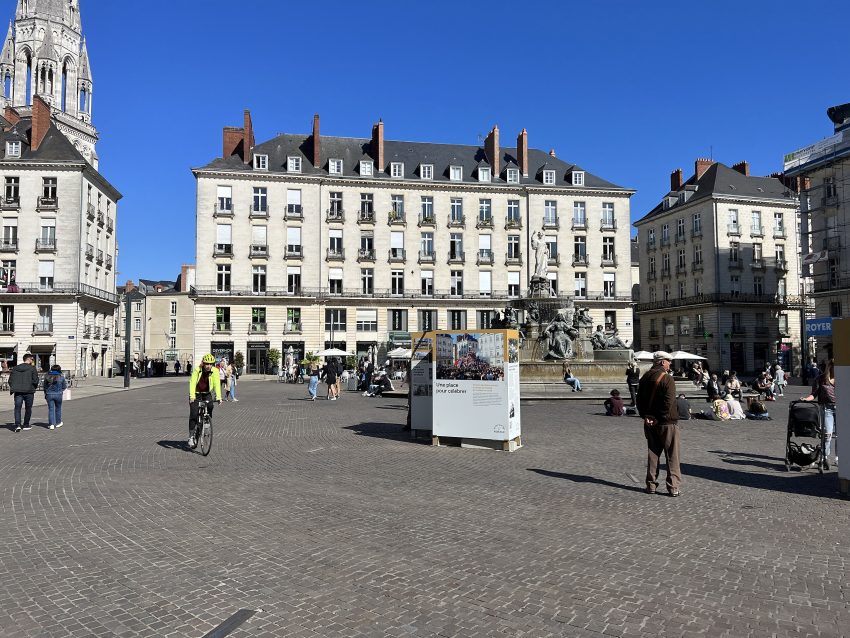
Place Royale is one of the top sights in Nantes if you love beautiful squares that mix history, architecture, and everyday life. Designed by Mathurin Crucy in 1786 and completed in 1790, it emerged after the demolition of the medieval ramparts, symbolising a modern, outward-looking city. The square's distinctive layout-part rectangular to the east, semicircular to the west-creates a shape locals sometimes compare to a “toilet mirror”, but the effect in person is pure classical elegance, framed by harmonious facades and bustling ground-floor shops and cafés.
At its heart, the monumental fountain inaugurated in 1865 pulls everything together. A pyramid-like structure cascades water through three granite basins, surrounded by allegorical figures of Nantes, the Loire, and its tributaries: the Erdre, Sèvre, Cher, and Loiret. The crowned central figure holding a trident underlines the city's maritime vocation, reminding you that this urban stage is rooted in centuries of river trade and Atlantic connections. Often visited on walking tours of Nantes, Place Royale is as much a lived-in public space as it is a postcard-perfect backdrop.
Table of Contents
History and Significance of the Place Royale
Place Royale was born out of a major 18th-century urban renewal project. With the medieval ramparts coming down, Nantes had the chance to rethink its centre, and architect Mathurin Crucy seized the opportunity to create a grand classical square that would showcase the city's ambitions. Completed in 1790, the design combines a rectangular eastern section and a semicircular western part, forming a distinctive, carefully proportioned space that channels light and movement in a very deliberate way.
Unlike some other royal squares in France, Place Royale never hosted a statue of a monarch. Instead, it became a symbol of civic pride and a flexible stage for public life. Over the centuries, it has hosted everything from artistic performances and festive celebrations to political rallies and demonstrations, reflecting the changing moods and priorities of Nantes itself. In this sense, the square tells as much of a social story as an architectural one.
The devastation of World War II left deep scars, and Place Royale suffered significant damage during bombing raids. Its meticulous restoration between 1945 and 1961 was a statement of resilience and respect for the city's heritage. Later, in the early 2000s, the square was reworked again to prioritise pedestrians, folding it into a wider car-free zone. Today, it stands as an accomplished blend of 18th-century design and 21st-century urban thinking, a space built for people rather than traffic.
Things to See and Do in the Place Royale
The fountain is the obvious focal point, and it rewards a lingering look. Walk around it slowly to take in the sculptural details: the crowned figure of Nantes with her trident, the personifications of the Loire and its tributaries, and the way water flows through the three granite basins. Each element hints at the city's long relationship with river trade, shipbuilding, and maritime routes reaching far beyond the Loire estuary.
Lift your gaze to the surrounding facades, whose symmetry and rhythm are key to the square's atmosphere. The upper levels present a harmonious classical frontage, while the ground-floor shops and cafés provide the energy-display windows, tables spilling onto terraces, and people meeting, talking, and passing through. Place Royale is one of the where to go in Nantes when you want to feel the pulse of the city in a single glance.
For visitors, this is a perfect place to pause between sights. Grab a coffee at a terrace, watch the fountain and the tramlines just beyond, and use the square as a mental map reference as you connect other landmarks like Passage Pommeraye, Place Graslin, and the château. At certain times of year, seasonal decorations, light displays, or events add an extra layer of spectacle, turning the square into a stage for festivals and public art.
How to Get to the Place Royale
Place Royale sits in the very heart of central Nantes, close to the main shopping streets and within easy walking distance of Passage Pommeraye, Place Graslin, and the historic core. Most international visitors arrive via Nantes Atlantique Airport, southwest of the city, where shuttle buses and other public transport connect the terminal to central Nantes in about 20-30 minutes; from the drop-off points, it's a short tram ride or walk into the pedestrian zone around the square. For the best deals and a seamless booking experience, check out these flights to Nantes on Booking.com.
If you are arriving by train, Nantes' main railway station offers TGV and regional services from cities such as Paris, Rennes, and Bordeaux. From the station, you can reach Place Royale by tram or bus, or on foot in roughly 20-25 minutes, passing the château and central shopping streets along the way. You can use SNCF Connect to check schedules, compare routes, and purchase tickets for National (SNCF ) and regional trains (TER). For a more streamlined experience, we recommend using Omio, which allows you to easily compare prices, schedules, and book tickets for both National and Regional travel across all of Europe, all in one place. The pedestrian layout of the centre makes it easy to navigate, and Place Royale is well signposted.
Travellers by car should follow signs for Nantes centre and look for nearby underground car parks around the central shopping district, such as those near Place Graslin or along the main axes; from there, it is a short walk through the pedestrianised streets to the square. If you are looking to rent a car in France I recommend having a look at Discover Cars, first, as they compare prices and review multiple car rental agencies for you. Once you are in the area, exploring on foot is the best way to appreciate the architecture and atmosphere without worrying about traffic.
Practical Tips on Visiting the Place Royale
- Suggested tips: Use Place Royale as a natural pause point between visits to Passage Pommeraye, the château, and Bouffay; it is ideal for a mid-morning coffee or late-afternoon drink.
- Best time to visit: Late morning and early evening are especially atmospheric, with good light for photos and a lively but not overwhelming buzz from cafés and shops.
- Entrance fee: Free; Place Royale is a public square open to everyone.
- Opening hours: Accessible at all times as an open public space, though shops and cafés follow their own business hours.
- How long to spend: Plan 20-40 minutes to enjoy the fountain, take photos, and soak up the atmosphere; longer if you sit at a terrace or use it as a base between other sights.
- Accessibility: The square is largely flat and paved, making it easy to navigate for visitors with reduced mobility; surrounding streets are pedestrian-friendly but can be busy.
- Facilities: While there are no dedicated facilities in the square itself, cafés, shops, and nearby streets offer toilets, food, and services within a few minutes’ walk.
- Photography tip: Shoot from the corners of the square to capture the fountain framed by facades, or from slightly elevated spots in nearby streets to show the “mirror” layout.
- Guided tours: Many guided city walks pass through Place Royale, using it to explain Nantes' 18th-century urban planning and post-war reconstruction.
- Nearby food options: The area around the square is full of bakeries, brasseries, and cafés-ideal for anything from a quick snack to a longer lunch with a view of the fountain.
Where to Stay close to the Place Royale
Staying near Place Royale puts you right at the heart of Nantes' city life, just steps from main shopping streets, theatres, and many key attractions. For a stylish, central base, Hôtel La Pérouse Nantes offers contemporary design within a short stroll of both Place Royale and Passage Pommeraye, with easy tram access across the city. If you prefer to mix the lively centre with historic views, L'Hôtel - Face au Château sits opposite the Château des Ducs de Bretagne and is an enjoyable walk from the square through the old streets. For a quieter, neighbourhood feel while staying within walking distance of Place Royale and the main sights, Hôtel Chateaubriand provides a cosy, good-value option.
Is the Place Royale Worth Visiting?
Place Royale is absolutely worth visiting, especially if you enjoy seeing how a city expresses its identity in public spaces. The square's classical lines, striking fountain, and layered history-from rampart demolition to wartime damage and modern pedestrianisation-make it much more than just a pretty backdrop. It is a place where locals meet, events unfold, and the rhythm of daily life plays out around a 19th-century monument to Nantes' maritime and commercial power. This spot is one of the best places to see in Nantes if you want a single, memorable scene that captures both the city's heritage and its contemporary energy.
What Other Travellers Say...

Fontaine de la Loire at 17 Place Royale in Nantes sits in the centre of a lively square surrounded by cafes and restaurants and offers stepped seating where visitors often relax; opinions vary on its recent modern sculptures—many find them a striking, contemporary update while some feel they clash with the setting—and the fountain is generally kept clean; visitors note it can be festive when events are on, and advise keeping an eye on belongings in the area.


FAQs for Visiting Place Royale
Nearby Attractions to the Place Royale
- Passage Pommeraye: A stunning 19th-century covered arcade with a grand staircase, glass roof, and elegant boutiques just a short walk away.
- Place Graslin: An 18th-century square anchored by the Graslin Theatre and surrounded by cafés and restaurants, perfect for dining and people-watching.
- Château des Ducs de Bretagne and Nantes History Museum: A former ducal fortress housing the city's history museum, with ramparts and an inner courtyard to explore.
- Quartier Bouffay: The lively medieval quarter filled with narrow lanes, half-timbered houses, and plenty of bars and eateries.
- Cathédrale Saint-Pierre-et-Saint-Paul de Nantes: The city's Gothic cathedral with a soaring nave and the tomb of François II, within walking distance of the square.
The Place Royale appears in our Complete Guide to Visiting Nantes!

Moira & Andy
Hey! We're Moira & Andy. From hiking the Camino to trips around Europe in Bert our campervan — we've been traveling together since retirement in 2020!
This website uses affiliate links which may earn a commission at no additional cost to you!
Planning Your Visit
Accessible at all times as an open public space, though shops and cafés follow their own business hours.
Free; Place Royale is a public square open to everyone.
Nearby Attractions
- Passage Pommeraye (0.1) km
Historic Building - Place Graslin (0.3) km
Square - Eglise Sainte-Croix (0.3) km
Church - Jungle Intérieure (0.4) km
Gardens - Natural History Museum of Nantes (0.5) km
Museum - Musée Thomas Dobrée (0.6) km
Museum - Nantes History Museum (0.7) km
Museum - Cathédrale Saint-Pierre-et-Saint-Paul de Nantes (0.7) km
Cathedral - Château des Ducs de Bretagne (0.8) km
Castle - Mémorial de l'Abolition de l'Esclavage (0.8) km
Monument