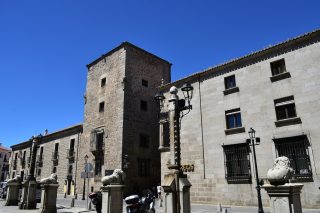
Palace of Polentinos (Ávila)
Historic Building and Palace in Ávila

The Palacio de Polentinos is one of those Ávila surprises that feels like you've “found” it rather than ticked it off. Tucked inside the walled city on Calle Vallespín, it's a noble Renaissance palace built around a calm, square courtyard-an architectural pause-button amid the stone-and-tower intensity that defines the old town.
Today the building forms part of the complex that houses the General Military Archive of Ávila and the Quartermaster (Intendencia) museum, but it still reads first and foremost as an elegant 16th-century mansion. If you enjoy architecture and want a quieter counterpoint to the big monuments, this is one of the things to see in Ávila on a walking tour of Ávila, especially because the façade and courtyard are both genuinely memorable.
Table of Contents
- History and Significance of the Palacio de Polentinos
- Things to See and Do in the Palacio de Polentinos
- How to Get to the Palacio de Polentinos
- Practical Tips on Visiting the Palacio de Polentinos
- Where to Stay Close to the Palacio de Polentinos
- Is the Palacio de Polentinos Worth Visiting?
- For Different Travelers
- FAQs for Visiting Palacio de Polentinos
- Nearby Attractions to the Palacio de Polentinos
History and Significance of the Palacio de Polentinos
The palace was built in the early 16th century by the influential Contreras family, with work linked to the circle of the sculptor Vasco de la Zarza, and it remains one of Ávila’s standout civil buildings from the Renaissance period. Its later name comes from the Counts of Polentinos, reflecting the way prominent marriages and titles reshaped property identities over generations in Castilian cities.
Architecturally, the building is a great snapshot of how the Renaissance arrived in Ávila without abandoning local craftsmanship. The plateresque façade-rich with carved detail-acts almost like a public statement of status, while the interior plan focuses on proportion, symmetry, and a controlled sense of grandeur.
In the modern era, the palace’s role shifted from private residence to public and institutional use. It became associated with the Army’s Quartermaster training and later the General Military Archive, and since 2011 it has also hosted the Quartermaster museum collection, giving the palace a second life as a place where architecture and military-social history overlap.
Things to See and Do in the Palacio de Polentinos
Start outside with the façade, because it's the palace's “signature moment.” The layout is balanced and confident, but the decorative richness is what pulls you in-look closely and you'll notice how the ornament feels both ceremonial and distinctly Ávila in its stonework character.
Inside, the heart of the building is the square courtyard with two levels of slender proportions. The monolithic columns and the plateresque details on friezes and shields are worth lingering over, because the space is designed to be looked at slowly, not rushed through.
If you’re lucky enough to see the grand interior rooms used historically for formal functions, the standout is the tribute room with its impressive coffered ceiling and carved corbels. Even when your visit is focused on the museum areas, keep an eye on ceilings, stair details, and door frames-the palace itself is the main exhibit.
The Quartermaster museum adds a very different layer: uniforms, logistics, provisioning, and the “behind the scenes” story of how armies actually function. It’s compact enough to stay light on your schedule, but distinctive enough that it won’t blur into the next church or palace you visit.
How to Get to the Palacio de Polentinos
Because it sits inside Ávila's walled old town, the simplest approach is on foot from central landmarks like Mercado Chico and the cathedral area-once you're in the historic centre, it's a quick, easy link through walkable streets.
For most travellers, Madrid-Barajas Airport (MAD) is the main international gateway for reaching Ávila, followed by onward rail or coach connections into the city. For the best deals and a seamless booking experience, check out these flights to Ávila on Booking.com. From Madrid, trains to Ávila are a practical option, and from Ávila's station you can take a short taxi ride or walk into the old town depending on where you're staying. Train schedules and bookings can be found on Omio.
Long-distance buses from Madrid and other regional hubs can be straightforward and often land you close enough that the final leg is easy by taxi or a short walk. If you're driving, park outside the tightest historic streets and walk in, since the walled centre is best experienced on foot. If you are looking to rent a car in Spain I recommend having a look at Discover Cars, first, as they compare prices and review multiple car rental agencies for you.
Practical Tips on Visiting the Palacio de Polentinos
- Entrance fee: Free.
- Opening hours: Monday – Friday: 10:30–14:00. Saturday – Sunday & Public holidays: 10:30–14:30 & 16:00–19:00.
- Official website: https://patrimoniocultural.defensa.gob.es/es/centros/museo-intendencia-avila/portada
- Best time to visit: Go late morning for a calm, unhurried feel in the courtyard, then continue your route toward nearby monuments inside the walls.
- How long to spend: Plan 30-60 minutes for a satisfying visit, longer if you like reading exhibits and pausing for architectural details.
- Accessibility: Expect historic thresholds and some uneven surfaces; the palace is manageable for many visitors, but full step-free access may vary by room.
- Facilities: Bring a photo ID if you’re planning anything beyond a casual museum-style visit, and treat this as a focused stop with breaks best taken in nearby plazas and cafés.
Where to Stay Close to the Palacio de Polentinos
For a culture-heavy itinerary, base yourself inside Ávila’s walled Old Town so you can walk to the main sights dawn-to-dusk, while travellers prioritising transport links may prefer the station area for the smoothest arrivals and departures.
If you want a refined, historic stay that keeps you close to the walls and puts the old town at your doorstep, Sofraga Palacio is a strong choice for comfort and location. For a classic “sleep inside the monument zone” feel near the cathedral and central lanes, Hotel Palacio de los Velada makes it easy to move between churches, palaces, and evening strolls without thinking about transport. If you prefer a quieter base with a little more space while still staying within the historic quarter, Parador de Ávila is ideal for an unhurried, garden-set atmosphere.
Is the Palacio de Polentinos Worth Visiting?
Yes-especially if you like Renaissance architecture and want a “civil” monument to balance Ávila’s more famous religious sites. The courtyard and façade are genuinely distinctive, and the building’s proportions make it feel elegant rather than overpowering.
It’s also a smart stop for variety: the military-archive setting and Quartermaster collection give you a slice of Ávila’s institutional history that most visitors miss, while still delivering a strong architectural payoff.
What Other Travellers Say...

Palacio Polentinos sits on C. Vallespín 19 in Ávila’s walled city and houses a small, free museum focused on the history of the Spanish Army’s Logistic Corps; visitors praise the beautiful Renaissance building and courtyard, note most signage is Spanish, and say a visit typically takes about 15–20 minutes while being family-friendly even during partial restoration work.


For Different Travelers
Families with Kids
This works well for families because the visit can be short, structured, and visually engaging-courtyard first, then a quick look at the most interesting museum displays. It’s an easy “small win” stop between bigger landmarks that can feel more formal or crowded.
If you’re travelling with kids who like stories, frame it as a palace that later became part of the city’s military history, with objects that show how people lived and worked behind the scenes. Keeping it snack-and-break friendly by pairing it with a nearby square helps everyone stay happy.
Couples & Romantic Getaways
For couples, the Palacio de Polentinos is ideal when you want something quieter and more intimate than the headline sights. The courtyard has a calm, enclosed elegance that feels made for slow travel-pause, look up, and take in the detail without feeling rushed.
It also fits beautifully into an unstructured day: palace stop, a wander through walled lanes, then a long lunch or early evening stroll. If you enjoy photography, the best shots here are often the subtle ones-columns, shadows, doorways, and stone textures.
Budget Travelers
This is a strong pick for budget travellers because it adds real depth to your itinerary without putting pressure on your wallet. It’s also centrally placed, so you can fold it into a walking loop without paying for extra transport.
The best strategy is to pair it with other nearby, walkable highlights so you’re maximising value per step: palace, a section of walls, a church interior, then a viewpoint. You’ll get a full day of variety while keeping costs controlled.
History Buffs
History buffs will enjoy how the palace links noble life, civic acquisition, and later military use in one place. It’s a neat case study in how buildings are repurposed over centuries without losing their architectural identity.
If you’re interested in “how a city actually functioned,” the Quartermaster theme is especially rewarding because it focuses on logistics, provisioning, and administration rather than battlefield drama. It rounds out Ávila’s story beyond saints and fortifications.
FAQs for Visiting Palacio de Polentinos
Getting There
Tickets & Entry
Visiting Experience
Tours, Context & Itineraries
Photography
Accessibility & Facilities
Food & Breaks Nearby
Safety & Timing
Nearby Attractions to the Palacio de Polentinos
- Ávila Cathedral: A fortress-like Gothic cathedral that anchors the old town and rewards a slow circuit around its dramatic exterior.
- Plaza del Mercado Chico: Ávila's central square area, ideal for a short break and a sense of local day-to-day rhythm.
- The Walls of Ávila: The city's signature landmark, with walkable sections and viewpoints that frame the old town beautifully.
- Basílica de San Vicente: One of Spain's strongest Romanesque churches, known for its sculpture and commanding stone presence.
- Convento de Santa Teresa: A key Saint Teresa site that adds context to Ávila's spiritual history and pilgrimage identity.
The Palace of Polentinos (Ávila) appears in our Complete Guide to Visiting Ávila!

Moira & Andy
Hey! We're Moira & Andy. From hiking the Camino to trips around Europe in Bert our campervan — we've been traveling together since retirement in 2020!
This website uses affiliate links which may earn a commission at no additional cost to you!
Planning Your Visit
Monday - Friday: 10:30-14:00.
Saturday - Sunday & Public holidays: 10:30-14:30 & 16:00-19:00.
Free.
Nearby Attractions
- Parador de Ávila (0.2) km
Palace - El Convento de Santa Teresa (0.2) km
Convent - Iglesia de San Juan Bautista (0.2) km
Church - Torreón de los Guzmanes (0.2) km
Palace - Palacio de Los Superunda (0.2) km
Palace - Palacio de Núñez Vela (0.2) km
Palace - Palacio de Los Almarza (0.2) km
Palace - Plaza Mercado Chico (0.2) km
Square - Puerta de Santa Teresa (0.2) km
City Gate - Puerta del Carmen (0.2) km
City Gate, City Walls and Convent