New Town Hall, Dinkelsbühl
Historic Building in Dinkelsbühl
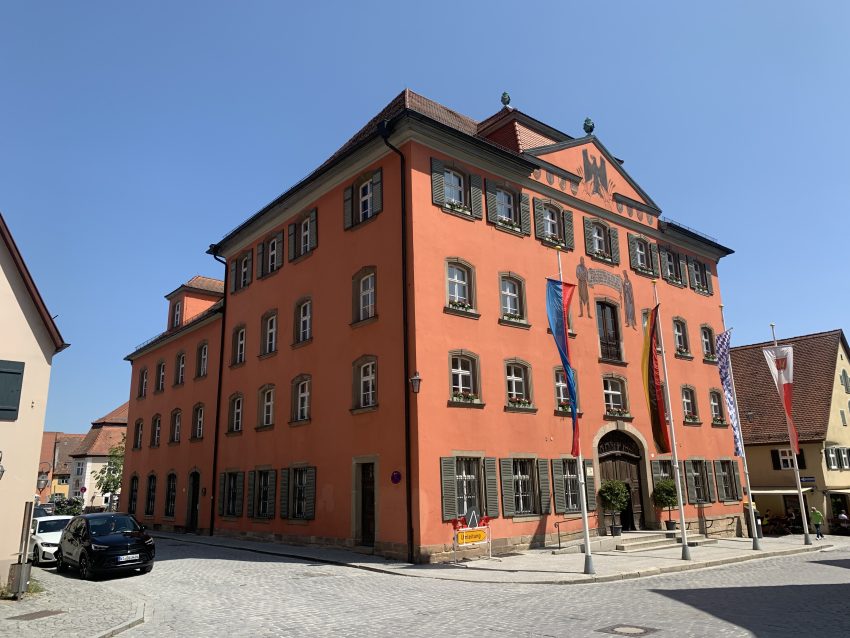
The New Town Hall in Dinkelsbühl stands at the heart of the old town, a Baroque-era building constructed in 1733 that has served both private and civic purposes over the centuries. Originally built as the residence of Bauer-who held positions as postmaster, senator, and eventually mayor-the building showcases the prosperity and influence of its early owners. Its handsome façade and central location make it one of the top sights in Dinkelsbühl for travellers who enjoy elegant architecture paired with rich historical context.
Since 1855, this building has housed the town administration, cementing its role in local political life. Above the main entrance, visitors can see a banner displaying a quotation from the Richtungsbrief of 1387, a foundational document that shaped the organisation and authority of Dinkelsbühl's guilds. Across the street stands the former guesthouse Drei Mohren, a place of cultural interest thanks to Johann Wolfgang von Goethe, who dined there on 4 November 1797 during his journey to Nuremberg. This spot is often visited on walking tours of Dinkelsbühl, offering a blend of architecture, governance, and literary history.
Table of Contents
- History and Significance of the New Town Hall
- Things to See and Do in the New Town Hall
- How to Get to the New Town Hall
- Practical Tips on Visiting the New Town Hall
- Where to Stay close to the New Town Hall
- Is the New Town Hall Worth Visiting?
- FAQs for Visiting the New Town Hall
- Nearby Attractions to the New Town Hall
History and Significance of the New Town Hall
Built in 1733 as a private residence, the New Town Hall reflects the Baroque architectural style that flourished in southern Germany during the 18th century. Its construction by Bauer-a man who held several prominent civic roles-underscores the building's original status as a symbol of influence and social standing within Dinkelsbühl.
By 1855, the building's purpose shifted from private residence to municipal administration. This transition marked a significant moment in the town's governance, as the New Town Hall became the operational centre of civic life. The inscription above the entrance, taken from the 1387 Richtungsbrief, serves as a historical anchor connecting centuries of guild traditions, local regulation, and political evolution.
The New Town Hall also carries cultural significance beyond its administrative role. Its location directly opposite the former guesthouse Drei Mohren ties it to Goethe's documented visit in 1797, when the iconic writer stopped in Dinkelsbühl en route to Nuremberg. This association adds a literary dimension to the building's already rich historical identity.
Things to See and Do in the New Town Hall
A visit to the New Town Hall begins with appreciating its Baroque exterior, where balanced proportions and subtle decorative details hint at the building's 18th-century origins. The entrance banner featuring the quotation from the Richtungsbrief offers insight into the town's medieval guild system, making this a rewarding stop for anyone interested in civic or social history.
While the building primarily functions as an administrative centre and is not typically open for full interior tours, the exterior alone tells an engaging story. Stand opposite the building to take in its elegant façade and to imagine the comings and goings of both Bauer’s household and later civic officials across the centuries.
Directly across the street, the former guesthouse Drei Mohren invites you to pause and reflect on Goethe's journey. Though the building's function has changed over time, its location still evokes the historic encounter between Dinkelsbühl and one of Germany's greatest literary figures. Together, the two buildings create an engaging corner of the old town filled with architectural charm and cultural resonance.
How to Get to the New Town Hall
The nearest major airports to Dinkelsbühl are Nuremberg Airport and Stuttgart Airport, each offering frequent international and domestic flights. For the best deals and a seamless booking experience, check out these flights to Dinkelsbühl on Booking.com.
As Dinkelsbühl lacks its own train station, visitors typically travel to nearby Dombühl or Ansbach by train. Both towns maintain frequent regional connections from Nuremberg and surrounding cities. From these railway stations, buses run directly into Dinkelsbühl's historic centre. Train schedules and bookings can be found on Omio.
Travelling by car is straightforward, with well-signposted routes from Rothenburg ob der Tauber, Nuremberg, and the scenic Romantic Road. Parking areas located outside the old town walls provide easy access to the New Town Hall on foot. If you are looking to rent a car in Germany I recommend having a look at Discover Cars, first, as they compare prices and review multiple car rental agencies for you.
Practical Tips on Visiting the New Town Hall
- Best time to visit the New Town Hall: Year-round, as the building’s exterior and location are always accessible.
- Entrance fee in Euros: Viewing the exterior is free.
- Opening hours: The administrative offices have set hours, but exterior viewing is possible at any time.
- Official website: Consult the Dinkelsbühl tourism page for additional historical information.
- How long to spend: Around 10-20 minutes, especially if visiting Drei Mohren as well.
- Accessibility: The surrounding streets are flat and easy to navigate.
- Facilities: Cafés, bakeries, and shops are nearby in the old town.
- Photography tip: Capture the building from across the street to include the inscription banner above the entrance.
- Guided tours: Some tours discuss the building’s role in town governance.
- Nearby food options: Several traditional restaurants and cafés are within a short walk.
Where to Stay close to the New Town Hall
Staying within the old town makes it easy to explore the New Town Hall and the surrounding historic streets. A highly regarded option is Hotel Deutsches Haus, located just a short walk away. For a stylish stay in beautifully restored buildings, Hezelhof Hotel is an excellent choice. Travellers seeking a cosy and central stay often enjoy Goldene Rose, offering comfort close to many key landmarks.
Is the New Town Hall Worth Visiting?
Yes, the New Town Hall is absolutely worth visiting for its Baroque architecture, historical continuity, and cultural connections. Its role in shaping local governance, combined with the nearby Drei Mohren and its link to Goethe, makes it a rewarding stop for travellers seeking deeper insights into Dinkelsbühl's past.
What Other Travellers Say...

Dinkelsbüchl Altstadt is a compact, walkable medieval town on the Romantic Road with well-preserved half-timbered houses, cobbled streets, city walls, towers and gates; visitors praise its photogenic charm, peaceful park outside the walls, pleasant shops and cafes and recommend strolling along the walls by the river (especially at night), allowing several hours or staying overnight, while noting parking is available but limited in duration and not free.


FAQs for Visiting the New Town Hall
Nearby Attractions to the New Town Hall
- St. Georg Church: A stunning Gothic landmark dominating the town skyline.
- Segringer Tor: A Baroque-era gate offering scenic views and historic fortifications.
- Nördlingen Gate: A medieval gateway with unique architectural features and garden plots.
- Hospital of the Holy Spirit: A peaceful medieval complex with Gothic and Baroque elements.
- Armoury of the Kinderzeche: A 16th-century building housing artefacts from the town's famous festival.
The New Town Hall appears in our Complete Guide to Visiting Dinkelsbühl!

Moira & Andy
Hey! We're Moira & Andy. From hiking the Camino to trips around Europe in Bert our campervan — we've been traveling together since retirement in 2020!
This website uses affiliate links which may earn a commission at no additional cost to you!
Nearby Attractions
- Three Kings Chapel (0.2) km
Church - Weinmarkt (0.2) km
Historic Building - Bäuerlin Tower (0.2) km
City Walls and Tower - Segringer Tor (0.2) km
City Gate and Tower - St. Georg Church (0.2) km
Cathedral - Hospital of the Holy Spirit (0.3) km
Church and Historic Building - Armoury of the Kinderzeche (0.3) km
Historic Building - House of History (0.3) km
Historic Building and Museum - Rothenburg Gate (0.3) km
Historic Building and Tower - Faulturm (Debtors' Tower) (0.3) km
Tower