Lucca City Walls
City Walls in Lucca
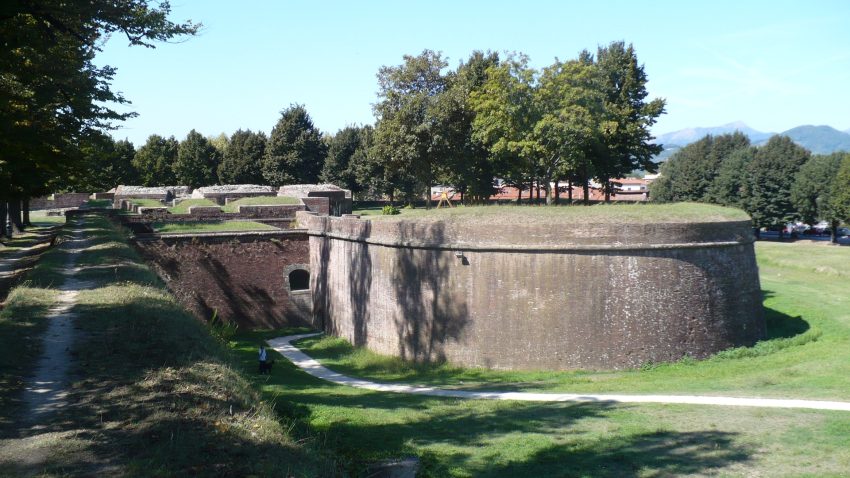
Lucca's Historical Walls are the city's signature feature: a complete, elevated ring that wraps the old town in brick, trees, and wide pathways. Built between the mid-1600s and early 1800s, this is actually the fourth generation of walls on the site, following a Roman circuit from the 2nd century BCE, a medieval line completed in 1270, and a late-1500s redesign that anticipated the present form. What survives today is a remarkably intact Renaissance fortification, with 11 bastions, 12 enceintes with ramparts, and six imposing gates forming a 4.2 km loop-yet instead of soldiers, you'll find joggers, cyclists, and families out for a stroll.
Originally conceived to counter the growing military threat from nearby Florence, the walls were a massive undertaking. Work began in 1544 under the guidance of Italian and Flemish experts, with around 2,000 labourers on site daily and extra manpower drafted in from the surrounding countryside once a week. Ironically, the walls saw almost no military action: their only dramatic “defence” came in 1812, when a flood of the River Serchio threatened Lucca. The city shut and reinforced all gates, and the bastioned ring successfully held back the water. Today, this peaceful, elevated promenade is a highlight of any walking tour of Lucca and one of the must-see places in Lucca for anyone wanting to understand how the city grew and protected itself.
Table of Contents
- History and Significance of Lucca’s Historical Walls
- Things to See and Do in Lucca’s Historical Walls
- How to Get to Lucca’s Historical Walls
- Practical Tips on Visiting Lucca’s Historical Walls
- Where to Stay close to Lucca’s Historical Walls
- Is Lucca’s Historical Walls Worth Visiting?
- FAQs for Visiting Lucca’s Historical Walls
- Nearby Attractions to Lucca’s Historical Walls
History and Significance of Lucca’s Historical Walls
The current walls are the latest chapter in a very long story. Lucca’s first defences were laid out by the Romans in the 2nd century BCE, encircling a compact settlement with a typical grid of streets. As the town expanded and the Middle Ages unfolded, a new, larger circuit was completed in 1270, wrapping the growing community in stone and earth. By the late 1500s, changes in artillery and siege warfare meant those older lines were outdated, prompting work on a third, more modern fortification that began to resemble the walls you see today.
From 1544 onwards, the threat from Florence-whose influence had spread as far as Altopascio, just 15 km away-pushed Lucca to reinforce its defences further. The city hired Italian and Flemish military engineers to design a cutting-edge bastioned system, capable of withstanding cannon fire and prolonged sieges. The scale of the project was huge: nearly 2,000 workers were employed each day, with additional labour from the countryside called in weekly. The result was a massive earth-filled brick structure with bastions, ramparts, and strategic gates, more like a low fortress than a simple city wall.
Remarkably, these defences were almost never tested in battle. Their most notable use came during the 1812 flooding of the Serchio, when the authorities closed and reinforced all the gates, effectively turning the city into a watertight bowl that protected Lucca from the high waters. In 1815, with the arrival of the Borbone family from Parma and the creation of the Duchy of Lucca, Duchess Maria Luisa set a new course for the walls: she commissioned architect Lorenzo Nottolini to turn parts of them into green spaces. By the late 1800s, the fortifications had been fully transformed into a public park, a model of adaptive reuse that still defines the city's character today.
Things to See and Do in Lucca’s Historical Walls
The classic experience is to walk or cycle the entire 4.2 km circuit. The path is wide, flat, and shaded by long rows of trees, making it easy for all ages and fitness levels. As you move from bastion to bastion, you’ll enjoy shifting views: one moment you’re looking down onto terracotta rooftops and church towers, the next you’re facing open countryside, the Serchio plain, or the hills beyond. Benches and grassy areas invite you to pause and take it all in.
Each bastion has its own character, often with grassy slopes, shaded corners, and small clearings where locals meet, picnic, or read. Some ramparts host playgrounds and informal sports areas, while others remain quiet, leafy viewpoints. The six gates offer natural entry and exit points, linking the walls to key parts of the city below: from here, stairways and ramps drop you into the old streets, where you can wander to the cathedral, Piazza dell'Anfiteatro, or San Michele in Foro before climbing back up again.
You don't have to do the full loop in one go. Many visitors choose to walk just one section at a time-perhaps from a gate near their hotel to a viewpoint or bastion they've been recommended, then back down into town for a coffee or gelato. Whatever your route, the combination of history underfoot, greenery around you, and Lucca's skyline at eye level makes the walls one of the best places to visit in Lucca if you enjoy mixing gentle exercise with panoramic city views.
How to Get to Lucca’s Historical Walls
Lucca's Historical Walls form a complete ring around the old town, so once you've reached the city, you can't really miss them. The elevated, tree-lined embankment is visible from most approaches, with multiple ramps and stairways allowing access to the top from just inside the perimeter streets.
If you are flying into Tuscany, the most convenient airports are Pisa International Airport and Florence Airport, both of which have good onward connections to Lucca. For the best deals and a seamless booking experience, check out these flights to Lucca on Booking.com. From the airport you can continue by train, bus, or hire car, depending on your itinerary.
By train, Lucca is well served by regional lines from Pisa, Florence, and other Tuscan cities.Use Omnio to easily compare schedules, book train tickets, and find the best prices all in one place for a hassle-free journey across Italy. The station lies just outside the southern stretch of the walls near Porta San Pietro; from there, it’s only a few minutes’ walk to the nearest ramp onto the ramparts, making it easy to start your circuit as soon as you arrive.
If you are travelling by car, the A11 motorway and regional roads link Lucca with Pisa, Florence, and the rest of Tuscany.If you are looking to rent a car in Italy I recommend having a look at Discover Cars, first, as they compare prices and review multiple car rental agencies for you. Parking is available in lots outside or just inside the walls; once you’ve parked, you can walk to the nearest access point and head up onto the walkway. Remember that the historic centre inside the walls has restricted vehicle access, so it’s usually best to leave the car and explore on foot or by bike.
Practical Tips on Visiting Lucca’s Historical Walls
- Suggested tips: Consider renting a bicycle for an hour or two to ride the full circuit, then slow down on foot for your favourite sections and bastions.
- Best time to visit: Early morning and late afternoon offer cooler temperatures and softer light, while evenings are especially atmospheric in summer when locals come out to stroll.
- Entrance fee: Free – the walls are a public park and promenade open to everyone.
- Opening hours: Generally accessible year-round; specific ramps or gates may have limited hours, but the main circuit can usually be enjoyed from early morning until late evening.
- How long to spend: Allow 1-2 hours for a full loop at a relaxed pace, plus extra time if you plan to stop at viewpoints, playgrounds, or cafés inside the city.
- Accessibility: The walkway is broad and mostly level, suitable for wheelchairs and strollers once you are on top; look for ramps rather than stairs at certain gates for easier access.
- Facilities: Along the circuit you’ll find benches, tables, drinking fountains, and children’s play areas, especially near the bastions; cafés and restrooms are available just below on the city side.
- Photography tip: Use the walls as a moving balcony-shoot toward the old town for rooftops and towers, then toward the countryside for sweeping views of the surrounding hills.
- Guided tours: Local guides often include a segment of the walls in their itineraries, combining historical explanation of the fortifications with viewpoints over key landmarks.
- Nearby food options: Drop down from the ramparts into streets near Porta Elisa, Porta San Pietro, or Piazza Napoleone for bakeries, wine bars, and trattorie serving Lucchese specialities.
Where to Stay close to Lucca’s Historical Walls
Staying near Lucca's Historical Walls lets you step straight up onto the ramparts for a morning walk or an evening passeggiata. Just inside the walls near Porta San Pietro, Albergo San Martino offers a welcoming base within easy reach of both the cathedral and the nearest access to the walkway. For a comfortable hotel that sits close to the eastern stretch of the walls and the historic centre, Hotel Ilaria is a popular choice, with quick access to ramps, bastions, and the tree-lined path above. If you prefer a touch of historic charm, Palazzo Alexander places you inside the walled city but still just a short stroll from the nearest climb up to the fortifications, making the walls a great place to visit on a walking tour of Lucca starting right from your door.
Is Lucca’s Historical Walls Worth Visiting?
Lucca's Historical Walls are absolutely worth visiting-and, in many ways, they are the city's defining experience. Few places in Europe have such a complete, well-preserved ring of Renaissance fortifications that now function as a peaceful park rather than a defensive barrier. Up here you can circle the city at your own pace, watching daily life unfold below, pausing at bastions, and enjoying views that shift with every turn. Whether you walk, jog, cycle, or simply sit on a bench under the trees, the walls give you both a sense of Lucca's history and a calm, green escape from its narrow streets.
What Other Travellers Say...

Mura di Lucca, on Via delle Mura Urbane in Lucca, is a well-preserved historic city wall converted into a leafy, paved recreational path perfect for walking, jogging and cycling; visitors praise its continuous circular promenade with ramps and gates for easy access, tree-lined avenues, parks, playgrounds and picnic spots on the bulwarks, plus pedestrian tunnels and connections to museums and the Botanical Gardens; stroll sections offer charming views of the old city on one side and surrounding hills and the Apuan Alps on the other, with small water channels visible beneath parts of the wall.


FAQs for Visiting Lucca’s Historical Walls
Nearby Attractions to Lucca’s Historical Walls
- Cathedral of San Martino - Lucca's duomo, with a Romanesque façade, Gothic interior, and masterpieces like the Volto Santo and Ilaria del Carretto's tomb.
- Piazza dell'Anfiteatro - Oval piazza built on the footprint of a Roman amphitheatre, surrounded by cafés and pastel façades.
- Guinigi Tower - Medieval brick tower crowned with a rooftop garden, offering panoramic views over the walled city.
- San Michele in Foro - Striking church on the site of the Roman forum, with an ornate façade and lively square.
- Basilica di San Frediano - Romanesque church with a shimmering golden mosaic façade, just a short walk from the northern stretch of the walls.
The Lucca City Walls appears in our Complete Guide to Visiting Lucca!

Moira & Andy
Hey! We're Moira & Andy. From hiking the Camino to trips around Europe in Bert our campervan — we've been traveling together since retirement in 2020!
This website uses affiliate links which may earn a commission at no additional cost to you!
Planning Your Visit
Generally accessible year-round; specific ramps or gates may have limited hours, but the main circuit can usually be enjoyed from early morning until late evening.
Free - the walls are a public park and promenade open to everyone.
Nearby Attractions
- Via Fillungo (0.3) km
Street - Basilica of San Frediano (0.3) km
Church - Piazza dell Anfiteatro (0.3) km
Amphitheatre - Palazzo Pfanner (0.4) km
Gardens and Historic Building - Domus Romana (0.5) km
Historic Site - Guinigi Tower (0.5) km
Tower - Villa Guinigi National Museum (0.5) km
Museum - Torre delle Ore (0.6) km
Tower - Villa Bottini (0.6) km
Historic Building - San Michele in Foro (0.6) km
Basilica