Kmoch Gate (Gate of the Dead), Siem Reap
City Gate in Siem Reap
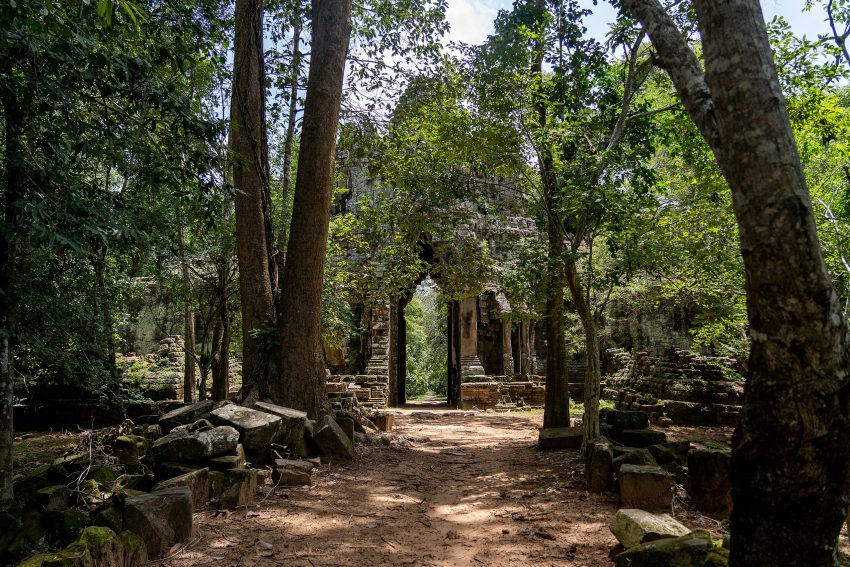
Kmoch Gate (Gate of the Dead), also known as Thvear Khnoch, is the east gate of Angkor Thom in the Angkor Archaeological Park near Siem Reap, Cambodia. It is one of the city's monumental entrances, built as a face-towered gateway through the walled enclosure. Compared with the gates reached directly by modern roads, this one is approached by a dirt trail from the Bayon area, which helps explain why it feels noticeably calmer.
I’d include it if you like quieter corners of Angkor and want to slow down for details: the large stone faces looking out to the cardinal directions, the overgrown setting, and traces of the old approach. Look for remnants of the former bridge and its flanking figures, the unusual laterite chambers that project from the wall, and sections of original sandstone paving still marked by chariot wheel ruts. It’s a short stop, but it can be a memorable contrast to the busier gates.
History and Significance of the Kmoch Gate (Gate of the Dead)
Angkor Thom’s gate system
Kmoch Gate is one of five major gates that pierce the walls of Angkor Thom, the great walled city at Angkor. Like the other entrances, it was conceived as both a defensive choke point and a ceremonial threshold into the city. Its position on the east side links it closely with the central temple area around the Bayon.
Bayon-period imagery and symbolism
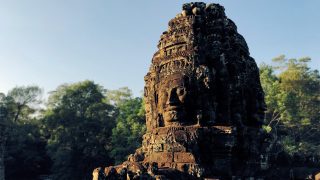
The gate’s defining feature is the set of massive stone faces oriented toward the cardinal directions, a visual language associated with the Bayon period. These faces give the entrance a watchful, human presence and make it immediately recognizable as part of Angkor Thom’s monumental program. Even in partial ruin, the scale of the masonry communicates the importance of controlled entry into the city.
Later changes, survival, and archaeological finds
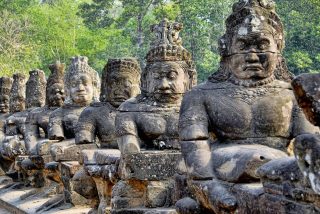
Over time, parts of the approach have shifted and degraded: a stone bridge once spanned the moat with lines of figures along it, but today only remnants remain, and some elements may have sunk into moat silt. The area has also produced notable discoveries, including statues found nearby by Henri Marchal in 1925, such as the head of Prajnaparamita, a statue of Avalokitesvara, and a Buddha head. Traces of the inner moat and canalization to the west, and remains of the balustrade and causeway to the east, add context for how movement and water were managed around the gate.
Things to See and Do in the Kmoch Gate (Gate of the Dead)
I come here mainly to walk the quiet approach and pass under the face tower at a slower pace than the road-access gates. The combination of jungle edges, fewer people, and the towering stonework makes the transition through the gateway feel more atmospheric. As you move through, pause to take in how the faces align outward and how the gate frames the path beyond.
For details, I look along the base and platform molding for the band of medallions inset with Bayon-era caricature-like figures. It’s also worth scanning the ground for surviving sandstone paving; in places you can still see chariot wheel ruts worn into the stone. On either side of the entrance, notice the laterite chambers projecting from the wall-an unusual feature shared with the north and west gates, though their purpose is not certain.
How to Get to the Kmoch Gate (Gate of the Dead)
The nearest international airport is Siem Reap-Angkor International Airport (SAI), with onward travel into Siem Reap before continuing to the Angkor Archaeological Park. For the best deals and a seamless booking experience, check out these flights to Siem Reap on Booking.com.
Siem Reap does not have a central passenger rail service for most visitors, so train travel is not typically the practical way to reach the city for this stop. Train schedules and bookings can be found on Omio.
By car, you can reach the Angkor area easily, but Kmoch Gate is not directly connected to the modern road network, so expect a final approach on smaller tracks or by walking from the Bayon area rather than driving right up to it.
Is the Kmoch Gate (Gate of the Dead) Worth Visiting?
It's worth a short stop if you're already exploring Angkor Thom and want a quieter, more off-route gateway with strong atmosphere and a few standout details (faces, medallions, and ancient paving). It's less essential if you're limited on time and mainly want the most convenient, road-access gates, or if you prefer attractions with extensive interpretation on-site. Treat it as optional on a packed first day, but a good add-on when you have flexibility and enjoy walking between monuments.
What Other Travellers Say...
Gate of the Dead is a quieter, atmospheric eastern entrance to Angkor Thom featuring a multi-faced tower gate flanked by rows of carved deities and demons along the causeway; set amid jungle, it feels more untouched than the busier south approaches, is best explored on foot, by bike or remork, and rewards visitors who include it on a longer, more comprehensive tour despite being in somewhat lesser condition than the more famous gates.


Practical Tips on Visiting the Kmoch Gate (Gate of the Dead)
- Best time to visit: Go when you can take your time on the approach trail; the gate’s quiet feel is part of the appeal.
- How long to spend: Plan 15-30 minutes for a look-through and time to study the carvings and paving, longer if you linger for photos.
- Accessibility: The approach can involve uneven dirt paths and old stone surfaces, so it may be difficult for wheelchairs or anyone who needs smooth ground.
- Facilities: This is a simple monument area without dedicated visitor facilities at the gate itself, so bring what you need before you walk over.
Where to Stay Close to the Kmoch Gate (Gate of the Dead)
Base yourself in central Siem Reap (around the Old Market/Pub Street or the riverside) for the easiest access to Angkor Archaeological Park while still having dining and transport options close by.
These hotels in central Siem Reap make practical bases for early starts to Angkor Thom and flexible temple touring. Park Hyatt Siem Reap works well for good choice if you want a central address for easy evening meals and straightforward tuk-tuk pickups for Angkor temple days. FCC Angkor by Avani works well for works well for travellers who prefer a quieter riverside setting while staying close to town services and quick departures toward Angkor. Jaya House River Park works well for best if you want a calmer base away from the busiest streets, with simple vehicle access for temple circuits and downtime between visits.
FAQs for Visiting the Kmoch Gate (Gate of the Dead)
Getting There
Tickets & Entry
Visiting Experience
Tours, Context & Itineraries
Photography
Accessibility & Facilities
Food & Breaks Nearby
Safety & Timing
The Kmoch Gate (Gate of the Dead) appears in our Complete Guide to Visiting Siem Reap!

Moira & Andy
Hey! We're Moira & Andy. From hiking the Camino to trips around Europe in Bert our campervan — we've been traveling together since retirement in 2020!
This website uses affiliate links which may earn a commission at no additional cost to you!
Planning Your Visit
Nearby Attractions
- Victory Gate of Angkor Thom (0.5) km
City Gate - Thommanon Temple (0.8) km
Buddhist Temple - Prasat Leak Neang (0.9) km
Buddhist Temple - Ta Keo (1) km
Buddhist Temple - Prasat Suor Prat (1.4) km
Tower - Prasat Bayon (1.5) km
Buddhist Temple - Bayon Temple (1.5) km
Buddhist Temple - Angkor Thom (1.6) km
Buddhist Temple - Terrace of the Elephants (1.6) km
Historic Site - Terrace of the Leper King (1.7) km
Historic Site