Iglesia de San Saturnino (San Cernin), Pamplona
Church in Pamplona
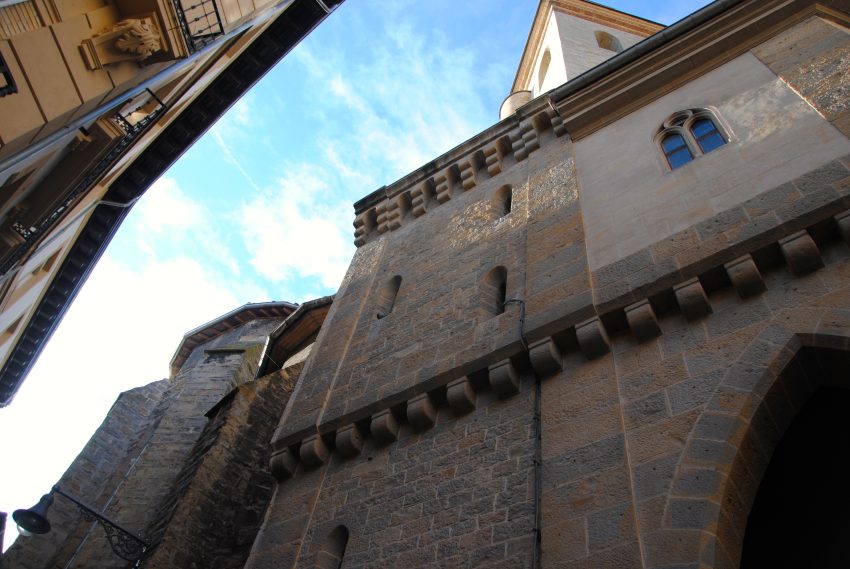
In the heart of Pamplona's Old Quarter, the church of San Saturnino, better known as San Cernin, rises above the surrounding streets with its two unmistakable towers and fortress-like walls. Dating from the 13th century, this Catholic church stands on a site where at least two earlier churches once stood, reflecting how long this corner of the city has been a spiritual anchor. With its thick masonry and defensive look, San Cernin feels very different from a delicate Gothic church: it was built to withstand conflict as much as to host worship, making it one of the must-see places in Pamplona if you are interested in the city's layered medieval past.
San Cernin was not only the religious centre of its borough but also a stronghold in the sometimes fierce skirmishes between the medieval neighbourhoods that eventually merged into modern Pamplona. Its twin towers still dominate postcard images of the city, and the clock tower becomes the focus of attention every 6 July when it marks noon and the official start of San Fermín. Today, stepping inside from the bustle of the Old Quarter, you find a calmer space that still hints at its Franco-Navarrese origins, a church built “in the French fashion” and dedicated to Saint Cernin, echoing Saint-Sernin in Toulouse. San Cernin is often visited on walking tours of Pamplona that trace the medieval boroughs and the modern festival route through the old streets.
Table of Contents
- History and Significance of the Church of San Saturnino San Cernin
- Things to See and Do in the Church of San Saturnino San Cernin
- How to Get to the Church of San Saturnino San Cernin
- Practical Tips on Visiting the Church of San Saturnino San Cernin
- Where to Stay close to the Church of San Saturnino San Cernin
- Is the Church of San Saturnino San Cernin Worth Visiting?
- FAQs for Visiting Church of San Saturnino San Cernin
- Nearby Attractions to the Church of San Saturnino San Cernin
History and Significance of the Church of San Saturnino San Cernin
Although the standing building dates from the 13th century, archaeological work shows that at least two earlier churches occupied this same site, underlining how long this spot has served as a religious focus. The medieval Pamplona that grew up around it was not a single unified city but a patchwork of three distinct boroughs: the town of San Cernin, the city of Navarrería and the town of San Nicolás. Each had its own identity and its own fortifications, and relations between them were far from friendly. In this tense context, San Cernin became both parish church and defensive refuge.
The borough of San Cernin was founded at the end of the 11th century, during the episcopate of Don Pedro de Roda, when settlers from France, particularly from Cahors, established themselves on the flat ground between the episcopal city of Navarrería and the open countryside to the west. With the cathedral far away and relations with Navarrería strained, the new Franco-Navarrese community needed its own place of worship that reflected its roots. The result was a church built according to French models, with a Provençal dedication to Saint Cernin, explicitly recalling the great pilgrimage church of Saint-Sernin in Toulouse.
San Cernin’s powerful walls and tall towers reveal its second role as a military building. In periods of conflict between the boroughs, the church could be defended and used as a kind of stronghold, its towers doubling as watchpoints over surrounding streets. This dual identity-church and fortress-makes it an especially interesting building for anyone exploring Pamplona’s urban history. Over the centuries it has witnessed countless local events, and its clock tower still plays a symbolic role today, counting down to the beginning of San Fermín each 6 July at noon, linking the present festival to the medieval borough that once owned this part of the city.
Things to See and Do in the Church of San Saturnino San Cernin
Approach San Cernin from the narrow streets of the Old Quarter and take a moment to stand back and look at its silhouette. The two towers rise above the compact stone mass of the church, and the thickness of the walls is immediately apparent; this is a building that still looks ready to withstand trouble. Walk around the exterior if you can, noticing the defensive character and how the church sits within the fabric of the former borough, slightly apart from the cathedral yet clearly central to its own district.
Inside, the atmosphere shifts from fortification to devotion. While details may be more modest than in some cathedrals, the interior still offers the cool, reflective space you would expect from a medieval church: arches, chapels and side altars that have served local worshippers for centuries. Look for signs of the French influence in its dedication and layout, and imagine the community of Franks who once gathered here, distant from their homeland but closely connected by faith and tradition.
If you are in Pamplona during San Fermín, pay close attention to the church's clock tower on 6 July at noon, when it marks the start of the festival and becomes a focal point for both locals and media. Even outside festival time, understanding this role gives extra weight to the building: it is not a quiet backstreet church but a structure deeply woven into the city's identity. Combine your visit with a walk to the cathedral and across to San Nicolás to appreciate how each medieval borough expressed itself through its main churches.
How to Get to the Church of San Saturnino San Cernin
Most travellers reach Pamplona via Pamplona Airport or larger regional airports such as Bilbao or San Sebastián, then continue into the city by bus, taxi or hire car. For the best deals and a seamless booking experience, check out these flights to Pamplona on Booking.com. Once you are in the centre, the church is located in the Old Quarter, just a short walk from Plaza del Castillo and the surrounding historic streets.
If you are arriving by train, Pamplona's main station links the city with Madrid, Barcelona and other Spanish hubs.Train schedules and bookings can be found on Omio. From the station, local buses and taxis run into the historic centre; from Plaza del Castillo or nearby points, it is just a few minutes on foot to San Cernin through the narrow lanes of the old borough.
Visitors coming by car will find Pamplona well connected by major roads.If you are looking to rent a car in Spain I recommend having a look at Discover Cars, first, as they compare prices and review multiple car rental agencies for you. Park in one of the central car parks near the edge of the Old Quarter and continue on foot, as the streets around San Cernin are best explored without a vehicle and let you enjoy the medieval layout at a slower pace.
Practical Tips on Visiting the Church of San Saturnino San Cernin
- Suggested tips: Combine your visit to San Cernin with stops at the cathedral and San Nicolás to get a feel for the three medieval boroughs that once made up Pamplona.
- Best time to visit: Late morning or late afternoon works well, when light on the towers is good for photos and the Old Quarter is lively but not yet at evening peak.
- Entrance fee: Free
- Opening hours: Opening times can vary by season, day of the week and religious services; confirm locally for current hours and mass times.
- Official website: http://iglesiasansaturnino.com/
- How long to spend: Allow 30-60 minutes to explore the exterior, step inside, and walk a little through the surrounding streets of the former San Cernin borough.
- Accessibility: The immediate area is on narrow, sometimes uneven streets and there may be steps at the church entrance; visitors with reduced mobility should check the access route in advance.
- Facilities: Basic facilities are limited to what is provided for worshippers; cafés, bars and toilets are available a short walk away in the Old Quarter and around Plaza del Castillo.
- Photography tip: Capture the twin towers from different angles in nearby streets and look for vantage points that show the church rising above the rooftops; early or late light brings out the texture of the stone.
- Guided tours: Consider joining a walking tour of the Old Quarter that includes San Cernin, as guides can explain the rivalries between boroughs and the church's defensive role.
- Nearby food options: Use the visit as a springboard to explore nearby pintxos bars and cafés; some of the best spots are just a few minutes’ walk away in the surrounding streets.
Where to Stay close to the Church of San Saturnino San Cernin
Staying in the Old Quarter makes it easy to visit San Cernin more than once and see how the church and its towers look at different times of day. A classic central choice is Gran Hotel La Perla, which places you on the main square within a short stroll of San Cernin, the cathedral and key festival streets. For an atmosphere even closer to the city walls and religious heritage, Pamplona Catedral Hotel offers a characterful base near the cathedral, from which you can walk across to San Cernin in just a few minutes. If you prefer a hotel close to parks and still within easy reach of the Old Quarter, Hotel Tres Reyes Pamplona combines green surroundings with quick access to the historic centre and its churches.
Is the Church of San Saturnino San Cernin Worth Visiting?
The Church of San Saturnino San Cernin is well worth visiting, especially if you want to go beyond the better-known cathedral and understand how medieval Pamplona was really organised. Its dual role as parish church and defensive stronghold, its Franco-Navarrese origins and its continuing symbolic place in the San Fermín festival all make it more than just another historic building. Standing beneath its towers and walking through the streets of the old borough, you get a strong sense of how separate communities once coexisted, competed and eventually merged into the Pamplona you see today.
What Other Travellers Say...

San Saturnino on C. San Saturnino in Pamplona is a 13th-century Gothic sanctuary notable for its two towers—one topped by a rooster-shaped weather vane—and a plain exterior that gives way inside to richly decorated stonework, ribbed ceilings and an unusual wooden floor that can creak underfoot; visitors praise its beauty and memorable atmosphere in the old town, note occasional weekday masses (including an evening service for pilgrims), and warn that opening times can be unclear.


FAQs for Visiting Church of San Saturnino San Cernin
Nearby Attractions to the Church of San Saturnino San Cernin
- Pamplona Cathedral: The city's main Gothic cathedral with Neoclassical façade, royal tombs and cloister, located in the neighbouring Navarrería area.
- Plaza del Castillo: Pamplona's principal square and social hub, lined with cafés and arcades, just a short walk from San Cernin.
- Museum of Navarra: The regional museum housed in a former pilgrims' hospital, with collections from prehistory to Goya and 20th century art.
- Ciudadela de Pamplona: A 16th century star-shaped fortress turned public park, offering ramparts, lawns and a deeper look at the city's defensive history.
- La Taconera Park: A landscaped 19th century park with sculptures and a mini zoo, ideal for a relaxing stroll after exploring the Old Quarter's churches.
The Iglesia de San Saturnino (San Cernin) appears in our Complete Guide to Visiting Pamplona!

Moira & Andy
Hey! We're Moira & Andy. From hiking the Camino to trips around Europe in Bert our campervan — we've been traveling together since retirement in 2020!
This website uses affiliate links which may earn a commission at no additional cost to you!
Planning Your Visit
Opening times can vary by season, day of the week and religious services; confirm locally for current hours and mass times.
Free
Nearby Attractions
- Ayuntamiento de Pamplona (0.1) km
Town Hall - Museo Universidad de Navarra (0.2) km
Museum - Museum of Navarre (0.2) km
Museum - San Fermín de Aldapa (0.2) km
Church - Royal and General Archive of Navarra (0.2) km
Archive and Palace - Plaza del Castillo (0.2) km
Square - Calle Estafeta (0.3) km
Street - Albergue de Jesús y María (0.3) km
Church and Hostel - Iglesia De San Nicolas (0.3) km
Church - Catedral de Pamplona (0.3) km
Cathedral