San Michele in Foro, Lucca
Basilica in Lucca
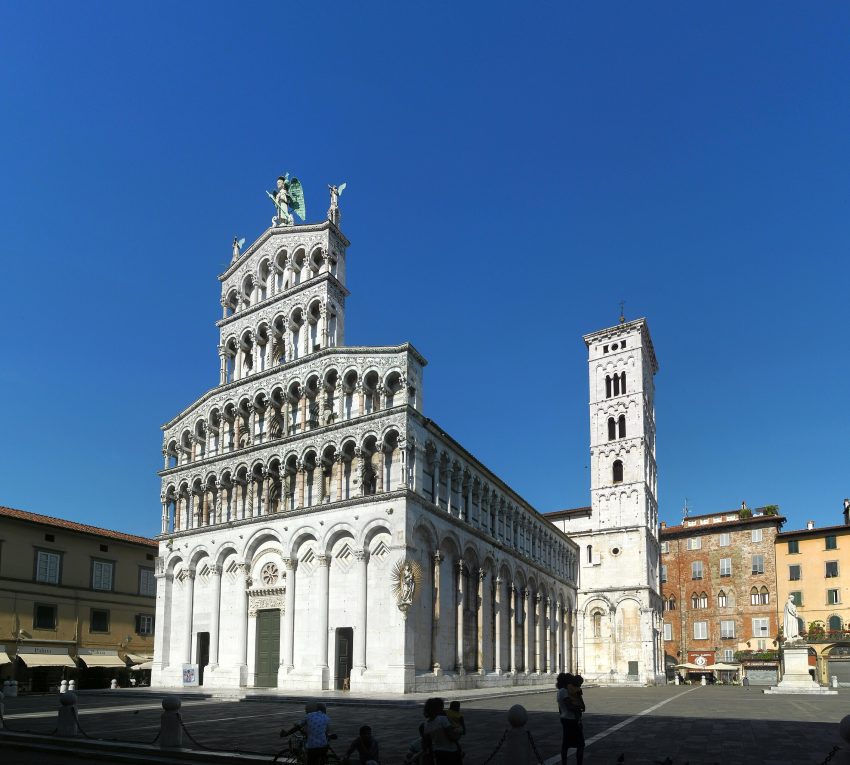
In the heart of Lucca's historic centre, San Michele in Foro rises above the bustle of the piazza with its dazzling marble façade and watchful Archangel Michael. Built on the site of the ancient Roman forum and documented as early as 795, the church we see today was commissioned in 1070 by Anselmo da Baggio, the future Pope Alexander II. For nearly three centuries, until 1370, it wasn't just a religious building but also the seat of the Major Council and the Podestà, tying it directly into Lucca's political life as well as its spiritual one.
From the square, your eye is immediately drawn upward to the Pisan Romanesque façade, impossibly tall and richly carved with arcades, animals, and decorative stonework. At its peak, the great marble figure of the Archangel Michael stands triumphant over the dragon. Locals whisper that on sunny days, a green flash glints from his chest where an emerald is said to be hidden, though no one has ever found it. Step inside and a calmer, more contemplative world unfolds: three naves, a transept, and a semi-circular apse, with the main nave carried on monolithic columns and ceilings covered in lunette barrel vaults. San Michele in Foro is one of the top sights in Lucca and a highlight of any walking tour of Lucca for visitors who love architecture, legend, and art all in one place.
Table of Contents
- History and Significance of San Michele in Foro
- Things to See and Do in San Michele in Foro
- How to Get to San Michele in Foro
- Practical Tips on Visiting San Michele in Foro
- Where to Stay close to San Michele in Foro
- Is San Michele in Foro Worth Visiting?
- FAQs for Visiting San Michele in Foro
- Nearby Attractions to San Michele in Foro
History and Significance of San Michele in Foro
San Michele in Foro stands where Lucca's Roman forum once lay, a reminder that this spot has been the civic heart of the city for nearly two millennia. A church has been recorded here since at least 795, but the major turning point came in 1070, when the current structure was commissioned by Anselmo da Baggio. He would later become Pope Alexander II, and his involvement underlines the importance of Lucca in the politics and religion of medieval Tuscany.
From the 11th to the 14th century, San Michele in Foro was much more than a parish church. For almost 300 years, until 1370, it served as the seat of the Major Council and the Podestà, the city's highest magistrate. That meant crucial decisions about Lucca's governance and future were made within these walls, merging sacred and civic functions in a way that was typical of medieval Italian cities yet still striking today. The piazza in front of the church, echoing the outline of the ancient forum, remained the main urban stage, where markets, announcements, and gatherings took place.
Architecturally, the church exemplifies the influence of Pisan Romanesque style: a tall, layered façade, rich sculptural decoration, and arcaded galleries that seem to rise higher than the church behind them. The great statue of the Archangel Michael crowning the top, locked in eternal victory over the dragon, became one of Lucca’s most recognisable symbols. The legend of the mysterious green sparkle-perhaps from a hidden gem-adds a playful note to the building’s otherwise solemn dignity, tying the church not only to theology but also to the stories and superstitions of generations of Lucchesi.
Things to See and Do in San Michele in Foro
Begin outside, in the piazza, to fully appreciate the façade. From a few steps back, you can take in its impressive height and the layered arcades, each row decorated with different columns, sculpted animals, and carved motifs. Look closely and you’ll notice that many columns are unique, an intentional display of variety and craftsmanship. Then let your gaze climb to the top, where Archangel Michael spreads his wings over the dragon at his feet-this is the statue at the centre of the emerald legend, said to emit a green gleam on just the right kind of sunny day.
Step inside and the mood changes. The interior is sober and elegant, with three naves separated by arcades resting on monolithic columns. The transept and semi-circular apse focus the eye towards the altar, while the lunette barrel-vaulted ceilings add rhythm and depth overhead. The light is softer here, drawing your attention to the artworks rather than overwhelming you with brightness.
Among the artistic highlights, three works stand out. Luca della Robbia's Madonna and Child in enamelled terracotta brings a gentle, luminous presence to the space, with the sculptor's characteristic clarity and warmth. Filippino Lippi's Pala Magrini from 1483 introduces a refined, late-Quattrocento atmosphere, depicting Saints Roch, Sebastian, Jerome, and Helena with delicate detail and an almost narrative intimacy. Finally, seek out the high-relief of the Virgin by Raffaello di Montelupo, whose carving adds another layer of sculptural richness. Taken together, these works make San Michele in Foro one of the things to do in Lucca that rewards careful, unhurried looking.
How to Get to San Michele in Foro
San Michele in Foro sits right in the centre of Lucca's walled old town, a short walk from Via Fillungo and not far from both the cathedral and Piazza dell'Anfiteatro. Once you've entered the city through any of the main gates, just follow signs for “San Michele” or head toward the open square that once marked the Roman forum-the church's tall façade and statue of Michael are hard to miss.
If you're flying into Tuscany, the closest major hubs are Pisa International Airport and Florence Airport, both offering good connections into the region. For the best deals and a seamless booking experience, check out these flights to Lucca on Booking.com. From there, you can reach Lucca by train, bus, or hire car before walking into the historic core.
By train, Lucca is connected to Pisa, Florence, and other Tuscan cities by regular regional services.Use Omnio to easily compare schedules, book train tickets, and find the best prices all in one place for a hassle-free journey across Italy. The railway station lies just outside the southern section of the city walls near Porta San Pietro; from there, it’s about a 10-15-minute walk through the old streets to Piazza San Michele, where the church dominates the scene.
If you are travelling by car, Lucca is linked to the rest of Tuscany via the A11 motorway and local roads.If you are looking to rent a car in Italy I recommend having a look at Discover Cars, first, as they compare prices and review multiple car rental agencies for you. Because much of the old town is a restricted traffic zone, it's best to park outside or just inside the walls in designated car parks, then walk into the centre; San Michele in Foro is one of the easiest landmarks to navigate to once you're inside the walls.
Practical Tips on Visiting San Michele in Foro
- Suggested tips: Take a few minutes to circle the piazza outside before entering so you can fully appreciate the façade from different angles and distances.
- Best time to visit: Late morning or late afternoon offer a nice balance of open interior and lively piazza life; evenings are particularly atmospheric when the façade is softly lit.
- Entrance fee: Entry to the main church is typically free; occasional donations or separate offerings may be suggested for maintenance or specific chapels.
- Opening hours: Generally open daily with a mid-day pause or limited access during services; check posted times at the door on arrival.
- How long to spend: Plan 30-45 minutes to admire the façade, explore the interior, and linger over the key artworks without rushing.
- Accessibility: The main entrance has a small step and stone flooring; access for visitors with reduced mobility may vary, so it’s worth checking at the door or via local information.
- Facilities: There are no visitor facilities inside the church itself, but bars, cafés, and restrooms for customers are plentiful in the surrounding streets and on the piazza.
- Photography tip: For exterior shots, stand near the opposite side of the square to capture the full height of the façade; inside, focus on details like della Robbia’s terracotta and Lippi’s altarpiece rather than wide, dark interiors.
- Guided tours: Many city walking tours include San Michele in Foro, explaining its dual political and religious role and pointing out artworks that are easy to miss on a quick visit.
- Nearby food options: The streets around the piazza are lined with cafés, gelaterie, and trattorie, making it easy to combine your visit with a coffee, aperitivo, or relaxed lunch.
Where to Stay close to San Michele in Foro
Staying near San Michele in Foro keeps you right in Lucca's historic heartbeat, with easy access to major sights in every direction. Just a short stroll away, Palazzo Alexander offers characterful rooms in a restored palace, placing you close to the church, Via Fillungo, and the city walls. For a comfortable base near the cathedral and still within easy walking distance of San Michele, Albergo San Martino combines a welcoming atmosphere with a handy location. If you prefer to be near the eastern stretch of the walls while staying central, Hotel Ilaria is a good choice, with a pleasant walk through the old streets bringing you straight to Piazza San Michele.
Is San Michele in Foro Worth Visiting?
San Michele in Foro is absolutely worth visiting, and for many people it becomes one of their favourite spots in Lucca. Few churches manage to combine such a dramatic façade, deep historical roots, and a compact but high-quality collection of artworks in quite the same way. Standing in the piazza, looking up at the Archangel Michael against the sky, you can feel the weight of centuries of civic and religious life; inside, the works of della Robbia, Filippino Lippi, and Raffaello di Montelupo reveal the city's artistic connections to the wider Italian Renaissance. This spot is one of the best places to see in San Michele in Foro's corner of Lucca if you want to sense how faith, politics, and art have intertwined here over time.
What Other Travellers Say...

Chiesa di San Michele in Foro, on Piazza San Michele in Lucca, is a striking Romanesque church famed for its ornate, multi-tiered marble façade topped by a tall statue of the Archangel Michael; visitors praise the intricate columns, reliefs and large sculptures and note the exterior's wedding-cake appearance, while the interior is described as more understated and serene with artwork, an organ and basilica layout; look closely at some columns for medieval hand-drawn animal graffiti, and be aware that crowds and visitors ignoring boundaries (and dogs) can detract from the experience; entrance is reported as free.


FAQs for Visiting San Michele in Foro
Nearby Attractions to San Michele in Foro
- Cathedral of San Martino - Lucca's duomo, with a Romanesque façade, Gothic interior, the Volto Santo, and Ilaria del Carretto's famous tomb.
- Piazza dell'Anfiteatro - Oval piazza built on the footprint of a Roman amphitheatre, now ringed with cafés and shops.
- Guinigi Tower - Iconic brick tower topped with a rooftop garden of holm oaks, offering panoramic views over the city.
- Basilica di San Frediano - Romanesque church with a striking golden mosaic façade and a serene interior.
- Lucca's Historical Walls - Complete Renaissance fortifications encircling the old town, now a tree-lined promenade perfect for walking or cycling.
The San Michele in Foro appears in our Complete Guide to Visiting Lucca!

Moira & Andy
Hey! We're Moira & Andy. From hiking the Camino to trips around Europe in Bert our campervan — we've been traveling together since retirement in 2020!
This website uses affiliate links which may earn a commission at no additional cost to you!
Planning Your Visit
Generally open daily with a mid-day pause or limited access during services; check posted times at the door on arrival.
Entry to the main church is typically free; occasional donations or separate offerings may be suggested for maintenance or specific chapels.
Nearby Attractions
- Puccini Museum (0.1) km
Historic Building and Museum - Torre delle Ore (0.1) km
Tower - Domus Romana (0.2) km
Historic Site - Piazza Napoleone (0.2) km
Square - Palazzo Ducale in Lucca (0.2) km
Historic Building and Museum - Church and Baptistery of Santi Giovanni e Reparata (0.3) km
Church and Museum - Palazzo Pfanner (0.3) km
Gardens and Historic Building - Risorgimento Museum in Lucca (0.3) km
Museum - Teatro del Giglio (0.3) km
Theatre - Guinigi Tower (0.3) km
Tower