Battistero di San Giovanni, Pisa
Historic Building in Pisa

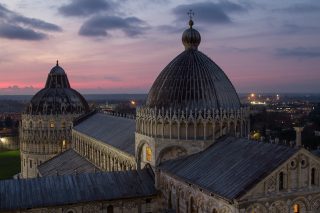
To the west of Pisa's cathedral, the Baptistery of San Giovanni rises as a free-standing marble giant, echoing the Duomo's style yet with its own distinct personality. Construction began in 1153, almost a century after the cathedral, when Pisa was at the height of its prosperity as a maritime republic. From the outside you will recognise the same building stone, blind arcading and dwarf galleries that tie it visually to the cathedral, but if you look closely you will notice how the lower sections speak the solid language of Romanesque architecture while the upper levels shift into a more delicate Gothic style. It is this layered character that makes the baptistery one of the best places to visit in Pisa for anyone who loves tracing history in stone.
Step inside and the atmosphere changes completely. The conical dome, supported by four pillars and eight columns, draws your eyes upwards and fills the circular space with a soft, resonant light. In the middle stands the font by Guido da Como, an exquisite piece from 1246, while around the interior you will find saintly figures sculpted by students of Nicola and Giovanni Pisano. The real showstopper is the free-standing marble pulpit carved by Nicola Pisano in 1260, bursting with energy and detail in its New Testament reliefs. Combined with the baptistery's extraordinary acoustics, often demonstrated by guides with a single sung note that hangs in the air, it all adds up to a great place to visit on a walking tour of Pisa that goes beyond the Leaning Tower.
Table of Contents
- History and Significance of the Baptistery of San Giovanni
- Things to See and Do in the Baptistery of San Giovanni
- How to Get to the Baptistery of San Giovanni
- Practical Tips on Visiting the Baptistery of San Giovanni
- Where to Stay close to the Baptistery of San Giovanni
- Is the Baptistery of San Giovanni Worth Visiting
- FAQs for Visiting Baptistery of San Giovanni
- Nearby Attractions to the Baptistery of San Giovanni
History and Significance of the Baptistery of San Giovanni
The baptistery's story begins in 1153, in an era when Pisa's fleets were carrying its name and influence across the Mediterranean. City leaders wanted a monumental baptismal church to complement the already impressive cathedral, and they chose to place it directly in front of the Duomo's west end, creating a powerful sacred axis across the future Piazza dei Miracoli. The architects followed the cathedral's design language, using the same pale stone, blind arcades and stacked galleries so that the two buildings would belong together visually as a unified complex.
Over more than two centuries of on and off construction, the building slowly evolved. The lower tiers kept the sturdy proportions and rounded arches of the Romanesque style, while later additions increasingly embraced Gothic features, with sharper lines and more ornate detailing in the upper zones. In 1260, Nicola Pisano took over the project, bringing with him a sculptor’s eye and a fascination with classical forms; his son Giovanni continued the work between 1285 and 1293, adding his own more dynamic and expressive touches. The result is an architectural hybrid that lets you read the shift from Romanesque to Gothic simply by looking up.
Spiritually, the baptistery was central to Pisan religious life. This was where the sacrament of baptism took place, marking a person's formal entry into the Christian community before they crossed the threshold into the cathedral itself. The decision to commission Nicola Pisano for the pulpit and Guido da Como for the font shows how seriously the city took this role. Together with the figures of saints created by the Pisano workshop's pupils, they transformed the interior into a three-dimensional teaching space, where sculpture and sound worked alongside ritual to convey the stories and symbols of the faith.
Things to See and Do in the Baptistery of San Giovanni
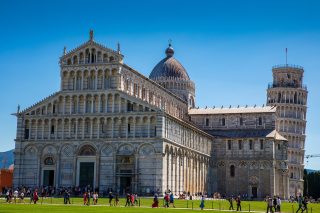
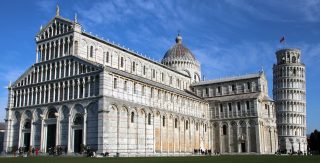
Start your visit by walking slowly around the exterior, noting how the blind arcades at ground level give way to lighter, more open galleries as your eyes climb higher. From some angles you can line up the baptistery and cathedral in a single view, seeing clearly how the two were designed to complement each other. Stepping inside, pause just beyond the entrance to let your eyes adjust and take in the full height of the dome, the ring of columns and the central font that anchors the space.
Move towards the middle to appreciate Guido da Como’s font. Its geometric precision and carved details make it more than just a functional basin; you can imagine the drama of medieval baptism ceremonies echoing under the dome, with candlelight reflecting off the water and stone. As you circle the interior, look out for the statues of saints crafted by the pupils of Nicola and Giovanni Pisano, which echo the style of their masters and add a human presence along the walls.
The highlight for most visitors is Nicola Pisano’s pulpit, completed in 1260 and considered one of the finest examples of Romanesque sculpture. Walk all the way around it and study how it stands on clustered columns, some shorter ones supported by crouching lions. On the base you can pick out figures of the Archangel Michael, Hercules and Christ surrounded by the Four Evangelists, while the relief panels above narrate key scenes from the New Testament with remarkable intensity. The figures feel solid and weighty, their drapery carved with a classical eye, yet the overall energy of the composition points towards the more dynamic Gothic style. Finally, if you are lucky enough to catch a demonstration of the acoustics, stand still in the centre and listen as a single voice fills the entire space; it is an unforgettable reminder that this building was designed as much for sound as for sight.
How to Get to the Baptistery of San Giovanni
Most international visitors arrive via Pisa International Airport Galileo Galilei, which lies only a few kilometres from the historic centre and offers easy connections into the city by bus, tram link, train or taxi; from there you can head towards the Piazza dei Miracoli where the baptistery stands directly in front of the cathedral's west front. For the best deals and a seamless booking experience, check out these flights to Pisa on Booking.com.
Within Italy, Pisa is well connected by train, with regular services to Pisa Centrale from Florence, Lucca, Livorno and other regional hubs; from the station it is roughly a 20-25 minute walk to the Piazza dei Miracoli, or you can take a local bus or taxi that drops you close to the cathedral and baptistery. Use Omnio to easily compare schedules, book train tickets, and find the best prices all in one place for a hassle-free journey across Italy.
If you are travelling by car, follow the main routes towards Pisa such as the A12 or the Florence-Pisa highways, then park in one of the signposted car parks outside the restricted traffic zone and walk or take a shuttle into the Piazza dei Miracoli area, where the Baptistery of San Giovanni forms part of the main monument group. If you are looking to rent a car in Italy I recommend having a look at Discover Cars, first, as they compare prices and review multiple car rental agencies for you.
Practical Tips on Visiting the Baptistery of San Giovanni
- Suggested tips: Combine your baptistery visit with the cathedral, Leaning Tower and Camposanto for a full Piazza dei Miracoli experience, and try to time your arrival to catch an acoustic demonstration if guides are present.
- Best time to visit: Early morning or late afternoon tend to be quieter and offer softer light both inside and outside; visiting outside peak summer also makes the interior more comfortable.
- Entrance fee: Adults: €8.00
- Opening hours: Daily: 9:00 – 18:00
- Official website: https://www.opapisa.it/en/tickets/prices/
- How long to spend: Plan around 30-45 minutes inside if you want to enjoy the font, pulpit, statues and acoustics without rushing, plus time outside for photos of the exterior.
- Accessibility: The entrance is at ground level with only minor thresholds; floors can be slightly uneven, so visitors with mobility issues should take care but will usually find the interior more accessible than climbing the Leaning Tower.
- Facilities: Restrooms, ticket offices and small cafés are available in and around the Piazza dei Miracoli; more extensive food and shopping options are a short walk away in the historic centre.
- Photography tip: For classic shots, stand outside to include cathedral and baptistery together, then inside look up to capture the dome and columns; close-ups of Nicola Pisano's reliefs reveal details that are often missed at a glance.
- Guided tours: Joining a guided tour of the Piazza dei Miracoli can help you understand how the baptistery fits into the wider complex and unpack the symbolism of the pulpit and font.
- Nearby food options: For better value and a more local feel, head a few blocks away from the piazza towards the river or university district, where you will find trattorias, cafés and gelato shops popular with residents.
Where to Stay close to the Baptistery of San Giovanni
If you want to be within a few minutes' walk of the baptistery and the rest of the Piazza dei Miracoli, Grand Hotel Duomo is a convenient choice, with upper floors offering views towards the Leaning Tower and cathedral. For a more intimate, historic atmosphere still close to the monuments, Relais dell’Orologio places you in a quiet corner of the medieval centre, making it easy to stroll to the baptistery early or late in the day. Travellers arriving by train who prefer to stay near Pisa Centrale but still want straightforward access to the Piazza dei Miracoli might opt for NH Pisa, from where regular buses and a pleasant walk lead you directly to the baptistery and surrounding sights.
Is the Baptistery of San Giovanni Worth Visiting
The Baptistery of San Giovanni is definitely worth adding to your Pisa itinerary, especially if you are already planning to see the cathedral and Leaning Tower. Architecturally, it offers a textbook example of how styles evolved from Romanesque to Gothic, all within a single building that still feels remarkably harmonious. Inside, the combination of Guido da Como's font, the saintly figures, Nicola Pisano's powerful pulpit and the extraordinary acoustics creates an experience that is as much about sound and atmosphere as it is about sculpture. For many travellers, the baptistery ends up being one of the must-see places in Pisa precisely because it surprises them with how beautiful and evocative it is once you step through the door.
What Other Travellers Say...

Battistero di San Giovanni, on Piazza del Duomo in Pisa, is a large medieval baptistery noted for its elegant Romanesque–Gothic design and praised for exceptional acoustics; visitors highlight a simple yet majestic interior with marble columns, gilded ceiling and frescoes, and recommend hearing the echo demonstration, while also noting it's an impressive exterior sight within the cathedral plaza and to be mindful of street vendors nearby.


FAQs for Visiting Baptistery of San Giovanni
Nearby Attractions to the Baptistery of San Giovanni
- Cathedral of Santa Maria Assunta: Pisa's grand Romanesque cathedral directly behind the baptistery, home to important artworks and an impressive oval dome.
- Leaning Tower of Pisa: The world-famous freestanding bell tower just across the Piazza dei Miracoli, offering panoramic views from its spiral staircase.
- Camposanto Monumentale: A monumental cemetery along the northern edge of the square, with Roman sarcophagi and restored frescoes in a serene cloister.
- Museo dell'Opera del Duomo: The museum preserving original sculptures, metalwork and paintings from the cathedral complex, including pieces that once decorated the baptistery.
- Borgo Stretto and the historic centre: An arcade-lined street and surrounding lanes filled with shops, cafés and local life, ideal for exploring after your time in the piazza.
The Battistero di San Giovanni appears in our Complete Guide to Visiting Pisa!

Moira & Andy
Hey! We're Moira & Andy. From hiking the Camino to trips around Europe in Bert our campervan — we've been traveling together since retirement in 2020!
This website uses affiliate links which may earn a commission at no additional cost to you!
Planning Your Visit
Daily: 9:00 - 18:00
Adults: €8.00
Nearby Attractions
- Campo dei Miracoli (0.0) km
Historic Site and Square - Camposanto Monumentale (0.1) km
Historic Building - Cathedral of Santa Maria Assunta (0.1) km
Cathedral - Leaning Tower of Pisa (0.2) km
Historic Building and Tower - Museo dell'Opera del Duomo (0.2) km
Museum - Orto Botanico dell’Università di Pisa (0.4) km
Gardens - Baths of Nero (0.6) km
Historic Site - Palazzo dei Cavalieri (0.6) km
Palace - Santo Stefano dei Cavalieri (0.7) km
Church - Lungarni of Pisa (0.8) km