Town Hall, Piran
Town Hall in Piran
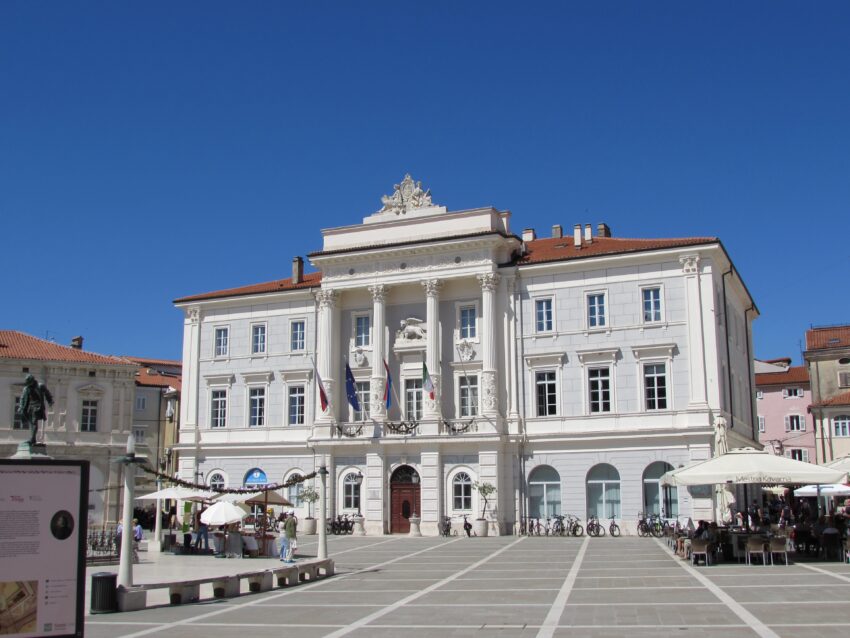
Town Hall Piran occupies a commanding position on Tartini Square, and its presence helps give the open space much of its formal character. While many visitors are first drawn to the square for its atmosphere and cafés, the Town Hall anchors the scene with a more official tone, standing as a reminder that this was not only a picturesque waterfront settlement but also a place of government and civic ceremony. Its location makes it one of the easiest historic buildings in Piran to notice, even on a short walk through the center.
The building works best as part of the wider experience of Tartini Square rather than as an isolated stop. Visitors usually admire it from outside while moving between the square's other landmarks, and that is enough to appreciate its role in the urban setting. It is not approached like a ticketed attraction, but as one of the structures that gives the square depth, balance and a stronger sense of civic history.
What makes the Town Hall memorable is the way it carries older layers of the town's story within a later building. The current structure belongs to the reshaping of the square in the late 19th century, yet it also preserves a symbolic connection to the earlier town hall through the reused lion statue associated with Venice. That mixture of continuity and change gives the building more interest than its administrative role alone might suggest.
History and Significance of the Town Hall Piran
Medieval origins of the Town Hall Piran
The original town hall in Piran was built in the 13th century in Romanesque-Gothic style. It stood by the old mandrač, or inner harbour, outside the former city walls, which shows how closely civic life was tied to the town's waterfront setting in earlier centuries. The first building also carried coats of arms and inscription plaques, emphasizing its role as a visible seat of local authority.
This earlier town hall matters because it places civic administration deep within the town's medieval development. It was not an afterthought added to a later square, but part of Piran's older urban structure. Even though the original building no longer survives, its presence helps explain why the Town Hall remains so central to the identity of Tartini Square today.
Nineteenth-century rebuilding of the Town Hall Piran
The original building was demolished in 1877, and the current town hall replaced it two years later. This rebuilding belongs to the same broader period in which the old harbour area was transformed into the civic space that became Tartini Square, giving the town a more formal central stage. The present Town Hall therefore reflects not just architectural renewal, but a wider rethinking of the town center in the late 19th century.
One of the most distinctive details of the present building is the immured stone lion holding an open book, a surviving emblem of the Venetian Serenissima and a reminder of the earlier town hall. That feature matters because it links the current façade to older political and cultural layers instead of treating the rebuilding as a total break from the past. It gives the Town Hall a more layered character than a straightforward 19th-century administrative building.
The Town Hall Piran in the square today
Today the Town Hall houses the municipal administration, which means it remains a working civic building rather than a purely historic shell. This continued use gives it a practical significance that many old-town landmarks no longer have. Visitors encounter it not as a closed monument, but as part of the living civic fabric of Piran.
Its significance now lies in the way it completes Tartini Square architecturally and historically. Alongside the Venetian House, Court Palace and other buildings around the square, it helps define the center of Piran as a place shaped by culture, government and urban change. For many visitors, it becomes meaningful not through interior access but through its contribution to the square as a whole.
Things to See and Do in the Town Hall Piran
The main thing to do here is to appreciate the building as part of Tartini Square rather than trying to treat it as a separate museum-style stop. From the square, visitors can take in the Town Hall's formal presence and see how it balances the more decorative and domestic-looking façades nearby. It is especially effective when viewed as part of the whole urban composition of the square, with civic architecture on one side and the waterfront history of the site behind it.
It is also worth looking for the Venetian lion detail built into the structure, because that small feature adds a much stronger historical dimension to the building. A casual glance may register the Town Hall simply as one more handsome façade, but closer attention reveals its ties to the previous town hall and to the town's Venetian past. That detail gives visitors something concrete to notice beyond the general square atmosphere.
How to Get to the Town Hall Piran
The nearest practical airports are in Slovenia and nearby northern Italy, with the final journey to Piran usually completed by road. For the best deals and a seamless booking experience, check out these flights to Piran on Booking.com.
The simplest rail option is to travel to a larger city in the region by train and then continue to Piran by bus or road transfer, since the town does not have its own railway station. You can easily check schedules and book tickets through the Slovenian Railways. However, for a smoother experience, we recommend using Omio, which simplifies the booking process and lets you compare prices and schedules all in one place.
By car, it is easiest to park on the edge of Piran and continue into the old town on foot, with the Town Hall reached directly on Tartini Square.
Practical Tips on Visiting the Town Hall Piran
- Best time to visit: Early morning and late afternoon are best for seeing the building as part of a quieter Tartini Square. At busier times, it is still easy to view, but the square feels more active and less architectural.
- How long to spend: Allow 10-20 minutes if viewing it as part of the square, or longer when combining it with nearby landmarks. It works best as one stop within a wider old-town walk.
- Accessibility: The Town Hall is easy to see from the open space of Tartini Square, which is one of the more straightforward parts of Piran to navigate. Interior access is limited because the building serves an administrative function.
- Facilities: Cafés, restaurants and visitor services are close by on and around Tartini Square. The building itself is primarily a civic landmark rather than a fully serviced visitor attraction.
Where to Stay Close to the Town Hall Piran
For a culture-heavy itinerary, the best base is central Piran around Tartini Square and the old town; for a quieter seaside stay with easier beach access and a more relaxed pace, Fiesa is the better choice.
Staying close to the Town Hall makes the most sense for visitors who want immediate access to Tartini Square, the main historic streets and the rest of the old-town landmarks without needing transport. Art Hotel Tartini is the clearest fit for anyone who wants to stay directly on the square itself, while Boutique Hotel Miracolo di Mare suits travelers who prefer a smaller, more tucked-away base within the old streets but still within a very short walk of the civic center.
For visitors who want a quieter overnight setting, Barbara Piran Beach Hotel works better as a base that balances coastal calm with walkable access to the old town. That makes it a sensible option when the trip is focused not only on architecture and history, but also on a more relaxed seaside atmosphere.
What Other Travellers Say...
Reviews highlight Piran as a charming, historic seaside town with a well-preserved medieval feel, narrow streets, and impressive architecture, often compared to a “Slovenian Venice.” Visitors enjoy strolling the old town and swimming, with some suggesting a day or two is enough to take in the atmosphere. A recurring caution is that dining quality can vary, and one reviewer reports a negative experience with motorhome parking rules and fines, describing the signage as unclear and the enforcement as unfair.






FAQs for Visiting the Town Hall Piran
The Town Hall appears in our Complete Guide to Visiting Piran!

Moira & Andy
Hey! We're Moira & Andy. From hiking the Camino to trips around Europe in Bert our campervan — we've been traveling together since retirement in 2020!
This website uses affiliate links which may earn a commission at no additional cost to you!
Planning Your Visit
Exterior: 24 Hours. Interior: Administrative building; access is limited.
Free to view from outside.
Nearby Attractions
- Tartini Square (0) km
Square - Casa Tartini (0.1) km
Museum - Piran Port (0.1) km
Port - St. George’s Cathedral (0.1) km
Cathedral - Sergej Mašera Maritime Museum (0.1) km
Museum - Piran Waterfront Promenade (0.2) km
Promenade - Walls of Piran (0.3) km
City Walls - Piran Lighthouse (0.4) km
Lighthouse - Museo Ferroviario di Trieste Campo Marzio (19.5) km
Museum, Railway and Train Station - Museo Sartorio (20) km
Historic Building, Historic Room and Museum