São Bento Railway Station, Porto
Railway in Porto
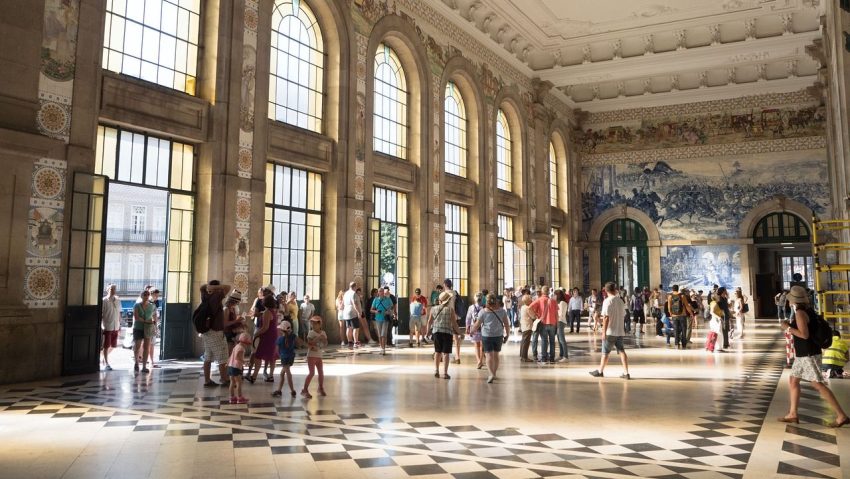
São Bento Railway Station is much more than a place to catch a train: it is a monumental gateway to Porto's historic centre and one of the top sights in Porto for anyone who loves architecture, history, or photography. From the outside, its 20th-century façade looks elegant but fairly restrained, tucked into the streets just above Ribeira. Step inside, though, and you are greeted by vast azulejo panels that wrap around the main hall, turning the everyday act of buying a ticket or checking a timetable into an encounter with Portuguese history.
The station, whose name translates as Saint Benedict, was built in the early 1900s on the site of a former Benedictine convent and inaugurated in 1916. Today, commuters, tourists, and day-trippers share the tiled hall, pausing under the murals that depict everything from medieval battles to rural harvest scenes. Because it sits in the heart of the UNESCO-listed historic centre, it is a highlight of any walking tour of Porto, and a natural starting point for exploring nearby streets, churches, and viewpoints before heading out by train into the Douro Valley or coastal towns.
Table of Contents
- History and Significance of the São Bento Railway Station
- Things to See and Do in the São Bento Railway Station
- How to Get to the São Bento Railway Station
- Practical Tips on Visiting the São Bento Railway Station
- Where to Stay close to the São Bento Railway Station
- Is the São Bento Railway Station Worth Visiting?
- FAQs for Visiting São Bento Railway Station
- Nearby Attractions to the São Bento Railway Station
History and Significance of the São Bento Railway Station
The story of São Bento Railway Station begins with a convent. For centuries, this hill above the river was occupied by a Benedictine monastery whose church and buildings shaped the neighbourhood. As rail travel expanded in the 19th century, the convent complex was gradually cleared to make space for a modern terminus that could connect Porto more efficiently with the rest of Portugal. Construction of the new station began in 1904, based on plans by architect José Marques da Silva, a key figure in Portuguese architecture at the turn of the century.
The building he designed is very much of its time: a balanced, Beaux-Arts-inspired station hall with a clear sense of order and proportion. But what truly sets São Bento apart is the azulejo decoration that was added soon after. From 1905 onwards, artist Jorge Colaço created scenes in blue-and-white and coloured tiles that would transform the interior walls into a pictorial narrative. By 1916, when the murals were completed and the station was inaugurated, São Bento had become a unique fusion of transport hub and art space.
The panels tell multiple stories at once. Large historical scenes show key episodes in Portuguese history, including battles and royal encounters, while bands of multicoloured tiles below depict rural life: markets, processions, and everyday scenes from different regions. Together they turn the station into a visual textbook that also reflects the romantic nationalism of the early 20th century. Today, São Bento is recognised as a National Monument and forms part of Porto's UNESCO World Heritage ensemble, illustrating how infrastructure and art can coexist in a living city.
Things to See and Do in the São Bento Railway Station
The main attraction at São Bento is the entrance hall, so take your time as soon as you step through the doors. Look up and around, letting your eyes follow the sequence of azulejo panels from one end of the hall to the other. The large blue-and-white scenes command immediate attention, but do not miss the friezes of coloured tiles nearer the floor, which show rural festivals, traditional costumes, and scenes of everyday work in the countryside.
Move slowly through the space to appreciate the details: the way the tiles wrap around doorways and windows, the ornate clock above the doors leading to the platforms, and the subtle play of light from the high windows. If you arrive at a quieter moment, you can stand in the centre and listen to the echo of announcements, footsteps, and rolling luggage beneath the painted ceilings. It is one of the things to do in Porto that feels both practical and poetic, especially if you are about to board a train.
If you are catching a regional service, you might have time to step out onto the platforms and see how the station opens toward the tracks that cut into the hillside. From here, trains head out toward places like Guimarães, Braga, and the Douro line, making São Bento a convenient starting point for easy day trips. Even if you are not travelling further, combining a visit to the station with nearby sights like the cathedral and Palácio da Bolsa creates a compact, rewarding route through the old town.
How to Get to the São Bento Railway Station
São Bento Railway Station sits right in Porto's historic centre, within walking distance of major avenues like Aliados and key sights in the old town. Most international visitors arrive at Francisco Sá Carneiro Airport, Porto's main international gateway, located to the northwest of the city and connected to the centre by metro, buses, and taxis. For the best deals and a seamless booking experience, check out these flights to Porto on Booking.com. From the airport, metro line E brings you into the downtown area, where you can walk or connect to another line to reach São Bento’s surroundings.
If you are already in Portugal, travelling to Porto by train is straightforward, with long-distance services arriving at Campanhã station before connecting by frequent local trains directly to São Bento in the historic centre.Train schedules and bookings can be found on Omio. This short hop is included in many long-distance tickets, making it very easy to arrive right in the heart of the city without needing a taxi.
Public transport within Porto is efficient, with metro, bus, and tram lines all converging near São Bento and Aliados. If you are driving, major highways link Porto with Lisbon, Braga, and the Douro Valley, and you can follow signs to the city centre before using a public car park near the station and exploring the surrounding area on foot.If you are looking to rent a car in Portugal I recommend having a look at Discover Cars, first, as they compare prices and review multiple car rental agencies for you.
Practical Tips on Visiting the São Bento Railway Station
- Suggested tips: Try to visit both when you are actually using the station and at a quieter time, so you can experience it as a living transport hub and as an art space.
- Best time to visit: Early morning or late evening tend to be calmer, making it easier to photograph the tiles without large crowds; mid-morning is livelier but more congested.
- Entrance fee: Free entry; São Bento is a working station and you do not need a ticket to enjoy the main hall.
- Opening hours: The station operates daily with long hours aligned to train timetables; the main hall is generally accessible from early morning until late evening.
- How long to spend: Plan for 20-40 minutes if you are just admiring the azulejos, and longer if you are catching a train or exploring the surrounding streets in detail.
- Accessibility: The main hall and platforms are generally accessible with level access or ramps, but some areas may involve minor height changes; check ahead if you have specific mobility needs.
- Facilities: As an active station, São Bento offers ticket counters, machines, restrooms, information boards, and a few kiosks; more extensive cafés and shops are just outside.
- Photography tip: A wide-angle lens helps capture the full breadth of the azulejo panels; stand near a corner of the hall to include both side walls and the ceiling in a single frame.
- Guided tours: Many city walking tours include a stop at São Bento to explain the stories behind key murals, which can add depth to what you are seeing.
- Nearby food options: Step outside toward Aliados or down toward Ribeira for plenty of cafés, bakeries, and simple restaurants where you can sit and review your photos over a coffee or glass of port.
Where to Stay close to the São Bento Railway Station
Staying near São Bento Railway Station puts you right in the middle of Porto's historic core, with easy access to trains, metro lines, and many of the city's major sights. For a polished stay just a few minutes' walk from the station, consider Pestana Porto - A Brasileira, a stylish hotel in a former coffee house that combines historic charm with modern comfort. If you prefer boutique character on one of Porto’s prettiest streets, PortoBay Flores offers elegant rooms in a restored palace between São Bento and Ribeira. Another appealing option is Pousada do Porto, Rua das Flores, which immerses you in the atmosphere of the old town while keeping the station just a short stroll away for day trips by rail.
Is the São Bento Railway Station Worth Visiting?
Yes, São Bento Railway Station is absolutely worth visiting, even if you are not taking a train. The combination of a working transport hub and a vast azulejo art installation makes it unique, and the murals offer a memorable introduction to Portuguese history and rural life. Because it is so central, you can easily add it to your itinerary without going out of your way, whether you are heading to the cathedral, Palácio da Bolsa, or the riverfront. This spot is one of the best places to see in Porto if you want a single location that blends everyday local routines with grand, evocative art.
What Other Travellers Say...

Porto São Bento sits on Praça de Almeida Garrett in central Porto and functions as an active railway terminus whose main hall is celebrated for extensive azulejo tilework: roughly twenty thousand tiles form large multicolored panels and murals depicting regional rural scenes and historical moments. Visitors note the interior is far more impressive than the exterior, the concourse can be busy and sometimes undergoing restoration or redevelopment, and there are newer station areas with restaurants and bars. Many recommend seeing the tiled hall—especially outside peak daytime crowds—while recognizing the station remains a working transport hub used by locals.


FAQs for Visiting São Bento Railway Station
Nearby Attractions to the São Bento Railway Station
- Porto Cathedral (Sé do Porto) - The city's fortress-like cathedral on a nearby hill, with a Romanesque nave, Gothic cloister, and superb views over the rooftops.
- Avenida dos Aliados - Porto’s grand central boulevard, lined with impressive buildings, hotels, and cafés, just a short walk uphill from the station.
- Palácio da Bolsa - The opulent 19th-century Stock Exchange Palace, famous for its lavish Arab Room, located downhill toward Ribeira.
- Igreja de São Francisco - A church with a simple Gothic exterior that hides an extraordinarily ornate, gilded Baroque interior and atmospheric catacombs.
- Ribeira District - The historic riverfront quarter along the Douro, full of colourful facades, narrow lanes, and lively terraces, reached by strolling downhill from São Bento.
The São Bento Railway Station appears in our Complete Guide to Visiting Porto!

Moira & Andy
Hey! We're Moira & Andy. From hiking the Camino to trips around Europe in Bert our campervan — we've been traveling together since retirement in 2020!
This website uses affiliate links which may earn a commission at no additional cost to you!
Planning Your Visit
The station operates daily with long hours aligned to train timetables; the main hall is generally accessible from early morning until late evening.
Free entry; São Bento is a working station and you do not need a ticket to enjoy the main hall.
Nearby Attractions
- Praça da Liberdade (0.1) km
Square - Porto Cathedral (0.3) km
Cathedral - Church of Saint Ildefonso (0.3) km
Church - Clérigos Church and Clérigos Tower (0.3) km
Church - Livraria Lello & Irmão (0.4) km
Historic Building and Library - Mercado do Bolhão (0.4) km
Market - Muralhas de D. Fernando (0.5) km
City Walls - Carmo Church and Carmelitas Church (0.5) km
Church - Funicular dos Guindais (0.5) km
Railway - Praça da Ribeira (0.6) km
Square