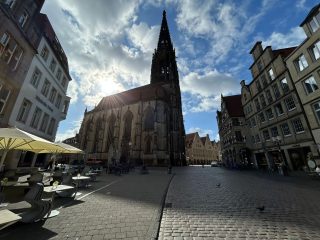
Promenade, Münster
City Walls in Münster

The Promenade in Münster is a green ribbon encircling the historic city centre, creating a calm, tree-lined contrast to the busy streets of Prinzipalmarkt and Salzstraße. Following the former line of the city walls, this four-kilometre loop is one of the best places to visit in Münster if you want to understand the city's layout while enjoying fresh air, shade, and changing views of church towers and gabled roofs. Benches, broad paths, and leafy canopies make it as inviting for a slow stroll as for a brisk bike ride.
As you move along the Promenade, you are constantly reminded that this quiet green belt was once a defensive ring of ramparts and bastions. Occasional plaques, surviving structures like the Buddenturm, and glimpses through the trees toward the Old Town help you imagine the city's medieval and early modern fortifications. At the same time, joggers, cyclists, and families using the path today show how Münster has turned its former walls into a shared urban space, making the Promenade a highlight of any walking tour of Münster.
History and Significance of the Promenade
The Promenade traces the footprint of Münster's former city fortifications, which were largely dismantled in the late 18th century as the military need for walls declined and new ideas about urban planning took hold. Where there were once ramparts, moats, and solid stone structures, the city developed a ring of paths and green spaces that softened the boundary between the historic core and newer districts. Over time, trees were planted along the route, creating the shady avenue you see today.
Despite the transformation from fortress to park-like walkway, traces of the old defences remain. Surviving elements such as bastions, gates, and towers like the Buddenturm punctuate the route, acting as anchor points in the city's story. Information boards along the Promenade explain how these fragments fit into the former wall system and how they were used in different periods, from medieval conflict through early modern gunpowder warfare.
The Promenade is also significant as a piece of urban design. By reserving this ring for pedestrians and cyclists and limiting motor traffic, Münster has created a car-free artery that makes crossing the city enjoyable rather than stressful. It links residential neighbourhoods, university buildings, parks, and the Old Town, embodying the city's reputation as a cycling capital and a place that balances heritage with liveable public spaces.
Things to See and Do in the Promenade
Walking or cycling the full loop of the Promenade is a rewarding way to get a feel for Münster's geography. You will pass through stretches that feel almost like a forest path, then suddenly emerge to find a view of cathedral towers, church spires, or the roofs of the Old Town. The route offers countless vantage points where you can pause, look back toward the historic core, and appreciate how compact and coherent the city centre really is.
Along the way, look out for historic features that break through the greenery. The Buddenturm, with its cylindrical form and neo-Gothic crown, is one of the most striking reminders of the old walls. Elsewhere, you may spot remnants of bastions, former gate locations, or plaques explaining what once stood at particular sections of the ring. These layers make the Promenade more than just a park path; it is a walking timeline of Münster's defensive past.
The Promenade is also very much part of everyday life in Münster. Locals use it for commuting by bike, jogging routes, dog walks, and relaxed evening strolls. Depending on the season, you might encounter blossoming trees, autumn colours, or the quiet hush of snow. You can easily combine sections of the Promenade with detours into the Old Town, the university quarter, or toward the Aasee, tailoring your route to your interests and energy levels.
How to Get to the Promenade
Because the Promenade completely encircles the Old Town, it is easy to access from many different points in central Münster. Most international visitors arrive via Münster Osnabrück International Airport, then continue by bus, shuttle, or taxi into the city centre in around 30 minutes. For the best deals and a seamless booking experience, check out these flights to Münster on Booking.com.
If you are travelling by train, Münster (Westf) Hauptbahnhof is well connected to regional and long-distance routes.Train schedules and bookings can be found on Omio. From the station, it is only a short walk or cycle to reach the Promenade: simply head toward the Old Town, and you will soon cross the tree-lined ring that marks the former city walls. Several local bus routes also stop close to different sections of the path.
Arriving by car, follow signs for the Innenstadt and park in one of the public car parks near the edge of the historic centre; from there, you can reach the Promenade on foot in just a few minutes.If you are looking to rent a car in Germany I recommend having a look at Discover Cars, first, as they compare prices and review multiple car rental agencies for you. Once you are on the path, you can choose to walk a small section between two gates or landmarks, or commit to a full loop around the city centre.
Practical Tips on Visiting the Promenade
- Suggested tips: Consider renting a bike to ride the full loop; it is a comfortable distance and gives you a great overview of Münster’s structure in under an hour.
- Best time to visit: Early mornings and late afternoons are especially pleasant, with softer light and fewer people, though the Promenade is enjoyable at almost any time of day.
- Entrance fee: Free; the Promenade is a public path open to everyone.
- Opening hours: Accessible at all times, though it is safest and most pleasant in daylight or early evening.
- How long to spend: A complete loop on foot can take 60-90 minutes at a relaxed pace; shorter segments of 20-30 minutes work well if you are linking specific sights.
- Accessibility: The paths are generally wide and well-surfaced, suitable for wheelchairs, strollers, and bikes, though occasional slopes and surface changes may occur near older structures.
- Facilities: Benches are scattered along the route, and cafés, toilets, and shops are easily reached by ducking into the Old Town or nearby neighbourhoods at various points.
- Photography tip: Use openings in the trees to frame church towers, gates, or the Buddenturm; seasonal changes in foliage can give very different moods to similar views.
- Guided tours: Some walking and cycling tours incorporate sections of the Promenade, explaining how the former fortifications shaped the city's development.
- Nearby food options: Leave the path briefly to explore side streets leading into the centre, where you will find bakeries, ice cream parlours, and restaurants ideal for a break.
Where to Stay close to the Promenade
Staying near the Promenade gives you the best of both worlds: quick access to the green belt for walks or bike rides, and an easy stroll into the Old Town for sightseeing. A convenient option is Stadthotel Münster, which places you close to both the historic core and the southern stretches of the Promenade. If you like a more contemporary, design-driven base, Factory Hotel sits not far from the northern sections of the ring and offers good connections by bike or bus into the centre. For those arriving by train who still want quick access to the Promenade and city sights, Hotel Kaiserhof provides a comfortable stay within walking distance of both the station and the ring path.
Is the Promenade Worth Visiting?
The Promenade is absolutely worth visiting, particularly if you enjoy seeing how cities reuse old defensive lines as living public spaces. It offers a gentle, car-free way to circle Münster's historic core, linking landmarks like the Buddenturm with leafy sections where you might forget how close you are to the city centre. For walkers, cyclists, and anyone who appreciates urban planning that respects both history and greenery, the Promenade is one of the things to do in Münster that ties the whole city together.
What Other Travellers Say...

Stadthafen on Hafenpl., Münster is a modern waterfront quarter with a path along the water and a line of bars, cafés and restaurants—many with terraces—where visitors come to stroll, brunch, dine or enjoy drinks, especially at sunset and in the evening; it's lively after dark with plenty of dining choices (and a nearby cinema), while daytime can be quieter, offering a pleasant, relaxed atmosphere for walking.


FAQs for Visiting Promenade
Nearby Attractions to the Promenade
- Buddenturm (Pulverturm): The oldest surviving tower of Münster's medieval fortifications, standing right by the Promenade and showcasing the city's defensive past.
- St. Paulus Dom (Münster Cathedral): The city's Romanesque-Gothic cathedral on Domplatz, just a short walk from several access points along the Promenade.
- Prinzipalmarkt: Münster's historic arcade-lined main street with gabled houses, shops, and cafés at the heart of the Old Town.
- Fürstbischöfliches Schloss Münster and Schlossgarten: The former prince-bishop's palace and its gardens, connected to the Promenade and ideal for extending your walk.
- Aasee: A large urban lake near the southern stretches of the Promenade, perfect for continuing your route with waterside paths, boat rentals, and parkland.
The Promenade appears in our Complete Guide to Visiting Münster!

Moira & Andy
Hey! We're Moira & Andy. From hiking the Camino to trips around Europe in Bert our campervan — we've been traveling together since retirement in 2020!
This website uses affiliate links which may earn a commission at no additional cost to you!
Planning Your Visit
Accessible at all times, though it is safest and most pleasant in daylight or early evening.
Free; the Promenade is a public path open to everyone.
Nearby Attractions
- Pablo Picasso Museum (0.4) km
Museum - City Hall of Münster (0.6) km
Town Hall - Westphalian State Museum of Art and Cultural History (0.6) km
Museum - Erbdrostenhof (0.6) km
Historic Building - Stadtmuseum Münster (0.6) km
Museum - Prinzipalmarkt (0.7) km
Square - Lambertikirche (0.8) km
Church - Münster Cathedral (0.8) km
Cathedral - Krameramtshaus (0.8) km
Historic Building - Kiepenkerl Denkmal (0.9) km
Statue